PART 2: HOA “Enforcement” Demolished the House on My Newly Purchased Land—Then Sued Me for $175,000
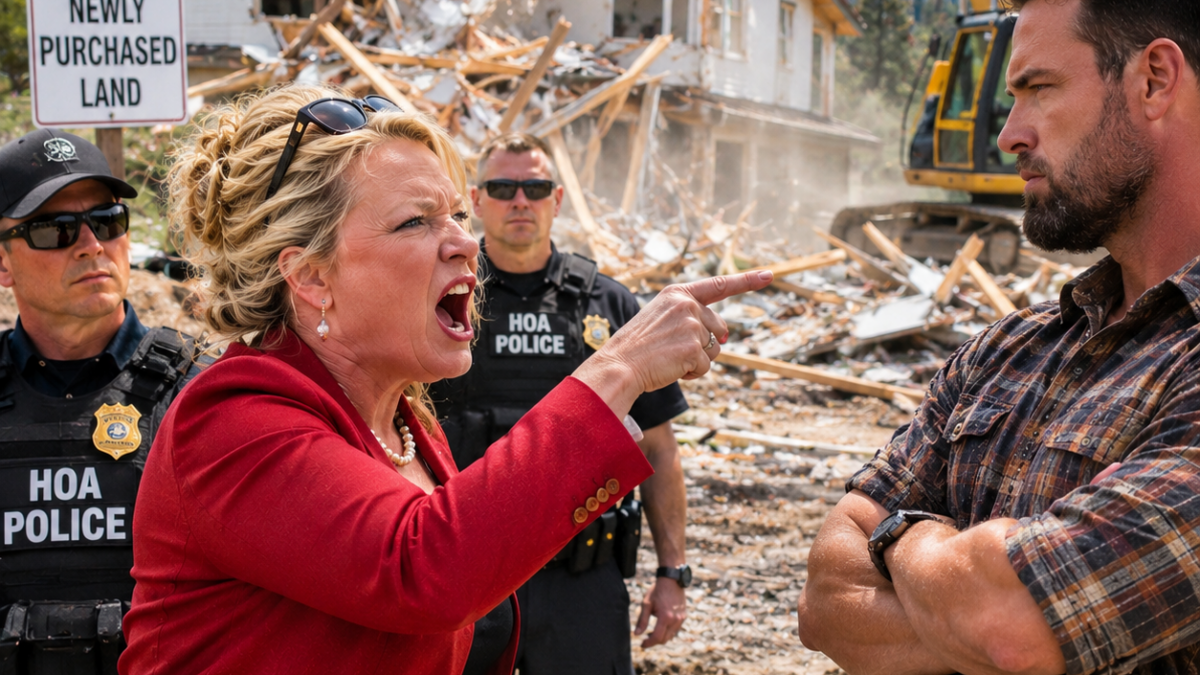
PART 2
The older man didn’t cross onto my land.
That detail stayed with me.
He stood with one boot on the shoulder of the gravel road and the other planted just inside the weeds as if an invisible line existed between us.
He was probably seventy. Flannel shirt. Work boots. Sun-darkened skin.
Victoria glanced in his direction.
He immediately lowered his eyes.
That told me almost as much as his words.
“What do you mean, another one?” I asked.
He watched the HOA trucks pull away before answering.
“Third structure I know about.”
“In this neighborhood?”
“Near it.”
He pointed west.
“Storage building over that ridge about two years ago. Small guest cottage before that.”
“Were they inside the HOA?”
He gave me a tired look.
“That’s the problem.”
“Meaning?”
“Depends who you ask.”
I walked closer.
“Who are you?”
“Sam Keller.”
“You live around here?”
“Thirty-seven years.”
I looked back at the rubble.
“Did you see them demolish this?”
“Most of it.”
“When did they start?”
“Yesterday morning.”
“Yesterday?”
He nodded.
“Had an excavator out here before eight.”
“Did anyone from the county come?”
“Not that I saw.”
“Sheriff?”
“No.”
“Building inspector?”
“No.”
“Court officer?”
“No.”
“Just them?”
“Just them.”
My jaw tightened.
“Why didn’t you call me?”
Sam looked uncomfortable.
“Didn’t have your number.”
“Police?”
His eyes went toward the road where Victoria had disappeared.
“You haven’t lived out here yet.”
“That’s true.”
“You don’t understand how things work.”
“Then explain it.”
He took off his cap, rubbed the brim, then put it back on.
“People around here learned that if Victoria says something is official, arguing gets expensive.”
“That doesn’t make it official.”
“No.”
“Then why does everybody act like it does?”
Sam looked directly at me for the first time.
“Because the last people who fought her lost more than the ones who paid.”
That sentence stayed with me.
I asked him about the other properties.
He shook his head.
“Don’t know everything.”
“But you know names?”
“One.”
“Who?”
“Castillo.”
“First name?”
“Steven, I think.”
“What happened?”
“Owned a small lot adjacent to Meadowbrook. Landscaping business. Put up a storage building.”
“And?”
“Victoria said it violated the community appearance.”
“Was his lot part of the HOA?”
Sam gave me the same look again.
“That’s what he argued.”
“What happened to him?”
“Sold.”
“Why?”
Sam shrugged.
“Lawsuits. Fees. Threats.”
He turned to leave.
“Mr. Brooks?”
“Yeah?”
“If you’ve got money tied up here, take whatever you can get and walk.”
I stared at the foundation.
Gerald Morrison had died before finishing the house.
His family had sold it because keeping an unfinished rural property made no sense for them.
I had bought it because I wanted something simple.
Land.
A house.
Quiet.
I had spent years in a city apartment listening to traffic through windows that never completely shut out the noise.
The first time I walked Gerald’s property, I had stood beneath two old oaks and imagined coffee there before sunrise.
Not a mansion.
Not an investment empire.
A home.
Now the roof Gerald had paid for was splintered in a pile.
“I’m not walking,” I said.
Sam’s shoulders dropped.
“That’s what Castillo said.”
He left.
I spent another hour photographing everything.
Wide shots.
Close shots.
Tracks from heavy machinery.
The foundation.
Broken framing.
Pieces of Gerald’s roof.
The uniforms.
Vehicle plates I had captured before Victoria left.
A torn magnetic sign one of the trucks had dropped.
**MEADOWBROOK HEIGHTS HOA ENFORCEMENT UNIT**
I put it in a plastic bag.
Then I walked around the foundation.
The concrete looked untouched.
Whoever demolished the structure had intentionally stopped at the slab.
That suggested they wanted removal, not destruction of the land itself.
I found a permit card beneath a collapsed section of plywood.
Gerald’s name was still visible.
Building permit number.
Inspection initials.
I photographed that too.
Then I sat on the hood of my car and pulled up my closing documents.
The title commitment.
Legal description.
Parcel map.
Nothing mentioning Meadowbrook Heights.
No HOA disclosure.
No covenant.
No mandatory association fee.
No architectural restrictions.
When you buy property, you can miss things.
Title companies can miss things.
Clerks can file documents incorrectly.
I knew that.
So I resisted the easiest conclusion.
Maybe Meadowbrook had some recorded easement I had not seen.
Maybe Gerald had signed something personally.
Maybe the property had once belonged to a larger parcel and the covenant survived a split.
Possible.
But none of those possibilities explained why Victoria couldn’t show me a court order.
I called my title company.
The closing agent, Karen Wells, answered on the second ring.
“Daniel? Everything okay?”
“No.”
I sent her one photograph.
She was quiet for five seconds.
“What happened?”
“An HOA demolished the house.”
“What HOA?”
“Meadowbrook Heights.”
Another silence.
“Your property isn’t in Meadowbrook Heights.”
There it was.
Not proof.
But confirmation that I wasn’t crazy.
“You’re sure?”
“I’m looking at the title commitment now.”
“Could there be covenants you missed?”
“If there were recorded restrictions affecting title, they should appear here.”
“Should?”
“Daniel, let me pull the full search again.”
“Do it.”
“Are you safe?”
I looked at the empty foundation.
“I’m fine.”
“Call the sheriff.”
“Soon.”
“Why soon?”
“Because first I want certified records.”
Karen understood.
“I’ll email everything we have.”
That night I slept in a cheap motel twelve miles away.
I use the word slept generously.
Every time I closed my eyes, I saw the house disappear again.
Not the demolition itself.
I hadn’t witnessed that.
My imagination supplied it.
Excavator bucket tearing into Gerald’s framed walls.
Roof collapsing.
Workers dragging lumber into piles.
Victoria standing with a clipboard.
The image made my hands clench.
At 2:10 in the morning, I opened my phone and looked at the photos I had taken the week after closing.
Gerald’s house still standing.
Roof on.
Windows not yet installed.
A framed doorway opening toward the woods.
I had taken one photo from inside what would have been the living room.
Sunlight came through the wall studs.
I remembered standing there thinking:
Mine.
Not in a greedy way.
In a relieved way.
I had spent most of my adult life making decisions based on practicality.
Rent here because it’s closer to work.
Buy the condo because the mortgage made sense.
Sell when the market improved.
This property had been the first choice in years that wasn’t optimized.
I just liked it.
Now people I had never met had destroyed part of it and told me they had the right.
At 6:30, I gave up on sleep.
At 7:45, I parked outside the county recorder’s office.
The doors opened at eight.
I was first inside.
The clerk who helped me was named Marlene.
Reading glasses hanging from a chain.
Patient voice.
I gave her the parcel number.
“I need everything.”
She smiled slightly.
“That’s a large category.”
“Start with deed history, subdivision plats, recorded covenants, restrictions, easements, liens, and anything connected to Meadowbrook Heights.”
Her smile disappeared.
“Dispute?”
“Maybe.”
She typed.
Then disappeared into the back.
Fifteen minutes later, she returned carrying documents.
My deed was first.
Recorded properly.
No problem.
Prior deed to Gerald Morrison.
Then the deed before that.
Chain looked clean.
She opened a digital map.
“Meadowbrook Heights is here.”
Forty-seven residential lots.
Central road.
Common area.
Recorded twelve years earlier.
“And my parcel?”
She zoomed east.
A rectangle appeared beyond the HOA boundary.
My parcel.
There was a narrow strip of county-owned land between the subdivision edge and my property line.
I leaned closer.
“That’s it?”
“Yes.”
“Are you sure?”
She turned the screen slightly.
“This is the recorded plat.”
“Is there an amended plat?”
She searched.
“No.”
“Annexation?”
“No.”
“Recorded covenant expansion?”
“No.”
“Service agreement?”
“Not affecting your parcel.”
I felt the anger in my chest change shape.
“Print this.”
“The plat?”
“Certified.”
She studied me.
“You may want the legal description too.”
“Everything.”
Marlene printed the boundary map and stamped it.
Then I asked:
“Any court orders concerning demolition on this parcel?”
She searched.
“No.”
“Any liens from Meadowbrook Heights?”
“No.”
“Any enforcement judgment?”
“No.”
“Architectural restrictions?”
“None recorded.”
“Mandatory HOA membership?”
“No.”
I looked at the certified boundary map.
My land sat outside Meadowbrook.
Not slightly inside.
Not disputed by a survey overlap.
Outside.
The HOA had no recorded jurisdiction.
Victoria Marsh had admitted no court order existed.
And yesterday I had stood in rubble while she told me the demolition was lawful.
I paid for the certified copies.
My next stop was the building department.
The permit clerk pulled Gerald’s file.
“Still active,” he said.
“Even though he died?”
“The permit had time remaining. New owner can transfer or renew as required.”
“Any code violations?”
He scrolled.
“No.”
“Stop-work order?”
“No.”
“Failed inspections?”
“Last inspection passed framing.”
“Any demolition order?”
He looked at me.
“Why are you asking?”
I showed him the photograph.
His eyebrows rose.
“Who did that?”
“Meadowbrook Heights HOA.”
He stared.
“Your parcel isn’t in Meadowbrook Heights.”
“You know that?”
“We have subdivision maps.”
“Could the HOA authorize demolition anyway?”
“No.”
“Could you?”
“Not like this. There’s process.”
“Did your office receive complaints?”
He searched again.
“Nothing.”
“Can I get that in writing?”
He hesitated.
“I can give you certified permit history and inspection records. For a statement about absence of complaints, you may need a records request.”
“Do it.”
He printed what he could.
Then I called county code enforcement.
A supervisor named Jenkins spoke with me.
“If a structure violated code,” I asked, “who can authorize demolition?”
“That depends on circumstances.”
“Can an HOA do it?”
“No.”
“Even if the property is inside their association?”
“They can pursue private remedies under covenants. Actual demolition of a private structure is not something an HOA enforcement team just conducts because it dislikes siding.”
“What if they claim their CC&Rs give them demolition authority?”
“Talk to an attorney.”
“I will. But county code didn’t authorize this.”
“Correct.”
“Could they represent themselves as code enforcement?”
“Not county code enforcement.”
“They wore uniforms saying HOA enforcement.”
“That by itself is different.”
“They blocked the property and said they conducted lawful enforcement.”
Jenkins became more careful.
“You should speak with law enforcement about specific conduct.”
I called the sheriff’s non-emergency line.
The deputy who took the report did not promise arrests.
Good.
That made me trust him more.
He asked what happened.
I gave him facts.
Three people.
Uniforms.
HOA patches.
One apparent holstered object.
Demolished private structure.
Claims of enforcement authority.
No court order.
County map showing property outside HOA.
He gave me a case number.
“Preserve everything,” he said.
“I am.”
“Don’t confront anyone alone if weapons are involved.”
“Understood.”
“And don’t remove anything from the HOA property.”
“I have no intention of going onto HOA property without reason.”
“Good.”
When I hung up, I had three separate government records supporting the same basic fact.
The land was mine.
The house had been permitted.
The HOA had no jurisdiction.
I expected that to be the beginning of the end.
It wasn’t.
Four days later, the HOA mailed me a bill.
Certified.
Thick envelope.
Official logo.
**NOTICE OF VIOLATION AND ASSESSMENT OF PENALTIES**
Unauthorized construction.
Failure to submit architectural application.
Unpaid assessment fees.
Obstruction of enforcement personnel.
Administrative costs.
Demolition-related compliance expense.
Total:
**$47,500.**
I actually laughed.
Not because it was funny.
Because there are moments when absurdity becomes too large for anger.
They had demolished a structure worth roughly $85,000.
Then billed me $47,500 for forcing them to demolish it.
At the bottom:
**Failure to remit payment within thirty days may result in lien, collection action, and additional legal remedies.**
Signed:
**Victoria Marsh
Chief Compliance Officer**
I laid the notice beside the county map.
Then I made a decision.
I was going to the HOA meeting.
Not to yell.
Not to threaten.
Not to wave documents dramatically.
I wanted them talking.
Meadowbrook Heights held monthly meetings on the second Thursday.
The community center sat about two miles from my parcel.
Low brick building.
Small parking lot.
Twenty residents attended that evening.
At the front were five board members.
Victoria.
Two men I didn’t know.
A nervous-looking woman whose placard read **GRACE HARRIS — SECRETARY**.
And a man in a rumpled suit.
**HAROLD PENCE — LEGAL COUNSEL**
Before going inside, I confirmed my phone was recording audio.
The state permitted recording where one participating party consented.
I was participating.
Victoria opened the meeting at seven.
Budget update.
Landscaping.
Pool maintenance.
Then:
“New business. Violation disputes.”
She looked directly at me.
“Mr. Brooks.”
I stood.
“May I approach?”
She gestured.
I placed the certified county plat on the table.
“My parcel is here.”
Victoria didn’t look.
I pointed.
“The recorded Meadowbrook boundary ends here.”
Nothing.
“My property is outside it.”
She folded her hands.
“I’m aware.”
There are sentences that become much more valuable after they are recorded.
That was one.
I kept my face neutral.
“You’re aware my property is outside the HOA boundary?”
“Yes.”
Several residents looked up.
Victoria continued.
“But your parcel falls within Meadowbrook’s community service area and visual corridor.”
“Where is that authority recorded?”
“The board adopted expanded governance protocols.”
“Recorded where?”
“Mr. Brooks, community governance evolves.”
“Land boundaries don’t evolve because a board votes.”
Harold Pence leaned forward.
“The architectural committee maintains jurisdiction over structures materially affecting Meadowbrook’s visual corridor.”
“Under what law?”
He blinked.
“Excuse me?”
“Please cite the statute or case establishing HOA architectural jurisdiction over neighboring non-member property.”
Harold shuffled papers.
“The doctrine is well established.”
“Name one case.”
His face reddened.
“This is not a courtroom.”
“You’re listed as legal counsel.”
“Yes.”
“Then give me your bar number.”
The room went silent.
Harold stared at me.
“That information is irrelevant.”
“It would help me verify the legal advice threatening my property.”
Victoria cut in.
“You are not here to interrogate counsel.”
“No.”
I picked up the county map.
“I came to dispute $47,500 in penalties issued by an HOA that just admitted my land is outside its recorded boundary.”
Her eyes hardened.
“The assessment stands.”
“On what authority?”
“Expanded governance.”
“Show me.”
“You’ll receive further communication.”
“Do you have a recorded covenant binding my parcel?”
No answer.
“Court judgment?”
Nothing.
“Signed agreement from Gerald Morrison?”
Nothing.
“Annexation?”
Nothing.
Victoria’s expression remained calm.
But Grace Harris looked sick.
Finally Victoria said:
“You have thirty days.”
“And if I don’t pay?”
“We will pursue a lien and legal action.”
“Against land you admit isn’t in your subdivision.”
“Against property within our service area.”
“What happens if I still refuse?”
Her smile returned.
“Then we refer the matter to our enforcement partners.”
“What does that mean?”
“You’ll find out.”
No resident reacted.
That frightened me more than shouting would have.
Twenty people sat in silence as a woman threatened a non-member property owner during a recorded meeting.
Not because they agreed.
Because they had heard this tone before.
I thanked the board.
Then sat down.
The rest of the meeting lasted ten minutes.
When it ended, I walked to my car.
Footsteps came behind me.
“Mr. Brooks.”
I turned.
Grace Harris.
She glanced toward the building.
“You need to be careful.”
“I’ve heard that.”
“I mean it.”
“What are you afraid of?”
She swallowed.
“Victoria.”
“Why?”
“She has people.”
“What people?”
“County contacts. Contractors. Attorneys.”
“Harold Pence?”
Grace looked away.
“You should check him.”
“I intend to.”
She lowered her voice.
“There was another man.”
“Castillo?”
Her eyes widened.
“You know?”
“I heard the name.”
“Steven Castillo.”
“What happened?”
Grace’s hands trembled.
“He challenged her.”
“How?”
“His property was outside Meadowbrook. Like yours.”
“Then what?”
“They demolished a structure.”
Exactly Sam’s story.
“He sued?”
“Tried.”
“And?”
“They sued him first.”
“How much?”
“I don’t remember.”
“Did he lose?”
Grace shook her head.
“He settled.”
“Why?”
“Because they kept making everything worse.”
“Where is he?”
“I don’t know.”
She stepped backward.
“Find him.”
“Grace.”
She stopped.
“Why are you telling me this?”
Her eyes filled with something close to shame.
“Because I should have told him too.”
Then she left.
Three days later, I found Steven Castillo.
Property management company forty miles away.
Maintenance supervisor.
When I called and explained who I was, he said nothing for so long I checked whether the call had disconnected.
Finally:
“They got you too.”
“Looks that way.”
“What did they destroy?”
“Seventy percent of a house.”
He exhaled.
“Jesus.”
“Can we meet?”
Another pause.
“I signed an NDA.”
“I’m not asking you to violate it.”
“Yes, you are.”
“I’m asking you to talk to a lawyer eventually.”
“That’s the same thing.”
“Then meet me and say nothing you don’t want to say.”
He laughed without humor.
“You sound like I used to.”
“Before?”
“Before Victoria.”
We scheduled a diner meeting.
But the morning before it, I returned to my property with a contractor named Bill Patterson.
I wanted an estimate.
Could the foundation be saved?
Could Gerald’s design be rebuilt?
Could any material be recovered?
As we turned onto the road, I saw four vehicles blocking the entrance.
Three trucks with magnetic HOA enforcement signs.
Victoria’s silver SUV.
Eight people.
Bill looked at me.
“That normal?”
“No.”
Victoria walked toward us.
“Mr. Brooks.”
“Victoria.”
“This property is under active enforcement restriction.”
“It’s my property.”
“Section 12.4 authorizes access control during unresolved compliance proceedings.”
“Of what document?”
“Our enforcement code.”
“I’m not an HOA member.”
“You are within our service area.”
Bill whispered, “What the hell is happening?”
Victoria pointed toward him.
“Your contractor must leave.”
“He’s here at my invitation.”
“If he enters, he will be removed.”
One of the uniformed men stepped forward.
Russell Reyes.
His right hand rested near his belt.
This time the object was clearly visible.
A handgun.
I looked at him.
“Are you armed?”
No answer.
“Russell.”
He stared.
Victoria said:
“Enforcement officers are authorized to carry protective equipment.”
I pulled out my phone.
“By whom?”
“Meadowbrook.”
“Does Russell have a state security license?”
Her expression changed slightly.
“That’s irrelevant.”
“Concealed carry permit?”
Russell shifted.
I dialed 911.
Victoria’s face hardened.
“What are you doing?”
“Reporting armed individuals blocking access to private property.”
“This is a civil matter.”
“Great. The sheriff can tell us.”
“You’re wasting police resources.”
“Then leave before they arrive.”
Nobody moved.
Neighbors began appearing.
First one at the end of a driveway.
Then another.
Phones came out.
Victoria noticed.
Her posture changed.
She wasn’t talking to me anymore.
She was performing for witnesses.
“Mr. Brooks is attempting to interfere with a lawful enforcement action.”
I held up my deed.
“Recorded owner.”
Then the county map.
“Outside HOA.”
Then I stepped back.
No yelling.
No argument.
The sheriff’s cruiser arrived twelve minutes later.
Then a second.
A male deputy approached first.
“Who called?”
“I did.”
I raised my hand.
Victoria immediately stepped forward.
“I’m Victoria Marsh, chief compliance officer for Meadowbrook Heights. We have an active non-compliance case—”
The deputy held up one hand.
“I’ll talk to everybody.”
That single sentence annoyed her.
He looked at the trucks.
“Who owns these?”
“Association contractors.”
“These uniforms?”
“HOA enforcement.”
He examined Victoria’s laminated credential.
Then looked at her.
“This is an HOA identification card.”
“Yes.”
“It is not law-enforcement authority.”
“We never claimed to be county law enforcement.”
“You are blocking private property.”
“Under association authority.”
“Do you have a court order?”
“No court order is required under our governing documents.”
The deputy looked at me.
“Your proof of ownership?”
I handed him the deed and certified county map.
He examined them.
Then radioed something.
The female deputy spoke with Bill.
The male deputy turned toward Russell.
“Sir, are you carrying a firearm?”
Russell’s hand moved away from his belt.
“Yes.”
“Do you have identification?”
Russell handed him something.
The deputy read it.
Then:
“Do you have a permit required under state law for this type of carry?”
Russell hesitated.
That was enough to change the deputy’s tone.
“Keep your hands away from the weapon.”
Russell went pale.
Victoria stepped in.
“He is security.”
The deputy looked at her.
“Is he licensed security?”
“He works for enforcement.”
“That isn’t what I asked.”
Victoria stopped.
The deputy pointed toward the road.
“Everyone not invited onto this property by Mr. Brooks needs to leave.”
“This is outrageous.”
“It is a civil dispute until people with guns start blocking access.”
Victoria’s face went rigid.
“You do not understand our authority.”
“Ma’am, if you have authority, show it to a judge.”
He pointed again.
“Not here.”
Nobody argued after that.
The trucks left.
Russell went last.
The deputy watched him the entire way.
Before leaving, the deputy looked at me.
“If they return armed and block access, call us.”
“I will.”
“Don’t escalate personally.”
“I won’t.”
Victoria rolled down her SUV window as she pulled away.
“This isn’t over.”
The deputy heard her.
He shook his head.
Bill looked at me.
“I charge extra for this kind of estimate.”
That made me laugh for the first time in days.
We inspected the foundation.
Good news.
The slab was sound.
Footings had not been compromised.
Utilities needed rechecking.
But rebuilding was possible.
“How much?”
Bill gave me a preliminary number.
I stared at it.
The financial pain became real in a different way.
I had bought the land and partial structure because I could afford to finish Gerald’s house.
I had not budgeted to rebuild seventy percent of it from scratch while paying lawyers.
Bill saw my expression.
“We can phase it.”
“I need the legal mess cleared first.”
“Probably.”
He looked at the rubble.
“Whoever did this knew what they were doing.”
“What do you mean?”
“They stripped the structure without breaking the foundation.”
“So?”
“So they weren’t angry.”
I looked at him.
“They were methodical.”
That was worse.
Three days later, a process server came to my temporary apartment.
“Daniel Brooks?”
“Yes.”
“You’ve been served.”
The envelope was thick.
**MEADOWBROOK HEIGHTS HOMEOWNERS ASSOCIATION v. DANIEL BROOKS**
Damages sought:
$175,000.
I read the claims at my kitchen table.
$50,000 for unauthorized construction and “community aesthetic harm.”
$75,000 for interference with lawful enforcement.
$50,000 for emotional distress allegedly suffered by HOA personnel.
I sat there for several seconds.
They had destroyed my house.
Now they were suing me for the trauma of being questioned about it.
Attorney of record:
**Harold Pence.**
That name bothered me.
I opened the state bar website.
Typed it.
Found him.
Then stared.
**License status: Suspended.**
Effective eighteen months earlier.
Reason:
Violations involving client trust accounts and professional misconduct.
I refreshed the page.
Same result.
Harold Pence was not authorized to practice law.
Yet his signature appeared on a fresh civil complaint demanding $175,000.
I called the clerk’s office.
I didn’t accuse anyone.
I asked whether the filing listed Harold Pence as counsel.
Yes.
I asked whether courts independently verified active bar status at intake.
The clerk would not discuss specifics.
Fair.
I printed the bar record.
Then I went to meet Steven Castillo.
He was already at the diner.
Late fifties.
Calloused hands.
Coffee untouched.
He looked like a man who expected bad news.
I sat.
“Thank you for coming.”
“Show me the lawsuit.”
I handed him a copy.
He read the amount.
Then laughed bitterly.
“They increased the price.”
“What was yours?”
“Ninety thousand.”
He pushed the complaint back.
“What did you build?”
“Storage shed. Six hundred square feet. Landscaping equipment.”
“Permit?”
“Yes.”
“Property inside Meadowbrook?”
“No.”
“Did Victoria know?”
“She knew exactly where the boundary was.”
“What happened?”
“They sent notices.”
“Like mine?”
“Probably.”
He pulled out his phone.
Old photographs.
Violation signs.
A demolished metal building.
“They came while I was working.”
I felt something in my chest tighten.
“Who demolished it?”
“Victoria’s enforcement people.”
“Russell Reyes?”
Steven looked up.
“You met Russell.”
“He was armed.”
Steven’s expression darkened.
“He wasn’t back then.”
“What happened after demolition?”
“I threatened to sue.”
“So they sued you.”
“Before I could find a lawyer.”
“For what?”
“Unauthorized structure. Nuisance. Interference. Same garbage.”
“Why settle?”
He stared into his coffee.
“I had payroll.”
That answer was simple.
“My landscaping business had six employees. Attorney wanted a twenty-thousand-dollar retainer to start. HOA offered to settle if I paid thirty-five thousand and signed an NDA.”
“You paid them after they destroyed your building?”
“I paid because every week I fought them cost me more.”
He rubbed his hands together.
“My wife wanted me to stop. Clients started hearing I was in legal trouble. Victoria filed complaints about my trailers. County inspectors started showing up.”
“Legitimate complaints?”
“Most went nowhere.”
“But you had to respond.”
“Exactly.”
Exhaustion.
Again.
Steven pulled a folder from beneath the table.
“I kept everything.”
“Why?”
“Because throwing it away would mean admitting they were right.”
Inside:
Photographs.
County permit.
Boundary map.
HOA notices.
Settlement agreement.
Canceled check for $35,000 payable to Meadowbrook Heights.
Confidentiality clause.
I looked at him.
“You know this NDA may still matter.”
“I know.”
“Don’t give me anything until a lawyer reviews it.”
“I don’t care.”
“I do.”
That surprised him.
“Why?”
“Because I’m not going to fight illegal behavior by asking you to violate a legal agreement unless counsel says you can.”
Steven sat back.
“You really think the system is going to save you?”
“No.”
“Then what?”
“I think evidence gives the system a chance.”
He looked at me for a long moment.
“That’s what I believed two years ago.”
“What changed?”
“I ran out of money.”
I nodded.
“Then I need a lawyer before I run out too.”
The next morning, I called Olivia Carter.
Property-rights litigation.
HOA disputes.
Eight years in the state attorney general’s office before private practice.
Her assistant said she was booked for ten days.
I explained one sentence:
“An HOA demolished a permitted house on property outside its subdivision, then sued me for $175,000 through a lawyer whose license appears suspended.”
I got an appointment that afternoon.
Olivia was in her forties.
No dramatic courtroom persona.
Gray suit.
Hair pulled back.
Yellow legal pad.
She listened without interrupting.
I laid out the documents in order.
Deed.
Title commitment.
Certified subdivision map.
Permit record.
Photographs before demolition.
Photographs after.
Video of Victoria.
HOA $47,500 notice.
Audio from the board meeting.
Sheriff incident.
Lawsuit.
Harold Pence bar status.
Steven’s name, but not his confidential settlement documents yet.
Olivia looked at the table.
Then at me.
“Do you understand how unusual this is?”
“I assumed.”
“No.”
She tapped the lawsuit.
“This is beyond aggressive HOA conduct.”
“What do you call it?”
“Potentially several things.”
She started writing.
“First, your property is outside the association.”
“Yes.”
“Second, they admitted that during a recorded meeting.”
“Yes.”
“Third, they physically destroyed a permitted structure.”
“Yes.”
“Fourth, they later sent armed private personnel to exclude you from your own land.”
“Yes.”
“Fifth, counsel signing their complaint appears suspended.”
“Yes.”
“And they’re suing you for emotional distress.”
“That part is my favorite.”
Olivia almost smiled.
“Don’t joke about it in court.”
“I won’t.”
She looked back at the documents.
“Daniel, this could become criminal.”
“I’ve already filed a sheriff report.”
“Good.”
“What next?”
“We answer the lawsuit.”
“Counterclaim?”
“Eventually. First we force them to establish jurisdiction.”
“They don’t have it.”
“I know.”
“So do they.”
Olivia looked at me.
“That makes me curious what they’ll do when ordered to prove it.”
She filed a motion to dismiss.
Simple.
No dramatic accusations.
No claims about conspiracy.
Just title and jurisdiction.
My parcel sat outside Meadowbrook Heights.
The HOA had no covenant authority over it.
Therefore the HOA lacked a contractual basis to impose architectural rules, assessments, fines, or enforcement remedies.
Attached:
Certified county plat.
Deed.
Original recorded CC&Rs.
Building permit.
Olivia explained the strategy.
“We’re giving them the opportunity to tell the truth.”
“And if they don’t?”
“They’ll create our next exhibit.”
The court gave them twenty-one days to respond.
On day nineteen, they filed.
Olivia called that evening.
“Come in tomorrow.”
“What happened?”
“They produced an amendment.”
“To the CC&Rs?”
“Yes.”
“Recorded?”
“No.”
“Then what is it?”
“A problem.”
At eight the next morning, the document sat on her desk.
**AMENDED COVENANTS, CONDITIONS AND RESTRICTIONS**
Supposed adoption date:
March 15, 2018.
It created a “community service area” and “visual corridor.”
My parcel number was included.
I stared at it.
“That’s Victoria’s argument.”
“Yes.”
“Why didn’t it appear in the county records?”
“Good question.”
She placed the original CC&Rs beside it.
Then another report.
“I had a document examiner look at the filing.”
“That fast?”
“I don’t sleep when opposing counsel hands me suspicious evidence.”
She pointed to the notary block.
“This notary commission number wasn’t issued until September 2018.”
“Six months later.”
“Yes.”
“So impossible.”
“For a document notarized in March, yes.”
Next:
The header font.
Calibri Light.
According to the expert’s analysis and metadata characteristics available from the court-submitted file, the formatting was inconsistent with the claimed creation date.
Then parcel numbering.
The document used a county parcel format adopted years after 2018.
I stared.
“They made this recently.”
“That is the concern.”
“And backdated it.”
“That appears likely.”
“Harold filed this?”
“Yes.”
“While suspended.”
“Yes.”
I leaned back.
“Why would anyone do something this stupid?”
Olivia capped her pen.
“Because it worked before.”
That was the answer.
Not intelligence.
History.
Victoria’s system had survived because victims lacked time, money, records, or stamina.
She didn’t need perfect documents.
She needed intimidating documents.
The difference only mattered when someone checked.
Olivia filed three things.
Motion for sanctions.
Referral requesting criminal review of the suspected forged evidence.
Complaint to the state bar concerning Harold Pence’s unauthorized practice and court filing.
Then she called a journalist she trusted.
I looked at her.
“Media?”
“Not yet.”
“You just called one.”
“To preserve the option.”
“I don’t want a circus.”
“Neither do I.”
“Then why involve a reporter?”
“Because retaliation often thrives in darkness.”
She pointed toward the forged amendment.
“They have already lied to a court. If Victoria starts lying publicly about you, independent scrutiny can matter.”
She was right.
Victoria retaliated within forty-eight hours.
Local community forums filled with posts.
**Dangerous outsider targets Meadowbrook volunteers.**
**Property owner threatens enforcement staff.**
**Board members fear for families after harassment.**
One post accused me of stalking Victoria.
Another claimed I had threatened violence during the armed-blockade incident.
I had video.
So did neighbors.
None showed that.
I screenshotted everything.
No reply.
Olivia added it to our file.
“Good,” she said.
“Good?”
“Retaliation evidence.”
“I’d prefer she stop.”
“Of course.”
“She’s telling people I threatened her family.”
“Can she prove it?”
“No.”
“Then stay quiet.”
“I hate staying quiet.”
“I know.”
“How?”
“You’ve called me seven times in four days.”
Fair.
Eleven days after the bar complaint, Harold Pence received notice of investigation.
Forty-eight hours later, he filed to withdraw from Meadowbrook’s lawsuit.
Reason:
**Irreconcilable differences with client.**
Olivia read it aloud.
I laughed.
“What differences?”
“My guess?”
“Please.”
“He would like not to be prosecuted.”
“And Victoria?”
“Would like him to keep pretending.”
Harold vanished from the case.
Then six regional firms declined to replace him.
I knew because Olivia heard through legal circles.
Eventually, an out-of-state community-association lawyer agreed to appear.
His first move:
Dismiss the HOA’s own lawsuit without prejudice.
Olivia opposed.
At the hearing, Judge Elaine Mercer looked over her glasses at the HOA attorney.
“Counsel, your client initiated this litigation.”
“Yes, Your Honor.”
“Seeking one hundred seventy-five thousand dollars.”
“Yes.”
“And supported jurisdiction with an alleged CC&R amendment.”
“Yes.”
“The authenticity of which is now challenged.”
“Yes.”
“So why should dismissal be without prejudice?”
The attorney stood carefully.
“In light of newly discovered historical inconsistencies, my client seeks time to reevaluate its claims.”
Olivia stood.
“Your Honor, ‘historical inconsistencies’ is an extraordinary way to describe a document containing a notary credential that did not exist on the date printed on the page.”
The judge looked at the HOA lawyer.
He glanced down.
Olivia continued.
“The plaintiff did not merely misunderstand boundaries. It filed purported governing documents to manufacture jurisdiction after destroying my client’s structure and demanding payment from him.”
“Counsel,” the judge said to Olivia, “fraud is a serious allegation.”
“Yes, Your Honor.”
“You intend to prove it?”
“Yes.”
Judge Mercer turned back.
“Request to dismiss without prejudice is denied at this time.”
Victoria sat behind her attorney.
Perfectly still.
The judge ordered an evidentiary hearing.
All relevant parties to appear.
Document authenticity to be addressed.
Sanctions reserved.
When we left the courtroom, Victoria passed within six feet of me.
She did not look over.
Her lawyer did.
His expression said:
Why did I accept this case?
I almost felt sorry for him.
Almost.
Three weeks later, I received a call from the district attorney’s office.
“Daniel Brooks?”
“Yes.”
“Investigator Thompson.”
He asked to meet.
The county administrative building had the kind of windowless conference rooms designed to make everyone confess to something just to get outside.
Thompson was early fifties.
Calm.
Three-inch file in front of him.
“Mr. Brooks, we received Ms. Carter’s referral.”
“Okay.”
“We’ve also received other complaints concerning Meadowbrook Heights.”
I sat straighter.
“How many?”
“I’m not going to discuss active complainants.”
Fair.
“How long?”
“Almost two years.”
That surprised me.
“So you knew?”
“We had allegations.”
“Not evidence?”
“Not enough connected evidence.”
He opened the file.
“Your documentation changes that.”
I walked him through everything.
Purchase.
Demolition.
Victoria’s statements.
County boundary.
Permit.
Board meeting admission.
Armed blockade.
Sheriff response.
Lawsuit.
Harold’s suspended status.
Suspected forged amendment.
Steven Castillo.
Thompson wrote notes.
Then:
“Russell Reyes.”
“What about him?”
“We ran his background after the sheriff incident.”
I waited.
“He has a felony conviction.”
My stomach tightened.
“For?”
“Aggravated assault. Twelve years ago.”
“He had a handgun.”
“Yes.”
“Can he legally possess one?”
“Not under the circumstances we identified.”
I sat back.
Victoria had sent an armed convicted felon to block me from land she didn’t control.
“What charges are you considering?”
“I’m not promising charges.”
“Understood.”
“Potential document fraud. Forgery. Destruction of property. Extortion-related conduct. Criminal impersonation issues depending on how the enforcement unit represented itself. Weapons violations concerning Reyes.”
“Harold?”
“Unauthorized practice is being reviewed separately too.”
“What do you need from me?”
“Nothing new right now.”
He closed the file.
“Keep preserving evidence.”
“I will.”
“And don’t conduct your own investigation into people.”
“I’m not.”
“You found Castillo.”
“He agreed to speak.”
“Good. Let counsel handle future contact.”
That was a reasonable boundary.
I followed it.
Olivia filed our countersuit the following week.
Victoria Marsh.
Harold Pence.
Russell Reyes.
Two other enforcement participants.
Claims arising from destruction of property.
Trespass.
Fraud.
Intentional misconduct.
Wrongful interference.
Attorney fees.
Punitive damages where available.
Total exposure exceeded $300,000.
We sought the value of the demolished structure.
Construction delay.
Cleanup.
Professional fees.
Other provable losses.
Steven consulted his own attorney.
His NDA became part of a larger analysis because contracts cannot necessarily be used to conceal unlawful conduct.
Two other former victims surfaced.
One was a retired nurse named Maria Delgado.
She had owned a parcel near Meadowbrook’s southern boundary.
A greenhouse.
Small.
Permitted.
Victoria called it a “commercial agricultural structure visible from community space.”
The HOA threatened demolition unless Maria paid $18,000.
She paid $9,500 in settlement.
Then moved.
Another man, Eric Vaughn, had a workshop.
Same pattern.
Notice.
Threat.
Enforcement appearance.
Settlement.
The operation became visible.
Target properties near Meadowbrook.
Often outside formal boundaries.
Assert broad “community” authority.
Create urgency.
Threaten demolition.
Sometimes demolish.
Sue or threaten suit.
Settle for cash.
Confidentiality.
Move to next target.
Steven had been right.
It wasn’t about aesthetics.
It was a business model.
The journalist Olivia contacted published the first major article four days after our countersuit.
Headline:
**HOA Enforcement Team Accused of Destroying Structures, Using Questioned Documents in Multi-Year Dispute Pattern**
The article included public court filings.
County maps.
Photographs of my demolished house.
Steven’s account, cleared through his lawyer.
Maria’s story.
Victoria responded:
“These allegations represent a coordinated effort by disgruntled individuals who repeatedly refused lawful community standards.”
She called the enforcement program “necessary to protect homeowners.”
She did not explain why my parcel sat outside her subdivision.
She did not explain the forged amendment.
She did not explain Harold’s suspended license.
She did not explain Russell’s gun.
Then residents inside Meadowbrook began contacting Olivia.
Not because Victoria had demolished their homes.
Because they had paid into the “enforcement fund.”
Special assessments.
Compliance surcharges.
Settlement proceeds.
One resident sent budget records.
Another sent internal emails.
Grace Harris finally called me.
“I want to talk.”
“Call Olivia.”
“I want to talk to you first.”
“Why?”
“Because I owe you an apology.”
We met at a coffee shop.
Grace looked exhausted.
“I voted for some of those enforcement budgets.”
“Did you know what Victoria was doing?”
“Not all of it.”
“Some?”
She looked down.
“I knew she was aggressive.”
“That isn’t the same thing.”
“I knew Castillo’s property wasn’t inside Meadowbrook.”
That mattered.
“Why did you stay silent?”
Grace’s eyes filled.
“My husband was sick.”
I waited.
“We depended on our house. I was terrified Victoria would put us through what she did to other people.”
“So you voted with her.”
“Yes.”
“Even when she targeted outsiders.”
“Yes.”
I didn’t rescue her from the shame.
Some truths need room.
Finally she said:
“She kept saying Harold had approved everything legally.”
“Did you ever verify?”
“No.”
“Why?”
“Because not verifying made life easier.”
That was brutally honest.
Grace slid a folder toward me.
Board minutes.
Emails.
One message from Victoria:
**Castillo needs pressure before he contaminates the community with litigation. Harold recommends immediate counterclaim.**
Another:
**Do not engage county unless necessary. Internal authority sufficient.**
Another concerning my parcel:
**New owner expected within weeks. Resolve Morrison structure before occupancy complicates enforcement.**
I read that twice.
“They knew I bought it.”
“Yes.”
“They demolished before I moved.”
“Yes.”
“Why?”
Grace swallowed.
“Victoria said once you occupied the property, removal would be more difficult.”
There it was.
Premeditation.
Not a mistaken inspection.
Not confusion.
They intentionally destroyed the structure before I returned because they believed an absent new owner was easier to control.
“Did she know the parcel was outside Meadowbrook?”
Grace nodded.
I felt the anger rise.
“You heard her admit it at the meeting.”
“I knew before.”
“How?”
“The board maps.”
“And you said nothing.”
“No.”
I closed the folder.
Grace cried quietly.
“I’m sorry.”
I believed she was.
That did not erase it.
“Give this to Olivia.”
“I will.”
“And Thompson.”
“Yes.”
“You may need your own attorney.”
“I already hired one.”
Good.
Fear was turning into testimony.
The evidentiary hearing arrived in early summer.
Courtroom fuller than I expected.
Steven sat behind us.
Maria.
Eric.
Several Meadowbrook residents.
Reporter near the back.
Victoria at defense table.
Navy blazer.
Rigid posture.
Harold Pence absent.
That empty chair mattered.
Judge Mercer entered at nine sharp.
Olivia began with boundaries.
Certified county recorder.
Original Meadowbrook plat.
My deed.
No annexation.
No recorded amendment.
Then permits.
Gerald’s structure was lawful.
No stop-work order.
No demolition authority.
Then the HOA’s purported amended CC&Rs.
Dr. Patricia Holloway testified.
Twenty-three years analyzing questioned documents.
She was calm.
Almost boring.
Perfect.
“The document purports to have been executed March 15, 2018.”
“Yes.”
“Did you examine the notary information?”
“I did.”
“What did you find?”
“The commission identifier shown was not issued until September of that year.”
“So the stamp could not have been used in March?”
“Not legitimately.”
Next:
Document formatting.
Parcel identifiers.
File characteristics.
Each clue pointed in the same direction.
“Your conclusion?”
Dr. Holloway looked at the judge.
“The amended CC&Rs could not have been created in the form presented on the date they claim.”
Victoria’s lawyer stood.
“Could later formatting changes explain some anomalies?”
“Some formatting, theoretically.”
“Could a clerical employee have transferred older text into a newer template?”
“Yes.”
“So you cannot say every word was written recently.”
“Correct.”
Victoria’s attorney looked relieved.
Then Olivia asked:
“Would that explain a notary commission identifier not yet issued?”
“No.”
“Would it explain parcel numbers using a county system adopted later?”
“No.”
“Would it establish that the document existed in 2018?”
“No.”
Done.
The county recorder testified next.
No amendment filed.
Original CC&Rs remained the recorded governing instrument.
No official expansion over my parcel.
Then Olivia played a portion of my board-meeting recording.
My voice:
“Your board is aware my parcel sits outside the original subdivision?”
Victoria:
“Yes.”
The courtroom became very still.
Then:
“However, your property falls within our community service area.”
Olivia stopped the recording.
“Ms. Marsh admitted knowledge of the boundary before the lawsuit.”
Victoria’s attorney objected to characterization.
Judge Mercer:
“Overruled as to playback. I’ll draw my own conclusions.”
Finally, Olivia called Victoria.
Her attorney advised her not to testify.
She did anyway.
I understood why.
Victoria had spent years surviving by talking.
She believed words were where she was strongest.
Olivia approached.
“Ms. Marsh, did Meadowbrook Heights possess a court order authorizing demolition of the Morrison structure?”
“No court order was necessary.”
“Please answer yes or no.”
“No.”
“Did the county building department issue a demolition order?”
“No.”
“County code enforcement?”
“No.”
“Was Mr. Brooks’s parcel within the recorded Meadowbrook subdivision?”
“No.”
Several residents shifted.
Olivia continued.
“Was it subject to recorded Meadowbrook CC&Rs when your enforcement team demolished the structure?”
Victoria looked toward her lawyer.
He couldn’t answer for her.
“We believed expanded governance protocols applied.”
“That was not my question.”
Victoria’s jaw tightened.
“The recorded documents did not reflect the expansion.”
“So no.”
“Technically.”
“Thank you.”
Olivia walked toward the exhibit screen.
“Did you obtain Gerald Morrison’s written agreement to Meadowbrook jurisdiction?”
“No.”
“Mr. Brooks’s?”
“No.”
“Did you notify Mr. Brooks before demolition?”
“We sent notices to the address of record.”
“What address?”
“The property.”
“An unfinished, unoccupied structure.”
Victoria hesitated.
“Yes.”
“Did you know Gerald Morrison was dead?”
“Yes.”
“Did you know the property was in estate sale?”
“I was aware.”
“Did you know ownership had changed?”
“I learned.”
“When?”
“I don’t recall.”
Olivia displayed Grace’s email.
**New owner expected within weeks. Resolve Morrison structure before occupancy complicates enforcement.**
“Is that your email?”
Victoria stared.
“I’d need context.”
“Is that your email address?”
“Yes.”
“Did you write those words?”
“I don’t remember every email.”
Olivia handed her a paper copy.
Victoria read it.
No answer.
Judge Mercer said:
“Ms. Marsh?”
“It appears to be.”
Olivia continued.
“So before demolition, you were aware a new owner was expected.”
“It appears so.”
“You intentionally wanted the structure removed before Mr. Brooks occupied the property.”
“That isn’t what it says.”
“What does ‘before occupancy complicates enforcement’ mean?”
Victoria looked angry now.
“It means enforcement is safer on unoccupied structures.”
“For whom?”
“Our personnel.”
“You sent people onto land outside your HOA to destroy a permitted house because the owner wasn’t there.”
“We believed we had authority.”
Olivia paused.
“From whom?”
“Harold.”
“Harold Pence?”
“Yes.”
“The lawyer whose license had already been suspended.”
Victoria’s face changed.
“I did not know that.”
“Did you verify?”
“No.”
“Did anyone?”
“He was our counsel.”
“Your organization also filed amended CC&Rs claiming authority over the parcel.”
“Yes.”
“Who created those amendments?”
“Harold handled documents.”
“Did you sign them?”
Victoria’s attorney objected.
Judge Mercer allowed the question.
Victoria hesitated.
“I signed board materials.”
“Did you sign the amendment?”
“I may have.”
“On March 15, 2018?”
“I don’t remember.”
“The notary commission on that page did not exist then.”
“I don’t control notaries.”
“The parcel numbers did not exist in that format.”
“I don’t control the county.”
“The county has no record of the amendment.”
“Clerical error.”
Olivia stopped.
The word hung there.
“Three independent impossibilities are clerical errors?”
Victoria snapped:
“We were protecting Meadowbrook.”
There it was again.
The justification beneath everything.
Olivia’s voice softened.
“From Daniel Brooks?”
“From uncontrolled construction.”
“On land Meadowbrook did not own.”
“It was visible from our roads.”
A few people in the gallery shook their heads.
Olivia approached the witness stand.
“Ms. Marsh, what legal right do I have to demolish your garage because I can see it from a public road?”
“That’s not comparable.”
“Why?”
“Because Meadowbrook has standards.”
“For Meadowbrook.”
“Yes.”
“My client isn’t in Meadowbrook.”
Victoria stared.
Olivia let the silence work.
Then:
“No further questions.”
Judge Mercer did not recess.
She took off her glasses.
Looked at the documents.
Then Victoria.
Then the lawyers.
“The plaintiff’s claims present a fundamental problem.”
Nobody moved.
“The association has not established contractual or recorded authority over Mr. Brooks’s parcel.”
She looked toward the purported amendment.
“Worse, the association submitted a document containing substantial evidence of fabrication.”
Victoria’s attorney stood.
“Your Honor—”
“Sit down.”
He sat.
“The court does not regard impossible notary credentials, later-adopted parcel identifiers, and absent recorder records as ordinary clerical errors.”
Victoria stared straight ahead.
“The HOA’s complaint against Mr. Brooks is dismissed with prejudice.”
My lungs emptied.
I had not realized I was holding my breath.
“With prejudice” meant they could not simply correct the paperwork and sue me again on the same claims.
Judge Mercer continued.
“Sanctions in the amount of twenty-five thousand dollars are imposed against Ms. Victoria Marsh personally based upon the conduct established in this proceeding and the filing of frivolous claims supported by materially unreliable evidence.”
Victoria’s attorney closed his eyes.
“The matter remains referred for criminal investigation.”
She looked toward Olivia.
“Mr. Brooks’s counterclaims will proceed.”
Gavel.
Done.
No cheering.
Courtrooms don’t work like movies.
Steven put a hand on my shoulder.
“I never thought I’d see it.”
“It’s not over.”
“For me it is.”
“What do you mean?”
He looked toward Victoria.
“She lost.”
I understood.
For two years Steven had lived with a private conclusion:
She always wins.
That belief had been broken.
Outside the courtroom, a reporter approached Victoria.
“Ms. Marsh, any comment on the criminal referral?”
“This is a witch hunt.”
Her attorney touched her elbow.
She pulled away.
“We were protecting our community from people who have no respect for standards.”
He finally guided her toward the elevator.
Steven stood beside me.
“She still believes it.”
“Maybe.”
“No.”
He shook his head.
“She needs to.”
That was probably true.
If Victoria admitted she had been running an extortion system, she would have to revisit every victim.
Easier to call it protection.
Investigator Thompson caught me near the exit.
“Mr. Brooks.”
“Good hearing?”
“For us.”
“What happens now?”
He gave a small smile.
“We let documents keep talking.”
Six weeks later, indictments were unsealed.
Victoria Marsh:
Fraud-related charges.
False-document charges.
Criminal destruction of property.
Other counts tied to the scheme.
Harold Pence:
Unauthorized practice of law and related conduct.
Russell Reyes:
Unlawful firearm possession, with other charges connected to the armed enforcement operation.
Two additional enforcement-team members:
Trespass and property-destruction charges.
All were taken into custody within twenty-four hours.
I saw Victoria’s mugshot on television.
Same silver hair.
No clipboard.
No navy enforcement patch.
For the first time, the image didn’t make me angry.
It made me tired.
The reporter said prosecutors were examining additional victims.
Then Steven’s name appeared on screen.
Maria Delgado.
Eric Vaughn.
Others.
What happened to my property had opened a door that had been closed for years.
The civil case moved faster after the indictments.
Victoria’s insurer took the position that intentional criminal acts were outside ordinary coverage.
That left the defendants exposed.
Meadowbrook’s board—without Victoria controlling it—began negotiating.
The enforcement fund became central.
I learned how it had grown.
Settlement after settlement.
Fine after fine.
People paying because litigating cost more.
Some payments legitimate.
Many disputed.
The fund had become both sword and shield.
It financed enforcement.
It paid lawyers.
It pressured outsiders.
Now Olivia wanted it used for restitution.
Our case settled for $185,000.
It covered the destroyed structure, losses, cleanup, legal costs, and additional damages.
I signed only after Olivia walked me through every paragraph.
“Happy?” she asked.
“No.”
“That’s normal.”
“I thought winning would feel better.”
“You didn’t buy this property to become a plaintiff.”
That was exactly it.
I had wanted a house.
Not a case caption.
Not a news article.
Not a settlement.
I wanted Gerald Morrison’s unfinished retirement home completed.
The money didn’t restore the months.
It didn’t unbreak the lumber.
It didn’t erase the image of Russell’s hand near a gun.
But it meant I could rebuild.
Steven filed his own claim.
So did Maria.
Eric.
Others.
The enforcement fund Victoria had used to pressure people began emptying into settlements for the same people.
There was something satisfying about that.
Not poetic justice.
Accounting.
Money taken through intimidation returned through documented claims.
The criminal cases concluded the following spring.
Victoria ultimately pleaded no contest to major fraud and false-document charges.
At sentencing, several victims spoke.
Steven went before me.
He carried no notes.
“My name is Steven Castillo.”
Victoria looked up.
“I paid Meadowbrook thirty-five thousand dollars after your people destroyed my storage building.”
His voice shook.
“I told my employees I had to cut hours because business was slow.”
He paused.
“It wasn’t slow. I was broke from fighting you.”
The courtroom was silent.
“I lost the company anyway.”
Victoria looked down.
“I spent two years thinking that happened because I wasn’t strong enough.”
Steven swallowed.
“Now I know you built the system so people would blame themselves for being exhausted.”
He returned to his seat.
Maria spoke.
Then a former Meadowbrook resident.
Then me.
I had prepared something.
Didn’t use it.
I looked at Victoria.
“When I bought my property, I didn’t know your name.”
She met my eyes.
“I didn’t want anything from Meadowbrook Heights.”
I paused.
“I didn’t want to change your rules. I didn’t want to join your community. I didn’t want to fight your board.”
Her face remained still.
“I wanted to finish a dead man’s house.”
That sentence hit me harder than expected.
I continued.
“You could have left me alone.”
Silence.
“Instead, you destroyed a lawful structure on land you knew was outside your boundary.”
I looked toward the judge.
“Then Ms. Marsh demanded money from me. Sent armed people to block my access. Sued me. Submitted fabricated documents. And when every opportunity existed to stop, she escalated.”
I turned back toward Victoria.
“That’s what matters to me.”
She frowned slightly.
“The first demolition could have been called a mistake.”
Her lawyer shifted.
“The bill could have been called bureaucracy.”
“The lawsuit could have been called bad legal advice.”
“The forged document ended those excuses.”
Victoria looked down.
I finished:
“I am not asking the court to punish her because I’m angry. I’m asking the court to recognize that this worked for years because consequences never reached the people making the threats.”
I sat.
The judge sentenced Victoria to eighteen months in state prison, followed by three years of probation, and barred her permanently from serving in HOA leadership.
Harold Pence’s law license was permanently revoked through disciplinary proceedings.
He also faced consequences for practicing while suspended.
Russell Reyes chose trial.
Lost.
Received three years on the firearm-related charge and associated conduct.
The other enforcement participants received probation and restitution obligations based on their roles.
No fifteen-year sentence.
No cinematic collapse.
No cheering courtroom.
Just consequences.
Thorough.
Recorded.
Public.
That was enough.
Meadowbrook dissolved its private enforcement program unanimously.
No more navy uniforms.
No more magnetic “enforcement unit” signs.
No more private personnel presenting themselves as something close enough to official authority that ordinary people hesitated to challenge them.
An independent audit found more than $340,000 had moved through the enforcement fund over six years.
Some money paid legitimate expenses.
A disturbing amount came from coercive settlements and disputed penalties.
The audit went to state regulators and the attorney general.
Lawmakers began discussing tighter limits around HOA enforcement and clearer requirements before associations could take drastic action involving property.
I didn’t follow the legislation closely.
I had a house to rebuild.
Bill Patterson returned to the property eight months after the first demolition.
He stood on the foundation with a set of plans.
“Still good.”
“You said that before.”
“Concrete doesn’t care about litigation.”
“Lucky concrete.”
He grinned.
We rebuilt.
Not exactly Gerald’s design.
Mostly.
I wanted to respect what he had started.
His family gave permission to use the original architectural plans.
I changed the kitchen.
Opened the living room slightly.
Added better insulation.
Kept the porch.
That mattered.
During construction, no one from Meadowbrook crossed my property line.
Not once.
The first time a delivery truck with lumber arrived, I stood at the road and watched it turn in.
Normal.
No uniforms.
No clipboard.
No one ordering it away.
I didn’t realize how much tension I had carried until I heard nail guns again.
Building sounds.
Not demolition.
That difference became emotional.
A wall rising instead of falling.
A roof being placed instead of torn apart.
One afternoon Bill called me over.
“Daniel.”
“What?”
He held an old board.
Weathered.
Nail holes.
“Found this under the debris pile we moved.”
It was part of Gerald’s original framing.
Still usable for nothing structural.
Too damaged.
“What do you want me to do with it?”
“Keep it.”
“For what?”
“I don’t know.”
I took it anyway.
Later, I cut a small piece.
Sanded it.
Kept it in the garage.
Not a shrine.
A reminder.
Something had existed before Victoria decided she could erase it.
Grace Harris visited shortly after I moved in.
She parked on the road and waited.
I stepped onto the porch.
“Come up.”
She carried a bottle of wine.
“I wasn’t sure you’d want me here.”
“You warned me.”
“Late.”
“Still warned me.”
She handed me the bottle.
“I resigned from the board.”
“I heard.”
“A new board was elected.”
“Good.”
“They changed the rules.”
“Also good.”
Grace looked toward the house.
“It’s beautiful.”
“Bill did most of it.”
“Gerald would have liked it.”
I looked at her.
“You knew him?”
“Not well.”
She smiled sadly.
“He used to attend Meadowbrook yard sales even though he wasn’t a member.”
“That sounds dangerous.”
She laughed.
Then grew serious.
“I should have spoken up before they demolished his structure.”
“You knew?”
“I knew Victoria was pressuring him.”
That surprised me.
“Gerald?”
“Yes.”
“What about?”
“The same thing. Architectural control.”
“Did he fight?”
“He ignored her.”
I almost smiled.
That sounded like a retired man building his dream house.
“Did Victoria threaten demolition while he was alive?”
“Not directly in front of me.”
Grace looked at the porch.
“After he died, she said it was our chance to clean up the eastern edge.”
The phrase disgusted me.
“Clean up.”
“I know.”
“His retirement house.”
“I know.”
Grace’s eyes filled.
“We all let language make it easier.”
“What do you mean?”
“She never said, ‘Let’s destroy Gerald’s house.’”
Grace stared at the floorboards.
“She said ‘resolve the noncompliant structure.’”
I understood.
Bureaucratic language can turn cruelty into procedure.
Destroy sounds violent.
Resolve sounds administrative.
Victim becomes parcel.
House becomes structure.
Threat becomes enforcement.
Extortion becomes assessment.
“Words helped us not think about what we were doing,” Grace said.
I didn’t say she was wrong.
“Why did you finally warn me?”
She looked up.
“Because when you put that county map on the board table, I realized you had proof.”
“So?”
“Castillo had proof too.”
She swallowed.
“But he was alone.”
That hurt.
I thought about Steven.
Six employees.
Business dying.
Thirty-five-thousand-dollar settlement.
NDA.
Alone.
“People like Victoria don’t need everyone to support them,” Grace said. “They just need everyone else to stay quiet.”
I remembered Sam at the edge of my property.
The way he wouldn’t step across the line.
“You’re right.”
Grace stayed for one glass of wine.
Then left.
Steven called on the day Victoria reported to prison.
I answered from the porch.
“You see the news?” he asked.
“Yes.”
Long silence.
“I thought I’d feel happy.”
“Same.”
“I don’t.”
“Same.”
Another silence.
Then he said:
“I slept last night.”
That got my attention.
“Good.”
“First time in a while I didn’t replay that shed coming down.”
I looked toward the old board fragment in my garage.
“Maybe that’s enough.”
“Maybe.”
His claim had settled too.
Not enough to rebuild the business he had lost.
Enough to stabilize his life.
He was considering starting a smaller landscaping company.
“No employees this time,” he said.
“Why?”
“Employees complain.”
I laughed.
“You miss them.”
“Terribly.”
He called me three months later.
He had hired two.
I did not mention it.
Maria moved back closer to the county.
Eric rebuilt his workshop.
Not every victim got everything back.
Some claims were barred by time.
Some evidence was weak.
Some people didn’t want to reopen old wounds.
Justice did not produce a perfect ledger.
But silence broke.
That mattered.
I eventually met Sam Keller again.
The old man who had told me to leave.
He walked down the gravel road while I was installing a porch light.
“House looks good.”
“Thanks.”
He stopped at the boundary.
Again.
“You can come up.”
He hesitated.
Then crossed onto my property.
The first time he had done so.
I noticed.
So did he.
“Guess I’m still trained,” he said.
“By Victoria?”
“By years.”
We sat on the porch.
“I told you to sell.”
“You did.”
“Bad advice.”
“Reasonable advice based on experience.”
He looked toward Meadowbrook.
“I watched Castillo get ruined.”
“I know.”
“Watched another couple pay.”
“Maria?”
“No. Before her.”
There were always more stories.
“Why didn’t anyone organize?”
Sam laughed.
“You ever try organizing frightened people when the thing they’re afraid of controls the meeting room?”
Fair.
“Still,” he continued, “I should’ve called somebody when they started tearing this place down.”
“Maybe.”
“I watched from my porch.”
“That must have been hard.”
“Harder knowing I did nothing.”
I didn’t tell him it was okay.
It wasn’t.
But I also didn’t need to punish him.
“You spoke to me afterward.”
“Too late.”
“Late is not never.”
Sam nodded.
We sat quietly.
Then he said:
“You know what Victoria hated most?”
“What?”
“People checking.”
That made me smile.
“She loved rules nobody read.”
“Exactly.”
He looked at my finished house.
“You read them.”
“I read the county map.”
“Same thing.”
No.
Not exactly.
But close enough.
A year after I first found the rubble, Olivia mailed me a copy of the final civil docket closure.
I called her.
“What am I supposed to do with this?”
“Frame it.”
“I’m not framing litigation.”
“Shred it.”
“I paid you too much for this advice.”
She laughed.
“How’s the house?”
“Standing.”
“Excellent legal strategy.”
“I’ve become very committed to structural continuity.”
“Any HOA officers demolish it this week?”
“None.”
“Progress.”
I thanked her.
Not just for winning.
For slowing me down when I wanted to react.
She had kept the case about evidence.
“When Victoria posted those lies,” I said, “I wanted to respond to every one.”
“I remember.”
“You wouldn’t let me.”
“Correct.”
“Why?”
“Because angry people create discoverable exhibits.”
I laughed.
“That’s cynical.”
“It’s litigation.”
Then she became serious.
“You also did something most clients don’t.”
“What?”
“You documented before you interpreted.”
I thought about the first day.
Photographs.
Uniforms.
Vehicles.
Victoria’s exact words.
“Anger without information is useless.”
“Who taught you that?”
“No one.”
“Keep it.”
I did.
That phrase became the lesson people assumed I learned from the case.
But it wasn’t the deepest one.
Months later, Gerald Morrison’s daughter contacted me.
Her name was Claire.
She had seen a regional follow-up story showing the rebuilt house.
“Mr. Brooks?”
“Daniel.”
“Daniel. I wanted to ask something strange.”
“Okay.”
“Could I see the house?”
“Of course.”
She came on a Saturday with her husband.
The moment Claire stepped onto the porch, she cried.
I hadn’t expected that.
Neither had she.
“Sorry.”
“No need.”
“My dad talked about this porch constantly.”
I looked around.
“It follows his original plans.”
“I know.”
She touched one of the posts.
“He wanted two rocking chairs.”
I had one.
“Guess I owe him another.”
She laughed through tears.
Inside, she walked slowly.
Living room.
Kitchen.
Hall.
Gerald’s original design had included a small study facing the trees.
I had kept it.
Claire stood in the doorway.
“This was supposed to be his reading room.”
“I didn’t know.”
“He hated reading.”
I laughed.
“Then why?”
“He liked the idea of being someone who had a reading room.”
That sounded human enough to hurt.
She looked out the window.
“He never got to live here.”
“No.”
“I’m glad somebody did.”
I didn’t know what to say.
Claire saw the small piece of salvaged framing wood on a garage shelf.
“What’s that?”
“Original house.”
She picked it up carefully.
“This was Dad’s?”
“Probably framing.”
I started to say she could take it.
Then stopped.
She noticed.
“You should keep it.”
“I was going to offer.”
“No.”
She put it back.
“You rebuilt.”
I looked at her.
“That piece belongs here.”
Before leaving, Claire stood at the end of the driveway and took a photograph.
Same angle I had photographed the rubble.
She sent me a copy later.
Two images side by side.
Before:
Foundation.
Debris.
Dust.
After:
Finished house.
Porch.
Trees.
That comparison meant more than the settlement check.
More than Victoria’s mugshot.
More than the sanctions order.
Because revenge can make you stare backward forever.
Rebuilding forces you to look forward.
That didn’t mean I forgot.
The Meadowbrook enforcement sign remained in an evidence box for years.
The one that fell off the truck.
I considered throwing it away.
Instead, I gave it to a local archive when a researcher began documenting the case and related HOA reform efforts.
I didn’t want it in my garage.
The house was not a museum to Victoria Marsh.
It was my home.
The final change came quietly.
I installed a gate.
Not because of Meadowbrook.
Because deer kept eating the shrubs.
The first week after installation, Sam walked by.
“Gate?”
“Deer.”
“Sure.”
“Actually deer.”
He laughed.
I put a small sign beside it.
Not **PRIVATE PROPERTY — TRESPASSERS PROSECUTED.**
Not **NO HOA.**
Nothing angry.
Just:
**BROOKS**
Below it:
**PLEASE CLOSE THE GATE**
Sam read it.
“You’ve gone soft.”
“I have plants now.”
“That’s how it starts.”
One evening, I sat on the porch as the sun dropped behind the trees.
The house was quiet.
Not the city-apartment quiet that always had sirens underneath it.
Real quiet.
Wind.
Birds.
Occasional truck on the county road.
I thought back to the first drive.
I had come around that bend imagining electrical contractors.
Instead, I found rubble and three people wearing uniforms designed to make me hesitate.
That was Victoria’s real power.
Not law.
Presentation.
Patch on the shoulder.
Clipboard.
Official language.
A lawyer at the table.
A man with a gun.
An “enforcement unit.”
A $47,500 assessment.
A $175,000 lawsuit.
Stack enough official-looking things together and most people assume authority must exist somewhere underneath.
But when I went looking, there was nothing.
No recorded covenant.
No annexation.
No court order.
No code violation.
No valid expansion.
No active lawyer.
Nothing.
So Victoria manufactured what she needed.
That was her biggest mistake.
She could intimidate people with uncertainty.
She could not survive verification.
The county map did not care how confidently she spoke.
The building permit did not care how polished her uniform looked.
The bar database did not care that Harold called himself legal counsel.
A notary commission date did not care what year Victoria typed onto a page.
The criminal-background check did not care that Russell called himself enforcement.
Facts were boring.
That made them powerful.
They didn’t need to win an argument.
They only needed to remain true after everyone stopped talking.
The foundation beneath my house was the same way.
Victoria’s people demolished everything above it.
The concrete stayed.
Bill tested it.
Measured it.
Verified it.
Still sound.
We rebuilt on it.
Sometimes I think that is why the finished house means so much to me.
The part they couldn’t erase became the part that held everything afterward.
Truth worked the same way.
They destroyed framing.
They created claims.
They buried people in legal bills.
They frightened neighbors.
But once someone checked the underlying record, the structure Victoria built began collapsing instead.
Not because I was braver than Steven Castillo.
I had resources he didn’t have.
Timing he didn’t have.
A lawyer who knew where to push.
A sheriff incident that created independent witnesses.
A forged document so sloppy it became evidence against its creators.
I never forgot that.
People sometimes told me:
“You beat the HOA.”
That wasn’t quite right.
I had beaten a group of people abusing the name of an HOA.
There were forty-seven families inside Meadowbrook.
Most hadn’t demolished anything.
Many had been afraid too.
When the enforcement program ended, several residents formed a reform committee.
They invited Steven to speak.
He refused at first.
Then changed his mind.
He later told me he stood in the same community center where Victoria used to run meetings and said:
“I don’t want your apology. I want you to read what you vote on.”
That was probably the best advice anyone gave them.
Grace eventually ran for the new board.
I was surprised.
When she told me, I asked:
“Why?”
“Because being afraid of power isn’t the same as being unfit to hold it.”
“True.”
“And I know what silence costs.”
Also true.
“Term limits?”
“Two terms.”
“Independent counsel?”
“Yes.”
“Active license?”
She laughed.
“Yes, Daniel.”
“Then good luck.”
She won.
Not overwhelmingly.
That pleased me.
Unanimous votes after dictators make me nervous.
Her first controversial issue involved landscaping.
Sam hated the new tree plan.
He attended a meeting and argued for twenty minutes.
Nobody fined him.
Nobody threatened his property.
Nobody demolished anything.
Progress.
One afternoon, years after the case ended, I received a letter from Victoria.
Prison mail.
I almost threw it away unopened.
Instead, I set it on the kitchen counter for three days.
Then I read it.
She did not apologize.
Not exactly.
She wrote that the media had turned her into a monster.
That she had started the enforcement program because property values were declining.
That people wanted strong rules until those rules affected them.
That Harold had assured her the legal structure was valid.
Then, near the end:
**I understand now that your parcel was outside Meadowbrook.**
I laughed aloud.
Now.
As though the certified map had just become clear.
She continued:
**I should have handled your situation differently.**
Different.
Not wrong.
I kept reading.
**I believed the community’s interests justified aggressive measures.**
There it was.
Same belief.
Still alive.
The final line surprised me:
**Seeing your rebuilt house on television was difficult. I suppose that means you won.**
I folded the letter.
Put it back in the envelope.
Then I threw it away.
Not dramatically.
Kitchen trash.
Under coffee grounds and packaging.
Because I finally understood something Steven had learned before I did.
Victory wasn’t getting Victoria to admit I was right.
That gave her too much control.
The house stood whether she admitted anything or not.
The deed was recorded.
The boundary was certified.
The settlement was paid.
The criminal case was closed.
Her opinion had become irrelevant.
That might have been the greatest consequence she faced.
For years, her opinion had functioned like law.
Now it was just an opinion written on prison stationery.
I went outside.
The afternoon sun hit the porch.
Two rocking chairs.
I had finally bought the second one after Claire’s visit.
One for me.
One for Gerald, in a way.
Or guests.
Or whoever happened to be there.
Sam sometimes occupied it without asking.
I allowed the violation.
That evening he showed up carrying two bottles of soda.
“No beer?”
“Doctor.”
“Smart doctor.”
“Annoying doctor.”
He sat.
We watched the road.
After a while, Sam said:
“You know, first day I saw you, I thought you’d be gone in a month.”
“Encouraging.”
“Castillo was tougher than you looked.”
“Thanks.”
“Didn’t help him.”
“I know.”
Sam nodded toward the house.
“What made the difference?”
I thought about it.
Not one thing.
Certified map.
Phone camera.
Permit.
Recording.
Grace.
Steven.
Olivia.
Deputies.
Document examiner.
County recorder.
Thompson.
Reporter.
Other victims.
Court.
Too many pieces.
“People stopped being alone,” I said.
Sam considered that.
“Yeah.”
We sat quietly.
Then he pointed toward my gate.
“Deer got your shrubs again.”
I looked.
Half the leaves were gone.
“Son of a—”
Sam laughed so hard he almost dropped his drink.
That was life after Victoria.
Not dramatic.
Deer.
Contractors.
Property tax.
A leaking outdoor faucet.
The kind of problems I had expected when I bought the place.
Normal problems.
I was grateful for every one.
On the second anniversary of the demolition, I woke before sunrise.
I made coffee and walked onto the porch.
The house was dark behind me.
Trees moved gently.
For some reason, I pulled out my phone and found the original photograph.
Rubble.
Dust.
Bare foundation.
Three navy uniforms.
I looked at it for a long time.
Then raised the phone and took another photograph from the same spot.
Finished house.
Porch.
Lights.
Two chairs.
Same foundation underneath.
I saved both.
No social-media post.
No caption.
No victory announcement.
Just evidence.
Because that was how the whole thing had started.
I had arrived angry and confused.
Victoria wanted me to react.
Instead, I documented.
That choice did not magically solve anything.
The next year was expensive.
Exhausting.
At times humiliating.
There were mornings I wanted to accept less just to make the case stop.
Nights I wondered whether buying the land had been the worst financial decision of my life.
Moments when I understood exactly why Steven signed his settlement.
I do not judge him for it.
Not anymore.
People like Victoria depend on outsiders looking at exhausted victims and asking:
Why didn’t you fight harder?
Wrong question.
The right question is:
Why was someone allowed to make defending the truth so expensive?
That was the system she created.
Not law.
Cost.
Fear.
Delay.
Appearance.
My case broke it because she pushed one step too far.
Then another.
Then another.
Demolition.
Assessment.
Armed blockade.
Lawsuit.
Fake legal authority.
Forged evidence.
Every escalation created a stronger record than the one before.
By the time she reached court, the thing she called power had become a stack of exhibits.
I finished my coffee.
Walked down the porch steps.
At the edge of the driveway, the county survey marker was visible in the grass.
Small metal cap.
Almost nothing.
That marker had existed before Victoria.
Before Meadowbrook.
Before Gerald’s house.
Before me.
It didn’t wear a uniform.
Didn’t threaten anyone.
Didn’t send certified letters.
It simply marked where one property ended and another began.
Victoria’s entire operation depended on pretending that line meant less than her authority.
She was wrong.
I touched the top of the marker with my shoe.
Then looked back at the house.
Gerald Morrison never got to finish it.
I did.
Steven Castillo lost his business, but eventually started another.
Grace found her voice.
Sam finally crossed the property line without fear.
Olivia moved on to the next impossible client.
Harold Pence would never practice law again.
Russell Reyes sat in prison because a fake enforcement patch did not erase a real felony record.
Victoria Marsh lost eighteen months of freedom, years of control, her position, and the one thing she valued most—the ability to make people act as though her word was final.
The Meadowbrook enforcement fund was gone.
The private unit was gone.
The false “visual corridor” doctrine disappeared the moment someone asked for an actual citation.
And my house remained.
Quiet.
Legal.
Complete.
I walked back up the steps.
Before going inside, I looked once more toward Meadowbrook Heights.
From my porch, I could see the tops of several roofs through the trees.
Visible from my land.
By Victoria’s logic, perhaps that meant I could have claimed architectural authority over them.
The thought made me laugh.
Then I opened my own door and stepped inside.
I didn’t need their keys.
I didn’t need their money.
I didn’t need control over their homes.
I only needed them to respect the boundary around mine.
It had taken a demolition, two lawsuits, forged documents, an armed confrontation, criminal charges, and far too much money to establish something that had already been written on a county map before any of us met.
But now nobody questioned it.
The house was standing.
The land was mine.
And the last person who tried to turn intimidation into authority had learned the one lesson her entire operation could never survive:
A lie can look official for years.
It can wear a uniform.
Carry a clipboard.
Send invoices.
Hire lawyers.
File lawsuits.
Even frighten good people into silence.
But the moment someone finally checks the record, all that borrowed authority has nowhere left to stand.
My house did.
And this time, nobody was ever going to tear it down again.
[END OF STORY]








