PART 2: HOA Dumped Toxic Waste on My Ranch for Two Years — So I Stopped Protecting Them From What Came Next
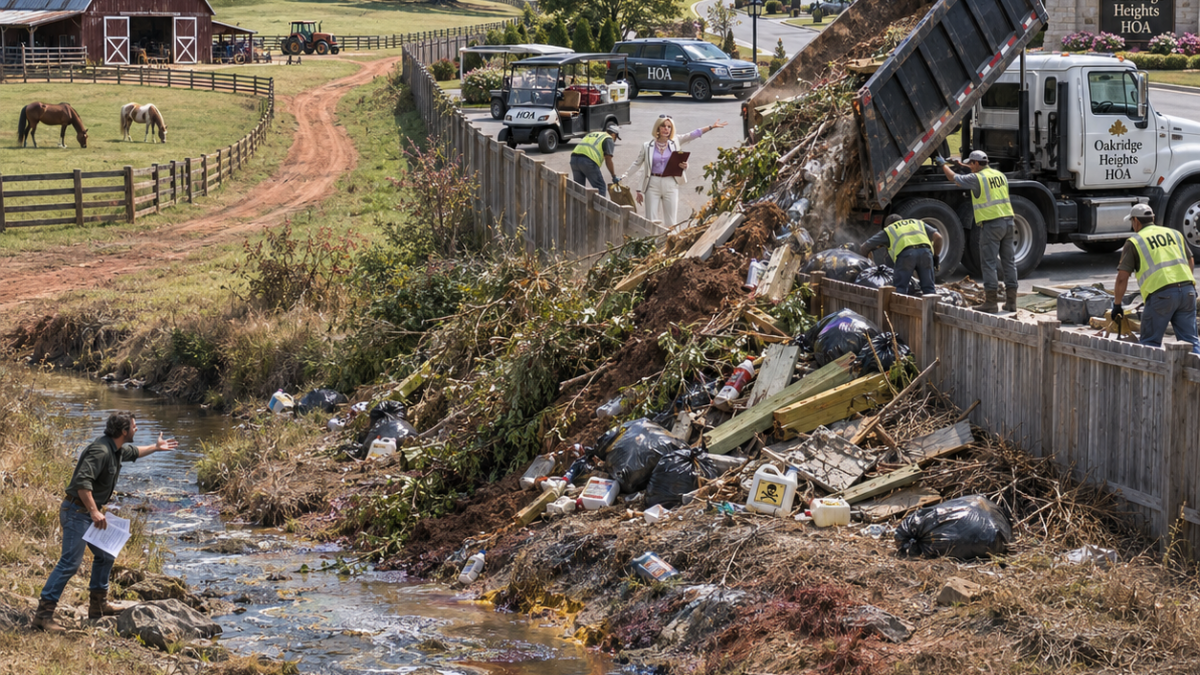
PART 2
People like Denise depend on one assumption.
That everyone else wants peace more than they want justice.
Usually, they’re right.
Most people have jobs.
Children.
Mortgages.
Aging parents.
Medical problems.
Nobody wakes up wanting to spend a Tuesday night reading county ordinances because somebody dumped hedge trimmings over a fence.
I didn’t either.
So I started politely.
I wrote a letter.
Certified mail.
Return receipt requested.
Stonebridge Estates Homeowners Association.
Attention: Denise Callaway, President.
I sat at the kitchen table with Hank sleeping under my chair and wrote the first version by hand.
Sarah always said my first drafts sounded angry even when I thought I was being reasonable.
So after I finished, I read it aloud.
Then removed three sentences.
Then removed two more.
The final letter was simple.
Fourteen photographs.
Dates.
Times.
GPS locations.
A clear request that Stonebridge stop dumping material on Thornton Ranch, remove what had already been deposited, and compensate me for damaged grazing grass.
I also referenced the state prohibition against illegal dumping on private property.
Not as a threat.
As information.
I even highlighted the relevant language.
Then I mailed it.
Denise signed for it three days later.
Nothing happened.
No call.
No apology.
No contractor.
No cleanup.
The next pile arrived thirteen days later.
This one included rotting fence boards, sprinkler fittings, weed-barrier fabric, lawn clippings, and more of the green-tinted lumber.
After the next rain, runoff from the pile turned dark.
The smell bothered me.
Not ordinary compost.
Not manure.
Not wet grass.
Something chemical.
I put on nitrile gloves and filled glass jars with soil.
One from beneath the pile.
One ten feet downhill.
One near the drainage swale.
I labeled each.
Date.
Time.
Location.
Depth.
Then stored them in the old refrigerator in the barn.
My daughter Ellie came home from school and found three sample jars sitting beside a casserole.
She looked at me.
“Dad.”
“What?”
“Why is there mud next to dinner?”
“Evidence.”
She stared.
“Normal families keep food in refrigerators.”
“This is a barn refrigerator.”
“It contains Mom’s casserole.”
“Your point?”
She took the casserole inside.
Ellie was sixteen.
She had Sarah’s eyes.
And Sarah’s ability to communicate disappointment without raising her voice.
After losing her mother, Ellie became quieter.
Not withdrawn.
Just careful.
She had learned too young that people can disappear.
I tried to compensate by becoming predictable.
Breakfast.
School.
Ranch.
Dinner.
Same schedule.
Same house.
Same jokes she pretended not to find funny.
I wanted the ranch to feel permanent because so much else hadn’t been.
That was part of why Denise’s dumping made me angrier than I admitted.
It wasn’t just trash.
It was intrusion.
Sarah had planted flowers along that fence.
My father had stretched wire there.
Grandpa had set some of the original cedar posts.
Every pile Denise’s contractors dropped felt like somebody tossing garbage into a family photograph.
Then Denise went on offense.
Hays County Environmental Health called me.
A complaint had been filed against Thornton Ranch for excessive odor, flies, and potential bacterial contamination allegedly affecting Stonebridge residents.
The inspector introduced himself as Ray Gutierrez.
“Mr. Thornton, I’m required to follow up.”
“Come whenever you want.”
“You understand I’ll need access to livestock areas?”
“Absolutely.”
Thursday morning, Ray arrived in a white county truck.
Hank inspected him before I did.
Ray passed.
We walked everything.
Pastures.
Water troughs.
Feed storage.
The barn Dad built in 1978.
Manure-management areas.
Drainage.
Ray asked questions.
I answered.
No defensiveness.
No performance.
When we reached the east fence, he stopped.
The waste pile had grown large enough to be seen from fifty yards away.
Dark discoloration spread through the grass beneath it.
Ray pointed.
“That yours?”
“No.”
“Whose?”
“Stonebridge HOA contractor.”
He looked at me.
“They dump it here?”
“Yes.”
“With permission?”
“No.”
Ray took out his phone.
Photographed the pile.
Then another angle.
Then the green lumber.
Then the chemical containers.
“What have you done about it?”
“Certified notice.”
“Response?”
“More dumping.”
He sighed.
The ranch passed inspection.
No odor violation.
No livestock-health issue.
No bacterial problem.
Ray described the operation as well above standard.
Then, while leaning against his truck, he said something I never forgot.
“Garrett, that pile bothers me more than anything I saw on your ranch.”
“I know.”
“If there’s treated lumber or chemical residue in it, get it tested.”
“Already sampling.”
He smiled slightly.
“Keep documenting.”
Then he drove away.
I stood there watching the county truck disappear.
Denise had tried to put me on the defensive.
Instead, she had sent a government inspector onto my property who saw her waste with his own eyes.
Sometimes arrogance is efficient.
It builds your case for you.
Three weeks later, I heard diesel equipment east of the ranch.
Not lawn crews.
Heavy machinery.
I walked toward the fence with Hank.
Stonebridge had hired a contractor to build a concrete drainage channel.
A mini excavator cut through the soil.
A concrete truck waited nearby.
Two workers shaped a reinforced channel angled toward my lower pasture.
I stood at the property line.
Nobody approached me.
Nobody explained.
I took photographs.
Wide view.
Property marker.
Excavation.
Concrete forms.
Grade.
Then I looked at the direction of the channel.
Every drop from Stonebridge’s streets, driveways, roofs, common areas, and manicured lawns would be concentrated there.
And fired onto my property.
“Who approved this?” I asked one worker.
He shrugged.
“HOA.”
“Engineering plan?”
“You’ll have to ask the boss.”
“Drainage easement?”
Another shrug.
I photographed the survey pin.
The fresh channel crossed my property line.
Not far.
Maybe a foot.
But property law doesn’t measure disrespect in feet.
The first serious rain arrived three weeks later.
Two inches in four hours.
Nothing extraordinary for Central Texas.
I stood on a rise near the barn and watched the channel perform exactly as intended.
Which was the problem.
Stormwater poured from Stonebridge into the concrete chute.
The smooth surface accelerated it.
Water shot into my pasture.
Thirty acres began flooding.
My cattle moved uphill.
Mud rose around their hooves.
The lower field became brown water.
And beneath the smell of wet earth came something else.
Chemicals.
I knew that smell.
Residential runoff carries everything.
Fertilizer.
Herbicides.
Oil.
Pesticides.
Dog waste.
Detergent.
Sediment.
Stonebridge had taken all of that and created a direct delivery system onto my ranch.
For the next month, I bought supplemental hay.
Twenty-eight hundred dollars.
Because grazing acreage had become unreliable.
I sent Denise the invoice.
Her reply consisted of five words.
**Not an HOA responsibility.**
I printed it.
Filed it.
Denise’s next move was almost impressive.
At a board meeting, Stonebridge adopted a resolution restricting “agricultural odors” within five hundred feet of the subdivision.
Then I received a letter from Preston Keller, HOA counsel.
My cattle operation, he wrote, was “incompatible with the residential character of Stonebridge Estates.”
I sat at the table reading that sentence.
Thornton Ranch existed long before Stonebridge.
Long before its swimming pool.
Long before Denise’s Escalade.
Long before anyone decided one hundred eighty suburban houses belonged next to cattle country.
Now they were telling me the ranch was incompatible with them.
I called Dale Whitfield.
Dale owned the place north of me.
Sixty-three.
Retired welder.
Built like a refrigerator.
Opinions equally heavy.
He read the letter.
Then looked at me.
“Move the cows?”
“That’s what they’re suggesting.”
“Where?”
“Apparently another century.”
He laughed so hard Hank started barking.
Texas agricultural protections were straightforward enough for my attorney to explain later: a long-established agricultural operation does not suddenly become illegitimate because residential development arrives beside it and dislikes the realities of agriculture.
I printed the relevant state provision anyway.
Had it framed in cedar.
Hung it in the kitchen beside Sarah’s handwritten chicken-fried-steak recipe.
Ellie came home.
Stared at it.
“What is that?”
“Interior decorating.”
“Mom would hate it.”
“Your mother married me. Her standards were flexible.”
Ellie smiled.
A real smile.
Small.
But real.
I had not seen enough of those since Sarah died.
Then I stopped seeing the dump pile as trash.
I started seeing evidence.
I sorted through one load carefully.
Gloves.
Boots.
Eye protection.
No unnecessary handling.
What I found changed the entire situation.
CCA-treated lumber.
Green tint.
Old material.
Chromated copper arsenate.
Arsenic.
Chromium.
Copper.
Not something I wanted decomposing beside a creek.
Empty herbicide containers.
Pesticide packaging.
A damaged bag of pre-emergent product.
The landscaping contractor had mixed normal green waste with material that had no business being discarded on agricultural land.
I sampled again.
This time professionally.
Six soil locations.
Willow Creek upstream.
Adjacent to the dump.
Downstream.
Chain-of-custody forms.
Independent environmental laboratory in Austin.
Then I waited.
Ten days.
The report arrived on a Friday.
I opened it at the kitchen table.
Arsenic elevated.
Pesticide residues present.
Downstream water showing contamination not present in the upstream sample.
I read the report twice.
Then a third time.
Ellie came downstairs.
She looked at me.
“What happened?”
I didn’t answer immediately.
She sat across from me.
“Dad?”
“They’re poisoning the creek.”
Her face changed.
Willow Creek wasn’t just water to Ellie.
Sarah had taken her there as a child.
Taught her names of flowers.
Caught tadpoles with her.
Sat on the limestone shelf while Ellie splashed barefoot.
“Mom’s creek?”
I hated that she called it that.
And loved that she did.
“Yes.”
She turned toward the window.
For almost a minute, she said nothing.
Then:
“What are you going to do?”
Every angry answer entered my head.
Sue them.
Call every agency.
Drive the waste back onto Denise’s lawn.
Dump it into the HOA clubhouse.
Those were satisfying thoughts.
Bad strategies.
I looked at the lab report.
“I’m going to document every single thing they do.”
Ellie frowned.
“That’s it?”
“For now.”
She looked disappointed.
Teenagers want justice to arrive fast.
So do adults.
But I had spent fifteen years working around environmental enforcement.
Good cases grow slowly.
Dates.
Locations.
Samples.
Patterns.
Photographs.
Witnesses.
Receipts.
People ruin their own defense one decision at a time.
Denise was exceptionally talented at that.
Her next letter accused me of “visual pollution.”
My tractors.
Hay rake.
Stock trailer.
Water troughs.
Farm equipment visible from Stonebridge.
I stared at the page.
The woman whose contractor had dumped arsenic-containing lumber onto my land wanted to discuss aesthetics.
I filed the letter.
No response.
Then I went to the Hays County Records Office.
I requested the original Stonebridge plat.
Construction permits.
Environmental records.
Drainage approvals.
Louise Hadley worked the archive desk.
She had known my father.
Possibly my grandfather.
She disappeared for twenty minutes and returned carrying two banker boxes.
“Have fun.”
“That sounds ominous.”
“It usually is when people ask for this much paper.”
I spread the original plat across a reading table.
Eastern boundary.
Stonebridge beside Thornton Ranch.
Then I found it.
A fifty-foot natural conservation buffer.
Native vegetation.
No clearing.
No development.
No grading.
Required in perpetuity.
I stared at the map.
Stonebridge had not preserved fifty feet of native Hill Country.
They had cleared it.
Mowed it.
Landscaped it.
And now used the area as a dumping corridor.
The next issue was drainage.
The subdivision plans showed runoff naturally moving toward my property.
For Stonebridge to rely formally on Thornton Ranch as part of its drainage system, I expected an easement.
I searched.
Nothing.
No recorded agreement.
No compensation.
No Thornton signature.
No legal right granting Stonebridge permission to treat my land as stormwater infrastructure.
Then came the environmental assessment.
I found the folder.
Opened it.
Empty.
I checked the index.
Checked the permit file.
Nothing.
The approval signature?
Brent Callaway.
Denise’s husband.
Member of the county planning commission at the time.
I sat back.
That was the first moment I understood the scale of what I was looking at.
Maybe it was incompetence.
Maybe favoritism.
Maybe more.
But Denise had spent two years treating me like a backward rancher while the development she controlled socially had been approved through a process carrying her own family’s fingerprints.
Louise walked over with coffee.
She didn’t ask what I had found.
She looked at my face.
“Bad?”
“Interesting.”
“That means bad.”
“Usually.”
I drove home without radio.
Texas cedar.
Hot pavement.
Dust.
For six years, without thinking much about it, I had been helping Stonebridge.
I cleared branches from natural channels.
Mowed problem areas near the boundary.
Removed debris.
Ran off feral hogs.
Tracked coyotes.
Fixed fence gaps.
Managed land the way my father taught me.
Not for Stonebridge.
For the ranch.
But they benefited.
Their drainage stayed open because I kept downstream channels functional.
Their edge stayed cleaner because I removed dumped material.
Their manicured yards stayed separated from wildlife because I maintained fences and discouraged animals from settling near the border.
Nobody paid me.
I didn’t expect them to.
Neighbors help neighbors.
Then Denise turned neighborliness into entitlement.
That evening Dale came over.
Ellie sat with us.
Hank slept beneath the table.
I spread the plat.
Lab results.
Survey photographs.
Letters.
“What are you going to do?” Dale asked.
“Stop.”
He frowned.
“Stop what?”
“Helping them.”
His eyebrow rose.
“I’m not blocking anything. I’m not damaging anything. I’m not sending anything their way.”
“Okay.”
“I’m just done volunteering.”
I pointed toward the boundary.
“I stop clearing their dumped waste.”
Another point.
“I stop maintaining drainage features for their benefit beyond what I need for my own ranch.”
Another.
“I stop managing wildlife for the purpose of keeping it away from their side.”
Dale started smiling.
Ellie looked between us.
“You’re going to let nature take over.”
“I’m going to manage my property for my ranch.”
“That sounds like lawyer language.”
“It will be.”
I contacted counsel.
Patricia Herrera.
Environmental and property litigation.
She reviewed everything.
“Do not create a hazard.”
“Agreed.”
“Do not intentionally direct water toward them.”
“Agreed.”
“Do not move contaminated material without professional guidance.”
“Agreed.”
“You can absolutely stop performing free maintenance on behalf of people trespassing, dumping waste, and using your property without an easement.”
“That’s what I thought.”
“Also, Garrett?”
“Yes?”
“File the environmental complaint now.”
I did.
Lab results.
Photographs.
Dump dates.
Certified letter.
Inspector report.
Everything went to state environmental authorities.
I hired a licensed surveyor.
Carl Briggs.
He confirmed the drainage structure crossed onto my land.
He also confirmed there was no recorded drainage easement.
My attorney routed the appropriate information to agencies responsible for waterway impacts and permitting.
Then I submitted a legitimate wildlife-management plan for Thornton Ranch.
Not as a revenge gimmick.
The land already supported habitat.
The classification formalized practices that fit what I wanted anyway.
Native vegetation.
Habitat restoration.
Reduced unnecessary disturbance.
Monitoring.
And I installed trail cameras.
Six.
Not pointed into bedroom windows.
Not aimed at private homes.
My property.
My fence.
My dump sites.
My drainage area.
Motion activated.
Timestamped.
Backed up.
Finally, I called Teresa Marsh at the San Marcos Daily Record.
“I have an environmental dumping story.”
“Who’s dumping?”
“HOA contractor.”
“How long?”
“Roughly two years.”
“Proof?”
“Enough to ruin your weekend.”
She came out the next Thursday.
By then, I had stopped mowing the buffer area that legally should have existed all along.
Nature responded immediately.
Bluestem appeared.
Switchgrass.
Wildflowers.
Seedlings.
The boundary began looking like Texas again.
Denise noticed.
Of course she did.
The first letter demanded I mow.
The second threatened fines.
Two hundred fifty dollars per day.
I wasn’t a Stonebridge member.
I had never signed their covenants.
Never paid dues.
Never accepted their authority.
Patricia Herrera called me after reading the letter.
“They’re fining you?”
“Trying.”
“For vegetation on your ranch?”
“Yes.”
“Garrett.”
“Yes?”
“I need you to promise not to frame this one.”
“Why?”
“Your house is becoming weird.”
I looked toward the framed Right to Farm statute.
“Too late.”
Denise also called county code enforcement and reported Thornton Ranch as abandoned.
A county employee drove out.
Saw sixty Angus cattle.
A working barn.
Hay.
Equipment.
Me waving.
He left.
No citation.
Then somebody cut my fence.
Two sections.
Clean cuts.
Wire cutters.
Not storm damage.
Not livestock.
A deliberate opening facing Stonebridge.
My cameras caught a pickup but not a clear plate.
The fence section keeping cattle contained was repaired immediately.
The outside opening became part of the broader boundary issue my lawyer documented.
I did not bait wildlife.
Did not feed hogs.
Did not release anything.
That distinction matters.
Because what happened next did not need help.
The waste pile had grown.
Branches.
Grass clippings.
Organic material.
Food traces from landscaping crews.
Rotting vegetation.
Rats appeared.
Then raccoons.
Then feral hogs discovered the area.
If you live in Texas, you understand feral hogs are not charming woodland guests.
They are demolition crews with legs.
My trail camera caught the first sounder after two in the morning.
Adults.
Younger hogs.
Noses down.
Following scent.
They tore through decomposing material.
Rooted soil.
Scattered debris.
Then moved along the boundary.
By sunrise, several Stonebridge lawns had been rooted.
Flower beds overturned.
Irrigation tubing exposed.
A decorative path destroyed.
One resident lost a section of expensive turf.
The Stonebridge neighborhood app exploded.
I did not know that until Thomas Avery, a Stonebridge resident I actually liked, called.
“Garrett.”
“Morning.”
“We have hogs.”
“You live in Texas.”
“No, Garrett. We have biblical hogs.”
“I don’t think that’s a category.”
“My front yard looks like somebody plowed it drunk.”
“Sorry.”
“Denise says you released them.”
I closed my eyes.
“Thomas.”
“I know. I know. I told her hogs don’t take instructions.”
“Smart man.”
“What do we do?”
“Call a licensed wildlife professional.”
“Can you handle them?”
That question mattered.
For years, I probably would have.
“I’m not managing Stonebridge property.”
He became quiet.
“Fair.”
I hated saying it.
Thomas wasn’t Denise.
Neither were most residents.
That was the complicated part of letting consequences return to their source.
Institutions make bad decisions.
Ordinary people receive the bill.
I gave Thomas the number of a reputable wildlife-control company.
That was neighborly enough.
Coyotes followed the increase in small animals.
Mostly heard at night.
Residents panicked.
Outdoor cats disappeared.
A tiny dog named Biscuit became locally famous because its owner posted nightly updates about carrying him indoors before sunset.
Then snakes appeared.
Most harmless.
One rattlesnake ended up beneath a patio chair.
Animal control removed it.
Residents demanded the HOA force me to clear my land.
The HOA demanded the county force me.
The county explained agricultural property and managed habitat are not suburban lawns.
Denise responded by writing longer letters.
Each one went into my filing cabinet.
But the most poetic consequence came from plants.
For two years, Stonebridge’s waste had delivered seeds onto my property.
Weeds.
Grasses.
Opportunistic species.
Now the buffer was no longer being repeatedly cut flat.
Plants germinated.
Wind blew east.
Seeds returned.
Ragweed.
Johnson grass.
Thistle.
Cocklebur.
The landscaping material Stonebridge had discarded began producing exactly the kind of vegetation Stonebridge hated.
Returned to sender.
No postage required.
By September, Denise had lost control of the narrative.
Residents were angry.
Some at me.
More at her.
Then Teresa Marsh published her first article.
**HOA LANDSCAPING WASTE UNDER ENVIRONMENTAL REVIEW AFTER RANCH CONTAMINATION CLAIMS**
It included photographs.
Not accusations disguised as facts.
Documentation.
Lab findings.
County records.
The missing buffer requirement.
The questionable drainage channel.
A quote from me:
“I asked them to stop dumping on my property. They chose not to.”
Denise gave a statement.
“Stonebridge Estates is committed to environmental stewardship and believes Mr. Thornton is exaggerating routine landscaping practices as part of a personal vendetta against residential growth.”
Ellie read it.
“Routine landscaping practices?”
“Apparently.”
“She dumped poison by Mom’s creek.”
“I know.”
“She’s lying.”
“I know.”
“Why aren’t you angrier?”
I looked at my daughter.
“I am.”
“You don’t act like it.”
“That doesn’t mean I’m not.”
She folded the newspaper.
“If somebody did this to me, Mom would lose her mind.”
I smiled.
“Your mother would write them six pages.”
“She would sue them.”
“After the six pages.”
Ellie smiled too.
Then her eyes moved toward Willow Creek.
“Do you think it’ll be okay?”
That question hurt more than Denise’s letters.
“Yes.”
“You know?”
“No.”
I decided not to lie.
“But we’re going to make sure they clean it.”
Ellie nodded.
“I want Mom’s flowers back.”
“They never left.”
Some had.
Near the contaminated area, growth had thinned.
But farther up the fence, Sarah’s wildflowers survived.
Every year.
Seeds finding soil.
Roots finding rain.
Life continuing without permission.
October arrived wet.
Weather forecasts showed heavy rain.
I started walking drainage paths more often.
My responsibility remained protecting Thornton Ranch.
I cleared what I needed to protect cattle, structures, and Willow Creek.
But I did not maintain Stonebridge’s unauthorized drainage arrangement for them.
The concrete channel they had built concentrated runoff toward an area now complicated by sediment, vegetation, and years of dumped debris.
My attorney had already warned the HOA.
The survey warned them.
Environmental complaints warned them.
County records warned them.
They did nothing.
Then four inches of rain fell in six hours.
I watched from the porch with Hank.
Rain hammered the metal barn roof.
Willow Creek rose.
Brown water moved over limestone.
For a moment, seeing the creek swollen beside Sarah’s old reading spot made my chest tighten.
Water on Thornton Ranch spread across pasture as it always had.
Slowly where vegetation remained.
Into natural depressions.
Through channels.
Toward the creek.
Stonebridge’s concrete system behaved differently.
It moved water fast.
Fast is useful when you have somewhere safe to send it.
They didn’t.
Their discharge met reduced capacity near the boundary.
Water backed up.
Then more came.
Street drains filled.
The Stonebridge retention area rose.
Roads began holding water.
By late afternoon, sections of the subdivision flooded.
Not catastrophic.
But serious.
Garages wet.
Lawns underwater.
Parking areas covered in muddy runoff.
Residents moved vehicles uphill.
And the water carried something else.
Residue.
Sediment.
The environmental mess Stonebridge had spent two years helping create.
Ellie stood beside me.
“Is this because you stopped cleaning?”
“Partly because they built drainage without a legal outlet.”
“But if you had kept maintaining everything?”
“It might be less visible.”
She watched the rain.
“So you could fix it.”
I thought carefully.
“I could keep making their bad system easier to live with.”
“That’s not the same thing.”
“No.”
I was proud of her for understanding.
Tuesday’s emergency HOA meeting drew more than one hundred residents.
I went because Patricia Herrera told me to.
“Say as little as possible.”
“That ruins my whole evening.”
“I’m serious.”
“So am I.”
The community center was packed.
Denise stood behind a podium.
White blazer.
Clipboard.
Brent sat three rows back.
Preston Keller stood near the side wall.
Denise opened aggressively.
“Stonebridge Estates has been subjected to intentional environmental sabotage by the adjoining ranch owner.”
Murmurs.
“He has deliberately refused drainage maintenance, allowed dangerous wildlife migration, and permitted invasive vegetation to spread into our community.”
A man stood.
Thomas Avery.
“Didn’t our landscapers dump the vegetation on his land?”
Denise pointed toward him.
“Please wait for resident comments.”
“You didn’t answer.”
Another resident spoke.
“My yard got torn up by hogs because the waste pile attracted them.”
Denise shook her head.
“That is speculation.”
Someone else called:
“Then why didn’t you remove the pile when he asked?”
The room shifted.
Denise was used to directing angry homeowners one at a time.
Not facing them together.
Then the side door opened.
Three people entered.
Teresa Marsh.
A representative from the state environmental agency.
And an official associated with the waterway permitting review.
The room quieted.
The state official carried a thick folder.
He introduced himself.
Then summarized preliminary findings.
Stonebridge’s contracted landscaping operation had repeatedly disposed of prohibited material on private agricultural property without consent.
Testing confirmed contamination requiring remediation.
The HOA would be responsible for cleanup costs subject to the final enforcement process.
The drainage structure was also under review because of unpermitted impacts and its encroachment onto private property.
Denise’s face changed.
“Those conclusions are premature.”
The official remained calm.
“They are investigative findings.”
“Our attorney disputes them.”
“Your attorney may use the appropriate appeal process.”
Denise turned toward Preston.
He looked suddenly fascinated by his folder.
I stood.
Patricia Herrera gave me a warning look.
I walked to the table.
Unrolled the original Stonebridge plat.
No speech planned.
No theatrics.
Just the map.
“This is the fifty-foot conservation buffer required when Stonebridge was approved.”
Residents leaned forward.
“It was supposed to remain native.”
I pointed.
“It didn’t.”
Another section.
“This is the natural drainage path.”
Then the property line.
“There is no recorded drainage easement giving Stonebridge the right to use Thornton Ranch as its stormwater facility.”
I pointed toward Brent’s signature.
“And this is the approval.”
Brent looked down.
Then I faced the room.
“For two years, your landscaping crews dumped material over my fence.”
Denise interrupted.
“Contractors acted independently.”
“No.”
I looked directly at her.
“I sent you certified notice after the first documented incident.”
Silence.
“You signed for it.”
Thomas turned toward Denise.
“You knew?”
She said nothing.
I continued.
“I cleaned some of it because I didn’t want it spreading.”
I pointed toward the drainage map.
“For years, I also kept natural channels clear because that’s what ranchers do.”
Another pause.
“I discouraged wildlife near your boundary.”
Then I stopped.
“I didn’t flood your neighborhood.”
Denise’s jaw tightened.
“I didn’t send hogs into your yards.”
A few people laughed.
“I didn’t plant weeds in your flower beds.”
More laughter.
“I stopped cleaning up problems I didn’t create.”
The room became quiet again.
“Everything that came back toward Stonebridge began with something Stonebridge pushed outward.”
Denise stared at me.
I thought about the first phone call.
Free fertilizer.
Move your creek.
Your dirt farm exists because I allow it.
I could have humiliated her.
Quoted every word.
I didn’t.
I only said:
“I didn’t make nature fight you.”
Pause.
“I just stopped fighting nature for you.”
No applause.
Not immediately.
It was too serious.
The state official continued explaining the cleanup order.
The room erupted twenty minutes later when residents learned the expected cost.
People shouted at Denise.
At the board.
At Brent.
One woman cried because a special assessment would hurt her family.
That was the part revenge fantasies never include.
Denise deserved consequences.
The residents didn’t all deserve the cost.
After the meeting, Thomas caught me outside.
“My assessment may be thousands.”
“I’m sorry.”
“You mean that?”
“Yes.”
He studied me.
“You hate Denise.”
“I do not particularly enjoy Denise.”
He laughed despite himself.
“You could’ve said ‘not my problem.’”
“I could.”
“But?”
“You didn’t dump the waste.”
He looked toward the building.
“We let her run everything.”
“That’s not the same as poisoning my creek.”
“No.”
He rubbed his face.
“We should’ve paid attention.”
“That’s probably the real lesson.”
Two weeks later, residents voted to remove Denise.
One hundred eight to four.
I wasn’t there.
I was fixing a fence.
Dale called.
“Gone.”
“What?”
“Queen Denise.”
“Removed?”
“By a margin that qualifies as a landslide.”
I sat on a fence post.
“Good.”
“That’s it?”
“What do you want me to do, fire a cannon?”
“I expected more joy.”
I looked toward Willow Creek.
“I’ll celebrate when the soil is clean.”
Brent resigned from the planning commission three days later.
County officials reopened review of several approvals connected to missing environmental documentation.
Not because I personally destroyed him.
Because records existed.
Again: paper.
Always paper.
The environmental fine against Stonebridge held.
The insurance carrier refused to treat intentional dumping as an ordinary covered accident.
The HOA faced cleanup costs.
Residents were furious.
Not just at Denise.
At the board members who had nodded along for years.
At contractors.
At themselves.
Accountability spread outward.
The illegal drainage structure came out.
This time, engineers designed something appropriate.
A bioswale.
Native grasses.
Stone.
Slower water.
Filtration.
Drainage treated as a landscape system instead of a concrete gun aimed at somebody else’s ranch.
I watched construction from my side of the fence.
One engineer introduced himself.
“David.”
“Garrett.”
“I’ve read your watershed reports.”
“Sorry.”
He laughed.
“We should’ve built this six years ago.”
“That would have been cheaper.”
“Almost everything is cheaper before lawyers.”
True.
Cleanup of Thornton Ranch took four months.
Contaminated soil was excavated.
Properly transported.
Additional sampling conducted.
Willow Creek monitored.
The first week heavy equipment removed soil near Sarah’s old wildflowers, Ellie stood beside me crying.
I put an arm around her.
“They’re destroying it.”
“They’re cleaning it.”
“It looks destroyed.”
“I know.”
Her voice cracked.
“Mom planted those.”
I didn’t have a good answer.
So I told the truth.
“We’ll plant them again.”
She stepped away.
“It won’t be the same.”
“No.”
That word matters.
Adults tell children everything will be okay when what we often mean is:
You will survive something that cannot be restored exactly.
Sarah wasn’t coming back.
The original soil wasn’t coming back.
Some flowers were gone.
Some places change.
Healing is not pretending they didn’t.
By spring, lab results improved.
Then improved again.
Willow Creek returned toward baseline conditions.
The first thing Ellie noticed was tadpoles.
“Dad!”
I thought something was wrong.
She stood ankle-deep near the limestone shelf.
“Tadpoles.”
I looked.
Small black commas moving in shallow water.
Weeks later, crawdads returned.
Then frogs.
Then one morning a great blue heron appeared.
Tall.
Gray-blue.
Motionless in the creek.
Ellie named him Walter.
“Why Walter?”
“He looks like a Walter.”
“You knew a lot of herons growing up?”
“Don’t question science.”
Walter became part of our mornings.
Hank hated him.
Walter did not care.
The required conservation buffer was finally restored.
Native oaks.
Cedar elm.
Mexican buckeye.
Switchgrass.
Wildflowers.
No manicured Bermuda sod.
No decorative HOA landscaping.
A real edge.
Within a year, the boundary became softer.
Ranch.
Native buffer.
Neighborhood.
That was how it should have been from the beginning.
Stonebridge residents changed too.
Not all.
Some remained angry at me.
One woman told Teresa Marsh I had “allowed preventable consequences.”
Maybe she was right in a limited sense.
I could have continued spending my time, money, and labor mitigating Stonebridge’s failures.
But there is a point where helping becomes enabling.
I had warned them.
Documented.
Reported.
Their leadership chose not to act.
Eventually, systems have to carry their own consequences.
Thomas understood.
He became part of the new board.
Their first priorities were environmental compliance, financial transparency, and contractor oversight.
Not mailbox color.
Not cattle smell.
Not visual pollution.
Actual risk.
One Saturday, Thomas walked over with his wife and two children.
His son stared at Hank.
“Can I pet him?”
“If Hank allows it.”
Hank allowed it.
Thomas looked toward the restored buffer.
“You know, I hated this when it started growing.”
“The grass?”
“All of it.”
“Why?”
“Looked messy.”
I smiled.
“And now?”
He looked at the wildflowers.
“My wife says it’s the prettiest part of the neighborhood.”
“She’s smarter than you.”
“She says that too.”
We stood near the fence.
“Garrett?”
“Yeah?”
“I’m sorry.”
“For what?”
“We benefited from what Denise was doing.”
“You didn’t dump anything.”
“No. But when she complained about the ranch, most of us figured it wasn’t our problem.”
He looked uncomfortable.
“We liked the neighborhood looking clean. We didn’t ask what got pushed out of sight to keep it that way.”
That was one of the most honest things any Stonebridge resident ever said to me.
Clean is not the same as responsible.
Sometimes places look perfect because somebody else is carrying the mess.
Trash hauled elsewhere.
Water diverted elsewhere.
Wildlife pushed elsewhere.
Noise pushed elsewhere.
Problems don’t disappear.
They cross boundaries.
That became the lesson I wanted Ellie to remember.
Settlement negotiations ended the following year.
I received compensation for damaged grazing land, contamination impacts, supplemental feed, survey costs, and other documented losses.
The number looked large on paper.
It didn’t feel like winning.
Money can reimburse hay.
Not two years of watching people disrespect your home.
Not Ellie crying beside contaminated flowers.
Not Willow Creek carrying chemicals.
Still, the settlement created an opportunity.
I sat with Ellie at the kitchen table.
“What should we do with part of it?”
“Fix the barn roof.”
“That’s already budgeted.”
“New truck.”
“No.”
“You asked.”
“I asked for a serious answer.”
She looked toward Sarah’s framed recipe.
Then toward the window.
“Scholarship.”
I stared at her.
“For what?”
“Water stuff.”
“Very technical.”
“You know what I mean.”
I did.
Sarah Thornton Conservation Scholarship.
For a Hays County high-school student pursuing watershed management, soil science, environmental engineering, ecology, or conservation.
The first year, one student.
Then two.
Then a local foundation contributed.
Then Stonebridge did.
That surprised me.
Their new board voted to contribute annually.
Denise had once thrown poison over our fence.
The community she ruled now helped fund young people learning how not to repeat the same mistake.
That was satisfying.
Ellie had another idea.
A trail.
Not across the working ranch.
Along the restored creek corridor.
Controlled access.
Educational signs.
Native vegetation.
Water quality.
Hill Country ecology.
We called it Thornton Trail.
At the entrance, Ellie carved a wooden sign herself.
**THORNTON TRAIL
IN MEMORY OF SARAH THORNTON
LET NATURE SHOW YOU THE WAY**
The first time I saw it installed, I walked away.
Dale found me beside the truck.
“You crying?”
“No.”
“Your face is wet.”
“Humidity.”
“January humidity?”
“Texas.”
He sat beside me on the tailgate.
“Your dad would like this.”
“He’d say I took too long.”
“He would.”
We laughed.
Then became quiet.
Sometimes people imagine emotional endings happen with music.
Sunsets.
Perfect speeches.
Mostly they happen sitting on pickup tailgates beside men who knew your father.
Stonebridge’s children began using the trail.
That was not something Denise would have understood.
For years, she saw Thornton Ranch as an ugly thing beside her neighborhood.
Cattle.
Old equipment.
Weeds.
Dirt.
Wildlife.
But children saw something different.
Frogs.
Bird tracks.
Creek stones.
Wildflowers.
One boy spent twenty minutes watching dung beetles and announced it was the best day of his life.
His mother looked horrified.
I considered that a success.
Hank became unofficial trail security.
By then he was thirteen.
Slower.
Gray around the muzzle.
Still determined to inspect every visitor.
Ellie eventually left for college.
Environmental science.
I accused her of copying me.
She said:
“Mom would’ve been cooler about it.”
Probably true.
The day she left, Hank sat beside her car.
Refused to move.
She knelt.
“You have to stay with Dad.”
Hank looked at me.
Then at her.
I have never seen a dog communicate disappointment more clearly.
Ellie hugged me.
“Don’t become weird while I’m gone.”
“I’m already weird.”
“Weirder.”
“No promises.”
She pulled away.
Then looked toward the creek.
“Take care of Mom’s flowers.”
“I will.”
After she drove off, the ranch felt enormous.
For sixteen years, my life had been structured around being somebody’s husband and somebody’s father.
Then Sarah died.
Now Ellie was beginning her own life.
That night, I sat on the porch with Hank.
“Just us.”
He sighed.
“Try not to sound thrilled.”
He rested his head on my boot.
Things change.
Land teaches that better than people do.
Grass burns.
Returns.
Creeks dry.
Fill.
Trees fall.
Seedlings rise beside them.
Nothing stays unchanged.
That doesn’t mean nothing lasts.
Denise disappeared from public life.
For a while, I heard rumors.
She was moving.
She wasn’t.
She was suing the board.
She wasn’t.
She planned to run again.
She didn’t.
Brent faced county review.
Some matters resulted in administrative consequences.
Others simply exposed how little oversight had existed.
Preston Keller stopped sending me letters.
I missed them.
Patricia Herrera did not.
One afternoon, years later, I saw a white Escalade stopped near the public trail entrance.
Denise stepped out.
Older.
Hair different.
No clipboard.
For a moment, I considered turning around.
Then she saw me.
“Garrett.”
“Denise.”
Neither of us knew what to do next.
She looked toward the sign.
“Sarah.”
“Yes.”
“I didn’t know her.”
“No.”
“I heard about the scholarship.”
I waited.
“That’s good.”
“Thank you.”
She looked toward the restored buffer.
“This used to be ugly.”
I almost laughed.
“That sounds like you.”
“I mean after everything started growing.”
“Also sounds like you.”
A faint smile appeared.
Then vanished.
She crossed her arms.
“Do you hate me?”
I hadn’t expected that.
“No.”
Her eyebrows lifted.
“I did.”
“That makes more sense.”
“But hate takes maintenance.”
She looked at me.
“I have enough land to maintain.”
That time she laughed.
Quietly.
“I was awful to you.”
“Yes.”
“I thought you were trying to make Stonebridge look bad.”
“I was trying to stop your crews dumping chemicals near a creek.”
“I know that now.”
“You knew it then.”
She flinched.
Good.
Not because I wanted to hurt her.
Because apologies are useless if they rewrite history.
She had known enough.
Maybe not the contamination details.
But she knew contractors were dumping over my fence.
She knew I objected.
She chose not to care.
“I thought if I gave in once,” she said, “everyone would stop listening to me.”
There it was.
Not greed.
Not even hatred.
Fear of losing control.
“Then nobody was really listening.”
She stared toward the trail.
“No.”
We stood silently.
Then Denise said:
“I’m sorry about the creek.”
I looked at her.
Not “I’m sorry you were upset.”
Not “mistakes were made.”
The creek.
Specific.
“I’m sorry about Sarah’s flowers too.”
That landed harder.
“Thank you.”
She nodded.
Then walked back toward her Escalade.
Before getting in, she turned.
“For what it’s worth, Garrett…”
“What?”
“You were right.”
I smiled.
“About what?”
“That’s an annoying question.”
“I have several categories.”
She shook her head.
“Nature.”
Then left.
I watched the Escalade disappear.
Hank would have hated that scene.
He never forgave anyone.
By then Hank was gone too.
Fourteen years old.
He made it through one more summer after Ellie left for college.
Then one morning he couldn’t stand.
The vet came to the ranch.
I sat with him on the porch.
His head on my boot.
Same place he had rested it a thousand mornings.
I told Ellie over video.
She drove home anyway.
Five hours.
We buried Hank near the wildflowers.
Not too close to the creek.
High ground.
Ellie placed his old collar beneath the stone.
That evening, we sat together.
No conversation.
Just sunset.
Loss returns in strange shapes.
Losing Hank reopened Sarah.
Then Dad.
Then everything.
But grief changes as you age.
At first, it feels like something has been taken.
Later, it becomes evidence that something mattered.
Ellie stayed three days.
Before leaving, she walked the trail.
When she returned, she said:
“Walter’s still there.”
“The heron?”
“Maybe not the same heron.”
“Then it’s not Walter.”
“It’s Walter spiritually.”
“Environmental science has changed.”
She laughed.
I needed that.
The scholarship grew.
Ellie finished college.
Then graduate school.
Watershed restoration.
Apparently she inherited my disease.
Her first major project involved restoring a creek damaged by suburban runoff outside Austin.
She called me.
“Dad.”
“Everything okay?”
“The developer says the erosion is natural.”
I smiled.
“And?”
“I found the original drainage plan.”
“Good girl.”
“Don’t say good girl. I’m twenty-four.”
“Good professional.”
“Worse.”
“What did the plan show?”
“Two missing detention areas.”
I leaned back in my chair.
“Have you documented everything?”
She became quiet.
Then:
“You sound like Mom.”
That stopped me.
Sarah had never been an engineer.
But she had taught me the rule.
Documentation.
Patience.
Make the truth difficult to ignore.
“I’ll take that as a compliment.”
“You should.”
Years after Stonebridge, I started speaking occasionally at county workshops.
Not as the angry rancher.
As a former watershed specialist.
My presentation had one photograph people remembered.
The original dump pile.
Branches.
Grass.
Treated wood.
Chemical containers.
Then another photograph.
The restored buffer.
Wildflowers.
Trees.
Clear creek.
I would ask:
“What changed?”
People usually answered:
“Cleanup.”
“Enforcement.”
“Restoration.”
All true.
Then I would say:
“Responsibility.”
Because environmental problems often start when somebody decides the cost can be pushed somewhere else.
Trash onto another property.
Water downstream.
Chemicals into soil.
Wildlife into a different habitat.
Maintenance onto a neighbor.
Stonebridge looked perfect because Thornton Ranch had been absorbing part of its disorder.
Once I stopped absorbing it, the system revealed itself.
That became the deeper lesson.
Not “release hogs on your HOA.”
I never did.
Not “let neighborhoods flood.”
I never intentionally caused that either.
The lesson was:
Don’t mistake someone’s kindness for an obligation.
For years, I kept channels clear because it was practical.
I managed wildlife because it was responsible.
I cleaned garbage because I hated seeing it.
Denise saw those actions and assumed they would continue regardless of how she treated me.
She believed my cooperation was infrastructure.
It wasn’t.
It was goodwill.
Goodwill is incredibly valuable.
And completely voluntary.
Stonebridge learned that the expensive way.
One spring morning, almost a decade after the first pile appeared, I woke at 5:15.
Habit.
Coffee.
Boots.
No Hank.
That still felt wrong sometimes.
I walked the fence.
The restored buffer had matured.
Young trees now cast shade.
Wildflowers moved in the wind.
Willow Creek ran clear.
At Sarah’s limestone shelf, I stopped.
Sat.
Took off my boots.
Put my feet in the water.
Cold.
Sarah used to do that.
I never understood why.
Now I did.
The creek made everything slower.
Birds.
Insects.
Water over stone.
No HOA letters.
No court filings.
No lab reports.
No Escalade.
Just morning.
I thought about the first time Denise told me to move my creek.
Such an absurd sentence.
But arrogance makes absurdity sound reasonable.
People convince themselves land should move for convenience.
Water should obey development plans.
Animals should understand property values.
Farms should stop smelling.
Ranches should hide equipment.
Creeks should accept chemicals.
Neighbors should absorb waste.
Nature should behave.
It does.
Just not the way we mean.
Nature behaves according to rules older than HOAs.
Water runs downhill.
Seeds travel.
Animals follow food.
Contaminants move with runoff.
Soil remembers what enters it.
Floodplains remain floodplains even after somebody builds houses on them.
Buffers matter.
Roots matter.
Wetlands matter.
Time matters.
Denise thought she controlled the boundary.
The boundary was never truly hers to control.
Neither was it mine.
I owned the land legally.
But owning land and controlling nature are not the same thing.
A rancher learns that quickly.
You manage.
You guide.
You repair.
You respect.
That’s all.
The sun came higher.
I stood.
Pulled on my boots.
Walked home.
At the porch, an envelope waited in the mailbox.
Scholarship applications.
I carried them inside.
Made another cup of coffee.
Sat beneath Sarah’s framed recipe and my ridiculous framed farm statute.
One applicant wrote about growing up in Stonebridge Estates.
Her name was Madison Avery.
Thomas’s daughter.
I remembered her as a little girl standing beside the trail looking at tadpoles.
Her essay said:
> I grew up beside a ranch that taught my neighborhood what happens when development treats natural systems like obstacles instead of partners.
I stopped reading.
Looked out the window.
Then continued.
She wanted to study environmental engineering.
Specifically urban stormwater design.
I laughed.
Not because it was funny.
Because sometimes consequences grow into something better than punishment.
Stonebridge had once tried to push every inconvenience west toward my fence.
Now one of its children wanted to spend her life designing communities that didn’t need to.
Madison received the scholarship.
At the award ceremony, Thomas hugged me.
“You know what Denise would say?”
“Please don’t ruin this.”
He laughed.
Madison approached.
“Mr. Thornton?”
“Garrett.”
“My dad says you hate being called Mr. Thornton.”
“Your dad talks too much.”
She smiled.
“I wanted to thank you.”
“For the scholarship?”
“For the trail.”
That surprised me.
“I used to go there whenever my parents fought.”
I didn’t know that.
“I’d sit by the creek.”
She looked toward Ellie, who had come home for the ceremony.
“It made me want to work with water.”
I looked at my daughter.
Then back at Madison.
Sarah would have loved that.
Two girls influenced by the same creek.
One her daughter.
One from the neighborhood that once helped poison it.
Life does not move in straight lines.
Neither does water.
The annual scholarship dinner became a tradition.
So did Thornton Trail Day.
Stonebridge volunteers helped maintain public sections of the buffer under professional guidance.
Not manicuring it.
Maintaining it correctly.
Invasive removal.
Trail repair.
Monitoring.
One year, a new homeowner asked why the vegetation was “so overgrown.”
Thomas nearly choked.
Before I could answer, Madison—home from college—said:
“It’s not overgrown. It’s a functioning conservation buffer.”
I smiled.
The man looked confused.
“What’s the difference?”
Madison spent fifteen minutes explaining it.
I said nothing.
That may have been my favorite moment of the entire story.
Because the opposite of Denise wasn’t me winning.
It was knowledge becoming normal.
Years later, people stopped talking about the scandal.
New residents didn’t know who Denise was.
Children didn’t know about the hog invasion.
The old drainage channel existed only in photographs.
The contamination site grew grass again.
Some stories fade.
That is healthy.
A community should not need an enemy forever.
Neither should a person.
I kept one box.
Not the entire filing system.
That eventually went to attorneys, archives, and secure storage.
One box.
First certified letter.
Lab report.
Original plat copy.
Photograph of the waste pile.
Denise’s visual-pollution letter.
A picture of the restored creek.
Sarah’s trail sign.
Ellie once asked:
“Why keep it?”
“To remember.”
“Remember Denise?”
“No.”
“What then?”
I looked at the box.
“How easy it is to become the person who cleans up everyone else’s mess because fighting feels harder.”
She nodded.
“That sounds depressing.”
“It’s not.”
“What’s the positive version?”
“Boundaries.”
She smiled.
“Therapy would’ve taught you that faster.”
“Therapy costs more than filing cabinets.”
“Dad.”
“Fine. You’re right.”
For a long time, I thought revenge meant making Denise feel powerless.
And yes, there was satisfaction in watching agencies tell her no.
Watching residents remove her.
Watching Brent resign.
Watching her letters become evidence against her.
I am not going to pretend I achieved spiritual enlightenment while she was trying to destroy my ranch.
Some days, I enjoyed her losing.
But that feeling didn’t last.
What lasted was Ellie studying watersheds.
Madison studying engineering.
The creek clearing.
The buffer returning.
The ranch surviving.
The trail.
The scholarship.
The wildflowers.
That was the revenge worth keeping.
Denise tried to make Thornton Ranch into Stonebridge’s dumping ground.
Instead, the boundary became a conservation corridor.
She tried to use my property as their drainage outlet.
Instead, engineers built a proper system.
She complained about my farm’s appearance.
Years later, residents called the native buffer the most beautiful part of Stonebridge.
She tried to weaponize environmental complaints against my cattle.
Instead, investigators found environmental violations created by her own contractors.
She wanted the ranch quieter.
Cleaner.
More suburban.
Instead, the ranch taught her neighborhood what the Hill Country looked like before subdivisions tried to manicure it into submission.
I never released a hog.
Never planted a weed in Stonebridge.
Never redirected contaminated water toward anyone.
Never poisoned anyone’s yard.
I didn’t have to.
All I did was stop donating my time to hide the consequences of someone else’s decisions.
That was enough.
Nature did what it always does when we stop pretending we are in charge.
It moved.
Seeds moved.
Animals moved.
Water moved.
Truth moved.
Eventually, so did Denise.
Some evenings, I still sit on the porch.
No Hank now.
Ellie visits when she can.
Sometimes Dale comes over.
He’s slower.
Still opinionated.
We watch sunset turn the hills orange.
One evening he said:
“You know what your dad would’ve done?”
“What?”
“Dumped a load of manure on Denise’s driveway the first week.”
I laughed.
“He would not.”
“You didn’t know him as well as I did.”
“He was my father.”
“Exactly.”
I shook my head.
Dale continued.
“Your way was better.”
“What way?”
“Letting her beat herself.”
I looked toward the restored trees.
“I didn’t let her.”
“No?”
“She insisted.”
Dale laughed.
We sat until dark.
The lights of Stonebridge came on beyond the buffer.
Soft.
Mostly hidden by trees now.
No enemy territory.
Just neighbors.
That mattered too.
A boundary should separate ownership.
Not humanity.
Thomas and I became friends.
Not close like Dale.
Different.
Once a month we had coffee.
He complained about Stonebridge politics.
I complained about cattle prices.
Normal neighbor stuff.
No legal threats.
No contaminated waste.
No clipboard wars.
One morning, he asked:
“Would you ever sell?”
“The ranch?”
“Yeah.”
“No.”
“Never?”
I looked at him.
“My grandfather asked my father that once.”
“What did he say?”
“No.”
“And your dad asked you?”
“No. He knew.”
Thomas smiled.
“So Ellie gets it.”
“If she wants it.”
“Does she?”
I looked toward the east pasture.
“I think she’ll decide when it’s her turn.”
Land should not become a prison disguised as legacy.
Sarah taught me that too.
Love is not forcing people to preserve your life exactly.
It is giving them enough roots to grow their own.
When Ellie was twenty-nine, she called.
“I’m coming home.”
“For Christmas?”
“No.”
Pause.
“Home home.”
I sat down.
“What happened?”
“Nothing.”
“Job?”
“I can work regionally.”
“Boyfriend?”
“Dad.”
“Sorry.”
“I want to start a watershed consulting practice.”
“From here?”
“Yes.”
I looked toward Sarah’s recipe on the wall.
“Your mother is causing problems from beyond the grave.”
Ellie laughed.
“So?”
“So what?”
“Can I?”
I almost cried.
Instead:
“Rent’s expensive.”
“Dad.”
“Fine.”
She came home.
Not to become a rancher exactly.
To build something alongside it.
Her office went into the old equipment room beside the barn.
**THORNTON WATERSHED & LAND SERVICES**
I complained about the name.
She ignored me.
Her first client?
A homeowners association outside Austin.
I laughed for ten straight minutes.
“What?”
“Nothing.”
“They need erosion help.”
“Of course they do.”
“They seem nice.”
“Give it time.”
“Dad.”
She did good work.
Better than mine in some ways.
New technology.
Better modeling.
Stronger ecological training.
She understood people differently too.
I had learned how to fight institutions.
Ellie knew how to make them listen before they became enemies.
Sarah in her.
Definitely.
The first time Ellie led a group of Stonebridge children along Thornton Trail, I followed at a distance.
She stopped by Willow Creek.
Explained runoff.
Buffers.
Soil.
How chemicals move.
Why native plants matter.
A boy raised his hand.
“Is this the creek that got poisoned?”
Ellie looked at me.
Then back at him.
“Yes.”
“Who did it?”
She paused.
“A lot of bad decisions did.”
That answer impressed me.
Children want villains.
Adults too.
Denise made many bad choices.
Brent did too.
Contractors.
Board members.
Residents who looked away.
Systems fail collectively.
Repair takes the same.
That afternoon, after everyone left, I told Ellie:
“You handled that well.”
“I know.”
“Humility.”
“I learned from you.”
“Clearly not.”
She laughed.
The sun caught the wildflowers.
Sarah’s wildflowers.
Or descendants of them.
Impossible to know.
Maybe that is what legacy really is.
Not preserving the exact plant.
The exact house.
The exact job.
The exact person.
Just seeds continuing.
In soil you may never see.
Thornton Ranch changed because Stonebridge tried to use it.
Stonebridge changed because Thornton Ranch stopped absorbing its mistakes.
Ellie changed because she watched me fight.
I changed because I watched her grow.
And somewhere inside all of that, Denise changed too.
Enough to apologize.
Enough to admit she had been wrong.
That was more than I expected.
The last time I saw her was at Thornton Trail.
She stood near the sign alone.
I almost walked past.
Then she said:
“Walter still here?”
I stared.
“How do you know Walter?”
“Stonebridge Facebook group.”
I laughed.
“Possibly his descendants.”
She nodded.
Then looked toward the water.
“I never understood why you cared this much about a creek.”
I sat on the limestone shelf.
She remained standing.
“Sarah loved it.”
“I know that now.”
“It was also my job.”
“Watershed management.”
“Fifteen years.”
She shook her head.
“I really picked the wrong neighbor.”
“You picked the wrong creek.”
She smiled.
Then sat several feet away.
For a while, neither of us spoke.
Water moved across limestone.
Finally she said:
“I thought controlling everything meant protecting it.”
I looked at her.
“And?”
“It mostly meant making everyone afraid to disagree with me.”
“That sounds exhausting.”
“It was.”
“Why do it?”
She shrugged.
“When Brent got involved in planning politics, everybody treated us like we mattered. HOA president was the first thing that was mine.”
There it was.
Power often grows from emptiness.
Not an excuse.
An explanation.
“You could’ve been a good president.”
“I know.”
“That probably hurts more.”
“Yes.”
I nodded.
Nothing else needed saying.
When she left, she touched Sarah’s trail sign.
Then walked away.
No dramatic forgiveness.
No hug.
No friendship.
Some relationships do not need reconciliation.
Peace is enough.
That evening Ellie joined me on the porch.
“Was that Denise?”
“Yes.”
“Did you push her in the creek?”
“No.”
“Missed opportunity.”
I stared at my daughter.
“You work in environmental consulting.”
“I contain multitudes.”
I laughed.
Sarah would have loved the woman Ellie became.
That remains one of grief’s cruelest truths.
You keep encountering moments the dead should have witnessed.
Graduations.
Careers.
Weddings.
Children.
Jokes.
Creeks restored.
You carry both joy and absence.
Neither cancels the other.
A few years later, Ellie married.
A hydrologist.
I accused her of having no imagination.
She said I was just happy he understood runoff coefficients.
Fair.
They held the reception near the trail pavilion.
Stonebridge residents came.
Dale danced badly.
Thomas gave a toast.
Madison Avery, now working as an environmental engineer, attended.
Sarah’s scholarship had become an established county program.
During the reception, Ellie took my hand.
“Mom should be here.”
“I know.”
She looked toward the wildflowers.
“Maybe she is.”
I don’t usually talk like that.
But that evening, I didn’t argue.
The creek ran clear behind us.
Walter—or Walter IX—stood in the shallows.
Native grass moved in the wind.
Children ran between tables.
And for once, everything felt exactly where it belonged.
Not perfect.
Never perfect.
Right.
There is a difference.
Today, Thornton Ranch is still two hundred eighty acres.
Still cattle.
Still hay.
Still limestone.
Still hot summers and unpredictable rain.
Stonebridge still exists beside us.
But the line between us is no longer a battlefield.
It is a living buffer.
Fifty feet of native Texas doing what someone should have let it do from the beginning.
Filtering.
Holding soil.
Supporting wildlife.
Slowing water.
Softening edges.
People often ask me whether I planned what happened.
The hogs.
The weeds.
The drainage backup.
No.
I planned documentation.
I planned boundaries.
I planned to stop doing free work for people who abused it.
Nature supplied the rest.
That is why I never tell this story as:
**I attacked my HOA with nature.**
I didn’t.
I let cause meet effect.
There is a difference.
Denise spent two years throwing problems west.
Garbage west.
Chemicals west.
Water west.
Blame west.
Eventually, those problems stopped disappearing.
They accumulated.
Then weather, wildlife, seeds, records, inspectors, and angry residents moved them back into view.
People called it karma.
Maybe.
I call it systems behavior.
Less poetic.
More accurate.
On the wall of my workshop now hangs a photograph.
Not Denise.
Not the trash.
Not the flood.
Sarah.
She’s sitting on the limestone shelf beside Willow Creek.
Bare feet in the water.
Book in her lap.
Wildflowers behind her.
Ellie was eight when she took it.
Beside the photograph is the first lab report.
I almost threw that report away after cleanup.
Ellie stopped me.
“Keep it.”
“Why?”
“So people remember what clean water had to survive.”
She was right.
Underneath both, I mounted a small brass plate.
It reads:
**THE LAND REMEMBERS WHAT WE DO TO IT.
SO SHOULD WE.**
That sentence became the closest thing Thornton Ranch has to an HOA rule.
One rule is enough.
Respect the land.
Everything else follows.
Sometimes, before sunrise, I still walk the east fence.
Coffee in a travel mug.
No Hank anymore.
Occasionally Ellie joins me.
Sometimes her daughter does.
Yes.
I am a grandfather now.
Her name is Sarah.
Ellie asked whether I minded.
I couldn’t answer for a minute.
Little Sarah loves Willow Creek.
Of course she does.
She throws stones.
Finds bugs.
Asks why cattle poop so much.
Important scientific questions.
One morning she pointed toward Stonebridge.
“Grandpa, is that where the bad lady lived?”
Ellie nearly choked laughing.
I crouched beside her.
“There wasn’t a bad lady.”
Ellie looked at me like I had lost my mind.
I continued.
“There was a lady who made bad decisions.”
Little Sarah frowned.
“Lots?”
“Yes.”
“Did she get a timeout?”
Ellie laughed harder.
“Something like that.”
Little Sarah considered this.
Then ran toward the creek.
Ellie looked at me.
“That was generous.”
“She’s four.”
“I meant to Denise.”
I watched my granddaughter.
“I don’t want Sarah growing up thinking people are only the worst thing they ever did.”
Ellie became quiet.
“Mom would like that.”
“Your mother liked everybody.”
“No.”
She smiled.
“She tolerated you.”
“Barely.”
We walked on.
At the old dump location, wildflowers covered the ground.
No marker.
No plaque.
Nothing saying:
THIS IS WHERE SIX TONS OF HOA WASTE ONCE SAT.
Good.
The land doesn’t need to keep our grudges.
It keeps consequences long enough.
Then, with care, it can heal.
That may be the final lesson Denise taught me accidentally.
Nature is powerful.
But nature is not revenge.
Nature doesn’t hate.
Water wasn’t angry.
The hogs weren’t taking my side.
Seeds didn’t know whose landscaping they entered.
The creek didn’t understand Denise or me.
Nature simply responded to conditions.
We were the ones assigning meaning.
So eventually, I stopped calling what happened revenge.
The real revenge would have been watching Stonebridge collapse.
Watching property values fall.
Watching every lawn get destroyed.
Watching Denise lose everything.
That might have felt good for a day.
Instead, Stonebridge improved.
Thornton Ranch healed.
The creek recovered.
Denise left power.
Brent faced scrutiny.
Residents learned.
Engineers fixed the drainage.
Children learned conservation.
Scholarships were funded.
My daughter came home.
That outcome was better than revenge.
It was correction.
There’s a satisfaction in correction that anger can’t match.
A system working after years of failure.
A stream running clear.
A boundary respected.
A neighbor asking permission.
An HOA funding native habitat instead of dumping over a fence.
Those things are quiet.
Quiet victories last.
Last week, Stonebridge’s current board sent me a letter.
For a moment, I felt my blood pressure rise automatically.
Old reflex.
I opened it.
They were requesting permission.
Requesting.
Not demanding.
They wanted Thornton Watershed & Land Services to advise on expanding native landscaping throughout the subdivision.
Reduce irrigation.
Improve stormwater infiltration.
Create pollinator habitat.
Ellie read the letter over my shoulder.
“Well?”
“Well what?”
“Are we taking the contract?”
“We?”
“It’s my company.”
“Then why ask me?”
“Because you’re going to complain either way.”
“Correct.”
She pointed toward the fee proposal.
I whistled.
“That’s what you charge?”
“I learned boundaries.”
“Apparently profitable ones.”
She grinned.
“Mom would be proud.”
“Yes.”
We accepted.
The first project replaced a section of chemically dependent ornamental turf with native prairie plants.
Denise would have hated it.
Or maybe not anymore.
Hard to say.
I stood beside Ellie during installation.
Stonebridge residents volunteered.
Thomas brought coffee.
Madison reviewed drainage grading.
Little Sarah chased butterflies.
The old boundary that once separated “ranch people” from “real neighborhood people” had become almost meaningless.
Good.
Because neighborhoods are not defined by matching roofs.
They are defined by whether people understand that what happens on one side of a fence affects the other.
Water crosses.
Air crosses.
Wildlife crosses.
Seeds cross.
Pollution crosses.
Consequences cross.
So does kindness.
Denise understood the first half too late.
We learned the second half afterward.
At sunset, I walked back toward Thornton Ranch.
The sky turned amber.
Sarah’s favorite color.
Cattle moved across the pasture.
Willow Creek reflected the last light.
I stopped near the limestone shelf.
The exact place my wife used to sit.
For years after she died, I thought protecting this ranch meant keeping it unchanged.
I was wrong.
The ranch is not unchanged.
Neither am I.
Sarah’s flowers spread farther now.
The buffer exists.
The trail exists.
The scholarship exists.
Ellie runs a business from the barn.
My granddaughter throws rocks into the creek.
Stonebridge children know what a watershed is.
That is not preservation.
That is growth.
I sat down.
Touched the water.
Cold.
Clear.
Then I thought about Denise’s voice from years earlier.
**Then move your creek.**
I smiled.
She had been wrong about almost everything.
But especially that.
You don’t move the creek because somebody finds it inconvenient.
You learn where the water needs to go.
You respect the land that carries it.
You stop dumping problems upstream and expecting somebody else to absorb them forever.
Because eventually, everything finds its way back.
Garbage.
Water.
Seeds.
Evidence.
Truth.
Even kindness.
I stood and walked home.
That night, rain began.
Soft.
Nothing dramatic.
I listened from the porch.
Water moved through Stonebridge’s bioswale.
Through the restored buffer.
Across Thornton Ranch.
Into Willow Creek.
No backup.
No flooded lawns.
No chemical smell.
No angry phone calls.
No emergency meeting.
Just a system finally working the way it should have from the beginning.
Ellie stepped onto the porch.
“You coming inside?”
“In a minute.”
“You’re going to sit here watching rain?”
“Yes.”
“That’s weird.”
“It’s my hobby.”
She shook her head and went back inside.
I stayed.
Rain fell over both properties.
Stonebridge.
Thornton Ranch.
Same storm.
Same watershed.
No fence in the world could change that.
That was what Denise had never understood when she started throwing her problems over mine.
She thought a property line meant whatever left her side stopped being her responsibility.
Nature disagreed.
So did the law.
So did the evidence.
Eventually, so did her own neighbors.
For two years, she tried to turn Thornton Ranch into Stonebridge’s dumping ground.
In the end, Thornton Ranch didn’t destroy Stonebridge.
It taught Stonebridge how to become a better neighbor.
And somehow, after everything, that became a much more satisfying ending than watching it fail.








