PART 2: HOA Dumped Construction Waste on My 10 Acres—Then Their Perfect Lawns Started Losing to Nature
PART 2
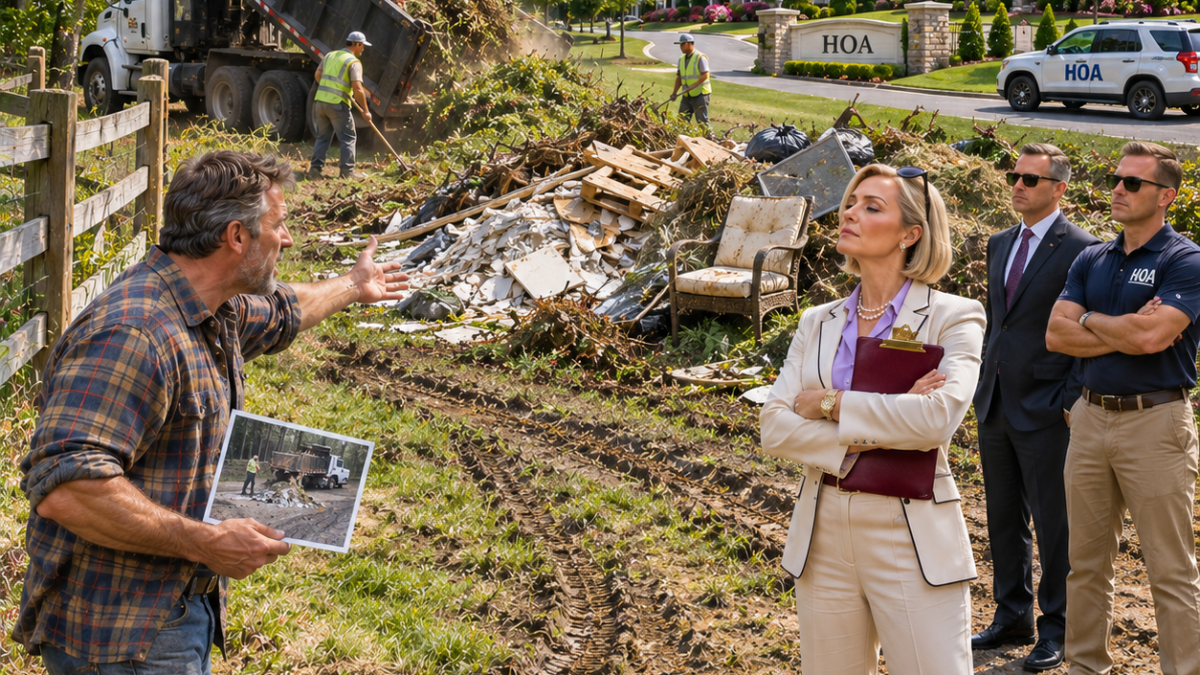
Fresh hedge trimmings sat on top.
There were broken bathroom tiles now too.
A torn bag of old mulch.
Two pieces of treated lumber.
I stood there with my hands on my hips.
Seven days.
I had given Cynthia seven days because I wanted to be able to look back later and know I hadn’t jumped straight into a war.
I had gone to the office.
Shown evidence.
Explained ownership.
Asked for cleanup.
Given a deadline.
They answered by adding to the pile.
That changed the situation.
But not immediately.
That’s the truth people usually leave out of stories like this.
Part of me wanted to ignore it.
Conflict is exhausting.
Especially after you spend years rebuilding a quiet life.
My divorce hadn’t been dramatic.
No cheating scandal.
No police.
No screaming courtroom scene.
Just two people slowly becoming different people and eventually admitting the house felt quieter when one of us wasn’t in it.
Afterward, I promised myself I wasn’t going to spend the rest of my life fighting.
I bought out what I needed to.
Moved back full-time onto my grandfather’s land.
Worked.
Fixed the cabin.
Cleared trails.
Rebuilt the chicken coop.
Learned how good silence could feel again.
Blackwood Heights was the opposite of everything I wanted.
Meetings.
Rules.
Committees.
Neighborhood apps.
Landscaping competitions disguised as community standards.
I didn’t want to join their world.
I definitely didn’t want their world coming over my fence.
A few days after my conversation with Cynthia, I was replacing a damaged fence post when I heard an ATV behind me.
Walt.
My neighbor on the other side.
Retired electrician.
Vietnam veteran.
Seventy-something.
The kind of man who could sit beside you for thirty minutes without saying a word and somehow make that feel completely normal.
He killed the engine.
Looked at the pile.
Then looked at me.
“You gonna let them do that?”
That was it.
Five words.
I drove the post deeper.
“No.”
Walt nodded.
“Good.”
He started the ATV.
“That’s all?”
He looked back.
“What else you need?”
Apparently nothing.
He drove away.
That night, I sat on my porch with a beer.
Tree frogs were loud near the creek.
A barred owl called from somewhere beyond the south trail.
I could barely see the lights of Blackwood Heights through the trees.
And I kept thinking about one word.
Unused.
Cynthia had looked at land with trees growing on it and decided it was unused because it wasn’t generating HOA dues.
Because nobody built a tennis court on it.
Because there wasn’t a pool.
Because I wasn’t manicuring it for photographs.
My grandfather would have hated that idea.
He used to tell me woods did more work than people gave them credit for.
They held soil.
Slowed water.
Gave animals cover.
Dropped leaves.
Fed insects.
Protected the creek.
He never called any of that unused.
Around midnight, I made a decision.
I wasn’t going to dump their garbage back over the fence.
Too easy.
Too stupid.
I wasn’t going to vandalize anybody’s lawn.
I wasn’t going onto Blackwood Heights property.
I wasn’t going to spray anything.
Cut anything.
Damage anything.
I was going to deal with what had been dumped on my land.
On my side of the line.
And after that, nature could make whatever point it wanted.
The next morning, I called a rental yard outside town.
I knew the manager from construction work.
“Need a chipper and compost shredder.”
“What size project?”
“Neighborhood improvement.”
He laughed.
“You joining an HOA?”
“I’d rather eat roofing nails.”
“That bad?”
“Worse.”
Two days later, I started sorting the pile.
That took longer than expected.
Organic material on one side.
Branches.
Leaves.
Grass.
Old mulch.
Then construction waste.
Drywall.
Tile.
Treated wood.
Anything that didn’t belong in soil got separated.
That distinction turned out to matter later.
At the time, I was simply making sure I wasn’t contaminating my own property because somebody else couldn’t be bothered to dispose of their waste correctly.
By afternoon, the trail looked like a job site.
Walt showed up again.
No invitation.
He always did that.
“You building something?”
“Cleaning their mess.”
He looked at the machine.
Then the sorted piles.
“You look happy.”
“I’m not.”
“You look happy.”
“I’m focused.”
“Same face.”
He stayed for an hour.
Mostly watched.
Eventually he pointed toward the organic debris.
“What you doing with that?”
“Using it.”
“For?”
“Privacy.”
Walt stared toward Blackwood Heights.
Then back at me.
He smiled.
First smile I’d seen from him in a week.
“Alright.”
That was the only endorsement I needed.
I processed the usable organic debris into material I could spread along the disturbed section of my own fence line.
Then I did something Cynthia probably never expected from the bitter hillbilly she imagined I was.
I stopped landscaping that strip for her benefit.
No manicured edge.
No clearing volunteer growth because it might offend the view from somebody’s deck.
No keeping the boundary cosmetically convenient for Blackwood Heights.
I let the existing wild growth come back thick.
Native wildflowers.
Ground cover.
Volunteer grasses.
Vines that had always been present in patches farther down the creek.
Nothing crossed my property line because of me.
I didn’t go into their yards.
I didn’t plant their lawns.
I didn’t touch their sprinklers.
But I was finished spending money keeping my side looking like an extension of their landscaping plan.
The disturbed soil loved the organic material.
Then Tennessee spring arrived.
Warm rain.
Humidity.
Sun.
Growth.
The first week, nothing looked dramatic.
Tiny green shoots.
A few broad leaves.
Wildflowers emerging in places I hadn’t seen them before.
The second week, everything accelerated.
The fence line thickened.
Green replaced brown.
Vines climbed my old posts.
Volunteer plants filled gaps between the trees.
From my porch, it looked better.
Not polished.
Alive.
The subdivision did not agree.
The first voicemail came on a Tuesday.
Unknown number.
A woman.
“Hi, I live in Blackwood Heights, directly behind your property. There appears to be vegetation growing through our rear fencing. I’m not sure if you’re aware.”
Delete.
Next voicemail.
Man.
More aggressive.
“Whatever you’re doing along that property line is spreading into our landscaping.”
Delete.
Another.
“You need to maintain your side.”
That one made me laugh.
Maintain.
According to whose definition?
Thursday morning, Cynthia called.
No polite voice.
“What exactly did you do?”
I leaned back on my porch.
Two deer stood near the lower trail.
“What do you mean?”
“You know exactly what I mean.”
“I cleaned up the material your contractors dumped.”
“You altered the vegetation along our boundary.”
“My boundary.”
“Our shared boundary.”
“There you go with shared again.”
Her breathing changed.
“You have aggressive vegetation entering residential properties.”
“I haven’t entered any residential property.”
“Plants are crossing.”
“Plants do that.”
“You deliberately created this problem.”
“No, Cynthia.”
I looked toward the green wall forming behind my fence.
“I stopped solving your problems for you.”
Silence.
“You need to remove it.”
“From my property?”
“Yes.”
“No.”
“This affects property values.”
“So did your garbage pile.”
“That was already addressed.”
“No, it wasn’t.”
Pause.
“We’ll be sending someone to inspect.”
“On your side.”
“Excuse me?”
“Anybody crosses my fence without permission, I call the sheriff.”
She hung up.
That afternoon, a landscaping crew arrived on the Blackwood Heights side.
Same company.
I recognized the trucks.
That was almost poetic.
My trail camera caught workers cutting back vegetation that had reached through their decorative fence.
They worked for hours.
The next morning, they returned.
Then again two days later.
Blackwood Heights was discovering something rural property owners already knew.
Nature has a bigger maintenance budget than you do.
Their lawns had been engineered for uniformity.
One grass.
One irrigation schedule.
Neat flower beds.
Mulch circles.
Trimmed shrubs.
The wild edge didn’t respect that design.
Seeds already present in dumped yard waste and disturbed soil moved with wind, birds, water, mower tires, and ordinary spring growth.
Dandelions appeared.
Volunteer grass showed up inside flower beds.
Vines threaded through fence openings.
None of it transformed the neighborhood overnight.
But to people who considered three dandelions an emergency, it looked like the apocalypse.
Walt called.
Not texted.
Walt hated phones.
That alone told me something.
“You hear the yelling?”
“What yelling?”
“Other side.”
I walked toward the fence.
Voices.
A man shouted:
“I pay nine hundred dollars a month for this!”
Another voice:
“We were told this would be handled!”
Walt chuckled.
“You did anything today?”
“No.”
“Yesterday?”
“No.”
“Week?”
“No.”
He paused.
“Best kind of revenge.”
“I’m not calling it revenge.”
“What are you calling it?”
“Ecological indifference.”
Walt laughed so hard he started coughing.
By the third week, Blackwood Heights landscapers were working constantly along the southern boundary.
I felt satisfaction.
I’m not going to lie.
But satisfaction is dangerous when it makes you careless.
I knew that from construction.
A crew has three good days.
Starts assuming everything is under control.
Then somebody skips one safety step.
That’s when somebody gets hurt.
So I documented.
Photographs of my property.
Survey markers.
Original dumping footage.
Every communication with Cynthia.
Every voicemail.
Every date.
I also kept the construction debris I had separated.
That turned out to be one of the smartest things I did.
Because Cynthia did exactly what Dale—or any attorney worth paying—would have predicted.
She escalated.
Certified letter.
Twelve pages.
Blackwood Heights HOA.
Attorney letterhead.
Language about deliberate vegetation encroachment.
Ecological damage.
Interference with residential property.
Potential diminution of value.
Demand to stop.
Demand to remediate.
Demand to pay.
I sat at my kitchen table reading it.
Then read it again.
I got halfway through the second time before I started laughing.
They dumped broken drywall, treated lumber, old adhesive-covered construction material, rotten furniture, and yard waste onto my land.
Now they were threatening me because weeds existed near their fence.
I almost called an attorney.
Then I saw one paragraph referencing environmental harm.
That reminded me of something.
County inspectors.
I had worked commercial construction long enough to understand one universal truth.
Inspectors love clean evidence.
Not screaming.
Not accusations.
Evidence.
Especially when environmental disposal is involved.
So I called the county environmental office.
A receptionist answered.
I explained.
“Illegal dumping on private land?”
“Yes.”
“Yard waste?”
“Some. Also construction material.”
“What kind?”
“Drywall, tile, treated lumber, adhesives. I have footage of trucks unloading.”
Pause.
“You have video?”
“Yes.”
“With plates?”
“Yes.”
Another pause.
“Can you bring copies?”
I could.
That afternoon, I sat across from an inspector named Russell.
Late sixties.
Jeans.
Work boots.
Hands that looked like he had worked outside before he ever held a county badge.
He watched the footage.
First truck.
No expression.
Second truck.
He leaned forward.
Third truck.
One worker pointed at my NO TRESPASSING sign.
Russell paused the video.
Looked at me.
“They didn’t even try to hide it.”
“No.”
“You talk to the HOA?”
I showed him Cynthia’s response.
“Unused land?”
“Her words.”
Russell gave a low sound in his throat.
Not quite a laugh.
“Show me the property.”
He arrived three days later.
Unmarked pickup.
Clipboard.
Camera.
We walked the entire fence.
He photographed the remaining debris.
Tire impressions.
Separated construction material.
Drainage direction.
Then he stopped.
“Where’s your creek?”
I pointed downhill.
“Less than two hundred yards.”
His expression changed.
That was when I realized the dispute had crossed into a category bigger than neighborhood manners.
Russell walked toward the drainage swale.
“Water move through here during storms?”
“Yes.”
“Toward creek?”
“Yes.”
He looked back toward the debris.
“Any paint cans?”
“No.”
“Chemical containers?”
“Not that I saw.”
“Treated wood?”
“Yes.”
“Adhesives?”
“Looks like it.”
He took more photos.
Then asked:
“Do you want this handled informally or officially?”
I thought about Cynthia smiling.
Unused land.
Seven days.
More garbage on day eight.
Attorney letter.
“Officially.”
Russell nodded.
“Alright.”
He left.
For ten days, nothing happened.
Blackwood Heights kept fighting weeds.
I kept working.
Then Walt showed up on his ATV one evening laughing before he even turned off the engine.
That was unsettling.
“What?”
“You need to drive by their entrance tomorrow.”
“Why?”
“Just do it.”
“Walt.”
“Tomorrow.”
He drove away.
So I did.
Blackwood Heights looked like somebody had scheduled a neighborhood civil war.
Three landscaping trucks.
Residents standing near the mailbox pavilion.
Two HOA board members surrounded by homeowners.
A man in golf clothes shouting.
I rolled my window down.
“I pay nine hundred dollars a month, and my backyard looks like Jumanji!”
I had to drive another hundred yards before pulling over.
I laughed so hard my stomach hurt.
Petty?
Yes.
I’m capable of admitting it.
But the real trouble wasn’t the weeds.
It was the county.
The landscaping company received citations first.
Then individual parties connected to disposal.
Then the HOA became part of the investigation because records showed complaints had already existed about dumping behind the subdivision.
Before I ever walked into Cynthia’s office.
That changed everything.
Cynthia had told me:
Contractors probably thought it was unused.
County records suggested the HOA had already been told dumping was occurring.
Maybe she didn’t personally watch every truck.
Maybe she never explicitly ordered anyone to use my property.
But the board had enough warning that pretending surprise became difficult.
Russell called me.
“We found material that should never have been dumped there.”
“What happens now?”
“Cleanup requirements. Citations. Contractor issues.”
“How much?”
“Not my department to speculate.”
“Russell.”
He chuckled.
“They’re not going to enjoy the mail.”
He wasn’t wrong.
Between citations, remediation, legal expenses, and cleanup, the number circulating later was around eighty thousand dollars.
I never saw every invoice.
Didn’t need to.
The neighborhood changed almost immediately.
People who had treated my property like empty land suddenly knew exactly where the property line was.
The landscaping company stopped using the rear path.
No trucks.
No clippings.
No branches.
Nothing crossed.
But Blackwood Heights had another problem.
Their perfect landscape was still fighting the spring.
Their crews had spent years creating an environment where anything outside the approved palette was treated like contamination.
Now every stray weed looked political.
Every yellow flower became evidence.
Residents blamed Cynthia.
Cynthia blamed contractors.
Contractors blamed unclear instructions.
Board members blamed one another.
I watched from my side of the woods.
Mostly.
One afternoon, I caught myself walking toward the fence just to see how bad things looked.
I stopped.
That bothered me.
I had started enjoying their frustration too much.
Walt was nearby.
He saw me turn around.
“What?”
“Nothing.”
“You going to spy on them?”
“No.”
“You were.”
“I changed my mind.”
“Why?”
I looked toward my house.
“Because I don’t want them controlling what I do with my evenings.”
Walt nodded.
That was one of his rare serious expressions.
“Good.”
I went home.
That became a turning point.
The first half of the fight had been about making Blackwood Heights respect my property.
I didn’t want the second half to become me obsessing over theirs.
The wild buffer stayed.
Not because I wanted their lawns destroyed.
Because I liked it.
That surprised me.
Wildflowers started blooming.
Bees returned in numbers I hadn’t seen for years.
Birds nested in the thicker growth.
The fence line became dense enough that Blackwood Heights practically disappeared.
The land felt quieter.
The debris they dumped had accidentally pushed me to stop maintaining the boundary for people I didn’t care to impress.
It looked more like my grandfather’s property again.
Not a country-club edge.
Woods.
Then the legal threat came back.
Their attorney sent another letter.
Stronger language.
More accusations.
They wanted me to remove vegetation near the boundary.
They wanted assurances.
They wanted reimbursement for landscaping impacts.
That was when I finally called an attorney.
His name was Dale Morgan.
Property and land-use work.
He read everything.
Dumping evidence.
County investigation.
Letters.
Survey.
Photos.
Then leaned back.
“You didn’t cross their boundary?”
“No.”
“You didn’t apply anything on their land?”
“No.”
“Spray?”
“No.”
“Destroy landscaping?”
“No.”
“Enter Blackwood Heights?”
“Only by road to complain to the HOA office.”
He nodded.
“Good.”
“What do you think?”
“I think everybody needs to calm down.”
“Legal analysis?”
“That is legal analysis more often than you’d think.”
He reviewed the HOA letter again.
“They’re trying to frame your vegetation as an intentional nuisance.”
“I stopped mowing a strip of my land.”
“I understand.”
“The garbage caused the soil disturbance.”
“I understand.”
“They dumped it.”
“I understand.”
“Then why am I paying you?”
“To tell you to stop talking when you get irritated.”
Fair.
Dale responded.
Shorter than their letter.
That made me happy.
He denied their claims.
Referenced the property boundary.
Referenced the county’s active disposal matter.
Noted that I had not entered Blackwood Heights or altered its property.
Then invited them to direct future communication through him.
Cynthia called me the next morning.
I didn’t answer.
She called again.
Dale said:
“Don’t.”
I didn’t.
For about two weeks, life returned to something resembling normal.
Work.
Chickens.
Trail repairs.
Coffee.
The county finished parts of its enforcement.
Blackwood Heights contractors performed additional cleanup near my side under supervision.
Everything removed properly this time.
They asked permission before entering.
Imagine that.
The first crew supervisor walked to my gate.
“We need access to recover some material identified by the county.”
“You have paperwork?”
He held it up.
“You stay inside the marked area.”
“Yes, sir.”
“You close the gate.”
“Yes, sir.”
“And nobody dumps anything.”
He looked embarrassed.
“No, sir.”
Ten minutes of respectful conversation accomplished what months of arrogance hadn’t.
That was the frustrating part.
The entire conflict could have ended on day one.
Cynthia could have looked at the screenshots and said:
“That’s unacceptable. We’ll remove it.”
Cleanup.
Apology.
Done.
Instead, she protected authority.
And authority, once challenged, started protecting itself.
The residents eventually figured that out.
One man named Richard came to my gate.
I had seen him yelling near the mailbox pavilion.
Golf clothes.
Jumanji guy.
He stayed outside the gate.
“Can we talk?”
“Sure.”
He looked toward the wild buffer.
“You did this because of the dumping?”
“Mostly.”
“My backyard got hammered.”
“Sorry.”
He looked surprised.
“You are?”
“Yeah.”
“But you caused it.”
“I let my land grow.”
“You knew what would happen.”
“I knew Blackwood Heights wouldn’t like it.”
“That’s not the same thing.”
“No.”
He looked down.
“My wife spent fourteen years on that garden.”
That changed the conversation.
Not because I suddenly accepted blame for everything that grew in nature.
Because now I saw the cost through somebody else’s eyes.
“What kind of garden?”
“Roses.”
“My mom liked roses.”
Richard laughed bitterly.
“Ours don’t like competition.”
“I imagine not.”
He looked toward the fence.
“We didn’t dump anything.”
“I know.”
“Most residents didn’t.”
“I know.”
“Then you understand why some people think this was too much.”
“Yes.”
He looked at me.
“You do?”
“I didn’t say I agreed with everything they blame me for.”
Pause.
“But yeah. I understand.”
That was important.
Because anger had simplified Blackwood Heights into one thing.
They dumped on me.
They laughed.
They dismissed me.
But “they” was actually a landscaping crew, a management system, an HOA board, and whatever residents knew or didn’t know.
Richard’s wife had never thrown drywall over my fence.
If her roses suffered, she had a reason to be angry too.
That realization didn’t make Cynthia right.
It made me more careful about what came next.
I asked Dale:
“Can we solve the boundary vegetation issue without giving them control of my property?”
“Of course.”
“How?”
“You create a defined buffer maintenance agreement.”
“I don’t want an agreement with their HOA.”
“Then don’t.”
“Helpful.”
“You can manage your vegetation voluntarily in a way that protects your privacy and reduces encroachment.”
“Without making it look like their golf course.”
“Your land. Your choice.”
That was the answer.
I hired a local habitat contractor.
Not Blackwood Heights’ landscapers.
A guy named Evan who did native restoration, erosion control, and creek buffers.
He walked the boundary.
“This is actually pretty healthy.”
“Tell that to them.”
He laughed.
“The problem is the transition.”
“What does that mean?”
“You’ve got dense growth right against ornamental landscaping. Different ecosystems. They’re always going to fight.”
“Solution?”
“Manage your side intentionally instead of manicured or abandoned.”
That phrase hit.
Intentionally.
Not surrender.
Not revenge.
Stewardship.
We thinned certain growth where it pushed physically through the fence.
Kept the dense privacy farther back.
Added native shrubs.
Wildflowers.
Ground cover that stabilized disturbed soil.
I wasn’t cleaning my land for Blackwood Heights.
I was taking control of what my side became.
The change worked.
Slowly.
Their crews still battled weeds.
But the boundary stopped feeling like an active front line.
The wild buffer remained thick.
My view of Blackwood Heights stayed blocked.
And my property looked better than it had before the dumping.
That should have been the end.
Then Cynthia came to my house.
Alone.
No lawyer.
No landscaping supervisor.
No sunglasses.
No country-club outfit.
Jeans.
Gray sweatshirt.
Hair not quite perfect.
She looked tired.
Ten years older.
I was splitting firewood.
Her SUV came down the gravel drive and stopped.
I shut off the splitter.
She got out.
“I think we got off on the wrong foot.”
I laughed.
Couldn’t help it.
“You dumped garbage on my land, Cynthia.”
“I didn’t personally dump anything.”
“No.”
I wiped my gloves on my jeans.
“You just defended the people who did.”
That landed.
She looked toward the woods.
For a while, neither of us spoke.
Wind.
Birds.
Cooling metal clicking on the splitter.
Then she said:
“I grew up poor.”
That was not where I expected the conversation to go.
I waited.
“My father worked maintenance for the county parks department.”
“Okay.”
“We lived in a trailer until I was fourteen.”
I knew almost nothing about Cynthia beyond HOA president.
She looked toward Blackwood Heights.
“When my husband and I moved there, I spent years trying to fit in.”
Something in her face changed.
The perfect smile wasn’t there.
Neither was the condescension.
“I know how that sounds.”
“I don’t.”
“I wanted people to believe I belonged.”
She crossed her arms.
“I became president because I thought if everything looked right, if everything ran right, nobody could look down on me.”
I glanced toward her SUV.
The huge subdivision beyond the trees.
Her story didn’t excuse anything.
But I understood it.
People who spend years ashamed of where they came from sometimes become obsessed with proving they escaped it.
Blackwood Heights wasn’t just Cynthia’s home.
It was evidence.
Evidence she had made it.
Perfect lawns.
Stone entrance.
No mess.
No weeds.
No “unused” woods reminding anyone that luxury development sat beside somebody else’s older, rougher life.
“You called my property unused.”
“I know.”
“My grandfather bought this place before your subdivision existed.”
“I know.”
“You laughed when I asked you to remove garbage.”
“I didn’t laugh.”
“You smiled.”
She looked away.
“That was worse.”
“Yes.”
For the first time, Cynthia didn’t argue.
She said residents were furious.
The board was divided.
Some people wanted her gone at the next election.
They blamed her for escalating instead of fixing the dumping immediately.
She looked toward the tree line.
“What happens now?”
I thought about that.
Months earlier, I might have answered:
You keep paying.
You keep fighting weeds.
You learn your lesson.
I didn’t feel that anymore.
My property looked healthy.
The creek was clean.
County enforcement had handled the waste.
The contractors had stopped.
Blackwood Heights knew exactly where my line was.
I looked at her.
“Everybody stays on their own side of the fence.”
Cynthia nodded.
No comeback.
No smile.
She got into the SUV and left.
I never had another real conversation with her.
After she drove away, Walt appeared.
I swear that man had some kind of radar.
“You make her cry?”
“No.”
“Shame.”
“She apologized. Sort of.”
“Sort of doesn’t count.”
“She admitted enough.”
Walt looked toward the road.
“You forgive her?”
I picked up another log.
“That’s not what happened.”
“What happened?”
“I’m done.”
He nodded.
“Better.”
He was right.
Being done is underrated.
The environmental case wound down.
The landscaping company absorbed fines and cleanup costs.
Other citations landed where the county believed responsibility belonged.
The HOA paid for its part of remediation and legal fallout.
The total costs people talked about were around eighty thousand dollars.
Could have been more.
Could have been less once insurance and contractor disputes got involved.
I stopped caring about the exact number.
The number I cared about was zero.
Zero loads dumped after that.
Not one.
No leaves.
No grass.
No broken chair.
No tile.
Nothing.
Months later, I replaced the old NO TRESPASSING sign.
The original had faded.
I considered putting up something bigger.
Meaner.
Then decided against it.
Same size.
Simple.
**PRIVATE PROPERTY
NO DUMPING
NO TRESPASSING**
That was enough.
Blackwood Heights changed after the fight.
Not dramatically.
The waterfall still ran.
Mailboxes still matched.
People still cared far too much about grass.
But the southern edge became less ornamental.
The HOA installed clearer service areas on their own property.
Landscapers used designated disposal.
Residents were told not to push yard debris behind the fence.
Basic things.
Things that should have existed before.
Richard stopped by one afternoon.
His wife’s roses had recovered.
Not all of them.
Most.
“I owe you something.”
“For?”
“I called you an environmental terrorist at a meeting.”
I laughed.
“Creative.”
“I was angry.”
“I get it.”
“We didn’t know about the construction waste.”
“I figured.”
“Cynthia told everybody you were trying to punish the neighborhood.”
“I was angry too.”
He looked at the native buffer.
“Looks better now.”
“Don’t tell your HOA.”
He laughed.
We weren’t friends.
But we waved afterward.
That mattered.
The hardest thing after a conflict is allowing people to stop being enemies.
Anger likes permanent categories.
Good.
Bad.
Us.
Them.
Reality is more annoying.
Richard loved his wife.
Loved roses.
Paid too much in HOA dues.
Got angry when weeds entered his yard.
None of that made him responsible for drywall dumped on my land.
Cynthia had made bad decisions.
That didn’t mean every resident had.
Separating those things made my life quieter.
And quiet was the reason I lived there in the first place.
One evening, about a year after everything started, Walt and I walked toward the creek.
The buffer was thick.
Native flowers.
Tall grass.
Young shrubs.
Pines behind it.
Blackwood Heights almost invisible.
“You planned this?”
Walt asked.
“Not like this.”
“Better than before.”
“Yeah.”
“Grandfather would like it?”
I thought about him.
Granddad hated waste.
He reused nails if he could straighten them.
Saved jars.
Kept lumber stacked by size.
Turned leaves into compost long before anybody called it sustainable.
He probably would’ve cursed the HOA for a week.
Then made something useful from the mess.
“Yeah,” I said. “He would.”
Walt nodded.
We kept walking.
The creek had been one of my biggest worries.
Not the lawns.
Not the legal letter.
The creek.
After Russell explained what some construction materials could mean near runoff, I had spent weeks thinking about contamination.
I tested water.
Checked after storms.
Watched for anything unusual.
The creek remained okay.
That was the part I was most grateful for.
A brown lawn grows back.
A flower bed can be replanted.
Contaminated water can follow you for years.
That knowledge changed my feelings about the original dumping.
At first, I had viewed it as disrespect.
Then I understood it as risk.
That was why official enforcement mattered.
If I had simply shoved everything back over the fence, we might have fought forever without addressing the real problem.
Instead, the county put consequences where they belonged.
The longer I lived with the outcome, the less I liked the way people retold the story.
The version that spread around town was:
**Man turns HOA into jungle after they dump trash.**
Funny.
Simple.
Not really accurate.
Another version:
**Retired construction guy plants nightmare weeds beside luxury development.**
I wasn’t retired.
Another:
**Blackwood Heights loses $80,000 fighting one farmer.**
I wasn’t a farmer either.
People like clean stories.
The truth was less clean.
I had acted out of anger.
I intentionally stopped maintaining the boundary in a way that benefited them.
I enjoyed watching their panic.
Then I realized some people being hurt by that panic hadn’t dumped anything.
So I adjusted.
At the same time, Blackwood Heights had actually used my property as a disposal area.
The HOA president had dismissed evidence.
Their contractor had ignored a posted sign.
County enforcement found real disposal problems.
Both things could be true.
I could have been angry and still right about the dumping.
I could have gone too far emotionally without crossing their property.
I could correct course without admitting Cynthia had authority over my land.
That complexity made the ending better.
I didn’t need to be perfect to have a boundary.
A few years passed.
Walt got older.
So did I.
The ATV became a side-by-side because his knees got bad.
He still appeared without warning.
One spring morning, he pulled up while I was repairing the chicken fence.
“Cynthia gone.”
“What?”
“HOA president.”
“How do you know?”
“Richard.”
“You talk to Richard?”
“He talks too much.”
Apparently Cynthia no longer held the position.
Whether she resigned, lost the next election, or simply got tired of the job, I never asked.
It didn’t matter.
A new board sent me one letter.
I almost didn’t open it.
Inside was a short notice recognizing the surveyed boundary and asking whether we wanted a point of contact for any future maintenance concern near the rear line.
I laughed.
Then called the number.
A man named Peter answered.
“This is the owner behind the southern boundary.”
“Mr.—”
“Just call me.”
“Okay.”
I said:
“If your landscapers need to discuss something, they call before coming near my property.”
“Absolutely.”
“If residents have vegetation concerns, they stay on their side.”
“Understood.”
“And nobody dumps.”
Long pause.
Then Peter laughed.
“Yes. That one has been explained to us in detail.”
“Good.”
That was the entire relationship.
Exactly how I wanted it.
Over time, the wild buffer became one of my favorite parts of the property.
Birds.
Butterflies.
Deer bedding down near the pines.
Rabbits.
Pollinators.
The soil held moisture better.
Erosion slowed near the trail.
Evan came back every year or two and helped me keep it healthy without turning it into either a golf-course edge or an uncontrolled mess.
The irony was almost too good.
Blackwood Heights originally looked at my woods and saw wasted land.
Their dumping pushed me to manage that land more intentionally.
It became more alive.
More private.
More useful.
Not because garbage is good.
It isn’t.
Because I decided their disrespect wasn’t going to define what happened next.
That distinction mattered.
One summer evening, I sat on the porch.
Same chair.
Same view.
Almost no Blackwood Heights lights visible now.
The tree line had thickened.
The frogs were loud.
A whip-poor-will called from down near the creek.
My phone buzzed.
A message from Richard.
Photo.
His backyard.
Roses.
Healthy.
Behind them, their side of the fence.
Clean.
He wrote:
**LOOK. NO JUMANJI.**
I laughed.
Replied:
**MIRACLES HAPPEN.**
That was peace.
Not everybody agreeing.
Not everybody forgetting.
Just the ability to joke after the stakes came down.
Walt died the following winter.
Stroke.
Fast.
His daughter found him.
I didn’t expect that loss to hit me the way it did.
Men like Walt become part of your landscape.
You assume they’ll always show up on an ATV when something stupid happens.
At his funeral, his daughter hugged me.
“He talked about you.”
“That worries me.”
She laughed through tears.
“He said you were stubborn.”
“He was worse.”
“He said you finally learned how to defend your peace.”
That sentence followed me home.
Defend your peace.
Not attack theirs.
Not destroy theirs.
Defend yours.
That was the difference I had struggled to understand during the worst part of Blackwood Heights.
The garbage made me feel violated.
Their dismissal made me angry.
Their legal threats made me want to win.
But winning wasn’t peace.
Peace came when their trucks stopped crossing.
When I stopped checking the subdivision every day.
When the county case ended.
When the boundary grew green.
When I no longer cared what Cynthia thought.
That was the real ending.
The following spring, I planted an oak near the south trail for Walt.
Nothing fancy.
Small tree.
I put it far enough from the fence that nobody could ever claim it was theirs to manage.
Richard saw me from the other side.
“What’s the tree?”
“Friend of mine died.”
“I’m sorry.”
“Thanks.”
He stood there.
“Walt?”
I looked at him.
“You knew Walt?”
“Everybody knew Walt.”
That sounded right.
“What kind?”
“Oak.”
“Good tree.”
“Yep.”
We stood on opposite sides of the fence.
Nobody needed to cross.
That felt symbolic without trying too hard.
Years later, the oak had grown taller than I expected.
So had everything else.
The neighborhood behind me became almost entirely hidden.
Occasionally I could hear lawn mowers.
Children.
A dog.
Sometimes music.
Normal sounds.
They didn’t bother me.
I never hated the people.
Not really.
I hated being treated like my property didn’t count because it wasn’t landscaped the same way theirs was.
There is a kind of arrogance that comes from believing unused means available.
Empty chair?
Available.
Open parking spot?
Available.
Wooded land?
Available.
Quiet person?
Available to push.
That was Cynthia’s mistake.
My woods were not unused.
My silence was not consent.
My patience was not permission.
The county citations taught Blackwood Heights the legal version.
Life taught me the personal version.
One afternoon, I found the original pile location while clearing a trail.
I knew it mostly from memory.
The ground had changed so much.
Wildflowers.
Leaf litter.
Young saplings.
No drywall.
No broken furniture.
No tire tracks.
Nothing.
I stood there trying to picture the garbage.
Couldn’t quite.
That made me happier than I expected.
Places heal when you stop forcing them to carry the evidence forever.
I had photographs.
Video.
County paperwork.
Attorney letters.
Enough proof.
The land didn’t need to remain angry on my behalf.
I walked toward the creek.
The water moved clear over rock.
Frogs jumped from the bank.
A deer track crossed the mud.
Granddad would have liked it.
That was enough.
People still occasionally asked whether I regretted what I did.
Depends what part.
Did I regret standing up to Cynthia?
No.
Did I regret reporting illegal dumping?
Absolutely not.
Did I regret using the organic material responsibly on my own property?
No.
Did I enjoy their landscaping panic more than I should have?
Probably.
Did anger influence how aggressively I let that boundary go wild?
Yes.
Would I handle every detail exactly the same today?
Probably not.
I would call the county sooner.
That’s the biggest change.
Evidence first.
Official disposal complaint.
No seven-day dance with somebody who had already shown me the sign meant nothing to her contractor.
I would still protect my privacy.
Still keep a wild buffer.
Still refuse to make my ten acres look like the edge of somebody else’s country club.
But I wouldn’t need the satisfaction of watching them struggle.
Age does that.
You stop confusing somebody else’s discomfort with your success.
Success is simpler.
They stay on their land.
I stay on mine.
Creek stays clean.
Everybody goes home.
That’s enough.
Cynthia never came back.
Sometimes I wondered what she thought when driving past my entrance.
Maybe nothing.
Maybe she still believed I overreacted.
Maybe she told the story with herself as the exhausted HOA president facing an unreasonable neighbor.
Most people are the hero in their own version.
I didn’t need to control hers.
I only needed to know what happened.
Their trucks dumped waste.
I asked them to remove it.
They dismissed me.
The county enforced the rules.
The dumping stopped.
Everything else was emotion.
Years after Walt died, his daughter sold his property.
The buyers were a younger couple from Nashville.
First thing they did was walk over.
At the gate.
Not through it.
Good start.
The man introduced himself.
“We heard about Blackwood Heights.”
I sighed.
“What version?”
He laughed.
“The weed war.”
“Of course.”
His wife said:
“We just wanted to make sure there aren’t any boundary issues.”
“There aren’t.”
I showed them the markers.
They thanked me.
Then she looked toward the dense buffer.
“That’s beautiful.”
I turned.
For years, I had thought of that section as the battlefield.
Hearing somebody call it beautiful caught me off guard.
“Thanks.”
“What did you plant?”
I smiled.
“Mostly patience.”
They laughed.
I didn’t explain.
Some stories don’t need instructions.
They need endings.
The old rotten patio furniture was long gone.
The drywall gone.
The legal letters boxed in my closet.
The landscaping company changed ownership.
Blackwood Heights changed presidents.
Walt was gone.
Granddad had been gone far longer.
But the ten acres were still there.
That continuity mattered.
Neighborhoods come and go.
Boards change.
People move.
Rules get rewritten.
Land remembers through what grows after everybody stops arguing.
One fall evening, I sat on my porch with coffee.
Not beer anymore.
Doctor’s orders.
Wind moved through pine branches.
The oak I planted for Walt had turned bronze.
Beyond it, the southern buffer was thick with green, gold, brown, and late wildflowers.
Blackwood Heights invisible.
I could hear one mower in the distance.
Then it stopped.
Silence returned.
I thought about Cynthia saying:
“Unused land.”
I smiled.
Bees used it.
Deer used it.
Owls used it.
Rain used it.
Roots used it.
I used it every single day, even when I never stepped into that section.
It protected my creek.
Protected my quiet.
Protected distance.
That is the problem with people who measure land only by what they can build on it.
They miss what space does.
Sometimes empty-looking space is the most valuable thing you own.
Not because of what you put there.
Because of what you keep out.
The next morning, I drove past Blackwood Heights.
Entrance waterfall running.
Stone clean.
Lawns green.
Nobody screaming about Jumanji.
They recovered.
Of course they did.
That’s another reason revenge stories are exaggerated.
Most consequences are temporary.
People adapt.
Lawns recover.
Boards change.
Bills get paid.
Life keeps moving.
The question is whether anyone learned enough not to repeat the mistake.
Nobody dumped on my property again.
That was my answer.
At the stop sign near their entrance, a landscaping truck pulled out ahead of me.
Different company.
Trailer full of branches.
I followed it for three miles.
It turned into the county disposal facility.
I laughed.
Not because I knew where those branches came from.
I didn’t.
It just felt appropriate.
Proper place.
Proper process.
Amazing how easy that is when people finally care.
I turned toward home.
Gravel crunched under my tires.
Chickens started making noise before I even parked.
Some hinge on the shed needed fixing.
A branch had fallen across the lower trail.
Ordinary problems waiting.
Exactly the kind I wanted.
No attorneys.
No HOA.
No county inspector.
Just work.
Before going inside, I walked to the south boundary.
The new NO DUMPING sign was weathered now.
Still readable.
Behind it, the green buffer rose thick and alive.
I put one hand on the fence post.
My grandfather had set some of those lines decades earlier.
He never knew Blackwood Heights.
Never knew Cynthia.
Never knew what a neighborhood app was.
But I knew exactly what he would have said.
Your land only stays yours if you’re willing to act like it matters.
Not violently.
Not recklessly.
Not because you need to prove you’re tougher than the person next door.
You document.
You know the boundary.
You call the right people.
You clean what needs cleaning.
You restore what needs restoring.
And when somebody mistakes quiet for weakness, you remind them—carefully, legally, and clearly—that there is a line.
I looked through the trees.
Couldn’t see Blackwood Heights.
Perfect.
Then I walked back toward the house.
The wind moved through the wildflowers behind me.
No garbage.
No trucks.
No voices.
Just land doing what Cynthia had never understood it was already doing.
Living.








