PART 2: HOA Dug a Retention Pond Through My Family Land — She Never Expected Me to Bring the Excavators Back
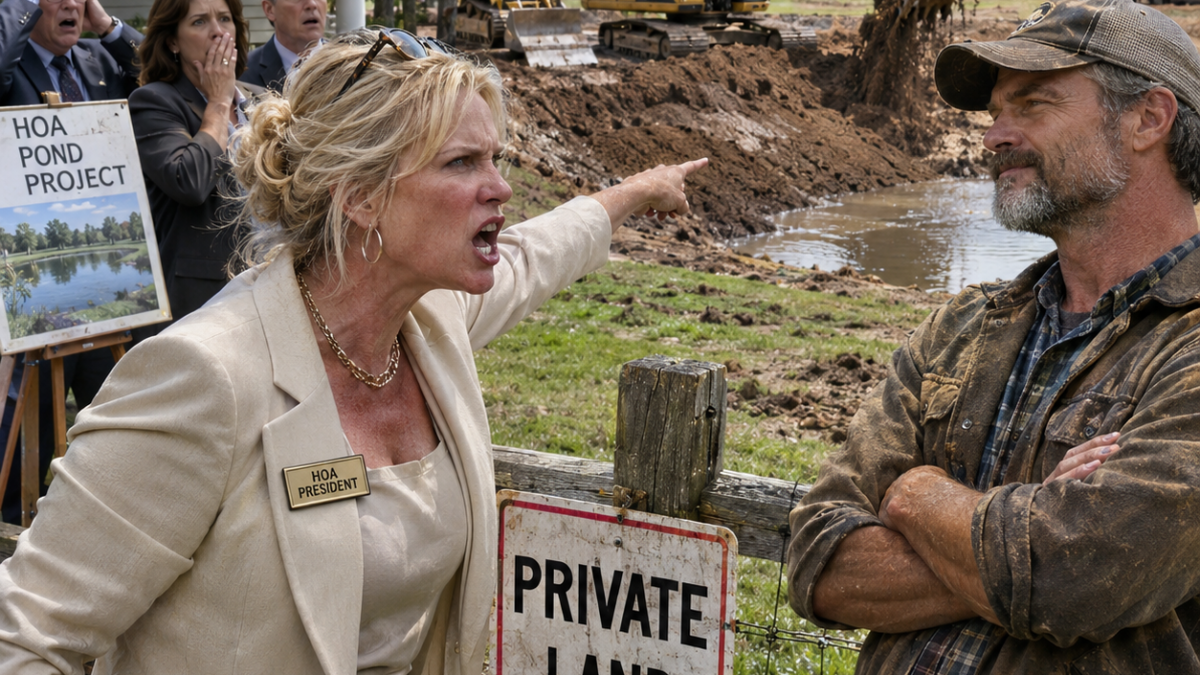
PART 2
The silence lasted maybe three seconds.
It felt much longer.
Brenda recovered first.
“That information is part of the municipal filing.”
“That wasn’t my question.”
“I’m not required to debate permit language with you in your yard.”
“My yard.”
She looked toward the excavator operator.
“Continue.”
I stepped closer to the machine, but not into its working radius.
“Sir.”
The operator looked down at me.
Weathered face.
Gray beard.
Probably in his fifties.
“Do you have proof the owner authorized this?”
Brenda snapped:
“He doesn’t need to discuss contractual matters with you.”
The operator looked from her to me.
Then back.
I held up my phone.
“I’m Grant Thompson. I own this property.”
That changed something.
Not dramatically.
But his hands stopped moving on the controls.
Brenda’s shoulders stiffened.
“This project is lawfully authorized by the Willowbrook Estates Homeowners Association.”
The operator said:
“Ma’am, you told us HOA-owned drainage tract.”
My stomach dropped.
I turned the camera toward Brenda.
“You told the contractor this was HOA land?”
She looked furious now.
Not because I accused her.
Because the operator had spoken.
“This parcel is subject to an easement.”
“That still doesn’t make it HOA property.”
“You’re not an attorney.”
“No.”
I pointed toward the house.
“But my deed is inside.”
Then to the torn yard.
“And your excavator is outside.”
The operator killed the engine.
The sudden quiet felt enormous.
Birds.
Wind.
My own breathing.
Brenda spun toward him.
“Why did you stop?”
“I need to call my office.”
“You have a signed work order.”
“I have a work order that says association-controlled property.”
“It is.”
I said:
“No, it isn’t.”
He climbed down.
That was the first crack.
—
Within two hours, my yard looked like a construction disaster frozen mid-sentence.
The excavator remained.
Fence down.
Garden torn open.
Flagstone shattered.
Oak untouched, thankfully.
Brenda had left after several increasingly tense phone calls.
The contractor stayed beside his machine waiting for instructions.
Police arrived first.
They looked at the deed.
Looked at Brenda’s paperwork.
Then told me what I expected.
Property dispute.
Civil issue for the moment.
But the city planning department reacted differently.
The phrase “unauthorized excavation on private property” got attention.
So did “retention pond.”
Drainage changes are not cosmetic.
They affect runoff.
Neighbors.
Infrastructure.
Liability.
I called my friend Derek.
Derek was a property lawyer who had developed what he called “a healthy professional dislike of people who use paperwork as camouflage.”
He answered:
“Please tell me you’re exaggerating.”
“I wish.”
“She really has an excavator?”
“Still here.”
“On your deeded parcel?”
“Yes.”
“Permit number?”
I read it to him.
“Give me twenty minutes.”
It took forty-three.
When he called back, his voice sounded almost cheerful.
“Grant.”
“What?”
“I have the permit application.”
“And?”
“You’re going to enjoy this less than you think.”
“That’s ominous.”
“She listed herself.”
“As what?”
“Property owner.”
I sat down on the broken edge of my grandfather’s garden wall.
“What?”
“The application identifies Brenda Kensington as authorized property owner or owner’s representative for the affected parcel.”
“I never authorized her.”
“I know.”
“Could she claim the HOA did?”
“Not if the HOA doesn’t own your parcel.”
I looked across the damage.
“So she lied on the permit.”
“She made a material representation we need the city to examine.”
“Criminal?”
“Slow down.”
Derek’s tone sharpened.
“This is exactly where homeowners make mistakes. Don’t declare crimes. Preserve facts.”
“She claimed ownership of my land.”
“Yes.”
“She used it to bring an excavator onto it.”
“Yes.”
“And destroy my property.”
“Yes.”
“So what do we do?”
“We let the city tell us what that means.”
—
Inspector Patricia Reeves arrived the next morning.
She was maybe fifty.
Dark hair.
Steel-framed glasses.
A city jacket zipped halfway up.
She carried a tablet and the expression of someone who did not appreciate having her department dragged into neighborhood theater.
Brenda arrived ten minutes later.
Naturally.
Hard hat again.
Clipboard again.
No excavator movement.
Patricia asked:
“Ms. Kensington?”
“Yes.”
“Did you submit this permit application?”
“I did on behalf of Willowbrook Estates.”
“You identified yourself in the ownership field.”
“As authorized representative.”
Patricia turned the tablet.
“Your application does not say authorized association representative. It identifies you as having authority over this parcel.”
Brenda smiled tightly.
“That’s clearly a clerical issue.”
“Who owns the parcel?”
“The property is subject to association drainage rights.”
“That isn’t what I asked.”
Brenda looked at me.
Then back.
“Mr. Thompson is the titled owner.”
Patricia tapped something.
“Did Mr. Thompson sign an authorization?”
“The covenants provide—”
“Did he sign one?”
“No.”
“Did you attach a current easement document?”
“Yes.”
“Where is it?”
Brenda handed over a photocopy.
Patricia scanned it.
Then looked at the excavation.
“Work stops.”
Brenda blinked.
“We’re in the middle of an emergency drainage project.”
“Work stops.”
“The HOA has authority—”
“I am not adjudicating your HOA authority. I am telling you the permit basis is disputed, ownership representations are inconsistent with the deed, and no additional excavation occurs until this is resolved.”
The operator had already started loading tools.
Brenda stared at him.
“You’re under contract.”
He gave her a look that said the contract was becoming less interesting by the minute.
Patricia turned to me.
“Do not alter the excavation yet.”
“Why?”
“Because I need the site documented.”
That hurt.
I wanted the hole gone immediately.
But she was right.
Evidence first.
Restoration later.
I had learned that lesson already.
—
A week passed.
The crater remained.
Rain turned parts of it to mud.
My grandfather’s garden looked like a wound.
Every morning I stood at the kitchen window and felt the same pressure behind my ribs.
I could replace soil.
I could reset stone.
I could replant tomatoes.
But memory doesn’t understand replacement.
One afternoon I found an old hand trowel half buried near the torn beds.
Wooden handle.
His initials burned into it.
G.T.
Same as mine.
He had given it to me when I was twelve and then taken it back because, according to him, I “left tools wherever gravity got tired.”
I washed the mud off.
Set it on the kitchen counter.
That nearly broke me more than the excavator had.
—
Then Brenda sent the certified letter.
Three pages.
She accused me of interfering with HOA infrastructure.
Claimed my confrontation had caused project delays.
Claimed equipment costs might be assessed to me.
Then, on page three:
The easement.
1962 plat.
Drainage corridor across the exact part of my property she had excavated.
Old county stamps.
Survey notation.
Aged document.
It looked real.
I called Derek immediately.
“She has an easement.”
“Send it.”
I scanned everything.
Twenty minutes later:
“Looks real at first glance.”
“That’s bad.”
“It’s inconvenient.”
“That’s lawyer language for bad.”
“No. Bad is when you have no questions left.”
“What questions?”
“Why this document appeared after work stopped.”
“Maybe she already had it.”
“Maybe.”
“You don’t believe that.”
“I believe documents leave trails.”
—
Derek hired a surveyor he trusted.
Tom Berkshire.
Tom arrived with enough equipment to map a moon landing.
GPS receiver.
Laser instruments.
Tripod.
Tablet.
Old plat copies.
Current county maps.
He worked three hours.
Measured the destroyed yard.
Fence line.
Recorded monuments.
Compared bearings.
Then sat on the tailgate of his truck with the 1962 document.
“Drainage corridor existed.”
I closed my eyes.
“So she was right?”
“I didn’t say that.”
He used a magnifier.
Pointed to a notation near the lower corner.
“Look.”
Tiny text.
County clerk notation.
1987.
Abandonment.
I read it twice.
“What does that mean?”
“It means the easement was formally terminated or abandoned according to the recorded notation.”
“So it died.”
“Ask Derek for the legal version.”
“But practically?”
“Practically, I would not assume anyone can act today under a right formally abandoned decades ago.”
I felt something loosen inside me.
Then tighten again.
“Why would Brenda have a copy without the abandonment obvious?”
Tom looked at me.
“That’s the more interesting question.”
—
The document bothered me.
Not just because it was old.
Because it was too useful.
Exact corridor.
Exact location.
Exact story Brenda needed.
So I requested HOA records.
Financials.
Vendor payments.
Legal bills.
Colorado law and the covenants gave homeowners access to a lot more than Brenda liked to advertise.
The records arrived incomplete.
Then more arrived after Derek sent a letter.
Eighteen months of payments to a Denver firm.
Research.
Historical property review.
Easements.
Title work.
Then one February invoice caught my eye.
$847.
**Historical document reproduction and aging services.**
I stared at it.
Aging services?
I called Derek.
“You seeing this?”
“Yes.”
“What does that mean?”
“Could be legitimate reproduction work.”
“Or?”
“Don’t jump.”
“I’m getting tired of not jumping.”
“That’s why I’m the lawyer.”
Fair.
We obtained more documentation.
The firm had provided historical research materials and reproduced old property instruments for HOA use.
The exact scope became critical.
Derek warned me not to call anything forged until an expert established what had happened.
But even without that conclusion, the pattern was ugly.
Brenda had spent thousands researching dormant or abandoned property rights across multiple homes.
Not just mine.
She had been looking for old legal hooks.
Anything she could wave in front of people who didn’t know how to read the history behind them.
That changed the size of the problem.
—
Janet Washington brought me her folder.
Seventeen notices.
I counted.
One cited Christmas lights in July.
She laughed without humor.
“The lights were in my basement.”
Miguel Garcia came next.
Monthly barking-dog notices.
He did not own a dog.
His wife was allergic.
Mr. Kowalski arrived with a shoebox.
Grass violations.
Setback complaints.
Mailbox measurements.
He held up one notice.
“She measure my grass three inch.”
“How tall was it?”
“Two.”
“How do you know?”
“I measure after she leave.”
He looked offended.
“Good ruler.”
There it was.
Not one feud.
A pattern.
—
The discriminatory pattern bothered me most.
The families targeted most heavily were also the families Brenda seemed to treat as outsiders.
The Washingtons.
The Garcias.
Mr. Kowalski.
Me, because I fought.
Derek told me:
“Document differences. Don’t label motive until we can prove motive.”
That became difficult.
Because intent seemed obvious when you stood in my dining room surrounded by notices.
But law cares about evidence, not what feels obvious.
So we built evidence.
Property comparison.
Violation type.
Dates.
Rule cited.
Similar properties ignored.
Board votes.
Statements.
No speeches.
Just records.
—
Then code enforcement arrived over an anonymous complaint that I was running a commercial landscaping business from my house.
Julie Martinez stood at my door looking apologetic.
“We’re required to inspect.”
“Come on.”
She inspected my tools.
Rakes.
Shovels.
Old mower.
Wheelbarrow.
Tool shed.
No commercial trucks.
No employee parking.
No customer traffic.
No invoices.
No sign.
Nothing.
Julie closed her tablet.
“I’m finding no evidence of commercial operations.”
“Who complained?”
“Anonymous online complaint.”
“Can I obtain it?”
“You can make a records request.”
I did.
The complaint used a fake name.
Detailed ordinance references.
Aerial photographs.
Somebody had worked hard.
The digital origin later became part of the investigative trail.
I stopped thinking Brenda was simply angry.
She was scared.
And scared people who are used to control often become reckless.
—
I organized a neighborhood potluck.
Not a protest.
Not officially.
Food first.
Records second.
Twenty-three families came.
I covered three folding tables with documents.
Permit application.
Easement history.
Financial records.
Violation comparisons.
Janet stood first.
Then Miguel.
Then Mr. Kowalski.
Then the Hendersons.
Then families I had barely known.
Stories came out.
Brenda had isolated us so effectively that most of us thought our own harassment was unique.
By the end of the evening, seventeen households signed formal complaints requesting review of the HOA’s enforcement pattern and financial practices.
Three agreed to provide sworn statements if necessary.
The room changed.
People who had spent years whispering started comparing dates.
That was Brenda’s real defeat.
Not yet legal.
Social.
Isolation was gone.
—
She reacted the next morning.
Police report.
She claimed I had threatened her during a property inspection.
Sergeant Williams called.
“When did this occur?”
She gave a date.
I checked.
That date had video.
I had been standing in my driveway recording from twenty feet away.
No threat.
No physical approach.
No raised fist.
No weapon.
Just me telling her to leave.
Williams reviewed the footage.
Then asked me:
“Any history between you?”
I laughed.
“How much time do you have?”
He didn’t laugh.
Fair.
I gave him the file.
Another document.
Another contradiction.
—
Then Derek found the detail that blew open Brenda’s claimed presidency.
The original neighborhood structure.
Willowbrook Estates began with voluntary guidelines.
Later, mandatory covenants were adopted.
But older properties were not automatically bound unless owners opted in according to the underlying documents.
Derek spent a night tracing property histories.
At six in the morning, he called me.
“Coffee.”
“What?”
“Make it.”
“That bad?”
“That good.”
I made coffee.
He said:
“Brenda bought her property before the mandatory structure took effect.”
“So?”
“So I cannot find any opt-in instrument recorded for her parcel.”
I stopped.
“She isn’t in the HOA?”
“Not the mandatory association structure she claims to govern, based on what I’m seeing.”
“That’s impossible.”
“That’s what I thought.”
“She’s president.”
“She’s acting as president.”
“She’s been elected.”
“By an association she may not have been eligible to join.”
I sat down.
Every notice.
Every board vote.
Every “emergency power.”
Every threat.
Everything shifted.
“How did nobody catch this?”
“People assume.”
“Management company?”
“Assumed.”
“Board?”
“Assumed.”
“City?”
“They saw her title on applications and assumed somebody else verified it.”
I looked toward the ruined yard.
“That pond…”
“Still unauthorized.”
“Worse now?”
“Much.”
—
I wanted to destroy her.
That is the truth.
For maybe twenty-four hours, I imagined every possible humiliation.
Public meeting.
Newspaper.
Handcuffs.
Bankruptcy.
Everything.
Then Derek came to my house.
He looked at the evidence boards.
Looked at me.
“Careful.”
“With what?”
“Enjoying this too much.”
“She dug up my grandfather’s garden.”
“I know.”
“She harassed families.”
“I know.”
“She used fake authority.”
“I know.”
“Then why are you defending her?”
“I’m defending you from becoming stupid now that you’re finally winning.”
That shut me up.
He pointed toward the evidence.
“Justice is enough.”
I stared at him.
“Sometimes.”
“Make it enough.”
He was right.
I hated that.
—
So we planned restoration.
Legal.
Permitted.
Professional.
No midnight stunt.
No sabotage.
No dangerous retaliation.
I wanted the pond erased.
More accurately, I wanted my land restored.
Tom Berkshire connected me with Ray, an excavation contractor.
Ray walked the yard.
Measured.
Whistled.
“Who did this?”
“HOA.”
“No.”
“Yep.”
“How much authorization?”
“None.”
He shook his head.
“Restoration’s around twelve grand.”
I grimaced.
Then told him the full story.
Ray looked toward the crater.
“Eight.”
“What?”
“Eight thousand.”
“Why?”
“I’ve spent thirty years getting blamed for bad excavation somebody else ordered.”
He spat into the dirt.
“I’d enjoy fixing one.”
We shook hands.
—
We scheduled the restoration for the same morning as a community meeting.
Not to create chaos.
Because city officials needed to inspect the remediation and residents wanted answers.
Inspector Reeves agreed to attend.
Sergeant Williams arranged for law-enforcement presence because emotions were running high.
Reporter Jennifer Martinez from the Denver Post community desk became interested once she saw the permit filings, financial questions, and governing-document issues.
Derek coordinated everything.
I sent invitations to forty-three households.
**Emergency Community Meeting: Pond Project, Property Rights, Governance Review.**
No accusations.
No “Brenda Exposed.”
No drama in print.
The documents would supply enough.
—
Brenda came to my door at 8:30 that morning.
She brought two people.
Janet Ferguson, the HOA treasurer.
And a lawyer named Ronald Ashford.
Ronald handed me a card.
“Ms. Kensington has retained me.”
“Personally?”
His pause was tiny.
“Yes.”
Interesting.
Brenda spoke first.
“The HOA is willing to resolve this.”
“What does that mean?”
“All fines against you withdrawn.”
“Go on.”
“Full compensation for documented property damage.”
“Go on.”
“In exchange, you discontinue activities that disrupt normal HOA operations.”
I looked at Janet.
“Did the board authorize this settlement?”
Janet’s face changed.
“The board hasn’t formally met.”
Brenda cut in.
“Executive authority allows—”
Janet turned.
“Does it?”
Brenda stared at her.
Janet continued:
“Did we vote to excavate Grant’s land?”
“Emergency provisions—”
“Yes or no?”
Ronald stopped writing.
Brenda looked toward him.
Then Janet asked:
“Did we approve the legal research expenses involving historical documents?”
Ronald’s pen stopped entirely.
Brenda’s face hardened.
“This is exactly the manipulation I warned you about.”
Janet’s voice became colder.
“I sign the checks, Brenda.”
Nobody spoke.
“I don’t remember authorizing those invoices.”
Ronald closed his notebook.
“Perhaps we should postpone substantive discussion until I review the association records.”
That told me everything.
Brenda had hired a lawyer and not told him the story.
—
She threatened defamation before leaving.
I smiled.
Not because I wanted a lawsuit.
Because truth backed by records gives threats a different weight.
“Community meeting starts in an hour,” I said.
“Come present your position.”
Ronald looked at Brenda.
She said nothing.
They left.
Janet remained on my porch for a second.
Then said:
“I’ll be at the meeting.”
“Good.”
“Grant?”
“Yes?”
“I’m sorry.”
I didn’t know what to say.
So I nodded.
—
At 9:45, Ray’s excavator arrived.
Smaller than Brenda’s original machine.
Still loud enough to bring people outside.
He posted permits.
Insurance.
Restoration plan.
Inspector Reeves inspected everything.
Ray climbed into the cab.
“Ready?”
I looked at my grandfather’s garden.
“Do it right.”
“Only way I know.”
Hydraulics whined.
Bucket moved.
Soil shifted.
But this time every movement had a purpose.
Grading.
Backfilling.
Drainage correction.
Stone recovery.
Topsoil placement.
Restoration.
Neighbors began gathering.
Some brought chairs.
Mrs. Smith brought coffee.
Bob Martinez showed up with binoculars for reasons nobody understood.
Teenagers watched because excavators are irresistible at any age.
For the first time since the damage, the yard was moving toward home again.
—
Then Brenda arrived.
In a sheriff’s patrol car.
For half a second, my stomach dropped.
She stepped out passenger side.
Pointed toward Ray.
“This is the unauthorized destruction I reported.”
Deputy Martinez looked at the machine.
Then at Reeves.
Patricia stepped forward.
“This work is fully permitted.”
Brenda’s expression tightened.
“He is removing community infrastructure.”
“This is private property.”
“There is a drainage easement.”
“Abandoned.”
“That’s disputed.”
“Not for purposes of this permit.”
Brenda pointed at the soil piles.
“That material belongs to the HOA.”
Even Ray looked over.
“Ma’am.”
His voice carried from the cab.
“That’s dirt.”
“It was removed as part of a community project.”
Ray stared.
“From his yard.”
“Yes.”
“And I’m putting it back in his yard.”
“You don’t understand property law.”
Ray looked at me.
“I’m gonna keep digging.”
“Please do.”
—
Deputy Martinez asked Brenda:
“You mentioned restraining-order violations when you called.”
“I’m seeking an order.”
“So there is no current order?”
“Not yet.”
“Then please do not represent to dispatch that an existing order has been violated.”
Brenda flushed.
“I said I was in the process—”
The deputy held up one hand.
“Ma’am. Filing inaccurate police reports can create separate issues. I need precise facts.”
The crowd had grown.
Folders appeared.
Janet Washington.
Garcias.
Mr. Kowalski.
The reporter.
Photographer.
Brenda looked around.
She finally realized this was no longer a private fight between her and me.
That was the moment I had been waiting for.
Not fear.
Recognition.
—
Inside the community center, forty-seven residents packed a room designed for thirty.
Derek stood beside me.
Three folding tables held our documents.
Projection screen.
Timeline.
Permit.
Deed.
Easement.
Financials.
Covenants.
Notices.
Neighbor statements.
Brenda sat front row beside Ronald.
Janet Ferguson sat several seats away.
Far enough to make a point.
I started with one question.
“Who actually has legal authority to act for this HOA?”
Derek took over.
He explained the original structure.
Voluntary guidelines.
Later mandatory covenants.
Older properties not automatically included without proper opt-in.
Then he held up Brenda’s deed history.
“Ms. Kensington purchased her home before the mandatory HOA framework took effect.”
Murmurs.
He continued.
“We have located no valid recorded opt-in document binding her parcel to the mandatory association structure.”
Someone said:
“What?”
Derek didn’t dramatize.
“That raises a fundamental eligibility problem.”
Brenda stood.
“This is absurd.”
Ronald touched her arm.
She ignored him.
“I have served as duly elected president for three years.”
Derek nodded.
“That does not cure eligibility.”
“Everyone recognized my authority.”
“Recognition is not the same as legal qualification.”
The room erupted.
—
Janet Washington shouted:
“Then what about my seventeen violation notices?”
Miguel Garcia stood.
“What about my dog fines? I don’t have a dog.”
Mr. Kowalski waved a ruler.
“And my grass!”
The room laughed.
Not because his anger was funny.
Because absurdity finally had witnesses.
Derek raised his hand.
“Please. One at a time.”
Brenda turned toward the room.
“These accusations are politically motivated.”
I stepped forward.
“No.”
She looked at me.
“You built this entire campaign because you resent legitimate enforcement.”
“You dug a pond on my property.”
“Under emergency authority.”
The room went quiet.
Derek looked at Deputy Martinez.
The deputy’s pen stopped.
He looked directly at Brenda.
“Are you stating that you personally ordered the excavation?”
Brenda froze.
Ronald leaned toward her.
Too late.
She said:
“I authorized necessary drainage improvements on behalf of the HOA.”
“Using what authority?”
“My authority as president.”
Derek spoke:
“The same office for which your eligibility is now in serious dispute.”
Ronald whispered:
“Brenda, stop.”
She turned on him.
“I hired you to defend me.”
“I am advising you not to continue making statements.”
That landed harder than anything I could have said.
—
Inspector Reeves stepped forward.
She confirmed the permit irregularities.
No theatrics.
No promises of prison.
Just facts.
Ownership information inconsistent with title.
Abandoned easement.
Unauthorized excavation.
Restoration permit valid.
Then Jennifer, the reporter, asked:
“Ms. Kensington, did the board vote on the pond project?”
Brenda looked at Janet.
Janet answered instead.
“Not in any properly noticed meeting I attended.”
Another murmur.
Then:
“Did the board approve the historical-document research expenses?”
Janet again:
“Not to my knowledge.”
Brenda snapped:
“You signed checks.”
“I signed payment batches based on summaries you provided.”
“And you never asked questions.”
Janet looked at her.
“I’m asking now.”
That was the end of their alliance.
—
We presented the financial records.
Not accusations.
Payments.
Law firm.
Historical research.
Document reproduction.
Expenses tied to easement investigations.
Then the neighborhood enforcement pattern.
Washingtons.
Garcias.
Kowalski.
Others.
Similar properties ignored.
Targeted homes cited repeatedly.
I did not call it ethnic cleansing.
I did not need rhetoric.
The chart was worse.
Numbers.
Dates.
Names.
People could see.
—
Then Brenda made one final attempt.
“This meeting has no legal authority to remove me.”
Derek said:
“You may be right about the meeting’s power to remove someone who was never eligible to hold office.”
Laughter broke out.
Even Ronald closed his eyes.
Brenda grabbed her bag.
I said:
“Before you leave, I want one thing on the record.”
She turned.
“My property will be restored.”
“Fine.”
“You will not enter it.”
“I never personally—”
“You stood there directing the excavator.”
Silence.
“You told the contractor you had authority.”
Silence.
“You filed the permit.”
Ronald stood.
“We’re done.”
He guided her toward the exit.
For once, Brenda followed someone else’s instructions.
—
Outside, Ray’s excavator was nearing completion.
The crater was disappearing.
Layer by layer.
Soil restored.
Grade corrected.
Topsoil spread.
The oak still standing.
Flagstones stacked for resetting.
The garden would take longer.
But the wound was closing.
Brenda stopped on the sidewalk.
Watched.
Maybe for thirty seconds.
Then got into her car.
Not the patrol car.
Her own.
She left.
No speech.
No final threat.
That felt right.
—
What followed took months.
Not one satisfying afternoon.
Months.
Investigations.
Audits.
Interviews.
Restitution calculations.
Permit review.
Association restructuring.
Brenda eventually entered agreements resolving multiple allegations and paid restitution to affected homeowners.
The final amount tied to various claims and settlements was substantial.
Her tenure ended.
She sold her house.
Moved away.
The neighborhood did not celebrate in the street.
We were too tired.
But people slept better.
That counted.
—
The Denver Post story ran.
Not exactly the revenge headline people later repeated.
But strong enough.
A photograph showed Ray’s excavator restoring my yard while Brenda argued with officials nearby.
The image spread locally.
I hated the attention.
Janet loved it.
Mr. Kowalski had three printed copies.
One laminated.
Of course.
—
The association held a legitimate election.
This time eligibility was verified first.
Janet Ferguson became president.
She won overwhelmingly.
Her first action:
Independent legal review of governance documents.
Second:
Conflict-of-interest rules.
Third:
No major property action without recorded board approval and ownership verification.
Fourth:
Full financial transparency.
Online records.
Meeting notices.
Minutes.
Vendor contracts.
No more “trust us.”
Trust was something you rebuilt.
Not something you demanded.
—
The pond restoration cost about eight thousand.
Restitution ultimately covered it.
Ray restored the grade.
Rebuilt part of the path.
Replaced damaged irrigation.
The fence went back.
The garden took longer.
That first spring, I stood in the dirt with my grandfather’s old trowel.
The beds looked too new.
I hated that.
His garden had never looked new.
It had layers.
Old boards.
Weathered stone.
Uneven corners.
History.
You can restore land.
You cannot manufacture age.
So I stopped trying.
I planted tomatoes.
Beans.
Peppers.
The same varieties he used when I was a kid.
I left one cracked flagstone unrepaired.
Because I remembered him tripping over it every summer and refusing to replace it.
“Stone’s fine,” he’d say.
“It’s trying to kill you.”
“Then walk smarter.”
I kept it.
—
The oak survived.
That mattered most.
One branch had been damaged by equipment.
An arborist trimmed it.
The tree recovered.
By midsummer it cast shade over the new beds.
I sat beneath it some evenings.
I would put my hand against the bark and think about my grandfather.
He would have hated the HOA drama.
He also would have found the excavator restoration extremely entertaining.
He loved machinery.
—
Willowbrook changed.
The new board created a community garden.
Not on my property.
Not through an “emergency easement.”
A vacant lot was acquired properly.
Vote.
Purchase.
Permit.
Survey.
All of it.
We donated starter plants from my grandfather’s garden.
Tomatoes.
Herbs.
Peppers.
Mrs. Smith expanded her sunflower competition into a neighborhood festival.
Mr. Kowalski became the unofficial grass expert.
Nobody asked him.
He brought his ruler anyway.
Miguel Garcia started growing herbs.
Janet Washington organized potlucks.
For the first time in years, meetings involved planning something people actually wanted.
—
One Sunday morning, I walked to the community garden carrying tomato starts.
A little girl followed me.
“Are those yours?”
“They were my grandfather’s variety.”
“Your grandfather grew tomatoes?”
“Thousands.”
“Why?”
“To eat.”
She considered that.
“That’s a lot of tomatoes.”
“He had opinions.”
“What kind?”
“Mostly about tomatoes.”
She accepted that.
I showed her how deep to plant the stem.
She pressed soil around it with both hands.
That did more for me than any court result.
My grandfather’s garden had been destroyed.
Now part of it was growing in twenty different yards.
Brenda tried to erase a legacy.
She accidentally multiplied it.
—
We also created a small legal-aid fund.
I used part of my restitution payment.
Not all.
I had my own restoration costs.
But enough.
Property disputes.
HOA questions.
Boundary issues.
Code enforcement.
First consultation free for qualifying homeowners.
Derek helped organize volunteer attorneys.
Within the first year, twenty-three families across the Denver area received assistance.
Most cases were not dramatic.
Fence.
Easement.
Notice.
Fine.
Title.
But the difference between panic and strategy is often one hour with someone who knows what the document actually means.
That became the fund’s purpose.
—
One case got to me.
Young couple.
First baby on the way.
Repeated code complaints.
Then a below-market purchase offer from an investor.
Different neighborhood.
Different people.
But I recognized the pattern.
They called.
Derek reviewed everything.
The complaints were mostly baseless.
The investor disappeared once counsel asked for written explanations.
The couple stayed.
Derek called.
“Thought you’d want to know.”
“They’re staying?”
“Yes.”
I was standing in my garden.
Tomatoes waist-high.
“Good.”
“That’s all?”
“What do you want me to say?”
“Maybe thank your brilliant attorney.”
“I’ll think about it.”
He laughed.
I hung up.
Then I sat under the oak.
That one felt like my grandfather handing me back something Brenda had tried to take.
—
Ray’s business got busy after the story.
He started advertising property restoration after unauthorized grading and drainage disputes.
His slogan:
**WE FIX WHAT SHOULDN’T HAVE BEEN BROKEN.**
I told him it sounded like a movie.
He loved it.
He kept the slogan.
—
Years passed.
The restored yard stopped looking restored.
That was the best part.
Grass grew.
Stone weathered.
Fence faded.
Garden soil darkened.
The oak dropped leaves.
Nothing looked new anymore.
History returned.
One morning, I realized I could no longer see exactly where the pond had been.
I stood there trying to locate the original edge.
Couldn’t.
That made me unexpectedly emotional.
For years, the crater had existed in my head even after the dirt was replaced.
Now the land had forgotten.
Maybe I could too.
—
Janet served two terms.
Then stepped down.
No fight.
No power struggle.
Normal election.
That seemed revolutionary after Brenda.
Her final report included:
Reserve balance.
Vendor list.
Legal expenses.
Meeting attendance.
Every figure visible.
Someone joked:
“Too much information.”
Janet answered:
“After Brenda, there is no such thing.”
Fair.
—
Mr. Kowalski died a few years later.
Eighty-seven.
His family asked whether the neighborhood garden could plant something in his memory.
We planted ornamental grass.
The irony was perfect.
A small plaque:
**STANISLAW KOWALSKI — MEASURED EVERYTHING, TRUSTED NOTHING.**
His daughter laughed until she cried.
—
The Washingtons stayed.
So did the Garcias.
That mattered.
Brenda’s system had relied on making certain families feel temporary.
Like the neighborhood belonged more to some residents than others.
After she left, Willowbrook became messier.
More gardens.
Different mailbox colors.
More kids.
More languages.
Some people hated that.
Most didn’t.
Property values did not collapse.
Society survived blue mailboxes.
—
One afternoon, Janet found me resetting a section of flagstone.
“Still working on that?”
“Always.”
“You know you could hire someone.”
“I know.”
“Then why don’t you?”
“My grandfather laid these.”
“Your grandfather is not grading your work.”
“You didn’t know him.”
She laughed.
Then became serious.
“Do you regret the meeting?”
“What part?”
“The public part.”
I thought about it.
“I regret needing it.”
“Not doing it?”
“No.”
She nodded.
“Me neither.”
Then:
“I signed some of those checks.”
I stopped working.
She looked toward the garden.
“I’ve thought about that a lot.”
“You didn’t know.”
“I should’ve.”
“Probably.”
She looked at me.
I shrugged.
“What do you want? Me to lie?”
She smiled faintly.
“No.”
“You asked questions when it mattered.”
“Late.”
“Still mattered.”
That was enough.
—
The old fake easement copy remains in my records.
Not because I admire it.
Because it reminds me how authority can be manufactured visually.
Old paper.
Stamp.
Legal language.
Plat lines.
People see those things and assume truth.
But documents have histories.
Easements are created.
Modified.
Released.
Abandoned.
Rights live in chains of title, not in whatever photocopy someone waves at you.
That became another workshop topic for the legal-aid fund.
Derek teaches it.
He starts every session by holding up the reproduction.
Then asks:
“What is this?”
People answer:
“An easement.”
He says:
“No. It’s a piece of paper claiming to describe an easement.”
That distinction saves people.
—
One of the younger homeowners asked me once:
“Why didn’t you just fill the pond immediately?”
I told him:
“Because I was angry.”
He looked confused.
“That’s why you waited?”
“Yes.”
“If I’d brought equipment in immediately, Brenda would’ve claimed I destroyed evidence, damaged drainage infrastructure, violated permits, whatever else she could invent.”
“So waiting helped?”
“Hated every day of it.”
“But yes?”
“Yes.”
Patience is easy to praise after it works.
While you’re living it, patience feels a lot like doing nothing.
That is the hard part.
—
The first anniversary of the restoration, Ray stopped by.
No reason.
He brought coffee.
We stood near the garden.
“You know,” he said, “that pond was badly shaped.”
I laughed.
“That’s what you remember?”
“I’m an excavator operator.”
“Heavy machinery critique?”
“Grade was wrong. Spillway concept was wrong. Compaction was bad.”
“So even her illegal pond was incompetent?”
“Deeply.”
“That’s comforting.”
“It shouldn’t be.”
Fair.
—
Eventually, people stopped introducing me as “the pond guy.”
Thank God.
For a while, that was my identity.
Grocery store.
Community events.
Hardware store.
“Oh, you’re the guy whose HOA dug the pond.”
No.
I was Grant.
Grandson.
Gardener.
Homeowner.
Man who liked old tools.
The story was something that happened to me.
Not what I was.
That distinction took time.
—
The legal-aid fund expanded.
Not huge.
Still local.
But useful.
We helped homeowners request records.
Read covenants.
Understand hearings.
Find surveyors.
Know when to call a lawyer.
Know when not to.
Most importantly, we taught people not to turn every HOA dispute into a war.
Sometimes the board is right.
Sometimes the homeowner is wrong.
Sometimes a fence really does cross a line.
Sometimes a drainage project really is necessary.
Authority is not automatically abuse.
Abuse is authority without accountability.
That was the lesson Brenda taught us accidentally.
—
One summer, Willowbrook actually needed a drainage project.
Heavy rains.
Lower lots flooding.
The irony was not lost on anyone.
At the meeting, Janet’s successor presented engineering studies.
Maps.
Costs.
Proposed easements.
Consent forms.
Public comment.
One route crossed the edge of my property.
Everyone looked at me.
I laughed.
“You’ve got to be kidding.”
The engineer looked nervous.
“It’s the least disruptive alignment.”
I read the survey.
This time:
Real.
Necessary.
Limited.
Compensation offered.
Restoration terms.
Everything disclosed.
I signed.
Someone asked:
“After everything, you’re letting them dig?”
“Yes.”
“Why?”
“Because they asked.”
That was the difference.
Not the dirt.
Consent.
Procedure.
Trust.
The project took four days.
They restored the grass.
No garden damage.
No oak damage.
No war.
That may be the clearest proof Willowbrook changed.
—
The little girl who planted my grandfather’s tomatoes grew up.
Her name was Lily.
By high school, she volunteered in the community garden.
Senior year, she applied for an environmental-science program.
The neighborhood scholarship helped with books.
At the award dinner, she found me.
“Remember when you taught me tomatoes?”
“No.”
She frowned.
“You do.”
“Yes.”
She held up the scholarship letter.
“I wrote about the community garden in my application.”
“That’s dangerous.”
“Why?”
“You might become an HOA officer.”
“Absolutely not.”
“Smart.”
She laughed.
Then said:
“My mom told me the garden exists because somebody destroyed yours.”
I looked toward the window.
“No.”
“She said—”
“The garden exists because people decided to build one.”
Lily thought about that.
“Isn’t that the same thing?”
“No.”
Destruction explains why we were angry.
Building explains who we became.
She nodded slowly.
I’m not sure she agreed.
That was fine.
—
Eventually I stopped keeping all the evidence in my dining room.
Three boxes went to Derek’s archive.
One stayed in my fireproof cabinet.
The walls became walls again.
Dinner table became a dinner table.
The first night after I cleared everything, I sat there eating alone and felt strange.
For three years, conflict had occupied physical space.
Maps.
Notices.
Photographs.
Now there was nothing but a bowl and a glass.
Quiet can feel empty when you’ve been fighting too long.
I had to relearn peace.
—
I started inviting neighbors over.
Not evidence meetings.
Actual dinners.
Janet.
Miguel and his wife.
Washingtons.
Mrs. Smith.
Ray sometimes.
Derek if he promised not to talk law.
He never kept that promise.
Kids ran under the oak.
People ate tomatoes from the garden.
My grandfather would have complained they were picking them too early.
I could hear him.
“Still got green shoulders.”
I started saying it too.
Then realized I was becoming him.
Could be worse.
—
One evening, Miguel asked:
“You ever wish you’d sold when Brenda started?”
“No.”
“Never?”
I thought.
“There were mornings.”
He nodded.
“Us too.”
“Why didn’t you?”
“My wife.”
“What’d she say?”
“Why should we move because somebody else wants us uncomfortable?”
I raised my glass.
“To stubborn wives.”
His wife yelled from across the yard:
“I heard that.”
We laughed.
That sound—neighbors laughing under my grandfather’s oak—was better revenge than watching Brenda leave.
—
The media eventually moved on.
Of course.
Another scandal.
Another headline.
Another neighborhood.
Jennifer Martinez called once on an anniversary.
“Any comment on what changed?”
I said:
“We learned to read before voting.”
“That’s your quote?”
“Yes.”
“It’s boring.”
“Perfect.”
She used it anyway.
—
Years later, Derek retired.
Mostly.
He became impossible about it.
“I am no longer accepting clients.”
Then he accepted three legal-aid fund cases.
I called him.
“You’re bad at retirement.”
“I’m selective.”
“You’re addicted to documents.”
“Better than golf.”
True.
At his retirement dinner, I gave him a framed copy of the abandoned easement.
He stared at it.
“You are a terrible person.”
“You love it.”
He hung it in his office.
—
Ray retired too.
Sold the excavation company to his foreman.
The slogan stayed.
He visited once in a new pickup.
We stood in the backyard.
He pointed at the garden.
“Can’t even tell.”
“No.”
“That’s good work.”
“Yours.”
“Ours.”
I appreciated that.
—
One spring, the oak got sick.
Fungus.
Arborist came.
For a week I was terrified.
Not because of property value.
Because it was his tree.
My grandfather’s hands had placed it.
The arborist treated it.
Removed one limb.
Adjusted drainage.
Tree recovered.
I sat under it afterward and thought about the pond again.
Brenda almost took it.
Then nature almost did.
Only one of those made me angry.
You can’t argue with age.
You can argue with entitlement.
—
The community garden installed a plaque years after everything ended.
No Brenda.
No scandal.
Just:
**WILLOWBROOK COMMUNITY GARDEN
ESTABLISHED BY RESIDENT VOTE
GROW WHAT YOU SHARE**
That was Janet’s idea.
Good one.
My grandfather would have liked the last line.
He gave away half his tomatoes every year and then complained nobody returned his baskets.
—
I kept his trowel.
Same one I found in the mud after the excavation.
Wood handle worn smooth.
Initials burned in.
G.T.
When Lily graduated college, she visited.
Now studying watershed management.
She saw the trowel in the shed.
“That the famous one?”
“Nothing about my gardening tools is famous.”
“My mom told me.”
“Your mom talks too much.”
Lily picked it up carefully.
“This survived the pond?”
“Yes.”
She handed it back.
“Good.”
One word.
Exactly right.
—
The final time I saw Brenda’s name in an official document was a restitution closure notice.
Accounts satisfied.
Case closed.
I read it.
Filed it.
Did not celebrate.
There is something deeply satisfying about a closed file.
Not because the other person loses.
Because you are no longer required to keep the file open.
That was freedom.
—
A few months later, I found the original HOA violation over my grandfather’s roses.
Sightline obstruction.
Fourteen days to comply.
I took it outside.
Stood beside the roses.
They were blooming.
Still not obstructing anything.
I considered throwing the notice away.
Then decided to keep it.
Not anger.
History.
I put it behind the deed.
Not in front.
That ordering mattered.
The deed came first.
Then the noise.
—
Willowbrook never became perfect.
Thank God.
Someone complained about parking.
Someone else complained about pool hours.
One board member talked too long at meetings.
Teenagers left trash near the garden.
Mrs. Smith accused Mr. Kowalski’s nephew of cheating at the sunflower competition.
Life.
Normal conflict.
The difference was nobody could weaponize the system alone anymore.
Records were visible.
Votes mattered.
Authority had boundaries.
That was enough.
—
The night I finally understood the whole thing was not the day Brenda lost power.
It was years later.
Summer.
Barbecue in my backyard.
Oak overhead.
Kids running through grass.
Community garden vegetables on the table.
Ray visiting.
Derek complaining about retirement.
Janet arguing with Mrs. Smith about whether zucchini counts as a useful crop.
Miguel laughing.
Someone had music playing too loud.
Nobody cared.
I looked toward the exact place the illegal pond had been.
Couldn’t find it.
Not approximately.
Exactly.
The soil had settled.
Grass blended.
Garden expanded.
Flagstone path weathered.
The land no longer displayed the damage.
I stood there holding a plate.
Derek came beside me.
“You’re doing the thing.”
“What thing?”
“Staring at dirt like it owes you an explanation.”
I pointed.
“Where was the pond?”
He looked.
“Over there.”
“No. More left.”
“Maybe.”
We both studied it.
Couldn’t tell.
Derek smiled.
“Well.”
“What?”
“It’s gone.”
I thought about that.
Not filled.
Not covered.
Gone.
In every way that mattered.
Ray’s excavator had done its job years earlier.
Time finished the restoration.
—
Later that night, after everyone left, I walked the yard alone.
Picked up cups.
Moved chairs.
Checked the garden.
The oak leaves moved gently overhead.
I stood beside my grandfather’s old tomato bed.
That morning years earlier, Brenda had believed a clipboard and a title allowed her to turn that ground into whatever she wanted.
She was wrong.
Not because I owned a better lawyer.
Not because I brought a bigger excavator.
Not because a newspaper wrote about her.
She was wrong because property rights, community authority, and trust all depend on something she never respected:
Consent.
Limits.
Accountability.
The garden smelled like wet soil and tomato leaves.
The same smell I remembered from childhood.
I picked one tomato.
Turned it over.
Red.
Still a little green near the shoulder.
I heard my grandfather in my head.
Too early.
I smiled.
Put it back.
Then I looked across a yard where no pond remained, beneath an oak Brenda had nearly destroyed, beside a path rebuilt stone by stone.
For three years, she had tried to convince us that community meant obedience.
What remained after her was something better.
Neighbors.
Gardens.
Open records.
Arguments resolved by votes instead of threats.
Children growing tomatoes where fear used to grow.
I turned off the porch light and went inside.
Behind me, the yard settled into darkness.
No excavator.
No clipboard.
No fake emergency.
Just my grandfather’s land, finally quiet again.
[END OF STORY]








