PART 2: HOA Demolished the Fence I Built on My Own Land — They Never Checked Who Actually Owned the Road
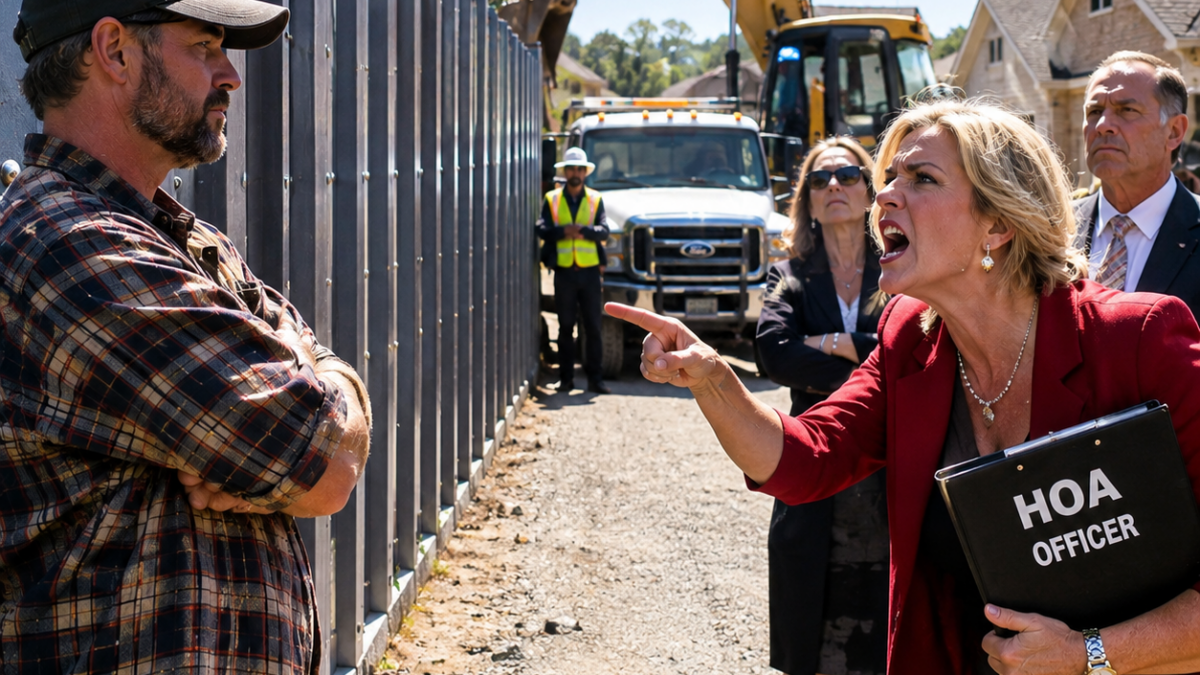
PART 2
I stared at that last page long enough that the clerk finally asked whether I needed another copy.
“Actually,” I said, “I need three.”
She looked at the document.
“Boundary issue?”
“Something like that.”
I paid fourteen dollars in copying fees and drove straight home.
Dolph was already there.
He had been digging too.
That was what Dolph did when something bothered him. He didn’t complain. He found records.
He was seventy, retired from a machine shop, and had the patient mind of somebody who had spent forty years working from tolerances measured in thousandths of an inch.
He sat at my kitchen table while I spread out the county documents.
“You found it,” he said.
“You knew?”
“I suspected.”
He tapped the plat map.
“That road was never public.”
“Granddad signed a use agreement.”
“With the Beckfords.”
“Expired when the last Beckford sold in 2009.”
Dolph nodded.
“No new easement.”
I leaned back.
“So for six years…”
“They’ve been using your property.”
“Without permission.”
“Looks that way.”
I thought about the landscaping trucks.
The gravel.
The chicken pen.
Constance standing in her cream coat while an excavator destroyed a fence built to stop unauthorized traffic.
Then I thought about what she had said.
The HOA has access rights.
She had sounded absolutely certain.
Either she had never checked, or she had checked and assumed nobody else would.
Both possibilities bothered me.
Dolph poured himself coffee.
“What are you going to do?”
“Nothing tonight.”
“That’s smart.”
“I’m not sure I like smart.”
“You’ll like it more than expensive.”
He was right.
The next morning, I installed temporary orange safety fencing across the south end of the service road.
Steel T-posts.
Bright plastic mesh.
Nothing aggressive.
Nothing permanent.
A white sign in black letters:
**PRIVATE PROPERTY
NO RECORDED EASEMENT
ROAD USE AGREEMENT EXPIRED 2009
CONTACT GARRETT PRUITT**
Then I put my phone number at the bottom.
Constance called before lunch.
“Garrett.”
“Morning.”
“You’ve blocked community access.”
“I blocked my property.”
“That road has been used continuously by Sycamore Ridge contractors.”
“That doesn’t make it yours.”
“It is an established community route.”
“Show me the easement.”
Silence.
Then:
“Our management company has documents.”
“Great. Send them.”
“You cannot interfere with essential HOA operations.”
“If Vantage has a recorded easement, send me the book and page number.”
Another silence.
Then she hung up.
I smiled.
Not because I had won.
Because for the first time, she had ended a conversation before telling me what I was required to do.
That lasted less than two days.
A county code officer named Dennis showed up.
Thin guy.
Late forties.
Clipboard.
The expression of a man who already wished he were somewhere else.
“Mr. Pruitt?”
“That’s me.”
“We received a complaint regarding temporary fencing.”
“From Sycamore Ridge?”
He gave me a careful smile.
“I don’t usually identify complainants.”
“Fair.”
He looked at the plastic barrier.
“County rules allow temporary safety fencing for thirty days.”
“I know.”
“How long has it been up?”
“Two.”
He wrote something.
“I’ll take it down before thirty.”
“Or replace it?”
“Maybe.”
He looked at me.
“What kind of replacement?”
“Permanent.”
That got his attention.
I handed him the plat.
“The complaint also mentioned access.”
He read the document.
Then the expired agreement.
He frowned.
“There’s no recorded easement?”
“Not that the recorder’s office can find.”
Dennis looked down the road.
Then toward the subdivision.
Finally, he wrote something else.
“I’m not issuing anything today.”
“Appreciate it.”
He handed back the papers.
“Mr. Pruitt?”
“Yeah?”
“If this turns into a property-rights dispute, get an attorney before you build anything expensive.”
“That’s the plan.”
He left.
That afternoon, I called Haskell Tran.
Real-property lawyer.
Murfreesboro.
Recommended by another tradesman who had once fought a boundary dispute over a shared driveway.
Haskell’s office was small.
No dramatic skyline.
No leather walls.
Just books, maps, and a coffee maker that looked older than my truck.
He reviewed the documents.
The HOA covenants.
The plat.
The expired agreement.
Constance’s demolition letter.
My video.
The temporary fence complaint.
Finally he leaned back.
“Their argument is going to be established use.”
“Meaning?”
“They’ll say they’ve used the road long enough that they’ve acquired some right to continue.”
“Have they?”
“Six years?”
“Yes.”
“No.”
I waited.
“In Tennessee, claims based on adverse use generally require a much longer period and specific elements. Six years isn’t going to magically become ownership because landscapers got comfortable.”
“So I shut it down.”
“You can.”
“Today?”
“You could.”
“But?”
Haskell smiled.
“You sound like you know how lawyers work.”
“I’ve worked around inspectors.”
“Same instinct.”
He pulled out a pad.
“I would send formal notice first.”
“To Constance?”
“To the HOA and Vantage.”
“Why?”
“Because right now they can still claim confusion.”
He wrote as he spoke.
“Give them sixty days to either negotiate a legitimate recorded easement or stop using the road.”
“What happens if they keep using it?”
“After notice?”
“Yes.”
“Every documented crossing strengthens your trespass claim.”
I looked at him.
“So I give them enough rope.”
“I would never phrase it that way.”
“But yes?”
He smiled.
“Basically.”
The letter went certified.
One to Constance.
One to Vantage Community Solutions.
The management company.
Formal notice.
Expired agreement.
No recorded easement.
Sixty days.
Negotiate or stop.
A reasonable board would have called.
Maybe negotiated a maintenance agreement.
Maybe offered to repair damage caused by years of truck traffic.
Maybe even apologized about the fence.
Constance filed a complaint against me instead.
She claimed the temporary barrier interfered with community operations.
Then she made a post in the neighborhood Facebook group calling me a “hostile legacy landowner attempting to hold the community hostage.”
I wasn’t in the group.
Dolph read the post to me.
“Legacy landowner,” he repeated.
I sat quietly.
“Sounds fancy.”
“It isn’t meant kindly.”
“No.”
My family had been there more than fifty years.
Constance had lived there four.
Yet somehow I was being described like an outdated obstacle to the neighborhood around me.
I felt anger.
Not the hot kind.
The useful kind.
I printed the post.
Added it to the folder.
Then called my cousin Rayford.
Rayford ran a steel supplier and fabrication yard in Dickson County.
Six foot four.
Slow voice.
Never rushed a measurement.
I asked:
“How much to build something that stops trucks?”
Long silence.
“What kind of trucks?”
“Landscaping pickups. Trailers.”
“Where?”
“Property line.”
“Legal?”
“Yes.”
“Permanent?”
“Yes.”
Another pause.
“I’ll come Saturday.”
Rayford arrived at eight.
We walked the south line three times.
He crouched.
Dug fingers into the clay.
Looked at grade.
Measured road width.
Then:
“What do you want it to look like?”
“Like a fence.”
“What do you want it to do?”
“Stop vehicles.”
“Different questions.”
“That’s why I called you.”
He almost smiled.
I told him about the agricultural-use exemption Haskell had mentioned.
My property still had chickens.
A garden.
Old agricultural classification history.
Haskell had told us not to assume anything and to verify the applicable county and state requirements before relying on an exemption.
We did.
The design had to function genuinely as boundary fencing rather than some disguised roadway barricade built only to cause harm.
That was fine.
I wanted a boundary.
Rayford sketched.
Square steel posts.
Galvanized.
Concrete footings.
Horizontal rails.
Spacing wide enough for a person.
Not wide enough for a pickup.
No spikes.
No hidden hazards.
Nothing designed to injure anybody.
The purpose was simple:
Vehicles stop before entering private property.
People could walk through.
Animals stayed contained.
Trucks could not pass.
Rayford pointed at the drawing.
“Eleven posts.”
“How deep?”
“Three feet.”
“Overkill?”
“For a fence?”
“Yes.”
“For you sleeping at night?”
“No.”
“Do it.”
Before we ordered steel, Haskell reviewed the design.
Then Rayford checked local requirements.
We made adjustments.
No surprise permits.
No setback issue.
No obstruction of public right-of-way.
Everything sat on my side of the line.
Legal.
Visible.
Boring.
That last part mattered.
I did not want a trap.
I wanted something nobody could pretend they hadn’t seen.
Meanwhile, Constance started working the neighborhood.
A community meeting.
PowerPoint.
Property values.
Contractor delays.
“Hostile legacy landowner.”
Miriam Goss called me afterward.
Miriam had served on the board for six years.
Late sixties.
Retired teacher.
Soft voice.
Persistent in the way only somebody who spent thirty years teaching middle school can be persistent.
“She had maps,” Miriam said.
“Of what?”
“Your property.”
“Of course.”
“She says blocking the south road will raise landscaping costs.”
“Probably.”
“She says your new structure may depress values.”
“I haven’t built it.”
“She has renderings.”
I laughed.
Then stopped.
“Miriam.”
“Yes?”
“Why are you calling me?”
She was quiet.
“I’ve been trying to resign from the board.”
“For how long?”
“Fourteen months.”
“What?”
“She keeps tabling it.”
“She can’t imprison you on an HOA board.”
“I know.”
“Then why stay?”
Another silence.
“Because every time I try to leave, something happens and I think maybe I should stay one more meeting.”
I understood that.
“What do you think about the road?”
“I think there’s no easement.”
“What about the fence demolition?”
“I voted against it.”
I sat straighter.
“The letter had your signature.”
“She said the vote was already approved and asked us to sign the notice.”
“You signed?”
“Yes.”
Regret filled her voice.
“I shouldn’t have.”
I didn’t answer immediately.
Then:
“Will you talk to Haskell?”
“Yes.”
That was the first crack in Constance’s board.
I didn’t know how wide it would become.
Haskell found the second.
Vantage Community Solutions.
Remember that name.
They managed Sycamore Ridge and ten other associations.
Haskell pulled corporate records.
Management agreements.
Vendor contracts.
He called me while I was welding.
I shut off the machine.
Lifted my helmet.
“What?”
“Vantage takes referral fees.”
“For what?”
“Contractor work.”
“How much?”
“Twelve percent.”
I sat on a steel stool.
“You mean whenever the HOA hires a contractor through Vantage…”
“Vantage gets twelve percent.”
“From who?”
“Vendor.”
“Disclosure?”
“Buried in a master contract.”
“Homeowners know?”
“Not from the documents I’ve seen.”
I thought about the excavator.
“Hargrove.”
“Yes.”
“The contractor that destroyed my fence.”
“Preferred Vantage vendor.”
“So Vantage made money when the HOA tore down my fence?”
“Potentially, yes.”
I felt my jaw tighten.
“How much?”
“Your demolition job was small.”
“That’s not what I mean.”
“I know.”
He paused.
“We need records.”
Miriam brought them.
Two days later, she arrived carrying a banker’s box.
She set it on my kitchen table.
“Everything I kept.”
Board minutes.
Vendor approvals.
Contract amendments.
Budget summaries.
Emails.
Meeting packets.
She had copies going back years.
Then she said:
“Bradford knew.”
Bradford Sutton.
Board member.
Rental-property owner.
Constance’s closest ally.
“Knew what?”
“Referral fees.”
“How?”
“He negotiated the Vantage renewal.”
Miriam sat down.
“I found out eight months ago.”
“What happened when you raised it?”
“Constance adjourned the meeting.”
“That’s it?”
“She said I was creating confusion around standard management practices.”
Dolph, sitting across from her, snorted.
“Confusion is a useful word when you don’t want to say money.”
Miriam looked exhausted.
“I should have pushed harder.”
“No.”
I shook my head.
“You’re here now.”
She looked at the box.
“So are these.”
That night, we spread records across my kitchen.
Haskell joined by video.
A woman named Darla Ferris—Dolph’s daughter-in-law, a nonprofit accountant—helped review the numbers.
Landscaping.
Paving.
Maintenance.
Tree removal.
Structural work.
Fence demolition.
Vantage’s preferred-vendor network appeared again and again.
Referral percentages.
Vendor invoices.
Management fees.
Some disclosed only inside contracts most homeowners had never seen.
Darla ran the math.
“Confirmed amount?”
Haskell asked.
“In Sycamore alone?”
“Yes.”
She looked at her spreadsheet.
“Just over fifty-three thousand dollars tied to referral structures we can verify from these records.”
Miriam stared.
“Fifty-three?”
“Over five years.”
“And nobody was told?”
“Not in the homeowner disclosures I’ve seen.”
Darla leaned back.
“I’m not calling it criminal.”
Haskell nodded.
“Good.”
“But it’s a conflict issue.”
“Yes.”
“And if the board approved contracts without meaningful disclosure…”
“Potential fiduciary problem.”
Dolph looked at me.
“All because they tore down your fence.”
“No.”
I looked at the records.
“That’s just why we started looking.”
The steel arrived the following Monday.
Rayford brought Cecil and Tuck.
Both fabricators.
Both quiet.
We started at seven Saturday morning.
Auger.
Concrete.
Galvanized tube.
Measured line.
Eleven posts.
Each on my property.
Each visible.
Each aligned.
I had spent years welding pipe systems where one bad joint could shut down a plant.
Building a fence was almost relaxing.
Almost.
Rayford watched me check the first post with a level.
“You planning to measure that again?”
“Yes.”
“You already measured it twice.”
“I know.”
“Your granddad do that?”
“Worse.”
Rayford nodded.
“Family problem.”
By sunset, the first five stood.
Gloss black.
Straight.
Heavy.
The following weekend we finished the rest.
Horizontal rails.
Strong welds.
No sharp edges.
Galvanized chains between access openings.
It looked serious.
Not ugly.
Industrial, maybe.
But clean.
Professional.
A boundary nobody could confuse with orange plastic.
Dolph came over.
Put one hand on a rail.
“Think a truck can get through?”
“No.”
“Good.”
I looked toward the service road.
“That’s the point.”
The first Hargrove truck arrived Monday morning.
My trail camera notified me.
I opened the feed from the fabrication shop.
White pickup.
Magnetic company sign.
Fifteen miles an hour.
The driver saw the steel.
Brake lights.
Truck stopped several feet short.
He sat there.
Probably confused.
Then backed all the way down the service road.
No crash.
No damage.
No confrontation.
Exactly how I wanted it.
I sent the clip to Haskell.
He replied:
**Perfect. Preserve original file.**
Constance posted a picture online that afternoon.
The caption described my steel boundary as evidence of hostility.
Contractors blocked.
Landscaping delayed.
Community harmed by “one resident’s vendetta.”
Thirty comments supported her.
Seventeen asked questions.
That was new.
What referral fees?
Why was the fence demolished?
Where was the easement?
Why had Miriam complained about board procedure?
The conversation was changing.
Then somebody vandalized the steel.
Saturday morning.
Red paint.
**REMOVE THIS NOW**
Two posts.
Scratch marks on another.
I stood looking at it.
Fresh aerosol smell.
Cold air.
My first instinct was rage.
Take a grinder.
Build it higher.
Install floodlights.
Confront Constance.
Instead, I called Orville Beck.
Retired sheriff’s deputy across the road.
He came over.
Looked.
“Camera?”
“Triggered.”
“Face?”
“Blocked angle.”
He studied the ground.
“Call the sheriff.”
I did.
Report.
Photographs.
No accusation.
Then I cleaned the paint.
The galvanized steel underneath was fine.
Rayford had insisted on good coating.
I repositioned cameras.
Added a second.
Cloud backup.
Wider angle.
Haskell approved.
Then I called Tess Odom.
Reporter at the Clarksville Gazette.
We had spoken twice before.
General terms.
No accusations.
That morning I said:
“We’re getting close.”
“To what?”
“A meeting.”
“Public?”
“Yes.”
“Records?”
“Yes.”
“Can I attend?”
“I’ll give you the date.”
Miriam meanwhile had started doing something more powerful than Facebook.
Kitchen conversations.
Quiet homeowners.
New section.
Older section.
Not the people who commented on every post.
The people who paid dues and assumed someone else understood the contracts.
She showed documents.
Not opinions.
Vantage contract.
Referral clause.
Fence-removal invoice.
Board minutes.
Expired road agreement.
One neighbor asked:
“Why didn’t anybody tell us?”
Miriam answered:
“That’s the problem.”
Three days before the annual meeting, Constance scheduled a separate “informational session.”
New section residents only.
Night before the full membership meeting.
Clubhouse.
A rally.
Miriam called.
“I’m going.”
“You’re older section.”
“I pay dues.”
“Are you invited?”
“No.”
“Then?”
“Haskell checked the bylaws.”
Common facility.
All members had equal access to association meetings held there unless properly closed for a recognized legal reason.
This wasn’t.
Miriam went.
Darla went.
Stu Hardwick went.
Stu was a retired civil engineer who loved mechanical pencils and hated imprecise language.
During questions, he raised his hand.
“Can you explain Vantage Community Solutions’ vendor compensation model?”
Constance said:
“That’s not relevant to tonight’s discussion.”
Stu nodded.
“Then I’ll narrow it.”
He held up the master services contract.
“Does Vantage receive a percentage when Sycamore Ridge uses vendors selected through their network?”
People turned.
Constance’s expression tightened.
“That agreement contains standard industry provisions.”
“What percentage?”
“This is not a financial audit.”
Stu waited.
“What percentage?”
Someone behind him said:
“I’d like to know too.”
Then another voice.
“Me too.”
Constance ended questions ten minutes early.
That night, in my shop, I finished a display board.
Four feet by three.
No fancy graphics.
Timeline.
1974 road agreement.
2009 expiration.
No recorded easement.
Fence built.
Fence denied.
Fence removed.
Notice served.
Truck crossings after notice.
Vantage contract.
Referral-fee clause.
Confirmed amount.
$53,400.
Vandalism report.
Photographs.
Haskell’s demand letter.
TREC complaint acknowledgment.
Everything had a source.
Everything could be checked.
I stared at the board until almost midnight.
My father used to say fabrication was mostly preparation.
The welding was the visible part.
But if the cut was wrong, the fit-up wrong, the measurement wrong, the final bead only made the mistake permanent.
This felt the same.
The meeting would be the weld.
The months before it were the fit-up.
Tess called.
“Tomorrow?”
“Tomorrow.”
Orville stopped by.
He had checked the plate from the silver sedan that had been sitting near my property.
Registered to a background-investigation business.
“Private investigator?” I asked.
“Maybe.”
“Who hired them?”
“Don’t know.”
I added it to the folder but not the display.
No proof.
No speculation.
That discipline mattered.
At six-thirty the following evening, I arrived at the Sycamore Ridge community center.
By six-forty-five, ninety people were there.
More than twice normal attendance.
I set the display on an easel.
Tess sat near the back.
Photographer beside her.
Miriam sat with Dolph and Darla.
Stu had three sharpened pencils lined up on his notepad like ammunition.
Orville sat quietly against the wall.
Constance arrived at six-fifty.
Bradford behind her.
She saw the display.
Stopped.
Walked directly toward me.
“That is not approved agenda material.”
“Open comment period.”
“This is harassment.”
“Section 4.7 gives every member five minutes.”
“You are creating legal exposure for the association.”
“Haskell has reviewed every document.”
Her eyes moved to the dollar figure.
$53,400.
Bradford saw it too.
His face changed.
Not much.
Enough.
Constance said:
“You’re making accusations based on contracts you do not understand.”
“Then explain them during your five minutes.”
Her mouth tightened.
She walked away.
The meeting started.
Constance moved fast.
Treasurer report.
Grounds.
Pool.
Maintenance.
Landscaping renewal.
Stu raised his hand.
“Motion to table the Hargrove landscaping renewal pending an independent audit of all Vantage vendor referral arrangements.”
Miriam:
“Second.”
Constance stared.
“We have a contract obligation.”
Stu replied:
“The motion is to table renewal, not breach an active contract.”
“We have operational deadlines.”
“Then call the vote.”
She did.
Fifty-one to thirty-eight.
Motion passed.
The room shifted.
You could feel it.
Constance had lost a vote.
Not in private.
Not in a three-person committee.
In front of homeowners.
She sat straighter.
Then came open comment.
My name was third.
I walked to the podium.
Five minutes.
I didn’t look at Constance at first.
I looked at the residents.
“My grandfather bought the property along the south boundary in 1971.”
Then the plat.
“The road many HOA contractors use crosses private property.”
Agreement.
“The last recorded use agreement expired in 2009.”
No easement.
“We notified the HOA and Vantage.”
Camera stills.
“Seven contractor vehicles crossed after formal notice.”
Then the fence.
“They removed a cedar fence I built on my own property because they claimed the HOA had access rights.”
I held up the demolition notice.
“Those rights are not recorded.”
The room was quiet.
Then Vantage.
I pointed at the contract.
“The management company receives vendor referral compensation.”
Then the numbers.
“Based on records available to homeowners, more than fifty-three thousand dollars in referral-related charges and payments can be traced through Sycamore Ridge vendor relationships over five years.”
Constance stood.
“This is misleading.”
A man I didn’t know spoke from the third row.
“Please let him finish.”
She looked at him.
Then sat.
I continued.
“I’m not accusing anyone in this room of a crime.”
That mattered.
“I am saying homeowners have a right to know how contractors are selected, who benefits financially, and why those relationships were not clearly disclosed to the people paying dues.”
I pointed to the TREC acknowledgment.
“A complaint regarding Vantage’s management practices is under preliminary review.”
Then my demand letter.
“Haskell Tran has requested a full accounting.”
Then the fence-removal invoice.
“The same preferred-vendor system financially benefited Vantage when a contractor was sent to remove my fence.”
Murmurs.
I looked at Constance.
Not triumphantly.
Just directly.
“You told me the HOA had the right to use my road.”
She said nothing.
“You told homeowners I was blocking community property.”
Nothing.
“The county records say otherwise.”
I looked back at the room.
“I didn’t come here to tell anyone how to vote.”
Then I pointed toward the board.
“I came here because if somebody spends your money or acts in your name, you should be able to see the documents that give them the right.”
I stepped away.
Tess was writing fast.
The photographer had taken shots of the display.
Constance rose.
“The board will respond in writing to any legitimate financial inquiry.”
Darla raised her hand.
“Why not answer now?”
“Because selective excerpts from complex contracts require legal review.”
Darla stood.
“I’m an accountant.”
A few people laughed.
Constance didn’t.
Darla continued.
“The referral-fee clause is not complex.”
Bradford interrupted.
“These are standard vendor incentives.”
Darla turned toward him.
“Were homeowners told?”
He opened his mouth.
Closed it.
“Were they disclosed in annual financial statements?”
“Management expenses were reported.”
“That wasn’t my question.”
Miriam spoke next.
“I raised this eight months ago.”
The room quieted.
Constance looked at her.
Miriam’s hands shook slightly.
But her voice didn’t.
“I asked why Vantage was receiving money connected to contractors selected through Vantage.”
“Miriam,” Constance said, “that discussion was resolved.”
“No.”
Miriam shook her head.
“You adjourned the meeting.”
“That is not an accurate characterization.”
“I have the minutes.”
Miriam lifted a folder.
“I also have my notes.”
For the first time, Bradford looked toward the exit.
The officer-election segment came forty minutes later.
Before nominations began, Bradford stood.
“I am resigning effective immediately for personal scheduling reasons.”
Nobody believed the reason.
Nobody challenged him.
He left.
Miriam nominated Darla for the vacant seat.
The vote wasn’t close.
Constance stayed.
Rigid.
Silent.
At nine-thirty, meeting adjourned.
Outside, people clustered around Tess.
Around Miriam.
Around Haskell, who had arrived midway through.
Nobody clustered around Constance.
She walked to her car alone.
Three days later, she resigned by email.
No explanation.
No farewell.
Just:
**Effective immediately.**
I read the message twice.
Then closed my phone.
Dolph was in the shop.
“That it?”
“For her board seat.”
“You disappointed?”
“No.”
“You look disappointed.”
“I expected more noise.”
He smiled.
“Best machines shut down quiet when the power is cut.”
The civil case continued.
Haskell filed against Vantage.
The state review continued separately.
Other HOA communities managed by Vantage began pulling their own contracts.
Three contacted Haskell’s office.
Vantage suddenly had more than Sycamore Ridge to worry about.
Negotiations started.
Ninety days later, they settled.
Terms confidential.
But the Sycamore Ridge homeowner fund received a substantial payment tied to disputed referral compensation and associated claims.
My fence damage claim—$847.60—was paid.
With interest.
I framed the check.
Rayford saw it.
“You’re weird.”
“I know.”
“Why frame eight hundred dollars?”
“It cost them more than eight hundred dollars.”
He laughed.
The seven documented post-notice truck crossings were not pursued as separate lawsuits.
Haskell folded them into settlement leverage.
“Cleaner,” he told me.
“You don’t want seven little cases when one large agreement fixes the underlying problem.”
That was another thing I learned.
Justice is not always maximizing punishment.
Sometimes it is getting the structure right so the problem cannot repeat.
The service road finally got a legitimate easement.
Negotiated.
Recorded.
Clear boundaries.
Annual nominal payment earmarked for maintenance.
Specific vehicle width.
Hours of use.
Repair responsibilities.
No vague “established use.”
No assumption.
No handshake from 1974 being treated like eternal permission.
Everything went into county records.
I insisted the steel boundary remain.
The easement used a controlled opening farther east.
Contractors no longer drove through the section beside my garden.
Rayford came back.
Added decorative cap pieces.
I planted switchgrass.
By spring, the black steel looked less like a barricade and more like it had always belonged there.
Miriam became interim president.
She hated the title.
“I resigned from this board fourteen months ago.”
“No,” Dolph said.
“You tried.”
“Thank you, Dolph.”
“You’re welcome.”
Darla became treasurer.
Stu took architectural review.
His first act was to change the process so no single person could approve or deny exterior modifications.
Three-person committee.
Written reasons.
Appeal heard by members who did not participate in the original decision.
My cedar-fence application would have been approved under the new rules.
That made me laugh.
Miriam asked:
“Do you want to rebuild it?”
I looked at the steel.
“No.”
“Sure?”
“Cedar was pretty.”
“And?”
“Steel has memories.”
She smiled.
The board voted to reduce dues fifteen percent for two years using recovered funds.
Three hundred twelve homeowners benefited.
That mattered.
Not because each household got rich.
They didn’t.
But money that had quietly left the community came back in a form people could see.
The board published contracts online.
Vendor relationships.
Bid summaries.
Management fees.
Conflict disclosures.
Vantage’s contract was not renewed.
A new management company took over under stricter terms.
No undisclosed referral compensation.
No vendor kickbacks.
No board president making architectural decisions alone.
Hargrove Site Services dropped Sycamore Ridge.
Nobody mourned.
The old landscaping schedule changed.
Grass still grew.
Plants survived.
Civilization continued.
Dolph found that deeply satisfying.
“I was told blocking that road would destroy landscaping operations.”
“Apparently the tulips adapted.”
“Heroic.”
One evening in April, we sat on my tailgate.
Beer.
Steel fence ahead of us.
Switchgrass beginning to green.
Dolph said:
“Most interesting neighborhood fight since 1987.”
“What happened in 1987?”
“Shared well.”
“And?”
“Tractor ended up in drainage ditch.”
“On purpose?”
He drank.
“Depends who you ask.”
I laughed.
Then became quiet.
“Granddad would’ve hated all this.”
“No.”
“You sure?”
“He would’ve hated the meetings.”
“Exactly.”
“He would’ve loved the records.”
That was probably true.
Granddad Wendell kept everything.
Receipts.
Property-tax stubs.
Old feed invoices.
The 1974 road agreement had survived because he put it in a metal box with deeds and insurance papers.
That faded agreement was the first domino.
Without it, Constance might have kept saying “community road” until everybody believed her.
Paper outlives confidence.
The state review of Vantage took longer.
I stopped asking Haskell for weekly updates.
Some things move at government speed.
Constance stopped attending community events.
Her house remained.
She rarely spoke to neighbors.
I saw her once at a grocery store.
Frozen foods.
We recognized each other at the same time.
She looked away.
Then back.
“Garrett.”
“Constance.”
She studied me.
“Are you satisfied?”
That was a strange question.
“With what?”
“You know.”
I thought about the fence.
Settlement.
Resignation.
Money.
Meetings.
Steel.
“I’m satisfied the road is legal now.”
Her expression tightened.
“You embarrassed me.”
“I didn’t order the excavator.”
“You turned a property disagreement into a public campaign.”
“You turned it into a property disagreement by entering mine.”
“We believed we had access.”
“The records were available.”
“That wasn’t what Vantage told us.”
There it was.
Not an apology.
But a crack.
I asked:
“Did they tell you about the referral fees?”
She stared at the freezer door.
“I knew there were vendor incentives.”
“Did you tell homeowners?”
“No.”
“Why?”
“They were standard.”
“That’s not an answer.”
She looked at me.
“I thought keeping the neighborhood running mattered more than explaining every contract clause to three hundred people.”
“That’s how people stop knowing what they’re paying for.”
She shook her head.
“You think leadership is easy?”
“No.”
“You think everyone wants every detail?”
“No.”
“Then what?”
“I think they should be able to see it.”
That stopped her.
I didn’t hate Constance.
Not anymore.
I had hated what she did.
The morning of the excavator, I would have enjoyed watching her lose everything.
Months later, that feeling seemed childish.
She had lost the presidency.
Lost credibility.
Lost control.
But she still had a life.
That was enough.
She said:
“I shouldn’t have removed your fence.”
It was almost too quiet to hear.
I looked at her.
“No.”
“I thought if I let you block the road, every older property owner would start challenging access.”
“Maybe they should have.”
“That’s exactly what I was afraid of.”
I understood then.
Not greed alone.
Fear.
The HOA’s systems had been built on assumptions.
Road access.
Vendor arrangements.
Board habits.
Constance had treated challenges as threats because one successful challenge could force people to examine everything else.
She was right.
It did.
“You could have negotiated,” I said.
“I know.”
That was as close as we ever got to peace.
We walked away in opposite directions.
The new board created a scholarship fund with part of the settlement money.
Fifteen thousand dollars to start.
Annual awards for local graduating seniors.
First two recipients:
A young woman studying civil engineering.
A young man entering an electrical trade program.
I went to the ceremony.
The electrical student shook my hand.
“You weld?”
“Yeah.”
“My uncle does pipe work.”
“So did I.”
He smiled.
“I want my own company someday.”
“Then learn bookkeeping before you learn hiring.”
He laughed.
“I thought you were going to say work hard.”
“Everybody says work hard.”
“What do you say?”
“Know where the money goes.”
Darla overheard and pointed at me.
“Finally, something useful.”
The scholarship mattered more than I expected.
It took money that had become a symbol of mistrust and turned it into possibility.
That was better than revenge.
The board also started an annual community festival.
Not a polished branding event.
Cookout.
Music.
Swap tables.
Kids.
Old section.
New section.
The first one smelled like charcoal and cut grass.
Dolph brought honey from his daughter’s bees.
I made chili.
Miriam sat under a tent with no binder in front of her.
I had never seen her look so relaxed.
Stu was explaining drainage to someone who had made the mistake of asking a casual question.
Darla was arguing with the new treasurer about whether a raffle needed separate accounting.
Normal.
Messy.
Human.
That was what Constance’s version of Sycamore Ridge had lacked.
Everything had been polished.
Controlled.
Approved.
But nobody trusted each other.
That day people disagreed without fear.
They laughed.
They traded plants.
They complained about dues.
Nobody got a violation for it.
Late in the afternoon, I walked home along the south edge.
The steel boundary caught the sun.
Black rails.
Tall switchgrass.
The road opening farther east, properly gated and marked according to the new easement.
A landscaping truck came through.
Stopped.
Driver unlocked the approved access point.
Passed.
Closed it behind him.
No tires in my garden.
No gravel in the chicken pen.
No assumptions.
Dolph had followed me.
He stood beside the original section.
“You going to paint it again this year?”
“Maybe.”
“Doesn’t need it.”
“I know.”
“Then why?”
I looked at the rail.
“Because I like taking care of things.”
He nodded.
That was something my grandfather would have understood.
Granddad believed permanence was mostly maintenance.
A house did not stay standing because it was built once.
You kept the roof dry.
Kept water away from the foundation.
Replaced boards.
Painted steel.
Checked hinges.
Same with rights.
Same with communities.
If nobody checks them, they rot.
Years passed.
The steel stayed.
So did the trail cameras, though I checked them less.
No more vandalism.
No more mystery sedan.
No more Hargrove trucks attempting the closed route.
The chickens grew old.
We replaced some.
The garden changed.
My father died two years after the dispute ended.
That was the part of life nobody prepares for while you’re busy fighting over fences.
He had been in assisted living.
His memory came and went near the end.
One afternoon, I brought him a photograph of the steel boundary.
He held it for a long time.
“What’s that?”
“Fence.”
“Ours?”
“Yeah.”
He looked closer.
“Why steel?”
I smiled.
“Long story.”
He handed it back.
“Your granddad would’ve used pipe.”
I laughed.
“Probably.”
Then he said:
“Looks straight.”
From him, that was praise.
After he died, I found one of Granddad Wendell’s old levels in Dad’s storage box.
Wood.
Worn ends.
Bubble still good.
I hung it in the fabrication shop above the framed settlement check.
Rayford saw it.
“Now that’s worth framing.”
“It’s not framed.”
“You know what I mean.”
The following spring, I used that level to check one of the steel rails.
Perfect.
Probably coincidence.
I chose to enjoy it.
A reporter once called me years later asking whether I considered the steel wall an act of revenge.
I told her no.
She sounded disappointed.
“It stopped their trucks.”
“Yes.”
“After they destroyed your fence.”
“Yes.”
“So that’s revenge.”
“No.”
“What is it?”
“A boundary.”
Silence.
Then:
“That’s not as exciting.”
“Probably why it worked.”
I never wanted trucks to hit the steel.
That part of the original story got exaggerated around the neighborhood.
People would say:
“Garrett built a wall that could stop a six-ton truck.”
Rayford encouraged this because Rayford enjoys legends as long as he doesn’t have to tell them quickly.
The truth was better.
The trucks stopped themselves.
They saw it.
Braked.
Backed up.
That was the whole point.
A good boundary doesn’t need to hurt anybody.
It needs to be unmistakable.
The same was true of the legal notice.
The easement.
The contracts.
The audit rules.
The new architectural process.
Clarity prevented conflict better than intimidation ever had.
The new board eventually replaced Miriam.
She finally escaped.
At her retirement from HOA service, the community presented her with a plaque.
She read it.
Started crying.
Then immediately said:
“I hate plaques.”
Dolph whispered:
“She loves it.”
She heard him.
“I do not.”
She kept it.
Darla served two terms as treasurer.
Every quarterly report was so detailed that homeowners joked they knew more about mulch expenses than their own retirement accounts.
She took that as a compliment.
Stu chaired architecture for three years.
Approvals became faster.
Appeals became rare.
Not because people stopped building.
Because standards were clear.
One homeowner wanted a cedar fence.
The committee approved it.
Stu mailed me a copy.
At the bottom he wrote:
**Apparently cedar has become aesthetically acceptable again.**
I pinned it beside the old denial.
Some documents deserve neighbors.
Constance eventually sold her house.
No scandal.
No foreclosure.
Just a listing.
Moving truck.
New family.
I watched from the road as boxes went into the truck.
Dolph came up beside me.
“You going to wave?”
“No.”
“You should.”
“Why?”
“Confuse her.”
I laughed.
When her car pulled away, she looked toward my property.
Toward the steel.
Maybe toward me.
I lifted one hand.
She hesitated.
Then lifted hers.
That was it.
No victory speech.
No apology.
No final confrontation.
Just two people acknowledging each other at the end of a long argument.
I was glad it ended that way.
Because by then, I no longer needed her to lose for me to feel that I had won.
The property was secure.
The road was legal.
The money had been accounted for.
The board was different.
My fence claim had been paid.
Neighbors had learned how their HOA worked.
That was enough.
One evening, Rayford came over with two beers.
We sat on the tailgate where Dolph and I had once admired the cedar fence.
The steel line stood in the same place.
Switchgrass moved behind it.
Rayford said:
“You miss the cedar?”
“Sometimes.”
“Prettier.”
“Yeah.”
“Steel’s better.”
“For trucks.”
“For memory.”
I looked at him.
“That sounded almost poetic.”
“Don’t tell anybody.”
We drank.
The sun dropped over the south road.
A contractor truck approached the authorized gate farther east.
Stopped.
Opened it.
Passed.
Closed it.
Everything exactly as recorded.
Rayford watched.
“You know what that costs them?”
“What?”
“Nothing.”
I smiled.
“Exactly.”
That was the part Constance had never understood.
I wasn’t asking the neighborhood to give up something it owned.
I was asking them to stop taking something it didn’t.
There was a difference.
Once everyone accepted that, negotiation became easy.
The old fight looked almost absurd.
They had torn down a cedar fence because they thought it interfered with an assumed right.
Then spent months defending the assumption.
All they ever needed to do was check the records.
Maybe that’s why I kept the check framed.
Not because of $847.60.
Because that number represented the simplest thing I had asked for from the beginning.
You broke something on my property.
Pay for it.
You want to use my road.
Ask.
You want homeowners to trust contracts.
Show them.
You want authority.
Follow the rules that create it.
None of that was radical.
It only felt radical because people had become used to the opposite.
Years later, a storm knocked a tree across the approved service entrance.
I got a call from the HOA president.
Not Miriam.
A younger guy named Aaron.
“Garrett?”
“Yeah.”
“We’ve got a problem.”
“What?”
“Tree across the easement gate.”
“Okay.”
“Landscaping crew needs access.”
“I’m listening.”
“Could we temporarily route one truck through your old south opening?”
I looked toward the steel.
There was a removable chain section wide enough for my equipment but not the full truck unless we removed one interior rail.
It could be done.
The old Garrett—the one standing on the porch while cedar cracked—might have said no out of principle.
Instead I asked:
“How long?”
“Two hours.”
“Insurance?”
“I’ll email certificate.”
“Driver name?”
“I’ll send it.”
“Ground conditions?”
“Dry.”
“Fine.”
Silence.
“You mean yes?”
“Yes.”
“Seriously?”
“You asked.”
That was the difference.
They asked.
I removed one rail.
The truck passed.
No damage.
Tree cleared.
Truck returned.
Rail went back.
Aaron stopped before leaving.
“Thanks.”
“No problem.”
He looked at the steel.
“I’ve heard stories.”
“I’m sure.”
“They make you sound terrifying.”
“Do I look terrifying?”
He studied me.
“Little bit.”
“Get off my land.”
He laughed.
So did I.
Afterward, I sat on the porch.
The same porch.
Different morning.
No excavator.
No Constance.
No splintering cedar.
Just a properly requested favor between neighbors.
That felt more satisfying than the day the trucks first stopped.
Because boundaries are not walls against everyone.
They are rules for entry.
The best ones make respect possible.
When Dad died, the house officially became the last piece of the old Pruitt property still held by our branch of the family.
I updated the estate plan.
Recorded everything.
Road easement.
Boundary survey.
Fence maintenance.
Shop permits.
Agricultural use.
No ambiguity for whoever came after me.
My daughter asked why I was so obsessive.
I handed her Granddad’s 1974 agreement.
“This.”
She read it.
“An old road contract?”
“Expired road contract.”
“So?”
“So fifty years later, it saved us.”
She looked at me like I was exaggerating.
Maybe I was.
But not much.
One piece of paper proved the difference between permission and ownership.
That difference became the foundation of everything after.
The annual community festival still happens.
The scholarship grew.
Local businesses added donations.
First fifteen thousand became twenty-three.
Then thirty.
One year, a scholarship recipient came to my shop.
Civil engineering student.
She had been one of the first winners.
She was interning with a county transportation office.
She walked the steel line with me.
“This spacing is interesting.”
“Don’t start.”
She laughed.
“I’m serious.”
“So was Rayford.”
She inspected a footing.
“You really set these three feet?”
“Yes.”
“Why?”
“Family problem.”
She smiled.
Then asked:
“Did you really build this because the HOA destroyed a cedar fence?”
“Yes.”
“Worth it?”
I thought.
“Depends what you mean.”
“Would you do it again?”
“No.”
That surprised her.
“Why not?”
“I’d check the road records before I built the cedar fence.”
She laughed.
That was the honest answer.
I wasn’t perfect.
I had built first and submitted paperwork afterward.
Even though the fence was legal and reasonable, that gave Constance an opening.
I had assumed years of contractor use meant somebody must have a legitimate agreement.
I had not checked.
I had ignored small damage because arguing seemed exhausting.
Those choices helped the situation grow.
Being right later did not erase what I could have done earlier.
That humility mattered.
Otherwise, the story becomes too simple.
Garrett good.
Constance evil.
Real life wasn’t that clean.
Constance believed she was protecting a community she had helped organize.
She valued order.
Appearance.
Predictability.
She trusted Vantage more than she should have.
She preferred control to conversation.
When challenged, pride made her worse.
But she wasn’t a movie villain.
She was a person who had enough authority to stop hearing the word no.
That is dangerous all by itself.
The old south boundary is one of my favorite parts of the property now.
Not because of the fight.
Because switchgrass has taken over.
Tall.
Four feet in summer.
Gold in fall.
Birds nest there.
The black rails disappear behind it from certain angles.
You can still see the tops of the steel posts.
Rayford’s caps catch sunlight.
Dolph died the year after my father.
Seventy-six.
Heart attack.
Fast.
Unexpected.
His daughter Darla gave me his old coffee thermos.
The dented stainless one he carried the morning he brought me the plat map.
I keep it in the shop.
Sometimes I use it.
Mostly I don’t.
At the funeral, Darla said:
“Dad talked about your fence more than he talked about grandchildren.”
“That sounds unhealthy.”
“He was proud.”
“Of the steel?”
“No.”
She looked at me.
“Of finding the road agreement.”
I laughed through tears.
“That sounds like him.”
After the funeral, I walked the south line alone.
For the first time, there was nobody beside me who remembered the cedar fence exactly as I did.
Dolph had helped set the posts.
Held the level.
Drank the first beer after we finished.
Then stood in my kitchen with the document that turned the entire dispute.
I put a small brass tag on the inside of one steel post.
Not visible from the road.
Just for me.
**D.F. — MEASURE TWICE.**
Rayford saw it months later.
Didn’t say anything.
He just touched it once.
Some things do not need speeches.
By then the legal disputes were old history.
New homeowners had moved in.
Many did not know Constance.
Some barely remembered Vantage.
That was healthy.
A community cannot live forever inside its worst meeting.
But the systems stayed.
Transparent contracts.
Conflict disclosures.
Recorded easement.
Independent architectural review.
Published minutes.
Those were the parts worth remembering.
The dramatic story was useful once.
The structure was useful afterward.
One summer morning, I was welding in the barn when a landscaping truck stopped near the steel.
New driver.
Young.
He got out.
Looked confused.
I walked over.
“Can I help?”
“Map says road continues.”
“Old map.”
He held up his tablet.
“HOA route?”
“Gate’s farther east.”
“Oh.”
He looked at the steel.
“This always been here?”
“Long enough.”
“Looks serious.”
“It’s a fence.”
He laughed.
“Whatever you say.”
I pointed.
“Take the next left.”
“Thanks.”
He drove away.
No drama.
That might have been the most satisfying moment of all.
The steel had stopped being a statement.
It was infrastructure.
It no longer needed the story behind it.
Neither did I.
I still have the video from the morning the cedar fence came down.
Forty-one minutes.
I watched it once after the settlement.
Never again.
The file sits on a hard drive with tax documents and old family photographs.
I know what happens.
Hydraulic arm.
Cedar cracking.
Tomato plant crushed.
Constance in pearls.
Me holding the phone.
For years, I thought the important part of that video was what they destroyed.
Now I think the important part is what I did not do.
I didn’t charge down the yard.
Didn’t touch the excavator.
Didn’t threaten the crew.
Didn’t give Constance the angry confrontation she probably expected.
I documented.
Then I checked.
Then I built.
That sequence mattered.
Emotion would have given me one morning of satisfaction.
Records gave me the road.
Steel gave me the boundary.
People gave us the community back.
On the fiftieth anniversary of Granddad buying the property, my family came over.
My daughter.
Cousins.
Rayford.
Grandkids running around where the chicken pen used to be.
We cooked outside.
I brought out the old photograph of Wendell and Loretta standing beside the unfinished house.
Concrete foundation behind them.
Granddad skinny.
Grandma holding a hammer like she planned to use it on him if he gave instructions.
My daughter held the picture beside the modern house.
“Looks smaller.”
“It was.”
“Still here.”
“Yep.”
She looked toward the steel boundary.
“So’s that.”
“Hopefully longer than me.”
She rolled her eyes.
“Don’t get dramatic.”
“Runs in the family.”
As the sun went down, Rayford walked toward the fence with me.
We leaned against the inside rail.
“Remember when you called?” he asked.
“Yes.”
“What’d you say?”
“How much to build something that stops a truck?”
He smiled.
“You sounded mad.”
“I was.”
“You still mad?”
I looked through the switchgrass.
“No.”
“Good.”
“Why?”
“Angry people overbuild.”
I stared at the four-inch galvanized posts set three feet into concrete.
“You could have mentioned that earlier.”
“You didn’t ask.”
We laughed.
A breeze moved through the grass.
The road beyond was quiet.
Everything where it belonged.
The cedar fence had been beautiful.
The steel boundary was stronger.
But neither one was the thing that lasted most.
What lasted was the recorded agreement.
The changed board.
The scholarship.
The restored money.
Miriam finally laughing at a cookout instead of clutching board minutes.
Darla explaining budgets to homeowners who now listened.
Stu approving someone else’s cedar fence.
A landscaping driver using the correct gate because the map had finally been updated.
The best thing we built wasn’t the wall.
It was certainty.
I know where my land ends.
The HOA knows where its rights begin.
The county knows where the easement runs.
The contractors know which gate to use.
Nobody has to guess.
Nobody gets to invent authority because guessing is convenient.
One cold morning years later, I carried coffee outside.
Frost covered the switchgrass.
The steel rails were silvered white.
The sun had barely reached the tops of the trees.
For a second, I remembered the other freezing morning.
Excavator.
Splintered cedar.
Constance smiling.
I walked to the nearest post.
Brushed frost from the black paint.
The brass tag for Dolph caught the light.
Behind me, chickens scratched at the yard.
Ahead, the recorded service gate sat closed until somebody with permission needed it.
No truck was trying to force through.
No contractor was crossing without asking.
No board president was standing at the line telling me that years of convenience had become ownership.
The steel didn’t need to stop anybody anymore.
Everybody already knew where to stop.
[END OF STORY]








