PART 2: HOA Demolished My Family Home Over $127 — Then the President Saw My Federal Badge
PART 2
The machine stopped only after I stepped far enough into the operator’s line of sight that he could no longer pretend he hadn’t seen me.
He killed the engine.
The sudden silence was violent in its own way.
A few seconds earlier, steel had been ripping through timber.
Now I could hear insulation fluttering.
Glass settling.
Somewhere behind the house, a dog barking.
I stood in the middle of Grandma’s front yard staring at what used to be the living room.
The wall was gone.
Part of the roof sagged.
My grandmother’s old bookshelf had collapsed sideways into the debris.
A framed photograph lay face-down near the broken porch steps.
I walked toward it.
Delilah called after me.
“Rex, you cannot enter an active remediation zone.”
I kept walking.
“Rex.”
I picked up the frame.
The glass was broken.
Inside was Grandma Rosalie at twenty-three, standing beside my grandfather in front of the house the year they bought it.
1962.
She was laughing.
He looked terrified to be photographed.
I brushed dust off her face.
Then looked at Delilah.
“Who authorized demolition?”
“The board.”
“Who pulled the permit?”
“This was an emergency action.”
“That wasn’t my question.”
She tightened her grip on the clipboard.
“The HOA possesses emergency authority.”
“Permit number.”
“Rex, this combative behavior is exactly why we had difficulty resolving your delinquency.”
Behind her, Marcus Ashworth stood beside one of the trucks.
City councilman.
Construction-company owner.
Delilah’s husband.
He wasn’t smiling.
I looked at the logo on the excavator trailer.
**ASHWORTH CONSTRUCTION SERVICES.**
There it was.
My first clean fact.
I took a photograph.
Marcus stepped forward.
“Why are you photographing our equipment?”
“Because it’s on my property.”
“We’re performing contracted work.”
“Contracted by whom?”
“The HOA.”
“Owned by your wife.”
His face changed.
Only for half a second.
Enough.
I photographed him too.
—
That night, I slept in what remained of my bedroom.
Calling it sleeping is generous.
Blue tarps had been stretched over exposed sections of roof.
Wind snapped them every few seconds.
The house smelled like pulverized drywall, damp insulation, and diesel.
I had electricity in the back half.
Running water, barely.
A working bathroom.
The front part of my childhood home looked like footage from a tornado.
I sat at the kitchen table with Grandma’s photograph beside me.
Sarah’s old coffee mug was in my hand.
I kept thinking about what she would have said.
Not what I wanted her to say.
What she actually would have said.
Sarah hated revenge.
Not justice.
There was a difference.
She used to tell me:
“Don’t become cruel just because somebody else decided to go first.”
That sentence annoyed me in life.
In death, it had become inconveniently wise.
So I did what I knew.
I opened a notebook.
**DATE.**
**TIME.**
**PEOPLE PRESENT.**
**EQUIPMENT.**
**DAMAGE.**
**STATEMENTS.**
**DOCUMENTS.**
Then I backed up every photo.
Cloud.
External drive.
Work laptop.
I made three folders.
One digital.
Two physical.
The federal inspector in me took over.
That part of my brain did not care that the broken window had belonged to Grandma.
It cared that a demolition occurred.
Who authorized it?
What permits existed?
What inspections supported it?
What contractor performed it?
Who paid them?
What emergency justified skipping normal procedure?
Emotion would come later.
First:
Paper.
—
Two days later, Delilah returned.
Clipboard.
Perfume.
Smile.
She stood in my destroyed front yard as though conducting a landscaping review.
“Rex, honey.”
I looked up from a folding table where I had spread insurance forms.
“I hope you understand the board had no choice.”
“Actually, I don’t.”
“Well, structural instability threatened neighboring properties.”
“Which engineer determined that?”
She hesitated.
“The board reviewed the condition.”
“Which engineer?”
“The HOA has discretion in emergencies.”
“Permit?”
“Again, this fixation on permits—”
“Permit number.”
She exhaled.
“Now, about your outstanding balance.”
I almost laughed.
She handed me a statement.
The number had changed.
$8,450.
I read the breakdown.
Original dues.
Late fees.
Administrative penalties.
Emergency demolition cost.
Debris-management fee.
Community-disruption assessment.
I looked up.
“You demolished my house and billed me for it?”
“You created the conditions requiring intervention.”
I set the paper down.
“Delilah, show me the municipal authorization.”
Her eyes sharpened.
“Why are you so obsessed with municipal paperwork?”
That answered more than she intended.
I smiled.
“No reason.”
She left ten minutes later.
I watched her white BMW disappear around the corner.
Then went to the county offices.
—
Fifteen years as a federal building inspector had taught me something civilians sometimes underestimate:
Government loves records.
Even when government loses records, it creates records explaining why it lost the records.
Demolition permits do not simply evaporate.
Emergency structural orders do not exist only in somebody’s memory.
If a building is dangerous enough to justify immediate demolition, somebody has to document why.
I searched.
Address.
Parcel number.
Owner.
Contractor.
Nothing.
No demolition permit.
No emergency order.
No city engineer’s report.
No condemnation.
No inspection.
No municipal authorization.
The woman behind the counter checked twice.
“Could it be under another parcel?”
“No.”
“HOA common area?”
“No.”
“Court order?”
“Not that I see.”
She printed the search result for me.
I thanked her.
Then searched Ashworth Construction Services.
Owner:
Marcus Ashworth.
Of course.
I leaned back in the chair.
The dispute had just changed.
This was no longer:
Did the HOA overreact?
It was:
Why had the HOA president ordered unpermitted demolition of a homeowner’s property using her husband’s company while inflating a $127 debt?
Different question.
Much better question.
—
The injunction was straightforward.
I filed as a property owner seeking immediate relief against further destruction.
No permit.
No municipal approval.
Active dispute.
Risk of irreversible harm.
Within a day, further demolition was halted pending review.
Delilah’s attorney called that afternoon.
His voice was cautious.
“Mr. Caldwell, the association is interested in a constructive resolution.”
“Wonderful.”
“We believe emotions have escalated.”
“My wall is missing.”
“I understand.”
“My roof is open.”
“I understand.”
“You billed me for the demolition.”
Pause.
“We are reviewing accounting.”
“Good.”
“And the board would like to avoid unnecessary litigation.”
“Then send me every document supporting the demolition.”
Another pause.
“We’re assembling those.”
“I’ve been asking for documents since the $127 bill.”
The call ended politely.
That was how lawyers fight when they know both sides are recording notes.
—
I also sent a tip to Channel 7.
Not using my name.
Just enough.
**HOA in Willowbrook Estates may be using unpermitted demolition work tied to a board member’s family construction company. Worth checking public records.**
Journalists love two things.
Documents.
Hypocrisy.
Willowbrook had both.
That evening, Delilah drove past my house four times.
Slowly.
On the fourth pass, I raised my chipped coffee mug.
She accelerated.
Small pleasures.
—
The retaliation started the next morning.
Violation notice.
**UNAUTHORIZED STRUCTURAL MODIFICATION.**
I stood inside the missing front wall reading it.
Apparently my house violated HOA standards because the roof was partially open.
Another notice:
**UNSIGHTLY DEBRIS.**
The debris created by their demolition.
Another:
**TEMPORARY COVERING NONCOMPLIANCE.**
My blue emergency tarps were not an approved community color.
Five hundred dollars per day.
I taped that one to the refrigerator.
Not because it was funny.
Because if I didn’t laugh, I was going to punch something.
Then:
**RESIDENTIAL OCCUPANCY VIOLATION.**
Apparently living in the remaining habitable section of my own partially demolished home violated neighborhood rules.
I called the attorney.
“Your client is fining me because of conditions she created.”
“I’ll review.”
“Please do.”
I added every notice to the file.
The file became a binder.
The binder became a box.
—
Then I started researching other properties.
That was when Willowbrook stopped being a story about me.
Mrs. Henderson.
Seventy-eight.
Oak Street.
Five years earlier, she had accumulated nearly fifteen thousand dollars in HOA penalties.
Garden decorations.
Maintenance.
Aesthetic violations.
Her late husband’s garden gnomes had apparently threatened “visual continuity.”
She sold.
Forty percent below market.
Buyer:
Mountain View Properties LLC.
I searched the LLC.
Layer.
Another company.
Registered agent.
Another address.
Eventually:
Ashworth connection.
I sat back.
Then found the Martinez property.
Same pattern.
Violation notices.
“Cultural compatibility concerns.”
A phrase I had to read twice because I couldn’t believe anybody had actually typed it.
Their daughter’s quinceañera decorations had been cited.
Escalating penalties.
Sale below market.
Buyer:
Mountain View Properties.
Then Mr. Kowalski.
Structural violations.
Fines.
Legal costs.
Foreclosure pressure.
Buyer:
Another entity.
Same network.
By two in the morning, my dining table looked like a criminal-conspiracy board.
Addresses.
Dates.
Companies.
Names.
Connections.
Marcus.
His relatives.
Related vendors.
Property acquisitions.
It was no longer possible to explain all of it as coincidence.
—
I found Mrs. Henderson at Sunset Manor.
The assisted-living facility smelled like disinfectant, weak coffee, and flowers people brought because they didn’t know what else to bring.
She was smaller than I expected.
Gray hair.
Blue cardigan.
Hands folded neatly.
I spread copies of the records on a card table.
She looked at the Mountain View purchase document.
Then at me.
“They bought my house?”
“Yes.”
“I thought a family bought it.”
“They may have later. But the immediate buyer appears connected to the Ashworth network.”
She touched the paper.
“My husband built that porch.”
“I know.”
“You know?”
“I saw the old listing.”
She looked away.
“I didn’t want to sell.”
That sentence did something to me.
Not:
I lost money.
Not:
They treated me badly.
**I didn’t want to sell.**
Home.
Again.
Sarah’s sentence.
A house should be a home, not just an investment.
I told Mrs. Henderson:
“I can’t promise what we get back.”
She nodded.
“I know.”
“But I can promise somebody finally looks at the whole pattern.”
Her eyes watered.
“That would be enough.”
I hoped she was wrong.
I wanted more than enough.
—
The Martinez family ran an auto shop across town.
Mr. Martinez still had copies of everything.
Of course he did.
People who have been humiliated often become obsessive archivists.
He showed me the quinceañera notice.
His hands shook.
“My daughter was sixteen.”
“I’m sorry.”
“They said our decorations were inconsistent with neighborhood character.”
“What did that mean?”
He laughed once.
No humor.
“You know what it meant.”
I did.
But evidence requires discipline.
“We’ll document the language.”
He stared at me.
“You’re federal?”
“I’m a federal building inspector.”
“Law enforcement?”
“Not the way you mean. But I work with investigators, contractors, fraud cases, code violations.”
“Can you help?”
“I’m trying.”
His wife came from the office carrying a box.
More letters.
Photographs.
Receipts.
The case grew.
—
Mr. Kowalski lived in his nephew’s basement.
Boxes everywhere.
He had been an EPA enforcement employee for twenty years.
When I explained what I was finding, he became very still.
Then said:
“They target government people.”
“What?”
“Henderson. DEA.”
I looked at him.
“Her husband?”
“Retired DEA.”
“Martinez?”
“Border Patrol.”
I stopped.
“Who?”
“His father.”
My skin went cold.
I made calls.
Checked records.
Patterns.
Federal families.
Government connections.
Not every victim.
Enough to ask a question.
Why?
Then Tommy Kowalski, the neighborhood handyman, supplied motive.
We met at Murphy’s Diner.
He wrapped both hands around a coffee mug.
“Delilah’s wanted your lot for years.”
“My grandmother’s lot?”
“Corner parcel.”
“For what?”
“Commercial redevelopment.”
“HOA can’t commercially redevelop residential property.”
Tommy shrugged.
“Marcus thinks zoning can change.”
Of course he did.
City council.
Construction company.
Real-estate acquisition network.
A corner property.
Manufactured debt.
Emergency demolition.
Below-market pressure.
The shape was emerging.
—
Then the complaints hit my federal office.
Anonymous reports.
Unstable behavior.
Obsessive conduct.
Threats.
Misuse of federal authority.
My supervisor called.
Her name was Dana.
She read one aloud.
“Mr. Caldwell has threatened residents with federal demolition protocols.”
I waited.
She started laughing.
“There is no such thing.”
“I know.”
“Are you okay?”
“Depends what you mean.”
“Work okay?”
“Yes.”
“House?”
“Half missing.”
“Still?”
“Mostly.”
She stopped laughing.
“Rex, document every complaint.”
“Already am.”
“Good.”
Then she said:
“We’ve seen something similar.”
That got my attention.
“Where?”
“Other employees. Different states.”
The details weren’t identical.
But enough overlap existed that people above my level became interested.
HOA or neighborhood pressure.
Government employees.
Manufactured violations.
Attempts to isolate or force sales.
Dana warned me:
“Do not freelance a federal investigation.”
“I know.”
“Anything tied to your work goes through us.”
“Understood.”
That distinction mattered.
I could investigate my property dispute as a homeowner.
My agency would handle anything crossing into official jurisdiction.
No cowboy nonsense.
No badge as a magic wand.
That would matter later.
—
Channel 7 appeared the following week.
Reporter Jenny Martinez.
No relation to the family.
She knocked on Delilah’s door with a camera crew.
I watched from across the street.
Delilah came outside smiling.
Thirty seconds later, she was shouting.
Something about harassment.
Biased journalism.
Privacy.
Then the camera turned toward landscaping crews working at her house.
HOA expense records raised questions about who was paying for some improvements.
Jenny had found more than my tip.
Good reporters do that.
Marcus arrived halfway through.
Saw cameras.
Stopped walking.
For the first time since the demolition, I saw fear.
Not panic.
Recognition.
They were losing control of who told the story.
—
Delilah escalated.
Fake utility emergencies outside my house.
Trucks blocking the driveway.
Crews appearing on days I had federal assignments.
Anonymous HR complaints.
Neighborhood rumors.
Then something uglier.
She started asking women in the neighborhood whether I had made them uncomfortable.
Carol, who lived three houses down, told me.
“She kept pushing.”
“What did she say?”
“Asked if you’d ever cornered me.”
I stared at her.
“She used that word?”
“Yes.”
“What did you say?”
“That you helped me carry groceries when my back was out.”
“And?”
“She said sometimes people don’t recognize inappropriate behavior immediately.”
I felt sick.
Not afraid.
Disgusted.
“That’s dangerous.”
“I know.”
Carol had saved text messages.
Good.
Other women came forward.
Same questions.
Same pressure.
No one fabricated anything.
Instead, Delilah had created witnesses against herself.
The irony was brutal.
—
Then I reviewed the cameras.
One captured Delilah near my driveway speaking with a neighbor.
Another picked up enough audio to document her pressing for “incidents.”
Not enough for me to make sweeping claims.
Enough for counsel to preserve.
Evidence is strongest when you don’t oversell it.
I learned that years earlier.
—
The confrontation at my house happened on a Tuesday.
I was replacing drywall.
Dust everywhere.
My arms hurt.
I had stopped hiring contractors for every repair because working on the house kept me sane.
Then Delilah walked through the missing front section.
Marcus behind her.
Two board members.
Another man with a clipboard.
No knock.
No permission.
She stood in what used to be Grandma’s living room.
“Rex.”
I set down the drill.
“What?”
“This ends today.”
“How?”
“You pay the current balance and cease your interference.”
“What current balance?”
She handed me paperwork.
$47,850.
I read it.
Then looked at her.
“It started at $127.”
“Your conduct increased costs.”
Marcus folded his arms.
“Actions have consequences.”
That line.
Something about it made me calm.
Sarah used to say the moment I became frighteningly calm was the moment everybody else should stop talking.
Delilah didn’t know Sarah.
She kept going.
“If you don’t pay, the board will authorize completion of the demolition.”
Neighbors had begun gathering outside.
People always know when a confrontation is happening.
I wiped drywall dust from my hands.
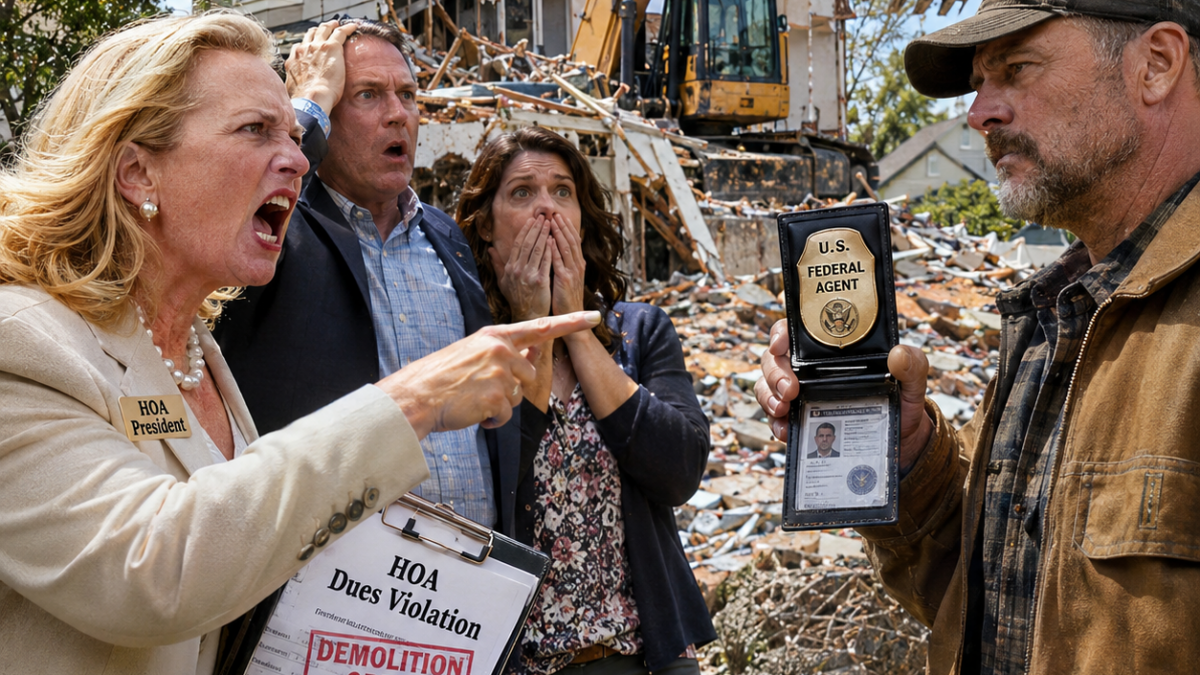
Then reached into my shirt pocket.
My federal credentials.
Badge.
Identification.
I held them where Delilah could see.
Not theatrically.
Just clearly.
“You’re right.”
She frowned.
“About what?”
“Actions having consequences.”
She stared at the badge.
I said:
“My name is Rex Caldwell. I’ve spent fifteen years as a federal building inspector.”
Color left her face.
Marcus stepped back.
One board member whispered:
“Oh, no.”
I continued.
“I inspect federal construction work, contractor compliance, and building violations. I understand permitting. I understand procurement. I understand documentation.”
Delilah’s clipboard slipped from her hand.
Hit the floor.
“Federal?”
“Yes.”
“You said you worked for the government.”
“I do.”
Marcus recovered first.
“So what? You still owe HOA assessments.”
I looked at him.
“Would you like to explain why Ashworth Construction billed for emergency demolition work performed without a municipal permit?”
He froze.
“We had board authority.”
“No municipal permit.”
“Emergency authority.”
“No city order.”
Delilah said:
“This is intimidation.”
“No.”
I put the credentials back in my pocket.
“This is identification.”
Then I looked at the two board members.
“You should each get independent counsel.”
That scared them more than anything.
—
Delilah tried one final performance.
“You cannot prove misconduct.”
I said:
“I don’t need to prove anything standing here.”
She stared.
“I document. Lawyers argue. Investigators investigate. Courts decide.”
That distinction broke something.
Because bullies understand shouting.
They understand threats.
They understand emotional escalation.
Procedure frightens them.
Procedure doesn’t get tired.
I pointed toward the opening where my wall used to be.
“Leave my property.”
Nobody moved.
“Now.”
One board member went first.
Then the other.
Marcus followed.
Delilah remained.
For perhaps five seconds.
Then she stepped backward through the destroyed front wall her own contractor had created.
The neighbors watched.
No applause.
That was better.
Just silence.
—
Within hours, calls started.
Neighbors.
Former residents.
People Delilah had fined.
People Marcus had pressured.
People whose properties had gone through related companies.
My house became an evidence room.
Not officially.
I still wasn’t running some private federal operation.
But as a homeowner and witness, I could organize my own records and provide them to the correct authorities.
Dana repeated that line to me twice.
“You are a witness, Rex.”
“I know.”
“Not the lead investigator.”
“I know.”
“You hate that.”
“Yes.”
She laughed.
“Good.”
—
We formed a victim group.
Twelve families.
Mrs. Henderson.
Martinez.
Kowalski.
Others.
Every person got a folder.
Original records stayed with them.
Copies went to counsel.
Digital backups.
Dates.
No social-media speculation.
No deleting embarrassing messages.
No rewriting memories.
If you don’t know, say you don’t know.
That was the rule.
Truth becomes weaker when people try to make it more dramatic.
We already had enough drama.
—
The investigation widened.
Postal inspectors became interested in notices and demands sent through the mail.
State licensing officials reviewed real-estate activity.
County prosecutors reviewed property transactions.
My agency examined the targeting complaints against federal workers.
Channel 7 continued reporting.
Delilah’s “small HOA dispute” was becoming something she couldn’t control with a gavel.
Then she tried settlement.
—
Wednesday morning.
She arrived alone.
Thick envelope.
No pastel blazer.
Gray suit.
Tired face.
“Rex.”
I stood behind the temporary barrier covering the front opening.
“What?”
“We should resolve this.”
“You’ve said that before.”
She handed me an offer.
All fines waived.
All assessments waived.
In exchange, I would sell my property to a “community-preferred buyer.”
Price:
Forty-five percent below real market value.
The justification?
Structural damage.
Community disruption.
I stared at the number.
“You demolished the house.”
“The damage affects value regardless of cause.”
I actually admired the audacity.
“Who is the buyer?”
“That would be disclosed during closing.”
“Mountain View?”
Her eyelid twitched.
There.
“Is it?”
“I’m not discussing confidential negotiations.”
I handed the envelope back.
“No.”
“Rex.”
“No.”
“You’re making this unnecessarily difficult.”
“You knocked down Grandma’s wall.”
“It was an authorized emergency—”
“No permit.”
She changed direction.
“Federal employee or not, some battles aren’t worth fighting.”
“You’re right.”
Relief flashed across her face.
“This one is.”
I closed the barrier.
—
That afternoon, the water line failed.
Not old-pipe failure.
Not freeze.
Physical damage.
Basement flooded.
Emergency crew arrived.
Industrial fans.
Pumps.
Wet drywall again.
I stood ankle-deep in water thinking:
This house has been hit with demolition equipment and now sabotage.
How much more can one building take?
Then cameras answered the more useful question.
At 2:30 a.m., a figure had approached the supply area.
Delilah’s son Trevor.
Clear enough to preserve.
Tools in hand.
I did not call him.
Did not drive to their house.
I contacted police.
Then my attorney.
Then the relevant investigators.
Dana said:
“Good.”
“I’m getting very tired of being congratulated for not doing stupid things.”
“That’s adulthood.”
—
The next final-demand letter arrived by certified mail.
The number:
$67,325.
Original:
$127.
Now:
Demolition.
Water-line repair.
Structural-remediation assessment.
Community-safety penalties.
Administrative fees.
The letter threatened complete property seizure and demolition if payment wasn’t made within twenty-four hours.
I read it twice.
Then laughed.
Not because it was funny.
Because after weeks of Delilah trying to discredit me, she had signed another aggressive demand and sent it through traceable mail.
I forwarded it to counsel.
Dana.
Investigators.
Then my phone rang.
Delilah.
“This is your final chance.”
“I received the letter.”
“Pay, or we finish the demolition tomorrow.”
“Delilah.”
“What?”
“Are you aware this call is being documented?”
Silence.
“You can’t threaten me.”
“I didn’t.”
“Stop using your federal position against me.”
“I told you I’m documenting.”
She hung up.
That was the last private conversation we had.
—
Thursday’s special HOA meeting had already been scheduled by Delilah.
She intended to address what her notice called “federal interference in community governance.”
I could not have invented a better venue.
Reporters planned to attend.
Homeowners packed the room.
Investigators attended in appropriate capacities.
Lawyers.
State officials.
People who had been ignored for years.
The atmosphere felt less like an HOA meeting and more like the moment before a storm breaks.
I wore my federal inspector credentials openly.
Not because my badge gave me magical authority over an HOA.
It didn’t.
Because Delilah had spent weeks telling residents I was a confused, unstable man inventing government connections.
That lie was over.
—
She entered at eight.
Aggressive pink suit.
Clipboard.
Marcus behind her.
Her smile had returned.
That impressed me.
Whatever else Delilah was, she could perform.
“Good evening.”
The room quieted.
“We are here to restore confidence in Willowbrook Estates and address recent attempts to undermine legitimate community governance.”
Someone laughed.
Small.
Delilah ignored it.
She launched into a presentation about successful compliance actions.
Property standards.
Emergency remediation.
Problem properties resolved.
Every phrase sounded different when the victims were sitting twenty feet away.
Mrs. Henderson was in the front row.
The Martinez family beside her.
Mr. Kowalski on the aisle.
Delilah said:
“Our enforcement procedures have consistently protected community value.”
I stood.
Her voice stopped.
She looked at me.
“Mr. Caldwell, there will be a comment period.”
“I understand.”
“Then sit down.”
I didn’t.
“Before you continue discussing HOA authority, residents need to see the governing documents.”
Her face changed.
That was the other discovery.
The one Derek—our outside property attorney—had confirmed from archived records.
Willowbrook’s original incorporation and covenant structure contained an expiration mechanism.
The enforceable authority Delilah had relied on had expired years earlier without proper renewal.
Some governing functions may have continued informally.
But the sweeping enforcement regime she claimed was legally far more vulnerable than residents knew.
That was the point at which her entire history of fines came under review.
—
We projected the documents.
Dates.
Expiration language.
No recorded renewal matching the authority Delilah claimed.
People read.
Murmurs.
Then louder voices.
She stood.
“These documents are being misinterpreted.”
Derek answered:
“Then explain the renewal instrument.”
“There are subsequent amendments.”
“Show the one that properly renews enforcement authority.”
“Our attorney—”
“Which document?”
Silence.
The room changed.
For years, residents had assumed Delilah held power because she acted like she held power.
Now the paper was asking her to prove it.
She couldn’t.
—
Then came the property transactions.
Mrs. Henderson’s sale.
Martinez.
Kowalski.
Companies.
Connections.
Marcus.
Ashworth Construction.
Related management entities.
Appraisal relationships.
We did not call every transaction criminal.
That would be irresponsible.
We showed patterns.
Investigators would decide what those patterns meant.
Then Channel 7’s Jenny Martinez asked:
“Mrs. Ashworth, did your husband’s company perform demolition work at Mr. Caldwell’s home without a city permit?”
Delilah looked at the camera.
“No comment.”
“Did the HOA pay Ashworth Construction?”
“No comment.”
“Was Mr. Caldwell’s alleged debt originally $127?”
“No comment.”
The woman who always had something to say had discovered silence.
—
A postal inspector present introduced herself and stated that multiple mailed demands and communications were under review.
State investigators confirmed licensing inquiries.
County representatives confirmed permitting questions.
No cinematic speech.
No immediate conviction.
Just agencies announcing facts.
That was more frightening.
Marcus moved toward the rear exit.
Two investigators stepped into his path.
Not dramatically.
Conversation.
He stopped.
Delilah watched.
The room had become uncontrollable.
Not chaotic.
Uncontrollable by her.
There is a difference.
—
Then I spoke.
I did not say:
I’m going to destroy you.
I did not say:
Federal government versus HOA.
I had had plenty of time to think about the line I actually wanted to say.
I looked at Delilah.
“You demolished my grandmother’s house over a disputed $127 bill.”
Nobody moved.
“You thought the house was just an asset.”
I looked toward Mrs. Henderson.
The Martinez family.
Kowalski.
“You treated all our homes like numbers that could be pressured, discounted, transferred, and resold.”
Then I held up Sarah’s old photograph that had survived the demolition.
“My wife used to say every house should be a home before it becomes an investment.”
My voice almost broke there.
I let it.
No shame.
“This is what you never understood.”
The room was silent.
“You can put a price on land.”
I looked at the photograph.
“You can’t price what happened inside it.”
Mrs. Henderson started crying.
So did Mrs. Martinez.
I continued.
“And when somebody abuses authority to take that from people, the answer isn’t revenge.”
I looked directly at Delilah.
“It’s accountability.”
That was enough.
—
The meeting collapsed after that.
Not physically.
Politically.
Board members requested independent counsel.
Two resigned on the spot.
Residents demanded audits.
Delilah tried to adjourn.
Nobody recognized her control anymore.
Investigators collected scheduled statements.
Reporters interviewed families.
Marcus left with counsel.
Delilah eventually left through a side exit.
No applause.
No dramatic handcuffs in the room.
Justice rarely arrives on cue.
But her reign ended that night.
Everyone knew it.
—
The following seventy-two hours moved fast.
Real-estate licensing action.
City-council pressure.
Construction-permit review.
Expanded financial investigation.
Property files subpoenaed through proper channels.
Shell companies examined.
Victims contacted.
I was interviewed repeatedly.
So were others.
Delilah’s public story changed three times.
First:
Everything was authorized.
Then:
The board relied on professional advice.
Then:
Marcus handled contractor matters.
Then:
She had been misled.
People often discover delegation right after investigators arrive.
—
Marcus lost his city council position.
His construction contracts came under review.
Ashworth family companies were frozen out of new work.
Property transfers were challenged.
Some victims pursued civil recovery.
Others entered restitution processes.
Mrs. Henderson’s case hit me hardest.
The title history of her old home was unwound enough for a settlement that gave her substantial compensation and a path connected to the property.
She chose not to move back permanently.
“Too many stairs now,” she said.
But she visited.
We stood on the porch.
She touched the railing her husband built.
“They kept it.”
“Yes.”
She smiled.
“I thought it was gone.”
That sentence was the opposite of the one she had told me at Sunset Manor.
I didn’t want to sell.
Now:
I thought it was gone.
Sometimes justice is just getting to touch something again.
—
The Martinez family received compensation connected to their loss.
Their auto-repair business expanded.
But the moment everyone remembered was their daughter’s second quinceañera celebration.
Not because she was fifteen again.
She wasn’t.
The family threw the celebration they had been denied.
Music.
Food.
Dresses.
Photographs.
Three generations.
I attended.
Mr. Martinez pulled me aside.
“You think this is silly?”
“No.”
“She’s older now.”
“So?”
He smiled.
“Exactly.”
Some things are worth doing late.
—
Mr. Kowalski used part of his settlement to help establish a fund for children of public-service families.
He refused to let anybody name it after him.
Called that “American nonsense.”
Fine.
We named it something practical.
He approved reluctantly.
—
My own house became a different question.
Insurance.
Civil damages.
Restitution.
Construction estimates.
I had enough resources available through settlements and asset-recovery processes to rebuild.
Everyone assumed I would reconstruct Grandma’s house exactly as it had been.
I thought so too.
Then I found Sarah’s notebook.
She kept lists during her cancer treatment.
Books.
People to call.
Things she wanted me to remember.
One page said:
**Rex—don’t turn grief into a museum.**
I sat on the kitchen floor for twenty minutes.
She had written it about herself.
But it applied to Grandma.
The old house.
Everything.
I had spent months trying to preserve a structure because it carried the people I loved.
Maybe preserving them didn’t require recreating every wall.
So I made a different decision.
—
I rebuilt a smaller home on part of the property.
Still a ranch.
Still simple.
I salvaged Grandma’s brick fireplace.
Reused some of the original hardwood.
Kept the closet trim with my childhood height marks.
The front door was new.
I was okay with that.
But I did not rebuild on the exact original footprint.
That portion of the lot became something else.
A small community park.
Not because I suddenly became sentimental about public spaces.
Because too many families had lost pieces of Willowbrook.
I wanted one part permanently removed from private acquisition games.
The park had:
Benches.
Trees.
A play structure.
Walking path.
No statue of me.
No plaque attacking Delilah.
Just one small sign.
**ROSALIE & SARAH COMMUNITY GREEN**
That was enough.
—
The criminal cases took much longer.
Months.
Then more months.
Charges.
Motions.
Negotiations.
Financial tracing.
Eventually Delilah and Marcus faced significant consequences tied to the broader fraud scheme.
The network of companies was dismantled.
Assets were used toward restitution.
Licenses disappeared.
Political influence disappeared.
The board structure that had protected them disappeared.
Whatever confidence Delilah had once drawn from being Willowbrook’s most feared person was gone.
For years she had made other people check the mailbox with anxiety.
Now every official envelope belonged to her.
That symmetry did not make me happy.
But I noticed it.
—
Willowbrook changed.
That was the hardest part to predict.
People who had barely spoken became friends because they had compared evidence.
New board elections were held under outside legal review.
Financial records became public to members.
Vendor relationships disclosed.
No family contracting without conflict review.
No emergency property action without proper municipal documentation.
No fines without written authority and appeal.
Simple things.
Things a community should have done all along.
The first new-board meeting lasted two hours because everyone was terrified of making mistakes.
The second lasted ninety minutes.
By the sixth:
Forty-five.
Progress.
—
The Sarah Caldwell Foundation came later.
I resisted the idea.
Someone else suggested it.
Then Mrs. Henderson called.
“You’re doing it.”
“Why?”
“Because there are other people like us.”
“I’m tired.”
“So rest and then do it.”
“You sound like Sarah.”
“Then listen.”
The foundation provided legal-resource referrals.
Document templates.
Connections to licensed professionals.
Education on HOA records.
Help finding investigators when patterns suggested larger misconduct.
No vigilantes.
No pretending every HOA fine is corruption.
Just information.
That mattered to me.
Sarah hated false certainty.
So the foundation’s first rule became:
**Facts before outrage.**
Our second:
**Home before profit.**
—
The first family we helped lived in Florida.
Grass dispute.
At first glance, ridiculous.
Wrong shade of green.
Threatened foreclosure.
But when counsel reviewed the documents, the real issue was a pattern of fines stacked without proper process.
We helped connect them with local representation.
They kept the house.
No television cameras.
No badges.
No criminal conspiracy.
Just paperwork corrected before it became catastrophic.
That case made me prouder than Channel 7 ever did.
Because prevention is quieter than revenge.
Quieter is better.
—
The park opened the following spring.
Children ran across the same ground where a wrecking ball had once stood.
I sat on a bench.
Grandma’s photograph in my jacket pocket.
Sarah’s wedding ring on a chain under my shirt.
Mrs. Henderson beside me.
She said:
“You okay?”
“No.”
“Good.”
I looked at her.
“Good?”
“Means you’re not pretending.”
Fair.
I watched a boy climb the play structure.
A little girl chased him.
Somebody’s dog stole half a sandwich.
Normal life.
I realized the house hadn’t disappeared.
Not really.
Pieces were in my new home.
Pieces were in memory.
Pieces were in the park.
A building can be destroyed without erasing what made it a home.
Delilah never understood that.
—
A documentary crew eventually called.
Then another.
Then national media.
I said no more often than yes.
The story became famous enough without me turning my grief into entertainment.
When I did speak publicly, I corrected the headline every time.
It was not:
**Federal Inspector Destroys HOA.**
It was:
**Families Document Pattern and Authorities Act.**
Less exciting.
More true.
—
The badge was never the real weapon.
That was another misconception people loved.
Yes, Delilah froze when she saw my federal credentials.
Because for weeks she had treated me like an isolated homeowner she could bury in paper.
The badge changed her perception.
But my employment didn’t magically erase the demolition.
It didn’t create evidence.
It didn’t restore Mrs. Henderson.
It didn’t reimburse Martinez.
The useful things were much less dramatic:
Records.
Permits.
Dates.
Corporate filings.
Witnesses.
People talking to one another.
The badge was one moment.
The documentation was everything.
—
Eight months after the demolition, I stood on the porch of the rebuilt house.
Fresh wood.
Salvaged brick.
Grandma’s old wind chime hanging beside the door.
It had survived in a debris box.
Bent.
Ugly.
Still worked.
I made coffee.
Sat.
Across the lawn, the community park was quiet in the early morning.
A maintenance worker unlocked the gate.
Somewhere farther down Maple Street, a delivery truck backed up.
Beep.
Beep.
Beep.
For half a second, the sound pulled me back to demolition morning.
Diesel.
Glass.
Delilah applauding.
I felt my chest tighten.
Then the truck drove away.
The feeling passed.
Healing is annoying like that.
Never dramatic.
Never linear.
—
I walked inside.
The salvaged height marks were installed beside the hallway closet.
Eight.
Eleven.
Fourteen.
My name in Grandma’s handwriting.
I ran my fingers across them.
For months, I believed justice meant returning everything to exactly how it had been before Delilah.
Impossible.
Grandma was still gone.
Sarah was still gone.
The old living room was gone.
The original porch was gone.
Justice could repair money.
Property.
Reputation.
It could punish fraud.
It could stop people from doing more damage.
It could not reverse time.
I finally accepted that.
The acceptance hurt less than fighting it.
—
Mrs. Henderson later used part of her compensation to create a college account for her great-grandchildren.
She moved into a smaller place closer to family.
Kept one garden gnome from the old property.
Just one.
She put it directly by the front walkway.
I visited.
“That thing still violates visual harmony.”
She laughed so hard she coughed.
Good.
—
The Martinez shop grew.
They hired more mechanics.
Their daughter eventually handled bookkeeping.
She framed one photograph from the delayed quinceañera above her desk.
Not as evidence.
As family.
Mr. Martinez told me:
“That’s the difference.”
“What?”
“When Delilah had the photo, it was evidence against us. Now it’s ours again.”
He was right.
Control changes meaning.
—
Mr. Kowalski retired.
Actually retired.
No basement boxes.
No stacks of legal notices around him.
The first time I visited his new apartment, there was almost no paperwork visible.
“You throw it away?”
“Copies.”
“Where?”
“Lawyer.”
He smiled.
“I learn.”
So had I.
—
Willowbrook created an annual audit requirement.
A real one.
Independent.
Published.
At the first presentation, only seventeen homeowners came.
I was disappointed.
Then I realized that might be healthy.
People weren’t terrified enough to pack every meeting.
Still, I insisted somebody read the report.
Complacency built the conditions Delilah exploited.
Transparency only works if someone occasionally looks.
—
I kept my federal job for several more years.
Then retired.
Properly.
No dramatic resignation.
No national crusade replacing my career.
Just retirement.
I continued supporting the foundation part-time.
Garden.
Park.
Travel.
Brianna—my niece, named for Grandma’s sister—visited often with her kids.
One afternoon her youngest pointed to the park.
“Was your house really there?”
“Yep.”
“Why’d they knock it down?”
I thought about explaining fraud.
HOA power.
Permits.
Criminal networks.
He was eight.
So I said:
“Some adults thought rules belonged to them.”
He frowned.
“Rules belong to everybody.”
I smiled.
“Exactly.”
That explanation was better than most legal briefs.
—
Years passed.
The park trees grew.
The smallest one had been planted where Grandma’s living-room window once faced the street.
I knew because I measured it during planning.
Not sentimentally.
Okay, a little sentimentally.
By year five, it cast enough shade for a bench.
I sat there every October on Grandma’s birthday.
Coffee.
No ceremony.
Sometimes Sarah’s brother came.
Sometimes nobody.
That was fine.
—
One year, a woman approached me at the park.
Maybe forty.
Nervous.
“Mr. Caldwell?”
“Rex.”
“My HOA is threatening foreclosure.”
I felt my stomach tighten automatically.
“What for?”
“Roof color.”
I almost laughed.
Then saw she was serious.
“Do you have the documents?”
She held up a folder.
Of course.
Everybody arrives with a folder eventually.
I didn’t tell her:
Don’t worry.
I didn’t tell her:
Your HOA is wrong.
I said:
“Let’s see what the papers actually say.”
That was Sarah’s foundation working exactly as intended.
Facts before outrage.
—
We discovered her HOA did have a roof-color restriction.
Properly adopted.
But the fine escalation had procedural problems.
Local counsel helped negotiate.
She changed the shingles during the next scheduled replacement instead of being forced into immediate foreclosure pressure.
Not every story needs a villain in prison.
Sometimes a good ending is everybody becoming reasonable before the damage becomes permanent.
I wish Willowbrook had gotten that version.
It didn’t.
So we built something useful from the version we got.
—
Delilah’s name eventually stopped coming up at neighborhood meetings.
That surprised me.
For a few years, everything was:
Before Delilah.
After Delilah.
The Delilah audit.
The Delilah properties.
Then one day, new homeowners didn’t know who she was.
Good.
A community should not need a villain forever to remember how to behave.
The rules stayed.
Transparency stayed.
The fear faded.
Perfect.
—
The last physical piece of Grandma’s original front wall stayed in my garage.
One brick.
Cracked.
Mortar still attached.
I kept telling myself I would use it in the garden.
Never did.
One spring, I carried it to the park.
There was a small landscaping bed near the Rosalie & Sarah sign.
I placed it beneath the soil as edging.
No plaque.
No explanation.
Nobody needed to know.
I did.
That was enough.
—
The foundation grew beyond Willowbrook.
Hundreds of families contacted us over time.
Some had genuine abuse cases.
Some had misunderstood their documents.
Some were simply angry.
We helped where we could.
Referred where we couldn’t.
The most important thing we taught was not how to “beat” an HOA.
It was how to separate authority from intimidation.
Ask:
Where is the rule?
When was it adopted?
Was proper notice given?
Who authorized the action?
What appeals exist?
Who benefits financially?
Is there a conflict?
Are records available?
Simple questions.
Questions Delilah survived for years because too few people asked them together.
—
One afternoon, a volunteer asked why I never displayed my federal badge in foundation presentations.
“It’s part of the story.”
“Not the useful part.”
“But that’s when she froze.”
“Yes.”
“People love that.”
“I know.”
“So?”
I looked at the wall behind him.
We had framed copies of:
A deed.
A permit search.
An audit page.
A meeting notice.
A court injunction.
“Those are the useful parts.”
He smiled.
“Less cinematic.”
“Much.”
He left the badge out.
—
The park became the neighborhood’s center.
Birthday parties.
Food drives.
Outdoor movie nights.
Nothing revolutionary.
Normal community life.
One summer, a family rented the pavilion for a quinceañera.
I didn’t realize until I walked past.
Music.
Bright fabric.
Flowers.
Laughter.
I stood outside the fence longer than necessary.
Not the Martinez family.
Different family.
New residents.
Nobody had asked whether the decorations matched community character.
Nobody measured anything.
Nobody sent a violation.
I went home smiling.
That felt like a victory Delilah would never understand.
—
The rebuilt house aged.
Fresh wood darkened.
Paint weathered.
Sarah’s mug chipped a little more.
The salvaged wind chime rusted.
Everything new eventually becomes old if you are lucky enough.
That changed how I thought about Grandma’s house.
I used to resent that I couldn’t restore it exactly.
Now I was grateful the new place had gathered its own memories.
Brianna’s kids sleeping in the guest room.
Thanksgiving.
A broken pipe one winter.
Sarah’s sister burning pie.
Ordinary things.
Homes are not valuable because nothing changes.
They are valuable because life keeps happening inside them.
—
On the tenth anniversary of the demolition, Channel 7 contacted me.
Jenny Martinez had retired.
A younger reporter wanted a retrospective.
I nearly declined.
Then agreed to one interview.
He asked:
“What did you feel when Delilah saw your badge?”
I thought about it.
“Relief.”
“Not revenge?”
“Some.”
He smiled.
“Some?”
“I’m human.”
“Did you know then she would go to prison?”
“No.”
“Did you want her to?”
“At the time? Probably.”
“And now?”
I looked toward the park.
“Now I mostly want the system we built afterward to keep working.”
That answer disappointed him slightly.
He wanted fire.
Age turns fire into perspective if you’re lucky.
—
Then he asked:
“What was the hardest part?”
Easy.
“Watching the house fall.”
“Not the threats?”
“No.”
“Not living under tarps?”
“No.”
“Why the house?”
I looked at him.
“Because people were inside it even after they were gone.”
He stopped writing for a moment.
Then nodded.
That line made the final piece.
I hated seeing it quoted.
Too personal.
But true.
—
That evening, I sat on the porch.
Same mountain air.
Same street.
Different house.
The park lights came on automatically.
Kids still playing.
Parents talking.
A teenager practicing skateboard tricks where the old driveway had ended.
I carried Grandma’s photograph outside.
The repaired frame now had new glass.
She and Grandpa stood in front of the original house.
1962.
Young.
Hopeful.
No HOA drama.
No Delilah.
No idea what the property would become sixty years later.
I set the picture beside me.
Then looked across the lawn.
For years, I thought Delilah destroyed Grandma’s legacy.
She didn’t.
She destroyed lumber.
Drywall.
Glass.
Roofing.
Things contractors can replace.
Grandma’s legacy was the stubborn belief that a home mattered because people mattered inside it.
Sarah believed the same thing.
That survived.
More than survived.
It became a park.
A foundation.
Families getting help before they lost homes.
Residents reading documents before signing checks.
Neighbors who understood authority should be questioned without being hated.
That was bigger than the old ranch house.
I wished I could tell Grandma.
Maybe she would complain about the park benches.
Wrong color.
Wouldn’t surprise me.
—
I picked up the photograph.
Went inside.
Locked the door.
One lock.
No cameras flashing alerts.
No demolition trucks.
No certified demands.
Quiet.
That was the thing Delilah had taken for a while.
Not just walls.
Peace.
And that was the thing I was happiest to get back.
Not her prison sentence.
Not the settlement.
Not seeing Marcus lose his council seat.
Not watching shell companies collapse.
Peace.
A house that felt like home.
A neighborhood where children played on land once treated like financial prey.
A front porch where I could drink coffee without wondering whether a clipboard was coming up the driveway.
Sarah had been right.
Every house should be a home before it becomes an investment.
Delilah learned that lesson through consequences.
I learned it through loss.
And Willowbrook learned it because enough people finally stopped being afraid to ask who really had the authority they had been obeying.
The original debt was $127.
That number had once felt insulting.
Now it felt almost ridiculous.
Because in trying to collect it, Delilah exposed a system that had been taking far more valuable things from people for years.
Homes.
Security.
Dignity.
Memory.
She tore down one wall too many.
And when the dust finally settled, the thing that disappeared wasn’t my grandmother’s legacy.
It was Delilah’s power.
[END OF STORY]








