PART 2: HOA Demolished My Coop Hours Before My Father’s Funeral—So I Used One Forgotten Valve to Drain Their $5M Resort Lake
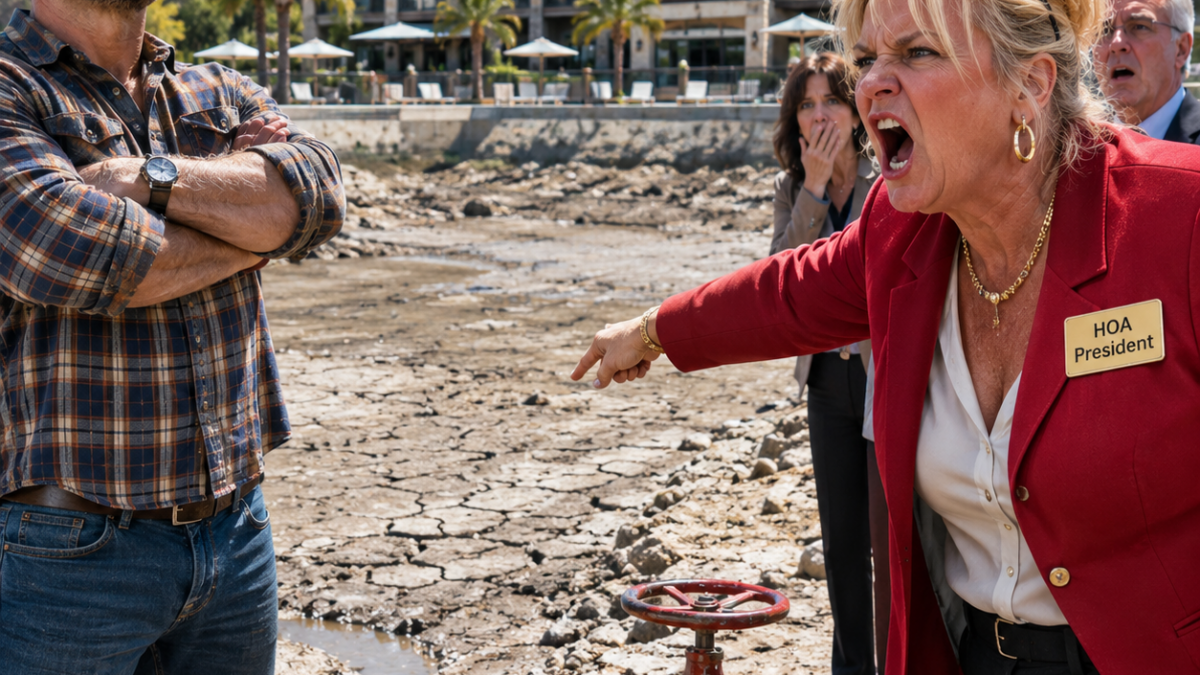
Four hours before I was supposed to stand beside my father’s coffin, I stood barefoot in the wet grass watching three men swing sledgehammers into the cedar chicken coop I had built with my own hands after my wife died, while terrified hens scattered through my memorial garden and the president of our HOA filmed the destruction from behind her white Range Rover like she was documenting a victory.
By the time the last wall collapsed, the structure that had kept me sober through grief, given my father something familiar to watch as dementia slowly stole pieces of him, and connected me to the grandmother who had raised chickens on that exact patch of earth since 1959 had been reduced to splinters—and Delilah Thornfield was already posting photographs online with laughing emojis and a message about teaching “certain residents” what happened when they refused to respect community standards.
What Delilah believed she had destroyed that morning was the last thing keeping a tired widower from surrendering, but she had no idea that grief had already taken almost everything from me, and people with very little left to lose sometimes notice things everyone else has been too comfortable to see.
My name is Jasper Crawford.
Most people call me Jazz.
I was fifty-one when this started, third-generation electrician, recently widowed, and taking care of a father who sometimes remembered how to rebuild a carburetor from memory but couldn’t always remember his own son’s name.
Some mornings he called me Jasper.
Some mornings he called me Tommy, his younger brother who had been dead for thirty years.
On the worst mornings, he simply looked at me like I was a polite stranger.
My wife Sarah had died from cancer the year before.
She was forty-eight.
Twenty-six years together, reduced to medical folders, unopened sympathy cards, and a closet full of clothes I couldn’t bring myself to touch.
After she died, people kept telling me I needed a hobby.
Something healthy.
Something to keep my hands busy.
I had been an electrician my entire adult life. My hands were always busy.
That wasn’t the problem.
The problem was that when the work stopped, my mind didn’t.
So I built a chicken coop.
Not because I had some lifelong dream of becoming a farmer.
Because my grandmother had kept chickens on the property when I was a boy, and one afternoon I found a photograph of her standing beside the old hen house with my father as a child.
For the first time in months, Dad remembered the picture.
“Your grandma could make eggs taste like steak,” he said.
Then he laughed.
A real laugh.
Not the confused little chuckle he used when he couldn’t follow a conversation.
That was enough.
I bought cedar.
Good cedar.
Straight boards.
Spent three months measuring, cutting, sanding and rebuilding the old footprint behind the house.
Sarah had always loved marigolds, so I planted them along one side.
Dad watched from the porch.
Every now and then, he’d tell me I was doing something wrong.
Usually he was right.
When I finally put the hens in, one of them immediately escaped.
Dad laughed so hard he cried.
I hadn’t heard that sound since Sarah died.
That coop became more than a structure.
It gave shape to mornings.
Feed the hens.
Check the water.
Collect eggs.
Make Dad breakfast.
Go to work.
Come home.
Repeat.
Simple routines can keep a man alive when everything complicated has already broken him.
The property itself had been in my family for generations.
Two acres inside what was now Willowbrook Estates.
Willowbrook was the kind of neighborhood where people spent five figures on outdoor kitchens and then got angry if someone parked a work truck where it could be seen from the clubhouse.
Three hundred forty-seven homes.
Most of them large.
Many of them lakefront.
And at the center of everything sat Willowbrook Resort Lake.
Five million dollars of manicured shoreline, private docks, paddleboards, wedding packages, fishing tournaments and sunset photographs designed to make buyers believe they weren’t simply purchasing oversized houses with HOA dues.
The lake made Willowbrook valuable.
Everybody knew that.
What almost nobody knew was that my property sat at the lowest natural point in the development.
Storm drains, retention ponds and runoff from hundreds of roofs all moved downhill.
Eventually, one way or another, much of that water crossed my land before reaching the lake.
I knew the drainage mattered.
I didn’t yet understand how much.
Then Delilah Thornfield decided my chickens were unacceptable.
The first violation notice arrived on a Tuesday.
**UNAUTHORIZED AGRICULTURAL STRUCTURE.**
Fine: $500.
Additional penalty: $100 per day.
I called her.
“My family’s had agricultural use on this parcel since before Willowbrook existed.”
“Mr. Crawford,” she said, “grief does not exempt you from community standards.”
I looked through the window at my father sleeping in his chair.
At Sarah’s marigolds outside.
At Henrietta scratching beneath the coop.
Something in me went very still.
“I didn’t ask for a grief exemption.”
“Then comply.”
And that was how the war began.
PART 2
For the next few seconds, I said nothing.
Delilah interpreted silence the way people like her always do.
As weakness.
“I’ll give you until Friday,” she continued. “After that, enforcement escalates automatically.”
“What authority are you using?”
“The HOA covenants.”
“Which section?”
A pause.
Then that same polished voice.
“Our legal department can provide any information you require.”
“Your legal department?”
“Thornfield and Associates.”
Of course.
Delilah’s own firm.
She was HOA president, enforcement authority, and connected to the law office sending residents compliance notices.
The conflict apparently bothered no one who mattered.
Yet.
“I want the section number.”
“You’ll receive formal correspondence.”
“Good.”
I hung up.
Then I walked outside.
Henrietta came running because she believed every human hand existed to distribute corn.
I sat on the step of the coop.
Dad appeared at the back door wearing a sweater even though it was seventy-two degrees.
“Tommy?”
“Jazz, Dad.”
He stared.
“Right.”
Then he looked at the coop.
“Your mother letting you keep chickens?”
“My mother has been dead twenty-two years.”
His face fell.
I hated myself instantly.
I stood.
“Sorry.”
He looked confused.
Then his attention shifted.
“Grandma kept hens there.”
I smiled.
“Yeah.”
He pointed toward the corner.
“Drain used to be underneath.”
“What drain?”
He frowned.
“Wet years.”
Then the thought disappeared.
“What are we having for breakfast?”
It was four in the afternoon.
“Eggs,” I said.
That made him happy.
Three days later, a certified letter arrived from Thornfield and Associates.
Heavy paper.
Thick envelope.
The kind designed to intimidate before you read a single sentence.
Three violations.
Administrative fees.
Immediate cessation order.
Seventy-two hours.
They had attached photographs of my coop.
The angle caught my attention.
I held one against the window.
The photograph had been taken from Janet Henderson’s property next door.
You could see the edge of her fence post.
I called her.
“Did HOA people come onto your property?”
“What?”
“To photograph my yard.”
“No.”
“Can you check your camera?”
Janet had a doorbell camera covering part of the side walkway.
Twenty minutes later she called back.
“Jazz.”
“Yeah?”
“You’re going to want this footage.”
A man in a Pine Ridge—
No.
Willowbrook.
I corrected myself automatically even in my own head.
A Willowbrook contractor had walked through her side gate while she was at work, stood behind her shed, photographed my property and left.
No permission.
No notice.
I saved the footage.
That evening, instead of drinking—which still happened in my mind more often than I admitted—I read.
County ordinances.
HOA covenants.
Land records.
Planning rules.
Sarah had always laughed at how stubborn I got when someone told me something couldn’t be fixed.
Electrical work teaches you to distrust symptoms.
A breaker doesn’t trip because it feels dramatic.
There’s always a reason.
You follow the circuit.
Three hours into my research, I found the first broken wire.
Delilah’s updated agricultural restrictions had never been properly filed with county planning.
No approval.
No recorded amendment.
Then I went downstairs.
My grandmother had kept everything.
Seed catalogs.
Tax receipts.
Property surveys.
Water bills from years when I wasn’t even alive.
I found the original 1959 survey in a metal file box behind fertilizer records.
The paper smelled like dust and basement damp.
There it was.
Original hen house.
Same footprint.
Same parcel.
Agricultural use.
Thirty-seven years before the HOA existed.
I sat on the basement floor holding that survey and laughed.
Not loudly.
Just enough.
The next morning, I filed a formal challenge.
Continuous agricultural use.
Grandfathered structure.
Unenforceable amended restriction.
I sent copies to the HOA.
County planning.
Thornfield and Associates.
And myself.
Certified.
Documentation beats confidence.
Always has.
Always will.
Two nights later, my camera alerted at 2:47 a.m.
I had installed four cameras after the trespassing photos.
Money I didn’t really have.
But I had spent twenty years crawling through attics full of burned wiring because someone had decided to save fifty dollars by skipping a safety device.
Prevention looks expensive until failure arrives.
The night-vision image showed a man crossing my yard.
Tall.
Heavy jacket.
Professional tripod.
Survey equipment.
I zoomed.
Preston Thornfield.
Delilah’s husband.
He owned the development company pushing Willowbrook Resort Phase Two.
He measured for forty-three minutes.
Distances.
Elevation points.
Property corners.
Drainage corridor.
Then left.
The next morning, I was at county planning before they unlocked the doors.
Forty-five minutes later, I found his preliminary application.
Willowbrook Resort Phase Two.
Luxury lake expansion.
Additional waterfront units.
New amenity facilities.
Drainage upgrades.
And one crucial line.
**Required access corridor: Crawford Parcel.**
I leaned back.
There it was.
The chicken coop wasn’t the problem.
The chickens weren’t the problem.
My grief wasn’t the problem.
My land was.
They needed access across it.
I owned the natural drainage point.
Buying me at fair value would cost money and possibly expose the whole project to scrutiny.
But if HOA fines piled up?
If legal fees climbed?
If liens followed?
If an exhausted widower caring for a dying father finally decided to sell?
Then Preston’s company could acquire the parcel cheap.
The next call from Delilah suddenly made perfect sense.
“Mr. Crawford, we’ve reviewed your filing.”
“Good.”
“It changes nothing.”
“It changes quite a lot.”
“The board has authorized removal.”
“Of a grandfathered structure?”
“Of a health and safety hazard.”
I laughed.
She didn’t.
“Contractors are standing by.”
“Send them and they’ll be trespassing.”
“Your deadline is tomorrow at noon.”
“What happens at noon?”
“You’ll see.”
She hung up.
I sat with the phone against my ear listening to the dead line.
Then Dad called from upstairs.
“Tommy?”
I closed my eyes.
“Coming.”
His hospice nurse was changing medication.
He had deteriorated quickly.
There are people who imagine caring for a dying parent is one long emotional goodbye.
It isn’t.
Mostly, it’s laundry.
Medications.
Diapers you pretend don’t embarrass either of you.
Phone calls.
Forms.
Trying to get someone to eat.
Trying not to lose patience when they ask the same question seven times.
Trying not to hate yourself when you do lose patience.
That night, Dad was lucid.
A rare gift.
He sat in his recliner while I made soup.
“You fighting somebody?”
I turned.
“What?”
“Your face.”
“What about it?”
“Same face you had when Coach Miller benched you.”
I laughed.
“You remember Coach Miller?”
“Bastard owed me twenty bucks.”
He had never met Coach Miller financially, but I let it go.
“HOA wants the coop gone.”
“Grandma’s coop?”
“My new one. Same spot.”
His brow furrowed.
“They can’t.”
“That’s what I’m saying.”
“They need the drain.”
I stopped stirring.
“What drain?”
Dad pointed toward the backyard.
“Under hens.”
“What is under the hens?”
“Big wheel.”
I put down the spoon.
“Dad.”
He looked at me.
For a few seconds, he was completely there.
“Your grandmother controlled the flood gate.”
“What flood gate?”
“Wet years.”
His eyes drifted.
“Lake wasn’t always there.”
“What did the gate do?”
He stared at the television.
“Your mother coming home?”
And he was gone again.
I stood in the kitchen.
Big wheel.
Under hens.
Flood gate.
It sounded like dementia talking.
Except I had seen something in Grandma’s records.
**Emergency drainage controls for wet seasons.**
The next afternoon I went back to the basement boxes.
Found the note.
Then an old county drainage drawing.
My parcel sat at the intersection of multiple drainage channels.
Manual control structure.
No dimensions.
No clear access point.
Just a handwritten notation.
**Valve below original hen house.**
I looked toward the floor above me.
Henrietta clucked outside.
“You have got to be kidding me.”
I still didn’t know what it controlled.
Not yet.
The contractor deadline came and went.
They showed up.
I stood on the porch with my survey, county records and a camera.
The contractor read everything twice.
Then called someone.
Then left.
Small victory.
Delilah answered with an emergency board meeting.
I wasn’t notified.
Janet was.
Friday night, while I was rewiring a restaurant kitchen, Delilah stood in the clubhouse and gave a PowerPoint presentation titled:
**HEALTH AND SAFETY RISKS OF UNAUTHORIZED AGRICULTURAL USE**
She showed pictures of my hens.
Rats.
Stock images of diseases.
Property-value charts.
She called my coop a threat to neighborhood sanitation.
The board voted four to one to authorize “hazard abatement.”
Forty-eight hours.
I watched Mark Henderson’s recording at midnight.
Delilah stood under fluorescent lights telling thirty neighbors that my grief project was dangerous.
Something cold settled in me.
I created a private neighborhood group.
Willowbrook Property Rights.
No insults.
No revenge fantasies.
Documents.
Original survey.
County filing records.
Preston’s midnight trespassing footage.
Development application.
Within a week, eighty-seven neighbors joined.
Then stories arrived.
Margaret Chen.
Three-thousand-dollar fines because her son’s wheelchair-accessible van remained in their driveway.
Bill Rodriguez.
Violations over raised vegetable beds.
The Hendersons.
Threats over a wheelchair ramp installed without design approval.
A single mother fined because her work vehicle had advertising decals.
People who had always thought they were individually unlucky suddenly compared paperwork.
Patterns appeared.
That was Delilah’s second major mistake.
Bullies survive by separating victims.
One violation feels personal.
Ten identical violations look like policy.
We held Heritage Day the next Sunday.
Part protest.
Part potluck.
Part history lesson.
Sixty-three people came.
Kids fed hens.
Neighbors brought old photographs.
The Rodriguez family grilled corn.
For a few hours, my property didn’t feel like a battlefield.
It felt like Sarah was still somewhere in the edges of things.
She had loved crowded tables.
She believed food tasted better when there were too many people in the yard.
I stood beside the marigolds watching children collect eggs.
For the first time since her funeral, I felt something dangerously close to joy.
Then Margaret Chen pulled me aside.
“I found Delilah’s business filings.”
“What about them?”
“Her law firm represents Preston’s development company.”
“I assumed.”
“No.”
She lowered her voice.
“She’s also receiving pre-sale commissions tied to Phase Two.”
I stared.
“How?”
“Consulting agreement.”
“For the project requiring my property?”
“Yes.”
There it was.
Personal financial interest.
Enforcement campaign.
Development pressure.
My land.
That night, Margaret brought me a copy of an old county drainage map.
1962.
My property was clearly marked as a manual flood-control point.
I took a shovel into the basement.
Sarah used to say I approached problems like a raccoon breaking into a trash can.
Persistent.
Unqualified.
Certain treasure existed.
Two hours later, the shovel hit metal.
Clang.
I dug carefully.
Six feet down, under old soil and concrete access blocks, I found an oiled canvas wrap.
Inside was a heavy steel valve wheel.
Cold.
Rusty.
Attached to a pipe wider than my arm.
I cleaned the mechanism.
Then turned it a quarter rotation.
Slowly.
Nothing happened.
For five minutes.
Then I went outside.
The retention pond behind my property looked different.
I marked the waterline.
Twenty minutes later, it had dropped almost two inches.
I stood there staring.
Then looked toward Willowbrook Resort Lake in the distance.
The most expensive view in the neighborhood.
I turned the valve back.
The pond stabilized.
I called Margaret.
Then county engineering.
The next morning, Rosa Martinez returned my call.
She was the county water systems engineer.
She asked for the agreement number.
I gave it.
Long silence.
Keyboard.
More silence.
“Mr. Crawford?”
“Yeah?”
“Where did you find this?”
“My grandmother’s records.”
“You still have the original?”
“Yes.”
“Don’t lose it.”
“I won’t.”
“What exactly does the valve control?”
“I’m checking.”
More typing.
Then:
“Oh.”
I hate when engineers say “oh.”
“What?”
“This is still active.”
“How active?”
“Your parcel remains the manual control point for the pre-development stormwater system.”
“What does that mean in English?”
“Most modern Willowbrook drainage eventually interfaces with infrastructure controlled through your easement corridor.”
“Most?”
“Approximately seventy-three percent of the input feeding the resort retention system.”
I sat down.
“Say that again.”
“The resort lake is primarily sustained by managed stormwater and retention flow.”
“And my valve?”
“Can redirect it.”
“How much?”
“Depending on weather, full closure could drop lake elevation eight to twelve feet in several days.”
I looked through the window.
At Henrietta.
At the coop.
At Sarah’s marigolds.
“Do I legally control it?”
“Under the 1962 agreement, the property owner is responsible for manual flood-control operation and maintenance.”
“HOA approval?”
“No.”
“City approval?”
“For routine operation within design limits? No.”
“Can the HOA stop me?”
“Not under its covenants.”
I leaned back.
“Interesting.”
Rosa became quiet.
“Mr. Crawford.”
“Jazz.”
“Jazz, don’t do anything stupid.”
“Define stupid.”
“Operating infrastructure purely to damage third parties.”
“I wouldn’t.”
“Good.”
“But if I needed to perform documented maintenance?”
“That’s different.”
“Testing?”
“Also different.”
I smiled.
She heard it.
“I don’t like that silence.”
“I’m just learning.”
“Learn slowly.”
I did.
Quarter-turn.
Measurements.
Restore.
Half-turn.
Measurements.
Restore.
Engineering records.
Photographs.
Dates.
Effects.
I didn’t want guesses.
I wanted proof.
Meanwhile, Delilah escalated.
Violations arrived almost daily.
Work truck.
Backup alarm.
Visitors.
Hospice nurses.
Grass.
Trash cans.
Then one that made me reread it because I genuinely thought I was hallucinating.
**Excessive emotional disturbance affecting community enjoyment.**
The incident?
I had cried on my porch after Dad forgot Sarah had died and asked when she was coming for dinner.
Eight thousand four hundred dollars in accumulated fines.
My father was actively dying.
And Delilah had decided grief was noncompliance.
That night, I almost turned the valve.
All the way.
I stood in the basement.
Hand on the wheel.
Anger makes simple things feel moral.
That’s its danger.
I thought about Delilah’s house.
Lakefront.
Private dock.
Preston’s project.
Five-million-dollar lake.
Then I thought about the other three hundred forty-six families.
They hadn’t demolished my coop.
Not yet.
I took my hand away.
Sarah’s voice lived in my head sometimes.
Not supernatural.
Memory.
She used to say, “If the revenge hurts people who didn’t hurt you, you’re just spreading the bill.”
I could hear her saying it.
Annoyingly reasonable even dead.
I went upstairs.
Dad died Tuesday morning.
Very quietly.
The hospice nurse woke me at 4:18.
He had stopped breathing.
I sat beside him until sunrise.
His hand grew colder in mine.
For the last few months, I had been losing him in pieces.
That morning, I lost what remained.
The funeral was scheduled Friday.
Delilah knew.
Everyone knew.
The obituary was public.
Friday morning at six, I woke to sledgehammers.
Crack.
Crack.
Crack.
I stumbled outside wearing a bathrobe.
Three contractors were inside my yard.
No police.
No court officer.
No county inspector.
Just HOA contractors.
The first wall of the coop had already collapsed.
“What the hell are you doing?”
A man raised a paper.
“Hazard removal.”
“This structure is under legal dispute.”
“Board authorization.”
“Get off my property.”
He looked toward the street.
Delilah stood beside her Range Rover.
Phone out.
Recording.
She smiled.
“Morning, Jasper.”
“My father’s funeral is in four hours.”
“I know.”
That answer killed something in me.
“You know?”
“This was the earliest available contractor window.”
Henrietta flew through the broken run.
Another hen disappeared into the marigolds.
A hammer struck cedar.
Crack.
“Stop them.”
“You had multiple opportunities to comply.”
“Delilah.”
“I’m sorry for your loss.”
No she wasn’t.
You know how you can tell?
People who are sorry don’t smile.
The last wall fell.
Three months of work.
Twelve minutes.
The contractors left.
Delilah remained long enough to take photographs.
Then her Range Rover disappeared down the street.
I stood among cedar splinters.
Sarah’s marigolds had been crushed.
One chicken was missing.
I sat down on a broken board.
My suit for Dad’s funeral hung upstairs.
I was supposed to shower.
Drive to church.
Shake hands.
Listen to people tell me he was in a better place.
I couldn’t move.
Janet found me twenty minutes later.
She didn’t say anything.
She just sat beside me.
Eventually she found Henrietta under a hedge.
Tank Morrison—real name Tommy, called Tank because he looked like industrial equipment—came over and helped gather the other hens.
At 8:30, I showered.
At ten, I buried my father.
At the graveside, the minister talked about inheritance.
Not money.
Things passed from one generation to another.
Stories.
Habits.
Faith.
Land.
Responsibility.
I thought about Dad saying:
**Big wheel. Under hens.**
After the burial, everyone went to the church hall.
I went home.
Straight to the basement.
Grandma’s files.
1962 agreement.
County correspondence.
Annual maintenance payments.
Perpetual flood-control easement.
Automatic transfer to heirs.
Me.
I called Rosa.
“Tell me exactly what I’m allowed to do.”
She did.
Then I called Marcus Webb.
Environmental attorney.
Retired.
Recently moved into Willowbrook.
He had joined the property-rights group.
He came over that evening.
Read everything.
Twice.
Then looked at me.
“This predates the HOA by decades.”
“Yes.”
“County easement?”
“Yes.”
“Maintenance authority transfers with title?”
“Yes.”
“HOA demolished a structure protecting access to the control point?”
“Yes.”
Marcus leaned back.
“They may have interfered with protected flood-control infrastructure.”
“That sounds expensive.”
“It could be.”
“Can I operate the valve?”
“You can maintain the system.”
“Full range?”
“If engineering conditions justify it and you stay within the agreement.”
“What about environmental damage?”
“That’s where Rosa matters.”
Rosa confirmed the system had been designed for manual closure.
Temporary diversion would effectively return portions of the watershed toward pre-development drainage behavior.
No poisoning.
No contamination.
No destruction.
Water simply wouldn’t be routed into the ornamental resort lake at the same rate.
Marcus looked at me.
“What do you want?”
I knew the truthful answer.
“I want Delilah to wake up and see mud.”
“That’s revenge.”
“Yes.”
“What else?”
“I want the harassment stopped.”
“Better.”
“Restitution.”
“Good.”
“Board records.”
“Good.”
“Preston off my land.”
“Good.”
“And I want them to understand I am not leaving.”
Marcus nodded.
“Then don’t make this only revenge.”
That became our rule.
We sent a formal demand.
Seventy-two hours.
Stop all enforcement.
Reverse unlawful fines.
Pay for the coop.
Cease development activity involving my parcel.
Preserve board records.
Negotiate.
Delilah responded with a lawyer letter accusing me of threatening critical infrastructure.
Then anonymous flyers appeared.
My driver’s-license photo.
**UNSTABLE RESIDENT THREATENS COMMUNITY**
They referenced grief.
Lawsuits.
Mental health.
The board held a “safety” presentation.
Photos of my property appeared on screen.
Neighbors started avoiding me again.
The strategy was obvious.
Isolate.
Discredit.
Provoke.
Marcus said exactly that.
“She wants you to snap.”
“I feel like snapping.”
“That’s why it works.”
Tank brought worse news.
Delilah was preparing a restraining-order petition.
Claims I had threatened to poison the water.
Claims I planned environmental sabotage.
Claims I had become dangerous after my wife’s and father’s deaths.
All fabricated.
Then Eleanor Pratt arrived.
Seventy-two.
Retired county clerk.
Three boxes.
She had spent decades understanding what records said when people weren’t paying attention.
Board members owned shares connected to Preston’s development.
The treasurer’s wife worked for the firm handling Phase Two permits.
The secretary’s brother-in-law was bidding on construction.
And Preston’s development agreement contained a deadline.
December 31.
If they failed to secure access through my parcel, they risked forfeiting a $500,000 deposit and millions in exclusive development rights.
That was Delilah’s clock.
Not community health.
Not chickens.
Not aesthetics.
Money.
We gave her seventy-two hours.
She chose war.
So Friday morning, I went into the basement.
Rosa had already documented acceptable operating ranges.
Marcus had prepared the legal memorandum.
Cameras were running.
I put both hands on the valve wheel.
I thought about Sarah.
Dad.
Grandma.
Then turned it one full rotation.
Slowly.
Metal groaned.
Water shifted somewhere beneath the earth.
I started a stopwatch.
“Game on,” I whispered.
Twenty-four hours later, Willowbrook Resort Lake had dropped four feet.
The shoreline retreated.
Beach expanded into wet mud.
Docks ended over sludge.
The ornamental fountain stopped functioning correctly.
Wedding planners panicked.
Homeowners called.
Resort management called.
Delilah called nineteen times.
I answered the twentieth.
“What have you done?”
“Flood-control maintenance.”
“You drained the lake!”
“Partially.”
“You destroyed our property.”
“No.”
“You’ll go to prison.”
“I suggest you speak with county engineering.”
“You are insane.”
“Anything else?”
“You fix this now.”
“Send me your board’s response to my demand.”
She went quiet.
“This is blackmail.”
“No.”
“You’re threatening three hundred families.”
“Water service to homes is unaffected.”
“The lake is the community.”
“No, Delilah.”
I looked toward the muddy shoreline in the distance.
“The lake is an amenity.”
“You have no idea what you’ve done.”
“I know exactly what the valve controls.”
She hung up.
By seven that morning, the lake had become a spectacle.
The decorative beach looked absurd.
Mud flats stretched beyond the docks.
Fish concentrated in deeper sections, so Rosa ordered a partial adjustment to protect aquatic conditions.
I complied.
This mattered.
I wasn’t destroying an ecosystem.
I was demonstrating control.
Delilah told everyone otherwise.
Emergency meeting.
Environmental terrorism.
Unstable widower.
Property destruction.
She invited the sheriff.
News stations.
Her plan was simple.
Put me onstage.
Make me angry.
Have law enforcement remove me.
Then seek emergency seizure of my property.
But she had invited cameras.
That was her third major mistake.
Tuesday night, the clubhouse overflowed.
More than two hundred residents.
Channel 7.
County engineering.
Resort representatives.
Deputy Williams.
Marcus.
Rosa.
Tank and a small army of tradesmen.
Eleanor with her boxes.
Delilah stood at the front beneath a screen showing dramatic photos of the drained lake.
“Environmental terrorism,” she said.
I almost admired the phrase.
Very television-friendly.
She described me as unstable.
Grief-stricken.
Dangerous.
A threat to property values.
Then she clicked to a photograph of my destroyed coop.
She had labeled it:
**UNAUTHORIZED STRUCTURE REMOVED DURING SAFETY ENFORCEMENT**
My hands tightened.
Marcus touched my shoulder.
“Documents,” he whispered.
Not anger.
Documents.
When Delilah finished, I stood.
“May I respond?”
She started to say no.
Deputy Williams said, “I think he should.”
That ended it.
I walked to the front.
“My name is Jasper Crawford.”
Someone laughed.
Nerves.
I continued.
“My family has owned two acres here since before most of Willowbrook existed.”
I held up Grandma’s agreement.
“In 1962, county flood control entered a perpetual easement agreement with my grandmother.”
The screen changed.
Marcus projected the scan.
“These documents place maintenance authority for a manual flood-control system on my property.”
Murmurs.
“The HOA says I illegally sabotaged the lake.”
I looked toward Rosa.
She stood.
“My name is Rosa Martinez. I’m a county water-systems engineer.”
Delilah interrupted.
“She’s not authorized to speak for—”
Deputy Williams said, “Let her finish.”
Rosa explained.
Original drainage.
Manual controls.
Maintenance obligations.
Legal operation.
No residential water shutoff.
No contamination.
No poisoning.
No illegal entry.
Then Deputy Williams spoke.
“I’ve reviewed the documentation provided by county engineering and counsel.”
He looked at Delilah.
“At this time, I have no basis to arrest Mr. Crawford for operating infrastructure he is legally authorized to maintain.”
The room changed.
Not yet against Delilah.
But away from certainty.
That was enough.
I lifted my phone.
“There’s one more thing.”
Delilah stared.
I called Rosa.
Even though she stood twenty feet away.
Confusion spread.
She answered.
Then walked outside.
Our live camera feed appeared on the screen.
The valve.
The wheel.
Her gloved hands.
“This,” I said, “is the system Mrs. Thornfield has described as terrorist sabotage.”
Rosa turned the wheel one quarter rotation.
Water resumed toward the lake.
Not instantly.
But visibly enough through the retention channel outside.
Residents moved to the windows.
Someone gasped.
Within minutes, flow returned.
Nothing exploded.
No toxic cloud.
No catastrophe.
Just water.
Moving where a legal valve sent it.
“Normal operating position will restore lake elevation,” Rosa said through the live feed.
“Environmental conditions remain monitored.”
I looked at Delilah.
“That’s all it was.”
Her face had lost color.
“A valve.”
Silence.
“A valve my family was legally responsible for maintaining while your husband trespassed on my property surveying land his company needed.”
There it was.
Preston’s footage appeared.
2:47 a.m.
Survey tripod.
Measurements.
Then Phase Two application.
Required access.
Then Eleanor stood.
“I’ve got more.”
Delilah snapped.
“Sit down.”
Eleanor smiled.
“No.”
Seventy-two-year-old retired county clerks do not scare easily.
She opened the first box.
Conflicts of interest.
Contracts.
Board members connected to development vendors.
Legal services tied to Delilah.
Pre-sale commission agreements.
Improper meeting notices.
Questionable expenses.
Then Janet Reese, board secretary, stood.
“I resign.”
Delilah spun.
“What?”
“I resign effective immediately.”
“You can’t—”
“I can.”
Janet faced the residents.
“I participated in votes I should have questioned.”
Her voice shook.
“I told myself I was keeping the peace.”
She looked toward me.
“I was wrong.”
One board member called for a no-confidence vote.
Another seconded.
The room erupted.
Delilah slammed her gavel.
“You cannot conduct an unauthorized recall!”
Marcus stood.
“The membership provisions permit an emergency removal motion under quorum conditions.”
She stared.
He had the bylaws in his hand.
The real ones.
Not her interpretation.
Delilah looked toward Deputy Williams.
He did nothing.
Toward the news cameras.
Still recording.
Toward resort management.
Their representatives looked furious.
Then toward me.
“This is your fault.”
I thought about Dad’s funeral.
Sarah’s marigolds.
The broken cedar.
“No.”
I said it quietly.
“You did this.”
The no-confidence vote passed overwhelmingly.
Delilah stormed out.
The applause that followed her into the parking lot probably felt better than it should have.
I won’t pretend otherwise.
The lake returned to normal elevation within hours after we restored full flow.
No permanent ecological damage.
No homeowner lost water.
No house flooded.
No fish kill.
The point had been proven.
A week later, the new interim board voted to suspend every enforcement action connected to me.
Then came the audits.
That’s where revenge turned into accountability.
Financial records showed development-related conflicts.
Inflated legal expenses.
Contracts steered toward connected companies.
Irregular assessments.
Payments tied to Phase Two work.
Investigators became involved.
Preston’s development deal collapsed when the easement acquisition deadline failed.
The $500,000 deposit was forfeited.
Investors pulled out.
His company started unraveling.
Delilah blamed me publicly.
I read one statement.
Then stopped.
The funny thing about winning is that eventually your enemy’s opinion becomes boring.
Six months later, Delilah pleaded guilty to charges connected to fraud, embezzlement and coordinated misuse of HOA authority.
The judge sentenced her to eighteen months in minimum security, restitution and financial restrictions.
Preston faced separate civil and regulatory consequences.
His company folded.
The lake expansion died.
My two acres remained mine.
The HOA reimbursed my legal costs.
Paid damages for the destroyed coop.
Reversed every retaliatory fine.
Then the board sent a formal apology.
I framed it.
Not because it healed anything.
Because Sarah would have thought that was hilarious.
I hung it beside her cornbread recipe.
The coop was rebuilt.
But not by me alone.
Tank showed up first.
Then Dave from three streets over.
Then the Hendersons.
Margaret Chen.
Bill Rodriguez.
People I barely knew arrived with lumber.
Someone brought a compressor.
Someone brought roofing.
Someone brought lunch.
Children painted little wooden signs.
By sunset, we had walls.
The next weekend, a roof.
Two weeks later, hens moved in.
Henrietta had survived the entire war.
She immediately rejected the new nesting boxes.
Naturally.
But Elena—
No.
Different story.
This was my life.
No teenage daughter this time.
Instead, the person who kept showing up was Rosa.
At first because of county work.
Then because she enjoyed coffee.
Then because the county work ended and she kept coming anyway.
I noticed.
Janet noticed before I did.
“She’s flirting with you.”
“She is discussing culvert capacity.”
“Same thing at your age.”
“Go home.”
Rosa helped design a watershed-education area around the rebuilt coop.
That idea grew.
The two acres became the Willowbrook Heritage Garden.
Agricultural history.
Drainage education.
Raised beds.
Pollinator areas.
A demonstration of how the valley had handled water before Willowbrook covered it with rooftops.
School groups came.
Fourth graders learned where eggs came from.
Children collected warm ones and acted shocked that they weren’t manufactured in cardboard cartons.
They learned what stormwater was.
How development changed runoff.
Why old easements mattered.
How farmland wasn’t simply “empty land waiting for houses.”
The first time a class visited, I stood near Sarah’s marigolds.
A little girl held an egg with both hands.
“Mr. Jazz?”
“Yeah?”
“Why did you build this?”
I looked at the coop.
“The first one?”
She nodded.
“Because I was sad.”
“Did it make you happy?”
“Sometimes.”
“What happened?”
“Somebody broke it.”
Her eyes widened.
“Why?”
“Because adults can be very stupid.”
Her teacher coughed.
I corrected myself.
“Because adults sometimes make bad decisions.”
“Did you get revenge?”
Now the teacher looked horrified.
I laughed.
“Sort of.”
“What did you do?”
I pointed toward the lake.
“I made them pay attention.”
She accepted that.
Children usually understand power better than adults.
They just haven’t learned to decorate it with respectable language yet.
The Heritage Garden became bigger than I expected.
We added photographs from my grandmother’s farming years.
Dad as a boy.
Old chicken sheds.
Drainage maps.
Sarah in the garden.
I almost didn’t include Sarah’s photo.
It felt too private.
Rosa said, “It’s part of why this exists.”
She was right.
The Easement Education Fund came later.
Marcus and Rosa helped.
We raised money for rural and older homeowners who needed title research before developers or associations bullied them into surrendering rights they didn’t know they had.
Our first case was Margaret Chen’s son.
Different issue.
Accessible van.
HOA parking restriction.
We found the enforcement conflicted with disability protections and the association backed off.
Then Bill Rodriguez’s garden.
Agricultural language.
Then a veteran’s flagpole.
Then an elderly couple’s drainage easement.
One case became four.
Four became sixteen.
I had spent months thinking my fight was unique.
It wasn’t.
Delilah wasn’t unique either.
Different names.
Different neighborhoods.
Same pattern.
People with titles using complexity to make ordinary owners feel stupid.
That’s the real weapon.
Not fines.
Confusion.
Make the rules complicated enough and people assume the person holding the clipboard must understand them better.
Sometimes they do.
Sometimes the clipboard is just camouflage.
A year after the showdown, Willowbrook held its first Heritage Festival.
What had started as my protest potluck became a full community event.
Food trucks.
Old farm equipment.
Environmental exhibits.
Music.
Children feeding chickens.
The resort participated.
Ironically.
Its managers had been furious during the lake drainage.
Then they realized stable governance was good for bookings.
The lake glittered again.
Wedding couples returned.
Property values recovered.
Then climbed.
Turns out buyers liked a neighborhood famous for environmental education more than one famous for tyrannical HOA meetings.
I stood near the coop watching families move through the garden.
Rosa walked up carrying two lemonades.
“You’re smiling.”
“Am I?”
“It’s unsettling.”
She handed me one.
I looked toward the lake.
“You know what everyone thinks?”
“That you’re handsome?”
“No one thinks that.”
“I do.”
I ignored it because I was fifty-one and apparently still twelve when women flirted with me.
“They think draining the lake was the revenge.”
“It wasn’t?”
“It felt like it.”
“Four feet of mud says otherwise.”
I laughed.
“But that isn’t what I remember most.”
“What do you remember?”
I pointed toward the children.
“This.”
She watched them.
“The coop?”
“All of it.”
I looked at her.
“She wanted the property empty.”
“Yeah.”
“Now it’s full.”
Rosa smiled.
“That’s very poetic for an electrician.”
“Don’t tell anyone.”
The anniversary of Dad’s death hit me harder than expected.
Grief does that.
You think you’ve learned the schedule.
Then it changes.
I woke at 4:18 a.m.
Same time hospice had called me downstairs.
For a few seconds, I thought I was back there.
Then I heard chickens.
Henrietta III.
Not original Henrietta.
Chickens do not respect narrative continuity.
I went outside.
Cold morning.
Coffee.
The lake barely visible through mist.
I sat where the first coop had stood.
Dad’s last clear sentence came back to me.
**They need the drain.**
At the time, I thought dementia had scrambled half a memory.
Maybe it had.
But some part remained.
He had known.
He had inherited knowledge from Grandma and never thought it mattered enough to explain until everything else was disappearing.
I wished I had asked earlier.
Then I caught myself.
That is another cruelty of grief.
You judge your past self using information only the future could provide.
Sarah had done that to herself during cancer.
“If I’d gone to the doctor six months earlier…”
“If I’d noticed…”
“If I’d…”
I used to stop her.
Now she wasn’t here to stop me.
Rosa did instead.
She found me around seven.
“You okay?”
“Yeah.”
“No.”
I smiled.
“You’ve gotten annoying.”
“Professional development.”
She sat beside me.
“Your dad?”
I nodded.
“He would’ve loved all this.”
“You think?”
“He loved attention.”
I laughed.
“He did.”
“What would Sarah think?”
I looked at the coop.
“She’d hate that people know I have feelings.”
Rosa smiled.
“She’d probably like the chickens.”
“She picked the cedar.”
“For the first one?”
“Yeah.”
That was something I had never told Rosa.
“She helped?”
“Just at the lumberyard.”
I stared toward the marigolds.
“She was sick already. Didn’t know how sick yet.”
A long silence.
“She made me buy better boards.”
“Of course.”
“She said if I was going to build something because I was sad, it shouldn’t look sad.”
Rosa leaned against me.
I let her.
For a long time, I believed rebuilding the coop would mean I had moved on.
People say that phrase too easily.
Move on.
Like grief is a road and the dead are traffic behind you.
I didn’t move on.
I built around it.
Sarah remained.
Dad remained.
Grandma remained.
Not physically.
But in the shape of decisions.
The garden.
The coop.
The valve.
My refusal to sell.
The people I chose to help afterward.
That’s inheritance too.
The new HOA wasn’t perfect.
Thank God.
Perfect associations make me nervous now.
Florence Hartwell became president.
She refused for three months.
Then accepted after nobody else would.
Her first rule was that all major financial contracts had to be posted publicly before votes.
Her second was competitive bidding.
Her third was no board member could profit directly or indirectly from association vendors.
Her fourth was that complaints about chickens were routed directly to me.
I told her that one wasn’t legitimate.
She said she was president.
I reminded her what happened to the last president.
She removed it.
Meetings became boring.
Gloriously boring.
Budget reserves.
Road repairs.
Pool hours.
A forty-minute debate over whether Christmas lights could remain until January fifteenth.
I sat through half of it.
Then left.
Tank called later.
“You missed bloodshed.”
“What happened?”
“Janet wants January tenth.”
“Monster.”
“Exactly.”
That was the community I wanted.
People arguing about harmless things because nothing truly dangerous was being hidden beneath them.
Three years after Delilah, I got a letter forwarded from her attorney.
At first I thought it was legal.
It wasn’t.
Personal.
Marcus advised me not to respond unless I wanted to.
I read it.
She didn’t apologize properly.
People like Delilah struggle with sentences that don’t contain justifications.
She wrote that prison had given her “perspective.”
That she regretted “how events escalated.”
Events.
As though sledgehammers had developed free will.
She wrote that Preston blamed her for the collapse of the development.
Their marriage had ended.
He had moved away.
She asked whether the garden was still there.
That line bothered me.
Not angrily.
Humanly.
I didn’t respond for three weeks.
Then I sent one photograph.
No words.
The rebuilt coop.
Children planting tomatoes.
Sarah’s marigolds.
The lake in the background.
I never heard from her again.
That was enough.
The valve still exists.
Of course.
Six feet down.
Maintained annually.
County inspected.
Locked.
Documented.
The wheel has been replaced but the original hangs in the Heritage Garden exhibit.
People always stop at it.
A rusted piece of metal.
Nothing special.
There’s a plaque.
**MANUAL FLOOD-CONTROL VALVE, INSTALLED 1962.**
**Operated by the Crawford family under perpetual easement.**
Below that, Eleanor insisted on adding another line.
**PLEASE DO NOT ANGER THE ELECTRICIAN.**
I objected.
The board approved it unanimously.
Traitors.
Visitors sometimes ask whether I would drain the lake again.
I usually say no.
Then they ask whether I regret doing it.
That’s harder.
I regret the panic it caused families who didn’t understand what was happening.
I regret wedding couples who had their weekends wrecked.
I regret that it reached a point where a dramatic demonstration felt necessary.
But do I regret proving Delilah’s threats depended on everyone assuming I was powerless?
No.
Absolutely not.
And here’s why.
The valve never mattered because it could destroy something.
It mattered because it forced people to pay attention to what had already been destroyed.
My rights.
Margaret’s rights.
Bill’s.
The Hendersons’.
Every family fined into silence.
Every resident who thought fighting would cost more than surrender.
Delilah understood economics.
She knew that.
Make resistance expensive enough, and most people comply even when they’re right.
The lake changed that equation.
Suddenly her side had something to lose.
For the first time, negotiation became cheaper than bullying.
That’s what leverage is.
People romanticize justice as a moral awakening.
Sometimes people don’t wake up morally.
Sometimes they wake up financially.
I’ll take either if the outcome protects families.
The last major piece of the story happened five years after the coop demolition.
A new development company approached Willowbrook.
Not Preston.
Different people.
They wanted to build near the northern edge.
They needed drainage access.
The representative came to the HOA meeting.
Professional.
Polite.
Plans prepared.
After his presentation, Florence looked toward me.
“Jazz?”
“What?”
“Questions?”
Everyone laughed.
The developer did not.
I raised my hand.
“Recorded easements?”
He had them.
“Environmental study?”
Completed.
“Drainage capacity?”
County reviewed.
“Owner consent?”
Signed.
“Competitive public review?”
Scheduled.
“Any midnight surveying?”
He smiled nervously.
“No, sir.”
“Good.”
I sat down.
The project eventually passed.
That’s important.
My story did not end with us becoming people who opposed everything because once somebody had hurt us.
Not all development is theft.
Not all HOAs are evil.
Not all rules are tyranny.
The lesson was never “never trust authority.”
It was “authority should survive questions.”
Good systems don’t need you ignorant.
Good boards don’t fear records.
Good contracts don’t require threats.
Good neighbors don’t demolish grief therapy four hours before your father’s funeral.
That seems like a reasonable baseline.
The Heritage Garden is larger now.
Dad’s old recliner is in the greenhouse.
Don’t ask why.
I couldn’t throw it out.
Sarah’s cornbread recipe gets used at every Heritage Festival.
Someone always burns the first batch.
Usually Tank.
Rosa and I eventually stopped pretending we were only discussing drainage maps.
We got married quietly.
Backyard ceremony.
Thirty people.
No resort lake.
That was my condition.
She agreed.
Florence officiated because apparently retired HOA presidents can collect certificates for anything online.
Henrietta IV escaped during the vows.
Sarah would have laughed until she couldn’t breathe.
That made it perfect.
Sometimes I wonder what my life would have looked like if Delilah had simply approved the coop.
No cameras.
No legal fight.
No lake drainage.
No Heritage Garden.
Maybe Dad would’ve died peacefully.
I would’ve kept working.
Grieved Sarah privately.
Sold the property years later.
Maybe.
Pain does not automatically make life better.
I refuse to romanticize what happened.
I would trade every award, every newspaper article, every successful legal case and every dollar raised by our fund for one more ordinary breakfast with Sarah and Dad.
But trades like that aren’t offered.
You get what happened.
Then you decide what to build with what remains.
That is where revenge and healing finally separate.
Revenge asks:
**How can I make them feel what I felt?**
Healing asks:
**What can I create that they can never take from me again?**
For a while, I needed both.
The lake dropping four feet?
That was revenge.
Seeing Delilah’s face?
Revenge.
Watching Preston’s development collapse?
Definitely revenge.
But rebuilding the coop with neighbors?
Healing.
Turning two acres into a place where children learn?
Healing.
Helping sixteen families avoid foreclosure?
Healing.
Falling in love again when I had convinced myself that chapter was closed?
Healing.
Keeping the lake full now that I could legally interfere with it?
That might be the most important one.
Power does strange things to people.
Bill Morrison once told Marcus that people become dangerous when they start confusing what they can do with what they should do.
I think about that every time I inspect the valve.
I can change the lake.
That doesn’t mean the lake belongs to me.
I can inconvenience the resort.
That doesn’t mean every resort worker deserves punishment.
I can cause property values to wobble.
That doesn’t mean every family with a mortgage is my enemy.
Delilah forgot those distinctions.
That’s what made her dangerous.
Not the Range Rover.
Not the gavel.
Not the law firm.
Not even the corruption.
It was the belief that having authority over one thing gave her moral ownership over everyone affected by it.
I never want to become that.
So the valve has protocols now.
Written procedures.
County oversight.
Multiple witnesses for major operations.
Emergency criteria.
No one person gets to make a dramatic decision because they’re angry.
Including me.
Especially me.
Rosa wrote that clause.
I complained.
She kissed me.
Then kept the clause.
Marriage.
One morning last spring, I was on the porch before sunrise.
Coffee.
Chickens.
Marigolds.
Normal.
A boy from down the street walked past on his way to school.
He was maybe ten.
“Mr. Jazz?”
“Yeah?”
“Is it true you drained the whole lake?”
“Not the whole lake.”
“My dad says you did.”
“Your dad exaggerates.”
“He says you turned one handle.”
“Sort of.”
The boy stared toward the lake.
“Could you do it again?”
I smiled.
“Probably.”
His eyes widened.
“Cool.”
“No.”
“What?”
“The cool part isn’t being able to.”
He frowned.
“What is?”
“Knowing when not to.”
He considered that for about three seconds.
Then asked if he could feed Henrietta.
Children have limited patience for philosophy.
I gave him corn.
He left five minutes later.
The sun came up.
The lake caught the light.
Liquid gold.
Exactly the way it had looked before everything went wrong.
Only now I understood what was beneath it.
Pipes.
Easements.
Old agreements.
Human choices.
Power looks natural when you can’t see the infrastructure.
That’s true of water.
It’s true of communities too.
Delilah wanted my land because she believed the person with the biggest project, biggest house, biggest legal letter and biggest bank account naturally deserved the final word.
My grandmother disagreed sixty years earlier when she signed a drainage agreement protecting her property.
Dad remembered just enough to point me toward it.
Sarah taught me, even after she was gone, not to turn grief into cruelty.
Neighbors taught me that people who feel powerless separately can become very difficult to bully once they compare notes.
And the valve taught all of us one final lesson.
Every system has a point of control.
Sometimes it’s money.
Sometimes it’s information.
Sometimes it’s fear.
Sometimes it’s one rusted wheel six feet underground.
Delilah smashed my coop because she believed she was removing an obstacle.
She gave me the reason to look beneath it.
She mocked my grief.
It became evidence of her cruelty.
She tried to erase my family’s agricultural history.
We turned it into a public heritage site.
She wanted Preston’s luxury development.
The project vanished.
She tried to make me look unstable.
Her own records sent her to prison.
She wanted me isolated.
I ended up surrounded by people.
And yes—
She destroyed my coop.
So I turned a valve.
Her five-million-dollar lake became mud.
For a little while.
Long enough for everybody to understand that the quiet widower with chickens was not powerless.
But I turned the water back on.
That’s the part I care about now.
Because revenge showed Delilah what I could destroy.
Restraint showed everyone else what I chose not to.
The resort lake still sparkles every morning.
Kids still feed hens where Grandma’s chickens once lived.
Sarah’s marigolds come back every spring.
Dad’s photograph hangs inside the greenhouse.
And beneath all of it, six feet underground, that valve waits.
Rusty.
Quiet.
Powerful.
Exactly where my family left it.
I don’t think of it as a weapon anymore.
I think of it as a reminder.
You don’t have to destroy everything you can control.
Sometimes the strongest thing you can do is prove you could—
and then build something better instead.








