PART 2: HOA “Cops” Tried to Seize My Inherited 1,000 Acres—They Had No Idea Who They’d Handcuffed
PART 2
I stayed in that gas-station parking lot for nearly an hour.
Not because I was afraid to drive.
Because I was angry enough that driving immediately would have been stupid.
The leather credential case remained on the passenger seat beside me.
**FEDERAL BUREAU OF INVESTIGATION.**
I had carried those credentials for fifteen years.
Financial crimes.
Public corruption.
Fraud.
Racketeering cases.
Enough time around real law enforcement to recognize exactly how carefully legitimate authority is supposed to be used.
That was why Brown bothered me.
The lights.
The cuffs.
The language.
The practiced commands.
The deliberate resemblance to police.
Private security can protect property.
It cannot create a criminal justice system because an HOA president enjoys being obeyed.
And Christopher Allen’s line bothered me even more.
**I decide who belongs.**
I opened my notebook.
First visit.
Date.
Time.
Names.
Jay Brown.
Christopher Allen.
Unknown second officer.
Vehicle numbers.
Search of briefcase.
Physical restraint.
Threat of detention.
Elderly resident removed for curfew violation.
I wrote down the exact phrases I remembered.
Then I photographed the marks on my arm where Brown had grabbed me.
There was no visible bruising yet.
Still worth preserving.
Habit.
At work, people sometimes teased me because I documented conversations that everyone else trusted themselves to remember.
Memory is useful.
Contemporaneous records are better.
My phone buzzed.
Unknown number.
**THIS IS WILLOW CREEK HOA SECURITY. YOUR VEHICLE HAS BEEN FLAGGED. RETURN WITHOUT AUTHORIZATION AND YOU WILL BE REPORTED FOR TRESPASSING AND HARASSMENT. DO NOT TEST US.**
I took a screenshot.
Saved it.
Then called someone I trusted.
Special Agent Melissa Grant had worked with me for nine years.
We had investigated procurement fraud together, a municipal bribery case, and one particularly ugly pension scheme that took almost three years to unravel.
She answered:
“You’re supposed to be on bereavement leave.”
“I am.”
“That usually means not calling me.”
“I had an interesting morning.”
“That sentence from you is never good.”
I explained.
Not theories.
Facts.
She listened.
When I finished, she asked:
“Did you identify yourself?”
“No.”
“Why not?”
“I wasn’t acting officially. I was visiting inherited property.”
“Good.”
“They searched my briefcase.”
“Anything sensitive inside?”
“No Bureau material. Probate documents.”
“Better.”
“They detained another resident.”
“Actual arrest?”
“Private security called it detention.”
“For walking after curfew?”
“Apparently.”
Melissa exhaled.
“Arthur, be careful.”
“I know.”
“You’re emotionally involved.”
“I know.”
“And if this turns into an investigation, you are not investigating your own case.”
“I know that too.”
“Good. Because I don’t want to spend six months explaining conflict-of-interest rules to Internal Affairs because you decided to become Batman in an HOA.”
Despite myself, I laughed.
“I don’t own a cape.”
“You probably have a spreadsheet.”
“Several.”
“That’s worse.”
Her tone changed.
“Get your property documents independently verified. Use a private attorney for the land issue. If they touch you again, call local law enforcement first. If there’s evidence of a federal offense, bring it through channels.”
“Understood.”
“And Arthur?”
“Yeah?”
“Don’t go back there alone just to see what they’ll do.”
I looked toward Willow Creek’s direction.
“I’m going back.”
She sighed.
“I knew you were going to say that.”
“Not today.”
“That somehow makes it worse.”
I drove home.
For the next ten days, I worked on one question.
What exactly had Aunt Michelle left me?
The answer was stranger than the probate lawyer’s phone call suggested.
In 1972, Willow Creek had been developed under a long-term ground-lease structure.
The developer acquired rights to build homes and infrastructure across roughly one thousand acres, but fee title to the underlying land remained with the Carter family trust.
Over the decades, the arrangement had become complicated.
Residents owned homes and various leasehold interests.
The HOA maintained community areas.
The developer’s corporate successors disappeared through mergers and bankruptcies.
But the underlying fee title never vanished.
Michelle inherited it.
Now I had.
The lease had provisions concerning access, management, easements, community services, and renewal.
Nothing gave Christopher Allen power to decide whether the landowner could inspect property.
I had three separate attorneys review it.
One specialized in estates.
One in real property.
The third, Sarah Nguyen, handled complex land-use litigation.
Sarah called after two days.
“This is going to make people nervous.”
“Because I own the land?”
“Because everybody has behaved for decades as if nobody does.”
“That sounds impossible.”
“It’s common enough with old ground leases. People buy structures, transfer leasehold interests, refinance, and nobody thinks about fee title because the lease has decades remaining.”
“So I’m their landlord.”
“Technically, the trust is the ground lessor.”
“That’s lawyer language for landlord.”
“Yes.”
“Can the HOA block me?”
“Not under what I’ve reviewed.”
“Can their security search me?”
“That’s a separate issue.”
“Can they detain residents?”
“Not merely because the HOA created a curfew.”
That was enough.
I assembled a folder.
Certified probate order.
Certified deed.
County survey.
Ground lease.
Trust documents.
Sarah wrote a short letter identifying me as successor trustee and fee owner.
I made copies.
Then I deliberately left my FBI credentials at home.
Not because I wanted a confrontation.
Because I needed the property matter to remain a property matter unless they made it something else.
I also wore a smartwatch.
Recording enabled.
My phone recorded separately.
Redundancy.
Melissa hated the plan.
“You’re creating evidence.”
“I’m documenting a civil interaction.”
“You sound exactly like someone creating evidence.”
“I called the county sheriff before leaving.”
That softened her.
“What did they say?”
“If there’s a disturbance, call 911.”
“Good.”
“And I gave Sarah my schedule.”
“Better.”
“I’ll check in with you in four hours.”
“Best.”
I arrived at Willow Creek at 9:17 Tuesday morning.
Brown was waiting.
Not inside the booth.
In the road.
Three other security men stood behind him.
He smiled as I slowed.
“The trespasser returns.”
I stopped ten feet away and rolled down my window.
“I have court-certified ownership documents.”
“You had documents last time.”
“I have more now.”
“Turn around.”
“I’m requesting access to inspect land owned by the Carter trust.”
“You’re not authorized.”
“I am the trustee.”
Brown walked to my window.
I held out Sarah’s letter and a certified copy of the probate order.
He took the folder.
Flipped through it.
I watched his eyes stop on the county seal.
For half a second, the performance disappeared.
He knew.
Then he grabbed the probate copy with both hands and tore it.
Once.
Twice.
The pieces fell beside my car.
“Forgery.”
I stared at him.
“You just destroyed a certified copy of a court document.”
“Trash.”
“Call Christopher Allen.”
“Mr. Allen doesn’t meet with trespassers.”
Brown’s hand moved to his belt.
This time I saw the device clearly.
Stun gun.
“Step out.”
I kept both hands visible.
“Why?”
“You’re being detained.”
“For what?”
“Trespass.”
“I just handed you evidence I own the underlying land.”
“Out.”
“I’m calling the sheriff.”
I reached slowly toward my phone.
Brown opened my door.
Two officers grabbed my arms.
“Do not resist.”
“I’m not resisting.”
They pulled me out.
One officer took my phone.
Another searched the car.
I kept repeating:
“I do not consent to any search.”
Brown leaned close.
“You don’t have rights here.”
That sentence was so useful I almost thanked him.
Instead:
“Am I free to leave?”
“No.”
“Am I under arrest?”
“You’re detained.”
“Under what legal authority?”
“Our security charter.”
“Private policy is not criminal law.”
Brown smiled.
“Here, I am the law.”
There it was.
The kind of sentence a prosecutor remembers.
They cuffed me.
Real metal cuffs.
Too tight.
I winced.
Brown noticed.
“Comfort comes with cooperation.”
One officer removed my phone.
“Recording app.”
Brown looked at the screen.
His expression hardened.
“Trying to build a case?”
“I’m documenting contact.”
“That’s obstruction.”
He powered off the phone.
Then pocketed it.
He did not notice the watch.
They placed me in the back of a white Willow Creek Security SUV.
No seat belt.
No explanation.
No call to county law enforcement.
We drove through the gates.
That was my first real look at the community.
Beautiful homes.
Trim lawns.
Families.
Swimming pool.
People walking dogs.
Normal suburbia built around something deeply abnormal.
Several residents watched the SUV pass.
Nobody looked surprised.
That scared me more than the cuffs.
The vehicle stopped at a building marked:
**WILLOW CREEK COMMUNITY MANAGEMENT CENTER**
They led me inside.
Hallway.
Locked door.
Small room.
Metal table.
Two chairs.
Camera in the corner.
The cuffs came off.
The door locked.
I checked my watch.
9:42.
I sat down.
If they wanted me nervous, I could wait.
Waiting is most of federal investigative work anyway.
Nothing happened for twenty minutes.
Then a young security officer opened the door.
Maybe twenty-five.
Thin.
Nervous.
He set down water.
“Sorry.”
“For what?”
He looked toward the hallway.
“The wait.”
“What’s your name?”
He hesitated.
“Tyler.”
“Last name?”
His eyes widened.
“I should go.”
He left.
I looked through the narrow window in the door.
A desk stood across the hall.
On it:
A thick binder.
**DETENTION LOG**
That word told me everything about how normalized this had become.
Not incident log.
Not security contacts.
Detention.
Beside it, a large community map.
Red pins marked homes.
Dozens.
I couldn’t read the labels.
Didn’t need to.
At 10:51, I heard a woman arguing.
“I paid it!”
A man answered:
“You paid the base assessment. Processing fee remains.”
“I don’t have another eight hundred dollars.”
“Then your vehicle stays impounded.”
“I need it for work.”
“Not my problem.”
Footsteps.
A door slammed.
At noon, someone brought another cup of water.
At 12:38, Christopher Allen entered.
No hurry.
Same gray suit.
He sat across from me.
“Arthur Reed.”
“You remembered.”
“I researched you.”
That interested me.
“What did you find?”
“No criminal history.”
“Congratulations.”
“No obvious business interests in property development.”
“Disappointed?”
“Confused.”
“By what?”
“Why someone like you is pretending to own Willow Creek.”
I leaned back.
“Did you read the deed?”
“I read what Brown showed me.”
“The one he tore?”
Allen’s jaw tightened.
“You need to understand something.”
“I’m listening.”
“This community exists because people respect order.”
“Whose order?”
“Mine.”
He said it without hesitation.
“Thirty years ago, this place had no structure. No discipline. No consistency. People did whatever they wanted.”
“You’ve been president thirty years?”
“Twelve.”
“So somebody managed before you.”
“Poorly.”
I looked toward the camera.
“Is this recording?”
Allen smiled.
“For our protection.”
“Good.”
That smile weakened.
I continued.
“Did you instruct Brown to detain me?”
“I authorized him to enforce our rules.”
“Did you authorize a search of my vehicle?”
“Security has broad discretion.”
“Did you authorize confiscation of my phone?”
“You were recording private operations.”
“Did you call the sheriff?”
“No need.”
“So I’m being held by private security.”
“Temporarily.”
“For how long?”
“That depends on you.”
There was the leverage.
“What do you want?”
“Sign a waiver abandoning your ownership claim.”
He placed a document on the table.
I actually stared at him.
“You detained me to make me sign away one thousand acres?”
“Don’t be dramatic.”
I looked at the page.
It was styled as an acknowledgment that I had no ownership or possessory interest in Willow Creek property and agreed never to return without HOA permission.
“You think I’m signing this?”
“I think you’ll realize it’s practical.”
“Why?”
“Because if you continue, we’ll pursue trespassing charges.”
“You’re not police.”
“No.”
His voice dropped.
“But local authorities know us.”
He stood.
“I also know judges.”
That sentence reminded me of a dozen public-corruption cases.
Not proof.
A clue.
Allen buttoned his jacket.
“Release him.”
Then he looked at me.
“If he comes back again, keep him overnight.”
The door closed.
At 1:03, Brown returned.
Cuffs.
Hallway.
Outside.
He tossed my phone onto the driver’s seat.
“Next time won’t be so easy.”
I looked at him.
“I’m sure.”
He unlocked my cuffs.
Red marks circled both wrists.
I got into the car.
Drove two miles.
Same gas station.
Same parking lot.
My hands shook once I stopped.
That irritated me.
Fear always arrives at inconvenient times.
I checked the smartwatch.
Three hours and seventeen minutes.
Every word.
I saved the recording to two secure locations.
Then called the county sheriff.
Formal report.
Unlawful detention allegation.
Search.
Confiscated phone.
Physical restraint.
I provided names and offered recordings.
After that, I called Melissa.
“I’m out.”
She exhaled.
“You’re hurt?”
“Bruised wrists.”
“Hospital?”
“Not necessary.”
“Photograph them.”
“Already did.”
“Of course you did.”
I could hear keyboards in the background.
Then she said:
“Arthur, from this point forward, you are a complainant and witness.”
“I know.”
“You do not run anything.”
“I know.”
“You don’t interview residents as an FBI agent.”
“I know.”
“You don’t access databases because you’re curious.”
“I know.”
“You turn over what you have, and if federal predicates exist, another squad handles it.”
I looked at the recording waveform.
“I know.”
Melissa paused.
“What happened?”
“They tried to make me sign away the land.”
Silence.
“What?”
“During detention.”
“Send me everything.”
I did.
That evening, Sarah came to my apartment.
She saw my wrists.
Her expression changed.
“They did that?”
“Yes.”
“On land owned by your trust.”
“Yes.”
“While trying to force a disclaimer?”
“Yes.”
She sat down.
“Arthur, the property case just became the least interesting part of this.”
“I’m beginning to agree.”
The sheriff’s office opened a local investigation.
My Bureau supervisor took my report.
Then the matter was routed away from my unit.
That was important.
I was too close.
I had inherited the land.
I had been detained.
Any criminal case needed investigators who could withstand a defense argument that I had used federal authority to settle a personal property dispute.
Melissa eventually became liaison on the federal side, but not because I ordered it.
Because the evidence developed independently.
My role changed.
I documented what happened to me.
I turned over records.
And privately, as a landowner, I kept learning about Willow Creek.
The first anonymous email arrived three days later.
**I heard what they did to you. You’re not the first.**
No name.
No attachment.
Then:
**If you are serious about stopping them, there are people who will talk.**
I forwarded it to Melissa.
She told me not to arrange covert interviews myself.
So the Bureau contacted the sender through a controlled channel.
With consent, I was later told the name.
Nancy Adams.
Sixty-eight.
Retired schoolteacher.
Six months earlier, Willow Creek Security had detained her after her granddaughter’s birthday party.
The alleged violation:
Unauthorized gathering.
Eight children.
Cake.
Balloons.
Four hours in the same room where they held me.
During intake, officers inventoried her purse and jewelry.
When she was released, her mother’s gold necklace was missing.
Brown told her:
“You must have lost it.”
She had worn it for thirty years.
Nancy had complained to the HOA.
Denied.
She complained to local police.
The issue was treated as a property dispute because she couldn’t prove where the necklace disappeared.
Then others came forward.
A man detained three times over parking orientation.
A woman fined repeatedly because her flower colors violated an approved palette.
A family assessed more than $12,000 after their teenage son played basketball in the street after six.
The dollar amounts varied.
Pattern did not.
Violation.
Security contact.
Threat.
Detention or confiscation.
Processing fee.
Fine.
More fees if challenged.
No actual police involvement.
Christopher Allen’s private system monetized fear.
Melissa called one evening.
“Do you remember the elderly man from your first visit?”
“The walker.”
“Bernard Thompson.”
“Is he okay?”
“Yes.”
“Good.”
“He’s seventy-seven, retired postal worker, thirty-one years in Willow Creek.”
“What was his violation?”
“Walking after eight without an HOA permit.”
“That’s real?”
“According to their policy.”
“Five hundred?”
“Three hundred on the paperwork. Guard apparently exaggerated.”
That detail mattered.
Memory isn’t perfect.
The recording from the guard-booth camera later confirmed the amount actually assessed.
Three hundred.
Not five.
Small correction.
Big principle.
Verify.
Bernard stopped taking evening walks after the detention.
He was embarrassed.
That hurt me more than I expected.
A man lived somewhere for thirty-one years and became afraid of his own sidewalk.
The financial side surfaced through Abigail Jones.
Former bank auditor.
Seventy-one.
Former HOA finance-committee member.
Removed after questioning expenses.
She had photocopies.
Fines and processing fees:
More than $300,000 across two years.
Payments to Willow Security Services:
About $180,000.
Additional contractor payments:
Hundreds of thousands.
Several vendors unverifiable.
Melissa called me after corporate records came back.
“You’ll like this.”
“I’m not supposed to like evidence.”
“You say that because you like evidence.”
“Who owns Willow Security?”
“Christopher Allen.”
I sat back.
“Directly?”
“Through an LLC structure, but beneficial ownership comes back to him.”
“So HOA money pays his private security company.”
“Yes.”
“And the security company issues the fines that generate more HOA revenue.”
“That appears to be part of the structure.”
“Brown?”
“Employee.”
“Any equity?”
“Still checking.”
This was no longer just fake-cop theater.
There was a financial engine behind it.
A private company controlled by the HOA president performed enforcement.
The enforcement generated fines and processing costs.
Association money returned to the president’s company.
And residents who challenged the system were detained.
A former accounting clerk added another piece.
Brown received normal payroll through Willow Security Services.
He also received additional payments from a discretionary “Community Enhancement Fund.”
Approximately $40,000 annually.
No clear job description.
No board approval investigators could find.
Several resident payments also did not reconcile cleanly to HOA accounts.
That became the path federal financial investigators followed.
Not my path.
Theirs.
I stayed out.
Mostly.
That last word matters.
I was not perfect.
One night, sitting in Aunt Michelle’s old study, I opened three years of public campaign-finance records.
Public information.
Anyone could search them.
Christopher Allen:
$15,000 donation to a county judicial campaign.
Two board members:
another $8,000.
The judge’s name matched the judge assigned to Sarah’s upcoming hearing involving the HOA’s request to restrain me from accessing Willow Creek.
I called Sarah.
“Conflict?”
“Campaign contributions aren’t automatically corruption.”
“I know.”
“But disclosure matters.”
“I know.”
“You sound disappointed.”
“I’m a fraud agent. Suspicion is a personality defect.”
“I’m filing a motion requesting disclosure and appropriate review.”
“Good.”
The judge later recused voluntarily once the relationship and appearance issues were raised.
No finding of bribery.
No dramatic judicial arrest.
That came from discipline.
We had evidence of contributions.
Not proof of corrupt decisions.
I refused to turn suspicion into fact.
Christopher Allen did not offer me the same courtesy.
Two weeks after Abigail spoke with investigators, neighborhood forums exploded with my photograph.
**WARNING: SUSPECTED PROPERTY SCAMMER**
The image came from my first visit.
Bold red text:
**CLAIMS TO OWN RESIDENT LAND. DO NOT ENGAGE. REPORT SIGHTINGS TO HOA SECURITY.**
Dozens of comments appeared.
Many from accounts created within forty-eight hours.
**Thank God Willow Creek protects us.**
**Scammers target seniors.**
**Keep him away from our families.**
The coordination was obvious.
Investigators preserved posts.
Subpoenas followed later.
I said nothing publicly.
Sarah hated that almost as much as I did.
“Don’t respond.”
“They’re calling me an elder scammer.”
“Correct.”
“My aunt left me the land.”
“Correct.”
“I’m literally refusing to sell anything.”
“Also correct.”
“So I can say that.”
“You can.”
“Then why shouldn’t I?”
“Because your goal is not winning Facebook.”
Fair.
Three days later, a law firm sent me a cease-and-desist letter.
Stop contacting Willow Creek residents.
Abandon ownership claims.
Pay $50,000.
In exchange, the HOA would refrain from pursuing unspecified “criminal complaints.”
Sarah called the demand:
“Extortionate-looking nonsense that should be preserved and not answered emotionally.”
I asked:
“Is that the legal term?”
“No.”
The letter also included notice that the HOA was seeking a temporary restraining order keeping me five hundred feet from Willow Creek property and residents.
The irony was impressive.
They wanted a judge to prohibit the owner of the underlying land from approaching the land because the HOA president disliked his ownership claim.
Sarah filed our response.
Certified title.
Ground lease.
Probate order.
Survey.
Prior correspondence.
Then a counterclaim seeking declaratory relief on access and ownership issues.
The property case moved.
The criminal investigation moved separately.
That separation saved us later.
Christopher’s defense attorneys would eventually argue that I weaponized the FBI to win a land dispute.
The record showed otherwise.
I hired private property counsel.
Local law enforcement took the initial complaint.
My supervisors recused me from investigative decisions.
Federal agents independently interviewed residents, subpoenaed records, reviewed bank accounts, and built their own probable cause.
I was a witness.
That was all.
But Christopher didn’t know that.
He thought I was simply a stubborn heir with a deed.
That misconception became dangerous.
And useful.
The HOA annual meeting was scheduled two weeks later.
Under the ground lease and Willow Creek bylaws, Sarah concluded I had a legitimate right to attend as the fee owner and lessor.
She sent certified notice requesting speaking time.
Christopher denied it.
Sarah responded with the relevant lease provisions.
He reversed himself.
Five minutes.
That was all.
Melissa called me the night before.
“Do not improvise.”
“I’m giving a property presentation.”
“You are also a witness in an active investigation.”
“I know.”
“If Brown touches you, you disengage.”
“I know.”
“If Allen threatens you, you do not threaten back.”
“I know.”
“If agents enter, you follow instructions like everybody else.”
“I know.”
“You say ‘I know’ more when you’re planning something.”
“I have one thing.”
“What?”
“My credentials.”
Silence.
Then:
“Arthur.”
“If Brown tries to arrest me in front of one hundred residents—”
“Showing identification to clarify status is different from pretending you’re running the arrest operation.”
“I understand.”
“Good.”
She lowered her voice.
“There may be law-enforcement activity tomorrow.”
“May?”
“You’re not cleared for operational details.”
That stung.
Also correct.
“Understood.”
“And Arthur?”
“Yeah?”
“We found enough for warrants.”
I sat very still.
“How many?”
“I’m not telling you.”
“You just did.”
“No. I said warrants exist. Go to sleep.”
I did not sleep.
At 6:45 the next evening, I parked outside Willow Creek Community Center.
For the first time, the gate opened for me.
Sarah had obtained a written access acknowledgment as part of the pending civil matter.
No patrol vehicle.
No Brown at the booth.
That almost made me more nervous.
Inside were about one hundred twenty residents.
Christopher sat at the center of the board table.
Gray suit.
Jose Brown stood to his right.
Same uniform.
Same cuffs.
Nancy Adams sat near the back.
Bernard Thompson beside the aisle.
Abigail Jones had a folder under her chair.
None looked at me.
Good.
The meeting started.
Budget.
Landscaping.
Security report.
Then Christopher announced a twenty-percent dues increase.
“Enhanced community safety costs.”
No discussion.
No vote.
Just declaration.
Residents murmured.
Christopher moved on.
Public comment.
His eyes found me.
“We have a request from an individual who is not a resident.”
I stood.
“Arthur Reed.”
“I know your name.”
“My attorney provided the lease provision authorizing the fee owner to address the board on property matters.”
Christopher smiled.
“The board does not recognize your fraudulent ownership claim.”
“County probate court does.”
Murmurs.
“Sit down.”
“I have five minutes.”
“You have zero.”
Sarah rose from the side wall.
“Mr. Allen, the written agreement signed by HOA counsel yesterday grants Mr. Reed five minutes.”
Christopher looked at the HOA lawyer.
The lawyer avoided eye contact.
That was interesting.
Finally Christopher said:
“Five.”
I walked toward the center aisle.
Held up the certified probate order.
“My aunt, Michelle Carter, died three months ago.”
The room quieted.
“She left me the fee interest in approximately one thousand acres underlying Willow Creek.”
Confusion moved through the crowd.
I continued.
“Many of you own homes and leasehold interests. I’m not here to take your houses.”
That mattered.
People relaxed slightly.
“The dispute is with the association’s claim that I have no legal right to inspect or access the underlying property.”
Christopher interrupted.
“Because you don’t.”
I held up the survey.
“County records say otherwise.”
“Fraud.”
“The probate judge disagreed.”
Christopher pointed toward Brown.
“Remove him.”
The room changed.
Brown stepped forward.
His hand rested on the cuffs.
Sarah said:
“Do not touch my client.”
Brown ignored her.
He walked down the aisle.
People moved their chairs back.
He enjoyed that.
I saw it.
The little expansion in his shoulders when others made room.
Power reinforced by choreography.
He stopped three feet away.
“Arthur Reed, you are under arrest for trespassing, disruption, and fraudulent misrepresentation.”
A woman in the second row whispered:
“He can’t do that.”
Brown heard her.
He looked at her.
She immediately looked down.
Then he reached for my shoulder.
I stepped back.
“Don’t touch me.”
“You’re under arrest.”
“By what agency?”
“Willow Creek Security.”
“That is not a police agency.”
Brown grabbed my jacket.
“Turn around.”
I reached inside.
Slowly.
Not for a weapon.
For leather.
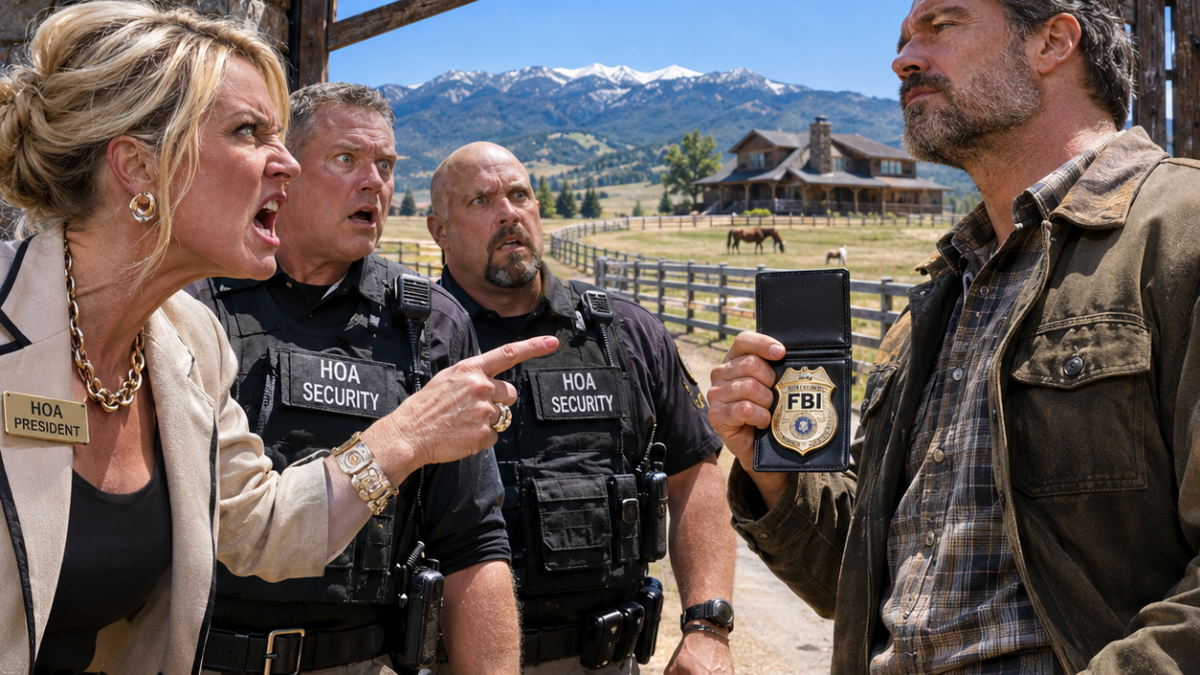
The credential case opened in my hand.
Gold badge.
Photograph.
Identification.
I held it where Brown could see.
“Special Agent Arthur Reed.”
His hand stopped.
The color left his face.
“Federal Bureau of Investigation.”
The room went silent enough to hear the air-conditioning.
Brown stared.
Then looked toward Christopher.
Christopher stood.
“No.”
I kept my voice level.
“Let go of my jacket.”
Brown did.
His hand dropped.
I turned slightly so nearby residents could see the credentials.
“I did not come here in an official capacity tonight. I came as the property owner.”
Christopher found his voice.
“That badge is fake.”
I looked at him.
“You said that about the court documents too.”
“Someone call the police.”
The main doors opened.
I did not know the exact timing beforehand.
That was important.
Four people entered first.
Two FBI agents in plain clothes.
Two state investigators.
Behind them came county deputies.
Melissa was among them.
She looked at me once.
Then at Christopher.
“Christopher Allen?”
He stepped backward.
“What is this?”
One agent produced papers.
“Federal search and arrest warrants.”
Brown dropped his handcuffs.
They hit the floor.
Metal on tile.
The sound traveled through the room.
Christopher pointed at me.
“This is his doing. He’s using the government to steal our community.”
Melissa answered:
“Mr. Reed is a victim and witness. He is not part of the arrest team.”
That sentence mattered more than anything I could have said.
Christopher’s face changed.
The agents moved toward him.
“Christopher Allen, you are under arrest pursuant to a federal warrant.”
His lawyer stood.
“On what charges?”
The agent began listing alleged offenses under the warrant and complaint.
Conspiracy.
Extortion-related conduct.
Wire fraud.
Money laundering.
Civil-rights offenses where legally applicable based on the evidence of joint action and misuse of apparent authority.
Additional state charges under review.
Brown backed toward the side aisle.
Melissa saw him.
“Mr. Brown, stay where you are.”
He ran.
Four steps.
That was all.
A state investigator and deputy intercepted him.
He struggled for half a second.
Then stopped.
The same cuffs he carried every day stayed on the floor.
County cuffs closed around his wrists instead.
Christopher kept talking.
“This is private property.”
I almost laughed.
He looked at me.
“You did this.”
“No.”
My voice surprised even me.
“You did.”
Agents escorted him out.
People stood.
Some cried.
Some shouted questions.
Some simply watched.
Nancy Adams had both hands over her mouth.
Bernard Thompson stared at Brown as though seeing him shrink.
Tyler—the young guard who had brought me water—stood near the wall.
He looked at Melissa.
Then raised his hand.
“I want to talk.”
She walked over.
He swallowed.
“I’ll cooperate.”
That was the beginning of the end.
Not the badge.
Not the warrants.
Tyler.
Because organizations built on fear do not collapse when the leader is arrested.
They collapse when followers stop protecting the secrets.
Within forty-eight hours, search teams entered the management center, security offices, Christopher’s residence, and Willow Security Services records facility under court-authorized warrants.
I was not present for most searches.
I learned details later through reports, testimony, and discovery as a witness and landowner.
The detention log I had glimpsed contained 217 entries across three years.
Two hundred seventeen.
Residents.
Visitors.
Contractors.
Some held twenty minutes.
Some hours.
A few overnight.
The stated reasons read like satire.
Unauthorized gathering.
Improper parking orientation.
Curfew.
Failure to comply with landscaping instruction.
Disruptive questioning at board meeting.
Refusal to identify.
“Suspicious attitude.”
That one stayed with me.
Suspicious attitude.
A private security organization had converted disagreement into an offense.
Financial records were worse.
More than $420,000 collected through fines, processing fees, security charges, towing assessments, and “administrative detention” costs.
Large portions flowed to Willow Security Services.
Willow Security Services paid Christopher-controlled accounts and related entities.
Brown received salary plus discretionary payments.
Several contractors were shells or related-party companies.
The investigation followed every dollar.
Nancy’s necklace turned up in Brown’s office safe.
So did watches.
Cash.
Credit cards.
Jewelry.
Property logged as “held during processing” and never returned.
When Melissa told me, I sat in Aunt Michelle’s kitchen and said nothing for almost a minute.
“You there?”
“Yes.”
“Arthur?”
“Can Nancy get it back?”
“Eventually. Evidence first.”
“She wore it thirty years.”
“I know.”
“Tell her they found it.”
“Prosecutors will handle victim notification.”
“Right.”
There were moments like that when being the victim and knowing the system became difficult.
I knew why evidence had to remain secured.
I also knew Nancy had spent six months wondering whether she was crazy.
Whether she had lost her mother’s necklace herself.
Christopher’s system didn’t just take property.
It made people doubt their memory.
The surveillance archive became central.
Christopher had cameras everywhere.
He probably believed recording protected him from false complaints.
Instead, he recorded the operation.
Residents restrained.
Residents threatened.
Money demanded.
Belongings inventoried.
Brown laughing.
Officers using phrases that mimicked police procedure.
The video that changed the case involved Harold Winters.
Eighty-two.
Willow Creek resident.
He had been brought into the management center three years earlier.
Security footage showed two officers escorting him down the hallway.
Harold stumbled at the detention-room threshold.
One officer pulled his arm.
Harold fell sideways.
His head struck the doorframe.
He collapsed.
For nearly a minute, nobody called emergency services.
Harold died two weeks later from complications following the injury.
No incident report had been sent to actual law enforcement.
His family was told only that he had suffered a medical event during an HOA security interaction.
Melissa called me after prosecutors located Harold’s daughter.
“This one’s bad.”
I had learned to fear that sentence.
“What happened?”
She told me.
I sat alone afterward.
Aunt Michelle’s house was almost empty.
She had lived simply.
Books.
Old furniture.
A framed photograph of me at my FBI graduation.
I hadn’t known she kept it.
I picked it up.
I had been twenty-nine.
Proud.
Certain.
Back then, I thought corruption always looked like envelopes of cash, whispered deals, falsified accounts.
Fifteen years taught me otherwise.
Sometimes corruption looks like a committee everyone stopped questioning.
Sometimes authority is not stolen all at once.
It is loaned away in tiny pieces because challenging it is inconvenient.
One evening, Sarah called.
“We need to discuss the land.”
I had almost forgotten the original reason any of this started.
“What about it?”
“Residents are panicking.”
“I’m not evicting anyone.”
“You need to say that formally.”
“They own their houses.”
“Many have leasehold or occupancy structures tied to the original ground lease. The criminal investigation has made everyone afraid their title is unstable.”
“It isn’t.”
“Then reassure them.”
We issued a statement through counsel.
The Carter trust had no intention of disturbing lawful residential interests.
No one would lose a home because Christopher Allen lied about ownership.
The ground lease would be reviewed transparently.
Existing residents would receive legal protections.
I insisted on that.
Christopher had used uncertainty as a weapon.
I would not.
Within weeks, residents formed an interim committee.
Nancy joined.
Abigail joined.
Bernard refused.
“I’m seventy-seven,” he told me. “I want to walk, not govern.”
Fair.
The old HOA board fragmented.
Two directors claimed ignorance.
One resigned and hired counsel.
Another began cooperating with investigators.
Evidence showed not every board member knew the criminal operation’s full scope.
Some had been negligent.
Some cowardly.
Some complicit.
Those distinctions mattered.
I resisted the easy story where every person near Christopher was evil.
Reality was messier.
One board member, Thomas Bell, came to my attorney’s office.
He looked exhausted.
“I voted for the security contracts.”
“Did you know Christopher owned the company?”
“No.”
“Did you ask?”
“No.”
“Why?”
He stared at the table.
“Because every time someone questioned him, something happened.”
“What?”
“Fines. Inspections. Rumors.”
“You were a board member.”
“I know.”
“Residents depended on you.”
“I know.”
He covered his face.
“My wife had cancer. I told myself keeping quiet meant protecting my family.”
I understood the motive.
Not the choice.
“You can tell investigators everything.”
“I have.”
“Then keep doing that.”
He looked at me.
“Do you hate us?”
“No.”
That surprised him.
“I don’t know enough about each of you to hate you.”
It was true.
My anger had narrowed.
Christopher.
Brown.
Specific acts.
Specific choices.
Blanket rage felt satisfying but imprecise.
Forensic work teaches you precision.
The investigation expanded into political donations.
Shell entities connected to Christopher had made contributions to several local campaigns.
That looked terrible.
But agents treated it correctly.
A contribution alone is not bribery.
Investigators looked for exchanges.
Official actions.
Messages.
Meetings.
Benefits.
One judge had received lawful campaign contributions and recused once the Willow Creek conflict surfaced.
No evidence supported charging that judge.
Another county official had received gifts routed through a contractor and had intervened in prior zoning and complaint matters.
That became a separate public-corruption investigation.
I stayed out.
This story was already personal enough.
Eight months after my first visit to Willow Creek, I entered federal court as a witness.
Not investigator.
Witness.
That distinction was repeated throughout trial.
Christopher’s defense strategy was predictable.
Arthur Reed inherited valuable land.
Arthur Reed wanted control.
Arthur Reed hid his FBI status.
Arthur Reed baited private security into making mistakes.
Arthur Reed turned a civil property disagreement into a federal vendetta.
On direct examination, the prosecutor walked me through the first gate encounter.
The search.
Christopher’s statement.
The second visit.
The torn documents.
The cuffs.
The detention room.
The waiver.
Then the annual meeting.
My badge.
The warrants.
Defense counsel stood.
Elegant suit.
Calm voice.
“Agent Reed, you concealed the fact that you were FBI.”
“Yes.”
“Twice.”
“Yes.”
“Why?”
“Because I was not acting in an official capacity during the property visits.”
“But you knew revealing it might change how security treated you.”
“Yes.”
“So you wanted them to mistreat you.”
“No.”
“You wanted evidence.”
“I wanted access to property I legally inherited.”
“Yet you recorded them.”
“After the first encounter, yes.”
“You planned a trap.”
“No.”
He walked closer.
“You returned knowing these men believed you were trespassing.”
“I returned with certified proof I owned the underlying land.”
“You knew they might detain you.”
“I knew they threatened to.”
“And you went anyway.”
“Yes.”
He smiled slightly.
“Because you wanted a federal case.”
“No.”
“Then why not simply show the badge?”
I looked at the jury.
Then back at him.
“Because an FBI badge does not make my property rights more valid than anyone else’s.”
The courtroom became quiet.
I continued.
“If the only reason a private security guard respects someone’s rights is because that person is a federal agent, the problem is not that the agent hid his badge.”
His smile disappeared.
Prosecutor objected to the extended answer.
The judge allowed it to stand but reminded me to answer questions directly.
Defense counsel changed direction.
“You were angry.”
“Yes.”
“You wanted Christopher Allen punished.”
“After learning what happened to residents, yes.”
“You wanted him destroyed.”
“No.”
“You expect this jury to believe that?”
“I wanted him held accountable for whatever prosecutors could prove.”
He looked dissatisfied.
That answer was less dramatic than he wanted.
Truth often is.
Nancy testified.
Her hands shook as the prosecutor displayed the gold necklace in an evidence bag.
“My mother gave it to me on my twenty-first birthday.”
“How long did you wear it?”
“Forty-seven years.”
She corrected herself.
“Almost every day.”
“Did you voluntarily give it to Mr. Brown?”
“No.”
“Did you receive it back after detention?”
“No.”
“What did he tell you?”
“That I must have lost it.”
She looked at Brown.
He stared at the table.
Abigail testified next.
She was devastating because she had no flair.
Auditors rarely do.
Rows.
Columns.
Dates.
Accounts.
Vendor registrations.
Money.
She showed how resident fines entered HOA systems, how funds moved into Willow Security Services and phantom vendors, and how portions returned to accounts tied to Christopher and associates.
The prosecution called bank analysts.
Forensic accountants.
Residents.
Former security employees.
Tyler testified under cooperation agreement.
That was one of the hardest days.
He described his first week.
Christopher’s training.
“Residents respond to confidence.”
“Never let them question your authority.”
“If they resist, isolate them.”
“Processing fees teach compliance.”
Tyler admitted he had participated in unlawful detentions.
He admitted taking property from residents and logging it improperly.
He admitted staying because the pay was good.
Then he explained why he gave me water.
“I knew it was wrong.”
Defense counsel attacked him.
“If you knew, why stay eight months?”
Tyler looked at the jury.
“Because knowing something is wrong and being brave enough to stop it are different things.”
No one moved.
“Why cooperate?”
“Because when Agent Reed showed the badge, I realized Christopher had lied to us too.”
“What lie?”
“That nobody could touch him.”
The elderly walker, Bernard Thompson, testified.
He wore a dark suit.
No cane.
He told the jury about thirty-one years in Willow Creek.
His evening walks.
The curfew rule.
The detention.
The fine.
Then the prosecutor asked:
“What changed afterward?”
Bernard looked down.
“I stopped walking.”
“Why?”
“I was embarrassed.”
“Of what?”
His voice became quiet.
“Being treated like a criminal where my neighbors could see.”
“How long did you stop?”
“Almost a year.”
“That’s all.”
Bernard started to leave.
Then the judge allowed a brief clarification requested by counsel.
Bernard said:
“I served twenty-six years carrying mail. Rain, snow, dogs, bad knees. I walked every day of my adult life.”
He looked at Christopher.
“One man with a fake badge took that away from me for a year.”
He stepped down.
Harold Winters’s daughter was last among the major victim witnesses.
She described the call from the hospital.
No explanation.
Her father unconscious.
Two weeks before he died.
She had believed he simply fell.
Then federal agents showed her the video.
The prosecutor did not play the full footage for long.
Enough.
Harold entering.
Arm pulled.
Fall.
Delay.
The daughter cried silently.
Several jurors did too.
Christopher never looked back at her.
That bothered me more than if he had glared.
Two weeks of testimony.
Five hours of deliberation.
Guilty on the major counts.
Christopher closed his eyes.
Brown’s shoulders sagged.
Tyler had already resolved his case through cooperation.
Other security officers faced separate outcomes based on their roles.
Sentencing came weeks later.
The judge spoke longer than I expected.
He described a system built not merely on financial fraud but on humiliation.
“You converted neighborly governance into coercive authority.”
Christopher stared straight ahead.
“You used private security to create the appearance of powers you did not lawfully possess.”
Then financial harm.
Theft.
Extortion.
Obstruction.
Civil-rights violations established through the proven facts of the case.
The sentence was severe.
Christopher received twenty-two years on the combined federal convictions, structured under applicable sentencing rules, along with substantial restitution and forfeiture.
Brown received eighteen years based on his convictions involving unlawful detentions, theft, assaultive conduct, and related federal offenses.
Other participants received lower sentences.
Tyler received probation, community service, and continuing cooperation obligations.
I did not applaud.
Some people in the gallery did.
I understood why.
But I sat beside Nancy.
She was holding the necklace.
The government had returned it after evidentiary use ended.
Her fingers never left it.
“You okay?” I whispered.
She nodded.
Then shook her head.
Then laughed quietly.
“I don’t know.”
Fair.
Christopher was led through a side door.
He never looked at me.
For months, I had imagined that moment.
I thought I would want eye contact.
Recognition.
Some sign that he understood he had lost.
When it came, I didn’t care.
My aunt used to say the opposite of love was not hatred.
It was irrelevance.
Christopher Allen was finally becoming irrelevant.
The land issue took longer.
One thousand acres containing hundreds of homes is not something you “take back” because a deed says your name.
There were homeowners.
Mortgages.
Longstanding leasehold interests.
Easements.
Utilities.
Roads.
Families who had done nothing wrong.
I spent almost a year with Sarah and a team of land-use lawyers untangling it.
Aunt Michelle had apparently understood exactly what she owned.
She had also understood the danger of disrupting everyone’s life.
In her papers, we found a letter addressed to me.
Not hidden.
Just filed in the most Michelle way possible:
**GROUND LEASE — FUTURE**
I opened it at her kitchen table.
Arthur,
If you are reading this, I ran out of time or nerve.
Possibly both.
Willow Creek sits on family land, but the people living there are not tenants in the ordinary sense. They built lives there. Do not punish them for mistakes made by developers or boards.
The association has become too powerful.
I tried to push back quietly.
Quietly was not enough.
If they ever force you to choose between proving ownership and protecting innocent families, do both.
You are irritating enough to find a way.
Love,
Michelle
I laughed and cried at the same time.
That was my aunt.
Affection delivered as insult.
She had known Christopher.
Not the criminal details.
But the control.
She had corresponded with the board several times over access rights.
Christopher had ignored her.
One letter from him read:
**Fee ownership carries no practical authority within Willow Creek governance.**
I framed that one.
Not because I enjoyed revenge.
Okay.
Partly because I enjoyed revenge.
Sarah called it “unhelpful emotional décor.”
I disagreed.
Ultimately, we restructured the ground arrangement.
Residents received clearer long-term protections.
No surprise eviction risk.
Transfer rights clarified.
Mortgage lenders satisfied.
Community areas placed under transparent leases.
The new Willow Creek Community Association replaced the old HOA after court proceedings and member action.
Rotating leadership.
Term limits.
Independent audits.
No private detention force.
No curfew enforcement.
No fake police vehicles.
Security, where needed, meant gates, cameras, emergency response, and licensed professionals operating within actual law.
Not a parallel justice system.
The guard booth remained.
Residents voted to keep it.
But the blue-and-red light bar came off the old vehicle before the vehicle was sold.
Bernard Thompson attended the removal.
“Want it?” someone joked.
Bernard shook his head.
“Put it in a museum of bad ideas.”
Nancy became treasurer.
The irony delighted Abigail.
“You trust her with money?”
Abigail asked at the first public meeting.
Nancy answered:
“More than I trust you with flowers.”
The room laughed.
That sound would have been impossible eighteen months earlier.
Abigail chaired the finance committee.
Every quarterly statement went online.
Every vendor disclosed.
Every contract over a threshold required competitive review.
Tyler finished his community service and later worked for a legitimate security firm outside Willow Creek.
Before leaving the area, he asked to meet me.
We sat at a diner.
He looked older.
Not much.
Enough.
“I’m sorry.”
“I know.”
“No.”
He shook his head.
“I mean for the room.”
“What room?”
“The detention room.”
I waited.
“I brought you water.”
“Yes.”
“I should have opened the door.”
“You would have been fired.”
“So?”
“You were twenty-five.”
“That isn’t an excuse.”
“No.”
He looked surprised.
I continued.
“But you eventually opened a bigger door.”
He frowned.
“That sounds like something from a movie.”
“It sounded better in my head.”
He smiled.
Then serious again.
“Do you forgive me?”
I thought about it.
“I’m not sure forgiveness is the useful question.”
“What is?”
“What do you do next?”
He nodded slowly.
That was enough.
Harold Winters’s family received compensation through restitution and civil settlements.
Nothing about money fixed the loss.
His daughter, Elaine, asked that Willow Creek install a memorial plaque near the community center.
Not large.
Just his name.
**HAROLD WINTERS
1939–2024
A NEIGHBOR WHO DESERVED BETTER**
I attended the dedication.
Elaine stood beside me.
“My dad would hate this.”
“The plaque?”
“Being the center of attention.”
“That seems common among people who end up with memorial plaques.”
She smiled.
“He liked birds.”
“What kind?”
“All of them. He wasn’t sophisticated about it.”
We planted a small shade tree beside the plaque.
Bernard brought a shovel.
Nancy brought food.
Abigail brought a printed budget for the memorial and made everyone laugh by announcing:
“Receipts available upon request.”
That was Willow Creek now.
Trauma translated into transparency.
Eighteen months after the trial, I drove through the entrance again.
No one stopped me.
The guard booth was empty that afternoon.
Children rode bicycles near the curb.
A man washed his truck.
Two women talked beside mailboxes.
Ordinary.
I parked near the community center.
Nancy was inside wearing her mother’s gold necklace.
Bernard had installed a bench in the park using part of his civil recovery.
The engraving read:
**FREEDOM HAS NO CURFEW**
I sat there after the ceremony.
Almost nine at night.
An elderly couple walked slowly down the path.
No permit.
No patrol vehicle.
No officer following them.
They passed the bench.
The man read the inscription.
Smiled.
Kept walking.
That should have been enough.
But Aunt Michelle’s name kept bothering me.
Everyone remembered Christopher.
Brown.
The arrests.
The case.
Few people knew Michelle had held the land for decades while quietly resisting the HOA’s expansion.
She had never wanted attention.
So naturally, I ignored what she would have wanted.
I created the Michelle Carter Legal Defense Fund.
Not an FBI project.
Not a government program.
A private nonprofit funded initially with income from the restructured land lease and part of my inheritance.
Its purpose was simple.
Help homeowners and residents get qualified legal advice when association disputes crossed into coercion, fraud, retaliation, or unlawful enforcement.
Not every HOA dispute is abuse.
Not every fine is tyranny.
Not every board president is Christopher Allen.
That distinction mattered.
The fund’s attorneys screened cases.
Sometimes the answer was:
The HOA is right. Cut your grass.
Sometimes:
You need mediation.
Sometimes:
This lien appears improper.
Sometimes:
Call actual police.
In its first year, the fund assisted forty-three households.
The number I cared about most was not forty-three.
It was one.
One elderly woman avoided signing away rights she did not understand after receiving a fraudulent-looking demand.
One family obtained counsel before losing a home over disputed assessments.
One disabled veteran got an accommodation issue resolved through mediation instead of a two-year war.
Aunt Michelle would have complained about the administrative expenses.
I could hear her.
“Arthur, why are you paying lawyers to have meetings about paying lawyers?”
She would have been right.
Some nights, I still thought about my second visit.
Brown tearing the probate certificate.
Cuffs around my wrists.
Christopher across the metal table.
**This is my world.**
He had believed that.
Not metaphorically.
He had actually believed control created ownership.
That if enough people obeyed, reality became whatever he announced.
Then I thought about my badge.
People love that part of the story.
The moment it opened.
Brown going pale.
Christopher freezing.
Agents entering.
It sounds satisfying.
It was.
For about ten seconds.
But the badge did not defeat Willow Creek.
Nancy did.
By speaking.
Abigail did.
By keeping records.
Bernard did.
By testifying.
Tyler did.
By turning on the men he had once obeyed.
Melissa and the agents did.
By building a case that could survive defense attacks.
Sarah did.
By separating property law from criminal law.
Prosecutors did.
Jurors did.
Residents did.
A badge is metal.
Evidence is what mattered.
That realization came to me one evening when I finally moved into Aunt Michelle’s house permanently.
I had spent nearly two years calling it “Michelle’s place.”
Like naming it mine would erase her.
The last box in the kitchen contained old photographs.
One showed Michelle at Willow Creek in the 1980s.
No gate.
No guard booth.
Just a dirt entrance and a wooden sign.
She stood beside my mother.
Both young.
Both laughing.
On the back, Michelle had written:
**LAND IS EASY. PEOPLE ARE COMPLICATED.**
I sat on the floor and laughed.
Christopher had told me:
**Land is dirt. Power is what matters.**
Michelle had understood something he never did.
Land lasts.
Power changes hands.
People are where responsibility lives.
I placed the photograph beside my FBI graduation picture.
Months later, I retired.
Not because of Willow Creek alone.
Fifteen years had become seventeen by then.
I had missed birthdays.
Weddings.
Too many dinners.
Aunt Michelle had died with a thousand acres and a nephew who had not visited enough.
That truth bothered me more than any HOA ever could.
On my last day, Melissa handed me a cardboard box.
“You’re officially useless now.”
“Thank you.”
“No badge to scare neighborhood security.”
“I’m keeping the retired credentials.”
“Don’t ruin the joke.”
Inside the box:
A coffee mug.
Case photographs.
Awards.
A framed copy of a message she had printed from years earlier.
My text after the second Willow Creek detention:
**I’M OUT. I’M SAFE. I HAVE ENOUGH TO REPORT THIS PROPERLY.**
She had written beneath it:
**FOR ONCE, HE FOLLOWED PROCEDURE.**
I laughed.
“Very funny.”
“You wanted to raid the place yourself.”
“I absolutely did not.”
“You made a whiteboard.”
“That proves nothing.”
“You called it a command center.”
“I was grieving.”
“That defense won’t survive cross-examination.”
We hugged.
Then I drove home.
Willow Creek was quiet.
I passed through because the road crossing part of the property had become public-access under the new agreement.
No gate confrontation.
No lights.
Bernard was walking.
Nine-fifteen at night.
Reflective vest.
He saw my truck.
Waved.
I pulled over.
“You’re out late.”
He looked at his watch.
“Call security.”
I laughed.
He leaned on the open window.
“Retired?”
“Today.”
“What will you do?”
“No idea.”
“Walk.”
“What?”
“Best hobby there is.”
“You’re biased.”
“Thirty-one years of experience.”
So I parked near the community center.
We walked.
Slowly.
Bernard told me which houses had new owners.
Who hated the new landscaping plan.
Who secretly fed stray cats despite a community rule against it.
Normal neighborhood gossip.
At the park, we stopped at his bench.
**FREEDOM HAS NO CURFEW.**
He sat.
I remained standing.
After a minute, Bernard said:
“You know what bothered me most?”
“About Brown?”
“No.”
“What?”
“That I let them make me afraid.”
“That wasn’t your fault.”
He waved one hand.
“I don’t need comforting.”
Fair.
“I spent a year inside after dark.”
He looked toward the path.
“Then one day I realized Brown was in prison and I was still following his rule.”
That hit me.
“So you walked.”
“Eight-oh-one.”
I smiled.
“Rebel.”
“Terrifying.”
We sat there until almost ten.
No one stopped us.
I thought that was the ending.
It wasn’t.
A week later, Sarah called.
“You have mail at the trust office.”
“Important?”
“Depends how sentimental you are.”
“Dangerous question.”
I drove over.
A package.
No return address.
Inside was my torn probate certificate.
Both halves.
Brown had apparently kept them in his office.
Evidence teams recovered them during the search.
The original certified copy had already been replaced long ago.
This one had no legal value.
Sarah said:
“Throw it away.”
I held the two pieces together.
County seal split through the middle.
My name.
Michelle’s name.
One thousand acres.
“I think I’ll keep it.”
“Why?”
“Because he thought tearing paper changed ownership.”
She smiled.
“That is irritatingly symbolic.”
“Thank you.”
I framed it.
Not my badge.
Not Christopher’s indictment.
Not a newspaper headline.
The torn probate certificate.
It hangs in my study now.
Visitors sometimes ask about it.
I tell them:
“That was the day someone mistook power for truth.”
Then I usually change the subject.
Because the better view is outside.
From my study window, I can see the edge of Willow Creek.
No fake police cars.
No lights.
No men with handcuffs deciding who belongs.
Just houses.
Trees.
Families.
And occasionally Bernard walking far later than any seventy-something-year-old man has business being awake.
The thousand acres are still in the Carter trust.
The residents are protected.
The community governs itself.
The audits are public.
Nancy still wears her mother’s necklace.
Abigail still complains when anyone submits an expense without a receipt.
Harold Winters’s tree is tall enough now to cast shade over his plaque.
Tyler sends a Christmas card every year.
Melissa sends sarcastic replies whenever I mention retirement projects.
And Christopher Allen?
He became what he spent years making other people feel like.
Powerless before a system larger than himself.
But I rarely think about him anymore.
That might be the consequence he would have hated most.
The last time I drove through Willow Creek at dusk, I passed the old gate where Brown first opened my car door without permission.
The booth had been renovated.
New sign.
No forty-seven-rule manifesto.
Just three lines:
**WILLOW CREEK**
**RESIDENTS • GUESTS • DELIVERIES**
**PLEASE DRIVE SAFELY**
I stopped for a moment.
No one came running.
No flashing lights appeared behind me.
No one demanded identification.
The gate opened.
I drove through.
My old FBI credential case was at home in a desk drawer.
I didn’t need it.
Not anymore.
[END OF STORY]








