PART 2: HOA “Cops” Tried Breaking Into My Truck With a ‘Master Key’—Then Called 911 on the Wrong Man
PART 2
I was standing at the grill when I heard gravel shift behind me.
Rick came around the corner of the house as casually as if the side yard belonged to him.
No knock.
No announcement.
No invitation.
He stopped about ten feet from the deck.
“Evening, Mr. King.”
I flipped a burger and looked at him.
“Rick.”
“You saw the towing notice?”
“I did.”
“Then you understand you have seventy-two hours.”
“To do what?”
“Remove the vehicle voluntarily.”
“From my own driveway.”
“Yes.”
“Under which covenant?”
His jaw tightened.
“You’ve already been informed.”
“That isn’t what I asked.”
I set down the spatula.
“Show me the provision authorizing the HOA to tow a legal personal vehicle from privately owned property.”
“The board has discretionary enforcement authority.”
“For aesthetics.”
“For community standards.”
“Not the same thing.”
He moved a little closer.
I pointed at the grass beneath his boots.
“Stop there.”
He looked down, then back at me.
“You serious?”
“Very.”
“This is HOA property.”
“No. This is my side yard.”
“Your lot is governed by the association.”
“That doesn’t make you the owner.”
He smiled.
Not friendly.
“People who cooperate usually have a much easier time here.”
I had heard variations of that sentence from suspects for years.
Sometimes it came from gang members.
Sometimes corrupt supervisors.
Sometimes businessmen who thought money turned threats into negotiations.
The structure was always the same.
Do what I want, or consequences will appear.
I nodded toward the tool on his belt.
“Is that part of HOA enforcement?”
His hand instinctively moved toward it.
“Vehicle access equipment.”
“Vehicle access.”
“For emergencies.”
“What emergency requires entering my F-150?”
His expression changed.
Just a fraction.
“You ask a lot of questions.”
“Occupational habit.”
“What do you do?”
“Consulting.”
That was not technically false.
Sheriffs consult constantly.
He looked at me for another few seconds.
Then:
“You’re making this harder than it needs to be.”
“So are you.”
“You don’t understand how Pinewood works.”
“I’m beginning to.”
He stepped backward.
“I’ll see you in seventy-two hours.”
“No.”
He paused.
“If you come onto my property again without permission, we’re going to have a different conversation.”
He smiled again.
“You threatening me?”
“No.”
I pointed to the motion camera beneath the eave.
“I’m informing you that you’re being recorded trespassing after being told to leave.”
The smile vanished.
He turned.
Walked through the side yard again.
I watched until he reached the sidewalk.
Then I went inside.
The camera had caught everything.
Three angles.
Audio clean.
Timestamp intact.
I copied the footage to cloud storage and sent another copy to a secure external drive.
My late wife Elena used to tease me about that kind of redundancy.
“You back up grocery lists too?”
“If they’re important.”
“You think bananas require chain of custody?”
“Depends who steals them.”
I could hear her voice as clearly as if she were standing in the kitchen.
Grief does that.
It lets someone disappear from the world while leaving them perfectly alive inside certain rooms.
I stood at the counter longer than I meant to.
Then the doorbell rang.
The woman outside was in her sixties.
Gray hair.
Cardigan.
Hands clasped too tightly in front of her.
I recognized her as a neighbor three houses down.
She rarely made eye contact when I drove past.
“Mr. King?”
“Yes.”
“My name’s Helen Marsh.”
“Come in?”
Her head moved quickly.
“No.”
She glanced toward the street.
“I shouldn’t be here long.”
That posture was familiar.
I had interviewed frightened witnesses for twenty-two years.
Most people imagine fear as shaking.
Often it looks like checking the street before every sentence.
“What can I do for you?”
She lowered her voice.
“The security team has a master key.”
I looked at her.
“To what?”
“Cars.”
“An actual key?”
“I don’t know if it’s a key.”
She swallowed.
“Some metal thing they slide into the doors.”
The slim-jim.
My eyes moved automatically toward the street.
Helen noticed.
“You’ve seen it.”
“Yes.”
She stepped closer.
“The Petersons lived in your house before you.”
I had seen their name on old closing documents.
“What about them?”
“They questioned the HOA finances.”
“When?”
“Last year.”
“What happened?”
“At first? Notices.”
“Like mine?”
“Parking. Lawn. Trash. Anything.”
“And then?”
Helen looked down.
“Things started disappearing from their car.”
I did not speak.
“Sunglasses. Coins. A charging cable. One time, paperwork from the glove compartment.”
“Did they report it?”
“To Barbara.”
“What did she say?”
“That security had inspected the vehicle because of a complaint.”
My chest tightened.
“Inspected it?”
Helen nodded.
“Mr. Peterson threatened to call police.”
“Did he?”
“I don’t know.”
“What happened next?”
“They sold.”
“How long afterward?”
“Three months.”
“At market?”
She gave a sad little laugh.
“Not even close.”
“Why are you telling me this?”
Helen looked toward my living room, where one framed photograph of Elena sat on the bookshelf.
Then back at me.
“My husband was Denver Police for thirty years.”
“Was?”
“He died four years ago.”
“I’m sorry.”
“He saw what Rick was becoming before he got sick.”
“What do you mean?”
“Uniforms got more official. Cars got lights. They started calling themselves officers.”
“Were they licensed security?”
“I don’t know.”
“Did your husband ever challenge them?”
“He tried.”
“What happened?”
She smiled bitterly.
“Three violations in one week.”
That fit.
Helen’s voice steadied.
“Watching Rick walk around pretending to be a police officer makes me sick.”
“Then why wait until now?”
Her eyes met mine.
“Because everybody who pushes back gets punished.”
Silence.
Then:
“And because you look at him like he’s ridiculous.”
I almost smiled.
“He is.”
“No.”
Her expression remained serious.
“You look at him like you’ve met real men with authority.”
That was closer than I wanted her to get.
I said nothing.
Helen nodded as though my silence confirmed enough.
“Just be careful.”
“I will.”
She started toward the steps.
“Helen.”
She turned.
“Did you personally see Rick enter anyone’s vehicle?”
“Yes.”
“The Petersons’?”
She hesitated.
Then nodded.
“With that tool?”
“Yes.”
“When?”
“More than once.”
“Would you be willing to tell an investigator that?”
Fear returned.
“I don’t know.”
“That’s okay.”
“I’m sorry.”
“Don’t be.”
She left.
I watched her cross three lawns instead of using the sidewalk.
Probably so fewer cameras would catch her.
That night I pulled every relevant public record I could find.
Rick Dutton.
Three failed applications to police departments in the early 2000s.
Two documented failures during psychological screening phases.
Then private security.
Mall patrol.
Commercial lots.
Eventually Pinewood Estates.
Nothing inherently criminal about failing to become a police officer.
Plenty of good people do.
But coupled with what I had seen, Rick had built the costume of the job he apparently wanted without accepting the limits that came with the actual profession.
The next morning, my phone lit up.
Emily.
**Coming home Friday. Need laundry access and free food.**
I smiled.
**Rent increased.**
She replied:
**You love me too much.**
She was right.
Emily arrived Friday evening with two bags of laundry, three law-school brochures, and approximately seventeen opinions about things I had not asked about.
The house changed when she came home.
After Elena died, silence had become both refuge and punishment.
Emily filled rooms the way her mother used to.
Music from upstairs.
Cabinet doors opening.
Half-finished conversations shouted from one floor to another.
For the first night in weeks, I forgot Barbara Walker and Rick Dutton.
Saturday morning ended that.
Emily and I were eating breakfast on the deck when she looked at her phone.
Her eyebrows drew together.
“Dad.”
“What?”
“Do you have the Pinewood app?”
“No.”
“You’re famous.”
She handed me the screen.
Barbara had posted a community email.
**PROTECTING PINEWOOD PROPERTY VALUES**
No name.
No need.
It described “one homeowner” who repeatedly refused reasonable requests about vehicle aesthetics.
A resident who had been confrontational with “volunteer security personnel.”
Someone creating “an uncomfortable environment” for those protecting the community.
Then there was a photograph of my truck.
Emily read it twice.
“This is insane.”
“It’s strategic.”
“They’re mobilizing the neighborhood against you over an F-150.”
“Not exactly.”
“What is it then?”
“Compliance.”
She set the phone down.
“You sound like Mom.”
I looked up.
“When?”
“When she’d explain hospital politics.”
That made me smile.
“She hated hospital politics.”
“She said people almost never fight about the thing they claim they’re fighting about.”
That did sound like Elena.
The effect of Barbara’s email appeared by afternoon.
Two women at the mailbox stopped talking when Emily and I approached.
One looked at me.
Then away.
They collected their mail and left.
Emily waited until we were inside.
“One email.”
“Yes.”
“One.”
“Yes.”
“And now you’re radioactive.”
“Social pressure works.”
“She’s lying.”
“People rarely verify a story that confirms what their group already believes.”
Emily looked toward the front window.
“This is like a cult.”
“Don’t say that at the board meeting.”
“Why?”
“Cult members hate that.”
She laughed.
Sunday morning, the hostility reached her.
I was making coffee when voices rose outside.
I opened the front door.
A woman in tennis whites stood at the edge of my driveway pointing at Emily.
“Your father is dragging down everyone’s investment.”
Emily’s face was calm.
Her hands were not.
They were clenched at her sides.
The woman continued.
“My husband and I paid one-point-two million dollars for this house. We’re not going to let someone who ignores standards lower our property values.”
Emily said:
“It’s a pickup truck.”
“That isn’t the point.”
“Then what is?”
“The rules.”
“Which rule?”
The woman blinked.
“The HOA notified him.”
“That wasn’t my question.”
I almost laughed.
Elena again.
The woman turned red.
“You have no idea who you’re dealing with.”
Emily folded her arms.
“Neither do you.”
That was my cue.
I stepped outside.
“Everything okay?”
The woman’s expression changed when she saw me.
“We’re having a discussion.”
“No.”
Emily looked at me.
“She was leaving.”
The woman stared at us both.
Then marched away.
Inside, Emily’s hands began shaking.
Adrenaline.
She noticed me notice.
“I’m fine.”
“I know.”
“I said I’m fine.”
“I heard you.”
She sat at the kitchen table.
“Dad, this isn’t normal.”
“No.”
“Why are you letting it continue?”
That was the question I had been avoiding.
I went upstairs.
Opened the nightstand.
Came back.
Set my badge on the table.
Emily stared.
Then looked at me.
“You haven’t told them?”
“No.”
“Anyone?”
“No.”
“Barbara?”
“No.”
“Rick?”
“No.”
Her disbelief turned into anger.
“Why?”
“Because one look at this and they start behaving.”
“Isn’t that the goal?”
“For me?”
“Yes.”
“For the next family?”
She stopped.
I turned the badge over.
“People behave differently around law enforcement.”
“Dad, you are law enforcement.”
“Here, I’m a homeowner.”
“You think they’ve committed crimes.”
“I think they’re going to.”
Her face went still.
“That’s dangerous.”
“Calculated.”
“That’s the word men use when they don’t want daughters telling them something is dangerous.”
I almost smiled.
She didn’t.
“Mom would hate this.”
“That’s unfair.”
“True.”
I sat opposite her.
“Helen warned me about the Peterson family.”
I told her everything.
The suspected vehicle entries.
Small thefts.
Families leaving.
Emily listened.
When I finished, she looked at the badge.
“So you’re waiting for them to do it to you.”
“I’m documenting what they choose to do.”
“Same thing.”
“Not exactly.”
“Close enough.”
My phone buzzed.
Bill Hawkins.
My undersheriff.
**Everything okay at the new place? Heard some Pinewood chatter at municipal meeting. Call me.**
Emily read it over my shoulder.
“Your own office knows.”
“Apparently.”
“You’re not nearly as invisible as you think.”
“Never claimed I was.”
I called Bill.
He answered:
“Boss.”
“What chatter?”
“Pinewood people complaining about some resident causing trouble.”
“That resident would be me.”
Silence.
Then:
“What did you do?”
“Bought a truck, apparently.”
He laughed.
I gave him the outline.
Not every suspicion.
Facts.
Bill stopped laughing.
“You want me involved?”
“Not yet.”
“Ethan.”
“I’m documenting.”
“You always say that before somebody gets arrested.”
“That is statistically unfair.”
“Need patrol aware?”
“No special treatment.”
“Fine.”
He hesitated.
“Just remember you’re sheriff even when you’re pretending not to be.”
“I’m not pretending.”
“You know what I mean.”
Emily left Sunday evening.
Before getting in her car, she hugged me harder than usual.
“Call every day.”
“I’m the parent.”
“Call anyway.”
“Drive carefully.”
“Show the badge before you get murdered by suburban mall cops.”
“Language.”
“Love you.”
“Love you too.”
I watched her taillights disappear.
The house went quiet.
The patrol SUV passed at 7:45.
At eight, Rick’s personal Dodge Charger rolled by.
He was off duty.
Still watching.
The next three days were small-pressure warfare.
Neighbors stopped waving.
Garbage bins were left scattered.
Another anonymous complaint appeared.
Thursday evening, I came home to a bright-red paper taped to my front door.
**FINAL WARNING**
My truck would be removed within twenty-four hours unless I voluntarily relocated it from “community property.”
My driveway.
I photographed the notice.
Checked the cameras.
Backed up the footage.
Then around 11:30 that night, headlights swept across my living-room ceiling.
I killed the lamp.
The Pinewood patrol SUV sat at the end of my driveway.
Lights off.
Engine running.
Rick sat behind the wheel.
I waited.
Fifteen minutes.
The driver door opened.
He stepped out.
Looked toward the house.
Then the truck.
His hand moved to his belt.
Slim-jim.
He took two steps toward my driveway.
His radio crackled.
Rick froze.
Listened.
Looked back at the SUV.
Then got in and drove away.
I remained at the window.
The intent was clear enough to concern me.
Not enough to charge based on that moment.
He had come prepared.
He had been interrupted.
Tomorrow morning, I decided, I would give him no reason to think I was home.
I woke at 5:45.
Coffee.
No lights facing the street.
Blinds tilted.
Truck exactly where it always sat.
Dash camera armed.
Exterior cameras recording.
I was positioned inside with a clear view.
At 6:42, Pinewood Security arrived.
Rick driving.
Younger guard beside him.
Later I learned his name was Tyler Reeves.
Twenty-three.
Six months on the job.
They parked along the curb.
Looked both directions.
No residents outside.
Rick approached the driver’s door.
Tyler stayed several feet back, clearly serving as lookout whether he understood the legal significance or not.
Rick removed the lockout tool.
He slid it between the glass and weather stripping.
Slowly.
Professionally.
He knew what he was doing.
The aftermarket lock system resisted.
He adjusted the angle.
Tried again.
Tyler shifted.
“Rick.”
No answer.
“Rick, maybe—”
“Shut up.”
The slim-jim scraped inside the door.
My dash camera captured Rick’s face.
Hands.
Tool.
Every movement.
Ten minutes passed.
Frustration replaced confidence.
Rick pulled the tool out.
Tried the passenger side.
Nothing.
Then he kicked the front tire.
Once.
Again.
Tyler stepped backward.
“Come on, man.”
Rick slammed his palm into the driver’s door.
Hard enough to dent it.
Tyler said:
“We need to leave.”
Rick ignored him.
He pulled out his phone.
Called someone.
I could not hear the other side.
His voice carried enough.
“Barbara. Lock won’t open.”
Pause.
“He’s got some upgraded system.”
Pause.
“No. Listen. We need to escalate.”
He paced beside my truck.
“Call the cops.”
I stopped moving.
“Report it as suspicious. Say someone was tampering with it.”
Tyler stared at him.
Rick turned partly away.
“Whatever gets them out here so they can search it legally.”
Pause.
“Good. Do it.”
He hung up.
Tyler whispered:
“You’re calling the police?”
“Barbara is.”
“Why?”
“Because this guy wants to play games.”
Tyler looked at my truck.
Then toward my house.
“This feels wrong.”
Rick opened the SUV door.
“Then quit.”
They sat inside.
And waited.
I stayed in my chair.
This was the moment I could have stopped it.
Walk outside.
Show badge.
Tell Rick to get off my property.
Call Bill.
Easy.
Clean.
But easy would have solved my problem.
Not Pinewood’s.
Helen’s warning kept returning.
The Petersons.
Missing items.
Forced sale.
Four years of a so-called master key.
If I revealed myself before Barbara placed the call, Rick might deny everything beyond the vehicle damage.
Barbara could claim ignorance.
Records could disappear.
Residents would remain unsure whether Helen’s memories were true.
So I waited.
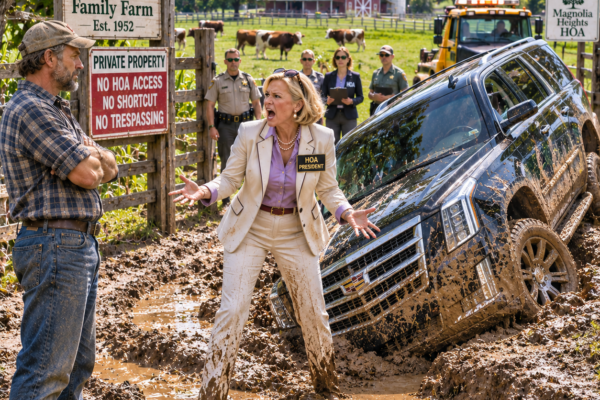
Twelve minutes later, sirens approached.
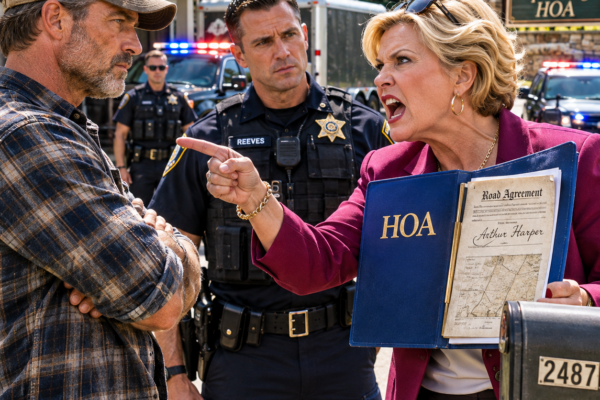
Two Summit County patrol units turned onto the street.
Unit 14.
Unit 22.
Jake Torres and Judy Mendoza.
Both deputies I knew well.
Both experienced enough that I trusted them to handle whatever happened next without needing a whispered instruction from me.
They parked behind the HOA SUV.
Rick climbed out.
Instant transformation.
Shoulders back.
Professional voice.
Concerned community officer.
I could not hear every word from inside, but the body language told the story.
Pointing at my truck.
Gesturing toward the house.
Tyler hanging back.
Torres listened.
Then he glanced at his mobile terminal.
Plate check.
I knew the moment he saw the registered owner.
His eyes lifted toward my front window.
Just once.
No smile.
Good deputy.
He turned back to Rick.
A silver Mercedes arrived.
Barbara.
Cream blazer.
Pearls.
Heels at six-something in the morning.
Some people prepare for arrests differently.
She approached holding a folder.
I stood.
Straightened my shirt.
Picked up nothing except my phone.
The badge remained in my pocket.
I walked outside.
Rick was speaking when he noticed me.
His voice slowed.
Torres turned.
Recognition flashed.
Then professional neutrality returned.
“Sir,” he said, “are you the resident at this address?”
“Yes.”
“And registered owner of the Ford F-150?”
“Yes.”
Rick interrupted.
“This is exactly what I was explaining. He has been noncompliant for weeks.”
Torres looked at him.
“With what?”
“Community vehicle standards.”
“Is that why 911 was called?”
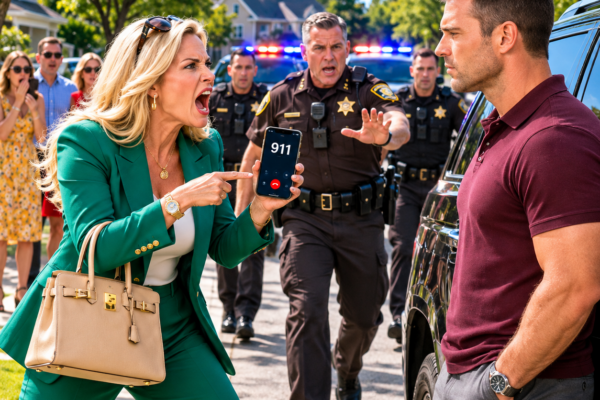
Barbara stepped forward.
“I placed the call.”
Torres looked at her.
“Your name?”
“Barbara Walker. President of Pinewood Estates.”
Mendoza took notes.
Barbara handed Torres the folder.
“This resident has been hostile toward security staff and has repeatedly violated association standards.”
Torres did not open the folder.
“What crime are you reporting?”
Barbara hesitated.
“Suspicious vehicle activity.”
“What activity?”
Rick answered.
“We observed apparent tampering with the lock.”
I folded my arms.
Torres said:
“You observed someone tampering?”
“Yes.”
“Who?”
Rick hesitated.
“Unknown.”
“Where is that person now?”
“We don’t know.”
“What time?”
Rick looked toward Barbara.
She jumped in.
“The vehicle itself has been the subject of ongoing concerns.”
Mendoza said:
“Ma’am, a vehicle being unpopular with an HOA is not a criminal complaint.”
Barbara’s face tightened.
“I understand that.”
“Then what did you report to dispatch?”
“That there was suspicious activity suggesting the vehicle may not be lawfully possessed.”
I almost admired how many words she could use without answering.
Torres turned to me.
“Mr. King, have you spoken with either of these people this morning?”
“No.”
Rick stepped forward.
“He made threats.”
Torres’s pen stopped.
“When?”
“During the vehicle interaction.”
I looked at Rick.
“What threat?”
He stared back.
“You said I’d regret touching the vehicle.”
“No.”
“Words to that effect.”
“Interesting.”
Barbara looked at me.
I continued.
“I haven’t spoken to either of you this morning.”
Silence.
Rick’s face changed.
I pointed toward the F-150.
“I was inside while Mr. Dutton spent approximately fifteen minutes trying to unlock my truck with the slim-jim currently hanging from his belt.”
Torres straightened.
Mendoza looked directly at Rick’s hip.
I continued.
“When the tool failed, he kicked the tire twice and struck the driver’s door hard enough to leave a dent.”
Rick’s color faded.
Barbara said:
“That is absurd.”
“Is it?”
“Rick would never—”
She stopped.
Too late.
I pointed through the windshield.
“Dash camera.”
Then to the eaves.
“Exterior cameras.”
Rick looked up.
I said:
“High-definition video. Continuous timestamp. Audio.”
Torres’s voice changed.
“Mr. Dutton, do not touch anything on your belt.”
Rick froze.
I continued.
“The recording also captured Mr. Dutton calling Mrs. Walker and instructing her to call 911, report suspicious activity, and create a reason for deputies to search my vehicle.”
Barbara’s face hardened.
“That never happened.”
“Then the recording will clear you.”
Mendoza looked at Barbara.
“Ma’am, did you call 911 after speaking with Mr. Dutton?”
Barbara said nothing.
“Mrs. Walker?”
“Yes.”
“What did he tell you?”
“I’d like to speak to an attorney.”
That was the first intelligent decision she had made.
Rick said:
“This is entrapment.”
Torres looked at him.
“How?”
“He was watching us.”
I almost laughed.
Mendoza actually blinked.
Rick realized what he had said.
I let the silence sit.
Then Mendoza asked me:
“Mr. King, can you provide proof of ownership?”
“Absolutely.”
She nodded toward the truck.
“Registration is returning to Ethan King at this address.”
Torres closed his notebook.
He knew the reveal was coming.
So did I.
But before I reached into my pocket, I looked at both deputies.
“Jake. Judy.”
Rick glanced between us.
Barbara did too.
I took out the leather case.
Opened it.
The badge caught the morning sun.
“Ethan King.”
Rick took one step backward.
“Sheriff of Summit County.”
Barbara’s mouth opened.
Nothing came out.
Tyler whispered something that sounded remarkably like:
“Oh, God.”
Torres maintained a straight face.
Barely.
Mendoza did better.
Barbara recovered first.
“You concealed your identity.”
“Yes.”
“This was a setup.”
“No.”
“You deliberately allowed—”
“I lived in my house.”
I kept my voice level.
“You sent notices.”
“You sent security patrols.”
“Mr. Dutton entered my property.”
“This morning he attempted to access my truck.”
“You called 911.”
I looked at Rick.
“I did not tell either of you to do any of those things.”
Rick started:
“You’re using your office—”
“No.”
I cut him off.
“And because I am the sheriff, I’m not going to direct the criminal investigation into conduct where I am the victim.”
That mattered.
I looked at Torres.
“Contact Undersheriff Hawkins and the district attorney’s office. Preserve the 911 recording, body-camera footage, my surveillance video, and the lockout tool. I’ll provide a witness statement like anyone else.”
Torres nodded.
“Yes, Sheriff.”
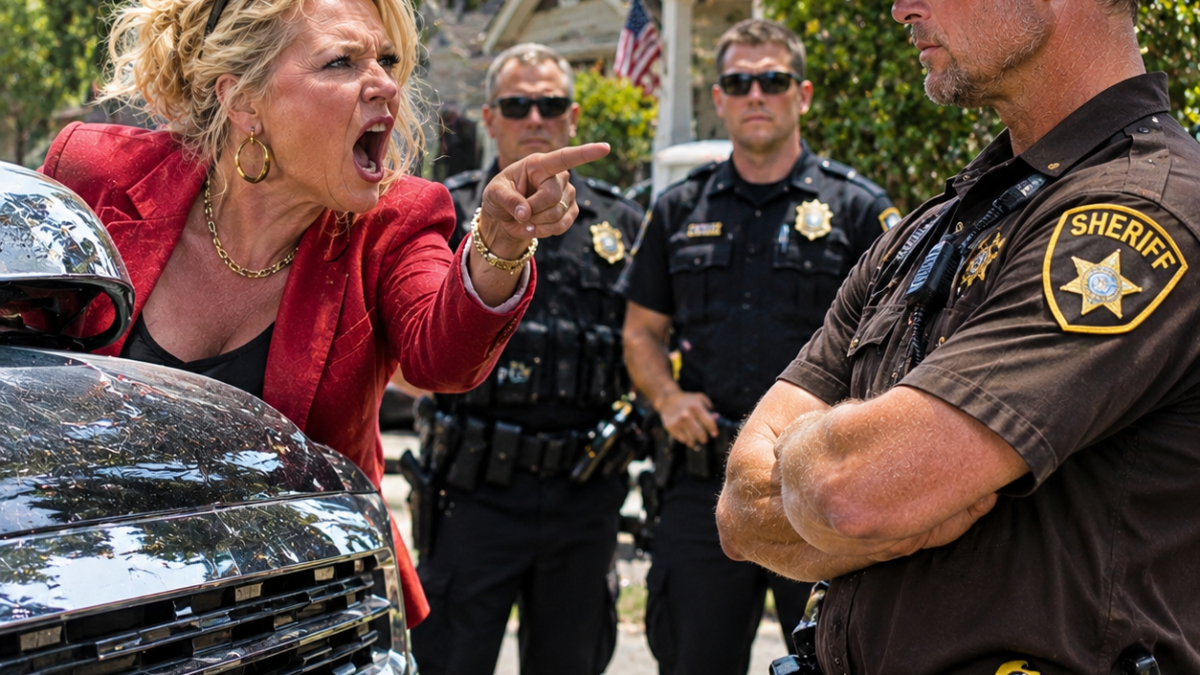
Rick’s face got worse when he heard the title from someone in an actual uniform.
Barbara said:
“You cannot arrest HOA officials for enforcing covenants.”
Mendoza answered:
“No one is talking about enforcing covenants.”
She pointed toward the truck.
“We’re talking about what happened to that vehicle.”
Bill Hawkins arrived twenty minutes later.
He looked at my dented door.
Then at me.
Then at Rick.
“You bought a truck and started a constitutional crisis?”
“Apparently.”
“This is why you should live farther away.”
He took over the scene.
I stepped back.
That was important.
The video was reviewed.
The 911 call was pulled.
Dispatch audio captured Barbara reporting a suspicious vehicle and suggesting someone had been seen tampering with it.
The cameras showed who had actually been tampering.
Rick.
Tyler gave a statement.
His first words to Bill were:
“I told him not to do it.”
Rick heard him.
“Shut up, Tyler.”
Bill turned.
“Mr. Dutton, from this point forward, I suggest you stop instructing witnesses.”
Rick did.
Then Helen Marsh walked out of her house.
She crossed the street.
Slowly at first.
Then with purpose.
“Deputy.”
Bill looked at her.
“My name is Helen Marsh.”
“Yes, ma’am?”
“I need to tell you something about that tool.”
Rick went still.
Barbara closed her eyes.
Helen pointed to the slim-jim now sitting in an evidence bag.
“They’ve used it before.”
A few neighbors had come outside.
More doors opened.
Phones appeared.
Helen continued.
“The Petersons. Last year.”
Rick shouted:
“She doesn’t know what she’s talking about.”
Mendoza stepped between them.
“Sir, stay where you are.”
Helen’s voice shook.
“I watched him open their car.”
Bill asked:
“How many times?”
“At least twice.”
“Did you see anything removed?”
“Once.”
“What?”
“I couldn’t tell. Something small.”
Rick looked toward Barbara.
Then toward the patrol car.
Something in him collapsed.
Not guilt.
Self-preservation.
“It was her policy.”
Barbara turned.
“Rick.”
He pointed toward her.
“The master-key thing. She told me to do it.”
“Stop talking.”
“She said problem residents needed encouragement.”
“Rick, shut up.”
Everyone heard that.
Bill raised a hand.
“Mrs. Walker, do not instruct him.”
Rick kept going.
“The Petersons complained about dues. Barbara told me to inspect their vehicle.”
“Inspect?”
Bill’s voice was flat.
Rick realized the word wasn’t helping.
“I went in.”
“How?”
“With the tool.”
“Did you take property?”
Rick looked down.
Barbara said:
“I want an attorney.”
Rick looked at her.
Then something bitter crossed his face.
“She told me to take little things.”
Barbara spun.
“You liar.”
“Coins. Sunglasses. Stuff they wouldn’t call cops over.”
Helen covered her mouth.
Her eyes filled.
“The Petersons weren’t imagining it.”
Nobody answered.
Rick said:
“She said it would make them uncomfortable enough to move.”
Barbara lunged verbally, not physically.
“You did those things on your own.”
“No.”
“Yes!”
“You gave me the tool.”
“No, I didn’t.”
“Your email said—”
Barbara stopped breathing for half a second.
Email.
Everyone noticed.
Bill did not smile.
“What email?”
Barbara said:
“I’m done speaking.”
Smart.
Late.
Tyler raised his hand like a student.
“I have seen emails.”
Rick stared at him.
Tyler continued.
“Instructions.”
Bill asked:
“From whom?”
“Barbara.”
“What kind?”
Tyler swallowed.
“Lists of houses.”
“Why?”
“People who needed extra attention.”
Barbara looked toward the street.
Her Mercedes.
Escape.
Impossible now.
Bill conferred with the district attorney by phone.
The immediate offenses were reviewed independently.
Probable cause developed from the video, 911 audio, property damage, possession and use of the lockout tool, witness statements, and the statements unfolding in front of body cameras.
Rick was arrested.
Barbara was arrested based on the false-report evidence and the alleged coordinated conduct, with additional allegations to be reviewed later.
Not because I ordered it.
Because they had built the case themselves.
Torres cuffed Rick.
The slim-jim came off his belt.
For four years that piece of metal had apparently symbolized authority to Pinewood residents.
Now it was evidence in a plastic bag.
Barbara stared at me as Mendoza prepared to place her in the second patrol car.
“You destroyed this community.”
I shook my head.
“No.”
“You came here and created chaos.”
“I bought a house.”
“You hid who you were.”
“That changed nothing about what you chose to do.”
“You wanted this.”
“I wanted peace.”
She laughed bitterly.
“Then why didn’t you show your badge the first day?”
Because Emily had asked the same question, I had already thought about the answer.
“I could have stopped you from targeting me.”
I looked toward Helen.
“But you would have been more careful with the next person.”
Barbara’s face tightened.
“You think you’re some kind of hero?”
“No.”
I meant it.
“I think people should be able to own trucks without being burglarized by their HOA.”
Mendoza guided her away.
As Barbara passed Helen, Helen said:
“My husband would’ve hated what you turned this place into.”
Barbara did not answer.
The patrol cars left.
Neighbors remained.
For the first time since I moved in, people approached me.
Some apologized.
Some asked questions.
Some simply wanted confirmation.
“Are you really the sheriff?”
A man across the street asked.
“Yes.”
“You never told anyone.”
“No.”
“Why?”
“Wanted to be a neighbor.”
He looked ashamed.
“We weren’t very neighborly.”
“No.”
He flinched.
I softened.
“But tomorrow’s another day.”
The woman in tennis whites stood twenty feet away.
Patricia, I later learned.
She did not approach.
Not yet.
Helen came onto my porch.
Her knees looked weak.
I brought out two chairs.
She sat.
For almost a minute, neither of us said anything.
Then she whispered:
“I thought maybe I remembered it wrong.”
“The Petersons?”
She nodded.
“After they left, Barbara told everyone they had financial problems.”
“Maybe they did.”
“Maybe.”
Helen wiped one eye.
“But she made us think that was the whole story.”
I looked at the empty street where the patrol vehicles had been.
“Fear creates bad witnesses.”
Helen nodded.
“My husband used to say memory gets quieter when people keep telling you that you’re wrong.”
“He was right.”
“You knew?”
“What?”
“That they would break into your truck.”
“No.”
She looked skeptical.
“I suspected.”
“That’s sheriff language.”
“Probably.”
She laughed.
It was the first time I had heard her laugh.
My phone buzzed.
Emily.
**DAD WHY IS THERE A VIDEO OF HOA BARBARA GETTING ARRESTED IN YOUR DRIVEWAY**
All caps.
Appropriate.
I called.
She answered immediately.
“What happened?”
“Good morning.”
“Dad.”
“Rick tried to open the truck.”
Silence.
Then:
“With the thing?”
“Yes.”
“The master key?”
“Slim-jim.”
“Same difference.”
“Legally, not really.”
“Dad.”
“He failed.”
“And?”
“He called Barbara.”
“And?”
“They called 911.”
Long silence.
Then Emily started laughing.
Not polite laughter.
Full, helpless laughter.
“They called your department?”
“Yes.”
“On your truck?”
“Yes.”
“And accused you?”
“Essentially.”
“Oh my God.”
She stopped.
“Are you okay?”
That changed the tone.
“Yes.”
“Really?”
“Yes.”
“Anyone hurt?”
“No.”
“Good.”
Pause.
“Mom would’ve loved this.”
My throat tightened.
“Your mother hated HOA meetings.”
“No.”
Emily laughed softly.
“She would have loved Barbara calling the sheriff on the sheriff.”
That was true.
Elena would have laughed for days.
I sat at the kitchen table after the call.
Cold coffee in front of me.
The adrenaline drained.
Victory is often quiet when it finally arrives.
Not cheering.
Not satisfaction.
Mostly exhaustion.
By afternoon, Bill called.
“We’re executing preservation requests.”
“Good.”
“You are not helping.”
“I know.”
“You sound disappointed.”
“Deeply.”
“DA wants you treated strictly as complainant and witness.”
“Correct.”
“Internal policy also says you’re walled off from anything involving charging recommendations.”
“Correct.”
“I hate when you agree.”
“Occupational habit.”
He grew serious.
“Tyler’s talking.”
“How much?”
“A lot.”
“Petersons?”
“More than Petersons.”
I looked toward my driveway.
“How many?”
“Don’t know yet.”
That answer stayed with me.
Over the next seventy-two hours, Pinewood began opening like a locked room where somebody finally found the key.
Residents came forward.
Not because I interviewed them.
I deliberately did not.
Investigators did.
A retired teacher reported that small items disappeared from her unlocked car after she challenged a special assessment.
A couple described finding their glove compartment open after Rick cited them for “garage noncompliance.”
Another homeowner had paid a towing fee even though his vehicle had never left his driveway; he paid because Barbara threatened a lien if he challenged the tow invoice.
Then investigators contacted the Petersons.
They had moved to Fort Collins.
Bill called me afterward.
“You were right.”
“Helen was right.”
“Peterson says Dutton entered the car at least three times.”
“Missing property?”
“Yes.”
“Can he prove it?”
“Not all of it.”
“What can he prove?”
“Email.”
I sat upright.
“What email?”
“Barbara apparently responded to one complaint with language about ‘authorized vehicle inspections.’”
That phrase would matter.
Tyler produced internal messages.
Barbara maintained lists.
“Problem residents.”
“High-priority compliance.”
“Monitoring needed.”
Some instructions were ordinary HOA enforcement.
Others were not.
One email told Rick:
**Peterson vehicle should be checked for compliance items when opportunity permits. Small discomforts produce cooperation faster than hearings.**
That sentence turned my stomach.
Not because it was violent.
Because it was administrative.
Cruelty disguised as workflow.
The district attorney expanded the investigation.
The towing company turned over records.
Pinewood had flagged dramatically more vehicles than comparable communities.
Some tows appeared lawful.
Others rested on questionable authority.
The company’s dispatcher remembered my call and cooperated.
Then investigators opened Barbara’s folder from my driveway.
The one she had handed Torres.
Violation notices.
Neighbor complaints.
Photographs.
And several statements supposedly documenting threatening behavior by me.
One resident whose name appeared on a statement denied writing it.
Another said her complaint had been altered.
That created a new problem for Barbara.
Possible document falsification.
I stayed out.
That was harder than I expected.
Twenty-two years in law enforcement teaches you how to move toward a case.
Now I had to sit still while other people handled mine.
Emily came home Friday.
The moment she entered, she put both hands on my shoulders.
“Turn around.”
“What?”
“Checking for damage.”
“I’m fine.”
“You’re impossible.”
“So I’ve heard.”
She went outside.
Inspected the F-150.
The dent remained.
“That’s it?”
“Rick kicked the tire too.”
“Animal.”
“It’s a Ford. It survived.”
She looked at the house.
“Show me where you were.”
I pointed toward the living-room chair.
She stood behind the blinds.
Looked at the truck.
“You watched the whole thing.”
“Yes.”
“Did you want to stop him?”
“At first.”
“Why didn’t you?”
I leaned against the wall.
“Because stopping Rick from touching my truck would have solved one incident.”
“And letting him continue exposed the system.”
“Yes.”
She was quiet.
Then:
“That sounds noble.”
“It wasn’t entirely.”
“What do you mean?”
“Part of me wanted to see Barbara’s face.”
Emily smiled.
“Thank God.”
“What?”
“You’re human.”
We opened wine.
She asked questions the way a pre-law student does.
“Could they argue entrapment?”
“No.”
“Because you didn’t induce them?”
“Correct.”
“You just observed.”
“Yes.”
“Could Barbara claim she believed the vehicle was suspicious?”
“She can claim anything. Evidence determines whether that explanation survives.”
“What about you being sheriff?”
“What about it?”
“Defense will say you used office power.”
“That’s why Bill and the DA control everything.”
She nodded approvingly.
“Smart.”
“Your father occasionally understands procedure.”
“Rare.”
She looked at Elena’s photograph on the nightstand later.
“I miss her.”
“Me too.”
“Do you think moving here was about Mom?”
The question surprised me.
“What do you mean?”
“You wanted quiet.”
“Yes.”
“You always hated quiet before.”
I looked toward the mountains.
After Elena died, the house we shared had become full of echoes.
I sold it.
Told everyone I wanted less maintenance.
Truth was simpler.
Every room had contained the person I had lost.
Pinewood offered a place where I could remember her without seeing her absence in every doorway.
“I think I needed somewhere she had never been sick.”
Emily took my hand.
“Does that work?”
“Sometimes.”
That was enough.
The preliminary hearing came two weeks later.
I testified.
No theatrics.
Date.
Time.
Cameras.
Rick’s actions.
Damage.
Phone call.
911 arrival.
I identified the badge only when asked about occupation.
Barbara sat at defense counsel’s table in a navy suit.
No pearls.
She never looked at me.
Rick looked often.
Tyler testified next.
He was nervous.
The prosecutor asked:
“Did Sheriff King instruct you to enter his truck?”
“No.”
“Did he invite Mr. Dutton onto the property?”
“No.”
“Did he tell Mr. Dutton to use the lockout tool?”
“No.”
“Whose decision was that?”
“Rick’s.”
“Did you tell him to stop?”
“Yes.”
“Why?”
“Because it felt illegal.”
“Why did you remain?”
Tyler looked ashamed.
“I needed the job.”
The prosecutor nodded.
“Did you know Mr. King was sheriff?”
“No.”
“Would Rick have behaved differently if he knew?”
Defense objected.
Sustained.
Fair.
Helen testified.
Her hands trembled.
Her voice did not.
She described her husband.
Thirty years Denver PD.
His illness.
Her fear.
The Peterson incidents.
Defense counsel pressed her.
“You never saw my client remove property.”
“No.”
“So you cannot say he stole anything.”
“No.”
“You cannot even say the Petersons’ car was locked.”
“I don’t know.”
“You’re assuming criminal intent.”
“No.”
“What are you saying?”
Helen looked at Barbara.
“I’m saying I watched Rick enter a neighbor’s vehicle after Barbara targeted that family.”
Silence.
“And then I watched them move away.”
Defense counsel stopped.
Six weeks after the arrests, plea negotiations ended.
Rick accepted responsibility.
The final disposition included eighteen months of probation, two hundred hours of community service, restitution for my truck damage and several other documented losses, and a permanent prohibition on security work in Colorado under the applicable licensing resolution.
Some residents thought that was too light.
Maybe.
But criminal cases are built on what can be proven, not what a neighborhood suspects happened over four years.
Barbara held out longer.
Two lawyers.
Several motions.
Eventually she accepted a plea.
Two years probation.
Three hundred hours community service.
$5,000 fine.
Five-year prohibition on HOA leadership under the agreement and related governance restrictions.
The judge called her behavior:
“A systematic abuse of community trust.”
That phrase appeared in the paper.
Barbara sold her house four months later.
Moved to Arizona.
The emergency HOA election happened three weeks after sentencing.
The old board collapsed.
Two members resigned.
Another lost reelection overwhelmingly.
Kelly Chen, a retired accountant who had lived in Pinewood twelve years without attending a single meeting, ran for president.
Unopposed.
Her campaign speech lasted four minutes.
“I don’t want this job.”
People laughed.
She continued.
“That is probably the best qualification anyone has had in a while.”
They laughed harder.
Then:
“My first proposal is simple. No one person controls enforcement, finances, complaints, or contracts without review.”
She won.
The private patrol unit was dissolved.
Immediately.
The old white SUV disappeared.
The towing contract ended.
The board eventually hired a properly licensed security firm for limited common-area services.
No police-style uniforms.
No imitation emergency lights.
No vehicle entry.
No household inspections.
No “master key.”
Any suspected crime went to actual law enforcement.
Any covenant dispute stayed civil.
The distinction should have been obvious from the beginning.
Now it was written into policy.
Helen came to my house the morning after the election carrying a bottle of wine.
At ten.
“A little early.”
“I’ve earned it.”
Fair.
We sat on the porch.
She looked different.
Not physically.
Her shoulders.
Relaxed.
“The Petersons called.”
My glass stopped halfway up.
“What did they say?”
“They saw the news.”
“How are they?”
“Okay.”
“Coming back?”
“Thinking about it.”
I looked toward the mountains.
“They sold the house.”
“I know.”
“They can’t exactly return.”
“They’re looking nearby.”
That mattered more than it should have.
Helen sipped the wine.
“Four years.”
“What?”
“That’s how long I watched this.”
“You didn’t cause it.”
“I stayed quiet.”
“You were afraid.”
“So were they.”
She looked at me.
“Does fear excuse silence?”
“No.”
She nodded.
“I didn’t think you’d say that.”
“It explains silence.”
I leaned back.
“Doesn’t erase consequences.”
Helen thought about that.
“My husband would’ve liked you.”
“Or hated me.”
“Same thing, with cops.”
I laughed.
Emily visited that weekend.
We sat on the porch after dinner.
She held up the cream-colored envelope from the new board.
“What’s this?”
“Invitation.”
“To what?”
“Board meeting.”
She opened it.
Then burst out laughing.
“They want you to join.”
“No.”
“You’re the sheriff.”
“That’s exactly why.”
“You could help.”
“I did.”
“You could keep them honest.”
“If Pinewood only behaves because the sheriff sits on the board, we haven’t fixed anything.”
She looked impressed.
“Mom phrase?”
“No.”
“Sounds like one.”
I folded the invitation.
“I moved here to watch mountains.”
“And spy on fake cops.”
“Temporary hobby.”
She raised her wine.
“To retirement activities.”
We clinked glasses.
I sent Kelly a polite refusal.
The HOA did not need a permanent sheriff looking over its shoulder.
It needed residents who read budgets.
Questioned decisions.
Voted.
Disagreed.
Showed up.
The first post-Barbara board meeting drew forty-seven residents.
Second:
Thirty-eight.
Third:
Thirty-one.
People worried attendance was falling.
Kelly called me.
“Is thirty-one bad?”
“What was average before?”
“Eight.”
“Then thirty-one is democracy.”
She sighed.
“They argued ninety minutes about mailbox colors.”
“Exactly.”
I attended one community barbecue that spring.
Forty-five minutes.
Potato salad.
Two conversations.
Then I escaped.
Emily teased me.
“You spent two decades talking to criminals but neighbors scare you.”
“Criminals usually have clearer motives.”
She had been accepted into law school.
When the letter came, she drove straight to Pinewood.
Held it behind her back.
“Guess.”
“Traffic ticket.”
“Dad.”
“Eviction notice.”
She showed me.
I read the first line.
Then again.
“Congratulations.”
She cried.
So did I.
Later, she sat beside Elena’s photograph.
“Mom knew.”
“Yes.”
“She always said I’d get in.”
“Yes.”
“Do you think she really believed that or was she being a mom?”
“Both.”
Emily laughed through tears.
I realized then that Pinewood had finally become what I hoped it would be.
A place where my daughter came home with good news.
Not a crime scene.
Not a case.
Home.
The dent in my truck was repaired.
Same F-150.
Same driveway.
No violations.
One morning, Patricia—the tennis-whites woman who confronted Emily—left a basket on my porch.
Muffins.
Handwritten note.
**Sheriff King, I owe you and Emily an apology. I believed what I was told without asking whether it was true. I’m embarrassed by how I treated her. I hope you’ll accept this. —Patricia**
I ate the muffins.
Threw away the note.
Not because I rejected the apology.
Because I accepted it.
Some mistakes don’t need archiving.
Months later, while driving to a county meeting, I saw Rick Dutton on the side of the highway.
Orange safety vest.
Community service crew.
Picking up trash.
He looked up.
Recognized the truck.
Our eyes met.
I did not slow down.
I had imagined that moment once.
Thought I might feel satisfaction.
Mostly I felt nothing.
That was better.
Barbara’s final emails and internal records had confirmed enough of the pattern to explain how Pinewood became what it was.
She did not start as a criminal mastermind.
That mattered.
Early board minutes showed something more ordinary.
Residents complained about parking.
Noise.
Property standards.
Barbara wanted quick enforcement.
Rick wanted authority.
Each rewarded the other.
Residents liked fast results when enforcement targeted someone else.
The board gave Rick broader discretion.
Then broader still.
Complaints were inconvenient.
So Barbara dismissed them.
Dissent threatened stability.
So dissenters became “problem residents.”
Eventually intimidation became normal because it worked.
Nobody woke up one morning and voted:
Let’s create a private police state.
They built one decision at a time.
That frightened me more than Barbara herself.
Systems rarely become abusive because everyone is evil.
They become abusive because enough people find the abuse useful, tolerable, or somebody else’s problem.
Pinewood changed the same way.
One decision at a time.
Publish budgets.
License security.
Ban unauthorized vehicle access.
Require board review.
Record complaints.
Create appeals.
Limit towing.
Disclose conflicts.
Vote.
Boring procedures.
Beautiful procedures.
Helen started attending every meeting.
Kelly joked:
“You know you’re allowed to stay home occasionally.”
Helen answered:
“I tried that for four years.”
Fair.
One evening, nearly a year after the arrests, Helen and I sat on my porch.
Sun dropping behind the mountains.
She pointed toward the F-150.
“You ever think of replacing it?”
“Why?”
“Barbara thought it was ugly.”
“That guarantees I’m keeping it forever.”
She laughed.
Then grew quiet.
“My husband had an old pickup.”
“What kind?”
“Chevy.”
“I’m sorry.”
“For what?”
“His taste.”
She threw a napkin at me.
We sat quietly.
Then she said:
“You know, when I first came to your door, I knew you were law enforcement.”
“No, you didn’t.”
“I suspected.”
“Different.”
“You stood like him.”
“Your husband?”
“Always watching hands.”
I smiled.
“Old habit.”
“He used to say the dangerous person in a room isn’t always the loudest.”
“He was right.”
Helen looked toward where the security SUV used to park.
“Rick was loud.”
“Yes.”
“Barbara too, in her way.”
“Yes.”
“What were you?”
“Tired.”
She laughed.
That night, after Helen left, I went upstairs.
My badge sat beside Elena’s photograph.
For twenty-two years, that piece of metal had opened doors.
Ended arguments.
Changed voices.
Made strangers straighten their posture.
When I first moved to Pinewood, I thought not showing it was simply privacy.
Later I told myself it was investigative patience.
Both were true.
But there was another reason.
I wanted to know whether I could still exist somewhere as Ethan.
Not Sheriff King.
Not command staff.
Not a widower everyone felt sorry for.
Just a man with a truck.
Barbara and Rick failed that test spectacularly.
But Pinewood eventually passed.
Neighbors stopped calling me Sheriff unless the context required it.
Patricia called me Ethan.
Kelly did too.
Helen always called me Sheriff when she wanted to annoy me.
Emily called whenever she needed money.
Normal.
The cream envelopes disappeared.
The HOA replaced them with plain white notices.
Kelly said:
“Cream feels authoritarian now.”
I told her:
“That may be the most ridiculous reform you’ve made.”
She kept it anyway.
The towing company changed its policies after the investigation.
Written authorization.
Proof of covenant authority.
Owner notice.
No private-driveway removal without clear legal basis.
The dispatcher who had warned me later sent a short email.
**Glad somebody finally asked questions.**
That sentence captured the whole story.
Questions.
What rule?
What authority?
What evidence?
Who approved it?
Where is it written?
Can I see the record?
Rick and Barbara had survived because too few people asked those questions.
Not because the answers favored them.
Because they had learned that confidence often sounds like authority until somebody checks.
My final official involvement came when the district attorney closed the remaining cases.
Bill walked into my office carrying a cardboard evidence box.
“What’s that?”
“Property release.”
Inside was the slim-jim.
Bagged.
Tagged.
Case number.
I stared at it.
“Why is this coming to me?”
“It’s evidence being released under the disposition. Technically it belongs to Dutton, but he abandoned claim and the court authorized disposal.”
“So dispose of it.”
Bill grinned.
“I thought you might want a trophy.”
“No.”
“Mount it over the fireplace.”
“No.”
“Put a plaque under it: Master Key to Pinewood.”
I pointed at the door.
“Get out.”
He laughed.
At the threshold, he turned.
“You did good.”
“That sounds ominous.”
“I mean it.”
I looked down.
“We got lucky.”
“Cameras.”
“Luck.”
“Tyler.”
“Luck.”
“Helen.”
“Luck.”
“Boss.”
I looked up.
“You know better.”
I did.
Cases are rarely one brilliant move.
They are accumulated decisions.
Helen speaking.
Tyler refusing to lie.
Torres remaining professional.
Mendoza recording.
Bill separating me from the case.
Emily reminding me that calculated risk is still risk.
Even Rick calling 911.
Especially Rick calling 911.
He thought real law enforcement would legitimize fake authority.
Instead, he invited witnesses with body cameras.
That was the mistake that ended everything.
I told Bill:
“Destroy the tool.”
He nodded.
No trophy.
No shrine.
No reason to preserve the object that had frightened people for years.
The lesson mattered.
The metal didn’t.
A year after I moved into Pinewood, I woke before sunrise.
Same porch.
Same coffee.
Same mountains.
The F-150 sat in the driveway.
No orange notice.
No white security SUV.
No one photographing plates.
A runner passed and waved.
I waved back.
At 7:15, the time Rick’s old patrol used to make its first pass, nothing happened.
I noticed because for months my body had expected that SUV.
Then one day it stopped expecting it.
That may have been the clearest sign the neighborhood had healed.
Emily drove up around eight.
Weekend visit.
Law-school books everywhere.
She got out and looked at the truck.
“Still have this thing?”
“Careful.”
“Property values.”
“I will arrest you.”
“That sounds like abuse of office.”
“Get your laundry.”
She smiled.
Then hugged me.
Inside, she noticed the board invitation still tucked under a magnet on the refrigerator.
“You kept it.”
“Forgot it.”
“Sure.”
“You hungry?”
“Always.”
I made breakfast.
She talked about classes.
A professor she loved.
Another she hated.
A student who quoted case law during casual conversation.
“Sounds unbearable.”
“You would love him.”
“I already dislike him.”
She laughed.
Her mother’s laugh.
For a moment, I looked toward Elena’s photograph.
Not painfully.
Just looked.
That was new too.
Emily followed my eyes.
“She’d like this place now.”
“Maybe.”
“No fake cops.”
“Big selling feature.”
“Truck discrimination resolved.”
“Historic progress.”
“Dad.”
“What?”
“I mean it.”
She looked out the window.
“You came here because you needed somewhere new.”
I nodded.
“Do you think you found it?”
I considered the question.
The mountain light had reached the tops of the pines.
Neighbors were opening garages.
Someone walked a dog.
A child rode a bike too fast down the sidewalk.
Normal sounds.
Normal movement.
No one asking permission.
“Yes.”
Emily smiled.
“Good.”
We ate.
Later that morning, I went outside to wash the truck.
The driver’s door looked perfect.
The body shop had repaired Rick’s dent months earlier.
If you did not know where to look, there was no sign anything had happened.
But I knew.
I ran my hand over the paint.
Not because I was sentimental about a truck.
Because objects become landmarks in memory.
That door marked the morning Pinewood’s fear became evidence.
Rick believed his uniform gave him authority.
Barbara believed her title gave her immunity.
They both believed my silence meant weakness.
They misunderstood all three things.
A uniform is only fabric without lawful authority behind it.
A title means nothing if it is used to abuse trust.
And silence is not always surrender.
Sometimes someone is simply watching.
Documenting.
Waiting for you to decide exactly how far you are willing to go.
Rick Dutton walked to my truck with a tool he called a master key.
When it failed, he called real law enforcement.
That was the part people in Pinewood still laughed about.
The fake cop calling the sheriff’s department on the sheriff.
I understood the humor.
But when I thought about that morning, the badge reveal was never the moment that mattered most.
The important moment came earlier.
Rick standing beside my truck.
Barbara on the phone.
Both of them still free to make another choice.
They could have stopped.
Walked away.
Admitted the towing notice was nonsense.
Called a lawyer.
Asked the board to review the rule.
Anything.
Instead, they called 911 and lied.
They did not lose because I was sheriff.
They lost because when they believed I was nobody important, they showed exactly how they treated people who could not scare them back.
And once that truth was on camera, no badge in the world could have protected them from it.
That afternoon, I carried my coffee to the porch.
The mountains turned amber as the sun moved lower.
Helen waved from three houses down.
Kelly drove past and actually stopped at the stop sign.
Progress.
My truck sat where it had sat from the beginning.
Dark blue.
Twelve years old.
Completely ordinary.
Exactly where it belonged.
I leaned back in the chair and listened to the quiet I had moved here hoping to find.
This time, nobody was watching me.
Nobody was measuring my grass.
Nobody was deciding whether my vehicle fit their idea of the neighborhood.
For the first time since I arrived, Pinewood Estates felt less like territory someone controlled and more like what it should have been all along.
A place where people lived.
My badge stayed inside.
I didn’t need it.
[END OF STORY]