PART 2: HOA “Cops” Gave Me 24 Hours to Demolish My Family Ranch—They Forgot Their Clubhouse Sat on My Land
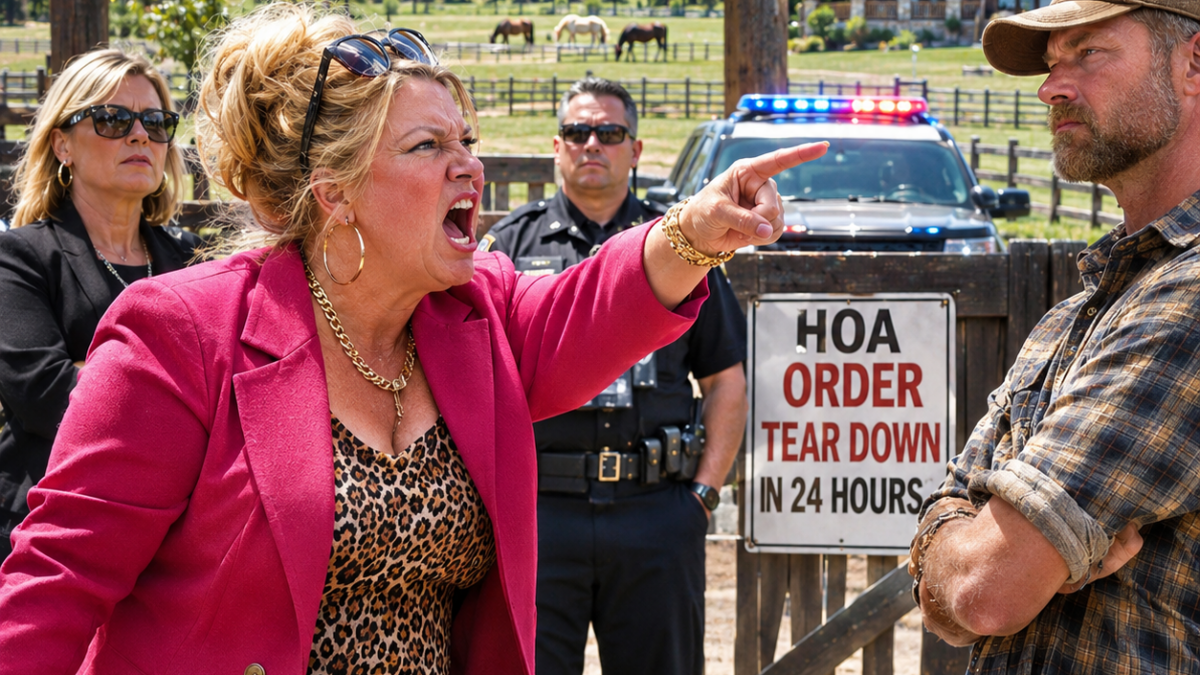
PART 2
“I’m recording,” I told him.
Martinez glanced at Chen.
“Mr. Dawson, there’s no need to make this adversarial.”
“You drove to my house at six in the morning dressed like police officers and told me to demolish my home in twenty-four hours.”
“We never represented ourselves as law enforcement.”
“You’re wearing badges.”
“Private security badges.”
“Good. Then say that clearly.”
His jaw tightened.
I held the phone a little higher.
“Your authority comes from Ridgewood Estates HOA.”
“Yes.”
“Not the county.”
“We act pursuant to the association’s governing authority.”
“Am I a member of Ridgewood Estates?”
Martinez paused.
“No.”
“Is this ranch inside Ridgewood Estates?”
“The association believes—”
“That is a yes-or-no question.”
Chen finally spoke.
“Boundaries can change.”
I looked at him.
“What?”
His expression remained flat.
“Zoning can be amended. Jurisdiction can be expanded. Mrs. Hartley has been communicating with county officials for months.”
There it was.
Not authority.
A threat of future authority.
I nodded slowly.
“That sounds important.”
Chen’s eyes narrowed.
“It should.”
I pointed at the county road behind them.
“You’re both standing outside my fence right now.”
Neither spoke.
“Keep it that way.”
Martinez smiled without warmth.
“We’re trying to resolve this peacefully.”
“By ordering demolition?”
“By giving you an opportunity to comply voluntarily.”
“With something you have no authority to demand.”
His smile disappeared.
“Twenty-four hours is generous, Mr. Dawson.”
“So is fifteen minutes.”
He frowned.
“Fifteen minutes for what?”
“That’s about how long it takes the sheriff to reach here if you cross my fence.”
Chen shifted.
Martinez stared at me.
Then turned toward the SUV.
Before getting in, he looked back.
“This property has been valuable to your family.”
“Yes.”
“It would be unfortunate if that changed.”
He entered the vehicle.
I watched them drive away.
Dust hung over the road.
The paper in my hand fluttered in the breeze.
I read Vivien Hartley’s name again.
I knew the type before I knew the woman.
Create urgency.
Use impressive language.
Imply authority.
Set a deadline so short the target reacts emotionally before checking the law.
Dad used to call it “panic paperwork.”
He had seen enough developers during his life to recognize the tactic.
That evening, I sat at his old desk.
The chair creaked the same way it had when I was twelve.
Dad had been dead almost six years.
I still sometimes expected to hear his boots in the hallway.
On the wall beside the desk hung a photograph of him standing next to my grandfather near the original barn.
My grandfather was twenty-eight.
Dad was maybe five.
The fence behind them had barely been finished.
I opened the fireproof cabinet.
My father never threw away paperwork.
Never.
Receipts from 1974.
Well permits.
Water agreements.
Tax notices.
Survey maps.
Equipment warranties for tractors we no longer owned.
Everything labeled.
Everything dated.
About halfway down I found a thick folder.
**RIDGEWOOD DEVELOPMENT LAND SALE AGREEMENT — 2010**
I opened it.
The sale itself was exactly as I remembered.
Three hundred acres transferred to Ridgewood Properties LLC.
Our eighty-acre homestead explicitly excluded.
Agricultural operation protected.
Existing water rights retained.
Then I found a separate section.
Lease.
Dad had not sold everything the developer needed.
The subdivision’s planned clubhouse sat partly on a parcel he refused to sell.
Lot 12A.
Instead, Dad leased it.
Thirty-year term.
Two thousand dollars per month.
I smiled.
I had known we received a Ridgewood payment every month.
Our bookkeeper treated it like ordinary rental income.
I had never asked for the full history.
Then I kept reading.
The lease included something else.
Access road.
The main road connecting Ridgewood to the county highway crossed another strip belonging to us.
Dad had bundled the clubhouse lot and road rights into one lease.
Then I reached Section 7.
I read it once.
Then again.
Then I sat back.
**In the event Lessee, or any entity acting on Lessee’s behalf or interest, attempts to impair, restrict, interfere with, or challenge Lessor’s property rights upon adjacent retained parcels, Lessor may impose an adjusted rental rate not to exceed ten times the base rent, effective upon written notice.**
In the margin, Dad had written:
**Insurance policy in case they forget who owns the land.**
I laughed.
Actually laughed.
Alone in the room.
“Dad…”
Twenty-four hours to demolish my ranch.
Their community center sat on my land.
Their main access depended on my land.
And according to the contract their HOA had inherited, interference with my property rights could increase their rent from two thousand dollars a month to twenty thousand.
I picked up the demolition notice.
Read it again.
Then looked at Dad’s handwriting.
I could almost hear him.
Don’t rush.
Let them show you what they intend to do.
The next morning, I called Amanda Reyes.
Amanda was a real-estate attorney in Austin who had spent twenty years representing landowners in disputes with developers, municipalities, and HOAs.
I drove ninety minutes to her office.
She read the demolition notice.
Then the citations.
Then the lease.
When she reached Section 7, she stopped.
Went back.
Read it again.
Then looked at me.
“Your father wrote this?”
“His attorney drafted it, but Dad negotiated it.”
Amanda tapped the page.
“Your father was paranoid.”
“He preferred careful.”
“In this case, careful may be worth eighteen thousand dollars a month.”
“So it’s enforceable?”
“On its face, yes.”
“Ten times?”
“Up to ten times.”
I leaned back.
“When do I send notice?”
Amanda folded her hands.
“Not yet.”
I frowned.
“They threatened to demolish my house.”
“They sent you a private HOA document without legal authority.”
“That sounds like interference.”
“It may be enough.”
“May?”
“You do not want enough.”
She pushed the lease toward me.
“You want overwhelming.”
I looked at her.
“Explain.”
“If you invoke this clause now, they will say it was a misunderstanding.”
“It wasn’t.”
“I agree.”
“They will say the security guards exceeded instructions.”
“They didn’t.”
“I agree.”
“They will argue Vivien never intended actual interference.”
“She signed it.”
“I agree.”
Amanda smiled slightly.
“You see why I like cases with angry clients?”
“I’m not angry.”
“You drove ninety miles carrying a demolition notice in a plastic evidence sleeve.”
“Prepared.”
“Fine.”
She became serious.
“Document everything.”
“They’ll escalate.”
“You think so?”
“I know so.”
“Then let them.”
That was difficult advice to follow.
The next morning, security patrols started.
One SUV.
Then another.
They never entered the ranch.
They drove past.
Slowed.
Stopped near the gate.
Moved on.
Sometimes twice before breakfast.
Then nothing for hours.
Then three passes around sunset.
By day three, I had forty-seven timestamped photographs.
Day four brought citations.
Three sheets taped neatly to my gate.
**UNLICENSED AGRICULTURAL OPERATION.**
**NOISE NUISANCE.**
**ODOR VIOLATION.**
No county seal.
No ordinance.
No legitimate jurisdiction.
I put them in a folder.
Amanda called that afternoon.
“Still want to invoke Section 7?”
“Yes.”
“Still not yet.”
“You’re enjoying this.”
“A little.”
Then Vivien Hartley called me personally.
I was repairing a water trough when the phone rang.
Unknown number.
“Thomas Dawson?”
“Yes.”
“This is Vivien Hartley.”
Her voice was calm.
Confident.
Educated.
Someone used to controlling meetings.
“I understand you’ve received communications from Ridgewood.”
“If by communications you mean fake legal notices.”
A pause.
“I hoped we could be productive.”
“I’m listening.”
“The association is willing to purchase your property.”
“No.”
“You haven’t heard the offer.”
“No.”
“Mr. Dawson—”
“My ranch isn’t for sale.”
Her tone cooled.
“Everything has a price.”
“No.”
“Your father sold.”
“Three hundred acres.”
“And kept an agricultural operation that has become incompatible with surrounding development.”
“The development surrounded us.”
“That distinction matters emotionally, perhaps.”
“It matters legally.”
She laughed softly.
“Legal systems are more flexible than people imagine.”
I stopped working.
“What does that mean?”
“I’ve served on the county planning commission for six years.”
I pressed record.
She continued.
“I chair the zoning subcommittee.”
“I know.”
“Your agricultural exemption comes up for renewal in October.”
I said nothing.
“Renewal requires recommendations.”
“Are you threatening my exemption?”
“I’m explaining reality.”
“Keep explaining.”
“Your water rights involve permits across multiple jurisdictions.”
“You influence those too?”
“I know people.”
There it was.
Not even disguised anymore.
Vivien continued.
“I am offering you an easy exit.”
“And if I refuse?”
“The difficult path involves a great deal of paperwork.”
I looked across the pasture.
My father’s barn.
Granddad’s fence.
The trough I had been repairing.
“Mrs. Hartley.”
“Yes?”
“Before you threaten a man’s livelihood, you should understand exactly what he owns.”
Silence.
“And you should probably understand what you owe him.”
Another silence.
Longer.
“Is that supposed to frighten me?”
“No.”
I smiled.
“It’s supposed to make sense later.”
She hung up.
I called Amanda.
“I think we have enough.”
She listened to the recording.
Then said:
“We’re getting close.”
“Close?”
“She threatened regulatory retaliation.”
“Exactly.”
“But I want to know whether her campaign is merely pressure or whether she’s actively manufacturing violations.”
I sighed.
“You lawyers are exhausting.”
“And ranchers are impatient.”
The fence was cut three nights later.
I found it shortly after sunrise.
Three strands of barbed wire.
Clean cuts.
Bolt cutters.
Not livestock damage.
Not weather.
Someone had opened a twenty-foot gap in my eastern boundary.
Three Herefords got through.
Two stood grazing beside the county road.
The third tried to return.
She had become tangled in loose wire.
Her left flank was ripped open.
Blood streaked her hide.
I dropped to my knees beside her.
“Easy, girl.”
She kicked once.
Panicked.
I cut wire away.
She was young.
I had raised her from a calf.
When I finally freed her, my hands were covered in blood.
Something inside me changed.
Until then, Vivien’s attacks had been paper.
Threats.
Patrols.
Politics.
Now an animal was hurt.
I wanted to drive straight to Ridgewood.
I wanted to find Martinez.
Find Vivien.
Demand answers.
Instead, I stood in the barn while the veterinarian stitched the wound.
My fists were clenched so tightly my nails cut my palms.
Dad’s voice came back.
Anger makes you fast.
Evidence makes you right.
I checked the security cameras.
2:47 a.m.
Two figures.
Dark clothing.
Faces covered.
They moved directly to the fence.
One crouched.
Cut.
The other watched the road.
No plate.
No faces.
But enough for a report.
Deputy Wilson arrived.
He photographed the fence.
Watched the video.
“I can prove trespass.”
“Good.”
“And criminal mischief.”
“Better.”
“But I can’t prove who.”
I looked at him.
“Come on.”
“Thomas.”
“You know what’s happening.”
“I know what I suspect.”
“Same as me.”
“Suspicion doesn’t get me a warrant.”
I hated that answer.
He continued.
“If someone admits involvement, communicates about it, or we find physical evidence linking them, that changes.”
“Nobody’s going to confess.”
“People confess in stupid ways all the time.”
Three hours later, the county agricultural office called.
Anonymous complaint.
Loose cattle.
Traffic hazard.
Time of complaint:
7:15 a.m.
Ninety minutes after I discovered the fence.
The caller had given my exact location.
Exact livestock description.
Exact road.
I called Amanda.
She listened.
Then said:
“Now.”
“Now?”
“Now we invoke Section 7.”
I sat down.
For a moment, I felt nothing.
Then satisfaction arrived slowly.
Not joy.
Not revenge.
Recognition.
Vivien had finally stepped across the line Dad predicted someone eventually would.
Amanda drafted the notice.
But before we sent it, another letter arrived.
Final enforcement warning.
Seven days to cease agricultural operations.
Copies sent to the planning commission.
Agricultural board.
Environmental office.
Vivien was building a government trail.
Not because violations existed.
Because she wanted paperwork showing they did.
Then she came to the ranch.
This time with a real county employee.
Robert Okonkwo.
Code enforcement.
He introduced himself professionally.
“Mr. Dawson, complaints were filed. I’m here to inspect if you consent.”
I looked at Vivien.
She stood outside the gate wearing sunglasses.
Arms crossed.
“And her?”
“Complainants may observe from a reasonable distance.”
“Outside the fence.”
“That’s acceptable.”
Vivien removed her sunglasses.
“Really, Thomas?”
“Mrs. Hartley does not have permission to enter.”
Okonkwo nodded.
“Understood.”
He spent forty-five minutes inspecting.
Barn.
Waste system.
Fences.
Water.
Livestock.
Permits.
Records.
At the end, he closed his notebook.
“Mr. Dawson, I find no violations.”
Vivien stiffened.
He continued.
“Your agricultural operation appears properly permitted. Waste handling exceeds minimum requirements.”
Vivien stepped forward.
“What about the barn?”
“Permitted.”
“Noise?”
“Normal agricultural activity.”
“Odor?”
He looked at her.
“Mrs. Hartley, cattle produce odors.”
Her face tightened.
Okonkwo continued.
“County maps also show this parcel is outside Ridgewood Estates jurisdiction.”
Vivien’s expression cracked.
“Boundaries are being amended.”
“I can’t comment on pending matters.”
“I’ve been working with planning.”
“My report concerns existing law.”
Then he left.
Vivien remained at the fence.
She looked toward the barn.
Then toward me.
“You think this helps you.”
“It does.”
“One inspector.”
“One honest inspector.”
Her eyes sharpened.
“I’ve spent six years building relationships in this county.”
“I know.”
“Planning commission.”
“I know.”
“Zoning.”
“I know.”
“Water district.”
“You told me.”
“I helped elect two commissioners.”
I smiled faintly.
“That sounds like something you should probably stop saying while I’m recording.”
She looked at the phone in my hand.
For a second, fear appeared.
Then vanished.
“You think recordings protect you?”
“I think facts help.”
Vivien stepped closer to the fence.
“Your grandfather built something here.”
“Yes.”
“Your father maintained it.”
“Yes.”
“But you’re going to lose it.”
Her voice dropped.
“Not because you did something wrong.”
That sentence stayed with me.
“Because you picked a fight with someone who understands how power works.”
I stared at her.
She smiled.
Then walked away.
That night, I replayed the recording for Amanda.
She was quiet.
“Well?”
Amanda exhaled.
“She is spectacularly bad at knowing when to stop talking.”
“So we send the notice?”
“Yes.”
“Ten times?”
“Yes.”
I leaned back.
“Dad would love this.”
“Your father terrifies me, and I never met him.”
Before Amanda filed anything, I dug deeper.
I spent three days at the county recorder’s office.
The full lease included a survey.
That survey revealed something else.
Lot 12A contained the community center and access road.
Beside it sat Lot 12B.
Two acres.
Still ours.
Never sold.
Never leased.
I drove to Ridgewood.
Walked the perimeter.
Then saw it.
The community center parking lot crossed onto Lot 12B.
Not slightly.
Approximately forty feet.
Asphalt.
Light poles.
Drainage.
Permanent construction.
All on my property.
I found an old survey pin half buried in grass.
Then another.
The boundary was obvious.
I photographed everything.
Pulled construction permits.
The parking lot expansion occurred three years earlier.
Permit application signed by:
Vivien Hartley.
The attached map used an obsolete aerial survey.
It ignored the lot division Dad recorded years before.
Whether intentional or negligent, Vivien had authorized construction on land Ridgewood did not own.
Amanda listened over the phone.
Then said:
“Thomas.”
“Yes?”
“Stop finding things.”
“Why?”
“Because every time you call, the case becomes worse for them.”
“That seems useful.”
“For you.”
“What can we do?”
“Lease penalty.”
“Encroachment claim.”
“Potential trespass damages.”
“Removal.”
“Settlement leverage.”
I smiled.
“Now who’s enjoying this?”
“A little.”
The next important person was Gerald Foster.
Ridgewood board member.
Retired engineer.
I had seen him watching during the inspection.
He looked uncomfortable every time Vivien spoke.
I went to his house.
He opened the door.
His expression tightened.
“Mr. Dawson.”
“Mr. Foster.”
“I’m not sure we should talk.”
“Then give me five minutes.”
He glanced down the street.
“Vivien monitors board loyalty.”
That sentence told me enough.
Inside, Gerald explained everything.
Board members who questioned Vivien suddenly received violations.
Proxy votes kept her in power.
Financial oversight was weak.
Special assessments increasingly funded “legal and community protection.”
But Gerald had seen invoices.
Political consultants.
Lobbyists.
Campaign firms.
Not attorneys.
“She told us you were trying to block development.”
“I live on my property.”
“I know that now.”
“She told us my ranch was inside HOA jurisdiction?”
“Yes.”
“It isn’t.”
“I know.”
I placed the original subdivision plat down.
Then the lease.
Then Section 7.
Gerald read it.
His face changed.
“What is your current rent?”
“Two thousand.”
He calculated.
“Ten times…”
“Twenty thousand.”
“Per month?”
“Yes.”
He sat back.
“Our annual discretionary reserve is barely sixty thousand.”
I nodded.
“Vivien has exposed this association to catastrophic liability.”
“She has.”
“And she never told the board this clause existed.”
“She may not know.”
Gerald looked up.
“How could the president not know what land the community center sits on?”
“Because nobody read the lease.”
He closed his eyes.
“That’s insane.”
“Sometimes boring documents matter.”
I showed him the parking lot photographs.
His face became paler.
“You own that too?”
“Yes.”
“Not leased?”
“No.”
He whispered:
“Oh, God.”
I collected my papers.
“Mr. Foster, I’m not trying to destroy Ridgewood.”
He looked at me.
“I’m protecting my ranch.”
“I believe you.”
“I’m also going to hold whoever did this accountable.”
He nodded.
“There’s a board meeting Saturday.”
“So?”
“Vivien wants approval for unlimited legal expenses against you.”
“Unlimited?”
“She’s calling your ranch an emergency threat.”
I laughed.
“Cows are apparently terrifying.”
“She’s also proposing a five-hundred-dollar assessment per household.”
I stopped smiling.
“Four hundred houses?”
“Yes.”
“Two hundred thousand dollars?”
“She wants a war chest.”
Gerald lowered his voice.
“I can get you speaking time.”
“She’ll never allow it.”
“State property law says an affected landowner can address the board when association action directly affects his property rights.”
“You’re sure?”
“I’m an engineer.”
“That’s not a legal qualification.”
He almost smiled.
“I already checked.”
The week before the board meeting became a race.
Vivien mailed the assessment notice.
Five hundred dollars per household.
Emergency legal action.
Protect community values.
No normal comment period.
Gerald called.
“She thinks she has the votes.”
“How many attending?”
“Eighty-five registered.”
“That’s high?”
“Highest in years.”
“What happens before I speak?”
“She scheduled the assessment first.”
“Of course.”
“Then legal authorization.”
“Then public comment.”
“She wants everything approved before you present.”
Amanda and I prepared anyway.
Slide one:
Subdivision plat.
My ranch outside HOA jurisdiction.
Slide two:
Lease.
Lot 12A.
Community center.
Access road.
Slide three:
Section 7.
Penalty.
Slide four:
Lot 12B.
Parking-lot encroachment.
Slide five:
Permit signed by Vivien.
Final slide:
Nothing.
Just audio.
Her own voice.
Then Amanda filed two documents.
Formal rent adjustment.
$2,000 to $20,000 per month.
Effective thirty days after notice.
Second:
Encroachment demand.
Remove unauthorized improvements on Lot 12B within ninety days or negotiate compensation.
The next afternoon, Ridgewood sued me.
Emergency agricultural nuisance.
Request for injunction.
Vivien was racing toward court.
Amanda read the complaint.
“She’s overreaching.”
“She wants to beat us.”
“She can’t create jurisdiction by filing first.”
“Can she slow us down?”
“Yes.”
“Enough to hurt?”
“That’s always possible.”
Saturday arrived.
I fed cattle before sunrise.
The young Hereford’s wound was healing.
A scar ran along her side.
I rested my hand on her neck.
“Sorry, girl.”
She chewed hay.
Unimpressed.
I looked toward Ridgewood.
Four hundred houses beyond the fence.
Most residents knew almost nothing.
Vivien had turned them into an army by making them afraid.
That mattered.
Because I could beat her and still create enemies.
Amanda had reminded me:
“Do not attack the residents.”
“I won’t.”
“They’ve been lied to.”
“I know.”
“Your target is the conduct.”
“I know.”
“Not the community.”
I nodded.
Dad used to say the same thing differently.
Never shoot at the fence when the snake is under one post.
The Ridgewood community center was packed.
More than seventy cars in the parking lot.
Some of those cars were parked on my Lot 12B.
That made me smile.
I signed in.
Vivien saw me.
Her expression did not change.
Gerald gave a small nod.
The meeting started at ten.
Routine announcements.
Then Vivien reached the emergency assessment.
She stood.
“Ridgewood is facing an unprecedented threat from an adjacent agricultural property whose owner has refused repeated opportunities to cooperate.”
I almost admired the wording.
“He has rejected reasonable community standards.”
I was not in her community.
“He has threatened legal action.”
I had filed none yet.
“He is attempting to disrupt association operations.”
I paid my taxes.
Fed cattle.
And read contracts.
“The board therefore requests authorization for a five-hundred-dollar special assessment per household.”
Hands went up.
The motion passed.
Then Vivien moved immediately.
“Next item—authorization for necessary legal—”
I stood.
“Point of order.”
The room turned.
Vivien’s eyes hardened.
“Public comment comes later.”
“This vote directly concerns legal action against my property.”
“You’ll have an opportunity—”
“State law gives an affected landowner an opportunity to address the board before action directly affecting his rights.”
A murmur moved across the hall.
Vivien looked toward the association attorney.
He whispered something.
She forced a smile.
“Of course.”
Then:
“Five minutes.”
“I’ll need fifteen.”
“You have five.”
Gerald spoke.
“I move that the affected landowner receive fifteen minutes due to the financial nature of the vote.”
Another board member said:
“Second.”
Vivien stared at them.
Vote.
Passed.
I connected my laptop.
First slide.
The subdivision plat.
“This is Ridgewood Estates.”
I highlighted the boundary.
“This is my ranch.”
Different line.
“Ridgewood’s governing documents stop here.”
I pointed.
“My property is here.”
Silence.
“I am not a member.”
I clicked.
“Never have been.”
A man in the third row leaned forward.
“Every HOA citation issued against my ranch has no legal effect.”
Vivien interrupted.
“Those boundaries are under review.”
“Correct.”
I looked at her.
“Under review means not changed.”
Someone laughed.
She did not.
Slide two.
Lease.
“This building is on Lot 12A.”
People looked around.
“The clubhouse?”
A woman asked.
“Yes.”
I continued.
“Fifteen years ago, my father refused to sell the land under this community center.”
That got attention.
“He leased it.”
I displayed the signature.
Original developer.
My father.
Thirty-year term.
“Your HOA inherited this lease when Ridgewood Properties went bankrupt.”
I pointed toward the road.
“The same lease includes the access road connecting your entrance to the county highway.”
People began talking.
A man raised his voice.
“You mean we rent the road?”
“Yes.”
“And this building?”
“Yes.”
“From you?”
“My family.”
Vivien stood.
“These documents need legal verification.”
“They’re county records.”
I looked toward the crowd.
“You do not have to believe me.”
I displayed the recorder number.
“Verify them Monday.”
Slide three.
Section 7.
I read it.
Slowly.
**If the tenant attempts to impair the landlord’s rights on adjacent retained property, rent may increase up to ten times the base rate.**
The room changed.
Someone asked:
“What’s the rent now?”
“Two thousand.”
Another voice:
“And ten times?”
“Twenty thousand.”
Noise erupted.
Vivien hit the table.
“Order.”
I waited.
Then:
“Wednesday, my attorney filed notice invoking this clause.”
Complete silence.
“Beginning in thirty days, Ridgewood’s contractual rent is twenty thousand dollars per month unless the dispute is resolved.”
A woman stood.
“Because of what?”
I clicked.
Demolition notice.
“Because your president ordered me to demolish property she has no jurisdiction over.”
Click.
Fake citations.
“Because association security began a harassment campaign.”
Click.
Recorded complaint timeline.
“Because officials were asked to investigate violations that did not exist.”
Then Lot 12B.
Survey.
Parking lot.
I overlaid them.
“The parking lot outside extends approximately forty feet beyond Lot 12A.”
I clicked.
Photographs.
Survey pins.
Permit.
“This portion is not leased.”
Murmurs.
“It belongs to my family outright.”
Then the permit appeared.
Vivien’s signature.
A woman in the front row turned.
“Did you sign that?”
Vivien’s face flushed.
“The site plan provided to us—”
I raised my hand.
“I’m not accusing her of anything beyond what the documents show.”
That quieted the room.
“The permit application uses an outdated property map.”
I clicked.
“The result is permanent construction on land Ridgewood does not own.”
Gerald spoke.
“How long has the parking lot encroachment existed?”
“Approximately three years.”
Vivien snapped:
“This is a technical survey dispute.”
“No.”
I clicked to the final audio file.
“This is your voice.”
She looked at me.
Fear.
Real this time.
I pressed play.
Her voice filled the hall.
**I’ve been on the county planning commission for six years.**
People looked at her.
**Your agricultural exemption comes up for renewal.**
Someone whispered.
**Your water rights depend on permits across jurisdictions I influence.**
The room became still.
Then:
**The difficult path involves paperwork you won’t enjoy.**
I let the recording continue.
Then stopped it.
Nobody spoke.
Gerald slowly stood.
Vivien said:
“Sit down.”
He ignored her.
“I move for an immediate vote of no confidence in President Vivien Hartley, pending independent financial and legal audit.”
Vivien’s face went white.
“This is out of order.”
A board member at the far end raised her hand.
“Second.”
“You cannot—”
Gerald looked toward the secretary.
“Call the vote.”
Vivien stood.
“You’re making a catastrophic mistake.”
A homeowner shouted:
“No, you did.”
Another:
“Where did our legal money go?”
Someone else:
“Why didn’t we know we rent this building?”
A woman:
“I want my assessment back.”
The hall exploded.
Gerald raised his voice.
“All in favor of removing Vivien Hartley as president pending audit?”
Hands rose.
At first, maybe twenty.
Then thirty.
Then more.
People looked around.
Fear changed sides.
The final count:
68 to 17.
Vivien remained standing.
For the first time since I had heard her voice, she looked ordinary.
No invisible machinery behind her.
No unquestioned authority.
Just one woman at a table after a vote she lost.
I disconnected my laptop.
Gerald caught me near the door.
“Thomas.”
I stopped.
“The new board will want to negotiate.”
“Good.”
“What are your terms?”
“The twenty-thousand-dollar notice stands.”
His face tightened.
“And the parking lot?”
“Separate.”
“Removal?”
“Or compensation.”
He nodded.
“I’ll call Monday.”
I looked back at the room.
Residents were surrounding Vivien.
Not threatening.
Questioning.
That was worse for her.
For years, questions had been the one thing she controlled.
Now everyone had them.
The county hearing happened two weeks later.
Vivien’s nuisance complaint was still alive.
The old HOA attorney refused to withdraw it because his retainer had already been paid.
Gerald apologized.
“Some machinery keeps moving after you switch off the engine.”
“I understand.”
Amanda and I attended.
Judge Catherine Morales presided.
She had spent two decades hearing land disputes.
The HOA attorney tried arguing that my ranch was effectively part of Ridgewood because its operations affected residents.
Judge Morales stopped him.
“Counselor, show me a recorded document placing Mr. Dawson’s property inside HOA jurisdiction.”
He shuffled papers.
“There is a longstanding relationship—”
“That was not my question.”
Silence.
“Do you have a plat?”
“The plat shows—”
“Yes?”
“The ranch outside.”
“Then what are we doing?”
The attorney tried another approach.
“De facto inclusion.”
Judge Morales stared.
“Is that a legal doctrine you intend to cite?”
He looked down.
“No, Your Honor.”
Amanda stood.
“We request permission to call Vivien Hartley.”
Vivien sat in the gallery.
Her attorney objected.
Amanda responded:
“She signed the complaint and has direct knowledge of the enforcement campaign.”
Judge Morales allowed it.
Vivien took the oath.
She looked different.
No HOA title.
No raised platform.
Just a witness chair.
Amanda started carefully.
“Did you authorize Ridgewood security to deliver a demolition notice?”
“I directed them to communicate the board’s position.”
“Yes or no?”
“Yes.”
“Were you aware Mr. Dawson’s property was excluded from Ridgewood’s recorded plat?”
“I understood boundaries were disputed.”
“Did you possess a recorded amendment bringing his ranch into Ridgewood?”
“No.”
“Did you threaten his agricultural exemption?”
“I discussed regulatory issues.”
“Did you tell him renewal required favorable recommendation from your office?”
She hesitated.
“I may have explained—”
Amanda pressed play.
Vivien’s recorded voice filled the courtroom.
No editing.
No interpretation.
Her own words.
Planning commission.
Water rights.
Influence.
The difficult path.
When the audio ended, Judge Morales looked directly at Vivien.
“Mrs. Hartley.”
“Yes?”
“Is that your voice?”
Her attorney leaned toward her.
She had only one safe answer.
“Yes.”
“Did Mr. Dawson threaten you in that conversation?”
“No.”
“Did he ask you to use your public position?”
“No.”
“Then why did you mention regulatory authority in connection with his refusal to sell?”
Vivien’s mouth tightened.
“That property should have been part of Ridgewood.”
Amanda remained still.
“Should have been?”
Vivien realized the trap too late.
Her frustration took over.
“His family was supposed to sell everything.”
“According to whom?”
“The original developer.”
“Was there a contract?”
“He kept the ranch.”
“Who?”
“His father.”
“And that made you angry?”
“No.”
“Then why pursue property outside your jurisdiction?”
“Because for fifteen years that ranch has—”
She stopped.
Judge Morales leaned forward.
“Has what?”
Vivien looked toward her attorney.
He said nothing.
She whispered:
“Interfered with the community.”
Amanda responded:
“By existing?”
Vivien glared.
Judge Morales dismissed the nuisance complaint with prejudice.
Then she did something Vivien did not expect.
She referred the evidence.
Recorded political threats.
Permit irregularities.
Manufactured complaints.
Potential abuse of office.
To the district attorney.
Vivien left court without speaking.
The investigation moved fast because I was not the first person to complain.
Two developers had accused her of demanding political contributions tied to favorable zoning decisions.
A former planning staffer described pressure.
Financial subpoenas followed.
HOA invoices were examined.
The association had collected money supposedly for legal expenses.
Some went to political consultants.
Some to lobbying.
Some to firms with relationships to campaigns Vivien supported.
Martinez and Chen were questioned.
At first, both claimed they were merely delivering documents.
Then investigators showed them emails.
Instructions.
Talking points.
A message from Vivien reminding them to “make sure Dawson understands we can escalate.”
Their loyalty disappeared quickly.
Both accepted plea agreements.
Security licenses lost.
Testimony provided.
The fence sabotage was harder.
Neither admitted cutting it.
No direct forensic evidence ever connected them.
I hated that.
The young Hereford still carried the scar.
Some wrongs remain partly unanswered.
Amanda reminded me:
“You do not have to solve every crime to prove the pattern.”
“I’d like to.”
“I know.”
Vivien’s criminal trial lasted four days.
Gerald testified.
I testified.
The recorded call played.
The permit showed her signature.
County officials described improper pressure.
A forensic accountant followed HOA money.
Vivien’s defense argued she had been aggressive but believed she was protecting residents.
The jury did not accept it.
Guilty.
Fraud connected to the permit filing.
Official misconduct.
False reports.
Abuse associated with regulatory retaliation.
At sentencing, Vivien finally spoke.
She stood before the judge.
“I dedicated years to that community.”
The judge listened.
“I believed the ranch was obstructing Ridgewood’s future.”
Still nothing.
“I may have pushed too hard.”
The judge leaned forward.
“Mrs. Hartley, pushing too hard is not the issue.”
Vivien’s face tightened.
“You used private authority you did not possess and public influence entrusted to you for purposes unrelated to public duty.”
The sentence was not dramatic prison time.
Eighteen months probation.
Fifteen-thousand-dollar fine.
Two hundred hours community service.
Permanent ban from serving in HOA leadership.
Ban from county advisory boards during the relevant period.
Ethics consequences.
Her planning commission seat disappeared.
Some people told me the sentence was too light.
Maybe.
But by then I understood something.
The most important punishment was not whether Vivien spent nights behind bars.
It was that she could no longer do to somebody else what she did to me.
The new Ridgewood board called me three weeks later.
Gerald.
Two new board members.
Their attorney.
Amanda sat beside me.
Gerald started.
“We want to resolve everything.”
“So do I.”
“The twenty thousand per month is unsustainable.”
“It was designed to be.”
“We understand.”
He pushed a proposal across the table.
“Ten thousand.”
I did not touch it.
“No.”
“Twelve?”
Amanda looked at me.
I looked at Gerald.
“How long?”
“Five-year fixed period.”
“Then?”
“Renegotiation under original lease terms without penalty unless there is another breach.”
“What about Lot 12B?”
“Remove encroachment within ninety days.”
“Drainage?”
“Relocated.”
“Lighting?”
“Removed.”
“Asphalt?”
“Cut back to boundary.”
“Compensation?”
Gerald gave me the number.
I looked at Amanda.
She nodded.
“And a permanent recorded acknowledgement that my ranch remains outside HOA jurisdiction.”
“Yes.”
“No future annexation petition without my written consent?”
Their attorney paused.
“That’s broad.”
“So was ordering me to demolish my home.”
He looked at Gerald.
Gerald nodded.
“Agreed.”
We settled.
Rent:
Twelve thousand dollars a month.
Not the full twenty thousand I had invoked.
Still six times the original rent.
Five-year term.
Encroachment removed.
Fifty-two thousand dollars for back rent adjustments, damages, harassment-related settlement components, and unauthorized use.
The HOA recovered part of the money from Vivien through court-ordered restitution related to misused funds.
Insurance covered portions of the property encroachment.
Homeowners received refunds or credits for the emergency assessment.
It was not the spectacular annihilation some people expected.
Ridgewood survived.
That mattered.
Because four hundred families had not threatened me.
Vivien had.
Most residents did not know what their president had been doing.
I had no interest in bankrupting retirees because they trusted the wrong person.
The parking lot was cut back.
The first morning construction crews arrived, I stood beside the fence.
Gerald joined me.
“Feels strange.”
“What?”
“Watching part of our parking lot disappear.”
“It was never yours.”
“I know.”
He smiled faintly.
“That’s the strange part.”
The old asphalt ended at the correct line.
Light poles came down.
Drainage moved.
For the first time in three years, Lot 12B looked like mine again.
I used part of the settlement money to rebuild the eastern fence.
Heavier posts.
Better wire.
Motion cameras.
A real gate.
Not to keep Ridgewood out.
To protect cattle.
The rest went into a machinery barn Dad had planned twenty years earlier.
I found his pencil sketch in the cabinet.
Dimensions.
Roof pitch.
Equipment bays.
At the bottom:
**Someday.**
I built it.
When the first steel went up, I sat in my truck and watched.
Dad had never seen the building.
But it felt like finishing a sentence he started.
Six months after the trial, Gerald called.
“I have an idea.”
“That usually worries me.”
“Open ranch day.”
“No.”
“Thomas.”
“No.”
“Families keep asking about the cattle.”
“They complained about the cattle.”
“Vivien complained about the cattle.”
“Some residents did too.”
“Because she told them the ranch was dangerous.”
I hesitated.
Gerald continued.
“Forty people.”
“No more.”
“Forty-three registered.”
“You’re terrible at negotiation.”
“Learned from you.”
I agreed.
That Saturday, families crossed the ranch gate for the first time as guests.
Not inspectors.
Not security.
Not complainants.
Kids stared at cattle like they were dinosaurs.
One little boy asked:
“Do cows sleep standing up?”
“Sometimes.”
“Why?”
“I’ve never asked.”
He considered that.
“You should.”
His mother laughed.
An elderly man walked through the barn.
“My grandparents had a ranch.”
“What happened?”
“Sold.”
“Regret it?”
He looked around.
“Every day.”
The young Hereford stood in the shade.
Her scar was visible.
A little girl touched it gently.
“What happened?”
I looked at her mother.
Then answered carefully.
“She got hurt when a fence broke.”
“Did she get better?”
“Yes.”
The girl stroked the animal’s neck.
“Then the scar is okay.”
I swallowed.
“Yeah.”
“It means she got better.”
Children understand some things more clearly than adults.
After everyone left, I sat on the porch.
Ridgewood’s community center was visible in the distance.
Still on Lot 12A.
Still rented.
The check arrived on the first of every month.
On time.
Every time.
Gerald once joked:
“Best landlord in the county.”
I told him:
“Best tenant would’ve read the lease.”
He never argued.
Relationships improved.
Not warm.
Functional.
That was enough.
One morning, Martinez came to the ranch.
Not in uniform.
Jeans.
Work shirt.
He stood outside the gate.
I walked over.
“What do you need?”
“To apologize.”
I waited.
“I shouldn’t have delivered that order.”
“You knew it wasn’t legal.”
He looked down.
“I knew it wasn’t a court order.”
“Different answer.”
“Yes.”
“Did you cut my fence?”
His head snapped up.
“No.”
“Do you know who did?”
“No.”
I watched him.
He held my stare.
Maybe he was telling the truth.
Maybe not.
“I lost my license.”
“I know.”
“My wife left.”
I said nothing.
“I’m working construction now.”
I still said nothing.
“I blamed you for a while.”
“That seems convenient.”
“It was.”
He rubbed his hands together.
“Then I realized Vivien kept telling us we were protected.”
“Protected from what?”
“Consequences.”
I understood.
“That’s how people like her work.”
He nodded.
“I’m sorry.”
I looked toward the pasture.
The scarred Hereford grazed near the fence.
“Apology accepted.”
He looked surprised.
“That easy?”
“No.”
I met his eyes.
“Acceptance doesn’t mean trust.”
He nodded.
“Fair.”
Then he left.
I never saw him again.
Years later, I still think about that first demolition order.
I keep it framed.
It hangs in the ranch office beside Dad’s handwritten Section 7 note.
Visitors laugh.
**NOTICE OF DEMOLITION ORDER.**
Twenty-four hours.
Beside it:
**Insurance policy in case they forget who owns the land.**
Dad’s handwriting.
Two documents.
One represented fake authority.
The other represented patience.
Vivien believed authority came from looking official.
Badges.
Letterhead.
Committees.
Titles.
Connections.
She was not entirely wrong.
Appearances can move people.
They can frighten them.
They can silence them.
For a while.
But real authority has a foundation.
Recorded boundaries.
Contracts.
Law.
Consent.
And when those foundations are missing, a title is only a word someone printed on a door.
My grandfather never held office.
Dad never chaired a commission.
I never wanted political influence.
We owned cattle.
Fence.
Water.
Land.
And documents.
That was enough.
The ranch changed after everything happened.
Not dramatically.
Cows still ignored my legal victories.
Fence posts still broke.
Water pumps still failed on holidays.
Summer still burned the grass.
Winter still found every crack in the barn.
But I changed.
For years I had thought protecting land meant refusing to sell.
It is more complicated than that.
Protecting something means understanding it.
The deed.
The boundaries.
The obligations.
The contracts somebody signed before you.
The rights attached to dirt that may look ordinary to everyone else.
If I had not opened Dad’s cabinet, Vivien might have spent years attacking me through agencies.
If Dad had not insisted on Section 7, I still would have owned the ranch.
But I would have had less leverage.
If I had exploded when Martinez arrived, I would have given them the version of me they wanted.
Angry rancher.
Unreasonable holdout.
Obstacle.
Instead, I took the paper.
Recorded the words.
Read the lease.
Waited.
That was the hardest part.
Waiting while they drove past my gate.
Waiting while they taped fake citations.
Waiting after my cattle were hurt.
Waiting while Vivien threatened my water rights.
Every instinct said strike back.
Amanda kept saying:
“Not yet.”
I hated those words.
Now I understand them.
Revenge taken too early is reaction.
Consequences built carefully are harder to escape.
Vivien did not lose because I had more political connections.
I had none.
She lost because she kept talking after the facts had already turned against her.
She threatened me on recording.
Signed a permit involving land she did not own.
Used HOA money to build influence.
Filed complaints that inspectors could not support.
Told a judge my ranch “should have” belonged to Ridgewood.
She mistook certainty for immunity.
That mistake cost her everything she actually valued.
Her title.
Her influence.
Her board.
Her commission seat.
Her reputation as the woman nobody challenged.
The ranch remained.
One fall afternoon, I drove to Dad’s grave.
It sits beneath an oak on the western side.
He chose the spot years before he died.
“Best view on the property,” he said.
“You’ll be dead.”
“Still like a good view.”
That was Dad.
I sat beside the stone.
Brought a copy of the new lease settlement.
Ridiculous, maybe.
But I wanted to show him.
“Twelve thousand.”
Wind moved through the grass.
“I asked for twenty.”
Nothing.
“They negotiated.”
A crow called from the tree.
I smiled.
“You’d say I got soft.”
Then I looked toward Ridgewood.
Roofs visible beyond the pasture.
“But four hundred families didn’t write that demolition order.”
That mattered.
Dad could be hard.
But not cruel.
I placed my hand on the stone.
“They pay on time.”
I stood.
“Your clause worked.”
For some reason, saying that made my throat tighten more than anything else.
He had been preparing for a future he would never see.
Maybe that is what inheritance actually is.
Not money.
Not land.
Someone solving a problem for you years before you know you have it.
That evening, I drove home slowly.
The new fence caught the sunset.
The machinery barn stood where Dad once drew it on paper.
Solar panels had gone up the previous spring.
The ranch was stronger than before Vivien arrived.
Not because of the settlement money.
Because I had been forced to understand everything my family had built.
At the gate, I stopped.
Same place Martinez had stood.
Same gravel.
Same road.
No black SUV.
No badges.
No demolition order.
Just a mailbox.
Fence.
Cattle.
Home.
My phone buzzed.
Bank notification.
**RIDGEWOOD ESTATES HOA — RENT PAYMENT RECEIVED.**
Twelve thousand dollars.
I laughed.
Not because the money was the victory.
It wasn’t.
The victory was the barn behind me.
The home still standing.
The cattle moving toward evening feed.
The boundary where Dad left it.
The HOA had once given me twenty-four hours to erase three generations.
Instead, years later, they were still driving across my land to reach a clubhouse that still sat on my family’s property.
Only now everyone understood the arrangement.
They were tenants.
I was the landlord.
And the ranch they tried to destroy was the one thing Vivien Hartley never managed to touch.
I drove through the gate and closed it behind me.
The sun dropped behind the pasture.
Somewhere in Ridgewood, people were probably arriving for another HOA meeting.
They had a different board now.
Recorded minutes.
Independent financial audits.
Rules about conflicts of interest.
A president whose first question before every major decision was reportedly:
“Do we actually have authority to do that?”
Gerald told me that once.
I laughed for ten minutes.
Maybe that was Vivien’s final contribution.
She taught an entire neighborhood the difference between power and authority.
Power can intimidate.
Authority has to come from somewhere.
A contract.
A statute.
A boundary.
Consent.
Something real.
Vivien had spent years believing connections allowed her to manufacture reality.
My family spent three generations writing things down.
In the end, paper beat politics.
The last thing I did that night was walk through the barn.
The scarred Hereford was older now.
Calm.
She raised her head when I approached.
I ran my hand over the line on her flank.
The little girl from open-ranch day had been right.
The scar meant she healed.
I looked around.
New equipment.
Old beams.
Granddad’s tools.
Dad’s saddle.
My life.
Vivien wanted all of it gone in twenty-four hours.
She believed urgency would make me panic.
Instead, urgency made me read.
And one clause my father wrote fifteen years earlier changed everything.
I turned off the barn light.
Outside, Ridgewood’s community center glowed beyond the eastern fence.
Their clubhouse.
My land.
Their road.
My land.
Their rent.
Definitely my rent.
I smiled.
“Good night, Dad.”
Then I walked back toward the house.
The porch light was waiting.
The cattle were quiet.
And the first of the month was only three days away.








