PART 2: HOA Claimed Part of My Ranch as Their “Common Area”—So I Opened a Legal 300-Hog Farm Beside Their Mansions
PART 2
Dave came over the following afternoon.
He didn’t use my driveway.
He walked through the back of his property and stopped at my new fence like he was crossing an international border.
In a sense, that was exactly what Karen had turned it into.
He rested his arms on the top rail.
“Nice fence.”
“According to Karen, it may cause civilization to collapse.”
Dave gave a tired laugh.
He was maybe forty.
Contractor.
Two children.
Mortgage.
The permanent expression of a man who carried three unfinished problems everywhere he went.
“She sent another email this morning.”
“What did it say?”
“You are hostile.”
“Accurate before coffee.”
“You’ve illegally occupied community land.”
“False.”
“You are preparing livestock operations that could endanger home values.”
I looked toward my horses.
“They’re terrifying.”
Dave smiled.
Then his expression became serious.
“You need to understand something.”
“What?”
“Karen’s good at fear.”
I waited.
“She doesn’t need everyone to believe her forever. She just needs them worried long enough to support whatever she does next.”
I had seen the tactic before.
Different scale.
Different uniform.
Same principle.
Create uncertainty.
Offer yourself as the solution.
“What does she want?”
Dave looked toward Oakwood Estates.
“Control.”
“Over fifty feet of pasture?”
“Over anyone who tells her no.”
He told me about his work truck.
Karen had tried to fine him two thousand dollars because the truck sat in his own driveway for too many hours.
He hired an attorney.
The fine disappeared.
“She never apologized.”
“I’m shocked.”
“She just moved on to somebody who couldn’t afford the lawyer.”
That sentence bothered me.
The HOA’s lawsuit arrived two weeks later.
It was no longer nuisance mail.
This was a summons.
Oakwood Estates Homeowners Association versus Arthur.
Damages.
Fence removal.
Unpaid fines.
Attorney fees.
Alleged destruction of common property.
Nearly fifty thousand dollars in claimed exposure before the litigation had really begun.
I sat at my kitchen table reading it.
The horses moved quietly outside.
I had bought this place to get away from papers stamped URGENT.
For thirty years, I had lived inside project schedules, contingency plans, legal reviews, acquisition regulations, and contract disputes.
Retirement was supposed to be fences and horses.
Not depositions.
My first reaction was anger.
My second was fatigue.
The third was familiar.
Organize.
I opened the binder.
Added the summons.
Then spent two days researching property lawyers.
I did not need somebody who handled closings.
I needed litigation experience.
I found Ms. Albright.
Her office was on the twentieth floor of a downtown building where everything smelled faintly of leather and expensive coffee.
She was maybe fifty.
Dark suit.
No wasted words.
I put the binder on her conference table.
She stared at its labeled tabs.
“You did this?”
“Yes.”
“You were military.”
“Army Corps.”
She opened the deed.
“Retired?”
“Lieutenant colonel.”
“That explains the binder.”
For the next hour, she read.
Deed.
Plat.
Survey.
HOA letters.
Karen’s notices.
The lawsuit.
Then she placed two documents beside each other.
My county parcel map.
The HOA’s exhibit.
On the association’s map, a fifty-foot strip reached into the rear edge of my property.
On mine, it didn’t exist.
Ms. Albright tapped Karen’s map.
“This is their entire case.”
“Yes.”
“Where did this come from?”
“They claim county records.”
“Then we go to county records.”
“That simple?”
“No.”
She looked at me.
“But that clear.”
She explained jurisdiction.
The HOA had contractual power over property lawfully subjected to its declaration.
My ranch had never joined.
If its alleged easement existed, it needed a legitimate legal origin.
Recorded grant.
Plat dedication.
Deed reservation.
Something.
A colored line drawn on an internal map wasn’t enough.
“What about the lien threat?”
“If they knowingly record an invalid lien, we deal with that separately.”
“And the lawsuit?”
“We answer it.”
She folded her hands.
“Do not underestimate litigation simply because their position looks ridiculous.”
“I don’t.”
“Good.”
She looked again at my agricultural zoning.
Then paused.
“How long has this parcel been agricultural?”
“Longer than Oakwood Estates has existed.”
“What kind of agricultural use?”
“Historically cattle and hay. I have horses now.”
She looked at me.
“Interesting.”
“What?”
“Later.”
I knew that tone.
It was the tone engineers use when they’ve noticed something nobody else has.
The county records office became my second home.
Old plats do not care how angry you are.
Neither do recorder indexes.
That is why I trusted them.
They reward patience.
I started with Oakwood Estates.
Original developer:
Pristine Homes.
Original plan filed in 2008.
I ordered the archived plat.
When it arrived, I spread it across a large viewing table.
There was my ranch.
Different owner then.
Clear boundary.
Oakwood Estates ended where the property line began.
No fifty-foot HOA strip.
No common-area easement.
Nothing.
I stared.
Then pulled Karen’s litigation exhibit.
The lines did not match.
I called Ms. Albright.
“Original plat is clean.”
“Good.”
“HOA map isn’t.”
“Better.”
“Where did theirs come from?”
“Find it.”
Two hours later, I did.
2010.
Amended plat.
Filed after the HOA had been incorporated.
A fifty-foot common-area strip suddenly appeared where none existed before.
Across land that did not belong to the association.
I felt my heartbeat change.
This was no longer a misunderstanding about survey interpretation.
Somebody had put a line on a recorded document.
I ordered the full instrument.
Signatures.
Notary.
Certification.
The document appeared to be executed by an earlier HOA president, not Karen.
That distinction mattered.
I could not blame Karen for creating a document she had not signed.
But she had used it aggressively.
That raised another question.
Did she know it was defective?
I photographed everything.
Paid for certified copies.
Then brought the packet to Ms. Albright.
She placed the 2008 and 2010 documents side by side.
Original.
Amended.
Her eyes moved slowly between them.
“This is a serious problem.”
“For them?”
“Yes.”
“Forgery?”
“Don’t use that word yet.”
I waited.
“We need authentication.”
She pointed toward me.
“This is where disciplined clients become valuable.”
“You’re welcome.”
“We establish who prepared the amendment.”
“Authority.”
“Chain of title.”
“Whether the adjoining owner consented.”
“Whether the filing was legally capable of creating the interest it claims.”
I nodded.
“If not?”
“Then their easement theory collapses.”
She smiled slightly.
“And if someone knowingly used a defective document to claim your land, our conversation becomes much less pleasant for them.”
Her investigator traced the 2010 filing.
My predecessor had not signed it.
No separate easement grant existed.
Nothing in the ranch’s chain of title transferred fifty feet to Oakwood Estates.
The HOA had essentially been behaving for years as though an annotation on its side of a plat could rewrite someone else’s deed.
Ms. Albright called me.
“The strip isn’t theirs.”
“I knew that.”
“Now we can prove it.”
“Motion to dismiss?”
“We could.”
“But?”
She looked delighted.
I had learned to fear that expression.
“The HOA has put this map at the center of litigation.”
“Yes.”
“They are making affirmative representations about it.”
“Yes.”
“I want to know what Karen says under oath.”
I leaned back.
“You want to let this continue.”
“For a little longer.”
“Why?”
“Because right now she can retreat by claiming she relied on old records.”
“And if she swears she personally knows the map is correct?”
“That changes the evidentiary posture.”
I understood.
“Let her commit.”
“Exactly.”
Then she returned to my zoning.
“Now.”
I waited.
“How attached are you to quiet ranching?”
“Very.”
“That’s unfortunate.”
“Why?”
She opened a file containing state agricultural-use protections.
“Because Oakwood Estates may have forgotten what it means to build homes beside preexisting agricultural land.”
I read.
State right-to-farm protections.
Local zoning.
Agricultural operations.
Nuisance standards.
None created absolute immunity.
Ms. Albright was careful about that.
“You still follow environmental rules.”
“Setbacks.”
“Waste management.”
“Health regulations.”
“Animal-welfare requirements.”
“Business licensing where applicable.”
She looked at me.
“But you have rights to conduct lawful agricultural activity.”
I started understanding.
“No.”
She smiled.
“I haven’t proposed anything.”
“You’re thinking livestock.”
“I am thinking your neighbors are suing an agriculturally zoned ranch because they dislike seeing ranch infrastructure.”
She leaned forward.
“Sometimes the cleanest way to clarify an abstract principle is to exercise the right everybody insists you don’t have.”
“What livestock?”
“How do you feel about hogs?”
I laughed.
She didn’t.
“You’re serious.”
“Completely.”
“A hog operation beside luxury homes.”
“A lawful hog operation.”
“How many?”
“That depends on permitting and operational practicality.”
The source story would later become exaggerated as five thousand cattle.
Reality was far smaller.
Three hundred feeder hogs.
Still more than enough.
I went home and walked the ranch.
The obvious location was a two-acre section below the ridge.
Inside my boundary.
Properly separated from waterways.
Accessible to trucks.
Suitable for an agricultural setup once graded and equipped.
It also happened to sit downwind of Oakwood Estates under the prevailing summer pattern.
I called Ms. Albright.
“You planned that.”
“I noticed it.”
“That is not an answer.”
“It’s the only one you’re getting.”
I did not simply buy pigs.
That would have been stupid.
I spoke with agricultural operators.
County offices.
Environmental regulators.
Insurance.
Veterinary contacts.
Waste-management consultants.
I wanted the operation legal in fact, not merely as a courtroom theory.
If Karen called every agency in the state, I wanted inspectors to find compliance.
The difference between revenge and self-destruction is preparation.
I registered the farm operation.
Developed manure-management protocols.
Installed proper fencing.
Automatic watering.
Feed storage.
Runoff controls appropriate to the site and scale.
A local excavation crew graded the area.
Steel panels arrived.
Then tanks.
Feeders.
Two silos.
From Dave’s backyard, construction was impossible to miss.
He walked to the fence one evening.
“What are you building?”
I tightened a bolt.
“Farm infrastructure.”
“That tells me nothing.”
“Good.”
His eyes moved toward the silos.
“Arthur.”
“Yes?”
“You’re not putting cattle there.”
“No.”
“She thinks you’re tearing the fence down.”
I stopped working.
“What?”
Dave handed me his phone.
Karen had sent another community email.
The landowner appears to have recognized the unsustainability of his position and begun corrective site work.
I read it twice.
“She thinks I’m surrendering.”
Dave smiled.
“You want me to correct her?”
“No.”
I handed the phone back.
“Absolutely not.”
The deposition came next.
Ms. Albright prepared me for three hours.
“Answer the question.”
“Yes.”
“Not the question you wish they had asked.”
“Yes.”
“No speeches.”
“Yes.”
“No sarcasm.”
“That seems excessive.”
She stared.
“Yes.”
“Good.”
Karen attended.
So did the HOA’s lawyer.
He was polished.
Expensive.
The kind of attorney who could make a grocery list sound adversarial.
He questioned my survey.
Fence.
Intentions.
Agricultural use.
Relationship with Oakwood Estates.
Then placed the 2010 amended plat in front of me.
“Mr. Arthur, this is the official recorded map showing the association’s common-area easement, correct?”
“It is a recorded document containing a depiction of such a strip.”
He frowned.
“Does it show the easement?”
“Yes.”
“And you built your fence within it.”
“No.”
He looked irritated.
“According to this document—”
“According to my deed, original development plat, and licensed survey, I built on my property.”
Karen whispered loudly to him.
“He knows exactly what he did.”
The court reporter looked up.
Her lawyer told her to stop.
Then he asked:
“Are you claiming the recorded amended plat is invalid?”
“I’m saying it conflicts with the prior recorded plat and my chain of title.”
“Do you have proof?”
“My counsel does.”
That ended that line quickly.
Karen’s deposition happened separately.
Ms. Albright called afterward.
“She did exactly what we expected.”
“What?”
“She didn’t merely rely on the plat.”
My stomach tightened.
“She swore it accurately represented a boundary she personally understood as legitimate.”
“That’s not surprising.”
“She also claimed she had direct historical knowledge supporting the easement.”
“How?”
“Poorly.”
“What does that mean?”
“It means her timeline doesn’t fit the records.”
Ms. Albright sounded almost cheerful.
“She is now committed to facts we can test.”
“Ready?”
“The legal side is getting very healthy.”
“That sounds ominous.”
“For them.”
The feedlot was finished two weeks later.
Empty pens.
Clean lanes.
Water system tested.
Feed storage ready.
I walked it before sunrise.
For years, this portion of the ranch had been quiet pasture.
Now it looked like an efficient small livestock facility.
Sarah was not part of this story because I lived alone in the original source’s ranch chapter—yet emotionally, the ranch itself filled that role.
It had been my quiet place.
I stood in the empty pen wondering whether I was about to ruin that quiet just to prove a point.
That question mattered.
Was Karen controlling me if every decision I made became a response to her?
I called Ms. Albright.
“Cold feet?”
“Yes.”
“Good.”
“Good?”
“It means you’re still thinking.”
“I bought this land for peace.”
“I know.”
“Three hundred pigs are not peace.”
“No.”
“How long?”
“That depends on your business plan.”
“And the litigation.”
“Arthur.”
Her voice sharpened.
“You do not operate livestock as extortion.”
I said nothing.
“You operate a legitimate agricultural business.”
“I understand.”
“If settlement happens later, you make an independent business decision about whether continuing makes sense.”
“Understood.”
“This matters.”
“I know.”
“Good.”
That distinction kept everything on the right side of the line.
I was not holding pigs hostage.
I was exercising agricultural rights on agricultural land.
The fact that Oakwood Estates hated the consequences did not convert their preference into my prohibition.
I made the call.
“Bring them.”
Three livestock haulers arrived just after sunrise.
Diesel engines echoed across the valley.
Dave stood in his backyard.
Coffee cup frozen halfway to his mouth.
The first gate opened.
A feeder hog hesitated.
Then trotted down the ramp.
Another followed.
Then another.
Soon the sound changed completely.
Snorts.
Squeals.
Metal gates rattling.
Workers calling to one another.
Three hundred hogs filling pens.
Not five thousand cattle.
Not an industrial megafacility.
But three hundred pigs can announce themselves convincingly.
The smell took longer.
People imagine livestock odor appears like a bomb.
It doesn’t.
At first, there was simply farm air.
Earth.
Feed.
Animals.
Then afternoon heat arrived.
The prevailing breeze moved toward Oakwood Estates.
At 12:43, Dave texted:
THEY HAVE NOTICED.
At 12:51:
COMMUNITY PAGE IS MELTING DOWN.
I called.
“What are they saying?”
“First twenty minutes everybody checked their garbage cans.”
I laughed despite myself.
“Then somebody posted, ‘Does anyone else smell manure?’”
“And?”
“Karen says she is handling it.”
“Of course.”
“Somebody asked whether the sewer failed.”
“That’s insulting to the pigs.”
Dave lowered his voice.
“You’ve made your point.”
“It’s a farm.”
“Arthur.”
“It is.”
“Fine.”
By two o’clock, the sheriff arrived.
Young deputy.
Professional.
Uncomfortable.
“Sir, we’ve received complaints.”
“Odor?”
“Yes.”
“That’s likely livestock.”
He looked toward the pens.
“Pigs.”
“Yes.”
“Residents claim you installed this to harass them.”
“I operate agricultural property.”
He sighed.
“I need to know if this is permitted.”
I handed him a folder.
Registration.
Zoning.
Site documentation.
Relevant agricultural protections.
Contact information for Ms. Albright.
He read.
Looked at the pigs.
Read again.
“You expected us.”
“I expected Karen.”
That almost made him smile.
“I’m not making a zoning determination.”
“I wouldn’t ask you to.”
“I’m going to document the call.”
“Please do.”
He left.
Then county health.
Then an environmental official.
Each inspection made me nervous despite preparation.
That was good.
Anyone who says they are never nervous when regulators arrive either has never met regulators or should be nervous for other reasons.
They inspected.
Asked questions.
Reviewed water.
Waste.
Site.
Buffers.
Records.
No shutdown order.
No emergency violation.
Oakwood’s complaints did not create a legal defect in an operation merely because residents hated its existence.
By evening, anger inside the subdivision had become panic.
Dave forwarded screenshots.
People wanted air-quality testing.
Emergency legal action.
Property-value assessments.
One woman had an outdoor engagement party scheduled.
A man wrote:
WHO DOES THIS TO THEIR NEIGHBORS?
I stared at that sentence.
Then thought about Karen threatening to take fifty feet of my ranch.
The irony was obvious.
Still, I felt for people like Dave.
They had not all created this.
That would matter later.
Near sunset, Karen arrived.
Not by car.
Golf cart.
Two board members packed beside her.
She stopped at the fence.
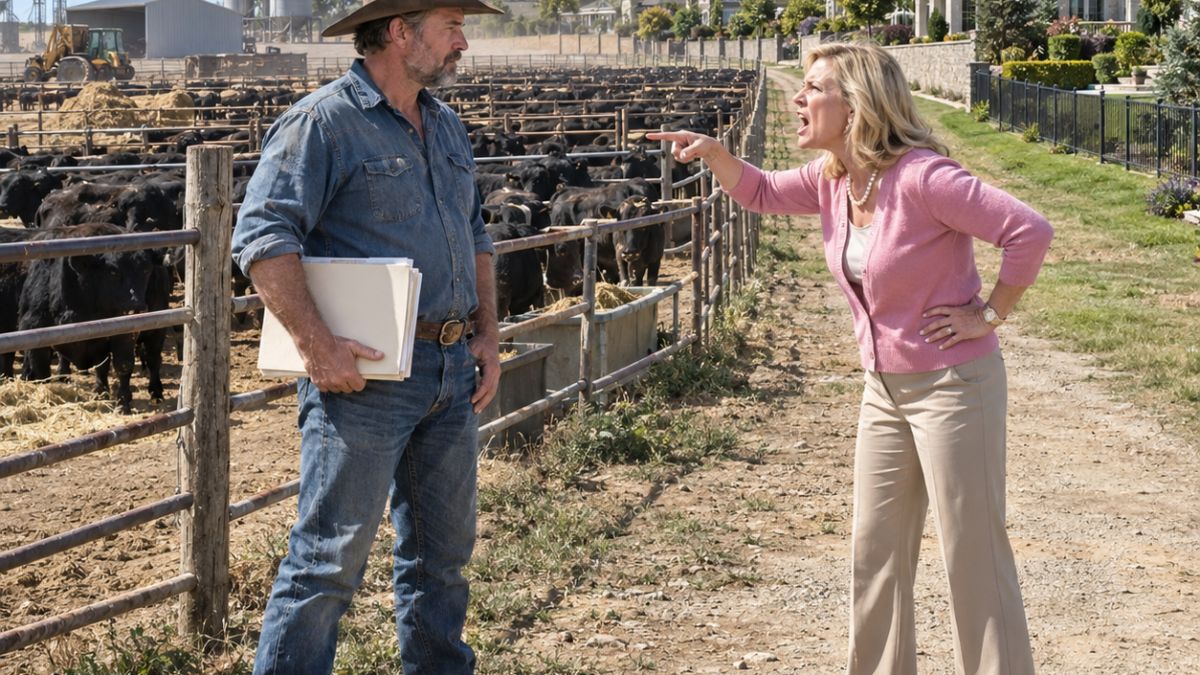
“GET RID OF THEM!”
I walked over slowly.
“Good evening.”
“Turn this off.”
I looked toward the hogs.
“They don’t have switches.”
Her face darkened.
“This is illegal.”
“It has been inspected today.”
“I will sue.”
“You already did.”
“We will get an injunction.”
“Talk to your lawyer.”
She pointed toward the pens.
“You did this to destroy us.”
“No.”
“Liar.”
“I opened a lawful agricultural operation on agricultural land.”
“Directly behind our homes!”
“You built homes beside agricultural land.”
“We were here before your pig farm.”
“The ranch was here before your subdivision.”
Karen slapped both palms against the top of the fence.
“Our lawsuit will take this property.”
“No.”
Her eyes narrowed.
“No?”
I had waited.
Ms. Albright had warned me not to reveal too much before Karen committed herself under oath.
Now the record existed.
I kept my voice low.
“Your lawsuit relies on a fifty-foot easement that did not exist on the original 2008 plat.”
One board member turned toward Karen.
She said nothing.
I continued.
“It first appears on a later amendment.”
“We know.”
“There is no corresponding grant from the ranch owner.”
“That’s your interpretation.”
“It’s the chain of title.”
“You’re bluffing.”
“Ms. Albright has certified copies.”
The second board member looked sick.
Karen tried to interrupt.
I kept going.
“You testified about the map.”
Her face changed.
Just slightly.
“You made sworn statements supporting its history.”
“I told the truth.”
“Good.”
I nodded.
“Then you have nothing to worry about when those statements are compared with the county records.”
The two board members looked at each other.
Karen’s voice became quieter.
“What did you do?”
“Nothing.”
“What did you send?”
“My attorney is handling the litigation.”
“You think you can frighten me?”
“No.”
I looked toward the hog pens.
“I think you’re already frightened.”
Karen slapped the folder out of my hand.
Pages scattered.
One board member flinched.
“Karen.”
“Shut up.”
That was the first time I saw her lose command of her own board.
She pointed at me.
“You don’t know who you are dealing with.”
I bent down.
Picked up my papers.
“I know exactly who I’m dealing with.”
Then I walked away.
The odor remained.
So did the pigs.
And for the first time, Karen had no final word.
Ms. Albright called the next morning.
“Your fence confrontation has already reached HOA counsel.”
“How?”
“Board member.”
“Which?”
“Doesn’t matter.”
“What happens now?”
“We file our counterclaims.”
“For?”
“Declaratory relief on the property boundary.”
“Damages associated with the wrongful litigation and harassment where supportable.”
“Potential title issues.”
“Attorney fees where recoverable.”
“And the plat.”
“Yes.”
“What about Karen personally?”
“We plead what the facts justify.”
“No dramatic extras.”
“No dramatic extras.”
I smiled.
“You sound disappointed.”
“I’m a lawyer. Precision is my drama.”
The HOA’s internal situation deteriorated quickly.
They had already spent thousands of homeowners’ dollars pursuing me.
Now their own attorney was learning the easement claim was potentially indefensible.
Then residents discovered the livestock operation could not simply be voted away.
Dave told me the clubhouse meeting became chaos.
“People are furious.”
“At me?”
“Everybody.”
“Helpful.”
“Half at you.”
“Half at Karen.”
“And the board.”
“Some at Pristine Homes.”
“Some at agriculture generally.”
“Democracy.”
Dave sighed.
“You know families are scared.”
“I know.”
“That assessment you’re asking for later—”
“I haven’t asked for anything.”
“Yet.”
I heard what he was really saying.
Don’t punish us for her.
That night, I walked through the hog operation.
Everything was working.
Animals feeding.
Waterers functioning.
Workers scheduled.
Yet something sat wrong inside me.
My legal position was strong.
My agricultural use legitimate.
But vindication can become cruelty if you stop distinguishing the guilty from the nearby.
That was not who I wanted to be.
I called Ms. Albright.
“When settlement comes, I don’t want to bankrupt the residents.”
“You’ve changed.”
“No.”
“You originally told me you wanted Karen buried in paper.”
“Karen.”
“Not Dave’s kids.”
“Correct.”
“Good.”
She paused.
“We seek your actual damages.”
“Legal fees.”
“Survey.”
“Title defense.”
“Operational costs properly connected to the dispute.”
“Harassment damages if supportable.”
“Settlement leverage.”
“Correct.”
“But no absurd punishment designed to destroy forty families.”
“Exactly.”
I breathed easier.
Karen had blurred every line.
Her authority.
My boundary.
Her preference.
The law.
I did not want to become her simply because the wind now blew in my direction.
The criminal investigation in the source story began after Ms. Albright referred the questionable plat and deposition record to appropriate authorities.
It did not mean Karen was automatically guilty.
It meant somebody outside the HOA would determine whether fraud, false filings, or perjury had occurred.
That distinction disappeared almost immediately in Oakwood gossip.
By Tuesday, according to the community Facebook page, Karen was already “going to prison for twenty years.”
She had not even been charged.
I told Dave to correct people.
“Why?”
“Because facts mattered when she lied about me.”
“You’re protecting her?”
“No.”
“I’m protecting the truth.”
Dave was quiet.
Then:
“Fair.”
An emergency homeowners meeting was called.
Not by Karen.
Enough residents petitioned.
I was invited.
I had never entered the Oakwood clubhouse.
The first thing I noticed was the air fresheners.
Four of them.
Plugged into outlets.
They were losing.
Every chair was full.
Windows closed because opening them made the smell worse.
Karen sat at the front.
Not behind the podium.
Beside it.
Dave chaired the meeting temporarily under the petition process.
He looked uncomfortable.
But determined.
“Before we discuss the farm situation,” he began, “we need to discuss why we are in litigation with Mr. Arthur.”
Karen interrupted.
“He created the farm situation as retaliation.”
Dave looked at her.
“You’ll have your turn.”
The room shifted.
Karen was not used to being told that.
Dave displayed the original 2008 plat.
Then the 2010 amended version.
Side by side.
People leaned forward.
“According to records reviewed by counsel, the fifty-foot common-area strip claimed in the lawsuit does not appear in the developer’s original plat.”
A man stood.
“So who added it?”
“That is being investigated.”
Karen spoke.
“It was always intended to be common space.”
“Intent isn’t a deed,” someone said.
Another homeowner shouted:
“How much have we spent suing him?”
The treasurer answered reluctantly.
The number made the room erupt.
Tens of thousands.
Lawyers.
Filings.
Experts.
And still climbing.
A woman near the back stood.
“My house backs up to his ranch.”
She looked toward me.
“I was furious at him about the pigs.”
I nodded.
“But if that land was never ours, why were we paying lawyers to take it?”
Nobody answered.
Karen finally stood.
“I was protecting this neighborhood.”
There it was again.
Always protecting.
“From what?” Dave asked.
Her eyes flashed.
“From becoming rural.”
A few people laughed because the statement was so absurd.
The development literally bordered a ranch.
Karen became angry.
“You may enjoy smelling manure every day, but respectable homeowners have expectations.”
I saw Dave’s jaw tighten.
“My children live here.”
“I know.”
“And my home is respectable.”
“I didn’t mean—”
“Yes, you did.”
Another resident rose.
Then another.
Questions came faster.
Why had the board accepted the later plat without verifying chain of title?
Who authorized the lawsuit?
Did Karen disclose the risk?
Why had no independent survey been ordered?
Why had the board rejected concerns?
Karen kept trying to answer everything.
That was her fatal instinct.
If she did not know, she invented certainty.
Eventually an older resident said:
“Stop.”
The room quieted.
“You don’t have to know everything.”
Karen stared.
“Yes, I do.”
He shook his head.
“No.”
And somehow that simple exchange exposed her more completely than any legal document.
Karen needed authority the way some people need air.
Admitting uncertainty felt like dying.
The vote to remove her from the board came that night.
The process was messy.
Arguments over procedure.
Bylaws.
Quorum.
Ballots.
But the result was overwhelming.
Karen lost.
Two members closely aligned with her resigned.
Dave became interim president until a formal election.
Karen sat in the same chair after everyone began standing.
Small.
Still.
For once, nobody waited for her reaction.
I walked toward the exit.
She called my name.
“Arthur.”
I stopped.
“You happy?”
I looked back.
“No.”
She laughed once.
“Of course you are.”
“I wanted you to leave my land alone.”
“You destroyed these people.”
That angered me.
But I kept my voice level.
“I built an agricultural operation on agricultural land.”
“You knew what would happen.”
“I knew you couldn’t regulate it.”
“You ruined home values.”
“You started a lawsuit to claim land that wasn’t yours.”
Her eyes filled.
Not with remorse.
Rage.
“I was trying to keep standards.”
“At whose expense?”
She looked away.
I left.
Dave and two newly selected interim directors came to the ranch the next morning.
They did not arrive by golf cart.
Pickup truck.
Good sign.
We stood beside the fence.
Same place Karen had first threatened me.
Dave spoke.
“We’re dropping the lawsuit.”
“That needs to come through counsel.”
“It will.”
“We’ll stipulate that the HOA claims no ownership interest in your ranch.”
“Recorded.”
“Yes.”
“Correct the plat issue.”
“Our attorney is working with the county.”
“Good.”
“We’ll apologize.”
I looked at him.
“You don’t need to apologize personally.”
“The association does.”
I nodded.
Then he looked toward the pigs.
“Arthur.”
“Yes.”
“What would make the livestock operation no longer attractive?”
I smiled slightly.
“Better market conditions somewhere else.”
“Come on.”
“I told Ms. Albright we aren’t extorting you.”
“I know.”
He rubbed his forehead.
“But you understand nobody is sleeping.”
“I do.”
“The houses nearest you are losing buyers.”
“I understand.”
“Families that had nothing to do with Karen are paying.”
That mattered.
“I know.”
Dave exhaled.
“What are you actually asking for?”
“Make me financially whole.”
He waited.
“Legal fees.”
“Survey and title costs.”
“Damages to my property interests.”
“Costs I reasonably incurred because of your lawsuit.”
“And whatever Ms. Albright says is legally supportable.”
“No revenge number?”
“No.”
He looked surprised.
“Why?”
“Because I’m not Karen.”
The answer came out before I thought about it.
But it was right.
Dave nodded.
“Thank you.”
“Don’t thank me yet.”
“Why?”
“The pigs are still a real farm.”
His face fell.
I almost laughed.
Settlement negotiations took several weeks.
Ms. Albright handled everything.
The HOA’s insurer participated.
Pristine Homes became involved because questions arose over the development documentation.
The association formally dismissed its claims.
A corrective instrument was prepared clarifying that Oakwood Estates held no fifty-foot common-area interest across my property.
My deed and surveyed boundary were recognized.
The HOA issued a written apology.
Not “we regret if you were offended.”
A real one.
Oakwood Estates Homeowners Association acknowledges that Arthur’s ranch is independent agricultural property and that prior enforcement efforts exceeded the association’s authority.
I read that sentence several times.
Fifty feet reclaimed on paper.
Not because it had ever physically left me.
Because false paperwork can make theft feel official.
The financial settlement was substantial.
Enough to cover legal fees.
Experts.
Surveys.
Operational expenditures connected to defending my agricultural rights.
And compensate me for the association’s conduct within the negotiated claims.
The residents did face a special assessment.
I hated that.
Karen had been removed.
Yet consequences remained.
Dave came to the ranch when the assessment notice went out.
“People are angry.”
“I expected it.”
“Some still blame you.”
“I expected that too.”
“They say you could waive the settlement.”
“Would they waive fifty thousand dollars if someone sued them over their backyard?”
“No.”
“Then neither will I.”
He nodded.
“I agree.”
“That doesn’t make it pleasant.”
“No.”
We stood quietly.
After a while Dave said:
“My assessment is painful.”
“I’m sorry.”
“I know.”
He looked toward his house.
“But my kids watched this whole thing.”
“What did they learn?”
“That when adults ignore documents because one loud person sounds certain, everybody pays.”
I smiled sadly.
“Expensive lesson.”
“Very.”
When the settlement funds cleared, I reviewed the hog operation as a business.
Livestock prices were favorable.
My supplier offered a purchase arrangement.
The temporary scale no longer fit what I wanted from retirement.
So the pigs left.
Not because Oakwood ordered them gone.
Not as a secret settlement condition.
Because I chose to return that part of the ranch to quieter use.
The livestock trucks arrived before sunrise.
Three hundred hogs loaded out.
The last one required convincing.
Stubborn animal.
I respected him.
By noon, the pens were empty.
The smell did not vanish instantly.
But the silence returned first.
Oakwood residents opened windows.
Dave sent one text.
MY WIFE SAYS THANK YOU.
I replied:
THANK THE HOG MARKET.
He answered:
JERK.
I smiled.
I dismantled much of the temporary pen layout but kept useful agricultural infrastructure.
Water.
Some fencing.
Feed storage converted.
The two horses returned to being the loudest livestock on the hill.
One month later, the investigation into the plat and deposition produced formal consequences for Karen.
The exact charges were narrower and more specific than neighborhood rumor.
Authorities alleged fraudulent conduct connected with the land records and false sworn statements.
Karen hired counsel.
Eventually, rather than a theatrical trial, the case resolved through the criminal process.
She faced penalties.
Probationary restrictions.
Financial consequences.
And permanent reputational damage inside the community she once controlled.
Her mug shot did appear in the local paper.
I saw it once.
Then closed the page.
I had expected satisfaction.
Mostly I felt tired.
A human being had made terrible choices because she could not tolerate being told her authority ended somewhere.
That was tragic in a way.
Not tragic enough to erase responsibility.
But tragic enough that I did not need the photograph.
Oakwood held elections.
Dave reluctantly ran.
Won.
His first meeting drew almost every homeowner.
By his third meeting, attendance was down by half.
That made me laugh.
Normalcy had returned.
The new board focused on roads.
Entrance maintenance.
Common landscaping.
Insurance.
Actual HOA work.
Mailbox-color enforcement disappeared.
Work-truck rules were rewritten.
Basketball hoops remained.
Residents argued about pool hours instead of property seizures.
The greatest sign of improvement was boredom.
One afternoon Dave leaned over my fence.
The same fence.
Still standing.
“I’ve got a complaint.”
“File it.”
“Your horse is staring at my house.”
“Menacingly?”
“Very.”
“I’ll speak to him.”
Dave nodded toward the pasture.
“You know for six months people genuinely thought you were evil.”
“I know.”
“My wife included.”
“I know.”
“I included.”
“You told me.”
“Then the pigs came and I knew you were evil.”
I laughed.
He did too.
Then his expression softened.
“But Karen really did start it.”
“No.”
He frowned.
“What?”
“The forged or defective property claim started before her.”
“Fair.”
“She escalated it.”
“Very fair.”
“And we all let her become too powerful because everyone thought somebody else would stop her.”
Dave nodded.
“That part bothers me.”
“It should.”
He looked toward Oakwood Estates.
“Forty houses.”
“Forty-something.”
“One woman.”
“She had a board.”
“Barely.”
“People voted.”
“Barely.”
“People skipped meetings.”
“Yes.”
“People ignored fines against neighbors until theirs arrived.”
Dave sighed.
“So we helped build her.”
“Not intentionally.”
“No.”
“But institutions don’t become abusive in one morning.”
He leaned on the fence.
“My kids ask why we have an HOA.”
“What do you tell them?”
“Roads, landscaping, common areas.”
“Good.”
“And what it isn’t for.”
I smiled.
“Better.”
The ranch changed after the fight too.
For a while, I associated every corner with conflict.
The fence where Karen screamed.
The field where hog pens stood.
The driveway where deputies arrived.
The kitchen table covered in legal documents.
I hated that.
I bought the land for peace.
Karen did not deserve to become its permanent meaning.
So I started reclaiming it.
Not legally.
Emotionally.
I seeded the old hog area.
Grass returned.
I rotated the horses through.
Built a small equipment shelter.
Planted oaks along one slope.
The first saplings looked pathetic.
Sticks with leaves.
But trees teach patience.
Five years later, they provided shade.
I repaired the farmhouse porch.
Repainted the kitchen.
Took the HOA binder from my desk and moved it into a cabinet.
For months, I still opened it occasionally.
Checking.
Reviewing.
Then I realized I had not touched it in almost a year.
That felt better than any court ruling.
Mr. Abernathy visited once.
The previous owner.
Older now.
Walking with a cane.
His daughter drove him out.
I took him around the ranch in my truck.
He saw the fence.
Horses.
New oaks.
We stopped overlooking Oakwood Estates.
He laughed.
“Heard you gave them hell.”
“News travels.”
“You really put pigs down there?”
“Three hundred.”
He whistled.
“My daddy would’ve loved you.”
“I’m not sure that’s good.”
He looked over the pasture.
Then became quiet.
“They tried taking land?”
“Fifty feet.”
“On paper.”
“Yes.”
Mr. Abernathy shook his head.
“My grandfather warned us about developers.”
“What did he say?”
“Never sell the map before you sell the dirt.”
I laughed.
“That doesn’t make sense.”
“It did to him.”
We sat there awhile.
Then he touched the dashboard.
“You kept it.”
“The ranch?”
He nodded.
“I was afraid selling to somebody new meant this would all become houses eventually.”
“Not while I’m here.”
He smiled.
“That’s enough.”
That conversation mattered.
Karen had made the fight feel like ownership was primarily about exclusion.
My land.
Stay out.
My boundary.
My deed.
But ownership was also stewardship.
Mr. Abernathy cared what happened after him.
Someday I would too.
I began placing portions of the ranch under better long-term agricultural management.
Improved pasture.
Erosion control.
Wildlife edges.
The hog operation had been lawful, but I did not want intensive livestock to become the ranch’s identity.
Horses suited the land.
Hay suited parts of it.
Quiet suited me.
The right to farm includes the right to choose what kind of farmer you want to be.
That may have been the lesson Karen never understood.
Rights are not commands.
Because you may do something does not mean you must.
Because someone cannot stop you does not mean you should spend your life proving it.
Years later, a new Oakwood family walked up my gravel drive.
Husband.
Wife.
Two children.
They had bought one of the houses backing onto the ranch.
The husband looked embarrassed.
“Are you Arthur?”
“Yes.”
“We’re the new people in the Carlson house.”
“Welcome.”
He pointed toward the pasture.
“Our realtor told us we needed to understand we border agricultural property.”
“Good realtor.”
“They made us sign a disclosure.”
“Even better.”
His wife laughed.
“We heard the pig story.”
“Of course.”
The older child asked:
“Do you still have pigs?”
“No.”
“Why?”
“I like horses better.”
She looked disappointed.
“Can we see them?”
Her parents immediately said no.
I said:
“From the fence.”
We walked.
The children fed carrots through the rail.
The husband stared across my pasture.
“This is actually why we bought the house.”
“What?”
“The view.”
I smiled.
Karen had accused the ranch of destroying Oakwood property values.
Now residents paid a premium to look at it.
Life enjoys irony.
Before leaving, the husband said:
“I just want you to know we won’t complain about farm stuff.”
“Don’t promise that.”
He looked surprised.
“If I actually do something unreasonable, complain.”
“That’s not what I meant.”
“I know.”
I pointed toward Oakwood.
“The lesson wasn’t that neighbors should never object.”
He waited.
“The lesson was to make sure you’re objecting to something you have a right to control.”
He nodded.
“I can live with that.”
So could I.
Ms. Albright eventually retired.
For real.
I took her to lunch.
She protested that clients do not take lawyers to lunch after paying legal fees.
“I need closure.”
“That sounds unhealthy.”
“Humor me.”
We sat outside a restaurant overlooking the river.
I asked the question I had wondered about for years.
“When you suggested livestock, did you already know exactly what would happen?”
“No.”
I stared.
“You looked extremely confident.”
“Occupational requirement.”
“You didn’t know residents would revolt?”
“No.”
“That Karen would be investigated?”
“No.”
“That settlement would happen?”
“No.”
“Then what did you know?”
She sipped coffee.
“That your agricultural rights were more substantial than the HOA wanted to admit.”
“That their map had serious defects.”
“And that people who build expensive houses beside farms should understand farms can farm.”
“That’s it?”
“That’s plenty.”
I laughed.
“You made it sound like a master plan.”
“Arthur.”
She smiled.
“Lawyers call that client management.”
I shook my head.
Then she became serious.
“You did something important at settlement.”
“What?”
“You stopped wanting everyone punished.”
“I still wanted Karen punished.”
“Accountability.”
“Fine.”
“Different word.”
“Important difference.”
She was right.
There had been a moment when I would have gladly watched Oakwood financially collapse.
Every homeowner.
Every mansion.
Every manicured yard.
Let them all pay.
Then I met more of them.
Dave.
His wife.
Children.
People who had believed Karen because authority is convenient when you are busy.
They were not innocent of everything.
But neither were they one mind.
Communities never are.
Karen’s great manipulation had been convincing people that the HOA was her.
Later, my anger almost made the same mistake.
The HOA was not Karen.
It was forty families.
A budget.
Common property.
Legal documents.
An institution temporarily captured by someone who enjoyed control.
Reforming it was better than destroying it.
That became the ending I was proud of.
Not the smell.
Although the smell remained legendary.
Oakwood held a barbecue several years later.
Dave invited me.
I almost declined.
Then went.
The clubhouse lawn was full of families.
Someone had hired a barbecue company.
Pulled pork.
I stopped at the buffet.
Dave appeared beside me.
Neither of us said anything.
We looked at the tray.
Then at each other.
“No,” I said.
He started laughing.
“I didn’t choose the menu.”
“Sure.”
“I swear.”
People nearby asked why we were laughing.
Dave told them.
Within minutes, half the picnic was joking about feeding me pulled pork.
I ate chicken.
Principle.
At sunset, an older woman approached.
I recognized her vaguely.
She had been at the emergency meeting years earlier.
“Arthur?”
“Yes?”
“I owe you an apology.”
“You don’t.”
“I do.”
She clasped her hands.
“I signed a letter supporting the lawsuit.”
I hadn’t known.
“Karen told us you were trying to steal common property.”
“I know.”
“I believed her.”
“You weren’t the only one.”
“When the pigs came, I hated you.”
“You definitely weren’t the only one.”
She smiled.
“My husband wanted to sell.”
“What changed?”
“The meeting.”
“The maps?”
She nodded.
“And something Dave said.”
“What?”
“That we were angry at you for using your own land while paying lawyers to take it from you.”
I looked toward Dave.
He was helping his son with a football.
The boy had been small during the dispute.
Now nearly grown.
The woman continued.
“I started attending meetings after that.”
“Good.”
“I hate them.”
“Even better.”
She laughed.
Then walked away.
Participation does not have to be enjoyable.
It merely has to happen often enough that power remembers it is borrowed.
The fence aged.
Cedar posts weathered darker.
Wire needed tightening.
I replaced two rails after a storm.
Every repair reminded me how absurd the original fight had been.
Karen called it unauthorized construction.
Fifteen thousand dollars.
Demolition by Friday.
Years later, it was just a fence keeping horses where horses belonged.
No monument.
No plaque.
I preferred that.
I had enough paperwork proving where the boundary was.
I did not need to make the landscape shout.
One spring, I found the original survey stake Karen had called a lie.
Weathered ribbon.
Still in place.
I pulled the faded flagging off and replaced it.
Then I stood there.
Thirty feet from the fence.
Fifty-foot imaginary common area erased from every valid current record.
A line Karen tried to move through confidence.
It had never moved.
That was the quiet beauty of facts.
People can argue.
Threaten.
Send letters.
File lawsuits.
Draw maps.
Facts do not become less true because somebody speaks louder.
But facts alone are not enough.
Somebody has to preserve them.
Find them.
Present them.
Defend them.
That was where my thirty years in the Corps helped.
Not military intimidation.
Not rank.
Discipline.
Documentation.
When Karen threatened me, I wrote it down.
When letters arrived, I kept them.
When surveys were completed, I filed them.
When the original plat surfaced, I obtained certified copies.
When regulators inspected the farm, records were ready.
When settlement came, numbers were supported.
People often tell the story like I defeated an HOA with three hundred pigs.
That makes a better headline.
But the pigs did not win.
Paper did.
Deeds.
Surveys.
Plats.
Transcripts.
Permits.
Inspection records.
The pigs simply made everybody pay attention.
That distinction always made Ms. Albright smile.
One afternoon, long after the litigation ended, I received an envelope with no return address.
Inside was a short handwritten note.
Arthur,
I was wrong about your property.
I should have verified the documents before pursuing the matter.
What happened afterward cost more people than I ever intended.
I doubt this changes anything, but I am sorry.
Karen
I stared at it.
No dramatic confession.
No explanation.
No request for forgiveness.
Just three sentences.
I called Dave.
“Guess who wrote.”
He knew immediately.
“What does she want?”
“Nothing.”
“You believe that?”
“I don’t know.”
“What are you going to do?”
“File it.”
He laughed.
“Of course.”
I placed Karen’s note in the HOA binder.
Last tab.
I did not reply immediately.
Weeks passed.
Finally I wrote:
Karen,
I received your letter.
Thank you for acknowledging the boundary and the harm the dispute caused.
I hope you are well.
Arthur
That was enough.
Forgiveness is not the same as pretending nothing happened.
And accountability does not require permanent hatred.
By then, Karen had already paid enormous costs.
Legal.
Financial.
Reputational.
She did not need me carrying anger on her behalf for the rest of my life.
The ranch was too beautiful for that.
When I turned seventy, Dave gave me a ridiculous birthday gift.
A small wooden pig.
Hand carved.
Mounted on a base.
Brass plate:
RIGHT TO FARM CONSULTANT.
I laughed harder than I had in years.
It sits on my desk beside the old HOA binder.
Grandchildren visiting the ranch ask about it.
I tell them a shortened version.
“Some neighbors thought part of our land belonged to them.”
“What happened?”
“We checked the records.”
“And?”
“They were wrong.”
“What about the pig?”
“That part is complicated.”
They always want the pig part.
Children have good instincts.
I tell them about three hundred hogs.
They howl.
“Did it stink?”
“Yes.”
“How bad?”
“Very.”
“Did the mean lady smell it?”
“Everyone smelled it.”
“Was she mad?”
“Extremely.”
They consider that the greatest legal victory in American history.
I let them.
Someday, if they inherit the ranch, I’ll show them the binder.
Not because I want them to fight Oakwood.
I hope they never have to.
I want them to understand land comes with paperwork.
Read it.
Preserve it.
Do not assume a neighbor is right because their letter has a logo.
Do not assume you are right because you own more acreage.
Verify.
Boundaries matter in both directions.
So does restraint.
The final chapter came when Oakwood Estates replaced its entrance sign.
The old sign had read:
OAKWOOD ESTATES
EXCELLENCE BY DESIGN
The new board kept the name.
Changed the landscaping.
Nothing dramatic.
But inside their updated homeowner handbook, they added a simple disclosure:
Oakwood Estates borders independently owned agricultural property. Normal lawful agricultural sights, sounds, traffic, and odors may occur.
Dave brought me a copy.
“Look.”
I read it.
“You wrote this?”
“Our lawyer.”
“Smart lawyer.”
“We learned.”
I handed it back.
“That one sentence could have prevented almost everything.”
“I know.”
He looked toward the ranch.
“Funny.”
“What?”
“We spent all that money fighting the fact that we live next to a farm.”
“You live next to a ranch.”
“Technical.”
“Important.”
“Fine.”
He smiled.
“You know what my house listing says now?”
“What?”
“Premium pastoral views.”
I laughed.
“You’re welcome.”
A home that once allegedly needed protection from my farm was now marketed using my pasture.
That might have been the most satisfying irony of all.
Not because Oakwood lost.
Because reality won.
The ranch was not a threat.
It was simply different.
Different use.
Different history.
Different rules.
People can live beside differences without controlling them.
That was what Karen never understood.
She believed adjacent meant subordinate.
Near meant hers.
Impact meant authority.
Discomfort meant violation.
That thinking had cost everyone.
The new community understood the better principle.
Your rights end somewhere.
So do mine.
Between those lines is room for negotiation.
Courtesy.
Compromise.
But not theft.
One evening, Dave stopped by while I was tightening the old fence.
His children were grown.
Mine existed mostly as nieces, nephews, and the next generation visiting now and then.
We were older.
Slower.
He leaned against the rail.
“Still straight.”
“Mostly.”
“Like you.”
“Debatable.”
We watched two horses graze.
Dave said:
“I meant what I said back then.”
“What?”
“For a while, I thought you were the villain.”
“I remember.”
“Then the assessment hit and I definitely thought you were the villain again.”
“I remember that too.”
He laughed.
“But I was wrong.”
“About what part?”
He looked toward Oakwood.
“Who created the cost.”
I waited.
“We blamed the pigs because we could smell them.”
He tapped the fence.
“We couldn’t smell bad governance.”
That was a good line.
“Did you practice that?”
“For years.”
“It shows.”
He grew serious.
“Karen started the fight.”
“The old plat problem started before her.”
“She made it a war.”
“Yes.”
“We let her.”
“For a while.”
“You forced us to look.”
I thought about that.
Then shook my head.
“The pigs forced you to look.”
“Same thing.”
“No.”
I smiled.
“I just opened the gate.”
The sun dropped behind the oaks.
Oakwood lights came on below.
No smell.
No shouting.
No lawyers.
No officers.
No Facebook outrage.
Just homes.
And my ranch.
Side by side.
That was all I had wanted.
People sometimes ask whether I would do the pig operation again.
The truthful answer is complicated.
It worked.
It was legal.
It exposed the absurdity of trying to erase agricultural rights after building luxury homes beside agricultural land.
It created leverage.
But it also hurt people who had not personally targeted me.
I understood that more clearly afterward.
If I faced the same dispute today, I might move even faster toward court and public records before expanding livestock.
Experience changes strategy.
That does not mean I regret defending myself.
I don’t.
Karen threatened to demolish my fence.
Claimed my land.
Demanded money.
Supported litigation based on a property interest her association could not establish.
At some point, refusing to fight becomes permission.
I refused.
What I am proudest of is not the retaliation.
It is that when the time came to settle, I stopped short of making innocent neighbors pay more than necessary just because I finally had power.
Power tests the person holding it.
That was Karen’s failure.
I didn’t want it to become mine.
The wooden pig on my desk reminds me of that too.
Humor.
Consequence.
Restraint.
All in one ridiculous object.
My HOA binder is thick.
The first page remains Karen’s cease-and-desist.
Fifteen thousand dollars.
Remove fence by Friday.
Your deed is irrelevant.
Behind it:
Deed.
Survey.
Original plat.
Amended plat.
Court filings.
Deposition excerpts.
Farm records.
Inspection reports.
Settlement.
Corrected property document.
HOA apology.
Karen’s final note.
A complete war reduced to paper.
Outside my office window, the fence still stands.
The horses still graze.
The land still rolls toward the ridge exactly as it did before Oakwood Estates appeared.
Mansions came.
HOA presidents came.
Lawsuits came.
Pigs came.
Pigs left.
The land remained.
That may be the final lesson.
People become very impressed with institutions they invent.
HOAs.
Boards.
Committees.
Rules.
Maps.
Titles.
They matter.
Sometimes deeply.
But none of them can substitute for reality.
A line is either on your deed or it isn’t.
An easement exists or it doesn’t.
A ranch is agricultural or it isn’t.
And if you build a luxury neighborhood next to land legally used for farming, the countryside does not stop being countryside because manure offends your patio furniture.
Karen learned that the expensive way.
Oakwood learned it through a special assessment.
I learned something harder.
Winning a fight and finding peace are separate operations.
The first required Ms. Albright.
The binder.
The records.
The hogs.
The second required putting all of it away.
That took longer.
But I got there.
These days, when evening comes, I sit on the farmhouse porch.
Sometimes a breeze travels from the direction of Oakwood.
Clean air.
Cut grass.
Barbecue smoke.
Occasionally somebody’s fireplace in winter.
Nothing else.
The pasture glows orange.
Horses move slowly in the distance.
And the fence that was supposed to come down by Friday casts a long shadow across ground that never belonged to anyone but the ranch.
I don’t think about Karen often anymore.
When I do, it isn’t with anger.
Mostly I remember the first sentence.
“Your deed is irrelevant. My rules are not.”
She had the relationship exactly backward.
Rules only matter when authority gives them somewhere legitimate to stand.
Her rules stopped at my property line.
My deed did not.
The pigs were temporary.
The lawsuit was temporary.
Her presidency was temporary.
The boundary wasn’t.
So when people tell the story and say I beat a tyrannical HOA with three hundred pigs, I usually smile.
It’s close enough for a barbecue.
But the truth is better.
I beat them with the one thing Karen never respected until it was too late.
A documented fact.
The pigs just made sure everybody could smell it.
[FULL STORY END]








