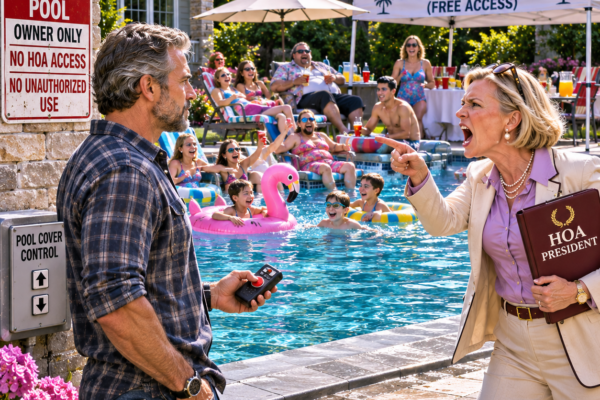
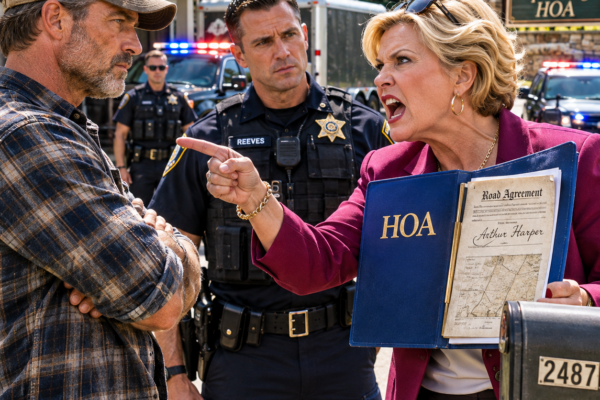
PART 2: HOA Claimed My 512-Acre Timberland Was Under Their Rules — One Meeting Wiped Out Their Entire Board
PART 2
I leaned against the kitchen counter.
“What did they miss?”
“Your conservation easement.”
I looked toward the window.
The creek ran through the western part of the property, hidden from the house by timber.
“So?”
“So the portion of your boundary they’re using to justify this ridiculous adjacent-property clause overlaps land already subject to a recorded conservation interest held by the county land trust.”
“I know that.”
“They apparently don’t.”
I sat down.
Delia continued.
“Garrett, that easement predates Cascade Ridge by years. It creates rights and restrictions that exist independently of the subdivision.”
“Does that mean the HOA can’t touch it?”
“It means they don’t get to pretend their declaration appeared first.”
That sounded good.
Too good.
“What about the rest of the property?”
“I looked at that too.”
I heard papers moving.
“The Cascade Ridge declaration binds the property actually submitted to the subdivision. Their clause claiming aesthetic authority over neighboring parcels is extremely aggressive.”
“Illegal?”
“Don’t make me practice law without a license.”
“You called me.”
“I’m a paralegal. I can tell you it smells terrible.”
“That I understand.”
“You need an attorney eventually.”
“Eventually?”
She laughed.
“That means you’re planning something.”
“I’m planning to do nothing.”
There was silence.
“Nothing?”
“For now.”
“Garrett.”
“They gave me thirty days.”
“Yes.”
“I’ve watched fir trees grow for thirty years. I can survive thirty days.”
—
So I waited.
That was harder than it sounds.
The first week, every time gravel crunched outside the house, I expected Vonda.
The second week, I stopped thinking about her so often.
I got up at five.
Coffee.
Equipment inspection.
Timber road.
Chainsaw.
Lunch from a thermos.
Home after dark.
The forest smelled the way it always did after rain—fir pitch, loam, wet bark.
The HOA did not alter the weather.
It did not alter timber prices.
It did not alter my deed.
Thirty days passed.
On day thirty-one, an envelope arrived.
Fine:
$200.
I put it into a manila folder and wrote:
**HOA NONSENSE**
Then went back to work.
Two weeks later, Vonda returned.
She didn’t get out of the Escalade.
She lowered the passenger window and photographed my barn.
Then the fence.
Then the trees.
I stood on the porch drinking coffee.
She drove away without speaking.
Four days later, another notice arrived.
Eleven violations.
The barn was now an “uncertified wood storage structure visible from community sightlines.”
My timber was “unmanaged forest encroachment.”
My old post-and-wire fence was “non-standardized boundary marking.”
There was even language criticizing stacked cut timber near the equipment shed.
Total claimed fines:
$1,400.
I called Delia.
“They cited the barn.”
“The 1889 barn?”
“Yes.”
She laughed again.
“You know, this is becoming fun.”
“For you.”
“Send me everything.”
I did.
—
Delia’s next call was more serious.
She had gone through property records, my management plan, the conservation documents, and the Cascade Ridge filing.
“Garrett, I think the entire theory that they can pull neighboring land into HOA jurisdiction is vulnerable.”
“Vulnerable or stupid?”
“Legal term: vulnerable.”
“What’s the ordinary term?”
“Stupid.”
Better.
She also pointed me toward Oregon statutes governing planned communities and land submitted to declarations.
Her explanation was cautious:
An HOA generally derives authority from the recorded declaration and the property actually bound by it.
My timber tract had never been voluntarily submitted.
No deed amendment.
No signed annexation.
No membership agreement.
Nothing.
“They can write whatever they want in their own document,” she said.
“That doesn’t automatically make your land theirs.”
I liked that sentence enough to write it down.
Then I did something I should have done years earlier with other property matters.
I pulled records.
Secretary of State.
County recorder.
Cascade Ridge HOA.
Dwight Pruitt’s development company.
Articles.
LLC filings.
Plat.
Deeds.
Everything public.
Cost me about a hundred dollars.
I put it all in a three-ring binder beside the HOA Nonsense folder.
I had no plan yet.
I just wanted paper.
Paper is patient.
—
The fines kept coming.
Month two:
$7,600 claimed.
I paid nothing.
Vonda’s monthly HOA meeting turned me into an agenda item.
I learned that from Ellis Brewster.
Ellis lived in Cascade Ridge and owned the feed store in town.
Quiet man.
Good reputation.
We had known each other casually for years.
He called me one evening.
“You know they talked about you for twenty minutes last night?”
“Only twenty?”
“I’m serious.”
“So am I.”
He told me Vonda had described my timber tract as an aesthetic threat to property values.
Ellis had raised his hand.
“Isn’t Caldwell’s place an active forest operation?” he asked.
Vonda replied:
“That’s being reviewed.”
I laughed when Ellis told me.
“Reviewed by who?”
“That part never came up.”
Two days later, someone tried.
—
His business card said:
**BRANDON — COMMUNITY STANDARDS ENFORCEMENT**
No last name.
Khaki pants.
Clean shoes.
Cascade Ridge polo.
Clipboard.
He stood outside my gate.
“I’m here to conduct a compliance inspection of the boundary area.”
“No.”
He blinked.
“Excuse me?”
“No.”
“Sir, the HOA has authorized—”
“You’re law enforcement?”
“No.”
“County?”
“No.”
“State forestry?”
“No.”
“Land trust?”
“No.”
“Then you’re a man named Brandon standing at my gate.”
His face reddened.
“I’m an authorized compliance officer.”
“Of land inside Cascade Ridge?”
“Yes.”
“This isn’t inside Cascade Ridge.”
“We have jurisdiction under—”
“You have permission from me to come onto my property?”
He stopped.
“No.”
“Court order?”
“No.”
“Then you’re not coming in.”
“Mr. Caldwell—”
“I’m calling the sheriff in thirty seconds if you’re still standing here arguing.”
He left in ten.
I watched his car disappear.
Then wrote down the date, time, description, and exact conversation.
Documentation.
The binder got thicker.
—
Vonda’s next move was smarter.
She went around me.
County zoning.
She filed a complaint alleging my timber operation was incompatible with adjacent residential use.
That one got my attention.
Not because I thought she would win.
Because zoning had real power.
I received the notice Thursday afternoon.
I drove to the ridge afterward.
Parked my truck.
Sat on the tailgate.
The old Douglas firs stood black against a gold sky.
Some were two centuries old.
I put one hand against the bark of a tree thick enough that three adults could barely encircle it.
That land had survived fire.
Market crashes.
Ice storms.
Disease.
Two world wars.
Five generations of Caldwells.
And now a developer’s wife was asking county government to make commercial forestry inconvenient because she had built houses next door.
I drove home and called Clifton Oaks.
—
Clifton was seventy-one.
Retired.
Timber and agricultural land attorney.
My father’s oldest friend.
He wore suspenders.
Hearing aid.
Kept old case files in milk crates.
He answered:
“Oaks.”
“Clifton, Garrett.”
“Who died?”
“Nobody.”
“Then this better be interesting.”
“It’s HOA-related.”
Long pause.
“I’m hanging up.”
“They’re claiming jurisdiction over the timber tract.”
Another pause.
“You have my attention.”
I told him everything.
He listened.
When I finished, he said:
“Send me every document.”
“I have a binder.”
“Of course you do. You’re your father’s son.”
Within a week, Clifton filed a formal zoning response.
Forest management plan.
Conservation easement.
Forest classification records.
Timber-use history.
Legal analysis of protections applicable to long-established forest operations.
The county dismissed Vonda’s complaint without letting it become the battle she wanted.
Clifton called me.
“Done.”
“That easy?”
“Good facts make lawyers look talented.”
“You’re admitting that?”
“I’m retired.”
I laughed.
Then I made my first real mistake.
I told Ellis.
—
Ellis told people at the diner.
Not maliciously.
Tuesday morning coffee.
Eight locals.
By Wednesday, half the county knew.
By Friday, I received a cease-and-desist letter from Cascade Ridge’s attorney.
It accused me of sharing confidential HOA matters and making defamatory statements.
I drove the letter to Clifton.
He read it.
Then laughed so hard his hearing aid squealed.
“What?”
He took the hearing aid out.
“Give me a second.”
“You’re enjoying this too much.”
He wiped his eyes.
“Garrett, did you break into their office?”
“No.”
“Steal confidential files?”
“No.”
“Fabricate statements?”
“No.”
“What did you tell Ellis?”
“That the zoning complaint was dismissed.”
“True?”
“Yes.”
“That they’re fining me?”
“True.”
“That they claim jurisdiction over my property?”
“Written right here.”
Clifton put the letter down.
“This is intimidation stationery.”
“Meaning?”
“A cease-and-desist letter is not a court order.”
“I know.”
“They can threaten litigation. That does not magically make public records confidential.”
“So ignore it?”
“Not quite.”
He smiled.
“Keep it.”
I added it to the binder.
That letter changed my mood.
Until then, I had been defending.
Boundary.
Zoning.
Trespass.
Fines.
Now they were telling me I couldn’t even discuss what they were doing to me.
That evening, I drove to the courthouse.
I started digging.
—
I pulled Dwight Pruitt’s original purchase deed.
Thirty-eight acres bought from Walt Hennessey.
I knew the general story.
Walt was ninety-one.
His children lived out of state.
The land had become too much.
Dwight paid him fairly.
Nobody objected.
Then I reached a clause near the end of the deed.
I read it once.
Then again.
Eastern boundary.
Old oak windbreak.
Approximately 1.2 acres.
No clearing.
No grading.
No development.
In perpetuity.
I knew those trees.
Everybody did.
Walt’s grandfather had planted them in the 1930s.
I drove straight to Cascade Ridge.
Parked on the county road.
Looked east.
Playground.
Mailbox kiosk.
Fresh grading.
Concrete.
Stumps.
Not one oak left.
I took photographs from public areas.
Wide shots.
Boundary markers.
Stumps.
Playground.
Then I drove home.
Laid the photographs beside the deed.
Poured myself two fingers of bourbon.
Called Clifton.
Then Ellis.
Then I made a list.
By midnight:
Twenty-three names.
People.
Agencies.
Landowners.
Anyone who might have their own reason to care about what Dwight and Vonda Pruitt were doing.
That was the night the fight stopped being about my trees.
—
Clifton pulled at the thread.
First:
Construction loan.
Pruitt Holdings had borrowed millions from a regional bank for Cascade Ridge.
Loan covenants limited new legal encumbrances on project property without lender approval.
Clifton believed parts of the HOA declaration raised issues the lender would want to review.
The bank had apparently never been asked.
Second:
Board elections.
Cascade Ridge had existed for more than a year.
Its articles required annual elections.
None had happened.
Vonda appointed herself president.
Rutherford Gaines and Paige Dunmore had been appointed alongside her.
No proper owner election.
Third:
The declaration itself had notarization problems.
Clifton was careful.
“A defective notarization does not automatically erase an entire document.”
“Then why do you care?”
“Because they’re trying to use this document aggressively against nonmember property.”
He tapped the page.
“Defects matter more when somebody is already stretching authority.”
Fourth:
Walt’s oaks.
That one needed no theory.
Deed says trees remain.
Trees gone.
Photographs.
Stumps.
Playground.
I sat across from Clifton at his kitchen table.
Coffee.
Old files.
Two binders now.
“Can we remove the board?”
He picked up his mug.
“Son, I think they’re removing themselves.”
—
The plan was not to spend five years suing everybody.
Clifton hated unnecessary litigation almost as much as I did.
Instead, we would use the rights of the Cascade Ridge homeowners themselves.
Special membership meeting.
Proper notice.
Actual owners.
Real vote.
I could not force their HOA election from outside.
They could.
Ellis knew residents.
Residents had grievances.
The petition needed enough signatures under the association’s procedure to compel a special meeting.
Cascade Ridge had forty-one lots.
We needed a manageable number.
Ellis found eleven owners willing to sign.
That surprised me.
One was Gloria Whitfield.
Retired teacher.
Lot 17.
She told Ellis:
“I bought a house, not a monarchy.”
I liked her immediately.
Clifton served the petition through the HOA’s registered agent.
Certified mail.
Clock started.
Then he contacted the bank.
Not a threat.
Not a demand.
A letter.
Here are the documents.
Here is the declaration.
Here are the potential loan-covenant questions.
There is a membership meeting scheduled.
Your legal department may wish to attend.
Banks hate surprise.
A week later, the bank confirmed it would send someone.
—
I went to see Walt.
Assisted living smelled like disinfectant, institutional coffee, and reheated lunch.
He sat beside a window wearing suspenders almost identical to Clifton’s.
I brought diner coffee.
He looked at the photographs.
The oak stumps.
Playground.
Mailbox pad.
For a long time he didn’t speak.
Then:
“They took all of them?”
“Yes.”
“Every tree?”
“Yes.”
His hand trembled slightly when he picked up the deed copy.
“My grandfather planted those.”
“I know.”
“Dwight signed this.”
“Yes.”
Walt looked at me.
“I sold him the dirt.”
He tapped the restriction.
“Not those trees.”
That afternoon, Walt got a lawyer.
Frederica Lund.
Agricultural and land-rights work.
She reviewed the deed and photographs.
Took the case.
The Pruitts had thought a ninety-one-year-old man was finished being relevant.
That was another mistake.
—
Dale Mercer ran the Harney County Beacon.
Weekly newspaper.
Small office.
Real journalism.
Clifton did not feed him gossip.
I didn’t either.
We told him where public records were.
Dale pulled them.
Verified them himself.
HOA documents.
Zoning dismissal.
Board filings.
Notary issue.
Walt’s deed restriction.
He interviewed Cascade Ridge homeowners.
By the week before the meeting, his story was ready.
He scheduled publication for the morning after.
Then Clifton filed a formal complaint with the relevant state authorities raising governance and procedural issues involving the HOA.
Again:
Paper.
Notice.
Record.
No theatrics.
Everything Vonda hated because she could not control it.
—
She knew trouble was coming.
Not all of it.
Enough.
Her first counterattack was astonishing.
Cascade Ridge homeowners received an offer:
$500 “community improvement grant” from association reserves if they signed a statement supporting the current board’s management philosophy.
Ellis brought me a copy.
“Is this what I think it is?”
I called Clifton.
He read it.
“What do you call that?”
“I call it exhibit material.”
“That isn’t what I asked.”
“I know.”
Gloria Whitfield had refused the money.
She forwarded her letter.
Clifton added it to the file.
Vonda had taken association funds and connected them to expressions of support for her board.
Whatever legal label eventually applied, it looked terrible.
Sometimes that is enough.
—
Then she called Dale.
Threatened defamation if he printed the story.
Dale listened.
Thanked her.
Called his attorney.
Kept the story scheduled.
Then Vonda hired a property research firm to photograph my land from public viewpoints.
Barn.
Equipment.
Fuel tank.
Sheds.
They filed an agricultural complaint over fuel storage.
That would have annoyed me.
Except three months earlier, I had voluntarily asked an agricultural compliance officer to review my operation.
Everything relevant had been inspected.
I had the letter.
Date.
Signature.
File number.
When the complaint arrived, I placed it behind the compliance letter in Binder Two.
Priscilla—no, I had no wife in this story; that was another life, another man—sometimes solitude makes a kitchen too quiet, and that night I noticed it.
The binders sat on the table.
My father had died six years earlier.
My mother before him.
No one waiting in the living room to ask how the day went.
For the first time since this started, I wondered whether I was enjoying the fight because it made the house less empty.
That thought bothered me.
I went outside.
The forest was black against the stars.
The creek moved somewhere below.
I listened until my anger returned to its proper size.
This was not entertainment.
Walt had lost trees planted by his grandfather.
Cascade Ridge homeowners were being manipulated.
My land was being threatened on paper.
I went back inside.
Prepared.
—
One week before the meeting, Dwight Pruitt called.
Just before six.
I was on the porch.
Fog lifting.
Coffee.
Unknown number.
“Caldwell.”
“This is Dwight Pruitt.”
“I figured I’d hear from you eventually.”
“I think this situation has gotten unnecessarily adversarial.”
“You built your HOA against my fence.”
“Our attorney may have drafted language more broadly than intended.”
“Your wife fined my barn.”
A pause.
“Vonda is passionate about maintaining community standards.”
“My barn was built in 1889.”
“I understand.”
“No, I don’t think you do.”
His voice stayed smooth.
He offered compromise.
Written acknowledgment my timber tract sat outside HOA jurisdiction.
All fines—now more than $24,000 on their paper—removed.
No enforcement.
No future claim.
“In exchange for what?” I asked.
“I hope you’ll approach the membership meeting constructively.”
“What does that mean?”
“This doesn’t need to become a spectacle.”
I looked toward the south boundary.
Then asked:
“Dwight, are you aware Walt’s deed protected the oak stand?”
Silence.
“Our attorneys are reviewing that.”
“The trees are gone.”
“There may have been a contractor misunderstanding.”
“Forty oak trees is a pretty large misunderstanding.”
“Garrett—”
“Walt has counsel.”
Longer silence.
“I’ll see you at the meeting.”
I hung up.
—
Written settlement offer came later.
$15,000.
My fines erased.
Permanent release.
In exchange:
I would not attend the special membership meeting or actively oppose the current board.
Non-disparagement language.
I called Clifton.
“If I sign this, can I tell the homeowners about the election issue?”
“Not the way it’s drafted.”
“Bank still coming?”
“Yes.”
“Regulatory complaint filed?”
“Yes.”
“Dale’s story?”
“Ready.”
“Walt’s case?”
“Frederica expects to file before the meeting.”
I listened to the wind through the firs.
“Tell them no.”
Next offer:
$30,000.
I said no again.
Clifton didn’t try to talk me into it.
“Good.”
“You’re supposed to advise me financially.”
“I am.”
“Thirty thousand is money.”
“Yes.”
“So why good?”
“Because I know why you’re refusing it.”
“Do you?”
“You want the board to stop doing this to everybody, not just you.”
I looked at the binders.
“Yes.”
“Then thirty thousand is cheap.”
For once, a lawyer said something in fewer words than necessary.
—
The night before the meeting, I drove the property boundary.
Windows down.
Cold October air.
Fir.
Wet soil.
Diesel.
The smells of my entire life.
I stopped near Elias Caldwell’s grave.
The white oak above it had lost most of its leaves.
His stone was plain.
1884 claim.
Five generations.
I put my hand on the fence.
Four hundred feet of shared boundary.
That was what started this.
Four hundred feet touching a new subdivision had somehow convinced three strangers they could reach across the line and rewrite 140 years.
I thought about Elias arriving with a mule.
About my grandfather grading roads.
My father teaching me how to fell a tree without wasting good timber.
None of them would have understood what HOA stood for.
But they would have understood a boundary.
And they would have understood patience.
I drove home.
Organized everything.
Three copies.
One for me.
One for Clifton.
One for the room.
Then I slept eight hours.
—
The Cascade Ridge clubhouse held forty-six people that Tuesday.
More than every lot.
Owners.
Spouses.
Proxies.
Ellis at the back in his feed-store vest.
Dale with notebook.
Gray-blazer woman from the bank.
A state representative connected to the pending HOA compliance matter.
Walt Hennessey in the front row.
Ninety-one.
Frederica beside him.
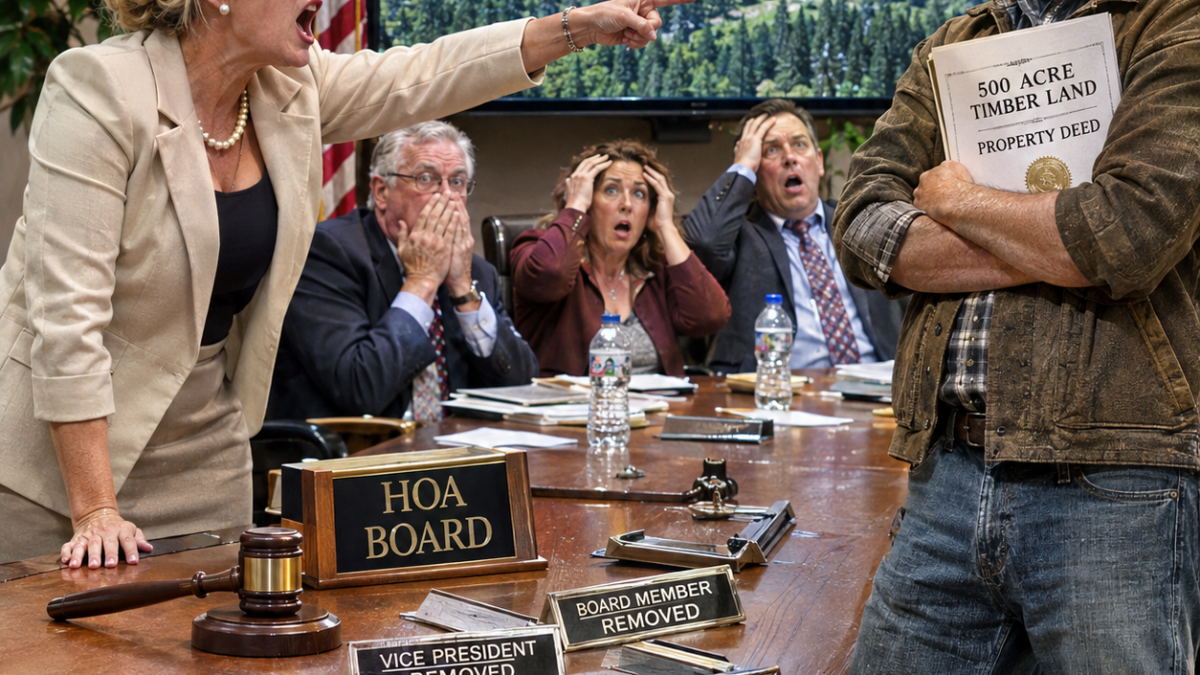
Vonda sat behind a folding table.
Bright red blazer.
Rutherford Gaines.
Paige Dunmore.
Dwight stood off to one side.
He wasn’t formally on the HOA board.
That didn’t stop everybody from looking at him.
Vonda tapped the microphone.
“We’re here to address misinformation that has unfortunately divided—”
“Before that,” Clifton said.
He did not raise his voice.
She looked at him.
“This is an HOA membership meeting.”
“I know.”
“Are you a member?”
“No.”
“Then—”
“I represent interests directly affected by actions this board has taken and have been invited by petitioning members to present relevant documentation.”
Gloria stood.
“He speaks.”
Several owners nodded.
Vonda’s jaw tightened.
She sat.
Clifton stood.
No projector.
No dramatic slides.
Just paper.
“Let’s start with governance.”
He held up the articles.
“This association requires annual director elections.”
He looked toward the room.
“Can anyone identify the date of Cascade Ridge’s first election?”
Silence.
Vonda answered:
“The developer-controlled transition period—”
Clifton lifted another document.
“The articles do not support an indefinite appointed board of the structure presently operating.”
Rutherford leaned toward Vonda.
She whispered something.
Clifton moved on.
Notary defect.
Declaration filing.
Boundary language.
My property never voluntarily submitted.
Conservation easement.
No annexation document.
No membership agreement.
Then the loan.
The bank representative sat straighter.
Clifton explained that the lender was reviewing whether relevant recorded restrictions or governance actions implicated loan covenants.
The woman in gray stood.
“My name is Karen Whitlow. I represent the lender’s compliance department.”
You could feel Dwight tighten from across the room.
She chose every word carefully.
“Our institution is reviewing several matters involving the development’s governing documents and expects full cooperation from the borrower.”
That was all.
Didn’t need more.
Banks do not threaten in public rooms.
They notify.
Dwight knew the difference.
—
Clifton introduced the state compliance complaint.
Then Walt’s lawsuit.
Frederica stood.
“Filed at 3:14 this afternoon.”
She held up the stamped copy.
Walt stared at Dwight.
“You cut my grandfather’s trees.”
Nobody moved.
Dwight said:
“Mr. Hennessey, the clearing was completed by a contractor operating under—”
“You signed.”
Walt’s voice wasn’t loud.
It didn’t need to be.
“You signed the deed.”
Dwight stopped.
Walt pointed toward the eastern side of the subdivision.
“I sold you land.”
His hand shook.
“Not the right to erase everything that came before you.”
That was the moment the room changed.
Up to then, this had been legal.
Documents.
Quorums.
Notaries.
Banks.
Now it was human.
I watched Gloria wipe one eye.
Ellis looked at the floor.
Even Paige seemed uncomfortable.
Vonda tried to recover.
“We have sympathy for Mr. Hennessey, but that matter is separate from association governance.”
Clifton looked at her.
“Then let’s return to governance.”
He placed one page on the table.
My fine summary.
More than $24,000.
Eleven separate grounds on which he argued the HOA could not enforce it against my timber tract.
Then he sat down.
I stood.
—
I had notes.
Didn’t use them.
“My name is Garrett Caldwell.”
A few people smiled because everyone obviously knew.
“My family has worked the land north of you since 1884.”
I looked around.
“I’m not saying that makes me more important than anybody in this room.”
Vonda watched me.
“It does mean I know exactly where my property ends.”
I let that settle.
“And yours begins.”
Nobody moved.
“I never signed your declaration.”
I pointed toward the south.
“I never asked for your clubhouse. I don’t use your roads. I don’t use your maintenance. I don’t vote in your association.”
Then I looked at Vonda.
“But you sent me a letter telling me my trees were an aesthetic violation.”
Somebody laughed.
Vonda didn’t.
“You fined a forest.”
Another laugh.
“I did not start this because I hate your subdivision.”
I looked at the homeowners.
“Walt had every right to sell. You had every right to buy. Most of you probably moved here because this county is beautiful.”
Several nodded.
“I’m asking for three things.”
I raised one finger.
“Every fine against my property removed.”
Second.
“A written acknowledgment that the Caldwell Timber Tract is outside Cascade Ridge jurisdiction.”
Third.
“A proper board election.”
I lowered my hand.
“That’s it.”
Vonda leaned toward the microphone.
“Mr. Caldwell is presenting an incomplete legal interpretation designed to destabilize—”
Gloria stood.
“I move the board resign.”
Silence.
Vonda froze.
Gloria continued.
“And I move that the homeowners proceed with immediate interim elections consistent with counsel’s guidance and the association documents.”
A man from Lot 22 named Gordon stood.
“Second.”
Vonda looked toward Rutherford.
He stared at the table.
Paige was looking at her phone.
Vonda said:
“This motion is procedurally improper.”
Gloria turned toward Clifton.
“Is it?”
He looked at the governing documents.
“Based on the meeting notice, quorum, and removal provisions your association is operating under, members have a pathway to act tonight.”
Vonda’s face changed.
Not panic.
Calculation.
“Before any vote,” she said, “I need to remind homeowners that continuity is essential to property values.”
Ellis spoke from the back.
“Did you offer people five hundred dollars to support the board?”
The room snapped toward her.
Vonda’s mouth opened.
Gloria held up her letter.
“I got one.”
Another homeowner:
“So did I.”
A man near the aisle:
“You were paying people with our reserve?”
Vonda raised both hands.
“The community improvement grant was not payment for votes.”
“Then why did support require a signature?” Gloria asked.
No answer.
That silence cost her more than anything Clifton had said.
—
Vote.
Thirty-one for removal.
Three against.
The rest abstained or were otherwise not counted in support.
The motion carried.
Rutherford resigned before anyone asked him to speak.
“I did not understand the legal problems here,” he said.
“I should have.”
Then he sat down.
Paige typed on her phone.
Seconds later, several phones around the room chimed.
Ellis looked at his.
Then laughed.
“She just resigned in the group chat.”
Paige stood.
“I believe that is sufficient.”
It was the most passive-aggressive resignation I had ever witnessed.
Then Vonda.
She remained seated.
Dwight moved closer.
Whispered.
She shook her head.
He whispered again.
Finally she stood.
“You’re making a serious mistake.”
Nobody shouted.
Nobody booed.
That made it worse for her.
Gloria said:
“Maybe.”
Then:
“But it will be our mistake.”
Vonda stared at her.
That was the end.
She resigned.
Every original seat gone.
One meeting.
—
The interim board elected that night consisted of Gordon from Lot 22, Gloria Whitfield, and—against every expectation I had—Walt Hennessey.
Someone nominated him.
The room applauded.
Walt waved them off.
“I’m ninety-one.”
Gloria said:
“Then you’ve had time to prepare.”
People laughed.
Vote carried.
Walt got a standing ovation.
He sat there shaking his head.
Frederica leaned over and said something.
He wiped his eyes.
That got me more than I wanted to admit.
Outside, someone had a burn barrel going.
November air.
Wood smoke.
Cold.
I stood beside Ellis.
He handed me coffee from a thermos.
“That went well.”
“Understatement.”
“Your fines are gone.”
“Not until they write it.”
He smiled.
“You really are impossible.”
“Receipts.”
He lifted his cup.
“To receipts.”
—
The new board moved quickly.
Written acknowledgment:
Caldwell Timber Tract outside HOA jurisdiction.
Every fine rescinded.
Every violation deleted from association records.
No claim over my barn.
No claim over my fence.
No claim over my forestry.
I framed none of it.
I put the letter in the binder.
That was enough.
Proper election scheduled.
New attorney.
Governing documents rewritten without the adjacent-property language.
Transparent meeting procedures.
Real votes.
It turned out most Cascade Ridge owners didn’t want a dictatorship.
They had simply never been given a reason to look closely.
—
Walt’s oak case settled.
Confidential money terms.
I didn’t ask.
Frederica called me afterward.
“He’s satisfied.”
“Good.”
“Very.”
“Better.”
The part that mattered publicly was restoration.
Sixty native white oaks.
Planted along the eastern boundary.
Local nursery.
Long-term care plan.
I went out on planting day.
Walt couldn’t stay long.
Cold bothered him.
But his daughter brought him.
He sat in a folding chair while crews worked.
Small trees.
Nothing like what had been cut.
Saplings with thin trunks and wire guards.
Dwight did not attend.
Walt watched one go into the ground.
“Those look pathetic.”
I laughed.
“They’re young.”
“My grandfather’s were bigger.”
“Eventually.”
“I won’t see eventually.”
That silenced me.
He looked at the nearest oak.
Then smiled.
“That’s all right.”
“How?”
“He didn’t see his eventually either.”
I looked at him.
Walt nodded toward the tree.
“Some things you plant because somebody else gets the shade.”
I remembered that sentence.
—
The bank required additional review of Pruitt’s development business.
I never learned every detail.
Didn’t need to.
Dwight became less visible.
The developer swagger disappeared.
He still owned interests.
Still had lawyers.
Still did business.
Real life doesn’t always end with villains losing everything.
But he stopped pretending he could rewrite my deed.
That was enough.
The state compliance matter resulted in formal requirements that Cascade Ridge maintain proper governance records, elections, minutes, and financial transparency.
That stayed in the public record.
Dale’s story ran the morning after the meeting.
Front page of the Beacon.
Not a sensational headline.
Something like:
**Cascade Ridge Board Replaced After Land and Governance Dispute**
Dale hated drama in headlines.
The regional sites added plenty.
My phone rang for a week.
Three timber owners from other counties called about similar letters they had received from subdivisions.
I gave them Clifton’s number.
He complained.
“I was retired.”
“You’re welcome.”
“I hate you.”
“You sound happier.”
He was.
—
Cascade Ridge’s permanent election happened sixty days later.
Gloria won.
Gordon won.
Another owner, Marissa Bell, joined them.
Walt declined to continue.
“I’ve done enough governance for one lifetime,” he said.
He returned to assisted living and became, according to his daughter, insufferably proud of having served on an HOA board for sixty days.
He demanded she print the minutes.
Kept them beside his chair.
—
That spring, the new board proposed something I initially hated.
The Caldwell-Hennessey Timber Heritage Fund.
I told Gloria:
“Absolutely not.”
She laughed.
“You haven’t heard it.”
“My name is in it.”
“So is Walt’s.”
“Still no.”
“Five percent of a designated portion of community funds and voluntary contributions toward forestry education.”
I stopped.
“What?”
“Scholarships.”
“For Cascade Ridge kids?”
“County students.”
“Forestry?”
“Forestry, environmental science, conservation, land management.”
I looked at her.
“You planned this knowing I couldn’t complain about scholarships.”
“Yes.”
“That’s manipulative.”
“I learned from the previous board.”
I laughed.
The membership voted.
Approved.
First year:
Two $1,500 scholarships.
One student headed toward forestry.
One toward environmental science.
I attended the presentation.
Didn’t speak.
Didn’t need to.
—
Walt died the following August.
Ninety-two.
His daughter called me.
“He had the oak agreement on his nightstand.”
I sat down.
“I’m sorry.”
“He was ready.”
People say that when someone is very old.
Sometimes it’s true.
Sometimes it’s something we need to believe.
“Can I do anything?”
“There is one thing.”
His children wanted to scatter part of his ashes near the replanted oaks.
They asked whether I would come.
Of course I did.
—
The trees were still small.
Second season.
New leaves.
Walt’s family stood near the boundary.
His daughter held the container.
No speeches.
A grandson said a few words.
Then they scattered the ashes into the grass near the first row.
Wind carried a little dust.
Not much.
I stood farther back.
Gloria was there.
Ellis.
Frederica.
Even Dale.
Nobody from the Pruitt family.
That was probably best.
Afterward, Walt’s daughter came to me.
“He talked about you.”
“That seems dangerous.”
She smiled.
“He said you were the most stubborn man he knew.”
“That sounds like Walt.”
“He meant it as a compliment.”
“Still sounds like Walt.”
She looked at the oaks.
“He was so angry when they cut the old ones.”
“I know.”
“I thought the settlement would fix it.”
“It couldn’t.”
“No.”
She touched one of the saplings.
“But this helped.”
I nodded.
That was the thing about land.
Money can compensate.
Courts can order.
Contracts can settle.
But a ninety-year-old tree does not come back because a lawyer wins.
You plant another.
Then wait.
—
The Oregon Department of Forestry invited me to a stewardship conference later that year.
I almost declined.
I don’t like speaking.
Clifton told me:
“You testified against an HOA president in a room full of bankers and regulators.”
“I didn’t testify.”
“Fine. You gave a speech.”
“I talked.”
“You can talk in Corvallis.”
So I went.
Planned five minutes.
Spoke twelve.
Timber rotation.
Riparian protection.
Conservation easements.
Development pressure.
The importance of knowing what is actually recorded against your land.
But mostly I talked about patience.
Not legal strategy.
Forestry.
A Douglas fir takes its time.
You make decisions whose best results may belong to somebody who isn’t born yet.
That changes how you think.
Afterward, people stood.
I hated that part.
Clifton loved it.
He called later.
“Standing ovation?”
“Who told you?”
“Delia.”
“I’m changing cousins.”
—
Life got quieter.
The way I wanted.
Fines stopped.
Escalades stopped.
No one came to inspect my fence.
Cascade Ridge remained next door.
Kids played where Walt’s old trees used to stand.
The new oaks grew behind them.
Sometimes that image bothered me.
Sometimes it didn’t.
The subdivision wasn’t the enemy.
That took me longer to understand.
Forty-one families had bought houses.
They wanted schools.
Safety.
A yard.
A place to live.
Most had no idea Dwight removed protected trees.
No idea Vonda claimed my property.
No idea the board had never been properly elected.
They were people.
The mistake was treating them as extensions of the Pruitts.
Once I stopped doing that, the boundary felt less hostile.
Still a boundary.
Just not a battle line.
—
Ellis and I became better friends.
He came by sometimes after closing the feed store.
We sat on the porch.
Coffee.
Beer.
Whatever the weather called for.
One evening he pointed toward Cascade Ridge.
“You realize you made their HOA better.”
“I did not.”
“You absolutely did.”
“I tried to destroy their HOA.”
“No.”
He shook his head.
“You destroyed three people’s idea of what the HOA was.”
“Difference?”
“Pretty big one.”
He was right.
I hated that.
—
The barn still leaned east.
Gloria once asked whether I wanted help applying for a preservation grant.
I said:
“No.”
“Why?”
“It’s fine.”
“It visibly leans.”
“It’s been leaning since 1986.”
“That is not an engineering standard.”
“It is a Caldwell standard.”
She eventually stopped asking.
Every few years, I replaced a board.
Checked the foundation.
Kept the roof dry.
But I refused to make it straight.
Some things earn the right to show their age.
—
The first Timber Heritage scholarship recipient came back after college for a summer internship with the county land trust.
His name was Lucas Hart.
Twenty-two.
Studying forestry.
He spent two weeks helping survey regeneration plots on my property.
One afternoon, he asked:
“Which trees are the old-growth ones?”
I pointed up the ridge.
“That stand.”
He stared.
“Those are huge.”
“Very technical observation.”
He laughed.
Then asked:
“Did your family plant them?”
“No.”
“Then how are they family land?”
That question surprised me.
I thought about it.
“We don’t own the trees in the way people think.”
He frowned.
“I own the deed.”
“Yeah.”
“I own timber rights.”
“Yeah.”
“I can harvest within the law.”
“So?”
I looked uphill.
“Mostly, I own responsibility.”
Lucas was quiet.
“That sounds inconvenient.”
“It is.”
He laughed.
Good answer.
—
Years later, the oaks along Cascade Ridge had finally begun to look like trees instead of sticks.
Not big.
But real crowns.
Shade patches.
Birds.
One autumn morning, I stopped by the boundary after checking fence.
Leaves turning.
Red-brown.
A child from Cascade Ridge was sitting beneath one with a backpack.
Maybe ten years old.
He saw me.
“Are you Mr. Caldwell?”
“That depends.”
He looked worried.
I smiled.
“Yeah.”
“My mom says your family used to own this.”
“Walt Hennessey’s family owned your subdivision land.”
“Oh.”
He pointed toward my forest.
“Do you own all those trees?”
“Most.”
“That’s a lot.”
“It is.”
“Can I come over?”
“Not without an adult and permission.”
He nodded seriously.
“Do bears live there?”
“Sometimes.”
His eyes widened.
“Cool.”
Then his mother called from a porch.
He ran home.
I stood beneath the young oak.
That was what Walt’s land had become.
Not what he would have chosen.
But not nothing.
Children.
Homes.
New trees growing where old ones had been destroyed.
History did not move backward.
It layered.
—
Dwight eventually sold his remaining development interests.
I heard it from Dale.
Vonda left the county not long afterward.
No dramatic farewell.
No final confrontation.
Her white Escalade disappeared.
Somebody else moved into their house.
That was fine.
I had no need to see her lose more.
At the beginning, I imagined revenge.
Her humiliation.
Court orders.
Financial pain.
By the end, the most satisfying part was quieter.
She stopped mattering.
—
I kept the original violation letter.
Of course I did.
Binder One.
Page one.
The paper has yellowed slightly.
At the top:
**NOTICE OF AESTHETIC NONCOMPLIANCE**
Underneath:
References to timber.
Fence.
Barn.
Daily fines.
Sometimes I show it to younger landowners.
Not as a trophy.
As a warning.
Official-looking paper creates its own fear.
Letterhead.
Code sections.
Deadlines.
Dollar signs.
That fear makes people comply before asking the first important question:
Who gave you authority over me?
Vonda assumed nobody would ask.
She was wrong.
—
The Caldwell-Hennessey fund grew.
Not huge.
Enough.
Two students most years.
Forestry.
Environmental science.
Natural-resources management.
One became a wildland firefighter.
Another studied watershed science.
Every spring, scholarship recipients toured either my land or the county land trust property.
I usually gave the timber tour.
I always showed them the conservation easement first.
Not the giant firs.
Not the equipment.
The easement.
“Why this?” one student asked.
“Because this piece of paper saved me from a lot of nonsense.”
Clifton, standing nearby that year, corrected me.
“The deed saved you.”
“Go away.”
“The statute helped.”
“Clifton.”
“The easement was one piece.”
The students laughed.
He enjoyed ruining my stories with accuracy.
That’s why I kept him around.
—
Clifton officially un-retired.
Not full-time.
He took selected land cases.
Mostly farmers and timber owners dealing with development pressure.
He blamed me.
“You cost me retirement.”
“You were bored.”
“I had fishing.”
“You hate fishing.”
“I had the option of fishing.”
Delia started helping him occasionally with records.
That made me happy in a way I didn’t say out loud.
What began at my gate had created a little network.
People who knew where to look.
People who read before reacting.
People who returned phone calls.
That matters in rural places.
Expertise can be two counties away.
Sometimes the person who saves your land is a cousin with a printer and too much curiosity.
—
The forest changed too.
It always does.
Storm took several trees one winter.
Beetles hit a small stand.
We harvested one section earlier than planned.
Regenerated another.
Creek stayed cold.
Steelhead returned.
The old cemetery fence needed work.
I replaced it using cedar posts.
Same line.
Same footprint.
Nothing fancy.
I stood near Elias Caldwell’s grave afterward.
“You caused a lot of trouble,” I told him.
Wind in the firs.
No answer.
Fair.
—
One morning, Gloria came up the road in a pickup.
Not an Escalade.
That already improved things.
She got out near the gate.
“Relax. I’m not here to inspect.”
“I was about to call the sheriff.”
She held up an envelope.
“What?”
“Scholarship committee wants you at the ceremony.”
“I went last year.”
“Yes.”
“I don’t need to go every year.”
“You’re going.”
“Why?”
“This year’s recipient is Walt’s great-granddaughter.”
That stopped me.
“What?”
“Environmental science.”
I looked at the envelope.
“His family moved away.”
“One came back.”
I opened the invitation.
Name:
Emily Hennessey.
I sat on the porch step.
Gloria sat beside me.
For a while neither of us said anything.
Then she asked:
“You okay?”
“Yeah.”
“You don’t look okay.”
I looked toward Cascade Ridge.
The oaks were visible now.
Still young.
But visible.
“Walt would’ve liked that.”
“Yes.”
That was all.
—
Emily spoke at the scholarship ceremony.
She had Walt’s eyes.
That surprised me.
Not genetically surprising.
Emotionally.
She stood in the Cascade Ridge clubhouse—same room where Vonda lost the board—and thanked the scholarship committee.
Then she said:
“My great-grandfather believed land remembers what people do to it.”
I looked down.
She continued.
“He was angry when the old oak windbreak was removed. But before he died, he told my mother that seeing the new trees planted made him feel like the land had been apologized to.”
That line got the room.
Even Clifton took off his glasses.
Emily planned to study restoration ecology.
Not because of the lawsuit.
Because she had grown up hearing about the oaks.
After the ceremony, she found me.
“You’re Garrett.”
“That depends.”
She smiled.
“Mom warned me you say that.”
“Then yes.”
She held the scholarship envelope.
“Thank you.”
“Don’t thank me.”
“Your name’s on the fund.”
“I argued against that.”
“She told me.”
“Gloria talks too much.”
Emily looked toward the eastern boundary.
“Can you show me where the original oaks were?”
“Yes.”
We walked outside.
—
The new trees were taller than both of us by then.
We stood among them.
Emily touched the bark of one.
“Which one was first?”
“First planted?”
“Yeah.”
I pointed.
“That row.”
She walked over.
No plaque.
No memorial marker.
Walt had refused one.
He said trees didn’t need labels.
Emily stood there.
Then asked:
“Do you remember him?”
“Very well.”
“What was he like?”
“Stubborn.”
She laughed.
“Everybody says that.”
“He got worse with age.”
“Good worse?”
“Mostly.”
I looked at the trees.
“He loved this ground.”
She nodded.
“So do I.”
That sentence mattered.
Not ownership.
Not title.
Love.
The thing developers couldn’t record.
The thing HOAs couldn’t regulate.
—
By then, my own land had been in the Caldwell family close to a century and a half.
People sometimes asked whether I planned to sell.
My answer used to be immediate.
Never.
Age changes certainty.
My knees hurt more.
Chainsaws feel heavier.
You start thinking about succession.
I had nieces and nephews.
One wanted nothing to do with forestry.
Another loved the land.
I began working with the land trust on future stewardship.
Not because I was leaving.
Because Elias had done the same thing in his own way.
He claimed land knowing somebody else would eventually hold it.
Responsibility again.
—
One November morning, I woke at five.
Coffee.
Porch.
Mist over creek.
The barn leaning east.
The ridge dark.
Almost exactly like the morning Vonda first drove up.
I heard gravel.
For half a second, my body remembered.
Escalade.
Violation letter.
Then the vehicle appeared.
County forestry truck.
Lucas Hart stepped out.
Former scholarship kid.
Now working in forest management.
He raised a hand.
“Morning.”
“Too early.”
“You’re awake.”
“Doesn’t mean I approve.”
He laughed.
We spent the morning walking regeneration plots.
At the ridge, he stopped beneath one of the old Douglas firs.
“You remember when I asked if you owned these?”
“Yes.”
“I thought your answer was weird.”
“It was.”
“I get it now.”
I looked at him.
“What changed?”
“Job.”
“Bad?”
“Responsibility.”
I smiled.
There it was.
—
We finished near noon.
Lucas drove away.
I stayed.
Wind moving through the canopy.
Deep sound.
Almost like ocean surf if you close your eyes.
Five generations had heard it.
Elias.
His son.
My grandfather.
My father.
Me.
Cascade Ridge roofs were visible through a break in the timber now.
The young oaks formed a thin line along the edge.
The boundary remained.
That was good.
Boundaries aren’t hostility.
They are clarity.
My forest.
Their homes.
Shared county.
Shared watershed.
Different rights.
Different responsibilities.
No one needs to own the other to live beside them.
That was the lesson Vonda never understood.
She thought community meant control.
It didn’t.
Community meant recognizing the line and still choosing to be decent across it.
—
I walked back toward the truck.
Stopped at the old barn.
The east wall still leaned.
I put one hand against it.
Solid.
Not straight.
Solid.
That felt familiar.
On the workbench inside sat two binders.
I kept them there now.
HOA NONSENSE had become a joke.
The folder was almost too thick to close.
Beside it:
Scholarship photographs.
Walt’s oak agreement.
A copy of Emily’s thank-you letter.
The state forestry commendation.
Things that came after.
Those mattered more.
I closed the barn door.
The hinges complained.
I left them that way.
Some sounds belong.
Then I walked toward the house through the smell of fir pitch and cold earth, past a fence nobody questioned anymore, beneath trees nobody would ever again call ornamental foliage.
The morning sun reached the ridge behind me.
Across the boundary, young white oaks were catching the same light.
And for the first time in a long while, there was nothing left to fight.
Only land.
Growing.
[END OF STORY]