PART 2: HOA Called the Cops When I Bought the Lake Reserve—Then They Learned Their Entire Waterfront Depended on My Land
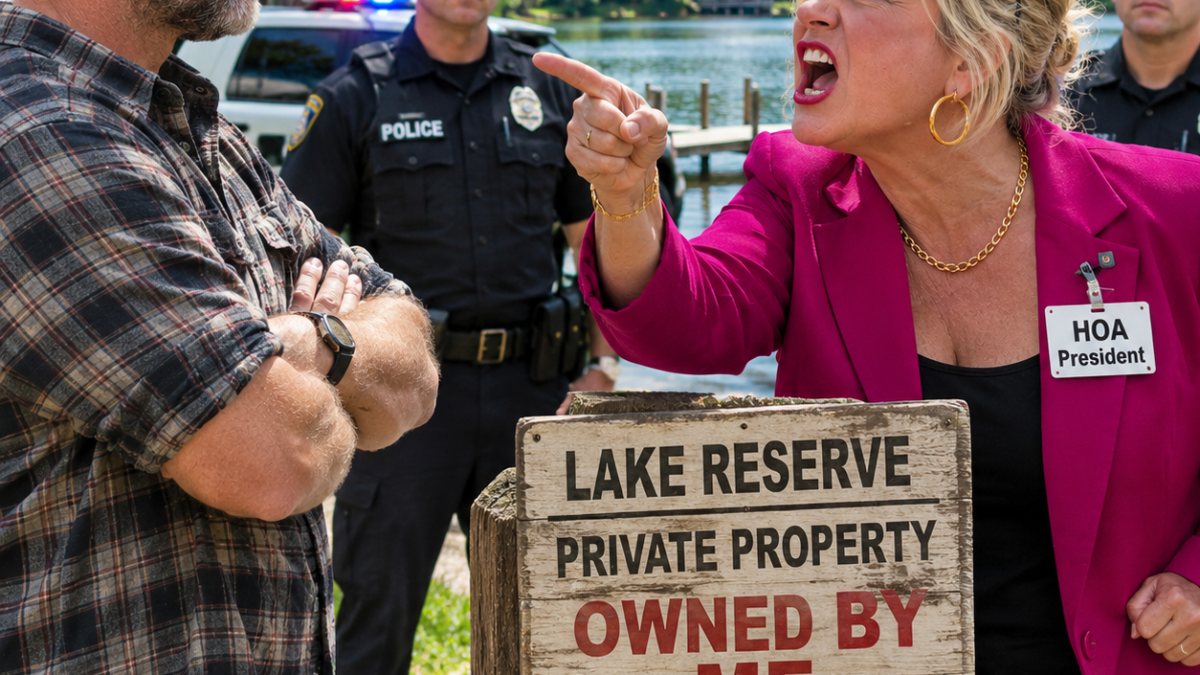
PART 2
I looked down at the map.
The paper was old enough that I was afraid to breathe too hard near it.
Blue lines branched beneath Uncle Jasper’s property like veins. Garrett had overlaid a modern county map on his laptop, and the old markings lined up with three spring heads that emerged uphill from the cabin before feeding the basin.
I had walked past two of them without giving them much thought.
Clear mountain water bubbled from stone and disappeared beneath alder roots.
Beautiful.
Nothing more.
At least that was what I had assumed.
“What exactly are you telling me?” I asked.
Garrett turned the deed toward me.
“I’m telling you to call a water-rights attorney before you sign anything, sell anything, or let Delilah convince you this is just some HOA argument.”
“Why?”
“Because this language is old.”
“I gathered that.”
“No, I mean legally old. Territorial old.”
He tapped one paragraph.
“Jasper’s title appears to carry historic rights associated with the springs feeding this part of Pine Lake. I don’t know how broad those rights still are, and I’m not a lawyer, but they’re not decorative wording.”
I stared through the kitchen window.
Across the water, expensive houses caught the late-afternoon sun.
Private docks.
Boat lifts.
Stone patios.
Outdoor kitchens.
Everything arranged around the lake.
“What does Delilah know?”
Garrett leaned back.
“That’s what I want to know.”
My phone rang before I could answer.
Unknown number.
I almost ignored it.
Garrett glanced at the screen.
“Take it.”
I did.
“Rex Thornton?”
“Yes.”
“Mr. Thornton, this is Delilah Whitmore.”
Her voice was different.
Still controlled, but the confidence had a crack in it.
“I’d like to resolve the unpleasantness from earlier.”
“Dale’s fine?”
A pause.
“I have no idea what that man told you.”
“You brought him.”
“He was recommended.”
“By who?”
“That isn’t important.”
“It seems pretty important.”
She exhaled.
“The community is prepared to make you an offer.”
“For what?”
“Your property.”
Garrett raised his eyebrows.
“How much?”
“Two hundred thousand dollars.”
I nearly laughed.
I’d paid one-fifty less than a month earlier.
Fifty thousand profit wasn’t trivial.
For a man whose retirement plan had become a blank page after losing his wife, fifty thousand dollars mattered.
But there was something about the timing.
The fake inspector.
The questions about the springs.
Garrett’s map.
Then the offer.
“I’ll think about it.”
“You need to decide quickly.”
“Why?”
“Because the HOA is considering litigation.”
“For what?”
“Your purchase.”
“I bought it at a public auction.”
“There are questions about whether the parcel should have been separated from community assets.”
“Was it owned by the HOA?”
Silence.
“Delilah?”
“You don’t understand the complexity.”
“Then explain it.”
“I don’t negotiate legal matters over the phone.”
“Funny. You just offered me two hundred thousand dollars over the phone.”
The call ended.
Garrett grinned.
“She knows.”
“Knows what?”
“That Jasper’s land matters.”
I walked over to the window.
“Then we find out how.”
The attorney Garrett recommended was Maya Blackstone.
Her office was eighty miles away in a brick building above an old pharmacy.
She was in her early sixties, with steel-gray hair, ranch boots beneath an expensive suit, and the kind of stare that made you feel as if every unnecessary sentence had already been removed from the conversation.
She read the deed.
Then the old map.
Then the auction documents.
Then the deed again.
I sat across from her for almost twenty minutes without speaking.
Finally, Maya removed her glasses.
“Where did you get the 1887 survey?”
“County archive. Garrett found it.”
“And you have Jasper’s original title chain?”
“Some of it.”
“Some?”
“His basement looks like a paper mill died down there.”
That almost made her smile.
“Bring me everything.”
“What do I own?”
“Land.”
“I know that.”
“Then let’s start by not getting ahead of ourselves.”
I leaned back.
“You sound like my old foreman.”
“Was he usually right?”
“Annoyingly.”
“Good.”
She turned the document toward me.
“This language suggests your parcel carries senior rights associated with the springs that feed Pine Lake. How much authority that gives you depends on historical filings, later appropriations, state adjudication, and whether any rights were severed or transferred.”
“So Garrett was wrong when he said I control the lake?”
“He was premature.”
That was not the answer I wanted.
But I trusted it more because she refused to tell me what I wanted to hear.
“What happens if the rights are intact?”
“Then Pine Lake Estates has a problem.”
“How big?”
“Potentially very big.”
I looked at the water-rights paragraph again.
“Can I stop them from using the lake?”
Maya’s expression sharpened.
“Do you want to?”
I pictured Delilah’s smile as the police officer approached my dock.
For half a second, yes.
Then I pictured forty-seven families.
Children swimming.
Retired couples.
People I had never met.
“No.”
“Good.”
“Why good?”
“Because revenge makes terrible water policy.”
I laughed once.
She didn’t.
“I’m serious, Rex. If these rights are what they appear to be, you may have leverage that can hurt people who never wronged you. Don’t confuse leverage with moral permission.”
That sentence followed me home.
So did another.
“Bring me Jasper’s files.”
The basement door stuck halfway.
I had been avoiding the room since moving in.
Uncle Jasper smoked a pipe for forty years, and the smell had soaked into the floor joists.
Tobacco.
Dust.
Old fishing gear.
Machine oil.
At the bottom of the stairs, I found metal filing cabinets lining an entire wall.
Each had labels in Jasper’s handwriting.
**TAXES.**
**SURVEYS.**
**LAKE LEVELS.**
**COUNTY.**
**WATER RIGHTS.**
**PINE LAKE DEVELOPMENT.**
**HOA DISPUTES.**
I stood there staring.
“You paranoid old bastard,” I muttered.
Then I opened the water-rights drawer.
Jasper had kept everything.
Maps.
Letters.
Photographs of spring heads.
Flow measurements.
Correspondence with surveyors.
Photocopies of territorial land grants.
Legal opinions from the 1980s and 1990s.
One file was labeled:
**DEVELOPERS — 1994**
Inside was a carbon copy of a letter.
The paper had yellowed at the edges.
The handwriting was unmistakably Jasper’s.
*Margaret—*
*Those developers never secured the spring rights before they started selling lots. My 1887 grant is still in the chain. I don’t mind sharing. Never believed water should become a weapon between neighbors. But somebody needs to know what the paper says before a fool decides kindness means surrender.*
*Jasper.*
I read the last line twice.
Kindness means surrender.
Clara would have liked that.
She had spent twenty-six years married to an electrician who could repair a three-phase service panel but sometimes needed written instructions to apologize after an argument.
She believed generosity worked best when it came with boundaries.
I found Margaret Sawyer’s business card clipped behind the letter.
The phone number looked impossibly old.
I tried it anyway.
“Chen Surveying.”
A woman answered.
“I’m looking for Margaret Sawyer.”
“You found her.”
“My name is Rex Thornton.”
Silence.
Then:
“Jasper’s nephew?”
“Yes.”
“Oh, hell.”
That wasn’t the response I expected.
“Is that good?”
“It means Jasper finally died.”
“He did.”
“How old?”
“Eighty-three.”
“Stubborn man.”
“You knew him?”
“Knew him? Your uncle argued with me about water maps for thirty years.”
I sat on Jasper’s workbench.
“Margaret, I bought his parcel at auction.”
“You bought it?”
“Yes.”
“And nobody explained the rights?”
“No.”
She laughed for almost ten seconds.
Not politely.
The kind of laugh that gets louder because the situation becomes more ridiculous the more you think about it.
“What’s funny?”
“Pine Lake Estates.”
“What about them?”
“They’ve spent thirty years pretending that lake was part of their product.”
“And?”
“Jasper never transferred his senior spring rights.”
My stomach tightened.
“Are you sure?”
“I helped map them.”
“What does that mean for me?”
“It means you need a lawyer.”
“I have one.”
“Good.”
“Can the HOA use the lake?”
“Don’t ask a surveyor for a legal conclusion.”
“You sound like Maya.”
“Then Maya’s smart.”
I smiled despite myself.
“Margaret, did Delilah Whitmore ever contact Jasper?”
Another silence.
“Yes.”
“When?”
“More than once.”
“What did she want?”
“The rights.”
My fingers tightened around the phone.
“Did he sell?”
“No.”
“Why?”
“Because she wanted control, not cooperation.”
“What did he say?”
Margaret laughed again.
“Something about preferring mosquitoes to real-estate agents.”
That sounded like Jasper.
“Did she threaten him?”
“She sent letters.”
“Do you have copies?”
“Probably.”
“Can I get them?”
“You can get more than copies.”
“What does that mean?”
“I’ve got the original survey file.”
My heart started beating faster.
“Where?”
“My office.”
“I’m coming tomorrow.”
“Bring coffee.”
The next morning, she laid thirty years of Pine Lake history across a conference table.
The first major development proposal dated to 1992.
The developer had purchased most of the surrounding land but not Jasper’s parcel.
They marketed lakefront lots anyway.
The early documents described access as “subject to existing water interests.”
Later brochures dropped that sentence.
By the late nineties, the development advertised “exclusive private lake privileges.”
“What happened between those two?” I asked.
Margaret slid a letter toward me.
The developer had approached Jasper.
They offered to purchase his spring rights.
He refused.
Then they asked for a perpetual agreement.
He refused that too.
Finally Jasper sent a simple letter.
*I have no objection to reasonable residential use of Pine Lake so long as my ownership and prior rights remain acknowledged and nobody interferes with my land or springs.*
I looked at Margaret.
“He gave them permission.”
“In plain English, yes.”
“Recorded?”
“No.”
“Why not?”
“Jasper didn’t trust lawyers.”
“Maya’s going to love that.”
“He believed a handshake was a contract between decent people.”
“And when people weren’t decent?”
Margaret tapped the file.
“He kept receipts.”
I understood my uncle a little better.
I also understood Delilah.
She hadn’t been fighting about a dock.
She wanted something Jasper had refused to give her.
Permanent control.
I returned home with scanned copies and found another certified envelope waiting.
**EMERGENCY HOA MEETING — THREAT TO COMMUNITY WATER ACCESS**
There it was.
Water.
Delilah planned to ask forty-seven homeowners to fund litigation challenging my auction purchase.
According to the letter, I represented an “existential threat to Pine Lake Estates.”
That sounded dramatic for a man who had spent the morning buying new screws for a dock.
Garrett came over around dusk.
I handed him the notice.
He read it.
“She is terrified.”
“Seems that way.”
“She should be.”
“Why?”
He pointed toward the lake.
“Because every house she sold as premium waterfront depends on that water staying exactly where it is.”
“That’s not the homeowners’ fault.”
“No.”
“And I don’t want to punish them.”
Garrett nodded slowly.
“Jasper wouldn’t either.”
I looked at him.
“You knew him?”
“Everybody knew Jasper.”
“You never mentioned that.”
“You never asked.”
“What was he like?”
“Mean until noon.”
“Accurate.”
“Generous after lunch.”
Also accurate.
Garrett folded the letter.
“He hated the HOA.”
“Why?”
“He didn’t hate HOAs. He hated Delilah.”
“That seems healthier.”
“She started pushing him about five years ago. Dock standards. Vegetation rules. Noise. She even tried to fine him once.”
“For what?”
“Having a canoe the wrong color.”
I stared at him.
“What color was it?”
“Green.”
“What was allowed?”
“Earth tones.”
We looked at each other.
Then both started laughing.
The laugh felt good.
Too good.
I hadn’t laughed like that since Clara died.
For a few seconds, the whole mess disappeared.
Then headlights swept across the cabin.
A sheriff’s SUV pulled into the driveway.
The same officer who had spoken to me at the dock stepped out.
Deputy Aaron Rodriguez.
He removed his hat as he approached.
“Mr. Thornton.”
“Deputy.”
“Got another complaint.”
I sighed.
“Delilah?”
He didn’t answer.
Didn’t need to.
“What did I do this time?”
“Threatened to interfere with community water access.”
“I’ve spoken to two attorneys and one surveyor.”
“That a threat?”
“Apparently.”
Rodriguez looked toward the lake.
“May I ask something?”
“Sure.”
“What exactly did you buy?”
“I’m still figuring that out.”
“That makes two of us.”
I gave him the emergency HOA letter.
He read it.
“She’s claiming you threatened shutoff.”
“I haven’t.”
“Any recording?”
“My call with her wasn’t recorded.”
“Witness?”
“Garrett heard one side.”
Garrett raised a hand.
“Mostly Rex saying no to two hundred thousand dollars.”
Rodriguez looked at me.
“She offered to buy?”
“Yes.”
“How much did you pay?”
“One-fifty.”
“That didn’t take long.”
“No.”
He handed back the letter.
“I’m documenting that you deny making threats.”
“I appreciate it.”
Then he hesitated.
“Off the record?”
“Sure.”
“This isn’t the first time Mrs. Whitmore has called us over neighborhood disputes.”
“How many?”
He shook his head.
“Off the record doesn’t mean I give you case information.”
“Fair.”
“Keep your cameras running.”
That advice became important three nights later.
I woke at 5:40 Monday morning and walked down to the dock with coffee.
The first rope was cut.
Not frayed.
Cut cleanly.
The second rope was half severed.
A support post had been loosened enough that the outer section shifted under my weight.
I nearly went into the water.
I caught the railing.
Coffee splashed across the boards.
For several seconds I just stood there.
Then I saw the paint.
Red letters across Jasper’s cedar.
**TRESPASSER**
My jaw locked.
Garrett arrived twenty minutes later.
He crouched beside the support bracket.
“Somebody knew what they were doing.”
“How?”
“This bolt was loosened, not removed. Enough movement to scare you. Not enough for obvious destruction.”
“Could I have fallen?”
“Yes.”
That answer cooled my anger instantly.
Vandalism was one thing.
Making a dock unsafe was another.
“Cameras.”
Garrett nodded.
“Today.”
We installed six.
Two overlooking the dock.
One near the spring trail.
One behind the shed.
One pointed toward the driveway.
One hidden near the shoreline path.
Garrett configured motion alerts.
“If a raccoon sneezes, you’ll know.”
That night, nothing happened.
The next night, nothing.
At 2:31 Thursday morning, my phone vibrated.
I was awake before the second alert.
A person in dark clothes moved toward the dock.
Young.
Thin.
Baseball cap.
Wire cutters.
Paint.
He crouched near the repaired rope.
Then his phone rang.
I watched through the camera feed.
He answered in a whisper.
“Yeah, Mom.”
I sat upright.
Garrett had enabled audio.
The young man’s voice came through clearly.
“No, I’m here.”
Pause.
“I’m working on it.”
Pause.
“You said two grand.”
My hand tightened around the phone.
Another pause.
Then:
“Red paint again?”
He looked back toward the cabin.
“No, nobody’s awake.”
I called the sheriff.
I did not go outside.
That choice probably saved us all from a much uglier night.
Deputies arrived before the young man finished.
He tried to run.
He made it about forty yards.
They caught him near the road.
His name was Bradley Whitmore.
Nineteen.
Delilah’s son.
I stood on the porch while Rodriguez read him his rights.
Bradley looked less like a criminal mastermind and more like a terrified kid who had agreed to something stupid and realized too late that stupidity can have handcuffs.
Delilah arrived in her Mercedes fifteen minutes later.
She exploded out of the driver’s seat.
“What are you doing to my son?”
Rodriguez stepped between us.
“Ma’am, stay back.”
“He works security for the HOA.”
“At two-thirty in the morning?”
“He was checking community property.”
“My dock isn’t community property.”
She pointed at me.
“This man set him up!”
I almost answered.
Rodriguez beat me to it.
“Ma’am, there are cameras.”
Her face changed.
Only for a second.
But I saw it.
Fear.
Real fear.
Bradley saw it too.
“Mom?”
She looked at him.
Then looked away.
That hurt him more than the handcuffs.
I could see it.
The next morning, Bradley asked to speak to me.
I refused until Maya said we could meet with his attorney present.
We sat in a small conference room at the sheriff’s office.
Bradley looked like he hadn’t slept.
His public defender sat beside him.
Maya beside me.
Bradley twisted a paper cup between both hands.
“My mom said it was security work.”
I didn’t respond.
“She said you were threatening everyone.”
“Did security work usually involve spray paint?”
He looked down.
“No.”
“Cutting ropes?”
“No.”
“Loosening supports?”
His face crumpled.
“I didn’t know somebody could get hurt.”
“But you did it.”
“Yes.”
The word came out barely audible.
His attorney touched his arm.
Bradley breathed.
Then he said, “She’s done this before.”
Maya leaned forward.
“What do you mean?”
“Other people.”
“What other people?”
“Homeowners.”
Bradley looked at me.
“When somebody fought her, she made their life miserable until they sold.”
“How?”
“Fines. Complaints. Contractors. Stuff breaking.”
“Did you break their property too?”
“Sometimes.”
His lawyer whispered something.
Bradley nodded.
“She’d call it community improvement.”
I remembered the phrase Garrett had used about Jasper.
“Who bought the houses?”
Bradley swallowed.
“Usually somebody through her real-estate company.”
Maya’s pen stopped.
“She earned commissions?”
“I think so.”
“Think?”
“Yes.”
“How many?”
“Three families that I know.”
The room became very quiet.
Maya asked, “Where did your two-thousand-dollar payment come from?”
Bradley’s eyes filled.
“The emergency HOA account.”
His attorney closed his eyes.
There it was.
Not just vandalism.
Not just a family argument.
Association money.
Private retaliation.
Maya said nothing for several seconds.
Then she stood.
“We’re done for now.”
Outside, I asked, “How bad?”
“For Delilah?”
“Yes.”
“Potentially very.”
“Good.”
Maya looked at me.
“Don’t.”
“Don’t what?”
“Enjoy it yet.”
I felt irritation.
“She paid her kid to damage my dock.”
“I know.”
“She could’ve gotten me hurt.”
“I know.”
“She terrorized other people.”
“I know.”
“So why shouldn’t I enjoy watching this come apart?”
Maya folded her arms.
“Because you haven’t met the forty-seven people whose money she may have stolen. You haven’t seen what happens when an HOA account gets emptied. Roof repairs stop. Insurance lapses. Roads don’t get maintained. People who trusted someone get bills they can’t pay.”
I looked toward the sheriff’s office.
“This isn’t just her falling.”
“No.”
That took some of the satisfaction out of it.
Good.
I needed that.
That weekend, I returned to Jasper’s basement.
I wasn’t looking for ammunition anymore.
I was looking for intent.
Why had he kept the rights?
Why had he allowed the lake development to exist?
Why hadn’t he charged them?
Why hadn’t he forced contracts?
I found the answer inside a folder marked **1995–2015**.
Dozens of letters.
Some angry.
Some funny.
One from a developer threatening condemnation.
Jasper had written across the top in red pen:
**TRY IT.**
Another proposed annual payments.
Jasper had rejected them.
But the document that mattered most was a handwritten note attached to the spring survey.
*Water was here before me and it’ll be here after me. I own rights because paper says so. Doesn’t mean I own people’s thirst. Let them use it. Stop them only if they damage the springs or forget sharing isn’t the same as taking.*
I sat alone in the basement.
Clara’s face came into my mind.
Not sick.
Not in the hospital.
The way she looked ten years earlier when we had spent three days camping near Yellowstone and I had complained about everything.
Mosquitoes.
Cold coffee.
A leaking tent.
She finally threw a pinecone at me.
“Rex, you can be miserable anywhere. It doesn’t make you special.”
I laughed out loud in Jasper’s basement.
Then I cried.
Not much.
Enough.
I understood what I wanted.
I wanted to protect Jasper’s legacy.
I wanted Delilah held accountable.
I wanted the homeowners to know the truth.
I did not want forty-seven families paying for one woman’s war.
Monday morning, Maya reviewed everything.
“This note isn’t legally operative by itself,” she said.
“I know.”
“But it tells you how Jasper thought.”
“That’s why I brought it.”
She pushed her chair back.
“What do you want?”
“Confirm the rights.”
“We’re doing that.”
“Then formalize reasonable access.”
“For everyone?”
“Yes.”
“And Delilah?”
“Separate issue.”
Maya smiled.
“What?”
“Now you’re thinking clearly.”
“Don’t sound so surprised.”
“I’ve met widowed men with leverage.”
“That specific?”
“Law is weird.”
The final historical review took weeks.
Hydrologists mapped the spring network.
Surveyors verified boundaries.
Maya’s water-law partner traced the original grant.
State records confirmed that Jasper’s property retained senior rights tied to the spring sources and certain access and diversion privileges.
The legal reality was more complicated than Garrett’s first excited declaration that I “owned all the water.”
I did not own every molecule in Pine Lake.
No one did in the cartoonish way Delilah feared.
But the historic rights attached to my parcel were powerful enough that the HOA’s claim to exclusive control was indefensible, and development documents showed Pine Lake Estates had never properly secured the rights it had marketed as if they belonged automatically to the subdivision.
That gave me enormous leverage.
It also created a problem.
Forty-seven households had purchased homes believing lake access was settled.
Most had done nothing wrong.
So Maya and I drafted two letters.
The first was legal.
Dry.
Precise.
It notified the HOA of my verified rights and demanded that all interference with the springs, reserve parcel, dock, and access routes stop immediately.
It reserved claims for past unauthorized use but did not demand millions.
The second was personal.
It went to every homeowner.
I wrote it myself.
*My name is Rex Thornton. I bought Jasper Thornton’s property at a lawful auction. I have no intention of draining Pine Lake, blocking families from reasonable lake use, or using water to punish people I have never met. I do intend to protect the springs, my property, and the rights attached to them.*
*If your board has told you otherwise, ask to see the documents.*
*Then ask to see your HOA financial records.*
That last sentence caused an earthquake.
By noon the following day, homeowners started calling.
Not me.
Delilah.
By three, somebody had demanded an emergency board audit.
By five, Garrett heard that two board members had resigned.
At six, Delilah arrived at my cabin.
She carried a manila envelope.
Her hair was slightly disordered.
The first time I’d ever seen it that way.
“Mr. Thornton.”
“Delilah.”
“We need to talk.”
“About what?”
She opened the envelope.
Money.
Cash.
Stacks of hundreds.
I stared at it.
“What is that?”
“Seventy-five thousand dollars.”
“For?”
“You leave.”
I actually thought I’d misheard her.
“You’re offering me seventy-five thousand dollars to abandon a property I paid a hundred fifty for?”
“To relocate.”
“That’s not better.”
“The HOA will assume responsibility for the reserve.”
“No.”
“You haven’t heard the terms.”
“No.”
Her expression sharpened.
“You are putting forty-seven families at risk.”
“No. I’m offering them continued access.”
“For money.”
“For a conservation agreement.”
“Same thing.”
“No.”
She shoved the envelope closer.
“Take it.”
I didn’t touch it.
“Where did the cash come from?”
Her eyes flickered.
“Community reserves.”
I felt something inside me go cold.
“Emergency funds?”
“That money exists to protect the community.”
“You’re using homeowners’ emergency money to buy me out?”
“To resolve a crisis.”
“What crisis?”
“You.”
My phone sat on the porch railing.
Recording.
Maya had told me to record any direct interaction where legally permissible.
I asked, “Did the board approve this?”
Delilah hesitated.
“The executive committee authorized necessary expenditures.”
“Names?”
“That isn’t your concern.”
“It will be theirs.”
She closed the envelope.
“You think this makes you powerful?”
“No.”
“Then what is this?”
I looked toward the lake.
“Paperwork.”
She laughed without humor.
“You’re enjoying this.”
“I was fixing my dock when you started.”
“You’re an outsider.”
“Jasper lived here forty years.”
“He was an obstacle too.”
The words came out before she could stop them.
We both heard them.
“You mean difficult?”
She realized what she’d said.
I stepped closer.
“That’s what you called him the first day.”
“I meant difficult to work with.”
“Bradley says you did this to three other owners.”
Her face went white.
“Bradley is confused.”
“He says you paid him from HOA funds.”
“He performed security work.”
“He vandalized my dock.”
“You manipulated him.”
“You’re his mother.”
Her voice dropped.
“You have no idea what that boy has put me through.”
There it was.
Deflection.
Not denial.
I felt anger rise.
Then Clara’s voice in my memory.
You can be miserable anywhere.
I let the anger pass.
“Take the money back.”
“You’ll regret this.”
“That’s enough.”
She leaned closer.
“You think those people will love you when they receive bills? You think they’ll thank you for destroying the value of everything they’ve worked for?”
“I haven’t sent them bills.”
“You will.”
“No.”
“You don’t know these people.”
“Neither do you.”
That hit.
She stepped backward.
Then she pointed at me.
“You’re going to lose this property.”
She walked away.
The next morning, Deputy Rodriguez arrived.
I almost laughed when I saw him.
“What now?”
He looked embarrassed.
“Threats.”
“Against who?”
“Mrs. Whitmore.”
“Of course.”
“She says you threatened physical violence during your conversation.”
I handed him my phone.
“Full recording.”
He listened on the porch.
Delilah offered the money.
I asked where it came from.
She called me a crisis.
I told her to take it back.
She threatened me.
No violence.
Rodriguez removed one earbud.
“This helps.”
“How many complaints has she filed against people?”
He looked at me.
“I can’t discuss unrelated cases.”
“You keep saying that.”
“Because you keep asking.”
“Fair.”
He gave me back the phone.
“Save the original.”
“I have cloud backup.”
“Good.”
Then he hesitated.
“Mr. Thornton?”
“Yeah?”
“You may want your attorney to contact the county attorney.”
“Why?”
“That’s all I’m saying.”
Maya made the call.
The county attorney already knew Delilah’s name.
So did investigators.
Bradley’s statement had opened doors.
Financial-record requests opened more.
Association expenditures showed payments to companies linked to Delilah.
“Security consulting.”
“Landscape remediation.”
“Community stabilization.”
Some vendors existed.
Some barely did.
One address belonged to a mailbox store.
Another linked to Delilah’s real-estate business.
Then investigators uncovered prior complaints from communities in Oregon and Idaho where she had worked before moving to Montana.
Similar patterns.
HOA disputes.
Distressed sales.
Aggressive fee enforcement.
Financial irregularities.
Nothing yet proved a grand multistate conspiracy.
But enough questions existed that authorities started comparing records.
Meanwhile, Pine Lake homeowners were turning on her.
Not all at once.
That would’ve been too easy.
Some still defended her.
Jennifer Walsh was one of them.
She lived three houses away and had two children.
At an emergency HOA meeting, she stood and told everyone I had approached her daughter near the water and said they were trespassing.
I wasn’t at the meeting.
Garrett attended and called me afterward.
“She says you frightened her kid.”
“When?”
“Tuesday.”
“I was in Bozeman Tuesday.”
“I know.”
“Receipts. Hardware store. Lunch.”
“Save them.”
“Already.”
Delilah posted Jennifer’s story online.
**WATER-RIGHTS OWNER THREATENS CHILDREN.**
The reaction was ugly.
People drove past my cabin honking.
Blocked calls came at night.
Someone left a note:
**GO BACK TO DENVER.**
Then my truck was vandalized.
Two tires slashed.
The words **WATER THIEF** scratched into the driver’s door.
I stood in the driveway at sunrise staring at the damage.
For the first time, I seriously considered leaving.
Not selling to Delilah.
Just leaving.
Lock the cabin.
Go back to Denver.
Let Maya fight it.
Let Garrett monitor things.
I was tired.
That was the simplest truth.
Grief had already hollowed me out before I arrived.
Conflict filled the space grief left behind.
Neither felt like a life.
Garrett found me sitting on the porch.
“You okay?”
“No.”
“Want coffee?”
“No.”
“That bad?”
I looked at the truck.
“I came here because Clara died.”
He didn’t speak.
“I thought maybe if I went somewhere new, I could stop waking up in the house where she was sick.”
Garrett sat beside me.
“I didn’t expect any of this.”
“No one would.”
“I don’t want to spend the rest of my life fighting a woman over water.”
“Then don’t.”
I turned.
“What?”
“Fight over something else.”
“Helpful.”
“I mean it.”
He pointed toward the lake.
“You’re not fighting over water anymore.”
“What am I fighting over?”
“Whether Delilah gets to decide everybody else’s reality.”
That sounded too dramatic.
But it wasn’t entirely wrong.
“Jasper could’ve crushed them years ago,” I said.
“He didn’t.”
“Why?”
“Because he liked the lake more than he hated the HOA.”
I smiled faintly.
“That’s probably the smartest thing you’ve ever said.”
“Write it down.”
The cameras solved the truck vandalism.
A young man from inside Pine Lake Estates had done it.
Not Bradley.
A homeowner’s twenty-two-year-old nephew.
Police identified him.
He admitted someone had circulated messages encouraging residents to “send Rex a message.”
He claimed Delilah hadn’t directly ordered him.
Maybe she hadn’t.
Either way, the harassment was feeding on the story she created.
That was enough for me.
I called Maya.
“I want a public meeting.”
“She already scheduled one.”
“Of course she did.”
“Monday. Pine Lake clubhouse.”
“What does she want?”
“To seek a restraining order against you through the HOA’s attorney and challenge your water-right notices publicly.”
“Media?”
“She invited them.”
I laughed.
“What?”
“She finally found a venue she thinks she controls.”
Maya paused.
“You’re learning.”
Monday started with another surprise.
A reporter named Patricia Vance from Channel 7 requested an interview.
I declined.
She asked for ten minutes.
I agreed to five.
We met outside the clubhouse before the meeting.
She was younger than I expected, maybe forty, with windblown dark hair and the tired eyes of someone who had spent years hearing everybody insist their local dispute was Watergate.
“I’ve seen the HOA’s statement,” she said.
“Then you know their position.”
“I’d like yours.”
I handed her a thin folder.
“Property deed. Historical survey. Attorney letter. Police report from the dock vandalism. That’s enough to start.”
She opened it.
“Is it true you’re demanding a thousand dollars a month from each homeowner?”
“No.”
“Eight hundred?”
“No.”
“What are you demanding?”
“A legal agreement protecting the springs and continued reasonable access.”
“Are you claiming you own Pine Lake?”
“No.”
That surprised her.
“Then what are you claiming?”
“That my parcel carries senior water and access rights the development never properly secured.”
“Can you shut off the lake?”
“I have no intention of finding out how much damage I can legally cause.”
That answer made her look up.
“Why not?”
“Because Clara would’ve hated me if I turned grief into cruelty.”
“Clara?”
“My wife.”
She closed the folder.
“I’m sorry.”
“Thank you.”
“May I ask what she has to do with this?”
“Nothing legally.”
“And personally?”
“Everything.”
Patricia nodded.
Then she asked, “What do you think tonight is really about?”
I looked toward the clubhouse.
“Control.”
At 6:45, the parking lot was full.
Forty-three homeowners attended.
Media.
County staff.
A deputy.
Three attorneys.
Garrett stood near the back.
Maya sat beside me.
I carried Jasper’s original leather portfolio.
Delilah sat at the head table.
Perfect hair again.
Perfect suit.
Perfect smile.
She looked restored.
That worried me more than panic would have.
The meeting began at seven.
Delilah opened with photographs of my cabin.
Then the dock.
Then my truck.
Then a blown-up image of me standing beside one of the springs.
The slide read:
**THREAT TO COMMUNITY WATER SECURITY**
She spoke for fifteen minutes.
I was unstable.
Vindictive.
Emotionally damaged by Clara’s death.
Obsessed with historical technicalities.
Trying to extort homeowners.
Threatening children.
Planning to cut off their water.
By the time she finished, people were staring at me.
Some afraid.
Some angry.
Some uncertain.
Then Jennifer Walsh stood.
She repeated the story about me threatening her daughter.
Her voice shook convincingly.
“My eight-year-old came home crying.”
Maya leaned toward me.
“Tuesday?”
“Yes.”
“Bozeman?”
“Yes.”
“Receipts?”
“In the folder.”
She nodded.
Another homeowner spoke.
Then another.
Both described conversations I had never had.
Delilah had built a case from fear.
Not facts.
Fear.
She finished by holding up one of Maya’s legal notices.
“This man is claiming the power to destroy all of us because of a document from 1887.”
Scattered applause.
“This isn’t law. It’s extortion.”
More applause.
I felt the old impulse.
Stand.
Fight.
Correct every lie immediately.
Maya touched my wrist.
“Wait.”
Delilah continued.
“We have lived peacefully here for decades.”
Garrett coughed loudly.
A few people laughed.
Delilah ignored him.
“We cannot allow one angry outsider to hold forty-seven families hostage.”
Then she turned toward me.
“Mr. Thornton, if you have anything to say for yourself, now would be the time.”
Maya whispered, “Slow.”
I stood.
Walked to the microphone.
Set Jasper’s portfolio down.
“My name is Rex Thornton.”
Someone muttered, “We know.”
I nodded.
“Fair.”
A nervous laugh moved through the room.
“I bought Jasper Thornton’s parcel at a public estate auction.”
I held up the deed.
“No fraud.”
Next document.
“Title confirmed.”
Next.
“Boundary confirmed.”
Next.
“Historic water rights confirmed as senior interests attached to the parcel, subject to Montana law and the specific limits my attorneys have explained to your board.”
Delilah interrupted.
“You’re manipulating old statutes.”
I looked at her.
“You invited me to speak.”
She sat back.
I projected the 1887 survey.
Blue lines filled the screen.
“These are the springs feeding Pine Lake.”
People leaned forward.
“This isn’t a threat. It’s geography.”
Next map.
Modern subdivision.
Same spring network.
“Pine Lake Estates was built decades after these rights originated.”
Murmurs.
Then Maya joined me.
“I’m Maya Blackstone, Mr. Thornton’s water-rights counsel.”
Delilah’s attorney visibly stiffened.
Maya continued.
“The association has been provided the underlying records and invited to negotiate a permanent agreement. Mr. Thornton has not demanded millions in past fees. He has not threatened to drain Pine Lake. He has not threatened children.”
Jennifer shifted in her chair.
Maya looked directly at her.
“Mrs. Walsh, you stated Mr. Thornton approached your daughter last Tuesday?”
“Yes.”
“Approximately what time?”
“Around three.”
Maya displayed a store receipt.
Then a restaurant receipt.
Then parking information.
“Mr. Thornton was seventy-eight miles away.”
Jennifer’s face changed.
“I may have the day wrong.”
“You stated Tuesday three times in your written complaint.”
Delilah stood.
“This is intimidation.”
Maya ignored her.
Jennifer began crying.
Not dramatic crying.
Real.
Ashamed.
“Delilah told me—”
The room went quiet.
Delilah said, “Jennifer.”
Jennifer looked at her.
“You said he confronted Emma.”
“I said Emma told me—”
“No. You told me.”
Jennifer pressed both hands to her face.
“You said we had to document incidents or he would take the lake.”
There it was.
The first crack.
Maya didn’t push.
She didn’t need to.
I opened another file.
“Now let’s talk about my dock.”
Video appeared.
Bradley Whitmore walking onto my property at 2:31 a.m.
Wire cutters.
Spray paint.
The room erupted.
Delilah shot to her feet.
“That recording was illegally obtained.”
“It was recorded on my property,” I said.
Bradley’s voice came through the speakers.
“Yeah, Mom. I’m almost done with the dock.”
The room fell silent.
“No.”
Delilah shook her head.
“No. That has been edited.”
Then Bradley’s voice again.
“You promised me two thousand for this security work.”
Someone shouted, “Two thousand from where?”
Another voice:
“Emergency reserve?”
Delilah grabbed the microphone.
“My son performed authorized security services.”
I played footage of him cutting rope.
“Security against what?”
“You.”
Then another voice came from the back.
Janet Morrison.
“Did you pay him from our emergency fund?”
Delilah stared at her.
“That account is under board discretion.”
Janet stood.
“Answer the question.”
“We had a security threat.”
“You used our money to vandalize his dock?”
“No.”
Maya opened a financial summary.
“Investigators are examining payments from HOA-controlled accounts to Bradley Whitmore and several entities associated with Mrs. Whitmore.”
The crowd erupted.
Delilah screamed over them.
“You people have no idea what I’ve protected you from!”
Garrett said, “Mostly green canoes.”
More laughter.
That made her angrier.
She pointed toward me.
“He is charging you for water!”
I shook my head.
“No.”
Maya projected our proposed settlement.
Past use waived.
No retroactive multi-million-dollar demand.
Permanent spring-protection easement.
Independent environmental monitoring.
Reasonable annual contribution to maintenance and conservation.
No unilateral shutoff.
Guaranteed residential lake access.
Transparent accounting.
A conservation fund.
The room quieted.
Someone asked, “How much?”
Maya explained the proposed structure.
Far less than the rumors Delilah had spread.
One waterfront owner raised his hand.
“You’re waiving past claims?”
“Yes,” I said.
“Why?”
I looked down at Jasper’s portfolio.
“Because my uncle did.”
I opened his handwritten note.
“He believed sharing wasn’t surrender.”
I didn’t read all of it.
Just enough.
People stopped looking at me like a threat.
Then Patricia Vance stood near the camera crew.
She wasn’t part of the meeting, but Delilah had invited media and apparently didn’t understand that reporters sometimes investigate.
“Ms. Whitmore,” Patricia said, “Channel 7 has confirmed you were involved in previous HOA management disputes in Oregon and Idaho. Would you like to comment on complaints involving association funds there?”
Delilah froze.
Her attorney closed his eyes.
Patricia continued.
“We’ve also confirmed state and federal investigators are reviewing financial activity connected to several organizations with which you’ve been associated.”
The room exploded.
Delilah looked at her attorney.
He whispered urgently.
She pushed him away.
“Everyone sit down!”
Nobody did.
She pounded the gavel.
“Order!”
Nobody listened.
Then Deputy Rodriguez stepped forward.
“Mrs. Whitmore.”
She turned.
“Not now.”
“Ma’am, I need you to come with me.”
Her face changed.
“What?”
“I have paperwork related to the ongoing investigation.”
“You cannot interrupt an HOA meeting.”
“Ma’am.”
“I am the president.”
“Delilah.”
Her attorney stood.
“Do what he says.”
That was the moment she understood.
Not when I showed the deed.
Not when Bradley appeared on video.
Not when homeowners demanded answers.
When her own lawyer stopped defending the room she believed she controlled.
Delilah backed away from the microphone.
“This is because of him.”
She pointed at me.
“You all know that, right?”
Nobody answered.
“He came here and started this.”
I looked at her.
“I was replacing a dock board.”
“You were trying to take control.”
“I didn’t know what I owned until you sent a fake inspector to investigate it.”
Her mouth opened.
I continued.
“You told me Jasper was difficult.”
“He was.”
“He shared the lake with you for years.”
“He blocked progress.”
“He refused to sign away the springs.”
“He had no right to hold this community hostage.”
“He never did.”
That silenced her.
I looked around the room.
“Jasper could’ve forced this issue thirty years ago.”
Then back at Delilah.
“He didn’t.”
Her eyes filled with something close to tears.
Anger, mostly.
Maybe fear.
“You’re going to regret trusting these people.”
I thought about Clara.
About Jasper.
About all the years I’d spent believing control was the same thing as safety.
“No,” I said. “I think trusting people is why the lake survived you.”
Rodriguez escorted her out.
No dramatic takedown.
No cheering.
Just the sound of her heels crossing the clubhouse floor.
Then the doors closed.
For several seconds, nobody moved.
Janet Morrison finally said, “Can somebody explain whether we’re bankrupt?”
That was the real beginning.
Not the arrest.
Not the documents.
The accounting.
The next six months were ugly.
The HOA hired independent counsel.
A forensic accountant reviewed years of expenditures.
Insurance carriers became involved.
Board members resigned.
Some claimed ignorance.
Some genuinely had been ignorant.
Others had signed documents without reading them because Delilah handled everything.
The investigation found substantial unauthorized spending.
Payments to related companies.
Improper reimbursements.
Money moved between accounts.
Payments to Bradley characterized as security and maintenance work.
Records connected to Delilah’s real-estate activities.
Investigators also examined her prior association-management history outside Montana.
The final criminal case was less cinematic than the rumors.
No secret helicopter.
No FBI agents storming the clubhouse.
Just subpoenas.
Interviews.
Bank statements.
Plea negotiations.
Delilah eventually pleaded guilty to multiple fraud-related offenses connected to association funds and false reports.
Other allegations were resolved through civil settlements rather than criminal convictions.
Her real-estate license was revoked.
Restitution was ordered.
She served prison time.
Bradley received a much lighter outcome.
He cooperated.
Admitted the vandalism.
Paid restitution.
Completed community service.
At first, I wanted nothing to do with him.
Then one Saturday morning he appeared at my cabin.
No expensive clothes.
No attitude.
Work boots.
He held a toolbox.
“I heard you’re rebuilding the dock.”
I stared at him.
“Who told you?”
“Garrett.”
“I’ll kill Garrett.”
Bradley almost smiled.
“I can leave.”
I looked at the cedar boards stacked beside the water.
“Why are you here?”
“Community service.”
“Your community service isn’t assigned to me.”
“No.”
“Then why?”
He swallowed.
“I broke it.”
I said nothing.
“I want to help fix it.”
“You almost made me fall through it.”
“I know.”
“You took money.”
“I know.”
“You lied.”
“I know.”
“Stop saying you know.”
He looked down.
“Okay.”
I wanted to send him away.
Then I remembered Jasper.
Sharing wasn’t surrender.
Neither was forgiveness.
Forgiveness didn’t mean pretending something didn’t happen.
It meant deciding the thing that happened didn’t get unlimited authority over what came next.
I pointed toward the pile.
“Those boards need sorting.”
Bradley looked up.
“That’s it?”
“No.”
“What else?”
“You’re buying lunch.”
He smiled for the first time.
“Deal.”
He worked badly.
For someone paid two thousand dollars in “security work,” he was terrible with tools.
I taught him how to square a board.
How to countersink screws.
How to check a dock post for movement.
The irony was not lost on either of us.
Around noon, he asked, “Did you hate my mom?”
I put down the drill.
“No.”
“You should.”
“I don’t have enough energy.”
He looked across the lake.
“She wasn’t always like that.”
I waited.
“After my dad left, she got obsessed with money.”
“That’s not an excuse.”
“I know.”
I gave him a look.
“Sorry.”
He kicked sawdust off the board.
“She kept saying if she lost the house, everybody would know she’d failed.”
“That sounds miserable.”
“It was.”
“For both of you?”
He nodded.
“Mostly everyone around her.”
That was probably the most honest thing he ever said.
The homeowners voted to dissolve the old HOA structure and replace it with a simpler association.
Term limits.
Independent annual audits.
Published monthly financial reports.
No president allowed unilateral expenditures above a small threshold.
All vendor relationships disclosed.
Meetings recorded.
Major legal actions required homeowner votes.
Garrett called it democracy arriving thirty years late.
My water agreement took longer.
I refused to sign anything rushed.
Maya insisted on environmental safeguards.
Hydrologists recommended limits on new shoreline development.
The spring heads needed protection from contamination and overuse.
The final arrangement did three things.
First, every existing homeowner received secure, permanent residential lake-access rights.
Second, Pine Lake Estates contributed annually to a conservation and maintenance fund based on property characteristics and use.
Third, management of the springs required transparent monitoring so neither I nor any future owner could recklessly exploit them.
I waived historic back charges.
Every dollar of future access contributions went into the fund.
I didn’t take profit.
Maya asked me twice if I was sure.
“Yes.”
“You could structure income.”
“I have retirement.”
“You also spent a substantial percentage of your savings buying this place.”
“I know.”
“Clara’s insurance money.”
That hurt.
“Yes.”
Maya waited.
I looked through her window at traffic.
“I used Clara’s money because I thought she would’ve wanted me to take one risk.”
“And now?”
“Now I want whatever comes from that risk to have her name on it.”
Maya’s expression softened.
“What are you thinking?”
“The Clara Thornton Memorial Conservation Fund.”
She smiled.
“That’s better than the Rex Thornton Water Empire.”
“Garrett suggested that.”
“Of course he did.”
The fund paid for shoreline restoration.
Spring monitoring.
Invasive-species control.
Public education.
And eventually scholarships for local students studying environmental science, civil engineering, forestry, and water law.
The first scholarship was small.
Five thousand dollars.
We awarded it to a seventeen-year-old girl named Emma Walsh.
Jennifer’s daughter.
The same child Delilah had claimed I frightened.
Jennifer nearly refused to let Emma apply.
Emma insisted.
She wrote an essay about how adults’ fear can become a kind of pollution—something invisible that spreads until everybody starts treating neighbors like enemies.
When Maya read it, she handed it to me.
“She’s good.”
I read it twice.
“She should get it.”
“Conflict of interest?”
“Then let the committee decide.”
They did.
Unanimously.
At the award dinner, Jennifer approached me.
We hadn’t spoken much since the clubhouse meeting.
She looked uncomfortable.
“Rex.”
“Jennifer.”
“I still owe you an apology.”
“You already apologized.”
“Not enough.”
I waited.
She folded her hands.
“Delilah told me if people didn’t provide statements, you’d shut down the lake.”
“I know.”
“I was terrified we’d lose the house.”
“I know.”
“I convinced myself that meant exaggerating was protecting my children.”
I looked toward Emma laughing with Bradley near the dock.
“How’d that work out?”
Jennifer gave a painful smile.
“Not well.”
“No.”
“I am sorry.”
“I believe you.”
She blinked.
“That’s it?”
“What else do you want?”
“I don’t know.”
“Punishment?”
“No.”
“Then let your daughter enjoy her scholarship.”
She looked at me for a long moment.
“Clara must have been remarkable.”
My throat tightened.
“She was.”
“How do you know what she’d want?”
“I don’t.”
That was the truth.
“I guess.”
Jennifer nodded.
“Maybe that’s what we all do.”
“Probably.”
The first annual Pine Lake Conservation Day happened almost by accident.
Garrett wanted volunteers to clean shoreline debris.
Janet wanted fundraising.
Mike from the marina wanted a fishing derby.
Bradley suggested teaching kids to fish.
Someone brought barbecue.
Someone else hired a local band.
Forty volunteers became three hundred visitors.
Then eight hundred the next year.
The third year, we stopped pretending it was just a cleanup day and called it a festival.
I hated the attention.
Garrett loved it.
“You’re becoming a local celebrity.”
“I’ll sell you the water rights for one dollar if you keep talking.”
“You wouldn’t.”
“No.”
“Because you love me.”
“Because Maya would kill me.”
Maya’s law practice did receive more water-rights and HOA cases after Pine Lake.
She hated when reporters called her a “bulldog.”
“Dogs don’t bill hourly,” she said.
Garrett eventually married Patricia Vance.
That shocked absolutely nobody except Garrett, who claimed he thought she was “just being friendly” for almost a year.
Their wedding took place beside the lake.
Bradley built the ceremony platform.
Straight.
Level.
No vandalism.
I checked.
At the reception, Patricia found me sitting alone near the dock.
“You hiding?”
“Yes.”
“Mind company?”
“Depends.”
She sat anyway.
Across the water, lights glowed from Pine Lake houses.
Music drifted through the trees.
“You know,” she said, “the first night I met you, I thought the story was going to be rich HOA versus stubborn property owner.”
“Good television.”
“Then I thought it was water rights.”
“Also good television.”
“Then corruption.”
“Better?”
“Much.”
I laughed.
“What do you think it was actually about?” she asked.
I watched Bradley teaching a little boy how to cast from the shore.
“Grief.”
Patricia looked surprised.
“Not the answer I expected.”
“Delilah was terrified of losing everything.”
“And you?”
“Same.”
She waited.
“I had already lost Clara.”
I looked at the cabin.
“Then I spent months acting like if I defended every inch hard enough, nothing else could be taken from me.”
“Was that wrong?”
“Partly.”
“How?”
“Ownership doesn’t fix loss.”
She nodded.
“Water rights didn’t bring Clara back.”
“No.”
“Did Pine Lake help?”
I thought about it.
“Yes.”
Not because it distracted me.
Because it forced me to participate in life again.
People knocked on the door.
Asked questions.
Needed decisions.
Brought food.
Argued.
Apologized.
Borrowed tools.
Returned them late.
Clara had always understood something I didn’t.
A quiet life wasn’t the same as an empty one.
The cabin had become full.
Years later, I still kept Jasper’s 1887 documents in a fireproof safe.
Copies sat with Maya.
Digital scans existed in three locations because Garrett had developed an almost pathological fear of historical records disappearing.
Every spring, the hydrologist checked flow.
Every summer, children jumped from docks.
Every fall, homeowners reviewed the conservation accounts publicly.
Boring.
Transparent.
Exactly the way money should be.
Delilah eventually completed her sentence.
I heard she moved out of state.
Bradley told me she called sometimes.
Their relationship remained complicated.
I never asked for details.
One afternoon, several years after the confrontation, Bradley and I were replacing two weathered planks on Jasper’s dock.
He had become a licensed contractor.
A good one.
He measured twice now.
Sometimes three times.
“You realize you caused this,” he said.
“What?”
“My career.”
“You vandalized a dock.”
“Exactly. Very formative.”
I handed him a screw.
“Most people don’t build a résumé from criminal restitution.”
“Entrepreneurship.”
“Don’t ever become an HOA president.”
He laughed.
“No danger.”
We finished before sunset.
He packed his tools.
Then he paused.
“My mom asked about you.”
I looked up.
“Why?”
“She wanted to know if you kept the property.”
“I did.”
“I told her.”
“What’d she say?”
He hesitated.
“That Jasper would’ve approved.”
I didn’t know what to do with that.
So I said nothing.
Bradley drove away.
I remained on the dock.
Mist had started forming above the far shore.
The lake was almost perfectly still.
I thought about the first morning I stood there.
Clara gone.
Jasper gone.
My life reduced to boxes, paperwork, and the belief that taking one reckless chance might make the future feel possible again.
Then Delilah arrived with a clipboard.
Funny how life enters through doors that don’t look like doors.
Sometimes it’s an auction notice.
Sometimes a lawsuit.
Sometimes a stranger telling you your dock violates community standards.
I reached into my jacket pocket.
Clara’s wedding ring was there.
I carried it on difficult days.
Not because I couldn’t move forward.
Because moving forward didn’t require pretending the past had disappeared.
I set my coffee beside me.
Across the lake, a group of kids shouted as somebody caught a fish.
One of them yelled for Bradley even though he’d already left.
A dog barked.
A boat eased toward shore at idle speed.
Normal sounds.
That was the victory.
Not Delilah’s conviction.
Not the water-right documents.
Not having leverage over forty-seven million-dollar houses.
The victory was that nobody around Pine Lake talked about who controlled the water anymore.
They talked about whether the trout were biting.
Whether the festival needed more parking.
Whether Garrett cheated in the fishing derby.
Whether the conservation fund could repair a public trail.
Power had become boring.
That was how I liked it.
Before going inside, I walked up toward the largest spring.
Cold water pushed steadily through limestone and moss.
Same water Jasper watched.
Same water developers built around.
Same water Delilah tried to control.
Same water I once thought might become my weapon.
I crouched and put my hand into it.
Ice cold.
Clear.
Moving.
Jasper had possessed rights to it for decades without believing possession made him its master.
I finally understood why.
The spring didn’t care about deeds.
Didn’t care about HOAs.
Didn’t care whose house cost a million dollars or whose cabin still had 1960s kitchen cabinets.
It simply kept flowing downhill.
I stood and walked back toward the cabin.
On the porch hung a small bronze plaque the conservation board had given me.
Garrett had wanted something dramatic.
I rejected every version.
The final plaque contained only six words from Jasper’s old note:
**Sharing isn’t the same as surrender.**
Underneath, in smaller letters:
**In memory of Clara Thornton.**
I touched the edge as I passed.
Inside, her photograph sat beside Jasper’s.
For years after Clara died, I thought honoring her meant holding tightly to everything she left behind.
The insurance money.
The house.
Her belongings.
Our plans.
Pine Lake taught me something different.
Sometimes the best thing you can do with what somebody leaves you is put it back into the world.
I bought three acres because I was lonely.
I accidentally inherited rights that could have made me wealthy.
An HOA president tried to frighten me into surrendering them.
For a while, I wanted revenge badly enough to imagine using those rights to make forty-seven families feel the same helplessness she had made me feel.
That would have been easy.
It also would’ve turned me into a different version of her.
Instead, Delilah faced consequences for what she actually did.
The homeowners kept their lake.
The springs got protected.
Bradley rebuilt what he once damaged.
Children received scholarships carrying Clara’s name.
And Jasper’s ugly little cedar dock remained exactly where he’d built it.
I stepped inside as darkness settled over Pine Lake.
Behind me, the lake reflected lights from forty-seven homes and one weathered cabin.
All of them depended on the same water.
But no one owned the peace that had finally settled over it.
That belonged to everyone willing to protect it.
[END OF STORY]








