PART 2: HOA Called the Cops on Me at the Lake Reserve I Bought — Then One Line in My Deed Changed Everything
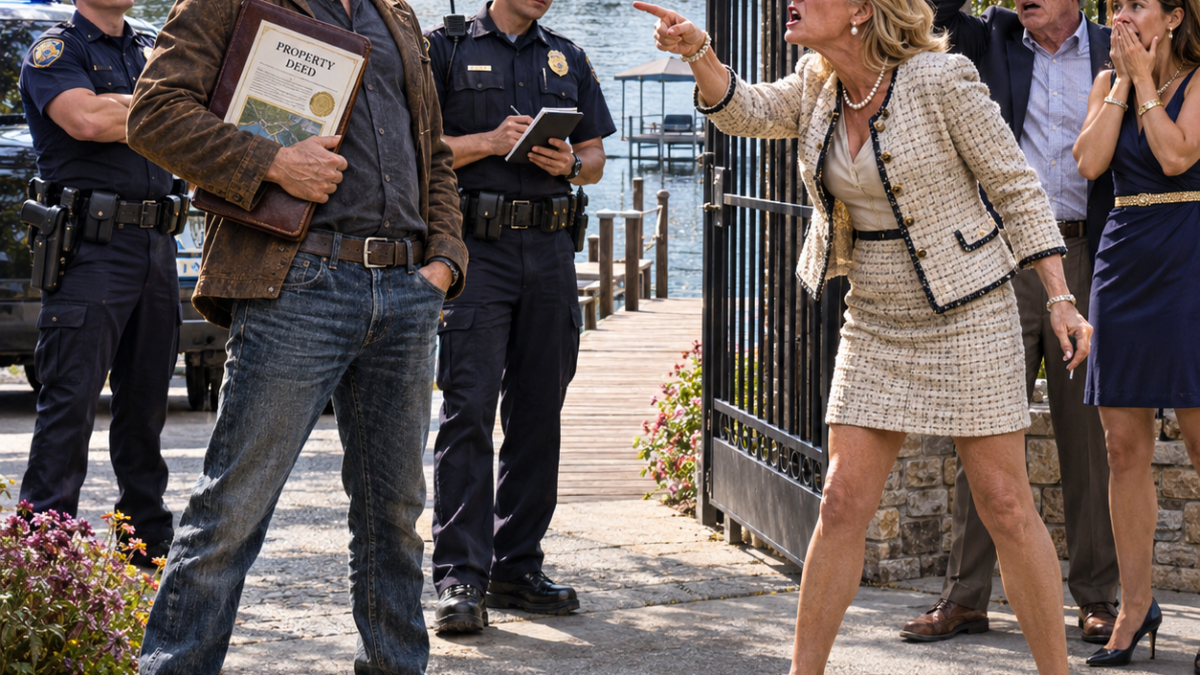
PART 2
I leaned closer.
The line beneath the deputy’s finger read:
**Together with all appurtenant territorial water extraction, diversion, retention, and reserve access privileges conveyed under the original 1887 grant.**
“I don’t know,” I admitted.
The deputy looked toward Delilah.
Apparently, he expected her to keep shouting.
She didn’t.
Her phone had dropped to her side.
“Ma’am?” he called. “Do you have documentation showing this dock belongs to the association?”
She hesitated.
That hesitation lasted maybe two seconds.
It told me more than anything she had said since arriving on my property.
“The HOA has maintained exclusive recreational use of Pine Lake for thirty years,” she replied.
“That wasn’t my question.”
Her expression changed.
The polished neighborhood president disappeared for a moment, replaced by a woman who suddenly realized the person she had summoned might not be taking orders.
“Our attorneys can provide whatever you need.”
The deputy handed the deed back to me.
“This appears to be a property dispute, not a criminal trespass matter.”
Delilah marched down from her deck and came around the shoreline path toward us.
“Deputy, this man is occupying a protected community facility.”
The deputy glanced at my dock.
“Whose name is on the parcel?”
“His, technically.”
I almost laughed.
“Technically?”
She ignored me.
“But the reserve has always functioned as part of Pine Lake Estates.”
The deputy’s expression flattened.
“Then your attorney can address that with his attorney. I’m not arresting a property owner for standing on a dock attached to land listed in his deed.”
Delilah went rigid.
“This community pays substantial taxes.”
“So does everybody else.”
“I know the sheriff.”
“I work for him.”
That shut her up.
He gave me his card before leaving.
“Document everything,” he said quietly. “And don’t do anything with that shoreline until you understand what you own.”
“I wasn’t planning to.”
His eyes moved toward Delilah.
“I wasn’t only talking about construction.”
He walked back to his cruiser.
Delilah waited until his door closed.
Then she stepped close enough that I could smell her perfume.
“You think that was some kind of victory?”
“I think I didn’t get arrested for repairing my own dock.”
“You don’t understand the people you’re dealing with.”
“That’s funny. I was about to say the same thing.”
Her eyes narrowed.
“Take the two hundred thousand.”
I stared at her.
“What?”
“I’m offering you two hundred thousand dollars for the property. You paid one-fifty. You walk away with fifty thousand profit after three weeks.”
The offer came so fast that for a moment I wondered if I had imagined it.
“You told the police this property barely belongs to me.”
“It shouldn’t have been separated from the development.”
“But it was.”
“A clerical oversight.”
“At a public auction?”
She folded her arms.
“Call it whatever makes you comfortable.”
I looked across the lake.
Forty-seven expensive homes curved around the shoreline. Nearly every backyard ended at a private dock. Boats rocked at lifts. Kayaks sat upside down on custom racks. Two children were throwing a tennis ball into the water for a golden retriever.
The entire neighborhood had been marketed around the lake.
And Delilah had just offered me fifty thousand dollars to disappear immediately after a deputy noticed four words in my deed.
Territorial water extraction privileges.
“No,” I said.
Her face hardened.
“You haven’t even considered it.”
“I just did.”
“You are making a serious mistake.”
“Then I guess it’s mine to make.”
She turned away.
After three steps, she stopped.
Without facing me, she said, “Jasper knew better than to interfere with this community.”
The hairs on my arms lifted.
I hadn’t mentioned Jasper to her once.
“How well did you know my uncle?”
She kept walking.
“Delilah.”
Nothing.
“Delilah!”
She climbed into her Mercedes and slammed the door.
I stood beside the dock until her taillights disappeared behind the pines.
Then I went directly to the basement.
The room smelled like pipe tobacco even though Jasper had been dead for months.
One wall held a workbench crowded with rusted fishing reels, old batteries, copper fittings, and jars full of screws sorted by size. The opposite wall was almost entirely filing cabinets.
Jasper had labeled every drawer in block letters.
TAXES.
SURVEYS.
LAND TRANSFERS.
COUNTY CORRESPONDENCE.
WATER RIGHTS.
PINE LAKE ESTATES.
I pulled open the last one.
It was full.
Not a few papers.
Hundreds.
Letters.
Maps.
Certified-mail receipts.
Copies of legal opinions.
County plats.
Developer proposals.
Handwritten notes.
Some went back before I was born.
I carried the first stack upstairs.
By midnight, my kitchen table had disappeared beneath thirty years of Pine Lake history.
That was where I found Delilah’s name for the first time.
A letter dated nine years earlier.
**Dear Mr. Thornton,**
**On behalf of Pine Lake Estates Homeowners Association, I am again requesting that you execute the enclosed transfer of reserve rights so our community may correct historical inconsistencies in the property records.**
The transfer price was ten dollars.
I read it twice.
Then I found Jasper’s handwritten reply.
**Mrs. Whitmore,**
**No.**
That was the entire letter.
I laughed for the first time in months.
Not because anything was funny.
Because I could suddenly picture the old bastard writing it.
One word.
No explanation.
No negotiation.
No room for argument.
I kept digging.
Delilah had contacted him repeatedly.
First politely.
Then through lawyers.
Then through the HOA.
Then through a development company.
One offer had reached $85,000.
Jasper refused them all.
A 1994 letter explained why.
It was addressed to a surveyor named Margaret Sawyer.
**Margaret,**
**Those developers are moving dirt faster than they are checking old records. My 1887 grant still carries the spring rights and reserve privileges. I told them I don’t mind neighbors using the lake as long as they leave the springs alone and stop trying to take what isn’t theirs. They say their lawyers will straighten it out. Maybe they will. Maybe one day somebody will finally read the deed.**
**Jasper**
I sat back.
Outside, Pine Lake was black beneath the moon.
For the first time, it didn’t look peaceful.
It looked like evidence.
The next morning I called the number printed on Margaret Sawyer’s old business card.
A man answered.
“Chen Surveying.”
“I’m trying to find Margaret Sawyer.”
There was a pause.
“Who’s asking?”
“Rex Thornton.”
Another pause.
Longer.
“Jasper Thornton’s nephew?”
“Yes.”
“Hold on.”
I heard muffled voices.
Then an older woman came on the line.
“Rex?”
“Yes, ma’am.”
“You bought Jasper’s place?”
“How did you know?”
“Because your uncle called me two weeks before he died and told me the county was finally forcing his estate toward auction. He was furious.”
That stopped me.
“He knew?”
“He knew what could happen.”
I looked toward the stacks of papers.
“Mrs. Sawyer, I need someone to explain these water rights to me.”
“I was wondering when you’d call.”
By noon, she was sitting at my kitchen table.
Margaret Sawyer was seventy-three and walked with a cane, but nothing about her seemed fragile. She wore jeans, boots, and a red flannel shirt, and she read Jasper’s deed without putting on glasses.
When she reached the territorial language, she nodded.
“Still there.”
“What is?”
“The part everybody hoped would disappear.”
She unfolded an 1887 survey.
The paper was so old I was afraid breathing on it might damage it.
Thin blue lines crossed Jasper’s parcel and ran toward the lake.
“Pine Lake looks natural,” she said, “but its modern water level depends heavily on these springs. Jasper’s tract contains the primary source and the original reserve corridor.”
“Meaning?”
“Meaning the nineteenth-century grant separated certain water and access rights from later surrounding parcels.”
“Do I own the lake?”
“No.”
That answer surprised me.
“Then Delilah’s right?”
“I didn’t say that.”
She pointed at the map.
“You don’t own the lakebed in the way people usually mean when they say they own a lake. You own something much more inconvenient for them.”
She traced three blue lines with one finger.
“The spring rights.”
Then a shaded strip.
“And the reserve-access rights.”
I stared at her.
“Explain it like I’m an electrician.”
Margaret smiled.
“Fine. Imagine somebody built forty-seven houses downstream from your breaker panel, connected every one of them to circuits running through your property, and never got an easement to use the panel.”
I understood immediately.
“They built around rights Jasper never transferred.”
“Exactly.”
“How did that happen?”
“Money. Speed. Assumptions. The original development changed hands twice. Lawyers focused on zoning and shoreline permits. Everyone treated Jasper like an eccentric old man who would eventually sign whatever they put in front of him.”
“But he didn’t.”
“No.”
“Could he have stopped them?”
“Parts of the development? Probably. The lake use? Almost certainly. But Jasper didn’t want to ruin anybody. He liked seeing families fish. He just refused to surrender control of the springs.”
I looked through the window at the houses across the water.
“So what happens now?”
Margaret folded her hands.
“Now you hire a very good water-rights attorney.”
I already had a name.
Maya Blackstone.
The lawyer I had called after Delilah’s fake inspector had referred me to her, describing her as “the person people call when western property law gets old enough to require archaeology.”
Her office was in Helena.
I drove there the next morning with two boxes of Jasper’s records strapped into the passenger seat.
Maya was in her early sixties, silver-haired, sharp-eyed, and completely unimpressed by drama.
She spent almost an hour reading before speaking.
Then she took off her glasses.
“Has anyone threatened you?”
“Yes.”
“Anyone offered to buy the property?”
“Delilah offered two hundred thousand yesterday.”
Maya wrote that down.
“Anything else?”
“Fake environmental inspector.”
Her pen stopped.
“Fake how?”
I showed her the laminated badge Dale had dropped.
She stared at it.
Then at me.
“You kept this?”
“I was an electrician for thirty years. I keep everything somebody lies to me about.”
“That may be the most useful personality flaw you have.”
“Clara used to call it annoying.”
“Clara?”
“My wife.”
The word still caught in my throat sometimes.
Maya noticed but didn’t push.
She returned to the deed.
“I need title research, county records, historical statutes, survey verification, hydrological analysis, and every document your uncle had.”
“So Margaret was right?”
“I’m not answering that until I can prove it.”
That was the first thing Maya said that made me trust her.
She did not promise victory.
She promised work.
Three days later, a truck pulled into my driveway.
A man climbed out carrying survey equipment.
I met him on the porch.
“Rex Thornton?”
“Depends who’s asking.”
He grinned.
“Garrett Flynn. Margaret sent me.”
He was thirty-eight, sunburned, with the permanent squint of someone who spent more time outdoors than under a roof.
He pointed at my expression.
“She said you’d be suspicious.”
“She sent a surveyor after somebody already tried sending me a fake inspector?”
“Fair.”
He produced identification, licensing information, Margaret’s handwritten note, and a business card.
I checked all of it.
Garrett waited.
“Happy?”
“Getting there.”
He laughed.
“You really were an electrician.”
“What does that mean?”
“My dad was one. He wouldn’t trust a fire extinguisher until he’d checked who filled it.”
Garrett spent six hours surveying the property.
Near dusk, he asked me to follow him into the trees behind the cabin.
We walked down a narrow slope thick with moss until I heard water.
Three springs emerged from the hillside.
I had seen them before, but I had assumed they were ordinary runoff.
Garrett crouched beside the largest.
“This one feeds the north channel.”
He pointed farther downhill.
“That joins Pine Lake beneath the reserve corridor. Second spring runs under the marsh. Third is smaller but steady.”
“How much water?”
“Enough that if the flows were materially changed, the lake level would notice.”
I crossed my arms.
“I’m not shutting off anybody’s lake.”
“I didn’t say you should.”
“Everyone else seems to think that’s what I’m planning.”
Garrett stood.
“That’s because people get scared when they discover something they assumed belonged to them never actually did.”
That night, Delilah called.
I almost let it go to voicemail.
Then I remembered Maya’s instruction.
Document everything.
I answered and turned on the recording app.
“Rex.”
“Delilah.”
“I’d like to resolve this before things become unpleasant.”
“You already called the cops.”
“A misunderstanding.”
“You brought a furniture salesman onto my property dressed like a state inspector.”
“Dale’s mistake was presenting himself poorly.”
I actually pulled the phone away from my ear.
“Presenting himself poorly?”
“He was there in an advisory capacity.”
“He had a fake government ID.”
Silence.
Then she changed direction.
“The community will increase its offer.”
“How much?”
“Two hundred twenty-five thousand.”
“That’s generous.”
“It is.”
“Why?”
“Because unlike you, we understand the complications associated with that parcel.”
There it was.
Not inconvenience.
Not aesthetics.
Complications.
“What complications?”
“You know exactly what I mean.”
“I don’t.”
Another pause.
“You need to stop digging into old documents that no longer reflect modern reality.”
I looked toward Jasper’s basement.
“What documents?”
Her breathing changed.
Just slightly.
“You are not equipped to interpret nineteenth-century territorial grants.”
“Maybe not.”
“I’m trying to protect you.”
“From what?”
“From spending the rest of your retirement in litigation.”
I thought about Clara.
The hospital.
The machines.
The year I had spent learning that some fights could not be won regardless of how hard you worked.
Then I looked at Jasper’s one-word letter.
No.
“I’m not selling.”
Delilah’s voice turned quiet.
“You will.”
She hung up.
The first vandalism happened two nights later.
I came down to the dock at sunrise and found two mooring ropes sliced clean through.
At first, I told myself it could have been kids.
Then one of the new support braces worked loose.
I knew I had tightened it.
I had thirty years of muscle memory in my hands. I didn’t forget whether I had torqued a fastener.
The following morning, red paint covered three cedar planks.
TRESPASSER.
Garrett stared at it for a long time.
“You have cameras?”
“One on the cabin.”
“Not enough.”
He returned that afternoon with trail cameras, motion sensors, and two compact security units.
We placed them facing the dock, access path, driveway, and rear of the cabin.
I felt ridiculous doing it.
Clara would have teased me.
“Fort Knox, Rex?”
“Preventive maintenance.”
“Paranoia with better branding.”
Just remembering her voice made me smile.
Then it hurt.
That evening I sat on the porch until dark.
Grief had stopped arriving like a storm months earlier.
Now it behaved more like electricity in an old wall.
Usually invisible.
Always there.
Touch the wrong thing and it found you.
At 2:37 the next morning, my phone buzzed.
Motion detected.
I watched the live feed.
A figure in a black hoodie moved down the dock carrying a small pry bar.
He knelt beside a support.
Then his phone rang.
He answered in a whisper.
“Yeah.”
Pause.
“I’m here now.”
Pause.
“No, he’s asleep.”
I turned up the volume.
The figure looked toward my cabin.
“Mom, I said I’m doing it.”
My chair creaked beneath me.
He continued.
“The red paint was stupid. He just cleaned it off.”
Pause.
“I don’t care what message you’re trying to send.”
Longer pause.
“You said two thousand for security work. This isn’t security.”
I knew the voice.
Bradley Whitmore.
Delilah’s son.
I had seen him twice driving through the neighborhood in a lifted Jeep.
Nineteen years old.
Skinny.
Always looking at his phone.
Now he was kneeling on my dock with a crowbar.
I could have gone outside.
Part of me wanted to.
Instead, I stayed in the dark and let the cameras record.
Bradley worked for fourteen minutes.
Before leaving, he whispered into the phone again.
“If this gets me arrested, I’m telling them you paid me.”
He walked away.
I saved the footage in three places.
Then I called Maya.
At seven-thirty, she answered.
“Someone better be dead.”
“No.”
“Then why are you calling this early?”
“I have Delilah’s son on video vandalizing my dock while talking to her.”
She went silent.
“Send it.”
Ten minutes later, she called back.
“Do not confront either of them alone.”
“I was thinking about talking to the kid.”
“That sounds exactly like confronting one of them alone.”
“Coffee shop.”
“Rex.”
“Public place.”
She sighed.
“Record it.”
Pine Lake had one coffee shop.
Bradley was there almost every morning.
I found him in the back booth with a laptop open and untouched coffee beside him.
I sat across from him.
His eyes widened.
“Can I help you?”
“Rough night?”
His face changed.
“I don’t know what you’re talking about.”
I placed my phone between us.
Then I played ten seconds.
His own voice whispered from the speaker.
**Mom, I said I’m doing it.**
Bradley went white.
I stopped the recording.
“I’ve got forty-three more minutes from three cameras.”
His fingers curled under the table.
“She told me it was HOA security.”
“Does HOA security normally involve cutting dock lines?”
He looked toward the door.
“If you leave, I send this to the sheriff.”
His eyes snapped back.
“You can’t threaten me.”
“That isn’t a threat. It’s a schedule.”
His breathing became shallow.
“I didn’t know she was trying to steal your property.”
“You knew you were trespassing.”
“She said the HOA owned the reserve.”
“Did you believe her?”
No answer.
“Bradley.”
“She’s my mom.”
“That isn’t what I asked.”
His eyes filled.
He turned away, embarrassed.
“She said you were dangerous. She said Jasper had been holding the neighborhood hostage for years and you were going to do the same thing.”
“How long has she been paying you?”
He looked down.
“Since last summer.”
“For what?”
“Security. Deliveries. Watching properties.”
“Watching which properties?”
That question broke something.
He rubbed both hands over his face.
“There were others.”
“How many?”
“Three families that I know about.”
He told me names.
Janet Morrison.
Tom and Eileen Brennan.
The Carters.
Each had challenged Delilah over assessments, fines, or contracts.
Each had eventually sold.
“What did you do?”
“Mostly took pictures. Put violation notices on cars. Followed people. Mom had contractors handle other stuff.”
“What other stuff?”
“I don’t know.”
“Bradley.”
“I really don’t.”
His voice cracked.
“Sometimes a fence got damaged. Sometimes there were plumbing problems. One guy’s boat trailer got its tires slashed. Mom said it was pressure.”
“Pressure for what?”
“To make them leave.”
I stared at him.
The coffee shop sounds seemed to recede.
“Why?”
“She sold two of the houses.”
“As their agent?”
He nodded.
“And the third?”
“Her friend did.”
“Were you paid from the HOA?”
Another nod.
My anger changed shape.
Until then, I had thought Delilah wanted control because she was entitled.
That was simpler.
Ugly, but simple.
This sounded organized.
“Bradley, if what you’re telling me is true, you need a lawyer.”
His head jerked up.
“Are you turning me in?”
“You broke onto my property and damaged it.”
“She made me.”
“You’re nineteen. She pressured you. That matters. It doesn’t erase what you did.”
Tears ran down his face.
He wiped them away angrily.
“I hate her.”
“No, you don’t.”
“You don’t know anything about us.”
“You’re right.”
I leaned back.
“But I know what it looks like when somebody spends years letting fear make decisions for them.”
That landed harder than I expected.
Maybe because I had been talking about myself too.
I stood.
“Go home. Don’t destroy anything else. Don’t delete messages. Don’t warn her that I know what you told me.”
“Why?”
“Because if she’s been using HOA money for this, somebody needs to find out how much.”
I met Maya that afternoon.
She had already brought in a forensic accountant.
When I mentioned the names Bradley gave me, she opened another file.
“You’re not the first person to call about Delilah.”
“What?”
“Margaret contacted Janet Morrison yesterday. Janet has records.”
“What kind?”
“Fines. Threatening letters. invoices from contractors whose work she says was never performed.”
I sat down.
Maya studied me.
“Are you still thinking this is about a dock?”
“No.”
“Good.”
She slid a report across the desk.
Garrett’s survey.
The hydrologist’s preliminary findings.
Historical title research.
Copies of territorial records.
Maya tapped the cover.
“Your rights are real.”
I looked at her.
“How real?”
“Real enough that Pine Lake Estates has a serious problem.”
She opened the report.
“The original developers secured shoreline parcels. They secured building permits. They secured easements for roads and utilities.”
“But not the water.”
“Not the rights attached to Jasper’s reserve.”
I exhaled.
“So I own their lake access.”
“You control critical reserve and spring rights that underpin the access they’ve been treating as automatic. That distinction matters legally, but from their perspective the result is similar.”
“Can I stop them from using it?”
“You could seek an injunction.”
“Could I drain the lake?”
She gave me a look.
“No.”
“Good.”
“You sound disappointed.”
“I’m relieved.”
“Why?”
“Because the last thing I need is forty-seven families thinking I can pull a plug.”
Maya smiled slightly.
“Then you’re already approaching this more responsibly than Delilah expected.”
She showed me a second page.
“There’s another issue.”
I waited.
“Thirty years of uncompensated use.”
“How much?”
“Potentially millions, depending on how a court calculates historic value.”
I actually laughed.
“Maya.”
“I’m not recommending you demand it.”
“Good.”
“I’m telling you what leverage exists.”
I thought about Jasper.
He had known.
All those years.
He could have charged them.
He could have sued.
He could have made himself rich.
Instead, he fished from his dock and mailed one-word refusals to Delilah.
“Jasper never collected anything.”
“No.”
“Then neither will I.”
“Think before you decide that.”
“I just did.”
She watched me.
“All past use is off the table.”
“That’s a generous position.”
“It isn’t generosity.”
“What is it?”
“I’m not punishing forty-seven families because one woman decided to behave like a criminal.”
Maya leaned back.
For the first time since meeting her, she smiled fully.
“Now we have a strategy.”
The notices went out a week later.
Not demands for millions.
Not threats to drain a lake.
Formal notices advising homeowners that historic reserve and water rights belonged to my parcel and that continued recreational use would require a new access agreement.
The proposed monthly fee was substantial enough to establish the rights but nowhere near what Maya said we could legally seek.
I expected anger.
I got panic.
My phone rang twenty-six times the first day.
Some callers screamed.
Some apologized before saying anything.
One man offered to buy the property sight unseen.
Another accused me of extortion.
A woman named Jennifer Walsh cried and asked whether her children would still be allowed to swim.
“Yes,” I told her.
“Then why did Delilah say you’re closing the lake?”
“I don’t know.”
“She said you intend to fence off every dock.”
“I don’t.”
Silence.
“You swear?”
“I’m not trying to punish your kids, Jennifer.”
She hung up without answering.
At six that evening, Delilah arrived.
She carried a manila envelope.
Her usual precision was gone. Her hair looked as though she had been running her hands through it all afternoon.
“I want five minutes.”
“You can have them on the porch.”
“Inside.”
“No.”
Her eyes flicked toward the security camera above the door.
“Are you recording me?”
“Yes.”
“You need my permission.”
“Not for a conversation on my own porch.”
She breathed through her nose.
Then opened the envelope.
Inside were stacks of cash.
I stared.
“Seventy-five thousand dollars.”
“For what?”
“You leave.”
“Where did it come from?”
“That’s not your concern.”
“It becomes my concern when you bring it onto my property.”
“The board authorized an emergency expenditure.”
“For buying my house?”
“For resolving a community threat.”
I almost admired how easily she said it.
“Does the board know this is cash?”
Her mouth tightened.
“The board trusts me.”
“Bradley trusted you too.”
Everything in her face stopped.
I knew immediately she had not expected his name.
“Leave my son out of this.”
“You brought your son onto my dock at two-thirty in the morning.”
“He provides security.”
“With a crowbar?”
Her eyes went toward the camera.
Then back to me.
“You’re bluffing.”
I took out my phone.
I played his voice.
**Mom, I said I’m doing it.**
Delilah lunged for the phone.
I stepped back.
She stopped herself before touching me.
For several seconds, neither of us spoke.
Then she whispered, “You have no idea what you’ve done.”
“What I’ve done?”
“This community was stable before you arrived.”
“You paid your son to vandalize my property.”
“You destabilized everything.”
“You sent a fake inspector.”
“You refused every reasonable solution.”
“You called the police on me.”
“Because you don’t belong here!”
Her voice cracked across the water.
I had never heard her lose control like that.
A porch light came on at the neighboring house.
Then another.
Delilah lowered her voice.
“Jasper understood the arrangement.”
“No. Jasper tolerated the arrangement.”
“He was a bitter old man who enjoyed making everyone beg.”
“You offered him ten dollars for his rights.”
Her face changed.
So she remembered the letter.
“I offered him an administrative correction.”
“You tried to take something he owned.”
“Something he had no practical use for.”
“That doesn’t make it yours.”
Her breathing became uneven.
“You think this is about legal language? People invested their lives here.”
“I know.”
“Then withdraw the notices.”
“Give me the HOA financial records.”
She stared.
“What?”
“Five years. Emergency fund, security expenses, contractor invoices.”
“You have no authority.”
“Then I guess the notices stay.”
“You’re blackmailing me.”
“No. I’m giving your board the opportunity to explain where its money went.”
That was the moment I saw fear become hatred.
Not annoyance.
Not entitlement.
Hatred.
She gathered the money.
“You are going to regret humiliating me.”
“I’m not the one standing on a porch with seventy-five thousand dollars in HOA cash.”
She left.
The next morning, Deputy Rodriguez knocked on my door.
He was the same deputy who had responded to the dock complaint.
He looked exhausted.
“I need to ask about allegations made by Mrs. Whitmore.”
“What allegations?”
“Threats of violence. Stalking. Attempted extortion.”
I stared at him.
“She filed three reports.”
“Yesterday?”
“Yes.”
“I recorded yesterday.”
His shoulders dropped slightly.
“Of course you did.”
I handed him my phone.
He watched the entire conversation.
When it ended, he rubbed the bridge of his nose.
“Did you ever threaten her?”
“No.”
“Follow her?”
“No.”
“Approach her home?”
“No.”
“Contact her son?”
“Yes. Public coffee shop. I recorded that too.”
He watched part of the Bradley conversation.
Then he stood.
“Do not delete any of this.”
“I wasn’t planning to.”
“We’ve had previous complaints involving her.”
“How many?”
“I can’t discuss active matters.”
“Enough that you’re not surprised.”
His expression gave me my answer.
At the door, he stopped.
“Rex.”
“Yeah?”
“Be careful.”
“Of her?”
“Of anyone who starts realizing records are more dangerous than arguments.”
The smear campaign began that afternoon.
Flyers appeared on windshields.
**PROTECT PINE LAKE FROM WATER EXTORTION.**
A grainy photograph showed me standing beside my truck.
Another line read:
**UNSTABLE OUTSIDER THREATENS FAMILIES AFTER PERSONAL TRAGEDY.**
That one hit differently.
Delilah had turned Clara’s death into campaign material.
I stood in the grocery-store parking lot holding the flyer until the paper creased beneath my fingers.
For the first time, I wanted revenge.
Not justice.
Not leverage.
Revenge.
I wanted to send every bill Maya had calculated.
I wanted Delilah to watch her neighbors learn exactly how much her arrogance might cost them.
I wanted to use everything Jasper had left me like a weapon.
I called Maya.
“Send the full demand.”
“For back fees?”
“Yes.”
“How much?”
“All of it.”
She was quiet.
“Rex, what happened?”
I read her the flyer.
Another silence.
Then she asked, “What would Clara tell you to do?”
I shut my eyes.
“That’s not fair.”
“No. It isn’t.”
“She dragged my wife into this.”
“I know.”
“She doesn’t get to do that.”
“No, she doesn’t.”
“Then why shouldn’t I destroy her?”
“Because forty-six other households aren’t Delilah.”
I gripped the steering wheel.
Maya continued.
“If you weaponize those rights against everybody because she hurt you, she gets to decide what kind of man you become.”
I hated her for saying it.
Mostly because she was right.
I sat in the truck for twenty minutes.
Then I drove home.
I put the flyer in Jasper’s file.
Not because I forgave Delilah.
Because I wanted to remember exactly what anger had almost made me do.
The next escalation came Friday night.
Someone slashed all four tires on my truck.
They also dragged a key down the driver’s side.
WATER THIEF.
The cameras caught a hooded person doing it.
They also caught Delilah’s Mercedes parked fifty yards away with its lights off.
Maya sent the footage to Rodriguez.
The private investigator she had hired started tracing HOA expenditures.
What he found changed the case.
Over five years, more than $280,000 had flowed from community emergency and maintenance accounts to companies connected to Delilah, relatives, and associates.
Security consulting.
Landscape remediation.
Property compliance.
Special legal services.
Some companies existed only on paper.
Others had received money for work homeowners said never occurred.
Bradley’s payments appeared under “lake security.”
Then Maya found something even worse.
Delilah’s real estate company had been involved in sales of properties belonging to families she had pressured.
“Three confirmed,” Maya told me. “Potentially five.”
“So she created distress and then profited when they sold.”
“That’s what the records suggest.”
I looked toward the lake.
“How much debt is she in?”
Maya raised an eyebrow.
“How did you know?”
“People don’t take this many risks for nothing.”
“Over two hundred thousand that we can document. Failed investments. Credit lines. Gambling transactions.”
“Online?”
“Yes.”
“So the HOA wasn’t power.”
“Power was part of it.”
“But money kept her afloat.”
“That’s what it looks like.”
I thought about the cash on my porch.
Seventy-five thousand dollars.
Not hers.
Her neighbors’.
“She needs me gone.”
“Very badly.”
That weekend, three homeowners came to my cabin.
Janet Morrison was first.
She was sixty, with cropped gray hair and the wary posture of someone who expected every conversation to be used against her.
Tom Brennan came with his wife, Eileen.
Tom’s right hand trembled from Parkinson’s.
They sat around my kitchen table.
Janet placed a folder in front of me.
“These are from Delilah.”
Fines.
Warnings.
Photographs.
One letter demanded that Janet replace her roof because the shade of brown created “visual disharmony.”
Another threatened a $500-per-day penalty because her grandson’s fishing kayak had been visible from the street.
“I fought her for eleven months,” Janet said. “Then my fence got knocked down.”
“Police report?”
“Yes. Nothing came of it.”
Tom pushed another file toward me.
“She targeted our boat.”
“What was wrong with it?”
“Blue.”
I thought he was joking.
He wasn’t.
“She said approved watercraft colors were white, silver, black, or earth-tone.”
Eileen’s mouth twisted.
“We bought that boat before the rule existed.”
“What happened?”
“Fines. Tow threats. Complaints. Somebody loosened the trailer hitch.”
Tom looked down.
“That could have killed someone.”
I sat very still.
“Did you report it?”
“Yes.”
“Proof?”
“No.”
Janet watched me.
“Delilah counts on that.”
“Why didn’t the neighborhood vote her out?”
She laughed without humor.
“Because she controls information. She tells people every challenge is an attack on property values.”
“She also handles proxy votes,” Eileen added.
“And contracts.”
“And the newsletter.”
“And half the neighborhood buys or sells through her office.”
Tom’s hand trembled harder.
“She makes people feel alone.”
That sentence stayed with me.
She makes people feel alone.
I knew something about loneliness.
After Clara died, people stopped calling gradually.
Not because they didn’t care.
Because grief made them uncomfortable.
Friends who had brought casseroles in the first month eventually returned to their own lives. By six months, the house had become so quiet I sometimes turned on the television just to hear strangers speaking.
Delilah had apparently figured out how to create that same isolation deliberately.
Turn a neighborhood against one family.
Make them feel watched.
Make ordinary life exhausting.
Then offer an exit.
I looked at Janet.
“You’re not alone anymore.”
The words came out before I thought about them.
Her eyes filled.
She nodded once.
A week later, Maya and I proposed the alternative.
We would waive all historical claims.
Every dollar.
In exchange, Pine Lake Estates would recognize the reserve rights, sign a long-term access agreement, adopt transparent accounting rules, and contribute monthly fees based on property value.
The money would not go into my pocket.
Most of it would fund lake conservation.
I wanted a smaller portion reserved for scholarships.
Maya asked why.
“Clara taught middle school science for eighteen years.”
I looked out her office window.
“She used to spend her own money taking kids on field trips because some parents couldn’t afford twenty dollars.”
“Then name the fund for her.”
I swallowed.
“She’d hate that.”
“Why?”
“She hated having buildings and programs named after dead people.”
Maya smiled.
“What would she prefer?”
“Something useful.”
“Scholarships are useful.”
I thought about it.
“Fine.”
So the proposal became the Clara Thornton Conservation and Education Fund.
When I saw her name printed on the draft, I had to leave Maya’s office for a minute.
I stood beside my truck staring at the paper.
For months, Clara’s name had appeared only on medical bills, insurance forms, death certificates, and condolence cards.
Now it was attached to something that might outlive both of us.
I pressed the page against my chest.
Then I went back inside.
The proposal should have lowered the temperature.
Instead, Delilah escalated.
Cars began passing my property at all hours.
People shouted.
My phone filled with blocked calls.
Someone mailed me an envelope containing a photograph of Clara cut from an old obituary.
Nothing was written on it.
That frightened me more than the insults.
Maya insisted I report it.
Rodriguez came out personally.
He placed the photograph in an evidence sleeve.
“She’s losing control,” he said.
“Can you prove she sent it?”
“No.”
“Then what good is this?”
“Patterns matter.”
“I’m getting tired of patterns.”
“I know.”
“I want consequences.”
“So do we.”
“When?”
“When evidence gives us something stronger than anger.”
I understood.
I hated it.
Sunday night, I finally went to sleep around midnight.
At 2:14 a.m., glass broke downstairs.
I sat upright.
For one second, I didn’t know where I was.
Then the security alarm on my phone flashed.
**BASEMENT MOTION.**
I grabbed the flashlight beside my bed.
Then I stopped.
The baseball bat leaned in the corner.
I picked it up.
Not because I wanted to use it.
Because someone was inside my house.
I called 911 before leaving the bedroom.
“Someone broke into my basement. I’m upstairs. I’m armed with a baseball bat.”
The dispatcher told me to stay where I was.
Then another sound came from below.
Metal scraping.
I opened the camera feed.
A figure moved between Jasper’s filing cabinets.
Not Bradley.
Smaller.
Blonde hair visible beneath a hood.
Delilah.
My fear turned almost immediately into disbelief.
She was prying at the cabinet marked WATER RIGHTS.
I stayed upstairs.
Everything in me wanted to confront her.
Instead, I listened to the dispatcher.
Deputies were eight minutes away.
Delilah yanked the drawer.
Locked.
She hit it with the crowbar.
Once.
Twice.
Then she moved to the desk.
She opened drawers.
Pulled papers out.
Stuffed several into a bag.
One of them was a copy.
The originals were in Maya’s safe.
Delilah didn’t know that.
She kept searching.
Then my driveway filled with headlights.
She froze.
The first deputy approached the front.
A second moved behind the cabin.
Delilah ran upstairs.
I stood at the top landing.
She appeared below me holding the crowbar.
We looked at each other.
Neither of us spoke.
Then she raised one hand.
“Rex.”
I tightened my grip on the bat.
“Put it down.”
“You need to listen.”
“Put it down.”
“This isn’t what you think.”
I almost laughed.
“You broke my basement window and you’re holding a crowbar.”
“I needed proof.”
“Of what?”
“That you forged the records.”
“Put the crowbar down.”
Her eyes darted toward the front door.
Blue lights strobed across the walls.
“You ruined everything.”
“No.”
Her voice rose.
“You showed up and destroyed thirty years of stability!”
“You mean thirty years of people being too scared to challenge you.”
“You don’t know what it took to build this community.”
“You didn’t build the community.”
“I protected it.”
“From Janet’s roof?”
Her face twisted.
“People like Janet drag everyone down.”
“Tom’s blue boat?”
“Standards matter!”
“You had my tires slashed.”
“You forced me!”
There it was.
Not denial.
Justification.
I heard boots on the porch.
Delilah heard them too.
She lowered the crowbar.
For a second, I thought she would drop it.
Then she stepped toward me.
“Give me the originals.”
“They aren’t here.”
She stopped.
“What?”
“They haven’t been here for a week.”
All the color left her face.
The front door opened.
“Sheriff’s office!”
Delilah’s hand went loose.
The crowbar hit the floor.
Deputy Rodriguez came around the corner with another officer.
He looked at me.
Then Delilah.
Then the broken basement window.
“Ma’am, step away from the crowbar.”
She obeyed.
For once, Delilah Whitmore had nothing to say.
They arrested her for burglary.
She was released the following afternoon pending charges.
That surprised me.
Part of me assumed being caught inside somebody’s house with a crowbar would make a person disappear immediately.
Maya reminded me that real cases were slower than television.
Evidence had to be processed.
Charges had to be reviewed.
People got hearings.
Lawyers filed motions.
Nothing happened simply because I wanted it to.
Delilah used those twenty-four hours well.
By five o’clock, notices appeared throughout Pine Lake Estates.
**EMERGENCY COMMUNITY MEETING**
**MONDAY — 7:00 P.M.**
**DEFENDING OUR HOMES FROM EXTORTION AND FRAUD**
She invited local media.
That was Maya’s favorite part.
“She invited media?”
“Yes.”
“Voluntarily?”
“Yes.”
Maya leaned back and laughed.
“What?”
“She still thinks the biggest danger in that room is you.”
Channel 7 sent Patricia Vance.
I knew her name.
Most people in Montana did.
She had spent years reporting on municipal corruption, land disputes, and public contracts.
She arrived at my cabin four hours before the meeting.
“I’m told you’re threatening to cut off water to forty-seven families.”
“I’m not.”
“Your attorney sent notices.”
“Yes.”
“Demanding payment.”
“For continued reserve access.”
“People are calling that extortion.”
“I know.”
She studied me.
“You don’t seem angry.”
“I am.”
“Then why don’t you sound angry?”
“Because anger has been expensive enough already.”
That made her pause.
I gave her copies of the deed.
The historical survey.
Jasper’s letters.
The footage of Bradley.
The porch recording.
The police report from the break-in.
Patricia stopped taking notes halfway through.
“Does the HOA know you have all this?”
“Delilah knows parts.”
“And the homeowners?”
“No.”
“Why not?”
“Tonight seems convenient.”
She looked at me for a long time.
“Mr. Thornton, if these financial records are authentic, this is much larger than a neighborhood argument.”
“Maya thinks so.”
“Who is Maya?”
“My attorney.”
“Can I speak with her?”
“You’ll probably wish you hadn’t.”
Patricia smiled.
“I hear that a lot.”
By six-thirty, the clubhouse parking lot was full.
Forty-three of forty-seven homeowners attended.
Patricia’s crew set up near the back.
Garrett handled a projector Maya had brought.
Janet sat beside Tom and Eileen.
Bradley was nowhere to be seen.
I did not blame him.
Delilah sat at the front.
She looked immaculate.
That unnerved me more than if she had appeared angry.
A woman who had been arrested inside my basement less than forty-eight hours earlier had put on a cream blazer, pearls, and enough confidence to convince half the room she belonged behind the microphone.
At seven exactly, she stood.
“Thank you all for coming.”
The room quieted.
“What has happened to Pine Lake over the past several weeks is frightening.”
She looked directly at me.
“An outsider acquired a historically insignificant reserve parcel and is now exploiting obscure nineteenth-century language to threaten our homes, our children, and our financial security.”
Several people murmured.
Delilah clicked a remote.
My cabin appeared on the screen.
Underneath it, red letters read:
**THREAT TO PINE LAKE**
She continued.
“Mr. Thornton has demanded money for water families have lawfully used for thirty years.”
Maya leaned toward me.
“Let her talk.”
I nodded.
“He has intimidated residents, stalked board members, interfered with official inspections, and threatened to destroy our property values unless we submit to his demands.”
Another slide.
A photograph of me talking to Bradley at the coffee shop.
The angle made it look secretive.
“Here he is confronting my nineteen-year-old son.”
I heard someone behind me whisper, “Jesus.”
Delilah raised one hand.
“I know many of you are afraid.”
That was her skill.
She knew how to turn fear into permission.
“But fear cannot determine who we are.”
She brought Jennifer Walsh to the front.
Jennifer looked sick.
“Tell everyone what happened,” Delilah said.
Jennifer gripped the microphone.
“Last Tuesday, my daughter came home upset.”
“Why?”
Jennifer glanced toward me.
“Because she thought she might not be allowed to swim in the lake.”
Delilah’s expression flickered.
“What did Mr. Thornton tell her?”
Jennifer swallowed.
“He didn’t speak to her.”
Silence.
Delilah leaned closer.
“Jennifer, we discussed—”
“I know what we discussed.”
Jennifer’s hands trembled.
“You told me to say he approached my children.”
The room changed.
Not dramatically.
Not yet.
Just enough.
Delilah smiled tightly.
“Jennifer is obviously under significant stress.”
“I’m under stress because you told us the man was going to drain the lake.”
“I never used those words.”
“Yes, you did.”
“Sit down.”
Jennifer didn’t.
“You also told me if I didn’t support you, the HOA would review my deck permits.”
A voice from the crowd said, “She told me the same thing.”
Another voice.
“Me too.”
Delilah raised her hands.
“We are losing focus.”
Maya whispered, “Now.”
I stood.
The room quieted.
Delilah’s eyes locked onto me.
I walked to the front carrying Jasper’s leather portfolio.
“I came here three months ago because my wife died.”
No one moved.
“I wasn’t looking for a war. I wasn’t looking for a neighborhood. I wasn’t even sure I wanted to stay.”
I set the portfolio down.
“I bought a cabin, three acres, and a dock because I needed somewhere quiet enough to figure out who I was after thirty-one years of marriage ended in a hospital room.”
Delilah shifted impatiently.
“This meeting is about legal threats.”
“You’re right.”
I opened the portfolio.
“So let’s talk about the legal documents.”
I removed the certified copy of the territorial deed.
“This is the grant attached to my parcel.”
Garrett projected the survey.
Blue lines spread across the screen.
“These are the springs.”
Then the reserve corridor.
“This is the access strip.”
I looked around the room.
“I do not own your houses. I do not own your families. I am not trying to stop children from swimming.”
People watched silently.
“But your development was built around rights that were never transferred out of Jasper Thornton’s parcel.”
Delilah scoffed.
“An absurd interpretation.”
Maya stood.
“Then perhaps I can help.”
She introduced herself.
Delilah’s mouth tightened.
Maya walked to the front carrying a binder.
“The title work has been independently reviewed. The historical grant has been authenticated. The survey has been confirmed. The relevant reserve rights were never conveyed to Pine Lake Estates.”
One homeowner raised his hand.
“Can he really charge us?”
“Yes.”
“How much?”
“That depends on the agreement you ultimately negotiate.”
A woman near the back called out, “Could he shut off the lake?”
Maya chose her words carefully.
“He could seek significant restrictions on uses dependent upon his reserved rights.”
Panic moved through the room.
I raised my hand.
“I’m not doing that.”
Someone shouted, “Then why send us bills?”
“Because rights that are never acknowledged eventually get stolen.”
That quieted them.
“Jasper let this community use those rights without charging for decades.”
I held up his 1994 letter.
“He knew exactly what he owned. He also knew your developers failed to secure it.”
I turned toward Delilah.
“She knew too.”
“No.”
Her answer came instantly.
I pulled out her letters to Jasper.
“One of these is signed by you.”
Her expression changed.
I read the first line.
“‘On behalf of Pine Lake Estates Homeowners Association, I am again requesting that you execute the enclosed transfer of reserve rights.’”
The room became completely still.
Someone said, “Again?”
I looked toward Delilah.
“You wrote this nine years ago.”
She said nothing.
“You offered him ten dollars.”
A man in the front row laughed once in disbelief.
Delilah stood.
“This is a distortion. Those letters were administrative efforts to clean up obsolete language.”
“Then why did you offer me two hundred twenty-five thousand dollars?”
People turned toward her.
She opened her mouth.
I continued.
“Why did you send Dale Peterson onto my land wearing a fake state badge?”
Murmurs erupted.
“Why did you call the sheriff and claim I was trespassing on property you already knew Jasper had refused to transfer?”
Her face reddened.
“You manipulated an elderly man’s records.”
“I met him at Christmas twice in the last ten years.”
That stopped her.
I took out my phone.
“But you’re right about one thing. Documents can be misunderstood.”
I nodded to Garrett.
“Recordings are easier.”
Delilah’s voice filled the clubhouse.
**Seventy-five thousand dollars. You leave.**
Then mine.
**Where did it come from?**
**The board authorized an emergency expenditure.**
People began looking at one another.
The treasurer stood up.
His face had gone pale.
“What emergency expenditure?”
Delilah turned.
“Harold—”
“I never approved seventy-five thousand dollars.”
“You signed the discretionary-resolution authorization.”
“For legal fees.”
“Which includes settlement.”
“Not cash!”
Voices rose.
Delilah reached for the microphone.
Maya stepped between us.
“We also have video.”
Garrett changed files.
Bradley appeared on the screen.
Black hoodie.
Crowbar.
My dock.
His phone rang.
The speakers carried every word.
**Mom, I said I’m doing it.**
Delilah lunged toward Garrett.
“Turn that off.”
Nobody moved.
**You said two thousand for security work. This isn’t security.**
A woman gasped.
Someone else cursed.
Delilah spun toward me.
“You recorded my child without consent.”
“He was on my property at two-thirty in the morning with a crowbar.”
“He was protecting us!”
“From cedar boards?”
Laughter broke out.
Not friendly laughter.
The sound of people realizing how badly they had been deceived.
Delilah grabbed the microphone.
“This man has manipulated my son!”
The back doors opened.
Bradley walked in.
Delilah froze.
He looked terrified.
He was accompanied by a lawyer.
His hands shook as he approached the front.
“Bradley,” she said softly.
He did not look at her.
“What are you doing?”
His lawyer touched his shoulder.
Bradley faced the room.
“My mom paid me from HOA accounts.”
Delilah stepped toward him.
“No.”
“I have the messages.”
“No, you don’t.”
“I gave them to my lawyer.”
“Bradley.”
“I’m sorry.”
Her voice became frighteningly gentle.
“Come sit down.”
He backed away.
“You told me it wasn’t stealing because you controlled the fund.”
“That is not what I said.”
“You told me Janet Morrison was a problem.”
Janet stood.
“You told me to photograph the Brennans.”
Tom’s chair scraped backward.
“You told me to damage Rex’s dock.”
“Stop.”
Bradley finally looked at her.
“You told me if I didn’t help you, you’d cut me off.”
Delilah’s mask broke.
“After everything I have done for you?”
Bradley flinched.
“That’s what you always say.”
“I gave you everything.”
“You made me afraid of you.”
The room went silent.
I had thought the deed would be the most powerful thing revealed that night.
I was wrong.
It was a nineteen-year-old kid telling his mother the truth in front of people she had controlled for years.
Delilah’s voice dropped.
“You ungrateful little bastard.”
Bradley’s face crumpled.
His lawyer stepped between them.
Then Deputy Rodriguez moved forward from the rear wall.
Delilah stared at him.
“What is he doing here?”
Rodriguez held an envelope.
“Delilah Whitmore?”
“This is a private HOA meeting.”
“I have a warrant.”
The room erupted.
She backed away.
“For what?”
“Financial fraud, theft from association accounts, filing false police reports, and charges related to the burglary investigation.”
“This is insane.”
“Turn around, please.”
She looked toward the Channel 7 camera.
That was when I saw the final calculation happen.
She understood everything at once.
The homeowners.
The documents.
Bradley.
The police.
The cameras.
For years, she had survived by controlling which version of events people heard.
There was no version left to control.
She pointed at me.
“He did this.”
Nobody answered.
“I protected every one of you!”
Still nothing.
“You think he’s going to save you? He owns your water!”
I stepped toward the microphone.
“I don’t want to own anyone.”
Her laugh was sharp.
“You’re lying.”
“No.”
“You’ll squeeze every dollar you can from them.”
“I already waived the historical fees.”
That caught everyone by surprise.
Even Delilah.
Maya lifted copies of our proposal.
“Mr. Thornton has offered complete amnesty for all prior use.”
A man near the front stared at me.
“All of it?”
“Yes.”
“How much are we talking about?”
Maya answered.
“Potential exposure in the millions.”
The silence that followed felt almost physical.
Delilah stared at me as if I had spoken another language.
“Why?”
I looked at her.
“Because Jasper could have destroyed this community thirty years ago and didn’t.”
I turned toward the homeowners.
“He understood something I almost forgot.”
My fingers tightened around the edge of the lectern.
“Having leverage over people isn’t the same thing as having the right to hurt them.”
Rodriguez approached Delilah.
She did not resist when he cuffed her.
That surprised me.
She simply looked smaller.
Not defeated.
Smaller.
As she passed Bradley, she whispered something I couldn’t hear.
He closed his eyes.
Then she was gone.
Nobody applauded.
I was grateful for that.
It wasn’t a movie.
A woman had just been arrested.
Her son was crying.
Forty-three families were wondering whether the money they had trusted her to manage still existed.
Winning did not feel the way I had imagined it would.
Patricia Vance approached me while people gathered around Maya.
“Mr. Thornton.”
I turned.
“Can I get a statement?”
I looked through the clubhouse windows.
Moonlight stretched across Pine Lake.
Three months earlier, I had looked at that water and seen a place to hide.
Now I saw forty-seven houses, three springs, one terrified nineteen-year-old, and a neighborhood learning how expensive silence could become.
“I don’t have one tonight.”
“You sure?”
“Yes.”
“What happens to the water rights?”
“We work something out.”
“That simple?”
“No.”
I looked toward the residents.
“But simple and easy aren’t the same thing.”
The story aired at ten.
By midnight, my phone was unusable.
Reporters.
Lawyers.
Strangers.
People from other HOAs.
People who had found my Denver address.
One cable-news producer wanted to fly me to New York.
I declined everything.
At one in the morning, I turned the phone off.
Then I walked down to Jasper’s dock.
The boards Bradley had loosened still needed repair.
I sat where Clara would have sat.
For several minutes, I listened to the water.
“I almost became exactly what she said I was,” I whispered.
The lake gave me no answer.
Clara would have.
She would have told me I was being dramatic.
Then she would have handed me a beer and asked what I planned to do tomorrow.
So I answered that question instead.
“Fix the dock.”
The next morning, Jennifer Walsh arrived with her daughter.
The girl carried chocolate-chip cookies.
Jennifer looked as if she had not slept.
“I owe you an apology.”
“You don’t owe me cookies.”
“My daughter made those.”
The girl looked offended.
“I helped.”
I took the plate.
“Then I definitely want them.”
Jennifer’s eyes filled.
“I lied at first.”
“You corrected it.”
“Only because I got scared she was going to make me lie more.”
“That still counts.”
“She told us you were unstable because your wife died.”
“I know.”
“I believed her.”
“That part I know too.”
Her daughter tugged her sleeve.
“Can we still swim?”
I looked at the girl.
“Yes.”
“Even by our dock?”
“Yes.”
She nodded as if the most important legal dispute in Montana had just been resolved.
Jennifer gave a shaky laugh.
Over the next two weeks, apologies came almost every day.
Not everybody apologized.
Some homeowners remained angry about the fees.
A few hired separate lawyers.
One man told Channel 7 that I had exploited a historical loophole.
He had every right to feel that way.
Maya reminded me that reconciliation did not require universal affection.
The HOA board suspended Delilah and appointed an interim committee.
Then came the audit.
The numbers were worse than expected.
More than $300,000 had been diverted, misclassified, or paid through questionable contracts over five years.
Some money had covered legitimate work at inflated prices.
Some had gone to entities connected to Delilah.
Some had paid Bradley.
Some had apparently been used to cover personal debt.
The county case expanded.
Then federal investigators became involved because transactions crossed state lines and similar allegations existed in Oregon, Idaho, and Washington.
I stayed out of that part.
Patricia kept me informed.
So did Maya.
Delilah eventually accepted responsibility for multiple financial offenses as part of a plea agreement.
The sentence came months later.
Twenty-four months in federal custody.
Restitution.
Loss of her real-estate license.
Additional restrictions tied to financial management positions.
It sounded severe when Maya read it to me.
Then I remembered Janet’s fence.
Tom’s trailer.
The families who had sold homes because somebody had systematically made them feel unsafe where they lived.
Twenty-four months suddenly seemed less dramatic.
Bradley received probation and community service after cooperating.
He came to my cabin three days after the agreement was announced.
I was replacing the last damaged dock board.
He stopped ten feet away.
“You want me to leave?”
I looked at him.
“No.”
He shoved his hands into his pockets.
“I brought something.”
He held out an envelope.
Inside was $1,740.
“What’s this?”
“Everything I have left from what she paid me.”
I handed it back.
“I don’t want it.”
“I owe you.”
“You owe me repair work.”
He looked confused.
I pointed at the dock.
“Know how to use a drill?”
“Not really.”
“Then today’s educational.”
For the next four hours, Bradley helped me replace boards.
At first, we barely spoke.
Then he asked about electrical work.
Then fishing.
Then Clara.
That one surprised me.
“Was she like you?”
“No.”
“Better?”
“Much.”
He smiled faintly.
“What did she do?”
“Science teacher.”
“You miss her?”
Every day, I thought.
Instead, I said, “Yeah.”
He nodded.
“I miss my mom.”
That stopped my drill.
“She’s not dead.”
“I know.”
He stared at the water.
“I don’t know if she’ll ever forgive me.”
I set the drill down.
“Bradley, what happened to her isn’t something you did to her.”
“I testified.”
“She broke into my house.”
“She says she did everything for me.”
“Maybe she believes that.”
He looked at me.
“You think she loves me?”
The question hurt more than it should have.
“I think people can love somebody and still hurt them badly.”
“Then what am I supposed to do?”
“I don’t know.”
That was the truth.
“Maybe start by deciding what kind of man you want to be when nobody is telling you.”
He stared at the unfinished board.
Then he picked up the drill.
“That sounds hard.”
“It is.”
By late summer, Pine Lake Estates voted to dissolve and reform its HOA structure.
The new bylaws included term limits, open financial records, independent annual audits, and restrictions on executive authority.
Janet Morrison became interim president.
She called me the night she was elected.
“I blame you.”
“For what?”
“I’m seventy years old next spring. I should be gardening.”
“You accepted the nomination.”
“Temporary insanity.”
“How long is your term?”
“One year.”
“Then grow tomatoes next year.”
She laughed.
The water agreement took longer.
Maya negotiated with homeowners’ attorneys for almost five months.
In the end, we settled on a sliding scale.
Smaller properties paid less.
Large waterfront parcels paid more.
No historical back fees.
No penalties.
No threats.
The agreement also permanently protected the spring area from development.
A portion of the lakefront reserve became public-access space.
Not much.
Just enough for a fishing platform, canoe launch, and small picnic area.
Several homeowners objected at first.
Then Tom Brennan spoke at a meeting.
“My grandchildren learned to fish on this lake,” he said. “I don’t see why a kid whose parents can’t afford a million-dollar house should never get the same chance.”
The vote passed.
Every dollar from the agreement went into two accounts.
Lake conservation.
Education.
The scholarship fund kept Clara’s name.
When the first applications arrived, I could barely read them.
Students wanted to study biology.
Forestry.
Water-resource management.
Environmental law.
One girl wrote that she had grown up fishing with her grandfather and wanted to protect mountain waters from overdevelopment.
I read her essay twice.
Then I walked down to the dock.
I kept thinking about Clara spending her own money on school supplies.
She would have complained about the fund carrying her name.
Then she would have spent six weeks reading every application personally.
We awarded four scholarships the first year.
Bradley became one of the fund’s regular volunteers.
At first, some homeowners objected.
I understood.
Trust is not repaired because somebody says sorry.
So Bradley started with maintenance.
Trash.
Trail clearing.
Dock repairs.
No money.
No authority.
He showed up anyway.
Week after week.
By spring, Garrett had him helping with water-quality monitoring.
The kid turned out to be good with equipment.
Patient too.
Especially with children.
One Saturday I watched him teach a ten-year-old boy how to tie a fishing knot.
The boy kept getting it wrong.
Bradley showed him again.
And again.
No frustration.
No shouting.
Eventually the knot held.
The kid grinned like he had won a championship.
Bradley looked toward me.
I lifted my coffee cup.
He smiled.
That was enough.
Patricia kept reporting on the case long after the first broadcast.
Her investigation uncovered complaints involving Delilah’s previous HOA work in other states.
Garrett kept finding reasons to help her understand survey maps.
She kept finding reasons to need his help.
I noticed before either of them admitted it.
A year later, they got married beside Pine Lake.
Garrett asked whether they could use the public reserve.
“Only if I get to complain about your permit application.”
He laughed.
Patricia didn’t.
“Do we actually need one?”
“See? That’s why I like you better.”
Their reception was held under white tents near the canoe launch.
Janet brought pie.
Tom wore a suit and complained that his tie violated community aesthetic standards.
Even Rodriguez came for an hour.
Bradley stood near the dock watching Garrett dance badly.
“You ever think any of this would happen?” he asked.
“No.”
“I mean when Mom sent me down here.”
“No.”
He looked toward the crowd.
“I’m glad you had cameras.”
“So am I.”
“I hated you that morning at the coffee shop.”
“I know.”
“I thought you were ruining my life.”
“I probably looked like it.”
He nodded.
Then he said, “You weren’t.”
I didn’t answer.
Sometimes silence is the only response that doesn’t cheapen a moment.
Years later, I still wake early.
Habit.
Electricians learn to appreciate mornings because emergencies usually happen at night.
I make coffee and walk to Jasper’s dock before anybody else is awake.
The boards are newer now.
Bradley and I eventually replaced almost all of them.
But I saved one original plank.
It has Jasper’s initials carved underneath.
J.T.
1968.
I mounted it beneath the railing where nobody notices unless they know to look.
The springs are protected.
The lake is cleaner.
The scholarship fund has grown.
Families still argue.
The new HOA still has meetings that run too long.
People complain about fees.
Someone once spent forty-five minutes arguing about mailbox heights.
Pine Lake did not become perfect.
That may be the thing I value most.
It became ordinary.
Neighbors disagree without threatening each other.
Board members lose votes and go home.
Financial reports are posted.
Nobody gets photographed because their kayak is the wrong color.
Tom still owns his blue boat.
Janet grew tomatoes after finishing her term.
Jennifer’s daughter eventually received one of Clara’s scholarships.
She decided to study environmental law.
When she brought me her acceptance letter, she stood on my porch grinning.
“I want to do what Maya does.”
“Charge people four hundred dollars an hour?”
She laughed.
“No. Protect places like this.”
I looked toward the water.
“Then you picked the harder job.”
One autumn morning, I received a letter from Delilah.
She had been released months earlier.
I almost threw it away unopened.
Instead, I took it to the dock.
The letter was four pages.
Most of it was not an apology.
Not really.
She wrote about losing her career.
Her house.
Friends.
Status.
She wrote that prison gave her too much time to think.
She blamed gambling.
Debt.
Pressure.
Pride.
Then, near the end, one sentence stopped me.
**I kept telling myself I was protecting the community because admitting I was protecting myself would have meant admitting what I had become.**
I read that line several times.
The last paragraph mentioned Bradley.
She said he had not spoken to her since her release.
She asked whether I thought he ever would.
I folded the letter.
For an hour, I did nothing.
Then I called him.
I didn’t tell him what to do.
I simply told him the letter existed.
He came over that afternoon.
We sat on the dock.
He read it silently.
When he finished, he stared across the lake.
“Do I have to forgive her?”
“No.”
“Should I?”
“I can’t answer that.”
“What would you do?”
I thought about Clara.
Jasper.
Delilah.
All the time I had spent believing ownership gave me a clear answer to complicated questions.
“I’d decide what protects the person I’m trying to become.”
Bradley folded the letter.
“That’s annoyingly vague.”
“Clara used to say the same thing about me.”
He laughed.
A week later, he called his mother.
I never asked how it went.
That belonged to them.
One October evening, I stood on the dock after everyone had left the annual conservation festival.
Paper cups filled trash bags near the picnic tables.
A forgotten child’s jacket hung over the railing.
Smoke from the barbecue pit drifted through the pine trees.
The lake reflected the last orange light of sunset.
For years, people had treated that water as a symbol of exclusivity.
A selling point.
A reason some families were supposedly worth more than others.
Jasper had possessed the legal power to turn it into something else.
He never did.
I had inherited that power and nearly let anger decide how to use it.
Instead, children now fished from the public platform.
Students went to college because of the access agreements.
The springs were protected.
The people who lived around the lake knew exactly what rights they had and exactly where those rights ended.
I ran my hand along the cedar railing.
Beneath it, Jasper’s old plank was smooth with age.
“Not bad, old man,” I said.
The lake moved softly against the posts.
For a second, I could almost hear Clara laughing at me for talking to dead relatives.
I raised my coffee toward the sunset anyway.
Then I sat on the dock my uncle had built, beside water I had once thought I needed to own in order to protect myself, and watched a little boy on the public pier make his first cast into Pine Lake.
His line landed badly.
Maybe six feet from shore.
He looked embarrassed.
Bradley crouched beside him.
“Try again,” he said.
The boy reeled in.
This time he cast farther.
Not perfect.
Just better.
I stayed there until the sun disappeared behind the mountains, listening to the reel click and the water touch the cedar, and for the first time since Clara died, the silence around me no longer felt empty.
[END OF STORY]








