PART 2: HOA Called My Ice House a Hazard—Then a Historian Declared It a Rare State Treasure
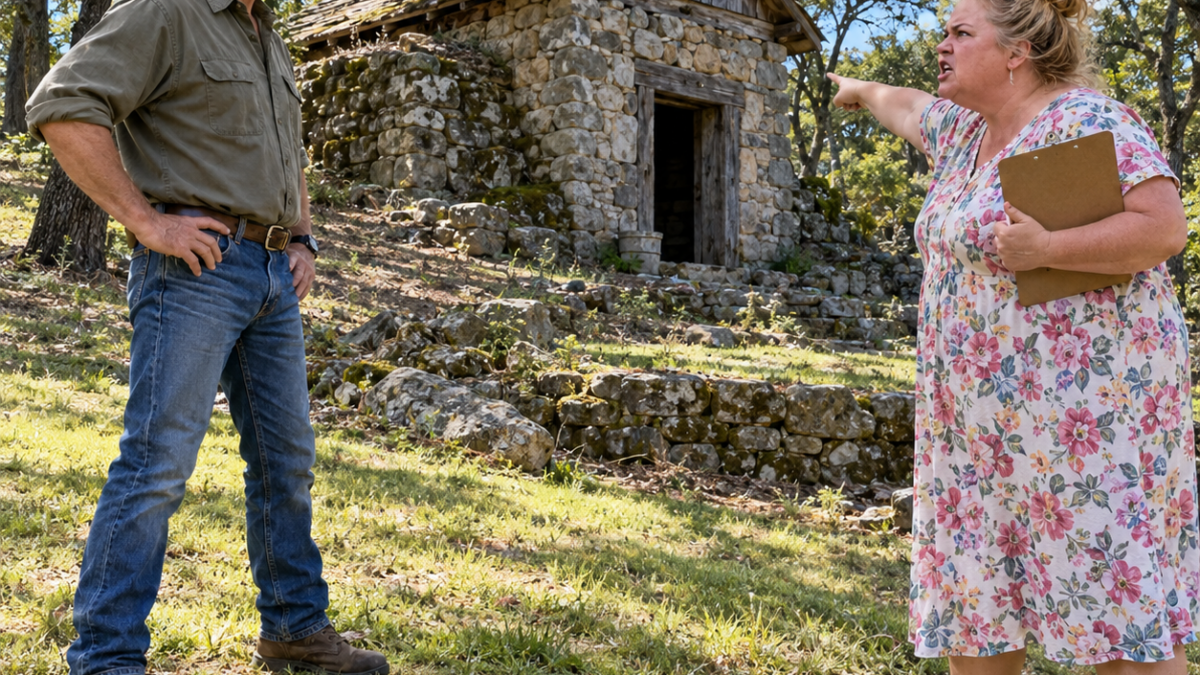
PART 2
The county records office occupied the basement of an old courthouse annex downtown.
It smelled exactly the way an archive should smell—paper, dust, binding glue, and decades of patience.
I arrived ten minutes after they opened.
A woman named Linda sat behind the records counter wearing reading glasses on a chain around her neck.
“What are we hunting for?” she asked.
“My property.”
She slid a request sheet toward me.
“That usually means one of three things. Boundary dispute, inheritance fight, or neighbor trouble.”
“HOA.”
She stopped writing.
“That makes four.”
I smiled for the first time that morning.
I gave her my parcel number.
For the next three hours, I followed my land backward through time.
My five acres had originally belonged to a much larger tract known locally as the Miller farm.
The present subdivision appeared on plats filed in the early 1990s, but the farm existed generations earlier.
Then Linda brought me a brittle survey map dated 1922.
I spread it carefully beneath the reading lamp.
There was the farmhouse.
There was the pond.
There were several barns that no longer existed.
And near the exact location of my stone structure was a tiny rectangular symbol.
Beside it, someone had written two words in faded ink.
ICE HOUSE.
I stared at them.
“You find something?” Linda asked.
I pointed.
She leaned over my shoulder.
“Well, I’ll be.”
“Can I get a certified copy?”
“Absolutely.”
That map became Exhibit Number One in what I privately started calling the Karen Binder.
The binder grew quickly.
Her original violation letter went inside.
The certified envelope.
My notes from our conversation.
A printed copy of every relevant HOA rule.
A copy of my deed.
The subdivision plat.
The 1922 survey.
Anything with a date went in chronological order.
Twenty-five years in engineering had taught me that memories become arguments, but documentation becomes evidence.
A week after Karen’s visit, her official demolition notice arrived.
It was worse than the conversation.
According to the letter, the ice house represented an “attractive nuisance,” “potential vermin habitat,” “structurally compromised edifice,” and my personal favorite, an “aesthetically incongruous structure inconsistent with the forward-looking character of Oakwood Bluffs.”
Thirty days to demolish it.
Ten-thousand-dollar penalty for noncompliance.
Potential lien against my property.
There was also a sentence claiming the Architectural Review Committee had evaluated the structure.
That interested me.
I had never seen an inspector.
Never received notice of an inspection.
Never given anyone permission to enter the ice house.
So I wrote my first response.
It was calm.
Almost painfully polite.
I requested the engineering report supporting their safety conclusion.
The names and qualifications of the Architectural Review Committee members who had evaluated the building.
The meeting minutes documenting the board vote.
The specific aesthetic standard being cited.
Any photographs, inspection notes, or expert opinions used in reaching their conclusion.
I sent everything certified mail.
Then I attended the next HOA meeting.
The community center was basically a double-wide trailer with fluorescent lights and ambitions.
Fifteen residents were scattered among folding chairs.
At the front sat Karen with two board members.
The treasurer, Frank Mercer, looked like a man permanently expecting bad news.
The secretary, Sarah Nolan, kept arranging and rearranging the same stack of papers.
Karen sat between them.
When she saw me, her expression changed.
Only slightly.
But enough.
“We have a new resident joining us tonight,” she announced when new business began. “Major Callahan.”
Several people turned.
I stood.
“I’m here regarding the demolition order on my ice house.”
Karen’s smile tightened.
“The structure has already been reviewed.”
“By whom?”
“The Architectural Review Committee.”
“Who serves on it?”
“That information is available through the proper procedure.”
“I used the proper procedure. I sent a written request.”
She paused.
“Then it will be processed.”
“Can you tell me whether a licensed structural engineer inspected the building?”
Her face sharpened.
“Mr. Callahan—”
“Major.”
A sound came from somewhere behind me that might have been a cough hiding a laugh.
Karen gripped her gavel.
“The board does not require you to agree with its determination.”
“I understand. I’m asking what evidence supports the determination.”
“We have eyes.”
The room became very quiet.
I let three seconds pass.
Then I said, “So the building has not been declared unsafe by an engineer?”
Karen realized too late where she had stepped.
“Our community standards do not require an engineering study to recognize an eyesore.”
I nodded.
“Then the safety language in the notice was based on appearance?”
“This discussion is finished.”
“Your bylaws say members have a right to address the board before enforcement action is finalized.”
That got Frank’s attention.
He began flipping through papers.
Karen glared at him.
“The decision has already been made.”
“Then I’m formally appealing it.”
“There is a five-hundred-dollar nonrefundable appeal processing fee.”
Another murmur moved through the room.
Five hundred dollars to challenge an HOA violation sounded ridiculous because it was ridiculous.
I pulled an envelope from my binder.
“I brought a check.”
Karen looked almost pleased again.
Then I added, “Paid under protest.”
Her eyes narrowed.
“Meaning?”
“Meaning cashing it doesn’t mean I agree it’s lawful.”
I placed the envelope on the table.
For the first time all evening, Karen looked uncertain.
Only for a heartbeat.
But I saw it.
When the meeting ended, an elderly man caught up with me outside.
“Major?”
He was thin, maybe seventy-five, with wire-rim glasses and a slight stoop.
“I’m George Harlan. Two houses down.”
We shook hands.
“You handled her better than most people.”
“Karen?”
He glanced over his shoulder.
“She’s been doing this for ten years.”
George told me about garden-hose fines.
Mailbox violations.
Children’s bicycles left visible from the street.
Holiday lights removed twenty-four hours too late.
One widow had been fined because her grass grew too high while she was hospitalized.
Another family paid hundreds because the basketball hoop beside their driveway was supposedly the wrong shade of black.
“Why does everybody tolerate it?” I asked.
George looked toward the glowing windows of the community center.
“Because every time somebody pushes back, she makes their life miserable until they quit.”
That sentence stayed with me.
The next morning, I added a new divider to my binder.
COMMUNITY PATTERN.
Then I started talking to neighbors.
Not campaigning.
Not complaining.
Just listening.
Maria Alvarez lived around the corner and had been in the area since before Oakwood Bluffs existed.
When I mentioned the ice house, she stared at me.
“The Miller place?”
“You know it?”
“My grandfather knew it.”
She smiled.
“When I was little, he used to tell us stories about cutting ice.”
My attention sharpened.
“From where?”
“The old pond in what’s state forest now. Men cut blocks in winter and hauled them by horse wagon. He said the Millers stored enough ice to sell to farms and businesses all through the valley.”
“Did he ever mention the stone building?”
“All the time.”
Maria looked toward my property.
“I thought they tore it down years ago.”
“It’s still there.”
Her eyes became glassy with memory.
“Then you should protect it.”
“I’m trying.”
She took my arm.
“No. I mean really protect it. That building isn’t yours alone. People worked there. Families depended on it. My grandfather was proud he worked one winter on that pond.”
That changed something inside me.
Until then, the fight had been personal.
Karen had threatened my property.
My peace.
My connection to Sarah.
Maria reminded me the ice house contained other people’s memories too.
I needed someone who understood that better than either of us.
The answer came through the VFW.
A retired Army JAG attorney named Dave Sterling agreed to meet me for coffee after another veteran described my situation to him.
Dave was sixty-eight, white-haired, and looked harmless until he started asking questions.
Then he became surgical.
“Show me everything.”
I opened the binder.
He read silently for nearly forty minutes.
Every few pages, he made a small sound.
“Huh.”
Then:
“Interesting.”
Finally:
“Oh, she should not have written that.”
I pointed.
“Which part?”
He looked up.
“Pick one.”
Dave explained that Karen’s refusal to provide association records could create legal problems for the board.
The appeal fee also concerned him.
“Five hundred dollars to read an appeal letter?”
“That’s what they charged.”
“Did they provide a schedule showing how it was calculated?”
“No.”
He smiled.
“I’m going to enjoy asking.”
Then he reached the 1922 map.
“What’s this?”
“The structure.”
He studied the label.
“Ice house.”
“There may be more history behind it.”
“How much more?”
“I don’t know yet.”
Dave leaned back.
“You need Alister Finch.”
“Who?”
“County historian.”
Dave scribbled a phone number on a napkin.
“Brilliant man. Slightly eccentric. He once spent four years proving a courthouse staircase had been built twelve years earlier than everybody thought.”
“Sounds exciting.”
“To him, it was Gettysburg.”
I called Dr. Finch that afternoon.
I barely finished describing the structure before his tone changed.
“Fieldstone?”
“Yes.”
“Wall thickness?”
“About twenty-three inches.”
“Interior pit?”
“Yes.”
“Ventilation openings near the upper wall line?”
“Two remain visible.”
“What kind of beams?”
“Hand-hewn oak, as far as I can tell.”
Silence.
Then:
“Major Callahan, what are you doing Friday morning?”
Dr. Alister Finch arrived at exactly ten.
His Subaru looked like it had spent twenty years losing arguments with dirt roads.
He stepped out wearing a tweed jacket, hiking boots, cargo pants, and the expression of a man who had already mentally left the modern world.
“Show me.”
No small talk.
I liked him immediately.
We walked through the trees.
When the ice house appeared, he stopped.
Not slowed.
Stopped.
For almost a full minute he said nothing.
Then he whispered, “Good Lord.”
He approached the building with both hands visible, almost like he didn’t want to startle it.
He touched the stone.
Studied the mortar.
Examined the corners.
Measured the doorway.
Inside, he aimed a flashlight toward the roof trusses.
“Don’t move.”
“What?”
“Your light.”
I froze.
He stepped closer.
“These adze marks.”
He ran his finger beside the scars left by a hand tool more than a century earlier.
“This timber was shaped before modern mill processing.”
For two hours, the old man became twenty years younger.
He measured everything.
Photographed everything.
Took notes.
Climbed halfway into the storage pit until I grabbed the back of his belt.
“Doctor.”
“I’m perfectly fine.”
“You’re seventy-something.”
“History is not age discriminatory.”
“Falling into a six-foot pit is.”
He reluctantly backed out.
Then he sat on a flat stone outside and looked at his notes.
“This was not a domestic ice cellar.”
I waited.
He looked up.
“It’s too large.”
“For what?”
“For one household. Possibly even one farm.”
Maria’s story came back to me.
“The Millers sold ice.”
Finch’s eyes flashed.
“Who told you that?”
“A neighbor. Her grandfather worked the pond.”
“Get me her name.”
I did.
He wrote it down immediately.
Then he walked around the building one more time.
“If your neighbor’s oral history is correct, and if I can match it to the archival record, this may have been a commercial ice house serving the valley.”
“How unusual is that?”
He looked at me over the top of his glasses.
“Major, almost all structures like this vanished.”
“Why?”
“Wood decays. Land gets redeveloped. Roads widen. Farms disappear. Refrigeration made these buildings obsolete, and people tore them down because they no longer understood why they mattered.”
The irony was not lost on either of us.
“And this one?”
“The stone saved it.”
He smiled.
“Possibly long enough for you to save it again.”
Before he left, I showed him Karen’s demolition order.
He read the phrase aesthetically incongruous twice.
Then handed it back.
“I have spent forty-seven years studying historical architecture, and I have never seen ignorance printed on such expensive stationery.”
I laughed.
He didn’t.
“I’m serious.”
He pointed toward the ice house.
“That structure may be important.”
“How important?”
“I’m not going to speculate before I finish the archival work.”
He opened his car door.
“But do not let anyone touch it.”
“I wasn’t planning to.”
“Not one stone.”
He drove away.
Three days later, Dave sent the HOA a formal legal demand.
The tone was polite.
The substance wasn’t.
Produce the inspection records.
Produce the minutes.
Produce the committee roster.
Produce the financial justification for the five-hundred-dollar fee.
Provide the statutory authority for entering my land or demolishing privately owned structures.
Ten business days.
Karen did not respond.
Neither did Frank.
Neither did Sarah Nolan.
Nothing.
On the eleventh day, I came home and found the orange sign.
CONDEMNED.
UNSAFE STRUCTURE.
DEMOLITION PENDING.
BY ORDER OF OAKWOOD BLUFFS HOA.
It had been zip-tied to an oak tree on my property.
I stood there staring at it for several seconds.
Then I started laughing.
Not because it was funny.
Because Karen had finally crossed the line from arrogance into something useful.
I called Dave.
“Don’t touch it,” he said immediately.
“I figured.”
“Photograph everything.”
“Already doing it.”
“Wide angles. Close shots. Show the location.”
“I know how to document a site, counselor.”
He chuckled.
“Right. Forgot who I was talking to.”
I took more than forty photographs.
I filmed the route from the road to the sign.
I wrote down the date and time.
Then I left it hanging.
George called that night.
“She can’t condemn buildings, can she?”
“No.”
“Then why would she put that sign up?”
“Because she thinks nobody will challenge her.”
George was silent.
“She really believes that.”
“Yes.”
The next escalation came two days later.
A white demolition van pulled into my driveway.
APEX DEMOLITION SERVICES.
A heavyset man climbed out carrying a clipboard.
“You Callahan?”
“Yes.”
“Need to see the stone shed out back.”
“No, you don’t.”
He stopped.
“I’m here to quote demolition.”
“For whom?”
“Homeowners association.”
“Did they tell you they don’t own the property?”
He frowned.
“I just need measurements.”
“You need permission.”
“I’ve got a work order.”
“From somebody who doesn’t own this land.”
He looked past me toward the trees.
“Listen, buddy, I’m just trying to do my job.”
“And I’m telling you, respectfully, that your job does not include entering my property without my permission.”
He sighed.
“Lady said she was president.”
“She could be President of the United States and she still wouldn’t own these five acres.”
He studied me.
I stayed calm.
After a moment, he shrugged.
“Not worth my day.”
He turned around.
Before leaving, he gave me something unexpectedly useful.
“Name’s Ray,” he said. “For what it’s worth, she told my office the association controlled the parcel.”
“Did she put that in writing?”
Ray hesitated.
“Email.”
“Keep it.”
He nodded slowly.
“Yeah.”
Then he drove away.
That evening, Dave called the demolition company himself.
By the following afternoon, Ray’s company had sent us a written statement confirming that Karen had represented the HOA as having authority over the structure.
The binder needed another divider.
MISREPRESENTATION / TRESPASS.
Karen was building my case faster than I could organize it.
But she still had one advantage.
Time.
The original thirty-day deadline was three days away.
And I still had no formal historical designation.
Then Dr. Finch called.
“Major.”
His voice was shaking.
Not with worry.
Excitement.
“I found the Miller ledger.”
“The what?”
“A transaction ledger from 1889 through 1903. State archive collection. Misfiled under agricultural commerce.”
I sat down.
“What does it say?”
“Your ice house sold stored ice.”
“To whom?”
“Everybody.”
He began naming farms.
A dairy.
Two hotels.
A butcher shop.
A railroad meal station.
A small hospital.
Then he said something that made the hair rise on my arms.
“There was a heat emergency in July of 1896.”
I waited.
“Temperatures exceeded one hundred degrees for days. Local newspaper archives describe spoiled food, illness, and livestock losses. According to the ledger, the Miller ice operation provided emergency deliveries into town.”
I looked toward the window.
The stone building was invisible behind the trees.
“People needed that ice.”
“Very badly.”
Finch lowered his voice.
“This building wasn’t merely a storage shed, Major. It was infrastructure.”
The word hit me differently.
Infrastructure.
That had been my world.
Bridges.
Roads.
Water systems.
Flood control.
Things ordinary people rarely thought about until they failed.
The Miller ice house had been the same thing for another generation.
“How many like it survived?”
“I’m still confirming.”
“Doctor.”
A pause.
“I have found two others.”
My hand tightened around the phone.
“In the county?”
“In the state.”
I said nothing.
Finch continued.
“If my survey is correct, yours would be the third known surviving commercial-grade stone ice house statewide.”
I looked down at Karen’s demolition letter on my table.
She wanted to bulldoze one of three.
“Can you prove it?”
“I would not have called if I couldn’t.”
His final report arrived by courier.
One hundred and twelve pages.
Maps.
Photographs.
Architectural diagrams.
Archival references.
Copies of ledger pages.
Newspaper clippings.
Oral-history notes from Maria.
A structural overview.
And on the final pages, Dr. Finch’s conclusion:
The Miller Farm Ice House represented an exceptionally rare surviving example of nineteenth-century commercial vernacular architecture associated with pre-electrical food preservation and regional agricultural commerce.
One of only three known comparable stone commercial ice houses remaining in the state.
Demolition would constitute an irreversible cultural loss.
I read the conclusion twice.
Then I carried the report outside.
I sat on the grass beside the ice house.
For several minutes I just leaned against the cold wall.
Sarah would have loved this.
Not the fight.
She hated conflict.
But the story.
She would have walked through the door with a flashlight and spent hours imagining the people who had worked there.
I could almost hear her.
See? I told you.
A place with old trees and a story.
I touched the stone beside me.
“I found it, sweetheart.”
My voice cracked.
That surprised me.
I had gotten good at containing grief.
Grief never disappears.
You just build walls around it strong enough to continue functioning.
But sitting beside a building Sarah had never lived long enough to see, I understood that sometimes those walls open without permission.
For a moment, I wasn’t Major Callahan.
I wasn’t the engineer with the binder.
I was a husband who had kept one promise too late for the woman who asked him to make it.
I stayed there until sunset.
The next morning, I called Dave.
He read the report.
When he reached the final conclusion, he laughed softly.
“Well.”
“That good?”
“Jack, Karen gave you a demolition deadline for one of three surviving structures of its kind in the entire state.”
“That sounds bad when you say it like that.”
“It’s going to sound worse in court.”
Then he became serious.
“But understand something. This report doesn’t automatically erase her authority. We still need formal protection.”
“What’s next?”
“Everything.”
Dave filed for an injunction.
He named the HOA.
Karen individually.
The other board members in their official capacities.
He sought return of my appeal fee, access to withheld records, suspension of all enforcement against the ice house, and relief related to the false condemnation notice and contractor entry.
Meanwhile, Dr. Finch submitted the historical nomination.
Maria made a phone call of her own.
Her son Ben worked for the Harrison County Chronicle.
We met in a coffee shop the following afternoon.
I brought one binder.
Ben brought a recorder.
“I want documents,” he said.
“Good.”
I placed the first violation letter on the table.
“No speeches?”
“You can get speeches from somebody else.”
That made him smile.
For the next hour, I gave him dates.
Letters.
Photographs.
Receipts.
Certified-mail records.
The fake condemnation sign.
The demolition contractor statement.
Karen’s written threats.
Then I placed Finch’s report in front of him.
Ben read the title.
His eyebrows went up.
He read the executive summary.
Then the conclusion.
When he looked at me again, he had stopped seeing a neighborhood dispute.
“She tried to have this demolished?”
“Yes.”
“After you challenged the safety determination?”
“Yes.”
“And no engineer ever inspected it?”
“Not on behalf of the HOA, as far as the records show.”
“Have they produced the Architectural Review Committee report?”
“No.”
“Committee membership?”
“No.”
“Meeting minutes?”
“No.”
He stared at the orange-sign photograph.
“She literally made her own condemnation notice?”
“Apparently.”
Ben leaned back.
“This is going on the front page.”
The lawsuit was served on Karen the following evening.
The newspaper hit driveways the next morning.
HOA DEMOLITION ORDER TARGETS RARE HISTORIC ICE HOUSE
A photograph of the stone building covered half the page.
Beside it was Karen’s orange CONDEMNED sign.
By nine o’clock, my phone started ringing.
By ten, the local television station called.
By eleven, a state preservation official had contacted Dr. Finch.
By noon, Karen Bellwether’s world was collapsing.
Frank Mercer called me first.
He sounded terrified.
“Major, I need to explain.”
“You should probably explain to your lawyer.”
“We didn’t know.”
“You voted.”
“Karen told us the building had been inspected.”
“Did you see an inspection report?”
Silence.
“Frank?”
“No.”
“Did you ask?”
Another silence.
“No.”
There it was.
The difference between being deceived and volunteering not to know.
“I’ve got a family,” he finally said. “I can’t be personally caught in something like this.”
“Then stop protecting the person who put you there.”
He exhaled.
“What do I do?”
“Get your own lawyer. Then read your bylaws.”
Sarah Nolan called twenty minutes later.
Same fear.
Same explanation.
Same realization.
Karen had kept them obedient by making herself the only source of information.
Now both of them wanted distance.
That afternoon an emergency board meeting was announced.
Two nights later, the community center filled beyond capacity.
People stood against the walls.
Neighbors crowded the doorway.
The television station had a camera crew in the rear.
George sat in the front row beside Maria.
Dave stood against one wall.
Dr. Finch had arrived wearing his tweed jacket like armor.
And beside him sat a man I had never met.
Dark suit.
State lapel pin.
Karen walked in last.
She looked different.
Still rigid.
Still angry.
But no longer comfortable.
She sat behind the table and struck the gavel.
“Order.”
Nobody listened.
Questions came immediately.
“Why weren’t we told about the lawsuit?”
“Where are the inspection records?”
“Did you really send a demolition company onto private property?”
“Why did you call it condemned when the county never condemned it?”
“Is the five-hundred-dollar appeal fee legal?”
Karen hit the gavel harder.
“This meeting will come to order!”
Frank suddenly stood.
That quieted people faster than the gavel.
“I need to make a statement.”
Karen turned on him.
“Sit down.”
Frank’s face went pale.
But he remained standing.
“I said sit down.”
“No.”
It was a small word.
Almost whispered.
But something happened in that room when he said it.
Ten years of fear cracked.
Frank looked at the residents.
“I was told the ice house had been investigated and represented a liability to the association.”
Karen slammed the table.
“You voted for the resolution.”
“Yes.”
Frank’s voice strengthened.
“And I voted based on information you provided.”
“You reviewed the documents.”
“No.”
He looked at her.
“Because you never provided them.”
Karen’s jaw tightened.
Secretary Sarah Nolan stood next.
“I never saw an engineering inspection either.”
Karen stared at her.
“You too?”
Sarah’s hands trembled.
“You told us everything was handled.”
“It was handled.”
“There’s a lawsuit!”
The room erupted.
Karen pounded the gavel.
“That lawsuit is frivolous.”
Dave smiled from the wall.
Karen saw him.
Her face changed again.
“Who are you?”
“David Sterling.”
Recognition.
She knew the name from the legal letters.
Dave gave her a small nod.
“Counsel for Major Callahan.”
Karen turned away.
Then the stranger beside Dr. Finch stood.
“Madam President.”
The room settled.
“My name is John Carlisle. I represent the State Historic Preservation Office.”
Karen slowly looked at him.
Carlisle held a folder.
“Our office has reviewed Dr. Alister Finch’s nomination regarding the Miller Farm Ice House.”
Dr. Finch sat perfectly still.
Carlisle continued.
“Based on the documented age, architectural integrity, commercial history, and extraordinary rarity of the structure, the state has granted provisional historic protection while final designation is processed.”
No one moved.
Carlisle looked directly at the board.
“Any deliberate demolition, alteration, or destruction from this point forward could expose responsible parties to significant legal consequences under applicable preservation law.”
Somebody behind me whispered, “Oh my God.”
Carlisle wasn’t finished.
“Our preliminary review supports Dr. Finch’s conclusion that the structure is among only three known surviving stone-built commercial ice houses of comparable type within the state.”
Now the room reacted.
Gasps.
Whispers.
Someone applauded.
Then another person.
Within seconds, nearly everyone was standing.
I remained seated.
I looked at Karen.
Her face had drained of color.
For thirty days she had called the ice house dangerous.
Ugly.
Obsolete.
A blight.
Now a state official had just called it rare heritage.
Dr. Finch walked to the front.
Karen lifted her gavel.
“This is still private association business.”
He looked at the gavel.
Then at her.
“History has an interesting way of becoming everybody’s business.”
The applause returned.
Karen’s hand began to shake.
She set the gavel down.
I finally stood.
I carried the binder with me.
I didn’t raise my voice.
I didn’t need to.
“This started when President Bellwether came onto my property and told me I had thirty days to demolish an old stone structure.”
Karen interrupted.
“Because it violated standards.”
I looked at her.
“I’m speaking.”
The room went silent.
Karen’s mouth closed.
I continued.
“She said it was unsafe.”
I opened the binder.
“No engineering report was produced.”
I turned a page.
“She said the Architectural Review Committee had evaluated it.”
Another page.
“No committee evaluation has been produced.”
Another.
“She charged me five hundred dollars to appeal.”
Another.
“She refused repeated document requests.”
Another.
“She posted a sign claiming the structure was condemned.”
I held up the photograph.
“The county did not condemn it.”
Another.
“She hired a demolition contractor and represented that the HOA had authority over my land.”
Another.
“The company documented that representation.”
I closed the binder.
“This stopped being about architecture weeks ago.”
Nobody moved.
“This is about whether a homeowners association exists to serve its residents or intimidate them.”
George stood.
Karen immediately grabbed the gavel.
“You are out of order.”
George ignored her.
“I move that Karen Bellwether be removed as president and from the board for gross negligence and malfeasance under Article Three, Section Four of the association bylaws.”
Maria stood beside him.
“I second.”
Karen slammed the gavel.
“You cannot do this!”
Frank looked down at the bylaws in front of him.
Then he looked at me.
Then at Karen.
“Yes,” he said quietly. “They can.”
Karen spun toward him.
“You spineless little coward.”
Frank flinched.
But this time, he didn’t retreat.
“No, Karen.”
His voice changed.
“I’ve been a coward for years.”
That silenced everybody.
Frank looked around the room.
“I signed things I should have questioned because it was easier than arguing with her.”
Karen shook her head.
“Don’t you dare—”
“I approved fines I knew were excessive.”
“Frank!”
“I watched neighbors get bullied.”
His eyes filled.
“And I told myself it wasn’t my responsibility because she was president.”
He swallowed.
“That was cowardice.”
Karen stared at him.
Then Sarah Nolan stood beside Frank.
“I did it too.”
A woman in the audience began crying.
Not because of Frank or Sarah.
Because people recognized themselves.
How many times do we tolerate something wrong because challenging it would be inconvenient?
How often does one loud person control twenty quiet people simply because nobody wants to be first to stand?
George had been right.
Karen’s power had never really been the gavel.
It had been everybody else’s fear of the noise it made.
Frank cleared his throat.
“The motion has been properly made and seconded.”
Karen stood.
“I forbid this vote.”
Someone laughed.
Then George said, “You don’t own us.”
That sentence broke the room open.
Applause exploded.
Karen grabbed her papers.
“You people are making a catastrophic mistake.”
Frank raised his hand.
“All members eligible to vote in favor of removing Karen Bellwether from the Oakwood Bluffs board, say aye.”
The response shook the trailer.
“AYE!”
Frank waited.
“All opposed?”
Karen stared around the room.
Nobody spoke.
Not one.
Even the people who had defended her for years looked at the floor.
“Nay,” she whispered.
Frank nodded.
“The motion carries.”
Karen’s gavel remained on the table.
Nobody touched it.
Her presidency ended not with a bang, but with a piece of polished wood nobody respected anymore.
She gathered her purse.
Then she looked at me.
“You did this.”
The room went quiet.
I met her eyes.
“No.”
I pointed toward the binder.
“You did.”
Her face twisted.
“You came in here looking for a fight.”
“I came here looking for peace.”
I glanced at the neighbors.
“You brought the fight to my property.”
She took a step toward me.
Dave moved away from the wall.
He didn’t have to say anything.
Karen stopped.
Then she left.
Nobody followed.
I wish I could tell you that was the end.
It wasn’t.
Karen had lost the presidency.
Now she wanted revenge.
Three mornings later, I found a white envelope tucked beneath my windshield wiper.
No stamp.
No name.
Inside was a photocopy of an anonymous complaint supposedly sent to county code enforcement.
It accused me of operating an illegal museum.
Running commercial tours.
Performing unauthorized construction.
Creating excessive traffic.
Harboring “dangerous structural conditions.”
I almost admired the persistence.
Almost.
The county inspector arrived later that week.
His name was Paul Jennings.
I met him at the driveway.
“I suppose you’re here for my illegal museum.”
His expression told me immediately he had already heard the story.
“Something like that.”
I handed him a hard hat.
He laughed.
“You engineers.”
“Habit.”
We inspected the ice house together.
He photographed the exterior.
Checked the walls.
Looked at the beams.
Examined the site.
Then he closed his clipboard.
“Major, I can’t perform a full structural certification. That requires a specialist. But I see no immediate public hazard.”
“What about my unauthorized museum?”
“Are you charging admission?”
“No.”
“Operating hours?”
“No.”
“Gift shop?”
“Not yet.”
He laughed.
“You’ll receive a closure notice on the complaint.”
“Can I ask who filed it?”
“Anonymous.”
I nodded.
I didn’t need the name.
Not yet.
Then another complaint came.
And another.
Noise.
Parking.
Improper landscaping.
Unpermitted repairs.
Each complaint forced a county employee to come out.
Each one found nothing.
Dave advised patience.
“Do not accuse her without proof.”
“I know.”
“She wants you angry.”
“I know.”
“She wants one ugly confrontation on camera.”
“I know, Dave.”
He sighed.
“You’re frustrating to counsel.”
“You’re billing by the hour.”
“That helps.”
Then something unexpected happened.
Ray from Apex Demolition called me.
“I think you should know something.”
“What?”
“That HOA lady called again.”
“When?”
“Yesterday.”
“What did she want?”
“Asked whether we could do emergency stabilization if a structure was a danger.”
I straightened.
“What did you tell her?”
“That we wanted nothing to do with your property.”
“Anything else?”
“She asked hypothetical questions about what happens if part of an old stone wall collapses.”
Cold moved through me.
“What kind of hypothetical questions?”
Ray hesitated.
“Like whether collapse would justify immediate removal.”
I stopped breathing for half a second.
“Did she put that in writing?”
“No.”
“Would you make a statement about the conversation?”
“Yes.”
That night I installed additional cameras.
Not because I thought Karen would knock down the building herself.
Because I no longer knew what she might justify to herself.
For two weeks, nothing happened.
The new HOA board elected George president.
He hated the idea.
Which was exactly why people trusted him.
His first actions were almost embarrassingly ordinary.
Publish meeting minutes.
Open the financial records.
Reduce unreasonable fees.
Create an actual architectural-review procedure.
Require written evidence before violations.
Give residents meaningful appeal rights.
Within days, the atmosphere changed.
Neighbors stood talking in driveways again.
People brought chairs to meetings.
Disagreements still happened.
But disagreement wasn’t punished.
The association had stopped acting like a monarchy.
Then George found the money.
He came to my house carrying three bank statements.
“Jack.”
His face was gray.
“What happened?”
“I think we’ve got a bigger problem.”
We sat at my dining table.
He spread out the statements.
There were recurring payments from the HOA operating account to a consulting firm.
BELLWETHER COMMUNITY COMPLIANCE SERVICES.
I looked at him.
“That her?”
George nodded.
“Registered to Karen’s home address.”
“How much?”
“Over six years?”
He swallowed.
“Forty-eight thousand dollars.”
“For what?”
“That’s the problem.”
There were no contracts.
No invoices describing services.
Just monthly payments.
Seven hundred dollars.
Eight hundred.
Nine hundred.
Sometimes more.
Karen had apparently been paying a company she controlled to administer enforcement activities she herself directed as HOA president.
Dave arrived within an hour.
He reviewed the records.
“This could get ugly.”
“Illegal?”
“Potentially. Conflict of interest at minimum. Possibly misappropriation depending on authorization and disclosure.”
George looked sick.
“We trusted her.”
Dave shook his head.
“No. You feared her. That’s different.”
The board hired an independent accountant.
What emerged over the next month made the ice-house fight look almost quaint.
Karen’s private company had received more than fifty thousand dollars.
Several fine payments collected from residents could not be matched cleanly to ledger entries.
Certain reimbursements lacked receipts.
Money had been spent on “compliance consulting,” legal review that apparently never occurred, and property assessments nobody remembered authorizing.
Karen denied wrongdoing.
Through a lawyer, she claimed every payment had been approved.
The board minutes told another story.
Some meetings authorizing the payments appeared never to have occurred.
One set of minutes listed George as present.
He had been in Florida visiting his daughter that week.
Another listed Maria’s husband as participating in a committee.
He had been dead for two years.
That was when anger finally replaced satisfaction for me.
Karen had not just bullied people.
She had used their exhaustion.
Their fear.
Their assumption that fighting back would cost more than paying.
Every small fine had reinforced the machine.
Twenty-five dollars here.
Seventy-five there.
Two hundred for a mailbox.
Three hundred for a satellite dish.
Most people paid because it seemed easier.
The amounts were small individually.
Together, they became power.
The new board turned everything over to law enforcement and the association’s insurance carrier.
I stayed out of that investigation.
Not my role.
Not my battle.
But Karen decided otherwise.
One rainy evening, she came to my house.
I saw her on the camera before she reached the porch.
She stood under the overhang soaked at the shoulders.
No clipboard.
No gavel.
No board title.
Just Karen.
I opened the door but kept the storm door locked.
“What do you want?”
“You’re destroying my life.”
Her voice wasn’t angry.
Not yet.
It sounded exhausted.
“I haven’t spoken to investigators about your finances.”
“You started all of this.”
“You came onto my property.”
“There it is.”
She laughed bitterly.
“The perfect soldier. Always documenting. Always calculating.”
“I wasn’t calculating when you arrived.”
“You wanted revenge.”
“No.”
“Don’t lie.”
I looked at her.
“You want to know what I wanted?”
She said nothing.
“I wanted breakfast on my porch. Work in my shop. A little land. Maybe restore that ice house slowly over a few years.”
Rain hissed behind her.
“My wife died, Karen.”
Her expression shifted.
“You know that?”
“I heard.”
“I came here because she asked me to keep living.”
Karen looked away.
“I didn’t know.”
“No. You didn’t ask.”
I felt the anger rising.
For once, I let some of it show.
“You looked at an old man living alone and decided I’d be easy.”
“You’re not old.”
“That your defense?”
She shook her head.
“I thought the building was ugly.”
“So?”
“It didn’t fit.”
“Neither do I.”
“That isn’t what I meant.”
“It’s exactly what you meant.”
I unlocked the storm door but didn’t open it.
“You wanted everything here to look the same because sameness made you feel in control.”
Her eyes filled unexpectedly.
“You know nothing about me.”
“You’re right.”
I paused.
“And I didn’t need to. I only needed to know what you did.”
Her mouth tightened.
“The board is trying to make me a criminal.”
“The board found financial records.”
“They approved those payments.”
“Then explain that to the investigators.”
She stared at me for a long time.
Then something in her posture collapsed.
“My husband left me twenty-two years ago.”
I said nothing.
“He told me I made every room miserable because nothing was ever good enough.”
Rainwater dripped from the edge of the roof.
Karen looked out toward the dark yard.
“He said I would rather control people than love them.”
For one moment, I saw the person underneath the title.
A lonely woman who had spent years confusing obedience with respect.
It explained something.
It excused nothing.
“I’m sorry he hurt you,” I said.
Her eyes snapped back to mine.
“Don’t pity me.”
“I don’t.”
That hurt her more.
She drew herself upright.
“You think you won.”
“This was never a game.”
“Oh, please.”
“You lost the board because your neighbors stopped being afraid of you.”
“You made that happen.”
“No.”
I shook my head.
“I gave them documents. They made their own decisions.”
Her jaw trembled.
“The historian. The newspaper. The lawyer. The state. You lined them all up.”
“I asked questions.”
“You humiliated me.”
“You posted a fake condemnation sign on my property.”
“I was protecting the community.”
“From a stone building?”
She looked toward the trees.
Even in darkness, she knew where it stood.
“That thing ruined me.”
“No, Karen.”
My voice softened.
“You ruined yourself trying to destroy it.”
She flinched.
Then she turned and walked back into the rain.
I watched until her car disappeared.
The next morning, I found a single sheet of paper on the porch.
It was the copy of my original violation notice.
Across the bottom, someone had written two words.
YOU WIN.
I kept it.
Not as a trophy.
As a warning.
People who believe every conflict needs a winner eventually turn everybody around them into an enemy.
Months passed.
The criminal investigation over the HOA finances continued.
Some allegations were resolved as sloppy recordkeeping.
Others were not.
Karen eventually entered a civil settlement with the association requiring substantial repayment of improperly documented funds.
The association’s insurer covered part of the losses.
Karen covered the rest.
Additional matters involving records and representations were handled through attorneys and local authorities.
I did not celebrate.
George expected me to.
“You’re a better man than I am,” he said one afternoon.
“Why?”
“I’d be dancing.”
“Sarah would haunt me.”
He laughed.
“She sounds terrifying.”
“She was five-foot-four.”
“Those are the dangerous ones.”
I smiled.
The ice house restoration began that fall.
Dr. Finch insisted on doing everything correctly.
That meant slowly.
Painfully slowly.
Every mortar mixture had to match historic composition.
Replacement wood had to be appropriate.
Modern hardware could not be visible.
The oak door took three attempts.
The first carpenter made it too perfect.
Finch rejected it.
“The nineteenth century did not possess computerized routers.”
The carpenter stared at him.
“I used hand tools.”
“Then use them less skillfully.”
I walked away before I laughed.
The preservation grant covered part of the work.
I covered the rest.
Then something happened I had not expected.
The neighborhood volunteered.
George showed up first with a wheelbarrow.
Maria arrived carrying enough food for an infantry company.
Frank came quietly with work gloves.
He stood at the edge of the yard like he wasn’t sure he belonged.
I walked over.
“You planning to work or supervise?”
He looked relieved.
“Whatever you need.”
“Start moving brush.”
He did.
Sarah Nolan came too.
So did families I barely knew.
Children carried small stones.
Teenagers hauled debris.
Retired men argued about tools.
Women organized lunch under folding tents.
For years, Karen had used the HOA to enforce uniformity.
Now the same association was helping preserve something completely different from everything around it.
That felt like the real revenge.
Not watching Karen lose.
Watching the community become the opposite of what she had built.
One afternoon, Maria brought an old photograph.
It showed eight men standing beside wagons loaded with rectangular blocks of ice.
Behind them was my stone building.
“Where did you find this?”
“My cousin had a box of Grandfather’s things.”
She pointed to the smallest man in the photograph.
“That’s him.”
He was maybe seventeen.
Thin.
Cap tilted sideways.
Trying very hard to look serious.
On the back, written in pencil, were the words:
Miller Pond Ice Crew, January 1901.
Maria touched the young man’s face.
“He told me they worked before sunrise because the ice was safer when it was coldest.”
Dr. Finch nearly levitated when he saw the photograph.
“Primary visual documentation!”
Maria laughed.
“You historians are strange.”
“Madam, this photograph is magnificent.”
He scanned it for the archive.
We eventually framed a copy inside the restored ice house.
Beside it, we displayed reproductions of the old Miller ledger.
Not as a museum.
Not exactly.
More like a memory room.
A few times each year, Dr. Finch gave talks there.
School groups visited.
The county historical society organized a winter program about nineteenth-century food preservation.
George joked that Karen had accidentally created the most educational HOA in the state.
One year after the fight began, the restoration was finished.
The dedication ceremony happened on a bright October morning.
Nearly seventy people came.
Ben from the newspaper returned.
The television station sent a smaller crew.
Nobody cared much about scandal anymore.
They were there because something had survived.
Dr. Finch spoke first.
He stood beside the oak door with his papers shaking in the autumn wind.
“History rarely survives because somebody powerful decides to protect it,” he said.
“It usually survives because an ordinary person encounters something old and vulnerable and decides it is worth the inconvenience of caring.”
He looked at me.
I hated being looked at during speeches.
“This structure survived industrialization, electrification, two world wars, suburban development, neglect, and one extremely determined homeowners association.”
Everybody laughed.
Even I did.
Finch smiled.
“And perhaps most importantly, it survived forgetfulness.”
Maria spoke next.
She held the 1901 photograph.
“My grandfather is standing right there.”
She pointed.
“When I was a child, he told stories and I barely listened.”
Her voice cracked.
“I would give anything now to tell him I finally understood why he kept telling them.”
She wiped her eyes.
“This building gave one of his stories back to me.”
Then George stepped forward.
“I used to think peace meant not making trouble.”
He looked around at the neighbors.
“For ten years, many of us stayed quiet because we wanted peace.”
He shook his head.
“What we got was fear.”
He turned toward me.
“Jack showed us something different.”
I immediately shook my head.
George ignored me.
“He showed us that standing up doesn’t always mean shouting. Sometimes it means keeping records. Asking questions. Refusing to surrender what matters just because someone else is louder.”
He stepped away before I could object.
Then it was my turn.
I hadn’t prepared much.
Public speaking never frightened me.
Personal speaking did.
I stood beside the stone wall.
For a moment, I looked at the bronze plaque waiting to be mounted on the restored oak door.
MILLER FARM ICE HOUSE
CIRCA 1880
STATE HISTORIC LANDMARK
PRESERVED THROUGH THE VIGILANCE OF THE COMMUNITY
No individual names.
Exactly as I wanted.
I looked at the people standing around me.
“A year ago,” I began, “I thought I bought this property because I wanted to be left alone.”
A few people smiled.
“I had retired. My wife was gone. I had spent most of my adult life solving other people’s problems in places that never really felt like home.”
My throat tightened.
I paused.
“Before Sarah died, she told me to find somewhere with old trees and a story.”
Nobody moved.
“I found the trees.”
A soft laugh.
“The story took longer.”
I touched the wall behind me.
“When Karen first threatened this building, I fought because I thought it was mine.”
I looked at Maria.
“Then Maria told me about her grandfather.”
At Dr. Finch.
“Dr. Finch showed me what these stones meant.”
At George.
“And this neighborhood reminded me that sometimes protecting one thing gives people permission to protect one another.”
I looked down for a second.
“I thought Sarah sent me here to find somewhere quiet.”
My voice nearly failed.
“I was wrong.”
The October wind moved through the oaks.
“She sent me somewhere I could belong.”
That was all I could manage.
Maria hugged me first.
Then George.
Then everybody became very interested in pretending they weren’t crying.
We mounted the plaque.
Dr. Finch insisted I tighten the final screw.
I refused.
“Community plaque.”
George rolled his eyes.
“Jack.”
“Community plaque.”
So Maria tightened it.
That felt right.
Karen’s house went on the market two weeks later.
I saw the FOR SALE sign during my morning walk.
For a moment, I felt something dangerously close to satisfaction.
Then I remembered the woman standing on my porch in the rain.
Not president.
Not tyrant.
Just lonely.
The house sold before Christmas.
She moved away quietly.
There was no dramatic final confrontation.
No screaming match.
No police escort.
No crowd watching her leave.
Real endings are rarely as theatrical as people imagine.
Sometimes a person simply packs boxes.
A truck pulls away.
And a neighborhood continues without them.
Several months later, an envelope arrived.
The return address was from another town.
Inside was no letter.
Only a photograph.
It showed an old wooden house.
Victorian.
Weathered.
Beautiful.
On the back, in Karen’s handwriting, were six words:
I decided not to tear it down.
I stared at that sentence for a long time.
Then I laughed.
Sarah would have loved it.
I put the photograph in the binder.
Last page.
Final exhibit.
Years have passed now.
The ice house is still standing.
Every winter, frost gathers in the joints between the stones.
Every summer, the interior stays strangely cool.
Children still ask how people kept food cold before refrigerators.
Dr. Finch, now moving much more slowly, still visits whenever he can.
Maria’s grandfather remains seventeen forever in the photograph on the wall.
George eventually stepped down as HOA president because, in his words, “Any man who starts enjoying this job should immediately become ineligible for it.”
The new boards come and go.
Sometimes they disagree.
Sometimes meetings run too long.
Sometimes somebody complains about trash cans.
Normal problems.
Human problems.
Nobody bangs a giant gavel anymore.
My own life became quieter too.
Not empty.
Quiet.
There is a difference.
I still miss Sarah every day.
Grief changes shape, but it never completely leaves.
Sometimes I sit beside the ice house near sunset with a cup of coffee and tell her what happened that week.
Yes, I know how that sounds.
I don’t care.
I tell her about the school groups.
About Maria.
About George.
About the latest repair Dr. Finch insists must be done using a method unavailable since 1897.
And sometimes I tell her I finally understand what she meant.
A place with a story.
She wasn’t talking about architecture.
She was talking about connection.
About finding somewhere your life can attach itself to something larger than your own loss.
Karen believed power meant being able to force another person to surrender.
I learned the opposite.
Real strength can be quieter than that.
Sometimes it looks like an old man searching through county records.
Sometimes it looks like a widow remembering her grandfather’s stories.
Sometimes it looks like a frightened treasurer finally saying no.
Sometimes it looks like neighbors arriving on a Saturday morning carrying shovels and work gloves.
And sometimes it looks like an old stone ice house standing beneath oak trees while the world around it keeps changing.
Karen once called that building a hazard.
She was right in one sense.
It was dangerous.
Not to the neighborhood.
Not to property values.
Not to anyone’s safety.
It was dangerous to the idea that authority becomes truth simply because somebody prints it on official-looking paper.
Those stones forced people to ask questions.
The questions exposed lies.
The lies exposed fear.
And once people stopped being afraid, the little kingdom Karen had spent ten years building disappeared almost overnight.
The funniest part is that if she had simply left the ice house alone, none of it would have happened.
Nobody would have investigated the board.
Nobody would have questioned the fines.
Nobody would have examined the financial records.
Nobody would have discovered the historical significance of the building so quickly.
Karen wanted those stones gone because she believed they made the neighborhood look imperfect.
Instead, her attempt to destroy them preserved the building permanently.
She gave the ice house state protection.
She reunited a community with its history.
She forced an entire neighborhood to rediscover its voice.
And, without ever intending to, she gave a widower the home his wife had hoped he would find.
Sometimes revenge is not destroying the person who tried to hurt you.
Sometimes the most satisfying revenge is letting the truth remain standing long after their power is gone.
The Miller Farm Ice House has been standing for nearly a century and a half.
If we take care of it, it may stand for another century.
And every time I walk past that bronze plaque, I run my hand across the cold stone and think about Sarah’s last request.
Find somewhere with old trees and a story.
I did.
The trees were waiting.
The story was waiting.
And apparently, all it needed was one very angry HOA president to make sure nobody ever forgot it again.








