PART 2: HOA Called My Greenhouse Abandoned — Just 72 Hours Later the County Hit Them With an $85,000 Fine
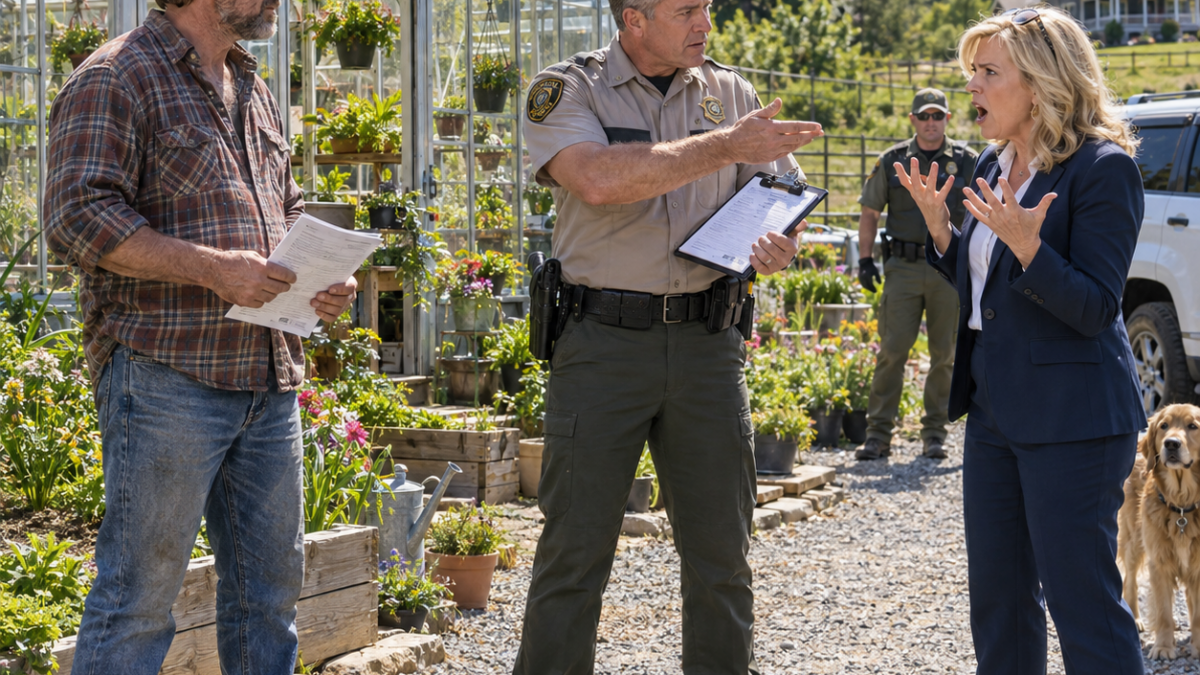
The HOA president stood in my backyard, pointed at the greenhouse I was building for my wife, and gave me seventy-two hours to tear it down.
She called it abandoned even though the wrench was still in my hand and the delivery straps were lying at my feet.
What she did not understand was that I had spent twenty-five years learning what happens when arrogant people sign their names to the wrong piece of paper.
“Five thousand dollars,” Karen Miller said, as casually as if she were telling me the weather. “That’s the fine. And if this structure is still standing after seventy-two hours, the board will take action.”
I lowered the torque wrench and stared at her.
Behind me, the greenhouse frame gleamed in the afternoon sun. Galvanized steel ribs were already anchored into fresh concrete. Stacks of new polycarbonate panels sat beneath a tarp near the fence. A delivery receipt was still clipped to one bundle.
I had been working on the structure less than ten seconds before Karen stepped onto the edge of my yard with two board members behind her.
“Abandoned?” I asked. “I’m standing here building it.”
She folded her arms.
“It has been unfinished for weeks.”
“Because I’m building it myself.”
“That is not the board’s concern.”
That sentence told me almost everything I needed to know.
Karen had been president of the Serenity Meadows Homeowners Association for eight years. She carried herself like the neighborhood had been issued to her personally, along with the mailbox keys and a crown nobody else could see.
The two people with her, Bob Jenkins and Linda Foster, said nothing. They just stood there in matching golf shirts, looking uncomfortable and loyal.
Karen pointed toward the greenhouse.
“It is industrial-looking. It disrupts the visual character of the community. We have complaints.”
“From whom?”
“The board is not required to disclose that.”
I almost laughed.
Instead, I looked back at the greenhouse.
To Karen, it was metal, concrete, and translucent panels.
To me, it was Elena.
My wife had spent the last few years learning how to live around chronic pain that could turn an ordinary morning into a negotiation. Some days she woke up smiling and moved carefully through the house like herself. Other days, simply walking from the bedroom to the kitchen drained the color from her face.
The one thing that consistently gave her peace was growing orchids.
Our spare bedroom had slowly become a miniature rainforest, filled with humidifiers, grow lights, and delicate plants. When Elena worked among them, her shoulders relaxed.
So I had designed her something better: a real climate-controlled greenhouse.
I spent six months on the plans, checking setbacks, drainage, electrical requirements, and zoning restrictions. The county approved my drawings and issued the building permit displayed in my front window.
I knew the HOA bylaws too.
That mattered.
Twenty-five years with the Army Corps of Engineers had taught me one lesson more valuable than any rank I ever held: never enter a fight until you understand the rules better than the person trying to use them against you.
Karen apparently had not learned that lesson.
“You have seventy-two hours,” she repeated.
I wiped sweat from my forehead with the back of my wrist.
“Put it in writing.”
Her eyebrows lifted.
“I intend to.”
“Good.”
She seemed almost disappointed that I had not shouted.
Then she smiled.
It was the kind of smile people wear when they believe the paperwork is already a weapon and all that remains is deciding where to aim it.
The certified letter arrived the next morning.
Karen had fined me five thousand dollars for an “abandoned construction structure,” added a two-hundred-dollar daily penalty, and cited the HOA’s vague “aesthetic harmony” clause.
She also included photographs of my backyard.
Not photographs taken from the street.
Zoomed photographs.
High-angle photographs.
Photographs that could only have been taken from the second floor of her own house.
Elena stood beside me at the kitchen counter as I read the notice twice.
I could feel my temper rising.
She touched my arm.
“Don’t give her what she wants,” she said quietly.
I looked at her.
“What does she want?”
“For you to get angry before you get smart.”
That stopped me.
I carried the letter into my office, closed the door, and placed it beside my county permit.
Then I opened the HOA bylaws.
By the time I found the paragraph Karen had either forgotten or hoped I would never read, I was no longer angry.
I was focused.
Because buried several pages away from the clause she had used against me was another rule—one that changed the entire meaning of the letter sitting on my desk.
PART 2
The paragraph was Section 8.2.
I read it once.
Then I read it again.
Then I leaned back in my chair and smiled for the first time since Karen had walked into my yard.
The language was plain enough. A structure carrying formal county approval was exempt from the HOA’s subjective aesthetic review unless it violated one of several specifically listed restrictions.
I checked those restrictions.
My greenhouse violated none of them.
Karen had cited the broadest, vaguest rule she could find while ignoring the specific rule that limited her authority.
Maybe she had never read the bylaws closely.
Maybe she had read them and simply assumed nobody else would.
Either possibility was useful to me.
I spent the next three hours drafting my response.
I did not insult her.
I did not threaten her.
I did not tell her she was stupid, although at that moment I had several paragraphs available on the subject.
Instead, I wrote the kind of letter I had learned to write when millions of dollars, public infrastructure, and legal liability could turn on the placement of a single sentence.
I documented the date and time Karen had approached me.
I stated that construction was active and ongoing.
I attached copies of material invoices, delivery receipts, photographs showing progress on successive days, my approved site plan, and the county building permit.
Then I quoted Section 8.2.
I followed that with the list of specific restrictions and explained, one by one, why none applied.
Finally, I addressed the photographs.
I wrote that the images appeared to have been taken from an elevated position on private property and that I considered the continuing surveillance of my backyard an intrusion on my family’s privacy.
I requested that the fines be rescinded immediately and that the board cease photographing my family’s private space.
I printed two copies.
One went into a binder.
The other went by certified mail.
When I finished, Elena was sitting at the dining room table trimming a damaged root from one of her orchids.
She looked up.
“You feel better?”
“A little.”
“You’re making that face.”
“What face?”
“The one you used to make when somebody handed you a project everyone else thought was impossible.”
I pulled out the chair across from her.
“I’m not trying to destroy anybody, Elena.”
“I know.”
“I just want them to leave us alone.”
She studied me for a moment.
“No,” she said softly. “You want them to stop doing this to everybody.”
I did not answer immediately.
That was the irritating thing about being married to somebody who knew you better than you knew yourself.
She was right.
Even before I had evidence, something about Karen’s confidence bothered me more than the fine itself.
She had not behaved like a woman enforcing a difficult rule.
She had behaved like a woman who had done this many times and never paid a price for being wrong.
A week later, her answer arrived.
My appeal was denied.
The daily penalties had continued accumulating.
According to Karen, I now owed $6,400.
She did not meaningfully respond to the county permit.
She did not explain Section 8.2.
She simply wrote that the board possessed broad authority to interpret community aesthetics and that its determination was final.
Her response to the privacy complaint was even more revealing.
As HOA president, she wrote, she had a “fiduciary responsibility to observe properties for ongoing violations.”
Observe properties.
That was how she described aiming a camera into my backyard from an upstairs window.
I carried the letter outside to Elena.
She was sitting on our patio with a blanket across her knees despite the warm afternoon.
“Denied?” she asked.
I handed it to her.
She read quietly.
Then she looked toward the unfinished greenhouse.
“Are you going to stop building?”
“No.”
“Good.”
“They may try to place a lien on the house eventually.”
Her expression tightened.
That was the first moment the fight stopped being abstract for her.
This house mattered to us.
We had bought it because the street was quiet, because the backyard caught the morning sun, because the downstairs bedroom meant Elena would not have to climb stairs on bad days.
We had planned to grow old there.
Karen knew that homeowners feared liens, lawyers, and legal bills.
That fear was part of her authority.
Elena folded the letter carefully.
“Then make sure they regret threatening our home.”
There was no anger in her voice.
That made the words heavier.
I started researching that evening.
Serenity Meadows was organized as a nonprofit homeowners association, which meant years of corporate filings and certain governing records were available.
I downloaded everything I could find.
Annual reports.
Board rosters.
Budgets.
Meeting minutes.
Vendor information.
Election records.
I printed until my printer overheated and shut itself down.
By midnight, the dining room table had disappeared beneath paper.
Elena came downstairs for water and found me surrounded by folders.
“Mark.”
“I found something strange.”
“It’s after midnight.”
“I know.”
“You said that three hours ago.”
I pushed a document toward her.
“Karen has been president for eight years.”
“So?”
“Bob has been on the board almost as long. Linda too. Look at the annual meeting minutes.”
Elena sat down.
Some meetings supposedly lasted twelve minutes.
Others fourteen.
Elections were routinely recorded as unanimous.
Attendance was tiny.
Major contracts were approved with almost no discussion.
“It looks like nobody cares,” Elena said.
“Or nobody believes showing up makes a difference.”
I began separating documents into stacks.
Karen.
Bob.
Linda.
Contracts.
Violations.
Minutes.
Finances.
Elena watched me for a minute.
“You’re building another greenhouse.”
I looked up.
“What?”
“Same face. Same piles. Same measuring. You’re just using paper instead of steel.”
That made me laugh.
She went back upstairs.
I kept reading.
Over the next several days, I realized documents alone were not going to tell me what Serenity Meadows had become.
People would.
So I started listening.
Not interrogating.
Listening.
I helped Raj Patel start his car one morning.
I loaned Tom Reynolds, the firefighter two houses down, my extension ladder.
I talked to people while checking the mailbox.
I stopped rushing through conversations at the curb.
Eventually the stories started coming.
Tom was the first.
He was mowing his front yard on a Saturday when I mentioned my greenhouse notice.
The engine had barely stopped turning before his entire expression changed.
“Aesthetic harmony?” he asked.
I nodded.
He gave a humorless laugh.
“She got you with that too.”
“What happened to you?”
He looked toward his garage.
A child-sized basketball sat against the wall.
“My son had a portable hoop.”
I waited.
“Not bolted down. Not attached to the house. A portable hoop. He got it for his ninth birthday.”
“What was wrong with it?”
“According to Karen? Visible sporting equipment created a ‘nonuniform residential presentation.’”
“You’re kidding.”
“I wish.”
He wiped sweat from his forehead.
“She fined us. I appealed. She added penalties. Then I got a letter talking about collection costs and a possible lien.”
His jaw tightened.
“My wife had just had our second baby. I work firefighter shifts. We were exhausted. I paid the fine and sold the hoop.”
He glanced toward the basketball again.
“My boy asked me why grown-ups make rules against kids playing outside.”
That stayed with me.
Not because it was the worst injustice in America.
It obviously was not.
But cruelty did not need to be historic to leave a scar.
Sometimes it was a nine-year-old watching his father dismantle his birthday present because an adult with a title enjoyed being obeyed.
“Do you still have the violation letter?” I asked.
Tom looked at me.
“Why?”
“I’m trying to determine whether this is a pattern.”
He stared at me long enough that I knew he was deciding how much trouble I represented.
Then he said, “Come by tonight.”
He still had everything.
So did the Patels.
Their offense had been repainting trim in a white shade Karen considered insufficiently warm.
The difference between the approved sample and the paint on their house was almost impossible to see unless the two colors were held beside each other.
They had paid $750.
“We thought about fighting,” Priya Patel told me. “Then the letters kept coming. Every letter sounded more serious. Legal fees. Hearings. Collection. We finally decided our peace was worth more than being right.”
That sentence bothered me.
Our peace was worth more than being right.
Because that was the system.
Karen did not necessarily need to win legally.
She just needed to make resisting her more exhausting than surrendering.
The story that finally changed the way I saw the whole fight came from Mrs. Gable.
She had lived in Serenity Meadows for nearly thirty years.
I had seen her tending roses but had never spoken to her for more than a minute.
One afternoon she invited me onto her porch for iced tea.
We talked about weather, landscaping, Elena’s orchids, and eventually the HOA.
The moment I mentioned Karen, Mrs. Gable’s hand tightened around her glass.
“That woman doesn’t like me.”
“Why?”
“I don’t know.”
Her eyes shifted toward a bare patch in the front lawn.
There was something about the way she looked at it that made me ask.
“What used to be there?”
She was quiet for several seconds.
“A Japanese maple.”
Her husband, Frank, had loved them.
They had seen one during a trip for their twenty-fifth anniversary, and he had talked for years about planting one at home.
After he died, Mrs. Gable finally did.
A small memorial.
Nothing extravagant.
Karen ordered it removed.
“Inappropriate species,” Mrs. Gable said.
Her voice cracked on the last word.
“She said the leaves could create maintenance problems near the sidewalk.”
I looked at the empty patch again.
“You removed it?”
“She told me the fines would continue every day.”
Tears gathered in her eyes, and she seemed embarrassed by them.
“I was seventy-six years old, Mr. Davis. My husband was dead. My son lived four states away. She sent letters that sounded like I could lose my house.”
I felt something cold settle in my chest.
“What happened to the tree?”
“The landscaping crew dug it up.”
“Which landscaping crew?”
She thought.
“The company the HOA uses.”
“What company?”
She went inside and returned with an old invoice.
Greenscape Solutions LLC.
I had seen that name.
It appeared all over the HOA budget.
That night I pulled the financial reports again.
Landscaping and common-area maintenance consumed a startling amount of the annual budget.
Yet our entrances had weeds.
Several irrigation heads had been broken for months.
Shrubs around the clubhouse were dying.
The expenditure did not match what I could see.
I looked up Greenscape Solutions in the state business registry.
The owner was Gary Miller.
Miller.
I stared at the name.
Then I searched further.
Gary Miller was Karen’s brother-in-law.
I sat back slowly.
Elena entered the room carrying tea.
“What?”
I turned the laptop toward her.
“The HOA pays this company nearly sixty thousand dollars a year.”
She looked at the screen.
“Okay.”
“It belongs to Karen’s brother-in-law.”
Her expression changed.
“Oh.”
“Yeah.”
“Is that illegal?”
“Not automatically. But it needs disclosure. Proper approval. Competitive dealing. And the work needs to actually exist.”
I pulled the budgets closer.
“And considering what these grounds look like, I want to know what we bought.”
For the first time, the greenhouse seemed almost small.
Karen had thought she was defending her authority by refusing to cancel my fine.
Instead, she had given me a reason to inspect the institution that produced it.
I needed help.
And I needed witnesses.
So I invited several neighbors to a barbecue.
Nothing dramatic.
Burgers.
Potato salad.
Beer.
Sweet tea.
I invited Tom and his wife.
Raj and Priya Patel.
Mrs. Gable.
And David Mercer, a relatively new homeowner who worked as a corporate attorney.
I did not tell anyone I was organizing a rebellion.
I just said I wanted to compare experiences with the HOA.
Saturday evening was warm and still.
The unfinished greenhouse stood behind the patio, its steel frame throwing long shadows across the grass.
People ate.
Children played.
For the first hour, nobody mentioned Karen.
Then I invited the adults inside.
My dining room wall had become a whiteboard.
At the center was one name.
KAREN MILLER.
Around it I had written dates, fines, contract names, and sections of the bylaws.
Tom stared at it.
“Good Lord, Mark.”
“I like visual aids.”
David smiled slightly.
“I can see that.”
I began with my own case.
I showed the county permit.
Karen’s violation notice.
Section 8.2.
Her denial.
Then I showed Tom’s basketball-hoop fine.
The Patels’ paint violation.
Mrs. Gable’s tree.
Nobody interrupted.
When I finished those, I placed the Greenscape corporate record beside the HOA budget.
David leaned forward.
“Where did you get that?”
“Public business registry.”
“And you’re sure Gary Miller is related to Karen?”
“Brother-in-law.”
Raj whistled softly.
I pointed to the expenditure.
“Nearly sixty thousand a year.”
“For this landscaping?” Priya asked.
“Exactly.”
Mrs. Gable stared at the paper.
“That’s the company that removed Frank’s tree.”
The room changed.
Until then we had been neighbors discussing grievances.
At that moment, we became something else.
People began telling stories over one another.
A fence denied for reasons nobody could find in writing.
A shed approved for one homeowner and rejected for another.
Late fees that appeared without warning.
Selective enforcement.
Letters ignored.
Records refused.
David raised a hand.
“Everybody stop for a second.”
The room went quiet.
He picked up Karen’s letter denying my request.
“Mark, have you formally asked for the association’s detailed financial records?”
“Not yet.”
“We should.”
“We?”
David looked around the table.
“If we do this, one homeowner is easy to characterize as disgruntled. Six homeowners requesting records under the governing documents and state nonprofit rules are harder to dismiss.”
Tom leaned back.
“So what exactly are you suggesting?”
“A proper records demand. Financial statements. Contracts. Invoices. Minutes. Conflict disclosures. Everything homeowners are entitled to inspect.”
Mrs. Gable spoke from the far end of the table.
“She’ll come after us.”
Nobody answered immediately.
That fear had been in the room all night.
Karen did not have police powers.
She was not a judge.
She did not own anybody’s house.
Yet years of threatening letters had taught intelligent adults to lower their voices when saying her name.
I looked at Mrs. Gable.
“She comes after people because she gets them alone.”
Mrs. Gable stared at her hands.
Then she lifted her head.
“We’re not alone tonight.”
That was the beginning.
David drafted three formal demands.
The first requested a transparent audit and access to five years of financial records.
The second sought full board minutes, including records related to disciplinary decisions.
The third focused on maintenance contracts.
That third request was mine.
Because while researching expenses, I had found another vendor that bothered me.
Crystal Clear Pool Services.
The HOA paid the company generously to maintain the community swimming pool.
I knew very little about pools, but enough about regulated infrastructure to understand one principle.
A decorative flower bed can hide waste.
A swimming pool can hide danger.
Water quality.
Electrical bonding.
Chemical storage.
Drain systems.
Fencing.
Emergency equipment.
Maintenance logs.
One neglected element could move an issue from embarrassing to catastrophic.
So I looked up Crystal Clear Pool Services.
The owner was Bob Jenkins.
The same Bob Jenkins who sat beside Karen on the board.
I stared at the screen for a long time.
Karen’s brother-in-law maintained the grounds.
Karen’s board ally maintained the pool.
The board approved the payments.
Residents paid the dues.
And nobody seemed able to see detailed invoices.
I called David.
“We need everything related to the pool.”
“How much?”
“Invoices. Work orders. inspection records. Chemical logs. Repair history. Contracts.”
“You found something?”
“Not yet.”
There was a pause.
“You sound like you found something.”
“I found a reason to look.”
He understood.
While he prepared the formal request, I went to the county health department and requested the pool inspection history.
The clerk asked how far back I wanted records.
“Five years.”
She looked up.
“That can be a lot.”
“I’m patient.”
She stamped the request.
“Give us about ten business days.”
Back home, Karen was escalating.
Another violation notice appeared.
Another daily penalty.
Then a letter accusing me of intentionally defying the board.
I continued working on the greenhouse whenever Elena felt well enough to sit outside with me.
Some evenings she watched from the patio while I fitted framing pieces.
“You realize this is now the most controversial greenhouse in the county,” she said one night.
“Not even finished and already famous.”
She smiled.
Then the smile faded.
“Mark?”
“Yeah?”
“If this becomes too much, we can stop.”
I set down the drill.
“No.”
“I mean it. I don’t need a greenhouse badly enough for you to spend every waking hour fighting these people.”
I walked over and crouched beside her chair.
“This stopped being about whether you need it.”
“What is it about?”
I looked toward the steel frame.
“It’s about somebody telling us fear is the price of living in our own home.”
Elena reached for my hand.
“I don’t want you turning hard because of me.”
“I’m not.”
“Promise?”
I squeezed her fingers.
“I’m building something.”
“What?”
“I’m not sure yet.”
The next morning David sent the record demands.
Karen’s response arrived several days later.
The financial audit request was dismissed as unnecessary.
The minutes request received a partial, heavily sanitized packet.
The pool request brought the most revealing answer.
Karen called my requests “obsessive and vexatious.”
She insisted the pool was professionally maintained and perfectly safe.
Then she told me to concentrate on removing my “illegal structure” instead of harassing the board.
I read that sentence three times.
Then I scanned the letter and sent it to David.
He called almost immediately.
“She personally vouched for the pool?”
“In writing.”
“You kept the original?”
“Of course.”
“Mark, you may be the only man I know who files insults alphabetically.”
“Chronologically.”
He laughed.
Then his voice became serious.
“If the pool has documented safety problems, this letter becomes very important.”
“I know.”
“When do the county records arrive?”
“Soon.”
They came on the eleventh business day.
A thick manila envelope.
I carried it inside without opening it.
Elena was at the table repotting an orchid.
She looked at the envelope.
“That’s it?”
“I think so.”
“Open it.”
I slid my finger beneath the flap.
The stack inside was almost an inch thick.
I began arranging reports by date.
The first couple of years were ordinary.
Minor maintenance observations.
A faded sign.
A small repair recommendation.
Then the tone changed.
Three years earlier, an inspector had documented multiple serious safety violations.
Improper storage of pool chemicals.
A noncompliant main drain cover.
A gate that did not reliably self-latch.
Corroded electrical bonding.
Incomplete chemical-testing logs.
I read the inspection summary twice.
Then the follow-up.
Then the next year.
The same violations appeared again.
Repairs had supposedly been “in progress.”
Inspections had been postponed when the pool happened to be closed.
Later reports still showed unresolved issues.
One notation stated that a violation notice had been personally delivered to HOA president Karen Miller.
Personally delivered.
I felt my stomach tighten.
This was no longer a possibility that Karen did not know.
She knew.
I kept reading.
The drain cover remained unresolved.
The chemical storage problem reappeared.
So did the gate.
And the HOA was paying Bob’s company thousands of dollars for pool maintenance while those problems sat there year after year.
Elena had stopped working.
“What is it?”
I pushed one report toward her.
She read slowly.
Her face changed.
“Children swim there.”
“I know.”
“The Patel girl swims there.”
“I know.”
“Tom’s boys.”
“I know.”
She looked at me.
The anger in her eyes surprised me.
“She knew?”
“According to this, yes.”
“And she spent her time photographing our greenhouse?”
I had no answer.
Until that moment, part of me had treated the fight like a technical problem.
Document the misconduct.
Challenge the rule.
Expose the financial conflict.
Beat Karen at the process she had weaponized.
But those inspection reports changed the stakes.
The fines against me were an abuse of authority.
The pool was a danger.
People trusted the HOA to maintain it.
Parents looked through the fence and saw blue water, clean concrete, lounge chairs, and a sign saying the facility was maintained.
They had no reason to imagine that the board had received repeated warnings.
I called David.
This time he did not joke.
“Do not alter anything,” he said.
“I’m looking at copies from the county.”
“Good. Scan them. Back them up. Keep the envelope.”
“Already doing it.”
“What do you want to do?”
“Get the pool inspected.”
“Officially?”
“Immediately.”
There was silence.
Then he said, “I agree.”
I called the county health department.
I described myself simply as a concerned Serenity Meadows resident.
I gave the pool’s identification information.
I referenced the previous inspection dates.
I described the drain-cover issue, chemical storage, gate, electrical concerns, and the fact that current visible conditions suggested at least some violations had not been corrected.
I did not mention Karen.
I did not mention my greenhouse.
I did not mention the HOA battle.
The woman on the phone initially sounded routine.
Then I gave her the old report numbers.
Her typing stopped.
“Where did you obtain those?”
“Your office provided them through a records request.”
Another pause.
“You believe the conditions remain?”
“Yes.”
“Do you have photographs?”
“I have photographs of what can be observed legally from common areas, including the gate. I cannot see the drain closely without entering the facility.”
She began typing again.
“I’m escalating this to the district chief inspector.”
“When?”
“I can’t give you a schedule.”
“I understand.”
“Thank you for reporting it.”
I hung up.
Then there was nothing to do.
That was the hardest part.
Waiting.
Friday afternoon arrived two days later.
The weather was beautiful.
School had just let out for the holiday weekend.
The pool was crowded.
I was organizing tools in my garage when a county vehicle turned onto our street.
Something about the way it moved told me immediately why it was there.
The SUV passed my house and pulled into the community-pool lot.
A man in a county uniform stepped out carrying a clipboard.
I did not follow him.
I walked into my front yard and knelt near a sprinkler head that required absolutely no attention.
From there I could see the pool entrance.
Families filled the deck.
Children splashed in the shallow end.
Teenagers gathered near the deeper water.
Karen reclined beneath an umbrella with Linda.
Bob sat nearby.
The inspector entered through the gate.
He had to pull it closed behind him.
Even from my yard I saw him test the latch twice.
Then he walked directly toward Karen.
I could not hear the first few words.
Then his voice rose.
“Who is responsible for this facility?”
Karen stood.
She gestured toward herself.
The inspector said something else.
Karen’s posture changed.
She pointed toward Bob.
Bob shook his head.
Then the inspector turned toward the pool and addressed everyone.
“Ladies and gentlemen, I need everyone out of the water.”
The entire deck seemed to freeze.
Parents looked at one another.
A lifeguard stood from his chair.
The inspector repeated himself.
“This facility is temporarily closed pending an immediate safety inspection. Everyone out, please.”
Children began climbing from the pool.
Karen rushed after him.
I could hear her now.
“This is unnecessary. We have a licensed maintenance contractor.”
The inspector did not slow.
He checked the gate first.
Then the emergency equipment.
Then the pump area.
When the chemical-storage room opened, he stopped dead.
Bob approached.
The inspector held up one hand.
“Stay there.”
Even at a distance, I saw Bob’s face lose color.
The inspector photographed the room.
He took notes.
He called someone.
Then he moved to the pool edge.
Karen followed him everywhere, talking faster with each passing minute.
Parents were no longer leaving.
They were gathering outside the fence.
Tom appeared beside me.
He was still in a fire-department T-shirt.
“What happened?”
“County inspection.”
“Because of you?”
“I reported documented violations.”
He looked toward the pool.
“My boys were in there ten minutes ago.”
“I know.”
That was all I needed to say.
The inspector spent nearly an hour inside.
By then half the neighborhood seemed to know something was happening.
People stood on sidewalks.
Phones came out.
Karen alternated between arguing with the inspector and whispering furiously at Bob.
At one point she turned toward my house.
Our eyes met across the street.
Her expression told me she had finally connected the dots.
She marched toward the fence.
“This is because of him!” she shouted.
Several people turned toward me.
I stayed where I was.
The inspector looked from Karen to me and back.
“I don’t care who made a complaint,” he said. “I care whether the complaint was true.”
That silenced her for about three seconds.
Then she began again.
“He has been harassing this board for weeks. He’s angry because we cited an illegal greenhouse.”
The inspector stared at her.
“Ma’am, your greenhouse dispute has nothing to do with pool safety.”
“It shows motive.”
“It doesn’t change a drain cover.”
A couple of people near the fence murmured.
Karen’s face went red.
The inspector returned to his paperwork.
Then he called Karen and Bob over.
His voice was loud enough for those nearest the fence to hear.
I caught fragments.
Repeated violation.
Prior notice.
Willful failure.
Critical safety conditions.
Karen began shaking her head.
Bob said, “That was supposed to have been replaced.”
The inspector looked at him.
“By whom?”
Nobody answered.
That question was going to matter later.
A lot.
The inspector filled out several forms.
Then he posted a closure notice at the entrance.
Karen tried one final time.
“You cannot shut our pool down on the Friday before a holiday weekend.”
The inspector turned.
“I can shut down an unsafe pool any day of the year.”
Silence.
He handed her the paperwork.
She read the first page.
Her mouth opened.
“What?”
The inspector said something.
Karen looked at the next page.
Then she shouted.
“Eighty-five thousand dollars?”
People around the fence gasped.
The inspector did not raise his voice.
“The penalties reflect long-term failure to correct documented critical violations, along with the additional deficiencies confirmed today.”
“This is insane.”
“You have appeal rights.”
“Eighty-five thousand dollars!”
“You were previously notified.”
Karen looked around wildly as though somebody might tell her this was theater.
Nobody did.
Tom stood beside me with his arms folded.
“Eighty-five grand,” he whispered.
I watched Karen.
All the confidence she had carried into my backyard was gone.
The woman who had calmly given me seventy-two hours to destroy something I was building for my wife was now holding a county notice she could not dismiss with a board vote.
She pointed at me again.
“He did this.”
For the first time, I answered.
“No, Karen.”
My voice carried farther than I expected.
“You did.”
The crowd went still.
I did not smile.
I did not celebrate.
Because behind that $85,000 number were years of warnings involving a place where our neighbors’ children swam.
The fine was not the victory.
The fact that nobody had been hurt was.
The inspector ordered the facility closed until every cited problem was corrected and approved.
Then he left.
Karen remained standing beside the locked gate.
Residents did not go home.
They surrounded her.
Questions came from every direction.
“How long did you know?”
“Why wasn’t the drain replaced?”
“Where did our dues go?”
“Why did you tell us the pool was safe?”
“Who is paying the fine?”
Bob slipped away first.
Linda followed him.
Karen tried to tell everyone there had been a misunderstanding.
That was when Tom stepped forward.
“My sons swim in that pool.”
Karen looked at him.
“The inspector is exaggerating the risk.”
Tom’s expression became frighteningly calm.
“I’m a firefighter.”
“So?”
“So I spend my career walking into places where somebody ignored a problem until it became an emergency.”
He pointed toward the closure notice.
“Don’t tell me warnings don’t matter.”
She looked away.
I walked back home.
Elena was waiting inside.
She had watched part of it through the front window.
“How bad?”
“Eighty-five thousand.”
Her eyes widened.
“For the HOA?”
I nodded.
“And the pool?”
“Closed.”
She sat down.
For a while neither of us spoke.
Then she asked the question that mattered.
“Was anyone hurt?”
“No.”
Her shoulders dropped.
“Thank God.”
I sat beside her.
She took my hand.
“You don’t look happy.”
“I’m not.”
“You wanted her stopped.”
“I wanted the greenhouse left alone.”
“No, you didn’t.”
I looked at her.
She squeezed my hand.
“You wanted people safe.”
That evening my phone barely stopped ringing.
People who had never attended an HOA meeting suddenly wanted copies of bylaws.
Parents wanted inspection reports.
Homeowners wanted budgets.
David called.
“Mark, things have changed.”
“I know.”
“No, I mean legally and politically. That fine creates an immediate financial crisis for the association. And now every homeowner is going to ask how the board allowed it to happen.”
“They should.”
“We need the emergency meeting now.”
The bylaws allowed homeowners to compel one if a petition met the required threshold.
We needed signatures from ten percent of the association.
I thought it might take days.
It took hours.
Tom walked one side of the neighborhood.
Raj took another.
Priya organized addresses and signatures.
Mrs. Gable, who had once been afraid even to speak Karen’s name too loudly, went door to door carrying a clipboard.
By sunset, we had crossed fifty percent.
By the next morning, more than sixty percent of homeowners had signed.
The usual clubhouse could not hold the turnout we expected.
So we rented the auditorium at the local middle school.
Karen tried to stop the meeting.
First she claimed the petition format was improper.
David answered with the applicable bylaw.
Then she claimed homeowners could not call a meeting while a regulatory appeal was pending.
David asked her to identify the provision supporting that claim.
She did not.
Then she announced that the existing board would recognize only meetings called by the president.
David sent a formal legal notice explaining why that position was unsupported and warning that any attempt to obstruct the membership’s voting rights would be documented.
The meeting remained scheduled.
For the next four days, my dining room became a command center.
And that was when the retaliation began.
The first move was almost laughable.
A new violation notice appeared on my door.
My trash cans had allegedly remained visible from the street for thirty-seven minutes beyond the permitted collection window.
Fine: $250.
I photographed the cans inside my garage with a timestamp showing the notice itself had been false.
The next day, Tom received a warning about parking his fire department pickup in his own driveway.
The Patels received a notice concerning a garden planter.
Mrs. Gable received one about the height of her roses.
Karen was lashing out.
David told everyone the same thing.
“Do not argue with her. Photograph everything. Save every envelope. Send me copies.”
Two nights before the emergency meeting, someone reported my greenhouse to county building enforcement.
A county officer arrived at 8:15 the next morning.
Karen stood in her driveway watching.
I met the officer outside.
“Greenhouse?”
“Yes, sir.”
“We got a complaint alleging unpermitted construction.”
I handed him the permit.
He checked the number on his tablet.
Then he looked at the frame.
“You mind if I inspect?”
“Please do.”
He measured setbacks.
Checked footing locations.
Compared the work to the approved drawings.
Ten minutes later he returned.
“Everything looks fine.”
“Can I get that in writing?”
He smiled.
“You’ve done this before.”
“A few times.”
“I’ll close the complaint as unfounded. You’ll get confirmation electronically.”
Karen disappeared inside her house before he left.
That afternoon an email went out from the HOA account accusing “certain residents” of conducting a campaign of harassment against volunteer board members.
No names were used.
None were necessary.
Karen wrote that the $85,000 county penalty was being appealed and suggested it resulted from “malicious reporting by individuals with personal grievances.”
That email may have been her worst tactical mistake after the pool letter.
Parents were furious.
One replied to the entire neighborhood distribution list.
“Are the inspection reports malicious too?”
Another wrote:
“Did the board know about the prior violations?”
Then:
“Please provide invoices proving the drain cover was repaired.”
Then:
“Why is Bob’s company the pool contractor?”
Karen stopped replying.
By the night of the emergency meeting, Serenity Meadows felt unlike the quiet subdivision Elena and I had moved into.
Cars filled the middle-school parking lot.
People streamed toward the auditorium in groups.
Some carried folders.
Some carried violation letters.
Some carried anger they had stored for years.
More than two hundred homeowners showed up.
I stood behind the curtain for a moment, listening to the noise beyond it.
Elena had insisted on coming.
“You should be home resting,” I told her.
“I have been home resting while you turn our dining room into the Pentagon for three weeks.”
“You’re tired.”
“I can be tired in a chair here.”
She straightened my collar.
“And I want to see how this ends.”
I looked at her.
“This isn’t about revenge.”
“No.”
She smiled faintly.
“But consequences are allowed.”
That was my wife.
I walked onto the stage.
Karen, Bob, and Linda were already seated behind a long table.
Karen had dressed for authority.
Dark blazer.
Pearls.
Hair perfect.
But the performance did not reach her eyes.
Bob looked sick.
Linda kept arranging and rearranging the same stack of paper.
David sat near the front.
Tom stood along one wall.
Mrs. Gable was three rows back.
When she saw me looking, she nodded.
I approached the microphone.
The room quieted.
“For eight years,” I began, “this community has been told that our association is being managed fairly, transparently, and in our collective interest.”
Karen shifted in her chair.
“I’m not going to ask you to believe my opinion tonight.”
I held up the first folder.
“I’m going to show you records.”
That distinction mattered.
I did not call Karen corrupt.
I showed the documents.
I did not call her a bully.
I showed the letters.
I did not accuse the board of selective enforcement.
I placed nearly identical situations side by side and let homeowners see different outcomes.
Tom’s basketball hoop came first.
He stood and briefly described what happened.
Then the Patel paint fine.
Then Mrs. Gable.
When I displayed a photograph of the empty patch where her memorial maple had once stood, Mrs. Gable rose slowly.
“My husband’s name was Frank,” she said.
The room became absolutely quiet.
“We were married fifty-one years.”
Karen looked down.
“Frank loved Japanese maples. After he died, I planted one because I wanted to see something beautiful from my front window and remember him.”
Her voice trembled.
“I was told it did not fit the character of the neighborhood.”
Someone near the back whispered, “Jesus.”
Mrs. Gable continued.
“I was afraid. So I let them remove it.”
She looked toward Karen.
“For two years I thought I was foolish for caring about a tree.”
Then she turned toward the audience.
“I don’t think that anymore.”
Applause started in one corner and spread through the auditorium.
Mrs. Gable sat down crying.
I had to wait before continuing.
Then came the finances.
I displayed the HOA budget.
The landscaping expenditure.
Greenscape Solutions.
Gary Miller’s ownership record.
Eight years of payments.
The room began murmuring.
Karen reached for her microphone.
“This is deliberately misleading.”
David stood.
“Mrs. Miller will have an opportunity to respond after the presentation.”
“I am the president.”
A voice from the audience shouted, “For now.”
The room erupted.
I raised my hand.
“Please. Let the documents speak.”
I showed the pool contract.
Crystal Clear Pool Services.
Owner: Bob Jenkins.
The audience turned toward him.
Bob leaned toward his microphone.
“My company is legitimate.”
“I have not said otherwise,” I replied.
“You’re implying criminal behavior.”
“I’m showing homeowners that a sitting board member’s company received substantial association payments while he participated in association governance.”
“I recused myself when necessary.”
“Then the meeting minutes should show that.”
His face changed.
Because the minutes did not.
I moved on.
Invoices showed payments for maintenance and repairs.
Yet county inspection reports showed the same critical problems recurring.
Then I projected Karen’s letter.
The one calling my records requests vexatious.
The one personally assuring me the pool was safe.
Nobody made a sound while I read the relevant portion.
Next came the county inspection history.
First warning.
Second warning.
Delivery to Karen.
Unresolved violations.
Then the current closure order.
Finally, the $85,000 penalty.
I let the image remain on the screen.
“You all deserve to understand something,” I said.
“This penalty did not appear because somebody disliked the board.”
Karen stared at me.
“It did not appear because of my greenhouse.”
Several people laughed bitterly.
“It appeared after county inspectors documented serious safety deficiencies that earlier records indicate had already been identified.”
A father near the front shouted, “And they knew!”
Others joined him.
Karen reached for her microphone.
“The board relied on professionals!”
Bob turned toward her.
His expression was instant panic.
The audience noticed.
So did I.
Karen continued.
“We were repeatedly assured the necessary work had been performed.”
Every eye went to Bob.
He leaned into his microphone.
“That is not what happened.”
Karen froze.
The room exploded.
Bob stood.
“Stop putting this on me.”
She stared at him.
“You were the contractor.”
“And you signed the checks!”
“You certified the maintenance!”
“You approved the budgets!”
Linda pushed her chair backward as though physical distance might save her.
David walked toward the stage.
“Both of you should probably stop talking.”
They did.
Too late.
I looked at the audience.
“This is why records matter.”
Then I said what I had been waiting to say since the day Karen entered my yard.
“Authority without accountability does not protect a community. It protects whoever controls the paperwork.”
The room was silent again.
David took the microphone.
He explained the procedure for removing directors.
No speech.
No theatrics.
The bylaws allowed a no-confidence vote at a properly convened membership meeting with adequate quorum.
We had quorum several times over.
Removal required a two-thirds majority.
I made the motion.
Tom seconded it.
Karen shot to her feet.
“This is a mob!”
“No,” David said.
“It is the membership.”
“You cannot remove an elected board because you’re angry about one county inspection.”
David looked at her steadily.
“The membership is about to decide why it is voting.”
“You’ll destroy this association.”
A woman in the audience called out, “You already tried.”
Applause thundered.
The ballots were distributed.
For several minutes, all I could hear was paper moving and pens scratching.
I did not vote immediately.
I looked toward Elena.
She was watching me.
I thought about the day Karen had stood beside the greenhouse.
Five thousand dollars.
Seventy-two hours.
Remove it or we will.
That woman had seemed enormous then.
Not physically.
Institutionally.
She had the letterhead.
The board.
The bank account.
The threat of liens.
The assumption that ordinary people would never risk the cost of challenging her.
Now she sat twelve feet away waiting for ordinary people to make a decision about her authority.
I marked my ballot.
The count did not take long.
The motion passed by an overwhelming margin.
Only a handful opposed it.
Karen, Bob, and Linda were removed from the board.
For several seconds Karen simply sat there.
Then the room erupted.
People stood.
Some applauded.
Some hugged.
Tom turned toward his wife.
Mrs. Gable covered her face.
I did not cheer.
I looked at Elena.
She mouthed two words.
“It’s over.”
I shook my head slightly.
Not yet.
Because removing the board did not repair the pool.
It did not erase an $85,000 fine.
It did not tell us where years of association money had gone.
It did not return Mrs. Gable’s tree.
And it certainly did not guarantee that the three people leaving the stage would cooperate.
We elected an interim board that same night.
Tom agreed to serve.
David agreed to serve temporarily so the association could stabilize its legal position.
Maria Alvarez, a retired accountant who had lived in Serenity Meadows for eleven years, accepted the third seat.
Their first motion was simple.
Rescind every outstanding fine issued under Karen’s discretionary use of the aesthetic-harmony provision until each case could be independently reviewed.
The vote was unanimous.
My greenhouse penalties disappeared.
Tom’s old basketball-hoop fine could not be refunded automatically without reviewing prior-year accounting, but his record was cleared.
The Patels’ violation was nullified.
Mrs. Gable’s landscaping restrictions were withdrawn.
When the vote passed, Tom walked up to me.
“How much did she say you owed at the end?”
“Six thousand four hundred and climbing.”
He grinned.
“Congratulations. You’re broke in reverse.”
For the first time in weeks, I laughed hard enough to feel it in my chest.
But the most important motion came next.
Independent forensic audit.
Eight years.
Every contract.
Every invoice.
Every payment.
Every reimbursement.
Every bank transfer.
Every vendor relationship.
Approved unanimously.
The new board terminated the landscaping and pool contracts pending review.
The following morning, certified demands went to Karen, Bob, and Linda for all association property.
Computers.
Keys.
Records.
Credentials.
Checkbooks.
Electronic files.
Linda returned hers before lunch.
Bob dropped two boxes at David’s house that afternoon.
Karen refused.
Her email said she disputed the validity of the removal vote and would retain HOA materials until “proper legal authority” instructed her otherwise.
David read it at my kitchen table.
“What happens now?” Elena asked.
He smiled.
“Now we stop asking Karen for permission.”
He took the certified meeting minutes, removal vote, new-board resolutions, and corporate documents to the bank.
The authorized signatories were changed.
Online access was revoked.
Locks at the clubhouse were rekeyed.
Passwords were reset.
Insurance carriers were notified.
The management mailing address was changed.
By five o’clock, Karen possessed several boxes of paper and almost nothing else.
Her title was gone.
Her bank access was gone.
Her keys no longer worked.
Her emails no longer came from the official HOA account.
Eight years of control ended not with police cars or dramatic handcuffs, but with passwords becoming invalid.
That apparently infuriated her more.
Two days later, I found her waiting beside my driveway.
I stopped several feet away.
“What can I do for you?”
Her eyes looked tired.
“You think you won.”
“I think the membership voted.”
“You orchestrated all of this because of a greenhouse.”
“No.”
“Yes, you did.”
“You came into my yard because of a greenhouse.”
“You humiliated me.”
“I showed documents.”
“You made me look like a criminal.”
I studied her.
“The audit hasn’t even started, Karen.”
Her face tightened.
For the first time, I saw fear.
Real fear.
“You have no idea what it takes to run an association like this.”
“Then help the new board understand. Return the records.”
“I kept this neighborhood from turning into a dump.”
“By fining children’s basketball hoops?”
“By enforcing standards.”
“By removing a widow’s memorial tree?”
“She violated landscaping rules.”
“There was no rule against that species.”
“You don’t understand.”
“No. I understand better than I did three weeks ago.”
I stepped closer, keeping my voice low.
“You thought the rules were whatever you said they were because nobody had enough time, money, or energy to challenge you.”
“That’s ridiculous.”
“You threatened my house over a permitted greenhouse while sitting on years of pool warnings.”
Her mouth tightened.
“I relied on Bob.”
“Then the audit will show that.”
I started walking toward my front door.
“Mark.”
I turned.
“If this association gets sued into bankruptcy, that’s on you.”
“No.”
I looked directly at her.
“That’s the problem you still don’t understand.”
I nodded toward her house.
“Not every consequence belongs to the person who discovered what happened.”
I went inside.
My hands were shaking.
Elena saw it.
“What did she want?”
“To make me responsible.”
“For what?”
“Everything.”
Elena looked through the window at Karen walking home.
“She’s probably been doing that for years.”
The audit began the following Monday.
Maria worked directly with the forensic accountants.
At first, the findings were merely sloppy.
Missing receipts.
Poor documentation.
Incomplete minutes.
Vendor files without competing bids.
Then the accountants started matching invoices against bank records and county reports.
The pattern changed.
Greenscape Solutions had charged the HOA for work that residents could not verify.
Tree replacement billed but not performed.
Irrigation repairs repeated on consecutive invoices.
Seasonal services at rates far above comparable bids.
Equipment rentals without supporting documentation.
Over eight years, auditors estimated that more than $150,000 had been overbilled or inadequately supported.
Then they reached the pool records.
One invoice stopped everyone.
“VGB-compliant main drain safety cover replacement.”
Paid.
Three years earlier.
The exact repair county inspectors repeatedly documented as not completed.
Maria called an emergency meeting at David’s house.
She laid the invoice on the table.
Bob’s company had billed the HOA for installing equipment that inspection records suggested had not been installed.
Tom stared at it.
“So where did the money go?”
Maria shook her head.
“That is the question.”
David looked at me.
“You remember what Bob said on stage?”
“That Karen signed the checks.”
“And Karen said he certified the maintenance.”
Elena, sitting beside me, whispered, “They’re going to blame each other.”
She was right.
Once the forensic accountants requested explanations, the alliance between the former board members collapsed.
Bob sent a letter claiming Karen frequently instructed him to submit simplified invoices to keep association accounting “administratively manageable.”
Karen’s attorney responded that all vendor invoices were the vendors’ responsibility and that she had reasonably relied on professional representations.
Gary Miller, Karen’s brother-in-law, claimed his landscaping company had performed every service billed but no longer possessed supporting job logs for several years.
The auditors kept digging.
The more everybody defended themselves, the more documents they produced.
The more documents they produced, the easier it became to compare stories.
One afternoon David arrived at my house holding a folder.
“This is no longer an HOA matter.”
“What happened?”
“The forensic firm finished its preliminary fraud schedule.”
He set it down.
“I’ve advised the board that we have a fiduciary obligation to refer this.”
“To whom?”
“District attorney.”
Elena looked at him.
“Criminally?”
“I’m not saying anyone will be convicted. That’s not our determination. But there is enough documentary evidence that the association shouldn’t bury it.”
I stared at the folder.
For weeks I had imagined exposing Karen.
Removing her.
Stopping the fines.
Making her answer for the pool.
But criminal investigators felt different.
I remembered her standing beside my greenhouse in the floral dress, smiling as she gave me seventy-two hours.
The distance from that afternoon to this table felt impossible.
“Do it,” I said.
David nodded.
The board voted that evening.
The audit package went to investigators.
Then we waited again.
Serenity Meadows began changing while the legal process moved at its own speed.
The county worked with the new board on the pool penalty.
David and Tom met with officials and showed them the audit, prior records, removal vote, and corrective-action plan.
The new board did not deny the violations.
They did not blame the inspector.
They did not argue that safety standards were unfair.
They said, essentially:
We found the problem.
We removed the people responsible for managing it.
Tell us what must be done.
That approach mattered.
The county agreed to discuss a structured resolution while repairs proceeded.
A reputable pool contractor was hired through competitive bids.
The first thing they did was drain enough water to inspect the equipment properly.
Tom invited me to stand outside the fence when the contractor removed the old drain assembly.
He held the replacement beside it.
The difference was obvious even to someone who was not a pool specialist.
Tom shook his head.
“My boys swam over that.”
I put a hand on his shoulder.
“They’re okay.”
“I know.”
He kept staring.
“That’s what scares me.”
The chemical-storage room was rebuilt and ventilated.
Incompatible chemicals were separated.
Electrical bonding was repaired.
The gate and latch system were replaced.
Emergency equipment was upgraded.
Chemical logs became part of a documented maintenance process.
The new contract required inspection records to be available to homeowners.
Meanwhile, Maria rebuilt the budget.
For the first time in years, residents could see where money went.
Actual bids were posted.
Contracts were disclosed.
Meeting minutes appeared online.
Homeowners were allowed to ask questions without being treated like insurgents.
At the first open budget session, nearly eighty people attended.
Maria looked terrified.
“I spent thirty years doing corporate accounting,” she whispered to me before the meeting. “I have never presented a budget to eighty angry neighbors.”
“They’re less angry now.”
“That’s easy for you to say. You own a torque wrench.”
The meeting lasted two hours.
People disagreed.
Some complained.
One man argued for fifteen minutes about mulch.
It was messy.
And it was wonderful.
Because nobody was afraid.
Mrs. Gable sat in the front row.
Near the end, she raised her hand.
“I have a landscaping question.”
Maria visibly braced herself.
Mrs. Gable smiled.
“Am I allowed to plant a tree?”
The room laughed.
Tom answered from the board table.
“Yes, ma’am.”
“What kind?”
“Whatever legal tree makes you happy.”
The applause lasted almost a minute.
A week later, several of us helped her plant a dogwood.
She decided against another Japanese maple.
“That one belonged to Frank,” she explained. “This one is for me.”
Tom dug the hole.
Raj brought mulch.
Priya brought lemonade.
Elena sat beneath an umbrella directing everyone because her joints were hurting too badly to kneel.
Mrs. Gable placed the first shovel of soil herself.
When we finished, she tied a small ribbon around one branch.
No plaque.
No permission form.
No board vote.
Just a tree.
My greenhouse was taking shape too.
With the violations rescinded, I returned to construction.
For several weeks the frame had stood unfinished while the fight consumed me.
Now the work felt different.
I installed the polycarbonate panels one by one.
Ran the electrical.
Set up environmental controls.
Built cedar benches.
Installed misting lines.
Mounted temperature and humidity sensors.
Elena sometimes sat inside before it was finished.
There was no collection of orchids yet, only bare benches and the smell of fresh lumber.
Still, she liked the warmth.
One evening I found her there alone.
The setting sun turned the translucent panels gold.
“What are you doing?”
“Trying it out.”
“There’s nothing in here.”
“There’s you.”
I sat beside her.
For a while we watched condensation form along one panel.
Then she said, “You disappeared for a little while.”
I knew what she meant.
“I’m sorry.”
“I’m not angry.”
“I spent too much time on it.”
“Yes.”
“I thought if I stopped paying attention for one day, they’d get away with something.”
She leaned her head against my shoulder.
“That’s what fear does.”
I looked at her.
She smiled sadly.
“Karen wasn’t the only person living around fear.”
That hurt because it was true.
I had told myself the binders and late nights were strategy.
Some were.
Some were obsession.
I had spent a career learning to anticipate failure.
Find weak points.
Plan contingencies.
Control variables.
But Elena’s illness was one problem I could not engineer away.
I could build her a greenhouse.
I could install perfect humidity controls.
I could fight an HOA.
I could read a thousand pages of records.
I could not guarantee she would wake up without pain tomorrow.
Maybe that was why the HOA fight had consumed me.
It was a problem I could solve.
Elena took my hand.
“You built this because you wanted to give me somewhere peaceful.”
“I know.”
“So don’t let Karen live in here with us.”
I looked around the unfinished greenhouse.
That night I closed the binder labeled KAREN and put it in a filing cabinet.
Not destroyed.
I am still an engineer.
But closed.
Several weeks later, investigators contacted the former vendors and board members.
We did not know every detail.
We were not supposed to.
Then court filings became public.
Karen Miller, Bob Jenkins, and Gary Miller faced fraud- and embezzlement-related allegations tied to association funds and vendor billing.
The news moved through Serenity Meadows quietly.
There was no neighborhood celebration.
No lawn signs.
No champagne.
By then most people were tired.
This had stopped feeling like revenge.
It felt like cleanup after a storm.
Karen’s house went on the market.
The sign appeared on a Tuesday morning.
I saw it while collecting the mail.
She was outside speaking to the listing agent.
We noticed each other.
Neither of us waved.
Two weeks later a moving truck arrived.
I was fitting the last bench inside the greenhouse when I heard its diesel engine.
For a moment, I considered staying inside.
Then I walked to the front yard.
Boxes came out of Karen’s house.
Furniture.
Lamps.
Framed pictures.
Ordinary things.
She looked ordinary too.
That surprised me.
No blazer.
No board folder.
No entourage.
Just a tired woman standing beside a moving truck.
She saw me.
This time she walked over.
We stopped at the property line.
For several seconds neither of us spoke.
Finally she said, “Happy?”
“No.”
She seemed almost offended.
“You got everything you wanted.”
“No.”
“You got me removed.”
“The homeowners removed you.”
“You exposed the contracts.”
“The audit exposed the contracts.”
“You called the county.”
“Yes.”
There was no reason to lie.
Her eyes hardened.
“So you did admit it.”
“I never denied it.”
“Eighty-five thousand dollars.”
“The inspector found the violations.”
“You knew what would happen.”
“No. I knew someone needed to look.”
Her jaw trembled slightly.
“You ruined my life.”
I thought about Mrs. Gable’s empty lawn.
Tom’s son.
The pool reports.
Elena standing beside a greenhouse Karen wanted destroyed.
Then I thought about the temptation to say something cruel.
A perfect line.
The kind of sentence people imagine delivering when the villain finally falls.
But real life is different.
Winning does not always make the other person disappear into smoke.
Sometimes they are still standing in front of you.
Older.
Smaller.
Human.
“I didn’t ask you to fine me,” I said.
She said nothing.
“I didn’t choose your vendors.”
Silence.
“I didn’t ignore the inspection reports.”
Her eyes dropped.
“And I didn’t send those invoices.”
She looked toward the moving truck.
“I was trying to protect the neighborhood.”
“Maybe you believed that once.”
She looked at me sharply.
“But somewhere along the way,” I continued, “protecting the neighborhood became the same thing as protecting your authority.”
Her eyes filled.
I almost stopped.
Then she asked, “Was the greenhouse worth all this?”
I looked back at my house.
From where we stood, I could see the top of the greenhouse rising beyond the fence.
“It was never about the greenhouse.”
She gave a bitter little laugh.
“That’s what everybody says after they destroy somebody.”
“No.”
I shook my head.
“It started with the greenhouse. It became about what happened when anyone told you no.”
The movers carried another box past us.
Karen straightened.
For one second I saw the old president again.
Then it disappeared.
She turned away.
I never spoke to her again.
The pool reopened near the end of July.
The county had approved the repairs.
The new board negotiated the financial consequences down from the worst-case impact by documenting corrective action and the previous leadership’s conduct, while arranging payment for the remaining obligation.
It still cost us.
There was no magical outcome where every homeowner escaped every consequence.
Negligence has a price, even when the people paying later were not the people who caused it.
But at least this time residents knew exactly what they were paying for.
Safety.
Repairs.
Transparency.
And a system that could no longer hide behind three people’s signatures.
The reopening became an unofficial neighborhood festival.
Tables lined the clubhouse lawn.
People brought barbecue, salads, desserts, and enough lemonade to supply a small county fair.
Kids waited impatiently outside the gate.
Tom stood in front of a microphone.
He had somehow become HOA president, a fact he claimed proved the universe had a sense of humor.
“I have exactly one campaign promise,” he said.
People laughed.
“What is it?” someone shouted.
“I never want to see Mark Davis carrying another binder toward me.”
Everyone turned toward me.
I raised both hands.
“No promises.”
Even Elena laughed so hard she had to wipe her eyes.
Then Tom became serious.
“This pool is open because it has been inspected, repaired, and independently certified.”
He looked around.
“But I want to say something bigger than that. A community is not safe because somebody sits on a board and says it is safe. It is safe when people can ask questions, see records, disagree openly, and expect honest answers.”
Mrs. Gable called out, “And plant trees!”
Tom pointed at her.
“And plant trees.”
Applause rolled across the lawn.
The gate opened.
Children rushed in.
I watched Tom’s sons jump into the shallow end.
For a split second he flinched.
Then he saw the new equipment, the new gate, the county approval posted beside the entrance, and he relaxed.
That expression was worth more to me than watching Karen receive any fine.
A few days later, I finished the greenhouse.
I did not tell Elena.
I wanted the first time to feel complete.
I moved every orchid carefully from the spare bedroom.
Some were thriving.
Some had struggled.
One delicate plant Elena had nearly lost the previous winter had produced a single new shoot.
I placed it on the center bench.
Then I adjusted the humidity.
Checked the temperature.
Tested the misting system.
Turned on the circulation fans.
Everything worked.
Of course I checked it twice.
Then a third time.
I went inside.
Elena was reading on the couch.
“Come outside.”
She looked at me suspiciously.
“What did you do?”
“Nothing.”
“That answer has never meant nothing in thirty-two years of marriage.”
“Trust me.”
She followed me slowly across the patio.
I opened the greenhouse door.
Warm, humid air drifted out.
She stopped.
For a moment she did not move.
Or speak.
Sunlight passed through the translucent roof and softened across rows of orchids.
Green leaves.
White blooms.
Purple blooms.
Tiny roots curling through bark.
The misting system released a faint cloud near the far wall.
Elena put one hand over her mouth.
“Mark.”
I stepped aside.
She walked in.
Very slowly.
She touched the edge of one bench.
Then one leaf.
Then another.
I watched her find the orchid with the new shoot.
“You saved this one?”
“You saved it.”
“I thought it was finished.”
“So did I.”
She turned toward me.
There were tears on her cheeks.
“You did it.”
I shook my head.
“We did.”
“No.”
She looked around.
“You built me a sanctuary.”
That word nearly broke me.
Because somewhere between Karen’s first letter and the audit and the pool and all those meetings, I had forgotten the reason I ever picked up the torque wrench.
Not to win.
Not to expose anybody.
Not to prove that I understood regulations better than an HOA president.
I had wanted to build one quiet place where my wife could have more good hours than bad ones.
Elena stepped closer and wrapped her arms around me.
I held her carefully.
Through the greenhouse panels I could see pieces of the neighborhood.
Tom and his son were assembling another basketball hoop in their driveway.
A big one this time.
Regulation height.
Bright black pole.
Backboard visible from half the street.
Nobody complained.
The Patels were repainting their trim.
Mrs. Gable’s dogwood moved slightly in the evening breeze.
Children rode bicycles past the house.
Two neighbors stood talking beside a mailbox.
Nothing about the scene looked revolutionary.
That was the beautiful part.
It looked normal.
For years, Serenity Meadows had been quiet because people were afraid to attract attention.
Now it was noisy because people felt at home.
There is a difference.
The new board eventually rewrote the worst sections of the governing rules.
The phrase “aesthetic harmony” stayed, but it was paired with objective standards and an appeals process that required written reasons.
Fines could no longer appear without documented notice and an opportunity to respond.
Conflicts of interest had to be disclosed.
Large vendor contracts required competing bids.
Financial statements were available to members.
Inspection reports for common facilities were posted.
Board members had term limits.
David insisted on that one.
“Power needs an expiration date,” he said.
Tom agreed immediately.
No one argued.
At the following annual meeting, the auditorium was not full.
Only about seventy people came.
At first Tom seemed disappointed.
I told him that was probably a good sign.
“Why?”
“People show up in huge numbers when the building is on fire.”
He looked around.
“And seventy?”
“They think the sprinklers work.”
He laughed.
Near the end of the meeting, a homeowner stood and asked about an exterior-lighting request.
Tom opened the governing standards.
He read the relevant section.
They discussed it.
A motion was made.
People voted.
Nobody threatened anyone.
Nobody mentioned liens.
Nobody photographed the homeowner’s backyard from an upstairs window.
The entire matter took seven minutes.
That was what good governance looked like.
Boring.
Transparent.
Predictable.
I loved every second of it.
As for the criminal case, it took much longer than neighborhood gossip expected.
Real legal proceedings usually do.
There were attorneys, motions, disputed accounting, negotiated resolutions, and months when nothing visible happened at all.
I learned not to build my life around waiting for the next development.
The evidence went where it needed to go.
The authorities handled it.
Serenity Meadows moved forward.
That was enough for me.
One morning the following spring, I woke before Elena.
The house was quiet.
I made coffee and walked outside.
Dawn was just beginning.
The greenhouse glowed faintly at the back of the yard.
I opened the door.
Warm air touched my face.
A heating system clicked softly.
Drops of water clung to leaves.
The orchids looked almost unreal in the early light.
I sat on the small bench I had built near the entrance.
On the shelf beside me was a framed copy of the original county permit.
Elena had put it there as a joke.
Below it she had placed a tiny brass plaque.
Not visible from outside.
Not an HOA sign.
Just something for us.
It read:
NOT ABANDONED.
I laughed the first time I saw it.
That morning, I stared at those two words for a long time.
Because they described more than the greenhouse.
Mrs. Gable had not been abandoned.
Tom had not been abandoned.
The Patels had not been abandoned.
The homeowners who had been paying dues without answers had not been abandoned.
And Elena—on the difficult mornings when illness made her world feel smaller—was not abandoned either.
The fight had started because one woman looked at unfinished steel and decided it was worthless.
She saw an eyesore.
I saw something still becoming what it was meant to be.
Maybe communities are like that too.
They are never finished.
They need maintenance.
Attention.
Honesty.
People willing to repair what others neglected.
People willing to speak when silence is easier.
The door opened behind me.
Elena stepped inside wearing her robe.
“There you are.”
“Couldn’t sleep.”
She sat beside me.
For several minutes we watched the sunrise brighten the greenhouse panels.
Then she pointed at the plaque.
“You know Karen would hate that.”
“Elena.”
“What?”
“I thought you were the peaceful one.”
“I am.”
She rested her head against my shoulder.
“Peaceful people are allowed to enjoy irony.”
I laughed.
Outside, somebody bounced a basketball.
Once.
Twice.
Again.
No violation letter followed.
Mrs. Gable’s dogwood had begun flowering.
The community pool was scheduled to open after its annual inspection.
Our HOA account was stable.
Meetings were public.
The greenhouse was full.
And my wife was smiling.
Seventy-two hours.
That was what Karen had given me.
Seventy-two hours to tear down the greenhouse or surrender to her authority.
Instead, those seventy-two hours became the beginning of the end of a system that had survived for years because everybody believed fighting back would cost too much.
In a way, Karen had been right about one thing.
The greenhouse did change the character of Serenity Meadows.
Just not in the way she expected.
It became proof that unfinished does not mean abandoned.
That a rule is not legitimate simply because an intimidating person quotes it.
That paperwork can protect ordinary people just as easily as it can frighten them—if somebody is willing to read it.
And that sometimes the most satisfying revenge is not destroying the person who tried to hurt you.
It is building the thing they ordered you to tear down, opening the door, and watching something beautiful grow inside it.
Elena reached toward a white orchid blooming beside us and gently turned the pot toward the morning light.
“Perfect,” she whispered.
I looked through the clear panels at the neighborhood we had almost allowed one person to define for us.
“No,” I said, putting my arm around her.
“Just finally ours again.”








