PART 2: HOA Called My Grandfather’s Cabin a “Slum” and Ordered It Demolished—Then the State Showed Up
PART 2
I did tell her once.
That distinction mattered later.
At the time, I still believed giving Karen a chance to correct herself was the decent thing to do.
I had spent too many years watching small problems become large ones because pride prevented someone from backing away.
So I attended the next HOA board meeting.
Oak Creek Estates held its monthly meetings in a clubhouse designed to resemble a luxury lodge despite being constructed mostly from synthetic stone and beige siding.
The meeting room smelled faintly of chlorine from the indoor pool.
Rows of folding chairs faced a long plastic table.
At the center sat Karen Miller.
Pink tracksuit.
Clipboard.
Reading glasses balanced on the end of her nose.
To her right sat Todd Benson, the treasurer, a nervous accountant who looked as though every HOA meeting shortened his life by several months.
To her left sat Brenda Hale, the secretary.
Brenda had the expression of someone who had learned that survival depended on agreeing quickly and speaking rarely.
Only eight homeowners had shown up.
That was one reason Karen had accumulated so much power.
Most people wanted nothing to do with the HOA.
They paid the dues.
Mowed their lawns.
Closed the garage door.
Hoped not to become noticeable.
Karen benefited from invisibility.
For forty minutes, she presided over violations with the gravity of a federal judge.
A basketball hoop left in a driveway overnight.
An “unapproved” shade of mulch.
A garbage container visible from the street at 7:15 the morning after collection.
Then she reached my case.
Her entire posture changed.
“Major Rener.”
She smiled without warmth.
“I assume you’re here to provide your demolition schedule.”
I stood.
“Actually, I’m here because I believe your notice was issued in error.”
Her smile tightened.
“I assure you it was not.”
I walked to the table carrying one leather folder.
No theatrics.
No stack of threatening papers.
Inside were only two documents.
The first was her condemnation order.
The second was a certified copy of my historic designation.
I placed the HOA notice in front of her.
Then I covered it with the state certificate.
Karen looked down.
“What is this?”
“The reason the cabin cannot be demolished.”
Todd leaned forward.
Brenda did too.
I continued.
“The Rener Homestead Cabin was formally designated a protected historic landmark before I closed on the property. The designation was completed through the state preservation office after review of architectural records, family documents, photographs, and local historical testimony.”
Karen picked up the certificate.
I watched her eyes move over the embossed seal.
Landmark number.
Effective date.
State signature.
She stopped reading halfway through.
Then she dropped it onto the table.
“Well.”
She leaned back.
“That’s charming.”
“Charming?”
“I’m sure your family is very proud.”
A few people in the audience exchanged glances.
“But,” she continued, “you agreed to Oak Creek Estates covenants when you purchased the property.”
“That’s correct.”
“And those covenants prohibit dilapidated structures.”
“They do not authorize destruction of a protected historic site.”
“Our rules are binding contracts.”
“So is a mortgage. That doesn’t allow a bank to ignore state criminal law.”
Karen’s nostrils flared.
“You’re being argumentative.”
“I’m being precise.”
Todd cleared his throat.
“Karen, maybe we should have counsel review this.”
She turned toward him so sharply he physically leaned backward.
“We have reviewed our authority.”
“With whom?” I asked.
“Our legal adviser.”
“Who is your legal adviser?”
“That’s association business.”
“I’m a member of the association.”
That produced a faint chuckle from the back row.
Karen ignored it.
“Our attorney has confirmed that signed covenants are enforceable.”
“I’m sure they are. That isn’t the question.”
I tapped the certificate.
“The question is whether an HOA covenant permits you to destroy a state-protected landmark.”
She folded her arms.
“I’m not going to debate law with you.”
“That’s wise.”
Todd coughed into his hand, perhaps hiding a laugh.
Karen heard it.
Her face reddened.
I kept my voice calm.
“I’m formally requesting that the board withdraw the demolition notice and any fines attached to it.”
“No.”
“Then I’m also formally advising the board that any attempt to alter or demolish that cabin may violate state preservation law.”
“Your opinion is noted.”
“It isn’t my opinion.”
“The thirty-day deadline remains.”
Todd tried again.
“Karen—”
“The matter is closed.”
She picked up her little wooden gavel and struck the table.
“Next item.”
I stayed where I was.
She stared at me.
“Was there something else?”
“Yes.”
I picked up the historic designation and slipped it into my folder.
“I want the minutes to reflect that I provided the board with proof of the cabin’s protected status and warned you against demolition.”
The room went very quiet.
Brenda looked down at her notebook.
Then at Karen.
Karen said, “Fine.”
“Please read that back.”
“What?”
“The entry.”
Her mouth tightened.
Brenda spoke before Karen could stop her.
She read slowly.
“Major Samuel Rener presented documentation stating the cabin on his property has been designated a state historic landmark and objected to the demolition order on that basis.”
I nodded.
“Thank you.”
Karen slapped her palm against the table.
“And the board rejected that objection.”
Brenda added it.
Perfect.
Now there was a record.
I returned to my seat.
Karen believed she had won the exchange.
She had done the opposite.
She had been offered a safe exit.
She had refused it publicly.
And I had learned the first rule of dealing with her.
Never interrupt Karen while she was creating evidence against herself.
The fines arrived five days later.
Five hundred dollars for failure to obey a board directive.
Then fifty dollars per day for maintaining a condemned structure.
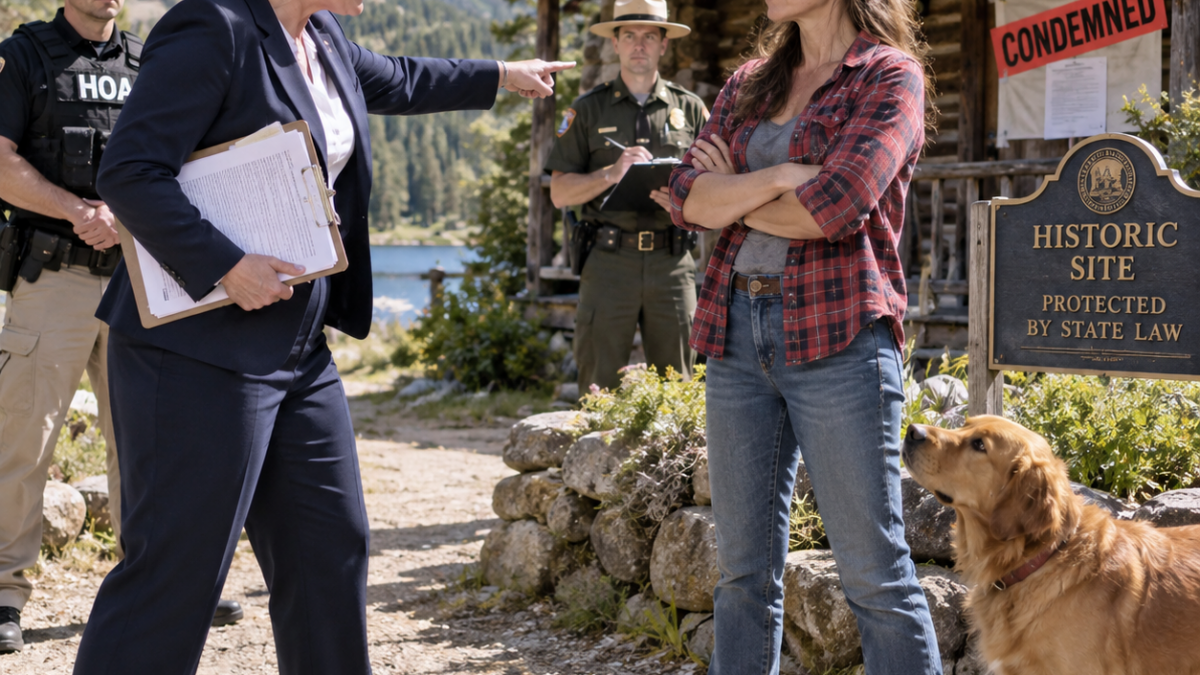
Three days after that, Karen zip-tied an enormous red violation notice to the fence beside my driveway.
CONDEMNED STRUCTURE.
The letters were large enough for passing cars to read.
I cut nothing down.
I removed nothing.
I photographed the sign.
Then another.
Then every envelope.
Every certified-mail receipt.
Every fine.
Every page entered a three-ring binder.
I labeled the spine:
OAK CREEK — CABIN.
By the end of the second week, that binder was two inches thick.
But I had begun realizing something else.
The cabin was not really the center of this story.
Karen was.
And if she was willing to do this to a man with a state certificate hanging in his study, what had she done to people who had no certificate?
So I started walking.
I had always exercised early in the morning.
Now I switched to evenings.
People were outside then.
Watering flowers.
Walking dogs.
Watching children ride bicycles.
I didn’t knock on doors asking people to join a crusade.
I simply talked.
That was how I met Margaret Ellison.
Margaret was seventy-two and lived alone two streets from me.
I found her kneeling beside a patch of bare soil next to her walkway.
“You planting something?” I asked.
She sat back on her heels.
“Eventually.”
Across the street stood a row of rose bushes exploding with color.
I nodded toward them.
“Those do well here.”
Margaret’s face changed.
“I know.”
She pointed to the empty patch.
“I had one there.”
“What happened?”
She hesitated.
Then asked, “You’re the man with the old cabin, aren’t you?”
“Sam.”
“Margaret.”
We shook hands.
Her eyes returned to the dirt.
“My husband planted a Peace rose there on our twenty-fifth anniversary.”
She smiled faintly.
“Yellow petals with pink edges. Beautiful thing.”
“How long did you have it?”
“Twenty-eight years.”
I looked at the empty bed.
“What happened?”
The answer came in a whisper.
“Karen.”
Apparently Karen had decided the thorns constituted a pedestrian hazard.
The sidewalk was more than four feet from the bush.
No complaint had ever been filed.
No one had been injured.
Karen issued a removal order anyway.
Margaret appealed.
The appeal went before Karen’s own board.
Denied.
Then came the fines.
Fifty dollars.
A hundred.
Two hundred.
Margaret finally hired a landscaping company.
“They cut it down while I stayed inside,” she said. “I couldn’t watch.”
I looked at the bare patch.
“My husband died six years ago.”
Her voice cracked.
“That rose was the last living thing he gave me.”
Something tightened in my chest.
A cabin could be designated by the state.
A memory could not.
Karen understood that weakness.
That was why she picked things nobody else could legally measure.
Sentimental things.
Personal things.
Things people eventually surrendered because fighting cost more than losing.
I asked Margaret whether she kept the notices.
She nodded.
“All of them.”
“Would you be willing to show them to me?”
She studied my face.
“Why?”
“Because I think Karen has been counting on everybody believing they’re alone.”
Margaret invited me inside.
Her kitchen table became the second evidence file.
By the time I left, I had copies of twelve violation notices.
That led to the Garcias.
Michael and Elena Garcia had moved into Oak Creek the previous year with two children.
Their backyard held a wooden playset.
Nothing elaborate.
Two swings.
A slide.
A little fort.
Karen fined them because they had not obtained architectural approval.
Michael showed me the application packet.
Twenty-three pages.
Site plan.
Material specifications.
Drainage impact.
Color sample.
Foundation detail.
“So submit it,” I said.
“We tried.”
He showed me the rejection.
INCOMPLETE TECHNICAL DOCUMENTATION.
“What was missing?”
“That’s the problem. Nobody will tell us.”
Elena came outside carrying another envelope.
“This came today.”
One hundred dollars.
I looked at the amount owed.
They were approaching three thousand dollars.
Michael rubbed his forehead.
“We could pay someone to take the whole thing down. But the kids saved birthday money for it.”
Their daughter, maybe eight, was sitting in the little fort coloring something.
I looked away.
I did not tell them about Margaret’s rose.
Not yet.
I simply asked permission to copy their paperwork.
Within ten days, patterns emerged everywhere.
A father fined because children had used sidewalk chalk on a driveway.
A widow ordered to remove a birdbath dedicated to her sister.
A homeowner forced to repaint because his beige was supposedly “too warm.”
One family accumulated hundreds in fines because a trash container could be seen through the slats of their side fence.
Another received three separate violations for leaving a small work trailer in the driveway while repairing storm damage.
Always the same language.
Community standard.
Property value.
Uniform appearance.
Compliance.
But Karen’s enforcement was inconsistent.
People she liked received warnings.
People who challenged her received fines.
People who embarrassed her received more fines.
Then I searched county civil records.
That changed the entire mission.
Oak Creek had recorded liens against nearly thirty properties over five years.
Some were small.
Some were not.
One had eventually contributed to a foreclosure.
I stared at that file for nearly an hour.
The family had fallen behind after accumulating HOA penalties.
The original violation?
Weeds.
Later, an unauthorized satellite dish.
Late fees followed.
Legal costs.
Interest.
Then a lien.
The numbers grew faster than the violations that created them.
I printed everything.
My cabin binder became three binders.
Then four.
But facts alone would not change Oak Creek.
Karen’s greatest weapon wasn’t the rulebook.
It was isolation.
Every resident believed their fight was private.
Private shame.
Private expense.
Private helplessness.
That was when I met Colonel David Sterling.
Retired Marine.
Twenty-five years in the Judge Advocate General’s Corps.
I noticed the small Marine Corps sticker on his truck before I knew anything else about him.
One Saturday morning, his riding mower refused to start.
I had rebuilt enough small engines to be dangerous.
We spent forty minutes removing a clogged fuel line.
Then another hour talking.
Eventually he asked about the red condemnation sign near my cabin.
I told him everything.
Historic designation.
Board meeting.
Fines.
Margaret.
The Garcias.
The liens.
Dave listened without interrupting.
When I finished, he wiped grease from his hands with an old rag.
“You have copies?”
“All of it.”
“Show me.”
We went to my study.
I placed four binders on the desk.
He opened the first.
Twenty minutes later, he had stopped making small talk.
An hour later, he was taking notes.
“This is not normal enforcement.”
“I know.”
“You have meeting minutes?”
I showed him.
“Proof they knew about the historic designation?”
The certified copy.
“Proof of continued fines?”
The envelopes.
He leaned back.
“Sam, she’s either incompetent or convinced nobody will challenge her.”
“Both.”
“That’s my assessment too.”
He turned to the lien records.
“This needs a deeper look.”
I studied him.
“You interested?”
He smiled.
“I retired because my wife said I was impossible when I didn’t have a fight.”
“Is she still around?”
“Upstairs.”
A woman’s voice shouted from somewhere above us.
“I HEARD THAT.”
Dave grinned.
“Yes, she is.”
By the following weekend, Dave and I had a plan.
We would not begin with a lawsuit.
Lawsuits are expensive.
Slow.
And Karen had used expense as a weapon for years.
Instead, we would organize the homeowners.
Quietly.
We invited twenty-two residents to my workshop on a Thursday night.
I called it a neighborhood safety meeting.
Technically, that was true.
The threat just wasn’t burglars.
At seven, folding chairs filled the workshop.
Margaret came.
The Garcias came.
The chalk family.
The birdbath widow.
Three homeowners whose properties had liens.
Two men I had never met who brought entire folders of violation notices.
People arrived looking nervous.
Several parked down the street because they didn’t want Karen seeing cars outside my house.
That told me everything.
I closed the workshop doors.
“Before we begin,” I said, “nobody here is required to speak.”
Twenty-two faces watched me.
“You don’t have to share anything. You don’t have to sign anything. And nothing said tonight leaves this room without permission.”
Shoulders relaxed slightly.
I had pinned enlarged copies of violations to a corkboard.
No names.
Only categories.
ROSE BUSH.
PLAYSET.
CHALK.
BIRDBATH.
PAINT COLOR.
TRASH CAN.
The room slowly understood.
Margaret looked at the playset notice.
Michael looked at the rose notice.
Someone whispered, “She did that to you too?”
That was the moment the structure began cracking.
For years, Karen’s victims had been separated.
Now they could see the system.
I spoke for less than five minutes.
“This works because each person believes they are the problem.”
Silence.
“You are not the problem.”
I pointed at the board.
“This is a pattern.”
Dave stepped forward.
He had the presence of someone accustomed to speaking in courtrooms.
He explained that HOAs possessed legitimate authority within limits.
Rules could be enforced.
Dues could be collected.
Architectural standards could exist.
But authority had procedures.
Notice.
Due process.
Consistent enforcement.
Legal boundaries.
“And,” he said, holding up a copy of my historic designation, “private covenants do not create a magical exemption from laws protecting a state landmark.”
Someone laughed.
Nervously at first.
Then more people.
Dave smiled.
“Mr. Rener gave the board written evidence.”
He held up the minutes.
“They acknowledged it.”
Then a fine.
“They continued anyway.”
Another fine.
“And again.”
Then Karen’s demolition order.
“This,” he said, “is not strength.”
He placed the paper on the table.
“It is evidence.”
A woman in the back raised her hand.
“What can we actually do?”
“Organize,” Dave said.
“How?”
“Your bylaws permit members holding sufficient voting interest to demand a special meeting.”
Most people did not know that.
Karen probably hoped they never would.
Dave had already calculated the threshold.
We needed signatures.
Not anger.
Not speeches.
Signatures.
We drafted a petition requesting a special membership meeting to consider removal of the president and review disputed fines.
Then Dave drafted a separate cease-and-desist letter concerning my cabin.
It was clinical.
No insults.
No threats beyond what the law itself provided.
It identified the landmark.
Included a copy of the state designation.
Referenced the prior board meeting.
Demanded withdrawal of demolition orders.
Demanded suspension of fines.
And stated clearly that any attempt to damage the cabin would be immediately reported to state preservation authorities and law enforcement.
Before everyone left, Margaret signed the petition first.
Her hand trembled.
Michael Garcia signed next.
Then Elena.
Then the room began moving.
One after another.
Twenty-two signatures.
Not enough yet.
But a beginning.
Margaret stopped beside me on her way out.
“What if she comes after us harder?”
“She probably will.”
Margaret’s face fell.
I continued.
“But she can’t isolate twenty-two people the same way she isolated one.”
That made her smile.
“Good night, Major.”
“Sam.”
“Good night, Sam.”
The cease-and-desist letter reached Karen on Monday.
Registered delivery.
Signature required.
Karen Miller signed at 10:14 a.m.
We knew because Dave had tracking confirmation.
Then something strange happened.
The fines stopped.
Three days.
Four.
Five.
I began wondering whether she had finally spoken to a competent attorney.
Dave was less optimistic.
“People like Karen sometimes go quiet before doing something stupid.”
“You sound experienced.”
“I was a military lawyer for twenty-five years.”
On the eighth day, I learned he was right.
I found the notice nailed to my oak tree.
Not taped.
Not clipped.
Nailed.
I stared at the metal head sunk into bark that had been growing since before Karen was born.
NUISANCE ABATEMENT NOTICE.
The HOA had determined I was noncompliant.
Therefore, pursuant to its claimed enforcement authority, Oak Creek Estates would hire a contractor to remove the condemned structure.
Demolition date:
Saturday, October 21.
9:00 a.m.
Contractor:
Big Dog Demolition & Hauling.
I photographed the nail.
The tree.
The notice.
Then removed it carefully.
Dave arrived thirty minutes later.
I placed the paper on my desk.
He read it once.
Then again.
Then began laughing.
Not loudly.
Just a slow, disbelieving chuckle.
“What?”
He looked at me.
“She signed for the cease-and-desist.”
“Yes.”
“We warned her in writing.”
“Yes.”
“She scheduled demolition anyway.”
“Yes.”
“And she posted the date publicly.”
“Yes.”
Dave leaned back.
“She may be the most cooperative opposing party I’ve ever had.”
I did not laugh.
The date on the paper bothered me.
Ten days.
Ten days until someone drove heavy equipment onto my property and aimed it at the building my grandfather had constructed with his own hands.
I knew the law was on my side.
Knowing did not remove fear.
“What if something goes wrong?” I asked.
Dave stopped smiling.
“That’s why we don’t rely on one layer of protection.”
The first call went to Charles Abernathy at the State Historical Preservation Office.
I had worked with him during the designation process.
He remembered the cabin immediately.
When I emailed him Karen’s demolition notice, the earlier board minutes, and Dave’s cease-and-desist, my phone rang before I could close the laptop.
“Sam.”
His voice sounded different.
Sharper.
“Tell me this notice is fake.”
“It isn’t.”
“She received the designation?”
“At a public board meeting.”
“And the legal warning?”
“Signed for it herself.”
“And now she has hired a demolition company?”
“That’s what the notice says.”
There was a long pause.
Then Abernathy said, “Do not confront the contractor yourself.”
“I wasn’t planning to.”
“I’m serious. Do not stand in front of machinery.”
“Understood.”
“I’m opening an enforcement file today.”
“What does that mean?”
“It means this stops being a disagreement between you and the HOA.”
That was the sentence I needed.
My second call went to the county sheriff.
Sheriff Robert Miller.
No relation to Karen.
I knew him through a local veterans organization.
I gave him the documents.
He asked several questions.
Then he said, “Let me make sure I understand this.”
“All right.”
“You presented proof that the cabin is protected.”
“Yes.”
“The board continued the demolition order.”
“Yes.”
“An attorney sent them another written warning.”
“Yes.”
“The HOA president signed for it.”
“Yes.”
“And afterward she scheduled a demolition crew.”
“Correct.”
Silence.
Finally he said, “That is remarkably poor decision-making.”
“Dave used less polite words.”
“I’m sure he did.”
The sheriff promised deputies would be present Saturday.
Abernathy planned to be there too.
I asked both men the same question.
“Should I warn Karen again?”
Abernathy answered first.
“You already did.”
Dave gave the same answer.
The sheriff gave the same answer.
So I said nothing.
The next ten days changed Oak Creek.
Word spread.
The petition signatures doubled.
Then doubled again.
Karen tried to counterattack.
She sent an association-wide email accusing “a small group of disgruntled residents” of trying to undermine community standards.
That email added twelve signatures.
She posted a notice warning homeowners that spreading “false information” about board business could result in enforcement.
That added nine more.
By Friday afternoon, more than half the neighborhood had signed the petition for a special meeting.
Karen did not know.
We made sure of that.
Friday night, I walked to the cabin alone.
Moonlight silvered the roof.
Inside, I turned on one small lamp.
The interior smelled of pine, old ash, and the linseed oil I used on the floor.
I sat in Grandpa’s chair.
It wasn’t really his original chair.
That one had fallen apart years earlier.
But it stood in the same corner.
I opened one of his journals.
His handwriting was compact and disciplined.
March 1931.
Too much rain. North wall leaking again. Recut sill log before winter.
June 1946.
Tom helped repair roof. Boy works hard when he stops complaining.
Tom was my father.
I smiled.
Then turned another page.
August 1969.
Sam came today. Four years old. Would not stop asking why smoke goes up chimney.
That one stopped me.
I had forgotten that entry existed.
My grandfather had written about me sitting in this same room fifty-seven years earlier.
I ran my fingers over the paper.
Karen called this place a blight.
A rotting pile of logs.
Something that lowered values.
For her, history had value only if it improved a brochure.
For me, it was proof that people existed before us and sacrificed so we could exist after them.
I closed the journal.
“Not tomorrow,” I whispered to the room.
I turned off the light.
At 6:20 Saturday morning, I made coffee.
At 6:45, Dave arrived wearing a suit.
“You know this isn’t court.”
“I dress for important executions.”
“Poor choice of word.”
He winced.
“Fair.”
At 7:30, a few neighbors began appearing along the road.
By eight, there were nearly forty.
No signs.
No chanting.
No confrontation.
People simply stood there.
Margaret brought a folding chair.
Michael and Elena came without their children.
Todd, the HOA treasurer, parked far down the street and joined the crowd.
That surprised me.
Brenda arrived ten minutes later.
“Karen know you’re here?” I asked.
“No.”
“You’re still on the board.”
“Not after today.”
She looked toward the cabin.
“I should have stopped her months ago.”
“Then help stop her now.”
At 8:44, Karen arrived.
Not in the Compliance Cruiser.
Today required more theater.
She drove her white luxury SUV onto the shoulder, parking partly across my driveway.
She emerged in a bright pink tracksuit carrying the clipboard.
Of course.
She surveyed the crowd.
For half a second, uncertainty crossed her face.
Then it vanished.
She enjoyed audiences.
“Good morning,” she called.
Nobody answered.
She turned toward me.
I stood on my front porch beside Dave.
“Major Rener.”
“Karen.”
“I hope you’re prepared to cooperate.”
“I’m prepared.”
She mistook that for surrender.
“I knew eventually you’d come to your senses.”
Dave looked at me.
I looked at him.
Neither of us answered.
At 8:52, the demolition truck arrived.
You could hear it before seeing it.
A diesel rumble rolled down the street.
Then a flatbed appeared carrying a yellow excavator.
Big Dog Demolition & Hauling.
The truck stopped near my driveway.
The operator climbed down.
Big man.
Work boots.
Grease-stained shirt.
Probably late forties.
He approached Karen.
“You Miller?”
“Yes.”
She pointed dramatically.
“That structure.”
The man looked toward the cabin.
“That little log place?”
“Yes.”
“You sure?”
“Completely.”
He glanced at the crowd.
“Property owner here?”
Karen pointed at me.
“He has been properly notified.”
The operator looked directly at me.
“You Sam Rener?”
“I am.”
“You know we’re here?”
“I know.”
He scratched his chin.
“This some kind of dispute?”
Karen stepped between us.
“He is refusing to comply with HOA orders. You are contracted by the association. Proceed.”
The operator studied me another moment.
“Ma’am, I usually like everybody clear before I run equipment.”
“He will stay clear.”
That sentence almost made me admire her confidence.
Almost.
The excavator was unloaded.
Steel tracks hit asphalt.
The engine growled.
Several neighbors stepped backward.
My stomach tightened.
Not because I doubted the plan.
Because plans look very different when forty thousand pounds of machinery is facing your grandfather’s home.
The operator climbed into the cab.
Karen moved to the lawn.
She folded her arms.
The excavator began creeping forward.
Tracks pressed deep marks into the grass.
The boom rose.
Dave whispered, “Any second.”
I said nothing.
The machine stopped near the cabin.
The bucket hovered over the porch roof.
I could see the operator through the glass.
He looked uncomfortable.
He glanced at Karen.
She waved impatiently.
“Take it down!”
The engine revved.
Hydraulic cylinders hissed.
The bucket rotated.
I gripped my coffee mug harder.
One foot.
Maybe eighteen inches.
That was all that separated steel teeth from cedar shingles my grandfather had once replaced with my father.
Then red and blue lights reflected off the excavator window.
The operator froze.
Two sheriff’s vehicles turned onto the road.
No sirens.
They did not need them.
A black state sedan followed.
The first patrol car stopped in front of the demolition truck.
The second stopped behind it.
The operator lowered the bucket without touching the cabin and shut off the engine.
Silence rolled over the property.
Karen spun around.
“What is this?”
Sheriff Miller stepped out.
Two deputies followed.
Then Charles Abernathy exited the sedan carrying a thick file.
Karen stormed toward them.
“You can’t block this operation.”
Sheriff Miller looked at the excavator.
Then at the cabin.
Then at Karen.
“Good morning.”
“This is private HOA business.”
“Not anymore.”
“You’re trespassing on association property.”
The sheriff looked at the ground.
“According to county records, I’m standing on Mr. Rener’s parcel.”
Karen opened her mouth.
Closed it.
Then pointed at the cabin.
“He is in violation of binding covenants. We have the legal right to abate—”
Abernathy stepped forward.
“Karen Miller?”
She turned.
“Yes?”
“Charles Abernathy. State Historical Preservation Office.”
Something changed in her eyes.
Only slightly.
But I saw it.
Recognition.
Not of him.
Of the words.
Historical Preservation.
“This structure is Landmark 734,” Abernathy said.
Karen recovered quickly.
“That designation doesn’t supersede our neighborhood covenants.”
The sheriff raised one eyebrow.
Dave almost smiled.
Abernathy did neither.
“Ms. Miller, our office received documentation showing that you were provided with certified notice of this landmark’s protected status.”
“I receive hundreds of papers.”
“You discussed the designation during a recorded HOA board meeting.”
Karen glanced toward Todd and Brenda in the crowd.
Todd looked away.
Abernathy continued.
“Your association then received a formal cease-and-desist letter explaining that demolition was prohibited.”
“Our counsel told us—”
“Which counsel?”
Silence.
Abernathy opened his file.
“Do you have a written legal opinion authorizing demolition of a protected historic landmark?”
Karen looked at Dave.
Then at me.
“This is harassment.”
“No, ma’am.”
Sheriff Miller’s voice was quiet.
“This is clarification.”
Karen suddenly pointed at me.
“He orchestrated this.”
I remained on my porch.
“You scheduled it.”
“You baited me.”
“You nailed the notice to my tree.”
The crowd murmured.
Karen’s breathing quickened.
She turned back to the sheriff.
“I am president of Oak Creek Estates.”
“I understand.”
“The board voted.”
Todd finally spoke from the roadside.
“No, we didn’t.”
Karen’s head snapped toward him.
“What?”
Todd stepped forward.
His face had gone pale.
But he kept walking.
“We never voted to hire demolition.”
“You approved enforcement.”
“I approved sending another notice.”
“You’re lying.”
Brenda joined him.
“He’s not.”
Karen stared at both of them.
“You signed the minutes.”
Brenda shook her head.
“You changed them after I sent you the draft.”
A murmur rippled through the crowd.
Dave slowly lowered his coffee.
That was new.
Karen’s face changed from anger to panic.
“You two are trying to save yourselves.”
Todd swallowed.
“Yes.”
The honesty stunned everyone.
Then he continued.
“Because I should have stopped you.”
Margaret rose from her folding chair.
“So should all of us.”
Karen looked around.
Neighbors she had fined.
Neighbors she had threatened.
Neighbors who once lowered their eyes when she drove past.
Nobody looked away now.
Abernathy handed a document to Sheriff Miller.
“Sheriff, our office is filing an enforcement complaint concerning the attempted unauthorized destruction of Landmark 734.”
The sheriff read it.
Karen stared.
“What does that mean?”
“It means,” Abernathy said, “this demolition is terminated immediately.”
Karen’s shoulders relaxed for half a second.
She thought that was all.
Then Abernathy continued.
“And because the attempted demolition proceeded after multiple documented warnings, our office is referring the matter for criminal review under the state preservation statute.”
The words seemed to physically hit her.
“Criminal?”
“Yes.”
Her voice rose.
“This is absurd.”
Sheriff Miller stepped closer.
“Ma’am, I need you to remain calm.”
“You cannot arrest me over an HOA violation!”
“This is not an HOA violation.”
The demolition operator climbed down from the excavator.
“Sheriff?”
Miller turned.
“Sir?”
“Nobody told me this was historic.”
Karen whirled.
“You were hired to do a job.”
The operator ignored her.
“I got a work order saying unsafe accessory building.”
He looked at the cabin.
“I wouldn’t have brought equipment if I knew the state was involved.”
Abernathy asked, “Who signed your authorization?”
The operator pointed directly at Karen.
“She did.”
The crowd went silent again.
Karen looked as though the air had disappeared around her.
Sheriff Miller spoke quietly with one deputy.
Then approached Karen.
“Ms. Miller, based on the complaint, the prior notice, and what we’ve observed here this morning, I’m placing you under arrest pending review of the attempted destruction of a protected site.”
For the first time since I had met her, Karen had no immediate answer.
Her mouth opened.
Nothing came out.
The deputy stepped forward.
Then the voice returned.
“You can’t.”
Nobody moved.
“I said you can’t!”
The deputy reached for her wrist.
Karen pulled back.
“Do you know who I am?”
Sheriff Miller looked exhausted.
“Yes, ma’am.”
“I am the president of this community.”
A voice came from the crowd.
“Not anymore.”
I never knew who said it.
Maybe Michael.
Maybe Todd.
Maybe someone who had never spoken at an HOA meeting in their life.
But Karen heard it.
Her shoulders collapsed.
The deputy secured her hands.
She began crying.
Not quietly.
Not with remorse.
With disbelief.
She kept repeating the same phrase.
“This isn’t happening.”
As she passed my porch, she looked at me.
The anger in her face was enormous.
“You did this.”
I set down my coffee.
“No, Karen.”
I looked toward the demolition notice still tucked beneath her clipboard.
“You did.”
She was placed in the patrol car.
The door closed.
Nobody applauded immediately.
I was grateful for that.
Watching another person lose everything is not as satisfying in real life as people imagine.
Even when they earned the consequences.
The moment felt heavier than triumph.
It felt like pressure leaving a room.
Then Margaret started crying.
Elena Garcia put an arm around her.
Todd sat down on the curb.
Brenda covered her face with both hands.
The demolition operator walked toward me.
“Mr. Rener.”
“Sam.”
He nodded toward the cabin.
“I’m sorry.”
“You didn’t know.”
“If I’d hit that roof…”
“But you didn’t.”
He looked relieved.
He called his crew.
They loaded the excavator.
Abernathy placed temporary state enforcement notices beside the cabin.
Bright official seals.
NO ALTERATION WITHOUT AUTHORIZATION.
He shook my hand.
“You did everything correctly.”
I looked at the old logs.
“It shouldn’t have come this close.”
“No.”
He followed my eyes.
“But it didn’t fall.”
That mattered.
By noon, the street was empty again.
The cabin stood untouched.
Only deep track marks in my lawn showed how close the machine had come.
I walked to the porch.
One cedar shingle trembled in the breeze.
I placed my hand against a front log.
Cold.
Solid.
Still there.
I closed my eyes.
“Got you, Grandpa.”
That night, Oak Creek held an emergency meeting.
Karen obviously did not attend.
Neither did I at first.
I was exhausted.
But at seven, Margaret knocked on my front door.
“You’re coming.”
It wasn’t a question.
“Margaret—”
“No.”
She pointed toward the road.
“We spent five years being afraid to attend those meetings. You’re not staying home the first night we’re not scared.”
So I went.
The clubhouse was packed.
Standing room only.
People lined the walls.
Todd and Brenda sat at the front.
Before anything began, both resigned.
Todd spoke first.
“I allowed one person to exercise authority that belonged to the entire board.”
His voice shook.
“I told myself I was preventing conflict by staying quiet.”
He looked at the room.
“I wasn’t preventing anything. I was enabling it.”
Brenda followed.
She admitted Karen regularly rewrote draft meeting minutes.
Sometimes small changes.
Sometimes not.
“I knew,” Brenda said. “I didn’t challenge her because every person who challenged her became a target.”
Someone shouted, “So you let us become targets?”
Brenda’s eyes filled.
“Yes.”
The honesty quieted the room.
“I’m sorry.”
Dave stood near the back.
The residents demanded he come forward.
Someone nominated him as interim president.
He immediately refused.
Then twenty people yelled at him.
He accepted on the condition that the job last only until elections.
His first motion was simple.
Suspend all fines for ninety days.
Unanimous.
His second.
Commission an independent review of active liens and penalties.
Unanimous.
Third.
No enforcement action above a warning could be authorized by one person.
Unanimous.
Fourth.
Review the entire covenant enforcement process.
The room erupted in applause.
I looked at Margaret.
She was smiling.
The next morning, she stood again beside that empty patch near her walkway.
Only this time she wasn’t alone.
Ten neighbors showed up with shovels.
Someone had ordered a new Peace rose.
Same variety her husband planted decades earlier.
It wasn’t the same plant.
Nothing could make it the same.
Margaret understood that.
Still, when Michael Garcia lowered the root ball into the soil, she touched the leaves with both hands.
“My Frank would have liked this.”
Elena hugged her.
Across Oak Creek, things began changing quickly.
The Garcias’ playset fines were canceled.
Then refunded.
The chalk violations disappeared.
The birdbath returned.
A homeowner repainted a front door deep blue simply because he liked deep blue.
Nobody died.
Property values did not collapse.
The sun still rose.
Children still went to school.
Life continued even though every mailbox was not identical.
Meanwhile, the cabin became a different kind of project.
Abernathy helped me apply for a small preservation grant.
A local carpenter volunteered.
Then another.
The more people learned about the cabin, the more stories surfaced.
An eighty-six-year-old man from the next county contacted me after seeing a newspaper photograph.
“My father knew your grandfather,” he said.
He brought an old picture.
The cabin stood in the background.
1934.
My grandfather, maybe twenty-nine, stood beside a mule.
Three other men were repairing a wagon.
I had never seen the photograph.
I stared at it so long the old man laughed.
“Thought you might want that.”
I wanted more than that.
I wanted every person Karen dismissed as irrelevant restored to the story.
So we began collecting history.
Grandpa’s journals.
Old tax maps.
Family photographs.
Letters.
Newspaper clippings.
Neighbors volunteered to scan everything.
The cabin was never turned into a formal museum.
I didn’t want velvet ropes inside the place where my grandfather drank coffee.
Instead, we made it useful.
A long table went beneath the front window.
Children came for local-history days.
Veterans occasionally gathered there.
Margaret held gardening-club meetings on the porch.
During winter, neighbors drank coffee beside the rebuilt stone fireplace.
The cabin became something I had never planned.
Community property without becoming HOA property.
That distinction made me smile every time someone asked.
The legal fallout from Karen took longer.
Criminal cases move slowly.
So do civil ones.
The initial preservation charge was serious.
Her attorney eventually negotiated a plea to a lesser offense.
She avoided prison.
But she did not avoid consequences.
Probation.
A substantial fine directed toward preservation work.
Hundreds of hours of community service.
The judge assigned much of it to county parks and historic-trail maintenance.
When Dave told me, he laughed.
I didn’t.
Not immediately.
Then I imagined Karen spending Saturdays clearing brush beside historic markers she once considered less important than HOA landscaping.
I admit it.
I smiled.
The larger damage came from the civil review.
Once Oak Creek hired an independent accountant, strange expenditures appeared.
Meals.
Fuel.
Home-improvement purchases.
Repeated contractor payments to companies associated with Karen’s personal friends.
Legal costs tied to enforcement actions that had never been properly approved by the board.
Nothing looked enormous individually.
That was how it survived.
A few hundred here.
A thousand there.
Year after year.
But together, the numbers told a story.
The new board turned the records over to counsel.
Residents filed claims seeking reimbursement for fines they believed had been wrongfully assessed.
Not every fine was invalid.
Dave insisted on that distinction.
“We are not replacing one kind of abuse with another,” he said at a meeting. “If somebody actually violated a legitimate rule, we deal with that honestly.”
Some people grumbled.
He didn’t care.
That was one reason he made a good president.
Rules were not the enemy.
Unaccountable power was.
Several liens were released.
Others were reduced.
A few remained because the underlying debts were legitimate.
Transparency replaced Karen’s version of discretion.
Every board vote was recorded.
Budgets went online.
Contracts above a threshold required multiple bids.
Homeowners could attend enforcement hearings without being treated like defendants at a criminal trial.
The two-hundred-page rulebook did not literally vanish overnight.
But within a year, it had been rewritten almost beyond recognition.
Simple standards.
Safety.
Maintenance.
Shared spaces.
No regulation of rose thorns.
No paint-temperature arguments.
No authority to treat childhood chalk drawings like gang graffiti.
The first summer after Karen’s arrest, Oak Creek held a picnic near the clubhouse.
Someone hung lights between the trees.
Families brought food.
Children ran through grass that nobody measured.
I was sitting at a table with Dave when Michael Garcia walked up carrying a beer.
“You realize all this happened because Karen hated your cabin.”
“No.”
I pointed toward his backyard in the distance.
“It happened because your kids wanted a swing.”
Margaret overheard us.
“No.”
She pointed toward herself.
“It happened because she murdered my rose.”
Elena laughed.
“Margaret wins.”
Margaret raised her iced tea.
“I usually do.”
For the first time since returning to my family land, Oak Creek felt less like a subdivision built around me and more like a neighborhood I belonged to.
That surprised me.
When I bought the five acres, belonging had not been part of the plan.
I wanted quiet.
The Army had given me two decades of people.
Briefings.
Crews.
Command structures.
Phone calls at impossible hours.
Problems involving bridges, roads, generators, drainage, materials, schedules, and occasionally people trying to kill us while we solved them.
Retirement was supposed to be solitude.
Grandpa’s cabin.
A workshop.
Five acres.
Coffee before sunrise.
That was enough.
Then Karen declared war on the cabin.
And somehow the battle gave me neighbors.
A year after the attempted demolition, we held a small ceremony outside the cabin.
Nothing extravagant.
Abernathy came from the state office.
The old man who had brought the 1934 photograph came with his daughter.
Several children from Oak Creek read short passages from Grandpa’s journals.
Margaret insisted on decorating the porch with roses.
Dave unveiled a small bronze plaque.
RENER HOMESTEAD CABIN
ESTABLISHED 1928
STATE HISTORIC LANDMARK 734
I ran my fingers over my grandfather’s name.
For a moment, the crowd disappeared.
I could see him again.
Not the man in the old photograph.
The grandfather I remembered.
Suspenders.
Work shirt.
Coffee too strong for any normal human being.
Hands cracked from labor.
He used to tell me something whenever I complained about fixing a fence.
“If you inherit something worth keeping, Sam, you inherit the work too.”
As a boy, I thought he meant maintenance.
Roof shingles.
Fence posts.
Firewood.
Standing there beside that plaque, I finally understood.
He meant responsibility.
History is not preserved because it is old.
It survives because somebody decides it matters enough to defend.
After the ceremony, people slowly left.
Dave remained.
We sat on the porch.
The sun dropped behind the oak.
He handed me a glass of iced tea.
“You ever think about what would’ve happened if you’d just shown Karen the certificate privately and convinced her to back off?”
“I did show her.”
“You know what I mean.”
I leaned against the post.
“She might have backed off.”
“And then?”
“She’d have fined Margaret for something else.”
“Exactly.”
We watched fireflies appear over the grass.
“So,” Dave said, “do you feel victorious?”
I considered it.
“No.”
He looked surprised.
“Satisfied?”
“Sometimes.”
“Vindicated?”
“Definitely.”
He laughed.
“That’s closer.”
I looked through the cabin window.
Inside, the 1934 photograph hung beside Grandpa’s journal entry mentioning me at age four.
“The cabin wasn’t the victory.”
“No?”
“Margaret’s rose is.”
Dave smiled.
“The playset too.”
“And Brenda admitting what she did.”
“And Todd.”
“And the board rules.”
He nodded.
“The cabin was just the hill everybody finally decided was worth defending.”
We sat quietly.
A car slowed on the road.
For a strange second, I thought about Karen.
She had sold her home months earlier.
A FOR SALE sign appeared without ceremony.
Then a moving truck.
Then she was gone.
Nobody organized a farewell.
Nobody vandalized the house.
Nobody cheered when she left.
Oak Creek simply moved forward.
I heard later that she had relocated two counties away.
I did not verify it.
I had no interest in following her.
Justice becomes unhealthy when you need to keep watching the punishment.
Her consequences belonged to her.
My responsibility was here.
That autumn, a storm tore through the county.
High winds dropped branches everywhere.
One massive limb fell from the old oak beside the cabin.
It landed six feet from the roof.
I walked outside after the storm and stared at the branch.
Another direction and it could have crushed the porch.
Dave arrived with a chainsaw.
Michael Garcia brought another.
Todd showed up wearing gloves.
Then six more neighbors.
Nobody had called them.
They had simply heard.
Within three hours, the branch was cut and stacked.
Someone checked the roof.
Someone cleared debris.
Margaret brought sandwiches.
I stood in the middle of the yard watching people work around the cabin Karen once described as a nuisance.
That was when the full irony finally struck me.
Karen claimed the cabin damaged community values.
In reality, trying to destroy it created the first real community Oak Creek had ever possessed.
The following spring, Margaret’s Peace rose bloomed.
She called me at seven in the morning.
“Sam.”
“What happened?”
“It opened.”
I drove over.
One flower.
Yellow center.
Soft pink edges.
Margaret stood beside it in her robe.
She was crying.
“It’s not his rose,” she said.
“No.”
“But it’s ours now.”
I nodded.
“That sounds right.”
She cut one bloom several days later and brought it to the cabin.
We placed it in a glass jar beneath the photograph of Grandpa.
For the rest of that week, everyone who entered asked why there was a rose on the table.
We told them.
That story became part of the cabin too.
Not historic in the official sense.
No state plaque.
No number.
Just a widow, a bully, a neighborhood, and a flower that returned.
Years have passed since the morning the excavator stopped inches from my grandfather’s roof.
The track marks disappeared from the lawn after one season.
The nail scar on the old oak took longer.
You can still find it if you know where to look.
I never covered it.
I consider it part of the story.
Inside my study, I kept one original copy of Karen’s demolition notice.
Not the fines.
Not the threatening letters.
Just that final notice.
Sometimes I show it to people when they ask how the cabin became a landmark gathering place.
They usually laugh when they see the language.
CONDEMNED.
BLIGHT.
MANDATORY REMOVAL.
Then I walk them outside.
Children might be sitting on the porch.
Margaret’s gardening group might be meeting inside.
A veteran might be drinking coffee beside the fireplace.
The bronze landmark plaque catches the light near the door.
And that old condemnation order suddenly looks very small.
That may be the part Karen never understood.
Authority looks enormous when everyone obeys it without question.
A clipboard can feel like a weapon.
A fine can feel like a verdict.
A lien can feel like an execution.
Until somebody asks the simplest question.
Do you actually have the right to do this?
Then paperwork changes sides.
The violation notice becomes evidence.
The certified letter becomes proof.
The meeting minutes become testimony.
The demolition order becomes intent.
Karen believed bureaucracy belonged to whoever used it most aggressively.
She was wrong.
Rules are strongest when they restrain power, not when power uses them to frighten people.
My grandfather knew something similar, though he never said it in those words.
He believed a person’s character was measured most clearly by what they did when they could get away with doing otherwise.
Karen could get away with a lot.
For years, she did.
Margaret didn’t fight because she was grieving.
The Garcias didn’t fight because they were raising children and paying a mortgage.
Todd didn’t fight because he was afraid of conflict.
Brenda didn’t fight because she feared becoming the next target.
I almost didn’t fight either.
Not because I was afraid of Karen.
Because I had retired from fighting.
I wanted peace badly enough that, for the first few violations, I simply complied.
Trim this.
Repaint that.
Move something.
Easy.
Harmless.
Keep the peace.
But peace purchased by surrendering everything another person demands is not peace.
It is permission.
Karen eventually reached the one thing I would not surrender.
A weathered log cabin under an oak tree.
She thought she had finally found the ugliest structure in Oak Creek.
What she actually found was the line.
And once one person refused to move that line, everyone else began remembering where theirs had been.
Margaret’s rose.
The Garcias’ playset.
A child’s chalk drawing.
A memorial birdbath.
A front door.
A patch of lawn.
A family home threatened by a lien.
Small things.
Except they were never small to the people who owned them.
That was Karen’s fatal mistake.
She measured everything according to how little it mattered to her.
Real community works the opposite way.
You learn to respect something because it matters to your neighbor.
Even if you would never choose it yourself.
I do not grow roses.
But Margaret’s rose matters.
I do not own a playset.
But the Garcias’ playset matters.
I do not care what shade of beige somebody paints a house.
That is precisely why I should be cautious about controlling it.
The cabin taught Oak Creek that lesson.
Eventually, it taught me another one.
For most of my life, I believed protecting my grandfather’s legacy meant preserving what he left behind.
The logs.
Journals.
Photographs.
Land.
I was wrong.
Those were objects.
His real legacy was the way he lived.
Work hard.
Tell the truth.
Do not confuse kindness with weakness.
Do not seek conflict, but do not abandon your ground simply because the other person is louder.
And when somebody beside you is being pushed around, do not pretend the problem belongs only to them.
One evening, not long ago, I sat alone on the cabin porch.
A summer storm had passed.
Water dripped from the oak.
The neighborhood beyond my field glowed with porch lights.
Some homes were gray.
Some beige.
One was pale blue.
A basketball hoop stood beside a driveway.
A bicycle lay on somebody’s lawn.
Somewhere down the street, children were drawing on pavement with chalk.
I smiled.
Oak Creek looked less perfect.
And much more alive.
I opened Grandpa’s journal.
The page fell naturally to the 1969 entry.
Sam came today. Four years old. Would not stop asking why smoke goes up chimney.
I laughed.
Then I looked at the chimney.
Still standing.
The roof.
Still standing.
Those uneven windows.
Still there.
Nearly a hundred years after Grandpa built the place, the cabin had survived winter storms, termites, heat, neglect, modernization, developers, and one HOA president with an excavator.
The building was never fragile.
People simply assumed it was because it looked old.
Karen made the same mistake with the residents of Oak Creek.
Margaret looked fragile.
Todd looked weak.
Brenda looked defeated.
The Garcias looked overwhelmed.
I looked like a retiree who wanted to be left alone.
She mistook quiet people for powerless people.
That is a dangerous mistake.
Because quiet people notice.
They remember.
They collect paperwork.
They speak to one another.
And when they finally stand together, the person who built power by keeping them separated suddenly discovers how little power they truly had.
Sometimes visitors ask what I would say to Karen if she walked up that driveway again.
For years, I thought about it.
Something sharp.
Something clever.
Maybe I’d show her the bronze plaque.
Maybe I’d tell her exactly how many people use the cabin now.
Maybe I’d point toward Margaret’s rose.
But eventually I realized I wouldn’t say any of that.
I would probably just say hello.
Not because I forgot.
Not because what she did became acceptable.
And certainly not because consequences were unfair.
I would say hello because the battle ended.
She no longer has authority over this place.
She no longer has authority over me.
Keeping anger alive forever would only give her a room in the very home she tried to destroy.
I have better uses for that space.
So the cabin remains.
On cold mornings, smoke still curls from the chimney.
Children still ask why.
I tell them heat rises.
Then sometimes, if they are old enough to listen, I tell them the rest of the story.
I tell them about my grandfather.
I tell them about Margaret.
The Garcias.
Dave.
Todd.
Brenda.
The state inspector.
The sheriff.
The excavator bucket that stopped inches before touching the roof.
And I tell them the most important part.
History did not save the cabin by itself.
The certificate mattered.
The law mattered.
The sheriff mattered.
But paper cannot stand in front of a bulldozer.
People did.
People decided the rules had gone too far.
People signed their names.
People told the truth.
People who had spent years believing they were isolated finally looked around and realized they were surrounded by neighbors.
Karen came to my property believing she was about to remove an old building.
Instead, she uncovered a community.
She called my grandfather’s cabin an embarrassment.
Today, it is the place Oak Creek is proudest of.
She tried to use a rulebook to erase its history.
Now her demolition order is preserved inside that history as proof of what nearly happened.
And every time sunlight crosses those old axe marks on the logs, I think about the man who built them.
He survived a Depression.
A war.
Years of hard work.
He came home and created something meant to last.
Karen nearly destroyed it because it did not fit her idea of what a neighborhood should look like.
But she forgot one thing.
Neighborhoods are not made beautiful by forcing every home, every flower, every family, and every memory to look the same.
They become worth living in when people protect what matters to one another.
That little cabin taught us that.
It taught me too.
And now, almost every evening when I walk past the bronze plaque and step onto those creaking porch boards, I touch the same hand-hewn log my grandfather once shaped with an axe.
The wood is rough beneath my palm.
Still solid.
Still carrying his marks.
Still standing.
And after everything that happened, those two words mean more to me than they ever did before.
Still standing.
[FULL STORY END]








