PART 2: HOA Called My Foster Kids “Undesirables” and Tried to Push Us Out—Then a Federal Fair-Housing Case Hit the Board
PART 2
The next time came three days later.
Oak Haven’s pool opened at ten.
I took Leo and Maya just after lunch because the temperature had climbed into the nineties and Maya had spent the entire morning asking whether Pickles the teddy bear needed a swimsuit.
I told her Pickles had no lifeguard certification.
She informed me that he was “very experienced.”
That was Maya.
She could build a complete legal argument out of nothing if dessert was involved.
The pool was crowded when we arrived.
Kids splashed in the shallow end.
Parents sat under blue umbrellas with plastic cups sweating in the heat.
Leo stayed near me at first, the way he always did in unfamiliar social situations.
Then a boy named Ethan waved from the water.
“Leo!”
Leo looked at me.
“Go.”
He hesitated.
“Really?”
“Go before I change my mind and make you put sunscreen on again.”
That worked.
He ran.
Watching him climb into the pool beside another kid should not have felt like a victory.
But after weeks of watching him wonder why people suddenly avoided us, it did.
Maya and I walked toward the shallow end.
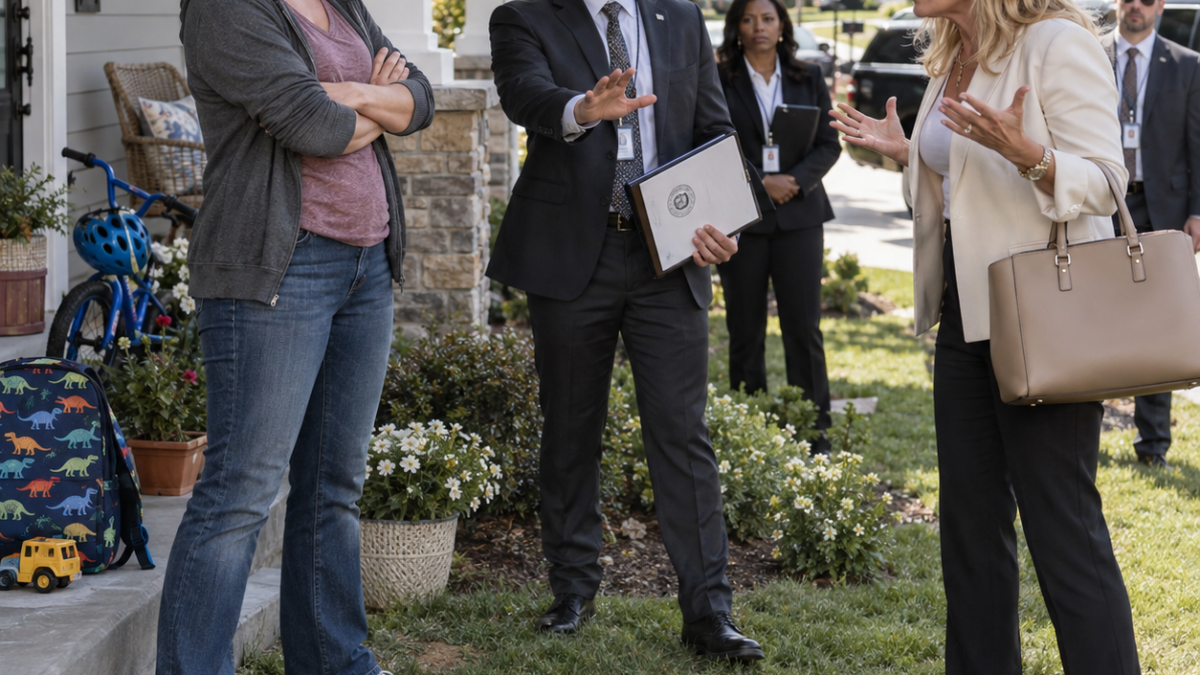
That was when Karen appeared.
She wasn’t swimming.
Of course she wasn’t.
Karen treated the pool less like recreation and more like a satellite office.
She wore oversized sunglasses and carried a leather folder even though it was ninety-four degrees.
Barry Collins and Jean Mercer, the two board members who almost always voted with her, followed several steps behind.
“Sarah.”
I stopped.
“Karen.”
“We need to discuss something.”
“Can it wait?”
“I’m afraid it can’t.”
Maya held my hand.
Karen glanced down at her.
Not warmly.
“We’ve received additional concerns.”
“What concerns?”
“About the children.”
Every muscle in my body tightened.
“Be specific.”
Karen lowered her voice slightly, but not enough.
“They’re creating instability.”
“They’re six and eight.”
“You know what I mean.”
“No. I don’t.”
Several parents nearby had gone quiet.
Karen noticed.
Instead of becoming embarrassed, she seemed energized by the audience.
“The board has an obligation to protect homeowners.”
“From what?”
She gave me the patient smile I had come to hate.
“Sarah, foster placements can be unpredictable.”
I heard a splash behind me.
Leo had stopped swimming.
He was listening.
I stepped closer to Karen.
“Repeat that.”
Her smile wavered.
“I said there are concerns about instability.”
“No. Repeat exactly what you’re saying about my children.”
Barry shifted uncomfortably.
Jean looked toward the clubhouse.
Karen doubled down.
“This community was designed for permanent families who have made a long-term investment here.”
“I own my home.”
“That isn’t what I meant.”
“Then what did you mean?”
She inhaled.
“Those children are temporary residents.”
Maya squeezed my hand.
“We don’t know their backgrounds,” Karen continued. “Other parents are concerned.”
“Which parents?”
“I’m not going to violate confidences.”
“Convenient.”
Karen’s mouth tightened.
“Our responsibility is property values and community safety.”
“What do my kids have to do with property values?”
She hesitated.
Only for a second.
Then she said it.
“Families make buying decisions based on who lives around them.”
Everything around me seemed to become very still.
“You’re saying Leo and Maya lower property values?”
Karen leaned toward me.
“I’m saying children from unstable environments can create perceptions that affect desirability.”
Maya looked up.
“Mom?”
I had been her foster mom for months.
The first time she called me Mom, I cried in a grocery-store parking lot.
Now the word cut straight through me.
Karen kept talking.
“This isn’t personal.”
“Stop.”
“I’m trying to explain—”
“Stop talking about my children.”
Her expression hardened.
“You need to understand that defiance will only make this worse.”
“There it is.”
“What?”
“The threat.”
“It is not a threat. The board has enforcement tools.”
“For what violation?”
“Occupancy concerns. Nuisance concerns. Repeated rule violations.”
Barry finally spoke.
“Karen, maybe we should handle this privately.”
She turned on him.
“This is board business.”
Then she looked at me again.
“If you continue refusing to cooperate, we will consider every remedy available under the covenants.”
I stared at her.
“What remedy? Eviction?”
Her silence answered before her mouth did.
“The association can pursue enforcement against owners who create continuing conditions harmful to the community.”
“You’re talking about forcing me out because I foster children.”
“I didn’t say that.”
“You didn’t have to.”
Leo had climbed out of the pool.
He stood dripping beside a chair, trying not to look scared.
That ended the conversation.
I turned away from Karen.
“Kids. We’re going home.”
Maya whispered, “Did I do something?”
“No, baby.”
“Are we in trouble?”
“No.”
Leo wrapped his towel around himself.
His face was shut down.
That frightened me more than tears would have.
In the car, nobody spoke for almost two minutes.
Then Maya asked the question that changed everything.
“Mom, are we not supposed to live here?”
I pulled the car over.
Put it in park.
Turned around.
“You listen to me.”
Both children looked at me.
“This is your home.”
Leo stared at the floor.
“For how long?”
My throat tightened.
Foster care makes promises complicated.
You cannot promise forever when courts, parents, caseworkers, relatives, and circumstances all have roles in a child’s future.
Children like Leo know that better than anyone.
So I chose my words carefully.
“For every day you are with me, you belong here completely.”
He looked up.
“Even if she says we don’t?”
“Especially then.”
That evening, after they went to sleep, I sat at my dining-room table.
Binder open.
Legal pad beside it.
I wrote down every word I could remember.
Temporary residents.
Unstable environments.
Property values.
Permanent families.
I wrote down who had been present.
Barry.
Jean.
Parents near the umbrella.
Pool attendant.
Then I stopped.
Because something had shifted.
Until then, I had thought I was dealing with selective enforcement.
A vindictive HOA president.
Maybe retaliation.
Now I was looking at something else.
Discrimination.
I opened my laptop.
At first, I searched broadly.
HOA discrimination against foster family.
HOA rules children.
Housing discrimination children.
Fair housing familial status.
The same term kept appearing.
Fair Housing Act.
I knew the basics.
Race.
Color.
Religion.
Sex.
National origin.
Disability.
Familial status.
I kept reading.
Familial-status protections generally concern households with children under eighteen and can extend beyond biological parent-child relationships depending on legal custody and placement arrangements.
I stared at the screen.
Leo and Maya were children under eighteen placed lawfully in my home.
Karen wasn’t enforcing a neutral rule that happened to affect us.
She had connected her enforcement directly to the children’s presence.
Their backgrounds.
Their foster status.
Their supposed effect on desirability.
I did not suddenly become a fair-housing lawyer because I spent two hours online.
So the next morning, I found one.
A veterans’ legal referral network connected me to Benjamin Carter.
Former Army JAG.
Now a civil-rights and housing attorney.
He returned my call at 8:17 the next morning.
“Sarah Evans?”
“Yes.”
“Ben Carter. I reviewed the summary you sent.”
“Thanks for calling.”
“Tell me everything from the beginning.”
I did.
Tricycle.
Dandelions.
Soccer noise.
Pinwheel.
Recycling bin.
Board meeting.
Social isolation.
Pool confrontation.
Ben rarely interrupted.
When he did, his questions were precise.
“Did Karen know Leo and Maya were foster placements before the fines began?”
“Yes.”
“How?”
“She asked me about them when Maya arrived. I told her I had reunited siblings through foster placement.”
“Any witnesses?”
“My neighbor Brenda was standing there.”
“Did she ever refer to biological children in similar terms?”
“Not that I heard.”
“Other families getting the same fines?”
“No. That’s part of my binder.”
“Tell me about the pool statement again. Exact words if you can.”
I did.
There was silence on the line.
Then Ben said, “This is serious.”
“How serious?”
“Serious enough that I don’t want you communicating with the board about substance without letting me know.”
My heartbeat changed.
“You think there’s a case?”
“I think there are facts worth formally investigating.”
That careful answer told me I had called the right man.
He did not promise victory.
Did not call Karen evil.
Did not tell me I was sitting on a million-dollar lawsuit.
He explained the law.
If an HOA selectively imposes burdens because a household includes children, familial-status discrimination may be implicated.
Statements expressing hostility toward foster placements could be highly relevant, particularly if they connect the children’s presence to enforcement.
HUD accepts housing-discrimination complaints.
Private civil remedies can also be available under federal law.
“But,” Ben said, “we build this correctly.”
“I’m listening.”
“First, no retaliation.”
“From me?”
“From anyone. You don’t start filing complaints against Karen. Don’t chase neighbors for statements. Don’t argue online.”
“I don’t argue online.”
“Everybody says that until Facebook finds them.”
I almost smiled.
“Second, preserve everything.”
“Already doing it.”
“Good. Third, no secret tactics that violate state law.”
“I understand.”
“We can discuss recording law before you record any conversation. Don’t assume.”
That mattered.
A lot of internet stories make evidence gathering sound like espionage.
Real lawyers prefer admissible evidence.
Ben confirmed that in our state I could lawfully record a conversation I was personally part of, subject to his specific guidance about context.
He still told me not to provoke anything.
“Your job is not to get Karen to say something discriminatory.”
“She already does that voluntarily.”
“Excellent. Then let her continue without help.”
He sent the HOA a preservation notice and a formal request for records available under state law and the governing documents.
Meeting minutes.
Violation logs.
Policies.
Financial statements.
Communications relating to my property.
Internal complaints.
Correspondence concerning children, occupancy, or family status.
The letter was calm.
That seemed to make Karen angrier than a threat would have.
Three days later, another violation arrived.
$200.
Failure to maintain a uniform exterior appearance.
My offense?
The welcome mat.
It was yellow.
Apparently Oak Haven’s architectural guidelines did not approve of optimism.
I photographed it.
Scanned the notice.
Sent it to Ben.
His response was four words.
**Keep everything. Do nothing.**
Karen approached me the following Saturday.
I was unloading groceries.
I started my recorder before she reached the driveway.
“Sarah, dear.”
“Karen.”
“I hope there are no hard feelings about the pool.”
“There are.”
She blinked.
Apparently diplomacy required me to pretend otherwise.
“I’m only trying to protect the community.”
“Okay.”
“Some residents are still concerned.”
“About?”
She lowered her voice.
“Children like that.”
I felt my pulse in my neck.
“What does that mean?”
“You know what foster placements can involve. Trauma. Behavioral issues. Uncertain family backgrounds.”
“My children have not harmed anyone.”
“That isn’t the point.”
“What is?”
“Risk.”
She leaned closer.
“People spend their life savings to live somewhere stable.”
“And Leo and Maya make it unstable?”
“I’m saying their situation creates uncertainty.”
“For property values?”
Karen exhaled impatiently.
“Yes, Sarah. Property values are part of the board’s responsibility.”
There it was.
Clear.
Unambiguous.
No audience needed.
No interpretation required.
The recorder was in my pocket.
I kept my face neutral.
“Thank you for explaining the board’s position.”
She frowned.
“That’s all you have to say?”
“Yes.”
She had wanted a fight.
Instead, I carried my groceries inside.
Then locked the door.
Only after I reached the kitchen did my hands start shaking.
I sent the audio to Ben.
He called that evening.
“Do not lose that file.”
“I have three backups.”
“Marine.”
“Logistics.”
“I stand corrected.”
Then his voice became serious.
“That recording matters.”
“Enough?”
“Sarah, stop thinking in terms of one smoking gun. Good cases are rarely one thing. The strength is the pattern.”
He listed it.
Selective fines.
Different treatment compared with other families.
Statements about foster children.
Property-value comments.
Threatened enforcement.
Social-pressure evidence.
Any internal communications we might obtain.
“We build all of it.”
The HOA stalled the records request.
First they demanded a $500 copying and administrative fee.
Then they claimed emails had been lost during a server migration.
Then they produced meeting minutes with large redactions.
Ben smiled when he saw the first production.
Not because it was good.
Because it was sloppy.
Buried among invoices was a charge from a real-estate appraiser.
**Consultation: potential market effect of transient/nontraditional household occupancy.**
The date was three weeks after Maya moved in.
Ben stared at the page.
“They paid for this?”
“Apparently.”
Another email chain contained a message from Barry to Karen.
**We need to be aggressive with Evans. If we tolerate this kind of occupancy, we’ll have more of it.**
Karen responded:
**Agreed. Consistency now prevents bigger problems later.**
There was no explanation of what “this kind of occupancy” meant.
But the timing mattered.
Then David started helping.
Carefully.
He talked to families who had their own concerns.
Not everyone had been targeted because of children.
Some people had ordinary HOA complaints.
I did not want to turn every grievance into discrimination.
But patterns emerged.
The Murrays had been fined repeatedly because a stroller remained folded on their porch.
Single father Carlos Diaz was ordered to remove his son’s treehouse even though it predated Karen’s presidency and similar structures existed elsewhere.
The Wilkins family had installed a therapy swing for their child after professional recommendation.
Karen’s board initially called it an “unauthorized recreational structure” and threatened daily penalties.
David said, “She goes after families.”
Ben corrected him.
“We prove specific treatment. We don’t generalize before evidence.”
That became our rule.
Facts first.
Always.
Meanwhile, the hardest part had nothing to do with law.
It was Leo.
He stopped asking neighborhood kids to play.
If somebody invited him, he assumed it was a joke.
One Saturday I found him taking apart the Lego city he had spent three weeks building.
“Why are you doing that?”
“Need the pieces.”
“For what?”
“I don’t know.”
I sat on the floor.
“You okay?”
“Yes.”
I waited.
Silence works on children too, if you don’t use it as pressure.
Finally he said, “If we have to move, Legos are hard to pack when they’re built.”
I felt something inside me break.
“We’re not moving.”
“How do you know?”
“Because nobody has told us we have to.”
“Karen said—”
“Karen doesn’t decide where we live.”
“What if she makes people hate us?”
I swallowed.
“You know what Marines do when people don’t like them?”
He looked at me.
“What?”
“Usually complain and drink bad coffee.”
He almost smiled.
Then I became serious.
“Leo, you do not have to earn the right to take up space in this house.”
His eyes filled.
“Okay.”
“No. Look at me.”
He did.
“You are not a guest I’m waiting to send away.”
His chin trembled.
“I know foster care can make everything feel temporary. I can’t promise things the court hasn’t decided. But I can promise this: no HOA president gets to decide whether you are worthy of a home.”
He leaned into me.
I held him.
That night, after he slept, I cried in the laundry room because sometimes you need a place with a closed door and a running dryer.
Maya handled things differently.
She became defiant.
Every time Karen walked by, Maya wanted to put another pinwheel in the garden.
“No.”
“Why?”
“Because I do not need a federal case called Evans v. Extremely Excessive Pinwheels.”
“What’s federal?”
“Complicated.”
“Can we have two?”
“Go brush your teeth.”
She got three eventually.
Ben filed the HUD complaint first.
The package was thick.
Timeline.
Violation notices.
Photographs.
Comparative examples.
Recorded statements.
Internal emails.
Appraisal invoice.
Affidavits where appropriate.
He also filed a federal civil action alleging fair-housing violations and related state claims after reviewing the available evidence and procedural strategy.
Karen was served on a Thursday.
David texted me.
**Process server at Karen’s house. She looks like she swallowed a lemon whole.**
I wrote back:
**Stop watching her house.**
He replied:
**I’m walking my dog. My dog is very legally observant.**
HUD’s notice reached the HOA soon afterward.
That was when panic began.
Not because federal agents stormed the clubhouse.
They didn’t.
HUD investigations are mostly paperwork, interviews, requests, deadlines, and legal review.
But bureaucracy becomes terrifying when you have spent years believing bureaucracy belongs to you.
Barry called David.
Jean contacted her own attorney.
The HOA’s insurance carrier requested documents.
Karen did the one thing Ben predicted.
She doubled down.
She sent every homeowner a letter.
**URGENT COMMUNITY LEGAL NOTICE**
It described my lawsuit as “frivolous.”
Claimed I was trying to enrich myself at the expense of neighbors.
Warned that defending the association could cost hundreds of thousands of dollars.
Then she called an emergency membership meeting to vote on a $2,000 special assessment per household.
When I read the notice, I felt sick.
“That’s what she wants,” I told Ben.
“What?”
“For everyone to hate me again.”
“They may.”
“Great legal strategy.”
“I didn’t say pleasant strategy.”
He leaned back in his office chair.
“Think about what she’s doing. She’s asking homeowners to personally fund a defense to allegations that arose from board conduct.”
“So?”
“So homeowners are going to ask what conduct.”
“She’ll lie.”
“Then she’ll lie in front of witnesses.”
The meeting was held on a Tuesday evening.
The clubhouse parking lot filled before seven.
People stood along the walls.
I walked in with Ben.
Conversation dropped.
I felt every eye.
A woman behind me whispered:
“That’s her.”
Her husband whispered back:
“She’s costing us two grand.”
I kept walking.
Ben leaned toward me.
“Eyes forward.”
“I’m aware.”
“No Marine face.”
“What is Marine face?”
“The expression that makes civilians reconsider their life choices.”
We sat in the front row.
Karen entered five minutes later.
Barry and Jean followed.
Neither looked well.
Karen did.
She wore navy.
Pearls.
Full makeup.
She had prepared for battle.
“Good evening,” she began.
“We are here because Oak Haven is under attack.”
There were murmurs.
Karen described the lawsuit as a threat to every family.
She claimed I had refused reasonable rules.
Claimed the board had merely enforced longstanding standards.
Claimed outside lawyers wanted to “federalize a local disagreement.”
Then she pointed toward the financial projection.
Legal defense.
Potential experts.
Discovery costs.
Insurance deductibles.
Two thousand dollars per home.
People began whispering angrily.
Karen knew how to redirect fear.
“You should understand,” she said, “that if one homeowner can ignore our standards and then sue when enforcement occurs, no rule means anything.”
Ben stood when questions opened.
Karen’s face tightened.
He walked toward the aisle microphone.
“My name is Benjamin Carter. I represent Sarah Evans.”
Somebody groaned.
Ben waited.
“I have one question.”
Karen folded her arms.
“This is not a deposition.”
“No. It’s a membership meeting.”
“Then ask.”
“What conduct by Ms. Evans created the violations underlying this dispute?”
Karen looked around.
“Repeated failure to comply.”
“With what?”
“Property standards. Noise rules. Exterior appearance.”
“Let’s take noise.”
Ben sounded almost bored.
“What caused the noise?”
Karen hesitated.
“Children.”
“Playing?”
“Excessively.”
“What time?”
“During the day.”
“Any citation from police?”
“No.”
“Any decibel reading?”
“That is not required.”
“Fine. Exterior appearance. What items?”
Karen glanced toward Barry.
“Various things.”
“Tricycle?”
Silence.
“Pinwheel?”
Someone laughed.
Karen’s cheeks reddened.
“Those were technical violations.”
“Were comparable toys present at other homes?”
“That is irrelevant.”
“It may be very relevant.”
She gripped the podium.
Ben continued.
“Did you tell Ms. Evans that foster children create instability?”
“This is exactly what I mean by manipulation.”
“Did you?”
“I expressed residents’ concerns.”
“Did you tell her foster children can affect property values?”
Karen looked around.
She should have stopped.
Her attorney, sitting at a side table, actually moved in his chair.
But Karen had spent years winning rooms by speaking louder than everyone else.
“It is not discriminatory to acknowledge reality,” she said.
Ben went still.
“What reality?”
“That transient placements can create uncertainty.”
Nobody moved.
Karen pressed on.
“We don’t know the backgrounds of children entering the community. Homeowners have every right to care about safety, stability, and who lives around them.”
A woman in the back said, “Oh my God.”
Karen heard her.
Instead of stopping, she attacked.
“Do not pretend parents don’t think about these things when buying homes.”
Ben’s voice remained level.
“So the board’s enforcement against Ms. Evans was influenced by the fact that foster children lived in her household?”
Karen opened her mouth.
Her attorney stood.
“Karen, do not answer.”
Too late.
David rose from three rows back.
“Wait.”
Karen pointed.
“This is not your turn.”
“You’re asking me for two thousand dollars.”
Applause broke out.
David continued.
“I want to know what I’m paying to defend.”
“Sit down.”
“No.”
His voice shook.
David was not a naturally confrontational man.
That made the moment stronger.
“You made me paint my daughter’s swing set beige. I thought that was ridiculous, but I did it because I was afraid you’d make things worse.”
Several people murmured agreement.
“Now you’re asking my family for two grand because you went after Sarah’s kids?”
“It is not about children.”
“We just heard you say it was.”
Karen looked toward Barry.
“Call the meeting to order.”
Barry stared at the table.
“Karen…”
“Barry.”
He stood slowly.
“I think we should postpone the vote.”
Her face changed.
“No.”
Jean whispered something to Karen.
Karen snapped, “We are voting tonight.”
A man near the back shouted:
“Not with my money.”
Another voice:
“Show us the legal bills.”
Another:
“Why did you hire an appraiser about nontraditional families?”
Karen froze.
I looked at Ben.
He hadn’t said anything.
David had apparently told someone.
The room erupted.
Karen struck the gavel.
“Order!”
Nobody listened.
For years, the sound of that gavel had meant something because everyone collectively agreed it did.
That night, the agreement vanished.
The special assessment failed overwhelmingly.
Karen left through the side door.
For the first time since this started, neighbors approached me.
Not all apologetic.
Some angry.
“Why didn’t you tell us?”
“I couldn’t discuss pending litigation.”
“Did she really say those things?”
“Yes.”
“Do you have proof?”
“My lawyer does.”
One woman stood several feet away holding her purse.
Her name was Monica.
She had pulled her daughter away from Maya at the playground months earlier.
“I’m sorry,” she said.
I looked at her.
“Maya asked me why your daughter wouldn’t play with her.”
Monica’s eyes filled.
“I believed Karen when she said there were safety concerns.”
“You never asked me.”
“I know.”
I was too tired to comfort her.
So I told the truth.
“I’m not ready to tell you it’s okay.”
She nodded.
“That’s fair.”
That was the beginning of Oak Haven turning.
Not one magical meeting.
Slowly.
Painfully.
People started asking for records.
They wanted financial statements.
Violation logs.
Legal invoices.
Board emails.
They compared fines.
Patterns became harder to deny.
The HOA insurer issued a reservation-of-rights letter.
Ben explained it to me.
“It means they may defend, but they’re preserving arguments that intentional discriminatory conduct may not be covered.”
“So Karen’s worried.”
“Karen should speak with her lawyer.”
“You’re very boring when you’re happy.”
“That is why judges like me.”
Barry and Jean hired separate counsel.
Their lawyers contacted Ben.
They wanted distance from Karen.
Cooperation discussions began.
I did not celebrate.
Watching people abandon Karen wasn’t the goal.
Changing the conduct was.
HUD investigators interviewed me.
The questions were detailed.
When did Leo arrive?
When did Maya arrive?
When did violations increase?
Which rules existed before?
Which other homes had similar items?
Who heard pool comments?
What exact phrases were used?
How did enforcement affect our use of common spaces?
Did I avoid amenities because of treatment?
How were the children affected?
That last question was hard.
I told them about Leo dismantling his Lego city.
Maya asking whether she was allowed to live there.
The Fourth of July barbecue.
That event had happened shortly before the pool confrontation and had been one of Karen’s most carefully coded performances.
She stood under an American flag and spoke about “permanent roots.”
“Predictable families.”
“Maintaining the character of Oak Haven.”
At the time, I wondered whether I was reading too much into it.
After the pool and driveway comments, context changed.
HUD interviewed other residents too.
David.
Monica.
Carlos.
The Wilkins family.
Brenda.
Even Ethan’s mother.
Not everyone remembered the same things.
That was good.
Real investigations are messy.
Some neighbors said they never heard Karen make discriminatory comments.
Others said she had expressed “concerns about foster placements.”
One recalled Karen saying she worried Oak Haven would become a destination for “temporary households.”
Another had an email.
Karen wrote:
**We must be cautious about policies that encourage nontraditional transient occupancy.**
Ben read it twice.
“People keep putting useful things in email.”
Months passed.
The legal fight affected the children in ways I hadn’t predicted.
Maya became obsessed with mail.
Every time an envelope arrived, she asked:
“Is that from the mean board?”
I finally bought a blue basket.
“Everything HOA goes here.”
She drew a skull on it.
“Subtle.”
“It means bad mail.”
Leo started therapy with a counselor experienced in foster care.
One evening he told me something that hurt more than Karen’s worst words.
“I thought if I behaved better, she’d stop.”
I put down the dish I was drying.
“What?”
“The lady.”
“Karen?”
He nodded.
“I thought maybe if I didn’t play loud and didn’t leave anything outside, she wouldn’t make us go.”
I knelt.
“Leo, look at me.”
He did.
“This was never your job to fix.”
“But—”
“No.”
I had used that voice on Marines twice his size.
Now I softened it.
“You do not have to be perfect to deserve a home.”
His eyes dropped.
“Even if I mess up?”
“Especially when you mess up.”
“What if I break something?”
“We fix it.”
“What if I’m loud?”
“We remind you.”
“What if I get mad?”
“We deal with being mad.”
“What if—”
I pulled him into me.
“You are a child. You are allowed to be a child.”
He cried then.
Quietly.
Into my shoulder.
After he went upstairs, I sat at the table with that ridiculous binder.
For months I had treated it like a weapon.
That night it looked like a record of everything the children had endured.
I called Ben.
“I want this finished.”
“I know.”
“I don’t care about punishing Karen anymore.”
“Good.”
“That sounded judgmental.”
“It sounded like progress.”
“I want rules changed.”
“I know.”
“I want the fines removed.”
“Yes.”
“I want protections for other families.”
“Yes.”
“And I don’t want Leo to spend another year believing he has to earn his place here.”
Ben was quiet.
“Then those are our settlement priorities.”
HUD eventually issued a reasonable-cause determination finding reason to believe unlawful discriminatory housing practices had occurred.
It was not a criminal conviction.
It was not federal agents storming the clubhouse.
But legally, financially, and politically, it changed everything.
The findings described a pattern.
Selective enforcement.
Statements tying the children to neighborhood desirability.
Different treatment.
Internal communications.
Retaliatory-looking actions after I challenged enforcement.
Oak Haven’s board could no longer plausibly describe this as a dispute over a tricycle.
Federal fair-housing enforcement moved forward.
Our civil case moved forward too.
Then came the meeting that ended Karen’s presidency.
David circulated a petition under the HOA bylaws demanding a special membership meeting and recall vote.
At first he worried nobody would sign.
He got enough signatures in forty-eight hours.
By Sunday he had nearly double the required number.
The clubhouse was packed again.
This time Karen did not control the microphone.
A neutral property-management representative moderated.
David spoke first.
He looked terrified.
“I spent two years being afraid of this board.”
He glanced at Karen.
“I’m embarrassed by that.”
Karen crossed her arms.
David continued.
“When my daughter asked why her swing set had to be beige, I told her rules were rules.”
He looked around the room.
“They weren’t.”
He held up violation records.
“They were whatever we allowed them to become.”
Carlos spoke next.
“My son cried when I took down his treehouse.”
The Wilkinses spoke about the therapy swing.
Monica stood.
She surprised me.
“I participated in what happened to Sarah’s children.”
The room went still.
“I stopped my daughter from playing with Maya because I believed rumors about foster children.”
Her voice cracked.
“I was wrong.”
She turned toward me.
Not asking forgiveness.
Just acknowledging it.
“I’m ashamed.”
Karen finally stood.
“This has become a mob.”
The moderator said, “Ms. Whitmore, you will have time.”
“I will speak now.”
“No.”
Karen looked stunned.
That might have been the first time in years someone running an Oak Haven meeting had simply told her no.
When her turn came, she walked to the front.
“I have served this community for six years.”
That was true.
She had organized storm cleanup.
Negotiated pool repairs.
Managed vendor disputes.
Helped elderly owners with maintenance issues.
Real people are rarely villains in every room they enter.
“I made decisions intended to protect our investments.”
She looked at me.
“Some residents have chosen to reinterpret those decisions through the most inflammatory lens possible.”
Ben was not speaking that night.
He simply sat beside me.
Karen continued.
“I never hated children.”
Nobody had accused her of that exact thing.
“I never said foster children were bad people.”
Also not the issue.
“I expressed legitimate concerns about occupancy stability and neighborhood standards.”
A voice from the audience said:
“You’re doing it again.”
Karen stopped.
A few people laughed bitterly.
Then she lost control.
“I am not going to apologize for wanting standards.”
The moderator said, “Nobody asked you to.”
“You all enjoyed those standards when your property values went up.”
Someone shouted:
“Not by targeting kids!”
Karen pointed toward the crowd.
“This is exactly what happens when emotion replaces responsible governance.”
I watched Barry close his eyes.
Jean looked at the floor.
Karen had one final chance to sound reflective.
She chose defiance.
The vote followed.
Remove Karen Whitmore from the board.
Hands went up.
Rows of them.
Not unanimous.
That mattered too.
A few homeowners still supported her.
Some abstained.
But the margin was overwhelming.
Karen sat absolutely still.
The moderator announced the result.
For years, Karen had ruled Oak Haven through paperwork, certainty, and fear of consequences.
Now the same bylaws she had weaponized removed her.
David became interim president only because nobody else wanted the job and he made the mistake of volunteering to help.
His first text to me afterward read:
**I have made a terrible error. There are 47 unread emails about mulch.**
I laughed so hard Maya came running.
“What?”
“Nothing.”
“Is Karen gone?”
“From the board, yes.”
She thought about that.
“Can I put out my pinwheels?”
“Three.”
“Six.”
“Four.”
“Deal.”
The settlement discussions became serious after the recall.
Karen, Barry, and Jean had separate lawyers.
Oak Haven had its own counsel.
The insurer participated subject to coverage positions.
HUD’s process continued.
Ben’s approach surprised me.
He was harder on policy than money.
“The money matters,” he said. “But this case is valuable because we can change the structure.”
We negotiated for months.
Every improper fine against me removed.
Amounts I had paid reimbursed with interest.
No enforcement based on Leo and Maya’s status or presence.
Clear non-discrimination provisions.
Independent review of future enforcement complaints for a period of time.
Mandatory fair-housing training for directors and management personnel.
A transparent appeals process.
Record-retention requirements.
Objective standards replacing vague phrases that had enabled selective punishment.
Karen fought the apology.
More than money.
More than losing the presidency.
She did not want to admit harm.
Her attorney offered neutral language.
**The board regrets that Ms. Evans perceived its actions as exclusionary.**
I read it once.
“No.”
Ben smiled.
“I assumed.”
“That is not an apology.”
“No.”
The next draft said:
**We regret the distress caused by enforcement actions.**
“Still no.”
Eventually the language became direct.
The HOA acknowledged that foster families and households with children are entitled to fair treatment and that prior enforcement against my household had caused harm.
Karen personally agreed to a separate statement recognizing that her words about Leo and Maya were inappropriate and hurtful.
Not the dramatic confession people imagine.
Lawyers do not usually write dramatic confessions.
But it named the harm.
That mattered.
The financial resolution was substantial.
Enough to reimburse me.
Enough to compensate for documented emotional and legal harm.
Enough that the insurer and association clearly understood the cost of discrimination.
After legal fees and obligations were resolved, I set aside a significant portion of my recovery for Leo and Maya’s future needs, subject to the rules governing their placements and whatever permanency decisions came later.
I did not tell the children an HOA lawsuit had created money for them.
They were children.
Their job was not to carry litigation.
I told them something simpler.
“We won’t have to move because of Karen.”
Maya screamed.
Leo did not.
He sat very still.
Then asked:
“She can’t make us?”
“No.”
“She can’t fine us because I play outside?”
“No.”
“What if I leave my bike?”
“I will personally fine you five dollars.”
He smiled.
“Really?”
“No.”
Maya shouted:
“I’m leaving everything outside!”
“Absolutely not.”
That weekend we went back to the pool.
The first time since the confrontation.
I almost turned around in the parking lot.
Not because Karen was there.
She wasn’t.
Because memory is physical.
I could still see her standing near the chairs.
Hear Maya asking if we belonged.
Leo stood beside me holding his towel.
“We can go home.”
I looked at him.
“You want to?”
He shrugged.
That meant yes and no.
Maya had already run halfway to the gate.
I took Leo’s hand.
“Let’s stay ten minutes.”
We stayed three hours.
Ethan was there.
He jumped into the water.
“Leo!”
Leo looked at me.
I nodded.
He went.
Monica arrived later with her daughter.
The little girl walked toward Maya holding a purple pool noodle.
“Want to play?”
Maya looked at Monica.
Then at me.
She was waiting for adult permission because adults had taught her that friendship could be revoked.
My heart hurt.
“Go.”
The girls ran.
Monica sat several chairs away.
After a while, she came over.
“I’m not asking you to forgive me.”
“Good.”
She smiled sadly.
“My daughter kept asking why she couldn’t play with Maya. I told her things I should never have repeated.”
I watched the children.
“What did you tell her?”
“That Maya came from a bad family.”
I closed my eyes.
Monica started crying.
“I’m sorry.”
I believed her.
That did not erase it.
But believing an apology and instantly removing all hurt are different things.
“Don’t tell your daughter foster children come from bad families.”
“I won’t.”
“Children come into foster care because adults and circumstances failed somewhere. That doesn’t make the child bad.”
“I know.”
“You know now.”
“Yes.”
We sat in silence.
Eventually I said:
“Let the girls play.”
That was enough for that day.
Oak Haven changed slowly.
The new board published violation logs without names so residents could see how rules were being enforced.
David hated every second of presidency.
“I have received seven emails about one mailbox.”
“Step down.”
“I can’t.”
“Why?”
“Because if I do, Carol says she’ll nominate you.”
“Stay strong.”
They rewrote the architectural guidelines.
Instead of “harmonious outdoor accessories,” they specified measurable standards.
Instead of vague “family nuisance” provisions, they used neutral noise rules tied to time and actual conduct.
The attorney added a fair-housing compliance section.
Annual training became mandatory.
At the first session, David sent me a photograph of forty exhausted board members and committee volunteers sitting in folding chairs.
Caption:
**Your revenge is PowerPoint.**
I wrote back:
**Justice is cruel.**
The federal and civil matters ultimately resolved through a combination of settlement, policy changes, and enforceable commitments.
There were no agents dragging Karen from her home.
No prison sentence.
Fair-housing cases like ours do not need theatrical endings to matter.
The consequences were real.
Her board position was gone.
Her actions were documented.
The association paid.
Policies changed.
Residents who had been afraid began speaking.
And Karen could no longer pretend the law ended where her subdivision began.
She sold her house the following spring.
I found out because Maya saw the real-estate sign.
“Mom!”
She ran inside.
“What?”
“The mean lady is selling!”
“Maya.”
“The formerly mean lady.”
“Still not ideal.”
We stood in the front yard.
A white sign had appeared in Karen’s grass.
FOR SALE.
I expected satisfaction.
Instead I felt something almost like sadness.
Not for what she had done.
For what all of it had cost.
Karen came outside while we were standing there.
For months we had avoided each other.
She walked toward the property line.
I told the kids to go inside.
Leo hesitated.
“It’s okay.”
He and Maya went.
Karen stopped six feet away.
“I’m moving.”
“I figured.”
“My daughter lives in Arizona.”
I nodded.
She looked older.
Not dramatically.
Just tired.
“I suppose you’re happy.”
“I’m relieved.”
“That’s different?”
“Yes.”
She looked toward my house.
“I didn’t hate them.”
“Leo and Maya?”
“No.”
“Then why?”
Karen folded her arms.
Old habit.
Then lowered them.
“I was afraid.”
“Of children?”
“Of change.”
I almost laughed.
She noticed.
“I know how that sounds.”
“Do you?”
“I bought here when Oak Haven was new. Everyone knew everyone. Then rentals started. Different families. People complained. Property values became the answer to everything.”
She stared at the street.
“I convinced myself that preserving the community meant controlling it.”
“That doesn’t explain what you said about foster children.”
“No.”
Finally.
No excuse attached.
“I was wrong.”
I waited.
She continued.
“I had ideas about what foster care meant.”
“Bad kids.”
“I wouldn’t have said it that way.”
“You did say it that way. Just with better vocabulary.”
She winced.
Fair.
“I’m sorry.”
“Tell me what you’re sorry for.”
Karen looked at me.
“You really were a Marine.”
“Ten years.”
She inhaled.
“I’m sorry I treated Leo and Maya as risks instead of children.”
That was the first apology from her that mattered.
“I’m sorry I used the board against you.”
I said nothing.
“I’m sorry I made them feel unwelcome in their own neighborhood.”
My throat tightened.
“Thank you.”
She seemed surprised.
“That’s it?”
“What were you expecting?”
“I don’t know.”
“Forgiveness?”
“Maybe.”
“I’m not there.”
She nodded.
“I understand.”
Then she turned to leave.
“Karen.”
She looked back.
“Do better wherever you go.”
Her eyes filled.
“I’m trying.”
I never saw her again.
That could have been the ending.
But the part that mattered most happened months later.
A moving truck arrived four houses down.
David came by while Maya and I were planting pinwheels.
Not one.
Not four.
Twelve.
I had lost control of the negotiation.
“You’re going to get cited,” David said.
“By whom?”
He looked at his own chest.
“Oh. Right.”
Maya laughed.
David pointed toward the moving truck.
“New family.”
“Okay.”
“Rachel and Kim Morgan. Three kids.”
“Good.”
“One uses a wheelchair.”
I looked toward the house.
A ramp company was already measuring the front entrance.
David smiled.
“They called before closing because they were nervous about the HOA.”
“That’s reasonable.”
“I showed them the new bylaws.”
“And?”
“Told them accessibility requests go through an expedited review now.”
“Good.”
“Told them Oak Haven welcomes families.”
I looked at him.
“Did you actually use the word welcomes?”
“I’m growing.”
“Terrifying.”
Leo came around the side of the house carrying a soccer ball.
“Who moved in?”
“Three kids.”
His face changed.
Not fear.
Hope.
“How old?”
“Go ask.”
He looked toward me.
A year earlier, he would never have walked toward a new family alone.
“Go.”
He ran.
Maya abandoned her pinwheels and chased him.
I stood beside David watching them cross the street.
A girl came out of the new house.
Maybe nine.
Then a younger boy.
Then another child rolled down a temporary ramp in a bright blue wheelchair.
Leo stopped for half a second.
The girl said something.
He held up the soccer ball.
Within five minutes, four children were figuring out a game whose rules made absolutely no sense.
Maya shouted that everybody was cheating.
Normal.
Beautifully normal.
David said quietly:
“That’s what Karen thought would hurt property values.”
I shook my head.
“No.”
“What?”
“She thought difference would hurt property values.”
He nodded.
We watched the kids.
The new family’s mother came outside.
She looked nervous.
I recognized that look.
New neighborhood.
HOA.
Children.
Trying to determine whether everybody smiling actually meant welcome.
I walked over.
“Hi. I’m Sarah.”
“Rachel.”
She shook my hand.
“David said you live down the street.”
“Four houses.”
“He told us you helped change the HOA.”
“That is an extremely generous description of a miserable year.”
She laughed.
Then lowered her voice.
“We almost didn’t buy here.”
“Why?”
“We had a bad experience with our last association.”
Her eyes moved toward her son’s wheelchair.
“They made every modification feel like we were asking for a favor.”
I understood.
“Well, Oak Haven has lawyers now who enjoy writing policies.”
She smiled.
“The ramp approval came through in two days.”
“Good.”
She looked toward Leo and Maya.
“Those yours?”
The question still carried complexity.
I smiled.
“They’re with me.”
Something in Rachel’s expression told me she understood not to ask more.
“Good kids.”
“Yes.”
That night, after dinner, Maya placed one final pinwheel near the mailbox.
Bright purple.
I started to object.
Then stopped.
Leo sat on the porch building a Lego set.
Not dismantling it.
Building.
Piece by piece.
“What is it?” I asked.
“A house.”
“Looks huge.”
“It has six bedrooms.”
“Why?”
“For lots of people.”
I sat beside him.
He kept building.
“Does it have an HOA?”
He looked horrified.
“No.”
I laughed.
Then he smiled.
“Maybe David can be president.”
“That is cruel.”
We sat there until sunset.
A year earlier, I had promised myself I would dismantle Karen’s power.
At the time, that felt like the mission.
I was wrong.
Destroying Karen was never the mission.
Making sure Leo and Maya knew they belonged was.
Making sure the next family did not face what we faced was.
Making sure rules became rules instead of weapons was.
The rest was consequence.
The binder still sits in my office.
It is nearly four inches thick.
Tricycle notice.
Dandelion fine.
Pinwheel violation.
Recycling-bin photograph.
Pool notes.
Emails.
Record requests.
Legal letters.
HUD correspondence.
Settlement papers.
Sometimes I open it and wonder how something so ugly began with something so small.
A child’s pink tricycle.
But maybe that is how these things usually begin.
Not with someone announcing:
I intend to discriminate.
They begin with a rule applied differently.
A joke.
A coded phrase.
A warning about “those kinds of families.”
A concern about “property values.”
A quiet decision that one child belongs less than another.
Then everyone around it decides whether to ignore it.
That was the mistake Oak Haven made.
For too long, decent people were afraid of becoming Karen’s next target.
I understand that now.
Fear does not always look like cowardice.
Sometimes it looks like silence at a board meeting.
Looking away at the playground.
Painting a swing set beige because fighting feels exhausting.
Then one person speaks.
Then another.
Then the room changes.
One Saturday the new board held Oak Haven’s first community picnic after the settlement.
I almost skipped it.
Too many memories.
Maya refused to allow that.
“They have cupcakes.”
“Compelling civic argument.”
“And a bounce house.”
“Constitutional right, apparently.”
We went.
No speeches about permanent families.
No lectures about standards.
David spoke for maybe ninety seconds.
“Thank you for coming. Pool closes at nine. Please pick up trash. Carol made potato salad. Nobody sue me.”
Everyone laughed.
Perfect speech.
Leo played soccer with Ethan and two new kids.
Maya ran around with frosting on her face.
Rachel Morgan’s son joined a relay where somebody had modified the course so his wheelchair could race with everyone else.
Nobody announced inclusion.
Nobody congratulated themselves.
They just changed the game and kept playing.
That mattered more.
Monica came over.
“You okay?”
I looked around.
“Yeah.”
“You know Maya taught my daughter that word.”
“What word?”
“Bioluminescence.”
“That sounds like her.”
“She can’t pronounce it.”
“Also sounds like her.”
We laughed.
The relationship between us never returned to what it had been before.
It became something more honest.
Maybe better.
The foster-care case moved forward too.
I will not pretend the legal victory solved everything in Leo and Maya’s lives.
Foster care does not become simple because an HOA president loses an election.
There were hearings.
Family meetings.
Case plans.
Hard days after visits.
Questions I could not answer.
Nights when Maya woke crying.
Times Leo shut down because an adult was ten minutes late and his body interpreted lateness as abandonment.
Those struggles belonged to their story, not Karen’s.
And that was another thing I learned.
For months Karen had reduced them to “foster children.”
A category.
A risk.
A housing issue.
But Leo was a boy who hated tomatoes, loved space documentaries, and could remember every Lego piece he owned.
Maya believed glitter improved almost anything and insisted Pickles the bear had allergies.
They were not symbols of my lawsuit.
They were kids.
The happiest moment came one rainy afternoon almost two years after the first fine.
Leo came home from school and dropped his backpack.
“Mom?”
“Kitchen.”
He entered holding a folded paper.
“What happened?”
“Nothing.”
That answer from a child always means something happened.
He handed me the paper.
It was a school writing assignment.
**Write about a place where you feel safe.**
Leo had written about our house.
Not the Marine Corps.
Not the court case.
Not Karen.
The kitchen.
Movie nights.
Maya stealing blankets.
The rosemary by the porch.
My terrible pancakes.
And one sentence near the bottom:
**I like this house because nobody can vote me out of it.**
I sat down.
Leo immediately looked worried.
“Is it bad?”
“No.”
“Why are you crying?”
“Because you’re rude about my pancakes.”
He smiled.
I pulled him into a hug.
Then I kept that paper.
Not in the legal binder.
In a different box.
The important one.
Years later, when people asked me whether taking on Oak Haven had been worth it, I never thought first about the settlement amount.
Or HUD.
Or Karen losing the presidency.
I thought about that sentence.
Nobody can vote me out of it.
Technically, life is more complicated than that.
But a child who had once dismantled his Lego city because he was afraid he might have to leave had started building again.
That was enough.
On the anniversary of the day Maya moved in, she decided we needed a new front-door mat.
We went shopping.
She chose the brightest one in the store.
Yellow background.
Blue flowers.
Completely obnoxious.
I looked at the price tag.
Then at her.
“This would have gotten us fined.”
She grinned.
“That’s why I picked it.”
I bought it.
We placed it on the porch.
Then Maya stepped back and admired it.
“Do we need approval?”
“No.”
“Are you sure?”
“Yes.”
“What if David fines us?”
“I’ll overthrow him.”
She nodded seriously.
“Okay.”
Leo came outside.
“That mat is ugly.”
Maya gasped.
“You’re ugly.”
“Maya.”
“Sorry.”
She turned to Leo.
“Your opinion is ugly.”
“Improvement,” I said.
The three of us stood there laughing.
Across the street, kids rode bikes.
Somebody’s basketball hoop was technically three inches beyond the position shown on their architectural application.
No one cared.
A stroller sat on a porch.
No violation letter appeared.
A therapy swing moved gently in the Wilkinses’ yard.
Carlos’s son had rebuilt his treehouse.
David never asked him to paint it beige.
Oak Haven did not collapse.
Property values did not crash.
The neighborhood did not become unsafe because children played.
Life simply continued without one woman deciding which families looked respectable enough to belong.
That was Karen’s final defeat.
Not the money.
Not the lawyers.
Not the federal fair-housing case.
Oak Haven became proof that everything she had warned would happen without her control never happened.
Families moved in.
Kids grew up.
Homes sold.
Lawns survived.
The pool remained crowded.
And one Saturday morning, I stood in my flower bed while Maya planted another ridiculous pinwheel.
Sunlight caught the plastic blades.
Blue.
Red.
Yellow.
Purple.
They spun together in the breeze.
Leo came down the driveway carrying his soccer ball.
“Mom, Ethan’s here.”
“Homework?”
“Done.”
“Room?”
He paused.
“Mostly.”
“Leo.”
“Fine.”
He ran inside.
Maya looked up at me.
“Can we stay here forever?”
There are questions a foster parent learns not to answer carelessly.
I crouched beside her.
“I don’t know what every part of the future looks like.”
She frowned.
“But I know something.”
“What?”
“Nobody gets to make you feel like you don’t deserve a home.”
She thought about it.
Then pointed at the pinwheel.
“Not even if this is an unauthorized decoration?”
I laughed.
“Especially then.”
She leaned into me.
I kissed the top of her head.
Behind us, the bright yellow welcome mat sat crooked on the porch.
I could have straightened it.
I didn’t.
Some things are better slightly out of compliance.
[END OF STORY]








