PART 2: HOA Called My Farm “White Trash”—So I Built a Billboard They Had to Face Every Day
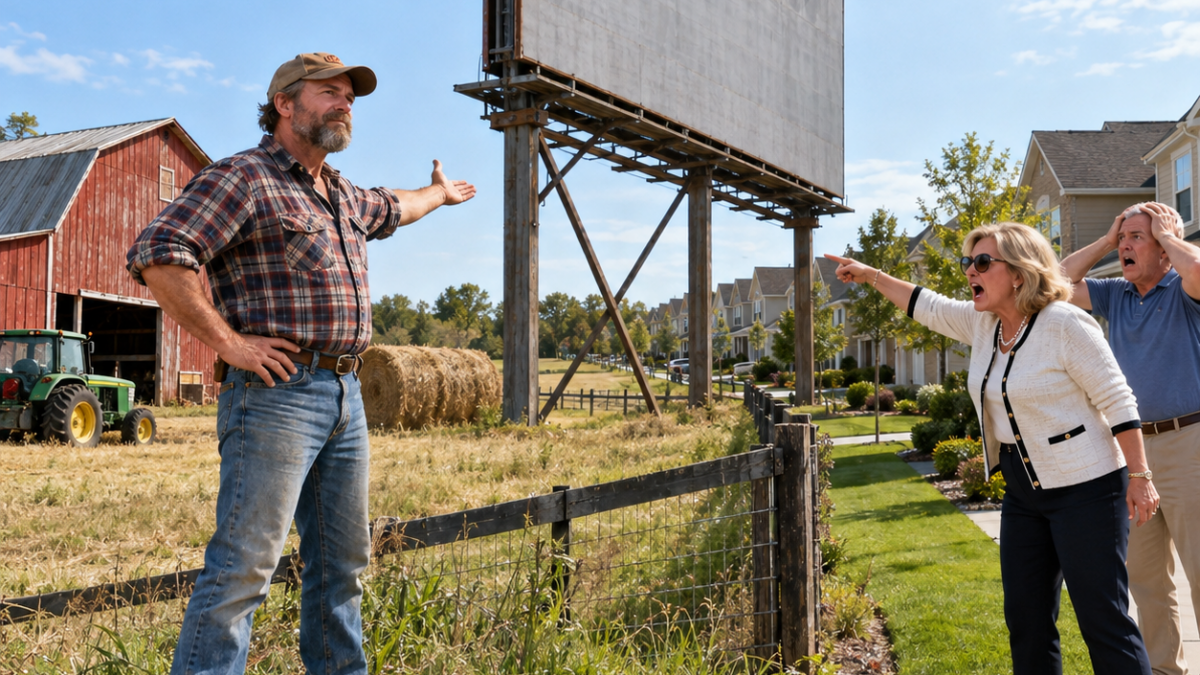
PART 2
I wasn’t at the ranch when Victoria’s convoy broke through the gate.
That was not an accident.
By then, very little about the situation was accidental.
At 6:11 that morning, I was sitting inside an unmarked command vehicle three miles south of the property with a federal operations team that had spent months preparing search warrants, seizure orders, and arrest warrants connected to Victoria Langley, her private security chief, several members of the Silver Crest executive board, and executives from the development company that had tried to buy my land.
Ray was the only person on the ranch who knew exactly how close the investigation was to breaking open.
The rest of my crew knew only what they needed to know.
Work normally.
Document anything unusual.
Do not confront Silver Crest personnel.
Call Ray if anyone crossed the property line.
What none of us predicted was that Victoria would choose that exact morning to turn fourteen months of harassment into an armed occupation.
At 6:13, one of the ranch cameras transmitted the first image.
Black SUV.
Then another.
Then seven more.
“Movement at the east gate,” the surveillance technician beside me said.
I leaned toward the monitor.
The first SUV stopped in front of the steel gate.
Two men jumped out.
One carried a portable hydraulic ram.
I felt the room inside the command vehicle change.
“She’s actually doing it,” Agent Lena Brooks said quietly.
Brooks worked financial crimes and had taken over the primary investigation after I formally removed myself from all operational decisions involving Victoria.
That recusal mattered.
From the moment evidence suggested the HOA president’s actions might be part of a larger criminal scheme, I had refused to use my federal position to settle a dispute involving my own property.
Every subpoena.
Every warrant.
Every surveillance decision.
Every request to prosecutors.
All of it went through independent investigators.
I provided evidence like any other complainant.
Nothing more.
That would become important later.
On the monitor, the hydraulic ram struck my gate.
Once.
Twice.
The latch gave way.
The convoy entered.
Brooks looked at me.
“You want to call it?”
“No.”
Her eyebrows lifted.
“Not yet.”
The warrant team already had legal authority to move.
But we wanted to see exactly what Victoria intended to do.
There is a difference between suspecting conspiracy and watching someone commit it in high definition.
The SUVs spread across the ranch yard.
Doors opened before the vehicles stopped moving.
Men in dark tactical uniforms jumped out.
They wore body armor.
Sidearms.
Less-lethal launchers.
Radios.
No law enforcement insignia.
No agency patches.
Nothing identifying them as anyone with legal authority.
My crew had been replacing fence posts along the north pasture.
They froze as men surrounded them.
One worker, Ben Alvarez, raised both hands immediately.
“What is this?”
A contractor shoved him against the fence.
“Hands behind your back.”
“For what?”
“Now.”
Ben looked toward Ray.
Ray had just stepped from the equipment barn.
He saw eight men forced against the fence.
Plastic restraints went around their wrists.
Personal phones were confiscated.
One of the contractors dumped wallets and radios into a plastic storage crate.
Then Victoria stepped from the fourth SUV.
Even through a surveillance camera, I recognized the confidence in her posture.
Tailored jacket.
Dark sunglasses.
Leather portfolio under one arm.
She walked through my ranch yard as if she had finally taken possession of something that had always belonged to her.
Brooks whispered, “She brought paperwork.”
“She always brings paperwork.”
Ray approached.
Two guards moved toward him.
He stopped before they touched him.
“Who’s in charge?”
Victoria smiled.
“I am.”
Ray looked at the restrained workers.
“Under whose authority are you detaining my employees?”
“Silver Crest Emergency Community Protection Authority.”
Ray stared at her.
“That’s not a thing.”
Victoria opened the leather portfolio.
She removed a thick sheet embossed with a gold seal.
I had seen dozens of her invented notices during the previous year.
This one was more ambitious.
According to Victoria, my ranch had created an “immediate environmental and structural danger” through agricultural dust, fencing encroachment, and heavy equipment operation.
Silver Crest’s executive board had supposedly voted the night before to place the disputed property corridor into “temporary administrative receivership.”
Ray read the first paragraph.
Then he laughed.
Not loudly.
Just once.
That made Victoria furious.
“You find this amusing?”
“I find counterfeit legal authority amusing.”
Her smile disappeared.
“This document authorizes us to secure hazardous property.”
“No, it doesn’t.”
“You’re not an attorney.”
“I can still recognize the absence of a judge.”
Ray held the page up.
“No county seal. No court number. No case number. No warrant. No judge’s signature.”
He handed it back.
“This is HOA stationery.”
Victoria stepped close enough that the camera caught the anger in her eyes.
“You people have had fourteen months to cooperate.”
“You people?”
She glanced at the barn.
The equipment shed.
The workers.
“This entire operation has been a nuisance from the beginning.”
Ray folded his arms.
“The ranch has been here seventy-eight years.”
“And now the area has changed.”
“Then maybe the people who moved here should’ve looked at a map.”
One of the contractors smirked.
Victoria noticed.
Her face reddened.
She pointed at Ray.
“Detain him.”
The security chief hesitated.
His name was Wade Mercer.
No relation to me.
Former private military contractor.
Former corporate security consultant.
Current head of security for Silver Crest.
He had spent months escalating surveillance around my property while carefully remaining just outside the threshold that would have made his conduct obviously criminal.
Until that morning.
“Victoria,” he said quietly, “we’ve secured the workers. Maybe we should wait for counsel before—”
“Do it.”
He stared at her.
“Victoria.”
“I said detain him.”
Ray looked directly into the camera mounted beneath the barn eave.
He knew we were watching.
Then he checked his watch.
“Mrs. Langley,” he said, “I’m going to give you one opportunity.”
She laughed.
“You’re giving me an opportunity?”
“Release everyone. Put your people back in those vehicles. Leave the property.”
“Or?”
Ray looked toward the county road.
“Or you’re going to remember this morning for the rest of your life.”
Victoria’s face twisted.
“Secure the office.”
Wade said nothing.
“Now.”
Three contractors grabbed Ray.
They forced his arms behind him.
Zip ties tightened around his wrists.
That was enough for Brooks.
She reached for the radio.
“Operations, prepare to advance.”
I raised a hand.
“Wait.”
Brooks looked at me.
I pointed at the screen.
Victoria was moving toward the ranch office.
Months earlier, investigators had discovered communications suggesting she desperately wanted proof that I had been researching the development company.
We also knew she had previously ordered employees to photograph documents through windows and search trash left near our office.
So investigators had created a monitored evidentiary package.
Nothing classified.
Nothing dangerous.
Nothing containing protected information.
Just controlled case material placed somewhere Victoria would have no lawful reason to access.
The folder sat on Ray’s desk.
Its label was impossible to miss.
HARTWELL DEVELOPMENT — ACCESS CORRIDOR ACQUISITION.
The office door was locked.
Wade’s men drilled it.
Victoria entered.
Every camera angle recorded her.
She went directly to the desk.
Opened drawers.
Pulled files.
Photographed documents.
Then she saw the folder.
She froze.
Brooks leaned closer to the screen.
“Don’t.”
Victoria grabbed it.
She opened the flap.
Read the first page.
Then looked toward the door.
Finally, she shoved the entire folder into her leather bag.
Brooks exhaled.
“There it is.”
She keyed the radio.
“All teams move.”
The command vehicle lurched forward.
Behind us, eight federal vehicles accelerated simultaneously.
Three miles disappear quickly when everyone already knows exactly where they’re going.
At the ranch, Victoria stepped from the office.
She looked pleased.
That expression lasted approximately forty seconds.
The first thing she heard was engines.
The cameras showed everyone turning toward the south road.
Then our vehicles appeared.
One came through the main entrance.
Two crossed from an access road.
Others moved around the perimeter.
The federal team sealed every practical exit before Victoria understood what was happening.
Wade understood sooner.
I saw it on his face.
He watched the formation.
The body armor.
The marked tactical identifiers.
The disciplined movement.
His shoulders dropped.
“Everybody lower weapons,” he shouted.
One contractor looked at him.
“What?”
“Lower them!”
Victoria spun around.
“What are you doing?”
Wade ignored her.
He removed his sidearm.
Placed it on the ground.
Raised his hands.
“Knees!” an agent ordered.
Wade dropped immediately.
His men followed.
Victoria stood in the center of my ranch yard while the private army she had brought to intimidate farmworkers surrendered without a fight.
Then I stepped from the command vehicle.
I wore my service vest.
U.S. MARSHALS.
Large letters across the front.
Victoria stared.
Her sunglasses were gone.
For a moment, she simply looked confused.
Then recognition hit.
“You?”
I walked toward Ray first.
An agent cut the plastic restraints from his wrists.
“You good?”
“Fine.”
He glanced at Victoria.
“Tried to warn her.”
Ben Alvarez rubbed his wrists.
“Boss, what the hell is happening?”
“I’ll explain later.”
I walked toward Victoria.
She clutched the leather bag against her side.
That mattered.
Brooks joined me.
Victoria looked from her to me.
“You’re a federal officer?”
“Yes.”
“You never told me.”
“You never asked.”
“This is entrapment.”
Brooks spoke.
“No one forced you onto this property.”
Victoria pointed toward me.
“He’s using federal resources to intimidate me over a land dispute.”
“Mr. Mercer has been recused from this investigation for months,” Brooks said.
Victoria’s eyes flickered.
That was the moment she realized this operation was larger than me.
I looked toward Wade.
“Mr. Mercer.”
He raised his head.
“What court authorized you to enter this property?”
He stayed silent.
“What judge signed your warrant?”
Nothing.
“What statute allows armed HOA contractors to detain agricultural employees?”
His face tightened.
Finally, he said, “There isn’t one.”
Victoria turned.
“Wade.”
He continued.
“We were operating under instructions from the association.”
“Stop talking.”
Brooks looked at him.
“Whose instructions?”
Wade looked directly at Victoria.
“Hers.”
She stepped toward him.
“You coward.”
Two agents blocked her.
Victoria suddenly remembered the bag.
She shifted it behind her hip.
Brooks noticed.
“Mrs. Langley, place the bag on the ground.”
“No.”
“Place it down.”
“This is my personal property.”
Brooks remained calm.
“You were recorded entering a locked office on property you do not own and removing controlled evidentiary material.”
Victoria’s lips parted.
“I was conducting a safety inspection.”
“You drilled the lock.”
“I didn’t.”
“Your contractors did.”
“I didn’t order that.”
Ray spoke from behind us.
“Yes, you did.”
Victoria spun toward him.
“You stay out of this.”
Ray smiled.
“I own the security cameras.”
Her face lost color.
Brooks extended one hand.
“The bag.”
Victoria hesitated.
“You can’t search me.”
“You’re being detained pending investigation of an armed unlawful entry, false imprisonment, burglary, theft, and other offenses. You may voluntarily surrender the folder, or we can proceed pursuant to lawful search authority.”
Victoria’s fingers shook.
She reached into the bag.
Pulled out the manila folder.
And threw it onto the ground.
“There.”
An evidence technician retrieved it wearing gloves.
Victoria started speaking rapidly.
“I didn’t steal anything. I found it. The office was open. I believed it related to an environmental threat affecting our community.”
Ray laughed again.
Victoria glared at him.
The technician opened the folder.
There were no development blueprints inside.
No secret ranch financial records.
No deed.
Instead, the first page was a high-resolution photograph.
Victoria handing a thick envelope to an excavator operator near my property line.
The photograph had been taken three weeks earlier.
The second page was a sworn statement from that operator.
He had already begun cooperating with investigators.
He described the payment.
The instructions.
The plan to remove portions of my fence and later claim the boundary had been historically located farther inside my ranch.
The third page documented communications between Victoria and Hartwell Development discussing access to the corridor.
She stared.
Her mouth opened.
Closed.
Then opened again.
“You manufactured this.”
Brooks shook her head.
“No.”
“This is fake.”
“The witness gave a sworn statement.”
“He’s lying.”
“The payment was recorded.”
“He’s lying!”
I watched her.
Fourteen months earlier, Victoria had stood at my gate and called my farm white trash.
She had believed wealth was authority.
That a gated entrance was jurisdiction.
That expensive attorneys could transform lies into law.
Now there was dust on her designer jacket and panic in her voice.
She looked at me.
“You planned this.”
“I preserved evidence.”
“You baited me.”
“I told you the land wasn’t for sale.”
“This is because I called your disgusting farm an eyesore?”
“No.”
For the first time, I let some of the anger into my voice.
“This is because you moved survey markers. Forged notices. Threatened my employees. Paid people to damage property. Laundered developer money through association accounts. And this morning you sent armed contractors onto a ranch you don’t own.”
She went still.
“How do you know about the accounts?”
That question was almost funny.
Brooks answered.
“Because your attorney came to us.”
Victoria’s face changed completely.
“Which attorney?”
Brooks didn’t answer.
But Victoria knew.
Daniel Reese had served as general counsel to Silver Crest for nearly eleven years.
He was conservative.
Quiet.
Careful.
The kind of lawyer who preferred boring compliance over dramatic litigation.
That was exactly why Victoria had underestimated him.
Months earlier, Reese had discovered financial transfers from the HOA into companies he didn’t recognize.
He asked questions.
Victoria gave vague answers.
He asked for contracts.
She delayed.
Then he found altered board minutes approving transactions he distinctly remembered advising against.
That frightened him enough to start looking deeper.
According to the later testimony, he discovered hidden digital folders containing modified deeds, falsified maps, fraudulent notarizations, and communications with Hartwell Development.
Reese did not confront Victoria.
He copied what he legally could preserve.
Consulted outside counsel.
Then reported evidence of suspected crimes through proper channels.
His materials transformed my collection of harassment evidence into something much larger.
The federal investigators found money moving through shell companies.
Association dues funding activities that had nothing to do with homeowners.
Consulting payments promised to Victoria personally if Hartwell obtained the corridor.
Payments to private security.
Payments to people tasked with interfering with my property.
The case became conspiracy.
Fraud.
Extortion.
Forgery.
And potentially racketeering conduct involving multiple participants.
That morning, the warrants were already signed.
Victoria had invaded my ranch while federal teams were preparing to arrest her.
She had essentially walked into the middle of her own takedown.
Brooks took one step toward her.
“Victoria Langley, turn around.”
Victoria backed away.
“No.”
“Turn around.”
“I know the governor.”
“No one asked.”
“My attorneys will destroy this case.”
“You can discuss that with them.”
“You have no idea who you’re dealing with.”
Brooks’s expression never changed.
“Turn around.”
Victoria looked toward me.
“You’re going to regret this.”
I said nothing.
She pointed at my barn.
“You think this property is worth destroying people’s lives?”
That finally got a response from Ray.
“You invaded his property.”
Victoria ignored him.
“You could’ve taken the money.”
I looked at her.
“So that’s what you still don’t understand.”
“What?”
“This was never about the offer.”
“Everything is about the offer.”
“No. Everything is about what you think money allows you to do after someone says no.”
For the first time since I met her, Victoria Langley had nothing to say.
Brooks turned her around.
The handcuffs closed.
Two clicks.
Then another.
Victoria flinched.
Behind her, federal agents moved from worker to worker, cutting away the plastic restraints her contractors had used.
Medical personnel checked wrists.
Phones and wallets were returned.
Wade’s security team was separated for interviews.
Several immediately requested attorneys.
Two asked to cooperate.
Wade asked first.
By 7:02 that morning, the invasion of my ranch was over.
The larger operation was only beginning.
Five miles away, another federal team executed a warrant at Silver Crest’s administrative office.
Computers were imaged.
Servers secured.
Filing cabinets inventoried.
Financial accounts frozen where authorized.
Investigators found materials Daniel Reese had already described.
Original ledgers.
Communications with Hartwell Development.
Draft acquisition plans.
Invoices from shell companies.
Copies of altered land records.
Multiple versions of correspondence designed to make it appear that my ranch was subject to Silver Crest covenants.
It never had been.
Not for one day.
My family’s deed predated the subdivision by decades.
There was no annexation.
No covenant.
No easement giving them authority over my land.
Victoria knew that.
Internal communications proved it.
In one email to a Hartwell executive, she wrote that legal jurisdiction was “less important than creating sustained economic pressure.”
Another message discussed making the ranch “administratively unbearable.”
One proposed strategy was particularly revealing.
“Once Mercer understands that peace costs more than cooperation, he’ll sell.”
I read that sentence months later.
Peace costs more than cooperation.
It summarized Victoria perfectly.
She did not believe boundaries mattered.
Only leverage.
When legal authority didn’t exist, she manufactured it.
When regulations didn’t apply, she invented them.
When the county cleared us of violations, she filed new complaints.
When survey lines didn’t move, she moved stakes.
When the ranch wouldn’t become ugly enough to embarrass me into selling, she called it white trash and promised to make Silver Crest residents “sick of seeing it.”
She made one mistake repeatedly.
She believed my silence meant I was losing.
For fourteen months, I gave her almost nothing.
No angry voicemail.
No public confrontation.
No threats.
No social media war.
Every letter she sent went into an evidence sleeve.
Every camera clip was cataloged by date and location.
Every photograph of a moved survey stake was measured against the licensed survey.
Every vehicle that idled along our fence line was documented.
Ray sometimes hated it.
One night, about six months into the harassment, we stood behind the barn watching a Silver Crest security vehicle shine a spotlight through the windows.
Ray clenched his jaw.
“You going to let them keep doing this?”
“For now.”
“You could stop it tomorrow.”
“Maybe.”
“You’re a federal marshal.”
“Not in this dispute.”
“They don’t know that.”
“Exactly.”
Ray looked at me.
“You’re letting them think you’re weak.”
“Yes.”
“Why?”
“Because people show you who they are when they believe consequences aren’t coming.”
He stared at the security vehicle.
“And if they hurt somebody?”
“Then we act immediately.”
He looked unconvinced.
I understood.
Patience is harder when injustice is visible.
But a bad case handled emotionally can become a weak case.
A strong case requires proof.
Victoria supplied more than we ever expected.
The search of her office uncovered an entire planning document outlining ways to pressure me.
Noise complaints.
Dust complaints.
Water complaints.
Livestock complaints.
Boundary challenges.
Contractor intimidation.
Insurance threats.
Tax complaints.
Even anonymous tips suggesting illegal weapons were stored at the ranch.
That one made Brooks laugh when she read it.
“You’re a federal law enforcement officer.”
“I own weapons.”
“Legally.”
“Yes.”
“She reported you for possessing legal firearms?”
“Apparently.”
“She really didn’t research you.”
“No.”
That remained one of the most remarkable parts.
Victoria knew property values to the dollar.
She knew who owned which Silver Crest home.
She knew the names of county commissioners.
She knew which contractors could be pressured.
She knew how much Hartwell was willing to pay.
But she never spent ten minutes learning about the man whose land she planned to take.
Arrogance creates blind spots.
Wade began cooperating within forty-eight hours.
He gave investigators text messages, invoices, voice recordings, and instructions he had received from Victoria.
His motives weren’t noble.
He was trying to reduce his own exposure.
But evidence does not require moral purity to be useful.
According to Wade, Victoria became increasingly desperate as Hartwell’s deadline approached.
The developer needed proof that corridor acquisition was progressing.
Millions in financing depended on construction starting before the next fiscal quarter.
Victoria had already received portions of her promised consulting compensation.
If the project collapsed, questions would follow.
So the harassment escalated.
Wade admitted his teams moved survey markers.
He admitted they entered the ranch at night.
He admitted contractors had been told to create minor damage and blame my equipment.
He admitted Victoria directed him to prepare the fake “emergency community protection order.”
“Did you believe it was lawful?” an investigator asked.
Wade hesitated.
“No.”
“Then why participate?”
He looked down.
“Money.”
The simplest answer was often the ugliest.
Hartwell Development’s executives initially denied everything.
Then investigators presented the financial records.
Emails.
Payment schedules.
Daniel Reese’s copies.
Wade’s testimony.
The excavator operator’s affidavit.
Video surveillance.
The executive who had negotiated directly with Victoria eventually began cooperating too.
One person protecting himself becomes two.
Then three.
Conspiracies look solid from outside because everyone has aligned incentives.
Once consequences arrive, those incentives change.
The Hartwell executive produced the original consulting agreement.
Victoria had been promised a seven-figure compensation package if she helped secure the corridor without Hartwell publicly appearing as the buyer during the early stages.
There was even a bonus clause tied to acquisition speed.
That explained the aggression.
But it didn’t excuse it.
Several Silver Crest board members resigned immediately.
Two claimed they had no idea how far Victoria had gone.
That was partly true.
She had hidden personal kickback arrangements.
But emails showed some knew the HOA was sending notices to a property outside its jurisdiction.
Some approved legal expenses intended to pressure me.
Some attended meetings where Victoria openly discussed “breaking the rancher’s resistance.”
They had not necessarily understood the entire criminal operation.
They had understood enough to know something was wrong.
They simply liked the promised result.
A cleaner view.
Higher property values.
Expansion opportunities.
A more exclusive community.
That’s how abuse often spreads.
Not everyone needs to be corrupt.
Some people merely need to enjoy the benefits of someone else’s corruption enough not to ask questions.
Silver Crest residents reacted differently.
Many were horrified.
A few were angry at me.
That surprised Ray.
“You get invaded, and they’re mad at you?”
“People don’t like finding out their dues helped pay for misconduct.”
“But that’s not your fault.”
“Guilt rarely arrives wearing the right name tag.”
For several weeks, reporters parked near the subdivision entrance.
The story spread.
Luxury HOA president arrested after armed ranch confrontation.
Developer investigated over land acquisition conspiracy.
Federal probe exposes alleged fraud involving association funds.
The ranch appeared on television more times in one month than it had in the previous seventy-eight years.
I declined every interview.
So did Ray.
My workers deserved privacy.
They had spent nearly an hour zip-tied at gunpoint because wealthy people decided a cattle ranch stood in the wrong place.
Ben Alvarez did agree to testify later.
He described being forced against the fence while Victoria watched.
“She looked happy,” he said.
The prosecutor asked what he meant.
“Like she’d finally won something.”
Ben paused.
“I remember thinking maybe we really had done something wrong, because there were so many men with guns.”
That sentence stayed with me.
Authority has costumes.
Uniforms.
Vehicles.
Seals.
Clipboards.
Official language.
Victoria understood that.
She built an imitation of government because she knew most people instinctively comply when something looks official enough.
But costume is not jurisdiction.
Volume is not authority.
Money is not law.
The criminal case took more than a year.
Victoria’s defense attorneys attacked everything.
They claimed I had engineered the investigation to punish her.
They claimed the ranch surveillance was harassment.
They claimed evidence was manufactured.
They claimed Victoria believed Silver Crest had emergency authority.
They claimed the commercial payments were legitimate consulting fees.
Most importantly, they claimed my federal position created an irreparable conflict.
That argument was the one I expected.
The prosecution answered with dates.
The date I reported the potential conflict.
The date I formally recused myself.
The independent investigative team assignment.
Approval chains.
Warrant applications.
Judicial findings.
Grand jury materials.
Separate supervisory reviews.
The prosecutor did not need to tell the jury I had behaved properly.
He showed them.
Then he played Victoria’s own words.
On one recording, she told Wade:
“I don’t care what Mercer thinks the boundary is. Move it fifty feet and make him prove it.”
Another:
“Once his lawyers start charging him every week, he’ll become reasonable.”
Another:
“If the county won’t condemn that barn, we’ll create our own enforcement mechanism.”
And then the one that silenced the courtroom.
“If he won’t sell voluntarily, make staying more expensive than leaving.”
Victoria sat at the defense table without moving.
The prosecutor then showed footage from the raid.
Workers against the fence.
Plastic restraints.
Wade’s men entering the office.
Victoria taking the folder.
Her own voice captured clearly:
“Get everything. Blueprints, deeds, accounts—anything we can use.”
There was no safety inspection.
No misunderstanding.
No good-faith enforcement effort.
There was only coercion.
Wade testified.
The excavator operator testified.
Daniel Reese testified.
A Hartwell executive testified.
County officials testified that none of Victoria’s repeated complaints had established serious violations.
Surveyors testified that boundary stakes had been moved.
Forensic accountants traced money.
Digital analysts authenticated emails.
The defense had expensive lawyers.
The evidence did not care.
Victoria eventually entered a negotiated resolution on multiple counts rather than risk the maximum exposure from every charge prosecutors were pursuing.
Other defendants entered their own agreements.
Hartwell paid substantial penalties and civil settlements.
Several executives were removed.
Silver Crest’s insurers became involved.
The association itself faced lawsuits from homeowners and from my ranch operation.
I hated the civil case.
Criminal investigations are about proof.
Civil litigation often becomes a long argument about value.
How much was the damage worth?
How much did fourteen months of harassment cost?
How much for lost work?
Legal fees?
Security upgrades?
Survey repairs?
Property damage?
Emotional distress?
Reputational harm?
The workers who had been detained had their own claims.
Ben had nightmares for months.
Another employee, Tomas Reed, quit ranch work altogether after the raid because the sight of black SUVs made him panic.
That made me angrier than the fence.
A fence can be rebuilt.
People aren’t lumber.
During settlement negotiations, Silver Crest’s new leadership repeatedly apologized.
And I believed most of them.
The old executive board was gone.
Residents had elected new directors.
Outside counsel reviewed every governance policy.
Private security authority was dramatically restricted.
Financial controls were rebuilt.
Contracts required independent review.
It was what responsible people should have done years earlier.
Still, an apology made in a conference room is easy to forget.
Words disappear.
Victoria had spent fourteen months telling everyone my ranch was the ugly thing in the valley.
That mattered to me.
Not because my feelings were hurt.
I had been called worse things in places far less comfortable than Silver Crest.
It mattered because her contempt had become justification.
The barn was “white trash,” so pushing us around felt acceptable.
Our workers were “farmhands,” so armed contractors could restrain them.
Our fence was “ugly,” so moving it felt like beautification.
The ranch became less worthy in her language before it became vulnerable in her actions.
So when settlement discussions turned toward a formal public apology, I made one unusual request.
My attorney stared at me.
“You’re serious?”
“Completely.”
“You realize they’ll hate this.”
“They don’t have to agree.”
“And if they don’t?”
“We keep litigating.”
He leaned back.
“You’ve turned down private confidentiality.”
“Yes.”
“A larger cash component.”
“Yes.”
“And now you want permission for a structure.”
“Yes.”
He read my proposal again.
Then started laughing.
“I’ve represented people for thirty-two years.”
“Okay.”
“This may be the most legally sophisticated act of spite I’ve ever seen.”
“It’s not spite.”
“Of course not.”
“It isn’t.”
He looked at me.
“What do you call it?”
“Visibility.”
The final civil settlement included compensation.
Worker claims.
Repair costs.
Legal expenses.
Specific governance reforms.
A formal written apology from Silver Crest acknowledging that my ranch was outside association jurisdiction and that prior enforcement attempts had been improper.
The exact wording was negotiated for weeks.
Lawyers fought over every adjective.
Finally, everyone signed.
Then I hired a structural engineer.
Ray watched the survey crew mark a location along the ridge-facing side of my ranch.
“What are we building?”
“You’ll see.”
“Barn?”
“No.”
“Equipment shed?”
“No.”
“New gate?”
“No.”
He narrowed his eyes.
“You’ve got that look.”
“What look?”
“The same one you had before the raid.”
“That seems dramatic.”
“So you’re not telling me?”
“No.”
Three weeks later, two flatbed trucks arrived carrying steel.
Silver Crest noticed immediately.
Residents called the county.
The county inspected.
Our permits were valid.
The structure met setback requirements.
Engineering requirements.
Wind-load requirements.
Lighting requirements.
Every rule.
Every code.
Every restriction.
I had no intention of giving anyone grounds to remove it.
Steel columns rose beside the old fence line.
Crossbeams followed.
Then a rectangular frame.
Ray finally understood.
“No.”
I smiled.
“Yes.”
“You’re building a billboard.”
“Yes.”
“Facing Silver Crest.”
“Yes.”
He laughed so hard he had to sit on the truck tailgate.
“You absolute bastard.”
“It’s legal.”
“That doesn’t make it less beautiful.”
The sign itself arrived covered in protective sheeting.
We installed it before sunrise.
By noon, several Silver Crest residents had gathered at the edge of their road.
Some angry.
Some curious.
Some taking pictures.
The new HOA president, Michael Reeves, drove down personally.
He parked outside my gate.
I walked over.
He stared upward.
The billboard towered above us.
“You couldn’t resist.”
“I resisted for fourteen months.”
He rubbed his forehead.
“This is going to generate complaints.”
“I’m sure.”
“You checked the sign ordinance?”
“Yes.”
“County permits?”
“Posted inside the gate.”
“Lighting?”
“Down-shielded, solar, compliant.”
“Height?”
“Three inches under the maximum.”
Michael sighed.
“You really checked everything.”
“I learned from Victoria.”
He looked at the billboard.
The covering still hid the message.
“What does it say?”
“It’s from the settlement.”
His face changed.
“Which part?”
“The apology.”
“All of it?”
“The relevant portion.”
He stared at me.
“Residents are going to lose their minds.”
“Some probably will.”
“I didn’t do what Victoria did.”
“I know.”
“Most current residents didn’t either.”
“I know.”
“Then why make them look at it?”
That was a fair question.
I leaned against the gate.
“Because for more than a year, people up there looked down at my ranch and heard it called ugly, trashy, dangerous, illegal, backward, dirty.”
Michael listened.
“Nobody corrected her publicly.”
He started to answer.
I continued.
“Some did privately. Some didn’t know. Some believed her. Some didn’t care because they wanted the view improved.”
I pointed toward the ranch.
“My people got zip-tied in that yard because a lie went unchallenged long enough to put guns behind it.”
Michael looked toward the billboard.
“So this is punishment.”
“No.”
“What is it?”
“A record.”
He considered that.
Finally, he nodded.
“Fair enough.”
At sunset, Ray gathered the crew.
Ben came too.
Even Tomas returned for the unveiling.
He didn’t work for us anymore, but Ray had invited him.
The workers stood near the old fence.
My daughter Claire drove in from two counties away.
She had grown up on the ranch before becoming a veterinarian.
When she saw the structure, she stared at me.
“Dad.”
“What?”
“Mom would have hated this.”
I laughed.
“She would’ve pretended to hate it.”
“She would’ve made you plant trees around the supports.”
“Probably.”
Claire looked toward the Silver Crest balconies.
“Are you sure?”
I knew what she meant.
My wife, Laura, had died six years before any of this began.
The ranch had been more hers than mine in many ways.
She kept the books when we were young.
Raised calves by bottle.
Painted the barn herself one summer because I said we couldn’t afford contractors.
She loved that valley.
When Hartwell offered millions, some people thought I refused because I was stubborn.
The truth was more complicated.
The corridor they wanted cut through a meadow where Laura and I had scattered part of my father’s ashes.
It crossed the creek where Claire learned to fish.
It would have divided grazing land our family had spent generations putting together.
Money could replace acreage.
It could not replace continuity.
Laura once told me, “Land remembers what people do to it.”
I used to tease her for saying things like that.
After she died, I understood.
Claire touched my shoulder.
“She would’ve liked the apology part.”
“I think so.”
“She definitely would’ve thought the billboard was tacky.”
“Definitely.”
We both laughed.
At 7:42, the crew removed the covering.
The billboard appeared.
White background.
Dark letters.
No insults.
No cartoons.
No photograph of Victoria.
No revenge slogan.
Just a court-approved excerpt from Silver Crest’s formal settlement statement:
**SILVER CREST ESTATES ACKNOWLEDGES THAT MERCER RANCH IS INDEPENDENT PRIVATE PROPERTY AND WAS NEVER SUBJECT TO SILVER CREST HOA AUTHORITY. THE ASSOCIATION APOLOGIZES FOR WRONGFUL ENFORCEMENT ACTIONS, DEFAMATORY STATEMENTS, PROPERTY INTERFERENCE, AND THE HARASSMENT OF THE RANCH, ITS OWNER, AND ITS EMPLOYEES.**
Below that:
**PRIVATE PROPERTY. BOUNDARIES MATTER.**
Ray whistled.
Ben laughed.
Tomas stared for a long time.
Then he wiped his eyes.
Nobody mentioned it.
The solar lights switched on.
The words brightened against the darkening sky.
Across the valley, Silver Crest’s glass balconies faced directly toward us.
The farm Victoria had once called white trash now held the largest legally permitted reminder of her failure in the county.
For the first few weeks, complaints came constantly.
Too bright.
Too large.
Emotionally upsetting.
Damaging to the community aesthetic.
That last one made Ray print the email and frame it.
The county inspected twice.
Both times, the sign passed.
Someone suggested planting tall trees to block it.
Their own landscaping committee rejected the plan because mature trees would obstruct mountain views.
Ray laughed for ten straight minutes.
Local teenagers started calling it the Truth Board.
Delivery drivers used it as a landmark.
“Turn left at the giant HOA apology.”
I pretended not to enjoy that.
Claire did not believe me.
Neither did Ray.
The new Silver Crest board eventually stopped fighting it.
Michael Reeves came to see me one afternoon.
He brought coffee.
We sat on the tailgate overlooking the pasture.
“They’re asking me if you’ll ever take it down.”
“Who’s they?”
“Everyone.”
“You?”
He shrugged.
“I’ve gotten used to it.”
“That bad?”
“Actually, it’s useful.”
“How?”
“Every time someone on the board proposes something aggressive, somebody else points toward your sign.”
I smiled.
Michael took a drink.
“Governance has become extremely cautious.”
“Good.”
“You know, Victoria did a lot of damage to people up there too.”
“I know.”
“She raised dues. Hid money. Lied about the development deal. Used their association like a personal company.”
“I know.”
“Some people lost friendships over it.”
I looked toward the houses.
“I never thought all of Silver Crest was the enemy.”
“Some ranch employees probably did.”
“That morning, I’m sure.”
Michael nodded.
“Fair.”
He was quiet.
Then he said, “We’re holding a community meeting next month. The new board wants to invite ranch representatives.”
“For what?”
“Boundary and land-use cooperation. Emergency access. Fire mitigation. Water planning.”
I stared at him.
“You want farmers at Silver Crest?”
“We’ve discovered farmers know things.”
“Dangerous precedent.”
He laughed.
“You’ll come?”
“No.”
His face fell slightly.
“But Ray probably will.”
From the barn, Ray shouted, “No, I won’t!”
Michael laughed harder.
I shouted back, “You’re going.”
Ray responded with language inappropriate for a community meeting.
That spring, something happened I never expected.
Silver Crest had a wildfire scare.
Lightning struck dry brush west of the subdivision.
Wind pushed smoke toward the ridge.
The fire department responded quickly, but access around the lower slope was difficult.
Ray called me.
“We can cut a dozer line from the north pasture.”
“You sure?”
“Fastest route.”
Within minutes, ranch equipment moved.
Our crew opened gates.
A bulldozer cut across our land.
Water trailers rolled toward the ridge.
Several Silver Crest residents evacuated through a ranch access road that Victoria once wanted to seize.
The fire was contained before it reached homes.
Nobody was hurt.
Two days later, Michael returned.
This time, half the HOA board came with him.
They brought food for the ranch crew.
Not fancy catering.
Sandwiches.
Pie.
Coffee.
Ben stared at the table.
“Did the HOA just feed us?”
Ray nodded solemnly.
“We’re compromised.”
Michael heard him.
“Don’t get used to it.”
One elderly Silver Crest resident walked over to Tomas, who had come back to visit the crew.
She recognized him from news coverage.
“I wanted to apologize,” she said.
Tomas looked confused.
“For what?”
“I believed Victoria.”
He said nothing.
“She told us your workers were trespassing near our property and causing problems.”
Tomas looked toward me.
Then back at her.
“You didn’t tie me up.”
“No.”
“You didn’t point a weapon at me.”
“No.”
“Then we’re okay.”
The woman started crying.
Tomas awkwardly patted her shoulder.
Later he told me, “Rich people cry weird.”
I said, “Everyone cries weird when they’re embarrassed.”
He considered that.
“Fair.”
The billboard remained.
But over time, its meaning changed.
At first it was revenge to some people.
Justice to others.
An eyesore to many.
A joke to Ray.
A headache to Michael.
A monument to Ben.
For me, it became something quieter.
A boundary marker.
Not between rich and poor.
Not HOA and farmer.
Not subdivision and ranch.
Between authority and entitlement.
Authority has limits.
Property has boundaries.
Law has process.
Human dignity has lines people are not allowed to cross just because they own nicer shoes.
Two years after Victoria’s arrest, I stood near the billboard with Claire.
She had brought her six-year-old son, Mason.
He looked up.
“Grandpa, why is that sign so big?”
Claire smiled.
“Careful.”
I crouched beside him.
“Because some adults forgot how to listen.”
He thought about that.
“So you yelled?”
“No.”
He pointed at the billboard.
“That looks like yelling.”
Claire covered her mouth.
I admitted, “A little.”
Mason read slowly.
“Boundaries matter.”
“That’s right.”
“Like fences?”
“Sometimes.”
“Like when Mom says don’t go in her office?”
Claire nodded.
“Especially that.”
He looked across the pasture.
“Did somebody come on your farm?”
“Yes.”
“Why?”
“They wanted something that wasn’t theirs.”
“Did you say no?”
“Yes.”
“And they didn’t listen?”
“No.”
He shook his head with the profound disappointment only a six-year-old can express toward adult stupidity.
“They should’ve listened.”
I looked at Claire.
She smiled.
“Your entire federal career summarized by a first grader.”
Mason ran toward the fence to look at a calf.
Claire stayed beside me.
“You happy you kept the ranch?”
“Yes.”
“Even after all this?”
“Especially after all this.”
She looked toward the meadow.
“Mom would’ve been proud.”
I didn’t answer immediately.
“Of the case?”
“No.”
“The billboard?”
“Absolutely not.”
I laughed.
Claire slipped her arm through mine.
“She would’ve been proud you didn’t become Victoria.”
That silenced me.
Because that had been the real danger.
When someone treats you badly long enough, revenge can start to feel like permission.
Permission to humiliate.
To destroy.
To become cruel because cruelty seems deserved.
I had wanted Victoria held accountable.
I had wanted Hartwell exposed.
I had wanted every worker compensated.
I had wanted every false record corrected.
But I never wanted to become a man who needed another person’s suffering in order to feel whole.
The billboard walked close to that line.
Maybe crossed it a little.
I could admit that.
But the words on it were true.
Court-approved.
Public.
No slurs.
No threats.
No lie.
Victoria had tried to erase my farm because she thought ugliness was something wealth could define.
The sign forced the opposite lesson into view.
Truth does not have to be beautiful to deserve space.
Three years after the raid, Silver Crest asked whether I would consider removing the billboard.
This time, the request came differently.
No threat.
No lawyer.
No fake violation.
Michael walked down himself.
“We’d like to talk.”
“Okay.”
“The settlement doesn’t require you to keep it.”
“Correct.”
“You’ve made your point.”
“Have I?”
“Yes.”
I looked across the valley.
The subdivision had changed.
New leadership.
Transparent budgets.
Residents attended meetings.
Contracts were public.
Security stayed inside actual security functions.
The Hartwell expansion was dead.
The valley remained undeveloped.
Silver Crest and the ranch had even signed a mutual wildfire access agreement.
Victoria’s name rarely came up anymore.
People had moved on.
Maybe I needed to decide whether the billboard was preserving truth or preserving anger.
“What are you offering?” I asked.
Michael smiled cautiously.
“I expected that question.”
“Not money.”
“Good.”
“Plant something.”
“What?”
“Along the shared boundary.”
He looked confused.
“Trees?”
“No. Native habitat.”
I pointed toward the strip of land below the ridge.
“Wildflowers. Pollinator plants. Cottonwoods near the drainage channel. Restoration work.”
Michael looked toward Silver Crest.
“You want the HOA to fund habitat restoration?”
“Half.”
“And you pay half?”
“Yes.”
“In exchange for removing the billboard?”
“In exchange for replacing what it means.”
He studied me.
“Explain that.”
“The sign exists because your old leadership treated the boundary like something to conquer.”
I pointed toward the land.
“Let’s build something along it instead.”
Michael slowly smiled.
“You know, that’s annoyingly reasonable.”
“Don’t spread it around.”
The proposal went before Silver Crest residents.
They voted overwhelmingly in favor.
That summer, ranch workers and Silver Crest residents worked side by side.
They planted native grasses.
Milkweed.
Wildflowers.
Young cottonwoods.
We installed bird boxes.
Created a buffer for erosion.
Built a walking path on their side, well inside their property.
Harold Simmons, an eighty-year-old Silver Crest resident who had once complained about manure smells, spent an entire Saturday planting flowers beside Ben Alvarez.
At lunch, Harold admitted, “I think I owe you an apology too.”
Ben looked suspicious.
“How many?”
Harold laughed.
“At least one.”
“What for?”
“I signed the petition calling the ranch an aesthetic nuisance.”
Ben chewed his sandwich.
“Did you know Victoria wanted the land?”
“No.”
“You know now?”
“Yes.”
“Then plant another flower.”
Harold smiled.
“Deal.”
When the habitat project was finished, I scheduled the billboard removal.
Ray objected.
“You can’t.”
“I can.”
“It’s historical.”
“It’s steel.”
“Same thing.”
“You hated it when I built it.”
“I matured.”
“You framed an HOA complaint.”
“Art preservation.”
Ben supported Ray.
So did half the crew.
Even Michael seemed unexpectedly sentimental.
“I thought I’d be thrilled.”
“You asked me to remove it.”
“I know.”
“You’ve been complaining for three years.”
“I complain professionally now.”
The crane arrived on a bright September morning.
We disconnected the solar lights.
Unbolted the sign face.
The giant apology slowly lifted from its frame.
Across the ridge, Silver Crest residents gathered.
So did ranch workers.
Nobody cheered.
That surprised me.
People simply watched.
Mason stood beside me.
“Grandpa?”
“Yeah?”
“Where’s the sign going?”
“Storage.”
“Why?”
“Don’t need it anymore.”
He looked toward the boundary garden.
“Because they learned?”
I smiled.
“Maybe because we all did.”
The steel frame came down last.
When the final column lifted free, the view opened.
Ranch.
Meadow.
Creek.
Silver Crest.
No enormous message between us.
Only land.
Ray sighed.
“Looks empty.”
“Give the cottonwoods time.”
He looked at me.
“You’re becoming sentimental.”
“I’m retiring soon.”
“That bad?”
“Apparently.”
We saved one piece of the billboard.
The bottom panel.
PRIVATE PROPERTY. BOUNDARIES MATTER.
Ray mounted it inside the equipment barn.
It still hangs there.
Not facing Silver Crest.
Facing us.
Because boundaries are not merely things you demand other people respect.
They also tell you where your own power stops.
That was the lesson Victoria never learned.
Years later, when people ask about the HOA president who called my farm white trash, they expect the best part of the story to be her arrest.
Some expect the federal raid.
Some expect the developer collapsing.
Most want the billboard.
I understand why.
There is something satisfying about imagining someone who insulted your home waking every morning to a giant reminder that they lost.
And yes, I enjoyed that more than I probably should have.
But that isn’t the moment I remember most.
I remember Ben’s wrists after agents cut the plastic restraints.
Red marks where the ties had bitten into his skin.
I remember Tomas sitting quietly beside the barn because his hands would not stop shaking.
I remember Ray looking toward the gate after fourteen months of being told not to retaliate and finally understanding why we had waited.
I remember Claire standing beneath the billboard and telling me her mother would have thought it was tacky.
I remember Silver Crest residents arriving during the wildfire with coffee and food for the same workers their former president had treated like criminals.
I remember people from both sides of that fence planting wildflowers together.
Those things mattered more than Victoria.
The ranch still operates.
The old red barn is still standing.
I repainted it once.
Same red.
The tractors still throw dust on dry mornings.
Cattle still gather near the southern fence.
The creek still floods every few springs.
Silver Crest is still on the ridge.
Its homes are still expensive.
Its balconies still overlook my land.
And if anyone standing on one of those balconies thinks the farm is ugly, they’re perfectly free to close the curtains.
My grandson asked me once whether I would ever sell.
I told him everybody has a price for something.
He looked worried.
“So you’d sell the ranch?”
“No.”
“But you said everything has a price.”
“I said everybody has a price for something.”
“What does that mean?”
“It means you need to know which things are merchandise and which things are inheritance.”
He frowned.
“What’s inheritance?”
I looked toward the pasture.
“Something you receive with the responsibility to leave part of it for somebody else.”
He thought about that.
“Like the ranch?”
“Exactly.”
He smiled.
“Then don’t sell it.”
“I wasn’t planning to.”
He ran toward the barn.
I stayed by the fence.
The place was quiet.
Not silent.
Never silent.
A tractor was running near the equipment shed.
Cattle bawled farther down the pasture.
Ray was arguing with somebody about irrigation.
Claire’s truck was coming up the road.
And beyond the shared boundary, native wildflowers moved in the afternoon wind.
Years earlier, Victoria Langley had looked at this same land and seen something worthless unless it could be converted into money.
She thought my barn was trash.
My fence was an eyesore.
My workers were obstacles.
My refusal was ignorance.
She believed enough wealth could turn entitlement into ownership.
She was wrong.
The billboard facing Silver Crest was satisfying.
Watching her fake empire collapse was satisfying.
Seeing courts and investigators expose what she had done was justice.
But none of those things were the real answer I gave her.
The real answer was still standing in front of me.
The barn.
The fields.
The cattle.
The people.
The property line exactly where it had always been.
I never gave her the corridor.
I never sold the meadow.
Hartwell never built its luxury expansion.
And long after Victoria’s name stopped appearing in newspapers, the thing she tried hardest to erase remained exactly where she had found it.
Home.
[EXPANDED SECTION — APPROX. 2,000 ADDITIONAL WORDS]
The part nobody ever put in the newspaper happened three nights after the raid.
At 2:17 in the morning, my phone rang.
I was awake before the second vibration.
Years in law enforcement will do that to you.
“Mercer.”
For a moment, all I heard was breathing.
Then Ben Alvarez said, “Boss?”
His voice sounded wrong.
Small.
“Ben?”
“I’m sorry.”
“What happened?”
“I don’t know.”
I sat up.
“Where are you?”
“My apartment.”
“Are you hurt?”
“No.”
“Is someone there?”
“No.”
I heard him take a shaky breath.
“I can’t get these damn things off.”
“What things?”
“The ties.”
My chest tightened.
“Ben, there are no ties on you.”
“I know.”
Another breath.
“I know that.”
Then I understood.
He was sitting in his apartment three days after being zip-tied against my fence, and his body had not yet figured out that the danger was over.
“Turn on the lights,” I said.
“They’re on.”
“Good. Put both feet on the floor.”
He didn’t answer.
“Ben.”
“Yeah.”
“Tell me five things you can see.”
“What?”
“Humor me.”
There was a long pause.
“The TV.”
“Good.”
“My boots.”
“Keep going.”
“Coffee table. Window. That stupid cactus my sister gave me.”
“Four.”
“My work jacket.”
“Good. Now tell me where you are.”
“My apartment.”
“Who’s there?”
“Just me.”
“Are your hands free?”
“Yes.”
“Move your fingers.”
I heard him breathing.
“Okay.”
“Again.”
A few seconds passed.
“They’re moving.”
“Good.”
We stayed on the phone for twenty-seven minutes.
I didn’t tell him everything was fine.
It wasn’t.
I didn’t tell him to forget it.
He couldn’t.
I simply stayed there until his breathing slowed.
The next morning, I called every worker who had been detained.
Not as their employer.
As the man whose land had become the place where somebody else’s greed traumatized them.
Most said they were okay.
Which meant almost nothing.
Tomas Reed didn’t answer.
Ray found him later sitting in his truck behind the feed store.
He had driven there to buy fencing staples and had seen a black Escalade pull into the parking lot.
He froze.
Couldn’t open his door.
Couldn’t start the engine.
Couldn’t breathe.
Ray sat beside him for almost an hour.
When they returned to the ranch, Tomas came into my office.
He wouldn’t sit.
“I’m quitting.”
I looked at him.
“You don’t have to decide today.”
“I already decided.”
“Tomas.”
“I know they’re gone.”
His jaw tightened.
“I know those men can’t come back here. I know you had cameras. I know the feds arrested them.”
He looked toward the window.
“But every time I hear tires on gravel, I think they’re coming back.”
There was nothing I could say that would make that irrational.
Because fear does not ask permission from logic.
I stood.
“You’ll get every hour owed. Vacation too.”
He nodded.
“And the ranch will cover counseling.”
He looked at me.
“No.”
“Yes.”
“Boss—”
“This happened here.”
“It wasn’t your fault.”
“That doesn’t change my answer.”
His eyes dropped.
“I feel stupid.”
“For what?”
“Being scared.”
That made me angry.
Not at him.
At the entire chain of people who had taught a hardworking man to be ashamed of the damage they caused.
“Tomas, nine vehicles came through a locked gate. Armed men restrained you. That isn’t you being weak.”
He nodded, but I could tell he didn’t believe me yet.
Before he left, he turned at the door.
“You know what I keep remembering?”
“What?”
“Her shoes.”
“Victoria’s?”
He nodded.
“White. Clean. Expensive.”
He swallowed.
“She was standing there in clean white shoes while we were on our knees in the dirt.”
He left before I could answer.
For months afterward, whenever people asked me why I refused to sign a confidential civil settlement, I thought about those shoes.
Victoria wanted privacy.
Her lawyers wanted confidentiality.
Hartwell Development wanted language stating that payments represented “commercial resolution without admission.”
Silver Crest’s insurers wanted everybody to move on.
That phrase appeared in meeting after meeting.
Move on.
It is easy to ask victims to move on when forgetting protects you.
I wasn’t interested.
Neither was Ben.
Neither was Tomas.
Neither was Ray.
During one settlement conference, a Hartwell attorney looked across the polished mahogany table and said, “Mr. Mercer, surely there is some monetary number that allows everyone to put this unfortunate episode behind us.”
I stared at him.
“Unfortunate episode?”
He adjusted his glasses.
“I’m not minimizing what occurred.”
“You just did.”
“Our point is that prolonged litigation benefits no one.”
“That depends on what the alternative requires.”
“We’re offering substantial compensation.”
“For silence.”
“For closure.”
“Same thing, written by a lawyer.”
My attorney touched my arm under the table.
Not to silence me.
To remind me not to give the other side more than necessary.
The Hartwell attorney sighed.
“What exactly do you want?”
I thought about Ben calling at two in the morning.
Tomas unable to leave his truck.
My crew lined against a fence.
Victoria’s spotless shoes.
“I want the record to say what happened.”
“The court record already does.”
“Not enough.”
“What does that mean?”
“It means nobody gets to spend millions making this disappear.”
That afternoon, negotiations ended without agreement.
Ray was waiting when I returned to the ranch.
“How bad?”
“They think I’m unreasonable.”
Ray handed me a beer.
“You are unreasonable.”
“Thanks.”
“You’re also right.”
We sat on the tailgate outside the barn.
The sun had dropped behind Silver Crest.
Its windows reflected orange light.
From a distance, the place looked peaceful.
That was one of the strangest things about the entire case.
Beauty could hide rot remarkably well.
Ray took a drink.
“You ever think about taking the money?”
“All the time.”
He glanced at me.
That answer surprised him.
“I thought you’d say no.”
“I’m not noble, Ray.”
“How much?”
“Enough.”
“That’s not a number.”
“Enough that Claire would never worry about money. Mason’s college. Ranch improvements. New equipment. Medical bills if something happened.”
Ray nodded.
“So why not?”
I looked toward the meadow Hartwell had wanted to pave.
“Because Laura would ask what I sold.”
He understood immediately.
My wife had been dead six years, but Ray had known her almost as long as I had.
“She hated bullies,” he said.
“She hated waste more.”
“That too.”
“She’d tell me taking their money and using it for something useful was practical.”
“So do that.”
“She’d also ask what the nondisclosure agreement cost.”
Ray smiled.
“There she is.”
I looked at him.
“You know what she said when Claire was twelve and got suspended for fighting?”
“No.”
“She asked who started it.”
“That sounds like Laura.”
“Principal said that was the wrong question.”
“What did Laura say?”
“She said it was the first question.”
Ray laughed.
I did too.
Then the laughter faded.
“I miss her.”
“I know.”
“She would’ve known exactly what to do with this.”
Ray shook his head.
“No. She would’ve told you exactly what to do. Different thing.”
He was right.
The criminal proceedings brought a different kind of pressure.
Victoria’s defense did what defense attorneys are supposed to do.
They challenged evidence.
Questioned witnesses.
Attacked motives.
But one strategy crossed into something more personal.
They tried to turn me into the aggressor.
A federal officer with a ranch.
A powerful man supposedly using government machinery against a suburban HOA president.
On paper, they thought the image might work.
Until the prosecutor played the video.
Victoria’s attorney had spent almost forty minutes questioning me.
“You possessed surveillance cameras throughout the property?”
“Yes.”
“Hidden surveillance cameras?”
“Yes.”
“Unknown to Mrs. Langley?”
“The cameras were located on my property.”
“That wasn’t my question.”
“No, she did not know the location of every camera.”
“And you intentionally permitted my client to believe you were an ordinary rancher?”
I looked at him.
“I am an ordinary rancher.”
A few jurors smiled.
The attorney frowned.
“You know what I mean.”
“I know what you’re implying.”
“Did you tell Mrs. Langley you were a supervisory deputy United States Marshal?”
“No.”
“Why?”
“She was trying to buy land.”
“So you concealed your federal position.”
“I did not discuss my occupation.”
“Because you wanted her to make a mistake.”
“No.”
“Isn’t it true you allowed tensions to escalate because you wanted to build a criminal case?”
“No.”
“You could have stopped this entire dispute simply by revealing who you were.”
That made me pause.
Not because the question was good.
Because I knew exactly what was wrong with it.
“Sir,” I said, “the legality of someone’s conduct cannot depend on whether their intended victim has a badge.”
Silence.
I continued.
“If Mrs. Langley believed it was acceptable to trespass, falsify documents, intimidate workers, or interfere with property because she thought I was powerless, then my job title is not the problem.”
The prosecutor looked down to hide a reaction.
The defense attorney shifted.
“So you admit you intentionally appeared powerless?”
“No.”
“I behaved like a property owner who said no.”
That exchange appeared in nearly every news story covering the trial.
I hated that.
Not because it was inaccurate.
Because people turned it into a slogan.
Strangers mailed me letters.
Some praised me.
Some called me a government thug.
One man sent a handwritten note saying the entire case proved “farmers should arm themselves and deal with trespassers personally.”
I threw that one away.
The lesson had never been violence.
In fact, the exact opposite.
Ray once asked how close I had come to drawing my weapon during the raid.
“Never.”
“Really?”
“The federal team had control.”
“What if Wade’s guys resisted?”
“Then trained people would respond according to the threat.”
He nodded.
“You don’t sound disappointed.”
“Why would I be?”
“Because everybody likes imagining the dramatic version.”
I looked toward him.
“The dramatic version gets people buried.”
That was something the television coverage never captured.
The victory wasn’t that federal agents arrived with rifles.
The victory was that nobody fired one.
The contractors surrendered.
My workers went home.
The case went into court.
Records spoke louder than weapons ever could.
Months later, Ben testified during a sentencing hearing.
He nearly refused.
“I don’t want to see her,” he told me.
“You don’t have to.”
“The prosecutor says it might matter.”
“It might.”
“What would you do?”
“I can’t answer that.”
He frowned.
“You always have answers.”
“Not for somebody else’s courage.”
That irritated him.
“Helpful.”
“It’s your choice, Ben.”
Two days later, he called the prosecutor.
When Ben entered the courtroom, Victoria never looked at him.
That bothered him more than if she had stared.
He stood behind the lectern.
“My name is Benjamin Alvarez. I worked at Mercer Ranch for eleven years.”
His hands shook slightly.
The judge noticed.
Everybody did.
Ben told them about the morning.
The vehicles.
The yelling.
Being pushed against the fence.
The zip ties.
The weapons.
Then he described the nights afterward.
“I knew nobody was coming for me,” he said. “But my body didn’t.”
He looked embarrassed.
Then he forced himself to continue.
“I started sleeping with the lights on. My wife would wake up because I was standing at the bedroom window.”
The courtroom remained silent.
“I’m not telling you this because I want anybody hurt.”
Finally, Victoria looked at him.
“I’m telling you because Mrs. Langley never asked what happened to us.”
He paused.
“She wanted that land so bad she stopped seeing the people standing on it.”
That was the strongest statement made in the entire proceeding.
Not mine.
Not the prosecutor’s.
Ben’s.
Outside the courthouse afterward, he leaned against the stone wall.
His face had gone pale.
“You okay?”
“No.”
“Want water?”
“No.”
“Want to leave?”
“In a minute.”
After a while, he said, “She looked at me.”
“I saw.”
“I thought I wanted that.”
“And?”
“I don’t know.”
That was honest.
Accountability rarely delivers the clean emotional resolution people expect.
Sometimes the person who hurt you goes to prison and you still wake up afraid.
Sometimes money comes back and the memory doesn’t leave.
Sometimes everyone tells you that you won while part of you is still living on the morning before the victory.
That changed how I thought about the billboard later.
At first, I wanted the sign because I wanted Victoria’s contempt answered publicly.
But by the time settlement negotiations ended, she was already gone.
The billboard was no longer really for her.
It was for the record.
For Ben.
For Tomas.
For every Silver Crest resident who had been told my land was the problem.
For people who needed to see that the official version had changed.
Still, the first night it lit up, I had doubts.
After everyone left, I stayed near the fence alone.
The words glowed against the darkness.
SILVER CREST ESTATES ACKNOWLEDGES…
From the ridge, balcony lights blinked on.
People were looking.
I should have felt satisfied.
Instead, I heard Laura’s voice in my memory.
Not literally.
Just the way you remember someone so well you can predict their reaction.
Really, Jack?
A billboard?
I laughed quietly.
“Yeah.”
A breeze moved through the pasture.
I imagined her standing beside me with her arms folded.
You couldn’t plant a tree?
“They called the barn white trash.”
So you built something tackier?
“That’s not the point.”
It usually isn’t with you.
I smiled.
“Miss you.”
The night gave me no answer.
The next morning, Claire called.
“I drove past.”
“And?”
There was a long silence.
“Mom would hate it.”
“I know.”
“She’d also take approximately nine hundred pictures.”
“I know.”
“And mail one to every person who insulted the ranch.”
“That sounds more accurate.”
Claire laughed.
Then her voice softened.
“Dad?”
“Yeah.”
“Are you okay?”
I almost said yes automatically.
Instead, I looked through the kitchen window toward the billboard.
“I’m tired.”
“I know.”
“Everybody keeps acting like this is over.”
“It is legally.”
“That’s not the same thing.”
“No.”
I sat down.
For the first time since the raid, I admitted something I had not said to anyone.
“I keep wondering if I should’ve stopped Victoria earlier.”
Claire was quiet.
“If I’d told her what I did. If I’d called the county sheriff every time. If I’d pushed harder at the beginning.”
“Would she have stopped?”
“Maybe.”
“Would you have uncovered Hartwell?”
“Maybe not.”
“Would the fraud have continued?”
“Probably.”
“So you don’t know.”
“No.”
“Then stop putting yourself on trial after the real trial already ended.”
That sounded so much like her mother that I shut my eyes.
Claire continued.
“You protected your land. You built evidence. You protected the case. And when those men came through the gate, you stopped them.”
“My workers still got hurt.”
“Yes.”
The answer came without hesitation.
“That matters. But their pain doesn’t prove your failure.”
I rubbed my forehead.
“When did you get wise?”
“When you got old.”
“Goodbye, Claire.”
“Love you too.”
For weeks afterward, Silver Crest residents reacted to the billboard in ways I hadn’t expected.
Some hated it.
One man wrote the county demanding an investigation into “psychological visual harassment.”
Ray framed that letter too.
But other residents came down to the ranch gate.
Not many.
One at a time.
A woman named Margaret Ellis arrived first.
She was in her seventies.
Widowed.
She had lived in Silver Crest nearly twelve years.
“I signed a complaint against your barn,” she said.
I waited.
She looked embarrassed.
“Victoria told us the county had declared it structurally unsafe.”
“It hadn’t.”
“I know that now.”
She held out a folded piece of paper.
It was a copy of the petition.
Her name was number fourteen.
“I wanted to tell you myself.”
“Why?”
“Because an apology sent through an attorney seemed cowardly.”
I respected that.
“Thank you.”
She looked toward the ranch.
“My father grew up on a dairy farm.”
That surprised me.
“He hated it,” she continued. “Worked every day before school. Swore he’d never milk another cow.”
She smiled faintly.
“But he would’ve been ashamed of me for calling somebody else’s farm trash.”
I opened the gate.
“Want coffee?”
She looked startled.
Then smiled.
“Yes.”
Margaret became the first Silver Crest resident to sit at my kitchen table after the case.
Then others came.
Not all apologizing.
Some simply wanted to understand.
One couple admitted they had supported Victoria because they believed the development would increase their property values.
Another man confessed he knew her authority over my ranch sounded questionable, but he had never challenged her because he didn’t want trouble with the board.
“I convinced myself it wasn’t my business,” he said.
“What changed?”
He looked toward the billboard through the window.
“Apparently it became everybody’s business.”
Those conversations mattered more than the angry emails.
They reminded me that communities do not become corrupt only because one person gains power.
They become corrupt when ordinary people surrender small responsibilities.
The responsibility to ask questions.
To demand records.
To say that something feels wrong.
To refuse benefits purchased through somebody else’s mistreatment.
That lesson eventually shaped the joint restoration project along the boundary.
The first planning meeting nearly collapsed.
Silver Crest residents wanted ornamental trees.
Ray wanted native grasses.
Their landscape architect wanted symmetry.
Ray hated symmetry on principle because Victoria had liked it.
“You cannot reject plants because a criminal liked straight lines,” I told him.
“I can try.”
Michael Reeves rubbed his temples.
“This meeting has been going for two hours.”
A Silver Crest woman pointed toward the plan.
“These cottonwoods will drop leaves in our drainage system.”
Ray replied, “Trees do that.”
“We pay significant landscaping fees.”
“So?”
“We care about appearance.”
Ray leaned back.
“Here we go.”
I kicked his boot beneath the table.
He glared at me.
The woman noticed.
“What?”
“Nothing,” I said.
She folded her arms.
“No. Say it.”
Ray looked at me.
I nodded.
He chose his words more carefully than usual.
“Some of us hear ‘appearance’ and remember the last person who used that word to justify messing with our property.”
The woman’s expression changed.
“Oh.”
Nobody spoke.
Then she said, “That’s fair.”
Ray blinked.
He had been prepared for battle.
She continued.
“But I’m not Victoria Langley.”
“No.”
“And you’re not obligated to agree with me.”
“No.”
“So can we talk about drainage?”
Ray slowly smiled.
“Yeah.”
That meeting, more than any courtroom decision, convinced me Silver Crest had changed.
Not because everyone agreed.
Because disagreement no longer automatically became domination.
Months later, when the cottonwoods were planted, Ray stood beside that same woman with muddy gloves.
She pointed toward a crooked sapling.
“That one’s leaning.”
Ray shrugged.
“Natural character.”
“You’re impossible.”
“Been told.”
She straightened it herself.
He waited until she walked away.
Then he whispered to me, “I like her.”
“I know.”
“Don’t tell her.”
“I’m absolutely telling her.”
“You’re fired.”
“It’s my ranch.”
“Details.”
The billboard eventually came down.
But the section Ray mounted inside the equipment barn remains there today.
PRIVATE PROPERTY. BOUNDARIES MATTER.
New employees sometimes ask about it.
Ray tells increasingly inaccurate versions of the story.
In one version, thirty helicopters arrived.
In another, Victoria drove a tank.
Ben corrects him.
Tomas occasionally visits and laughs now when Ray exaggerates.
He never came back to ranch work full time.
He found a job maintaining equipment for the county parks department.
Fewer surprise vehicles.
More predictable days.
He says he sleeps better.
That matters to me more than any verdict.
Ben stayed.
Years later, he became ranch foreman after Ray finally retired.
Ray claimed he wasn’t retiring.
He was “transitioning to aggressive part-time criticism.”
Which turned out to be accurate.
Claire eventually took over more of the ranch’s business operations.
Mason grew tall enough to help repair fence.
The old barn remains red.
The same ugly red Victoria hated.
Every few years, someone suggests new siding.
I refuse.
Not because I am fighting a dead battle.
Because Laura painted part of that barn.
There is still a faint smear near the western door where she leaned against wet paint and cursed for ten straight minutes.
I could repaint over it.
I haven’t.
Some things should be allowed to age.
Some things should carry evidence that people were there.
Victoria wanted everything clean.
Controlled.
Expensive.
Perfect.
She confused perfection with value.
I don’t anymore.
The ranch is not perfect.
Fences sag.
Mud collects by the water trough after rain.
Equipment rusts.
Calves escape.
Cottonwood leaves clog drainage.
Barn paint fades.
People get tired.
People disagree.
People heal slowly.
But when I stand by the fence in the evening and look toward Silver Crest, I no longer see enemies on the hill.
I see houses.
Families.
People who made mistakes.
People who learned.
People who didn’t.
The wildflower strip moves between us.
No giant billboard anymore.
No armed security.
No survey stakes mysteriously moving overnight.
Just the boundary.
Clear.
Legal.
Respected.
And sometimes, when the sunset hits the equipment barn just right, I can see that piece of the old sign through the open doors.
PRIVATE PROPERTY. BOUNDARIES MATTER.
I used to think those words meant keeping other people out.
Now I understand them differently.
A boundary also tells you where revenge should stop.
Where authority should stop.
Where fear should stop.
Where you stop letting the person who hurt you decide the kind of man you become.
Victoria crossed every boundary she encountered because she believed wealth made boundaries negotiable.
I nearly made the opposite mistake.
I nearly let what she did become the defining story of my ranch.
It isn’t.
She is one chapter.
A loud one.
An expensive one.
A chapter with black SUVs, federal warrants, courtrooms, frightened workers, and one enormous illuminated billboard.
But the ranch existed before her.
And it continued after her.
That may be the most complete victory I ever received.
Not watching Victoria Langley lose everything she thought made her powerful.
Not hearing steel handcuffs close.
Not reading the settlement.
Not seeing her apology glowing across the valley.
The victory was realizing one morning that nobody had mentioned her name in months.
Ben was complaining about feed prices.
Ray was arguing about an irrigation pump.
Claire was bringing Mason over after school.
The cattle needed moving.
A storm was coming over the ridge.
The barn roof needed one more patch.
Life had reclaimed the space revenge used to occupy.
I stood beside the fence and understood that the thing Victoria wanted most had become the thing she never got.
She wanted my ranch to become a monument to her power.
Instead, it became ordinary again.
And after everything we had survived, ordinary felt sacred.








