PART 2: HOA Called Me at 3:56 A.M. to Say 100 People Were Using My Private Pool—At 6 A.M., They Cut My Lock
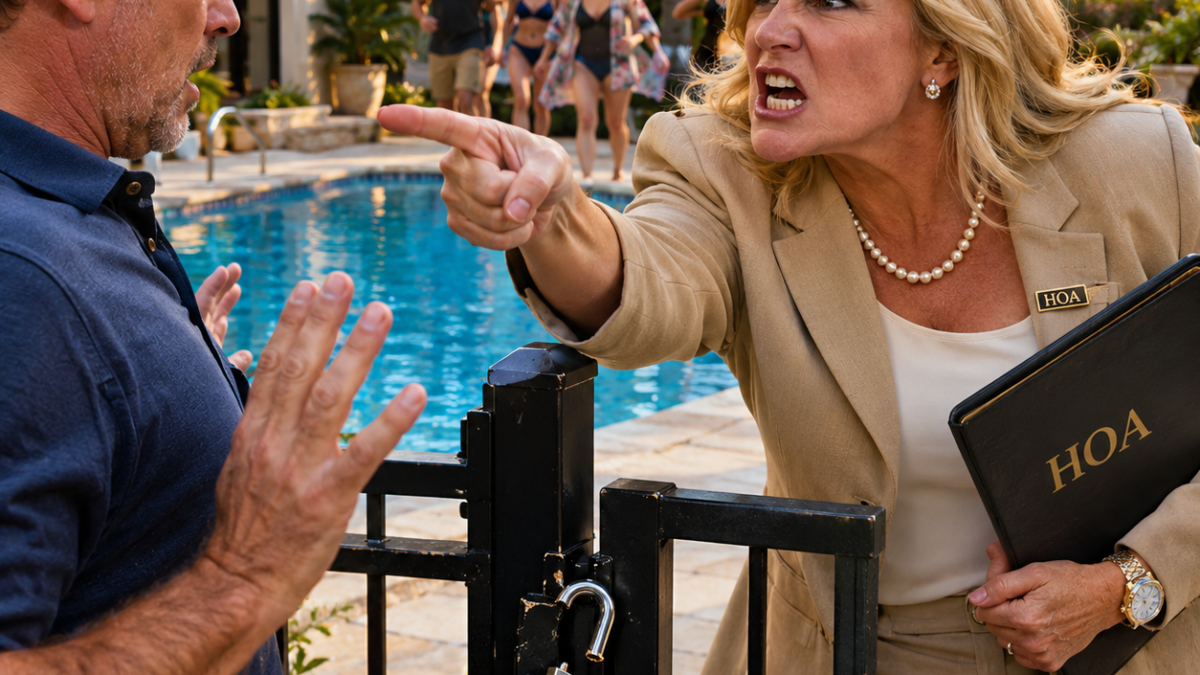
PART 2
## **The Phone Call That Changed Everything**
I stood in my bedroom with the phone pressed against my ear.
For several seconds, neither of us spoke.
I could hear papers moving on Victoria’s end of the line.
That detail bothered me more than it should have.
She had prepared for this.
This wasn’t a drunken idea somebody came up with at a party.
There were schedules.
Lists.
Vendors.
Volunteers.
A DJ.
And apparently a plan to use my backyard.
“Victoria,” I said slowly, “who exactly approved this?”
“The board.”
“Your board can’t approve the use of my property.”
“We’ve discussed the issue extensively.”
“You discussed my house without me?”
“We discussed the needs of the community.”
I almost laughed.
“My swimming pool isn’t a community need.”
“Luke, please don’t make this difficult.”
There it was.
Not *illegal*.
Not *incorrect*.
Difficult.
As if my refusal to hand strangers access to my yard was a personality defect.
“Cancel it.”
She sighed.
“We can’t.”
“Then move it.”
“There’s nowhere else appropriate.”
“That’s not my problem.”
“The clubhouse pool is undergoing maintenance.”
“Still not my problem.”
“We’ve already issued notices.”
“Not my problem.”
“Families are expecting this.”
“Victoria.”
I lowered my voice.
“If one person comes through my gate without my permission, they’re trespassing.”
Her sugary tone disappeared.
“That is an unnecessarily hostile way to frame a community event.”
“It’s my property.”
“You’re physically located inside Redwood Heights.”
“My property is legally exempt.”
“That exemption has always been controversial.”
I actually stopped breathing for a moment.
“Controversial?”
“The original arrangement was made before the association matured.”
“Recorded property rights don’t expire because you don’t like them.”
“You benefit from this community.”
“I pay county taxes.”
“You benefit from our landscaping.”
“I didn’t ask for it.”
“You benefit from our security patrol.”
“I didn’t hire them.”
“You benefit from property values.”
“And none of that gives you my swimming pool.”
Silence.
Then Victoria said:
“The board voted.”
I stared into the dark hallway.
“Then your board voted on something it doesn’t own.”
Her voice dropped.
“Luke, this isn’t about you.”
“It’s happening at my house.”
“Don’t be selfish.”
Then she hung up.
I looked at the screen.
Call duration: seven minutes, eleven seconds.
For maybe thirty seconds, I just stood there.
Then my phone rang again.
Unknown number.
I answered.
“Luke?”
Male voice.
Too casual.
“Who’s this?”
“Caleb Morrison. Event coordinator for Unity Weekend.”
Of course there was an event coordinator.
“Why are you calling me?”
“Victoria said there might be some confusion.”
“There isn’t.”
“Listen, man, we’re all adults. Nobody wants drama.”
“Great. Don’t come to my house.”
He laughed.
Actually laughed.
“You’re serious?”
“Completely.”
“Come on. It’s just a few hours.”
“No.”
“Kids are excited.”
“No.”
“Vendors have already been paid.”
“No.”
“You’re going to ruin a charity event over a technicality?”
“My ownership of my backyard isn’t a technicality.”
Caleb’s friendly voice disappeared almost as quickly as Victoria’s had.
“You aren’t going to call the cops on families and children.”
“If they enter my property after I’ve told you not to?”
“Seriously?”
“Yes.”
He exhaled.
“Be reasonable.”
“I am being reasonable. I’m giving you two hours’ warning not to trespass.”
There was a pause.
Then he muttered:
“See you at six.”
The line went dead.
I looked at the clock.
4:09 a.m.
That was when fear replaced disbelief.
They were really coming.
## **Preparation**
I didn’t go back to sleep.
I went downstairs.
My hands were shaking, although I wasn’t sure whether it was anger or adrenaline.
Probably both.
I made coffee I barely touched.
Then I opened the steel file box in my office.
Deed.
Title documents.
Recorded exemption.
Property map.
Closing paperwork.
Insurance records.
I placed everything on the dining table.
Then I logged into the security system.
Front camera.
Driveway.
Side yard.
Pool deck.
Rear gate.
Every camera was working.
I enabled continuous recording instead of motion-only mode.
Then I started recording my computer screen with my phone as an additional backup.
Maybe that sounds paranoid.
It didn’t feel paranoid at 4:20 that morning.
It felt responsible.
Next, I called the police non-emergency line.
A woman answered.
I explained everything.
“I want to be very clear,” I told her. “Nobody has entered yet. I’m calling ahead because I’ve been told approximately one hundred people are coming to use my private pool without permission.”
There was a pause.
“One hundred?”
“That’s what I was told.”
“And this is an HOA event?”
“An HOA I’m not part of.”
She asked for my address.
I gave it.
She confirmed the property information available to her.
Then she said:
“Do not physically confront anyone.”
“I wasn’t planning to.”
“Keep the gate secured. If anyone forces entry, call 911.”
“What if they just climb over?”
“Still call.”
“I’m recording.”
“Good. Preserve everything.”
That sentence steadied me.
Preserve everything.
I printed the exemption documents.
Then I placed a handwritten sign on the inside of the gate:
**PRIVATE PROPERTY
PRIVATE POOL
NO HOA EVENT AUTHORIZED
ENTRY WITHOUT OWNER PERMISSION IS TRESPASSING**
I photographed the sign.
I photographed the locked gate.
I photographed the chain.
I photographed the padlock.
Then I waited.
## **5:17 A.M.**
Ray was the first neighbor to notice something.
My phone buzzed.
**You awake?**
I replied:
**Very.**
Thirty seconds later:
**Why are two vans unloading folding tables by the clubhouse?**
I called him.
“You’re going to think I’m insane.”
“Try me.”
I explained.
He was silent for a long time.
Then he said:
“She told people you volunteered.”
My stomach turned.
“What?”
“There was a flyer online yesterday. Community pool donated by a local homeowner.”
“I never saw it.”
“You wouldn’t. Private HOA group.”
“Can you screenshot it?”
“Already did.”
That was Ray.
Retired firefighter.
Prepared for everything.
He sent it.
There it was.
**REDWOOD HEIGHTS UNITY SWIM**
6:00 A.M. – 10:00 A.M.
Breakfast refreshments.
Music.
Games.
Fundraiser.
And beneath everything:
**SPECIAL THANKS TO OUR NEIGHBORHOOD HOST FOR GENEROUSLY MAKING A PRIVATE POOL AVAILABLE TO THE COMMUNITY.**
No name.
No address.
But Victoria had deliberately told people I volunteered.
That changed things.
Up to that point, part of me wondered whether residents were knowingly participating in something wrong.
Now I understood most of them were probably victims of the lie too.
At 5:28, somebody knocked softly on my front door.
It was Melissa Grant from three houses down.
She was wearing sweatpants and a hoodie.
Her hair was pulled into a messy ponytail.
She held her phone in one hand.
“Tell me this isn’t real.”
“It’s real.”
“Victoria told the Facebook group you agreed.”
“I didn’t.”
“I figured.”
“Why?”
“Because I’ve met you.”
Despite everything, I laughed.
She stepped inside.
“You need a witness?”
“Yes.”
“I’m staying.”
“You don’t have to.”
“Luke, she once sent me three notices because my daughter’s chalk drawings were visible from the sidewalk. I absolutely have to.”
At 5:36, the first SUV turned onto my street.
Then another.
Then another.
## **The Crowd**
By 5:45, the quiet street looked like a school drop-off zone.
Cars lined both curbs.
Parents unloaded folding chairs.
Children carried inflatable rings.
Teenagers had towels around their shoulders.
Someone wheeled a cooler down the sidewalk.
A man carried two trays of pastries.
Another person had boxes of bottled water.
I watched through the cameras.
Melissa stood beside me.
“They really think you invited them.”
“Most of them probably do.”
Then I saw Caleb.
Polo shirt.
Khaki shorts.
Clipboard.
Radio clipped to his belt.
He looked like a summer camp manager.
He stood near my driveway directing people.
“Pool entrance is around the side!” he called.
My jaw tightened.
I opened the side window.
“Caleb.”
He looked up.
“Morning!”
“There is no event here.”
People nearby stopped.
He kept smiling.
“Luke, we’ve been over this.”
“No. You’ve been told no.”
A woman with two small children looked confused.
“Wait. This isn’t the community pool?”
I answered.
“No, ma’am. This is my house.”
Caleb turned toward her.
“Just give us a moment. We’re sorting out a technical issue.”
“It’s not technical.”
He glared at me.
Then his smile returned for the crowd.
“Everything’s fine.”
Melissa whispered:
“He’s lying right in front of you.”
“Keep recording.”
“I am.”
Then the crowd parted.
Victoria walked toward my house.
White blouse.
Dark slacks.
Sunglasses.
Perfect hair.
And in her right hand—
Bolt cutters.
Melissa inhaled sharply.
“Oh my God.”
I felt strangely calm.
Not because I wasn’t scared.
Because that one object ended every question.
There would be no pretending this was confusion.
No pretending the gate happened to be open.
No pretending I had consented.
I took out my phone.
Started recording separately.
Then I walked to the back door.
Victoria reached the gate.
She looked at my sign.
Read it.
And smiled.
## **The Last Warning**
I spoke through the security intercom.
“Victoria.”
She looked toward the camera.
“Good morning, Luke.”
“You’ve been told not to enter.”
A few parents were watching now.
She glanced at them.
Then toward the camera.
“We’re not going to have this argument in front of children.”
“I’m not arguing. I’m giving you notice. This event is not authorized.”
Caleb stepped beside her.
“You’re making a scene.”
“I’m inside my house.”
Victoria lifted the cutters.
“Luke, the community paid vendors.”
“Then refund them.”
“You’ve caused enough disruption.”
“Put the bolt cutters down.”
Someone behind her asked:
“Why does she have bolt cutters?”
Another voice:
“I thought he volunteered.”
Victoria ignored them.
“The board voted to temporarily designate the pool as an event amenity.”
I almost couldn’t believe the sentence.
“You can’t vote yourself access to private property.”
“We have community-use authority.”
“Not over my parcel.”
“You benefit from the association.”
“We’ve had this conversation.”
“We have.”
“Then you know I’m calling the police.”
She stared into the camera.
Then smiled.
“You wouldn’t do that.”
I raised my phone.
“I already warned them.”
Her expression changed.
Only for a second.
Then she placed the bolt cutters around my padlock.
Melissa whispered:
“Luke.”
“I know.”
Victoria squeezed.
The first attempt didn’t break it.
A strange silence fell over the people nearest the gate.
She repositioned the jaws.
Squeezed again.
Metal snapped.
I dialed 911.
## **6:02 A.M.**
The dispatcher answered almost immediately.
“911. What’s your emergency?”
“My name is Luke Harrington. I called earlier regarding anticipated trespassing at my home. They’re cutting the lock now.”
“Are you inside the residence?”
“Yes.”
“Stay inside.”
“The gate just opened.”
“Do not confront them.”
“I’m not.”
“How many people?”
“Thirty or forty at the gate. More arriving.”
“Any weapons?”
“One woman has bolt cutters.”
“Anything else?”
“Not that I can see.”
“We have units en route.”
Victoria pushed the gate open.
For one second, nobody moved.
That hesitation gave me hope.
Maybe people finally understood.
Then Caleb clapped his hands.
“All right, folks. Pool area this way.”
And people entered.
Not all of them.
Several families backed away.
But enough followed him.
Ten.
Twenty.
More.
Children ran toward the water.
Parents unfolded chairs.
Somebody dragged a cooler onto my deck.
A vendor carried speakers toward the outlet near my grill.
One man actually began moving my patio furniture.
I watched all of it through glass.
There are moments when anger becomes so intense that it stops feeling hot.
It becomes cold.
Precise.
I wanted to storm outside.
I wanted to scream.
I wanted to grab every person and tell them to get out.
But I could still hear the dispatcher’s voice.
“Stay inside, sir.”
So I stayed.
Melissa stood beside me recording the security monitor.
“Luke, they are literally putting decorations on your fence.”
I looked.
Blue-and-white banners.
**REDWOOD HEIGHTS TOGETHER**
The irony was almost impressive.
## **The Lie Starts Breaking**
The first crack didn’t come from me.
It came from a mother near the shallow end.
She looked toward the house.
Then toward Victoria.
“Does he actually live here?”
Victoria answered:
“Yes, but this is a community matter.”
The woman frowned.
“You told us the homeowner offered the pool.”
“He had been informed of the board’s decision.”
“That’s not the same thing.”
Caleb stepped in.
“Let’s not ruin the morning.”
Another man asked:
“Did you cut his lock?”
Victoria’s voice sharpened.
“The gate had to be opened.”
Melissa whispered:
“They’re figuring it out.”
Then I heard sirens.
Far away at first.
Then closer.
The sound moved through Redwood Heights until conversations began stopping one by one.
Children kept playing.
Adults looked toward the road.
Caleb stopped adjusting the speakers.
Victoria turned toward the gate.
Two patrol cars appeared.
Red and blue light washed across the immaculate lawns.
For the first time all morning, Victoria didn’t look in control.
## **The Officers Arrive**
Two officers stepped out.
The older one was broad-shouldered, gray at the temples.
The younger officer scanned the crowd immediately.
The older man approached my front door first.
I opened it but stayed behind the threshold.
“You Luke Harrington?”
“Yes.”
“Officer Daniels. That’s Officer Vega.”
I handed him my ID.
“Tell me what happened.”
I kept it simple.
“I was called at 3:56 this morning and told the HOA would use my pool. I said no. I told them anyone entering would be trespassing. Around six, the HOA president cut the padlock on my side gate and brought people into my yard.”
“You have video?”
“Every second.”
“Property ownership documents?”
“On the table.”
He glanced toward the backyard.
“How many people?”
“Maybe thirty inside. More outside.”
“Anyone threatened you physically?”
“No.”
“Did you give anyone permission to enter?”
“No.”
He nodded.
“Stay here.”
Officer Vega moved toward the gate.
Daniels joined him.
I watched through the window.
“Police department,” Daniels called.
Every conversation stopped.
“Everyone step away from the pool.”
A teenager froze halfway through taking off his sandals.
A child was still holding an inflatable flamingo.
One parent asked:
“What’s happening?”
Victoria approached the officers.
“Good morning. I’m Victoria Hale, president of the Redwood Heights Community Association.”
Daniels looked at her.
“This is private property.”
“Yes, but the association authorized—”
“The homeowner says he did not authorize this event.”
Victoria folded her hands.
“There is a dispute regarding community access.”
Daniels pointed toward the broken lock.
“Who cut that?”
Silence.
Caleb stepped forward.
“This is really more of a civil misunderstanding.”
Officer Vega looked at him.
“Who are you?”
“Caleb Morrison. Event director.”
“Did you cut the lock?”
“No.”
Vega looked back at Victoria.
“Ma’am?”
Victoria’s shoulders stiffened.
“The gate was obstructing a scheduled community function.”
“Did you cut the lock?”
“We had authorization.”
“From the property owner?”
“The association—”
“From the property owner?”
Victoria went silent.
The mother who had questioned her earlier spoke from behind them.
“She told us the homeowner volunteered.”
Heads turned.
Another parent nodded.
“That’s what the flyer said.”
Victoria looked suddenly surrounded.
Not by enemies.
By witnesses.
## **Everybody Out**
Officer Daniels raised his voice.
“Anyone who does not reside at this address needs to leave the property immediately.”
The reaction was instant.
Parents grabbed towels.
Children were pulled from the water.
Chairs folded.
Coolers closed.
People began moving toward the gate.
Not angrily.
Embarrassed.
Confused.
Some were furious at Victoria.
One man stopped near my back door.
“I’m sorry,” he called. “We honestly thought you agreed.”
I nodded.
“I know.”
A woman carrying a toddler said the same thing.
Another parent wouldn’t look at me.
A teenage girl was crying.
That’s when my anger shifted.
These people weren’t all accomplices.
Most had been lied to.
They were props in Victoria’s demonstration of authority.
And she had brought them into something they never understood.
Within ten minutes, the yard was nearly empty.
What remained looked like the aftermath of a strange storm.
Wet footprints.
Abandoned water bottles.
A crushed paper cup.
A towel with cartoon sharks.
Ice melting beneath a cooler.
My private space looked used.
Invaded.
Different.
## **The Evidence**
Officer Daniels called me outside.
I carried my file folder.
Melissa came with me.
“She’s a witness,” I explained.
“And I recorded everything,” Melissa added.
Victoria rolled her eyes.
That was a mistake.
Officer Vega saw it.
I laid the documents on my patio table.
“This is my deed.”
Then the recorded HOA exemption.
“This property predates the association. Here’s the recorded language.”
Daniels read carefully.
I showed him the flyer Ray had sent.
Then Victoria’s calls.
Then the video.
3:56 a.m.
Her call.
My refusal.
Caleb’s call.
My warning.
The gate camera.
Victoria reading the PRIVATE PROPERTY sign.
Victoria placing the bolt cutters on the lock.
Snap.
Gate opening.
Crowd entering.
Nobody needed to interpret it.
The video explained itself.
Daniels looked toward Victoria.
“Ma’am, were you aware he had refused permission before you arrived?”
She straightened.
“The board believed his refusal was unreasonable.”
Daniels stared at her.
“That’s not what I asked.”
She didn’t answer.
He repeated:
“Did you know he refused permission?”
“Yes.”
“And then you cut his lock?”
“The board had determined—”
Officer Daniels interrupted.
“The HOA cannot vote to enter somebody else’s fenced private residence.”
Her face changed.
Not dramatically.
Just enough.
The confidence finally cracked.
“This property is part of Redwood Heights geographically.”
I said nothing.
Daniels replied:
“Geography isn’t permission.”
Caleb stepped forward.
“No one was trying to commit a crime.”
Officer Vega looked at him.
“Intent doesn’t make the broken lock disappear.”
Caleb’s face lost color.
“This was a charity event.”
“That doesn’t make the property public.”
Victoria raised her voice.
“Luke has been deliberately antagonistic toward this community for months.”
Every head turned toward me.
She continued.
“He refuses participation. He ignores notices. He benefits from our services without contributing. He creates division.”
Daniels looked almost tired.
“Ma’am.”
“He acts like he’s above everyone.”
“Ma’am.”
“He deliberately—”
“Stop.”
Silence.
Daniels pointed toward the broken gate.
“This is a private residence. He told you no. The gate was locked. There was a sign. You cut the lock and entered anyway.”
Victoria stared at him.
He continued.
“That isn’t a communication problem.”
Then he said the words I needed to hear:
“It’s trespassing and property damage.”
## **The Citations**
Victoria wasn’t handcuffed.
There was no dramatic arrest.
No crowd cheering.
Real life isn’t edited like that.
But she and Caleb were separated.
Statements were taken.
Names recorded.
The damaged lock was photographed.
The security footage was copied.
The officers issued citations and explained that additional consequences could depend on review of the evidence and local law.
Victoria kept asking to speak “board to board.”
Officer Daniels finally told her:
“The police department is not a homeowners association.”
Melissa nearly choked trying not to laugh.
I didn’t.
I was too tired.
When the officers finally left, it was after seven.
The sunrise was beautiful.
That almost made me angry.
The sky had no business looking that peaceful.
I stood beside the broken gate.
Melissa touched my shoulder.
“You okay?”
I looked at the pool.
“I don’t know.”
That was the truth.
The lock was maybe thirty dollars.
The gate could be repaired.
The deck could be cleaned.
But something bigger had been damaged.
Until that morning, home had been the place where I assumed I was safe because I had legal rights.
Afterward, I understood that rights only matter when people are willing to respect them—or when you’re willing to defend them when they don’t.
## **The Cleanup**
Melissa stayed another two hours.
We picked up cups.
Towels.
Plastic wrappers.
A pair of children’s goggles.
Somebody had spilled orange juice near the grill.
One chair had been dragged through a flower bed.
There was sunscreen smeared across my outdoor table.
None of it was catastrophic.
That almost made it worse.
The damage looked ordinary.
Like evidence of a normal party.
Except there had been nothing normal about it.
Melissa found a melted popsicle wrapper under a chair.
She held it up.
“Evidence.”
I laughed.
I couldn’t help it.
A stupid, exhausted laugh.
She laughed too.
Then suddenly I wasn’t laughing anymore.
“I hate that I’m this angry.”
“You should be angry.”
“There were kids here.”
“That part wasn’t their fault.”
“I know.”
She looked toward the broken gate.
“Don’t let Victoria use that against you.”
“What do you mean?”
“She’ll say you ruined a children’s charity event.”
I stared at her.
Melissa continued.
“People like her don’t admit they crossed a line. They rewrite where the line was.”
Those words stayed with me.
By noon, she was proven right.
## **The Spin Begins**
The private Redwood Heights Facebook group exploded.
Ray sent screenshots.
Victoria posted first.
**This morning’s community event was unfortunately disrupted because of an unexpected disagreement concerning use of a neighborhood-adjacent amenity. We regret that certain individuals chose escalation rather than cooperation.**
Certain individuals.
That was me.
Another post called the incident:
**A regrettable misunderstanding regarding community access.**
Then Caleb wrote:
**Our volunteers acted in good faith based on board instructions.**
No mention of bolt cutters.
No mention of my refusal.
No mention of the sign.
No mention of police.
A woman replied:
**I was there. We were told Luke volunteered. He clearly didn’t. Why were we lied to?**
That comment disappeared fifteen minutes later.
Then another resident posted:
**Did Victoria actually cut the lock?**
Deleted.
Then Ray uploaded a photograph taken from his front yard.
Victoria.
Bolt cutters.
Gate.
That couldn’t be deleted fast enough.
Screenshots spread privately.
By afternoon, the story was already changing.
Not Victoria’s version.
The truth.
## **My Lawyer**
At 1:30 p.m., I called attorney David Mercer.
He had helped with my purchase years earlier.
“Tell me you’re calling about a contract.”
“I wish.”
I explained.
There was silence.
Then:
“She cut the lock?”
“On camera.”
“After you explicitly denied permission?”
“Twice by phone. Again through the intercom.”
“You still have the recordings?”
“Yes.”
“Back them up.”
“Already did.”
“Again.”
I smiled for the first time that afternoon.
“I like how you think.”
“Luke, preserve original files. Don’t edit anything. Save call logs. Save the HOA notices. Save screenshots. Save the damaged lock.”
“I have a folder.”
“Good.”
“It’s literally labeled Future Court Exhibits.”
David laughed.
“Finally, a client who listens before hiring me.”
Then his voice became serious.
“Do not communicate directly with Victoria from this point forward.”
“What if she comes here?”
“Tell her to contact me.”
“What do we do?”
“First, we make sure the record cannot be rewritten.”
That became our strategy.
Not revenge.
Record.
Truth.
Consequences.
## **The Letter That Wasn’t an Apology**
Three days later, a certified envelope arrived.
The HOA logo was at the top.
I expected an apology.
That was naive.
The letter said:
**The Redwood Heights Community Association regrets that communication surrounding the Unity Swim was misinterpreted by certain parties.**
Misinterpreted.
My jaw tightened.
Then:
**The Association maintains that its actions were intended solely to promote neighborhood cohesion and charitable participation.**
Finally:
**We hope Mr. Harrington will refrain from further public escalation and work collaboratively toward a peaceful resolution.**
I called David.
“They want me to stop escalating.”
He read the letter.
Then laughed.
“What?”
“This is useful.”
“How?”
“They still aren’t apologizing.”
“That’s useful?”
“They’re locking themselves into a narrative.”
“What narrative?”
“That cutting your lock was somehow communication.”
I looked at the broken padlock sitting in a plastic bag on my desk.
“Interesting form of communication.”
“Exactly.”
David sent a response.
It was three pages.
He demanded preservation of:
Board meeting minutes.
Emails.
Text messages.
Event plans.
Vendor contracts.
Facebook posts.
Internal communications regarding my property.
Any document identifying my pool as a community amenity.
Any vote supposedly authorizing entry.
And all communications concerning my HOA exemption.
That letter did more than any angry message I could have written.
Because suddenly Victoria had to preserve the evidence she had created herself.
## **The Board Meeting**
A week later, Redwood Heights announced an emergency board meeting.
I wasn’t technically a member.
But David informed them I would attend because my property was the subject of the dispute.
The clubhouse was packed.
I stood near the back with Ray and Melissa.
Victoria sat behind the board table.
Caleb sat in the first row.
She looked composed.
For about six minutes.
Then residents started asking questions.
A father named Eric stood.
“Were we told Luke volunteered?”
Victoria answered:
“The event materials reflected the board’s understanding at the time.”
“That’s not what I asked.”
I almost smiled.
Eric repeated:
“Did Luke volunteer?”
Victoria paused.
“No.”
The room changed.
A woman near the front stood.
“Then why did the flyer say he did?”
“It did not identify Luke specifically.”
“You sent us to his address.”
Murmurs.
Another resident asked:
“Did he tell you not to come?”
Victoria shifted.
“There were ongoing discussions.”
Ray called from the back:
“He told you no.”
Victoria looked at him.
“This meeting will remain orderly.”
Ray folded his arms.
“I’m retired. I’ve got all night.”
A few people laughed.
Then Robert Chen, the HOA treasurer, spoke.
He looked uncomfortable.
“Victoria, I need clarification on something.”
She turned.
“Yes?”
“Was there actually a board vote authorizing access to Luke’s property?”
Silence.
The room became completely still.
Victoria glanced toward another board member.
Robert repeated:
“Was there a recorded vote?”
“We discussed the event.”
“That’s not what I’m asking.”
“There was consensus.”
“Was there a motion?”
Victoria’s face tightened.
“No formal motion was necessary.”
Robert leaned back.
“You told Luke the board voted.”
She didn’t answer.
That was the moment her story began collapsing inside her own organization.
## **What the Board Had Actually Approved**
The truth came out slowly.
The board had approved Unity Weekend.
They had approved a community swim.
They had approved vendor expenses.
They had not approved using my pool.
Victoria had told them she was “working out access.”
Several members assumed I had agreed.
Then, days before the event, one member apparently asked Victoria whether written permission had been received.
Her response:
**Luke has been notified.**
Not agreed.
Not consented.
Not volunteered.
Notified.
She had turned a warning into permission.
Then she’d turned permission she didn’t have into a “board decision.”
Robert looked sick.
“You told us the property issue was resolved.”
“It should have been.”
“That’s not an answer.”
“The exemption is outdated.”
David, sitting beside me, whispered:
“There.”
“What?”
“She just admitted she knew about the exemption.”
That mattered.
Victoria had spent months sending fake compliance notices.
She had known I was exempt.
She simply believed the exemption shouldn’t matter.
## **The Recording**
Victoria tried to regain control.
She looked toward me.
“Mr. Harrington has portrayed himself as a victim while intentionally refusing reasonable community cooperation.”
David leaned toward me.
“Don’t respond.”
I didn’t.
She continued.
“He was offered repeated opportunities to participate.”
A resident shouted:
“Did he say yes?”
Victoria ignored him.
Then Melissa stood.
“I have something.”
Victoria frowned.
“This isn’t a public trial.”
Melissa held up her phone.
“No, but you keep pretending you don’t remember what happened.”
She had recorded the intercom conversation.
Not through hidden surveillance.
Standing in my living room while Victoria was outside.
Melissa played the relevant section.
My voice:
**This event is not authorized.**
Victoria:
**The board voted to temporarily designate the pool as an event amenity.**
Me:
**You can’t vote yourself access to private property.**
Then:
**Put the bolt cutters down.**
The room went silent.
Finally, the sound of the lock snapping.
Click.
Metal.
Gate.
Someone near the front whispered:
“Oh my God.”
Victoria’s face had gone pale.
David looked at me.
“That’s the meeting.”
“What?”
“We don’t need anything else.”
But Victoria did.
## **Victoria Blames Me**
She stood.
“Do you understand what he has done to this community?”
The room went quiet.
She pointed toward me.
“This man has spent years refusing every attempt at inclusion.”
I couldn’t believe what I was hearing.
“His property benefits from our neighborhood while he contributes nothing.”
Robert interrupted.
“He’s legally exempt.”
“That doesn’t make it fair.”
“It makes it legal.”
“This is bigger than legal technicalities.”
That’s when David finally stood.
“I’m David Mercer, counsel for Mr. Harrington.”
Victoria froze.
He continued.
“And I strongly recommend that nobody representing this association describe my client’s recorded property rights as a technicality while litigation is being considered.”
Nobody spoke.
David sat down.
Victoria looked like she’d just realized that every angry sentence she said could become another exhibit.
For the first time that evening, she stopped talking.
## **The Investigation**
Over the next month, things became less dramatic on the surface and more serious underneath.
Police reports were finalized.
Statements were reviewed.
The property damage was documented.
My homeowners insurance representative inspected the gate.
The HOA’s insurer got involved.
Lawyers exchanged letters.
And the association’s internal records began surfacing.
One email from Victoria to Caleb, sent two days before the event, read:
**Luke is likely to object, but once residents arrive he won’t risk making a scene in front of families.**
I stared at those words.
David asked:
“You okay?”
“She planned that.”
“Yes.”
“She knew I’d say no.”
“Yes.”
“And she thought kids would pressure me into accepting it.”
“That’s how I read it.”
There was another email.
Caleb had written:
**Are we sure he agreed?**
Victoria responded:
**He’ll cooperate when he sees the turnout.**
That changed the entire emotional weight of the morning for me.
They hadn’t misunderstood.
Victoria had calculated.
She believed I would be too embarrassed to enforce my rights once children were standing at the gate.
She had weaponized politeness.
## **The Hearing**
The hearing itself was less cinematic than I expected.
No dramatic courtroom confession.
No screaming.
No judge slamming a gavel while Victoria was dragged away.
Just lawyers.
Documents.
Security footage.
Call logs.
Property records.
Testimony.
Facts.
But facts turned out to be more damaging than drama.
My deed established ownership.
The recorded exemption established that Redwood Heights had no authority over my parcel.
The video showed the locked gate.
The sign showed clear notice.
The audio showed repeated refusal.
The security footage showed Victoria cutting the lock.
The HOA communications showed she anticipated my objection.
The police reports showed strangers had entered the property.
There was very little left to argue about.
Victoria’s attorney tried to frame the situation as an overzealous community event.
David responded:
“An enthusiastic fundraiser doesn’t turn a private residence into public property.”
That line stayed with me.
Victoria was fined.
The trespass and property-damage consequences became part of the official record.
Caleb faced consequences for his role as well.
The HOA’s insurance and legal representatives pushed for settlement of the property damage and my related costs.
And Redwood Heights agreed in writing that my home, yard, pool, driveway, and access gates were private property outside HOA control.
It sounds obvious.
It had always been obvious.
But now it was written in language Victoria couldn’t reinterpret.
## **My Conditions**
The settlement offer came through David.
“They’ll replace the gate and lock.”
“They should.”
“Cover documented damages.”
“Good.”
“Reimburse certain legal expenses.”
“Good.”
“And issue a clarification to residents.”
I looked at him.
“What kind of clarification?”
He slid the draft across the table.
It said:
**A recent community event resulted from a misunderstanding concerning property access.**
I handed it back.
“No.”
David smiled slightly.
“I thought you’d say that.”
“It wasn’t a misunderstanding.”
“What do you want it to say?”
“The truth.”
We revised it.
The final version read:
**The Redwood Heights Community Association acknowledges that the Harrington residence and swimming pool are privately owned property not subject to Association control. The Association did not possess authorization from the owner for the Unity Swim event. Future Association activities will not use, enter, advertise, or identify the property as a community amenity without the owner’s express written permission.**
That was enough.
No public humiliation.
No insults.
Just facts.
Victoria hated it.
I could tell because she fought the wording for days.
Eventually, the association approved it without her support.
## **The Vote**
I didn’t know there would be another board vote until Ray called.
“You might want to come tonight.”
“Why?”
“They’re discussing leadership.”
I almost said no.
I was tired of Victoria.
Tired of the clubhouse.
Tired of being the center of a neighborhood I had deliberately chosen not to join.
Then Melissa called.
“Come.”
So I did.
The atmosphere was different.
Nobody treated Victoria like a monarch anymore.
Robert chaired the meeting.
That told me everything before anyone spoke.
He summarized the association’s exposure.
Legal expenses.
Insurance claims.
Damage reimbursement.
Police involvement.
Loss of resident trust.
Then he said:
“We need to address the decisions that led to this situation.”
Victoria sat rigidly at one end of the table.
A board member made a motion to remove her as president.
The room gasped even though everyone knew it was coming.
Victoria immediately spoke.
“This is a reaction to outside pressure from someone who isn’t even a member.”
Robert looked at her.
“This is a reaction to what happened.”
“I acted for the community.”
“You cut a private lock.”
“To carry out an approved event.”
“The board never approved that location.”
“Everyone knew.”
“No.”
Robert shook his head.
“We knew you were arranging access.”
Victoria looked around the room.
“You’re letting Luke destroy Redwood Heights.”
For some reason, that was the moment I finally stood.
“Victoria.”
She turned toward me.
I hadn’t spoken directly to her in weeks.
“You keep saying I did this.”
“You did.”
“No.”
I pointed toward the floor between us.
“I was asleep in my own house when you called me.”
Silence.
“I told you no.”
“You refused reasonable—”
“I told you no.”
She stopped.
“You came anyway.”
Nobody moved.
“You read a sign saying private property.”
Her jaw tightened.
“You cut the lock.”
Silence.
“You brought families into my yard after telling them I’d volunteered.”
I looked around the room.
“I didn’t destroy anything here.”
Then back at her.
“I just stopped pretending what you did was normal.”
The vote passed.
Victoria was removed as HOA president.
She remained a resident.
She remained a member.
But she was no longer the person who could turn her personal obsession into neighborhood policy.
I expected to feel triumphant.
Instead, I felt empty.
Maybe relief.
Mostly exhaustion.
## **The Part That Hurt Most**
The hardest part wasn’t the legal fight.
It was my relationship with the neighborhood afterward.
Some people apologized.
A lot.
One family brought me a new pool skimmer as a joke.
I laughed.
Another mother wrote a three-page letter explaining she’d believed the event was authorized and felt terrible that her children had entered my yard.
I told her she didn’t owe me an apology.
She had been lied to.
Others avoided me.
A few people still believed I’d overreacted.
One man told Ray:
“Luke could’ve just let them swim for a few hours.”
Ray apparently asked him:
“Mind if I borrow your house Saturday for seventy people?”
The conversation ended quickly.
But there were people who genuinely couldn’t understand why I cared so much.
That taught me something.
People are often generous with property that belongs to somebody else.
## **Victoria Comes Back**
About two months after the hearing, I was repairing the gate.
Not because it was still broken.
That had been replaced.
I was adding a steel reinforcement plate.
I heard footsteps.
Victoria stood outside the fence.
No clipboard.
No sunglasses.
No perfect presidential posture.
Just Victoria.
I didn’t open the gate.
“What do you need?”
She looked at the new lock.
“Stronger.”
“Yes.”
“Because of me?”
“Because someone cut the last one.”
She winced.
Fair enough.
For a moment, she said nothing.
Then:
“You won.”
I set down the drill.
“This wasn’t a game.”
“Feels like one.”
“Maybe to you.”
She looked at the pool beyond me.
“I lost my position.”
“You know I didn’t vote.”
“You didn’t have to.”
“No.”
I crossed my arms.
“You made that happen yourself.”
She gave a bitter laugh.
“That’s what everyone says.”
“Maybe they’re right.”
She looked at me.
“Do you have any idea how difficult it is to manage that neighborhood?”
“No.”
“Everyone wants something.”
“I believe you.”
“They complain about everything. Grass. Dogs. Parking. Fences. Noise. They expect the president to solve it.”
“Then solve things you’re responsible for.”
Her eyes narrowed.
“You always have an answer.”
“No.”
I shook my head.
“I just know my house isn’t yours to manage.”
That hit her.
She looked down.
Then she said:
“I thought you’d back down.”
There it was.
The first honest sentence I’d heard from her.
“Why?”
“Because there were families.”
“I know.”
“I thought once they arrived, you wouldn’t embarrass everyone.”
“By letting you trespass?”
She shook her head.
“That’s not how I saw it.”
“How did you see it?”
She took a long breath.
“As getting past your stubbornness.”
For several seconds, I said nothing.
Then:
“That’s the problem, Victoria.”
She looked at me.
“You thought my consent was an obstacle.”
Silence.
“You didn’t think no meant no. You thought it meant you hadn’t applied enough pressure yet.”
Her eyes moved toward the gate.
“I know.”
That surprised me.
“You know now?”
She nodded.
“Yes.”
It wasn’t an apology.
Not yet.
But it was closer than she’d ever been.
Then she walked away.
## **The Stronger Gate**
I finished the reinforcement that afternoon.
New lock.
Steel plate.
Anti-cut shield.
Additional camera.
Some people might call that paranoid.
Maybe.
But privacy feels different once someone has physically broken through it.
Before the incident, my fence was decorative security.
Afterward, it became a boundary I actually understood.
I added a small sign beside the gate.
Nothing aggressive.
Just:
**PRIVATE RESIDENCE
ENTRY BY OWNER PERMISSION ONLY**
Ray saw it.
“Subtle.”
“Trying to be friendly.”
“You should’ve written, ASK VICTORIA.”
I laughed.
“Absolutely not.”
“Missed opportunity.”
## **The Pool Party I Actually Chose**
That summer, Melissa asked me something unexpected.
“Would it feel weird if you had an actual party?”
“Very.”
“Maybe that’s why you should.”
I thought she was joking.
She wasn’t.
“Luke, you’re barely using the pool.”
“I use it.”
“You sit beside it.”
“That’s using it.”
She rolled her eyes.
Eventually, I agreed.
But this time I made the guest list.
Ray.
Melissa and her daughter.
A couple guys from my crew.
Eric and his family.
The woman who had apologized after the Unity Swim.
Maybe twelve people total.
Nothing organized.
No banners.
No DJ.
No clipboard.
Burgers.
Music from a small speaker.
Kids swimming.
Adults talking.
At one point, I stood near the grill and looked across the yard.
For a split second, I remembered the invasion.
Wet footprints.
Strangers.
Police lights.
Victoria with bolt cutters.
Then Melissa walked over.
“You okay?”
“Yeah.”
“You sure?”
I looked around.
“Actually, yeah.”
The difference was obvious.
The people were there because I invited them.
That was everything.
Consent transforms the same space.
The same pool.
The same laughter.
The same chairs.
One morning had felt violating.
This evening felt like home.
## **The Final HOA Letter**
Near the end of summer, I received another envelope from Redwood Heights.
For once, I didn’t immediately throw it into the Future Court Exhibits folder.
Robert had become interim president.
The letter was short.
**Mr. Harrington,**
**The Board has completed its review of all records relating to your property. Redwood Heights acknowledges that your residence is legally outside the Association’s governing authority. No Association rule, assessment, amenity designation, event policy, architectural restriction, or access policy applies to your parcel unless you voluntarily enter into a separate written agreement.**
Then:
**Association representatives will not enter your property without express permission except in a genuine emergency recognized by law.**
And finally:
**We apologize for the actions that led to the unauthorized entry onto your property.**
I read that last sentence several times.
No “miscommunication.”
No “unfortunate misunderstanding.”
No “community cohesion.”
Unauthorized entry.
Truth.
I put the letter in the folder.
Not because I expected court anymore.
Because it was the final page.
## **Victoria’s Apology**
Months passed.
Then one evening around sunset, Victoria stopped outside my gate again.
I was sitting beside the pool.
I saw her on the camera.
I walked over.
She didn’t touch the gate.
“Can we talk?”
“From there.”
She nodded.
Fair.
She looked tired.
Not defeated.
Just human.
“I’ve been wanting to say this.”
I waited.
“I’m sorry.”
I said nothing.
“For the gate.”
She swallowed.
“For lying to the residents about your permission.”
That mattered.
“For ignoring you when you said no.”
That mattered more.
She looked directly at me.
“And for treating your exemption like it was something I could override because I thought the neighborhood would be better if everyone followed the same rules.”
I leaned against the fence.
“Why now?”
“Because when I lost the presidency, I spent weeks telling myself everyone betrayed me.”
I waited.
“Then I read the incident report again.”
Her eyes dropped.
“I watched the gate video.”
I couldn’t imagine doing that if I were her.
“You told me no four times.”
“Yes.”
“I heard it.”
She shook her head.
“I don’t know how I convinced myself that wasn’t enough.”
I did.
Control.
Ego.
Authority.
But she needed to say it herself.
Finally:
“I thought being president meant I was responsible for making everyone cooperate.”
She looked toward my house.
“I forgot cooperation isn’t something you can force.”
That was the closest thing to understanding I ever expected from her.
“I accept your apology.”
Her head lifted.
“Really?”
“Yes.”
“After everything?”
“Accepting it doesn’t mean it didn’t happen.”
She nodded slowly.
“No.”
“It means I’m done carrying it.”
That answer surprised both of us.
Victoria walked away.
She never came onto my property again.
## **The Folder**
A year later, I cleaned out my home office.
I found the folder.
**FUTURE COURT EXHIBITS.**
It was thick.
Trash can notice.
Fence notice.
HOA meeting notice.
Pool flyers.
Screenshots.
Police documentation.
Attorney letters.
Settlement.
Final HOA acknowledgment.
I almost threw it away.
Then I decided to keep it.
Not because I expected another fight.
Because it reminded me how slowly unreasonable behavior becomes dangerous.
Victoria didn’t begin with bolt cutters.
She began with little pieces of paper.
Trash cans.
Fence height.
Meeting attendance.
Things easy to laugh at.
Each time I ignored her, she didn’t learn that she lacked authority.
She learned that there had been no consequence for pretending she had it.
By the time she called at 3:56 a.m., she had convinced herself that enough confidence could manufacture permission.
That was the real lesson.
People rarely cross a boundary in one giant step.
They test it.
Then test it again.
They see whether you object.
They see whether there is a consequence.
And if nothing stops them, they eventually forget there was ever a line.
## **Ray’s Version**
Ray tells the story differently.
According to him, Victoria “declared war on a swimming pool and lost.”
I tell him that’s ridiculous.
He says it’s accurate.
One afternoon we stood by my mailbox while he watered his lawn.
“You know the funniest part?” he asked.
“What?”
“If she’d just asked you nicely, would you ever have considered letting some neighbors use the pool?”
I thought about it.
“Maybe a few.”
“Exactly.”
“Not a hundred.”
“Obviously.”
“Not at six in the morning.”
“Obviously.”
“And definitely not Caleb with a DJ.”
Ray nodded.
“Nobody wants Caleb with a DJ.”
We laughed.
Then he turned serious.
“That’s what people like Victoria never understand.”
“What?”
“You can get more by asking than demanding.”
I looked toward my gate.
“Yeah.”
“But asking means accepting the possibility of no.”
That was exactly it.
## **What Happened to Redwood Heights**
The HOA didn’t disappear.
I didn’t want it to.
Other homeowners had agreed to live under it.
They wanted landscaping standards.
A clubhouse.
Common maintenance.
Community events.
That was their choice.
After Victoria, though, the board changed its procedures.
Any event held on privately owned property required written owner authorization.
Any dispute involving a parcel outside HOA jurisdiction had to go through counsel before notices were issued.
Board votes had to be formally recorded.
Residents were given access to meeting minutes.
No one person could declare a property a temporary community amenity.
The fact that such a rule had to exist still makes me laugh.
But it existed.
Robert once saw me at the grocery store.
“Luke.”
“Robert.”
“Things are quieter.”
“Good.”
“You know, I joined the board because I wanted better landscaping.”
“I’ve heard that before.”
He laughed.
“Now I read legal documents.”
“Character building.”
“That’s one phrase for it.”
Then he said:
“For what it’s worth, what happened forced us to fix things we should’ve fixed years ago.”
I appreciated that.
Sometimes the best outcome isn’t destroying a system.
It’s making it remember where its authority ends.
## **The Last Time Someone Asked About My Pool**
A few years after the incident, a new family moved into Redwood Heights.
They had no idea what had happened.
One summer afternoon, the father stopped me near the mailbox.
“You’re Luke, right?”
“Yeah.”
“I’m Ben.”
We shook hands.
He pointed toward my property.
“My kids swear there’s a pool behind your fence.”
“There is.”
He laughed.
“They’re desperate to know whether the HOA has some arrangement with you.”
I laughed harder than he understood.
“No.”
“Didn’t think so.”
“But you guys are welcome over Saturday if you want.”
He looked surprised.
“Seriously?”
“Sure.”
“Should I ask the HOA?”
“No.”
“Right.”
He smiled.
“Your house.”
“My house.”
He brought his wife and kids Saturday.
We grilled burgers.
The kids swam.
Nobody cut anything.
Nobody voted.
Nobody needed police.
Amazing how simple life becomes when people ask.
## **Why I Never Sold**
After everything, several people asked why I didn’t move.
I considered it.
For maybe a week.
The backyard didn’t feel the same immediately after the invasion.
Every time a car slowed near my property, I looked at the cameras.
Every knock at the door annoyed me.
Every HOA envelope made my stomach tighten before I remembered they couldn’t regulate me.
But selling would have meant letting that morning permanently change what home meant.
I didn’t want Victoria to own that too.
So I stayed.
I repaired the gate.
Strengthened the fence.
Used the pool.
Invited friends.
Let the place become mine again.
Slowly.
And one evening, months later, I realized I had spent almost an hour beside the water without thinking about the HOA.
That’s when I knew I’d gotten my home back.
## **What Revenge Actually Looked Like**
People love the word revenge.
They expect something dramatic.
They expect me to drain the pool into Victoria’s yard.
Or hold a giant party outside her bedroom.
Or cover my fence with signs mocking the HOA.
I did none of that.
The best revenge was far quieter.
Victoria said I was powerless because one homeowner couldn’t stand against the “community.”
I kept the video.
Victoria said the board’s wishes overruled my refusal.
I produced the deed.
Victoria said the pool was a neighborhood amenity.
The legal record said private property.
Victoria said police involvement would make me look unreasonable.
The police documented her trespass.
Victoria said residents would turn against me.
Many of them discovered she’d lied to them.
Victoria said I was destroying community unity.
Her own board removed her because she’d abused its authority.
I never needed to damage her house.
Never needed to threaten her.
Never needed to scream.
I just stopped giving her room to rewrite reality.
That was enough.
## **The Morning I Finally Understood**
About a year after the incident, I woke up unexpectedly at 3:56 a.m.
I know that sounds made up.
But I did.
I reached toward my phone instinctively.
No call.
No message.
The house was silent.
I got out of bed.
Walked downstairs.
Opened the back door.
The pool reflected the moon.
The gate was locked.
The cameras blinked softly.
Everything was quiet.
For a moment, I remembered that morning so clearly I could almost hear cars arriving again.
Then it faded.
I sat in a chair beside the pool.
Barefoot.
Just like the morning Victoria called.
Except this time nobody was coming.
Nobody had plans for my property.
Nobody had voted.
Nobody was standing outside with bolt cutters.
And I realized that this was what I’d been protecting.
Not concrete.
Not water.
Not a gate.
Choice.
The right to decide who comes into your space.
The right to say yes.
And more importantly, the right to say no.
## **The Thing About Boundaries**
People often hear the word “boundary” and imagine hostility.
Walls.
Fences.
Division.
But a healthy boundary isn’t an attack.
It’s information.
This is mine.
That is yours.
You can ask.
I can answer.
We can cooperate when we choose.
And when one person says no, cooperation stops there.
Victoria saw boundaries differently.
To her, my refusal was opposition.
My independence was disloyalty.
My exemption was unfair.
My locked gate was an obstacle.
My no was selfishness.
That’s why she failed.
She never understood that respecting people requires accepting limits you don’t personally like.
## **The Final Evening**
On the anniversary of that morning, Melissa and Ray came over.
Nothing formal.
Just dinner.
We sat beside the pool.
Ray raised his beer.
“To locked gates.”
Melissa lifted hers.
“To cameras.”
I shook my head.
“You’re both ridiculous.”
Ray looked at me.
“To bolt cutters?”
“Absolutely not.”
We laughed.
The sun dropped lower.
The water turned orange.
For a while, nobody talked about Victoria.
Nobody talked about police.
Nobody talked about court.
We talked about work.
Ray complained about his knees.
Melissa complained about her daughter’s college applications.
I complained about lumber prices.
Normal things.
And that was the ending I wanted most.
Normal.
Because when somebody invades your life, victory isn’t spending the rest of your life fighting them.
Victory is eventually having evenings where you forget they ever mattered.
## **Epilogue**
The new lock is still on my gate.
The HOA still exists.
The pool is still mine.
Redwood Heights still hosts community events.
They simply hold them on property they actually own or places where they have permission.
A revolutionary concept, apparently.
Victoria eventually stopped attending board meetings regularly.
When I occasionally saw her walking through the neighborhood, we’d nod.
Nothing more.
That was fine.
Caleb sent one final email months after the settlement.
He wrote:
**I handled the situation badly and should have verified permission myself. I’m sorry.**
I appreciated that more than his original “let’s move forward collaboratively” nonsense.
I replied:
**Thank you.**
Two words.
Enough.
I didn’t need revenge after that.
The record existed.
The truth existed.
My home existed.
And the gate closed behind me every evening exactly the way it was supposed to.
## **The Answer I Wish I’d Given at 3:56 A.M.**
Sometimes I imagine replaying that first call.
Victoria:
“We’ll be using your pool.”
Me:
“No.”
She argues.
Board vote.
Community good.
Families.
Charity.
Unity.
I used to imagine giving some perfect speech.
Quoting property law.
Explaining the exemption.
Warning her about criminal consequences.
Now I understand I didn’t owe her any of that.
“No” was the complete answer.
Everything she did after hearing it belonged to her.
That realization gave me more peace than the hearing ever did.
## **What Stayed With Me**
I still work as a carpenter.
Most days I’m fixing other people’s houses.
Replacing doors.
Building decks.
Installing cabinets.
And every once in a while, a client will apologize for being particular about their home.
They’ll say:
“Sorry. I’m probably being difficult.”
I usually tell them the same thing.
“It’s your house. You’re allowed to care.”
Because I understand that differently now.
A home isn’t precious because it’s expensive.
It’s precious because it’s one of the few places where an ordinary person is supposed to have the final say.
Victoria forgot that.
For one strange morning, she convinced herself that a title printed beside her name gave her more authority over my property than my deed did.
It didn’t.
A hundred invitations didn’t create permission.
A board meeting didn’t create ownership.
A charity event didn’t erase a fence.
A clipboard didn’t create authority.
And bolt cutters definitely didn’t create consent.
## **The Real Ending**
If you drove through Redwood Heights today, you probably wouldn’t notice my house.
That’s exactly the way I like it.
There’s no giant sign warning the HOA away.
No memorial to the Great Pool Invasion.
No billboard telling the neighborhood Victoria was wrong.
Just a house.
A fence.
A gate.
A pool behind it.
Sometimes friends are swimming there.
Sometimes neighborhood kids I’ve actually invited are splashing in the shallow end.
Sometimes it’s completely empty.
All three situations have one thing in common.
I chose them.
And that’s why I know exactly when I won.
It wasn’t when the police arrived.
It wasn’t when Victoria was cited.
It wasn’t when the board discovered she’d misled them.
It wasn’t when she lost the presidency.
It wasn’t when the HOA paid for my damaged gate.
It wasn’t even when the official acknowledgment arrived confirming that Redwood Heights had absolutely no authority over my property.
I won the moment Victoria held those bolt cutters against my lock and I refused to walk outside and become the angry man she needed me to be.
I stayed calm.
I documented everything.
I called the right people.
I let the evidence speak.
Because people who abuse authority often expect one of two responses.
Submission.
Or rage.
Submission lets them win.
Rage lets them call you dangerous.
Evidence gives them nowhere to hide.
Victoria had spent months trying to turn me into the selfish outsider who refused to support his community.
That morning, she finally got the confrontation she’d been looking for.
But she couldn’t control what the cameras recorded.
She couldn’t control the deed.
She couldn’t control the police report.
She couldn’t control the parents who realized they’d been lied to.
She couldn’t control the emails showing she’d expected me to object.
And eventually, she couldn’t control her own board.
That’s the part she never anticipated.
Authority works only as long as other people believe you’re using it legitimately.
The moment they discover you’ve been using their trust as a weapon, the title becomes nothing more than words beside your name.
That morning started with a phone call at 3:56 a.m.
A cheerful voice telling me one hundred people would soon be using something that belonged to me.
Victoria expected me to surrender because refusing would be awkward.
She expected a crowd to overpower a boundary.
She expected children, charity, and the word “community” to make trespassing sound generous.
She was wrong.
By six o’clock, strangers were standing inside my fenced backyard.
By sunrise, police were walking them back out.
And by the time everything was over, the one person who had spent months insisting I needed to learn my place finally learned exactly where hers ended.
At my gate.
Not because I hated my neighbors.
Not because I hated community.
And not because I believed property mattered more than people.
Quite the opposite.
Real community requires respect.
It requires asking instead of taking.
It requires accepting that another human being can say no without becoming your enemy.
It requires understanding that generosity stops being generosity the second it’s forced.
My pool was never the real issue.
Neither was the gate.
Neither was the thirty-dollar lock Victoria cut.
The fight was about whether someone else’s idea of the “greater good” gave them the right to erase one person’s consent.
It doesn’t.
It never did.
And now, every evening when I close that reinforced gate and hear the lock click into place, I don’t think of Victoria.
I don’t think of police lights.
I don’t think of lawyers or HOA meetings.
I look across the quiet water and remember why I bought the house in the first place.
Peace.
Privacy.
A little corner of the world that belonged to me.
And after everything that happened, those things mean more to me now than they ever did before.
Because I finally understand something I once took for granted:
A boundary isn’t important because it keeps everyone out.
It’s important because it leaves the decision of who comes in exactly where it belongs—
**with the person on the other side of the gate.**








