PART 2: HOA Called Me a Trespasser on My Family’s Ranch—Then I Found the Record Their President Was Desperate to Hide
PART 2
I read the date again.
Then a third time.
“June.”
“I see it.”
“That can’t be right.”
She pushed her glasses higher on her nose.
“Dates generally don’t change because we dislike them.”
June Castillo had worked in county records for thirty-one years before retiring, then come back part-time because, according to her, retirement involved too many people asking her to join committees.
She had white hair cut short around her ears, a voice like dry paper, and no patience for drama.
Which made the expression on her face more unsettling.
I pointed at the document.
“This easement was supposed to renew.”
“Possibly.”
“Possibly?”
“Read the clause.”
I did.
The original agreement had been signed by my grandfather Asa Walker and the Cahill Development Company in 1968.
The Cahill brothers were the developers who built Cedar Hollow.
My grandfather had allowed them to use roughly forty acres along the northwest corner of Walker land for residential-community purposes.
Roads.
Recreation.
Common facilities.
Utilities.
The language was old-fashioned, but the point was clear enough.
Use.
Not sale.
The Walker family retained underlying ownership.
The Cahills received permission to use the ground for a fixed term.
There was a renewal mechanism.
But renewal required written action.
Signed by both sides.
Recorded.
June tapped the paragraph.
“Find me that renewal.”
For the next two hours, we tried.
Grantor indexes.
Grantee indexes.
Miscellaneous books.
Subdivision records.
Property files.
Nothing.
“Maybe it wasn’t indexed properly.”
“Could be.”
“Maybe somebody renewed it privately.”
“Private paper doesn’t help much if the agreement required recording.”
“Maybe my grandfather lost it.”
“Your grandfather wasn’t responsible for recording the developer’s renewal.”
I leaned back.
The fluorescent lights hummed overhead.
“What does this mean?”
June folded her hands.
“It means we keep looking before you start thinking it means anything.”
That was the first lesson she gave me.
Documents don’t become conclusions merely because you want them to.
So we kept looking.
We pulled the original Cedar Hollow plat.
There it was.
Forty homes arranged along curved streets.
The clubhouse parcel.
Pool.
Entrance park.
Open-space tract.
All drawn neatly.
All exactly where residents believed they were.
June tapped the map.
“A plat can dedicate roads or depict intended ownership depending on how it’s executed and accepted, but I don’t want you assuming the drawing itself answered every conveyance question.”
“So what answers it?”
“The deeds.”
We followed them.
Home lots had deeds.
Road dedications had records.
Utility easements existed.
But the common-area ground was strange.
The title path kept pointing backward.
Toward Asa Walker.
The specific deed that should have conveyed the underlying common land from my grandfather to the Cahill brothers did not appear.
Neither did a later deed to Cedar Hollow’s HOA.
What did appear was the 1968 easement.
Permission.
Nothing more.
We spent another day verifying.
Then another.
June called an old title examiner she trusted.
I pulled boxes from the ranch house that hadn’t been opened since Dad died.
Finally, June sat across from me in the records basement and said:
“Ethan, as far as the recorded chain shows, your grandfather never sold this land.”
I stared at her.
“What about adverse possession?”
Her eyebrows rose.
“You’ve been reading.”
“I didn’t sleep.”
“Bad habit.”
“They’ve occupied it for almost sixty years.”
“True.”
“They built on it.”
“Yes.”
“They treated it like theirs.”
“Yes.”
“So doesn’t time matter?”
“It can.”
She took the easement and placed it between us.
“But occupation began with permission.”
That mattered.
A lot.
As June explained it, Cedar Hollow wasn’t a stranger who walked onto Walker property and openly claimed it against us.
The developers had entered under a written grant of permission.
Their use began permissively.
Any claim that they later acquired ownership by hostile possession would face serious problems because the relationship had started with an acknowledged right granted by the owner, and there had been no clean record showing when or how that use supposedly turned openly hostile against the Walker title.
I wasn’t going to rely on June’s word alone.
She insisted I shouldn’t.
“You need a property attorney.”
“I need aspirin.”
“You need both.”
Still, the essential discovery was there.
The land had never been conveyed away.
The easement had expired under its written terms long ago.
And Cedar Hollow’s clubhouse, pool, entrance park, and much of its common property sat on land still in the Walker chain of title.
I drove home in silence.
No radio.
No phone.
The ranch road climbed along the creek, then opened toward the north pasture.
From the ridge, I could see Cedar Hollow.
Roofs between trees.
Pool flashing blue.
Clubhouse.
Entrance sign.
Forty families living ordinary lives.
Children riding bicycles.
Somebody grilling.
A man washing a pickup.
I should have felt triumphant.
Marla had called me a trespasser.
Now I had records suggesting her clubhouse was standing on my dirt.
That should have been satisfying.
Instead, I felt sick.
My father used to say a deed is only exciting when something has already gone wrong.
He was right.
At the ranch house, I carried the papers into the kitchen and put them on the table.
Dad’s coffee cup still sat in the cabinet above the sink.
He’d been dead six years, but I hadn’t moved it.
Neither had I moved Granddad Asa’s old steel deed box from the closet.
I pulled it out.
Inside were cattle receipts.
Tax notices.
Handwritten grazing records.
Photographs.
A yellowed picture of Asa standing beside two younger men in suits.
On the back:
Asa with Cahill boys — summer ’66. Talking development.
My grandfather looked uncomfortable in photographs.
One hand in his pocket.
Hat pushed back.
The Cahill brothers looked excited.
I sat there imagining the conversation.
Maybe they promised a nice little community.
Maybe Asa saw a chance to make use of land he wasn’t grazing heavily.
Maybe somebody said:
“Your family will always own the ground.”
Then shook hands.
In Asa’s world, a handshake wasn’t symbolism.
It was obligation.
He could be stubborn enough to go six months without speaking to a neighbor over a water gate.
But once he gave his word, that was it.
He assumed others worked the same way.
For almost sixty years, apparently, they had.
Then Marla called me a trespasser.
I looked again toward Cedar Hollow.
I didn’t know what to do with what I’d found.
So I did the most decent thing I could think of.
I tried to tell them.
I requested time at the next HOA meeting.
Marla responded within twenty minutes.
Five minutes under homeowner concerns.
I wasn’t a homeowner inside Cedar Hollow.
But she gave me the slot.
That should have warned me.
She wanted me there.
The meeting took place Thursday at seven.
About thirty residents attended.
More than usual, judging by the folding chairs pulled from storage.
Marla sat at the center table.
Wendell Price, an older board member, sat to her left.
Two others beside him.
I recognized the Reddings in the second row.
Josh and Emily.
Young couple.
Their little girl, Sophie, sometimes came to our ranch with her preschool group.
Josh had bought hay from me once when he tried keeping rabbits.
He gave me a nervous nod.
Marla began.
Pool repairs.
Landscaping.
Trash schedule.
Then:
“Mr. Ethan Walker has requested time regarding what he claims is a property-line dispute.”
What he claims.
I stood.
Carried my folder to the front.
“Thank you.”
Marla smiled.
“Five minutes.”
I started with the oldest document.
“My grandfather granted Cedar Hollow’s original developer a recorded easement in 1968.”
I held it up.
“Not a deed.”
Someone whispered.
I continued.
“The underlying land remained Walker property.”
Marla leaned back.
“The community has owned its common areas for nearly sixty years.”
“That’s what everyone believes.”
“You’re saying forty homeowners are wrong?”
“No.”
I looked around.
“I’m saying the records show a problem that needs fixing.”
That distinction mattered to me.
It apparently didn’t matter to Marla.
I explained the missing deed.
The easement.
The expiration date.
Residents shifted in their chairs.
Josh Redding raised his hand.
“What does that mean for our houses?”
“I don’t know yet.”
Marla jumped in.
“It means nothing.”
I looked at her.
She stood.
“This is exactly the kind of irresponsible panic I warned the board about.”
Warned them?
Before I’d spoken?
She reached beneath the table.
Pulled out a large white sheet.
Survey.
Modern.
Clean.
Stamped.
Recorded.
My stomach tightened.
Marla lifted it so the room could see.
“Cedar Hollow had this issue professionally reviewed months ago.”
Months.
She looked directly at me.
“This survey confirms the association boundary.”
She placed it on an easel.
A heavy black line ran behind the clubhouse.
Forty feet south of my grandfather’s fence.
Exactly where Marla claimed.
The room exhaled.
You could feel relief move through it.
She had given frightened people what they wanted.
A modern answer.
Fresh ink beats yellowed paper when you’re scared.
I stepped closer.
Licensed surveyor’s seal.
Recording stamp.
County document number.
Nothing obviously wrong.
Marla folded her arms.
“You’re working from obsolete material.”
“The original easement isn’t obsolete.”
“The surveyor reviewed title.”
“Which surveyor?”
“The name is on the document.”
It was.
Daniel Foster, PLS.
I didn’t know him.
Josh stood.
“So the HOA does own it?”
Marla answered before I could.
“Yes.”
I said:
“The survey shows a boundary. It doesn’t create a deed.”
Marla smiled.
“Here we go.”
Her tone worked.
Suddenly I was the unreasonable one.
The old rancher refusing modern evidence.
A man near the aisle said:
“Why are you doing this?”
I turned.
“What?”
“We’ve lived here twenty years.”
“I know.”
“Now you show up saying the pool is yours?”
“I didn’t say that.”
“You basically did.”
Marla let him continue.
Another woman said:
“My home is under contract.”
My stomach dropped.
“If you start filing claims, can my sale fall apart?”
“I haven’t filed anything.”
“But you could.”
Marla stepped forward.
“That’s exactly why this board acted.”
She spoke calmly.
Protectively.
Almost kindly.
“We discovered vague historical documents, so we commissioned a professional survey to protect the homeowners.”
There it was.
She knew.
She had known.
I looked at her.
“When?”
“When what?”
“When did you discover the easement?”
She ignored the question.
Instead:
“Mr. Walker is attempting to use an ancient technicality to seize community property.”
“No.”
“He repaired a fence over our surveyed boundary even after being warned.”
“That fence has existed for sixty years.”
“On our property.”
A man near the back said:
“Land grabber.”
It hit harder than I expected.
Then Josh Redding stood.
He looked at me.
Not angry.
Afraid.
“Ethan, what do you want?”
That question stopped me.
What did I want?
Granddad’s fence left alone.
Truth.
Nothing else.
But inside that room, surrounded by families suddenly picturing worthless titles and lost homes, none of that mattered.
I looked dangerous to them.
“I don’t want your houses.”
“Then drop it.”
Marla didn’t smile.
She didn’t need to.
The room had done the work for her.
I gathered my papers.
“I’m going to verify the survey.”
A woman snapped:
“It’s recorded.”
I looked at her.
“I know.”
Then I left.
Outside, the air was cold.
I sat in my truck without starting it.
Through the clubhouse windows, I could see Marla speaking.
People listening.
Her hands open in reassuring gestures.
Protector.
That was the role she understood.
Maybe she believed it.
I drove home feeling smaller than I had after Dad’s funeral.
The next morning, June called.
“You saw it?”
“Yes.”
She had pulled the survey.
“What do you think?”
“I think there’s a stamp on it.”
“I can see that.”
“Recorded.”
“I can see that too.”
“What am I missing?”
“I don’t know.”
That wasn’t what I wanted to hear.
“June.”
“Ethan, a recorded survey prepared by a licensed professional is serious evidence.”
“So we’re wrong?”
“I didn’t say that.”
“It sure sounds like it.”
“It means we test it.”
I was tired.
“I think I’m done.”
Silence.
Then:
“That your final answer?”
“Maybe.”
“Fine.”
June hung up.
I stared at the phone.
June did not like surrender.
For a week, I tried to go back to normal.
Cattle needed feeding.
A heifer had an infection.
Water line froze near the south barn.
Real problems.
Useful problems.
Things solved with hands instead of paper.
But every evening I could see Cedar Hollow’s lights.
Every morning I passed Granddad’s deed box.
And every time I drove near the northwest pasture, I saw that fence.
My fence.
Maybe.
That word poisoned me.
Maybe.
One night, I carried Asa’s papers outside.
The burn barrel sat behind the machine shed.
I had a box in my arms.
Matches in my coat.
I wasn’t going to burn recorded deeds.
Just the private notes.
Old maps.
Sketches.
The things that kept me thinking.
I set the box beside the barrel.
Struck one match.
Wind killed it.
I struck another.
Then saw a page sticking from the box.
Asa’s handwriting.
Northwest corner — reset after creek flood, October ’66. Iron pin remains good. Stone marker above bend.
I put out the match.
My grandfather wrote everything down.
Calving dates.
Rainfall.
Fence repairs.
Names of people who borrowed tools and never returned them.
If a boundary had been surveyed, Asa would have noted it.
I carried the box inside.
The next morning, June called at 7:14.
“Bring me everything your grandfather had.”
“I was planning to.”
“I know.”
“How?”
“Because you’re not entirely stupid.”
By nine, Asa’s box covered her counter.
June worked in silence.
Then found a field notebook.
Small.
Brown leather.
Pages brittle.
Inside were bearings.
Distances.
Monument descriptions.
Surveyor name.
Date.
June took off her glasses.
“Here.”
She pointed.
Original northwest corner.
Iron pin.
Reference distance from a stone at the creek bend.
Another monument along the section line.
“These are field notes.”
“Granddad’s copy.”
“Good man.”
“Stubborn man.”
“Same thing when paperwork survives sixty years.”
She looked at me.
“If Marla’s survey is correct, these old monuments should either match it or have a documented reason not to.”
“So we find them.”
“Not us.”
“You just found them.”
“We are not surveyors.”
She reached for the phone.
“I know one.”
Tom Reyes arrived that afternoon.
He was sixty-one.
Compact man.
Gray mustache.
Sun-browned face.
Licensed land surveyor for nearly forty years.
He read both documents.
Marla’s modern survey.
Asa’s field notes.
Then said:
“I don’t like this.”
“Why?”
He pointed to the modern survey.
“Control.”
“What about it?”
“It’s weak.”
June nodded.
Tom looked at me.
“A boundary this old should tie back to original monuments or recognized controlling corners.”
“It doesn’t?”
“The report references monuments, but I want to see what’s physically there.”
“What are we doing?”
“Nothing.”
I frowned.
He continued.
“You’re doing nothing.”
He pointed at himself.
“I’m surveying.”
That was the difference between someone like Tom and people like Marla.
Authority mattered to him because responsibility came with it.
He didn’t want me touching anything.
Didn’t want June pulling markers.
Didn’t want amateur conclusions.
Everything by the book.
Two days later, Tom began.
He started far away from the disputed fence.
Government corner.
Then another.
Reference monuments.
Creek bend.
Old road.
He built the boundary from evidence outward.
Not from Marla’s line inward.
I followed at a distance sometimes.
Mostly I let him work.
On Saturday, June joined us.
Tom had calculated where Asa’s original iron pin should sit.
We walked through tall grass.
Tom used professional locating equipment.
Then a metal detector.
Nothing.
He widened.
Nothing.
He stopped.
Checked numbers.
Again.
No pin.
“Could have rusted?”
I asked.
Tom looked at me.
“Not into another dimension.”
We searched the reference area.
Then June noticed the soil.
Dark patch.
Grass different.
Tom crouched.
Used a hand probe.
His jaw tightened.
“Disturbed.”
“How recently?”
“Can’t tell precisely from looking.”
He documented it.
Photographs.
Measurements.
Coordinates.
Then he stood.
Marla’s newer survey showed a monument forty feet north.
We walked.
It took three minutes to find.
Bright cap.
Clean.
Newer metal.
Tom crouched beside it.
Read the cap.
Then looked toward June.
“This isn’t right.”
My throat went dry.
“How wrong?”
He didn’t answer.
Not yet.
For the next eleven days, he worked.
Tied measurements to the oldest authoritative corners he could locate.
Checked deeds.
Compared calls.
Reviewed subdivision records.
Re-established lines.
The result wasn’t close.
Marla’s survey boundary was shifted almost forty feet in the direction that conveniently pulled the clubhouse common area away from Walker property.
Tom’s line matched Asa’s old field notes.
Matched surviving monuments.
Matched the original chain.
Matched the old fence.
My grandfather had been right.
Then Tom found something worse.
He studied the seal on Marla’s survey.
“Daniel Foster.”
“Yes.”
“You know him?”
“No.”
“I do.”
Tom called him.
The conversation lasted five minutes.
Tom’s face changed.
“What?”
He hung up.
“Daniel Foster did not prepare this survey.”
I stared.
“What do you mean?”
“Exactly what I said.”
“His seal is on it.”
“He didn’t put it there.”
June sat down on the courthouse archive stool.
Nobody spoke.
Tom called Foster again on speaker.
The man was furious.
“I’ve never surveyed Cedar Hollow.”
Tom asked:
“Never?”
“Never.”
“Any subcontract?”
“No.”
“Boundary consultation?”
“No.”
“Did you authorize anybody to use your seal?”
“Absolutely not.”
Tom emailed him a scan.
We waited.
Three minutes later my phone rang.
Foster.
“That is my seal number.”
His voice had gone cold.
“But that is not my signature.”
Tom said:
“Daniel, I’m documenting a displaced monument.”
Silence.
Then Foster:
“Call the board.”
“What board?”
“Licensing.”
“I was going to.”
“Call them now.”
The property dispute changed in that moment.
Until then, Marla could claim misunderstanding.
Bad records.
Conflicting surveys.
An old ranch family stubborn about a fence.
Now someone had filed a survey under another man’s professional seal.
A monument appeared to have been removed.
A new one had been set where the questionable survey needed it.
Tom didn’t accuse Marla.
Neither did I.
Not yet.
We documented.
The licensing board opened an inquiry.
The county was notified.
My attorney—because by then June had bullied me into hiring one—told me to stop discussing the issue with anyone outside counsel and investigators.
His name was David Sloan.
Fifty-six.
Property attorney.
Born in the county.
His first reaction after reviewing the file was:
“Ethan, do you understand what you own?”
“I understand what the deed says.”
“Do you understand what sits on it?”
“Unfortunately.”
He turned the map toward me.
Clubhouse.
Pool.
Park.
Entrance landscaping.
Part of the common road network.
Not the privately deeded houses.
But enough infrastructure that the situation threatened Cedar Hollow’s functioning.
David leaned back.
“What do you want?”
That question again.
“I want my fence.”
“That’s not enough anymore.”
“I know.”
“You could assert possession.”
“I don’t want their pool.”
“You could negotiate purchase.”
“I don’t want to sell.”
“Lease?”
“Maybe.”
“Easement renewal?”
“Maybe.”
“What about Marla?”
I looked at him.
“Whatever the truth requires.”
He nodded.
“Good answer.”
But Marla was moving too.
Cedar Hollow residents received a community-wide letter accusing me of launching an aggressive claim against neighborhood property.
Someone posted on social media that I planned to lock children out of the pool.
Another rumor said I wanted five million dollars.
Another said I intended to bulldoze the clubhouse.
None true.
People I had known for years stopped waving.
At the feed store, a Cedar Hollow resident named Howard passed me in an aisle and said:
“Hope you’re proud.”
I set down the mineral block I was carrying.
“Of what?”
“Scaring retirees.”
“I haven’t threatened anybody.”
“You hired lawyers.”
“So did your HOA.”
“You’re going to ruin home values.”
“I didn’t create the title problem.”
“You’re exploiting it.”
That hurt.
I said:
“Ask Marla when she first learned about the easement.”
He stared at me.
“What?”
“Ask her.”
Then I walked away.
The Reddings were worse.
Josh came to the ranch one evening.
Alone.
He stood on my porch, hat in his hands.
“Can I talk?”
I let him in.
He didn’t sit.
“Sophie heard at school we’re losing the house.”
My chest tightened.
“You’re not losing your house.”
“Can you promise that?”
No.
Not yet.
He saw the answer.
“Jesus, Ethan.”
“Josh, I don’t want your house.”
“But if the common access is invalid—”
“We’re working through it.”
“My title company won’t answer me.”
“I know.”
“Our refinance is frozen.”
That was the first concrete damage I saw.
Not theoretical value.
A family financial decision stopped.
Josh rubbed his face.
“Marla says you want control.”
“Marla lies.”
His eyes hardened.
“She’s got a survey.”
“A forged survey.”
He froze.
“What?”
I had gone too far.
David had told me not to share investigative details.
But the words were out.
Josh whispered:
“Forged?”
“I shouldn’t have said that.”
“Ethan.”
“There is an investigation.”
“Into Marla?”
“Into the survey.”
His face changed.
Fear.
Then anger.
“At the meeting she said it was verified.”
“I know.”
“She said the board had handled it.”
“I know.”
He sat.
For the first time.
“What aren’t we being told?”
“A lot.”
“By you?”
“By everybody.”
I poured coffee.
He didn’t drink it.
Before leaving, he said:
“If you’re lying to me—”
“Then never speak to me again.”
“And if Marla is?”
I looked toward Cedar Hollow’s lights.
“Then you’re going to have decisions to make.”
The investigation uncovered the timeline slowly.
Marla had found the easement months before our fence dispute.
She’d been reviewing historical HOA files after a title company raised a question during a house sale.
Instead of telling the full board, she had contacted a document-preparation service.
Then apparently gone hunting for a way to make the modern boundary conform to what everyone assumed.
Investigators found emails.
Not enough alone.
Then payment records.
A private contractor.
Digital files.
Draft survey versions.
One email from Marla stood out:
The corrected boundary must keep all association improvements within Cedar Hollow ownership. We cannot have title questions attached to the common facilities.
Corrected.
That was her word.
Not fraudulent.
Not fabricated.
Corrected.
In her mind, she wasn’t stealing.
She was making paper match reality as she believed reality should be.
Then another message:
Do not involve the board until the updated survey is recorded. Too many people will panic unnecessarily.
She knew.
That sentence removed whatever illusion remained.
She had hidden it deliberately.
The licensing investigator traced the seal image to a survey document available in another county filing.
Copied.
Reused.
Foster’s signature imitated.
Then the monument.
Security footage from a nearby Cedar Hollow house showed Marla’s SUV near the common area late one evening.
Not enough to show her moving anything.
Then an invoice surfaced from a handyman she had paid privately.
“Remove old rusted stake and install replacement marker per attached location.”
The handyman thought he was replacing an abandoned stake.
He cooperated instantly.
He gave investigators texts.
Marla had sent coordinates.
He had followed them.
He had no idea he was moving a legal boundary monument.
When David showed me the message, I sat quietly.
“So she didn’t dig it herself.”
“No.”
“But she ordered it.”
“Evidence suggests that.”
“Why?”
“You know why.”
I did.
Fear.
Marla’s whole identity rested on Cedar Hollow.
She lived in one of its best houses.
Served eleven years in leadership.
Told people she protected values.
If she revealed that the association had never obtained ownership beneath its common facilities and that an easement had expired, everything she claimed to protect might wobble at once.
So she chose a shortcut.
Then another.
Then another.
By the time I repaired the fence, she had already committed herself to the lie.
My existence threatened not just her authority.
It threatened exposure.
That explained the fear on her face when I said county recorder.
She already knew what was waiting there.
I could have released everything immediately.
David advised patience.
“Let investigators work.”
Residents continued blaming me.
That was hard.
One Sunday I drove past Cedar Hollow and saw a handmade sign near the entrance.
SAVE OUR COMMUNITY FROM THE WALKER LAND GRAB.
I pulled over.
Sat there.
Then drove home.
For the first time, I considered becoming exactly what they accused me of being.
Not evicting anyone.
But charging market rent.
High market rent.
Demanding compensation for decades of use.
Selling the forty acres to a developer.
Let Cedar Hollow solve its own mess.
Why should I rescue people who called me greedy?
That night I opened Asa’s notebook.
One page contained a list of repairs.
Another hay totals.
Then a note:
Cahill asked use of northwest ground for family homes. Told him yes if creek access stays open and people treat place decent. No need squeeze a man just because you have leverage.
I read the last sentence again.
No need squeeze a man just because you have leverage.
My grandfather had been dead thirty-two years and was still correcting me.
I closed the book.
The next morning, I called Josh Redding.
“Saturday.”
“What?”
“Bring everybody.”
“Where?”
“My creek pasture.”
“For what?”
“Barbecue.”
He was silent.
“Ethan, people think you’re trying to take their neighborhood.”
“Then they should hear what I’m actually trying to do.”
“Marla won’t come.”
“Yes, she will.”
“How do you know?”
“Because she can’t stand not controlling a room.”
He laughed despite himself.
That helped.
We sent invitations to every Cedar Hollow household.
No threats.
No legal language.
Just:
SATURDAY, 4 P.M. — WALKER RANCH CREEK PASTURE
Food provided.
Discussion regarding Cedar Hollow common-area title and survey.
Licensed surveyor and records specialist present.
All residents welcome.
Marla sent an HOA email warning residents that attendance was voluntary and that nothing said at the event would bind the association.
Perfect.
That guaranteed turnout.
Saturday was clear.
I smoked beef from sunrise.
Set folding tables near the creek.
June arrived carrying three document boxes and complaining about dust.
Tom brought survey exhibits mounted on boards.
David came but stayed mostly quiet.
Josh and Emily arrived first.
Sophie ran toward the horses.
Then others.
Twenty people.
Thirty.
Nearly everybody.
Wendell from the old board.
Howard from the feed store.
Retirees.
Families.
A few teenagers who clearly came for food.
Marla arrived at 4:27.
White blouse.
Dark slacks.
Binder.
She walked in like she owned the pasture.
I nearly laughed at the irony.
At five, I climbed onto my pickup tailgate.
Held a paper plate.
No microphone.
Didn’t need one.
“Eat first.”
People looked confused.
“I mean it. Food gets bad faster than title law.”
A few laughed.
Tension eased.
We ate.
That was intentional.
Harder to turn neighbors into enemies while passing barbecue sauce.
Then I stood again.
“I want to start with one thing.”
People quieted.
“I do not want your homes.”
Josh looked at me.
I continued.
“I do not want to close your clubhouse.”
“I do not want to drain your pool.”
“I don’t want your park.”
Marla crossed her arms.
I said:
“What I want is a truthful record of who owns what and a legal agreement that protects all of us.”
Then I told the story.
Asa.
The Cahills.
Easement.
No deed.
Expiration.
June showed the records.
Not my interpretations.
The actual copies.
I explained that underlying common-area title remained in the Walker chain.
People grew uneasy.
Then Tom stood.
He spoke like surveyors speak.
Slow.
Precise.
No drama.
He explained controlling monuments.
Government corners.
Field notes.
How boundary reconstruction works.
Then Asa’s notes.
The missing original pin.
Disturbed ground.
The newer marker forty feet away.
Marla interrupted.
“This is speculation.”
Tom looked at her.
“No, ma’am.”
“You weren’t there when the old marker was set.”
“No.”
“So you cannot know.”
“I can know where the controlling boundary runs.”
“According to your opinion.”
“According to measurements tied to original government control.”
She laughed sharply.
“Your client hired you.”
Tom didn’t flinch.
“Yes.”
“That makes you biased.”
“No.”
“It absolutely does.”
Tom lifted one board.
“This is my license number.”
Then another.
“This is the seal on the survey your association recorded.”
He pointed.
“Daniel Foster’s.”
Marla became still.
Tom continued.
“Mr. Foster has provided a sworn statement that he did not perform that survey.”
Nobody moved.
A child laughed somewhere near the creek, not understanding.
Tom said:
“He did not visit Cedar Hollow.”
Marla’s lips parted.
“He did not authorize use of his seal.”
Wendell whispered:
“Oh, God.”
Tom’s voice stayed flat.
“The document is under investigation as a forged professional survey.”
People turned toward Marla.
She stepped forward.
“This is absurd.”
June opened a folder.
“The recording is real.”
Marla seized on that.
“Exactly.”
June looked at her.
“The recording is real.”
Her voice hardened.
“The instrument recorded may not be.”
That distinction landed.
Marla pointed at me.
“He’s orchestrating this.”
I didn’t answer.
Tom showed photographs.
Missing monument location.
Disturbed soil.
Replacement marker.
Measurements.
Then David spoke for the first time.
“There is an active investigation.”
Marla laughed.
“Based on his complaint.”
“Based on evidence.”
“Which he manufactured.”
Tom’s face changed.
“You should be careful.”
She turned on him.
“Is that a threat?”
“No.”
“Then what?”
“A professional recommendation.”
Wendell stood.
His knees shook slightly.
He had sat on Marla’s board for seven years.
“Marla.”
She looked at him.
“When did you know?”
Her expression hardened.
“Know what?”
“That the easement expired.”
Nobody breathed.
She said:
“I don’t recall.”
Wendell’s face collapsed.
“You told me last winter there was a historical title issue.”
Marla stared at him.
“I said there might be.”
“You told me you had it handled.”
“I did.”
“With a forged survey?”
“No!”
The shout echoed across the pasture.
Wendell stepped back.
Marla looked around.
Dozens of faces.
For the first time, nobody looked reassured by her confidence.
She tried again.
“The association was facing a catastrophic risk.”
I felt David shift beside me.
Marla continued.
“One title-company question could have destroyed values.”
Nobody interrupted.
“I acted to preserve the boundary Cedar Hollow has recognized for generations.”
Tom asked:
“By moving a monument?”
“I did not move anything.”
“Did you direct someone to replace one?”
Silence.
Her face changed.
That was the moment.
Not confession.
But recognition.
People saw it.
Josh whispered:
“You knew.”
Marla looked at him.
“You have a daughter.”
He blinked.
“You have a mortgage.”
“What does that have to do with—”
“I was protecting you.”
Josh stepped closer.
“By lying?”
“By preventing panic.”
“You called Ethan a thief.”
“He was threatening all of you.”
“I was repairing a fence,” I said.
Marla spun toward me.
“And if I’d let you?”
Her voice cracked.
“If I’d let you keep pushing?”
“Pushing what?”
“The title issue!”
Finally.
Out loud.
Everyone heard.
She had known before the fence.
She had known before the sheriff.
Before calling me a trespasser.
Before waving the modern survey.
She knew.
The whole creek bank went silent.
Marla seemed to realize what she’d said.
Too late.
I climbed down from the tailgate.
Walked toward her.
Stopped several feet away.
“You called the police on me.”
Her eyes filled.
Not tears exactly.
Pressure.
“I was protecting forty families.”
“You were protecting your lie.”
“I was protecting their homes.”
“They weren’t yours to gamble with.”
She shook her head.
“You don’t understand what would’ve happened if this came out.”
I looked around.
“It’s out.”
People stood quietly.
Nobody cheering.
Nobody shouting.
Good.
I didn’t want a mob.
I wanted daylight.
Marla looked toward the road.
Then left.
No dramatic exit.
No threats.
She simply walked to her SUV, got in, and drove away.
The barbecue continued.
But differently.
People clustered around June.
Tom.
David.
Questions.
A hundred questions.
“Do we own our houses?”
“Yes, your individual lots have separate recorded deeds.”
“What about the clubhouse?”
“Underlying common land is disputed but Walker chain appears controlling.”
“Can Ethan evict us?”
“I have no intention of doing that.”
“Can the HOA buy the land?”
“Maybe.”
“Lease?”
“Yes.”
“What happens to insurance?”
“We’ll work through it.”
For hours.
The fear didn’t disappear.
But it became specific.
Specific problems can be solved.
Vague fear lets people like Marla rule.
At sunset, Josh found me by the truck.
“I’m sorry.”
“For what?”
“The meeting.”
“You were scared.”
“I called you greedy.”
“Yes.”
“I believed her.”
“Yes.”
He winced.
I wasn’t trying to punish him.
Just refusing to pretend.
He said:
“I should’ve asked you first.”
“Probably.”
He looked toward Sophie feeding grass to an old gelding.
“Are you really not going to take the common area?”
“I already own the dirt.”
“You know what I mean.”
“Yes.”
I looked at the children near the creek.
“No.”
His shoulders dropped.
For the first time in weeks, he looked like a man who could breathe.
Investigators moved after the barbecue.
Not because of the barbecue.
The case had already been building.
But now witnesses cooperated.
Wendell turned over board communications.
Cheryl, another former director, provided old emails.
The handyman gave his texts.
Daniel Foster testified about the stolen seal.
Tom submitted his full survey report.
June authenticated the old records and chain.
My grandfather’s field notebook helped locate historical evidence, but Tom’s licensed work tied everything properly into the current survey system.
Months passed.
Then one Tuesday afternoon, Deputy Cole drove to the ranch.
Same man from the original trespass call.
He got out holding his hat.
“Mr. Walker.”
“Cole.”
He looked uncomfortable.
“What?”
“You heard?”
“No.”
“They arrested Ms. Bennett.”
I stared.
“When?”
“This afternoon.”
He paused.
“I thought you might hear it through gossip. Figured you deserved a clean version.”
I leaned against the fence.
“Charges?”
He listed them.
Forgery-related counts.
Filing a false public instrument.
Survey-monument tampering.
Other associated charges depending on how prosecutors structured the case.
My first reaction surprised me.
“Is she okay?”
Cole blinked.
“Yes.”
“Her husband?”
“Not involved as far as I know.”
I nodded.
He looked toward Granddad’s fence.
“You were right about the dirt.”
“Apparently.”
He smiled faintly.
“I’m glad you didn’t make me arrest you that first day.”
“So am I.”
Then:
“Cole.”
“Yes?”
“Did she tell you she knew about the easement?”
“No.”
“Figures.”
He left.
I stood there alone.
Cedar Hollow’s clubhouse roof was visible beyond the trees.
Somewhere over there, neighbors were probably standing on porches watching Marla’s house.
I could picture it.
Cruiser.
Handcuffs.
Whispers.
Part of me wanted to go.
I didn’t.
There are moments when justice becomes spectacle.
If you’re not careful, wanting accountability turns into wanting humiliation.
I had already come too close to that once.
I fed cattle instead.
The criminal case lasted months.
Marla’s defense wasn’t ridiculous.
Her attorney argued she had acted out of genuine belief that the historic boundary needed correction.
They challenged the chain.
Questioned whether she personally intended fraud.
Pointed out that the HOA had used the common ground openly for generations.
Tried to separate her from the physical monument removal.
But the paper trail was ugly.
She had found the easement issue.
Hidden it from much of the board.
Commissioned a document outside normal professional channels.
Used another surveyor’s seal without authorization.
Directed replacement of a boundary marker.
Recorded the resulting survey.
Then used that survey publicly against me after knowing exactly why it existed.
Intent became difficult to explain away.
She eventually entered a plea.
The exact sentencing hearing happened without me.
David asked whether I wanted to attend.
“No.”
“You sure?”
“Yes.”
June went.
She called afterward.
“Done.”
“What happened?”
“She got a custodial sentence.”
“How long?”
June told me.
Long enough to be real.
Not life.
Not some cartoon punishment.
But incarceration, restitution tied to investigative costs where applicable, probation after release, and a felony record that would follow her.
I sat on the porch.
June said:
“You don’t sound happy.”
“Are you?”
“No.”
“Then why should I?”
“Because you’re younger.”
I laughed.
Then she said:
“Tom reset the monument today.”
I stopped.
“Already?”
“County approved restoration.”
“Where?”
“Where Asa’s notes said.”
I looked toward the north pasture.
June continued:
“Brass cap.”
“Good.”
“Ethan.”
“Yeah?”
“It’s back.”
Her voice softened.
“Where it belongs.”
Then she hung up.
I drove there before dark.
Tom had already left.
Fresh soil surrounded the new iron pin.
Brass cap.
Survey information.
Coordinates tied properly to government control.
I crouched.
Put my palm on the metal.
Cold.
My grandfather had been dead decades.
My father gone.
The Cahill brothers gone.
Marla in custody.
Yet that corner still mattered.
Not because dirt remembers.
People say things like that.
Land doesn’t remember.
We do.
Records do.
Markers do.
Communities do, if they’re responsible.
I sat beside the pin until the sun dropped.
Then came the harder problem.
Cedar Hollow.
Marla was gone.
The title defect remained.
A new board had been elected.
Wendell refused to run.
“I’m done.”
He sat across from me in David’s office.
“I let her get away with too much.”
“You didn’t forge anything.”
“No.”
“But I stopped asking questions.”
That mattered to him.
The new board president was Emily Redding.
Josh laughed when she got elected.
“She complained about the meetings for six years.”
I said:
“That makes her qualified.”
First negotiation took three hours.
The HOA could not afford to buy the entire common tract at market value.
I didn’t want to sell it anyway.
I could have demanded back rent.
David said there was an argument for compensation.
I declined.
Emily looked suspicious.
“Why?”
“Because your families didn’t know.”
“You’re giving up a lot of money.”
“I know.”
“Why?”
I thought about Asa.
“No need squeeze a man just because you have leverage.”
She looked confused.
“Granddad.”
That explained nothing to her.
But enough.
We discussed a lease.
Long term.
Recorded.
Renewable.
Clear.
HOA responsible for maintenance.
Insurance.
Taxes allocated properly.
No quiet expiration.
No handshake ambiguity.
No assumption.
Everything written.
Emily insisted on an option allowing eventual purchase negotiations if both sides wanted.
I agreed.
Rent became the hardest part.
An appraiser gave a number that would have burdened families.
I rejected it.
David objected.
“You asked for market data.”
“I wanted to know it.”
“So use it.”
“No.”
“You’re underpricing.”
“I know.”
“Ethan.”
“These people didn’t steal from me.”
“Their association occupied your land.”
“With permission originally.”
“The permission expired.”
“And nobody noticed.”
David leaned back.
“You’re making an emotional decision.”
“Yes.”
He smiled.
“At least you admit it.”
We set rent at an amount the HOA could carry without a special assessment that would hurt retirees or young families.
Enough to acknowledge ownership.
Enough to maintain legal clarity.
Not enough to punish.
Thirty-year term.
Renewal options.
Recording requirement.
Survey incorporated.
Every corner identified.
Every responsibility assigned.
The day we signed, Emily brought half the neighborhood to the courthouse.
June came too.
She sat in the back.
The clerk stamped the lease.
I watched the machine press the recording mark onto the page.
There.
What Asa and the Cahills should have done sixty years earlier.
In writing.
In daylight.
No assumptions.
Emily shook my hand.
“You’re sure?”
“About what?”
“That you don’t want more.”
“I want everybody to stop arguing about my fence.”
She laughed.
“That can be arranged.”
The title companies relaxed once the agreement recorded.
Transactions resumed.
Josh and Emily completed their refinance.
A pending home sale closed.
Insurance carriers got the documents they needed.
The clubhouse stayed.
Pool stayed.
Park stayed.
Entrance sign stayed.
Only one thing changed immediately.
Marla’s name came off the donor plaque by the entrance.
Emily asked me whether I wanted Walker Ranch added.
“No.”
“Why?”
“I don’t need my name on your sign.”
“But you own the ground.”
“Exactly.”
She looked at me strangely.
“What?”
“You’re not what she said you were.”
“Most people aren’t.”
A few weeks later, Josh and Sophie visited the ranch.
Sophie was seven.
She wore pink boots.
Went straight to the old mare named June.
I had not named the horse after June Castillo.
June insisted I had.
Josh stood on the porch.
Hands in pockets.
“I owe you a better apology.”
“You already apologized.”
“Not enough.”
“Josh.”
He looked at me.
“At that meeting, when Marla showed the survey, I wanted you to be the villain.”
I said nothing.
“Because if you were greedy, then my house was safe.”
That was honest.
He continued.
“I didn’t care whether you were telling the truth.”
“Fear does that.”
“That’s not an excuse.”
“No.”
“I know.”
We watched Sophie try to convince the mare to eat an entire apple at once.
Josh said:
“Why didn’t you punish us?”
“Some of you made it tempting.”
He laughed.
Then got serious.
“I mean it.”
I thought about the sign.
Land grabber.
The feed-store confrontation.
People avoiding me.
“Because Granddad would’ve hated it.”
“Your grandfather sounds like a better man than most.”
“He was mean about borrowed tools.”
Josh smiled.
Then I said:
“And because you have a kid.”
His face changed.
“You think I’d make her lose a pool because her dad panicked?”
He looked down.
“No.”
“Then quit asking.”
He nodded.
After that, they became friends.
Not dramatic friendship.
Real kind.
Josh helped during calving season.
Emily sent over food when I injured my shoulder.
Sophie started riding lessons.
Years later, she could saddle a horse faster than her father.
The lease money arrived quarterly.
First check sat on my desk for three days.
I didn’t need it.
Ranch was doing fine.
No children of my own.
My sister’s kids had lives elsewhere.
The money felt strange.
Income from land my grandfather had allowed neighbors to use because he believed in handshakes.
I took Asa’s notebook down.
Read it again.
Then an idea came.
Scholarship.
I called Emily.
“What do you think about using the lease payments for local kids?”
Silence.
“Ethan.”
“What?”
“You negotiated the rent down and now you’re giving it away?”
“Apparently.”
“You’re terrible at capitalism.”
“So I’ve been told.”
We created the Asa Walker Valley Scholarship.
For graduating students from Cedar Hollow and the surrounding rural area.
Preference to first-generation college students and trade-school students.
No requirement that they study agriculture.
Asa would’ve hated that restriction.
He believed half the county should learn a trade and the other half should learn enough law not to get cheated.
First year, two scholarships.
One went to a ranch kid named Mateo headed to welding school.
The other went to Rachel Redding.
Josh’s niece.
First in her family to attend university.
At the award ceremony, Josh sat behind her crying.
Pretending allergies.
I handed Rachel the envelope.
She whispered:
“My uncle says your family almost owned our whole neighborhood.”
I leaned closer.
“Your uncle exaggerates.”
“He says you saved it.”
“No.”
I looked toward Emily.
“Your neighborhood saved itself once it stopped letting one person decide what everybody was allowed to know.”
Rachel nodded like she understood.
Maybe she did.
June retired again.
For real this time.
We threw her a party in the courthouse basement.
Someone gave her a plaque.
She hated it.
I gave her a new magnifying glass.
She hated that less.
Before leaving, she handed me a photocopy.
Asa’s original easement.
“Keep another copy.”
“I have twelve.”
“Keep thirteen.”
“Superstitious?”
“Records clerk.”
She looked at me.
“You know what bothers me?”
“What?”
“This whole thing could have ended differently.”
“I know.”
“If you’d burned those papers.”
I went still.
I had never told her about the burn barrel.
She saw my face.
“You almost did.”
“How do you know?”
“Because every man with old family papers eventually considers burning them when they become inconvenient.”
“You made that up.”
“Probably.”
She smiled.
Then:
“Don’t destroy history just because the present is loud.”
I remembered that.
Years passed.
Cedar Hollow became boring again.
That was the goal.
New board presidents came and went.
Emily served two terms.
Never more.
No one ruled eleven years.
They amended the bylaws.
Term limits.
Independent review for boundary or title disputes.
Board records accessible.
Major legal issues disclosed to members.
No president allowed to commission property instruments without formal board authority and counsel review.
There were still arguments.
Of course.
Fence colors.
Pool hours.
Dogs.
One spectacular dispute about Christmas lights that blinked too brightly into a bedroom.
Normal people being mildly unreasonable.
Not criminal forgery.
I preferred it.
Deputy Cole eventually became Sergeant Cole.
One afternoon, he stopped by the ranch.
He was helping organize a county youth safety day.
Needed a place for parking.
“Your pasture?”
“Which property?”
He stared at me.
Then laughed.
“Still doing that?”
“Always.”
He handed me a county-use agreement.
I looked it over.
He said:
“Paperwork.”
“Beautiful.”
“You ruined me.”
“No.”
“Marla did.”
His smile faded slightly.
“Yeah.”
We stood by Granddad’s fence.
Cole said:
“That first day, I thought you were just stubborn.”
“I was.”
“I thought she was certain.”
“She was.”
“That was the problem.”
I nodded.
Certainty is not evidence.
Years after Marla’s release, I heard she had moved to another state.
No HOA leadership.
At least according to rumor.
I didn’t follow her life.
Didn’t search social media.
Didn’t ask around.
People expected me to care.
I didn’t.
One day, a letter arrived.
No return address I recognized.
Handwriting unfamiliar.
Inside:
Mr. Walker,
I don’t expect an answer.
I spent years believing that if Cedar Hollow’s property values fell, I had failed everyone who trusted me. When I found the easement, I panicked. I convinced myself the boundary on the ground was wrong because accepting the legal record felt impossible.
Every decision after that came from trying to protect the decision before it.
I should have told the board. I should have called an honest surveyor. I should have called you.
Instead I decided the truth was a problem I could manage.
I was wrong.
I am sorry for accusing you of trying to steal land your family never sold.
Marla Bennett
I read it twice.
Set it down.
Went outside.
The north pasture was green.
Cattle near the creek.
Cedar Hollow clubhouse visible through trees.
I felt nothing dramatic.
No anger.
No triumph.
Just distance.
That evening, I wrote:
Marla,
I received your letter.
Cedar Hollow is stable. The common land is under a recorded long-term lease, the residents’ titles are secure, and the original boundary monument has been restored.
I hope you find a way to build the rest of your life around the truth rather than fear of it.
Ethan Walker
I mailed it.
Never heard from her again.
That was fine.
Forgiveness is strange.
I don’t know when mine happened.
Maybe it didn’t completely.
I know I stopped wishing she could see how well Cedar Hollow was doing without her.
That felt close enough.
Granddad’s fence stayed.
I replaced sections over the years.
Wood posts rot.
Wire stretches.
Cattle lean.
The original line remained.
Tom Reyes retired too.
Before he did, he returned once to check the monument.
We walked from the creek bend.
He measured casually.
Then crouched beside the brass cap.
“Still here.”
“Where’s it going?”
“You’d be surprised.”
I looked at him.
“Poor wording.”
He smiled.
We stood.
I asked:
“Does this case still bother you?”
“The stolen seal?”
“Yes.”
He nodded.
“Professionally.”
“Personally?”
Tom thought.
“Every surveyor knows people treat our marks as boring.”
“They are boring.”
“Exactly.”
He kicked dirt lightly beside the pin.
“But boring is good.”
“How?”
“Nobody thinks about the corner until someone moves it.”
He looked at me.
“A functioning system is mostly invisible.”
That was probably the smartest thing anyone said about the whole mess.
The new lease became invisible too.
Residents stopped talking about it.
Quarterly payments went automatically.
Scholarship fund grew.
Children used the pool.
Birthday parties happened in the clubhouse.
Dogs ran through the park.
New families moved in and had no idea that the ground under their community center had nearly detonated the neighborhood.
Sometimes a realtor would call me.
“Mr. Walker, I have a buyer asking about the Cedar Hollow common-area lease.”
“It’s recorded.”
“Yes, sir.”
“Read it.”
“Anything they should worry about?”
“Pay rent.”
That was usually enough.
One summer, Cedar Hollow invited me to its neighborhood picnic.
I almost declined.
Emily insisted.
They held it beside the pool.
Kids everywhere.
Music too loud.
Hamburgers overcooked.
Exactly right.
At one point, someone handed me a microphone.
“No.”
“Just say something.”
“No.”
Josh grabbed it.
“Ethan doesn’t do speeches.”
“Correct.”
“He only does sixty-year title investigations.”
Laughter.
Then Sophie—sixteen by then—walked up.
She had become tall.
Confident.
Still riding.
She said:
“Mr. Walker, can I?”
“Unfortunately.”
She took the microphone.
“My parents told me that when I was little, everybody thought Mr. Walker was going to take our house.”
Groans from adults.
She smiled.
“Relax. I know he wasn’t.”
More laughter.
“But what I remember is his horses.”
She looked at me.
“And later I found out that the scholarship paying part of my cousin’s college came from the rent on the land everybody fought about.”
The crowd quieted.
“So I think it’s kind of funny that the place everyone was afraid we’d lose ended up helping kids leave here and build something.”
She handed me the microphone.
I hated her slightly for that.
I looked around.
Pool.
Clubhouse.
Entrance road.
The same structures Marla had believed she had to lie to protect.
Then I said:
“My grandfather would have liked that.”
I handed the microphone back.
Speech over.
Years later, I found myself thinking less about Marla and more about Asa.
People criticized handshake deals.
Rightly.
Put things in writing.
Record them.
Define terms.
Plan renewals.
Asa’s trust created vulnerability.
But trust wasn’t the sin.
Dishonesty was.
He allowed the Cahills to build because he thought land could serve more than one family.
For decades, that worked.
Children grew up there.
People married.
Retired.
Buried spouses.
Paid mortgages.
Used the pool.
Had Christmas parties.
The arrangement wasn’t evil because it began informally.
It was fragile.
There’s a difference.
We fixed the fragility.
That was all.
When I turned sixty-five, I began leasing more ranch work to a younger neighbor.
My back didn’t appreciate fence repair the way it once had.
I still rode the property.
Still checked water.
Still checked the northwest corner.
One fall morning, I found Sophie there.
Twenty-one now.
College senior.
She was crouched beside the monument.
“What are you doing?”
She jumped.
“Nothing.”
“Suspicious answer.”
She laughed.
“Dad showed me where it was.”
“Why?”
“For a class.”
“What class requires trespassing on my land?”
She looked horrified.
I let her suffer three seconds.
Then smiled.
She punched my arm.
“Not funny.”
“Very funny.”
She was studying public administration.
Of all things.
Her project was about local governance failures.
“You’re writing about Marla?”
“Partly.”
I groaned.
“She’ll never die.”
“Not really about her.”
“What then?”
“How institutions make people trust documents.”
I looked at the monument.
“Ask Tom.”
“I did.”
“Traitor.”
“He said the same thing.”
“What?”
“That people only notice systems when they fail.”
We walked toward the ranch.
Sophie asked:
“Do you think Marla thought she was doing the right thing?”
“Yes.”
She looked surprised.
“Really?”
“Mostly.”
“How can someone forge a survey and think that?”
“Easy.”
I opened the gate.
“You decide your goal is morally important enough.”
She waited.
“Then every rule becomes an obstacle instead of a boundary.”
Sophie nodded.
“So intention isn’t enough.”
“No.”
“Results?”
“Not enough either.”
“Then what?”
“Process matters.”
She laughed.
“You sound like my professor.”
“Your professor probably owns fewer cows.”
She wrote her paper.
Won an award.
Later worked in county planning.
June lived long enough to hear that.
She called me.
“See?”
“What?”
“We made another bureaucrat.”
“You sound proud.”
“I am.”
June died at eighty-seven.
Her funeral included half the courthouse.
Someone placed an old index card box beside her photograph.
Tom spoke.
I didn’t.
I stood near the back.
Afterward, June’s daughter handed me an envelope.
Inside was a note.
Ethan —
Your grandfather filed things correctly enough that we could still find the truth sixty years later.
Do the same favor for whoever comes after you.
— June
I framed it.
Not where anyone could see.
In the ranch office.
Beside the lease.
When Tom died several years later, Sophie attended that funeral too.
One by one, the people who had pulled truth from dirt and paper disappeared.
The documents stayed.
That mattered.
I began preparing Walker records for whoever would inherit.
My nephew Daniel planned to take the ranch.
Good man.
Better with cattle than paperwork.
So I trained him.
Deeds.
Leases.
Surveys.
Renewal dates.
Monuments.
He complained.
“Uncle Ethan, this is why title companies exist.”
I stared.
He sighed.
“Okay.”
“Say it.”
“Never assume.”
“Again.”
“Never assume.”
“Good.”
I showed him the brass monument.
“Don’t move it.”
“I know.”
“If somebody else moves it?”
“Call a surveyor.”
“Good.”
“If an HOA president moves it?”
He smiled.
“Call everybody.”
I laughed.
The Asa Walker Scholarship grew larger than I expected.
Lease payments.
Donations from Cedar Hollow families.
One former resident left money in her estate.
By the twentieth year, we’d helped dozens of students.
Welders.
Nurses.
Teachers.
Engineers.
One land surveyor.
That one made me laugh.
His name was Miguel Ortiz.
Cedar Hollow kid.
Parents moved there after Marla.
He had no idea about the story until Tom Reyes spoke at his college orientation.
Miguel came to the ranch after graduation.
“I heard your property paid for part of my tuition.”
“The HOA’s lease did.”
“Same difference.”
“No.”
“Mr. Walker, I want to thank you.”
“Do good work.”
He nodded.
Then looked toward the northwest corner.
“Can I see it?”
“The monument?”
“Yes.”
We walked.
He crouched beside it with the reverence some people reserve for graves.
“This is it?”
“This is it.”
He brushed dirt from the brass cap.
“So much trouble over one pin.”
“No.”
I looked toward Cedar Hollow.
“So much trouble over one lie.”
He stood.
Years later, Miguel became the surveyor Cedar Hollow used for an expansion of its walking trail.
Full circle.
This time every line was checked.
Every easement signed.
Every instrument recorded.
Emily joked that the packet was thick enough to stop a bullet.
I told her that was the correct amount of paperwork.
On the fiftieth anniversary of Cedar Hollow, the HOA installed a small history board near the clubhouse.
They asked if I objected to mentioning Walker Ranch.
“No.”
They asked if they could include Asa.
“Yes.”
The plaque read:
CEDAR HOLLOW — ESTABLISHED 1966
THE COMMUNITY’S ORIGINAL COMMON GROUNDS WERE MADE POSSIBLE THROUGH AN AGREEMENT BETWEEN THE WALKER FAMILY AND THE CAHILL DEVELOPMENT COMPANY.
TODAY, CEDAR HOLLOW CONTINUES UNDER A RECORDED LONG-TERM LAND AGREEMENT WITH WALKER RANCH.
Nothing about Marla.
I liked that.
She wasn’t the founding story.
She wasn’t the ending.
Just the crisis in the middle.
People like Marla often imagine history will revolve around them.
Usually it doesn’t.
One afternoon, an elderly man I’d never met stood reading the plaque.
He turned when I walked past.
“You a Walker?”
“Yes.”
“Did your family really own the clubhouse?”
“Ground under it.”
He laughed.
“That’s something.”
“Apparently.”
“What stopped you from kicking everybody out?”
I looked through the fence at children in the pool.
“Common sense.”
He laughed again.
Then I said:
“And my grandfather.”
“He was alive?”
“No.”
The man looked confused.
I didn’t explain.
Sometimes dead people remain useful.
My final conversation about Marla happened with Deputy Cole.
He was retired by then.
So was I, depending how you define ranchers who still work every morning.
We sat on my porch drinking coffee.
He looked older.
So did I.
“Remember when she called you a trespasser?”
“Hard to forget.”
“I almost made you leave.”
“You did ask.”
“I didn’t know.”
“I didn’t either.”
He looked toward Cedar Hollow.
“That’s the part that bothers me.”
“What?”
“How confident everybody was.”
Marla.
Him.
Residents.
Even me.
I had believed my grandfather’s fence was right before I proved it.
Turned out I was right.
But right conclusions reached by assumption are still dangerous.
I said:
“That’s why you asked for documents.”
“Eventually.”
“You did your job.”
Cole shook his head.
“I’ve replayed it.”
“Don’t.”
“You don’t?”
“No.”
He looked surprised.
“I replay other parts.”
“Like what?”
“The burn barrel.”
“What burn barrel?”
I told him.
He stared.
“You almost burned the field notes?”
“Not intentionally.”
“You had matches.”
“Details.”
He laughed until he coughed.
Then:
“That would’ve been a different story.”
Yes.
It would have.
Without Asa’s notes, Tom still might have reconstructed the line using government control.
Maybe.
But those notes gave June the clue she needed when Marla’s forged survey looked convincing.
A dead rancher’s handwriting kept me from quitting.
I often thought about that.
We imagine evidence as something dramatic.
Video.
DNA.
A confession.
Sometimes evidence is an old man writing:
Iron pin remains good.
Then keeping the notebook.
On my seventy-fifth birthday, Daniel gave me a gift.
A small glass display case.
Inside, mounted carefully, was a rusted section of old fence wire from Granddad’s northwest line.
Beside it, a replica of the survey brass cap.
Plate beneath:
THE LINE THAT STARTED AN ARGUMENT AND ENDED AN ASSUMPTION.
I stared.
“This is terrible.”
“You love it.”
“I don’t.”
“You’re crying.”
“Dust.”
“Inside?”
“Ranch dust.”
He smiled.
I put it in the office.
Next to June’s note.
The real monument remained outside.
Where it belonged.
As the years passed, Cedar Hollow expanded in ways nobody predicted.
Not more houses.
More community.
The HOA partnered with Walker Ranch for a creek-restoration project.
Students planted native trees.
We opened a walking easement along one section during daylight hours.
Properly documented.
Signed.
Recorded.
June would have approved.
The first time Emily brought the walking-easement paperwork, I counted thirty-eight pages.
“Excellent.”
“You’re sick.”
“Prepared.”
She laughed.
Sophie designed part of the public-information process.
Miguel surveyed it.
Josh volunteered.
Asa’s old corner became less a battle line and more a connection.
Not because ownership stopped mattering.
Because ownership was finally clear enough that generosity didn’t feel dangerous.
That’s important.
People sometimes say boundaries divide us.
Bad boundaries can.
Unclear boundaries definitely do.
Clear boundaries can make trust possible.
If I know where mine ends and yours begins, I can invite you across without wondering whether you’re taking something.
My grandfather understood that instinctively.
Maybe not legally.
But humanly.
Near the end of my ranching years, I walked the northwest fence every Sunday.
Slowly.
Not because it needed checking that often.
Because I liked the route.
Past cattle.
Creek bend.
Old cottonwood.
Then the brass-capped monument.
Beyond it, Cedar Hollow.
One Sunday, I found a child’s toy beside the marker.
Red plastic truck.
Probably rolled down from the park.
I picked it up.
Carried it to the clubhouse.
A little boy saw it.
“Mine!”
His mother smiled.
“Thank you.”
She had no idea who I was.
Good.
I handed him the truck.
Walked home.
That was the future I’d wanted.
Not being the famous man who owned their common ground.
Not being the rancher who defeated Marla.
Just being a neighbor returning a toy.
When people ask what revenge looked like, they expect me to say Marla’s arrest.
The handcuffs.
The courtroom.
The sentence.
Maybe the moment forty families realized she had lied.
Those were consequences.
Necessary ones.
But revenge?
No.
The best revenge was that her central lie became irrelevant.
She told everyone I wanted Cedar Hollow destroyed.
Cedar Hollow survived.
She said I wanted their property.
I gave them a stable long-term lease.
She said I was greedy.
Lease money became scholarships.
She claimed only she could protect their homes.
Their homes became safer after she lost power because the title problem was finally fixed honestly.
She moved a marker forty feet to make reality fit her story.
We put the marker back.
Then built something better around the truth.
That was enough.
More than enough.
The last time I walked that fence with Asa’s notebook in my pocket, I was eighty.
Daniel came with me because my balance wasn’t what it used to be.
We reached the monument.
I lowered myself carefully.
Put a hand on the cap.
Same place.
Cedar Hollow’s clubhouse had been renovated.
New roof.
Pool larger.
Entrance sign replaced twice.
Families changed.
Marla’s name almost forgotten.
Daniel said:
“You okay?”
“Yes.”
“You always touch that thing.”
“I know.”
“Why?”
I thought.
Then said:
“Because metal doesn’t care who has the louder story.”
He waited.
I smiled.
“It’s just there.”
We stood.
On the walk back, children shouted from Cedar Hollow’s park.
Cattle grazed beyond the creek.
Two communities occupying the same valley.
One on deeded home lots.
One ranch older than the highway.
Shared ground between them.
Recorded.
Renewed.
Clear.
That evening I opened Asa’s notebook one more time.
At the bottom of the page about the Cahills, below the sentence I had read so many times, was another line I had somehow ignored for years:
Ground lasts longer than disagreements. Make arrangements accordingly.
I laughed.
“Could’ve told me earlier, Granddad.”
I closed the notebook.
Outside, the lights around Cedar Hollow’s clubhouse came on.
Still standing.
Still on Walker land.
Still theirs to use.
There was a time when that fact nearly tore the valley apart.
Now it was just a line in a recorded lease.
Exactly as it should be.
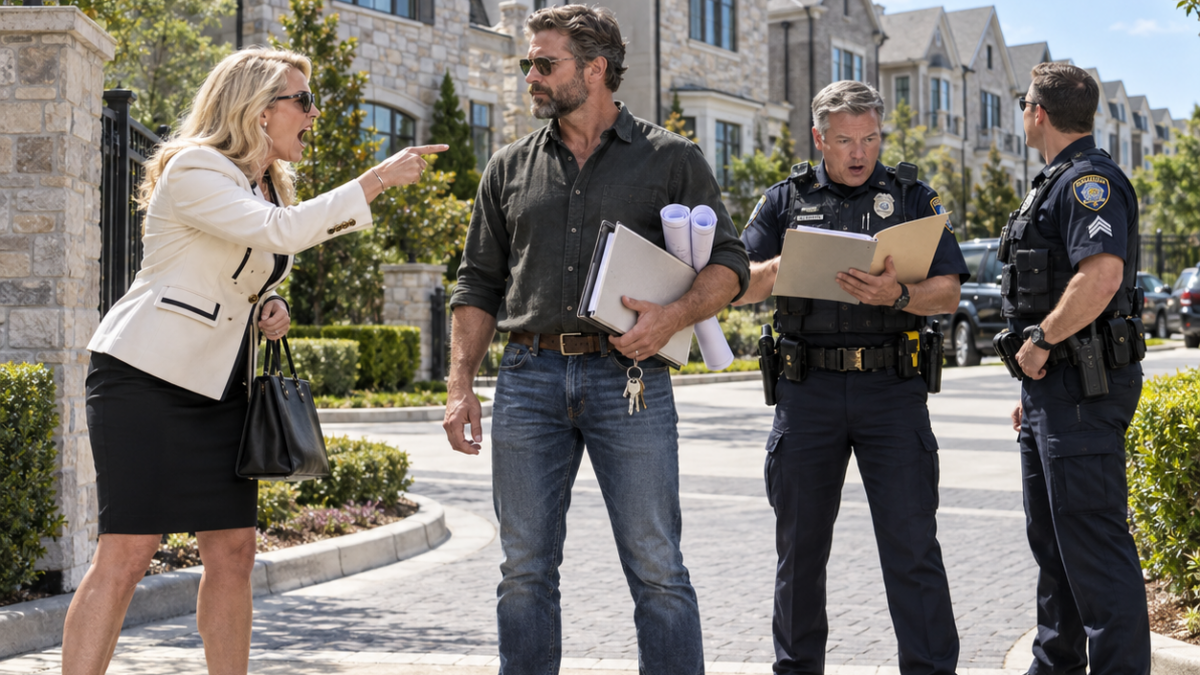
Marla Bennett once stood beside a sheriff’s cruiser and told me I was trespassing on land my family had never sold.
For a while, almost everyone believed her.
Then June found the easement.
Asa’s handwriting found the old monument.
Tom made the dirt match the record.
Investigators found the lie.
And forty frightened families eventually found out the man they had been told to fear was the one person with enough legal power to hurt them—and the least desire to do it.
I never forgot that.
Neither, I think, did Cedar Hollow.
The brass marker is still in the ground at the northwest corner.
Cold metal.
Survey number.
Walker line.
Exactly where it belongs.
Somewhere beyond it, children still jump into the pool.
Families still gather in the clubhouse.
The entrance sign still welcomes people home.
And every year, another student opens an Asa Walker Scholarship letter without knowing that the money began with an argument over a fence.
That’s a better ending than watching a neighborhood disappear.
A better ending than revenge.
And a much better use of land than proving I could take it back.
[END OF STORY]








