PART 2: HOA Called Me 20 Times at 3 A.M. Demanding My Gate Keys—They Forgot One Thing: They Didn’t Own My Land
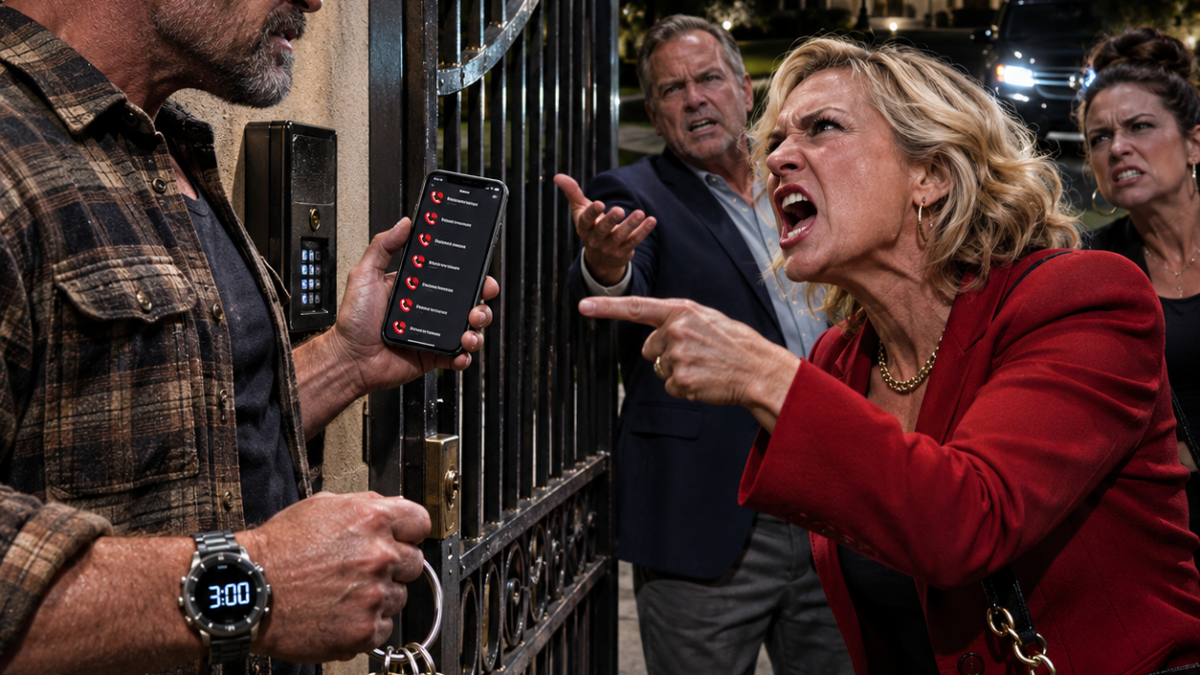
PART 2
The first late-night call came two days later.
At 2:48 a.m.
I ignored it.
I had gotten home less than an hour earlier after a brutal shift. I had eaten cold leftovers over the kitchen sink, showered, and fallen into bed with the kind of exhaustion where your bones feel heavy.
The phone buzzed.
Stopped.
Buzzed again.
I pulled the pillow over my head.
Third call.
Then fourth.
I grabbed the phone.
I didn’t say hello.
I just listened.
At first, all I heard was music.
Bass.
Loud enough that the microphone distorted.
Then laughter.
Car doors slamming.
Somebody yelling directions.
A man shouting that there was nowhere to park.
Another person laughing too loudly.
Drunk.
Definitely drunk.
Then, underneath everything, I heard Marlene.
“Why is the gate locked?”
I rubbed my face.
I checked the time.
2:59.
“Because it’s a gate.”
“Excuse me?”
“And because it’s three in the morning.”
“You need to open it.”
Her voice had that clipped tone people use when they believe irritation is the same thing as authority.
I sat up.
“Why?”
“We have people waiting outside.”
That woke me up.
I swung my feet onto the floor.
“What people?”
“The wedding party.”
I said nothing.
“The wedding party,” she repeated.
Like those words explained why strangers were lined up outside my private property before sunrise.
“What wedding?”
She sighed dramatically.
“The Harrison reception. The clubhouse parking area reached capacity. We’ve redirected overflow traffic to the rear entrance.”
I looked toward the bedroom window.
From there, through the trees, I could just barely see moving headlights near the gate.
“You redirected them where?”
“The rear access road.”
“My road.”
“The community rear access.”
“No.”
“Yes.”
“Marlene, listen carefully. There is no community access through my property.”
“We’ve already discussed this.”
“No. You made a demand. I refused it.”
She inhaled sharply.
“We have approximately thirty vehicles trying to get through.”
“Then you have approximately thirty vehicles that need to turn around.”
“You are creating a safety hazard.”
I almost admired the speed at which she turned her own terrible planning into my responsibility.
“Use the front entrance.”
“There’s congestion.”
“That isn’t my problem.”
“It becomes your problem when you obstruct association operations.”
I reached over and pressed record.
The little red icon appeared.
My anger disappeared completely.
From that moment forward, I wasn’t arguing.
I was collecting.
“Marlene, is anyone at my gate experiencing a medical emergency?”
“No, but—”
“Is there a fire?”
“That’s not the point.”
“Police emergency?”
“No.”
“Utility emergency?”
“No.”
“Then you are directing private event guests onto property you do not own.”
“You are being deliberately difficult.”
“I’m being very clear.”
“Open the gate.”
“No.”
“I’m warning you—”
“Use the main entrance.”
“If you refuse, the HOA will hold you responsible for any damages caused by this obstruction.”
“Document that.”
She went quiet.
“What?”
“I said document that. Put it in writing.”
For the first time all night, she hesitated.
Then she snapped:
“You think you’re clever.”
“No. I think I’m tired.”
A horn blared in the background.
Somebody shouted.
Marlene covered the phone briefly.
Then came back.
“If you would just give us the master code, none of this would happen.”
“You are never getting my master code.”
“We need permanent emergency access.”
“Emergency services already have lawful access procedures.”
“We need HOA access.”
“No.”
“This community cannot function around one selfish homeowner.”
“I’m not one of your homeowners.”
“You live here.”
“I live beside you.”
“That distinction is meaningless.”
“My deed disagrees.”
She started yelling.
I hung up.
My phone rang immediately.
I declined it.
Again.
Declined.
Again.
Then I stopped touching it.
I laid the phone face down on the nightstand and listened to it vibrate.
Call after call.
Text after text.
At one point, I got out of bed and looked through my camera feed.
A line of vehicles sat outside the gate.
People were getting out.
Some were holding drinks.
One guy walked up to the gate and shook it.
Another tried pulling on the pedestrian side.
I zoomed in.
Then saved the footage.
The next voicemail arrived.
Marlene.
“You are now officially refusing emergency community access. This will be documented.”
Saved.
Another voicemail.
A man this time.
Slurring.
“Hey, buddy, just open the damn thing. Everybody’s trying to leave.”
Saved.
Another.
Marlene again.
“You will be fined for every minute this continues.”
Saved.
Another.
“You’re creating liability for the entire neighborhood.”
Saved.
Twenty calls.
Six texts.
Four voicemails.
Video of intoxicated strangers attempting to enter my property.
By 3:34, the headlights started turning around.
One by one, the cars disappeared.
Silence returned.
I didn’t sleep.
At 5:30, I made coffee.
At 5:42, I opened my computer.
Inside **HOA — EVIDENCE**, I created subfolders.
**CALL LOGS**
**VOICEMAILS**
**TEXTS**
**VIDEO**
**DEED AND SURVEY**
**HOA CORRESPONDENCE**
I downloaded everything.
Backed it up.
Then backed it up again to an external drive.
At 6:15, I typed a timeline.
Not emotional.
No adjectives.
Just facts.
**2:48 — first call.**
**2:59 — answered fourth call.**
**3:01 — informed HOA president property is private and no emergency exists.**
**3:02 — HOA president demanded gate code.**
**3:03 — refused.**
**3:07 — twentieth call.**
I had spent enough years working around contracts to understand one thing.
Memory argues.
Records don’t.
At 8:57, my doorbell camera alerted me.
Marlene.
Of course.
She stood on my porch looking like she had slept less than I had.
Her hair was still somehow perfect.
Behind her stood a man named Rick Dalton, another board member.
Rick was one of those men who always positioned himself half a step behind whoever had authority.
Broad shoulders.
Crossed arms.
Chin forward.
Human punctuation.
I opened the inner door but left the locked screen between us.
Marlene didn’t say good morning.
“Keys.”
I stared at her.
“Try again.”
“We need a physical gate key and master access code immediately.”
“No.”
Rick stepped forward.
“Come on, man.”
I looked at him.
“Do I know you?”
“We’ve met.”
“We haven’t.”
He frowned.
“Well, we’ve talked about the access problem.”
“We have never spoken.”
Marlene slapped a sheet of paper against the screen.
**NOTICE OF VIOLATION — $300**
I read the header.
Then laughed.
She looked furious.
“What is funny?”
“You’re fining someone who isn’t in your HOA.”
“You interfered with community safety.”
“It was a wedding.”
“That is irrelevant.”
“Thirty drunk people wanting a shortcut at three in the morning is not an emergency.”
“You don’t get to decide what qualifies as community business.”
“On my property, I do.”
Rick stepped closer.
“You really want to make enemies with everyone here?”
That sentence interested me.
Not because it frightened me.
Because it told me what they thought this was.
Not law.
Not property.
Social pressure.
They thought if they made life uncomfortable enough, I would surrender.
I pulled out my phone and took a photograph of Marlene holding the violation notice.
She recoiled.
“What are you doing?”
“Documenting.”
“Put that away.”
“No.”
“You cannot record me without permission.”
“We’re standing at my front door, and my doorbell camera is already recording.”
Rick glanced upward.
For the first time, he noticed it.
His posture changed.
Marlene’s didn’t.
“You’re playing a dangerous game.”
“No.”
I kept my voice soft.
“I’m done playing yours.”
Her mouth tightened.
“Any further refusal will result in escalating penalties.”
“Send everything.”
“You’ll regret this.”
“Send that too.”
She stared at me.
Then I said the sentence that finally changed her expression.
“Any further communication goes through my attorney.”
She blinked.
“You have an attorney?”
“I do now.”
Technically, I had an appointment in three hours.
Close enough.
I closed the door.
Then stood behind it listening.
Rick muttered something.
Marlene hissed back.
The camera caught both of them walking away.
At noon, I sat across from Dana Reeves.
Dana was a real estate attorney with a reputation for being unpleasant to people who confused confidence with legal authority.
I liked her immediately.
Her office had no motivational quotes.
No decorative scales of justice.
Just shelves.
Files.
And a legal pad.
She listened for nearly forty minutes without interrupting.
I showed her the deed.
Survey.
Original county records.
HOA map.
Emails.
Dues notice.
The listing advertising my gate.
Then I played the recording from 3 a.m.
When Marlene’s voice said, **“The community gate,”** Dana stopped the audio.
She looked at me.
“She called your gate what?”
“Community gate.”
Dana restarted it.
Listened again.
Stopped.
Then looked at the photograph from the real estate listing.
“This is your gate?”
“Yes.”
“And this listing was for a house inside the HOA?”
“Yes.”
“Was the seller authorized to represent your property as an amenity?”
“No.”
“Did you ever sign an access easement?”
“No.”
“License agreement?”
“No.”
“Maintenance agreement?”
“No.”
“Shared road agreement?”
“No.”
“HOA declaration binding your parcel?”
“No.”
She leaned back.
“This is remarkably stupid.”
I almost laughed.
“That’s good?”
“For you.”
Dana started listing issues.
Misrepresentation.
Unauthorized commercial use of the image.
Attempted interference with private property rights.
Improper fines.
Potential harassment.
Possible tortious interference depending on how buyers were being induced.
And, most importantly, a need for declaratory relief.
“What does that mean?”
“We ask the court to declare, formally, that your property is outside their authority and that they have no access rights.”
“They already know that.”
Dana gave me a look.
“Knowing and admitting are different things.”
She pulled my deed closer.
“People like this often survive because everyone fights them one incident at a time.”
“What do you mean?”
“Gate today. Fine tomorrow. Brochure next week. Each one seems annoying but small.”
She tapped the stack.
“But put them together and you have a pattern.”
That word mattered.
Pattern.
I had been thinking in incidents.
Dana was thinking in systems.
She drafted a cease-and-desist letter that afternoon.
It was beautiful.
Not emotionally.
Legally.
Every sentence felt like a door closing.
The HOA was instructed to immediately stop claiming access rights over my parcel.
Stop issuing violations.
Stop requesting keys.
Stop representing my gate as an HOA amenity.
Preserve all internal correspondence concerning my property.
Preserve meeting minutes.
Preserve advertisements.
Preserve communications with real estate agents.
Preserve communications regarding the wedding.
At the bottom was another sentence.
**Further unauthorized attempts to enter or direct third parties onto the property may result in immediate legal action.**
Dana sent it by certified mail and email.
I expected silence.
Instead, the HOA did the dumbest possible thing.
They sent a community-wide email.
The subject line:
**URGENT COMMUNITY SAFETY NOTICE**
A neighbor forwarded it to me within seven minutes.
I read it twice.
The HOA described me as a “non-compliant adjacent property owner.”
They said I had obstructed emergency secondary access.
They suggested my refusal could increase insurance costs.
They warned that future congestion might delay emergency response.
Then came the masterpiece:
**The board remains committed to cooperation despite one individual’s unwillingness to prioritize community welfare.**
Dana called me.
“I just got this.”
“Same.”
“Do not respond.”
“I wasn’t going to.”
“Good.”
She sounded almost cheerful.
“That email helps us.”
“How?”
“They published a claim to the entire neighborhood after being formally notified they have no legal basis for it.”
“So?”
“So tomorrow we file.”
Two days later, the lawsuit went in.
Declaratory judgment.
Injunction.
Damages.
Attorney fees.
Related complaints concerning the HOA’s conduct.
I thought filing would make me feel powerful.
It didn’t.
Mostly, I felt tired.
Legal fights are strange.
On television, lawsuits begin with dramatic papers slammed onto desks.
In reality, there are emails.
Attachments.
Deadlines.
Documents named things like **Exhibit C-4**.
But something else happened.
Neighbors started contacting me.
Not angry.
Curious.
The HOA’s email had accidentally created the question they had spent months avoiding.
**What is actually happening with that gate?**
A woman named Joanne stopped me near the mailbox cluster.
“Can I ask you something?”
“Sure.”
“Marlene says your road used to belong to the community.”
“No.”
“Never?”
“Never.”
“Then why is it on the neighborhood map?”
“I’d like to know that too.”
She looked uncomfortable.
“They told us that rear access was one reason our property values were protected.”
“When?”
“When we bought three years ago.”
I stared at her.
“They advertised my gate when you bought?”
“I think so.”
That sent me back to Dana.
Discovery hadn’t even formally started yet, but now we knew to look deeper.
We began collecting real estate listings.
Six houses over four years mentioned some variation of:
**rear gated access**
**secondary gated entrance**
**private community rear road**
**exclusive emergency exit**
My road.
My gate.
My land.
Dana looked at the printouts.
“They’ve been selling something they don’t own.”
“Does that make them liable?”
“It makes them very interested in settling before we learn who knew what.”
I started receiving messages from more residents.
Some apologetic.
Some embarrassed.
One man wrote:
**I always thought you were blocking an HOA road. That’s what Marlene told us.**
Another:
**Our agent specifically mentioned the rear gate.**
Another:
**I paid a premium for a lot near “secondary access.”**
That one made me sit down.
The issue was becoming bigger.
Marlene hadn’t simply tried to bully me into opening the gate.
She had woven my property into the neighborhood’s identity.
If I gave her a key now, it would retroactively make her story look true.
Dana explained it plainly.
“If you voluntarily grant ongoing access, they may later argue that a license existed.”
“Even if I can revoke it?”
“They can argue anything. The point is not to give them facts they can distort.”
That night, I stood at the gate.
The steel looked ordinary.
That was the ridiculous part.
This whole fight centered around two steel panels and a motor.
But it wasn’t about metal.
It was about the meaning of **no**.
Marlene heard no and translated it into negotiation.
That was the real conflict.
A week later, the first formal HOA board meeting after the lawsuit was announced.
Usually, according to neighbors, twelve people showed up.
That night, the clubhouse parking lot overflowed.
Ironically, they managed without my road.
Standing room only.
Dana came with me.
Marlene sat at the front table.
Rick beside her.
Three other board members looked like they would rather be undergoing dental surgery.
The moment I entered, conversations quieted.
I hated that.
I had never wanted to become a character in neighborhood politics.
I wanted trees.
A gate.
Sleep.
Dana leaned toward me.
“Say nothing unless I tell you.”
“Best legal advice I’ve heard.”
The meeting began.
Marlene read the agenda.
Her voice was stiff.
Then public comments opened.
Joanne stood first.
“I want to know whether the rear gate belongs to the HOA.”
Marlene’s eyes flicked toward me.
“The matter is under litigation.”
“That isn’t an answer.”
“Our counsel has advised—”
“Does the HOA own it?”
Murmurs spread.
Marlene tapped her pen.
“The access situation is legally complex.”
I heard Dana whisper:
“It is absolutely not complex.”
Another resident stood.
“My purchase documents describe gated secondary access. Who authorized that?”
Marlene looked toward Rick.
Rick looked at the table.
Then an older man named Henry stood.
He was probably seventy.
Thin.
Suspenders.
The kind of person who looked like he had been attending meetings longer than the clubhouse existed.
“I served on this board twelve years ago.”
The room quieted.
“That road has never been ours.”
Marlene’s face tightened.
Henry continued.
“We asked the previous owner once whether he would consider an emergency access easement.”
My heart started beating faster.
“What happened?” someone asked.
“He said no.”
The room erupted.
Marlene raised her voice.
“That was a different board.”
Henry stared at her.
“Property rights don’t reset when presidents change.”
I liked Henry.
A lot.
Rick finally spoke.
“We’re getting distracted. The current issue is public safety.”
Dana wrote something on her pad.
Then pushed it toward me.
**They are admitting knowledge.**
I felt a chill.
If Henry was right, the HOA had known for years.
Marlene hadn’t misunderstood.
She had inherited an old refusal and simply decided to ignore it.
Another homeowner raised his hand.
“Why were wedding guests sent there?”
Marlene answered:
“Parking conditions required adaptive routing.”
A man in the back laughed.
“Adaptive routing?”
Someone else said:
“You sent drunk people down somebody else’s driveway.”
Marlene slammed her pen down.
“They were not drunk.”
I couldn’t help myself.
I looked at Dana.
She shook her head before I even opened my mouth.
No.
Fair.
Then a woman stood with her phone.
“My daughter was at that wedding.”
The room turned.
“She told me people were drinking since six.”
Marlene’s face changed.
The woman continued.
“She also told me volunteers were telling guests that the gate owner was refusing to cooperate.”
Now people looked at me.
I hated that too.
I stood anyway.
Dana lightly touched my sleeve.
Then nodded.
I kept it short.
“My property is not part of the HOA.”
Silence.
“I have never granted the HOA access rights.”
Someone whispered.
I continued.
“At three in the morning, I was called twenty times because private-event guests had been directed toward my locked gate. No emergency existed.”
Marlene interrupted.
“That is your characterization.”
Dana stood.
“My client has recordings.”
The room exploded.
Marlene went pale.
Dana continued.
“Unedited.”
Silence returned.
Marlene looked at the HOA attorney sitting two chairs away.
I will never forget his expression.
He had the face of a man learning, in real time, that his client had not told him everything.
The meeting ended badly.
For them.
Very badly.
The HOA attorney requested a recess.
Then another.
Eventually, they adjourned.
Outside, Henry caught up with me.
“I’m sorry.”
“For what?”
“We should’ve stopped this years ago.”
“You weren’t on the board.”
“I knew what Marlene was like.”
“That doesn’t make it your responsibility.”
He gave me a tired smile.
“That’s how this stuff survives, son. Everybody says it isn’t their responsibility.”
That sentence stayed with me.
The next week, discovery began.
Dana requested internal emails.
Board minutes.
Insurance communications.
Maps.
Marketing materials.
Communications with realtors.
Gate access discussions.
Wedding planning messages.
At first, the HOA produced almost nothing.
Dana filed a motion.
Suddenly, documents appeared.
Thousands of pages.
We learned that my road had been discussed repeatedly.
Three years earlier, Marlene wrote in an email:
**We should stop referring to the Hayes parcel as “outside HOA” in resident materials. It creates unnecessary confusion.**
Dana read it twice.
“What does that even mean?”
“I think it means reality was inconvenient.”
Another email:
**Until formal access is established, continue marketing the rear corridor as potential emergency routing.**
Potential.
Except residents had been told it existed.
Then came another.
From Rick.
**Has anyone gotten a code from him yet?**
Marlene replied:
**No. He’ll eventually cooperate. They always do.**
I stared at that line.
They always do.
That was the entire philosophy.
Pressure people.
Fine people.
Exhaust people.
Eventually, they cooperate.
Dana printed the email.
“This goes on the board.”
“What board?”
She pointed toward the large corkboard on her wall.
I smiled.
“You actually make evidence boards?”
“When clients give me villains who write like television villains, yes.”
The wedding emails were even worse.
Two days before the reception, the HOA event committee realized parking would exceed capacity.
One volunteer wrote:
**Can we ask the private-road owner before directing traffic there?**
Marlene responded:
**No need. Rear access is under HOA operational control.**
It wasn’t.
The night of the wedding, at 11:14 p.m., another message:
**Gate appears locked. Do we have a code?**
Marlene:
**I’ll handle it.**
At 2:40 a.m.:
**Send overflow to rear. I’m contacting owner.**
She had known the gate was locked.
Known she had no code.
Known I had repeatedly refused access.
And still directed vehicles there.
That changed the case.
It wasn’t impulsive.
It was deliberate.
The community-wide email had another hidden problem.
Insurance.
The HOA claimed my refusal could raise premiums.
Discovery showed the insurance company had never said that.
In fact, an insurance representative had warned the board that directing unauthorized vehicle traffic onto privately owned roads could create liability.
Marlene received that email three months before the wedding.
Dana leaned back.
“I love competent insurance adjusters.”
I stared at the page.
“She knew.”
“Yes.”
“And she told everyone the opposite.”
“Yes.”
“Why?”
Dana took off her glasses.
“Because by then, this wasn’t about access.”
“What was it about?”
“Winning.”
That answer made me uncomfortable because it felt true.
Marlene needed me to submit.
Maybe if she had asked differently on day one, I might have considered some limited emergency arrangement.
A locked Knox box for fire services.
A written easement under defined circumstances.
Maybe.
But she never asked.
She declared.
Then demanded.
Then punished.
By the time lawyers were involved, there was nothing left to negotiate except whether my rights existed.
Mediation was scheduled.
Before that happened, things got uglier.
A county vehicle appeared near my gate one afternoon.
Two inspectors stepped out.
Someone had reported that the gate violated emergency access width requirements.
I walked down carrying my permit folder.
The older inspector looked almost embarrassed.
“You’re Mr. Hayes?”
“Yes.”
“Mind if we inspect?”
“Go ahead.”
They measured everything.
Gate width.
Setback.
Emergency clearance.
Motor release.
Posts.
Then he looked at the original permit.
“This was approved seven years ago.”
“Yes.”
“Who filed the complaint?”
He looked at his partner.
“We can’t really—”
“I know who.”
He sighed.
“Everything appears compliant.”
“Can I get that in writing?”
He smiled.
“You’ve done this before.”
“Recently.”
Two days later, another complaint.
Alleged drainage obstruction.
Inspection passed.
Then noise violation.
For the gate motor.
At 48 decibels.
Dana began adding each complaint to the harassment record.
“Keep filing,” she said.
“They’re helping us.”
I didn’t enjoy it.
That’s important.
People imagine retaliation feels satisfying.
Sometimes it does for about thirty seconds.
Mostly, it consumes your attention.
I checked cameras constantly.
I kept my phone beside me.
When headlights slowed near the road, I noticed.
When envelopes arrived, my stomach tightened.
One night I woke at 3:12 without the phone ringing.
Just because my body remembered.
That angered me more than the calls themselves.
Marlene had gotten inside my sleep.
One morning, I mentioned it to Dana.
She stopped reviewing documents.
“You need to stop letting this case become your whole life.”
“Easy for you to say.”
“No, it isn’t. Cases are my whole life.”
That actually made me laugh.
She continued.
“Your goal is not to spend every waking hour proving you’re right.”
“What is my goal?”
“To get your quiet back.”
That sentence reset me.
My quiet.
That was why I had bought the place.
So I changed my routine.
I stopped checking the HOA message board.
Stopped reading neighborhood gossip.
I backed up evidence once a day, not ten times.
If something legal happened, Dana handled it.
I worked.
I came home.
I used my property.
The gate opened.
The gate closed.
That simple mechanical movement became grounding.
A month later, mediation began.
The HOA sent Marlene.
Rick.
Their attorney.
An insurance representative.
Dana and I sat opposite them.
A retired judge served as mediator.
He began with the usual speech.
Compromise.
Costs.
Risk.
Uncertainty.
Then the HOA attorney presented their position.
They claimed years of “informal community understanding” created an expectation of access.
Dana said:
“Expectation is not an easement.”
They argued public safety.
Dana produced the insurance email warning against unauthorized access.
They argued historical use.
Dana produced affidavits from the previous owner and Henry confirming no community access had existed.
They argued my gate affected neighborhood circulation.
Dana produced the recorded plat.
Separate parcel.
Separate road.
Then Marlene made a mistake.
She interrupted her own attorney.
“He knew what we needed.”
The mediator looked at her.
Dana did too.
“What did he know?”
Marlene pointed at me.
“He knew the community expected access.”
Dana folded her hands.
“Expected based on what legal instrument?”
Marlene hesitated.
“It was understood.”
“By my client?”
“He was told.”
Dana’s eyes sharpened.
“Told is not consent.”
“He refused to cooperate.”
“Yes.”
“That’s my point.”
“No, Ms. Wick.”
Dana’s voice stayed perfectly calm.
“That is our point.”
The mediator looked down to hide what might have been a smile.
Then Dana played the phone recording.
Not all of it.
Enough.
**“The community gate.”**
**“Open it.”**
**“We need the master code.”**
**“You’re obstructing association business.”**
Then the call log.
Twenty calls.
The HOA attorney’s face changed.
He leaned toward Marlene.
Whispered.
She whispered back.
His face changed more.
Dana produced the real estate listings.
Six.
Then the email:
**He’ll eventually cooperate. They always do.**
The insurance representative asked for a break.
We waited in a separate room.
I paced.
Dana ate almonds.
“How can you eat right now?”
“I skipped lunch.”
“What do you think they’re doing?”
“Panicking professionally.”
Forty minutes later, the mediator returned.
“They want to discuss resolution.”
I expected to feel triumphant.
Instead, I sat down.
“What are they offering?”
The first offer was insulting.
Remove the fine.
Stop using my gate in advertising.
Each side pays legal fees.
Dana laughed.
Not dramatically.
Just one short sound.
“No.”
Second offer.
Written acknowledgement of private ownership.
No future access claims.
Legal fees partially reimbursed.
“No.”
Third.
All violations withdrawn.
All attempted dues voided.
Full written acknowledgement my property was outside HOA jurisdiction.
No future representation of gate as amenity or access point.
Removal of all gate images.
Written notice to realtors correcting prior representations.
Attorney fees paid.
Additional damages.
Board policy changes.
Dana looked at me.
“Closer.”
I thought about the nights.
The calls.
The cameras.
The pressure.
I thought about something else.
“What about the residents?”
The mediator frowned.
“What about them?”
“People who bought houses believing this access existed.”
Dana looked at me.
The HOA attorney looked nervous.
I continued.
“They need a correction.”
The mediator nodded slowly.
Dana added language.
The HOA would issue a formal written statement to every homeowner clarifying that my parcel, road, and gate were private and had never been an HOA amenity.
They resisted.
I refused to settle without it.
Marlene stared at me across the table.
“You want to humiliate us.”
For the first time that day, I spoke directly to her.
“No.”
“You want everyone to know I was wrong.”
“I want everyone you told I was wrong to know the truth.”
“That’s the same thing.”
“No.”
I leaned forward.
“Humiliation is what happens when someone lies publicly and the correction has to be equally public.”
She looked away.
That was the moment I knew we were done.
The final settlement took another week to draft.
When I signed it, my hand didn’t shake.
No fireworks.
No celebration.
Just ink.
The HOA retracted every violation.
The $300 fine disappeared.
So did the invented dues.
They paid my legal fees.
They paid damages.
They acknowledged in writing that my property was not, and had never been, subject to HOA authority.
They acknowledged no ownership, easement, license, or permanent access rights existed over my road or gate.
They agreed never again to use images of my gate in advertising.
Never again to describe it as a community amenity.
Never direct residents, guests, vendors, or event traffic toward it.
And every homeowner received a written correction.
The email subject line was almost poetic.
**CLARIFICATION OF REAR PROPERTY ACCESS**
I printed it.
Not because I needed revenge.
Because I wanted one copy for the folder.
The opening sentence read:
**The Board wishes to clarify that the gated road at the rear of Pine Hollow Estates is privately owned and is not available for community use.**
I stared at it.
Private.
Such a small word.
It had taken lawyers, recordings, lawsuits, thousands of pages, and months of stress to get people to respect it.
The correction changed the neighborhood faster than I expected.
Residents started asking questions.
Not just about me.
About everything.
Why had certain fines been issued?
Why were some contracts awarded without discussion?
Why did the board communicate decisions as if residents had no say?
Why had Marlene been allowed to treat her interpretation as law?
At the next election, turnout tripled.
Marlene didn’t run.
She resigned first.
No goodbye.
No apology.
No final speech.
One Tuesday morning, her name disappeared from the HOA website.
That was it.
Rick resigned two weeks later.
A new board took over.
Their first meeting lasted almost four hours because everyone suddenly had opinions.
I didn’t attend.
Henry did.
He called me afterward.
“You would’ve hated it.”
“Why?”
“Democracy.”
I laughed.
“What happened?”
“They argued over everything.”
“Sounds healthy.”
“It was exhausting.”
“Also healthy.”
He chuckled.
Then his voice softened.
“You changed things.”
“No.”
“You did.”
“I protected my gate.”
“Sometimes that’s enough.”
The new board president was a woman named Lisa Chen.
Three weeks after taking office, she came to my house.
Alone.
No clipboard.
No entourage.
She knocked once.
I opened the door.
“Mr. Hayes?”
“Yeah.”
“I’m Lisa.”
“I know.”
She looked slightly nervous.
“I wanted to introduce myself.”
“Okay.”
“And apologize.”
“You didn’t do anything.”
“The association did.”
I considered that.
“Fair.”
She glanced toward the gate.
“We’ve removed it from all internal maps except where it’s marked as private property.”
“Good.”
“We’re also revising event plans so nobody is ever directed there.”
“Better.”
She smiled.
“I thought you’d be harder to deal with.”
“I’m extremely easy to deal with.”
She laughed.
“I’ve heard conflicting reports.”
“Ask permission before using my property.”
“That’s it?”
“That’s the whole system.”
She held out her hand.
I shook it.
That might have been the first normal HOA interaction I had ever had.
A few months passed.
Then something strange happened.
Nothing.
No notices.
No late-night calls.
No strangers at the gate.
No emails.
No threats.
Nothing.
And I discovered that peace after conflict feels uncomfortable at first.
For weeks, my body stayed ready.
The phone buzzed at midnight and my heart jumped.
Spam email.
A delivery truck stopped near the road and I checked cameras.
Wrong address.
An envelope from Pine Hollow arrived and I stared at it for ten seconds before opening.
Annual water schedule.
That was all.
Threats teach your nervous system faster than resolutions do.
It took time to unlearn.
One night, around 12:30, I came home from work.
Rain.
Cold.
The kind of night where everything beyond your headlights disappears.
I turned onto the gravel spur.
Trees closed around me.
Then my headlights hit the gate.
For months, I had associated that gate with conflict.
Marlene.
Lawyers.
Calls.
Evidence.
Now it was just a gate again.
I pressed the visor button.
The motor hummed.
Steel slid sideways.
I drove through.
Behind me, it closed.
**Click.**
That sound stopped me.
I sat in the truck with the engine idling.
No one was calling.
No headlights lined up outside.
Nobody wanted a code.
Nobody was demanding a key.
Nobody cared.
I laughed softly.
Then, unexpectedly, my eyes burned.
Not because I was sad.
Because I finally felt how exhausted I had been.
I shut off the engine.
Rain tapped against the windshield.
I sat there for ten minutes.
Sometimes you don’t recognize peace until the fight ends.
A week later, I received a letter.
Not from the HOA.
From a neighbor.
Henry.
His handwriting looked like it had been carved rather than written.
**Mark,**
**I told you at the meeting that we should have stopped this earlier. I meant it. For years, people here complained privately and obeyed publicly. It became easier to pay a fine than ask whether the fine was legitimate. Easier to accept an answer than request the rule. Easier to stay quiet than become the next target.**
**That isn’t community. That’s exhaustion.**
**You reminded people there’s a difference.**
**Thank you.**
I read the letter twice.
Then put it in the evidence folder.
Not everything in that folder needed to be ugly.
Over the next year, Pine Hollow changed.
Slowly.
The landscaping still looked the same.
The mailboxes still matched.
People still complained about trash cans.
Human civilization survived.
But the tone changed.
Meeting notices included actual agendas.
Homeowners received copies of proposed rules before votes.
Contracts above a certain value required competitive bids.
Fines included citations to specific governing documents.
An appeals process was adopted.
People began saying things like:
“Where is that written?”
That phrase made me smile every time.
The strangest change was the gate itself.
Before the fight, most residents barely noticed it.
During the fight, it became a symbol.
Afterward, it became ordinary again.
Exactly what I wanted.
One afternoon, a young couple named Ben and Alyssa stopped near my driveway while walking.
Their toddler sat in a stroller.
Ben waved.
“Hey, Mark.”
“Hey.”
“Can I ask you something weird?”
“Probably.”
He pointed toward the gate.
“Is that the famous gate?”
I groaned.
“Please tell me people don’t call it that.”
Alyssa laughed.
“Some do.”
“Great.”
Ben smiled.
“Our realtor actually mentioned the lawsuit.”
“That feels unnecessary.”
“He used it as a selling point.”
I stared at him.
“What?”
“He said, ‘This is one of the few HOAs where residents actually forced the board to respect boundaries.’”
I started laughing.
Really laughing.
After everything, my private gate was still being used in real estate marketing.
Just differently.
“At least he didn’t promise you access.”
“No.”
Ben grinned.
“He specifically said, ‘Do not drive down that road.’”
“Excellent realtor.”
They continued walking.
I stood there shaking my head.
That evening, I called Dana.
“You’re not going to believe this.”
“Try me.”
I told her.
She laughed.
“Technically accurate advertising.”
“Progress.”
“Take what you can get.”
Dana and I stayed in touch.
Not frequently.
A holiday card.
Occasional legal question.
Once, two years later, she called me.
“I have a client who reminded me of you.”
“That sounds terrible.”
“He has a private road an HOA is claiming.”
I smiled.
“What did you tell him?”
“Document everything.”
“Good.”
“And don’t answer twenty calls at three a.m.”
“Better.”
Then she became serious.
“You know, most people would have opened the gate.”
“I know.”
“Not because they agreed.”
“I know.”
“Because they were tired.”
That was the piece I thought about most afterward.
Marlene’s strategy had depended on exhaustion.
Not law.
If she could make resisting harder than surrendering, eventually people surrendered.
One little exception.
One payment.
One key.
One code.
One night.
And that is how boundaries disappear.
Not always through dramatic theft.
Sometimes through inconvenience.
People say:
**Just this once.**
Then later:
**Well, you let us before.**
Then:
**This has always been allowed.**
Then:
**Everyone knows this is community access.**
And eventually, a private gate appears in a real estate advertisement as if it belonged to everyone.
That progression terrified me more than Marlene ever did.
Because it was believable.
If I had opened the gate that night, what would have happened?
Thirty cars would have driven through.
Maybe nothing else.
No crash.
No vandalism.
No lawsuit.
Everyone would have gone home.
Marlene would have thanked herself for solving the problem.
Then the next event came.
Another request.
“You opened it last time.”
Then a contractor.
Then landscaping crews.
Then residents.
Then delivery overflow.
Eventually, refusal would look unreasonable because access had become routine.
That was the trap.
Not one huge demand.
A precedent.
The more I thought about it, the less petty the fight seemed.
The gate represented something simple.
My right to decide who entered my property.
That should not have required courage.
But sometimes ordinary rights only remain ordinary because somebody insists on them.
Years passed.
Pine Hollow remained Pine Hollow.
New families moved in.
Old ones left.
Henry eventually sold his house and moved closer to his daughter.
On his last morning, he drove to my place.
I opened the gate and let him through.
Voluntarily.
That mattered.
He parked near the house.
We drank coffee on the porch.
“You know,” he said, “this is the first time I’ve ever been inside your gate.”
“I know.”
“Feels illegal.”
“It probably should.”
He laughed.
Then looked around.
Trees.
Gravel.
Nothing exciting.
“This is what all that fighting was about?”
“Pretty much.”
He shook his head.
“People are ridiculous.”
“You were expecting a castle?”
“Maybe gold.”
“No gold.”
He looked toward the road.
“Marlene used to talk like you were hiding something back here.”
“I was.”
“What?”
“Peace.”
Henry stopped smiling.
Then nodded.
“Fair enough.”
Before leaving, he handed me a small wooden sign.
He had carved it himself.
Three words.
**PRIVATE MEANS PRIVATE**
I laughed.
“You want me to hang this?”
“No.”
“Then what?”
“Put it somewhere you can see it when somebody tells you you’re difficult.”
I hung it in my garage.
Not at the gate.
I never wanted the gate to become hostile.
A boundary doesn’t need to insult people.
It just needs to exist.
That distinction became important to me.
I did not want to become Marlene in reverse.
I didn’t want property rights to turn into an identity.
I didn’t want every neighbor to feel like a threat.
So when people asked, I helped.
A neighbor’s truck broke down near the main road one winter.
He called.
“Any chance I can temporarily pull onto your spur while the tow truck comes?”
“Of course.”
A fire crew once needed a staging area during a brush fire.
They used the road.
Emergency.
Real emergency.
I opened the gate.
A utility company needed access to repair a damaged line affecting my parcel and two nearby homes.
They called ahead.
I let them in.
The lesson had never been **never share**.
It was **sharing requires consent**.
That difference is everything.
One summer night, Pine Hollow hosted another wedding.
I knew because music drifted through the trees.
Around eleven, Lisa texted me.
**Just FYI: parking is full but we have overflow arranged at the church lot. Nobody will be directed to your road.**
I stared at the message.
Then replied:
**Thanks.**
That was it.
At 1:30 a.m., I went to bed.
Phone silent.
At 3:00, I woke automatically.
Old habit.
I looked at the clock.
3:01.
The room was dark.
No calls.
No vibrations.
I smiled.
Then went back to sleep.
The next morning, I walked down to the gate.
There were no tire tracks.
No cups.
No strangers.
Just leaves scattered on the gravel.
I leaned against one steel post.
For the first time, the memory of that original night felt far away.
I thought about Marlene.
I had not seen her in years.
Someone told me she moved to another county.
Someone else claimed she joined another neighborhood committee.
I hoped that part was false.
People occasionally asked whether I hated her.
I never knew how to answer.
Hate takes energy.
She had already taken enough.
I didn’t forgive her in some dramatic, spiritual way.
I just stopped carrying her.
There’s a difference.
The best consequence she ever received wasn’t my lawsuit.
It wasn’t paying legal fees.
It wasn’t resigning.
It was becoming irrelevant to my life.
One afternoon, I found the original violation notice while cleaning my office.
**$300 — FAILURE TO PROVIDE COMMUNITY ACCESS**
I held it.
Remembered her standing behind the screen.
Keys.
No greeting.
Just keys.
For a second, the anger returned.
Then disappeared.
I put the paper back.
Evidence of who I had been forced to become for a while.
Careful.
Suspicious.
Prepared.
But not permanently.
That part mattered.
Winning a boundary fight means very little if you spend the rest of your life living behind emotional walls.
So I made a deliberate choice.
The physical gate stayed.
The rest didn’t have to.
I became friends with neighbors.
Not all of them.
Enough.
Ben sometimes helped me move equipment.
Alyssa brought over food when I was sick.
Lisa called me when the HOA needed historical context on old maps.
I even attended one community barbecue.
People were shocked.
Joanne handed me a beer.
“You came.”
“I was promised food.”
“No clipboard?”
“I checked.”
She laughed.
At one point, someone joked:
“Should’ve held it behind Mark’s gate. Plenty of parking.”
Everyone looked at me.
I stared at them.
Then smiled.
“No.”
The whole table laughed.
And that was when I knew it was really over.
Not when the settlement was signed.
Not when Marlene resigned.
Not when the correction email went out.
When the joke stopped hurting.
Years later, the gate motor finally failed.
I came home at 11:46 p.m., pressed the button, and nothing happened.
I pressed again.
Nothing.
For half a second, I felt that old irritation.
Then I laughed.
After everything, the only thing that had finally defeated the gate was age.
I manually released it and pushed it open.
The next morning, a technician arrived.
He examined the motor.
“Original?”
“Yeah.”
“How old?”
“About twelve years.”
“You got your money’s worth.”
He installed a new drive unit.
Before leaving, he asked:
“You want remote cloud access? We can set it up so other authorized users can open it from their phones.”
I stared at him.
He had no idea.
“No.”
“You sure? Pretty convenient.”
“I’m sure.”
“Keypad?”
“No.”
“Shared codes?”
“No.”
He laughed.
“You really like privacy.”
“You could say that.”
He packed up.
The new motor was quieter.
That night, I tested it several times.
Open.
Close.
Open.
Close.
Each movement smooth.
Controlled.
Mine.
I stood outside after dark.
The forest was still.
I remembered something Dana had once told me.
**Your goal is to get your quiet back.**
I had.
But I also understood quiet differently now.
Before Marlene, I thought quiet meant nobody bothering me.
After Marlene, I understood that quiet is what exists when boundaries are respected without having to be defended.
That is much rarer.
And much more valuable.
The most satisfying part of the story was never that the HOA “lost.”
It was what happened afterward.
The board became accountable.
Neighbors stopped assuming a letterhead made every demand legitimate.
People asked questions.
They read rules.
They attended meetings.
The association still existed.
So did order.
Turns out civilization did not collapse because one man refused to hand over a gate key.
If anything, Pine Hollow became healthier.
Less fear.
More discussion.
More disagreement, actually.
But honest disagreement.
People sometimes treat conflict as failure.
It isn’t.
Silence under pressure isn’t harmony.
It’s compliance.
Real community can survive hearing **no**.
Marlene never understood that.
Lisa did.
One day, she called me.
“Can I ask you a favor?”
“You can ask.”
She laughed.
“I appreciate the wording.”
“What do you need?”
“We’re updating the emergency plan. Fire department wants to note all private roads nearby.”
“Okay.”
“Would you be willing to let us list yours as private property with owner-controlled emergency access?”
“What exactly does that mean?”
“I’ll send the language.”
She did.
I read every word.
Then sent it to Dana.
Dana replied ten minutes later:
**Looks fine. Notice how civilized life becomes when people ask permission?**
I approved it.
No master code.
No HOA key.
Emergency responders could contact me directly when necessary.
Clear.
Limited.
Revocable according to the agreement.
A real arrangement.
Not an invented one.
That document meant more to me than I expected.
Because it proved I had never been unreasonable.
I had simply refused to let someone else define my consent.
There is a massive difference between:
**Give me the keys.**
and
**Would you agree to this specific access arrangement?**
One is authority theater.
The other is negotiation.
I can work with negotiation.
Most people can.
Years later, after another late shift, I turned onto the gravel road around 12:40 a.m.
The trees were black against the sky.
My headlights swept across the gate.
I pressed the remote.
It opened.
I drove through.
Then stopped on the other side.
In the rearview mirror, I watched it close.
The steel panels met.
The lock engaged.
Soft mechanical click.
Same sound as years earlier.
But now it carried no anger.
No fear.
No memory of twenty calls.
Just certainty.
I owned the land.
I owned the gate.
And, more importantly, I owned the decision.
That was all I had ever asked for.
I went inside.
Set my phone on the nightstand.
Turned off the light.
And slept until morning.
No calls.
No demands.
No strangers.
Nothing but silence.
The good kind this time.








