PART 2: HOA Called 911 When I Moved Into My New Lake House—Then They Learned My Deed Included Their Entire Street
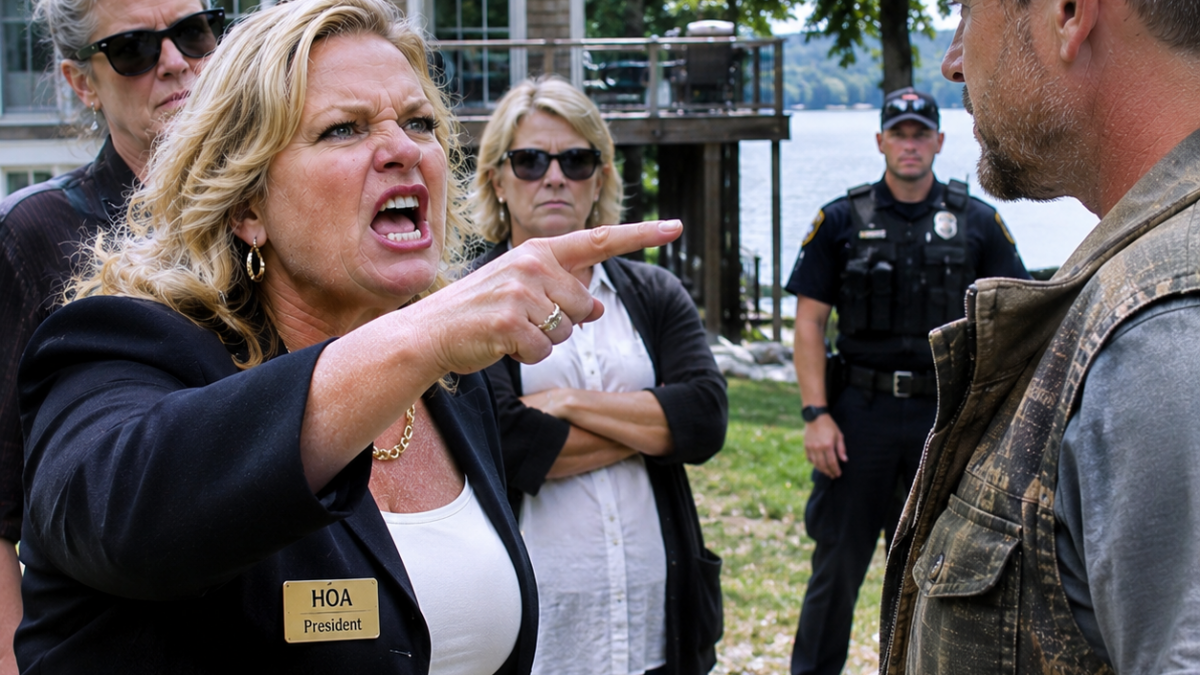
PART 2
The lead deputy’s name was Sergeant Crane.
Mid-forties.
Quiet.
Square jaw.
The manner of someone who had spent enough years in a small county department to know that the information dispatch gives you and the truth waiting at the address are sometimes two completely different things.
He stopped about thirty feet away.
“Sir, step away from the vehicle, please.”
“Yes, sir.”
I stepped six feet left.
Hands visible.
Palms open.
Flying professionally teaches you something useful about tense situations.
Reduce variables.
Make your intentions obvious.
Do not surprise anybody.
Crane said:
“Can I see identification?”
“My license is in my back pocket.”
I waited.
“My closing paperwork is in a manila folder on the passenger seat.”
He studied me.
“License first. Slowly.”
I did exactly that.
He checked the name.
Pierce Holloway.
Then the address.
14 Briar Bluff Drive.
He looked at the mailbox.
Looked back at me.
“Closing folder?”
“Yes, sir.”
I retrieved it with both hands.
He opened it.
Recorded deed.
October third.
Buyer:
Pierce Holloway.
Seller:
Estate of Lurlene Trask.
Title insurance.
Wire transfer.
Executor signature.
He read long enough for the tension in his shoulders to disappear.
Then handed the folder back.
“Mr. Holloway, I owe you an apology.”
“No apology necessary.”
“The call indicated a suspicious individual was attempting to enter a vacant property.”
“The property isn’t vacant anymore.”
“No, sir.”
“How long have you owned it?”
“Eleven days.”
He nodded.
“My wife joins me in about four weeks. She’s helping our daughter through the end of a difficult pregnancy.”
Crane looked across the road.
I followed his eyes.
The woman who had called 911 stood on her porch.
Navy blazer.
White pants.
Coffee cup.
Blonde hair.
Watching.
Smiling.
Tamsin Cruz Boutwell.
HOA president.
I had seen her photograph in the neighborhood packet.
She was heavier than the carefully cropped image in the newsletter, but otherwise unmistakable.
Crane’s jaw tightened.
“Would you object if I spoke with the reporting party?”
“Please do.”
He walked across.
The other deputies remained near the cruisers.
I went back to the truck.
The box at my feet was labeled:
BECKETT — FLIGHT SCHOOL.
I picked it up.
For a second, the cardboard felt heavier than it had an hour earlier.
Inside were his old manuals.
A sectional chart folded badly.
A weather handbook.
A notebook where he had once written:
DON’T CHASE A BAD APPROACH. GO AROUND.
I stood holding it while a woman across the street gestured toward me with her coffee.
That sentence suddenly felt useful beyond aviation.
Don’t chase a bad approach.
Go around.
Reset.
Try again with more information.
Crane spoke with Tamsin for about three minutes.
She gestured.
Crossed her arms.
Pointed toward my house.
He listened.
Then handed her something.
Walked back.
“Mr. Holloway.”
“Sergeant.”
“I have advised the reporting party that knowingly filing inaccurate 911 reports can carry criminal consequences.”
He glanced toward her.
“She has received a written warning.”
“I appreciate it.”
“And, sir?”
“Yes?”
“Welcome to the lake.”
He tipped his hat.
The cruisers left.
I looked across at Tamsin.
She wasn’t smiling anymore.
She stared at me.
I stared back.
Then I carried Beckett’s books inside.
The front door closed.
The house became quiet.
I should have kept unpacking.
Instead, I put the box on the dining-room floor.
Opened the closing folder.
Read the deed.
Page one.
Page two.
Then page three.
Appurtenant rights.
Old language.
The kind of legal wording most people skip because it looks like it was written by somebody wearing powdered hair.
I read it once.
Then again.
The grant conveyed the roadway commonly platted as Briar Bluff Drive from State Route 11 all the way to the lake parcel.
Not simply a right to use it.
Fee-simple interest.
Underlying roadway.
Ingress.
Egress.
Appurtenant to the Whitaker parcel.
I stopped.
Went to my title policy.
Schedule A.
Same description.
Lake parcel.
And the private roadway.
I picked up my phone.
Francis Stilwell answered on the second ring.
“Captain Holloway. Welcome to retirement.”
“Francis.”
“How’s the lake?”
“I need to read something.”
Her voice changed.
Francis had been my attorney for nineteen years.
She handled my mother’s estate.
Our wills.
Most painfully, the documents after Beckett died.
She knew when I used a certain tone that this was not small talk.
“Read.”
I did.
Every word.
Silence.
Then:
“Again.”
I read it slower.
Another silence.
“Pierce, where are you?”
“Kitchen.”
“Title policy?”
“Here.”
“Schedule A.”
I opened it.
Read the legal description.
Francis said:
“Sit down.”
“Why?”
“Sit.”
I sat.
“Pierce.”
“Yes.”
“You own Briar Bluff Drive.”
I looked through the window.
The asphalt ran past Tamsin’s house.
Past every mailbox.
Around the curve.
Out toward State Route 11.
“The entire road?”
“From the state route to your parcel.”
“Fee simple?”
“Yes.”
“Not just an easement?”
“No.”
Silence.
Twenty-three homes used that street.
Twenty-three driveways connected to it.
For thirty-nine years, the HOA had acted as if Briar Bluff Drive belonged to the community.
Francis continued:
“Howell Whitaker built the road in 1968 to reach his own lake house.”
“Okay.”
“When he sold the upland parcels, he apparently never dedicated the road to the county.”
“Okay.”
“And never conveyed it to a homeowners association.”
“Because the HOA didn’t exist yet.”
“Correct.”
“He left it attached to the lake parcel.”
“Yes.”
“So every person who owned this house—”
“Owned the road.”
“Lurlene?”
“Yes.”
“And now me.”
“Yes.”
I leaned back.
Across the street, Tamsin’s Range Rover sat in her driveway.
I remembered the HOA disclosure packet.
“Francis.”
“Yes?”
“They charge road maintenance.”
Pause.
“What?”
“Annual assessment.”
“How much?”
“Three hundred ninety-two dollars per household.”
Another silence.
“How many households?”
“Twenty-three.”
“How long?”
“I don’t know.”
“Pierce.”
“Yes?”
“Do not do anything.”
“I wasn’t planning to.”
“No signs.”
“Okay.”
“No chain.”
“Okay.”
“No angry letter.”
“Okay.”
“No conversation with Tamsin.”
“I understand.”
“We research.”
I looked at the asphalt.
“With one recorded notice, could I restrict non-owner traffic?”
“Potentially, subject to any rights we haven’t found yet.”
“Could every house here suddenly have an access problem?”
“If there truly are no recorded easements, yes.”
I exhaled.
“Then we research.”
Francis laughed quietly.
“Good answer.”
I said:
“You sound pleased.”
“She called 911 on the owner of the street.”
“That’s one way to say it.”
“It’s an excellent way.”
Forty-eight hours later, Tamsin escalated.
Of course she did.
Thursday morning.
Paper under my windshield wiper.
HOA violation.
My 2017 Ford F-150 violated neighborhood vehicle aesthetic standards.
Fine:
$250.
I read it.
My truck was gunmetal gray.
Nothing modified.
Nothing commercial.
Nothing offensive unless you considered pickup trucks a character flaw.
I folded the notice.
Created a manila folder.
BB-HOA.
Friday:
Mailbox post.
Improper paint.
$125.
The post was black.
Every mailbox on the street was black.
Saturday:
Laundry violation.
I had hung a bedsheet on my rear deck.
One hundred dollars.
I placed it in the folder.
No response.
The aviation version of Tamsin’s behavior was a pilot pushing a bad approach lower because admitting the approach was unstable felt more embarrassing than going around.
That is how people crash.
Saturday afternoon, Margot called.
“Dad, are you sitting?”
“Yes.”
“Nothing bad.”
“That phrase means something bad.”
“I’m coming tomorrow.”
I smiled.
“You’re seven months pregnant.”
“I’m aware.”
“Your mother said you were staying near Charlotte.”
“Jasper’s driving.”
“That doesn’t make you less pregnant.”
“I want to see the house.”
I looked across the street.
“Sweetheart.”
“What?”
“There is an HOA president here with interesting judgment.”
“How interesting?”
“She called 911 on me.”
“For what?”
“Moving boxes.”
Silence.
“What did she say?”
“That I was breaking in.”
“Dad.”
“Yes.”
“I’m definitely coming now.”
“That’s the opposite of what I was trying to accomplish.”
Margot laughed.
Then I said:
“You and Jasper may present a second test.”
Her tone changed.
“What do you mean?”
“You’re a pregnant white woman arriving with a six-foot-four Black firefighter.”
Silence.
“Dad.”
“I’m not saying she will do anything.”
“You are absolutely saying she will do something.”
“I’m saying statistically, after Tuesday, I don’t trust her assumptions.”
Margot said:
“Then let her make them.”
I closed my eyes.
That was Carlene’s daughter.
“Fine.”
I called Francis.
“Margot’s coming.”
“With Jasper?”
“Yes.”
“Dash cams.”
“Already thought of it.”
“Front and rear.”
“Yes.”
Sunday morning, they arrived around eleven.
Margot climbed out carefully.
Pregnancy had changed her walk.
Jasper came around immediately.
Hand at her back.
Other hand holding a casserole.
“Your mother?”
I asked.
“Of course.”
He kissed my cheek.
Jasper had done that since he and Margot got serious.
Six-foot-four firefighter.
Broad shoulders.
Calm.
He had never once performed toughness around me because he didn’t need to.
I liked him immediately.
Margot had already told me the engagement ring was hidden in his sock drawer and that if he waited much longer for a “perfect moment,” she planned to propose to him in the delivery room herself.
We sat on the porch.
Sweet tea.
Casserole.
Lake.
For one hour, nothing happened.
I almost relaxed.
Then engines.
Three sheriff’s cruisers.
Margot looked at me.
“No.”
I stood.
Sergeant Crane got out of the first cruiser.
Hat in his hand.
He looked at Jasper.
Margot.
Then me.
Closed his eyes.
A full second.
“Mr. Holloway.”
“Sergeant.”
“I am very sorry.”
Margot stood slowly.
Jasper remained seated.
Crane said:
“We received a 911 report describing a Black male loitering at this residence and a pregnant white female who may be detained against her will.”
The world went very still.
Margot’s eyes filled immediately.
Not fear.
Humiliation.
Jasper put his arm around her.
He did not shout.
He did not move toward the deputies.
He looked patient.
That broke my heart more than anger would have.
Because patience like that is learned.
You do not learn it because the world has always treated you fairly.
Crane removed a notebook.
“I do not require identification.”
He looked at Jasper.
“Sir, I apologize.”
Jasper nodded once.
Crane turned to Margot.
“Ma’am.”
Then me.
“This is the second inaccurate call from the same reporting party in five days.”
He glanced across the road.
“With your permission, I would like to take formal witness statements.”
Margot wiped her face.
Jasper said:
“Yes.”
Margot looked at him.
Then:
“Yes.”
I said:
“Take your time.”
Thirty-seven minutes.
Signed statements.
Timeline.
Dash-cam footage preserved.
The deputies left with evidence.
And a piece of casserole because Jasper’s mother apparently considered law enforcement an acceptable audience for leftovers.
After Margot and Jasper drove home, I walked to the road.
Moonlight.
Briar Bluff Drive looked ordinary.
Asphalt.
Mailboxes.
Trees.
The same road that had been under the Whitaker deed since 1968.
I stood in the middle.
I thought about Jasper’s face.
Margot crying.
Tamsin across the street.
Then I made a decision.
Not to close the road.
Not yet.
To let Tamsin keep showing us exactly who she was.
For three weeks, I researched.
Oconee County records.
HOA filings.
Minutes.
Annual reports.
Assessments.
Lavinia Threadgill worked behind the clerk’s counter.
Soft-spoken.
Had been there since 1991.
When I asked for Briar Bluff Lake Estates records, she looked over her glasses.
“You bought the Whitaker place.”
“Yes.”
“I wondered when someone would come.”
“What do you mean?”
She smiled slightly.
“What are you looking for?”
“Road records.”
“That’s not the real question.”
I liked her immediately.
“What’s the real question?”
“Where the money went.”
She pulled the filings.
Six annual assessments.
Five ordinary.
Landscaping.
Insurance.
Common amenities.
Administration.
Reserve.
Then:
Road maintenance assessment.
$392 per household.
Twenty-three homes.
$9,016 each year.
Collected since 2012.
Twelve years.
More than $108,000.
I asked:
“Who did the work?”
Lavinia slid another file.
Disbursements.
Brookwood Property Services LLC.
Monthly payments.
I asked:
“Who owns Brookwood?”
Without speaking, she wrote something on a Post-it.
Patton Cruz Boutwell.
Tamsin’s husband.
Sole member.
Registered 2012.
Same year the road assessment began.
I sat back.
“Vendor invoices?”
Lavinia gave me another folder.
Consulting services.
Community management oversight.
Shareholder education.
Not paving.
No patching.
No striping.
No ditch cleaning.
No road work.
I knew from the disclosure packet that Oconee County had paved the road once in 2019 as part of a courtesy cycle.
The HOA had collected more than a hundred thousand dollars supposedly to maintain a road it did not own and paid those funds to a company controlled by the president’s husband.
The company didn’t maintain it.
I called Francis from the parking lot.
“You were right.”
“About?”
“Road assessment.”
“How bad?”
“One hundred eight thousand.”
“Vendor?”
“Patton.”
Silence.
“Tamsin’s husband?”
“Yes.”
“Work?”
“None.”
Francis exhaled.
“That just became a very serious problem.”
It got worse.
Lavinia mentioned something called the community fit review process.
I had seen the phrase in my disclosure packet.
It sounded like one of those HOA euphemisms that means something different when nobody is recording.
“What is it?”
I asked.
She pulled another folder.
Rejected prospective buyers.
Eight years.
Twenty-two applications.
I started reading.
Names.
Notes.
Income information.
Board comments.
Reasons.
Some vaguely worded.
Cultural compatibility.
Neighborhood consistency.
Community character.
Financial profile.
I stopped after ten.
Then counted.
Fourteen rejected Black families.
Three Hispanic families.
Two single mothers.
Three buyers under an income threshold around $110,000.
I sat in silence.
Clock ticking behind Lavinia.
She did not editorialize.
She did not need to.
I thought of Jasper.
A Black firefighter.
Experienced.
Stable.
Calm.
The kind of man I hoped my daughter would marry.
Tamsin had seen him on my porch and called 911.
Not because he threatened anyone.
Because she saw him.
That call was not random.
It fit.
I called Francis again.
“There’s another folder.”
“What?”
I told her.
She was quiet.
Then:
“Send everything.”
“I’m heading home.”
“No. Scan it now.”
“Francis—”
“Pierce.”
I knew that tone.
“Okay.”
That evening, she called back.
“Fair Housing Act pattern case.”
“I assumed.”
“I’m calling DOJ.”
“Road fraud?”
“Separate.”
“State first?”
“Yes.”
I poured water.
Stood at the kitchen window.
The white Range Rover was across the street.
Tamsin still believed she ran the neighborhood.
She didn’t know the ground had moved beneath her.
The next six weeks felt strangely familiar.
Not because I had ever investigated an HOA.
Because flight planning is flight planning.
Layer.
Redundancy.
Alternates.
Weather.
Fuel.
Failure points.
Never depend on one outcome.
Francis contacted Yvette Sandoval.
DOJ fair-housing investigator out of Atlanta.
Mid-fifties.
Quiet.
Eighteen years.
She met me at a coffee shop in Seneca.
Four hours with the applications.
Very few questions.
At the end:
“Captain Holloway.”
“Yes.”
“This is one of the cleanest discriminatory screening patterns I have seen in years.”
I hated how good that sounded.
“How long?”
“Ninety days if evidence holds.”
“I can wait.”
“You’ll need to.”
“I flew long-haul.”
For the road funds, we went to District Attorney Quincy Halverston.
Older.
Soft-spoken.
Former defense attorney.
He read the LLC documents.
Invoices.
Assessments.
Disbursements.
Title records.
Then leaned back.
“I can charge Patton.”
“When?”
“Within the month.”
“What?”
“Mail fraud issues at the state level, theft above statutory threshold, fraudulent vendor billing, conspiracy depending on evidence.”
I said:
“I want sixty days.”
He smiled.
“Why?”
“Let the federal case mature.”
“Captain Holloway.”
“Yes?”
“You’re patient.”
“Usually.”
That was only partly true.
Patience is easier at thirty-five thousand feet.
Harder when the woman across the street has twice called police on your family.
I worked the neighborhood.
Six homes first.
Households Tamsin had openly targeted in minutes and violation records.
Geraldine Marbury.
Retired teacher.
Her adult son pastored a church in Atlanta.
She invited me onto the porch.
I explained the road.
The assessment.
Brookwood.
She stared.
Then laughed once.
Not happily.
“Pierce.”
“Yes?”
“I have been refunding that money in my imagination every January since 2014.”
“Why?”
“Because I knew something smelled wrong.”
“What happened when you asked?”
“Patton told me maintenance costs had increased.”
“Maintenance never happened.”
“I know that now.”
She reached across.
Took my hand.
“What do you need?”
“Eventually?”
“Yes.”
“Your vote.”
“You have it.”
Five of six families I visited reacted similarly.
They had waited for someone else to say:
This is not normal.
That is how petty institutions survive.
Every individual thinks:
Maybe I am difficult.
Maybe I misunderstood.
Maybe it isn’t worth the fight.
Then people compare documents.
Suddenly the problem has a name.
By week four, I had spoken to seventeen of twenty-three households.
Fifteen signed statements supporting restitution.
Eleven committed to dissolving the existing board when legally possible.
Then I hired Ridley Birchfield.
Licensed surveyor.
I paid five thousand dollars.
“Walk everything.”
“What do you think I’ll find?”
“I know what the deed says.”
“Then why hire me?”
“Because a captain who checks his own maintenance log is still not the mechanic.”
Ridley smiled.
“You aviation people are strange.”
“You surveyors put little flags in dirt.”
“Fair.”
He spent a clear Wednesday surveying the road.
State Route 11.
Every curve.
Rights-of-way.
Centerline.
Edges.
Underlying parent parcel.
Terminus.
Then my driveway.
His finished map looked almost insulting in its simplicity.
A clean private roadway.
Mine.
He sealed it.
Francis prepared an addendum.
Recorded.
Now there was no ambiguity.
The HOA had never owned Briar Bluff Drive.
It had never been conveyed to them.
The homeowners’ access rights were also far less secure than any responsible developer should have allowed.
That was the part I couldn’t ignore.
Twenty-three families had spent decades assuming the road to their homes was permanent.
I had leverage.
I did not want hostages.
Those are not the same thing.
Then Carlene came home.
Three days before Thanksgiving.
Gray hair.
One suitcase.
The woman I had missed more than I admitted.
She walked through the lake house slowly.
Stopped at the dock.
Looked at the water.
“This is why.”
“Why what?”
“You bought it.”
“Yes.”
“Beckett would have loved it.”
I swallowed.
“He did.”
Carlene turned.
“This isn’t the same cabin.”
“No.”
“But close.”
“Yes.”
She took my hand.
“Good.”
Three days later, the doorbell rang.
Carlene was peeling apples.
Margot had requested pie.
Some traditions become architecture.
Carlene wiped her hands.
“Her?”
“Yes.”
“Want me to answer?”
“Film.”
She smiled.
“Finally, something I’m qualified for.”
“Thirty-one years teaching middle school.”
“I’ve documented tyrants with less impulse control.”
She started recording.
I opened the door.
Tamsin.
Teal cashmere wrap.
Pearls.
White wine in one hand.
Folded document in the other.
“Mr. Holloway.”
“Mrs. Cruz Boutwell.”
“The board has voted to commence formal removal proceedings against you.”
I said nothing.
She lifted the paper.
“We are exercising our community-removal authority under Article Twelve.”
I had read Article Twelve.
Twice.
“HOAs in South Carolina cannot evict a homeowner from property he owns.”
“That’s for counsel.”
“No.”
I said calmly.
“That’s state law.”
Her jaw tightened.
She thrust the paper toward me.
I did not take it.
“Accept service.”
“No.”
She pushed it toward my chest.
It fell.
Then something happened I do not believe Tamsin had planned.
She lifted the wine glass.
Tilted it.
Four ounces of Sauvignon Blanc poured down my Carhartt jacket.
Chest.
Zipper.
Left shoe.
For one second, nobody moved.
I looked down.
Then up.
“Mrs. Cruz Boutwell.”
She was breathing quickly.
“You have just committed assault on my porch.”
She blinked.
“With a witness.”
Her eyes moved past me.
Saw Carlene’s phone.
For the first time since I had met her, Tamsin’s face emptied.
“That isn’t—”
“Leave.”
“I—”
“Leave my property.”
She stepped forward.
Carlene moved into the doorway.
Five-foot-four.
Middle-school teacher.
Phone still recording.
Tamsin outweighed her.
Did not matter.
Carlene’s voice was quiet.
“Get off my property.”
Tamsin backed down.
Walked toward the road.
Halfway across, she turned as though she wanted to shout something.
Then saw the phone still recording.
Changed her mind.
Got in the Range Rover.
Drove off much faster than the posted speed.
Carlene stopped recording.
Looked at my jacket.
“You smell like book club.”
I laughed.
Couldn’t help it.
Then called Sergeant Crane.
He answered:
“Mr. Holloway.”
“Sergeant, the reporting party from our previous two incidents has poured a glass of wine on me on my porch.”
Silence.
“Video?”
“My wife filmed everything.”
“I would like that video very much.”
“How long?”
“Eleven minutes.”
He arrived in nine.
That night, after statements and evidence were sent, after Margot called twice, after Jasper asked whether I wanted him to drive up immediately, Carlene and I sat on the rear deck.
Moon over Keowee.
She leaned into my shoulder.
“How long have you been waiting?”
“Six weeks.”
“For her to do something stupid?”
“For the case to be ready.”
“Same thing.”
“Not exactly.”
Carlene looked at me.
“And now?”
“Now I make the call.”
Next morning, I ordered signs.
Twenty-three.
Three feet by two.
White.
Black lettering.
PRIVATE PROPERTY
BRIAR BLUFF DRIVE
OWNER: PIERCE HOLLOWAY
FEE SIMPLE
ACCESS BY OWNER’S CONSENT
RECORDED DEED — OCONEE COUNTY
But I did not install chains.
Did not close the road.
I wrote letters instead.
Twenty-three certified letters.
Three pages.
Francis drafted.
I signed.
The road, they explained, legally belonged to the Whitaker lake parcel.
To me.
But the next paragraph was more important.
I had no intention of disrupting anyone’s home access.
I invited every household to my lawn on December seventh.
At that meeting, I would grant each property a recorded perpetual appurtenant easement.
Free.
Permanent.
Ingress.
Egress.
No annual fee payable to me.
No threat of arbitrary withdrawal.
In exchange, I asked the neighborhood to confront the institution that had caused the problem.
Dissolve the current board.
Create transparent governance.
Eliminate the community-fit screening process.
Return improperly collected road assessments.
The letter ended:
I am not your adversary.
I am your new neighbor.
Let us fix this together.
Twenty-one households said yes.
Tamsin did not.
Neither did Walton Pierce.
Her longtime board ally.
The day before the meeting, everything accelerated.
7:00 a.m.
Quincy’s office filed charges against Patton Cruz Boutwell.
By 7:30, he was under arrest.
The online edition of the Greenville paper had the story before lunch.
8:00.
Federal subpoena served on Tamsin in the fair-housing investigation.
8:15.
Sergeant Crane served charges connected to the false reports, intimidation pattern, and the porch assault.
By noon, news trucks had begun appearing near the entrance to Briar Bluff Drive.
Carlene looked out.
“Do they know the road is yours?”
“Probably.”
“Are they allowed on it?”
“No.”
She smiled.
“I like retirement.”
Friday evening, we set up chairs.
Twenty-three.
Even though only twenty-one had RSVP’d.
Carlene said:
“Why twenty-three?”
“Because invitations are not predictions.”
She nodded.
Coffee urns.
Hot cider.
Apple pie.
December gets dark early, so I hung work lights in cedar branches.
That night, I could not sleep.
Carlene did.
I stared at the ceiling.
Thought about Howell Whitaker in 1968.
He built one road for one lake house.
Typed one paragraph into one deed.
Fifty-six years later, that paragraph had become the legal hinge for an entire neighborhood.
Then I thought of Beckett.
My last real public speech had been at his memorial.
Two hundred forty pilots.
Friends.
Family.
I had read one typed page.
Cried twice.
Thanked everyone for loving my son.
I had not wanted to speak publicly since.
Saturday came anyway.
At 1:58, every RSVP seat was occupied.
And Walton Pierce had shown up too.
He sat in the back.
Twenty-one neighbors.
Sergeant Crane stood behind them.
Uniform.
Hat off.
Francis on my left.
Slate-gray suit.
Yvette Sandoval on my right.
Navy jacket with DOJ embroidered above the heart.
Quincy behind.
Carlene holding a clipboard.
Margot on FaceTime.
Jasper behind her.
Three television cameras waited near the public road.
Not on Briar Bluff Drive.
Because I had not given permission.
At 2:03, I stood.
My hands were steady.
“Good afternoon.”
People looked at me.
“My name is Pierce Holloway.”
I paused.
“Some of you know me because I recently bought the Whitaker house.”
A few smiles.
“Some of you know me because your HOA president called the police on me twice.”
No smiles.
“Today I want to tell you the story of this road.”
And I did.
Howell Whitaker.
1968.
Private road.
Appurtenant deed.
No dedication.
No conveyance to HOA.
Then the assessment.
Three hundred ninety-two dollars.
Twenty-three houses.
More than nine thousand per year.
Twelve years.
More than $108,000.
Brookwood Property Services.
Patton Cruz Boutwell.
No road maintenance.
Someone whispered:
“Jesus.”
I continued.
Then the community-fit files.
That was harder.
I did not name rejected people.
They had already been denied dignity once.
I gave categories.
Fourteen Black families.
Three Hispanic families.
Two single mothers.
Three lower-income applicants.
Twenty-two prospective homeowners denied over eight years.
Geraldine was crying.
I waited.
Then I said:
“This neighborhood was deliberately curated against people who may have made it stronger.”
Silence.
“Some of you suspected something was wrong.”
Several nodded.
“Some of you questioned the assessment.”
More nods.
“Some of you stayed quiet because you did not want to become a target.”
Geraldine raised her hand.
Not to ask a question.
Just raised it.
Others followed.
I looked at them.
“I understand.”
Then:
“Now we fix it.”
I held up the easement form.
“Every household on this street will receive a recorded, permanent appurtenant right of ingress and egress.”
Someone shifted forward.
“It will run with your property.”
Another person whispered to a spouse.
“It will not depend on me liking you.”
A few nervous laughs.
“It will not depend on your HOA status.”
I looked toward Geraldine.
“It will not cost you anything.”
Silence.
“You will never again have to wonder whether the road to your own home depends on a sentence nobody read.”
That was when the tension changed.
Not celebration.
Relief.
I continued.
“I ask three things.”
Dissolve the existing board.
Adopt transparent bylaws with no community-fit screening.
Refund unlawful road assessments, with interest, from recovered Boutwell assets rather than imposing the cost on innocent homeowners.
I gestured toward Quincy.
He nodded.
I said:
“I am not asking for apologies.”
I looked around.
“I’m not asking you to like me.”
Then:
“I’m asking you to vote.”
Geraldine stood.
She looked smaller than I remembered.
Older.
But her voice carried.
“I move that the existing board of Briar Bluff Lake Estates be dissolved effective today.”
She looked at me.
“And that a new election occur within thirty days.”
Theodore Hatcher, retired surgeon, raised his hand.
“Second.”
I asked:
“All in favor?”
Hands rose.
One.
Two.
Ten.
Twenty.
Then Walton Pierce.
The man who had declined the invitation.
Tamsin’s ally.
His hand went up last.
All twenty-one.
“Opposed?”
Nothing.
Motion passed.
Applause began softly.
Not cheering.
The sound of people releasing something.
Carlene started pouring cider.
Then I saw movement at the road.
Tamsin.
Walking.
Papers in hand.
No Range Rover.
No wine.
She came about ten feet up my drive.
Sergeant Crane met her.
They spoke quietly.
I could not hear.
Tamsin handed him the papers.
He folded her wrists behind her.
Professional.
Careful.
No spectacle.
She said nothing.
He walked her back.
One of the news cameras turned.
I looked away.
Quincy stepped beside me.
“Captain.”
“Yes?”
“Well done.”
I sat.
Carlene took my hand.
Geraldine walked over.
Put both hands around mine.
She didn’t speak.
Neither did I.
Then Theodore raised his coffee cup.
A small salute.
Walton approached last.
He looked exhausted.
“Captain.”
“Walton.”
“I should have known fifteen years ago.”
I waited.
He held out his hand.
I took it.
“Then help them get it right now.”
He nodded.
Walked home.
The legal aftermath did not happen in one satisfying explosion.
Real cases don’t.
They resolve file by file.
Hearing by hearing.
Plea by plea.
Brookwood Property Services was dissolved.
Seized bank balances and the resale value of business property produced around $140,000 for restitution to the twenty-three households affected by the bogus road assessments.
Federal and state prosecutions against the Boutwells produced convictions, prison terms, fines, and substantial asset losses.
Tamsin lost the home from which she had watched deputies question me.
The consulting structure disappeared.
The white Range Rover disappeared.
The pearls probably went somewhere too.
I did not care.
The fair-housing case mattered more.
The Department of Justice settled it the following March.
Restitution:
$1.4 million.
Twenty-two families.
People who had been screened out of a street because somebody had decided “community fit” was a respectable phrase for deciding what kind of neighbors they wanted to keep away.
Yvette called afterward.
“Captain.”
“Yvette.”
“Closed.”
“How?”
“Clean.”
“Good.”
“You know this is one of the cleanest pattern resolutions I’ve had?”
“You said that about the case.”
“I meant the settlement too.”
I looked toward the road.
“Good.”
“That’s all?”
“What do you want me to say?”
“Most complainants celebrate.”
“I wasn’t rejected.”
Silence.
“That money belongs to them.”
Yvette said:
“Fair answer.”
January brought a new board.
Geraldine Marbury became president.
The woman who had quietly resented the road assessment for years now sat at the head of the table.
Theodore handled finances.
Francis drafted the bylaws pro bono.
No community-fit review.
No racial screening disguised as compatibility.
Full annual financial disclosure.
Assessment limits.
Recorded minutes.
And actual rules explaining what property the association did and did not own.
The road remained mine.
That was important.
But I recorded twenty-three easements.
One for each property.
Including Tamsin’s former house after it was sold.
Nobody’s access depended on voting the way I liked.
Nobody’s access depended on treating me politely.
Property rights are most valuable when they survive disagreement.
About a year later, a young Black family from Atlanta bought Tamsin’s old house.
The Whitlocks.
First afternoon, the doorbell rang.
I opened it.
Woman named Denise.
Her husband Aaron behind her.
Two daughters.
Denise held a peach pie.
“We’re the new neighbors.”
I looked across the street.
For half a second, the old porch appeared in my mind.
Navy blazer.
Coffee cup.
911 cruisers.
Then it was gone.
I smiled.
“Welcome to Briar Bluff.”
Denise handed me the pie.
“I was told you own the road.”
“Unfortunately.”
She laughed.
“Do we need permission to drive home?”
“No.”
“I heard there was some kind of easement.”
“Permanent.”
“Recorded?”
“Absolutely.”
She smiled.
“Good.”
Her older daughter looked toward the lake.
“Do you fly?”
I looked at her.
“How did you know?”
“Mom said you were a Delta captain.”
“Retired.”
“I want to learn.”
That became important later.
The lawsuit and investigations produced some recovery for me too.
Trespass-related claims.
Costs.
Other amounts.
I did not need them.
I had a pension.
Savings.
A lake house.
More importantly, I knew exactly where I wanted the money to go.
Beckett Holloway Aviation Scholarship.
The name looked strange the first time Francis printed it.
I had not seen Beckett’s full name on official paperwork in years.
Not since death certificates.
Estate papers.
Insurance.
Now his name was attached to something beginning instead of ending.
Beckett wanted to fly commercially.
But he had another plan too.
Someday, after he built hours, he wanted to teach kids who could never afford flight lessons.
He once said:
“Dad, aviation keeps pretending merit is enough when the first hour costs more than some families have after rent.”
He was seventeen.
I said:
“You sound like your mother.”
He said:
“That was insulting.”
Carlene heard from the other room.
“It should be.”
The scholarship covers full flight training.
Ground school.
Written test.
Checkride.
Two students per year through the Spartanburg Community Aviation Program.
Not partial.
Full.
Because giving someone half a pilot certificate is like giving them half a runway.
Six students in three years.
Two moved into regional-airline careers.
One studied aerospace engineering at Embry-Riddle.
One became a flight instructor.
The first recipient was Vivian Whitlock.
Older daughter of the family that moved into Tamsin’s house.
Seventeen when selected.
Sharp.
Disciplined.
Obsessed with weather.
The first day I met her formally, she brought a notebook.
“Captain Holloway.”
“Pierce.”
“My mom says call you Captain.”
“Your mother enjoys making me feel old.”
Vivian smiled.
“I have questions.”
“How many?”
“Thirty-six.”
“Good.”
We sat.
She asked all thirty-six.
Then seven more.
I liked her.
Twenty months later, she earned her private certificate.
For her first solo cross-country, I was not technically beside her.
The source of this story sometimes tells that moment loosely, but a solo cross-country is exactly that—solo.
What I did was fly with her during training before she made it alone, then wait at the destination ramp on another leg of her journey.
What mattered was what she asked me before one of those Blue Ridge flights.
“Tell me about Beckett.”
I looked at her.
“What do you want to know?”
“The Asheville story.”
My chest tightened.
“You heard it?”
“Your daughter mentioned it.”
We were in a Cessna 172.
Headsets humming.
Carolina hills beneath us.
Copper and brown in late fall.
I told her.
Beckett.
Sixteen.
Wind.
Training.
How he learned never to force a bad approach.
How later, at twenty-two, weather gave him less room than training could save.
Vivian listened.
Then said:
“Do you wish you hadn’t taught him?”
The question hurt.
But it was honest.
“No.”
“Even after?”
“Yes.”
“Why?”
“Because loving someone does not mean preventing them from becoming who they are.”
She looked ahead.
“That sounds hard.”
“It is.”
Later, on the ramp, Vivian shook my hand.
Held it.
“Thank you.”
“For what?”
“Not making the story about fear.”
I could not answer.
Carlene could.
When I told her later, she said:
“Beckett would’ve liked her.”
“Yes.”
Then:
“He would have flirted terribly.”
“Absolutely.”
Margot gave birth the following March.
Seven pounds, three ounces.
Healthy.
Loud.
Perfect.
Beckett Holloway Jeffries.
They did not use our surname first because they were trying to replace anyone.
Names can carry love without becoming memorial stones.
The first time I held him, he opened one gray eye.
Then screamed.
I laughed.
Margot was exhausted.
Jasper—now officially fiancé, because Margot had indeed forced the issue—stood beside the bed.
Carlene cried.
I cried harder.
Baby Beckett did not care.
At eighteen months, I took him on his first canoe ride.
Sunset.
Lake Keowee.
Tiny life jacket.
Wooden paddle Carlene carved from cedar reclaimed from the porch renovation.
He held it backward.
Refused correction.
Very Holloway.
We floated near shore.
He pointed at the water.
“Pop Pop lake.”
“No.”
“Pop Pop lake.”
“Not mine.”
He looked offended.
I tried again.
“The lake belongs to everybody willing to take care of it.”
He nodded solemnly.
He understood none of that.
Or maybe toddlers understand ownership better than HOAs.
They know immediately when something is theirs.
They also know immediately when it isn’t.
The house became what I wanted it to be.
Not a retreat from Beckett’s memory.
A place where memory could exist without filling every room.
His books went onto shelves.
Not boxed.
His old sectional chart was framed in my office.
The page with:
DON’T CHASE A BAD APPROACH. GO AROUND.
I kept that one above my desk.
The street changed too.
The most obvious difference was what stopped happening.
No suspicious-person calls.
No community-fit interviews.
No letters about whether somebody looked like Briar Bluff material.
People moved in.
People moved out.
Some had money.
Some had less.
One family was Hispanic.
Nobody held a special meeting.
A single mother bought number nine.
No screening panel asked whether she represented the neighborhood brand.
One Black family now lived in the former HOA president’s house.
Life continued.
Geraldine once stopped me near the mailbox.
“Pierce.”
“Yes?”
“You know what the best part is?”
“What?”
“Meetings are boring.”
I smiled.
“That’s what government should aspire to.”
“We argued forty minutes about mulch.”
“Excellent.”
“It was awful.”
“Healthy.”
She laughed.
The bogus road assessment disappeared.
The road still needed maintenance, obviously.
Private asphalt does not heal itself because an HOA fraud case ended.
So we created a real system.
Quotes.
Invoices.
Work.
Transparent contributions by agreement from users who actually benefited.
When paving happened, people could see:
Contractor.
Scope.
Price.
Date.
No shell LLC.
No “shareholder education.”
One year, Theodore sent everyone photographs of patched drainage edges.
Geraldine complained:
“You’ve become one of those treasurers.”
“What kind?”
“The kind who sends pictures of asphalt.”
Theodore said:
“Transparency.”
She said:
“Boredom.”
Both were right.
Francis kept joking that I accidentally became the neighborhood infrastructure authority.
“I retired.”
“You own the road.”
“Poor planning.”
“Read your deed next time.”
“I did.”
“Eleven days late.”
Fair.
Sergeant Crane became a friend.
Not close at first.
Coffee sometimes.
He had carried genuine embarrassment over those first calls even though the calls were not his fault.
One afternoon, he came by out of uniform.
We sat on the dock.
He said:
“I’ve thought about that second call.”
“So have I.”
“I knew before we arrived it was probably bad.”
“Why?”
“Dispatch wording.”
He stared at the lake.
“Black male. Pregnant white female. Neighborhood caller.”
Silence.
“I hate that I still had to show up ready for the possibility that it was real.”
“You did your job.”
“That doesn’t mean the experience was neutral.”
“No.”
He looked at me.
“Jasper okay?”
“Yes.”
“Margot?”
“Yes.”
“I wanted to apologize again.”
“Don’t.”
“Pierce.”
“You didn’t call.”
He nodded.
“But the system still put three cruisers in your driveway.”
“Yes.”
“That matters.”
I appreciated that he understood.
Jasper never made a speech about it.
That was his style.
Months later, he and I were repairing a loose dock board.
He said:
“You know what I hated most?”
“What?”
“That I knew what to do.”
I stopped.
“Hands visible.”
He nodded.
“Voice low.”
“Yes.”
“Don’t move too fast.”
“Yes.”
He drove a screw.
“I hate that I didn’t have to think.”
I sat beside him.
“I’m sorry.”
He shrugged.
“Not yours.”
“No.”
Then:
“But I’m still sorry.”
He nodded.
“Fair.”
That conversation mattered more than any courtroom story.
Because the legal case could punish Tamsin.
It could not erase why Jasper already had a practiced response.
The DOJ settlement was not a victory parade.
It was an acknowledgment that patterns have victims.
Twenty-two families had been told, politely and bureaucratically, that this street was not for them.
Some went elsewhere.
Some paid more.
Some lost homes they wanted.
Some never knew why.
Restitution could not rebuild those exact years.
But public acknowledgment mattered.
Yvette later invited me to a fair-housing panel.
I declined.
“Why?”
“I’m not the victim you should put on stage.”
“You helped uncover it.”
“Put one of the rejected buyers up there.”
She did.
Good.
The strangest thing about the entire conflict was how little power I eventually used against the twenty-three homeowners.
I could have made the road a weapon.
I didn’t.
That surprised some people.
One television reporter asked:
“Captain Holloway, once you learned you owned the street, why didn’t you simply close it?”
“Because my neighbors didn’t steal the money.”
“But they benefited from the HOA.”
“Some did.”
“Didn’t they elect Tamsin?”
“Some voted.”
“So why not force them to confront the consequences?”
I looked at him.
“A family’s ability to reach its home is not leverage I wanted to use.”
He paused.
“But legally you could have.”
“Legal power and good judgment are different subjects.”
Thirty-two years in aviation taught me that.
A captain may have authority.
The question is what you do with it when other people cannot simply leave the airplane.
One person’s power creates another person’s vulnerability.
That should make you more careful.
Tamsin believed the opposite.
Authority made her bolder.
That was her central mistake.
The old HOA packet stayed in one drawer for years.
Community Fit Review.
Vehicle aesthetics.
Laundry.
Mailbox colors.
Road assessment.
I sometimes took it out when Francis wanted to use the case in training.
Eventually Carlene asked:
“Why are we keeping this?”
“Records.”
“Case is closed.”
“Archive.”
“You have the county archive.”
I looked at the folder.
She was right.
“What do you want to do?”
Carlene pulled out the laundry violation.
One hundred dollars for a sheet.
She laughed.
“Frame this.”
“Why?”
“For the guest room.”
“That is bizarre.”
“So was the fine.”
We framed it.
Visitors ask.
I tell them.
Usually after dinner.
The pickup violation went in the garage.
The original 911 warning?
That stayed in my office.
Not as revenge.
Reminder.
Assumptions turn dangerous when institutions act on them.
The deed stayed in the safe.
That was the document that mattered.
Page three.
One paragraph.
For fifty-six years, owners signed and closed and moved in and apparently nobody stopped long enough to ask what “fee simple interest in the platted private roadway” actually meant.
I had almost done the same thing.
Despite all my manual reading.
Despite thirty-two years of checklists.
I signed.
Closed.
Moved.
Then read carefully only after someone challenged my right to be there.
That humbled me.
The lesson was not:
Pierce was smarter.
The lesson was:
Pierce got lucky enough to look.
I told Vivian that once.
She had become an instructor by then.
We were sitting at the Spartanburg field.
“You know what killed more aviation careers than lack of talent?”
“What?”
“Assumption.”
She smiled.
“Captain lecture incoming.”
“Fuel assumed.”
“Yep.”
“Weather assumed.”
“Yep.”
“Maintenance assumed.”
“Yep.”
“Runway length assumed.”
“Yep.”
She held up both hands.
“Read the numbers.”
“Exactly.”
She pointed at me.
“Read page three.”
I laughed.
“Exactly.”
The Beckett Scholarship expanded slowly.
Two students each year.
No ambition to make it huge.
I had learned from aviation and from HOAs that growth for the sake of growth often produces very expensive stupidity.
We wanted students we could support fully.
Not fifty names on a brochure.
The first time one of our recipients got hired by a regional airline, she called me from the employee parking lot.
“Captain.”
“Yes?”
“They gave me a class date.”
I stood up.
Carlene looked over.
I put the phone on speaker.
“Say it again.”
“Class date.”
Carlene shouted.
The student laughed.
I cried.
I had expected that.
What I did not expect was the feeling afterward.
Pride without pain.
For years, every aviation milestone reminded me of what Beckett never reached.
This one did too.
But it also felt like something moving forward.
That was new.
Grief, Carlene had told me, does not arrive or leave in one piece.
Neither does forgiveness.
Neither does healing.
Sometimes it arrives disguised as a seventeen-year-old girl asking thirty-six questions about ground school.
Sometimes as a newborn named Beckett screaming in a hospital.
Sometimes as a peach pie from the family that moved into the house of the woman who once called police because my family did not fit her picture.
The Whitlocks became good neighbors.
Aaron loved fishing.
Denise gardened.
Vivian flew.
Their younger daughter, Naomi, wanted nothing to do with airplanes.
“Smart child.”
I told her.
She said:
“I’m going to be a lawyer.”
Francis heard.
“Poor child.”
One summer evening, Denise and Aaron invited us across.
Dinner on the same porch where Tamsin had watched the first 911 call.
I noticed that immediately.
Couldn’t help it.
The furniture was different.
More plants.
A wind chime.
Family photographs.
A soccer ball beneath a chair.
The porch looked lived in rather than staged.
Aaron handed me a beer.
“You’re staring.”
“History.”
“Bad?”
“Old.”
We ate.
At sunset, Denise said:
“The realtor told us part of the story.”
“How much?”
“That the former owner went to prison.”
“That narrows nothing.”
She laughed.
“They told us there had been discriminatory HOA litigation.”
“Yes.”
“I almost didn’t buy.”
“Why did you?”
“Vivian.”
I looked at her.
“She saw the lake.”
Denise smiled.
“Then she read about the scholarship.”
I went quiet.
“She said if the man across the street was willing to help kids like her fly, maybe the street had changed.”
I looked toward their house.
Tamsin’s old living room.
New family.
New life.
“Has it?”
Denise considered.
“Yes.”
Good.
Carlene retired fully not long after we moved.
Middle-school history.
Thirty-one years.
Her students had trained her for every HOA meeting imaginable.
Geraldine tried to recruit her to the new board.
Carlene said:
“I have already served my country.”
Geraldine said:
“You taught eighth grade.”
“Exactly.”
No board service.
Instead, Carlene became involved with the scholarship.
She was better at interviewing applicants than I was.
I cared too much about aviation answers.
She cared about people.
One boy came in with weak test scores.
I thought he wasn’t ready.
Carlene asked why he wanted to fly.
His mother cleaned hotel rooms.
His father drove nights.
He had watched planes from behind a fence since age six.
He had built a home simulator from discarded computer parts.
Carlene asked:
“How many hours?”
“Simulator?”
“Yes.”
“Four hundred eighty.”
I looked up.
She glanced at me.
Captain face.
Fine.
We selected him.
He became one of the strongest students.
Carlene reminded me afterward:
“You nearly screened him out.”
“I did not.”
“You absolutely did.”
“Based on preparation.”
“Based on your preferred evidence.”
That stung.
Because it brushed against the HOA story.
Not equivalence.
But a warning.
Any selection process can convince itself its filters are neutral.
Good systems need people willing to ask:
What are we actually measuring?
We revised the scholarship application.
More room for nontraditional experience.
That was Beckett’s fund teaching me something.
Years after the original conflict, the road still belonged to me.
People sometimes found that amusing.
Packages got misdelivered.
Once a county contractor asked Geraldine for permission to stage equipment on the shoulder.
She said:
“You need Pierce.”
The contractor called.
“Mr. Holloway, we understand you own the street.”
“Unfortunately.”
He laughed.
“Never heard of that.”
“Neither had the HOA.”
We signed a temporary access agreement.
Boring.
Correct.
That is how property should work.
No surprise chains.
No fake notices.
No absorption.
No community removal proceedings.
Clear rights.
Clear consent.
One autumn, the road needed real resurfacing.
Cost higher than expected.
The new board held a meeting.
I attended.
Theodore presented three bids.
Every homeowner could see them.
Geraldine said:
“Pierce, technically you could pay all this.”
I looked at her.
“Technically you could stop speaking.”
Everyone laughed.
Then we discussed cost-sharing.
Fairly.
Usage.
Frontage.
Reasonable contribution.
No profit.
No shell vendor.
The meeting lasted fifty-three minutes.
At the end, Geraldine said:
“Look at us.”
“What?”
“Arguing about a road we now know who owns.”
“That is progress.”
Tamsin never contacted me after the criminal cases ended.
Neither did Patton.
I did not search for them.
Did not follow parole dates.
Did not need updates.
A person can dominate your thoughts during a conflict long after they have lost practical power.
That is one last control you can give away voluntarily.
I wanted mine back.
Carlene helped.
One afternoon, I started telling a visitor about Tamsin before he even asked.
Carlene touched my arm.
“Pierce.”
“What?”
“Who lives there now?”
I looked across.
Whitlocks.
“Right.”
That became our rule.
When the old story tried to occupy the present, ask:
Who lives there now?
The answer changed everything.
Not Tamsin.
Not her system.
Now.
Beckett’s nephew grew.
Little Beckett.
At two, he still thought I owned Lake Keowee.
At three:
“Pop Pop owns the road.”
“That one is unfortunately true.”
Margot laughed.
At four, I took him to the Spartanburg field.
Vivian let him sit in a Cessna.
He put both hands on the yoke.
Looked at me.
“I fly?”
“Not yet.”
“Why?”
“Short.”
“I’m big.”
“Not enough.”
He frowned.
Vivian knelt.
“You want to learn something?”
He nodded.
She showed him the rudder pedals.
His feet could not reach.
He looked devastated.
I laughed too hard.
Later, he asked:
“Uncle Beckett flew?”
“Yes.”
“Good?”
“Very.”
“Like Vivian?”
I looked at her.
“Yes.”
“Like Pop Pop?”
Vivian said:
“Better than Pop Pop.”
Betrayal.
The scholarship made Beckett’s name easier to say.
That was a gift I had not expected.
For years, his name could stop a conversation.
People would lower voices.
“I’m so sorry.”
Now students said:
“I got the Beckett.”
“Beckett Scholarship.”
“Beckett recipient.”
His name appeared on certificates.
Training accounts.
Emails full of excitement.
Not only memorial notices.
The first time somebody called and said:
“Beckett paid for my checkride.”
I had to sit down.
Not literally him.
But in a way that mattered.
That was the opposite of erasure.
The HOA fight had started because one woman looked at me unloading my dead son’s books and decided I did not belong.
It ended by helping people who had been told aviation did not belong to them.
There is symmetry in that.
Not perfect.
Life rarely is.
But enough.
One evening, Sergeant Crane came to the annual neighborhood cookout.
The new HOA called it a community dinner because Geraldine said “annual HOA social” sounded like a threat.
Jasper was there.
By then Margot and Jasper were married.
Crane approached him.
They had spoken since the case, but not much.
“Jasper.”
“Sergeant.”
“Mark.”
Jasper nodded.
“Mark.”
Crane held out a beer.
Jasper accepted.
They stood quietly.
Then Crane said:
“I’m glad I don’t have to meet you at work anymore.”
Jasper smiled.
“I’m a firefighter.”
“I know.”
“Odds are one day you will.”
Crane laughed.
“Fair.”
That was it.
No dramatic reconciliation.
Good.
Real repair often looks small.
A beer.
A first name.
A conversation not happening beside cruisers.
Walton Pierce became unexpectedly useful after the old board collapsed.
He had supported Tamsin for years.
That did not disappear.
But shame changed him.
At meetings, when someone proposed giving too much discretion to the board, Walton would say:
“No.”
People looked at him.
He would continue:
“We tried discretion.”
Then everyone understood.
He became the man most likely to demand written criteria.
One day he came to my porch.
“Captain.”
“Walton.”
“I want to ask something.”
“Go.”
“Why did you give me an easement?”
I looked at him.
“Your house needed one.”
“You know what I mean.”
“Yes.”
“I backed her.”
“Yes.”
“I defended the assessments.”
“Yes.”
“I thought those screening rules protected value.”
“Yes.”
“Why give me permanent access anyway?”
I thought.
“Because I didn’t want Tamsin deciding who deserved basic security.”
He waited.
“If I used your access to punish you for supporting her, I would be building a new version of the same system.”
Walton looked down.
Then nodded.
“Fair.”
Before leaving he said:
“I’m sorry.”
I believed him.
I did not need more.
The phrase “I owned their whole street” became the popular version of the story.
It always bothered Francis.
“You didn’t suddenly own it.”
“I know.”
“You bought it.”
“I know.”
“With the house.”
“Yes.”
“The phone call merely revealed—”
“Francis.”
“What?”
“You sound like me ruining a headline.”
“Accuracy matters.”
“Exactly.”
So if you ask what happened:
I did not make one magical phone call and acquire twenty-three homes’ road.
I bought the Whitaker parcel.
The road was already part of it.
Howell Whitaker put that legal structure in place in 1968.
Then everybody forgot.
The HOA forgot so completely that it collected money to maintain a road it did not own.
The phone call did not give me power.
It told me what had been sitting inside my folder all along.
That may be the most useful part of the story.
Power often does not arrive when you need it.
Sometimes it has been there for years, hidden in language nobody respected enough to read.
But discovering power and using it well are different tests.
Tamsin failed the second test repeatedly.
I tried not to.
I could have closed the road.
Instead, I gave permanent access.
I could have demanded years of fees.
I didn’t.
I could have made families beg.
I refused.
Because the street did not need another ruler.
It needed paperwork that protected people from rulers.
That is why the easements were permanent.
That is why the reformed bylaws mattered.
That is why financial disclosure mattered.
Good governance should make one person’s personality less important.
If a neighborhood is only fair because the current president is nice, the system is still bad.
Geraldine understood that.
She insisted on term limits.
She said:
“I like myself.”
Then:
“I do not like myself enough to trust eighty-year-old Geraldine with unchecked authority.”
Everyone laughed.
She was right.
The most emotional moment came three years after I moved in.
Not the arrests.
Not the vote.
Not the DOJ settlement.
Not Vivian earning her license.
Margot brought little Beckett to the lake.
He was big enough to walk down the dock.
He held my hand.
Sunset.
He had Carlene’s cedar paddle.
Too large for him.
He asked:
“Pop Pop, Uncle Beckett here?”
Children do that.
They ask questions adults carefully avoid.
I looked at the lake.
“No.”
“Where?”
I swallowed.
“He died before you were born.”
“I know.”
Margot had explained.
Then he asked:
“Why name me Beckett?”
I looked back at Margot.
She was standing near the house.
Her eyes filled.
I crouched.
“Because he was brave.”
Little Beckett thought.
“And pilot?”
“Yes.”
“Like Vivian.”
“Yes.”
He nodded.
Then:
“Am I him?”
That one almost broke me.
“No.”
I took his shoulders.
“You are you.”
He looked uncertain.
“You don’t have to be anybody else.”
“Okay.”
“Your name just means somebody loved him enough to carry a little piece forward.”
He accepted that.
Children are good at accepting clean answers.
Then he pointed at the canoe.
“Ride?”
“Yes.”
End of philosophy.
We paddled.
He slapped water with the paddle more than he moved us.
Margot watched from shore.
Carlene took pictures.
The lake turned gold.
And for the first time in eight years, I remembered Beckett at fifteen on a wakeboard without immediately seeing the crash afterward.
That felt like forgiveness arriving in another small piece.
Carlene had been right.
As usual.
That night, after everyone slept, I went to my office.
Beckett’s flight books were on the shelves.
I pulled down the notebook.
DON’T CHASE A BAD APPROACH. GO AROUND.
I read the line.
Then thought about Tamsin.
She had made one bad assumption when she called 911 the first time.
She could have stopped there.
Apologized.
Introduced herself.
Asked about the new neighbor.
Instead she pushed lower.
Truck fine.
Mailbox.
Laundry.
Second 911 call.
Fraud hidden beneath assessments.
Discriminatory files.
Fake removal authority.
Wine on my jacket.
Each escalation made the approach less stable.
She never went around.
That was why she crashed.
Not because I outsmarted her.
Because she refused to correct after reality gave her multiple opportunities.
Pilots understand that lesson.
Pride kills.
So does fixation.
The right response to an unstable approach is not:
I have already come this far.
It is:
Go around.
Try again.
Tamsin never did.
The neighborhood eventually did.
That was the difference.
Briar Bluff Lake Estates still exists.
Different board.
Different culture.
Same twenty-three houses.
Same street.
Same lake.
The old Whitaker house is now home.
Carlene has a reading chair facing the water.
Margot keeps baby equipment in the guest closet even though little Beckett is no longer a baby.
Jasper leaves firefighting boots by the door when they visit.
Vivian sometimes stops for coffee after flying.
Geraldine still knows everyone’s business but now uses that power mostly to organize casseroles.
Theodore still emails photographs of asphalt.
Francis still reminds me I bought an entire road without noticing.
I still tell her closing packets are long.
She still says:
“You were literally paid for decades to follow checklists.”
Fair.
The road signs remain.
Not twenty-three giant warnings anymore.
One modest sign near State Route 11:
BRIAR BLUFF DRIVE
PRIVATE ROAD
RESIDENT & GUEST ACCESS
Simple.
No owner’s name.
No threat.
No assertion of dominance.
Because ownership does not need to be performed every morning.
That was Tamsin’s problem too.
She did not merely want authority.
She needed everyone to see her exercising it.
Calling police.
Sending notices.
Reviewing buyers.
Controlling aesthetics.
Authority became identity.
Once the title disappeared, there wasn’t much left.
I did not want that.
I had been Captain Holloway for decades.
Then one day I wasn’t.
Retirement is its own small loss of identity.
No uniform.
No flight deck.
No crew waiting.
No passengers.
No dispatch release.
For a while, I missed being needed.
The lake house helped.
The scholarship helped more.
Being Beckett’s father had always mattered more than being Captain Holloway anyway.
I just understood it better later.
One spring, Vivian asked me to sit in on a ground-school class.
Young students.
One asked:
“Captain Holloway, what is the most important thing you learned flying airlines?”
I could have said crew-resource management.
Weather.
Fuel.
Checklists.
Situational awareness.
Instead:
“Know what you actually have.”
The student frowned.
“Meaning?”
“Fuel quantity.”
“Okay.”
“Runway.”
“Okay.”
“Authority.”
He looked confused.
“Authority?”
“Yes.”
“Aircraft limitations.”
“Okay.”
“Your own limitations.”
Silence.
“And read what you sign.”
Vivian laughed.
“Here comes the road story.”
I smiled.
“Apparently.”
The students heard it.
Not the courtroom drama.
The deed.
Page three.
Howell Whitaker.
One paragraph.
One street.
Then I told them:
“Documents are another kind of instrument panel.”
They wrote that down.
I immediately regretted how pretentious it sounded.
Vivian loved it.
Later she put it on a poster.
I threatened to revoke scholarship alumni privileges.
She reminded me the bylaws did not permit that.
Good student.
The day little Beckett first flew with me was carefully planned.
I was older.
Not airline current.
We went with a qualified instructor.
Weather calm.
Short local flight.
No mythology.
No attempt to recreate anything.
He wore a headset too large for his head.
Looked down at Lake Keowee.
“Pop Pop.”
“Yes?”
“Our house!”
“Yep.”
“Our road!”
“Unfortunately.”
He laughed.
Then:
“Uncle Beckett flew here?”
“Near here.”
“Did he love it?”
“Yes.”
Little Beckett stared out.
“Me too.”
That was enough.
When we landed, Margot was waiting.
She hugged him.
Then me.
“Okay?”
I knew she was not asking about the flight.
“Yes.”
She nodded.
“Good.”
Jasper came over.
“You cry?”
“No.”
“Liar.”
Maybe.
Back at the lake that evening, I sat on the porch.
Across the street, Vivian’s family had friends over.
Music.
Laughter.
Cars parked legally.
Nobody conducting a community-fit review.
I thought of the first afternoon.
Tamsin watching from that same porch.
Smiling while three deputies questioned me.
She thought she had won something.
What?
Control of the narrative, maybe.
She had decided:
That man does not belong.
Then called an institution powerful enough to enforce her assumption.
That was the dangerous part.
Not that she disliked me.
People are allowed to dislike each other.
The problem begins when personal prejudice gains procedural tools.
911.
HOA notices.
Screening files.
Assessments.
Board authority.
Vendor payments.
An unfair person with no mechanism can be irritating.
An unfair person controlling systems can damage lives.
That was why reform mattered more than revenge.
Removing Tamsin was temporary.
Changing the rules lasted.
The story gets told as:
She called 911.
I discovered I owned the street.
I took her down.
It makes good drama.
The fuller truth:
She called 911.
I discovered the street’s ownership.
Then the road records led to money.
The money led to a shell vendor.
The HOA files led to discrimination.
Neighbors provided testimony.
Law enforcement documented false calls.
My wife recorded the assault.
Prosecutors acted.
DOJ acted.
Homeowners voted.
Then we replaced insecure access with permanent easements so nobody could ever recreate the same imbalance from the opposite direction.
That last part is the one I am proudest of.
Not owning the road.
Giving everyone certainty on it.
One afternoon, Geraldine came by with an old folder.
“We found this in storage.”
Original HOA newsletter.
1985.
Cream paper.
First board.
Photograph of twenty families standing beside a wooden sign.
WELCOME TO BRIAR BLUFF LAKE ESTATES.
She handed it to me.
“Look at the small print.”
I read.
COMMUNITY OF DISTINCTION.
I smiled.
“What?”
“Nothing.”
She sat beside me.
“Do you think it was always bad?”
“No.”
“Really?”
“Most systems don’t begin with villains.”
“So what happens?”
“People stop checking.”
She nodded.
“Then somebody learns they can.”
“Yes.”
“Can what?”
“Use the system for themselves.”
She looked toward the road.
“That’s depressing.”
“Then people start checking again.”
She smiled.
“Better.”
We put the newsletter in the community archive.
Beside the reformed bylaws.
History deserves context.
Not erasure.
The old HOA did real harm.
But pretending it never existed would only make the next generation easier to fool.
Francis eventually retired.
Or claimed to.
Her definition of retirement included three days a week at the office.
At dinner one night she said:
“Pierce, your case is why I tell every buyer to read the legal description.”
“Every buyer?”
“No.”
“Why not?”
“Most won’t.”
“Then why tell them?”
“Professional optimism.”
I laughed.
She looked at Carlene.
“He still keeps the deed in a safe?”
“Yes.”
“Has he memorized page three?”
“Yes.”
“Good.”
I said:
“You both enjoy this too much.”
They did.
Quincy retired too.
Yvette took a supervisory role.
Crane eventually made lieutenant.
Geraldine served two terms and stepped down voluntarily.
That last word mattered.
Voluntarily.
She said:
“Power should get bored before it gets comfortable.”
Excellent rule.
Theodore refused presidency.
Said treasurer was enough suffering.
A younger homeowner took over.
First meeting under him was about drainage.
Nobody was arrested.
Success.
As for me, I finally accepted retirement.
Mostly.
I still read maintenance manuals.
Carlene still finds it unattractive.
The Beckett Scholarship paperwork gives me enough aviation to stay connected.
Sometimes recipients call me Captain.
Sometimes Pierce.
Little Beckett calls me Pop Pop.
That is the title I prefer.
One evening, when he was five, we walked down Briar Bluff Drive.
He rode a small bicycle.
Training wheels.
He stopped near the curve.
“Pop Pop.”
“Yes?”
“You own this?”
“The pavement?”
“Yes.”
“Legally.”
“What means legally?”
I considered.
“Paper says I’m responsible for it.”
He thought.
“So you can tell everybody go away?”
“No.”
“But yours?”
“Yes.”
“Why not?”
Good question.
“Because owning something doesn’t mean you should use it to hurt people.”
He nodded.
Then pedaled off.
Five-year-olds accept moral principles faster than HOA boards.
I stood watching him.
A road is a strange inheritance.
Howell Whitaker built it for himself.
He could not know it would serve twenty-three houses.
Could not know an HOA would collect fake maintenance fees.
Could not know a retired airline captain would buy his lake house after losing a son.
Could not know a discriminatory board would collapse because the ownership structure he left behind gave someone enough leverage to make reform possible.
Old documents carry intentions forward in ways their authors cannot predict.
That should make us humble.
When I updated my estate plan, I asked Francis’s successor to make the road rights impossible to misunderstand.
Clear.
Recorded.
Existing easements protected.
Maintenance obligations transparent.
No future Holloway should be able to wake up angry and discover he can threaten twenty-three families because everybody forgot to read again.
The attorney asked:
“Why so detailed?”
I laughed.
“You wouldn’t believe me.”
Then told him.
He did.
Apparently the case had made continuing-education materials.
Wonderful.
The Whitaker house got renovated slowly.
Not too much.
I kept the original porch.
The cedar pieces Carlene used for little Beckett’s paddle came from a damaged section.
Beckett’s books stayed in the office.
His photograph by the lake stayed on the mantel.
Not the formal memorial picture.
A summer photo.
Fifteen years old.
Hair wet.
Wakeboard under one arm.
Grinning.
That is how I prefer remembering him.
Not the last flight.
Not the wreckage.
Not a chapel full of pilots.
The lake.
He was happy there.
That is why the house worked as a second chapter.
It connected the before and after without pretending they were separate books.
One day Margot stood in front of the photograph.
Little Beckett beside her.
“He looks like me.”
Her son said.
“A little.”
“Was he funny?”
“Yes.”
“Funnier than Dad?”
Jasper shouted from the kitchen:
“No!”
Margot laughed.
“Much funnier.”
“Was he better pilot than Pop Pop?”
I said:
“No need to answer.”
Margot looked at me.
“Probably.”
Betrayed again.
Little Beckett studied the photograph.
“I wish I knew him.”
Margot’s face changed.
“So do I.”
He hugged her.
That moment contained more grief than any lawsuit ever could.
And more healing.
That is how life continued after Tamsin.
Not with a final revenge scene.
With ordinary things that had been waiting behind the conflict.
Birthdays.
Pies.
Scholarships.
Road repairs.
Pregnancies.
Flights.
Neighbors.
The drama ended.
Thank God.
A good life cannot stay at climax forever.
The night of the third anniversary of my move, Carlene and I sat on the porch.
No sirens.
No HOA notices.
No reporters.
Across the street, the Whitlocks’ porch light glowed.
Carlene held tea.
I had coffee.
She said:
“Remember the first week?”
“I try not to.”
“You loved it.”
“What?”
“The case.”
“I did not.”
“You absolutely did.”
“I hated what happened to Jasper.”
“Yes.”
“And Margot.”
“Yes.”
“And the discrimination.”
“Yes.”
She smiled.
“But you loved finding page three.”
I considered.
“A little.”
“A lot.”
“Moderately.”
She laughed.
Then leaned into me.
“What would Beckett think?”
“About the road?”
“Everything.”
I looked at the lake.
“He’d tell me I overcomplicated it.”
“Probably.”
“He’d like the scholarship.”
“Yes.”
“He would tease me about Vivian.”
“Definitely.”
“And his nephew.”
Carlene smiled.
“He’d love him.”
That one hurt.
In a good way.
If grief can hurt in a good way.
The road below us was quiet.
Same road Tamsin had believed she controlled.
Same asphalt the sheriff cruisers had driven up.
Same street where twenty-three families once unknowingly paid a fraudulent assessment.
Now every family held a permanent recorded access right.
Nobody could take it.
Not me.
Not an HOA president.
Not some future board.
That was the best legal document to come out of the whole mess.
Not the indictment.
Not the settlement.
The easements.
They turned power into security.
That is what good paperwork should do.
Page three of my deed had given me enormous leverage by accident.
I used it to make sure nobody else on Briar Bluff Drive would ever be surprised by page three again.
That felt right.
Years later, people still ask:
“Is it true the HOA called 911 on you and you discovered you owned their entire street?”
“Yes.”
“Did you close it?”
“No.”
“Why not?”
“Because the people living there needed a road more than I needed revenge.”
They usually look disappointed.
The dramatic version wants a chain across the pavement.
Twenty-three trapped homeowners.
Tamsin begging.
Me standing beside a PRIVATE PROPERTY sign.
That would have been satisfying for about ten minutes.
Then I would have become responsible for hurting people who had not called the police.
People who had not stolen the assessments.
People who had not rejected Black families.
Some had been silent.
Some had even supported Tamsin.
But a road to someone’s home is too important to turn into an emotional weapon.
My revenge, if you need the word, was different.
Tamsin used paperwork to frighten people.
I used better paperwork to make them safe.
She used the HOA to decide who belonged.
We rewrote the bylaws so no future board could.
She and Patton collected money from a road they did not own.
The money came back.
She called police to question who had the right to stand at my house.
Years later, the family living in hers helped send their daughter into the sky on a scholarship named for my son.
That ending is better than a chain.
By a lot.
The last time Vivian flew with me before beginning airline training, we crossed the Blue Ridge under a clear autumn sky.
She handled the radios.
Smooth.
Professional.
We could see Lake Keowee in the distance.
She pointed.
“Briar Bluff?”
“Over there.”
“Can you see the road?”
“Barely.”
She smiled.
“Your empire.”
“Please never call it that.”
“Twenty-three houses.”
“They have easements.”
“Your subjects.”
“Vivian.”
She laughed.
Then settled back into flying.
A few minutes later, she said:
“Tell me again what Beckett wrote.”
“What?”
“In the notebook.”
I knew.
“Don’t chase a bad approach.”
“And?”
“Go around.”
She nodded.
“That’s good.”
“Yes.”
We flew another few miles.
Then she asked:
“Do you think that’s what the whole HOA thing was?”
I looked at her.
“How?”
“Tamsin knew something was wrong after the first call.”
“Yes.”
“Then instead of stopping…”
“She kept descending.”
“Until there was no runway left.”
I smiled.
“You’ve become annoyingly good at metaphors.”
“Scholarship benefit.”
Below us, the hills rolled toward the lake.
I thought of Beckett.
Twenty-two forever.
I thought of little Beckett, growing.
Vivian beside me.
Margot.
Jasper.
Carlene.
The street.
The deed.
All those lives intersecting because one woman looked through her window and decided a man unloading boxes did not belong in the house he had just bought.
Maybe she thought she was protecting her neighborhood.
Maybe at some point she convinced herself of that.
People are capable of giving ugly motives respectable names.
Community standards.
Fit.
Safety.
Property values.
Order.
The words do not matter as much as who gets hurt.
That is what documents showed.
Patterns.
Fourteen Black families.
Three Hispanic families.
Two single mothers.
Three lower-income applicants.
Two false 911 calls in five days.
Numbers do not explain every human experience.
But they can make denial harder.
The legal system eventually did its job because enough people documented what happened.
Crane.
Margot.
Jasper.
Carlene.
Geraldine.
Lavinia.
Francis.
Yvette.
Quincy.
Ridley.
Neighbors.
This was never one retired captain defeating an HOA queen.
That makes a better title.
It is not how systems change.
They change when isolated facts become a shared record.
That was the real power of page three.
It forced everyone to look.
Once they looked at the road, they looked at the money.
Once they looked at the money, they looked at the files.
Once they looked at the files, the entire system became impossible to defend.
A deed opened the door.
Evidence did the rest.
I still walk Briar Bluff Drive most mornings.
Downhill toward the state road.
Back toward the lake.
People wave.
Sometimes they stop.
Geraldine complains about her knees.
Theodore complains about taxes.
Aaron Whitlock complains about fish that refuse to cooperate.
Normal neighborhood problems.
Beautifully normal.
At the end of my walk, I pass the mailbox Tamsin once fined because it was supposedly painted wrong.
Still black.
Same post.
No violation.
Then my truck.
Still gunmetal gray.
No aesthetic catastrophe.
Carlene hangs sheets behind the house whenever she feels like it.
Sometimes, I suspect, specifically because she remembers the hundred-dollar notice.
One morning I asked:
“You own a dryer.”
“I know.”
“Then why?”
She smiled.
“Sunshine.”
Liar.
I love her.
The old BB-HOA folder is thick.
I could throw it out.
Haven’t.
But I don’t open it much.
The papers inside have finished their job.
The more important folder now says:
BECKETT HOLLOWAY AVIATION SCHOLARSHIP.
Applications.
Certificates.
Student letters.
Photographs.
Job offers.
The future weighs more than the fight.
That is how it should be.
On quiet evenings, I sometimes sit on the dock with little Beckett.
He talks constantly.
Fish.
Airplanes.
Fire trucks because Jasper has corrupted him.
One evening he asked:
“Pop Pop, why did you buy this house?”
I could have said because his uncle loved the lake.
Because I was retiring.
Because the timing felt like a sign.
Instead:
“I needed somewhere to start again.”
He nodded.
“Did it work?”
Children ask enormous questions casually.
I looked at the house.
The road.
Carlene reading on the porch.
Margot and Jasper inside.
The photograph of Beckett on the mantel.
Across the street, Vivian’s old bedroom window in the Whitlock house.
“Yes.”
I said.
“I think it did.”
He looked at the water.
“Good.”
Then threw a rock.
Ripple after ripple spread across the lake.
That is how I think about the whole story now.
A small act.
A 911 call.
One woman deciding who belonged.
Ripple.
Deputies.
Deed.
Phone call.
Road.
Money.
Discrimination.
Investigation.
Neighbors.
Vote.
Restitution.
Scholarship.
Vivian.
Another Beckett.
The first ripple was ugly.
What came after did not have to be.
That choice belonged to us.
Tamsin believed ownership meant control.
I learned ownership can mean responsibility instead.
She believed authority meant the ability to exclude.
The new neighborhood learned authority should create predictable rights.
She tried to use fear to defend a version of Briar Bluff built around people like her.
In the end, the house she lost became home to a family her old “fit” process might have rejected.
Their daughter learned to fly using money from a fund named after the son whose books I had been unloading when Tamsin called the police on me.
You cannot design symmetry like that.
You can only recognize it after it arrives.
So yes.
The HOA called 911 when I moved into my new lake house.
Yes.
One phone call to my lawyer told me the deed included the entire street.
But that is not the part I am proudest of.
I am proud that nobody lost access because of me.
I am proud twenty-three families received permanent recorded easements.
I am proud fraudulent assessments were returned.
I am proud rejected families were compensated.
I am proud the board was rebuilt rather than merely replaced with someone equally powerful.
I am proud a seventeen-year-old girl from the family that moved into Tamsin’s house became the first recipient of my son’s scholarship.
And I am proud that when my grandson looks at the road now, all he sees is a road.
He doesn’t know what it once represented.
He doesn’t need to.
The strongest systems are the ones children can take for granted because adults did the hard work before they arrived.
That is what page three finally became.
Not a weapon.
A foundation.
And if Beckett were here, I know exactly what he would say about the whole thing.
He would look at the old HOA letters.
The court files.
The easements.
The scholarship applications.
Then he would point to the sentence he wrote in that flight notebook when he was sixteen.
Don’t chase a bad approach.
Go around.
I think, eventually, that is what all of us did.
The neighborhood.
My family.
Me.
We stopped trying to force the old approach to work.
And found another way home.








