PART 2: HOA Buried My Century-Old Irrigation Ditch—30 Days Later Their Landscaping Contract Was Gone and They Owed Me $180,000
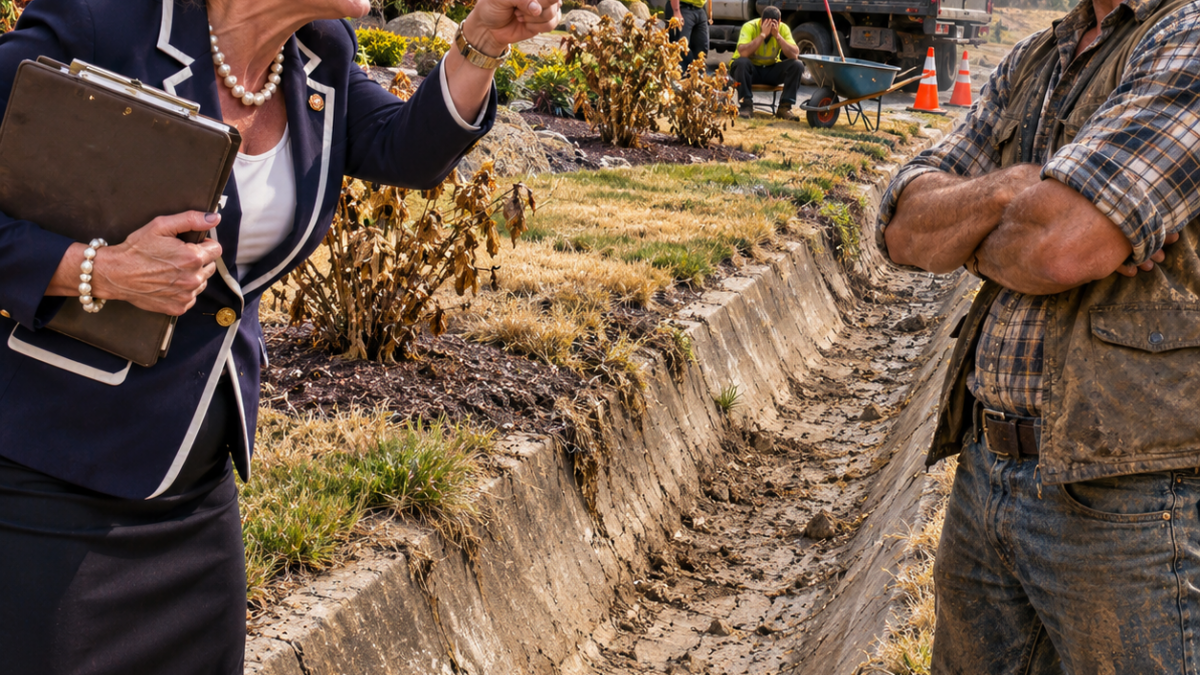
PART 2
The drive from the HOA office to my property took less than five minutes.
It felt much longer.
Willow Creek Estates had been designed to look effortless.
Every lawn was clipped to nearly the same height. Every mailbox matched. Every house sat behind a carefully approved palette of beige, gray, cream, or some other color whose entire purpose seemed to be avoiding personality.
Then I crossed the invisible line onto my property.
Everything changed.
I had bought the land because it still looked alive.
Not wild exactly, but honest.
The grass wasn’t perfect.
The fence posts leaned slightly in places.
Cottonwoods grew where they wanted.
And until that morning, the irrigation ditch had wound along the northern edge like a narrow silver ribbon.
It had been there long before Willow Creek Estates.
Long before Karen.
Long before the developers arrived with survey stakes and promises of luxury living.
That ditch was part of the land’s history.
Now it looked like a grave.
Fresh soil stretched almost three hundred feet across my property.
The skid-steer tracks were still visible.
The crew had packed the dirt tight.
They hadn’t misunderstood the location.
They hadn’t accidentally crossed a boundary.
They had deliberately followed the entire course of the ditch and erased it.
Sarah was standing on the porch when I got out of the truck.
She had an untouched glass of iced tea in one hand.
“What did she say?”
I looked toward the orchard.
“She says the ditch was a community hazard.”
Sarah stared at me.
“That ditch?”
“Apparently.”
“And?”
“They’re sending us a bill.”
For several seconds she said nothing.
Then she gave a short laugh that contained no humor whatsoever.
“A bill for what?”
“Destroying it.”
She closed her eyes.
Sarah had worked as a nurse for most of her adult life. She was patient in a way I had never been. She could listen to frightened families for hours without losing her composure.
But she also had a breaking point.
Karen was rapidly approaching it.
“Can they legally do that?”
“No.”
“Are you sure?”
“Absolutely.”
That answer seemed to steady both of us.
I went inside.
My home office was small, but it contained everything I needed.
I pulled a large storage box from the bottom shelf.
PROPERTY — DAVIS.
Inside were the documents from our purchase.
Closing papers.
Title policy.
Survey.
Deed.
Water-right documents.
I laid everything across the desk.
The survey plat was the first thing I opened.
There it was.
A dotted line ran along the northern boundary.
The notation was clear.
Recorded irrigation easement.
I found the easement number and wrote it on a yellow pad.
Then I pulled up the state water-resources database.
Parcel number.
Owner record.
Historic decree.
A scanned document appeared.
The language was old, but the meaning wasn’t complicated.
The owner of my parcel possessed a senior right to divert a defined amount of water from Willow Creek for agricultural use.
The right was attached to the land.
The ditch was the means of delivery.
Karen had not just filled a depression in my yard.
She had interfered with a legally recognized water right.
I leaned back.
Sarah stood in the doorway.
“Good news?”
“For us?”
“Yes.”
“Very good.”
“For them?”
I looked at the documents spread across my desk.
“Potentially terrible.”
I spent the next two hours drafting a letter.
I didn’t write it angry.
Angry letters feel satisfying for five minutes and become embarrassing exhibits later.
I wrote it the way I had written engineering memoranda during my career.
Fact.
Authority.
Violation.
Required corrective action.
Deadline.
I identified the property.
I cited the recorded easement.
I cited the water decree.
I described the unauthorized entry and alteration.
I documented the interruption of irrigation.
I rejected every proposed charge associated with the work.
Then I gave them ten business days to provide a restoration plan.
Not discuss one.
Not consider one.
Provide one.
The letter ended with a warning that further interference would increase damages and result in legal action.
I printed three copies.
One stayed in my file.
One went by certified mail.
The third went directly to the HOA office.
When I walked in, the receptionist looked nervous.
“Mr. Davis, do you have an appointment?”
“No.”
“Ms. Karen is busy.”
“I won’t take any of her time.”
I walked past.
Karen was on the phone when I entered.
Her eyes flashed with irritation.
I placed the envelope on her desk.
She covered the receiver.
“What is this?”
“Formal notice.”
She looked at the envelope.
“From you?”
“For now.”
Then I left.
That phrase bothered her.
I could tell.
For now.
Because people like Karen are comfortable when they believe the conflict exists only between them and one isolated person.
The possibility of lawyers, regulators, insurers, engineers, contractors, or government agencies entering the picture changes the temperature.
At least it changes the temperature for rational people.
Karen was not behaving rationally.
For ten business days, I heard nothing.
Every morning, I walked the length of the destroyed ditch and photographed the damage.
I photographed the orchard.
I photographed the pasture.
I documented the temperatures.
I kept receipts for hoses, water tanks, fuel, and everything else I used to keep the young trees alive.
Most evenings, I hauled water manually.
Five gallons at a time.
Sarah helped despite my asking her not to.
We would carry buckets from the house to the orchard as the sun dropped.
“This is ridiculous,” she said one night.
“I know.”
“Thirty trees.”
“I know.”
“Because one woman didn’t like a ditch.”
I emptied another bucket.
“That’s not why.”
Sarah looked at me.
“Then why?”
“Control.”
That was the part I had begun to understand.
This wasn’t about beauty.
If Karen truly thought the ditch was unsafe, she would have called.
If she thought it violated some rule, she would have sent notice.
If she thought it created a legal problem, she would have spoken to the county.
She had done none of those things.
She had seen something outside her control.
So she destroyed it.
On the eleventh business day, the HOA answered.
The envelope looked expensive.
Heavy cream paper.
Embossed logo.
Formal letterhead.
I opened it at the kitchen counter.
The first paragraph said my claims had been reviewed and found to be “without merit.”
The second claimed that properties adjacent to Willow Creek Estates were required to comply with community aesthetic standards whenever their condition could affect nearby property values.
That statement was nonsense.
Then came the invoice.
The original landscaping cost.
A late fee.
A $500 fine for an unauthorized landscape modification.
I read that line twice.
They were fining me for modifying the ditch they had modified.
Then came a $100-per-day charge for an “unstable excavated hazard.”
The hazard was the dry ditch bed created when they stopped the water and packed dirt across the channel.
At the bottom, the total had already climbed past $7,000.
And beneath it was the threat.
If unpaid within thirty days, the association would initiate lien proceedings against my property.
Sarah read over my shoulder.
“They’re threatening to take action against our house?”
“They’re threatening to try.”
“Can they?”
“No.”
“Then why would they send this?”
“Because they think we don’t know that.”
That was the moment the conflict changed for me.
Until then, I had wanted restoration.
I wanted the ditch opened.
I wanted the trees watered.
I wanted them off my land.
Now they were manufacturing fines and threatening a lien.
They were attempting to use paperwork as a weapon.
And that meant I needed to understand how often they had done the same thing to other people.
That evening, I printed a subdivision map of Willow Creek.
I marked my parcel.
Then I started studying the neighborhood.
The next morning, I took a walk.
I wore a polo shirt, khaki pants, and comfortable shoes.
No clipboard.
No camera hanging around my neck.
Nothing that made me look official.
I walked slowly.
The neighborhood was immaculate.
But the longer I looked, the more I noticed the little signs of people trying to remain human inside Karen’s system.
A basketball hoop hidden inside an open garage.
A birdbath behind shrubs.
A children’s bicycle tucked beside a porch.
A college flag that probably violated some regulation about approved displays.
Then I reached Primrose Court.
An older man was kneeling beside a small tomato patch.
The plants were healthy and heavy with fruit.
“Those are good-looking tomatoes,” I said.
He looked up cautiously.
“You from the committee?”
“No.”
He relaxed.
“Then they’re excellent tomatoes.”
I laughed.
He stood and brushed soil from his knees.
“I’m Mark Davis.”
His face changed.
“The ditch.”
“You heard?”
“Everybody heard something.”
“What did you hear?”
“That Karen finally went too far.”
His name was George Peterson.
He had retired from city planning years earlier.
Within twenty minutes, we were sitting at his kitchen table with lemonade between us.
George had files.
Lots of files.
Violation notices.
Fine schedules.
Board-meeting minutes.
Copies of bylaws.
He had spent years documenting Karen’s management style.
“Five years,” he said. “She became president five years ago.”
“And nobody challenges her?”
“They tried.”
“What happened?”
“She wears them down.”
George pushed one notice across the table.
It was for his tomatoes.
Another was for leaving a garden hose visible.
Another involved a crack in his driveway.
“She understands something most decent people don’t,” George said. “Most homeowners don’t want a war. They have jobs. Kids. Mortgages. Elderly parents. They get a letter for two hundred dollars, and even when they know it’s ridiculous, eventually they pay because fighting costs time.”
He leaned back.
“You aren’t going to pay.”
“No.”
“She knows that yet?”
“Not completely.”
George smiled.
“Good.”
I told him about the easement.
The 1908 water right.
The certified letter.
The fines.
The lien threat.
By the time I finished, George was staring at me.
“Mark, she didn’t just step over the line.”
“No.”
“She ran across it.”
“Yes.”
He tapped the table.
“Then this cannot be only about your ditch.”
I understood what he meant.
My case was stronger than anything Karen had faced before.
If I fought only for myself, I might get the ditch back.
But if the neighborhood saw the pattern, Karen’s entire system could collapse.
I wasn’t interested in becoming a revolutionary.
I wanted my water back.
But I also knew something else.
Bullies survive by keeping their victims isolated.
So George and I began talking.
Quietly.
Three nights later, we held a meeting in my barn.
Only four residents came besides us.
That was enough.
The Millers arrived first.
Young couple.
Exhausted parents.
Their offense was a cedar swing set.
Karen’s committee required white composite material.
The swing set had been a gift from the children’s grandfather.
The HOA had begun daily fines.
Mrs. Gable arrived next.
She was in her seventies.
Her late husband had spent his final year with limited mobility.
She had installed a wheelchair ramp.
The HOA claimed she had failed to obtain proper design approval.
Now they were threatening a lien over accumulated penalties.
She spoke quietly.
“I was taking care of my husband while he was dying,” she said. “I wasn’t thinking about matching rail colors.”
Sarah reached across the table and took her hand.
That moment stayed with me.
Because suddenly the ditch didn’t feel like the worst thing Karen had done.
Mine was expensive.
Visible.
Legally clear.
But Mrs. Gable’s story was cruel in a different way.
Karen had looked at a widow caring for a dying husband and seen an opportunity to enforce procedure.
I decided that night I didn’t simply want Karen to lose an argument.
I wanted her power removed.
Legally.
Publicly.
Permanently.
The following morning, I called David Sterling.
Dave and I had served together years earlier.
Back then he had been a JAG officer with the unnerving ability to read fifty pages of contract language and immediately find the sentence everyone else had overlooked.
Now he was a partner at a city law firm specializing in property, environmental, and water disputes.
He answered on the third ring.
“Mark Davis. Either you’re calling because you miss me or because something has gone terribly wrong.”
“HOA.”
He groaned.
“Absolutely not.”
“You don’t know the story yet.”
“Did someone paint a fence the wrong shade of beige?”
“They filled a deeded irrigation ditch tied to a 1908 water right.”
Silence.
Then:
“Say that again.”
I did.
He stopped joking.
“Send me everything.”
I emailed the case file.
Survey.
Deed.
Water decree.
Photos.
Certified-mail receipt.
HOA response.
Fine schedule.
Lien threat.
Damage log.
Two hours later, he called.
“Mark.”
“Yeah?”
“What in God’s name are these people doing?”
“I was hoping you could tell me.”
“This is not an HOA disagreement.”
“I know.”
“You have trespass issues, property destruction, interference with a recorded easement, potential water-law claims, improper collection activity, and depending on who authorized what, possible individual liability.”
“How strong?”
“Strong enough that I’m trying to understand why they haven’t already apologized.”
“They don’t think they need to.”
Dave paused.
“Good.”
“Good?”
“For the case.”
He agreed to represent me.
The next letter came from his firm.
There was nothing emotional about it.
That made it frightening.
It named the HOA.
It named the board.
And it named Green Pastures Landscaping, the contractor that had physically filled the ditch.
Dave’s letter demanded preservation of all emails, work orders, invoices, photographs, board communications, text messages, landscaping instructions, and payment records connected to my property.
Then it outlined potential damages.
Restoration.
Lost trees.
Lost agricultural use.
Engineering costs.
Legal fees.
Consequential losses.
The preliminary estimate was $150,000.
When Sarah saw that number, she looked at me.
“Is that real?”
“It could be.”
“For a ditch?”
“For destroying a protected water-delivery system, killing an orchard, and then refusing to restore it.”
Dave also included one crucial instruction.
No further alteration.
The existing condition was evidence.
Nobody was to dig, grade, landscape, cover, modify, or “repair” anything without agreement.
The letter went by courier.
Signature required.
Karen received hers.
Green Pastures received theirs.
Then we waited.
Bill Miller, the owner of Green Pastures, reacted like a businessman.
Karen reacted like Karen.
We later learned that Bill called her almost immediately.
He was scared.
The Willow Creek contract represented a large portion of his company’s annual revenue.
He wanted reassurance that the HOA actually had authority.
Karen gave it to him.
According to testimony he would later provide, she told him the letter was intimidation.
She said the HOA would protect him.
Then she reminded him who controlled his contract.
That was enough.
Bill backed down.
And Karen made the decision that destroyed her.
The filled ditch still looked ugly.
It was a wide scar of dirt.
The whole reason she had supposedly acted was beautification.
So she decided to finish the job.
Permanently.
She ordered Green Pastures to pour concrete over the entire channel.
I learned about it when concrete trucks arrived at my property.
The sound woke me before I saw them.
Heavy diesel.
Reverse alarms.
Metal clanging.
I walked onto the porch holding coffee.
Two mixer trucks stood near the property line.
Workers were setting forms.
Rebar lay beside the filled ditch.
For a few seconds, I could not believe what I was seeing.
Sarah stepped out behind me.
“Mark.”
“I see it.”
“Didn’t the lawyer tell them not to touch anything?”
“Yes.”
“What are you going to do?”
I put down my coffee.
“Document it.”
That answer surprised her.
It surprised me too.
A younger version of myself would probably have walked down there and stopped the work.
But Dave’s letter had already told them.
They knew.
If they continued now, they weren’t making an innocent mistake.
They were choosing it.
I grabbed my camera.
Then I stood thirty feet away and filmed.
Every truck.
Every worker.
Every form.
Every section of reinforcing steel.
Every company logo.
I filmed Bill supervising the work.
Eventually he noticed me.
Our eyes met.
He looked at the camera.
Then at me.
His face changed.
That was the moment he understood I wasn’t going to physically stop him.
I was going to let him finish.
I gave him a small nod.
He looked away.
All day, they poured.
By late afternoon, the place where water had once flowed was covered by a long gray strip of concrete.
Almost three hundred feet.
It looked like a drainage swale designed by someone who had never asked where the water was supposed to come from or go.
Sarah stood beside me.
“Now what?”
I sent the video to Dave.
His reply came within minutes.
One sentence.
Do not touch a thing.
He called shortly afterward.
“Mark, she may have just converted your strong case into an extraordinary one.”
“That’s what I thought.”
“The letter was delivered.”
“Signed for.”
“The contractor got his?”
“Yes.”
“And they did this afterward?”
“Every foot of it.”
Dave exhaled.
“All right.”
“What?”
“We stop asking.”
The next phase began.
But I didn’t want the fight to happen only in a law office.
Karen had used HOA money.
Homeowner money.
The residents deserved to know.
The next general meeting was two weeks away.
George and I prepared carefully.
No angry flyers.
No accusations printed in giant red letters.
No personal attacks.
We made a simple postcard.
On one side was a photograph of the concrete trucks working along my property.
On the other were four sentences.
Your HOA fees at work.
Do you know where your money is going?
Do you know what liabilities are being created in your name?
Attend the next general meeting.
We distributed them by hand.
The reaction was immediate.
People started calling George.
Then calling each other.
Stories surfaced.
More fines.
More threats.
More residents who had felt humiliated but believed they were alone.
The night of the meeting, the clubhouse parking lot filled early.
By the time Sarah and I arrived, people were standing along the back wall.
Karen sat at the front table.
She looked pleased at first.
Then she noticed George.
Then me.
Then the Millers.
Then Mrs. Gable.
Her smile tightened.
She moved through routine business quickly.
Treasurer report.
Landscape report.
Maintenance.
Minutes.
Then she tried to close.
I stood.
“Madam President.”
She looked at me.
“Mr. Davis, you’re not on the agenda.”
George spoke from the side.
“New business can be raised from the floor.”
Karen’s eyes snapped toward him.
He held up the bylaws.
The room murmured.
For the first time since I had met her, Karen had to follow a rule she didn’t control.
She looked back at me.
“You have three minutes.”
“That’s enough.”
I walked to the projector.
Connected my laptop.
The screen lit.
The first photograph showed the ditch in spring.
Water moving beneath the cottonwoods.
Wildflowers along the banks.
Dragonflies above the surface.
“This,” I said, “is an irrigation channel that has served my parcel for more than one hundred years.”
Next slide.
The survey plat.
“This is the recorded easement.”
Next.
The 1908 water-right decree.
“This is the legal right attached to the property.”
Next.
The filled ditch.
“This is what the HOA authorized without my permission.”
Murmurs became louder.
Karen shifted in her chair.
I continued.
Next slide.
The invoice.
“This is the bill they sent me for destroying it.”
Someone in the back said, “You’re kidding.”
“No.”
Next.
My certified letter.
“This is the notice informing the board that the work interfered with protected property and water rights.”
Next.
The HOA’s rejection.
“This is the response.”
Next.
Dave’s preservation letter.
“This came from my attorney.”
Next.
Video.
Concrete trucks rolled onto the screen.
Workers moved through the frame.
Bill stood beside the forms.
Concrete poured.
Nobody said anything.
I let the video play for fifteen seconds.
Then I stopped it.
“This work took place after the HOA and contractor had received formal written notice not to alter the area further.”
I switched to the last slide.
Numbers.
Estimated restoration cost.
Demolition.
Excavation.
Engineering.
Tree loss.
Lost pasture use.
Legal expense.
The figure at the bottom:
$180,000+
Now the room erupted.
“What?”
“Who approved that?”
“Is that our liability?”
“Did we vote on it?”
Karen grabbed her gavel.
“Order!”
Nobody listened.
I turned to the board.
“I have one question.”
The room quieted slightly.
“Who authorized these expenditures?”
Nobody answered.
I looked toward the treasurer.
“Was there a recorded board vote?”
The treasurer looked at Karen.
Then down.
That hesitation told everyone what they needed to know.
Karen banged the gavel again.
“This discussion is inappropriate. Mr. Davis is engaged in an active dispute with the association.”
“A dispute?” someone shouted. “You poured concrete on his property.”
“The association acted to protect community standards.”
Another voice.
“With whose money?”
The vice president leaned toward Karen.
I couldn’t hear what he said.
She shoved her microphone away.
“This meeting is adjourned.”
The crowd kept talking.
Karen stood.
She gathered papers too quickly and dropped several.
The treasurer didn’t help her.
Neither did the vice president.
That mattered.
Twenty minutes earlier, they had looked like a board.
Now they looked like people trying to decide whether they needed separate lawyers.
The next morning, Dave filed suit.
Willow Creek Estates Homeowners Association.
The relevant board members.
Green Pastures Landscaping.
The complaint included everything.
The recorded rights.
The photographs.
The correspondence.
The invoices.
The threats.
The concrete pour.
The damage calculations.
The demand sought $180,000 in compensatory damages plus any additional remedies available for willful conduct.
Karen was served at the HOA office.
Bill was served at his landscaping company.
Bill broke first.
I didn’t blame him for wanting to save his business.
I blamed him for ignoring the warning.
Those were different things.
His insurance carrier started asking questions.
So did the HOA’s insurer.
And suddenly Karen could no longer control who knew what.
Bill contacted Dave.
He wanted to cooperate.
During his deposition, he described everything.
Karen’s order to fill the ditch.
His concern after receiving the lawyer’s letter.
His phone call to her.
Her assurance that the HOA would protect him.
And the part that changed everything:
Her threat to cancel Green Pastures’ community-wide landscaping contract if he refused to continue.
When Dave told me that, I sat back.
“There it is,” I said.
“There it is,” he agreed.
Karen had transformed a contractor into a witness against her.
Then the HOA’s insurance company discovered something else.
The other board members claimed they had never seen Dave’s warning letter.
They had never seen the full documentation.
They claimed Karen had handled the issue herself.
They had also never formally voted to authorize the concrete work.
Whether that completely absolved them was another question.
But politically, it destroyed Karen.
Her allies realized she had exposed them to a six-figure lawsuit while withholding information.
They panicked.
George moved immediately.
The bylaws contained a procedure for removing a board member for cause.
He drafted a petition.
The Millers helped.
Mrs. Gable helped.
Residents went door to door.
The signatures came faster than anyone expected.
People weren’t signing only because of my ditch.
They were signing because of years of accumulated resentment.
A homeowner had been fined over a memorial rosebush planted after his wife died.
Another had received repeated notices over children’s toys.
George had his tomatoes.
The Millers had the swing set.
Mrs. Gable had the wheelchair ramp.
People who had once whispered complaints behind closed doors were now signing their names in ink.
Within a week, almost eighty percent of the community supported the petition.
A special meeting was called.
Sarah and I arrived early.
The atmosphere was different from the previous meeting.
No one was shouting.
No one needed to.
The room had the silence of a place where everyone already knew what was about to happen.
Karen entered with an attorney.
She looked tired.
Angry.
Smaller somehow.
Not physically.
Institutionally.
The title had stopped protecting her.
The vice president chaired the meeting.
He read the petition.
Then residents were invited to speak.
George went first.
He did not insult her.
He simply described five years of selective enforcement and intimidation.
The Millers spoke next.
Then Mrs. Gable.
She walked slowly to the microphone.
“My husband was dying,” she said. “I built a ramp so I could get him into our home.”
The room went still.
“I received violation notices while I was helping him through the final months of his life.”
Karen stared straight ahead.
Mrs. Gable continued.
“I asked for compassion. I was told rules were rules.”
She paused.
“So tonight, I agree.”
A few people turned toward Karen.
“Rules are rules.”
Then Mrs. Gable sat down.
Even I felt that one.
A man spoke about his wife’s rosebush.
A mother spoke about fines over children’s bicycles.
Another homeowner described being photographed by committee members while gardening.
The stories weren’t dramatic individually.
That was exactly the point.
Karen’s power had been built from a thousand tiny humiliations.
Then the treasurer stood.
He held a sheet of paper with both hands.
His voice shook.
“For the record,” he said, “I did not approve the expenditure related to Mr. Davis’s property.”
Karen turned toward him.
He kept reading.
“There was no recorded board vote authorizing the fill operation or subsequent concrete work.”
A murmur spread through the room.
He continued.
“The expenditures were categorized as emergency beautification maintenance under discretionary authority held by the president.”
Karen leaned toward her microphone.
“That is a gross mischaracterization.”
The vice president raised a hand.
“You’ll have an opportunity to speak.”
For perhaps the first time in her presidency, someone on her own board told her to wait.
She looked stunned.
When her turn came, Karen walked to the microphone.
She did not apologize.
That was her final mistake.
She said she had protected property values.
She said leadership required difficult decisions.
She said residents were reacting emotionally to misinformation.
Then she looked toward me.
“Certain individuals who do not even belong to this association have chosen to interfere in our community.”
I almost smiled.
That sentence summarized everything.
My property wasn’t part of the HOA when I challenged her authority.
But apparently it had been part of the HOA when she wanted to bulldoze my ditch.
People in the room recognized the contradiction immediately.
Karen kept talking.
The more she spoke, the worse it became.
Eventually, the vice president stopped her.
The ballots were distributed.
Sarah squeezed my hand.
“You okay?”
“Yeah.”
“You don’t look happy.”
“This isn’t supposed to be happy.”
She looked at me.
“What is it supposed to be?”
“Finished.”
The ballots were counted.
The vice president returned to the microphone.
One hundred eighty-two votes for removal.
Twelve against.
Karen was removed from the board.
There was no celebration.
No cheering.
Just a long exhale across the room.
Relief.
Karen gathered her documents.
She passed close enough to me that I could see the anger in her face.
“You’ve destroyed this community,” she said quietly.
I looked at her.
“No.”
She waited.
“I think they just took it back.”
She walked away.
Her attorney followed.
The landscaping contract collapsed next.
Green Pastures had spent years maintaining Willow Creek’s lawns, entrance plantings, medians, common spaces, trees, seasonal flowers, and irrigation systems.
It was one of their largest accounts.
But Bill understood that keeping the contract could make his position worse.
A week after Karen’s removal, his company terminated its agreement with Willow Creek Estates.
His written explanation referred to unethical instructions from former leadership and unacceptable legal exposure.
The irony wasn’t lost on anyone.
Karen had used the landscaping contract to pressure Bill into ignoring my attorney.
Now the contract was gone because of her pressure.
The perfect lawns she had treated like the symbol of her authority had become part of the evidence of her failure.
But I still didn’t have my ditch.
And until I did, I wasn’t finished.
With Karen removed, the remaining board stopped pretending the lawsuit was something they could bully away.
Their insurance attorney contacted Dave.
Settlement discussions began.
Dave called me one afternoon.
“They want to resolve it.”
“How much?”
“They’re asking what you’ll accept.”
“I already told you.”
“I know.”
“The ditch restored properly.”
“Yes.”
“The orchard loss.”
“Yes.”
“Pasture use.”
“Yes.”
“Engineering.”
“Yes.”
“Legal fees.”
“Yes.”
“And I control the restoration contractor.”
Dave laughed softly.
“I knew that was coming.”
“I’m not letting their landscaper fix what their landscaper destroyed.”
“I agree.”
There was one more issue.
Karen.
The insurance company had reviewed the documentation surrounding her conduct.
The first act might have been called a mistake.
The second could not.
She had received formal warning.
She had allegedly pressured Bill to continue.
She had withheld information from the board.
She had then authorized permanent concrete work.
The carrier took the position that portions of the conduct could fall outside ordinary coverage protections.
That meant Karen faced potential personal exposure.
For the first time, the woman who had mailed people fines without hesitation was receiving bills with her own name attached.
The final settlement totaled $180,000.
It covered demolition of the concrete.
Removal of the fill.
Re-excavation and grading.
Bank stabilization.
Engineering supervision.
Replacement value associated with the orchard.
Loss of pasture use.
Legal fees.
And related damage.
Most important to me, the restoration contractor would be selected by me.
The work would not be considered complete until it met the appropriate specifications.
Karen was required to contribute personally toward the portion attributed to her conduct.
I never asked exactly what she sold to come up with the money.
I didn’t need to know.
The number mattered less than the principle.
For weeks, she had treated my property as though it were hers to redesign.
Now her own money was helping restore what she had destroyed.
That was justice enough.
The restoration crew arrived early on a Monday.
These weren’t decorative landscapers.
They were heavy-civil contractors.
Excavator.
Dump trucks.
Hydraulic hammer.
Survey equipment.
Laser levels.
The foreman walked the alignment with me.
I carried a copy of the original survey.
He pointed toward the concrete.
“You want all of it gone?”
“Every inch.”
He smiled.
“I was hoping you’d say that.”
The excavator moved into position.
Sarah and I stood on the porch.
The hydraulic hammer lowered.
Then came the first strike.
CRACK.
A section of Karen’s concrete swale split.
The sound traveled across the property.
Another strike.
CRACK.
A second fracture.
Then another.
For months, I had seen that gray slab every morning.
It had become a physical reminder of helplessness.
Not because I had actually been helpless.
Because somebody else had believed she could do whatever she wanted and force me to live with it.
Now the slab was breaking apart in chunks.
I didn’t cheer.
I didn’t need to.
The sound was enough.
Concrete went into trucks.
Then the fill came out.
Load after load.
Underneath, traces of the old channel began to reappear.
The soil was darker there.
The original grade could still be read in places.
The crew followed the survey alignment carefully.
They rebuilt the banks.
Installed erosion protection where needed.
Placed native stone.
Verified slope.
Checked elevations.
I inspected everything.
Not because I distrusted them.
Because I had waited too long to leave any of it to chance.
By the fifth day, the ditch existed again.
Dry.
Open.
Waiting.
The foreman met me at the upstream headgate.
“Ready?”
I looked toward Sarah.
She was standing farther down the channel.
George had come over.
So had the Millers.
Mrs. Gable was there too, sitting in a folding chair beneath the shade.
I hadn’t invited a crowd.
They had simply heard the water was coming back.
I wrapped both hands around the old iron wheel.
The headgate had probably been turned thousands of times over its life.
Farmers before me had used it.
Families I would never know.
People who had depended on the same water.
I turned.
Metal groaned.
The gate lifted.
For a second, nothing happened.
Then came a soft gurgle.
A thin thread of water moved around the bend.
Someone behind me whispered, “There it is.”
The trickle became a stream.
The stream widened.
Water touched dry soil that had not seen it in months.
It moved around stones.
Past grass.
Toward the orchard.
What remained of it.
I walked beside the flow.
Sarah joined me.
We didn’t speak.
The water reached the end of the reconstructed section and continued along the original channel.
Exactly where it belonged.
George laughed.
Not loudly.
Just a short, relieved sound.
The Millers’ children ran along the bank until their mother called them back.
Mrs. Gable wiped her eyes.
That surprised me.
I walked over.
“You all right?”
She nodded.
“It’s silly.”
“No, it isn’t.”
She looked at the water.
“It’s just nice seeing something put back the way it was supposed to be.”
I knew she wasn’t talking only about the ditch.
Neither was I.
Over the following months, Willow Creek changed.
Not dramatically.
No one painted houses neon purple.
Nobody turned front yards into junkyards.
The community remained attractive.
But it became human again.
George’s tomatoes stayed.
The Millers put their cedar swing set back where their children could use it without hiding it.
The memorial rosebush remained.
The new board reviewed the enforcement policies.
Many accumulated fines were canceled.
Committees were restructured.
Rules that served no legitimate purpose were reconsidered.
People began attending meetings.
That may have been the biggest change.
Karen had built her authority partly on apathy.
Nobody wanted to spend an evening debating landscaping policies.
So people stopped showing up.
Once they stopped showing up, people like Karen could make the room their kingdom.
The new board learned something different.
An HOA existed to serve its residents.
The residents did not exist to serve the HOA.
My property remained outside its authority.
That point was confirmed clearly in writing.
No ambiguity.
No creative interpretation.
No “adjacent property” theory.
The line was the line.
A few months later, I saw a real-estate sign in Karen’s yard.
FOR SALE.
I felt less satisfaction than I expected.
By then, I was tired of thinking about her.
She had become almost irrelevant.
The ditch mattered.
The orchard mattered.
Sarah mattered.
The neighbors who had found their voices mattered.
Karen was simply the person whose arrogance had forced all of us to stop tolerating something we should have challenged earlier.
One afternoon, I saw a moving truck outside her house.
I was repairing a fence post near the road.
She drove past slowly.
For a moment, I thought she might stop.
She didn’t.
She looked toward me.
Then toward the restored ditch.
Then kept driving.
That was the last time I saw her.
I replanted the orchard that fall.
Thirty trees.
Again.
Apple.
Pear.
A few varieties Sarah picked simply because she liked the names.
We spent a weekend setting them in rows.
The work felt familiar.
But not the same.
The first orchard had represented retirement.
A fresh beginning.
Peace after years of moving and responsibility.
The second orchard represented something different.
Persistence.
The willingness to rebuild.
The knowledge that being right does not always protect you automatically.
Sometimes rights survive only because somebody is willing to document them, defend them, and refuse to surrender them for convenience.
On the final evening after planting, Sarah and I carried two chairs down to the ditch.
Sunset stretched orange across the water.
The surface caught the light and broke it into moving pieces.
For a long time, neither of us said anything.
Then Sarah looked toward the young trees.
“You know what the funny thing is?”
“What?”
“We moved here because you said you were done fighting.”
I laughed.
“I meant overseas.”
“You were very specific about wanting peace.”
“I remember.”
She leaned back.
“Do you regret buying this place?”
I looked along the ditch.
Toward Willow Creek.
Toward George’s house in the distance.
Toward the orchard.
“No.”
“Even after all this?”
“Especially after all this.”
She raised an eyebrow.
I thought about how to explain it.
“When we arrived, I thought peace meant nobody bothering us.”
“And now?”
“Now I think peace means knowing nobody can make you surrender what matters just because they’re louder.”
She smiled.
“That sounds like something a colonel would say.”
“Retired colonel.”
“Clearly not retired enough.”
We sat until the sky turned purple.
Water moved steadily beside us.
The same sound I had heard the first spring after we bought the property.
Soft.
Constant.
Unimpressed by everything that had happened.
That water had survived droughts.
Development.
Ownership changes.
A century of seasons.
Then one HOA president decided it offended her sense of order and tried to bury it beneath dirt and concrete.
For a while, she succeeded.
That was the part people often forget about justice.
Justice doesn’t always arrive before the damage.
Sometimes the trees still die.
Sometimes the bills still come.
Sometimes you still spend evenings carrying buckets across dry ground while someone who caused the problem sits comfortably behind a desk convinced she has won.
The satisfying part isn’t pretending those losses never happened.
It’s refusing to let the person responsible decide how the story ends.
Karen wanted a flat strip of approved landscaping.
She got a $180,000 settlement.
She wanted Green Pastures Landscaping to prove its loyalty by ignoring my lawyer.
Thirty days later, Green Pastures walked away from its community-wide contract and became one of the strongest sources of evidence against her.
She wanted her HOA board to stand behind her.
Instead, they discovered she had hidden legal warnings from them and moved to save themselves.
She wanted residents intimidated into silence.
They voted her out 182 to 12.
She wanted to erase my ditch.
In the end, her money helped rebuild it.
But the thing that satisfied me most wasn’t the settlement.
It wasn’t seeing the concrete broken apart.
It wasn’t watching Karen lose her title.
It wasn’t even hearing that Green Pastures had canceled the contract she used as leverage.
It was something much smaller.
A few weeks after the new orchard went in, I was walking near the property line when I heard children laughing.
I looked across toward the Millers’ yard.
Their cedar swing set stood in the open.
No fence hiding it.
No attempt to disguise it.
Two children were swinging as high as they could while their father stood nearby pushing the younger one.
Farther down the street, I could see George working around his tomatoes.
And in front of another house, a rosebush bloomed.
Ordinary things.
That was what Karen had never understood.
A neighborhood isn’t beautiful because every mailbox matches.
It isn’t beautiful because nobody leaves a hose visible.
It isn’t beautiful because every flower comes from an approved list.
A place becomes worth living in because people are allowed to live there.
Because a grandfather can build a swing set.
Because a widow can install a ramp without being treated like a criminal.
Because a man can grow tomatoes.
Because someone can plant a rose in memory of a person he loved.
And because a century-old stream of irrigation water can continue flowing where the law and history say it belongs.
Karen spent years trying to make Willow Creek perfect.
In the end, she almost made it lifeless.
The community became better only after people stopped being afraid of imperfection.
That evening, after Sarah went inside, I stayed beside the ditch alone.
The new orchard was little more than thin branches against the fading sky.
It would take years before those trees were large enough to provide shade.
Longer before they reached the size of the trees we had lost.
I was all right with that.
Some things cannot be rushed.
Trees.
Trust.
Communities.
Justice.
I leaned down and put my hand into the water.
It was cold.
Clear.
Moving.
I thought back to Karen’s office.
Her leather chair.
Her rulebook.
Her expression when she told me the ditch wasn’t mine.
At the time, I had wanted to answer her with anger.
Instead, I had told her she had made a grave mistake.
I hadn’t known then just how grave.
She assumed power meant having the final word.
My career had taught me something different.
Real authority leaves records.
Plans.
Signatures.
Surveys.
Statutes.
Votes.
Accountability.
Karen’s authority had rested on fear and convenience.
Mine rested on a deed, a water right, evidence, and the willingness to remain calm long enough for the truth to become impossible to ignore.
That’s why I never needed to scream at her.
I never needed to threaten her.
I never touched her property.
I never retaliated by breaking rules.
I simply documented what she did.
Then I let her keep making choices.
Every choice narrowed her escape.
Fill the ditch.
Send the bill.
Invent the fines.
Threaten the lien.
Ignore the easement.
Ignore my certified notice.
Ignore my attorney.
Pressure the contractor.
Pour the concrete.
Hide the letters.
Spend the money.
Dismiss the residents.
Refuse to apologize.
By the end, I didn’t destroy Karen’s position.
She did.
I just made sure there was a record.
The water moved between my fingers.
Then I stood.
Before walking back to the house, I looked once more toward Willow Creek Estates.
The lawns were still green.
The streets were still clean.
The houses were still attractive.
But now there were small signs of life everywhere.
A swing set.
A basketball hoop.
Flowers.
Vegetable gardens.
A wheelchair ramp that nobody dared complain about anymore.
It was still a community.
Just no longer Karen’s kingdom.
I walked back toward Sarah.
Behind me, the restored ditch kept flowing through the dark.
And for the first time since the day the bulldozers arrived, I realized I wasn’t angry anymore.
The war was over.
My land was whole again.
My orchard had been replanted.
My neighbors had found their voices.
The people responsible had paid for the damage.
And the woman who believed she could bury a century of legal rights beneath dirt and concrete had learned something no HOA rulebook could ever teach her:
You can intimidate people for a long time.
You can confuse silence with surrender.
You can mistake patience for weakness.
You can even get away with crossing the line once.
But when you keep pushing after you’ve been warned, eventually you reach a point where every threat, every invoice, every signature, and every arrogant decision becomes evidence against you.
Karen thought she had drained my ditch and won.
Thirty days later, her landscaping contract was gone.
Her board had turned against her.
Her neighborhood had voted her out.
And the association she controlled was negotiating a $180,000 settlement to repair the damage she ordered.
A few months after that, she was gone too.
The ditch wasn’t.
It still flows beside my orchard.
Some mornings I stand near the bank with my coffee and listen to it before the rest of the world wakes up.
There is nothing dramatic about the sound.
No gavels.
No courtroom speeches.
No arguments.
Just water moving over stone.
Steady.
Patient.
Persistent.
Exactly where it belongs.
And every time I hear it, I remember the lesson Karen learned far too late.
You can bury a waterway.
You can cover it with concrete.
You can surround your mistake with fines, threats, committees, and paperwork.
But if the right is real, the evidence is clear, and the person standing on the other side refuses to be bullied, sooner or later somebody is going to break that concrete apart.
And the water will find its way home.








