“GET OFF THIS RANCH—YOU’RE NOT THE OWNER ANYMORE!” HOA Karen Tried to Sell My Family’s Ranch While I Was Away, but When the Sheriff Put Two Documents Side by Side, Her Million-Dollar Development Deal Fell Apart
“GET OFF THIS RANCH—YOU’RE NOT THE OWNER ANYMORE!” HOA Karen Tried to Sell My Family’s Ranch While I Was Away, but When the Sheriff Put Two Documents Side by Side, Her Million-Dollar Development Deal Fell Apart
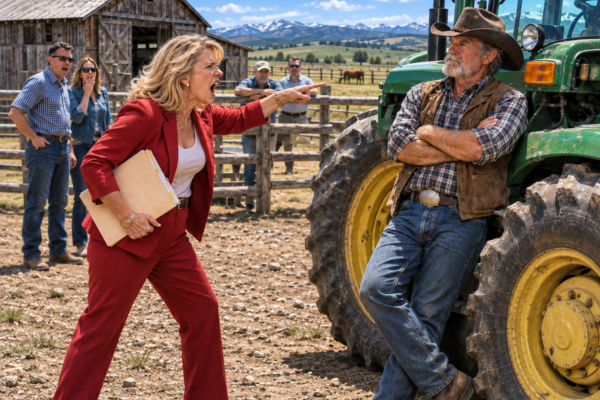
“YOU’RE THE FORMER OWNER, JAKE—STOP INTERFERING WITH OUR BUYERS!” HOA president Bethany Caldwell shouted as strangers toured the ranch I had owned for twenty-three years, unaware that I had never agreed to sell a single acre.
She had scheduled an open house during my fishing trip, removed the cedar sign my late father had carved thirty-four years earlier, and presented potential investors with an acquisition packet bearing what appeared to be my signature.
But when Bethany called the sheriff for the second time and demanded that I stop obstructing her real estate transaction, the officers laid two documents across the hood of their patrol vehicle—and the signature she had been relying on suddenly became the most dangerous piece of evidence against her.
I knew something was wrong before I reached my gate.
Eleven vehicles were parked along the shoulder. A black luxury SUV stood beside my cattle guard, and two couples were walking toward my barn carrying glossy brochures.
Then I saw the sign attached to the cedar entrance post.
OPEN HOUSE.
Beneath it was a smaller sign.
PRIVATE RANCH OPPORTUNITY.
I stopped my truck.
Carter Ranch had been my home for twenty-three years. I had never listed it, hired a broker, or discussed selling it.
Yet somebody was apparently conducting a real estate showing.
I pulled through the gate.
A woman carrying brochures waved at me.
“Sir, visitor parking is over there.”
“Visitor parking?”
“Yes. Bethany wants the main driveway kept clear for the new owners.”
I stared at her.
“What new owners?”
She pointed toward my farmhouse.
“The people buying the ranch.”
Then I saw Bethany Caldwell.
Red jacket. Blonde hair. Clipboard.
The president of Silver Pines HOA was standing in front of my barn, explaining to six strangers how they could renovate it after closing.
I climbed out.
“Bethany!”
She turned.
The color drained from her face.
“You’re back.”
“I live here.”
“You weren’t supposed to return until Monday.”
I had come home two days early because bad weather interrupted a fishing trip with my brother.
Apparently, Bethany had been counting on those two days.
Someone had tied blue ribbons along my pasture fence. Directional signs stood beside the driveway. A photographer was taking pictures of my workshop, and a man was peering through the tack room window.
“Everybody off my property.”
The conversations stopped.
Bethany approached me.
“Jake, don’t create a scene.”
I pointed toward the open house sign.
“What exactly would you call this?”
A man near the barn looked confused.
“Are you Jake Carter?”
“Yes.”
He turned toward Bethany.
“I thought Mr. Carter had already agreed to the acquisition.”
“I agreed to nothing.”
Bethany stepped between us.
“This is an authorized property showing.”
“Authorized by whom?”
“The association.”
“Your association doesn’t own my ranch.”
She lowered her voice.
“You’re going to make this much harder than it needs to be.”
“No. I’m going to make it very simple.”
I pointed toward the gate.
“Everybody leaves.”
Bethany reached for her phone.
“You have no authority to interfere with this transaction.”
I nearly laughed.
“On my own property?”
“You signed authorization.”
That stopped me.
“What did I sign?”
She opened her folder.
Then she backed away and dialed 911.
“Yes, I need a sheriff’s deputy at the Silver Pines West Expansion property. There’s an aggressive man interfering with an authorized real estate showing.”
I stared at her.
“Tell them my name.”
She did.
“Now tell them whose ranch you’re standing on.”
She turned away.
Ten minutes later, two sheriff’s vehicles entered my driveway.
Sergeant Tom Alvarez examined my identification and deed.
Then Bethany handed him her acquisition packet.
His expression became serious.
“Mr. Carter, have you signed any agreements with Silver Pines?”
“Only a limited survey access agreement last spring.”
Bethany smiled.
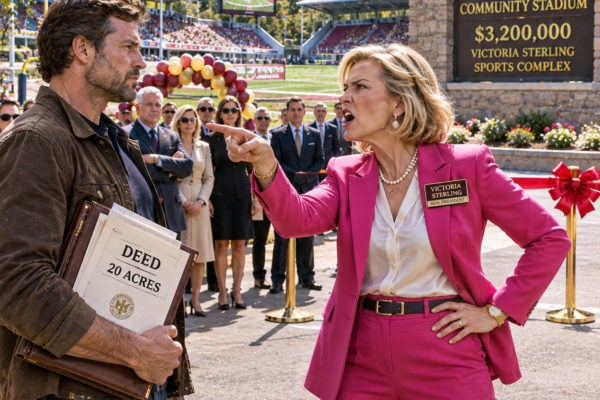
Tom handed me a document titled Property Access and Acquisition Authorization.
At the bottom was my name.
And beneath it was a signature that looked exactly like mine.
“Is that your signature?” he asked.
I stared at the page.
My late wife, Lauren, used to joke that my signature resembled a fence after a tornado.
Every crooked line looked familiar.
But the document didn’t.
“I never signed this agreement.”
Bethany folded her arms.
“You just admitted that’s your signature.”
I looked at her.
Then at the strangers holding brochures advertising my home.
And finally, I understood that this wasn’t merely an HOA president overstepping her authority.
Somebody had taken a document I had legitimately signed and apparently used it to convince investors that my family’s entire ranch was available for acquisition.
And I was standing in the middle of a transaction nobody had bothered to tell me about.
PART2
Sergeant Alvarez held the document between us.
“Mr. Carter, I’m going to ask you to be very specific. Are you saying that’s not your signature, or are you saying you’ve never seen this document?”
“I’m saying I’ve never signed a document with that heading.”
He nodded.
“What was the agreement you actually signed?”
“Limited access for a feasibility study. Silver Pines wanted to examine a strip of land along my northeast boundary for a possible emergency access road.”
“Do you have a copy?”
“At the house.”
Bethany immediately interrupted.
“This is exactly why we scheduled today’s showing while the acquisition was being handled professionally. Mr. Carter has become increasingly difficult about arrangements he previously accepted.”
I looked at her.
“You scheduled it while I was gone.”
“You were informed that the association intended to move forward.”
“With a survey, Bethany. Not the sale of my home.”
Sergeant Alvarez raised his hand.
“One person at a time.”
He examined the acquisition packet again, then turned toward the strangers gathered near my barn.
“Is anybody exchanging money here today?”
A man wearing a navy blazer stepped forward.
“I’m Nathan Brooks. I’m the broker conducting the preview. No money is changing hands today.”
“Do you have an executed purchase agreement?”
Nathan hesitated.
“We were informed that acquisition documents were being finalized.”
“By whom?”
He glanced at Bethany.
“The association’s development representatives.”
Bethany nodded vigorously.
“This is part of our expansion initiative.”
Tom closed the folder.
“Then I’m going to make something clear. Whatever contractual dispute you believe exists, it isn’t going to be resolved in this driveway.”
Bethany started talking again.
He stopped her.
“No more showing today.”
For a moment, I thought she might argue with him.
Instead, she looked toward the investors, apparently calculating how much damage his instruction had done to her presentation.
Tom handed my deed back to me.
“Mr. Carter, photograph the situation, preserve your documents, and contact your attorney. Don’t damage anything these people have brought onto the property while this gets sorted out.”
I nodded.
“Understood.”
It wasn’t the immediate victory I’d hoped for.
I had expected the deputies to examine my deed, establish that I owned the ranch, and instruct everybody to leave.
Instead, Bethany’s paperwork had introduced a sufficiently serious question that the officers wanted the matter addressed through appropriate legal channels.
I understood their caution.
But understanding it didn’t make the experience any less humiliating.
Strangers had been walking around my property, discussing what they might do with the buildings after I was supposedly gone. Now I was being advised to contact an attorney because somebody had presented a document bearing my own signature.
I looked toward my farmhouse.
Twenty-three years of mortgage payments, repairs, improvements, and responsibilities.
And apparently, a folder full of questionable documents could create enough confusion to make me defend my right to stand there.
One woman passed me on her way toward the parking area.
She stopped.
“We were told you’d already accepted.”
“Accepted what?”
“An offer.”
I stared at her.
“Did they tell you how much?”
She glanced toward Bethany.
“I think you need to speak with her.”
Then she walked away.
I watched the vehicles leave through my gate, one after another.
Several minutes later, Bethany removed the open house sign herself.
She carried it toward her white SUV without looking at me.
“Where did you get my signature?” I asked.
She stopped.
“You signed authorization for survey access.”
“Exactly. Survey access.”
“That’s your interpretation.”
“No, Bethany. That’s what the agreement said.”
She placed the sign inside her vehicle.
“You should consult your lawyer before accusing people of things you don’t understand.”
I opened my mouth to answer.
Then I looked toward the barn.
And suddenly, the argument about signatures became the second most upsetting thing I had discovered that afternoon.
Something was missing.
For thirty-four years, a weathered cedar plank had hung above the barn doors.
My father had carved two words into it when I was sixteen.
CARTER RANCH.
The lettering wasn’t particularly elegant. The first R leaned slightly to the left, and one corner of the board had developed a crack that Dad insisted gave it character.
He had never wanted a replacement.
“People’ll know what it says,” he used to tell me. “That’s all a sign needs to do.”
The board had survived two roof replacements, three droughts, and a tornado that damaged part of the equipment shed.
It had survived my father’s death.
It had been there on the morning Lauren and I began our life at the ranch.
It had remained there after she died, when I sometimes walked into the barn simply because the familiar smell of old timber and horse feed made the world feel a little less empty.
Now it was gone.
In its place hung a glossy promotional banner.
SILVER PINES WEST.
I stood beneath it.
For several seconds, I couldn’t speak.
Then I turned toward Bethany.
“Where’s my sign?”
She followed my gaze.
“The old board?”
“My father made that.”
She shrugged.
“It was removed for presentation.”
I stared at her.
“Where is it?”
“I don’t know. You’d have to ask the staging crew.”
Something inside me went quiet.
I had spent the previous hour controlling my temper because I knew Bethany would be delighted if I gave her an excuse to portray me as dangerous.
But hearing her dismiss that cedar plank as something inconvenient to a real estate presentation nearly broke my composure.
She climbed into her SUV.
Before closing the door, she looked at me.
“This could still end well for you, Jake.”
I looked back at the banner.
“For me?”
“You’re sitting on land the community needs. Nobody’s trying to hurt you.”
Then she drove away.
I remained beside the barn.
The afternoon wind moved across the pasture. Somewhere beyond the fence, one of my horses called to another.
Everything around me was familiar.
Yet the banner above my head made the place feel as though somebody had attempted to erase my family from it.
I thought about my father standing beside his workbench thirty-four years earlier, holding that cedar board while I complained that the lettering wasn’t straight.
“Then make yourself another one when you own the place,” he’d said.
I never did.
There were things you didn’t replace simply because something newer was available.
I took out my phone and photographed the banner.
Then I photographed the empty mounting points where the old sign had been attached.
Finally, I called Rebecca Shaw.
Rebecca had handled grazing leases for me, resolved an old boundary dispute, and helped with the transfer of my mother’s acreage after she passed away.
She knew the ranch.
More importantly, she knew me.
When she answered, I sent her several photographs before attempting to explain.
There was a long silence.
“Jake, what am I looking at?”
“An open house.”
“Whose?”
“Apparently mine.”
“Have you listed the ranch?”
“No.”
“Have you signed an agreement to sell it?”
“No.”
“Have you authorized anyone to market it?”
“No.”
“Given the association power of attorney?”
“Absolutely not.”
She became very quiet.
“Then I need you to find every document you’ve signed with Silver Pines.”
I looked toward the farmhouse.
“I know exactly where it is.”
“Good. Send it to me. And don’t have another conversation with Bethany about this until I’ve reviewed it.”
I nodded, forgetting she couldn’t see me.
Then I asked the question that had been bothering me since Sergeant Alvarez examined the acquisition packet.
“Rebecca, how can somebody have my signature on a document I’ve never signed?”
She paused.
“There are several possibilities. Let’s establish exactly what happened before we make accusations.”
I appreciated her caution.
But I also knew that whatever had happened wasn’t going to be explained by a simple misunderstanding about a parking space or a property boundary.
Bethany had brought buyers onto my ranch.
She had advertised a closing.
And she had removed my father’s name from the barn before I even knew my property was supposedly being acquired.
I found the original agreement in the second drawer of my office filing cabinet.
Four pages.
The title was exactly as I remembered it.
Limited Site Access Agreement.
It authorized designated surveying and engineering personnel to enter a narrow section along the northeast boundary for a feasibility study concerning a potential emergency access connection.
The duration was thirty days.
The document contained no agreement to sell the ranch, no purchase option, no authorization to list the property, and no transfer of title.
It didn’t give Silver Pines permission to conduct tours of my house or invite investors onto the land.
The last page contained my signature.
I scanned the complete agreement and sent it to Rebecca.
Then I sat at my desk looking at the original.
The arrangement had seemed straightforward when I signed it.
Silver Pines had expanded faster than its developers initially anticipated. As more houses appeared, the residents became interested in establishing another access route for emergency purposes.
The northeast corner of my ranch happened to occupy a potentially useful location.
Representatives of the association approached me the previous spring.
I told them I would consider a specific proposal if their engineers established that a route was feasible and the association offered reasonable compensation for any property rights it needed.
I hadn’t promised anything beyond considering a proposal.
I certainly hadn’t offered them the rest of Carter Ranch.
The thirty-day access agreement allowed them to collect information.
That information would determine whether there was anything worth negotiating.
As far as I was concerned, nothing had progressed beyond that preliminary stage.
Nobody had returned with a detailed engineering plan.
Nobody had presented a purchase offer.
Nobody had discussed a closing date.
And five months had passed since the limited access authorization expired.
Rebecca called approximately twenty minutes later.
“Jake, I’m comparing the photograph you took of Bethany’s packet with the agreement you’ve sent me.”
“And?”
“The signature page appears remarkably similar.”
I leaned forward.
“You mean she copied it?”
“I mean I want the original acquisition packet before I make a stronger statement. We need to establish where the signature page came from, whether anything was altered, and who assembled the documents.”
I looked at the four pages on my desk.
“Can she use that to sell my ranch?”
“Not simply because she has a document bearing what appears to be your signature. A legitimate sale requires actual authority and the necessary agreements.”
“Then why did the sheriff take her seriously?”
“Because deputies responding to a dispute aren’t necessarily in a position to determine the authenticity and legal effect of competing property documents on the spot.”
I sighed.
“She called them on me, Rebecca.”
“I know.”
“On my own land.”
“I know.”
“And she took down my father’s sign.”
There was a pause.
“Jake, we’re going to deal with the entire situation.”
I looked toward the barn through the office window.
“What do I do?”
“Nothing dramatic. Preserve everything. Don’t interfere with her property, don’t threaten her, and don’t allow her to turn this into a dispute about your behavior.”
I rubbed my forehead.
“She held a real estate showing while I was gone.”
“Yes.”
“How does somebody do that?”
Rebecca’s voice became firmer.
“That’s what we’re going to make her explain. Every representation, every document, every contractor, every person she invited. Don’t try to solve the entire thing tonight.”
I looked at my father’s old photograph on the bookshelf.
He was standing in front of the barn, one hand resting against the doorframe, wearing the broad smile I remembered from my childhood.
Above him was the cedar sign.
I thought about the woman who had called it an old board and removed it for presentation.
Then I answered Rebecca.
“Make her explain every step.”
“That,” she said, “is exactly what I intend to do.”
The following morning, I drove into town to purchase several supplies I’d planned to collect after returning from the fishing trip.
I was gone less than two hours.
When I returned, a white pickup was parked beside my north pasture. Two men wearing fluorescent safety vests were walking along the fence, placing orange survey flags into the ground.
For a moment, I wondered whether I was going to spend the remainder of my life discovering strangers on my ranch.
I stopped my truck.
“Morning, gentlemen. Who hired you?”
The older man approached carrying a work order.
“Silver Pines Homeowners Association.”
“What are you surveying?”
“Future access and parcel configuration.”
“Parcel configuration?”
He nodded.
“We’re supposed to identify some preliminary locations for the development team.”
I looked toward the flags.
They weren’t confined to the narrow strip identified in the original agreement.
One stood much farther inside the pasture.
“Who authorized you to come onto my property?”
The man examined his paperwork.
“We were told the association has site access.”
“It had limited access last spring. That authorization expired five months ago.”
He looked up.
“Hasn’t it been renewed?”
“Not by me.”
He glanced toward his colleague, then examined the work order again.
There was no signature from me.
No renewed agreement.
Nothing establishing that I had authorized the visit.
“I’d better call the office,” he said.
“Please do.”
While he made the call, I stood beside my truck and photographed the vehicle, its company markings, and the locations where the flags had been placed.
I didn’t blame the two men for being there.
They had accepted an ordinary assignment from their employer, apparently based on the assumption that somebody had obtained the necessary permission.
They hadn’t arrived carrying brochures or claiming that I no longer owned my ranch.
They were simply doing work they had been told was authorized.
Ten minutes later, they began collecting their equipment.
Before leaving, the older man handed me a copy of the work order.
“You might want to keep this.”
“Thank you.”
He looked uncomfortable.
“Sorry about the misunderstanding.”
“I appreciate you checking.”
They drove away.
I returned to the farmhouse and sent the document to Rebecca.
She called immediately.
“Another contractor?”
“Two surveyors.”
“What was the scope?”
“Future access and parcel configuration.”
Rebecca sighed.
“Apparently, yesterday’s encounter with the sheriff hasn’t persuaded them to stop.”
I looked through the window toward the north pasture.
“Maybe she thinks if enough people start working on the ranch, I’ll eventually believe it’s been sold.”
Rebecca didn’t laugh.
“I’m contacting the brokerage.”
That was when the first important part of Bethany’s operation began unraveling.
Nathan Brooks called me later that afternoon.
He introduced himself again and apologized for the previous day’s confusion.
I leaned back in my office chair.
“Which part are you apologizing for, Nathan? The strangers in my barn, the photographer at my workshop, or the fact that you were apparently showing people a house that isn’t for sale?”
He became quiet.
“All of it, Mr. Carter.”
I appreciated the fact that he didn’t immediately begin blaming someone else.
But I wanted answers.
“How did your brokerage become involved?”
“We were retained to conduct a private preview based on representations from Silver Pines.”
“What representations?”
“That the association’s acquisition of the property was substantially complete.”
I looked at my deed.
“It isn’t.”
“I understand that now.”
“Who told you it was substantially complete?”
“Bethany Caldwell.”
“Did she show you a purchase agreement?”
There was a pause.
“She supplied an acquisition authorization packet.”
“Did you verify the title?”
Nathan took a breath.
“We weren’t formally listing the property on the public market. This was an off-market investment opportunity contingent upon acquisition.”
It was a carefully phrased explanation.
And it revealed something I hadn’t fully understood during the open house.
Bethany wasn’t necessarily telling everybody that Silver Pines already held recorded title to my ranch.
She was telling them the association was about to acquire it.
Then she was inviting investors to examine the opportunities available once that acquisition supposedly became final.
The distinction might have been useful to somebody attempting to defend their professional conduct.
It didn’t make the people walking through my barn any more welcome.
“Nathan, did anybody speak directly with me before arranging that preview?”
“No.”
“Why not?”
“We were informed that direct communication with the owner could complicate sensitive negotiations.”
I closed my eyes.
Sensitive negotiations.
Bethany had apparently discovered a convenient way to prevent anybody from asking the one person who could immediately destroy her story.
“Send my attorney everything you distributed to prospective investors,” I told him.
“Of course.”
“And I want the name of whoever commissioned the photography and staging.”
“I’ll provide that information.”
I thanked him.
Then I asked one last question.
“Did you actually believe I was moving?”
He hesitated.
“We were told the owner had agreed to vacate after closing.”
I looked around the office.
There were photographs of Lauren, my parents, and several horses I’d raised over the years.
On the bookshelf stood an old clock my mother had given us when we moved into the farmhouse.
I knew every creaking floorboard in that house.
Every stubborn window.
Every place where the afternoon sunlight reached the kitchen.
I wasn’t planning to vacate anything.
“Nathan,” I said, “you were told something that isn’t true.”
“I understand.”
“Make sure everybody else understands it, too.”
After hanging up, I sat quietly for several minutes.
Then an email arrived from Rebecca.
The brokerage had supplied its investment brochure.
I opened it.
And for the first time, I saw exactly what Bethany had been promising people.
The first page contained a large aerial photograph of Carter Ranch.
I recognized the farmhouse, barn, equipment yard, pasture fences, and the line of cottonwoods near the entrance.
Somebody had placed colored overlays across the image.
The west pasture was divided into potential estate lots.
My workshop was identified as a possible event facility.
The farmhouse carried a label that made my stomach tighten.
Future clubhouse or executive residence.
I moved to the next page.
There were photographs of the property taken from angles I immediately recognized.
Some had apparently been captured while I was away.
The brochure described an opportunity to integrate rural character with the continuing expansion of Silver Pines.
It spoke about premium residential development, adaptable agricultural structures, and the long-term value of additional community amenities.
Then I reached the photograph of my barn.
Adaptive reuse structure.
I stared at those three words.
The barn was older than many of the people who had walked through it the previous afternoon.
My father had taught me to saddle a horse inside it. He had made me repeat the process until I could do it safely without his assistance.
My mother stored additional feed there during the winter of 1996, when weather conditions made ordinary ranch work considerably more difficult.
Lauren and I had spent one particularly exhausting spring sleeping in shifts on a folding cot because our best mare was preparing to foal.
For three nights, we hardly slept.
On the third morning, Lauren shook my shoulder.
“Jake. It’s happening.”
I remember stumbling out of the cot so quickly that I nearly tripped over my boots.
We stood together, watching life begin in the same barn Bethany’s brochure now described as an adaptable development asset.
Lauren had been gone for years.
But that building still contained a thousand reminders of our life together.
A hook where she used to hang her jacket.
A shelf she had insisted we build.
A little pencil mark on one of the beams from the time we couldn’t agree on the height of a new storage rack.
None of those things would appear in a valuation report.
None of them would matter to investors examining the property’s commercial potential.
But they mattered to me.
I closed the brochure.
Then I opened it again.
Rebecca had specifically told me to read everything.
On page six, I found the proposed transaction schedule.
Site control.
Pre-closing review.
Final acquisition.
Investor release.
The projected closing date was three weeks away.
Three weeks.
I called Rebecca.
“They’ve scheduled a closing.”
“They’ve advertised a projected closing date.”
“Without a purchase agreement?”
“Apparently.”
“Without asking me?”
“Yes.”
“How can they possibly close?”
“They cannot complete a legitimate acquisition unless the necessary agreement and authority exist.”
“Then what on earth is Bethany doing?”
Rebecca paused.
“I suspect she may believe that once she’s created sufficient commitments, financial expectations, and outside pressure, you’ll be more inclined to accept an offer.”
I looked at the aerial photograph.
“So she’s promising people the ranch first.”
“And possibly expecting you to make those promises true afterward.”
I leaned back.
For months, Silver Pines had been discussing an emergency access road.
That was the project I had agreed to let its engineers investigate.
A strip of land.
A specific purpose.
A limited period.
Somehow, by the time Bethany began speaking with investors, that modest feasibility study had expanded into an acquisition involving my farmhouse, workshop, barn, and pastures.
I wondered when she had decided that acquiring the whole ranch would be more attractive than negotiating for the small portion the association originally wanted.
Perhaps the value of the land had persuaded her.
Perhaps somebody on her development committee had encouraged the idea.
Perhaps she simply believed I would eventually surrender if the project appeared sufficiently inevitable.
I didn’t know.
But I knew something she apparently hadn’t considered.
Carter Ranch wasn’t vacant land awaiting its highest and best financial use.
It was my home.
And no development brochure could change that.
The next two days brought a procession of people who had apparently been told Silver Pines possessed access rights.
A photographer arrived shortly after sunrise.
I met him near the workshop.
“Who commissioned the photographs?”
“Silver Pines.”
“Have you spoken with the property owner?”
He looked confused.
“I understood the acquisition was in progress.”
“I’m the owner. You don’t have my permission.”
He immediately apologized and packed his equipment.
Later, a landscape consultant arrived.
Then a man carrying measurements associated with the barn doors.
Each had been given a version of the same explanation.
The project was moving forward.
Site access had been arranged.
The current owner was aware of the transaction.
Each left when I explained that those representations were inaccurate.
I documented the encounters and sent the information to Rebecca.
By Thursday morning, I had begun checking the gate before making my coffee.
That was something I’d never needed to do before.
For twenty-three years, Carter Ranch had been the place where I could decide how my morning began.
Now I was waking up wondering which contractor had been told he could enter.
That Thursday, I discovered a notice attached to the gate with a plastic zip tie.
PROPERTY ACCESS INTERFERENCE.
The notice alleged that I was obstructing previously authorized due diligence activities and potentially causing financial damage to Silver Pines.
At the bottom was Bethany Caldwell’s signature.
I read it twice.
The woman attempting to acquire my ranch without my agreement was now formally accusing me of interfering with her efforts.
I took a photograph.
Then I called Rebecca.
“Can I remove this one?”
“What is it?”
I read the notice aloud.
Rebecca sighed.
“Yes, Jake. Preserve the notice, but you don’t need to leave it attached to your gate.”
“Thank you.”
I cut the zip tie.
The amount of satisfaction I experienced from that small act was probably disproportionate.
I placed the notice inside a protective sleeve and added it to the growing file.
Then I went back to my morning chores.
At approximately three that afternoon, a dark blue sedan pulled into my driveway.
I recognized the woman who stepped out.
She had been at the open house.
She approached carefully, holding a folder against her chest.
“Mr. Carter?”
“Yes.”
“My name is Melissa Grant. I was here last Saturday.”
I remembered her standing near the barn.
“Are you here to discuss an investment?”
She shook her head.
“I’m here because I think somebody has been lying to both of us.”
Melissa looked toward the farmhouse before continuing.
“My husband and I were considering investing in two of the proposed estate lots. Nothing had been purchased. We were waiting for the acquisition to be finalized.”
I nodded.
“An acquisition I never agreed to.”
“That’s what I realized when you came home.”
She opened her folder.
“I’ve printed some emails. I think you should read them.”
We sat on the porch, and she handed me the first page.
The email came from Bethany.
It contained a description of the proposed development, followed by a sentence that immediately caught my attention.
Owner has accepted the structure of the transaction.
I looked at Melissa.
“She told you that?”
“Yes.”
I read the next message.
Title transfer is expected to be administrative.
Then the third.
Current owner will vacate following closing.
I stopped.
“Vacate?”
Melissa nodded.
“We were told you were relocating.”
“Where?”
She hesitated.
“Wyoming.”
For a moment, I actually laughed.
Not because the situation was funny.
Because its absurdity had reached a point where I didn’t know how else to respond.
“I’ve never even looked at property in Wyoming.”
Melissa appeared genuinely embarrassed.
“She told us you wanted something smaller and more manageable. That you’d been considering a move for some time.”
I looked across the pasture.
“Did she tell you that directly?”
“Yes.”
“Did she provide any written statement from me?”
“No.”
“Did you ask to speak with me?”
“We did.”
“And?”
“She said the negotiations were sensitive and that contacting you might jeopardize the acquisition.”
I looked at the emails again.
Everything fit together.
The prospective investors believed I had accepted the proposed transaction.
The broker believed the acquisition was substantially complete.
The contractors believed site access had been renewed.
The staging crew believed it had permission to remove existing signage and prepare the ranch for marketing.
Each participant had received enough information to believe somebody else had established the authority necessary for their involvement.
And none of them had asked me.
I looked at Melissa.
“Why are you showing me this?”
She considered the question.
“Because when you arrived during the open house, you didn’t look like somebody selling his home.”
I remained silent.
She continued.
“You looked like somebody who’d come home and discovered strangers in his house.”
I swallowed.
“That’s exactly what happened.”
Melissa lowered her eyes.
“I felt terrible afterward. We’d been walking around your buildings discussing what might happen to them. Your workshop, your barn. One of the people with us was talking about whether the farmhouse could be used for private events.”
She looked at the property.
“We didn’t understand that you still lived here and weren’t planning to leave.”
I appreciated her willingness to acknowledge it.
“Melissa, I’m not blaming you for believing the information you were given. But my attorney needs copies of these emails.”
“Of course.”
“Would you be willing to explain what Bethany told you if somebody needs to ask?”
“Yes.”
She handed me the folder.
“I don’t want us involved in anything like this.”
I thanked her.
Before leaving, she looked toward the barn.
“There’s something else.”
“What?”
“The brochure made the property sound like an opportunity nobody was going to get twice.”
I nodded.
“That’s probably true.”
She looked at me.
“But not for the reasons Bethany was telling us.”
I watched her return to her vehicle.
Then I walked back inside and sent the emails to Rebecca.
She called a short time later.
“Jake, these are important.”
“I thought so.”
“They establish representations made to people outside the association. We need to preserve them in their original form where possible.”
I looked at the sentence concerning my supposed departure.
“She’s already decided where I’m going to live.”
Rebecca became quiet.
“She doesn’t get to make that decision.”
I knew she was right.
But sitting inside the farmhouse with photographs of my late wife surrounding me, I found it difficult to accept how casually Bethany had described my departure.
Current owner will vacate following closing.
As though twenty-three years of life could be reduced to a scheduling item.
As though the place I had built my future with Lauren was merely a building that needed to be cleared before new people arrived.
I printed the email.
Then I placed it beside the original limited access agreement.
One document showed what I had actually authorized.
The other showed what Bethany had apparently decided I would do.
The difference between them was my entire home.
That evening, I contacted the staging company.
It took several calls before I reached somebody who understood which project I was discussing.
When I explained that a cedar sign had been removed from the barn without my permission, the manager sounded uncomfortable.
“Let me check our warehouse inventory.”
“Please do.”
“Can you describe the item?”
“Old cedar plank. Two carved words. Carter Ranch.”
He asked whether it had any particular identifying marks.
I described the crack near the corner and the crooked lettering.
Then I waited.
Twenty minutes later, he called back.
“We’ve located it.”
I closed my eyes.
“Is it intact?”
“Mostly. There’s a scrape on one corner.”
“Where was it?”
“In our warehouse. It was collected with other materials removed from the property before the preview.”
I gripped the phone.
“Who told your crew to remove it?”
“The project contact.”
“Bethany Caldwell?”
“Yes.”
“Did she explain why?”
There was a pause.
“Her instructions were to remove obsolete owner branding before the showing.”
I repeated the phrase.
“Obsolete owner branding?”
“Yes, sir.”
I looked toward the framed photographs on my office shelf.
My father.
My mother.
Lauren.
All the people whose lives had contributed to the history of Carter Ranch.
Obsolete owner branding.
That was what their name had become to somebody who wanted to advertise a different future for the property.
“Please bring it back,” I said.
“We can have someone deliver it this evening.”
“Thank you.”
When the vehicle arrived, I met the driver beside the workshop.
He carried the plank toward me.
The moment I saw it, I felt an enormous sense of relief.
It was weathered and scratched, but it was still there.
I ran my hand over the old lettering.
Then I examined the fresh scrape near the corner.
The driver apologized.
I shook my head.
“I’m glad you found it.”
After he left, I carried the sign into the workshop and leaned it carefully against the wall.
I could have rehung it immediately.
I wanted to.
But something stopped me.
The association’s marketing materials hadn’t all been removed yet. Orange markers remained near parts of the pasture. Temporary signs had been placed around the driveway. The glossy Silver Pines banner was folded on my workbench after Rebecca had documented it and advised me concerning its removal.
I wanted all of that gone.
I wanted the association’s representatives to understand that the ranch wasn’t available for their project.
Then I would return my father’s sign to its proper place.
I sat beside the old board for a few minutes.
I remembered Dad carving it at his workbench.
He had been proud of the finished sign, although the letters weren’t perfectly aligned.
I’d teased him about that.
Lauren had liked it, too.
When we first began making improvements to the property, somebody suggested that a new sign would make the entrance and barn look more impressive.
Lauren had shaken her head.
“Your dad made that one.”
I nodded.
“Exactly.”
“We’re keeping it.”
There hadn’t been a discussion after that.
We had kept it through everything.
Through years of work.
Through periods when money was tight.
Through the loss of my parents.
Through the most difficult chapter of my life, when Lauren was no longer there to help me decide what came next.
And now, for the first time in thirty-four years, somebody had removed it because she thought the name Carter interfered with her marketing presentation.
I looked at the fresh scrape.
“Not for much longer, Dad.”
Then I turned off the workshop lights.
Rebecca’s formal demand reached Silver Pines the following morning.
It was specific.
No further property showings.
No additional contractor access without my authorization.
No survey activity under an expired agreement.
No marketing materials representing that Carter Ranch was under contract or available through the association.
No unauthorized use of my name, signature, or property images in connection with the acquisition effort.
The demand also required preservation of the documents and communications associated with the project.
Silver Pines’ attorney responded that same day.
His name was Howard Finch.
Rebecca had expected him to make some attempt to defend the association’s position, perhaps by identifying an agreement or explaining its interpretation of the acquisition packet.
Instead, he requested copies of everything.
The original limited access agreement.
The document Bethany had presented to the sheriff.
The investor brochure.
The work orders.
The interference notice.
Melissa’s emails.
And the photographs documenting the open house.
Rebecca supplied the relevant material through the appropriate channels.
By Friday afternoon, Howard called her.
Then she called me.
“Jake, Silver Pines has directed Bethany to suspend all activity involving your ranch.”
I exhaled.
“Good.”
“The board is reviewing the acquisition documents.”
“Better.”
“And Howard has confirmed that there is no final purchase agreement.”
I looked toward the workshop.
“So it’s over.”
Rebecca didn’t answer immediately.
“Rebecca?”
“I didn’t say that.”
“What else is there?”
She took a breath.
“Bethany has an investor walk-through scheduled for tomorrow morning.”
I laughed.
“Then she’ll cancel it.”
Another pause.
“Jake, she has told Howard that she doesn’t consider it a showing.”
“What does she consider it?”
“A previously committed stakeholder inspection.”
I stared at the ceiling.
“What’s the difference?”
“That’s a question her own attorney is apparently trying to resolve.”
I shook my head.
“She’s been told to stop.”
“Yes.”
“She doesn’t own the ranch.”
“Correct.”
“There’s no purchase agreement.”
“Correct.”
“Then what could possibly justify bringing more people here?”
Rebecca sighed.
“I don’t believe you should try to settle that question with her by yourself.”
“I’m not leaving my ranch.”
“I didn’t ask you to.”
I looked toward the gate.
She continued.
“If anyone attempts to enter, make your position clear. Don’t touch anybody, don’t damage equipment, and don’t allow the encounter to become unnecessarily confrontational. I’ll arrange to be there.”
I nodded.
“Thank you.”
After hanging up, I went outside.
The evening sunlight was moving across the west pasture.
My horses were grazing.
The farmhouse windows reflected the sky.
From where I stood, there was nothing to suggest the place was involved in an elaborate real estate dispute.
It looked exactly as it had looked for years.
A working ranch.
My home.
Yet somewhere in Silver Pines, Bethany Caldwell was apparently preparing for another event involving property she had already been instructed to leave alone.
I wondered whether she truly believed she could still salvage the acquisition.
Or whether she simply couldn’t tolerate the idea of standing in front of investors and admitting she had made promises without obtaining the land necessary to fulfill them.
Either way, I wasn’t going to help her conceal the problem.
The following morning, I would be at my gate.
And for once, the people arriving to inspect Carter Ranch would be able to hear directly from the man whose signature they had been told was all the authorization they needed.
Saturday morning arrived beneath a clear sky.
I had been awake since before sunrise.
After feeding the horses and checking the usual ranch chores, I went back to the farmhouse and prepared a folder containing the original limited access agreement, my deed, copies of the relevant correspondence, and the notices Rebecca had advised me to retain.
I placed everything inside my truck.
Then I drove toward the entrance.
For a while, the road remained quiet.
At eight-fifteen, a commercial sign truck turned onto it.
The driver slowed when he saw me beside the gate.
He lowered his window.
“Silver Pines?”
“No.”
He looked at his paperwork.
“I’m supposed to install a sign here.”
“What kind of sign?”
He climbed out and walked toward the rear of his vehicle.
Then he showed me the panel.
SALE PENDING.
I stared at it.
Of all the signs Bethany could have ordered, that one was probably the most extraordinary.
There was no offer.
No acceptance.
No executed purchase agreement.
The association’s own attorney had confirmed that the previous afternoon.
And yet someone had instructed a sign company to announce that the sale of my ranch was pending.
I looked at the driver.
“This property isn’t for sale.”
He checked the work order.
“Are you the owner?”
“Yes.”
He looked at the panel again.
Then at me.
“Would you like me to call the client?”
“Please.”
He made the call.
Approximately five minutes later, Bethany’s white SUV appeared.
She parked behind the sign truck and climbed out wearing her red jacket and sunglasses.
She looked at me with immediate irritation.
“What are you doing here?”
“Standing on my ranch.”
“You’re interfering with contracted work again.”
I pointed toward the sign.
“There is no sale.”
“There is an active acquisition process.”
“Your attorney told you to stop.”
She adjusted her sunglasses.
“He told me to suspend marketing activity.”
I looked at the sign.
“What do you call that?”
“Transaction signage.”
Even the driver appeared confused.
I looked at him.
“Have you ever installed a sale pending sign on a property that wasn’t under contract?”
He shook his head.
“Not knowingly.”
Bethany turned sharply toward him.
“Your company has been contracted to complete this installation.”
He glanced at me.
“I’m going to wait until you two resolve this.”
“There’s nothing to resolve!”
I smiled faintly.
“Finally, something we agree on.”
She looked furious.
Before she could answer, three additional vehicles arrived.
Nathan Brooks stepped out of the first.
Melissa and her husband arrived in the second.
Two other prospective investors came with them.
Then Frank Keller, treasurer of Silver Pines HOA, parked near Bethany’s SUV.
Frank got out carrying a dark binder.
He walked directly toward her.
“What is this?”
“The scheduled stakeholder walk-through.”
“Howard told you to cancel it.”
“He told me not to market the property.”
Nathan approached.
“Bethany, this is a property showing.”
“It is a due diligence inspection.”
I looked at her.
“Due diligence for what?”
“The acquisition you authorized.”
“No.”
She turned toward me.
“Jake, we’ve been through this.”
“Yes. I authorized a limited survey of one strip of land. I didn’t authorize the acquisition of my ranch.”
“You signed the acquisition packet.”
“I signed page four of a different agreement.”
Her expression changed.
It was subtle.
A brief tightening around her mouth.
A slight shift in her posture.
But I saw it.
And so did Rebecca, who had just arrived behind my truck.
She parked, stepped out, and approached the gathering.
Bethany looked toward her.
“You brought an attorney to intimidate people?”
Rebecca closed her car door.
“No. Mr. Carter asked me to be present because your own attorney instructed you to suspend activity involving his property.”
Bethany turned toward the investors.
“I apologize for this inconvenience. We’ve encountered a last-minute title dispute, but it does not affect the underlying transaction.”
Melissa opened the folder she was carrying.
“What transaction?”
Bethany looked at her.
“The Carter acquisition.”
Melissa glanced toward me.
“Jake told us he never agreed to sell.”
“He has changed his position.”
I shook my head.
“No, Bethany. I finally discovered what position you’d been telling everybody I had.”
The other investors looked at one another.
Nathan took a step closer.
“Bethany, we need to establish something before anybody enters this property.”
She stared at him.
“What?”
“Do you have an executed purchase agreement?”
“The association has authorization.”
“That’s not what I asked.”
She opened her folder.
Nathan shook his head.
“I’ve seen that packet. I’m asking for a purchase agreement signed by Mr. Carter.”
Bethany looked toward Rebecca.
“This is exactly the kind of disruption we were attempting to avoid.”
Rebecca remained composed.
“There is no purchase agreement.”
“You don’t represent Silver Pines.”
“No. I represent the owner.”
For a moment, Bethany appeared unable to decide how to respond.
She looked at the investors, then at Frank.
“The association has spent months and thousands of dollars preparing this acquisition. We cannot simply abandon all that work because Mr. Carter has become uncooperative.”
I looked directly at her.
“Then you should have asked me to sell.”
“We did!”
“No. You asked to investigate an emergency access strip.”
“You knew why the association was interested!”
“Yes. You wanted an emergency road.”
“And you knew the community was considering expansion!”
“Considering expansion isn’t the same as owning my ranch.”
The conversation stopped.
A light breeze moved through the cottonwoods beside the road.
The sign driver remained near his vehicle, watching a disagreement he had almost certainly never expected to encounter when he accepted an ordinary installation assignment.
Bethany looked at the investors again.
“This is an attempt to renegotiate after the association relied on the owner’s authorization.”
That was when Melissa raised her phone.
“You told us he had accepted.”
Bethany turned toward her.
“That referred to the general structure of the negotiations.”
Melissa read the message aloud.
“Owner has accepted the structure of the transaction.”
She scrolled.
“Title transfer is expected to be administrative.”
Then she looked up.
“You told us he would vacate after closing.”
Bethany’s face tightened.
“Those statements were based on the information available at the time.”
I asked, “What information?”
She glared at me.
“You signed.”
I walked toward my truck to retrieve the original agreement.
Bethany immediately raised her phone.
“Don’t come any closer.”
I stopped.
“I’m getting my paperwork.”
“I’m warning you, Jake.”
“About what?”
Rebecca stepped forward.
“Bethany, there is no reason to escalate this.”
But Bethany had already dialed.
For the second time in one week, the president of Silver Pines HOA called 911 because the owner of Carter Ranch refused to let her bring people onto his property.
“Yes, I need law enforcement at Carter Ranch.”
I looked toward Frank.
He appeared stunned.
Bethany continued.
“The property owner is threatening an authorized transaction and blocking access.”
I couldn’t resist.
“You remembered I’m the property owner this time.”
She glared at me.
Nathan stepped away from her.
Frank removed his glasses and rubbed both hands across his face.
Rebecca spoke quietly.
“Nobody touch anything.”
I nodded.
Then I retrieved the original agreement from my truck and waited.
The next several minutes felt remarkably different from the first time Bethany called the sheriff.
During the original open house, I had been caught completely unprepared.
I hadn’t known what representations had been made to the broker.
I hadn’t known prospective investors had been told I was moving to Wyoming.
I hadn’t seen the development brochure.
And I certainly hadn’t expected Bethany to possess a document bearing what appeared to be my signature.
Now I had the original agreement.
Rebecca was present.
Melissa possessed the emails she had received.
Nathan had the brochure and the brokerage’s records.
Frank had brought official association documents.
Bethany, however, appeared to believe the arrival of law enforcement would still produce the outcome she wanted.
She told the investors that the officers would clarify the access issue.
She insisted that the association had relied on valid authorization.
She described the dispute as a misunderstanding concerning the stage of the transaction.
Nobody appeared particularly reassured.
One investor asked Nathan whether they should leave.
He replied that nobody would be entering the ranch until the ownership and authorization questions were resolved.
Melissa stood beside her husband, holding her phone.
Frank looked through his binder.
I leaned against my truck and said nothing.
There was no reason to argue with Bethany anymore.
She had summoned the people who would hear what everybody else had brought.
When Sergeant Tom Alvarez’s patrol vehicle appeared, I actually felt relieved.
He entered through the gate and stepped out.
He recognized me immediately.
Then he saw Bethany.
His expression changed.
“We’ve been here before.”
Bethany hurried toward him.
“Yes, and the interference has continued.”
Tom looked toward the sign truck.
Then at the panel bearing the words SALE PENDING.
Then at the prospective investors.
“Who called?”
“I did.”
“What happened?”
“Mr. Carter is blocking an authorized inspection of property under acquisition.”
Tom turned toward me.
“Mr. Carter?”
“I’m preventing people from entering property I never agreed to sell.”
Bethany opened her folder.
“He signed authorization!”
Tom accepted the acquisition packet.
I approached with my own document.
“This is what I actually signed.”
Deputy Cole Mercer joined us.
Tom looked through both agreements.
Then he placed them side by side across the hood of the patrol vehicle.
The investors moved a little closer.
Rebecca stood beside me.
Frank closed his binder.
And for several moments, nobody spoke.
The documents contained different headings.
Different descriptions of the rights supposedly granted.
Different purposes.
But the signature appearing on the acquisition packet looked remarkably like the one on the fourth page of my limited site access agreement.
The bottom portions of the pages appeared strikingly similar.
I looked at the signatures.
Then at Bethany.
For the first time, she wasn’t waving her clipboard or explaining how important the project was to the community.
She was staring at those two documents.
Tom looked toward Rebecca.
“You’re Mr. Carter’s attorney?”
“Yes.”
“Is there an executed purchase agreement?”
“No.”
“A recorded transfer?”
“No.”
“An option contract?”
“No.”
“Power of attorney authorizing the association to act on his behalf?”
“No.”
Tom looked at Bethany.
“What exactly gives Silver Pines the right to sell this ranch?”
She pointed toward the acquisition packet.
“The owner authorization.”
Rebecca responded calmly.
“We have substantial reason to believe that the signature page in that packet originated from a limited site access agreement. This is the original agreement Mr. Carter signed.”
Bethany snapped.
“You can’t prove that!”
Rebecca looked at the two documents.
“We have the original. That’s why the provenance of your packet needs to be investigated.”
Tom examined the signature pages again.
He didn’t declare that a criminal offense had been committed.
He didn’t announce that Bethany was guilty of forgery.
He was standing beside a patrol vehicle, not presiding over a trial.
But the question he asked next was the question Bethany had been avoiding all morning.
“Mrs. Caldwell, did Mr. Carter actually agree to sell the property?”
She looked toward the investors.
“The association’s acquisition negotiations had advanced considerably.”
“Did he sign a purchase agreement?”
“The project had reached a stage where—”
“Did he sign one?”
Bethany became quiet.
Nathan stepped forward.
“Bethany, you told my office that acquisition was substantially complete.”
“It was!”
“Based on what?”
“The association’s negotiations.”
Nathan pointed toward the documents.
“Did he ever sign a purchase contract?”
She didn’t answer.
Tom repeated the question.
“Did he?”
Bethany looked directly at me.
“He had agreed in principle.”
“No,” I said.
She opened her mouth.
Melissa interrupted.
“You told us he accepted.”
Bethany turned sharply toward her.
“Melissa, stay out of this.”
Melissa shook her head.
“No.”
Then she handed her phone to Sergeant Alvarez.
“That’s the email she sent me.”
Tom read the message.
He scrolled through the relevant correspondence.
Another investor stepped forward.
“I have the brochure.”
Nathan nodded.
“So do I.”
For several seconds, everybody seemed to be looking at a different piece of the same puzzle.
The document Bethany claimed granted acquisition authority.
The limited survey agreement I had actually signed.
The investment brochure advertising the future of my property.
The emails telling people I had accepted and would vacate.
It was all there.
But the most decisive piece of information hadn’t yet been presented.
Frank walked back toward his vehicle.
Bethany watched him.
“Frank?”
He returned carrying the binder.
“What are you doing?”
He opened it.
“I have the board minutes.”
Her voice became noticeably sharper.
“Frank, no.”
He ignored her.
And that was the moment I realized the association’s treasurer had come to the ranch for a reason considerably different from the one Bethany had apparently expected.
Frank placed the binder beside the two agreements.
“Here are the minutes from the meeting where the board first discussed Carter Ranch.”
He turned to the relevant page.
“The board authorized negotiations concerning a potential emergency access strip.”
Bethany shook her head.
“The development committee’s responsibilities were broader than that.”
Frank continued reading.
“We authorized preliminary surveying and feasibility work.”
He turned another page.
“We authorized the necessary discussions to determine whether an emergency route could be developed.”
He looked up.
“We never voted to acquire the entire Carter Ranch.”
One of the investors frowned.
“Never?”
“Never.”
Bethany stepped closer.
“The expansion committee was delegated negotiation authority.”
Frank looked at her.
“Negotiation authority.”
He pointed toward the sale pending sign.
“Not sale authority.”
The distinction seemed obvious to everybody except the woman who had spent months treating those two things as interchangeable.
Bethany gestured toward the binder.
“You’re taking those minutes out of context!”
Frank opened another section.
“Then show me where the board authorized this.”
He pointed toward the brochure Nathan was holding.
“The estate lots. The proposed clubhouse. The event facility. The investor preview.”
She crossed her arms.
“We had to explore the commercial potential of the acquisition.”
“Before the owner agreed to sell?”
“The committee needed to establish interest.”
Frank looked toward the people standing near the vehicles.
“You brought investors here and told them the owner had accepted.”
“We were working toward an agreement!”
I looked at her.
“Working toward an agreement with whom?”
She stared at me.
I continued.
“Because it wasn’t with me.”
Nobody interrupted.
I thought about the months since the original survey authorization.
Silver Pines had never brought me a complete proposal for the emergency road.
Nobody had shown me a proposed route, explained the property rights required, or presented reasonable compensation.
And certainly nobody had sat at my kitchen table and asked whether I was interested in selling the entire ranch.
Instead, Bethany had apparently moved forward with the idea that the property would eventually become available.
She had gathered outside interest.
She had arranged photography and staging.
She had commissioned brochures.
She had placed directional signs in my driveway.
She had told people I would leave after closing.
And whenever somebody questioned the authority behind those activities, she had referred to an acquisition packet containing a signature I recognized but an agreement I didn’t.
Now the board treasurer was standing beside her, explaining that the board hadn’t even authorized acquisition of the entire property.
For the first time since I came home early, Bethany had nowhere to redirect the question.
Not to the survey company.
Not to the broker.
Not to the development committee.
Not to the board.
And certainly not to me.
Sergeant Alvarez closed the acquisition packet.
“Mrs. Caldwell, did Mr. Carter give you permission to bring these people onto his property today?”
She glanced toward Rebecca.
“He had previously authorized access.”
Rebecca pointed toward the original agreement.
“For a specific purpose and limited period. That authorization expired five months ago.”
Tom looked at Bethany.
“Then you need to leave.”
She stared at him.
“This is a civil acquisition dispute!”
“It may involve a civil dispute.”
“Then you cannot remove us!”
Tom remained calm.
“I can address people remaining on private property without the owner’s permission. Whatever other claims you believe exist can be handled through the appropriate legal process.”
Bethany gestured toward the subdivision entrance farther down the road.
“Silver Pines has relied on this project!”
“That’s something you need to discuss with your attorney.”
“What about the transaction?”
Nathan answered before Tom could.
“There is no transaction.”
She turned toward him.
“You have buyers standing here!”
Nathan looked at the investors.
“I have people you invited to inspect property you haven’t established the authority to acquire.”
“You accepted the engagement!”
“Based on your representations.”
“You understood it was contingent!”
“Contingent on acquisition, Bethany. The owner says he never agreed to acquisition.”
“He’s changing his story!”
Melissa stepped forward.
“Then show us his accepted offer.”
Bethany said nothing.
Nathan looked directly at her.
“Show me the signed purchase agreement.”
Silence.
It was the simplest request anybody had made that morning.
And she couldn’t satisfy it.
The sign driver walked toward the rear of his truck.
He picked up the sale pending panel.
Bethany noticed him.
“What are you doing?”
He slid the panel back into its storage rack.
“I’m not installing this.”
She stared at him.
“I hired your company!”
“Yes, ma’am. But I’m not putting a sale sign on property the owner says isn’t for sale.”
He secured the rack.
Then he climbed into his vehicle and began preparing to leave.
Nathan walked toward his car.
Several temporary directional signs had been placed beside it in preparation for the walk-through.
He collected them.
One after another.
Then he put the open house materials into his trunk.
Bethany looked at him.
“Nathan!”
He closed the trunk.
“I’m suspending our involvement.”
“You can’t do that!”
“I’m not conducting another preview under these circumstances.”
He turned toward me.
“Mr. Carter, I’ll make sure our office communicates with your attorney.”
I nodded.
“Thank you.”
The investors began returning to their vehicles.
Nobody demanded to see the farmhouse.
Nobody wanted to discuss the proposed estate lots.
Nobody seemed interested in another explanation about why my workshop might become an event facility.
They had arrived believing the association was about to acquire a valuable property.
Now they had seen the owner denying the existence of an agreement, the board treasurer disputing the authority for the acquisition, and the broker refusing to continue the showing.
Whatever investment opportunity Bethany had promised them was no longer something they were prepared to accept on her word.
Melissa was the last investor to leave.
Before getting into her car, she approached me.
“I’m sorry we walked through your property.”
I shook my head.
“You didn’t know.”
She looked toward Bethany.
“We should have.”
Then she joined her husband and drove away.
Frank remained near the patrol vehicle.
Rebecca was gathering copies of the relevant information.
Deputy Mercer continued documenting the circumstances.
Sergeant Alvarez waited beside Bethany’s SUV.
She stood holding her acquisition packet against her chest.
Without the investors surrounding her, she no longer resembled the confident development representative who had been explaining the future of my ranch a week earlier.
But she wasn’t ready to acknowledge defeat.
She looked directly at me.
“You’ve destroyed a project that could have added millions of dollars in value to this community.”
I stared at her.
“You tried to sell my ranch.”
“We were trying to create an opportunity!”
“For whom?”
“For everybody!”
“Everybody except me.”
She shook her head.
“You would have been compensated.”
“I never agreed to sell.”
“You could have.”
That sentence told me more than all the brochures, emails, and board minutes combined.
Not I’m sorry.
Not We misunderstood your agreement.
Not We should have discussed it with you.
Just:
You could have.
As though the possibility that I might accept money someday entitled her to begin promising my property today.
As though my right to refuse had become an inconvenient detail in her development schedule.
As though my home mattered only because somebody had calculated how much money could be made by changing what it was.
I looked toward the barn.
“Bethany, you don’t understand the difference between an opportunity and something that belongs to somebody else.”
She opened her mouth.
Sergeant Alvarez intervened.
“Mrs. Caldwell, it’s time to leave.”
This time, she did.
She placed the folder inside her SUV.
Then she climbed into the driver’s seat and drove through my gate.
Her vehicle passed the cottonwoods, turned onto the road, and disappeared.
For several seconds, I simply stood there.
The sale pending sign was gone.
The investors were gone.
The brokerage materials were gone.
And nobody was standing beside my barn explaining what the new owners might do after closing.
Rebecca approached me.
“You handled that well.”
I looked at the empty road.
“Didn’t feel particularly good.”
She nodded.
“These things rarely do while they’re happening.”
I looked toward the farmhouse.
“Do you think she’ll come back?”
“Her association’s attorney now has considerably more reason to make sure she doesn’t.”
Frank approached carrying his binder.
“Jake, I’m going to make sure Howard receives these records.”
I offered my hand.
“Thank you for bringing them.”
He shook it.
“I should have brought them sooner.”
I appreciated his honesty.
But at that moment, I wasn’t interested in assigning blame to every person who had failed to stop Bethany before she arrived at my ranch.
There would be time for the association to examine how the project had developed.
Time for its attorney to investigate the acquisition packet.
Time for questions concerning the use of my signature and the representations made to investors.
For now, I wanted something much simpler.
I wanted to walk through my gate without explaining to anybody why I belonged there.
Three days later, Silver Pines sent a crew to remove everything it had placed on my property.
The arrangements were made through the association’s attorney, and Rebecca made sure the scope of the work was clear before anybody entered.
That was an improvement in itself.
For the first time since the dispute began, people working on behalf of Silver Pines were asking permission before coming onto Carter Ranch.
I met the crew beside the north pasture.
Their supervisor carried a written list of the items that needed to be collected.
Orange survey flags.
Temporary directional signs.
Parking markers.
Marketing materials.
A photographer’s lockbox attached near the gate.
The remaining items associated with the unauthorized acquisition activities.
He showed me the list.
“Mr. Carter, we’ll make sure everything is accounted for.”
“Thank you.”
He looked toward the pasture.
“We’ve also been instructed not to perform any other work.”
“That’s correct.”
He nodded.
Then his crew began walking through the affected areas.
I stood beside the fence as the orange markers disappeared one after another.
I had seen survey flags on the ranch plenty of times throughout my life. They had been used to identify locations for improvements, establish boundaries, and help contractors understand where legitimate work was supposed to occur.
There was nothing particularly objectionable about them.
What bothered me was what these particular flags represented.
Somebody else’s plans for land I had never offered to sell.
The men collected the blue ribbons from the pasture fence. They removed the temporary signs. The lockbox came off the gate.
Every item that made Carter Ranch appear to be part of the Silver Pines development disappeared.
By the time the crew finished, the driveway looked the way it had before my fishing trip.
The pasture was simply a pasture again.
Not a collection of proposed estate lots.
The workshop was a workshop.
Not a potential event facility.
The farmhouse was my home.
Not a future executive residence.
The supervisor reviewed the completed work with me.
“Anything else you want us to check?”
I looked toward the barn.
“No. I think we’re finished.”
He shook my hand.
“Appreciate your patience.”
I thanked him.
Then I watched the truck leave.
There had been no dramatic confrontation.
Nobody had shouted.
Nobody had required the involvement of the sheriff.
People had arrived with clear authorization, completed the work they were permitted to perform, and left.
It was extraordinary how uncomplicated everything became once the association started treating me like the property owner.
Rebecca handled the remaining communications.
Nathan Brooks’s brokerage formally terminated its involvement with the acquisition effort.
Prospective investors received notices explaining that Carter Ranch was not under contract.
Silver Pines withdrew the property access interference notice Bethany had attached to my gate.
The association’s board retained outside counsel to examine the acquisition records, including the circumstances under which my signature page appeared in Bethany’s packet.
That investigation was important.
The similarities between the two documents were serious enough to warrant independent examination. There were also the representations made to contractors, prospective investors, and the brokerage.
I wanted the records preserved.
I wanted the appropriate people to determine what had actually happened.
But I wasn’t going to invent conclusions before they had completed their work.
Rebecca understood.
“Jake, I know you’d like an immediate explanation for the signature.”
“Wouldn’t anybody?”
“Of course. But the board’s independent review is an important step, and we’ll address whatever the evidence establishes.”
I nodded.
“What about the ranch?”
“The association has acknowledged that there is no executed purchase agreement. The marketing activity has been discontinued, and the unauthorized materials have been removed.”
I looked toward the barn.
“That’s what I needed.”
She smiled.
“I thought so.”
We discussed the remaining documentation.
Then I thanked her.
She had helped protect my ownership without allowing my anger to become the central issue.
She had been careful when I wanted immediate answers.
She had insisted on evidence when I wanted to know who had copied my signature.
And she had made sure that when Bethany called the sheriff a second time, I wasn’t standing there alone, trying to explain several months of complicated events to officers responding to a telephone call.
Before hanging up, Rebecca asked about my father’s sign.
“Did you get it back?”
“Yes.”
“Is it damaged?”
“A scrape on one corner.”
“I’m sorry.”
I looked toward the workshop.
“At least it’s home.”
“Are you putting it back up?”
I smiled.
“Very soon.”
A week after the second confrontation, Frank Keller stopped by.
He parked outside the gate and walked toward the house.
I met him near the driveway.
He wasn’t carrying the large binder this time.
He simply looked tired.
“Jake, I wanted to tell you something personally.”
“Go ahead.”
“Bethany is no longer president of Silver Pines.”
I nodded slowly.
“Resigned or removed?”
He smiled faintly.
“Let’s say the distinction wasn’t particularly important by the end of the meeting.”
“Close vote?”
“Not close.”
We stood together for a moment.
Then he looked toward the barn.
“The board is turning over the acquisition records to outside counsel. We’re also changing the authorization procedure that allowed one officer to communicate project authority without a second signature.”
“Sounds useful.”
“We need to make sure this doesn’t happen again.”
I agreed.
Frank looked down at the gravel.
“Jake, I owe you an apology.”
“You didn’t hold the open house.”
“No. But I served on a board that stopped asking enough questions.”
I looked at him.
He continued.
“We heard about development opportunities. We heard about potential access improvements. We heard that negotiations were progressing. And too many of us assumed somebody had checked the details.”
He shook his head.
“By the time I saw the brochure, I was trying to understand how we’d gone from investigating an emergency road to discussing what might happen to your house.”
“That’s a fairly significant difference.”
“Yes.”
He looked toward the farmhouse.
“I can’t imagine how you felt coming home to that.”
I thought about the eleven cars.
The strangers.
The woman explaining visitor parking.
Bethany standing beside the barn telling people what they could do after closing.
“I felt like somebody had decided my life was an inconvenience.”
Frank lowered his eyes.
“I’m sorry.”
I appreciated the apology.
It didn’t contain an excuse.
He wasn’t pretending he could solve everything simply by removing Bethany from her leadership position.
He acknowledged that the association itself had responsibilities and that its directors should have exercised more oversight.
After a while, he looked toward the northeast pasture.
“For what it’s worth, the emergency road proposal is dead.”
I turned toward him.
“It didn’t have to be.”
He looked surprised.
“What?”
“I told the association from the beginning that I’d consider a proper proposal.”
Frank stared at me.
“After everything that’s happened, you’d still consider it?”
“I consider things people ask me about.”
I pointed toward the northeast corner.
“If engineers establish that a suitable route is possible, and somebody brings me specific terms and fair compensation, I’ll listen. That doesn’t mean I’ll automatically agree. It means I’m willing to have an honest conversation.”
Frank nodded slowly.
“I thought you’d refuse to deal with us again.”
I smiled faintly.
“I don’t respond well when people sell things before asking whether they’re available.”
He laughed.
“That’s fair.”
We shook hands.
Then he walked back toward the gate.
I watched him leave.
For the first time, I wondered whether Silver Pines might actually become a better neighbor after what had happened.
Not because its residents had stopped wanting improvements.
But because they had finally seen what could happen when a person’s enthusiasm for a project became more important than the rights of the people affected by it.
That afternoon, I went into the workshop and retrieved my father’s cedar sign.
I had cleaned away the dirt and dust.
The fresh scrape remained near the corner.
I could have sanded it out.
I had the equipment, and the repair wouldn’t have taken particularly long.
But after thinking about it, I decided to leave it.
The old board already contained marks from thirty-four years of weather and work.
The crack Dad had refused to repair was still there.
The lettering still leaned slightly in places.
And now the scrape served as another reminder of something the sign had survived.
I carried it outside.
It felt heavier than I remembered.
Perhaps that was because I was no longer sixteen.
Perhaps it was because holding it brought back so many people whose hands had once touched it.
I placed a ladder against the front of the barn.
Then I stood for a moment, looking at the empty mounting points.
My father had been gone for a long time.
Lauren had been gone for years.
Yet standing there with that cedar board in my hands, the ranch suddenly felt crowded with people I still missed.
I remembered Dad explaining that a sign didn’t need perfect lettering as long as people understood what it said.
I remembered my mother standing near the barn with a glass of lemonade, laughing at the argument we’d had about whether the board was straight.
I remembered Lauren telling me that we were keeping it when somebody suggested replacing it.
The ranch contained memories that had accumulated across generations.
Some were joyful.
Some were painful.
All of them belonged to the life my family had lived there.
Bethany had looked at the same property and seen a development opportunity.
She had seen the potential value of the west pasture, the possible uses of the workshop, and the attraction of converting the farmhouse into something more impressive.
There was nothing inherently wrong with recognizing the economic potential of land.
But she had failed to recognize that the person who owned it might value it for reasons having nothing to do with an investment return.
I climbed the ladder.
Two new bolts.
Two washers.
I positioned the board.
Tightened the first bolt.
Then the second.
I stepped down and looked up.
CARTER RANCH.
Exactly where it belonged.
For a few seconds, I couldn’t speak.
Then I smiled.
“Still crooked, Dad.”
I could almost hear him answering.
People’ll know what it says.
I looked at the sign again.
“Yes, they will.”
I was carrying the ladder back toward the workshop when a vehicle slowed near the gate.
A white SUV.
I recognized it immediately.
Bethany Caldwell pulled onto the shoulder.
She didn’t enter the ranch.
That, too, was an improvement.
I set down the ladder and walked toward the fence.
She lowered her window.
For once, she wasn’t wearing her red jacket.
There was no clipboard.
No leather folder.
No collection of documents she intended to wave in my direction.
Just Bethany.
She looked past me toward the barn.
“They put the sign back.”
“I did.”
She studied the old cedar plank.
Neither of us spoke for several seconds.
Then she looked toward the west pasture.
“Do you have any idea what this land could have been worth to Silver Pines?”
I nodded.
“I know what it’s worth to me.”
“That’s not the same thing.”
“No.”
She tightened her hands around the steering wheel.
“It could have been millions of dollars, Jake.”
“Maybe.”
“Do you understand what that development could have done for the community?”
I looked toward the neighborhood.
“I understand that you wanted my land.”
She shook her head.
“You destroyed that deal.”
I turned back toward her.
“There was never a deal.”
Bethany stared at me.
For a moment, I wondered whether she would finally apologize.
Whether she would acknowledge that she had misled prospective investors.
Whether she would explain how my signature had appeared in a document I hadn’t signed.
Whether she would admit that removing my father’s sign had been a particularly cruel thing to do.
She didn’t.
Instead, she said, “You could have sold.”
I nodded.
Then I gave her the answer she should have considered before arranging an open house, commissioning investment brochures, or calling the sheriff on the man whose ranch she was attempting to acquire.
“You could have asked.”
She looked at me.
Then toward the old cedar sign.
Her expression was difficult to read.
Perhaps she finally understood.
Perhaps she was simply disappointed that the development she imagined would never exist.
I didn’t need to know.
She raised the window.
Then she drove away.
I stood beside the fence until her SUV disappeared around the bend.
There was no audience.
No angry crowd.
No police officers.
No investors holding brochures.
Just a ranch owner standing beside his gate, watching a neighbor leave without entering his property.
And after everything that had happened, that ordinary little moment felt like the most complete victory I could have asked for.
That evening, I walked through the barn.
The horses were settling down.
I checked the equipment, made sure everything was secure, and completed the chores I had been doing for years.
Nothing about the routine was particularly remarkable.
But I appreciated every part of it.
For a week, Bethany had tried to make me feel that those ordinary responsibilities belonged to a chapter of my life that was already ending.
According to her emails, I was relocating.
According to her brochure, my buildings had future commercial uses.
According to the acquisition schedule, the land would change hands within weeks.
And according to the document she had carried to the sheriff, I had somehow authorized the process.
Yet there I was.
Still checking my horses.
Still maintaining my buildings.
Still living in the farmhouse Lauren and I had called home.
Nobody had the right to replace that life with a future I hadn’t chosen.
I went inside and returned the original limited access agreement to my filing cabinet.
The four pages remained intact.
The title remained exactly as it had been when I signed it.
The authorization was limited.
The purpose was specific.
The duration had expired.
Those simple facts had survived every attempt to turn the agreement into something it wasn’t.
I placed Rebecca’s correspondence beside it.
Then I closed the drawer.
There would still be questions for the association’s outside counsel to address. I didn’t know what conclusions its investigation would eventually establish about the acquisition packet.
But I didn’t need to invent another dramatic ending to understand what had already happened.
The broker had withdrawn.
The prospective investors had been informed that the property wasn’t under contract.
The unauthorized signs and markers had been removed.
The interference notice had been withdrawn.
Bethany was no longer the association’s president.
And Carter Ranch remained mine.
A little before sunset, I carried a cup of coffee onto the porch.
The evening light reached across the pasture.
The cottonwoods moved gently in the breeze.
My truck was parked beside the workshop, and the barn doors were open.
I thought about the fishing trip that had ended two days earlier than expected.
Had the weather been better, I would have returned Monday.
The open house would have been finished.
The vehicles would have disappeared.
The prospective investors might have gone home believing they had just inspected a property whose owner was preparing to leave.
Eventually, somebody would still have needed my agreement to complete a legitimate sale.
But I wondered how much further Bethany’s preparations would have progressed before I discovered them.
How many additional commitments would have been made.
How much more money the association would have spent.
How much more pressure would have been directed toward me to make those promises come true.
I was grateful the storm had interrupted our trip.
My brother had apologized for suggesting we leave early.
I’d told him afterward that he had probably done me an enormous favor.
Now, sitting on the porch, I considered the difference between the ranch Bethany had advertised and the ranch I knew.
Her brochure described land, buildings, potential revenue, and development possibilities.
I saw the places where my father had worked.
Where my mother had laughed.
Where Lauren and I had built a life.
Where we had struggled through difficult winters, repaired damaged fences, celebrated good years, and helped each other through the bad ones.
There were people who could look at all that land and calculate a dollar amount.
I respected that ability.
But no valuation could include the cost of losing the people whose memories remained there.
No projected investment return could recreate the sound of my father’s voice in the barn.
No development plan could give me another afternoon with Lauren.
And no real estate brochure could explain why, after twenty-three years, I still felt fortunate every time I turned into that driveway.
Bethany believed I was standing in the way of millions of dollars.
Perhaps I was.
But something doesn’t become available for purchase simply because somebody else believes buying it would be profitable.
A homeowner isn’t an obstacle to be removed from a development schedule.
A signature on a limited agreement isn’t permission to promise everything that person owns.
And an HOA presidency doesn’t make its holder the owner of every attractive piece of land beyond the subdivision entrance.
I finished my coffee and walked toward the barn.
The sun was going down behind the pasture.
Above the doors, my father’s cedar sign caught the last of the evening light.
The glossy promotional banner was gone.
There were no ribbons announcing an investment opportunity.
No directional arrows.
No sale pending signs.
Nobody needed a brochure to understand what those two weathered words meant.
They were the name my father had carved thirty-four years earlier.
They were the name Lauren and I had kept above the barn throughout our years together.
They were the name Bethany Caldwell had dismissed as obsolete owner branding when she decided our home would become Silver Pines West.
I looked up and smiled.
She had wanted me to surrender my ranch so her association could build something worth millions.
Instead, she lost her presidency, her investors, and the acquisition she had promised without ever obtaining my consent.
And I kept the one thing she had never understood how to value.
CARTER RANCH. My father’s name. My family’s memories. My home. And not a single acre of it was ever hers to sell.