PART 2: HOA Bulldozed a Road Through My Land and Sued Me—So I Took Their Board, Their Money, and Their Power
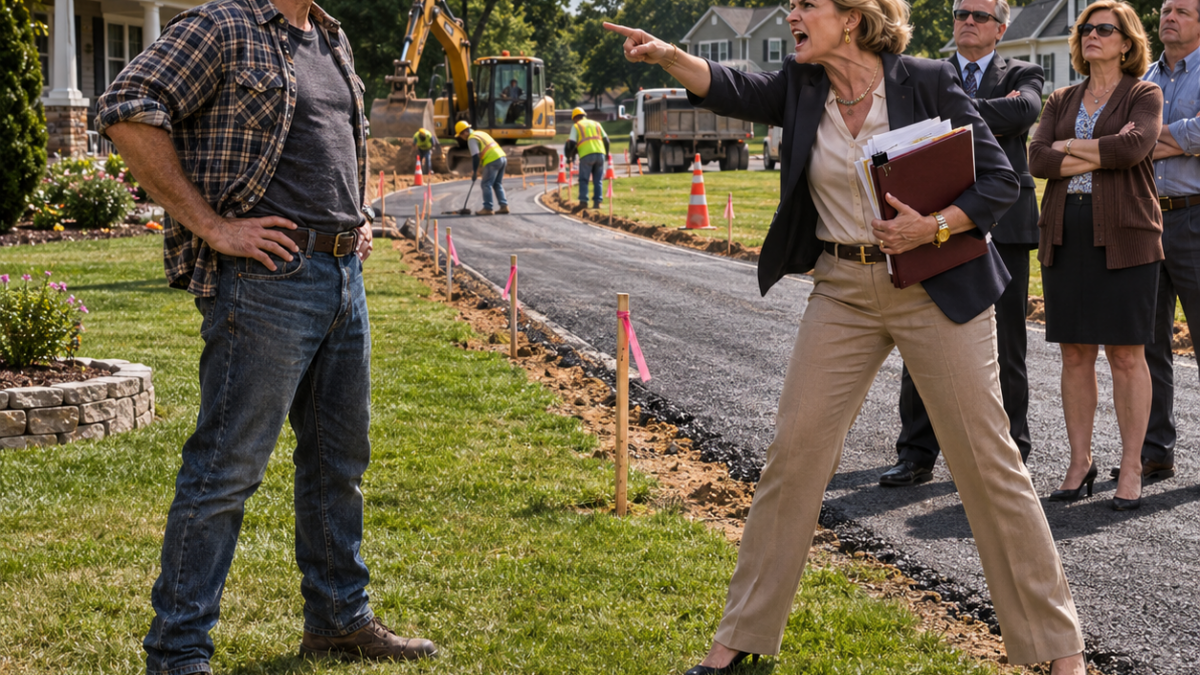
The sound that woke me wasn’t thunder—it was a chainsaw cutting into a tree that had been standing on my land for more than two centuries.
By the time I ran outside barefoot, bulldozers were carving a road through property my family had protected for generations, and the people doing it acted as though I were the trespasser.
What I didn’t know that morning was how much one fallen oak was about to expose.
My name is Garrett Tremblay.
Eighteen months earlier, I had come to Pine Haven Estates, North Carolina, because I wanted the quietest life I could find.
I was fifty-four, semi-retired after thirty years as a civil engineer, newly divorced, financially bruised, emotionally exhausted, and completely finished with arguments that required lawyers.
My late Uncle Donovan had left me eight acres outside the oldest section of Pine Haven Estates. He had lived there since 1953, but the land itself went back much farther. The original patent dated to 1824, decades before anyone had dreamed of homeowners associations, golf-cart lanes, approved mailbox colors, or neighborhood committees debating whether someone’s hydrangeas were sufficiently tasteful.
When developers built Pine Haven Estates around the property in the 1980s, Donovan’s parcel had been grandfathered into an unusual legal position.
Technically, it was inside the community.
Practically, it existed like an island.
Uncle Donovan liked it that way.
He had been a Korean War veteran who believed a man should know three things: how to keep his word, how to sharpen his own tools, and where his property line ended.
Half the summers of my childhood were spent there.
He taught me to fish in the creek behind the barn. He showed me how to recognize oak from hickory by bark alone. He taught me woodworking in a shop that smelled of cedar shavings, machine oil, and the old coffee he constantly forgot to finish.
Most importantly, he taught me patience.
“Anything worth keeping,” he once told me while guiding my hands through my first dovetail joint, “takes longer to build than it does to destroy.”
I had forgotten that sentence until the morning the bulldozers came.
After my divorce, that house became the one place where I could breathe.
I moved in with Hank, my one-eyed beagle mix, and Dolly, a sixty-pound pit bull who was brave enough to challenge delivery trucks but terrified of butterflies.
My mornings became simple.
Coffee on the wraparound porch.
Birdsong.
The smell of pine warming in the sun.
Sometimes I worked in Donovan’s old shop, building chairs or repairing cabinets. On Tuesdays I volunteered at the local food bank. When the town library needed a wheelchair ramp and couldn’t afford the engineering work, I designed one for free.
I wasn’t trying to impress anyone.
I was trying to rebuild a life.
Then I met Shayna Kovac.
Shayna was the president of the Pine Haven Estates HOA, a successful real estate agent with a white Mercedes, a carefully maintained platinum-blonde bob, and a smile that never quite reached her eyes.
Our first fight was over my shutters.
They were colonial blue, historically accurate, and supported by preservation records dating back more than a century.
Shayna wanted beige.
The violation notice arrived six months after I moved in.
**NON-COMPLIANT EXTERIOR COLOR.**
Correct within thirty days or face a $250 weekly fine.
I appealed.
I brought historical photographs, documentation from the state preservation office, and records showing that the house predated the HOA restrictions.
The county sided with me.
After the hearing, Shayna stood beneath the fluorescent lights with both hands resting on her leather folder.
“I suppose,” she said pleasantly, “some people enjoy proving that rules don’t apply to them.”
“They apply to me,” I replied. “Just not ones you invent after the fact.”
Her smile stayed in place.
Her knuckles turned white.
That should have warned me.
Over the next year came the small punishments.
My work truck parked overnight.
A bird feeder she called non-regulation.
My dogs barking at a UPS driver.
Every notice arrived with official language and cheerful threats.
I paid several small fines simply because fighting each one would have cost more than the fine itself.
That was my mistake.
I thought keeping my head down would buy peace.
Instead, it taught Shayna that I could be pushed.
Then, six months before that Thursday morning, the HOA proposed something called the **Community Connectivity Project**.
On paper, it sounded harmless.
In reality, it was a private road designed to cut directly across the back quarter of my property so residents could reach the golf course entrance about ninety seconds faster.
I opposed it.
There were old-growth trees there.
A wildflower meadow.
A creek drainage corridor.
And, most importantly, it was my land.
I was told the matter would be discussed later.
Apparently “later” meant at a board meeting I was never notified about.
At 6:47 that Thursday morning, Hank began barking.
Not his squirrel bark.
Not his mailman bark.
His alarm bark.
I looked through the bedroom window.
Two bulldozers, a backhoe, several pickup trucks, and a survey crew were inside my property line.
For one frozen second, I couldn’t understand what I was seeing.
Then one bulldozer turned toward Donovan’s oak.
I dropped my coffee.
And ran.
PART 2
I didn’t stop to put on a shirt.
I shoved my feet into boots without socks and ran across the back field in plaid pajama pants while Hank barked from the porch behind me.
Diesel exhaust hung low over the morning grass.
One bulldozer had already ripped a black trench through the wildflower meadow. Crushed goldenrod and coneflowers disappeared beneath mud and track marks.
The second machine was positioned in front of the oldest oak on the property.
That tree had a trunk nearly six feet across.
Uncle Donovan claimed it had been standing before his own grandfather was born.
Later, I counted the rings.
Two hundred seventeen.
At that moment, though, it was just alive.
And directly in front of a bulldozer.
“HEY!”
The operator didn’t hear me.
“HEY!”
I ran in front of the machine.
The engine dropped to idle.
A man in a yellow vest climbed down from the cab.
He had a clipboard tucked under one arm and the irritated expression of someone whose morning had been inconvenienced by the owner of the property he was destroying.
“You Garrett?” he asked.
“Yes. What the hell are you doing?”
“Road project.”
“On my land?”
He looked at the clipboard.
“HOA authorization.”
“I didn’t authorize anything.”
He shrugged.
“Not what I’ve got here.”
He handed me a work order.
Pine Haven Estates letterhead.
Approved construction corridor.
Start date: Thursday.
At the bottom was Shayna Kovac’s signature.
I read the page twice.
“This isn’t legal.”
The foreman shifted his weight.
“Look, man, my name’s Trey. I don’t make HOA decisions. I run equipment. I’ve got a signed contract and a start order.”
“You’re standing on private property.”
“I was told the HOA has easement rights.”
“They don’t.”
“Then call them.”
“I am telling you to stop.”
His expression changed slightly.
Not hostility.
Concern.
He glanced toward the operators.
“You got a court order?”
“No.”
“Then I’ve got a contract.”
I stared at him.
“Are you seriously telling me you’re going to keep cutting through my property after the owner has told you to stop?”
He exhaled.
“You need to call whoever hired us.”
So I did.
Shayna didn’t answer.
Her voicemail did.
I called again.
Nothing.
I called the HOA management company.
A receptionist placed me on hold.
While soft instrumental music played through my phone, I watched a bulldozer reverse toward the oak.
“No,” I whispered.
The receptionist returned.
“Mr. Tremblay, special projects are handled directly by the board president.”
“I’ve called her.”
“Then you’ll need to wait for her response.”
“There is a bulldozer on my property right now.”
“I understand.”
“No, you don’t.”
The machine revved.
I dropped the phone from my ear.
“Trey!”
The blade moved.
“TREY!”
The first impact stripped bark.
The second dug deeper.
The crack that followed is a sound I still hear sometimes in my sleep.
It wasn’t like lumber breaking in a workshop.
It was deeper.
A violent internal splitting.
A sound too large for the air around it.
The oak leaned.
For perhaps three seconds, all two hundred seventeen years of it seemed to hang between standing and falling.
Then the canopy came down.
Branches struck the ground first.
The trunk followed.
The impact shook the dirt beneath my boots.
Birds exploded out of neighboring trees.
And then everything became strangely quiet.
I walked toward the fallen oak.
I remember Trey saying something behind me.
I don’t know what.
I remember putting my hand against the exposed wood where the trunk had split.
The center smelled green and wet.
Alive.
That detail hurt worse than anything.
They hadn’t removed a dead tree.
They had killed one.
Uncle Donovan and I had eaten lunch under that oak.
Marissa had climbed it when she was eight.
My former wife and I had once tied a hammock between it and a smaller maple before our marriage became something neither of us recognized.
A life can fail in layers.
A marriage.
A career.
A sense of home.
When I moved to Pine Haven, I thought I had finally found one thing no one could take apart.
I was wrong.
Trey came over slowly.
“I’m sorry about the tree.”
I looked at him.
“Stop the machines.”
He hesitated.
Then he raised a hand toward his crew.
The engines dropped.
“For now,” he said. “Until someone calls me.”
“Thank you.”
I took out my phone.
And started documenting everything.
Every track.
Every stump.
Every piece of equipment.
Every worker.
Every marker flag.
The work order.
The fallen oak.
The torn meadow.
Forty minutes later, I was driving to the county clerk’s office wearing the same pajama pants.
I didn’t care.
I spent three hours pulling every recorded document attached to the property.
Deed.
Historical surveys.
Subdivision maps.
Utility easements.
HOA covenants.
Amendments.
Nothing gave Pine Haven Estates the right to construct a road across my land.
Nothing.
I called the sheriff’s department.
Deputy Manuel Ortiz arrived that afternoon.
He lived three streets over and coached youth baseball. We’d spoken several times before, mostly about whether Hank was part beagle or part criminal mastermind.
That afternoon, he wasn’t smiling.
He walked the property line.
Looked at the stumps.
Read the work order.
Then shook his head.
“This is bad, Garrett.”
“Then arrest someone.”
“I can cite the contractor if they knowingly trespass after notice.”
“They destroyed my property.”
“I know.”
“They cut down that tree.”
“I know.”
“Then do something.”
He looked at me for a long moment.
“I need you to hear me. The HOA is going to say they had authority under the bylaws. Once they make that claim, most of this turns into a civil property dispute unless we can prove criminal intent.”
“They knew it wasn’t theirs.”
“Maybe. But knowing and proving are two different things.”
“So they get to bulldoze first and argue later?”
His jaw tightened.
“I didn’t say it was right.”
“What would you do?”
“Get a lawyer today. Ask for an emergency injunction before those machines come back.”
That was how my quiet life ended.
My attorney was Stuart Friedman, the same man who had helped untangle several financial issues after my divorce.
When I walked into his office carrying a cardboard box of property records and photographs, he stared at the first picture for several seconds.
“They actually did this?”
“I’m beginning to dislike that question.”
He looked through the documents.
Then he found HOA bylaw 17.3f.
He read it aloud.
“The board may authorize infrastructure improvements on any parcel where majority community benefit is demonstrated and approved by board vote.”
He leaned back.
“Well.”
“Well what?”
“It’s badly written.”
“That’s good?”
“It’s something.”
“Can they take my land?”
“No.”
“Can they build a road across it?”
“Not simply because seven people voted that ninety seconds to the golf course is a community benefit.”
“So we stop them.”
“We seek an injunction.”
“Today.”
“Yes.”
He hesitated.
“But Garrett, you need to understand something.”
I knew that tone.
It was the tone lawyers use right before telling you justice has a price tag.
“What?”
“They’ll fight.”
“Let them.”
“They have HOA insurance. Legal reserves. Association money. Your money too, technically.”
“That’s insane.”
“Welcome to association litigation.”
His initial retainer was eight thousand dollars.
I signed the check.
One week later, while volunteering at the food bank, a process server walked through the dining room.
I was holding a ladle.
Forty clients were eating lunch.
Twenty volunteers were working behind the counter.
“Garrett Tremblay?”
I knew before he reached me.
“Yes.”
“You’ve been served.”
He handed me an envelope.
The room didn’t literally fall silent.
It only felt like it did.
I opened the complaint in my truck.
Pine Haven Estates HOA was suing me for $47,000.
They claimed my “interference” had caused construction delays, equipment standby fees, contract penalties, legal expenses, and reputational harm to the association.
I laughed.
Actually laughed.
Then I read it again.
And stopped laughing.
My phone buzzed.
An email from Shayna.
**Garrett,**
**I wish you hadn’t forced the community into this position. The board has obligations that go beyond the preferences of one homeowner. I hope you’ll reconsider your obstruction before this becomes more expensive for everyone.**
**Warmly,
Shayna**
Warmly.
She had cut down my oak and was suing me for the privilege.
That evening, I sat alone at my kitchen table with the lawsuit in front of me.
Hank slept beneath my chair.
Dolly lay near the back door.
I poured a bourbon and stared through the window toward the dark shape of the fallen oak.
For the first time since my divorce, I felt the old panic returning.
The kind that starts somewhere behind your ribs.
Court.
Lawyers.
Money disappearing.
People deciding things about your life while you sit under fluorescent lights waiting for your name to be called.
I closed my eyes.
“I can’t do this again,” I whispered.
My phone rang.
Marissa.
My daughter was twenty-one and away at college.
“Hey, Dad.”
“Hey, kiddo.”
“You sound weird.”
“Long day.”
“Mom told me something happened with the HOA.”
Of course she knew.
Small towns and divorced parents had one thing in common.
Information traveled.
“They cut down Donovan’s oak.”
Silence.
“What?”
“And they’re building a road.”
“Across your property?”
“Trying to.”
Another silence.
Then quietly, “The tree I used to climb?”
“Yeah.”
“Oh, Dad.”
That nearly broke me.
I pressed my fingers against my eyes.
“I’m handling it.”
“You always say that.”
“Because I usually am.”
“And when you’re not?”
I looked at the lawsuit.
“I’ll let you know.”
She didn’t sound convinced.
Neither was I.
Three days later, Pine Haven Estates turned on me.
It started with looks.
Conversations stopped when I entered the hardware store.
A woman who had chatted with me every Saturday at the farmers market suddenly discovered something fascinating on her phone.
Then Shayna posted in the private neighborhood Facebook group.
She didn’t use my name.
She didn’t have to.
She wrote about one selfish resident endangering property values, blocking improvements and creating unnecessary legal expenses for hundreds of families.
“Community first,” she called it.
By midnight, strangers were describing me as unstable.
Someone claimed I had threatened the construction workers.
I hadn’t.
Someone else wrote that my divorce had apparently “done something” to me.
A retired teacher named Deborah, a woman whose moving boxes I had carried the previous spring, commented that she hoped I “got the help I needed.”
I stared at her words until they blurred.
Then Marissa called again.
This time she was crying.
“Someone tagged me.”
My stomach dropped.
“In what?”
“A post about you. One of my roommate’s parents lives there.”
“Marissa—”
“They’re saying you’re some kind of psycho who attacked workers because you hate the neighborhood.”
“I didn’t attack anybody.”
“I know that.”
Her voice cracked.
“But now I’m explaining you to people.”
That hurt more than the lawsuit.
“I’m sorry.”
“Dad, are you sure this is worth it?”
I looked out at the tree.
“No.”
“You’re not?”
“I don’t know what’s going to happen.”
She was quiet.
Then she said, “Okay.”
“Okay what?”
“Just don’t become someone you hate trying to beat someone you hate.”
I leaned back in my chair.
“That sounds like something your mother would say.”
“She did.”
I laughed despite myself.
“Goodnight, sweetheart.”
“Love you.”
“Love you too.”
The next afternoon, Lionel Casterbridge appeared at my door carrying a tuna casserole and a manila folder.
Lionel was sixty-eight, retired from the postal service, and looked perpetually ready to correct someone on the proper placement of a stamp.
He was also the only HOA board member who had voted against the road.
“I brought dinner,” he said.
“I already ate.”
“You’ll eat again.”
He pushed past me.
“And I brought something better.”
He dropped the folder onto my kitchen table.
Inside were three years of HOA meeting minutes.
Not summaries.
Not edited public versions.
The real records.
I looked up.
“Where did you get these?”
“I was secretary before Shayna decided my handwriting was an administrative risk.”
“That happened?”
“No. She wanted someone loyal.”
I flipped through pages.
Contracts.
Votes.
Disciplinary hearings.
Vendor approvals.
Lionel sat down.
“She thinks you’re just another homeowner she can exhaust.”
“What does that mean?”
“It means she doesn’t have to beat you.”
He pointed at the lawsuit.
“She just has to make fighting cost more than surrendering.”
“I’ve noticed.”
“That’s how she works.”
He turned to a section marked with yellow tabs.
Payments to Green Vista Landscaping.
Nearly forty thousand dollars over comparable market rates.
No competitive bidding.
The company owner was Todd Vance.
“Her brother-in-law,” Lionel said.
I looked up.
“You’re kidding.”
“I wish.”
Another tab.
Meeting notices that had supposedly been sent to dissenting members but never arrived.
Another.
Fine waivers for several homeowners who happened to belong to Shayna’s social circle.
Another.
Aggressive fines and liens against elderly or financially vulnerable owners.
“She did this before you,” Lionel said.
“To who?”
“The Johnsons.”
He paused.
“And Mrs. Patel.”
“What happened?”
His face changed.
“Mrs. Patel lost her house.”
Over nine thousand dollars in HOA fines.
I sat back.
“For what?”
“A fence. Parking. Flowers. Whatever they could find.”
“And nobody stopped it?”
“We tried.”
“You were on the board.”
“I was one vote.”
He looked down at his hands.
“And I wasn’t brave enough soon enough.”
The room became quiet.
“Why are you giving me this?”
He looked toward the window.
At Donovan’s fallen oak.
“Because bullies get sloppy when they think no one can touch them.”
Then he looked at me.
“And because you’re angry enough to keep looking.”
That night, I stopped thinking like a homeowner.
I started thinking like an engineer.
Engineers don’t fight structures by shouting at them.
We find the load paths.
The hidden stress.
The point where one bad connection can bring down everything above it.
The road was the visible problem.
Shayna was the structural problem.
So I followed the money.
North Carolina association rules gave homeowners access to certain financial records.
I submitted a formal demand.
The HOA’s attorney stalled.
I submitted another.
He claimed records were being compiled.
I filed a complaint and copied the management company.
Ten days later, hundreds of pages arrived.
Budgets.
Invoices.
Checks.
Vendor contracts.
Expense reports.
I stayed awake until nearly three in the morning.
The road project had been budgeted at $78,000.
But county records showed contractor billing closer to $52,000.
Twenty-six thousand dollars had appeared in one set of books and disappeared in another.
That wasn’t proof yet.
It was a crack.
I kept digging.
Greenpath Construction had a corporate registration connection to Shayna’s real estate office.
Landscaping work went to her brother-in-law.
Consulting payments went to companies with no visible operations.
I called Stuart the next morning.
“I want to countersue.”
“For how much?”
“One hundred fifty thousand.”
He was quiet.
“You’ve found something.”
“I’ve found enough to make her uncomfortable.”
“That’s different from enough to win.”
“Then we’ll find the rest.”
We amended my response.
Property destruction.
Unauthorized entry.
Loss of mature timber.
Restoration costs.
Legal fees.
Emotional damages.
We also attached a request for an independent accounting.
Shayna’s attorney, Gil Mercer, replied with a letter describing my claims as “frivolous, retaliatory, and potentially defamatory.”
I printed it.
Put it in a folder.
Then posted the public financial records in the neighborhood group.
No accusation.
No rant.
Just documents.
Above them, I wrote:
**Transparency matters. Read the numbers and decide for yourself.**
For almost an hour, nothing happened.
Then someone noticed the road discrepancy.
Another homeowner asked why Todd’s landscaping company was being paid without competitive bids.
Another asked why several invoices shared identical formatting despite supposedly coming from unrelated vendors.
Then came dozens more.
Shayna deleted the post.
Too late.
Screenshots had already spread.
By midnight, my phone was full of messages.
Some were supportive.
Some apologetic.
Some came from people who had ignored me at the grocery store.
I didn’t answer most of them.
The war had moved.
Four days later, Shayna called an emergency board meeting.
The certified notice accused me of “conduct detrimental to community harmony.”
The meeting was packed.
More than sixty residents squeezed into a clubhouse designed for half that number.
Stuart sat beside me.
Shayna sat behind a folding table in a cream blazer.
She had a wooden gavel.
Of course she did.
“We regret that circumstances have reached this point,” she began. “But no individual has the right to damage the reputation and financial stability of our community.”
A PowerPoint appeared behind her.
Slide one: my police report.
She called it harassment of an authorized contractor.
Slide two: my financial post.
She called it dissemination of misleading information.
Slide three: a photograph of my truck parked overnight.
I stared through the clubhouse window.
Three other vehicles were parked along the street at that exact moment.
Shayna continued.
“Bylaw twenty-two permits suspension or expulsion of members whose behavior is materially harmful to the common interest.”
Stuart rose.
“Mrs. Kovac, my client—”
“This is not a courtroom, Mr. Friedman.”
Stuart looked at me.
I touched his sleeve.
“It’s okay.”
Then I stood.
“I have one question.”
Shayna smiled.
“Of course you do.”
“Did anyone on this board verify Greenpath Construction’s liability insurance?”
Her smile weakened.
“What?”
“The contractor building the road.”
I removed several copies of a certificate from my folder.
“Their insurance expired eleven days before work began.”
People shifted in their seats.
I walked to the table.
“Which means if someone had been injured on that project, the contractor’s carrier could have denied coverage.”
The treasurer, Eugene, looked down at the document.
His face drained of color.
“Shayna,” he said, “did we verify this?”
She didn’t look at him.
“This meeting concerns Mr. Tremblay.”
“It concerns liability,” I said.
She slammed her palm on the table.
“You’re attempting to derail—”
“And there was no grading permit.”
Now the room went still.
I placed another document down.
“I spent thirty years designing roads. Anything above the county’s threshold for disturbance requires permitting. Your project disturbed roughly eight thousand square feet.”
A man in the back called, “What does that mean?”
“It means the association exposed itself to penalties.”
“How much?”
“I don’t know what the county will ultimately assess.”
I looked at Shayna.
“But I know it won’t be cheap.”
The room erupted.
“What the hell did we pay for?”
“Who approved this?”
“Where was the lawyer?”
“Why weren’t we told?”
Shayna struck her gavel.
“Order!”
Nobody cared.
For years, that gavel had meant something because everyone agreed it did.
Now it was just wood hitting wood.
Finally, she forced a vote on my suspension.
Three voted against me.
Three refused.
Shayna broke the tie.
“You are suspended from all HOA privileges pending resolution of litigation.”
I almost laughed.
They had already destroyed part of my property, sued me and publicly humiliated me.
Now I couldn’t use the community pool.
I could live with that.
When the meeting ended, a woman named Deirdre Walsh caught me in the parking lot.
She had three children and had once been denied permission for a backyard swing set because the yellow plastic was “visually disruptive.”
She glanced back toward the clubhouse.
“How do we remove her?”
“Recall election.”
“What do we need?”
“Thirty percent of homeowners to demand one.”
“How many?”
“One hundred two signatures.”
She folded her arms.
“When do we start?”
I took out my phone.
“I already drafted the petition.”
For the first time since the bulldozers came, I smiled.
“Tomorrow.”
The anonymous envelope arrived two days later.
No return address.
Inside were foreclosure records.
The first name was **Indira Patel**.
Lot 47.
Nine thousand two hundred dollars in assessments, fines and penalties.
Foreclosure authorized.
Attached to the first page was a note.
**Ask why she really left.**
I searched for her.
She had died in 2021 at seventy-three.
Her son, Rajiv, lived near Charlotte.
I found a number through a community advocacy organization and called.
“You’re Garrett Tremblay,” he said almost immediately.
I froze.
“You know who I am?”
“People have sent me the financial posts.”
I swallowed.
“Then you probably know why I’m calling.”
“Because of my mother.”
“Yes.”
A long pause.
Then Rajiv began talking.
The first fine had been for a fence.
Indira had built it after her husband died because she wanted privacy in the backyard where she prayed each morning.
Six inches too high.
Then came wildflowers classified as weeds.
A broken garage opener forced her to park in the driveway.
Another fine.
A bird feeder.
Another.
Late fees.
Legal charges.
Administrative penalties.
“They made it impossible for her to catch up,” Rajiv said.
“What happened when they foreclosed?”
“My mother begged them.”
His voice tightened.
“She offered monthly payments. Shayna refused.”
I closed my eyes.
“The house sold at auction?”
“For around one-forty.”
“And afterward?”
“Six months later, Shayna Kovac Realty listed it for more than two hundred thousand.”
I didn’t speak.
Rajiv did.
“My mother had a stroke three days after the eviction notice became final.”
I felt something inside me go cold.
“She spent the last years of her life in assisted care. Half the time she didn’t know who I was.”
“I’m sorry.”
“So am I.”
Silence.
Then he asked, “What are you planning to do?”
I looked at the recall petition on my table.
“Remove her.”
“Good.”
“And I’m going to run for the board.”
Another pause.
Then, for the first time, emotion broke through his voice.
“Make them say my mother’s name.”
“What?”
“When you do this, don’t let her become a line in a spreadsheet.”
“I won’t.”
“People like Shayna survive because the damage becomes paperwork. Nine thousand dollars. Lot forty-seven. Foreclosure completed. They erase the person.”
His breathing shook.
“My mother was a person.”
“I know.”
“No. You don’t.”
He wasn’t angry at me.
He was angry at years.
“At least not yet,” he said.
“You’re right.”
I looked toward the dark field outside.
“But I want everyone in Pine Haven to know her name.”
“I’ll help.”
That night I called Lionel.
“We’re not only recalling Shayna.”
“What are you proposing?”
“We take the board.”
Silence.
Then he laughed.
Not because it was funny.
Because it was terrifying.
“Garrett, I’m sixty-eight.”
“You’ve spent half your life organizing things.”
“That doesn’t make me presidential material.”
“You’re the only person who voted against the road.”
“That makes me capable of saying no.”
“Right now, that’s a qualification.”
He sighed.
“When do we start?”
“Tonight.”
My kitchen became campaign headquarters.
Lionel arrived with an ancient laptop, a printer that jammed every few pages, and coffee strong enough to dissolve paint.
Deirdre brought spreadsheets.
Three other parents brought lists.
We needed 102 valid signatures.
We aimed for 160.
Door by door, Pine Haven began talking.
Jerry, a retired plumber, signed before I finished introducing myself.
“She fined me three hundred bucks for grass clippings.”
“Grass clippings?”
“Wind blew them into the street.”
“Were they still there when you got the notice?”
“No.”
He signed harder.
“That’s why I’m signing.”
Mrs. Chen signed because she had been cited for the color of her roses.
A young couple signed because they had received repeated fines for children’s bicycles visible from the street.
An elderly widower signed without saying why.
When I asked if he wanted a copy of the petition, he shook his head.
“No.”
Then he looked at me.
“But win.”
The pattern became impossible to ignore.
Everyone had a story.
A mailbox.
A garden flag.
A parked car.
A fence.
A wreath left up two days too long.
Rules were supposed to create predictability.
Shayna had turned them into weapons.
Rajiv came down on the fifth day.
He carried a box.
Inside were his mother’s records.
Every violation.
Every payment.
Every pleading letter she had sent.
One note was handwritten.
**I am seventy-one years old and living on a fixed income. I am not refusing to pay. Please allow me more time.**
At the bottom, someone had stamped:
**REQUEST DENIED.**
Rajiv sat on my porch holding the letter.
“She wrote this at my kitchen table.”
His thumb moved over the paper.
“I told her I’d get a lawyer.”
“What happened?”
“She told me she didn’t want to be a burden.”
He laughed once, bitterly.
“That generation. They’d rather lose everything than make their children feel responsible.”
Dolly walked over and leaned against his knee.
He looked down.
“She yours?”
“Technically. She thinks everyone belongs to her.”
He scratched behind her ears.
“She would’ve liked my mother.”
“Your mother liked dogs?”
“No.”
For the first time, he smiled.
“She hated them.”
I laughed.
“So Dolly would’ve made it her life’s mission.”
“Probably.”
Then his smile disappeared.
“Garrett?”
“Yeah?”
“Promise me something.”
“What?”
“If you win, don’t become them.”
The words stopped me.
Marissa had said almost the same thing.
“I won’t.”
“You say that now.”
“I know.”
“Power makes good people explain things to themselves.”
He looked toward Pine Haven’s manicured roofs in the distance.
“That’s how this probably started.”
I nodded slowly.
“Then we don’t build a better king.”
“What do you build?”
“Rules that don’t need one.”
By the end of the first week, we had 112 signatures.
By the end of the second, 140.
I created a one-page summary.
No insults.
No dramatic language.
Just facts.
**Your HOA fees: where did they go?**
Road budget discrepancy.
Related-party contracts.
Expired insurance.
Unpermitted work.
Foreclosures.
Four properties lost in five years.
Each later listed by Shayna’s real estate office.
That last line changed everything.
People who had tolerated petty fines began asking a different question.
Was enforcement being used to generate profit?
We couldn’t prove that yet.
But people were finally looking.
Shayna held what she called a “Community Truth Forum.”
Twelve people attended.
According to Lionel, eleven criticized her.
The twelfth was her sister.
Fourteen days after we began, we submitted 163 signatures.
Forty-eight percent of the community.
The recall was certified.
Election scheduled in thirty days.
That night I sat under the porch light drinking a beer while fireflies moved across the field.
For the first time in months, the air felt light enough to breathe.
Then Hank raised his head.
A car had stopped at the end of my driveway.
Gil Mercer stepped out.
Shayna’s lawyer.
He walked toward the porch carrying a leather folder.
“Mr. Tremblay.”
“Gil.”
“My client would like to settle.”
I didn’t invite him to sit.
“I’m listening.”
“You withdraw the countersuit and recall petition. Mrs. Kovac will authorize replacement of the damaged trees, professional landscaping and a ten-thousand-dollar payment.”
“Replacement trees?”
“Ten mature saplings.”
I stared at him.
“You don’t replace a two-hundred-year-old oak with ten saplings.”
“We understand sentimental value.”
“No, you understand liability.”
He exhaled.
“Twenty-five thousand.”
I didn’t answer immediately.
Twenty-five thousand dollars was real money.
It would cover legal fees.
Repair part of the land.
Maybe let me stop waking up at three in the morning doing arithmetic about retirement.
I thought about Marissa.
I thought about how tired I was.
Gil saw hesitation.
“Garrett, there is nothing shameful about ending a dispute.”
Then I thought about Indira’s handwritten letter.
**Please allow me more time.**
“What happens to the recall?”
“You withdraw.”
“Shayna stays?”
“Yes.”
“And the financial investigation?”
“My client makes no admission of wrongdoing.”
I smiled.
Not because I was happy.
Because suddenly the decision was easy.
“No.”
“Think carefully.”
“I did.”
“She can increase the amount.”
“Tell her she doesn’t have enough money.”
“For what?”
I looked toward the field.
“For every person she’d need me to forget.”
I closed the door.
The next morning, someone keyed my truck from front to back.
My mailbox had been spray-painted with one word.
**LIAR.**
I stood in the driveway staring at the red letters until rage began crawling up my throat.
I wanted to smash something.
Instead, I called Ortiz.
He arrived within an hour.
“You have cameras?”
“No.”
“Neighbors?”
Mrs. Chen lived two houses down.
Her security camera covered part of the street.
At two in the morning, a white pickup circled twice.
Then stopped.
A large man stepped out.
Cap low.
He keyed my truck.
Spray-painted the mailbox.
The license plate was visible.
Ortiz stared at the screen.
“You recognize the truck?”
I did.
Green Vista Landscaping.
Todd Vance.
Shayna’s brother-in-law.
Ortiz looked at me.
“Don’t call him.”
“I wasn’t planning to.”
“Don’t call Shayna.”
“I wasn’t.”
“Don’t post this.”
I looked at him.
“Garrett.”
“Fine.”
Todd was arrested that afternoon.
At six that evening, I received a text from an unknown number.
**Check your email.**
A message had arrived from an anonymous account.
Screenshots.
A conversation between Shayna and Todd.
**He’s not backing down.**
**What do you want me to do?**
**Scare him. Make him regret this. Just make it stop.**
**I’ll handle it.**
**Don’t tell me details.**
I read the messages again.
Then once more.
I forwarded them to Ortiz.
To Stuart.
And only after Stuart told me the screenshots could be preserved and authenticated did they begin circulating.
Shayna called them fake.
Then “misinterpreted.”
Then “private family communications taken out of context.”
Her defenses changed three times in twenty-four hours.
Public opinion didn’t.
By the end of the week, homeowners who had refused to sign the recall were asking for campaign signs.
Lionel called me Saturday morning.
“We’re going to win.”
“You sound disappointed.”
“I’m worried.”
“About what?”
“Winning is easy compared with governing afterward.”
I laughed.
“Spoken like a man ready to be president.”
“Don’t start.”
“We’ll need a forensic audit.”
“Yes.”
“Rewrite the bylaws.”
“Yes.”
“Review every selective fine.”
“Yes.”
“And destroy that stupid gavel.”
“No.”
I paused.
“Why not?”
“I want to auction it and put the money into the reserve fund.”
I started laughing.
“That might be the first campaign promise I’ve actually loved.”
Three weeks remained.
Then Shayna went nuclear.
Anonymous letters appeared in mailboxes.
**WHAT YOU DON’T KNOW ABOUT GARRETT TREMBLAY.**
They described my divorce.
My retirement.
My financial situation.
They implied I had been fired for incompetence.
They questioned my mental stability.
One copy reached Marissa at college.
She called me crying.
“Dad, how did they get my address?”
“I don’t know.”
“This isn’t politics. This is insane.”
“I know.”
“They’re telling people you were fired.”
“I wasn’t.”
“They’re saying you lost money and you’re trying to take control of the HOA to get it back.”
“Not true.”
“I know that.”
She sniffed.
“But I’m scared.”
That stopped me.
“Of what?”
“That these people are never going to stop.”
I sat down.
For once, I didn’t say I was handling it.
I didn’t tell her everything was fine.
I told her the truth.
“I’m scared too.”
She went quiet.
“You are?”
“Yeah.”
I looked around my kitchen.
At papers.
Folders.
Legal bills.
The campaign map.
“I’ve been scared since the morning that tree fell.”
“Then why are you still doing it?”
I thought for a moment.
“Because sometimes being scared doesn’t mean you’re wrong.”
She breathed out.
“I wish Grandpa Donovan were there.”
“So do I.”
“What would he say?”
I smiled.
“He’d probably ask why I let strangers operate heavy equipment on his land.”
She laughed through her tears.
Then she said, “Finish it, Dad.”
“I will.”
That same night, Lionel arrived at my door after nine.
“Eugene’s ready to talk.”
The HOA treasurer.
Shayna’s most reliable vote.
The man who had signed off on years of financial reports.
“Why now?”
“Because Shayna blamed him for everything.”
We went to Eugene’s house.
His wife Margaret answered using a walker.
“He’s in the kitchen.”
Eugene sat at a small table gripping a cold mug of coffee.
He looked ten years older than he had at the board meeting.
“I can’t do this anymore,” he said.
We sat.
He stared at his hands.
“She made me change the books.”
Nobody spoke.
“At first it wasn’t obvious,” he continued. “She’d say invoices were coming later. She’d ask me to approve emergency expenses. She’d tell me competitive bids weren’t necessary because a vendor had already done work for us.”
His voice began shaking.
“Then she started telling me which numbers to use.”
“Why did you do it?” I asked.
Margaret stepped closer.
Eugene looked at her.
“We have medical debt.”
Margaret’s eyes lowered.
“Shayna knew.”
He rubbed both hands over his face.
“She knew we couldn’t afford to move. She knew what Margaret’s treatments cost.”
I felt anger, but not the clean kind I’d felt toward Shayna.
This was messier.
“You still signed.”
“I know.”
“People lost money.”
“I know.”
“People lost homes.”
His face collapsed.
“I know.”
Margaret put her hand on his shoulder.
“He hasn’t slept properly in months.”
Eugene reached into his pocket.
A USB drive.
“These are the real records.”
I didn’t touch it immediately.
“What am I going to find?”
“One hundred thirty thousand dollars, maybe more.”
Lionel inhaled sharply.
“Fake invoices. Kickbacks. Companies that don’t exist. Payments to Todd.”
Eugene looked directly at me.
“I kept copies because I was afraid she’d blame me eventually.”
“And now she has.”
“Yes.”
“You understand this doesn’t erase your part.”
“I don’t want it erased.”
His voice broke.
“I want it stopped.”
I picked up the drive.
“I’ll give this to my attorney and the authorities.”
“I’ll testify.”
Margaret squeezed his shoulder.
“We both know what may happen.”
For the first time, I saw Eugene not as one of Shayna’s followers but as a frightened man who had made cowardly choices until living with them became more frightening than confessing.
I didn’t forgive him that night.
But I understood something.
Shayna’s power hadn’t come from strength alone.
It came from knowing what everyone feared losing.
Eugene feared his home.
Margaret’s healthcare.
The Patels had feared legal fees.
I had feared another court battle.
Every empire like hers had the same foundation.
Fear.
The USB drive cracked it open.
Stuart examined the records the next morning.
He called me after forty minutes.
“Garrett.”
“Yeah?”
“You need to listen carefully.”
“Okay.”
“This is no longer primarily an HOA dispute.”
I looked out the window.
“What is it?”
“Potential fraud. Embezzlement. Self-dealing. Maybe elder exploitation depending on what happened with the foreclosures.”
My stomach tightened.
“How much?”
“At least a hundred thirty thousand based on what I’m seeing. Maybe more.”
“So what do we do?”
“We preserve everything and send it to the appropriate investigators.”
“Today?”
“Immediately.”
By afternoon, the records were in official hands.
Within days, local media began asking questions.
Two board members resigned.
Shayna’s real estate license came under investigation.
And Pine Haven Estates, a community best known for manicured lawns and arguments about mailbox posts, suddenly had television trucks parked near the entrance.
Eighteen days before the election, Lionel and I sat on my porch with a bottle of bourbon.
“You know what bothers me?” I said.
“Only one thing?”
I ignored him.
“All I wanted was to be left alone.”
“That’s usually how these stories start.”
“I didn’t want to run anything.”
“You still don’t.”
“No.”
“Good.”
I looked at him.
“Good?”
“The dangerous people are usually the ones who enjoy power too much.”
We drank.
“What if we lose?”
Lionel shrugged.
“Then we made her spend a month terrified.”
I laughed.
“What if we win?”
“Then we work.”
Election day arrived crisp and cold.
By nine-thirty, forty people were waiting outside the clubhouse.
Voting didn’t start until ten.
Ortiz stood near the door.
“You working?”
“Volunteering.”
“As a deputy?”
“As someone who has no interest in writing reports about sixty-year-olds fighting over absentee ballots.”
I smiled.
“Fair.”
News cameras were across the street.
I hated them.
Every time one pointed toward me, I wanted to disappear behind Hank.
At 10:03, Shayna arrived.
White Mercedes.
Navy dress.
Pearls.
Her sister walked beside her.
Shayna crossed the parking lot without acknowledging anyone.
For one second, watching her walk through a crowd that had once feared her, I saw how much had changed.
People didn’t move aside.
They didn’t smile nervously.
They didn’t lower their voices.
They simply watched.
She had lost the thing that had protected her longer than money or bylaws.
The assumption that she couldn’t lose.
I voted at 10:15.
Yes on recall.
Garrett Tremblay.
Lionel Casterbridge.
Deirdre Walsh.
Two other reform candidates.
I filled each bubble carefully.
My hand didn’t shake.
Then I spent most of the day outside.
Jerry came.
Mrs. Chen came.
Parents arrived with children.
Older couples walked in holding hands.
Some people who had once ignored me at the grocery store stopped to apologize.
I accepted the apologies.
Mostly.
At two, Rajiv arrived.
“You came.”
“Wouldn’t miss it.”
He looked toward the clubhouse.
“My mother should’ve had this.”
“I know.”
“No.”
He smiled faintly.
“I think now you actually do.”
We shook hands.
Then he pulled me into a hug.
At four, the polls closed.
Counting took more than two hours.
By six-thirty, the clubhouse was overflowing.
I stood near Lionel.
Deirdre stood with her husband.
Rajiv was behind us.
Shayna stood near the wall.
Patricia, the representative from the neutral counting firm, walked to the front with a clipboard.
“Total eligible voters, including approved absentee ballots: four hundred twenty.”
Whispers.
“Total ballots cast: three hundred eighty-one.”
Someone whistled.
Ninety-one percent turnout.
Patricia waited.
“On the question of recall of the current board…”
My heart was hammering so hard I could hear it.
“Two hundred eighty-nine votes in favor.”
The room exploded.
People shouted.
Clapped.
Someone yelled, “YES!”
Patricia raised her hand.
“Ninety-two opposed.”
Lionel grabbed my shoulder.
“We did it.”
I looked at Shayna.
Her face had gone still.
Not angry.
Not yet.
Just empty.
For half a second, I felt something dangerously close to pity.
Then I remembered Donovan’s tree hitting the ground.
Indira’s letter.
Eugene shaking at his kitchen table.
Marissa crying because strangers had mailed lies to her dorm.
The feeling disappeared.
Patricia continued.
“For the incoming board, the elected candidates are…”
My name came first.
Two hundred forty-two votes.
Lionel.
Two hundred thirty-eight.
Deirdre.
Two hundred twenty-one.
People surrounded us.
Hands slapped my back.
Someone hugged me.
Deirdre was crying.
Lionel kept saying, “What have you done?” as though I had personally trapped him into public service.
Then the room changed.
Ortiz had stepped through the door.
His expression was serious.
He walked directly toward Shayna.
Conversation faded.
“Mrs. Kovac?”
She turned.
“What?”
“I need you to come with me.”
Her sister moved closer.
“What is this?”
Ortiz took out a document.
“The district attorney’s office has issued a warrant for your arrest.”
Nobody moved.
Shayna’s face lost all color.
“For what?”
“Fraud, embezzlement and charges connected to financial exploitation currently under investigation.”
Her mouth opened.
“This is ridiculous.”
“Turn around, please.”
“You can’t arrest me here.”
“I can arrest you wherever the warrant finds you.”
She looked toward Gil.
He wasn’t there.
For years, Shayna had summoned lawyers, contractors, managers, board members and violation notices with phone calls.
Now there was nobody to summon.
“Manuel,” she said.
She used Ortiz’s first name.
“You know me.”
His expression didn’t change.
“Yes, ma’am.”
“You know I wouldn’t—”
“Turn around.”
The steel cuffs clicked closed.
The sound was tiny.
But in that silent clubhouse, I heard it perfectly.
Shayna looked across the room.
At Lionel.
At Eugene, who had come quietly to watch.
At the people she had fined.
At people whose homes she had threatened.
Then she looked at me.
Our eyes met.
I expected hatred.
What I saw was disbelief.
As though some part of her still couldn’t understand how the rules had suddenly begun applying to her.
I didn’t smile.
I didn’t gloat.
I didn’t say a word.
That was the revenge I hadn’t known I wanted.
Not humiliation.
Not cruelty.
Accountability.
She walked past me.
Ortiz led her through the door.
For several seconds, nobody made a sound.
Then someone began clapping.
One person.
Then another.
Soon the entire room was standing.
I didn’t join at first.
I just stood there listening.
Lionel leaned close.
“You okay?”
I nodded.
But I wasn’t.
Not exactly.
Winning felt different from what I expected.
There was satisfaction.
Relief.
Anger.
Grief.
And underneath all of it, an enormous tiredness.
Someone shoved a microphone into my hand.
“No,” I said.
“Yes,” Lionel replied.
“I hate speeches.”
“You’re an elected official now.”
“I resign.”
“You can’t. We haven’t even sworn you in.”
People laughed.
I walked to the front.
The applause slowly faded.
I looked around the room.
Three months earlier, many of these people had believed I was unstable.
Some had avoided me.
Some had repeated Shayna’s lies.
Now they were waiting for me to speak.
I could have told them I had been right.
I could have told them they should have listened sooner.
Part of me wanted to.
Instead, I thought about Rajiv.
**Don’t let her become paperwork.**
“This started with a tree,” I said.
My voice cracked.
I cleared my throat.
“At least, that’s what I thought.”
The room quieted further.
“I thought I was fighting because someone came onto my land and destroyed something my family loved.”
I looked toward Rajiv.
“But then I learned about people who had lost much more.”
He lowered his eyes.
“People lost money. People lost dignity. One family lost a home.”
A few residents shifted.
“So I want everyone here to remember something tonight.”
I paused.
“Her name was Indira Patel.”
Rajiv looked up.
“She was not Lot 47. She was not a foreclosure file. She was not an outstanding balance.”
My throat tightened.
“She was someone’s mother.”
Rajiv covered his mouth.
“And if this board does nothing else, we will build rules strong enough that nobody in Pine Haven ever becomes just a number again.”
The room was silent.
Then Rajiv began clapping.
Others followed.
I lowered the microphone.
Outside, the sun was setting.
Orange light touched the tops of the trees.
Marissa called as I reached my truck.
“You won.”
“Apparently.”
“And they arrested her.”
“News travels fast.”
“Dad, there’s video everywhere.”
“Wonderful.”
“People are calling you a hero.”
I laughed.
“No.”
“You kind of are.”
“No, sweetheart. I’m a guy who got angry because someone cut down his tree.”
She was quiet.
Then she said, “Maybe that’s what heroes usually are.”
I leaned against the truck.
“You’ve been watching too many movies.”
“I’m proud of you.”
Those four words hit harder than everything else that day.
My eyes filled.
I looked away even though nobody was beside me.
“Thanks, kiddo.”
“No. Seriously.”
“I know.”
“You didn’t become someone you hated.”
I swallowed.
“Not yet.”
“Keep it that way.”
“I’ll try.”
The first meeting of the new board happened one week later.
No gavel.
No PowerPoint.
No cream blazer.
Seven people sat around folding tables with coffee, notebooks and the slightly terrified expressions of people who had just inherited a machine they didn’t know how to operate.
Lionel was elected president unanimously.
He glared at me while everyone applauded.
“This is your fault.”
“I nominated you.”
“Exactly.”
I became vice president.
Deirdre handled community outreach.
Our first vote authorized an independent forensic audit.
Our second suspended all non-essential violation fines while past enforcement was reviewed.
Our third established a temporary conflict-of-interest rule until permanent amendments could be drafted.
Then came my land.
Lionel looked at me.
“You want to leave the room?”
“Why?”
“You have a financial interest.”
I smiled.
Already better.
“Good point.”
I stepped outside while the board discussed restoration.
Ten minutes later, Deirdre opened the door.
“Approved pending membership vote.”
“How much?”
“Forty-two thousand estimated.”
“That’s a lot.”
“So was destroying it.”
The membership approved restoration 308 to 14.
Fourteen people voted against.
I respected their consistency.
The illegal road was removed.
Licensed crews pulled out the compacted base.
Topsoil was restored.
Drainage repaired.
Native meadow seed planted.
Every contractor had valid insurance.
I checked twice.
The audit took three weeks.
Eugene’s records were accurate.
More than $137,000 had been diverted through inflated contracts, fake invoices, kickbacks and related-party vendors.
Investigators froze Shayna’s major assets.
The association eventually recovered nearly $97,000 through restitution actions, liens and negotiated seizures.
We couldn’t undo everything.
So we started with what we could.
Jerry received his three hundred dollars back.
Mr. Cho received five hundred dollars for the most expensive garden gnome in North Carolina history.
Mrs. Chen received refunds for landscaping fines.
We reviewed four years of violations.
Dozens were reversed.
At one meeting, I read three hours of case files.
A homeowner fined because trash cans remained visible for forty-eight minutes past the permitted time.
A widow cited repeatedly for fading paint she had documented she was physically unable to repaint until her son visited.
A family fined for a child’s basketball hoop.
I looked at Lionel.
“How did everyone accept this?”
“They didn’t accept it all at once.”
“What do you mean?”
“You lose freedom by inches.”
He closed the file in front of him.
“One fine seems silly. Two feels irritating. Ten feels normal.”
That became the principle behind our bylaw rewrite.
No board member or immediate relative could hold a financial interest in an HOA vendor.
Expenditures above five thousand dollars required enhanced approval.
Financial records would be published monthly.
Board meetings would be recorded.
Violation notices required photographs, dates and a written explanation.
Homeowners received a real appeals process.
Emergency powers were narrowed.
Construction across privately owned land required actual recorded authority, not an imaginative interpretation of “community benefit.”
And no president could override the board simply because everyone else was tired of arguing.
Rajiv attended several meetings remotely.
One evening, after we passed the new foreclosure protections, he remained on the video call after everyone else logged out.
“Thank you,” he said.
“It’s not enough.”
“No.”
He smiled sadly.
“But my mother would’ve liked seeing someone make paperwork this complicated for the HOA.”
I laughed.
“She had a sense of humor?”
“When she was winning.”
In December, we held a dedication on the restored land.
Fifty native oak saplings had been planted across five acres, including part of the HOA common property.
Paths curved between them.
I built benches in Donovan’s workshop.
At the center stood a stone marker.
Rajiv had approved the wording.
**INDIRA PATEL MEMORIAL GROVE**
**In memory of those who came before us, and in hope for those who come after.**
**May we choose kindness over cruelty, accountability over power, and justice over silence.**
Rajiv stood before the stone for a long time.
Margaret and Eugene were there.
So were Deirdre and Lionel.
Marissa had driven home from college.
Snow threatened but never fell.
The saplings looked painfully small.
Thin trunks.
Bare branches.
Nothing like Donovan’s oak.
I stood beside Marissa.
“They look ridiculous.”
She leaned against my shoulder.
“They’re baby trees.”
“Exactly.”
“What did you expect? Instant forest?”
“Something more impressive.”
She rolled her eyes.
“In fifty years, they’ll be impressive.”
“I’ll be unavailable.”
“Other people won’t.”
That stopped me.
Across the grove, Rajiv touched the carved name of his mother.
And suddenly I understood.
The old oak had mattered because people before me had protected something they would never live long enough to see mature.
Now it was our turn.
The HOA established the Patel Family Scholarship the following spring.
Five thousand dollars annually for local students studying housing law, social work, elder advocacy or related fields.
The first recipient was a high school senior named Marcus.
His grandmother had lost a home in another county after a dispute with a different association.
At the scholarship dinner, Marcus stood at the podium wearing a jacket slightly too large for him.
“Nobody should lose a home because they can’t afford to fight back,” he said.
The room rose.
I looked at Rajiv.
He was crying.
So was I.
As for Shayna, the criminal case did not end with the dramatic arrest people kept replaying online.
Real justice moved much slower.
Hearings.
Depositions.
Evidence reviews.
Negotiations.
Her attorneys challenged several counts.
Investigators traced transactions.
Eugene testified.
Todd cooperated after his own lawyer explained exactly how much prison time loyalty to his sister-in-law might cost him.
Eventually, Shayna pleaded guilty rather than face trial.
She received eighteen months in minimum security, followed by probation and long-term restitution obligations.
Her real estate license was permanently revoked.
The association’s lawsuit against me disappeared.
My countersuit settled through insurance and restitution arrangements sufficient to cover my legal expenses, remaining property damages and restoration obligations.
I didn’t become rich.
I didn’t want to.
I wanted my life back.
Her marriage ended not long afterward.
The white Mercedes disappeared.
The real estate signs with her photograph came down.
People occasionally told me rumors about where she was living or what she was doing.
I stopped asking.
Revenge has a strange expiration date.
At first, every piece of bad news about Shayna felt satisfying.
Then one morning, I realized I hadn’t thought about her in several days.
That felt better.
Pine Haven Estates became boring.
Gloriously boring.
Meetings focused on playground proposals.
Streetlights.
Pool maintenance.
Tree trimming.
Whether the Fourth of July barbecue budget should include vegetarian options.
One Thursday night, Lionel spent forty-five minutes mediating an argument about pickleball hours.
Afterward, he looked at me and said, “I miss corruption.”
“No, you don’t.”
“At least embezzlement was interesting.”
“Go home, Lionel.”
“Yes, Mr. Vice President.”
“Stop calling me that.”
“No.”
Eugene never returned to the board.
That was his choice.
He helped complete the transition and then stepped away.
He accepted responsibility for his role in approving false records.
His cooperation mattered to investigators, but I never pretended cooperation erased the harm.
Neither did he.
One afternoon, months later, he came to my workshop.
I was sanding a bench.
He stood in the doorway.
“Can I ask you something?”
“Sure.”
“Do you forgive me?”
I turned off the sander.
Dust floated through the sunlight.
“I don’t know.”
He nodded as though he’d expected that.
“I understand.”
“But I don’t hate you.”
He looked at me.
“And I think what you did in the end mattered.”
His eyes filled.
“That’s more than I deserve.”
“Maybe.”
I set the sandpaper down.
“But that’s not my decision.”
“Whose is it?”
“Yours, mostly.”
He frowned.
“You’ve got to decide what the rest of your life looks like after the worst thing you did.”
He nodded slowly.
Then he looked at the bench.
“Need help?”
“You know how to sand?”
“No.”
“Perfect. Neither does Lionel.”
We worked for two hours.
That was enough.
My relationship with Marissa changed too.
During the worst months, I’d tried to protect her by pretending I was invulnerable.
Afterward, I realized how unfair that had been.
Children, even grown ones, don’t need parents who never struggle.
They need parents who tell the truth and keep going.
She came home for Thanksgiving with her girlfriend.
We cooked too much food.
Hank stole part of a dinner roll.
Dolly spent forty minutes staring suspiciously at a decorative turkey centerpiece.
Halfway through mashed potatoes, Marissa pointed her fork at me.
“You know you’re kind of a badass now, right?”
I nearly choked.
“Do not use that sentence at Thanksgiving.”
“Why?”
“Your uncle Donovan would haunt us.”
“You literally took down a corrupt HOA president.”
“I filled out forms.”
“You led a recall.”
“More forms.”
“You uncovered embezzlement.”
“Spreadsheets.”
“She got arrested at your election.”
“That part was not paperwork.”
Her girlfriend laughed.
Marissa smiled at me.
It was the smile that mattered.
Not the news stories.
Not the election numbers.
Not the applause.
My daughter no longer had to defend me to strangers.
That was enough.
I still dreamed about the oak occasionally.
In the dream, I always heard the crack but never saw it fall.
I’d wake before impact.
For a while, I thought that meant I hadn’t accepted what happened.
Maybe.
Or maybe part of me simply wanted one place where the tree remained standing.
In early spring, the saplings in the memorial grove began budding.
Tiny green leaves.
Almost ridiculous considering everything it had taken to get them there.
I walked out one morning with coffee.
Hank followed.
Dolly found a butterfly and froze.
Every muscle in her body tightened.
The butterfly landed on a branch.
Dolly stared at it.
The butterfly lifted away.
She didn’t bark.
“Look at you,” I said. “Personal growth.”
She wagged her tail.
I sat on one of the benches.
The sun came through the young branches.
Not shade yet.
Someday.
My phone buzzed.
Lionel.
**BOARD MEETING THURSDAY.**
I typed:
**AGENDA?**
His response came immediately.
**PLAYGROUND EQUIPMENT.**
I smiled.
Boring.
Normal.
Perfect.
For years, Shayna had convinced people that an HOA needed a strong hand.
What it actually needed was a weak enough hand that nobody could close a fist around everyone else’s life.
That was what we finally built.
Not a perfect community.
People still argued.
Some neighbors still thought my shutters were ugly.
Fourteen residents apparently remained personally offended that the association restored my land.
Jerry still sent emails written entirely in capital letters whenever the pool opened late.
Deirdre once threatened to resign because two parents spent a three-hour meeting arguing over whether the playground slide should be green or blue.
That was community.
Messy.
Irritating.
Human.
Nobody lost a house over a bird feeder.
Nobody got buried in fines because a board president disliked them.
Nobody could secretly funnel association money to relatives.
Nobody could put a road across another person’s property because a bylaw contained a vague sentence.
And if somebody ever tried again, the records would be public before they finished writing the check.
Sometimes visitors to Pine Haven stop at the grove.
Most don’t know the full story.
They read Indira’s name.
They sit on the benches.
Children run along the paths.
The trees get a little taller each year.
One afternoon, I found Rajiv standing near the marker.
He hadn’t told me he was coming.
“Hey,” I said.
He turned.
“Hey.”
We stood together.
The largest saplings were nearly six feet high now.
“My mother would’ve complained about the benches,” he said.
“Why?”
“She’d say we spent too much money.”
“I built them free.”
“She’d still find something.”
We laughed.
Then he touched one of the young trees.
“You know what I used to think?”
“What?”
“That winning would mean seeing Shayna suffer.”
I waited.
“For years, that’s what I wanted.”
“And now?”
He looked around the grove.
“Now I think this is winning.”
A child ran past us chasing another child between the trees.
Their mother called for them to slow down.
Rajiv smiled.
“She took my mother’s house.”
His hand rested on the oak trunk.
“But she doesn’t get to decide what my mother’s name means.”
I felt my throat tighten.
“No.”
He looked at me.
“And she doesn’t get your tree either.”
I frowned.
“That tree is gone.”
“The old one.”
He nodded.
“But look around.”
Fifty young oaks moved in the wind.
I had spent months thinking justice meant making Shayna pay.
For a while, it did.
She needed consequences.
People needed restitution.
The board needed to be dismantled and rebuilt.
But consequences alone were never going to repair what she had damaged.
Restoration did something punishment couldn’t.
It gave the story a future.
Uncle Donovan once told me anything worth keeping takes longer to build than it does to destroy.
He was right.
A bulldozer can destroy a two-hundred-year-old tree in minutes.
A corrupt president can poison a neighborhood one fine at a time.
A frightened board can surrender its judgment in a handful of votes.
A family can lose a home with one signature at the bottom of a page.
Destruction is fast.
Building is slower.
It took neighbors knocking on doors.
A retired postal worker refusing to stay quiet.
Mothers carrying petitions.
A grieving son reopening the worst chapter of his life.
A frightened treasurer finally telling the truth.
A deputy doing his job even when the accused was someone he knew.
A daughter reminding her father not to become what he was fighting.
And one angry man in pajama pants refusing to pretend a bulldozer had the right to be there.
I used to think revenge was watching Shayna leave the clubhouse in handcuffs.
I’d be lying if I said that moment didn’t satisfy something in me.
It did.
After everything she’d done, seeing her discover that she wasn’t untouchable felt like the universe correcting its balance.
But the deeper revenge came later.
It was Jerry getting his ridiculous fine refunded.
It was Eugene sleeping again.
It was Margaret attending meetings without fear that losing favor with the president might cost her home.
It was Deirdre’s children finally getting their swing set.
It was Rajiv seeing his mother’s name carved into stone instead of buried in a foreclosure file.
It was my daughter sitting at my Thanksgiving table proud instead of ashamed.
It was the board arguing about playground equipment rather than plotting how to punish a homeowner.
And it was fifty oak trees growing where one had been murdered.
That was the part Shayna could never take back.
She had tried to use power to make everyone smaller.
Instead, she forced us to find one another.
She tried to turn my land into a shortcut.
Instead, it became a memorial.
She tried to bankrupt me with a lawsuit.
Instead, her financial records destroyed her own defense.
She tried to remove me from the community.
Instead, the community elected me to help rebuild it.
She tried to frighten me into silence.
Instead, hundreds of people found their voices.
And in the end, I didn’t take control of Pine Haven Estates from her.
We did.
That distinction matters.
Because the point was never to replace Shayna Kovac with Garrett Tremblay.
The point was to build a place where nobody could ever become Shayna Kovac again.
I’m sitting on Donovan’s porch as I tell this.
Hank is asleep beside my boots.
Dolly is watching another butterfly with great suspicion.
The evening sun is dropping behind the memorial grove.
From here, I can see the tops of the young oaks moving in the breeze.
They are still small.
But every year, they’re a little harder to bend.
Maybe communities are like that.
Maybe people are too.
You go through something that should have broken you.
At first, all you can see is what was destroyed.
Then someone shows up with a casserole and a folder.
Someone else signs a petition.
Someone tells the truth.
Someone finally says a name everyone else tried to turn into paperwork.
And slowly, almost too slowly to notice, something begins growing in the ruins.
I can’t bring Donovan’s oak back.
I can’t give Indira Patel the years that were stolen from her.
I can’t erase the nights Marissa cried because strangers were spreading lies about her father.
Justice isn’t a time machine.
It doesn’t undo damage.
What it can do is make sure the damage means something.
It can stop the next person from being hurt the same way.
It can force a bully to discover limits.
It can turn private anger into public courage.
And sometimes, if you’re very lucky, it can leave behind something beautiful enough that the people who come after you won’t see the scars first.
They’ll see the trees.
Fifty years from now, I hope children will sit beneath these oaks and complain about their parents.
A hundred years from now, I hope someone ties a hammock between two of them.
Maybe a kid will climb too high and scare the life out of his mother.
Maybe somebody will carve initials into one and make some future HOA vice president furious.
They probably won’t know my name.
They may not know Shayna’s.
They may not know what happened here at all.
But they might read the stone in the middle of the grove.
**Indira Patel.**
And perhaps they’ll wonder who she was.
That is enough for me.
Because people like Shayna depend on everyone believing resistance is too expensive, too embarrassing, too exhausting and too lonely.
For a while, she was right.
Then we stopped being alone.
The road is gone now.
The lawsuit is gone.
The old board is gone.
The white Mercedes is gone.
But the grove remains.
And every spring, when those young trees put out new leaves, I think about the morning I stood barefoot in a ruined meadow watching an oak fall.
I thought I was watching the end of something.
I wasn’t.
I was watching the beginning.
And Uncle Donovan, wherever he is, would probably tell me I should have known better.
Good work takes time.
So does justice.
But both are worth building.








