PART 2: HOA Bulldozed 30 Acres of My Family Farm for a $15 Million Mall—Then I Opened My Late Father’s Filing Cabinet
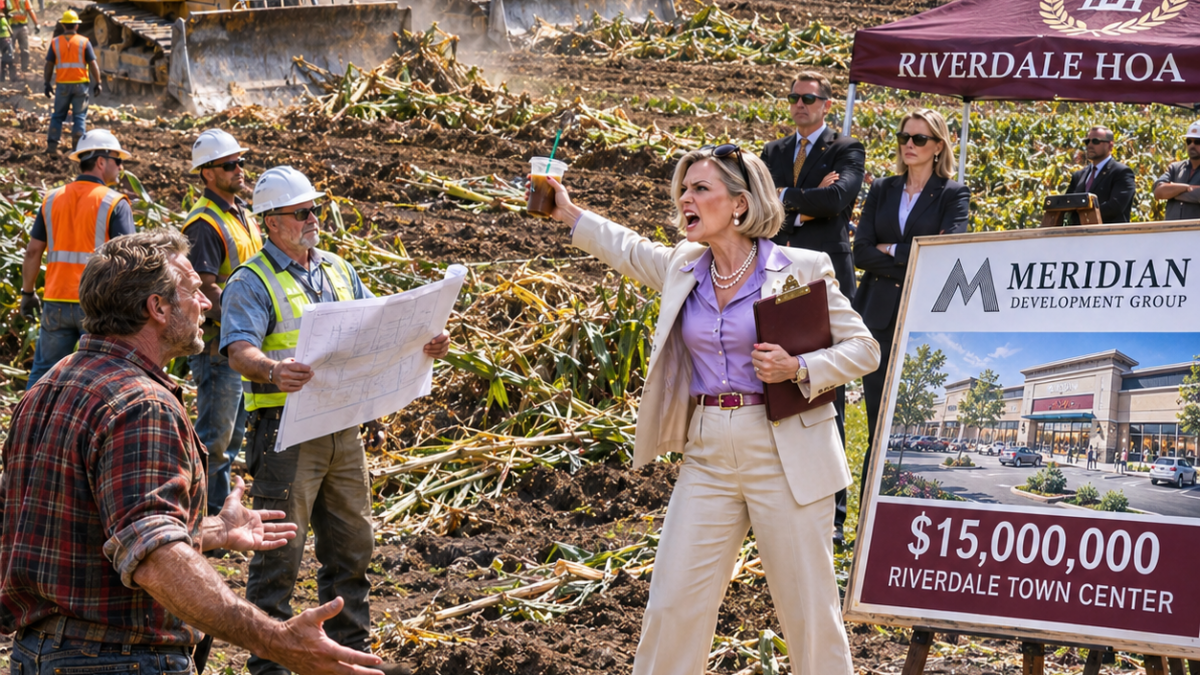
PART 2
The words at the top of the document were:
**AGRICULTURAL CONSERVATION EASEMENT — DEED OF EASEMENT.**
Below that was my father’s name.
Earl Callaway.
Then the United States Department of Agriculture.
I read the first page.
Then the second.
Then I went back and started over because my mind refused to accept what my eyes were telling me.
In October 2008, my father had voluntarily placed all eighty-five acres of the Callaway farm under a permanent agricultural conservation easement administered through a federal conservation program.
The restrictions were not complicated.
The property was to remain agricultural.
No commercial development.
No industrial development.
No residential subdivision.
The restrictions ran with the land.
Permanently.
I stopped reading.
The workshop was silent except for the old refrigerator compressor cycling on near the tool cabinet.
For three years after Dad died, that room had felt like a museum I wasn’t ready to visit.
His wrenches were still arranged by size.
A coffee can full of bolts sat on the shelf.
His work gloves hung from a nail beside the door.
There was even a pencil behind the vise that he’d sharpened down to almost nothing.
I looked at the signature on the easement.
Earl Callaway.
His handwriting.
The same handwriting on the filing cabinet.
“Dad.”
My voice sounded strange in the empty room.
He had never told me.
Not once.
He had made me promise not to let them pave the land without mentioning that, fifteen years earlier, he had already made paving it legally close to impossible.
I kept reading.
The easement gave the government and designated conservation authorities enforcement rights.
Violations could trigger restoration obligations.
Development inconsistent with the easement could be enjoined.
Depending on the circumstances, responsible parties could face substantial damages, costs, and penalties.
Then I found the recording information.
Instrument number.
Book.
Page.
Williamson County Register of Deeds.
This wasn’t an unsigned agreement forgotten in a desk.
It had been recorded.
Publicly.
Years before Stonebridge existed.
I opened my laptop.
The county database took less than five minutes.
There it was.
Recorded exactly where Dad’s document said it would be.
I leaned back.
Then I pulled up the survey Meridian Development had used.
Their survey showed my eastern boundary shifted roughly two hundred feet west.
The federal easement was absent.
Completely.
I searched the permit application.
Nothing.
No disclosure.
No reference.
No easement.
But the original county records contained both.
That changed the question.
This was no longer:
Could Brenda legally build a mall on my land?
The answer to that was obviously no.
The real question was:
How did a developer obtain county permits using a survey that erased thirty acres of property and omitted a recorded federal conservation restriction?
I called Tucker into the workshop.
He came wearing pajama pants and one sock.
“What’s wrong?”
“Nothing.”
He looked at the papers.
“That doesn’t look like nothing.”
“Come here.”
He sat beside me.
I showed him Dad’s signature.
He recognized it immediately.
“Grandpa?”
“Yeah.”
I explained the easement in language a twelve-year-old could tolerate.
Grandpa had signed a permanent agreement.
The land had to stay farmland.
It couldn’t become a mall.
Tucker looked toward the window, although the destroyed field was too far away to see from the workshop.
“So Grandpa saved it?”
I swallowed.
“Looks like he tried very hard.”
“Then why did they bulldoze it?”
That was the question.
“I don’t know yet.”
Tucker read another page.
His lips moved silently.
Then he said:
“Are they in trouble?”
I looked at the document again.
“I think they’re about to be.”
The next morning I drove to Franklin and met Clay Thornton.
Clay specialized in land-use disputes, agricultural conservation agreements, title conflicts, and development litigation.
His office sat above an old barber shop.
The whole place smelled faintly like shaving cream.
Clay was fifty-three, thin, serious, and had a habit of reading documents in absolute silence before asking questions.
He read Dad’s easement twice.
Then the original plat.
Then Meridian’s survey.
Then the county permits.
Finally, he looked at me.
“How much land did they clear?”
“Thirty acres.”
“Crops?”
“Standing corn.”
“Any permanent construction yet?”
“Site grading. Access road. Some drainage work.”
“How much have they spent?”
“I heard about four million.”
“Who told you?”
“One of the subcontractors.”
Clay leaned back.
“First thing, forget the fantasy of this ending tomorrow.”
“I wasn’t expecting tomorrow.”
“Good. Second, do not confront anybody without documenting it. Third, do not interfere physically with workers.”
“They’re on my land.”
“And we are going to make that a very expensive problem through the proper channels.”
I nodded.
He tapped the easement.
“This is serious.”
“How serious?”
“The conservation interest is real. Recorded. Prior to the development. If their construction violates it, the government can pursue enforcement and restoration.”
“And my land?”
“We’ll seek an injunction, damages for trespass and destruction, crop losses, restoration costs, and any enhanced remedies supported by the conservation program and evidence of willful conduct.”
“So Brenda doesn’t get her mall.”
Clay looked at me.
“Not there.”
For the first time since I saw the bulldozers, I breathed normally.
Then Clay said:
“But Garrett, I need you to understand something.”
“What?”
“The easement is powerful. It is not magic.”
He pointed to the survey.
“This is where I’m more interested.”
“The boundary?”
“Yes.”
“If this was an honest mistake, that’s one problem.”
“And if it wasn’t?”
He looked at me.
“Then somebody manufactured permission to build on land they knew they didn’t own.”
Clay designed the first legal move around speed.
Not damages.
Stopping further destruction.
He notified Meridian Development, the Stonebridge HOA, their insurers, the county, and the federal conservation office that the disputed acreage was subject to a recorded agricultural easement and contested title.
He demanded preservation of every document connected to the project.
Survey drafts.
Emails.
Permit applications.
Contracts.
Board minutes.
Maps.
Environmental reports.
Communications between Brenda, her husband Dale, Meridian, county officials, and surveyors.
The letter ended with a warning:
Any construction undertaken after receipt of notice would be performed with knowledge of the dispute and could increase exposure.
Dale Whitfield received it on Thursday.
Construction did not stop.
That decision eventually cost them more than anything Brenda had said to me.
At the time, though, I didn’t know why they kept going.
I only knew the bulldozers returned Friday morning.
I stood behind the fence line watching them.
A foreman approached.
“Mr. Callaway?”
“Yes.”
“I’m just doing what I’m contracted to do.”
“I know.”
“My company got notice from your attorney.”
“Then you should talk to your company.”
He looked uncomfortable.
“Meridian says permits are valid.”
“Does Meridian know about the federal easement?”
He glanced toward the machines.
“That is above my pay grade.”
“Probably a good place to keep it.”
He nodded.
Then walked away.
I did not threaten him.
I didn’t block equipment.
I started documenting.
Trail cameras.
Four of them.
Then two backups.
A drone survey every forty-eight hours.
Same altitude.
Same flight path.
Timestamped photographs.
Clay had an evidence consultant verify the storage and chain of custody because if the case reached court, I wanted nobody arguing that I’d manipulated images.
Every flight showed the same terrible progression.
Red dirt.
Concrete.
Steel.
Parking areas.
Drainage.
The beginning of foundations.
And every time the drone returned, Tucker stood beside me.
“How much now?”
He meant money.
Meridian’s investment.
“More than last time.”
“Why don’t they stop?”
“I don’t know.”
“Wouldn’t stopping be cheaper?”
“Yes.”
Tucker shook his head.
“Adults are weird.”
He had no idea.
The USDA’s Natural Resources Conservation Service responded quickly after Clay submitted the easement.
A regional specialist named Colleen Burke called me.
“Mr. Callaway, we have confirmed the easement in our records.”
I gripped the phone.
“So it’s valid.”
“Yes.”
“And permanent?”
“Yes.”
“Can they build a mall?”
“Not consistent with this easement.”
I closed my eyes.
“Thank you.”
“We still need an on-site inspection.”
“When?”
“Next week.”
She paused.
“Mr. Callaway?”
“Yes?”
“Do not sign anything from the developer without your counsel.”
“I won’t.”
“Do not accept payment for release or modification without notifying us.”
“Can the easement be released?”
“In circumstances like what you’re describing, that is not something anyone should assume.”
That was federal language for:
Don’t let Brenda sell you another story.
Meanwhile, Brenda went on television.
The Williamson County Herald had run a story weeks earlier about alleged water contamination.
After my laboratory results disproved it, the newspaper published a correction.
Brenda apparently blamed me for that too.
She appeared at a Stonebridge meeting and announced that my lawsuit was an “attack on responsible growth.”
I watched the video from my kitchen.
She said:
“One individual should not be allowed to hold hundreds of families hostage to outdated agricultural practices.”
Tucker looked at me.
“Is she talking about us?”
“Yes.”
“Are we holding people hostage?”
“No.”
“Okay.”
He went back to cereal.
I admired twelve-year-old priorities.
Brenda’s attorney filed a nuisance action.
My tractor noise.
Fertilizer odor.
Dust.
Alleged visual impacts.
Clay read it and laughed.
Not loudly.
Just one exhausted sound.
“They’re suing you for farming on farmland.”
“Apparently.”
“We’ll answer.”
The suit was useful because discovery works both ways.
They wanted records from me.
They got them.
Farm operations.
Permits.
Agricultural-use documentation.
Water testing.
USDA certifications.
They discovered exactly what I had already told them:
I was running a lawful agricultural operation.
We asked for their records.
That’s when their story began falling apart.
First came the ownership structure.
Dale Whitfield was not merely married to Brenda.
He was a silent investor in Meridian Development Group.
His stake had been structured through a holding company.
Stonebridge Crossing’s HOA had repeatedly hired Meridian-affiliated vendors.
Two HOA board members worked for Meridian.
Brenda had publicly represented the mall expansion as a neutral neighborhood improvement while her household stood to benefit financially.
Then discovery produced emails.
One from Dale:
**Need Callaway acreage to make Phase III numbers work. Access fails without eastern strip.**
Brenda replied:
**He’ll sell. They all sell once pressure starts.**
Clay read it aloud in his office.
I said nothing.
Another email.
**Health angle getting traction. County complaint can delay irrigation.**
Another:
**Hank sold after six months. Garrett will too.**
Hank Jessup had warned me.
Don’t be me.
I called him.
He answered from his tractor.
“What’s up?”
“They mentioned you in emails.”
Silence.
“What’d they say?”
I read it.
Hank shut off his engine.
The silence over the phone changed.
“They planned it.”
“Looks like it.”
“All those complaints.”
“Looks like it.”
He breathed slowly.
“I thought I was weak.”
“You were exhausted.”
“I sold my father’s land.”
“Because they engineered a campaign to make you believe you had no choice.”
He didn’t answer.
Then:
“What do you need from me?”
“Truth.”
“You got it.”
Hank became our first former-farmer witness.
Then Glenn Tate came forward.
Then Dwight Sumner.
Same pattern.
Threatening letters.
Environmental complaints.
HOA pressure despite their properties being outside Stonebridge.
Lowball offers.
Each man had thought his experience was unique.
It wasn’t.
Then came the signatures.
Remember the forty-seven Stonebridge residents supposedly demanding my irrigation shutdown?
Clay subpoenaed records around that petition.
Donna Mitchell, the kindergarten teacher, gave us a handwriting sample and affidavit.
More residents did the same.
At least sixteen denied signing.
Some signatures appeared copied from other community documents.
Clay referred the matter to investigators.
The county reopened the permit history.
That made Brenda angry enough to call another emergency HOA meeting.
I attended.
She wore red.
The room was packed.
Her proposal was simple:
Expand Stonebridge’s HOA boundary to include the Callaway farm.
I almost admired the nerve.
She needed a supermajority under the governing documents.
She gave a twenty-minute speech about “harmonizing land use” and “protecting shared community interests.”
She never once said:
My husband’s development company needs Garrett’s land.
A resident asked:
“Can we legally annex property if the owner doesn’t consent?”
Brenda answered:
“Our counsel believes the association has mechanisms.”
That wasn’t an answer.
I stayed silent.
The vote came.
Fifty-eight percent in favor.
She needed sixty-seven.
Motion failed.
For three seconds, Brenda didn’t move.
Then she collected her papers.
Outside, I leaned against my truck.
She came toward me.
Five feet away, she stopped.
“You think this is funny?”
“No.”
“You think you’ve won because a few scared residents voted wrong?”
“No.”
Her voice dropped.
“I will bury you in that field.”
I looked at her.
She continued.
“No bank in this county will lend to you. No major buyer will touch your crops. No neighbor will look at you without seeing the man who destroyed their property values.”
I didn’t answer.
That made her angrier.
“Say something.”
“Good night, Brenda.”
I got into the truck.
Tucker wasn’t with me.
That mattered.
I could absorb her threats.
My son did not need to.
When I arrived home, Clay called.
“Did she threaten you?”
“Yes.”
“Witnesses?”
“Parking lot cameras. Several residents.”
“What exactly?”
I repeated it.
He sighed.
“Document it.”
My new least favorite phrase.
The construction reached $8 million.
Then $8.7.
Steel rose over land where corn should have been drying for harvest.
I hated the sight.
People assumed I was delighted because every new dollar increased Meridian’s potential exposure.
I wasn’t.
Money could compensate.
It couldn’t reverse time.
It couldn’t put the Silver Queen back in the ground that season.
It couldn’t give Tucker back the Saturday mornings we’d lost.
Some evenings, I walked to the edge of the disturbed acreage and stared at the steel skeleton.
My father had spent forty years teaching that soil to produce.
Drainage.
Organic matter.
Crop rotation.
Care.
A bulldozer can destroy the visible part of that work in hours.
Restoring the living system underneath takes years.
One night Tucker came outside.
He stood beside me.
“Dad?”
“Yeah?”
“Are we going to be rich?”
I turned.
“Why would you ask that?”
“I heard Hank talking about the lawsuit.”
I looked at the half-built mall.
“Maybe they’ll owe us a lot.”
“Then that’s good.”
“Some of it.”
He waited.
I said:
“I’d rather have the corn.”
Tucker looked at the construction.
“Me too.”
That was when I knew how I wanted the case to end.
Not with a check.
With dirt.
The legal case took a darker turn at a Waffle House.
County surveyor Ronnie Scaggs had been reviewing the disputed boundary because his office maintained the original plats.
Dale Whitfield asked him to meet.
Ronnie later told the district attorney exactly what happened.
Dale ordered coffee.
Talked football.
Then slid an envelope across the table.
Twenty-five thousand dollars in cash.
His request:
Amend the official plat.
Shift the property boundary to match Meridian’s disputed survey.
In other words, make the lie true after the fact.
Ronnie looked at the money.
Then at Dale.
He stood.
Didn’t touch the envelope.
Walked outside.
Called the district attorney.
When Clay told me, I stared at him.
“Twenty-five thousand?”
“Allegedly.”
“For a county survey?”
“For a felony-shaped problem.”
“Why would Dale think Ronnie would take it?”
“Because people who have gotten away with smaller corruption eventually assume everyone has a price.”
That sounded familiar.
Brenda had told me everyone had a price the first week we met.
The district attorney opened an investigation.
Dale hired criminal counsel.
Construction still didn’t stop.
I asked Clay:
“Why?”
“Debt.”
“What?”
“Meridian borrowed against the project. Stopping could trigger defaults.”
“So they’re building because they can’t afford not to build.”
“Essentially.”
“Even though the land can’t legally support the mall?”
“They’re gambling on winning.”
I looked at the latest drone image.
“That’s an expensive gamble.”
“It’s getting more expensive.”
Then someone smashed my cameras.
Two in the morning.
Three trail cameras destroyed.
One ripped from its mount.
Another thrown into the drainage ditch.
A third beaten with a crowbar.
Whoever did it missed the backups.
The bluebird-box camera captured his face.
Richard Mercer.
Stonebridge HOA board member.
Also a salaried Meridian employee.
The second camera captured his truck and license plate.
Deputy Wade Prescott watched the footage with me.
He paused on Richard’s face.
“These people really don’t learn.”
“I’ve been wondering the same thing.”
“This camera damage happened after litigation started?”
“Yes.”
“And after preservation notices?”
“Yes.”
Wade exhaled.
“Send this to your lawyer.”
“I already did.”
“Of course you did.”
Richard was questioned.
His attorney advised silence.
Then, apparently after seeing the footage, his desire for silence became a desire for cooperation.
He told investigators that Brenda had asked him to “clean up surveillance problems.”
Did she explicitly tell him to smash cameras?
That became disputed.
But Richard handed over text messages.
One from Brenda:
**Those cameras need to disappear before federal people get here.**
Clay read it twice.
“That’s not ideal for her.”
The federal people arrived the following week.
Three NRCS officials.
Colleen Burke led the team.
They measured disturbance.
Reviewed the easement markers.
Compared original plats to current grading.
Photographed exposed subsoil.
Interviewed construction crews.
One foreman looked like he wanted to resign in real time.
After two days, Colleen stood beside me near the field.
“The easement has been violated.”
No hesitation.
“What happens?”
“Our formal findings go through counsel and enforcement channels. Restoration will be required unless a court determines something we haven’t seen.”
“What about the mall?”
She looked at the steel structure.
“It cannot remain in its current location consistent with this easement.”
Tucker had come home from school and stood a few feet away.
He heard her.
His face changed.
“So they have to take it down?”
Colleen smiled slightly.
“Your dad’s lawyer will explain the details.”
Tucker looked at me.
“Lawyers never answer anything.”
Colleen laughed.
“That’s not entirely wrong.”
Then Clay updated damages.
Destroyed crops.
Irrigation damage.
Soil disturbance.
Professional restoration.
Lost production.
Trespass.
Attorney fees where recoverable.
Potential enhanced damages for willful conduct after notice.
The construction costs themselves became central to settlement discussions because Meridian faced the prospect of dismantling millions of dollars of improvements it had knowingly continued after receiving notice.
The number being discussed crossed ten million.
Then twelve.
Then more.
People started saying fifteen.
I stopped repeating figures around Tucker.
Money was becoming too abstract.
Brenda received a federal subpoena at a nail salon.
I did not witness that.
But her aesthetician eventually became a witness in related proceedings and told the story to practically everyone in Williamson County.
The process server placed the papers beside a bottle of nail polish.
Brenda reportedly said:
“Do you know who I am?”
The process server apparently answered:
“Ma’am, the federal court does.”
That line traveled through town before sunset.
I found it funny.
For about thirty seconds.
Then I made spaghetti for Tucker.
He had a science project due.
Baking soda volcano.
He had somehow created a version that erupted sideways.
We spent an hour cleaning vinegar foam off the kitchen wall.
For one evening, there was no HOA.
No Meridian.
No Brenda.
No lawsuit.
Just my son laughing because his volcano attacked the refrigerator.
That night mattered more than I realized.
Legal fights can consume you if you let them.
Every letter feels urgent.
Every filing feels personal.
Every new piece of evidence becomes the most important thing in the world.
But Tucker was twelve once.
Only once.
I didn’t want Brenda taking that too.
Two weeks later, Clay called.
“Special county session Tuesday.”
“About the permits?”
“Everything.”
“Should Tucker come?”
Clay paused.
“If you think he’s ready to see it.”
I asked Tucker.
He said yes immediately.
The Williamson County Board of Commissioners meeting room held about eighty people.
More than a hundred showed up.
Farmers.
Stonebridge residents.
Reporters.
County staff.
Developers.
People who had never cared about agricultural easements until one suddenly threatened to collapse a shopping mall.
Brenda arrived twelve minutes late.
Red blazer.
Cream blouse.
Designer bag.
Perfect hair.
Dale sat farther back.
He looked terrible.
Clay stood at the podium.
For forty-five minutes, he built the case without raising his voice.
Original 1961 plat.
Then Meridian’s survey.
He placed them side by side on the screen.
A red line showed my actual boundary.
Another showed the boundary Meridian had used.
Two hundred feet of difference.
The room murmured.
Clay moved on.
The 2008 federal conservation easement.
My father’s signature.
Recorded county information.
The operative agricultural-use restrictions.
Then permit applications.
No easement disclosure.
Then drone footage.
The first image showed standing corn.
The second showed scraped earth.
The third showed foundations.
The fourth steel.
The fifth a spreading parking area.
Twelve weeks compressed into ninety seconds.
Nobody spoke.
Clay played the trail-camera footage.
Richard smashing equipment.
Then the backup footage showing his face.
Richard had already resigned from the Stonebridge board.
His chair in the audience was empty.
Then Clay displayed Brenda’s emails.
One dated before the bulldozers arrived.
**Just build it. The farmer won’t fight. They never do.**
I heard somebody behind us whisper:
“Oh my God.”
Tucker’s hand tightened around mine.
I looked at him.
“You okay?”
He nodded.
Clay continued.
Hank’s sale.
Glenn’s.
Dwight’s.
Pressure campaigns.
Lowball offers.
The forged petition signatures.
The environmental claims disproved by independent laboratory tests.
Then Colleen Burke stepped forward.
She didn’t sound angry.
That made her more effective.
“The conservation easement covering the Callaway property is valid, recorded, and enforceable.”
She described the prohibited uses.
The documented disturbance.
The government’s position requiring cessation and restoration.
Then the county attorney stood.
His voice shook slightly.
“Effective immediately, permits associated with the disputed Phase III development are suspended and subject to revocation pending enforcement orders and title review.”
Dale stood.
His attorney grabbed his arm.
He sat again.
Then Clay discussed damages.
Not a final judgment.
Not money already won.
A claim.
A very large one.
Current demand:
$15.2 million.
The room went still.
Brenda looked at Clay.
Then at me.
Then at Tucker.
For the first time since I had known her, she looked unsure.
Clay explained the number.
Crop and infrastructure losses.
Restoration.
Trespass.
Economic losses.
Legal exposure arising from knowingly continuing construction after notice.
Settlement allocation for dismantling unauthorized improvements.
Enhanced damages sought based on willful conduct.
Meridian’s insurers and lenders were now involved.
Then a commissioner asked:
“Mr. Thornton, is your client saying Meridian owes him everything they spent building the mall?”
Clay answered carefully.
“No, Commissioner. We are saying Meridian spent millions creating improvements that cannot lawfully remain on protected land, continued after notice, destroyed our client’s property, and now faces the cost of undoing that work in addition to compensable damages. The settlement exposure reflects that reality.”
I appreciated him for saying it that way.
The story everyone wanted was simple:
They built a mall.
Therefore every dollar became mine.
Law rarely works that neatly.
But the practical result was close enough to terrify Meridian’s lenders.
Their project had turned into an eight-figure liability.
Then Brenda tried to speak.
Her attorney whispered:
“Don’t.”
She ignored him.
“This is ridiculous.”
The chairman looked at her.
“Mrs. Whitfield—”
“That land was necessary for community development.”
I stared.
Necessary.
Not theirs.
Necessary.
“The county approved it.”
The county attorney answered:
“Based on filings now under investigation.”
She looked toward me.
“This farmer has manipulated everyone.”
Tucker shifted beside me.
I put one hand on his shoulder.
Brenda pointed at the screen.
“He is trying to destroy Stonebridge.”
That was when Donna Mitchell, the kindergarten teacher whose signature had been forged, stood from the audience.
“No.”
Brenda turned.
Donna held up a copy of the petition.
“You used my name.”
Another resident stood.
“Mine too.”
Another.
Then another.
Brenda’s face changed.
Stonebridge homeowners began speaking from different parts of the room.
“My husband never signed.”
“We didn’t authorize that complaint.”
“You told us the water was contaminated.”
“You told us the county had confirmed it.”
The meeting chairman called for order.
Nobody listened.
For years, Brenda had spoken for Stonebridge.
That night Stonebridge spoke for itself.
One board member made a motion for an emergency vote to remove her as HOA president pending financial and legal review.
Another seconded.
The vote was unanimous among eligible board members.
Brenda sat perfectly still.
Then she picked up her bag.
Her left hand shook.
She walked toward the door.
Outside, reporters waited.
Tucker and I stayed inside.
I wasn’t going to chase her for a victory shot.
The field was still destroyed.
Dad was still dead.
Nothing in that room changed either fact.
When we finally went outside, Brenda was already near her Escalade.
Her heel caught a crack.
The heel snapped.
She stumbled.
A photographer caught the moment.
The image ran the next morning beneath a headline about the Stonebridge scandal.
Everybody thought I would frame it.
I didn’t.
I framed Dad’s easement.
Settlement negotiations began immediately.
Meridian’s lenders froze further project funding.
The insurer reserved rights.
Investors demanded explanations.
The county revoked the permits.
Federal conservation officials issued restoration requirements.
Dale’s alleged attempt to bribe Ronnie Scaggs became a criminal case.
Richard Mercer’s camera destruction became another.
The shopping center died before a single store opened.
Steel sat unused.
Concrete hardened beneath court orders.
Grass weeds began pushing through piles of disturbed soil.
Meridian made its first serious settlement offer.
Three million.
Clay read it.
“No.”
Second:
Six.
“No.”
Third:
Nine plus restoration.
Clay looked at me.
“This is where your personal goals matter.”
“I want the land restored.”
“That has to be non-negotiable.”
“Yes.”
“And long-term soil remediation.”
“Yes.”
“Irrigation.”
“Yes.”
“Future production losses.”
“Yes.”
He tapped the settlement worksheet.
“Money after that?”
I thought about Tucker.
Hank.
The other farmers.
Dad’s promise.
“Enough that doing this to the next farmer hurts more than walking away.”
Clay smiled slightly.
“That I can work with.”
Discovery continued while negotiations dragged.
We learned Brenda and Dale had discussed my property for almost two years.
One document was a feasibility report.
Without the Callaway acreage, the proposed mall lacked adequate road access and parking geometry.
My thirty acres weren’t merely useful.
They were essential.
That explained everything.
The nuisance claims.
The fake environmental petition.
The irrigation shutdown.
The pressure.
The HOA expansion vote.
Brenda wasn’t protecting Stonebridge from a farm.
She was trying to remove the farm from the way of a deal.
Then we discovered the lowball offer strategy.
Meridian had calculated what my land might be worth after rezoning if unrestricted.
Millions.
Their internal acquisition target for me:
$175,000 to $225,000.
The man who brought me the $200,000 cashier’s check hadn’t chosen the number randomly.
It came directly from their strategy document.
Clay showed it to me.
Beside the figure was a note:
**Owner likely emotionally attached. Increase nuisance pressure before second approach.**
I read it twice.
Emotionally attached.
My father’s grave was a mile away.
My son learned to drive a tractor on that land.
My grandfather’s name was carved into an old barn beam.
They had reduced all of that to a negotiation weakness.
I felt something I had avoided for months.
Rage.
Not strategic anger.
Not determination.
Raw rage.
“I want to take everything.”
Clay remained quiet.
“Every dollar.”
Still quiet.
“I want Brenda to know what it feels like.”
Clay folded his hands.
“That’s exactly when I need you not to make decisions.”
I looked at him.
“She targeted my father’s land because she thought loving it made me weak.”
“I know.”
“She almost killed the crop.”
“I know.”
“She bulldozed thirty acres.”
“I know.”
“She used my son—”
“No.”
Clay’s voice sharpened.
“She did not get your son.”
I stopped.
“She got land. Crops. Time. Money. She does not get Tucker unless you give her the rest of your attention.”
That hit me harder than I wanted.
Clay continued.
“Go home.”
“What?”
“Go be a father.”
“We’re negotiating fourteen million dollars.”
“Tomorrow.”
I almost argued.
Then I remembered the vinegar volcano.
I went home.
Tucker was in the barn trying to repair an old cultivator with a socket wrench entirely too large for the bolt.
“What are you doing?”
“Fixing it.”
“You’re rounding the head.”
“I know.”
“Then stop.”
He looked at me.
“You seem mad.”
“Long day.”
“Brenda?”
“Mostly me.”
He handed me the wrench.
“Can we work on this?”
We did.
For two hours.
No lawsuit.
No millions.
At one point Tucker asked:
“If we get all that money, are we still farming?”
I stopped turning the wrench.
“Yes.”
“Good.”
“Why?”
He shrugged.
“I don’t want to become mall people.”
I laughed so hard I had to sit down.
That was the end of my revenge fantasy.
I still wanted justice.
I no longer wanted Brenda’s life.
Four months after the county meeting, Meridian agreed to settle.
The final number:
$14.8 million.
That figure covered a negotiated package including property and crop damages, restoration and remediation obligations, litigation-related exposure, resolution of trespass and easement claims, and other disputed damages.
The restoration costs were separately structured so the soil work actually happened.
I sat in Clay’s office when the final documents arrived.
“Fourteen point eight.”
He nodded.
“I don’t know what to do with that number.”
“First, don’t spend it before taxes and fees are understood.”
“Of course a lawyer would say that.”
“Second, restoration starts immediately.”
That mattered more.
“Third, Garrett?”
“Yeah?”
“You don’t have to feel happy.”
I looked at him.
“Everyone keeps congratulating me.”
“You lost thirty acres of a season and spent a year watching strangers build over your father’s work.”
I stared at the settlement signature line.
“It doesn’t feel like winning.”
“Sometimes winning means getting enough power to repair what happened.”
I signed.
Dale’s criminal case resolved later.
He was indicted in connection with the attempted payment to Ronnie Scaggs and fraudulent conduct surrounding the land records and conservation restrictions.
His attorney negotiated a plea.
Eighteen months in federal custody.
Financial penalties.
A long-term prohibition on participating in certain development activities under the settlement and licensing consequences that effectively ended his career in Tennessee real estate development.
Richard Mercer accepted responsibility for trespass and destruction of evidence-related property.
His cooperation reduced his sentence.
The county survey used by Meridian became the subject of professional-disciplinary proceedings against the survey professional who had signed it.
Evidence showed Dale and Meridian had supplied altered boundary information.
The surveyor claimed he relied on client materials without adequate verification.
His license was suspended.
And Brenda?
Her situation was complicated.
The federal case focused most aggressively on Dale and the development company.
State investigators reviewed the forged petition signatures and Brenda’s role in submitting false information.
The Stonebridge homeowners filed their own civil action after discovering association money had been spent on legal campaigns that directly benefited the Whitfields’ development plans.
More than three hundred homeowners eventually joined.
The board froze Brenda out completely.
Her authority vanished overnight.
Her social power lasted slightly longer.
People stopped answering her calls.
Then the civil discovery began.
HOA financial statements.
Emails.
Vendor payments.
Legal invoices.
Community funds had paid attorneys to attack farms outside the HOA.
Residents were furious.
Brenda had spent their dues helping her husband’s company acquire land.
Her attorney argued that Stonebridge benefited from the proposed retail project.
Residents responded that they had never approved financing a private land-acquisition campaign.
The civil case ended in a substantial settlement funded through a combination of insurance, recovered HOA money, Whitfield assets, and related parties.
Brenda sold the Escalade.
Then the house.
Her husband was going to prison.
Stonebridge residents did not invite her to stay.
The last time I saw her in person was at a mediation session tied to the homeowners’ civil case.
I was there only briefly because some of my documents overlapped.
She looked different.
No red blazer.
No designer sunglasses.
Hair pulled back.
She spotted me across the hallway.
“Garrett.”
I stopped.
Her attorney touched her arm.
She pulled away.
“Can I talk to him?”
Clay looked at me.
My choice.
I nodded.
Brenda approached.
For several seconds, neither of us spoke.
Then she said:
“You got your money.”
There it was.
I almost smiled.
“You still think that’s what this was about?”
“Fourteen million dollars says otherwise.”
“Fourteen point eight.”
Her eyes hardened.
Petty.
I regretted it immediately.
She said:
“You ruined Dale.”
“No.”
“You ruined our business.”
“No.”
“You turned Stonebridge against me.”
“No.”
Her voice rose.
“Then what do you think happened?”
I looked at her.
“You kept assuming every consequence was something somebody did to you.”
She stared.
“Dale offered a county official cash.”
She looked away.
“You submitted signatures residents say they never gave you.”
No answer.
“You kept construction going after receiving notice of the conservation easement.”
“We’d already spent millions.”
“That was your reason to stop.”
“You don’t understand development.”
“And you didn’t understand farming.”
That quieted her.
I continued.
“You saw thirty acres of corn and thought it was empty space waiting for someone richer to use it.”
She looked at me.
“You would’ve been financially secure for life if you’d sold.”
“I was secure.”
“You call farming secure?”
“I had my land.”
She laughed bitterly.
“Land doesn’t love you back.”
That sentence hurt.
Because part of me knew what she meant.
Dad was gone.
The farm couldn’t return him.
Then I thought about Tucker.
“It doesn’t have to.”
I said it quietly.
“It gives us somewhere to love each other.”
Brenda looked away.
For once, she had no response.
Then she asked:
“What are you going to do with all that money?”
I could have told her:
Restore the farm.
Protect other farms.
Scholarships.
Legal aid.
I didn’t.
“Plant corn.”
Her face changed.
Not much.
Enough.
I walked away.
Restoration began in the rain.
That was appropriate.
The construction steel came down first.
Cranes dismantled what had risen where my crop once stood.
Concrete was broken and removed.
Compacted areas were ripped and loosened.
Contaminated fill was hauled away.
Topsoil went back.
Not just any dirt.
Soil selected and amended according to agricultural restoration plans developed with agronomists.
Drainage rebuilt.
Irrigation replaced.
Cover crops planted first because nobody sensible throws corn into traumatized soil and expects a miracle.
Tucker and I stood beside the field while a crew spread the first loads.
He wrinkled his nose.
“Smells good.”
Most people wouldn’t understand that.
Wet soil.
Compost.
Clay.
Organic matter.
To us, it smelled like a future.
Hank Jessup came.
Then Glenn.
Dwight.
Four farmers standing beside land one of us had almost lost forever.
Hank kicked at the soil.
“Earl would’ve enjoyed this.”
“The money?”
“The part where Brenda had to pay to remove her own mall.”
I smiled.
“Probably.”
Hank became quiet.
“I wish I’d fought.”
I looked at him.
“Then fight now.”
“For what? My farm’s gone.”
“For the next one.”
That became the beginning of the Callaway Agricultural Heritage Trust.
I put enough settlement money into it that it could survive without depending on me.
Purpose:
Legal assistance for family farmers facing coercive development pressure.
Emergency loans when harassment or litigation disrupted a season.
Survey and title assistance.
Environmental testing.
Conservation-easement education.
The boring tools that prevent desperate people from signing away land because the other side has a more expensive lawyer.
Clay agreed to serve as counsel.
Hank joined the advisory board.
So did Glenn and Dwight.
Our first case involved a sixty-seven-year-old cattle farmer facing repeated nuisance complaints after a luxury subdivision appeared beside his pasture.
We paid for testing.
Surveying.
Legal review.
The subdivision backed down.
The farmer kept his land.
He sent me a photograph of a calf standing beside his fence.
No note.
Didn’t need one.
I also created the Earl Callaway Memorial Scholarship.
One full agricultural-science scholarship every year for a Williamson County student.
Dad never went to college.
He could rebuild an engine, read soil, predict rain better than local television, and calculate seed rates in his head.
But he had always been proud of my degree.
I imagined him complaining that I had named something after him.
“You spending money on a sign now?”
Probably his first question.
Tucker helped choose the first recipient.
A girl named Jasmine Alvarez.
Her parents ran a small vegetable farm.
She wanted to study soil science.
When I told her the scholarship covered tuition, she stared at me.
“All of it?”
“All of it.”
“Why?”
I thought of Dad.
“Because somebody once planned ahead for me.”
Stonebridge changed too.
The new HOA board published financial records.
They rescinded every resolution targeting neighboring agricultural properties.
They created a conflict-of-interest policy that would have prevented Brenda from voting on anything involving Meridian.
Residents apologized.
Some personally.
Others through action.
Donna Mitchell organized a volunteer day at the restored farm.
Thirty-seven Stonebridge residents showed up.
Adults.
Children.
Even people whose names had appeared on the forged petition.
We planted native wildflowers along the boundary.
One boy asked:
“Are these supposed to keep the smell out?”
His mother looked horrified.
I laughed.
“No.”
“What are they for?”
“Bees.”
“That’s it?”
“That’s enough.”
He accepted that.
The wildflowers became a border.
Not a wall.
Stonebridge on one side.
Farm on the other.
Different uses.
Both allowed to exist.
The first season after full restoration, I did not plant all thirty acres in corn.
The soil needed time.
Cover crops first.
Clover.
Rye.
Radish.
Things designed to rebuild structure.
Tucker hated waiting.
“When do we get corn?”
“When the dirt is ready.”
“It looks ready.”
“The dirt knows more than you.”
“That’s something Grandpa would say.”
Exactly.
By spring, soil tests improved.
Organic matter climbed.
Compaction decreased.
Biological activity returned.
I still remember the first earthworm Tucker found.
He held it up like we’d discovered gold.
“Dad!”
“What?”
“Look!”
I stared at the worm.
“You know we’re millionaires now, right?”
“So?”
Fair point.
We planted corn.
Not thirty acres.
Twelve.
Then soybeans.
Then more cover crops.
Slow restoration.
Dad had taught me that the land punishes impatience.
Meridian had learned the same lesson in a much more expensive way.
The first corn emerged after six days.
Tiny green blades breaking through red Tennessee soil.
Tucker called me from the field before breakfast.
“You need to come out.”
“What happened?”
“Just come.”
For one second, the old fear hit me.
Bulldozers.
Machines.
Someone on our land.
Then I heard the excitement.
I pulled on boots.
We walked to the eastern rows.
Green.
Small.
Fragile.
Thousands of little shoots.
Tucker knelt.
He touched one.
“Think Grandpa can see this?”
I looked toward the ridge.
Morning mist sat low over the valley.
Dad had loved mornings like that.
He would stand with coffee and complain about his knees while pretending not to be happy.
“I think he planned it.”
Tucker smiled.
“He planned the easement.”
“Exactly.”
We walked the rows.
For the first time since the destruction, the field made a sound again.
Not much.
The new corn was too short to create the deep rushing whisper of mature stalks.
But leaves moved.
Lightly.
A beginning.
Two years later, the farm was fully productive.
The settlement money changed our finances.
Of course it did.
I paid off every farm debt.
Replaced aging equipment.
Built better grain storage.
Installed efficient irrigation.
Set aside money for Tucker’s education.
But I did not build a mansion.
I didn’t buy a sports car.
I still drove the truck Brenda had called ugly.
Tucker once asked:
“Can we at least get a new tractor?”
“Yes.”
His face lit up.
“We are not buying the biggest one.”
His face fell.
“What’s the point of being rich?”
“Excellent question.”
We bought the second-biggest one.
The land itself could not be sold for a mall.
Dad’s easement remained.
That was the best part.
Money disappears.
Legal settlements get spent.
Buildings age.
A permanent conservation agreement meant that long after I was gone, Tucker couldn’t wake up one morning and sell eighty-five acres to become another Stonebridge.
I asked him once whether that bothered him.
“What if you don’t want to farm?”
He shrugged.
“I can lease it to somebody.”
“What if farming changes?”
“Still dirt.”
“What if you’re offered fifty million?”
He thought.
“Can I build a dirt-bike track?”
“No.”
“Then I guess I’ll farm.”
Twelve-year-old estate planning.
Clay eventually showed me one last discovery from the Meridian files.
It was an early planning map.
Before Brenda ever visited me.
The Callaway farm was shaded yellow.
Across it:
**FUTURE COMMERCIAL ACQUISITION — HIGH PRIORITY.**
My property had been in their plan before I knew there was a fight.
That bothered me.
Then I noticed a handwritten note in the margin.
Probably Dale’s.
**Owner inherited. Emotional tie likely. Pressure required.**
Emotional tie.
Again.
They believed attachment to land made me vulnerable.
They were half right.
Love can make you vulnerable.
That’s the point.
Dad’s love for the farm made him sign the easement.
Mine made me fight.
Tucker’s made the restoration matter.
What Meridian misunderstood was that vulnerability and weakness are not the same thing.
Years after the case ended, I visited Hank’s old property.
Stonebridge had built houses there.
Nice houses.
Children riding bicycles.
A woman watering flowers.
Nothing evil about them.
That was important for me to admit.
Development itself wasn’t the villain.
People need homes.
Stores.
Roads.
Schools.
The problem was how Brenda and Dale obtained land.
Fear.
Pressure.
Lies.
Lowball offers.
Fake complaints.
They could have negotiated honestly.
They didn’t.
Hank stood beside me.
“They put a cul-de-sac where my tobacco barn was.”
“You regret selling?”
“Every day.”
Then he looked at me.
“But I don’t hate those families.”
“Good.”
“Most of them probably don’t know.”
“They don’t.”
He nodded.
“That’s why the trust matters.”
Exactly.
We couldn’t undo his sale.
We could stop the same playbook from working on somebody else.
The Stonebridge civil case against Brenda eventually resolved.
She lost much of what remained of her financial security.
Not everything.
The law did not exist to turn her into a homeless caricature for my satisfaction.
Residents recovered misused dues and legal expenses.
The board obtained reforms.
Brenda was barred from HOA leadership under the settlement.
Her reputation in Williamson County never recovered.
That was probably worse for her than money.
For years, her identity had been authority.
President.
Chairwoman.
Community leader.
People listened because she expected them to.
Afterward, she was simply Brenda Whitfield.
I sometimes wondered whether she learned anything.
Then I stopped wondering.
That was part of healing too.
Her lesson wasn’t my responsibility.
Dale served his sentence.
After release, he moved out of Tennessee.
Meridian Development collapsed.
Creditors took what remained.
The half-built Stonebridge Phase III property outside my farm—not on protected land—was sold to another developer.
They changed the plan.
Smaller commercial center.
Different access.
No Callaway acreage.
The project opened years later.
A grocery store.
Pharmacy.
Coffee shop.
Nothing dramatic.
Sometimes Tucker and I shop there.
The first time we did, he looked at me.
“This is weird.”
“Why?”
“It’s kind of the mall.”
“Different mall.”
“Still weird.”
We bought milk.
Life moves on.
One afternoon, I saw Brenda there.
Years had passed.
I was pushing a cart through produce.
She stood beside the apples.
For a moment, neither of us moved.
Then she said:
“Garrett.”
“Brenda.”
She looked older.
So did I.
“Your farm looks good.”
“Thank you.”
“I drive past sometimes.”
I didn’t know what to say.
She picked up an apple.
Put it down.
“I heard about the scholarship.”
“Who told you?”
“People talk.”
“They always did.”
A small, almost embarrassed smile.
Then she said:
“I was wrong about one thing.”
Only one?
I kept that thought to myself.
“What?”
“I thought keeping the farm meant you were afraid of change.”
I waited.
She looked toward the store windows.
“Maybe I was the one who was afraid.”
That was more self-awareness than I had expected.
I nodded.
She continued.
“When Dale’s business started failing, every problem looked like something I had to control.”
“That doesn’t excuse what you did.”
“I know.”
It was the first time she had ever said those two words to me.
I know.
I didn’t forgive her on the spot.
Real life doesn’t need that kind of scene.
But I didn’t feel rage either.
That surprised me.
She said:
“I’m sorry about your father’s field.”
I looked at her.
“If you’re sorry, remember Hank.”
She frowned.
“Hank?”
“And Glenn. Dwight. The other farmers.”
Her face tightened.
“Garrett—”
“It wasn’t just my field.”
She looked down.
Then nodded.
“You’re right.”
We walked away in opposite directions.
That was the last time I spoke to her.
I didn’t tell Tucker until later.
“What’d she say?”
“She apologized.”
“For everything?”
“No.”
“Then bad apology.”
I smiled.
“She tried.”
Tucker was sixteen by then.
Old enough for opinions.
Young enough to believe apologies should repair what they broke.
Sometimes I believed that too.
But some things aren’t repaired by the person who caused the damage.
They’re repaired by what the people who survived do afterward.
The Callaway Trust helped twenty-three farming families in its first five years.
Not all cases were dramatic.
Sometimes we paid for a survey.
Sometimes an attorney wrote one letter.
Sometimes independent water tests shut down false pollution claims.
Sometimes we told a farmer:
“The developer’s offer is actually fair. If you want to sell, sell.”
The trust was not anti-development.
It was pro-choice.
A choice made without fabricated pressure.
The Earl Callaway Memorial Scholarship expanded from one student to three after donations came in.
Jasmine Alvarez, our first recipient, finished her degree and came back to Williamson County as a soil conservation specialist.
The first time she visited our farm professionally, I laughed.
“What?”
“You’re telling me how to manage my soil now?”
She smiled.
“You paid for the education.”
“Terrible investment.”
Tucker thought she was brilliant.
He later studied agricultural systems engineering himself.
That made me proud and terrified.
When he left for college, the farmhouse felt wrong.
Too quiet.
I understood my father’s side of life differently then.
Kids are exhausting.
Then they leave and take the noise with them.
Tucker came home most weekends during planting season.
I pretended I didn’t need the help.
He pretended to believe me.
One spring, we opened Dad’s old filing cabinet again.
The easement folder was no longer there.
The original lived in a fireproof safe.
Certified copies lived with the trust and attorney.
But Dad’s labels remained.
**TRACTOR**
**TAXES**
**SEED**
**LAND DOCS — DO NOT THROW AWAY**
Tucker touched the label.
“Grandpa really saved us with one folder.”
“No.”
He looked at me.
“What do you mean?”
“He saved us by doing the work fifteen years before we needed it.”
The easement hadn’t been revenge.
Dad had no idea who Brenda was.
It was preparation.
That became the deeper lesson for me.
People loved telling the story as if my father had somehow set a twenty-year trap for Brenda Whitfield.
He hadn’t.
He protected what he valued.
Brenda walked into the protection and discovered it applied to her too.
That’s different.
The best legal traps aren’t traps at all.
They’re boundaries established long before the bully arrives.
When I turned sixty, Tucker organized a birthday dinner in the barn.
Hank came.
Clay.
Colleen Burke.
Deputy Prescott.
Jasmine.
Maria Martinez—no relation to the earlier Maple Ridge story, just one of our trust beneficiaries.
Half the county seemed to appear.
Someone brought a cake decorated like a cornfield.
It looked terrible.
I loved it.
After dinner, Clay raised a glass.
“To Earl Callaway.”
Everyone echoed it.
I looked toward Dad’s old workbench.
For a second, I could almost see him standing there.
Flannel shirt.
Boots dirty.
Saying:
Stop making a fuss and get back to work.
That would’ve been his response to fourteen million dollars.
Get back to work.
So we did.
The final scar from the mall disappeared slowly.
Even after soil restoration, one section grew poorly.
Compaction.
Drainage.
We amended it for years.
The sixth season, corn there finally matched the rest.
Tucker and I stood beside the rows.
He was taller than me by then.
I hated that.
“Looks normal,” he said.
“That’s the goal.”
“After everything?”
“Especially after everything.”
Normal meant roots.
Worms.
Water infiltration.
Healthy stalks.
No steel.
No concrete.
No bulldozers.
Normal was victory.
That fall, we harvested the entire restored acreage.
I drove the combine through the eastern section as sunset hit the ridge.
Corn fed through the header.
Dust turned gold in the light.
The machine’s vibration traveled through my seat and into my bones.
Tucker drove the grain cart beside me.
At the end of the row, we stopped.
He climbed into the cab.
“Yield?”
I checked.
“Better than before.”
“Seriously?”
“Seriously.”
Tucker grinned.
“Grandpa would’ve bragged about that for ten years.”
“No.”
“He would’ve said he expected it.”
“Exactly.”
We laughed.
That night I sat on the porch alone.
There was a photograph of the destroyed field in my office.
I kept it.
Not because I enjoyed remembering.
Because money can distort memory.
Fourteen point eight million sounds like a jackpot when you remove the context.
People hear the number and think I was lucky.
I wasn’t.
I would have paid a great deal to never watch my father’s field disappear beneath bulldozers.
The settlement wasn’t a prize.
It was compensation for something that should never have happened.
And it gave me the ability to build protection beyond my own fence line.
That part I was grateful for.
A reporter once asked:
“Did Brenda Whitfield make you rich?”
I answered:
“No.”
He looked surprised.
“The settlement—”
“My father made me rich.”
“Financially?”
“No.”
I looked over the farm.
“He gave me something worth defending.”
The reporter didn’t use that line in the headline.
Headlines prefer millions.
I understand.
But years later, the money isn’t what I see when I remember the story.
I see Tucker at twelve.
One hand on the truck door.
Looking at flattened corn.
I see Dad’s handwriting on a metal filing cabinet.
I see Hank admitting he still regretted selling.
I see Donna holding up a forged signature.
I see Ronnie Scaggs walking away from an envelope full of cash.
I see Colleen Burke standing in red dirt telling me the easement was valid.
I see Brenda at the county meeting realizing that the people she had counted on remaining scared were standing up one after another.
And I see tiny green shoots pushing through restored soil.
Those were the moments.
Not the check.
The check eventually became accounts.
Trusts.
Scholarships.
Taxes.
Equipment.
Investments.
Numbers.
The land stayed physical.
I could put my hand into it.
Smell it after rain.
Watch my son walk across it.
That is why Dad had protected it.
Years after he died, I finally understood his hospital request.
Don’t ever let them pave this dirt.
He wasn’t telling me to reject change.
He was telling me that some things should not be valued only by what someone can build on top of them.
There are places whose worth comes from what they continue to be.
A farm.
A home.
A memory.
A promise.
One Saturday morning, many years after the lawsuit, Tucker came home with his own son.
My grandson was five.
Small boots.
Too much energy.
He ran toward the field before Tucker caught him.
“Stay by Grandpa.”
The boy looked at me.
“You’re Grandpa.”
That sentence made me feel about a hundred years old.
“Yes.”
“Dad says Great-Grandpa saved the farm.”
“He helped.”
“How?”
I looked at Tucker.
He smiled.
“Tell him.”
So I took the boy to the workshop.
The olive-green filing cabinet was still there.
We opened the drawer.
I showed him a copy of the conservation easement.
He couldn’t read most of it.
“What does it say?”
“It says this dirt stays a farm.”
“Forever?”
“As close to forever as lawyers can make something.”
He considered that.
Then:
“Can we have cows?”
Tucker laughed.
“We’ll discuss it.”
The boy ran outside again.
I stood beside my son.
“You really told him the story?”
“Of course.”
“What version?”
“The one where Grandma Brenda gets defeated by Grandpa Earl’s secret paper.”
I looked at him.
“Grandma Brenda?”
He laughed.
“Not grandma. You know what I mean.”
“Please fix that immediately.”
We walked outside.
My grandson had already found a stick and was digging a hole where no hole was needed.
Some things about farming never change.
The field rolled toward the eastern ridge.
Corn on one side.
Cover crop on the other.
Wildflowers along the Stonebridge boundary.
Beyond them stood houses.
Families.
Dogs.
Backyard grills.
No enemy lines.
Just neighbors.
The shopping center existed farther down the road where development was legally allowed.
People bought groceries there.
Farmers sold produce there during a seasonal market.
I even had a booth one weekend.
Life has a sense of humor.
A customer recognized me.
“Are you the mall farmer?”
I frowned.
“I hope that’s not what people call me.”
“The guy who got fourteen million.”
“Apparently that part survived.”
She bought six ears of corn.
Then said:
“Good for you.”
I thanked her.
But as she walked away, I looked at the corn.
Good for you.
Maybe.
The better thing was:
Good for the land.
Because one day I wouldn’t be there.
Neither would Tucker.
Brenda already wasn’t.
Dale wasn’t.
Stonebridge’s original board was gone.
Clay would retire.
Colleen would retire.
Everyone in the story would eventually disappear.
The easement would remain.
The soil would remain.
Some Callaway—or some farmer leasing from one—would plant.
Rain would fall.
Crops would rise.
That was the ending my father had arranged before any of us knew we needed one.
The final time I held the original settlement papers, I almost threw them away.
Clay stopped me.
“Keep historical copies.”
“Why?”
“Your grandson will want proof.”
“Of the money?”
“Of the insanity.”
He was right.
So the settlement lives in a fireproof file beside the conservation easement.
One thick stack describing destruction.
One thinner document preventing it from happening again.
The thinner document matters more.
Last fall, I walked the field at sunrise with Tucker.
No cameras.
No reporters.
No lawyers.
The air was cold enough to sting.
Mist sat low over the rows.
The corn had already been harvested.
Only stubble remained.
Tucker kicked at the red dirt.
“Remember when this was concrete?”
“Unfortunately.”
“Hard to picture now.”
That was the best thing he could have said.
Hard to picture now.
We stood where Brenda had once placed plywood over my soil so her shoes wouldn’t get dirty.
Nothing marked the spot.
I could have put up a plaque.
I never did.
Brenda didn’t deserve permanent space in the field.
Dad did.
Near the old oak, we installed one simple stone.
**EARL CALLAWAY
1938–2023
HE KNEW WHAT THIS LAND WAS WORTH**
No dollar sign.
Tucker stood beside it.
“He’d complain about the stone.”
“He’d say we wasted money.”
“He’d be right.”
We laughed.
Then Tucker crouched.
Picked up a handful of soil.
Held it near his nose.
Exactly the way Dad used to.
I felt my throat tighten.
“What?” he asked.
“Nothing.”
He rubbed the soil between his fingers.
“Moisture’s good.”
“Organic matter too.”
“Think we’ll plant corn here next year?”
“Yes.”
“How much?”
“All thirty.”
He nodded.
We started back toward the house.
Behind us, the sun came over the ridge.
Light moved across the restored acreage from east to west.
The dirt turned red.
The wildflowers along Stonebridge lifted in the morning breeze.
And for just a moment, before tractors started and phones rang and another ordinary day began, the field was completely quiet.
No bulldozers.
No engines crushing stalks.
No woman telling me the land was worthless unless someone paved it.
Just eighty-five acres of Tennessee soil.
Still agricultural.
Still protected.
Still ours.
And when the first breeze moved through the new cover crop, the field made that soft rushing sound my father used to call breathing.
I stood there listening.
For years, people told the story by saying an HOA bulldozed my crops and ended up paying me millions.
They weren’t wrong.
They just stopped too early.
The real ending wasn’t the $14.8 million settlement.
It wasn’t Dale’s sentence.
It wasn’t Brenda losing her HOA kingdom.
It wasn’t the failed mall.
It was this.
Tucker beside me.
My grandson somewhere back at the farmhouse asking when he could drive the tractor.
Dad’s name beneath the oak.
Corn going back into ground that had once disappeared under concrete.
The people who tried to take the farm had believed that money was the strongest thing in the story.
They were wrong.
The strongest thing was a promise my father put on paper in 2008 and placed inside an olive-green filing cabinet without ever expecting anyone to thank him.
He had told me not to let them pave the dirt.
They tried.
For a while, it looked like they had succeeded.
Then we tore their mall back out of the soil, planted the field again, and made sure the land would still be growing food long after every dollar of their settlement had been forgotten.
[END OF STORY]








