PART 2: HOA Built a Parking Lot On My Property So I Invoiced Them $1.2M as the County Assessor
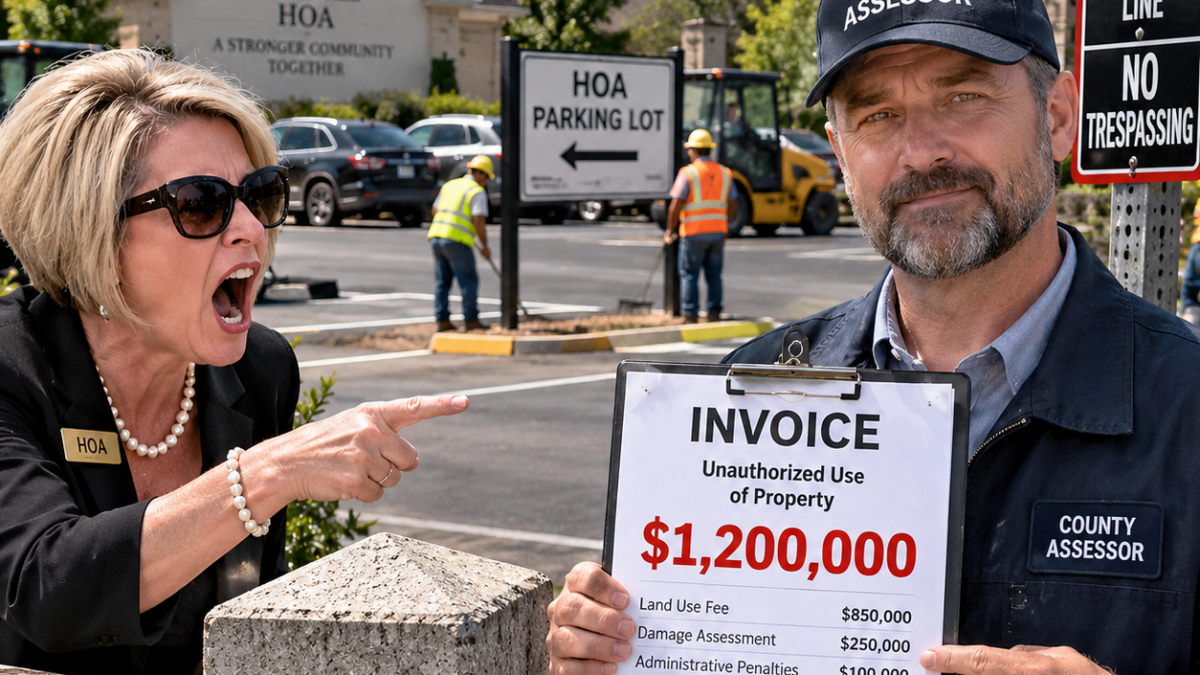
Karen paved two acres of my family’s land into an HOA parking lot while I was away burying my father, then smiled in my face and told me I should be grateful for the “upgrade.”
She thought twenty-two freshly striped parking spaces and one fake survey were enough to erase a deed my grandfather had protected for more than fifty years.
What she didn’t know was that I spent my working days inside the county assessor’s office—and the moment I opened the official records, her parking lot became the smallest problem she had.
“That’s community property now, Mr. Davidson.”
Karen Miller stood in front of me in a bright pink tracksuit with a thick HOA binder tucked beneath one arm.
Behind her stretched a fresh black parking lot.
Twenty-two spaces.
White lines.
Concrete wheel stops.
New LED lights.
And beneath all of it was the meadow my grandfather had once made me promise never to sell.
For a few seconds, I couldn’t speak.
I could still remember climbing the old oak tree with my brother when we were kids.
I remembered my grandfather sitting beneath it in a folding chair, telling me that land was the one thing nobody could make more of.
Now the tree was gone.
Its stump was buried somewhere beneath parking space twelve.
“You paved my property.”
Karen sighed as if I were inconveniencing her.
“We improved an unused parcel.”
“You poured asphalt over two acres that belong to me.”
“We held a community vote.”
I stared at her.
“You voted on stealing my land?”
Her smile tightened.
“Don’t be dramatic. Sterling Meadows has always considered this parcel future common area. Our residents needed overflow parking for the holidays.”
“My deed says otherwise.”
“Our survey says otherwise.”
She patted her binder.
I had been home less than three hours.
For eighteen months, my wife Sarah and I had lived across the state while helping my father through the final stage of his illness.
Doctors.
Hospitals.
Medication schedules.
Then the funeral.
I had barely looked at the emails from our tenants mentioning “construction near the field.”
I assumed the HOA was doing something on its own side of the boundary.
I never imagined anyone would be arrogant enough to grade, gravel, and pave privately owned land without calling me.
Karen stepped closer.
“You should really be thanking us. Frankly, that field was an eyesore.”
My hands curled into fists.
Twenty years in the Marine Corps had taught me that anger is useful only when you control it.
So I breathed.
Looked past Karen.
Studied the slope.
The drainage.
The location of the old survey pin.
Then I asked, “Who authorized the construction?”
“The board.”
“Who authorized the board?”
“The governing documents.”
“Who gave the HOA title to my property?”
Karen’s face hardened.
“You have a very aggressive tone.”
“No. I’m asking a property question.”
“And I’m answering it. Our planning survey clearly designates this parcel as future community space.”
“A planning survey doesn’t convey ownership.”
“That is your opinion.”
“It’s county property law.”
Her eyes narrowed.
Karen knew I worked for the county.
I don’t think she knew exactly where.
After leaving active service, I had taken a civil-service job in the county assessor’s office.
It suited me.
Plat maps.
Parcel records.
Valuations.
Tax classifications.
Numbers and boundaries that meant something because somebody had recorded them properly.
Karen pointed toward the parking lot.
“If you disagree, you may file a grievance with the HOA board.”
“You mean the board that took my land?”
“I chair it.”
“Of course you do.”
Her cheeks reddened.
“You are now standing on community property. If you continue behaving this way, I will have security remove you for trespassing.”
That almost made me laugh.
Instead, I stepped aside.
“Have a good afternoon, Karen.”
She looked disappointed.
She had expected shouting.
Threats.
Maybe she wanted a scene.
But I walked back to my grandfather’s house.
Sarah found me forty minutes later in his old study.
The desk was covered with documents.
His original deed.
My certified inheritance survey.
A high-resolution county GIS map.
Property-tax records.
And one thick red line I had drawn directly across the screen.
Sarah leaned over my shoulder.
The line ran straight through the middle of Karen’s new parking lot.
Every space.
Every light pole.
Every wheel stop.
Every square foot.
All of it was mine.
“What are you going to do?” she whispered.
I printed the official plat map and set it beside my grandfather’s deed.
Then I looked toward the black asphalt shining beyond the window.
“I’m going to give Karen exactly what she asked for.”
Sarah frowned.
“What’s that?”
“A lesson in how property records actually work.”
And by the time I finished checking the HOA’s own county files, I realized Karen hadn’t just stolen my meadow.
She had accidentally led me straight to the records that could destroy everything she had built.
PART 2
I didn’t sleep much that night.
Every time I closed my eyes, I saw black asphalt where tall grass should have been.
Not just grass.
My grandfather’s grass.
That sounds sentimental until you understand the man.
Walter Davidson wasn’t wealthy.
He spent most of his adult life repairing industrial machinery and saving every dollar that didn’t go toward feeding his family.
In 1964, he bought twenty acres outside the city limits.
Back then there was almost nothing around it.
No clubhouse.
No decorative entrance monuments.
No rows of identical houses.
Just open ground, deer trails, and an old oak tree that had probably been there before any Davidson ever set foot in the county.
When developers came in the late 1990s, Grandpa eventually agreed to sell eighteen acres.
He was already getting older.
Property taxes were rising.
The offer was fair.
But he refused to sell the upper meadow.
Two acres.
That was all.
The developer pushed.
Grandpa refused.
They offered more money.
He still refused.
I once asked him why.
We were standing beneath that oak tree.
I was nineteen.
He rested one hand against the trunk and said, “Every man should own one place where somebody with a tie can’t tell him where to stand.”
Years later, when he died, the two acres came to me.
The deed was clean.
The parcel was recorded separately.
The property line was surveyed when I inherited it.
Nothing about the ownership was ambiguous.
Which meant Karen had either made an extraordinary mistake—
or she knew exactly what she was doing.
By seven the next morning, I had decided to find out which.
The first thing I did was hire a surveyor.
Not through the county.
Not somebody I knew personally.
I wanted an independent third party whose work could never be dismissed as favoritism.
Henderson Land Surveying had been operating in the county for thirty-five years.
Frank Henderson himself came out.
Gray beard.
Faded ball cap.
No patience for nonsense.
He spent ten minutes reviewing the deed before looking across the parking lot.
“Well.”
“What?”
“If your documents are right, somebody spent a lot of money paving land they don’t own.”
“I’d like you to tell me whether the documents are right.”
“That’s why I’m here.”
His crew started working.
Less than twenty minutes later, Karen appeared.
Of course she did.
I saw the pink tracksuit before I heard her.
“What is this?”
Frank continued adjusting his equipment.
Karen marched toward him.
“I asked what you are doing.”
Frank glanced at me.
I nodded.
He looked back at Karen.
“Surveying.”
“This is HOA property.”
“That’s what we’re determining.”
“I am telling you it is HOA property.”
Frank smiled.
“Ma’am, if people telling me where property lines were actually settled property lines, I’d be out of a job.”
Her expression darkened.
“These men do not have permission to be here.”
Frank pointed toward me.
“The owner hired us.”
“I am the HOA president.”
“Congratulations.”
I nearly smiled.
Karen turned on me.
“You need to stop this immediately.”
“No.”
“You are interfering with community operations.”
“I’m locating my boundary.”
“We have already done that.”
“Then this should be easy.”
She folded her arms.
Frank and his crew kept working.
Two hours later, bright orange stakes began appearing.
The first was near the original stone marker.
The second landed directly beside parking space nine.
Another ran through space eleven.
Then thirteen.
Then fifteen.
By the time they finished, a perfect line of orange flags cut across Karen’s parking lot.
Residents began stopping.
Some stood in driveways.
One man took pictures.
Karen disappeared into her house.
Frank handed me the preliminary field notes.
“There’s no question.”
“None?”
“None. The entire improvement is inside your parcel.”
“All of it?”
“Every bit I’ve checked.”
I looked at the parking lot.
Twenty-two spaces.
Two light poles.
Drainage curbing.
Landscaping islands.
All mine.
“How much land?”
“Just over two acres disturbed.”
I exhaled.
“Can you certify that?”
“That’s what the final report is for.”
“Do it.”
Over the next week, I built the cleanest property file I had ever assembled.
Original deed.
Certified inheritance survey.
Current independent survey.
County plat.
Aerial GIS photographs.
Tax parcel data.
Construction photos.
Close-ups of fresh asphalt covering the old markers.
Timestamped photographs of the new orange boundary stakes.
I photographed everything.
Sarah found me one evening printing copies.
“You’re treating this like an operation.”
“I am.”
“You know you’re not deployed anymore.”
“I know.”
She sat on the edge of the desk.
“Then why do you look like you used to before missions?”
I stopped printing.
Because she was right.
Not because I wanted violence.
The opposite.
The military had taught me that the worst decisions happen when emotion runs ahead of information.
You identify the terrain.
You confirm the objective.
You build redundancies.
You make sure when you move, you know why.
“I want this handled legally.”
Sarah nodded.
“And?”
“And I want it handled so completely that she can’t rewrite what happened afterward.”
That was the real goal.
Not yelling at Karen.
Not embarrassing her.
Documentation.
My old friend Ben Carter agreed.
Ben and I had served together years earlier before he left the military and went to law school.
Now he handled civil litigation and property disputes.
I emailed him the deed, surveys, photos, and Karen’s HOA documents.
He called twenty minutes later.
“Mark.”
“Yeah?”
“How stupid are these people?”
“Professionally or personally?”
“I’m serious.”
“So am I.”
He laughed once.
Then his tone changed.
“Do not touch that parking lot.”
“I wasn’t planning to.”
“Do not block it yet.”
“Why?”
“Because right now you have a very clean trespass and conversion claim. If you start towing cars or tearing things up, Karen will try to turn this into mutual misconduct.”
“What should I do?”
“Give the board a formal opportunity to correct it.”
“They won’t.”
“I know.”
“Then why?”
“Because I want them to refuse.”
I understood immediately.
“You want it on the record.”
“Exactly. You are going to walk into their meeting with certified surveys and a recorded deed. You are going to explain the problem calmly. Then you are going to give them a chance to stop using your land.”
“And when Karen says no?”
“Then arrogance becomes evidence.”
Two weeks later, I entered the Sterling Meadows clubhouse carrying a rolled-up map nearly four feet wide.
Sarah wanted to come.
I asked her not to.
Not because I didn’t want support.
Because I knew Karen.
She liked provoking people.
Sarah had spent eighteen months watching my father die.
I didn’t want Karen anywhere near that grief.
The clubhouse smelled like chlorine and stale coffee.
About thirty residents attended.
I recognized Karen at the front table.
Beside her sat Gerald Pierce, the treasurer.
Gerald was a thin man in his sixties with wire-framed glasses and the nervous posture of someone who had spent too many years agreeing with the strongest personality in the room.
There was also Linda Weber, a board secretary who looked perpetually confused, and two other men whose names I barely knew.
I set up an easel.
Pinned the official county plat to it.
Outlined my parcel in red.
Karen watched me with obvious irritation.
When my agenda item came up, I stood.
“My name is Mark Davidson. I own parcel 7B, the two-acre property immediately west of the Sterling Meadows common area.”
A few people looked toward Karen.
I continued.
“The HOA recently constructed a parking lot on that parcel.”
Murmurs.
I tapped the map.
“This is the officially recorded county plat.”
Then I held up the independent survey.
“This is a new certified boundary survey completed last week.”
I placed copies in front of each board member.
“This is my deed.”
Another document.
“This is the certified survey from when I inherited the parcel.”
Then photographs.
“And these are photographs showing your parking lot relative to the certified property boundary.”
Gerald started reading.
Karen didn’t.
She pushed her folder aside without opening it.
I said, “The evidence confirms that the entire parking lot is on land owned solely by me.”
The room became quieter.
“I am asking this board to immediately cease using the parcel, preserve all construction records, identify the contractor who performed the work, and begin discussions regarding complete restoration.”
Karen leaned toward her microphone.
“Are you finished?”
“I am.”
“Thank you.”
Her tone suggested anything but gratitude.
“The board has already reviewed this matter.”
“When?”
“During planning.”
“Before you paved my land?”
She ignored that.
Karen pulled out her own binder.
“This survey was commissioned during original development planning in 1999.”
She displayed a faded page.
“It designates the area in question as future overflow common space.”
I looked at the paper.
It was exactly what I suspected.
A preliminary planning drawing.
Not a deed.
Not a recorded final plat.
Not a conveyance.
I said, “That document doesn’t transfer title.”
Karen smiled.
“That is your interpretation.”
“No. That’s how recorded ownership works.”
“You do not dictate Sterling Meadows governance.”
“I dictate what happens on land I own.”
Several residents shifted.
Gerald stared at the survey I had given him.
He looked worried.
Karen noticed.
“Gerald.”
He looked up.
“The board has reviewed this.”
He swallowed.
“Yes.”
I asked, “Did the board consult an attorney before spending HOA funds to construct improvements outside the recorded common-area boundary?”
Karen slammed the binder shut.
“That question is inappropriate.”
“Why?”
“Because our legal communications are confidential.”
“So there was a legal review?”
“I didn’t say that.”
Gerald’s face told me plenty.
I looked around the room.
“My request is simple. Stop using my property and restore it.”
Karen lifted her chin.
“The board rejects your claim.”
There it was.
Clean.
Public.
In front of witnesses.
I asked, “Is that the official decision?”
“Yes.”
“The HOA intends to continue using the parking lot?”
“Yes.”
“Despite the recorded deed and certified surveys?”
Karen’s patience broke.
“We are not relitigating this because some outsider waves papers around. Sterling Meadows voted for the improvement. The matter is closed.”
I nodded.
“Thank you.”
She looked confused.
“For what?”
“For making the board’s position clear.”
I rolled up my map.
As I returned to my chair, an older man in the back caught my eye.
He gave a small nod.
Nothing dramatic.
Just enough to say:
I saw that.
His name, I later learned, was Arthur Henderson.
And that small nod eventually became one of the reasons Karen lost control of everything.
One week after the meeting, the HOA mailed me a violation.
I stared at it in disbelief.
Failure to maintain landscaping.
The photograph showed the narrow strip of meadow their paving crew hadn’t disturbed.
Fine: $100.
Additional penalty: $25 per day.
Two days later came another.
Improper commercial vehicle storage.
The vehicle?
My Ford F-250.
Parked on my property.
Not HOA property.
My land.
Sarah read the letter.
“She’s fining you after stealing your land?”
“Yes.”
“Can she do that?”
“No.”
“Then why is she?”
“Because it has probably worked before.”
That became the next question.
How many times?
I called Ben.
“She’s sending fines.”
“Excellent.”
I held the phone away from my ear and looked at it.
“Did you say excellent?”
“Yes.”
“She’s charging me money.”
“Pay the first one.”
“You have lost your mind.”
“Under protest.”
“No.”
“Mark.”
“I am not giving that woman money.”
“You are giving me evidence.”
That got my attention.
Ben continued.
“A fraudulent notice is paper. A fraudulent demand followed by accepted payment is conduct. Send the smallest amount. Clearly state that it’s disputed and paid under protest. Use certified mail.”
“You really want me to pay her?”
“One hundred dollars.”
“I hate this plan.”
“I know.”
“You sound happy.”
“I am.”
“Why?”
“Because arrogant defendants are generous.”
I paid the $100.
In the memo line I wrote:
PAID UNDER PROTEST — VIOLATION 1024 — NO WAIVER OF PROPERTY RIGHTS.
Certified mail.
Return receipt.
One week later, the green card came back.
Karen Miller’s signature.
I put it into a binder.
Then I opened another set of records.
That was the moment the case changed.
My job at the county assessor’s office wasn’t glamorous.
Most days involved valuations.
Ownership transfers.
Parcel classifications.
Reviewing improvements.
Correcting mapping errors.
People generally thought property tax records were boring.
I liked them.
Boring records have one great advantage.
People underestimate them.
Out of professional curiosity, I pulled the Sterling Meadows common-area files.
I wasn’t changing anything.
I wasn’t using restricted information.
I was reviewing public county records tied to parcels next to mine.
The HOA controlled several pieces of common land.
Clubhouse.
Pool.
Entryway landscaping.
Drainage areas.
Then I noticed one parcel behind the subdivision.
Five acres.
Classification:
UNUSABLE MARSHLAND / CONSERVATION AREA.
Assessed value almost nothing.
I frowned.
I knew that parcel.
Everybody near Sterling Meadows knew it.
It contained the Sterling Meadows Nature Retreat.
A trail system.
Wooden bridges.
Benches.
Exercise stations.
Landscaping.
Signs.
The HOA advertised it constantly.
I pulled archived aerial photographs.
There it was.
Not unusable.
Improved.
Maintained.
Actively used.
Then I checked when the tax classification changed.
Seven years earlier.
The year Karen became president.
My pulse quickened.
I pulled the submitted declaration supporting reclassification.
It described inaccessible wetland unsuitable for development or recreation.
That description was obviously false.
Then I found the nature-trail newsletter from the same year.
Grand Opening!
Sterling Meadows Nature Retreat.
Five Acres of Beautiful Woodland Trails.
I sat back.
Sarah called from the doorway.
“What?”
I looked at her.
“I think Karen lied to the county.”
“About your property?”
“No.”
I turned the screen toward her.
“About theirs.”
The reduced assessment meant Sterling Meadows had paid far less property tax than it should have.
One year alone wasn’t catastrophic.
Seven years?
Different story.
County revenue.
School taxes.
Special district obligations.
All potentially affected.
Then something else bothered me.
If the HOA had been saving money on property tax, why had assessments kept rising?
I started reviewing publicly available financial reports.
Annual dues had risen almost forty percent.
Reserve balances did not reflect the supposed savings.
Instead, I found large payments under broad categories.
Community Consulting.
Landscape Management.
Administrative Strategy.
Capital Improvement Advisory.
I copied vendor names into the state corporate registry.
The first company came up.
Miller Landscape Solutions LLC.
Registered agent:
Daniel Miller.
Karen’s husband.
The second:
Miller Community Consulting.
Same registered agent.
Same mailing address.
I stared at the screen.
Sarah read over my shoulder.
“Oh my God.”
“Maybe coincidence.”
“You don’t believe that.”
“No.”
I kept digging.
Year after year, the payments increased.
$38,000.
$51,000.
$67,000.
$83,000.
Some years the two Miller-linked companies received more than six figures combined.
I called Ben.
“Parking lot just became secondary.”
He was silent.
Then:
“What did you find?”
I explained.
He listened.
When I finished, he said, “Do not investigate this through your official role.”
“I know.”
“You’re personally involved in a dispute with the HOA.”
“I know.”
“You need separation.”
“I’m using public records only.”
“Good. Keep it that way. If you see something suggesting tax fraud, report it through proper channels.”
“I will.”
“And Mark?”
“Yeah?”
“You need residents.”
“Why?”
“If Karen is siphoning money from the association, the victims are the homeowners. You can prove your land claim yourself. The financial story gets stronger when residents start asking where their money went.”
I thought about the older man at the meeting.
Arthur Henderson.
That Saturday, I knocked on his door.
He answered holding a Civil War book.
“Mr. Davidson.”
“Mark.”
“Arthur.”
He smiled.
“I thought you might eventually come by.”
His house smelled like coffee and old books.
Photographs of grandchildren covered the walls.
We sat in a small study.
I didn’t waste time.
“You believed me at the meeting.”
Arthur sighed.
“I believed your documents.”
“That’s more important.”
He nodded.
“Karen has been a problem for years.”
“What kind of problem?”
Arthur leaned back.
“Fines.”
“For what?”
“Anything.”
He started counting.
“Wrong mailbox color. Trash cans visible forty minutes too long. Holiday decorations up three days past her deadline. A vegetable trellis she called a permanent structure.”
“People appeal?”
“To Karen.”
“She chairs the appeals?”
“She chairs everything.”
“Why does nobody remove her?”
Arthur looked embarrassed.
“Because until recently, most people thought paying a hundred dollars was easier than giving up three nights of their life fighting her.”
That sentence stayed with me.
Easier.
That was how small abuses become systems.
Not because everyone approves.
Because resistance feels expensive.
I opened my briefcase.
“I want to show you something.”
First, the tax classification.
Then the aerial photos.
Then the newsletters advertising the nature park.
Arthur put on reading glasses.
He stared for a long time.
“She told us the county funded this.”
“What?”
“The trails.”
“No.”
“She said we received a green-space grant.”
I pulled the county grant database.
Nothing.
“No grant.”
Arthur went pale.
“Then where did the money come from?”
“HOA funds.”
“But Karen said—”
“I think you need to look at these too.”
I showed him the corporate filings.
Daniel Miller.
Miller Landscape Solutions.
Miller Community Consulting.
Arthur removed his glasses.
“My God.”
“You knew?”
“We suspected her husband did some maintenance work.”
“Did residents vote on contracts?”
“Not that I remember.”
“Competitive bidding?”
He shook his head.
“How much money?”
“Hundreds of thousands.”
Arthur looked toward the window.
Then he turned back to me.
“What do you need?”
“People who know the internal history.”
“I know exactly who.”
That was how I met Tom Slater.
Retired CPA.
Former member of the HOA finance committee.
Karen removed him two years earlier.
Official reason:
Disruptive conduct.
Real reason?
He asked questions.
Tom arrived at my house carrying three boxes.
“These are copies.”
“Of?”
“Every annual statement, budget, invoice, and meeting packet I kept.”
Sarah looked at the boxes.
“You kept all of this?”
Tom shrugged.
“I’m an accountant.”
That explained everything.
We worked until midnight.
Tom was frighteningly efficient.
He built spreadsheets.
Mapped payments.
Compared vendor rates.
Matched invoice dates to board minutes.
The numbers got worse.
Miller-linked landscaping bills ran three to four times what comparable contractors charged.
Consulting invoices described services no one could explain.
Some invoices had round figures.
$15,000.
$20,000.
$25,000.
No detailed work descriptions.
Tom leaned away from the computer.
“This is not normal.”
“How abnormal?”
“If this were a corporation I was auditing, I would immediately expand testing.”
“Meaning?”
“Meaning I would assume there is more.”
Arthur brought another resident.
Maria Alvarez.
Single mother.
Two children.
Quiet voice.
Tired eyes.
She placed a folder on my dining room table.
Karen had fined her repeatedly over garden decorations.
First $50.
Then $100.
Then daily penalties.
When Maria fought back, additional violations appeared.
A recycling bin.
A window shade.
A child’s bicycle.
Her unpaid balance eventually exceeded $6,000.
She took out a personal loan.
“Why didn’t you get a lawyer?” I asked.
“With what money?”
I regretted the question immediately.
Maria didn’t take offense.
She simply said, “That’s how Karen wins.”
Those four words hit harder than anything in the financial files.
That’s how Karen wins.
Not because she is right.
Because ordinary people have jobs.
Children.
Mortgages.
Sick parents.
Bills.
They don’t have endless time to fight.
Karen did.
So she weaponized inconvenience.
Tom found more residents.
An elderly couple fined over roof shingles.
A veteran cited for a flagpole.
A widow threatened with a lien because she missed a hearing while hospitalized.
The pattern became undeniable.
Then Tom found the number that changed the room.
Payments to companies connected to Karen’s husband exceeded $400,000.
Arthur stared at the spreadsheet.
“Four hundred thousand?”
“Over several years.”
“And the taxes?”
“Underreported property classification likely saved tens of thousands more.”
Maria whispered, “She stole from us.”
Tom corrected her gently.
“We need investigators to determine exactly what happened.”
Maria looked at him.
“She stole from us.”
Nobody corrected her again.
We developed a plan.
Not revenge.
Exposure.
Arthur requested time on the next HOA agenda to discuss budget performance.
He intentionally kept the language boring.
Karen approved five minutes.
Tom prepared a forensic presentation.
I supplied verifiable public records.
Arthur organized residents.
Maria agreed to speak if needed.
And I called Jake Mercer.
Jake and I had served together before he left the military.
He later became an investigative reporter for Channel 8.
“I have an HOA story.”
He groaned.
“Please tell me this isn’t about somebody’s mailbox.”
“Tax misclassification.”
Silence.
“Go on.”
“Possible self-dealing.”
Longer silence.
“Go on.”
“More than four hundred thousand dollars paid to companies connected to the HOA president’s husband.”
“Now I’m listening.”
“And they paved two acres of my private property.”
Jake laughed.
“You’re joking.”
“I wish.”
“Documents?”
“A lot.”
“Send me enough to verify.”
I did.
He called back an hour later.
“I’ll be there.”
The next HOA meeting drew almost sixty people.
Someone had leaked that something was coming.
Jake sat near the back with a cameraman dressed casually.
Tom sat three rows from the front.
Maria near the side.
Arthur beside the aisle.
I stood in the rear until the meeting began.
Karen looked confident.
She approved minutes.
Discussed landscaping.
Complained about holiday-light enforcement.
Then:
“Next item. Arthur Henderson. Budget performance concerns.”
Arthur stood.
“Thank you.”
Karen checked the clock.
“You have five minutes.”
“I’d like to yield my time to Tom Slater.”
Karen’s head snapped up.
“No.”
Murmurs.
Arthur stayed calm.
“Why?”
“Mr. Slater was removed from the finance committee.”
“He is still a homeowner.”
“He has no official financial role.”
Tom stood.
“I don’t need one to discuss where my dues went.”
A few residents applauded.
Karen struck the gavel.
“Order.”
Arthur said, “The bylaws allow homeowners to speak during an approved agenda slot.”
Karen stared at him.
Then at the crowd.
She could feel the room.
“Five minutes.”
Tom walked forward.
Connected his laptop.
The first slide appeared.
A FORENSIC REVIEW OF STERLING MEADOWS FINANCES.
The room changed instantly.
Karen sat straighter.
Tom clicked.
HOA dues over seven years.
Up forty percent.
Next slide.
HOA property taxes.
Down sharply.
He pointed toward the screen.
“If we were paying less in taxes while collecting significantly more in dues, residents should reasonably expect larger reserves.”
Click.
Reserve balances.
Not larger.
Then came the nature-trail parcel.
Official classification:
Unusable marsh.
Beside it:
A glossy photograph from the HOA newsletter showing wooden bridges, benches, exercise equipment, and manicured trails.
Laughter broke out.
Not happy laughter.
Disbelief.
Karen stood.
“This is misleading.”
Tom did not look at her.
“The property was represented to the county as largely unusable land. At the same time, Sterling Meadows marketed it as a premium recreational amenity.”
“That was an administrative classification.”
“Submitted under your presidency.”
“You don’t know what you’re talking about.”
Tom clicked again.
MILLER LANDSCAPE SOLUTIONS.
Payments by year.
The bars rose.
Then another chart.
MILLER COMMUNITY CONSULTING.
Tom said, “Together, these two vendors received more than four hundred thousand dollars from association accounts.”
A woman shouted, “Who owns them?”
Tom clicked.
State corporate registration.
Daniel Miller.
Karen’s husband.
The room exploded.
Residents stood.
Someone yelled, “Are you serious?”
Another:
“We paid your husband?”
Karen slammed the gavel.
“These are lies!”
I stepped forward.
She pointed at me.
“This man is behind this!”
I took the microphone.
“My name is Mark Davidson.”
Most of them knew that now.
“I work in the county assessor’s office.”
Karen’s face changed.
Not much.
But enough.
“The property records you are seeing are official public records.”
I pointed toward the nature parcel.
“The classification shown there is real.”
Then the corporate filings.
“These registrations are state records.”
Then I held up the plat map.
“And this is the official recorded boundary showing that the parking lot your HOA built is located on my private property.”
Karen stood completely still.
I continued.
“I gave your board these documents at the last meeting.”
Residents turned toward Gerald.
His face went white.
I said, “The board rejected them.”
A woman yelled, “Why?”
Gerald opened his mouth.
Karen interrupted.
“Because his claim is false.”
I looked toward the back.
“That is exactly why I invited independent witnesses.”
Jake nodded.
His cameraman switched on the light.
The front of the room flooded with white glare.
Karen froze.
Jake stood.
“Channel 8 Investigates.”
Gasps.
Karen whispered, “Turn that off.”
Jake replied, “We’re documenting a public-facing association meeting with resident permission.”
“You were not invited.”
“I was.”
Arthur raised his hand.
“So was I,” Maria said.
Then other residents began shouting:
“Keep filming.”
“Don’t turn it off.”
“We want this recorded.”
Karen’s authority disappeared in real time.
Not because I defeated her.
Because the room stopped obeying.
Then the clubhouse doors opened.
Ben Carter entered carrying envelopes.
He walked down the center aisle.
No drama.
No smile.
Just purpose.
He stopped in front of Karen.
“Karen Miller?”
“Yes?”
“You’ve been served.”
He placed the first envelope down.
Then served Gerald.
Linda.
The other board members.
Karen tore hers open.
“What is this?”
Ben said, “Complaint for trespass, conversion, property damage, unjust enrichment, civil conspiracy, and associated relief.”
The room fell silent.
Then he placed another packet on top.
“This is a formal demand.”
Karen opened it.
I watched her eyes move down the page.
Then stop.
The bottom number was bold.
$1,217,452.38.
Someone behind me whispered, “Holy…”
Karen looked at me.
“You are insane.”
“No.”
She held up the invoice.
“You think we owe you one point two million dollars?”
“That is the calculated demand.”
“For a field?”
“For unauthorized occupation of more than two acres.”
Ben took over.
“The demand includes fair-market commercial use value from the beginning of construction, damages associated with bad-faith trespass, survey and legal costs, demolition expenses, removal of asphalt and aggregate, soil remediation, regrading, drainage correction, native restoration, and loss of use.”
Karen’s voice cracked.
“This is extortion.”
Ben didn’t blink.
“No. It’s an invoice.”
Jake’s camera recorded every second.
That night, Karen’s face led the eleven o’clock news.
The headline was devastating.
HOA ACCUSED OF PAVING PRIVATE LAND AS FINANCIAL QUESTIONS MOUNT.
Jake did not sensationalize it.
That made it worse.
He showed documents.
The county plat.
The certified survey.
Nature-trail photographs.
Tax classification.
Corporate filings.
Payment charts.
Residents spoke.
Arthur called the situation “years of ignored warning signs.”
Tom explained the financial concerns.
Maria cried while describing taking a loan to pay HOA fines.
I refused an on-camera interview.
I gave one statement:
“My family is seeking restoration of property, lawful accountability, and a complete review of how HOA funds were used.”
By nine the next morning, the county district attorney announced an investigation.
Not because television automatically proves crimes.
Because the news coverage caused additional complaints and supporting documents to surface.
Former vendors called.
Residents sent records.
One former HOA employee provided internal emails.
The tax matter was referred for formal review.
The financial transactions were examined.
Karen’s world began collapsing.
Board members lawyered up.
Linda resigned immediately.
One of the men claimed he had never reviewed contracts.
Another offered cooperation.
Gerald had bigger problems.
His signature appeared on financial filings.
He had approved checks.
He had signed tax-related documents.
Ben’s phone rang constantly.
Then Sterling Meadows’ insurance carrier sent a reservation-of-rights letter.
Ben called me.
“This is going to hurt them.”
“What happened?”
“Carrier is questioning coverage for intentional conduct.”
“Meaning?”
“If a board knowingly takes property or participates in fraud, insurance may not cover the resulting damages.”
“Karen?”
“Potentially personally exposed.”
“And the HOA?”
“Potentially exposed too.”
I sat quietly.
Sarah looked at me.
“What?”
I told her.
She leaned back.
“Do you feel good?”
That question surprised me.
“Should I?”
“I’m asking whether you do.”
I thought about the parking lot.
My grandfather.
Maria.
The homeowners who had looked away.
Then I pictured families writing enormous special-assessment checks because five board members had failed them.
“No.”
Sarah nodded.
“Good.”
“Why good?”
“Because revenge would.”
I understood.
One week later, Sterling Meadows held an emergency election.
Karen did not attend.
Her resignation had been submitted through counsel.
Arthur Henderson became interim president.
Tom Slater became treasurer.
The new board’s first major decision was unanimous.
They requested settlement talks.
We met inside the same clubhouse.
This time there was no gavel.
No pink tracksuit.
No Karen.
Arthur sat across from me.
Tom beside him.
Three newly elected board members filled the remaining seats.
Ben sat at my right.
Sarah sat at my left.
Arthur began.
“Mark, I want to start with an apology.”
“You personally don’t owe me one.”
“I disagree.”
He looked toward the others.
“We all lived here.”
Nobody spoke.
“We saw Karen becoming more aggressive. Some of us complained privately. Most of us did nothing.”
Tom lowered his eyes.
Arthur continued.
“We let convenience become permission.”
That was exactly it.
He slid a financial statement toward me.
The numbers were ugly.
Reserve funds dangerously low.
Legal expenses rising.
Vendor payments under investigation.
Potential tax liabilities unresolved.
Tom pointed toward my $1.2 million demand.
“If this becomes a judgment anywhere near this amount, Sterling Meadows may not survive.”
I looked at him.
“What does that mean?”
“Massive special assessments.”
“How massive?”
“Potentially tens of thousands per home when everything is combined.”
Sarah shifted beside me.
Tom said, “Some residents could lose their homes.”
For a moment nobody spoke.
I had spent months imagining justice.
Now I had to decide what it looked like.
I could pursue the full amount.
Legally, Ben believed we had a strong claim.
Karen and the board had been warned.
The encroachment was substantial.
The conduct had continued after formal notice.
The restoration costs alone were enormous.
But the homeowners?
Some were guilty of apathy.
Others had no idea.
Some were elderly.
Some young families.
Some had been Karen’s victims themselves.
I remembered my grandfather.
He was stubborn.
But he was never cruel.
Once, when a neighboring farmer accidentally cut hay six feet across our line, Grandpa laughed and told him to keep it.
“Land matters,” he told me later, “but people matter too.”
I looked at Arthur.
“I don’t want to bankrupt Sterling Meadows.”
Tom exhaled.
“But.”
He knew there was a but.
I said, “I am getting my land back.”
“Absolutely.”
“Every inch.”
“Yes.”
“No asphalt.”
“Yes.”
“No gravel base.”
“Yes.”
“No buried construction debris.”
Tom nodded.
“Full removal.”
“Topsoil replaced.”
“Yes.”
“Native meadow restored under an environmental consultant I select.”
“Agreed.”
“Drainage restored.”
“Yes.”
“The HOA records a permanent acknowledgment that parcel 7B is privately owned and outside its authority.”
Arthur nodded.
“Agreed.”
“All fines against my parcel voided.”
“Immediately.”
“Every payment taken from me refunded.”
“Yes.”
Ben slid another document across the table.
“And the financial settlement.”
Tom looked at it.
$350,000.
He inhaled slowly.
Arthur read it.
“That’s still painful.”
“It’s supposed to be,” Ben said.
The number covered legal costs, surveys, experts, loss of use, associated damages, and part of the bad-faith component.
It was far below the $1.2 million demand.
But it was large enough that Sterling Meadows could not pretend nothing happened.
Tom said, “We can survive this.”
Arthur looked at me.
“Anything else?”
“Yes.”
I handed him one final document.
“A sworn admission from Karen.”
Arthur read the heading.
His eyes lifted.
“Mark.”
“She signs it.”
“Her lawyer may never agree.”
“Then the reduced settlement disappears.”
“What does it say?”
“The truth.”
Karen had to acknowledge that the HOA constructed the parking lot without legal title.
That the recorded deed and survey established my ownership.
That she received evidence before continuing the encroachment.
That certain survey materials she relied upon were preliminary and did not convey ownership.
And that fines were issued against property outside Sterling Meadows.
Tom asked quietly, “Why is this so important?”
“Because six months from now, I don’t want Karen telling everyone she was framed.”
Arthur nodded.
“And for the residents?”
“They deserve to know why they’re paying.”
Ben added, “The affidavit will become part of the settlement record.”
Arthur sat back.
“I support it.”
Tom did too.
The new board voted that evening.
Unanimous.
Karen resisted.
Of course she did.
Her attorney called the affidavit humiliating.
Ben replied:
“So was paving someone else’s land.”
Negotiations lasted two days.
Then Karen signed.
Not because she suddenly discovered integrity.
Because refusing would expose her to greater civil risk.
Her signature appeared beneath every admission.
The same looping signature that had once appeared on my fraudulent fine receipt now appeared beneath her acknowledgment of wrongdoing.
When Ben emailed me the executed copy, I printed it once.
Then I put it into my grandfather’s safe.
I never framed it.
I never displayed it.
I didn’t need a trophy.
The real trophy arrived on a cold November morning.
At 7:15, the first excavator rolled up.
Then a milling machine.
Dump trucks.
Loaders.
Survey equipment.
Environmental consultants.
I stood on my grandfather’s porch holding coffee.
Sarah stepped beside me.
“You ready?”
“I’ve been ready for months.”
The milling machine started.
Its drum lowered.
Metal teeth bit into the asphalt.
The sound was ugly.
Grinding.
Cracking.
Mechanical.
Beautiful.
A strip of black pavement disappeared.
Then another.
By noon, six parking spaces were gone.
The next day, twelve.
By the end of the week, the parking lot no longer looked permanent.
That mattered.
When I first saw it, permanence had been part of the intimidation.
Karen wanted asphalt to communicate inevitability.
It’s built.
It’s finished.
You lost.
Watching that asphalt break apart reminded me of something important.
Most things people call permanent are merely expensive to reverse.
Arthur visited almost every day.
He rarely talked.
Sometimes he stood beside me for twenty minutes, then left.
On the fifth day, he said, “Residents are angry.”
“At me?”
“Some.”
“I understand.”
“The special assessment hurts.”
“How much?”
“A few thousand per household.”
I looked toward the excavator.
“And the fraud losses?”
“Potentially worse.”
Arthur sighed.
“I keep telling them the same thing.”
“What?”
“This is not Mark’s bill. It’s ours.”
I looked at him.
He continued.
“We elected the board. We ignored warnings. We let oversight disappear.”
“That doesn’t make every resident responsible for Karen.”
“No.”
He watched another load of asphalt being hauled away.
“But it makes us responsible for building something better.”
That was why Arthur made a good president.
He didn’t enjoy authority.
He treated it like work.
The gravel came next.
Thousands of tons had been compacted beneath the asphalt.
Crews removed it carefully.
Then they excavated damaged subsoil.
Restored the original slope.
Rebuilt drainage.
Truck after truck delivered clean topsoil.
Dark earth gradually replaced gray aggregate.
For the first time in months, the property smelled like soil instead of tar.
Then came the oak tree.
Or what remained of it.
The paving contractor had cut it nearly flush before grading.
The stump was buried beneath parking space twelve exactly where I remembered.
The restoration crew uncovered it on a Thursday.
The foreman called me.
“You might want to come see this.”
I walked over.
There it was.
A ragged section of wood surrounded by dirt.
I knelt beside it.
Ran my hand across the rings.
Sarah stood behind me.
“You okay?”
I thought about Grandpa.
His folding chair.
Summer shade.
The first pocketknife he gave me.
All the things memory attaches to places without asking permission.
“They killed it.”
Sarah crouched beside me.
“Yes.”
The environmental consultant asked whether I wanted the stump removed.
I said no.
“Work around it.”
We built a small circular bed around what remained.
The following spring, I planted a young white oak ten feet away.
Not as replacement.
You can’t replace a seventy-year-old tree.
As continuation.
Meanwhile, Karen’s criminal problems grew.
Investigators reviewed the tax classification.
The Miller companies.
HOA expenditures.
Vendor relationships.
Gerald cooperated.
Former contractors produced invoices.
Internal emails surfaced.
According to the eventual case filings, Karen and her husband had used related companies to bill Sterling Meadows inflated rates while Karen participated in approving or controlling the spending.
Daniel Miller argued he had performed legitimate services.
Some work had been real.
That didn’t explain everything.
The inflated contracts, undisclosed conflicts, and tax-related misrepresentations became central issues.
Eventually, both accepted plea agreements rather than risk trial.
Karen received five years of probation, substantial fines, extensive community-service requirements, and restitution obligations.
Daniel had to repay improperly obtained funds tied to the contracts.
Karen was permanently barred from serving in positions involving association finances or fiduciary control.
Some residents wanted prison.
Maria did not.
That surprised me.
We were standing beside my truck after one of the final hearings when she said, “I don’t need her in prison.”
“Why not?”
“I needed someone to tell her she didn’t own me.”
She looked at the courthouse.
“They did.”
Maria eventually received partial reimbursement after Sterling Meadows reviewed past abusive fines.
So did other homeowners.
Arthur and Tom created an independent appeals committee.
No sitting HOA president could chair it.
Major contracts required competitive bids.
Related-party transactions had to be disclosed.
Financial statements were posted quarterly.
Meeting packets went online before votes.
Reserve-account withdrawals required multiple approvals.
The bylaws changed too.
Not because rules were bad.
Because unchecked rules were.
A good HOA should make shared obligations clearer.
Karen had turned shared obligations into personal leverage.
Sterling Meadows began recovering.
Not quickly.
People remained angry.
Some sold.
Some stayed.
Meetings were packed.
Residents who had ignored everything for years suddenly asked questions about individual invoices.
Tom loved it.
Arthur sometimes looked exhausted.
One evening, I attended a meeting because a drainage agreement affected my boundary.
A man in the second row raised his hand.
“Why did landscaping cost eighteen hundred dollars more this quarter?”
Tom pulled up the invoice.
Another resident asked:
“Did we get three bids?”
Arthur answered:
“Yes. They’re posted online.”
A woman near the front said:
“I want to see them.”
Arthur smiled.
“Please do.”
I leaned back.
That was the sound of a healthy community.
Annoying questions.
Awkward questions.
People checking.
Karen had hated scrutiny.
Arthur invited it.
The meadow took longer.
Nature doesn’t heal on legal timelines.
The first winter was mostly mud.
Then snow.
Spring brought thin green shoots.
Native grasses appeared unevenly.
Wildflowers struggled in some sections.
The consultant warned us not to expect instant beauty.
“So I paid all this money for weeds?”
He laughed.
“For succession.”
“Sounds expensive.”
“Everything involving ecology is expensive if someone paved it first.”
Fair point.
By May, green covered most of the ground.
Not lush.
Not yet.
But alive.
Sarah and I walked the property almost every evening.
One night she stopped near the new oak sapling.
“Your grandfather would be furious.”
“At Karen?”
“No.”
I looked at her.
“At you.”
“Why?”
“For spending this much energy being angry.”
I laughed.
“He was stubborn.”
“So are you.”
“He would have fought.”
“Yes.”
She touched my arm.
“But then he would have gone fishing.”
I looked across the field.
She was right.
For months, Karen had lived in my head.
Every document.
Every meeting.
Every new development.
I had won my land back.
But part of me was still waiting for the next attack.
“I don’t know how to turn it off,” I admitted.
Sarah understood immediately.
“Then don’t turn it off.”
“What?”
“Turn it down.”
I smiled.
“That sounds suspiciously healthy.”
“I’ve been married to you a long time.”
A month later, we brought a picnic table into the meadow.
Not HOA approved.
Sarah made sure to mention that.
We placed it beneath a temporary shade canopy near the young oak.
Arthur came over carrying lemonade.
Tom brought sandwiches.
Maria arrived with her children.
For the first time, people from Sterling Meadows were on my land because I invited them.
That distinction mattered.
Maria’s son ran through the grass.
His sister picked wildflowers until Sarah gently explained she should leave some for pollinators.
Arthur sat beside me.
“Remember the parking lot?”
“I’m trying not to.”
“Twenty-two spaces.”
“Twenty-two too many.”
“People complain about parking again.”
I looked at him.
“Careful.”
He laughed.
“Don’t worry. We’re considering restriping our actual property.”
“Radical idea.”
Arthur became serious.
“You know something?”
“What?”
“If Karen had asked you…”
He stopped.
I knew where he was going.
“If the community genuinely needed temporary overflow parking?”
“Yes.”
“I probably would have let you use part of the lower edge during major events.”
Arthur shook his head.
“That’s the tragedy.”
“It usually is.”
People who crave control often destroy cooperation.
Karen could not tolerate asking because asking leaves room for no.
She needed entitlement.
She needed ownership.
She needed people to obey.
And that need cost everyone far more than a respectful conversation ever would have.
Nearly a year after the parking lot was removed, I received an envelope.
Plain white.
No HOA logo.
No legal letterhead.
Return address belonged to Karen.
I considered throwing it away.
Sarah said, “Read it.”
“Why?”
“Because you’re going to wonder what it says forever.”
She knew me too well.
I opened it.
Karen’s handwriting was less confident than I remembered.
Mark,
I know you probably have no interest in hearing from me.
Accurate.
She continued.
I have spent months being told that I abused my authority. For a long time I believed everyone exaggerated what happened because the situation turned against me.
I almost stopped reading.
Then:
Community parking really was a problem. The meadow really was unused. I convinced myself that because I believed the project benefited more people than it harmed, the ownership question was an obstacle rather than a boundary.
That sentence made me pause.
An obstacle rather than a boundary.
Exactly.
She wrote that the original development file had contained preliminary plans showing the parcel as future common space.
Over time, she decided those plans represented what should have happened.
Then she treated should have happened as had happened.
When the current records contradicted her, she ignored them.
When I challenged her, she felt humiliated.
So she escalated.
The fines were retaliation.
She admitted that.
She admitted she approved them because she wanted to “make resistance expensive.”
I read that line twice.
That’s how Karen wins.
Maria’s words returned to me.
Karen kept writing.
I believed leadership meant making decisions and refusing to be pushed around. I now understand I stopped distinguishing firmness from domination.
I hated seeing your survey stakes because they made me feel powerless in front of people I had spent years convincing I was in control.
She apologized for the meadow.
For the tree.
For the fines.
Then:
I do not expect forgiveness. I am trying to learn the difference between losing control and losing dignity.
I folded the letter.
Sarah watched me.
“Well?”
“She finally understands some of it.”
“Will you answer?”
“I don’t know.”
“Do you forgive her?”
I looked toward the meadow through the window.
The young oak was barely visible beyond the grass.
“I don’t know if forgiveness is a switch.”
“No.”
“I don’t want her back in my life.”
“That’s not the same thing.”
“I don’t want revenge anymore.”
Sarah smiled slightly.
“That might be enough.”
I answered Karen three weeks later.
Short letter.
No anger.
No lecture.
I told her the meadow was recovering.
I told her a new oak had been planted.
I told her Sterling Meadows had a new board.
I told her Maria no longer had an outstanding violation balance.
Then I wrote:
The property line was never your real problem.
The word no was.
Leadership is not proven by what you can force people to accept.
Sometimes it is proven by whether you can respect the boundary after someone refuses you.
I wish you well in learning that.
I mailed it.
No certified receipt.
No documentation.
For once, I didn’t need proof.
The second spring after restoration was different.
The meadow finally looked like itself.
Not exactly.
It never would.
But the grass grew thick.
Wildflowers spread.
Butterflies returned.
Deer crossed early in the morning.
The young oak put out new leaves.
One Saturday, Sarah found me sitting beneath it.
“You realize this tree provides almost no shade.”
“I’m optimistic.”
“It’s four feet tall.”
“Give it time.”
She sat beside me anyway.
Across the property line, Sterling Meadows residents were setting up folding tables for their annual community picnic.
On their own land.
Arthur had invited us.
We planned to go later.
No bitterness.
No boundary dispute.
Just neighbors.
A little boy from Sterling Meadows walked near the line with his father.
He pointed toward the meadow.
“Wasn’t there a parking lot there?”
His father saw me.
He hesitated.
Then waved.
I waved back.
The boy asked again.
His father said, “There was.”
“Why did they take it out?”
The father looked toward me.
Then he told his son:
“Because it wasn’t ours.”
Four words.
Simple.
Clean.
More powerful than every argument Karen had made.
Because it wasn’t ours.
That should have ended the entire story before it began.
That afternoon, I walked over to the Sterling Meadows picnic.
Arthur met me at the entrance.
“Mark.”
“President Henderson.”
“Don’t call me that.”
“Why not? Karen loved it.”
“That is exactly why.”
Tom stood at a table covered with financial reports.
I stared.
“This is a picnic.”
“I know.”
“Why are there spreadsheets?”
“People asked.”
Arthur whispered, “He has a problem.”
Tom ignored us.
Maria was running a raffle for the playground fund.
Her kids waved.
Residents talked.
A few still gave me uncomfortable looks.
I understood.
Their special-assessment checks had hurt.
But most came over eventually.
Some apologized.
Others simply shook my hand.
One man said:
“I was angry at you for months.”
“I know.”
“I thought you should have eaten the cost.”
“Why?”
“Because it was easier than admitting we had allowed the board to get that bad.”
I appreciated the honesty.
He continued.
“I was wrong.”
“Thank you.”
That was enough.
Justice rarely makes everyone happy.
Sometimes the fairest outcome still hurts people who were not the primary wrongdoers.
The important part is what they do afterward.
Sterling Meadows changed.
So did I.
Before Karen, I believed documentation was mostly a professional habit.
After Karen, I understood something deeper.
Records protect memory.
A bully often depends on confusion.
That conversation never happened.
You misunderstood.
The line was always there.
Everyone agreed.
The rule says this.
The board voted.
Documentation forces reality to stay still long enough for people to examine it.
My grandfather had protected the meadow with one recorded deed.
I protected it with another survey.
Karen tried to erase both beneath asphalt.
The records outlasted the parking lot.
Years passed.
The new oak grew.
Slowly.
By year five, it finally cast enough shade for one folding chair.
I brought Grandpa’s old chair out of storage.
The canvas had been replaced twice.
The metal frame was scratched.
But it still opened.
I placed it beneath the tree.
Sarah brought coffee.
“You’ve officially become your grandfather.”
“That’s impossible.”
“You’re sitting in his chair staring at grass.”
“He had excellent hobbies.”
She laughed.
We sat quietly.
Then a Sterling Meadows maintenance truck drove past on the road.
The driver waved.
I waved back.
No survey stakes moved.
No fine arrived.
Nobody crossed the line.
That ordinary peace was worth more than the settlement.
People love dramatic endings.
Courtrooms.
Arrests.
Huge checks.
Public humiliation.
The original $1,217,452.38 demand certainly made a good headline.
Karen’s face when she read it became the image everyone remembered.
But I didn’t collect $1.2 million.
I didn’t want to bankrupt an entire neighborhood to prove I was right.
The final civil settlement was $350,000 plus full restoration and formal acknowledgment of my ownership.
That was enough.
The larger invoice served its purpose.
It forced Sterling Meadows to understand the scale of the liability Karen had created.
The real victory was not becoming richer.
It was getting back exactly what Karen had convinced herself didn’t matter.
My land.
The meadow.
My grandfather’s promise.
And there was one final piece of the story that mattered more as I got older.
I spent years in the Marine Corps believing strength meant standing firm.
That is part of it.
But strength also means knowing what you are defending.
If I had fought only because Karen insulted me, anger would have consumed everything.
If I had pursued the HOA simply because I could financially destroy it, then somewhere along the way I would have become another version of the person I despised.
What I wanted was restoration.
Accountability.
A boundary nobody would cross again.
I got all three.
Karen’s biggest mistake wasn’t building the parking lot.
It wasn’t the fake survey.
It wasn’t fining me after taking my property.
It wasn’t even allowing HOA money to flow toward companies connected to her husband.
Her biggest mistake was believing that rules only mattered when she controlled them.
The deed mattered.
The plat mattered.
The tax records mattered.
The residents’ money mattered.
The signatures mattered.
The invoices mattered.
And eventually every piece of paper she once used to intimidate people became evidence someone else could use to hold her accountable.
One autumn evening, years after everything ended, I walked to the highest part of the meadow.
The grass reached nearly to my knees.
The new oak stood behind me.
A deer disappeared into the brush.
Sterling Meadows lights glowed beyond the trees.
I could barely tell where the parking lot had once been.
The earth had almost erased it.
Almost.
I knew exactly where parking space twelve had stood.
I walked to the spot.
Knelt.
Ran my hand across the grass.
Somewhere beneath me were roots from the original oak.
Dead perhaps.
But still there.
I thought about my grandfather.
About the men in shiny shoes he never trusted.
About his warning.
Don’t let them take it.
For eighteen months, while I watched my father die, I had been distracted by something far more important than property lines.
Karen saw absence.
She mistook it for weakness.
She thought because nobody was standing in the meadow, nobody was protecting it.
She was wrong.
Ownership does not disappear because you leave.
Truth does not disappear because someone votes against it.
And a boundary does not become negotiable because the person crossing it has a binder and a title.
I stood.
Brushed the dirt from my hands.
Then Sarah called from the porch.
“Dinner!”
I turned toward home.
Behind me, the meadow moved softly in the wind.
No asphalt.
No painted lines.
No cars.
Just land.
My land.
Grandpa’s land.
And maybe that was the most satisfying ending possible.
Karen built twenty-two parking spaces because she thought taking something first would make ownership irrelevant later.
Instead, she gave me the reason to open the records.
Those records exposed the tax problem.
The tax problem led to the financials.
The financials exposed the vendor relationships.
The vendor relationships awakened the homeowners.
The homeowners removed her.
Investigators finished the rest.
All because she looked at two quiet acres that didn’t belong to her and decided nobody would stop her.
She was wrong about the land.
She was wrong about the residents.
And she was very wrong about the man whose job was reading property records.
The parking lot lasted a few months.
The deed had already survived more than half a century.
In the end, the paper won.
The meadow came back.
And the people who had once been too afraid to question their HOA president finally learned something my grandfather had understood all along:
A boundary only protects you if someone is willing to stand beside it.
This time, we all did.








