PART 2: HOA Built a Luxury Pool on My Land—So I Let Them Enjoy One Last Summer Before I Drained It
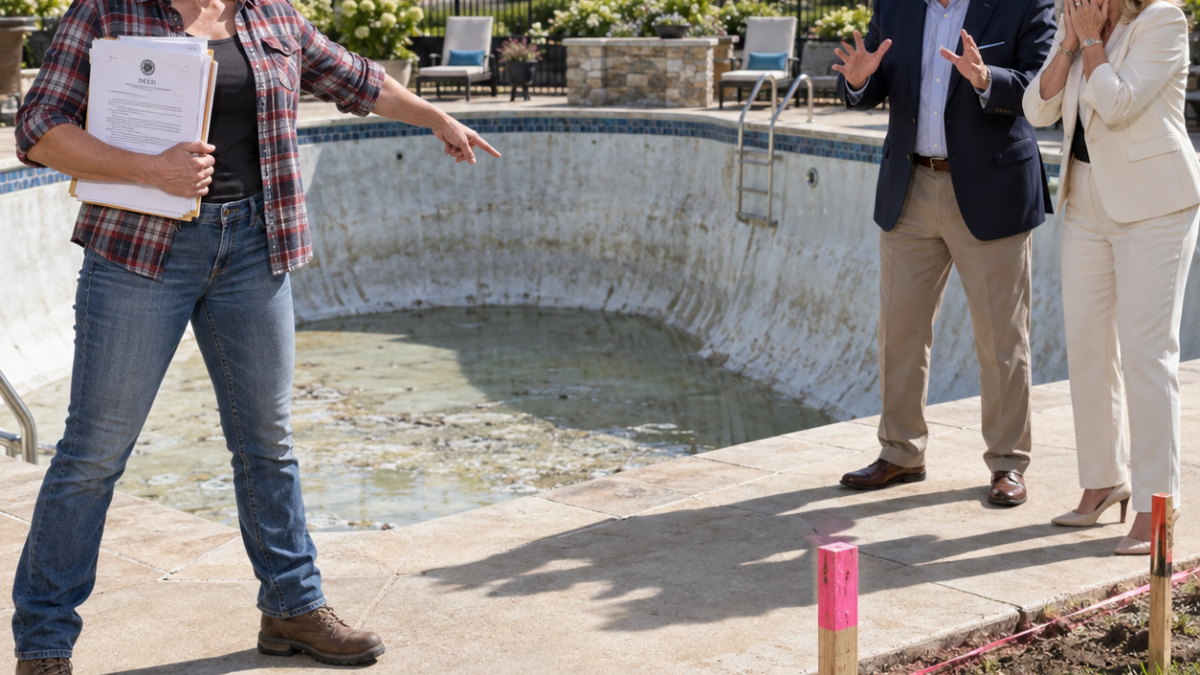
The HOA president stood beside a sparkling forty-thousand-gallon swimming pool, pointed at me, and threatened to call the sheriff because I was “trespassing” on HOA property.
The problem was that the pool, half the clubhouse, the pump house, and the fence behind her were sitting nearly seventy-five feet inside land my wife and I had owned for ten years.
I could have tried to shut everything down that afternoon—but after one phone call to a property lawyer, I made a decision Karen would not understand until summer was over.
“My advice,” Karen said, folding her arms across her polo shirt, “is that you go back to your property before I call law enforcement.”
I looked down.
Six inches from her shoe was an orange-capped steel survey pin.
My survey pin.
I had watched it being driven three feet into the ground a decade earlier.
Then I looked beyond Karen at the pool.
Kids were splashing in the shallow end.
Parents sat beneath umbrellas.
Music drifted from speakers mounted under the clubhouse roof.
Someone was grilling hamburgers.
It looked like the perfect suburban Saturday.
Except nearly an acre beneath that perfect summer scene belonged to me.
“My property begins here,” I said, pointing to the pin.
Karen laughed.
Not nervously.
Not uncertainly.
She actually laughed.
“According to whom?”
“The county deed. My recorded survey. And the man who installed that marker.”
She gestured toward the clubhouse wall, where a glossy developer map showed a different boundary.
“This is the official Lakeside Meadows site plan.”
“No,” I said. “That is the plan your developer gave you.”
Her smile disappeared.
“There is no difference.”
“There’s a very expensive difference.”
I was sixty-two then, newly retired after twenty-five years with the Army Corps of Engineers.
I had spent much of my career around construction plans, grading maps, site boundaries, drainage calculations, and contractors who knew that being six inches wrong could cost somebody thousands.
This wasn’t six inches.
The development’s fence had crossed my boundary and kept going.
And going.
Until the deep end of their new resort-style pool, the mechanical building, and part of the clubhouse were sitting squarely on my acreage.
Sarah and I had bought those fifty acres in North Carolina years before retirement.
It was our promise to each other.
A modest house.
A woodworking shop.
A garden for her.
Pines, oaks, deer, creek water, and enough distance from everyone else that the loudest thing on summer evenings would be cicadas.
Then the neighboring farm was sold.
Lakeside Meadows appeared.
I didn’t complain.
Their property was theirs.
Mine was mine.
At least, that was what I believed until I spent six weeks helping our daughter after she gave birth to twins.
When I returned, I heard children screaming through my woods.
At first I thought someone had wandered onto the creek.
Then I reached the eastern property line.
And saw a swimming pool where my trees used to be.
I spent the next two days photographing everything.
Then I called the surveyor who had marked my land ten years earlier.
Miller arrived in a battered Ford Ranger, walked the boundary with his old field notes, checked every surviving pin, and finally removed his hat.
“John,” he said, “this isn’t an ordinary construction mistake.”
The developer’s line had been angled westward.
Just enough near the northern marker to look plausible.
But over distance, that angle created a widening wedge.
Exactly where they needed room for the pool.
I stared at the blue water through the trees.
“How much?”
“Close to an acre.”
That afternoon, I called Evelyn Davies, a Charlotte property attorney known for handling boundary disputes.
I expected her to tell me to demand the pool close immediately.
She didn’t.
She studied my deed.
The surveys.
The photographs.
The developer’s map.
Then she leaned back.
“Do you want them off your property?”
“Yes.”
“Then don’t interrupt your opponent while she’s documenting your case.”
I frowned.
“What are you suggesting?”
Evelyn smiled.
“Let them have their summer.”
That was the moment my anger became patience.
And patience, I would learn, frightened Karen far more than anger ever could.
PART 2
I stared at Evelyn across her conference table.
“Let them have their summer?”
She folded her hands.
“Temporarily.”
“You understand that they’ve built a swimming pool on my property.”
“I understand exactly what they built.”
“And you want me to watch people use it?”
“For now.”
I leaned back.
The idea was almost insulting.
For ten years I had protected that land.
I had paid the taxes.
Cleared deadfall.
Maintained trails.
Watched deer move across it in the mornings.
Sarah and I had walked those acres discussing where the house would someday stand and which grove of oaks we would never touch.
Now a development company had bulldozed part of it, poured concrete, erected a clubhouse, installed pumps and plumbing, and sold prospective homeowners on the idea that the resulting resort belonged to them.
And Evelyn wanted patience.
She must have seen what was on my face.
“John, there are two ways people usually lose property disputes,” she said.
“Bad documents?”
“Bad emotions.”
That got my attention.
She pointed toward the folder containing the photographs from my first confrontation with Karen.
“You already did the important thing correctly. You did not touch the fence. You did not shut off electricity. You did not enter the pool enclosure and create a confrontation.”
“I walked into the clubhouse.”
“To speak to them.”
“Yes.”
“And their president threatened to call the sheriff on the documented owner of the ground beneath her chair.”
I almost smiled.
“When you put it that way…”
“I put it that way because that is how a judge may eventually hear it.”
She pulled Miller’s preliminary notes closer.
“We need an updated certified survey. We need county records. We need the developer’s filings. We need to determine exactly who owns each improvement, what warranties were made to the HOA, what insurance applies, and whether the development company still exists in a form worth pursuing.”
“And while you do that?”
“You behave like the most reasonable landowner in North Carolina.”
“I’m not feeling particularly reasonable.”
“You don’t need to feel it.”
She smiled faintly.
“You only need to document it.”
I drove home irritated.
Sarah was sitting on the back porch when I arrived.
She knew from my face that the meeting had not gone the way I expected.
“Well?”
“The lawyer wants me to do nothing.”
Sarah raised one eyebrow.
“That seems unlike lawyers.”
“She wants me to wait.”
“How long?”
“The summer.”
She lowered her coffee cup.
“The whole summer?”
“Apparently.”
Then the music started.
Three hundred yards through the trees, the pool speakers came alive.
Some bright pop song carried across land that had once been silent.
Sarah closed her eyes.
“Of course.”
“I could go over there right now.”
“No.”
I looked at her.
“You agree with Evelyn?”
“I agree that you’re angry enough to do something you’ll regret.”
“I am perfectly calm.”
“John, you’ve been standing for five minutes and haven’t taken your truck keys out of your hand.”
I looked down.
She was right.
I threw them onto the table.
Sarah smiled.
“There he is.”
“This isn’t funny.”
“No.”
She stood and walked toward me.
“But if somebody has stolen part of our land, I’d rather take it back permanently than win an argument today.”
That was why I married her.
Sarah could reduce a problem to one sentence.
I spent the next week helping Evelyn build the file.
Miller returned with two assistants.
They ran a complete resurvey.
No shortcuts.
No relying solely on old stakes.
They tied everything back to recorded monuments and county references.
The result was worse than his initial estimate.
The encroached wedge measured just under an acre.
Near the north end, the intrusion was comparatively narrow.
Farther south, the false boundary drifted deeper into my parcel.
The deepest intrusion captured exactly the land necessary for Lakeside Meadows’ primary amenity.
Pool.
Deck.
Mechanical room.
Fence.
Part of the clubhouse.
Decorative landscaping.
Outdoor grill area.
A section of the fire lane.
Miller laid the new plat on my hood.
“They pivoted off the right area and ran the wrong bearing.”
“Could it have been an innocent error?”
He gave me a look.
“Anything is possible.”
“That isn’t what I asked.”
“No.”
He tapped the widening wedge.
“You don’t accidentally create usable resort space this neatly.”
He was angry in a professional way.
I understood that kind of anger.
An inaccurate survey isn’t merely a bad drawing.
People build lives on those lines.
Homes.
Roads.
Loans.
Retirement plans.
A boundary survey is a promise in mathematical form.
Somebody had broken that promise.
Miller agreed to prepare a sworn statement describing his original work and the current conditions.
Meanwhile, Evelyn began tracing the developer.
Lakeside Meadows had been constructed by a subsidiary of a larger regional company.
The entity that built our phase had already transferred most community assets to the homeowners association and effectively wound down operations.
“That’s deliberate,” I said.
“It’s common corporate structure,” Evelyn replied.
“Meaning?”
“Meaning we don’t assume the shell company is the only pocket.”
She contacted the parent company.
No response.
Then she contacted the title insurer associated with the common-area transfer.
That produced interest.
Within forty-eight hours, someone wanted copies of my survey.
Interesting.
Karen, however, remained spectacularly uninterested in reality.
Three days after my meeting with Evelyn, I received a letter from the Lakeside Meadows HOA.
It was addressed to:
ADJOINING PROPERTY OWNER.
That made me laugh.
The letter informed me that my recent “intrusion” into HOA recreational facilities had alarmed members.
I was instructed not to enter the pool complex without permission.
Then came a paragraph warning me against harassment, interference with community activities, or attempts to disrupt residents’ enjoyment of association property.
Sarah read it at the kitchen counter.
“They sent this to you?”
“Apparently.”
“About our land?”
“Apparently.”
She looked toward the woods.
“Can I frame it?”
“Evelyn wants the original.”
“We’ll frame a copy.”
I scanned it and sent it to my attorney.
Her response contained exactly one word.
Excellent.
That became a theme.
Karen would do something outrageous.
I would send it to Evelyn.
Excellent.
A week later, another letter appeared.
This one concerned the condition of vegetation along my eastern boundary.
Apparently the natural grass and undergrowth on my fifty-acre rural parcel exceeded Lakeside Meadows’ four-inch standard.
I wasn’t a member of Lakeside Meadows.
My deed was not subject to their covenants.
My house didn’t even exist yet.
But Karen issued a violation notice anyway.
Fifty dollars.
I sent it to Evelyn.
Excellent.
A second violation arrived.
One hundred dollars.
Then a complaint about my 1985 John Deere tractor being visible from the recreation area.
Two hundred dollars.
I kept the tractor polished better than Karen kept her golf cart.
But that was beside the point.
The notices weren’t legally impressive.
They were psychologically useful.
Karen wanted me reacting.
She wanted angry letters.
Threats.
Arguments.
Anything she could wave around and use to convince residents that the old man beyond the fence was dangerous and irrational.
So I gave her nothing.
I created a binder.
Every letter went in chronologically.
Every envelope.
Every photograph.
Every date.
I started a log.
At first, documenting the pool felt absurd.
Saturday, June 22.
Pool opens at 9:03 a.m.
Approximately thirty-six residents by 11:00.
Two attendants.
Landscaper servicing beds along western fence.
Chemical-service truck at 1:14 p.m.
Music ends 8:47 p.m.
I felt like a retiree who had lost his mind.
Then Evelyn explained why the details mattered.
“We need a clear timeline.”
“For what?”
“For notice.”
She tapped the first letter I had personally delivered to Karen.
“Before you told the HOA, they can claim ignorance.”
“And after?”
“They know there is a serious ownership dispute.”
“So every dollar they spend after that…”
“Becomes harder to describe as innocent reliance.”
That changed the way I saw the summer.
It was no longer simply noise.
It was evidence unfolding in real time.
Still, patience is easier in theory.
July was brutal.
Lakeside Meadows discovered theme nights.
Friday Family Splash.
Saturday Sunset Social.
Sunday Grill and Swim.
One weekend they hired a DJ.
Another they rented inflatable palm trees.
I stood on my porch drinking coffee while artificial tropical decorations floated in a pool built where Sarah and I had once planned to plant dogwoods.
“You’re grinding your teeth,” she said.
“I’m chewing.”
“There’s nothing in your mouth.”
“Imaginary steak.”
She sat beside me.
“How much longer?”
“Evelyn says we wait.”
“I’m starting to dislike Evelyn.”
“You loved her last month.”
“That was before karaoke night.”
The residents themselves complicated my anger.
At first, I thought of them collectively.
The HOA.
The development.
The people using my property.
But people resist being reduced to categories once you actually meet them.
The first was Tom Bennett.
A Frisbee came over the fence one Saturday afternoon.
I was clearing brush fifty feet away when it landed near my boots.
A man called through the fence.
“Sorry!”
I picked it up.
A little boy stood beside him.
Maybe eight.
He looked worried.
“Nice throw,” I said.
The boy grinned.
“I was aiming for Dad.”
“Your aim needs work.”
His father laughed.
I handed the disc through the bars.
“Thanks. I’m Tom.”
“John.”
“You live back there?”
“I own back there.”
He looked past me.
“Beautiful property.”
“Usually quiet.”
He winced.
“Pool noise?”
“Some.”
“Sorry. We just moved in.”
“No need to apologize for swimming.”
That surprised him.
Karen had apparently told residents something different.
He hesitated.
“I heard there was some disagreement about the boundary.”
“Disagreement is one word.”
Tom glanced at the pool.
“What’s the other?”
“Survey.”
He smiled uncertainly.
I pointed toward the orange-capped marker beside the fence.
“See that?”
“Yeah.”
“That’s one of my original boundary monuments.”
He looked down.
Then at the fence.
Then at me.
“Why is it inside the pool side?”
“Excellent question.”
His expression changed.
“I thought this whole area was HOA property.”
“So does Karen.”
“You’re saying it isn’t?”
“I’m saying county records are public.”
I picked up my brush cutter.
“If I were paying dues on an expensive amenity, I’d probably want to know what the courthouse says.”
Then I walked away.
Sarah was waiting near the porch.
“You did that intentionally.”
“I returned a Frisbee.”
“You dropped a grenade.”
“A public-record grenade.”
“Much more respectable.”
A week later, Tom returned.
This time without his son.
He waited near the fence until he saw me.
“John.”
I walked over.
He held up his phone.
On the screen was a photograph of the county plat.
“You were right.”
“I know.”
“That sounded smug.”
“I’m working on humility.”
He zoomed in.
“This line doesn’t match the closing map.”
“No.”
“Not even close.”
“No.”
He looked toward the clubhouse.
“How much of this is yours?”
“Most of what you can see west of the original boundary.”
“The pool?”
“Yes.”
“All of it?”
“Enough of it that the distinction doesn’t help your HOA.”
“The pump building?”
“Yes.”
“The clubhouse?”
“Part.”
Tom rubbed his forehead.
“You told Karen?”
“Personally.”
“When?”
“Beginning of summer.”
His face went pale.
“She knows?”
“Yes.”
“She told us you were trying to shake down the association.”
“I haven’t demanded a dollar.”
“She said you produced some ancient unofficial map.”
“My deed isn’t ancient. And Miller’s survey is recorded.”
Tom stared at the orange pin.
“I’m a CPA.”
“Congratulations.”
“No, I mean…”
He looked troubled.
“I’m thinking about the books. Insurance. Reserve schedules. Depreciation. The pool is one of our biggest assets.”
“It may not be your asset.”
“That’s the problem.”
“Yes.”
“We’re spending thousands maintaining something we may not own.”
“Yes.”
“And she knows there’s a title dispute.”
“Yes.”
He looked at me for a long time.
“What are you going to do?”
“My lawyer would prefer I not answer that.”
“Fair.”
“But if I lived in Lakeside Meadows…”
He waited.
“I would start asking the board questions.”
Tom nodded slowly.
Then walked back toward the pool.
That conversation changed everything.
Not immediately.
At first, nothing visible happened.
Then I noticed smaller groups forming around the pool deck.
People talking instead of swimming.
Karen appearing unexpectedly whenever Tom spoke with someone.
Residents walking along the fence looking at survey markers.
One afternoon I saw two men crouched beside the orange cap taking photographs.
Sarah joined me at the window.
“Your public-record grenade exploded.”
“So it seems.”
Tom became our unofficial bridge.
He never gave me confidential records.
I didn’t ask him to.
He simply told me what homeowners were discussing.
They wanted the board to commission an independent survey.
Karen refused.
Her explanation?
It would waste HOA money validating a frivolous claim.
The finance committee asked why legal expenses related to me were increasing.
Karen called the matter privileged.
Residents asked whether insurance had been notified.
She avoided answering.
Then Tom discovered something that made even Evelyn sit forward.
The HOA had paid more than five thousand dollars to a local attorney for letters and consultations related to the boundary dispute and my alleged violations.
There appeared to be no recorded board authorization for the unbudgeted expenditure.
“Can she do that?” Tom asked me through the fence.
“Ask your bylaws.”
“I did.”
“And?”
“She needed a vote.”
“Then ask for the minutes.”
“I did.”
“There aren’t any?”
His silence answered.
Karen responded the only way she seemed to know how.
She escalated.
A newsletter described me as an “aggressive adjoining landowner.”
Another referred to “ongoing efforts to interfere with community amenities.”
She never used the word extortion in writing.
She came close.
Evelyn saved everything.
Then Miller called me late in August.
“I found your surveyor.”
“Mine?”
“The man who signed the developer plat.”
“Peterson.”
“Yes.”
“What about him?”
“His license has been suspended.”
I sat upright.
“For this project?”
“Another one.”
Miller explained.
Peterson had become involved in a separate boundary controversy in another county.
Regulators found serious professional violations.
Different development.
Similar methodology.
“Does that prove fraud here?” I asked.
“No.”
Miller was careful.
“And don’t say it does.”
“Evelyn has trained me.”
“But it matters.”
“How much?”
“It means anyone relying blindly on his work now has another reason to verify it independently.”
I called Evelyn.
She already knew.
Lawyers apparently have their own ecosystem.
“This helps,” she said.
“But?”
“But we continue proving our case, not narrating one.”
She had become Sarah with a law degree.
Labor Day weekend arrived.
Lakeside Meadows threw the biggest pool party of the year.
Live music.
Catered barbecue.
Games for children.
String lights around the deck.
A banner announcing:
END OF SUMMER CELEBRATION.
I could see only part of it through the trees.
I could hear all of it.
Around sunset, Sarah came outside with two glasses of bourbon.
“For patience.”
I accepted mine.
“This is the last weekend.”
“That’s what Evelyn says.”
“You believe her?”
“I value my life too much to accuse either of you of being wrong.”
We sat without speaking.
The sky faded orange behind the pines.
Children screamed happily.
Someone announced a cannonball contest.
I felt something unexpected.
Sadness.
Sarah noticed.
“What?”
“Those people have no idea.”
“Some do.”
“The kids don’t.”
“No.”
I looked through the trees.
“They didn’t steal our land.”
“The developer did.”
“Karen made it worse.”
“Yes.”
“But most of those families bought houses because they believed the paperwork.”
Sarah took my hand.
“Then remember that when this ends.”
That sentence stayed with me.
I had spent weeks fantasizing about the moment Karen discovered she had lost.
Sarah reminded me that justice could easily become cruelty if I stopped distinguishing between the guilty and the trapped.
Tuesday morning after Labor Day, Evelyn filed.
She called me at 8:42.
“It’s done.”
“How do you feel?”
“Ask me after coffee.”
At 9:03, Karen was served at the clubhouse.
At 9:17, the association’s registered agent received copies.
The title insurer already had notice.
The developer entities and related parties were served through their agents.
The filing included my deed.
Both surveys.
Miller’s affidavit.
Photographs.
The pool-site measurements.
The correspondence.
The violation letters.
A detailed chronology.
Evelyn also sent the HOA board a demand designed to force reality into the room.
The first path was a negotiated purchase of the affected land.
Not a token payment.
Not ordinary raw-acre value.
The price would have to account for the strategic value of the parcel, the existing improvements, the loss of my use, legal expenses, and the fact that I had repeatedly put them on notice.
The number was enormous.
Not impossible in theory.
Impossible for that association.
The second path was removal.
Stop using the encroached area.
Remove the improvements.
Restore my land.
Pay agreed damages and costs.
Evelyn gave them thirty days to respond while the lawsuit proceeded.
My phone rang at 9:31.
Tom.
I answered.
“Good morning.”
“What did you do?”
“Filed.”
“You filed everything.”
“That’s usually how exhibits work.”
“People are losing their minds.”
“I recommend coffee.”
“Karen just came out of the clubhouse.”
“And?”
“I have never seen a human being that shade of red.”
“Tom.”
“Yeah?”
“Do me a favor.”
“What?”
“Tell people to read before reacting.”
He became quiet.
“I’m serious.”
“I know.”
“This isn’t you versus me. It isn’t residents versus me.”
“I know.”
“The developer created this.”
“And Karen hid it.”
“She certainly refused to investigate.”
“That’s the nicest possible version.”
“My lawyer charges me to talk that way.”
Tom sighed.
“Emergency meeting tomorrow.”
“I assumed.”
“You coming?”
“No.”
“What?”
“I am not a member.”
“Technically the clubhouse is—”
“Don’t.”
He laughed despite himself.
“Fine.”
“You people need to decide what kind of board you want.”
“And the property?”
“That’s between the HOA, the other defendants, and my attorney.”
“You really aren’t coming?”
“No.”
“Probably smart.”
“I’m very smart when Evelyn threatens me.”
The emergency meeting began at seven.
I sat at my kitchen table with Sarah.
Tom texted updates.
7:04 — PACKED.
7:09 — KAREN TALKING.
7:11 — SHE CALLED YOU VINDICTIVE.
Sarah read the text.
“She needs new material.”
7:14 — NOW EXTORTION.
“That one’s new.”
“Progress.”
7:21 — TOM SPEAKING.
Then nothing for six minutes.
I hated those six minutes.
Finally:
7:27 — CHAOS.
Another message.
7:28 — GOOD CHAOS.
“What is good chaos?” Sarah asked.
“I’m afraid to ask.”
Then Tom called.
I put him on speaker.
Noise exploded through the phone.
People shouting.
Chairs moving.
Someone demanding to see financial records.
“What’s happening?”
Tom practically yelled.
“I showed the county plat.”
“Okay.”
“Then Janet showed the developer plat.”
“Who’s Janet?”
“Retired civil engineer. You’d like her.”
“Focus, Tom.”
“Everyone can see the lines don’t match.”
Sarah leaned closer.
“And Karen?”
“Still saying your survey is wrong.”
“Of course.”
“Then Maria asked her why she refused an independent survey.”
“Who is Maria?”
“Paralegal. Also scary.”
“I’m noticing a pattern.”
Tom continued.
“Then I asked about the five thousand in legal bills.”
“What happened?”
“The treasurer says he never approved them.”
Sarah’s mouth opened.
Tom lowered his voice.
“The rest of the board says Karen told them it was covered under administrative authority.”
“Is it?”
“Not at that amount.”
“What now?”
“Wait.”
Muffled voices filled the phone.
Then Tom whispered:
“Oh no.”
“What?”
“She’s losing it.”
“How badly?”
“Threatening fines.”
“For what?”
“For undermining the board.”
I closed my eyes.
Even now, she thought the solution to losing authority was to threaten more authority.
Then another voice became audible through Tom’s phone.
A man.
Calm.
Probably one of the board members.
“Karen, sit down.”
Tom whispered, “That was our treasurer.”
Someone shouted from the room.
“Resign!”
Another voice joined.
Then five.
Then ten.
Sarah looked at me.
“You wanted to be there.”
I shook my head.
“No.”
And for the first time, I meant it.
This wasn’t my meeting.
It was theirs.
Lakeside Meadows had a problem bigger than my property line.
Their homeowners had delegated responsibility to a board, then stopped watching.
Karen had filled the vacuum.
If the community was going to recover, residents needed to reclaim that responsibility themselves.
Tom called the next morning.
“She resigned.”
“How?”
“Effective immediately.”
“Board accepted?”
“Yes.”
“Others?”
“Two staying temporarily until a special election. Treasurer almost quit, but people asked him to help stabilize things.”
“How’s Karen?”
“No idea.”
“And residents?”
“Terrified.”
That was the word that mattered.
Not victorious.
Terrified.
Their pool might disappear.
Property values were uncertain.
Special assessments were possible.
They could face large restoration costs.
Families who had done nothing wrong were looking at bills they had never anticipated.
I thought of Sarah’s words.
Remember that when this ends.
Evelyn met with the remaining board forty-eight hours later.
I did not attend.
She called afterward.
“They finally understand the problem.”
“Good.”
“They cannot purchase at anything close to the number we proposed.”
“I expected that.”
“They want to negotiate restoration.”
I looked through the trees toward the pool.
It was empty that weekday morning.
“Meaning?”
“Closure at the end of operating season. Drainage performed professionally. Demolition. Removal. Grading. Soil restoration. Replanting.”
“And damages?”
“Negotiating.”
“Legal costs?”
“Negotiating.”
“Developer?”
“Separate battle.”
I was quiet.
“What is it?” she asked.
“Residents will get assessed.”
“Probably.”
“They didn’t create the false plat.”
“No.”
“Can we pursue the developer first?”
“We are.”
“But?”
“But your property rights do not have to remain suspended indefinitely while corporate defendants point at one another.”
I knew she was right.
I still didn’t enjoy it.
The final settlement with the HOA took another week.
They agreed to surrender all claim to the encroached parcel.
The pool would close permanently.
The structures crossing onto my land would be removed.
The site would be restored under plans approved by an independent engineer.
The association would contribute to my legal fees and damages.
Claims against the developer, survey parties, insurers, and others would continue separately.
Most importantly, the agreement included something I insisted upon after speaking with Sarah.
The HOA would retain its rights to pursue recovery from the parties responsible for the original boundary error.
I didn’t want Karen’s mistakes to turn innocent homeowners into the only people left paying.
Evelyn looked at me when I requested it.
“You understand that doesn’t guarantee reimbursement.”
“I know.”
“Could complicate settlement.”
“I know.”
“You’re sure?”
“Yes.”
She smiled.
“You’re ruining your reputation as a vindictive old man.”
“I worked hard on that reputation.”
The pool closed on September 18.
No dramatic confrontation.
No chains at midnight.
No angry sign.
The HOA emailed residents.
The recreation center would remain closed pending litigation and property restoration.
Karen’s supporters accused me of destroying the community.
Tom sent me screenshots.
I stopped reading them.
October brought cooler mornings.
Then the demolition contractors arrived.
The first step was the pool.
I walked down to the boundary with coffee.
The same orange-capped survey marker remained beside the fence post.
For months that pin had looked almost ridiculous.
A tiny piece of steel beside acres of concrete and landscaping.
Yet the pin had been right all along.
The pool contractor connected pumps.
Hoses ran across the deck.
Water began dropping.
Slowly.
Almost silently.
That surprised me.
I had imagined something dramatic.
A roaring torrent.
Sirens.
People watching.
Instead, there was a mechanical hum.
Water receded inch by inch.
Blue tile emerged.
Then the white plaster walls.
A dirty line showed where the water had been.
Sarah joined me.
“So this is the famous revenge.”
I took a sip.
“Disappointing?”
“A little.”
“We can ask them to play dramatic music.”
“No.”
We watched.
After half an hour, Sarah said, “Does it feel good?”
I thought before answering.
“Yes.”
She looked at me.
“But not the way I expected.”
“How?”
“Quieter.”
She nodded.
“That’s probably healthier.”
A vehicle appeared on the Lakeside Meadows road.
Karen’s SUV.
Boxes were stacked behind the windows.
She slowed when she saw us.
Then stopped.
For months, I had imagined what I would say.
Something devastating.
Something clever.
A perfect final line.
Karen rolled down her window.
“You happy?”
Sarah looked at me.
I walked closer to the fence.
“No.”
Karen laughed bitterly.
“Of course you are.”
“I’m relieved.”
“You cost this community a fortune.”
“Your developer put your pool on my land.”
“You could have worked with us.”
“I came to your office.”
“You came accusing us.”
“I brought a survey.”
“You threatened us.”
“I told you there was a serious problem.”
“You could have given us time.”
That one almost stunned me.
“I gave you the entire summer.”
Her face tightened.
“You enjoyed watching us spend money.”
“No.”
“Your lawyer admitted that was your strategy.”
“My lawyer told me not to interfere while ownership was being verified.”
“You wanted this.”
She pointed toward the draining pool.
I followed her finger.
“I wanted my land back.”
“You don’t even use it.”
There it was.
The sentence underneath everything.
You don’t use it.
As if property rights diminished when land was quiet.
As if undeveloped meant unwanted.
As if someone else’s dream became available because you preferred your own.
“My wife and I bought those acres before Lakeside Meadows existed.”
“So?”
“So whether I build a house, grow trees, plant corn, or sit there watching squirrels is not your decision.”
She stared at me.
“You could have sold it.”
“You could have asked.”
Silence.
Karen looked toward Sarah.
Then at the pool.
The water was several feet lower now.
She seemed suddenly older.
Not smaller physically.
Smaller in the way people look when the authority around them disappears.
“They hate me,” she said.
I wasn’t expecting that.
“Some probably do.”
“I gave five years to that neighborhood.”
“I believe you.”
“Nobody remembers anything I did right.”
“I’m not the person who can fix that for you.”
She looked at me.
For one strange second, all the anger drained from her face.
“What would you have done?”
“When?”
“The day you came into my office.”
I answered without hesitation.
“I would have walked outside and looked at the survey pin.”
Her eyes moved toward the orange cap.
“Then?”
“Called an independent surveyor.”
“And if you were right?”
“Called the developer. Called the insurer. Called the title company. Told the residents the truth.”
“And you think that would have saved the pool?”
“Maybe not.”
“Then what difference would it make?”
I looked back at her.
“It might have saved you.”
Karen’s eyes hardened again.
Perhaps the moment of honesty embarrassed her.
She rolled up the window.
The SUV moved away.
That was the last conversation we ever had.
The pool took most of the day to drain.
Demolition began the following week.
The first jackhammer strike was deafening.
I felt it through the soles of my boots.
Concrete cracked.
A second strike.
Then another.
I expected satisfaction.
Instead, I remembered the little boy with the Frisbee.
The families who had spent their first summer swimming there.
People who had bought brochures showing a beautiful pool and believed the asset was secure.
The thing being destroyed was on my land.
But it had been part of their dream too.
Justice can be necessary and still leave debris.
The contractor broke the pool shell into sections.
Excavators lifted slabs.
The deck disappeared.
The pump house came next.
Then the western portion of the clubhouse.
The structure had been designed so poorly in relation to the true line that most of it could not remain economically.
By the end of the second week, the pool looked like an archaeological site.
By the third, it was gone.
Tom came over most evenings.
He brought beer.
We sat on folding chairs near the woods and watched machines work.
“You know the new board hates that fence,” he said.
“Which fence?”
“The remaining HOA fence.”
“Why?”
“Symbolism.”
“People get dramatic when they join committees.”
“You would know.”
“I have successfully avoided committees for sixty-two years.”
Tom laughed.
Then became serious.
“The assessment passed.”
“How much?”
He told me.
It was painful.
Not catastrophic for most families.
But painful.
“I’m sorry.”
Tom shook his head.
“You didn’t put the pool there.”
“No.”
“People understand that now.”
“Not everyone.”
“They will.”
I looked at him.
“You sound confident.”
“The developer’s insurer has started talking.”
That got my attention.
“What kind of talking?”
“The kind with attorneys.”
“Evelyn didn’t tell me.”
“Maybe I’m finally ahead of her.”
“You should enjoy the next ten minutes.”
Tom laughed.
Then he leaned back.
“Something weird happened.”
“What?”
“People started attending meetings.”
“That sounds terrible.”
“I’m serious.”
“I know.”
“We used to get twelve people.”
“How many now?”
“Sixty last week.”
“Why?”
“Because everyone realized the HOA manages hundreds of thousands of dollars and assets we all own.”
“You needed a stolen swimming pool to discover representative government?”
“Apparently.”
“That’s expensive civics.”
“Very.”
The new board hired independent counsel.
They commissioned their own survey.
It matched mine.
They hired forensic accountants to review major decisions from Karen’s tenure.
Not because everything Karen had done was criminal.
Most wasn’t.
But confidence had collapsed.
The board responded with transparency.
Budgets went online.
Meeting minutes were posted promptly.
Large expenditures required documented votes.
Major contracts went through competitive review.
Residents created committees that actually reported to the membership instead of acting like private clubs.
Tom eventually became treasurer.
He regretted it almost immediately.
“You know what people care about more than stolen land?” he asked me one afternoon.
“What?”
“Pool chairs.”
“You no longer have a pool.”
“Exactly. They are arguing about the chairs in storage.”
I laughed.
“Democracy is beautiful.”
The restoration was slower than demolition.
Removing concrete is simple compared with making damaged ground feel like land again.
Trucks brought clean fill.
Crews rebuilt the original grade.
Drainage channels were restored.
Topsoil followed.
Then native seed.
I insisted on grasses and wildflowers suited to the area rather than manicured turf.
The landscape contractor approved by the settlement did good work.
One afternoon, the foreman handed me a clipboard.
“Final inspection.”
I walked the restored acre.
No fence.
No concrete.
No pipes.
No chlorine.
Fresh soil rolled gently toward the creek.
A few surviving oaks stood beyond the disturbance.
The foreman pointed to the hydroseed.
“Looks ugly now.”
“So did the pool.”
He laughed nervously, unsure whether I was joking.
“In spring you’ll barely recognize this.”
“I hope so.”
He extended his hand.
“Mr. Sterling, I’ve done restoration jobs after storms, utility failures, fires.”
He looked around.
“Never after a swimming pool got built on the wrong farm.”
“I recommend avoiding the specialty.”
“Absolutely.”
I signed.
Then he said four words I had waited months to hear.
“The land is yours.”
Technically, it had always been mine.
Emotionally, that was when I got it back.
Sarah and I walked out there at sunset.
The soil was soft beneath our boots.
For the first time since returning from our daughter’s house, I could see the creek unobstructed.
No clubhouse wall.
No aluminum fence.
No blue rectangle.
Just land.
Sarah slipped her arm through mine.
“You miss it?”
“The pool?”
She nodded.
“No.”
“Not even a little?”
“I miss the free entertainment.”
She laughed.
We stood quietly.
Then she said, “Where’s the house going?”
I looked at her.
“You still want to build?”
“Of course.”
“After all this?”
“This is why we bought it.”
I realized I had unconsciously postponed our dream.
For months, everything had become the dispute.
The survey.
Karen.
The lawsuit.
The pool.
Demolition.
I had allowed someone else’s mistake to occupy the future.
Sarah refused to.
She pointed toward our original clearing.
“House there.”
Then toward the south.
“Workshop there.”
Then toward the restored acre.
“And that…”
“What?”
“Nothing.”
“Nothing?”
“Nothing.”
She smiled.
“I think that piece of land deserves to rest.”
So we let it.
Winter came.
Rain settled the soil.
Grass emerged slowly.
By spring, wildflowers appeared.
Black-eyed Susans.
Ironweed.
Goldenrod.
The disturbed ground softened beneath green.
Deer returned first.
Then turkeys.
One morning Sarah found tracks near the place where the deep end had been.
She took a photograph.
I saved it beside the old drone image.
Same coordinates.
Two entirely different worlds.
Construction on our home began that March.
I became the contractor’s nightmare.
Not because I was unreasonable.
Because after twenty-five years with the Corps of Engineers and one stolen swimming pool, I checked everything.
Property lines.
Setbacks.
Foundation layout.
Drainage.
Elevation.
Twice.
Our superintendent, Rick, eventually started greeting me with:
“Yes, John, I checked the survey.”
I would answer:
“Check again.”
Sarah apologized to him on my behalf.
He told her he preferred me to the average client because at least I knew what the numbers meant.
The house took eight months.
Nothing huge.
One story.
Wide porch.
Large windows facing the woods.
A mudroom Sarah insisted we needed.
A kitchen I pretended not to care about until I discovered the commercial range.
My workshop went up fifty yards away.
Cedar siding.
Metal roof.
Enough room for every tool I had accumulated during a lifetime of convincing myself I needed one more.
The morning we moved in, I carried the original survey into my office.
Sarah saw me hang it on the wall.
“You know normal people hang family photographs.”
“We have family photographs.”
“Where?”
I pointed toward a box.
She shook her head.
“The survey gets wall space before our daughter?”
“The survey saved the property.”
“Our daughter gave us grandchildren.”
“Valid argument.”
The twins got the wall opposite the survey.
Compromise.
The lawsuit involving the developer and other responsible parties continued beyond the pool removal.
I didn’t attend every hearing.
Evelyn handled it.
The HOA participated.
Insurers negotiated.
There were arguments over indemnity, professional responsibility, warranties, and who should reimburse the association for restoration expenses.
I learned more about title insurance than any sane retired person should.
Eventually, a broader settlement was reached.
I cannot disclose every number.
I can say Lakeside Meadows recovered a meaningful portion of what it had spent correcting the encroachment.
That mattered to me.
The special assessment had hurt families who did not create the fraud.
Some of the recovered money was returned through credits against future dues and reserve restoration.
Tom called the day the agreement became final.
“You realize what this means?”
“You can stop calling me?”
“No.”
“Then I’m disappointed.”
“We survived.”
“You were never dying.”
“Our reserve fund disagreed.”
He laughed.
Then his voice changed.
“Seriously, John.”
“Yeah?”
“Thank you.”
“For suing you?”
“For not treating all of us like Karen.”
I was quiet.
He continued.
“You could have.”
“No.”
“Yes, you could have.”
“That kid threw me a Frisbee.”
“What?”
“Your son.”
“Eli?”
“He made it hard to think of everybody as enemies.”
Tom laughed softly.
“I’m going to tell him he saved our neighborhood.”
“Don’t. He’ll demand an allowance increase.”
The relationship between our properties changed over time.
At first, there was awkwardness.
Residents walking the road sometimes glanced toward our house as though I might emerge holding a lawsuit.
Then people started waving.
Sarah waved first.
Of course.
She made friends with a woman named Linda from Lakeside Meadows.
Retired schoolteacher.
Reasonable.
Funny.
Completely uninterested in becoming powerful.
Naturally, the residents elected her HOA president.
Linda came to our porch after the election.
She brought a pie.
“I come in peace.”
“I’m suspicious already.”
Sarah let her in.
We sat outside.
Linda placed a folder on the table.
I sighed.
“Please tell me that isn’t a violation notice.”
“Boundary agreement.”
I sat straighter.
“What kind?”
“A simple acknowledgment of the surveyed line, maintenance responsibilities near it, and a contact protocol if either side notices anything.”
I looked at her.
“You mean communicate before building a forty-thousand-gallon pool?”
“That’s provision one.”
Sarah laughed.
I reviewed it.
Evelyn reviewed it afterward.
It was sensible.
We signed.
Linda gave me her phone number.
“If something ever looks wrong, call me.”
“Same.”
Then she looked toward the restored meadow.
“Residents keep asking what you’re going to do there.”
“Nothing.”
“Really?”
“Why is that difficult for everyone?”
“People see empty land and imagine projects.”
“I see empty land and imagine empty land.”
She smiled.
“You may be the wisest person I’ve met since joining an HOA.”
“That is the lowest bar anyone has ever set for me.”
Years later, the meadow became my favorite place.
Not because of what happened there.
Because nothing happened there.
Sarah and I put a simple bench near the tree line.
No concrete pad.
No lights.
No sign.
Just cedar.
Some evenings we walked out with drinks and listened to the creek.
Lakeside Meadows still made noise occasionally.
Children playing.
Dogs barking.
Lawn mowers.
Normal human noise.
It no longer felt like invasion.
Because there was respect behind it.
One summer afternoon, several years after the demolition, Tom came through our gate with Eli.
The boy who had thrown the Frisbee was suddenly tall.
Teenagers commit that kind of betrayal.
He carried something behind his back.
“What’s going on?” I asked.
Eli produced a Frisbee.
Same bright red color.
Probably not the same one.
“I figured we should finish the game.”
“What game?”
“The one where I almost started a property war.”
Tom groaned.
“I told you not to phrase it like that.”
I laughed.
Eli threw the disc.
I caught it badly.
He stared.
“That was terrible.”
“I am old.”
“You blamed my aim last time.”
“Respect your elders.”
We spent half an hour throwing the Frisbee in the exact meadow where the pool once stood.
No fence separated us.
No Karen.
No clubhouse.
Just grass.
At one point Eli ran toward where the deep end had been.
He stopped.
“Here?”
“Approximately.”
He looked down.
“You can’t tell.”
“That was the idea.”
“My dad said you made them tear everything down.”
“The settlement required restoration.”
“So yes.”
“You’re going to become an accountant like him if you keep asking leading questions.”
Eli grinned.
“Was it awesome?”
I knew what he meant.
Watching the pool drain.
The demolition.
Winning.
I thought about the answer.
“At first.”
“What changed?”
“I realized winning and enjoying somebody else’s loss are different things.”
He frowned.
“That sounds like old-person philosophy.”
“It is.”
“So was Karen evil?”
Tom looked uncomfortable.
I didn’t.
“No.”
Eli seemed surprised.
“She did bad things.”
“Yes.”
“She lied.”
“Yes.”
“She threatened you.”
“Yes.”
“So?”
“People don’t have to be monsters to cause enormous damage.”
He waited.
“Sometimes they just need authority, pride, and nobody willing to challenge them.”
Tom looked at me.
“That’s going into the next budget meeting.”
“You’ll bore everyone.”
“Tradition.”
That conversation stayed with me.
Stories become simpler over time.
People like villains and heroes.
Karen became the villain.
I became the stubborn retired colonel who defeated her.
The developer became the faceless corporation.
The drained pool became a symbol.
Reality was messier.
The developer’s survey work failed catastrophically.
Whether every person involved understood what was happening was never as simple as neighborhood gossip made it.
Karen did not create the original boundary error.
Her failure was what happened when I showed it to her.
She had a choice.
Investigate.
Or defend her authority.
She chose authority.
Then every decision afterward served that first bad choice.
Deny.
Threaten.
Fine.
Spend.
Blame.
Attack the messenger.
By the time residents forced her to confront reality, admitting she was wrong would have meant admitting months of additional mistakes.
So she doubled down.
I had seen the same pattern in large engineering projects.
One bad assumption isn’t usually what destroys a project.
It’s the ten decisions made afterward to protect the assumption.
That was the real lesson.
Not revenge.
Not even property law.
Check the damn line.
And when somebody brings you evidence that the line may be wrong, stop digging.
Sarah says that should be engraved above my workshop door.
I tell her it lacks poetry.
She says accuracy beats poetry.
She is probably right.
On the fifth anniversary of the pool demolition, Lakeside Meadows held a summer picnic.
Not at a replacement pool.
They never rebuilt one.
The numbers never made sense.
Instead, the residents turned an existing common field inside their legitimate boundary into a park.
Playground.
Picnic shelter.
Walking path.
Community garden.
All properly surveyed.
Linda invited us.
I almost declined.
Sarah insisted.
“You fought a legal war with these people.”
“With some of their paperwork.”
“You can eat a hamburger with them.”
So we went.
Tom was grilling.
Maria, the paralegal who had challenged Karen at the emergency meeting, was now on the board.
Linda remained president because apparently no one else wanted the job.
Children ran across the grass.
Someone introduced me to a new homeowner.
“This is John Sterling.”
The man’s eyes widened.
“The pool guy?”
I sighed.
Sarah laughed.
“Yes. The pool guy.”
He shook my hand.
“I heard you waited an entire summer and then drained it.”
“Contractors drained it.”
“That’s less exciting.”
“Most true stories are.”
Linda overheard.
“Don’t let him fool you. He enjoyed it.”
“Briefly.”
Tom handed me a burger.
“To briefly enjoying consequences.”
I raised it like a toast.
“Very dignified.”
Later, Linda led Sarah and me toward the community garden.
Raised beds.
Tomatoes.
Peppers.
Herbs.
Sunflowers.
A hand-painted sign listed volunteer days.
Linda pointed toward the survey stakes around the perimeter.
“Notice anything?”
I pretended to inspect them.
“Could be straighter.”
She hit my arm.
“We had three surveys.”
“Wasteful.”
“Trauma response.”
Sarah laughed.
We walked to the far end.
From there, through the trees, I could see the meadow on our side.
Green.
Quiet.
Whole.
Linda stood beside me.
“You know, there were people who hated you.”
“I know.”
“Some still might.”
“That’s their right.”
“But most eventually understood.”
“Understood what?”
“That you weren’t trying to destroy Lakeside Meadows.”
I looked at the families around us.
“No.”
“You were trying to keep your property.”
“Yes.”
She nodded toward the new garden.
“We finally learned how to build things where we actually own the dirt.”
“That puts you ahead of many developers.”
She laughed.
As the sun dropped, Sarah and I walked home.
We crossed our own gate and followed the trail toward the meadow.
The grass reached almost to my knees.
Fireflies blinked above the wildflowers.
Sarah sat on our cedar bench.
I joined her.
For a while we listened.
Wind.
Cicadas.
Creek.
Far away, laughter from the Lakeside picnic.
Not intrusive.
Just distant.
Sarah rested her head on my shoulder.
“Remember the first summer?”
“I try not to.”
“You sat out here with binoculars.”
“They were not binoculars.”
“They were absolutely binoculars.”
“Optical documentation equipment.”
“You logged how many people were in the pool.”
“Evidence.”
“You counted inflatable flamingos.”
“They were repeat offenders.”
She laughed.
Then she became quiet.
“I was worried about you.”
“Why?”
“You were so angry.”
“I was.”
“I thought getting the land back might not be enough.”
I knew what she meant.
Anger can outlive the problem that created it.
Some people win and remain trapped inside the fight.
“I was worried too.”
“When did it change?”
I thought about that.
Not when Karen resigned.
Not when the lawsuit was filed.
Not when the pool drained.
Not even when the concrete disappeared.
“The day you asked where we should build the house.”
Sarah lifted her head.
“Really?”
“Yeah.”
“Why?”
“Because I remembered the land was supposed to be our future, not the place where I stored a grudge.”
She took my hand.
“That’s almost romantic.”
“Almost?”
“You’re still the man who named a drone ‘the witness.’”
“It was accurate.”
The light faded.
Somewhere beyond the meadow, a deer stepped from the woods.
Then another.
They walked slowly across the exact place where dozens of people had once floated in chlorinated water.
No trace remained.
That still amazed me.
Concrete feels permanent.
So do bad decisions when you’re living through them.
Neither necessarily is.
One can be broken up.
Hauled away.
The other can be corrected if enough people finally admit the truth.
I sometimes wonder what would have happened if Karen had walked outside with me that first Monday.
If she had looked down at the orange survey marker.
If she had said:
Mr. Sterling, this is serious. Give us forty-eight hours.
The entire story might have ended there.
No fines.
No rebellion.
No lawsuit against the HOA.
No special assessment.
No draining.
No demolition.
Maybe the developer would still have faced the same consequences.
Maybe the pool would ultimately still have needed to go.
But Karen might have remained president.
Residents might have respected her for confronting a terrible problem honestly.
Instead, she made the problem about winning.
And that is how people lose things they never needed to lose.
Their position.
Their credibility.
Their neighbors’ trust.
Sometimes even their home.
I eventually heard Karen had moved several counties away.
I never searched for her.
I hope she found peace.
That surprises people when I say it.
But I mean it.
I got what I wanted.
My land.
My quiet.
My house.
My workshop.
My wife beside me.
What would another person’s misery add?
Nothing.
That might be the part of revenge nobody tells you.
The most satisfying revenge has an expiration date.
At some point, if you’re lucky, you stop needing the other person to suffer.
You simply want the damage corrected.
The line respected.
The noise gone.
Your life returned.
The last physical reminder is still there.
That orange-capped survey marker.
I never removed it.
Miller died two years ago.
His son sent me a note after the funeral.
Apparently his father had told the story many times.
“Some developer tried to argue with my pins,” he would say.
Then he’d laugh.
I cleaned the marker one morning and repainted the orange cap.
Sarah found me kneeling beside it.
“You’re maintaining a piece of rebar now?”
“It has historical significance.”
“It’s rusted metal.”
“It defeated a swimming pool.”
She shook her head.
“You are impossible.”
I stood.
Then looked across the meadow.
“Want to know something strange?”
“What?”
“When I first found the pool, this marker looked tiny.”
She waited.
“The fence was huge. The clubhouse was huge. The pool was huge. Everything they built made the boundary marker look meaningless.”
“And?”
“It wasn’t.”
Sarah smiled.
“No.”
A legal boundary doesn’t become less real because somebody pours concrete across it.
Truth doesn’t become smaller because the mistake built on top of it is expensive.
And ownership doesn’t disappear because correcting the problem is inconvenient.
That half-inch steel pin had sat quietly in the dirt through every pool party.
Every HOA meeting.
Every threat.
Every lawyer letter.
Every argument.
It didn’t need to shout.
It only needed to remain where it belonged.
There was something comforting about that.
The following summer, Sarah planted a small grove of dogwoods near the meadow.
Not directly where the pool had been.
She said that would be too symbolic.
I accused her of secretly enjoying symbolism.
She denied it while arranging seven trees in a perfect arc.
By autumn, the leaves turned crimson.
The year after that, they flowered.
One April morning, our daughter visited with the twins.
The babies I had once traveled six weeks to help care for were now children racing through the woods.
They had heard the pool story.
Of course they had.
Family legends spread faster than accurate information.
Our grandson stood in the meadow.
“Grandpa!”
“What?”
“Where was the diving board?”
“There wasn’t one on my side.”
“Where was the deep end?”
I walked over and pointed.
“About there.”
He stared at grass.
“That’s boring.”
His sister ran past carrying flowers.
“Was it huge?”
“The pool?”
“Yeah.”
“Pretty big.”
“Can we build another one?”
Sarah started laughing before I could answer.
“No.”
“Why?”
I pointed at the creek.
“You have a creek.”
“That’s muddy.”
“Nature is free.”
“Pools are better.”
I looked at Sarah.
“This family has learned nothing.”
She put her arm around me.
“They learned to ask the owner first.”
Fair enough.
That afternoon, the four of us sat on the porch.
Our grandchildren argued over cookies.
Sarah’s garden stretched along the house.
The workshop door stood open.
Beyond it, the restored acre disappeared into wildflowers.
Lakeside Meadows was mostly hidden behind trees.
Occasionally a car passed.
No music.
No screaming through speakers.
Just summer.
The summer I had wanted a decade earlier.
Our daughter looked across the field.
“Dad?”
“Yeah?”
“Were you scared?”
“When?”
“When you found the pool.”
I almost gave her the easy answer.
Angry.
Not scared.
Then I decided she deserved the truth.
“Yes.”
She looked surprised.
“Of what?”
“That I could be right and still lose.”
She waited.
“People assume if the deed is yours, everything is simple.”
“It wasn’t.”
“No.”
“The HOA had money.”
“Some.”
“Lawyers.”
“Eventually.”
“A whole neighborhood.”
“Yes.”
“And there was just you and Mom.”
I looked at Sarah.
“There was Evelyn.”
“Still.”
I considered the question.
“I was afraid the cost of proving the truth would become greater than the land.”
My daughter nodded slowly.
“Did it?”
“No.”
“Because you won?”
“No.”
I looked toward the meadow.
“Because your mother kept reminding me why we bought it.”
Sarah squeezed my hand.
We didn’t buy fifty acres to fight over boundaries.
We bought it to live.
That is why the ending mattered.
If the story had ended with an empty pool shell, it would have been revenge.
If it had ended with Karen leaving, it would have been punishment.
If it had ended with a settlement check, it would have been compensation.
But it didn’t.
It ended years later on a porch.
My wife beside me.
Our grandchildren running across restored ground.
Wildflowers where concrete once stood.
Neighbors next door who had learned to ask questions.
An HOA that had learned that leadership meant stewardship rather than ownership.
And fifty whole acres finally quiet again.
That was justice.
Not because somebody else lost.
Because we got back what should never have been taken.
Sometimes people ask whether I really let them use the pool all summer knowing it was on my land.
Yes.
I did.
Not because I was weak.
Not because I accepted the theft.
And not because I wanted families to become attached to something I planned to destroy.
I waited because rage would have given Karen the story she wanted.
The crazy outsider.
The hostile neighbor.
The old man threatening families.
Patience gave me something stronger.
Documents.
Dates.
Surveys.
Letters.
Witnesses.
A record of exactly what happened after the HOA had been warned.
Most importantly, time gave the residents themselves a chance to discover the truth.
By the end, I didn’t have to convince Lakeside Meadows that Karen was wrong.
They had begun asking that question themselves.
That made all the difference.
The day the pool drained was satisfying.
I won’t pretend otherwise.
Watching the blue water sink beneath the tile after months of being told I was trespassing on my own land gave me a feeling I’ll remember for the rest of my life.
But the moment that mattered more came much later.
No contractors.
No lawyers.
No Karen.
No lawsuit.
Just Sarah and me walking through knee-high grass.
She stopped where the shallow end had once been.
A cluster of black-eyed Susans had grown there.
She bent down and touched one.
“Better,” she said.
I looked around.
The creek was visible.
Pines moved in the wind.
A turkey disappeared into the brush.
The clubhouse was gone.
The fence was gone.
The pool was gone.
Nothing separated our fifty acres anymore.
“Yeah,” I said.
“Better.”
She stood and slipped her hand into mine.
Then we walked home.
And behind us, the land that had once been full of chlorine, concrete, arguments, lawyers, and somebody else’s idea of paradise returned to the one thing I had wanted from it all along.
Peace.








