PART 2: HOA Built a Luxury Floating Restaurant on My Private Lake — So I Drained the Water Before Their Grand Opening
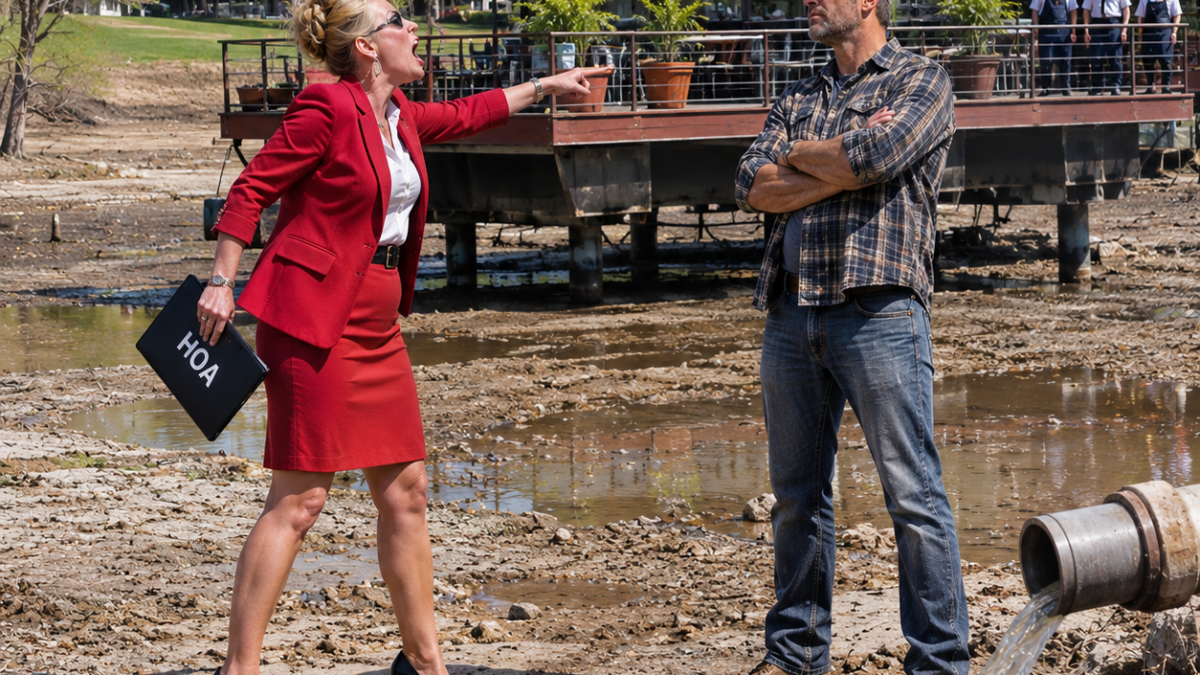
PART 2
## THE FIRST THREE FINES
The first HOA notices arrived six days later.
One for excessive vegetation.
Sarah’s wildflowers.
One for noise.
I had split firewood at seven in the morning.
One for an unpermitted accessory structure.
My grandfather’s shed.
Each notice demanded five hundred dollars.
Each carried Cordelia’s signature.
I called the HOA office.
Cordelia answered.
“Blackthorn Ridge Homeowners Association.”
“Jake Morrison.”
Silence.
Then:
“Yes?”
“I received three fines.”
“Correct.”
“My property isn’t in your association.”
“You’ve been informed that community boundaries are under review.”
“That doesn’t make your rules apply to me.”
“Failure to pay will result in further action.”
I almost laughed.
“Put that in writing.”
“We already did.”
“Good.”
I hung up.
I paid nothing.
Then I called Tom Bradley.
Tom and I had served together years earlier.
He eventually became a property attorney.
He reviewed the deed.
The HOA covenants.
Cordelia’s letters.
Then he called me.
“Jake.”
“What?”
“She has absolutely no authority over your property.”
“I know.”
“No. I mean zero.”
“Still know.”
He laughed.
“What?”
“You sound disappointed.”
“I wanted at least a complicated fight.”
“Give her time.”
He stopped laughing.
“Document everything.”
That phrase became my rule.
Every letter.
Every trespass.
Every photograph.
Every phone call.
Every vehicle.
Every survey stake.
I created a binder.
Then another.
I installed cameras.
Not cheap trail cameras.
Real security cameras.
Night vision.
Motion detection.
Cloud backup.
Sarah used to tease me about overengineering everything.
“If you build a birdhouse,” she once told me, “you design it for nuclear winter.”
She was not wrong.
The cameras caught Cordelia walking my boundary at midnight.
Flashlight.
Measuring tape.
Sometimes another person with her.
Cars drove slowly past my gate.
Once, someone tried to pull out a steel property marker.
My motion lights came on.
They ran.
I saved the footage.
Tom loved it.
“She’s building your case for you.”
“I’d prefer she stop.”
“That would be less useful.”
Lawyers are strange people.
## THE LISTING
The most shocking discovery happened on a Tuesday morning.
I was drinking coffee when a real estate advertisement appeared on my phone.
A photograph of my lake.
Then my dock.
Then my cabin.
Then Sarah’s oak.
The headline:
**PREMIER WATERFRONT COMMERCIAL DEVELOPMENT OPPORTUNITY**
I froze.
I opened the listing.
It described “underutilized community waterfront.”
“Restaurant potential.”
“Luxury recreational access.”
“Existing rustic structures suitable for redevelopment.”
Then:
**Current occupant motivated for transition.**
Occupant.
I was not the owner anymore.
I was apparently an occupant.
I stared at the screen.
Then I saw the agent.
Cordelia Blackthorn.
I called Tom.
He answered:
“Please tell me she did not do something stupid before breakfast.”
“She listed my property.”
There was a pause.
“She what?”
I emailed him the link.
Another pause.
Then:
“Oh.”
“That sounds bad.”
“For her.”
I printed everything.
Saved PDFs.
Archived the page.
Screenshots.
Cordelia had crossed from harassment into active misrepresentation.
But she still wasn’t done.
She began telling residents I was unstable.
An angry veteran.
Possibly dangerous.
She mentioned PTSD at HOA meetings.
I had never told her I had PTSD.
Because I didn’t.
That didn’t stop her.
Flyers appeared.
Residents were encouraged to avoid confrontations with me.
Someone claimed I stored weapons.
My grandfather owned three old hunting rifles.
That became an arsenal.
A man I had known for five years stopped waving when he passed my property.
Another neighbor moved his children away from the roadside when I drove past.
That hurt more than the fines.
Cordelia understood reputation.
Make a man appear dangerous and people stop asking whether he is right.
Sarah would have hated that.
Not because people judged me.
Because she hated cowardly cruelty.
## THE HOA MEETING
I decided to attend.
The community center was packed.
Cordelia sat at the front.
Perfect blazer.
Perfect hair.
Perfect smile.
She spoke about drainage.
Landscaping.
Security.
Property values.
Then financial reports.
I raised my hand.
Her smile faltered.
“Yes, Mr. Morrison?”
“I noticed the monthly financial statement is incomplete.”
“You’re not a member.”
“I noticed.”
Somebody laughed.
Cordelia’s jaw tightened.
I continued.
“Administrative expenses increased thirty-eight percent.”
“This meeting is not your concern.”
“Then why are you fining my property?”
Murmurs.
A man near the back turned toward his wife.
Cordelia tapped the microphone.
“Mr. Morrison, your situation is being handled separately.”
“I’m sure.”
I sat.
At the next meeting, I asked about legal fees.
Then missing reserve balances.
Then payments listed as executive administrative costs.
People began asking their own questions.
Cordelia stopped enjoying my attendance.
Eventually she banned me from speaking.
I kept attending.
Nothing scares people who depend on secrecy more than someone willing to sit quietly and watch.
## THE EASEMENT
Then Cordelia found something real.
That made her more dangerous.
A historical easement.
1920s.
Recorded against part of the property.
She presented it at an emergency HOA meeting like she had discovered the Declaration of Independence.
“Ladies and gentlemen,” she announced, “this proves Blackthorn Ridge has historical access rights to the lake.”
People applauded.
The HOA’s lawyer gave a presentation.
Charts.
Maps.
Historical language.
He argued that my lake fell under shared water access provisions.
Cordelia claimed the community had been illegally denied recreational use.
I sat in the back.
Took notes.
Then went home.
The easement was real.
But the purpose was narrow.
Emergency domestic water access during municipal shortages.
Nothing about recreation.
Nothing about restaurants.
Nothing about boating.
And the provision automatically terminated when municipal water infrastructure reached the district.
That occurred in 1952.
The right was dead decades before Cordelia was born.
Tom read the document.
“This is embarrassing.”
“For them?”
“For any lawyer who signed off on that presentation.”
“So we stop them.”
“Not yet.”
There it was again.
Not yet.
“Why?”
“Because she thinks she has leverage.”
“That seems bad.”
“Let her act like she believes it.”
“You enjoy this too much.”
“I bill hourly.”
Fair.
## MARCUS SAMUEL
Three days later, a man appeared on my porch at seven in the morning.
Expensive suit.
Blueprint tube.
Panic.
“Mr. Morrison?”
“Yes?”
“My name is Marcus Samuel.”
He looked toward the lake.
Then his phone.
Then the property markers.
“Did you lease waterfront rights to Lakeside Dining?”
“No.”
His face went white.
He opened the blueprint.
Floating restaurant.
One hundred fifty seats.
Commercial kitchen.
Wine bar.
Docking station.
The structure was designed specifically for my lake.
“Cordelia Blackthorn accepted seventy-five thousand dollars from me.”
I stared at him.
“For what?”
“Development rights.”
“You were told I agreed?”
“She said you were negotiating final terms.”
“I’ve never spoken to you.”
His mouth opened.
Closed.
Then he sat down on my porch step.
I made coffee.
We spent two hours going through documents.
Contracts.
Emails.
Wire transfers.
Cordelia had promised him an exclusive investment opportunity.
She claimed the lake was community controlled.
She represented me as a willing participant.
Worse—
Marcus knew of other investors.
We contacted them.
Six.
Different amounts.
Different promises.
Same lake.
Cordelia had been selling pieces of a project she did not own.
Marcus became an ally instantly.
Not because he liked me.
Because he wanted his money back.
Motivation doesn’t have to be noble to be useful.
## THE CONSTRUCTION CREW
Three months before the announced opening, barges arrived.
At sunrise.
Diesel engines.
Pile-driving equipment.
Workers.
I walked down to the shoreline.
The foreman, Rodriguez, met me.
“Morning.”
“Who authorized this?”
He pointed toward the work order.
“Blackthorn Ridge.”
“This is private property.”
He stared at me.
“No, sir. Community waterfront.”
“No.”
I showed him the deed.
His expression changed.
Then he handed me his paperwork.
County permits.
Environmental waiver.
Property-owner consent.
My signature.
Except I had never signed it.
I knew my own hand.
The J was wrong.
The M was wrong.
My middle initial sat too close.
I looked at Rodriguez.
“This is forged.”
His radio stopped halfway to his mouth.
“You sure?”
“I’ve been signing my name for fifty-two years.”
He stopped the crew.
Cordelia arrived fifteen minutes later.
White Escalade.
Fast.
She stormed down the dock.
“What is happening?”
Rodriguez pointed at me.
“Ownership dispute.”
“There is no dispute.”
I held up the forged consent.
“You signed my name.”
She barely looked at it.
“Administrative processing.”
“Forgery.”
“Clerical approximation.”
I laughed.
“Clerical approximation?”
She stepped closer.
“You are obstructing a lawful community project.”
“I am the property owner.”
“You’re one man.”
“And?”
“This benefits hundreds of families.”
“Then build it on land you own.”
Her face hardened.
“You don’t understand what you’re risking.”
“No, Cordelia.”
I lowered my voice.
“You don’t.”
For a moment, I saw fear.
Tiny.
Then gone.
She found another contractor.
Construction resumed.
That was when I understood she could no longer afford to stop.
## THE MONEY
Property records told the story.
Cordelia had borrowed against her home.
Roughly four hundred thousand dollars.
Credit lines.
Investor deposits.
HOA payments.
The floating restaurant was not just a business.
It was a lifeboat.
If it opened and generated enough revenue, perhaps she believed she could outrun everything else.
If it failed, she was finished.
That makes desperate people dangerous.
Tom told me:
“Do not confront her alone.”
“She’s a real estate agent.”
“She’s also financially cornered.”
He was right.
Financial desperation can turn ordinary fraud into reckless behavior.
I increased security.
Changed gate locks.
Added cameras near Sarah’s oak.
I hated that.
The memorial site had once required no protection.
## THE BASEMENT
I found the answer by accident.
Two months before opening.
I had avoided cleaning my grandfather’s basement for years.
Old boxes.
Tools.
Receipts.
Maps.
Family things.
After Sarah died, I avoided it even more.
Grief makes ordinary tasks feel disloyal.
Throw away an old coat and suddenly you are afraid you are throwing away a person.
That Saturday, I finally went down.
The basement smelled like cedar, leather, dust, and the faint lavender scent my grandmother had loved.
I opened boxes.
Old fishing licenses.
Photographs.
County tax receipts.
A rusted compass.
Then a cedar trunk.
Inside:
Oilcloth.
String.
Documents.
My grandfather’s water-control records.
The original 1923 agreement.
I read it once.
Then again.
Then I sat on the concrete floor.
The county had designated my grandfather as watershed flood-control coordinator.
The lake was not merely recreational water.
It was part of a historical flood-management system.
My family maintained authority to regulate, divert, and drain the water when necessary for maintenance and downstream protection.
Then I found the diagrams.
Manual spillway gates.
Underground culverts.
Emergency release channels.
The lake could be drained.
Completely.
Within approximately six hours.
I started laughing.
Not because I wanted to destroy the restaurant.
Because for months Cordelia had insisted she controlled the water.
My grandfather had left me a legal contract explaining exactly who did.
Then I found another clause.
Permanent obstructions on the lake surface interfering with emergency drainage operations were prohibited.
The restaurant itself conflicted with the old water-management authority.
I called Tom.
He answered:
“You sound happy.”
“I found something.”
“Legal something?”
“Very.”
## COUNTY ENGINEERING
The next morning, I visited the county engineering office.
A young engineer named Stevens reviewed the documents.
Then pulled archive records.
He became visibly excited.
“This is still active.”
“You sure?”
“Yes.”
He traced the contract number.
“Your family never surrendered the designation.”
He looked at the diagrams.
“My God.”
“What?”
“This system still exists?”
“Yes.”
“Do you know how rare this is?”
“I’m becoming aware.”
He leaned closer.
“Your grandfather built a gravity-operated emergency drainage network.”
“I know.”
“This is incredible.”
“Can we test it?”
His smile disappeared.
Then professional focus returned.
“Legally?”
“Yes.”
“As official maintenance?”
“Yes.”
He checked records.
The system had not been formally tested in decades.
“That actually needs to happen.”
“When?”
He looked at me.
“When do you want?”
I imagined Cordelia’s opening.
Then immediately pulled myself back.
This could not be revenge disguised as maintenance.
We needed safety.
Documentation.
Downstream review.
Environmental confirmation.
Everything.
“First available safe date.”
Stevens checked schedules.
“Saturday.”
The opening.
I stared at him.
He stared back.
“You okay?”
“Perfect.”
## MIKE PATTERSON
I called Colonel Mike Patterson.
Retired Army.
Infrastructure consultant.
Old friend.
“Jake, what are you doing now?”
“Draining a lake.”
Silence.
“Why?”
“Flood-control maintenance.”
Longer silence.
“Whose lake?”
“Mine.”
“And why do I hear happiness in your voice?”
I explained.
By the end, Mike was laughing.
“You need a witness.”
“I need documentation.”
“You need both.”
He agreed to supervise and record the engineering process.
County approval.
Safety plan.
Downstream monitoring.
Discharge rates.
Everything by the book.
That mattered.
I was not going to sabotage Cordelia’s restaurant.
I was going to exercise a legitimate property and flood-control right while performing maintenance the county agreed was necessary.
If a structure illegally floating on my lake could not survive that—
that was not my engineering failure.
## TESTING THE GATES
The spillway controls sat beneath old concrete housings near the southern bank.
I had seen them all my life.
Never understood their full purpose.
Massive steel wheels.
Mechanical linkages.
Valves.
Nothing electronic.
Nothing delicate.
Stevens helped inspect them.
Mike supervised lubrication.
The first wheel resisted.
Then moved.
Metal groaned.
Ancient engineering came alive.
Water surged into an underground channel.
We closed it after a short test.
Stevens looked like a kid.
“This is unbelievable.”
“My grandfather built it.”
“He built it to outlive everybody.”
He had.
Sarah used to say the same thing about my family.
“Morrisons build things like they expect the apocalypse.”
Maybe she was right.
## THE OLD NEIGHBORS
Tom and Martha Hendricks had lived nearby longer than anyone.
Tom remembered watching my grandfather operate the gates.
“Lake would drop like somebody pulled a bathtub plug.”
Martha laughed.
“Your granddad used to let kids watch.”
“Safe distance?”
“Mostly.”
Tom looked toward the lake.
“He saved our fields during flooding.”
That changed how I understood the contract.
I had initially seen it as my weapon.
It was not.
It was infrastructure.
Grandpa had not created the system to win property disputes.
He created it to protect farms and homes.
That made my responsibility heavier.
If I used it, it had to be for legitimate maintenance.
Not anger.
Not theater.
The irony could happen naturally.
I did not need to manufacture it.
## SARAH’S TREE
One evening I sat under Sarah’s oak.
The restaurant construction echoed across the water.
Hammering.
Generators.
Engines.
People shouting.
The lake no longer sounded like ours.
I touched the bark.
J + S.
Still there.
“I’m trying,” I said.
Talking to dead people is strange until you lose someone.
Then it becomes normal.
“I know this isn’t what you meant by peaceful.”
Wind moved through the wildflowers.
No answer.
Of course.
But I remembered something she once told me.
Peace isn’t silence, Jake. Sometimes peace is knowing you defended what mattered.
At the time we had been arguing about a neighbor’s barking dog.
She probably had not intended it as life philosophy.
Still useful.
## CORDELIA TRIES BRIBERY
Rumors spread that I had found old water rights.
Cordelia panicked.
County Commissioner Bradley showed up at my door with an envelope.
Three thousand dollars.
Cash.
And a note.
The language suggested revisiting my flood-control authority for “community benefit.”
Bradley looked embarrassed.
“This was under my windshield.”
“You think Cordelia?”
He handed me the note.
Her perfume was faint but unmistakable.
Vanilla.
Sarah used to say Cordelia smelled like someone weaponized a candle store.
I bagged the note.
Called Tom.
Bradley made a report.
That should have convinced Cordelia to stop.
Instead, she tried sabotage.
## MIDNIGHT AT THE SPILLWAY
Security footage captured her at 1:14 a.m.
Black clothing.
Gloves.
Crowbar.
Bolt cutters.
She approached the protected spillway control.
Tried forcing the housing.
Then the lock.
Then the wheel mechanism.
For nearly twenty minutes.
At one point she kicked it.
Repeatedly.
The system barely noticed.
She left behind a crowbar.
And part of her jacket.
I watched the recording twice.
Then called law enforcement.
Tom said:
“Jake, she is unraveling.”
“I know.”
“No. Listen to me. Stay away from her.”
I did.
Cordelia had stopped behaving like a person managing a conflict.
She was behaving like someone trapped inside one.
## THE PRIVATE INVESTIGATOR
Marcus Webb approached me in a hardware store.
Cheap aftershave.
Bad suit.
Too many questions.
He claimed residents had concerns about my military background.
Discharge history.
Anger.
Weapons.
I let him talk.
Then said:
“You work for Cordelia.”
He froze.
“I represent concerned parties.”
“She’s paying you.”
No answer.
“She’s also under investigation for investor fraud.”
That got him.
“What investigation?”
“Ask her.”
He left.
Three days later, he called.
“Mr. Morrison, I think we should talk.”
We met at a coffee shop.
He looked nervous.
“She fired me.”
“Congratulations.”
“I found your water-management contract.”
“I know.”
“I told her she has no legal basis.”
“And?”
“She demanded I find something else.”
“About me?”
“Anything.”
That made my skin crawl.
Then he gave me financial information.
Credit cards.
Loans.
Investor transfers.
Personal expenses.
Cordelia was broke.
Worse than broke.
She owed people.
The restaurant was her last chance.
Webb switched sides mostly to protect himself.
I accepted the information.
Then passed it through proper legal channels.
He asked:
“Are you really draining the lake?”
I looked at him.
“I’m performing flood-control maintenance.”
He laughed once.
“Right.”
## THE RESTAURANT
Two weeks before opening, the structure looked surreal.
White marble.
Crystal chandeliers.
Gold-rimmed plates.
Professional kitchen.
Champagne storage.
Docking platforms.
Outdoor seating.
Cordelia had built a floating palace.
On my lake.
Without my permission.
News stations called it innovative.
A lifestyle destination.
A transformative partnership.
Cordelia gave interviews from my dock.
My dock.
She stood where Sarah used to sketch birds.
That nearly broke my restraint.
I wanted to walk into the camera frame and tell everyone the truth.
Tom stopped me.
“Wait.”
“I’m tired of waiting.”
“Then stop thinking like a victim.”
I stared at him.
“You have documents.”
“Yes.”
“County approval.”
“Yes.”
“Evidence.”
“Yes.”
“Let facts arrive at the right moment.”
I hated him for twenty seconds.
Then admitted he was right.
## THE HEALTH INSPECTION
Friday morning, health inspector Rodriguez arrived.
Not the construction foreman.
Different Rodriguez.
He reviewed permits.
Looked at seals.
Checked signatures.
Then stopped.
“These are wrong.”
Cordelia stood beside him.
“What?”
“These county seals aren’t valid.”
“Administrative versions.”
“No.”
He held up the environmental paperwork.
“This was never filed.”
Cordelia smiled.
“Perhaps we can discuss this privately.”
Then she reached into her purse.
Pulled out an envelope.
Cash.
In front of staff.
In broad daylight.
Rodriguez stared at it.
“Ma’am, are you offering me money?”
“No.”
“You are holding cash.”
“This is an administrative facilitation.”
I almost laughed from fifty feet away.
Apparently Cordelia believed crimes disappeared when given corporate vocabulary.
Rodriguez shut the facility down.
Red notices.
No opening.
No food service.
No occupancy.
Cordelia called an emergency HOA meeting that night.
## THE MISSING $120,000
I attended.
The room was packed.
Cordelia stood at the front.
“We will open tomorrow.”
People murmured.
“The county is abusing authority.”
Then Janet Mills, HOA treasurer, stood.
Quiet woman.
Always avoided conflict.
That night she held a thick folder.
“Cordelia.”
Cordelia ignored her.
Janet spoke louder.
“Where is the emergency reserve?”
The room went silent.
Cordelia stopped.
“What?”
“One hundred twenty thousand dollars.”
Nobody moved.
Janet opened statements.
“Restaurant suppliers.”
“Construction.”
“Catering.”
“Decor.”
“Those are strategic community investments.”
“They were never approved.”
Cordelia’s voice rose.
“The board authorized development.”
“No.”
Janet held up minutes.
“We didn’t.”
People began shouting.
One man demanded an audit.
Another asked whether his dues bought chandeliers.
A woman cried.
Cordelia lost control.
She screamed back.
Called residents ungrateful.
Cowards.
Small-minded.
She promised the restaurant would open regardless of government sabotage.
Then she stormed out.
I sat in the back.
For the first time, I did not feel like her target.
She had finally created too many victims.
## FRIDAY NIGHT
Mike arrived.
Stevens reviewed safety documents.
Deputy Clark confirmed crowd-control procedures.
We walked the spillway.
Checked gates.
Checked culverts.
Checked downstream flow.
Nothing improvised.
Nothing hidden.
The county had posted notice of maintenance.
If Cordelia ignored the closure order and held a grand opening anyway, that was her decision.
At midnight, I sat on the dock.
The restaurant lights reflected across the water.
It was beautiful.
That almost made me angry.
Wrong things can be beautiful.
That is part of why people fall for them.
Sarah would have loved the chandeliers.
She would have hated everything they represented.
I whispered:
“Tomorrow.”
The water moved gently against the dock.
## SATURDAY MORNING
Perfect sky.
Clear.
Cool.
By ten thirty, luxury cars were arriving.
Without permission.
Mayor.
Commissioners.
Business owners.
Investors.
Reporters.
Cordelia welcomed them.
I stood fifty yards away with Stevens, Mike, and Deputy Clark.
At eleven, I radioed:
“County engineer, Morrison watershed coordinator. Beginning scheduled maintenance.”
Stevens answered:
“Confirmed. Authorized.”
I put both hands on the first wheel.
Turned.
Metal groaned.
The gate opened.
Deep underground, water began moving.
The lake barely changed at first.
Then the current strengthened.
Guests noticed.
A woman near the restaurant looked toward shore.
“What’s happening?”
Cordelia smiled.
“Normal circulation.”
At eleven fifteen, we opened the second gate.
The lake dropped faster.
Two feet.
The floating restaurant settled lower.
One corner touched bottom.
The platform tilted.
Inside, glasses slid.
A tray crashed.
Guests began murmuring.
Cordelia hurried toward me.
“What are you doing?”
“Maintenance.”
“Stop.”
“I’m authorized.”
“You can’t drain the lake today.”
“I can regulate my water whenever the county-approved flood-control schedule requires.”
“I have guests!”
“That sounds like your scheduling problem.”
Her face reddened.
“Do you know who is here?”
I looked toward the mayor.
“Yes.”
“Investors!”
“Yes.”
“Press!”
“Yes.”
She stepped closer.
“You planned this.”
I looked at her.
“No, Cordelia.”
I held up the county notice.
“I documented it.”
There is a difference.
## THE THIRD GATE
Cordelia tried to stop us.
Deputy Clark stepped between her and the controls.
“Ma’am, stay back.”
“This is my community!”
“This is private property.”
“You don’t understand!”
“I understand the county order.”
She screamed toward Stevens.
“You’ll lose your job!”
Stevens looked almost amused.
“For performing scheduled maintenance?”
Then the third gate opened.
Water level fell another three feet.
The restaurant descended.
Slowly.
Then suddenly.
Its flotation system reached mud.
One side settled.
The other stayed buoyant.
The entire dining room tilted.
Tables moved.
Plates slid.
Champagne bottles rolled across marble.
Guests shouted.
Servers evacuated.
Some waded through mud.
Others crossed temporary walkways.
Nobody was injured.
That mattered.
Mike documented everything.
Stevens monitored downstream discharge.
The system worked exactly as designed.
My grandfather had built it almost a century earlier.
Cordelia’s floating palace had existed less than a month.
The old system won without even knowing there was a contest.
## “THIS IS COMMUNITY PROPERTY!”
Cordelia stood near the shore screaming.
“This is community property!”
I held the original agreement.
“No.”
“You lost exclusive rights!”
“No.”
“The easement—”
“Expired in 1952.”
Her face froze.
The media microphones moved closer.
I continued.
“The historical easement allowed emergency domestic water access during municipal shortages. It never granted recreational or commercial development rights.”
A reporter asked:
“Did the HOA know that?”
I looked at Cordelia.
“She had legal counsel.”
Cordelia pointed at me.
“He is sabotaging a community business!”
Stevens stepped forward.
“This is county-authorized flood-control maintenance.”
Another reporter asked:
“Was the restaurant legally permitted?”
Health inspector Rodriguez had arrived.
He answered.
“No.”
Silence.
Then chaos.
Questions.
Cameras.
Investors shouting.
Marcus Samuel appeared.
The original investor.
He walked directly toward Cordelia.
“You took seventy-five thousand dollars from me.”
She backed away.
“This is not the time.”
“You told me Morrison approved the project.”
“Marcus—”
“You lied.”
Other investors joined.
Cordelia’s face collapsed.
## THE FBI
Then black SUVs arrived.
Not dramatic sirens.
Just vehicles.
Doors opening.
People in jackets.
Agent Sarah Samuel stepped out.
No relation to Marcus.
Financial crimes.
She held a warrant.
“Cordelia Blackthorn?”
Cordelia stared.
“You’ve got to be kidding.”
“No, ma’am.”
Charges included wire fraud.
Money laundering.
Real-estate fraud conspiracy.
Misuse of investor funds.
Other financial crimes.
Cordelia looked toward me.
Pure hatred.
“You did this.”
“No.”
“You ruined everything.”
“No.”
“You drained the lake!”
“That part was me.”
Even Mike smiled.
Cordelia was handcuffed.
News cameras recorded every second.
She shouted as they walked her away.
“This isn’t over!”
I looked at the restaurant sitting in mud.
Then at the ancient spillway controls.
“My grandfather built that system to last.”
She twisted toward me.
“Your restaurant didn’t.”
That was the last thing I ever said to her.
## AFTER THE CROWD LEFT
By sunset, the lake was mostly drained.
Mud.
Exposed rocks.
Old stumps.
The floating restaurant rested crooked in the basin.
Ugly now.
Without water, all the illusion disappeared.
It looked exactly like what it was.
A structure in the wrong place.
Mike stood beside me.
“Feel good?”
I thought about it.
“Not really.”
He nodded.
“Good.”
“What does that mean?”
“Means you didn’t do it for the wrong reason.”
I looked toward Sarah’s oak.
“I wanted revenge.”
“Of course.”
“I wanted her humiliated.”
“Also normal.”
“But now…”
He waited.
“Now I just want my lake back.”
That was the truth.
## REMOVING THE RESTAURANT
The structure could not stay.
Court orders followed.
Contractors returned.
This time with legitimate authority.
They dismantled the platform.
Removed kitchen equipment.
Recovered materials.
Cleaned the basin.
Every piece carried away felt like a small restoration.
But I hated the damage.
Mud churned.
Vegetation crushed.
Shoreline disturbed.
The lake looked wounded.
I worried.
Stevens assured me the spring system would recover.
Still, I worried.
Sarah had asked for peace.
I had given her mud.
That is how grief talks.
Unfairly.
Tom reminded me:
“You didn’t put the restaurant there.”
“I drained it.”
“Legally.”
“It still looks destroyed.”
“Temporary damage from removing an illegal structure is not moral equivalence.”
Lawyers speak like that.
Sometimes useful.
## THE WATER RETURNS
We closed the gates.
The spring began filling the basin.
Slowly.
Then steadily.
Day one:
Puddles.
Channels.
Shallow pools.
Day three:
A lake shape again.
Day seven:
Water covered most of the mud.
Two weeks:
Almost full.
The surface cleared.
Fish returned from deeper spring refuges and connected water pockets.
Birds came back.
One morning, a loon landed.
I stood on the dock and cried.
Not loudly.
Just tears.
Sarah loved loons.
The sound carried across the water.
For the first time in months, the lake sounded like home.
## CORDELIA’S CASE
The investigation revealed more than I expected.
Investor fraud.
Misused HOA money.
Personal expenses.
Restaurant construction.
Fake permits.
Multiple financial schemes.
Cordelia eventually pleaded guilty to numerous federal charges.
She received prison time.
Restitution.
Her house was sold.
The HOA audit showed more than two hundred thousand dollars had been misused or diverted over time.
Some board members faced civil claims.
Most had been negligent rather than criminal.
There is a difference.
Not everyone who follows a bad leader is a conspirator.
Some are cowards.
Some are lazy.
Some want the title without responsibility.
That can still cause enormous harm.
## THE APOLOGIES
Residents began coming to my gate.
One by one.
Some brought food.
One brought wine.
Another brought a plant.
Peggy from the subdivision cried.
“I believed her.”
“I know.”
“She said you were dangerous.”
“I know.”
“I’m sorry.”
That one was harder.
It would have been easier if everyone were evil.
They weren’t.
Most were ordinary people who trusted the person with the microphone.
I said:
“Thank you.”
Not:
“It’s okay.”
Because it wasn’t.
But apologies matter when they cost someone pride.
## JANET
Janet Mills became one of the people who helped rebuild trust.
She had exposed the missing reserve money.
At the first post-Cordelia community meeting, she placed full financial statements on every chair.
“No more summaries,” she said.
Everything.
Vendor payments.
Balances.
Contracts.
Fees.
People were stunned at how simple transparency looked.
The HOA survived briefly under an interim board, then residents voted to dissolve it after legal review showed they could replace many functions through simpler neighborhood agreements.
Some people opposed dissolution.
That was fine.
For the first time, disagreement happened openly.
Healthy communities are not ones where everybody agrees.
They are places where disagreement does not require fear.
## MY GRANDFATHER’S SYSTEM
County officials became fascinated by the spillway.
Historical engineers visited.
Records were digitized.
The system received landmark status.
Students came to study it.
Stevens built a small educational program around gravity-fed flood control.
He once stood beside a group of engineering students and said:
“Modern systems are smarter.”
Then pointed at my grandfather’s gate.
“But this one still works after a century.”
I smiled.
Grandpa would have loved that.
He distrusted anything that needed software updates.
## SARAH’S GARDEN
The memorial wildflowers Cordelia’s visitors had trampled came back.
Some needed replanting.
Neighbors volunteered.
Peggy came.
Janet.
Marcus Samuel.
Even Rodriguez the contractor sent two workers on their day off.
We expanded the garden.
Native flowers.
Benches.
Bird habitat.
I did not want Sarah’s memorial turned into some public attraction.
That mattered.
So we kept the inner space private.
But around it, we created a conservation garden for educational visits.
The oak remained ours.
J + S.
No signs.
No plaques.
Just us.
## THE FIRST FESTIVAL
The idea came from Martha Hendricks.
“We need something good connected to this place again.”
“I don’t want crowds.”
“Not a carnival.”
“That sounds like the beginning of a carnival.”
She ignored me.
The Sarah Morrison Conservation Festival began small.
Local families.
Water education.
Native plants.
Engineering demonstrations.
Birdwatching.
No alcohol sponsors.
No luxury dining.
No chandeliers.
No marble.
Children sat on the grass while Stevens demonstrated hydraulic principles using a plastic tub.
Mike brought old Army engineering equipment nobody asked for.
People loved it.
The festival grew.
Not because we marketed it.
Because families liked it.
That distinction mattered to me.
## THE SCHOLARSHIP
Community donations created a scholarship in Sarah’s name.
Environmental engineering.
Water management.
Conservation.
The first recipient was a local girl named Emily Torres.
Her father worked construction.
Her mother worked nights at a hospital.
Emily wanted to design flood-resilient infrastructure.
At the ceremony, she stood beneath Sarah’s oak and said:
“I want to build systems that help communities instead of dividing them.”
I had to look away.
Later, Mike said:
“You cried.”
“Pollen.”
“In October?”
“Climate change.”
He laughed.
## MARCUS SAMUEL’S SECOND CHANCE
Marcus lost money.
A lot.
He eventually recovered some through restitution.
Not all.
One day he asked to meet.
We sat on the dock.
“I should have verified ownership.”
“Yes.”
He looked embarrassed.
“I trusted documents.”
“Documents can lie when people make them lie.”
“I trusted confidence.”
That was the real problem.
Cordelia had sounded certain.
People confuse certainty with truth.
Marcus later invested in a legitimate restaurant downtown.
He invited me to the opening.
I declined.
Then Sarah’s voice appeared in my head:
Stop being stubborn.
So I went.
The restaurant was beautiful.
Legally permitted.
On land Marcus actually owned.
We laughed about that.
## THE FLOATING PLATFORM BECOMES SOMETHING ELSE
Some of the restaurant materials were salvageable.
Steel.
Wood.
Decking.
We could have sold them.
Instead, we used portions to build the new conservation center.
The irony was almost too perfect.
Cordelia’s illegal restaurant became classrooms.
A piece of the bar became a demonstration table.
Reclaimed decking became a walkway.
One marble slab became a bench.
I almost refused the marble.
Then Emily said:
“Why waste it?”
Sarah would have agreed.
So the marble stayed.
No gold trim.
## THE MAYOR
Mayor Thompson eventually apologized for attending the opening.
“I believed the project was permitted.”
“You didn’t ask?”
He looked uncomfortable.
“No.”
“That’s the problem.”
He nodded.
“I know.”
People in public positions hate being reminded that showing up is endorsement.
He helped secure funding for historical preservation.
Not forgiveness.
Accountability.
There is a difference.
## THE CABIN
For months after everything, I kept expecting noise.
Trucks.
Surveyors.
Cordelia.
My nervous system had learned invasion.
Silence felt suspicious.
One evening, I sat on the porch.
Nothing happened.
Another evening.
Nothing.
Slowly, peace stopped feeling like the calm before an attack.
It became peace again.
That process took longer than draining and refilling the lake.
## THE ANNIVERSARY
One year after the failed grand opening, Mike visited.
We stood at the spillway.
“Want to drain it again?”
“No.”
“Just a little?”
“No.”
“For maintenance?”
“It was maintained last month.”
He sighed.
“You’ve changed.”
“Improved.”
“Debatable.”
We walked to the dock.
Sarah’s oak cast a long shadow.
Mike sat.
“Think Cordelia understood what she did?”
“No.”
“Does that bother you?”
“Used to.”
“And now?”
I looked at the water.
“No.”
That surprised me as I said it.
I had once wanted recognition.
For Cordelia to admit I was right.
To understand Sarah mattered.
To understand Grandpa mattered.
Eventually I realized needing her understanding gave her one more piece of control.
I didn’t need it.
## WHAT SHE REALLY STOLE
People said Cordelia tried to steal my lake.
True.
But she stole something else first.
My peace.
For months, I woke checking cameras.
Read letters with my jaw clenched.
Watched strangers walk near Sarah’s memorial.
Wondered whether another forged document existed.
That constant readiness becomes a kind of occupation.
No one has to physically take your house if they can make you afraid inside it.
Recovering the lake was easier than recovering that feeling.
But it came back.
## SCHOOL KIDS
A fourth-grade class visited.
One boy stared at the giant spillway wheel.
“Did you use this to destroy the restaurant?”
His teacher looked horrified.
I laughed.
“No.”
“But the lake went away.”
“Yes.”
“So…”
“I used it for flood-control maintenance.”
He frowned.
“That sounds less cool.”
“It is less cool.”
“Did the restaurant fall?”
“It settled into mud.”
His eyes widened.
“That’s cool.”
Fair.
Then I explained why systems should never be used recklessly.
Why water downstream matters.
Why permits matter.
Why engineering has consequences.
His hand shot up.
“So the bad lady ignored engineering?”
“That’s one way to describe it.”
He nodded seriously.
“Bad idea.”
Exactly.
## PROPERTY VALUES
Cordelia always talked about property values.
The irony?
After conservation designation, transparency reforms, and improved public access to environmental education, nearby property values rose.
Not because of restaurants.
Because people liked living near protected land.
Local businesses benefited from visitors.
Hotels hosted engineering conferences.
Cafés served field-trip groups.
Nature tourism brought money.
Not Cordelia-level fantasy millions.
Steady money.
Healthy money.
Economic activity that did not require stealing someone’s lake.
Progress without erasure.
That became the lesson.
## TOM AND MARTHA
Tom died three years later.
Martha asked whether we could scatter some of his ashes near the creek that my grandfather’s system had protected.
Of course.
A small group gathered.
She said:
“Tom always said your granddad saved our farm.”
I told her:
“Your family saved the story.”
She smiled.
History is like that.
Infrastructure matters.
So do the people who remember what it did.
## STEVENS
Stevens eventually became county chief engineer.
At his promotion ceremony, he joked:
“I got the job because I helped drain a man’s lake.”
I said:
“You’re welcome.”
He later helped modernize flood-control planning across the county while preserving the old system as emergency redundancy.
Grandpa would have approved.
Use new technology.
Keep the wheel that still turns.
## SARAH
I still talk to her.
Less desperately now.
More conversationally.
I tell her about school visits.
Emily’s scholarship.
The loon population.
Mike being annoying.
One evening, I said:
“I kept it peaceful.”
Then I looked at children paddling educational canoes across the lake.
Not silent.
Not private in the same way.
But peaceful.
I wondered whether I had broken my promise by letting the place serve others.
Then I remembered Sarah.
She never meant isolation.
She meant no greed.
No exploitation.
No ugliness of spirit.
The lake was more alive now.
That felt like keeping the promise.
## THE LETTER FROM PRISON
I received one letter from Cordelia.
I almost threw it away.
Tom said:
“Read it if you want. Don’t if you don’t.”
I waited a week.
Then opened it.
She blamed everyone.
Investors.
Board members.
Lawyers.
Media.
Me.
Near the end, one sentence:
**You took everything from me over a piece of water.**
I stared at it.
Then laughed softly.
She still didn’t understand.
I did not answer.
There was nothing useful to say.
## THE ORIGINAL DEED
The deed is framed now.
Not the flood contract.
That stays protected.
The deed hangs in the conservation center.
A copy, technically.
The original remains secured.
Below it, a small plaque:
**Morrison Family Property, established 1923.**
Nothing dramatic.
No mention of Cordelia.
That was deliberate.
I did not want her name attached forever to my grandfather’s legacy.
She occupied enough space.
## THE REAL REVENGE
People love the part where the restaurant sank into mud.
Technically, it settled.
But “settled” lacks drama.
They imagine me turning a giant wheel while Cordelia screams.
That part is mostly accurate.
They imagine champagne rolling across tables.
Also accurate.
They imagine I planned everything only to humiliate her.
That part is wrong.
At first, maybe.
I wanted revenge.
I wanted her to feel powerless.
Then I found my grandfather’s contract.
And something changed.
He had been given authority because people trusted him to protect water.
That was not a toy.
If I turned the system into a personal weapon, I would become exactly what I hated about Cordelia.
So we did it correctly.
County approval.
Safety studies.
Witnesses.
Controlled discharge.
Legal notice.
The consequences for her illegal structure were hers.
That was the difference.
## ANOTHER SUNSET
Years later, I sat on the dock.
Sarah’s old sketchbook beside me.
I sometimes bring it out.
One page showed the memorial oak when it was smaller.
Another showed the far shoreline.
No subdivision.
No restaurant.
Just trees.
I turned the page.
She had written:
**Water changes shape without losing itself.**
I had forgotten that.
She probably wrote it about painting reflections.
But it felt like a message.
The lake changed.
The community changed.
I changed.
Still us.
## THE OLD WHEEL
My hands are older now.
The spillway wheel feels heavier.
We test it on schedule.
Students observe.
County records everything.
During the last test, Emily—now studying engineering—stood beside me.
“You want help?”
“I can still turn it.”
“I didn’t say you couldn’t.”
“You thought it.”
She smiled.
“Maybe.”
We turned together.
Water moved.
I thought about Grandpa’s hands.
My father’s.
Mine.
Now hers.
Legacy is not ownership alone.
It is knowledge passed forward.
## WHY CORDELIA LOST
She lost because she misunderstood five things.
Property.
Paperwork.
Money.
People.
Infrastructure.
She believed property became hers if she could create enough documents.
She believed documents became true if they looked official.
She believed money could fix every problem.
She believed people would stay quiet forever.
And she believed infrastructure was scenery.
The lake looked decorative to her.
It wasn’t.
The spillway looked obsolete.
It wasn’t.
My grandfather’s contract looked forgotten.
It wasn’t.
That is the danger of arrogance.
You stop asking what things are for.
You only ask how they can serve you.
## THE LAST HOA MEETING I ATTENDED
After the dissolution vote, people stood around unsure what to do.
For years, Cordelia had controlled every agenda.
Now no one had a script.
Janet asked:
“Jake, anything you want to say?”
I stood.
Looked at the residents.
Some had believed terrible things about me.
Some apologized.
Some hadn’t.
I said:
“I don’t want your lake.”
Confused faces.
“I don’t want your roads.”
A few laughs.
“I don’t want to run your neighborhood.”
More laughter.
“I just want everyone to understand that owning a home near someone else’s property does not give you ownership over their life.”
Silence.
Then Peggy clapped.
Others followed.
That was enough.
## FIVE YEARS LATER
The conservation festival now attracts hundreds.
I hide during part of it.
Too many people.
Mike says I’ve become the elderly hermit Cordelia advertised me as.
He might be right.
But children still visit.
Engineering students still study the spillway.
Scholarships still go out.
The lake remains private property.
Educational access happens by invitation and agreement.
That distinction matters.
Generosity only means something when it is chosen.
Cordelia tried to force sharing.
What she really wanted was control.
After she was gone, I chose to share parts of the property with the community.
Because choice changes everything.
## MARCUS’S DAUGHTER
One year, Marcus Samuel brought his daughter to the festival.
She was twelve.
She asked:
“Did my dad really invest in the bad restaurant?”
Marcus groaned.
I smiled.
“Yes.”
“Why?”
“He believed a convincing liar.”
She looked at him.
“You always tell me to verify things.”
Marcus sighed.
“Life lessons are usually expensive.”
She nodded.
Then ran toward the canoe group.
Marcus watched her.
“Still embarrassing.”
“Good.”
“What?”
“Means you learned.”
He laughed.
## THE RESTAURANT BENCH
Remember that marble?
It sits near the education center.
People rest on it.
No plaque explaining its origin.
Only those of us who know, know.
Sometimes I sit there.
Cordelia spent thousands importing that marble for a luxury restaurant designed to impress investors.
Now muddy children sit on it after pond ecology classes.
That feels appropriate.
## RAIN
One spring, heavy rain hit the county.
Three days.
Creeks rose.
Fields saturated.
Stevens called.
“We may need the Morrison system.”
For the first time since the restaurant incident, the spillway authority faced a real emergency.
We opened channels.
Controlled the lake level.
Released water gradually.
Protected downstream farms.
Tom Hendricks’s property—now Martha’s son’s—stayed dry.
That night, after the storm passed, Stevens said:
“Your grandfather’s system just saved millions in damage.”
I stood in the rain.
That mattered more than Cordelia ever did.
The system was never about revenge.
It was about service.
## FULL CIRCLE
A local newspaper printed a photo of the flood operation.
Headline:
**Century-Old Spillway Protects Modern Community**
No mention of floating restaurants.
No handcuffs.
No scandal.
Just Grandpa’s system working.
I clipped it.
Put it beside Sarah’s sketches.
That is how I prefer to remember the story.
Not the day something failed.
The day something old still worked.
## WHAT I WOULD TELL CORDELIA NOW
Nothing.
That is the truth.
Years ago, I imagined speeches.
Perfect lines.
Explanations.
I wanted to tell her she underestimated me.
Underestimated Grandpa.
Underestimated the law.
Now?
Silence is better.
My life continued.
That is the answer.
## THE PROMISE
Sometimes I walk to the oak.
Touch the initials.
“Still peaceful,” I tell Sarah.
Then children laugh from the education center.
A canoe paddle splashes.
A teacher calls for students to stay together.
Mike argues with someone about mechanical advantage.
Not silence.
Peace.
I finally understand the difference.
Peace is not the absence of sound.
It is the absence of fear.
## THE END
Cordelia Blackthorn looked at my lake and saw millions of dollars trapped behind one stubborn man.
She saw my cabin and thought redevelopment.
She saw my grief and thought weakness.
She saw an old deed and thought loophole.
She saw an easement and ignored the expiration.
She saw investors and thought deposits.
She saw HOA reserves and thought available capital.
She saw a floating restaurant before she saw permission.
Then she saw my grandfather’s spillway too late.
That was her tragedy.
Not that she lost.
That she never learned the difference between access and ownership.
Between leadership and control.
Between development and theft.
Between confidence and truth.
I spent thirty years in the Army Corps of Engineers learning that water always follows the path available to it.
Block one route, pressure builds.
Open another, flow begins.
Human beings are not so different.
Cordelia kept creating pressure.
Fines.
Lies.
Trespass.
Forgery.
Fraud.
Harassment.
Eventually everything needed somewhere to go.
The law provided one route.
The county provided another.
Her own residents opened a third.
And my grandfather had literally built the fourth beneath the lake.
When the gates opened that Saturday morning, I watched water rush through stone channels built before my father was born.
The floating restaurant slowly lost the one thing keeping it above everything it had been built on.
Water.
Without it, the marble did not matter.
The chandeliers did not matter.
The gold plates did not matter.
The publicity did not matter.
The VIP guest list did not matter.
It sank into the reality underneath it.
Mud.
That image stayed with me.
Not because it was funny.
Although Mike still thinks it was.
Because it was honest.
Cordelia had spent months creating appearances.
Community property.
Legal easement.
Approved permits.
Visionary leadership.
Shared prosperity.
The water disappeared.
So did the illusion.
Underneath was the truth.
Private land.
Forged paperwork.
Stolen money.
Broken trust.
And an expensive structure that had never belonged there.
The lake eventually returned.
That matters.
Everything healthy came back.
The water.
Fish.
Birds.
Wildflowers.
Quiet evenings.
Neighbors.
Purpose.
Cordelia’s restaurant vanished.
Her name gradually stopped coming up.
That is the nature of things built on lies.
They require constant energy to remain standing.
Stop feeding them and eventually gravity does the work.
Grandpa’s system required something else.
Maintenance.
Knowledge.
Responsibility.
It survived because it was built around reality.
Sarah’s memory survived for the same reason.
I used to think keeping my promise to her meant preventing the world from touching the lake.
I was wrong.
The world touches everything eventually.
Developers arrive.
People die.
Neighbors change.
Storms come.
Wood rots.
Water rises.
Water falls.
Peace cannot mean freezing life in place.
Peace means choosing what deserves to remain when everything else changes.
The oak remained.
The lake remained.
The spillway remained.
My family’s ownership remained.
The community learned.
And I remained.
Older.
Less angry.
Still stubborn.
Some mornings, before visitors arrive, I walk to the end of the dock.
The water is smooth.
Mist lifts off the surface.
The oak reflects near the shoreline.
For a few minutes, the last several years disappear.
I can almost see Sarah beside me with her sketchbook.
I can almost hear Grandpa turning one of those heavy steel wheels.
I can almost hear my father complaining that we should have replaced the dock ten years earlier.
Then the sun rises.
The illusion fades.
And what remains is enough.
One morning, Emily found me there.
She had graduated by then.
Environmental engineer.
She was helping the county design resilient water infrastructure.
She sat beside me.
“Do you ever miss how it was before?”
“Before Cordelia?”
“Before everything.”
I thought.
“Yes.”
“Would you undo it?”
I looked toward the conservation center.
A piece of Cordelia’s old restaurant platform formed part of the porch.
Kids would arrive in an hour.
Sarah’s scholarship had helped send four students to college.
Grandpa’s spillway had official protection.
The neighborhood no longer had an HOA.
People knew my name for something other than rumors.
I shook my head.
“No.”
“Why?”
“Because wanting the pain gone would mean wanting everything that grew out of it gone too.”
She nodded.
Then said:
“That sounds like something Mrs. Morrison would have said.”
I smiled.
“You never met Sarah.”
“No.”
“How do you know?”
“Everybody talks about her.”
That hit me harder than I expected.
Sarah had been dead for years.
Yet children who never met her knew her name.
Not because of cancer.
Not because of grief.
Because her name was attached to something hopeful.
That was a better memorial than anything I could have built alone.
Later that day, I stood beneath her oak.
The initials were harder to read now.
The bark had grown.
Trees do that.
They do not preserve carvings for us.
They heal around them.
That felt important.
I ran my fingers across the rough bark.
“Promise kept,” I said.
Not perfectly.
Nothing worth keeping is protected perfectly.
But the lake was peaceful.
The land was ours.
The community was better.
And the floating restaurant?
Gone.
Years later, people still ask me whether I drained the lake just to destroy Cordelia’s restaurant.
The answer is no.
I drained it because the county and I had every lawful reason to test a flood-control system my family had maintained for generations.
I drained it because the lake was never hers to control.
I drained it because infrastructure has to work even when someone inconveniently builds something illegal on top of it.
Did I know what would happen?
Yes.
Was there satisfaction in watching her monument to greed settle into mud?
I would be lying if I said there wasn’t.
But satisfaction is not the same as purpose.
The purpose was reclaiming what belonged to my family.
The purpose was making truth visible.
The purpose was ending a fraud that had already hurt investors, homeowners, neighbors, and the memory of the woman I loved.
The purpose was peace.
Cordelia believed power meant controlling people.
Grandpa believed power meant controlling water responsibly.
Sarah believed strength meant knowing what was worth protecting.
I learned from all three.
One showed me what not to become.
The other two showed me who I already was.
So if someone ever tells you that a document is too old to matter, remember my grandfather’s 1923 contract.
If someone tells you money can turn private property into community property, remember the marble restaurant sitting in mud.
If someone tells you leadership means forcing everyone else to accept your vision, remember the HOA residents demanding to know where their money went.
And if somebody mistakes grief for weakness—
let them.
Quiet people are often quiet because they are thinking.
And sometimes the person standing silently at the edge of the lake is not defeated.
Sometimes he is simply waiting for eleven o’clock.
Waiting for the county engineer to give the signal.
Waiting for a steel wheel built by his grandfather to start turning.
Waiting for gravity to do what gravity has always done.
Take everything built on the wrong foundation—
and bring it down to earth.
Cordelia wanted to turn my lake into a business.
Instead, her restaurant became a lesson.
She wanted to erase Sarah’s peace.
Instead, Sarah’s name became part of a conservation program.
She wanted to use my grandfather’s land for profit.
Instead, his engineering became a protected historical landmark.
She wanted the whole neighborhood to see me as an obstacle.
Instead, they eventually saw the obstacle had been the person lying to them.
And that is why, when I look across the lake now, I no longer remember Cordelia first.
I remember Sarah.
Her sketchbook.
The loons.
Smoke from the cabin.
Her head resting against my shoulder.
I remember Grandpa.
His old tools.
His handwriting.
The massive steel gates he maintained because people downstream depended on him.
I remember who this place belonged to before Cordelia arrived.
And who it belonged to after she left.
The same people.
My family.
That was the part she could never understand.
Property is more than the price someone might pay for it.
Home is more than development potential.
And peace is not something a rich, loud, ambitious stranger gets to redefine because she found an old piece of paper and thought no one else would read it carefully.
She built her restaurant on my lake.
She mocked my grief.
She forged my name.
She took other people’s money.
She ignored the county.
She ignored the law.
She ignored a hundred years of history.
Then she built everything on top of water she did not control.
My grandfather had already solved that problem in 1923.
All I had to do was turn the wheel.








