PART 2: HOA Built a Highway Through My Protected Wetlands — Then the Rain Started Rising
PART 2
I called Evelyn from the field.
She answered on the second ring.
“Tell me they stopped.”
“They didn’t.”
“How far in?”
“Too far.”
“That’s not a measurement.”
“Thirty yards of fill across the western channel. Maybe more.”
She went quiet.
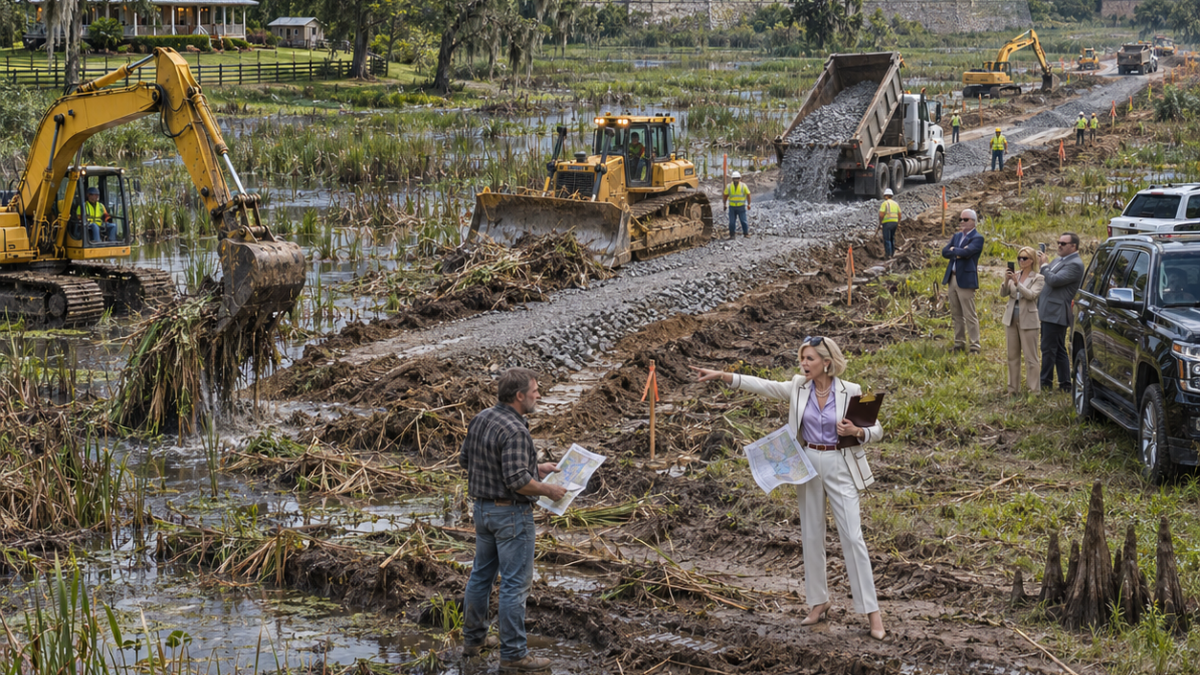
Behind me, a bulldozer pushed another load of gravel into water that had been moving freely that morning.
“Thomas, listen to me. Do not interfere with the equipment.”
“I’m standing on my property.”
“I know.”
“They’re trespassing.”
“I know.”
“They’re destroying a regulated wetland.”
“I know that too.”
“Then why am I the one standing here watching it happen?”
“Because courts move slower than bulldozers.”
That was the sentence I hated most.
I walked farther from the machines.
“How soon on the injunction?”
“We filed emergency papers this morning. I’m trying to get a judge.”
“They could bury the entire channel by tomorrow.”
“Then document everything.”
“That’s what everybody keeps telling me.”
“Because evidence is what turns outrage into consequences.”
I looked toward Natalie.
She was talking to Paul and pointing toward a laminated construction rendering spread across the hood of a truck.
Her husband owned Adams Development Group.
I had known that.
What I hadn’t understood was how much that mattered.
This road wasn’t just Natalie’s political trophy.
Her husband’s company was getting paid to build it.
“Evelyn.”
“Yes?”
“Pull the HOA contract with Adams Development.”
“Already requested.”
“I want the bid process too.”
“Why?”
“Because Natalie told the community they were getting a discounted project.”
“You think they weren’t?”
“I think I want to know who benefits every time she calls this progress.”
Evelyn exhaled.
“Good. That’s a better question.”
I hung up.
Bill was standing near the tree line with his hands jammed into the pockets of an old rain jacket.
He was seventy-one, retired electrician, and had lived beside my family’s land for two decades.
He watched the machines with the expression of a man witnessing someone saw through a power cable after being warned it was live.
“They really doing it?”
“They’re doing it.”
“Can’t you stop them?”
“I’m trying.”
Bill nodded toward Natalie.
“She looks happy.”
“She thinks she won.”
“You going to tell her?”
“Tell her what?”
“That water doesn’t vote.”
I looked at him.
“That’s pretty good.”
“I’m old. I’ve had time.”
By sunset, the roadbed reached nearly halfway through the lowest section of the wetland.
Three cypress trees were down.
Cattails had been buried beneath compacted stone.
The shallow pond where a pair of herons nested every spring was brown with sediment.
I walked the edge with a survey rod and notebook.
Water level.
Flow direction.
Turbidity.
Blocked channel.
Coordinates.
Photographs.
Every ten feet.
It was the kind of field work I had spent years doing for clients who actually wanted to know whether a project was safe.
This time I was documenting damage after the people responsible had decided they didn’t need my answer.
At 7:40, Natalie finally approached.
The construction crew was packing up.
She took off her hard hat.
“You should go home, Thomas.”
“I am home.”
Her smile tightened.
“You know what I mean.”
“Do I?”
“You’re upsetting the workers.”
“They’re on my property.”
“We’ve been through this.”
“No. You keep saying that because you want repetition to become permission.”
She folded her arms.
“The community voted.”
“The community can vote to build a bridge to the moon. It still doesn’t give you my land.”
“You are making this harder than it needs to be.”
I laughed once.
“You tore out my boundary markers.”
“I did no such thing.”
“Your contractor did.”
“You can prove that?”
“Yes.”
That stopped her.
Only for half a second.
But I saw it.
“Trail cameras,” I said.
Her eyes flicked toward the tree line.
I continued.
“I have the trucks. The workers. The stakes. The markers being removed. I have you standing here directing the work.”
“You’re recording people without consent now?”
“On my property.”
Her jaw tightened.
“Thomas, I’m going to give you some advice.”
“I can’t imagine wanting it.”
“This neighborhood is tired of you fighting everything.”
“I don’t live under your HOA.”
“You live beside us.”
“That doesn’t make you my government.”
“You’re one man.”
“And?”
“You’re trying to stop something more than a hundred families want.”
I looked behind her.
At the buried reeds.
The felled cypress.
The stagnant water already gathering against the new fill.
“Then a hundred families are being lied to.”
Her face hardened.
“No. They’re being led.”
That told me more about Natalie Adams than any document ever would.
She didn’t think leadership meant representing people.
She thought it meant moving them.
Sometimes by persuasion.
Sometimes by fear.
Sometimes by simply acting so certain that nobody stopped to ask whether she had the right.
She walked away.
I stayed.
The frogs did not sing that night.
That bothered me more than I expected.
My father had first brought me to that marsh when I was eight.
It wasn’t ours then.
He was helping the previous owner repair a pump.
Dad knew enough about land to explain things in simple language.
“See all this soggy mess?”
I nodded.
“It’s working.”
I remember laughing.
“It doesn’t look like it.”
“That’s because good land does half its work where nobody notices.”
Years later, when the property came up for sale, that sentence came back to me.
Good land does half its work where nobody notices.
So do good systems.
Wetlands look idle until rain arrives.
Floodplains look empty until water needs them.
Drainage channels look unnecessary until somebody blocks one.
Natalie saw unused space.
I saw infrastructure older and smarter than anything Willow Bend had ever built.
The next morning, the chainsaws started at six thirty.
I was already awake.
Coffee untouched.
Camera ready.
The crew cut two more cypress trees.
I filmed from the boundary.
One younger worker noticed me.
He walked toward the foreman.
They argued briefly.
Then the younger man came over.
He kept his voice low.
“Mr. Harris?”
“Thomas.”
“Okay. Thomas.”
He looked back toward the crew.
“I probably shouldn’t be talking to you.”
“Then don’t say anything you’ll regret.”
He swallowed.
“My name’s Luis.”
I waited.
“They told us the boundary had been legally changed.”
“It hasn’t.”
“I figured.”
“Why?”
“The stakes don’t match the survey file we got Monday.”
That caught my attention.
“What survey file?”
“Company packet.”
“Do you have a copy?”
His eyes widened.
“I can’t give you company documents.”
“I didn’t ask you to.”
He nodded.
Good.
“Who told you the line was changed?”
“Paul.”
“Adams?”
“Yes.”
“Did he give you a county survey?”
“A PDF.”
“County stamp?”
“I don’t know.”
“Surveyor’s certification?”
“I don’t know.”
“Recording number?”
“I definitely don’t know.”
The foreman shouted:
“Luis!”
He flinched.
I said, “You don’t owe me anything. But if somebody asks you later what you saw, tell the truth.”
He nodded quickly.
Then went back to work.
That afternoon, Evelyn called.
“I found something.”
I walked inside so the machinery noise wouldn’t drown her out.
“What?”
“Adams Development was the only bidder.”
“That’s convenient.”
“It gets better.”
“How?”
“The HOA never issued a formal competitive request.”
“Can they do that?”
“Depends on the governing documents and amount.”
“How much?”
“Initial estimate is four hundred eighty thousand.”
I stopped walking.
“For that road?”
“Yes.”
“Natalie called it discounted.”
“Maybe it is.”
“You sound skeptical.”
“I’m a lawyer. It’s a medical condition.”
“What else?”
“The board vote approved ‘access improvements.’”
“So?”
“It did not specifically authorize a contract with her husband’s company.”
I sat at the kitchen table.
“Conflict of interest?”
“Potentially.”
“Illegal?”
“Not automatically.”
“Unethical?”
“I don’t bill for adjectives.”
I smiled despite myself.
“Keep going.”
“More importantly, I checked the county recorder.”
“No easement.”
“Correct.”
“I know.”
“No new plat either.”
“Meaning?”
“Whatever Natalie is waving around did not come from the county recorder’s office.”
I stared through the window at the excavator.
“So it’s fake.”
“Careful.”
“Evelyn.”
“It may be an internal HOA map being misrepresented as something legally binding.”
“That’s fake with extra words.”
“In court, extra words are my profession.”
“When can we stop them?”
“I have a hearing tomorrow morning.”
“Tomorrow?”
“Ten thirty.”
“They’ll have another half mile of gravel down by then.”
“Thomas.”
“What?”
“Do not lose your temper tonight.”
I almost said I wouldn’t.
Then I looked outside.
Paul Adams was directing a truck over the area where the herons nested.
“I’m going to need a better promise.”
“Promise you won’t get arrested.”
“That I can do.”
At four, a sheriff’s cruiser arrived.
I had called that morning.
Deputy Harris stepped out.
No relation.
We had met at county meetings.
He looked from me to Natalie.
Then at the machines.
“What’ve we got?”
I handed him my deed.
“They’re on my property.”
Natalie appeared with Paul.
“Deputy, thank goodness. Mr. Harris has been interfering with an authorized community project.”
“I’m standing on my land.”
Harris held up a hand.
“One at a time.”
Natalie gave him the HOA document.
He read.
Then my deed.
Then looked exhausted.
“Do you have a county survey?”
Natalie pointed to the HOA paper.
“This is the updated easement plan.”
“That isn’t what I asked.”
Paul stepped forward.
“The project was approved by the board.”
Deputy Harris looked at him.
“County permit?”
Paul hesitated.
“Environmental review is pending.”
I laughed.
“Pending?”
Harris looked at me.
“Thomas.”
“They’re already building.”
“I can see that.”
“Then stop them.”
His expression tightened.
“I’m not a surveyor.”
“The deed has coordinates.”
“I’m not qualified to resolve an easement dispute roadside.”
“So if I drove a bulldozer onto Natalie’s yard and handed you a document I printed myself, you’d call it civil?”
Natalie snapped:
“That is completely different.”
“How?”
“Because this is community infrastructure.”
“No. It’s your husband’s construction contract.”
Paul’s face changed.
Deputy Harris looked between us.
“I’m documenting the complaint. If a court issues an injunction, law enforcement can assist.”
“By then the wetland may be destroyed.”
“I understand.”
“No, Deputy. You understand the sentence. You don’t understand the water.”
That came out harsher than I intended.
Harris looked offended.
I immediately regretted it.
“Sorry.”
He nodded once.
“I know you’re frustrated.”
“That’s not the word.”
Natalie smiled faintly.
She thought the interaction proved something.
I watched Harris leave and realized the most dangerous thing about Natalie’s plan was not that everyone believed her.
It was that nobody with immediate authority felt certain enough to stop her.
Uncertainty gave the bulldozers time.
That night, rain fell.
Not much.
Maybe three quarters of an inch.
I put on waders and walked the wetland at midnight.
The new roadbed had changed everything.
Water pooled against the embankment.
The western outflow channel barely moved.
My gauge showed six inches above the level I would normally expect after a rain that small.
I photographed it.
Two hours later:
Eight inches.
By dawn:
Ten.
I sent the data to Evelyn.
Then the Army Corps contact reviewing my complaint.
Then the state environmental office.
Subject:
ACTIVE HYDROLOGICAL OBSTRUCTION — IMMEDIATE FLOOD RISK.
At nine, Evelyn called.
“Judge moved us to one.”
“Why?”
“Court schedule.”
“Of course.”
“Thomas.”
“I know.”
“Document.”
“I’m starting to hate that word.”
“Good. That means you’re doing it enough.”
At eleven, I found Natalie standing on the partly finished road talking to a photographer.
She had brought golden shovels.
I thought I was hallucinating.
An HOA banner stretched between two posts:
WILLOW BEND CONNECTOR — BUILDING OUR FUTURE.
“What is this?”
Natalie turned.
“Groundbreaking photograph.”
“You broke ground three days ago.”
“Official groundbreaking.”
Paul smiled.
“Public relations.”
I stared at the rising water visible beyond the embankment.
“You’re holding a photo shoot on a drainage obstruction.”
Natalie turned to the photographer.
“Give us a minute.”
When he moved away, she faced me.
“You need to stop.”
“No.”
“I mean it, Thomas.”
“So do I.”
“You’re frightening residents.”
“I’m warning them.”
“You’re posting flood scenarios.”
“Because you’re creating one.”
“You’re trying to sabotage confidence in the project.”
I pointed toward the water.
“That is not a confidence issue.”
“You want this to fail.”
That hit me.
“Do you actually believe that?”
“I believe you would rather see Willow Bend suffer than admit you were wrong.”
For a moment, I couldn’t answer.
Because she believed it.
Or needed to.
“I spent my career preventing exactly this.”
“So you keep saying.”
I stepped closer.
“You know what scares me about you, Natalie?”
Her face tightened.
“You think expertise is an insult.”
“I think experts often use fear to protect their own importance.”
“And you think confidence changes elevation.”
She rolled her eyes.
“Here we go.”
“Your culverts are above the natural flow line.”
“Paul’s engineers approved them.”
“What engineers?”
“Professional contractors.”
“That is not the same thing.”
“You always have another objection.”
“Water always has another inch.”
She turned away.
I said:
“When this floods, nobody will care how good your ribbon-cutting photo looked.”
She looked back.
“If it floods, Thomas, I’m sure you’ll be thrilled.”
That hurt more than it should have.
Maybe because after weeks of fighting, she had reduced my concern for the neighborhood to spite.
I looked at her.
“No.”
My voice came out quieter.
“That’s the difference between us.”
At one, Evelyn texted.
INJUNCTION HEARING STARTING.
I joined remotely from my office.
She presented the deed.
Wetland designation.
Photographs.
Trail-camera footage.
The removed markers.
My water-level measurements.
The HOA attorney argued there was an established access corridor.
The judge asked for the recorded easement.
There was a pause.
Then the attorney said they needed time to produce the underlying instrument.
The judge’s expression changed.
“How much time?”
“Forty-eight hours.”
Evelyn leaned forward.
“Your Honor, active construction is occurring now.”
The HOA attorney responded:
“The project is substantially underway. Stopping work would create significant costs.”
Evelyn looked at me through the screen.
She did not smile.
Then she said:
“Costs created by unauthorized construction do not become property rights simply because the bulldozer moved quickly.”
The judge issued a temporary stop-work order pending review of the title record.
I nearly stood up cheering.
Nearly.
At 2:12 p.m., I walked toward the construction site with the electronic order on my phone.
Natalie was beside a dump truck.
“Stop the work.”
She laughed.
Then saw my face.
“What?”
“Judge issued a temporary restraining order.”
Paul came over.
“Let me see.”
I showed him.
His color changed.
Natalie took the phone.
Read.
“This is temporary.”
“Yes.”
“We’ll overturn it.”
“Maybe.”
She handed the phone back.
“But the crew has to stop now.”
Paul looked toward his foreman.
For the first time, nobody argued.
Engines shut down one by one.
The sudden quiet felt enormous.
Water dripped from the excavator bucket.
A bird called somewhere beyond the damaged marsh.
I stood there breathing.
Then Natalie said:
“Enjoy your little victory.”
I looked at the half-built road.
“This isn’t a victory.”
“It looks like one.”
“Half my wetland is buried.”
Her face softened for a fraction of a second.
Then hardened again.
“You could have negotiated.”
“About what?”
“Access.”
“You never asked.”
“The community needs it.”
“You decided that gave you the right.”
“No.”
She shook her head.
“I decided one man shouldn’t be able to block a hundred families.”
There it was again.
Numbers as morality.
Votes as ownership.
I said:
“One hundred people wanting my land still doesn’t make it theirs.”
She walked away.
The stop-work order lasted five days.
Those five days should have saved us.
Instead, they became the most important warning everyone ignored.
The county title review confirmed no recorded easement crossing the protected wetland.
That should have ended the project.
But the HOA produced an old planning sketch from the 1980s showing a proposed future access corridor.
Proposed.
Never granted.
Never recorded.
Never built.
Their attorney argued the sketch supported an implied access claim.
Evelyn called it nonsense.
The judge agreed enough to extend the restrictions.
But while the property case continued, something else happened.
A county administrator approved limited stabilization work to prevent erosion on the partially disturbed site.
Natalie treated that phrase like a blank check.
Instead of removing fill, Adams Development compacted it.
They added stone.
Reinforced the roadbed.
Installed two culverts.
When I discovered it, I called Evelyn furious.
“They’re finishing it.”
“They’re claiming stabilization.”
“They paved part of it.”
Silence.
“They did what?”
“Asphalt.”
“That is not stabilization.”
“I know.”
“Send photos.”
I did.
Another emergency filing.
Another hearing.
Another promise that consequences would come later.
But the road stayed.
Paul’s company worked in legal gray gaps faster than agencies could close them.
By the time the full environmental stop order arrived, the connector road was physically complete enough to drive.
Natalie held a barbecue.
A barbecue.
On the road.
Music.
Tables.
Banners.
Plastic cups.
Neighbors walking on asphalt laid across my land.
I went.
Bill stared at me when I told him.
“You lost your mind?”
“I need to hear what she says.”
“She’ll say stupid things tomorrow too.”
“I want witnesses.”
He sighed.
“I’m coming.”
The banner said:
THE FUTURE OF WILLOW BEND.
Natalie stood beneath it.
When she saw me, she raised her cup.
“Thomas!”
People turned.
Some looked embarrassed.
Others curious.
She called:
“Care to toast progress?”
Bill muttered:
“Don’t hit her.”
“I wasn’t going to.”
“You looked like you were considering the cup.”
I walked over.
Natalie offered me another plastic cup.
I took it.
Water.
Appropriate.
“To the future,” she said.
I looked at the black pavement beneath our feet.
Then at the low culvert opening.
Water stained the road shoulder six inches above where it should have been.
I lifted the cup.
“To the future.”
She smiled triumphantly.
“See? You’re coming around.”
“No.”
I looked toward the wetland.
“I just want witnesses when I say this.”
Her smile thinned.
“The road is acting like a dam.”
Paul scoffed.
“You’ve said that.”
“The upstream water level rose ten inches after less than an inch of rain.”
“We installed drainage.”
“Too high.”
“It passed inspection.”
“Which inspection?”
He didn’t answer.
Natalie stepped between us.
“Thomas, not tonight.”
“Tonight is exactly when.”
People nearby had gone quiet.
I continued.
“You have families standing downhill from an artificial embankment that blocks a natural flood channel.”
A woman I knew as Mrs. Langley frowned.
“Natalie?”
Natalie smiled at her.
“It’s fine.”
I said:
“It isn’t.”
Natalie snapped:
“Enough.”
The music continued behind us.
But the circle around us had gone still.
“You lost your lawsuit,” she said.
“I didn’t.”
“The road is here.”
“That’s not the same thing.”
“It looks real to me.”
I stared at her.
“So did the wetland.”
She turned away.
I said one last thing.
“Every dam breaks eventually.”
She looked over her shoulder.
For the first time since this started, I saw uncertainty.
Only for a second.
Then she laughed.
“Enjoy the barbecue, Thomas.”
Three weeks later, weather models showed a tropical system tracking inland.
I noticed it before most residents did.
Occupational habit.
The first forecast predicted three inches of rain.
Then five.
Then eight.
By Monday, the regional weather service warned of potentially historic rainfall.
Ten to fourteen inches in some areas.
Bill came by Tuesday.
He stood beside the road.
“Still looks like a dam.”
“It is.”
“Think it’ll hold?”
“That’s the problem.”
He looked at me.
“You want it to break?”
“No.”
“Why?”
“Because if it holds, water backs into my property.”
“And if it breaks?”
I pointed downhill.
“Willow Bend gets the stored volume all at once.”
Bill’s face changed.
“That bad?”
“Potentially.”
“What do we do?”
“Warn people.”
Natalie posted first.
WILLOW BEND WEATHER ADVISORY.
NO NEED FOR ALARM.
NEW CONNECTOR ROAD INCLUDES ADVANCED DRAINAGE INFRASTRUCTURE.
I read it twice.
Then replied:
The installed culverts are above the historic flow elevation. The wetland’s natural retention and outflow have been materially altered. Residents in low-lying streets should monitor official flood warnings and prepare to evacuate if ordered.
My comment disappeared in eleven minutes.
My account was blocked from the HOA forum.
Bill called laughing.
“You got banned.”
“During a flood warning.”
“Efficient.”
I emailed every resident address I legally had from prior environmental notices.
No drama.
No blame.
Just maps.
Low areas.
Emergency routes.
County alert link.
Flood preparation.
Natalie sent a response to the community accusing me of “creating panic.”
That email later became Exhibit 42.
Rain started Thursday.
Soft at first.
By sunset, it was steady.
I placed three cameras.
One at the upstream gauge.
One near the road midpoint.
One downhill toward Willow Bend.
At midnight:
Water up two inches.
At two:
Six.
At four:
Almost a foot.
I slept twenty minutes in a kitchen chair.
At dawn, front yards in Willow Bend had standing water.
Storm drains backed up.
Natalie posted:
MINOR RUNOFF.
SYSTEM FUNCTIONING AS DESIGNED.
Bill texted me.
SYSTEM FUNCTIONING TOO DAMN WELL.
I almost laughed.
Then I checked the gauge.
Eighteen inches.
No laughter.
I put on my rain gear.
The road looked different.
Water pushed against the upstream side in brown sheets.
The culverts gurgled.
One carried almost nothing.
The other was partially clogged with debris.
I filmed.
Narrated.
Measured.
The wetland had become a reservoir.
Not because wetlands shouldn’t hold water.
They should.
But this one could no longer release it through its normal path.
Natalie’s road had created an artificial wall.
A woman in a raincoat approached from the neighborhood.
Mrs. Langley.
“Thomas?”
“Yes?”
“My backyard is flooding.”
“Which street?”
“Sycamore.”
I pictured the elevation.
“You need to move valuables upstairs.”
Her eyes widened.
“Is it that serious?”
“Yes.”
“Natalie says it’s controlled.”
“It is not.”
“What should we do?”
“Listen to county emergency alerts. If they say evacuate, go immediately.”
She looked toward the road.
“You warned us.”
“This isn’t the time.”
“I voted for it.”
“Go home, Mrs. Langley.”
Her face crumpled.
“Go.”
She left.
By afternoon, the sky turned an ugly green-gray.
The radio issued a flash-flood warning.
Ten to fourteen inches possible through the night.
I launched my drone during a break in the strongest gusts.
From above, the geometry was horrifying.
Upstream:
Brown water spreading over my wetland.
Road:
Straight black barrier.
Downstream:
Willow Bend homes on slightly lower ground.
Two feet.
Maybe less.
That was the elevation difference between inconvenience and disaster.
Then I saw the cracks.
Hairline fractures across the asphalt near the center.
I landed the drone.
Called county emergency management.
“My name is Thomas Harris. Environmental consultant. I have a probable embankment-failure risk at Willow Bend.”
The dispatcher transferred me.
I explained.
Water level.
Road elevation.
Culvert failure.
Cracks.
The emergency coordinator asked:
“Is this the HOA road under investigation?”
“Yes.”
A pause.
“We’re sending someone.”
“Send evacuation guidance first.”
“We need field confirmation.”
“You’re about to get field confirmation from physics.”
I hated how angry I sounded.
But fear was underneath it.
At nine, somebody knocked on my door.
Deputy Harris.
Soaked.
“Thomas.”
“What?”
“Willow Bend asked whether you can open drainage channels on your side.”
I stared at him.
“Open what?”
“They say your property has auxiliary drainage.”
“I have small channels. They cannot carry this.”
“Can they help?”
“If I open them fully now, they may erode and increase downstream flow.”
He looked toward the wetland.
“How bad?”
I led him to the gauge.
He stared.
“Jesus.”
“Exactly.”
“How much?”
“Almost four feet above normal.”
“The road?”
“Failing.”
His radio crackled.
Flooding north entrance.
Cars stranded.
He looked at me.
“What do you recommend?”
“Evacuate everyone downhill from the road.”
“All of Willow Bend?”
“Low streets first. South and central.”
“Natalie says—”
“I do not care what Natalie says.”
He stopped.
I lowered my voice.
“Sorry.”
“No.”
He shook his head.
“Don’t apologize.”
I pointed through the rain.
“When that road goes, stored water moves downhill fast.”
“How fast?”
“Fast enough that nobody should be arguing about it from a living room.”
Harris keyed his radio.
“County dispatch, recommend immediate evacuation advisory for Willow Bend south sector pending emergency management confirmation.”
He looked at me.
“Good enough?”
“For now.”
Natalie called ten minutes later.
I almost didn’t answer.
“Thomas.”
Her voice was different.
No polish.
“Where are you?”
“Home.”
“Water is coming into the clubhouse parking lot.”
“I know.”
“Can you divert it?”
“No.”
“You said your wetland was flood control.”
“It was.”
Silence.
Then:
“So fix it.”
I closed my eyes.
“Natalie.”
“What?”
“You paved through it.”
“That doesn’t help us now.”
“No.”
“Then what does?”
“Evacuate.”
Another silence.
“We can’t evacuate a hundred houses over standing water.”
“You can evacuate them before moving water.”
“You’re exaggerating.”
I almost shouted.
Then stopped.
This could be recorded.
More importantly, shouting would waste time.
“Natalie, listen carefully. The road is holding back several feet of water across dozens of acres.”
“I don’t understand what that means.”
“It means the road is a dam.”
“Paul says—”
“I don’t care what Paul says.”
Her breathing changed.
I continued.
“I have cracking at the midpoint.”
“What kind of cracking?”
“The kind that comes before failure.”
She went quiet.
For the first time, I believed she was truly afraid.
“What do I do?”
“Get people out.”
“And the houses?”
“People first.”
“My house is on Sycamore.”
“I know.”
“Will it flood?”
“I don’t know.”
“Thomas.”
“I don’t know.”
That was the first honest conversation we had ever had.
She whispered:
“Okay.”
Then hung up.
At 9:47, the county issued an evacuation order.
Sirens moved through Willow Bend.
Cars began leaving.
Some people stayed.
They always do.
By ten, rain was so hard I could barely see the road from my porch.
The power flickered.
Died.
Generator kicked in.
My camera feed remained.
Water overtopped the road in narrow sheets.
Ten fifteen.
The first section of asphalt lifted.
Not much.
An inch.
Then settled.
My hands went cold.
I started recording a voice log.
“Day forty-one since construction began. Water level at critical stage. Overtopping observed. Roadbed showing structural displacement.”
Lightning flashed.
For one bright second, the whole wetland turned white.
Then thunder hit.
The road moved.
Not metaphorically.
The center sagged.
A crack widened from six inches to several feet.
Water punched through.
At first it looked almost small.
A brown jet.
Then the shoulder collapsed.
The hole doubled.
Gravel disappeared.
Asphalt folded.
And the entire trapped volume found the opening.
The sound was unlike anything I had heard.
Not an explosion.
A continuous deep roar.
Water tore through the roadbed.
Chunks of asphalt rolled away.
Mud.
Branches.
Stone.
Everything accelerated downhill.
I grabbed my radio.
“Road breach! Willow Bend connector has failed!”
The county dispatcher responded immediately.
“Confirmed. Units evacuating.”
I stepped onto the porch.
The flood entered Willow Bend.
Streetlights went dark one by one.
Car alarms screamed.
A white SUV moved sideways in the current.
Natalie’s.
I knew the shape.
For one terrible second, I thought she was inside.
Then I saw nobody.
The clubhouse took the first major impact.
Water smashed through the lower wall.
Windows broke.
The deck twisted.
Half the building shifted.
The road Natalie had called progress was disappearing chunk by chunk into the current.
There was no satisfaction.
None.
Only fear.
The river they had created did not know who had voted yes.
It did not know who had warned them.
It did not know who deserved what.
Water only followed elevation.
That was the brutal truth.
Nature was not punishing Natalie.
Nature was doing exactly what I had spent months telling her it would do.
At eleven thirty, somebody flashed a light from a second-story window on Sycamore.
I could see it from the rise near my house.
Three flashes.
Pause.
Three more.
Help.
I called emergency dispatch.
They had boats coming.
But current was too strong in several streets.
I put on my flotation vest and waders.
Bill called.
“Don’t you dare.”
“How do you know what I’m doing?”
“Because I know you.”
“There are people trapped.”
“Rescue crews are coming.”
“Not fast enough.”
“Thomas.”
“I’m not going into the main current.”
“That sounds like something a man about to go into the main current says.”
“I’ll call you.”
“You better.”
I took rope.
Life jackets.
A long fence plank.
My truck could reach the high gravel shoulder.
From there, I moved on foot.
Water waist-deep in places.
I used the plank for stability.
The house with the flashing light belonged to a couple named Daniel and Rose Mercer.
Daniel was leaning from the upstairs window.
“My wife’s hurt!”
“How?”
“Fell on the stairs!”
“Can she walk?”
“I don’t know.”
The current between us was ugly.
I anchored the rope to a mature oak.
Moved along the porch edge.
Climbed.
Inside, water swirled across the first floor.
Rose was upstairs with an ankle injury.
We moved them into the attic area until rescue crews arrived.
Daniel kept repeating:
“They said the road would protect us.”
I finally said:
“The road trapped the water.”
He stared at me.
“We voted for it.”
“Not now.”
“We laughed at you.”
“Daniel.”
“I’m sorry.”
“You can apologize when we’re dry.”
A fire-rescue boat reached us twenty minutes later.
As they loaded Rose, one firefighter recognized me.
“Thomas Harris?”
“Yes.”
“You the wetland guy?”
“Apparently.”
“Command wants you at staging when you’re clear.”
Then lightning illuminated a roof farther down Sycamore.
A person clung to the porch column.
Blonde hair.
Gray-white jacket.
Natalie.
She saw the boat.
“Help!”
One firefighter pointed.
“We’ll get her.”
A tree branch slammed into the boat’s side.
The operator fought the current.
Natalie’s porch roof shifted.
I knew that house.
Her house sat near the lowest part of Sycamore.
The foundation had likely taken water pressure from the downhill surge.
“Move!”
The firefighter shouted toward her.
“Stay where you are!”
Natalie screamed:
“The porch is coming apart!”
He threw a rescue line.
Too short.
The current pushed the boat away.
I was still tied into the shoreline rope.
I moved down the higher edge.
“Thomas!” the firefighter shouted.
“I can reach the side!”
“Do not enter the channel!”
“I’m not.”
I got onto a neighboring porch that still had structural support.
Natalie was twenty feet away.
Her column shifted.
She looked at me.
“Thomas!”
I had imagined that moment differently in darker parts of my mind.
Weeks earlier, when she mocked me.
When the cypress came down.
When she stood at the ribbon-cutting.
Some angry part of me had wanted a day when Natalie needed the wetland expert she dismissed.
I had imagined saying something clever.
Something satisfying.
Instead I saw a terrified woman about to fall into floodwater.
“Grab this!”
I threw the rope.
Missed.
Pulled back.
Again.
She caught it.
“Wrap it around your arm!”
“I can’t!”
“Then hold with both hands!”
The porch column cracked.
“Now!”
She pushed away just as part of the railing collapsed.
The current grabbed her legs.
She screamed.
I braced the rope around the porch support.
The firefighter joined me from the boat side.
Together, we pulled.
Natalie hit the edge hard.
Crawled.
Coughed.
Then collapsed.
For a long moment, she lay face down on wet shingles.
Alive.
The firefighter checked her.
“You hurt?”
She shook her head.
Then looked at me.
Mascara streaked.
Hair plastered to her face.
No hard hat.
No blazer.
No title.
“Thomas.”
I sat back against the roof.
“I warned you.”
The words came out before I could stop them.
Her face twisted.
Not anger.
Shame.
“I know.”
That answer took everything out of me.
No argument.
No “but.”
No board.
No easement.
Just:
I know.
We watched Willow Bend flood beneath us.
After a while, she said:
“I thought Paul knew what he was doing.”
“Paul builds roads.”
“He said the culverts would handle it.”
“They were three feet too high.”
“I didn’t understand.”
“You didn’t want to.”
She flinched.
I immediately wondered if that was cruel.
Then she whispered:
“No.”
I looked at her.
She stared at the water.
“You were right.”
The rescue boat returned.
We climbed in.
Nobody spoke on the way out.
By sunrise, rain weakened.
Willow Bend looked nothing like the place I knew.
Cars piled near intersections.
Fences gone.
Mud inside houses.
Mailboxes bent flat.
The clubhouse partly collapsed.
The connector road almost completely washed away.
My house survived because it sat higher.
Parts of my property were scoured.
But the wetland itself had begun doing what wetlands do.
Where asphalt had broken, water spread.
Slowed.
Redistributed.
The intact sections of marsh absorbed enormous volumes.
The land Natalie called useless was reducing damage even after being mutilated.
Emergency crews brought Natalie to my porch because it was one of the closest dry structures.
She sat wrapped in a silver blanket.
Paul arrived by rescue vehicle an hour later.
He looked destroyed.
“Natalie.”
He hugged her.
Then he saw me.
His expression changed.
“This wouldn’t have happened if you’d opened your drainage.”
I stared at him.
Natalie pulled away.
“Paul.”
“He could have diverted—”
“Stop.”
Paul looked at her.
She said:
“He warned us.”
He opened his mouth.
“He warned us, Paul.”
Silence.
“I told you the culverts were fine.”
“They were.”
“They weren’t.”
“Nat—”
“I almost died.”
Paul’s face collapsed.
For the first time, I saw their marriage not as some united political machine but as two people who had reinforced each other’s certainty until neither questioned anything.
Paul sat down.
Nobody spoke.
County engineers arrived that afternoon.
Then state investigators.
Then federal wetland officials.
The lead county engineer was Marianne Cho.
She walked the destroyed road for three hours.
When she came back, she looked furious.
“You filed the original complaint?”
“Yes.”
“Water logs?”
“Inside.”
“Drone footage?”
“Multiple days.”
“Construction records?”
“Some.”
She looked at the breach.
“This road acted as an embankment.”
“I know.”
“The culverts were functionally useless at the peak flow.”
“I know.”
“You knew all of this.”
“Yes.”
Marianne closed her clipboard.
“I’m sorry.”
That almost broke me.
Not because she had done anything.
Because after weeks of being dismissed, those two words finally arrived from somebody representing the system.
I looked away.
“Let’s just make sure nobody rebuilds it.”
“We won’t.”
The investigation lasted months.
The first finding came quickly:
The road had materially altered natural drainage.
The second:
The HOA had no recorded easement across my property.
The third:
Required wetland permits had not been obtained before construction.
The fourth hurt Natalie most:
Several maps submitted to contractors did not match recorded property boundaries.
They showed an “HOA access corridor” that legally did not exist.
Evelyn called me.
“They’re asking who created the map.”
“Paul?”
“His company says they received it from the HOA.”
“Natalie?”
“The metadata traces the file to a computer registered to the HOA office.”
I sat down.
“Forgery?”
“Potentially falsification or misrepresentation. Let investigators decide.”
Then the contract records surfaced.
Adams Development had received the road project without competitive bidding.
The board had approved infrastructure spending generally, but financial records showed additional change orders signed by Natalie.
Payments flowed to her husband’s company.
One change order covered “emergency drainage modification.”
The date?
Two days after I publicly warned that the culverts were wrong.
They had known enough to change something.
Not enough to admit the project was broken.
Homeowners learned all of this at an emergency meeting held in a school gym because the clubhouse was unusable.
I attended with Evelyn.
Natalie sat at the front.
Paul beside her.
No microphone initially.
Residents shouted anyway.
Mrs. Langley stood first.
“You told us Thomas was lying.”
Natalie looked down.
“You deleted his warnings.”
“We were trying to avoid panic.”
“You told us the road would protect us.”
Paul leaned toward the microphone.
“The storm exceeded design assumptions.”
Marianne Cho, attending for the county, raised her hand.
The room quieted.
“The rainfall was extreme.”
Paul nodded quickly.
“Exactly.”
Marianne continued.
“But the road was not properly designed as flood-control infrastructure.”
Silence.
“It obstructed natural drainage.”
Paul’s expression changed.
She added:
“The rainfall created the hazard. The road amplified it.”
That distinction mattered.
The storm was real.
Historic.
But the catastrophe had human fingerprints.
A man named Daniel Mercer stood.
His wife still wore an ankle brace.
“We lost our first floor.”
Paul said:
“We’re sorry.”
Daniel shook his head.
“No.”
His voice cracked.
“You’re sorry it happened.”
He pointed at me.
“He told you it would happen.”
Nobody answered.
Then Natalie stood.
“I take responsibility.”
The room exploded.
People shouted.
“Too late!”
“You lied!”
“My house is gone!”
Natalie gripped the podium.
“I said I take responsibility.”
Mrs. Langley shouted:
“Then resign!”
Natalie froze.
That was the final line.
The board held a vote.
President removed.
Paul’s development company contract terminated.
Independent audit authorized.
Environmental restoration fund established.
By midnight, the Willow Bend HOA as I had known it was effectively finished.
Investigations continued.
Environmental penalties.
Civil claims.
Restitution demands.
Contracting-license review.
Insurance disputes.
The numbers became enormous.
The road and wetland restoration alone cost more than the original project.
The lawsuits from homeowners pushed liability much higher.
Natalie and Paul eventually faced criminal allegations related to falsified documents, unlawful land alteration, and reckless conduct.
Their attorneys negotiated.
The final outcome was less cinematic than people expected.
Probation.
Large restitution obligations.
Hundreds of hours of community service.
Significant personal financial penalties.
Restrictions on holding leadership or development positions.
Paul lost his contracting license for a period and had to complete regulatory compliance requirements before any future reinstatement.
They sold their remaining property.
The HOA entered bankruptcy restructuring and then dissolved.
Some residents thought Natalie should have gone to prison for years.
Others thought the flood itself had already punished everyone enough.
I stopped thinking in those terms.
Punishment did not rebuild wetlands.
Restoration did.
The county hired me as a consultant.
I almost said no.
Evelyn stared at me.
“You spent six months screaming that nobody listened to you.”
“I know.”
“Now they’re paying you to tell them what to do.”
“I know.”
“And you’re considering refusing?”
“I’m tired.”
Her expression softened.
“That’s a better reason.”
I looked at the marsh.
“You think I should?”
“I think you should decide whether protecting the land matters more than how tired you are.”
I hated when she sounded reasonable.
I accepted.
Restoration took nearly a year.
First, road debris came out.
Asphalt.
Compacted fill.
Broken culverts.
Construction fabric.
Then the channels were regraded to historic elevations.
Native plants returned.
Cattails.
Sedges.
Buttonbush.
Cypress saplings.
We added shallow retention basins where damage had permanently altered microtopography.
No asphalt.
No grand entrance.
No ribbon cutting.
Bill came by every few days.
“Frogs yet?”
“No.”
Next week:
“Frogs?”
“One.”
“Progress.”
Then three.
Then dozens.
The first heron returned in early spring.
I saw it from my porch.
Tall.
Gray-blue.
Standing motionless at the edge of water.
I called Bill.
“Heron.”
He answered:
“You calling me about a bird?”
“Yes.”
“Good.”
Then hung up.
He came over ten minutes later with binoculars.
We stood in silence.
That bird mattered.
More than any verdict.
More than Natalie losing office.
More than money.
The wetland was functioning again.
Mrs. Langley volunteered during restoration.
The first time she showed up, she carried trays of marsh grass seedlings.
“I owe you an apology.”
“You already apologized.”
“Not properly.”
I waited.
“I voted for the road.”
“I know.”
“I laughed when Natalie called it your little pond.”
“I remember.”
Her eyes filled.
“I thought you were one of those people who oppose everything because you hate change.”
“That’s fair.”
“No, it isn’t.”
She looked toward the water.
“My basement flooded to the ceiling.”
I said nothing.
“We lost my husband’s photographs.”
That hurt.
Her husband had died four years earlier.
“I’m sorry.”
She nodded.
“I kept thinking about that meeting. You were standing there holding maps and we were eating donuts.”
I smiled faintly.
“They were decent donuts.”
She laughed through tears.
Then looked at the seedlings.
“Where do these go?”
I showed her.
That was how Willow Bend healed.
Not with speeches.
Hands in mud.
People who had once voted to pave the wetland planting it back.
The community reorganized.
No traditional HOA at first.
Residents formed a limited association for shared infrastructure, emergency planning, and environmental stewardship.
Financial records open.
Construction proposals independently reviewed.
Conflict-of-interest rules.
No board member could award a major contract to a family-owned company.
Any project affecting natural drainage required qualified outside review.
Alice Monroe, a biology professor, became the first president.
At the first meeting, she said:
“We’re not here to control property. We’re here to manage what we actually share.”
I raised my coffee.
“That’ll do.”
They offered me a board seat.
“No.”
Alice laughed.
“I didn’t finish.”
“Still no.”
“We could use your expertise.”
“You can hire my expertise.”
“Expensive?”
“Very.”
Bill, sitting behind me, muttered:
“Finally learned capitalism.”
I turned.
“You aren’t even a member.”
“I like meetings now.”
“You hated them.”
“I like watching you suffer.”
I declined the position.
I meant what I told them.
I didn’t want to run anything.
I wanted the frogs to keep singing.
Six months after the flood, I received a handwritten envelope.
No return address.
Inside:
Thomas,
I owe you an apology that does not begin with “but.”
So I am trying again.
I was wrong.
I knew the property issue was disputed and moved forward anyway.
I knew you had more experience with wetlands than anyone advising the board and treated that as opposition instead of expertise.
I let my pride turn every warning into a personal challenge.
Paul and I told each other the project was safe because admitting uncertainty would have meant stopping it.
I am working community-service hours at an urban garden.
I spend a lot of time dealing with drainage.
I realize the irony.
I thought leadership meant making people move.
I understand now that sometimes leadership is knowing when not to move anything at all.
I am sorry for what happened to your land.
I am sorry for what happened to Willow Bend.
Natalie.
I read it twice.
Then put it inside my field journal.
I didn’t answer.
Not because I wanted her to suffer.
Because the apology didn’t require a transaction.
She had finally said what she needed to say.
I didn’t need to absolve her.
One year after the flood, the county held a memorial at the restored marsh.
Not for deaths.
There had been no fatalities, which still felt miraculous.
For losses.
Homes.
Photographs.
Businesses.
Animals.
Years of financial security.
A sense of safety.
People placed flowers along the new low-impact boardwalk.
Mrs. Langley carried one photograph that had survived in a sealed upstairs box.
Daniel and Rose Mercer came together.
Rose no longer needed the brace.
Deputy Harris stood near the back.
Afterward, he approached me.
“I still think about that first call.”
“You apologized already.”
“Doesn’t mean I stopped thinking.”
“You called it civil.”
“Yeah.”
“It looked civil.”
He shook his head.
“I should’ve checked harder.”
“You’re not a surveyor.”
“That what I said.”
“It was true.”
He looked toward the wetland.
“I’ve learned a lot about wetlands.”
“Against your will?”
“Mostly.”
We shook hands.
When it was my turn to speak, I stood on the boardwalk.
No microphone at first.
Alice handed me one.
I looked at the water.
A year earlier, asphalt had crossed that exact place.
Now reeds moved in the breeze.
I said:
“Sixteen months ago, people called this land useless.”
Nobody moved.
“They said it was empty.”
“Underused.”
“Wasted.”
I looked toward Willow Bend.
“But land doesn’t have to look busy to be working.”
Mrs. Langley wiped her eyes.
“This wetland stored water for decades without sending anybody an invoice.”
A few people laughed.
“It protected houses that never knew its name.”
I paused.
“The flood didn’t happen because nature was angry.”
That mattered to me.
“Nature isn’t a judge.”
“It doesn’t punish arrogance.”
“It responds to conditions.”
“Water moves downhill.”
“Wetlands store it.”
“Block the flow and pressure builds.”
“Those are not opinions.”
I looked across the faces.
“The lesson is not that nature took revenge.”
“The lesson is that reality does not negotiate.”
Silence.
Then I added:
“We can.”
“People can listen.”
“People can stop.”
“People can admit they were wrong before something collapses.”
I looked down at the water.
“This place is alive because people finally did.”
That was enough.
I handed the microphone back.
Later, as the crowd thinned, I walked alone farther into the wetland.
The boardwalk ended near the old road midpoint.
I knew the coordinates exactly.
I had recorded them too many times.
There was no plaque.
I asked the county not to install one.
No sign saying:
HERE STOOD THE ROAD THAT DESTROYED WILLOW BEND.
The marsh didn’t need to become a monument to Natalie’s failure.
It needed to be a marsh.
I stepped off the boardwalk onto the permitted maintenance trail.
Soft mud.
Reeds.
Water moving.
Then I heard it.
Frogs.
Loud.
Unapologetic.
Almost ridiculous.
I laughed.
My father would have loved that sound.
I could hear his voice again.
Good land does half its work where nobody notices.
For years, I had thought that was about wetlands.
Standing there, I realized it was about people too.
Bill.
Evelyn.
Mrs. Langley.
The rescue crews.
The engineers who restored the channels.
Residents planting reeds.
Nobody got a ribbon cutting.
Nobody stood in a hard hat claiming victory.
They simply repaired what arrogance had broken.
That was the kind of progress I could live with.
A heron crossed overhead.
Its shadow moved across the water.
I watched until it disappeared behind the cypress.
Then my phone buzzed.
Bill.
WHERE ARE YOU?
I typed:
MARSH.
His reply came immediately.
FROGS?
I smiled.
LOUD.
Three dots appeared.
Then:
GOOD.
I put the phone away.
The evening sun settled low enough to turn the water gold.
For months after the flood, I had dreamed about the road failing.
The sound of asphalt cracking.
Natalie screaming from the roof.
Water swallowing Willow Bend.
Those dreams came less often as the land healed.
Eventually they stopped.
That evening, standing where the highway once crossed my property, I realized I could no longer picture the exact shape of it without trying.
Grass had covered the last scars.
Water flowed through the old channel.
Cattails hid the places where gravel had been.
Nature had not forgotten.
But it had stopped displaying the wound.
I understood the feeling.
I walked back toward the house slowly.
Halfway there, I stopped.
Behind me, the marsh was breathing again.
Not literally.
Wind moved the reeds.
Water shifted.
Frogs called.
But it sounded close enough.
For the first time since Natalie Adams arrived with her maps and promises of progress, I didn’t feel like I was defending anything.
I didn’t need to.
The road was gone.
The lawsuit was over.
The board was gone.
The water was where it belonged.
And so was I.
[END OF STORY]








