PART 2: HOA Built a $400K Pool on My Family’s Land While I Was in Kuwait—Then I Saw My Wife’s “Signature”
PART 2
I didn’t tell Tammy what bothered me.
Not yet.
That would have been the old mistake.
See something wrong.
Get angry.
Show the other person exactly what you know.
Give them time to adjust their story.
Combat engineering teaches a different lesson.
Before you cross a bridge, you inspect the load.
Before you remove an obstacle, you understand what is supporting it.
Before you act, you gather information.
So I slid my phone back into my pocket.
Tammy leaned forward.
“Anything else?”
“Yes.”
“What?”
“I want the construction records.”
Her smile flattened slightly.
“The board owns those records.”
“You said my wife authorized construction on my land.”
“She did.”
“Then I want every document connected to that authorization.”
“That will need to go through counsel.”
“Fine.”
I stood.
“Anything else, Sergeant?”
She emphasized my rank like it was sarcasm.
“Yes.”
“What?”
“Don’t come onto my property again without permission.”
Tammy laughed softly.
“You’ve been gone a long time, Garrett.”
“I know.”
“Creekstone changed while you were away.”
“My property didn’t.”
Her eyes hardened behind the smile.
“We’ll see.”
I drove directly to see Ethan Mercer.
Ethan and I had served together years earlier before he left the Army and became a paralegal.
He listened without interrupting.
Then looked through the photographs.
“Pool is how big?”
“Big.”
“That’s not a legal measurement.”
“Probably four hundred thousand dollars of big.”
“And you never signed anything?”
“No.”
“Lee?”
“No.”
“You’re sure?”
I gave him a look.
“Right. Stupid question.”
He tapped the consent form on my phone.
“I know somebody.”
“Good?”
“Mean when necessary.”
“Better.”
Daniel Kraton was sixty-two, former Army JAG, bald, broad-shouldered, and looked over his reading glasses instead of through them.
His office smelled like stale coffee and old case files.
Three minutes into my explanation, he stopped me.
“Let me make sure I understand.”
“Okay.”
“You own twelve acres.”
“Yes.”
“Predates the subdivision?”
“By about sixty years.”
“You never joined their HOA?”
“Never.”
“They built a pool.”
“Yes.”
“On land you believe is yours.”
“Yes.”
“Using a document your wife says she didn’t sign.”
“Correct.”
“And while you were deployed, their president repeatedly targeted your wife with complaints.”
“Yes.”
Daniel leaned back.
“That is not an HOA disagreement.”
“What is it?”
“Potentially several things, none of them pleasant for the HOA.”
He asked for the deed.
Original survey.
Subdivision plat.
Every complaint Lee still had.
Every letter.
Every screenshot.
Her CPS closure paperwork.
The Facebook post Tammy had made implying that I was an unstable returning veteran.
Lee had saved that one.
I read it again at Daniel’s desk.
**Our brave troops deserve respect, but PTSD is real, and some people come home changed. If you observe concerning behavior near the Sutton property, contact the appropriate authorities. Safety first.**
I stared at it.
Daniel said quietly:
“Don’t respond publicly.”
“I wasn’t going to.”
“Good.”
“She’s telling my neighbors I’m dangerous.”
“I know.”
“She’s using my service.”
“I know.”
“And my wife spent nine months alone with this.”
“I know.”
I looked at him.
“Then what do we do?”
“First?”
He folded his hands.
“We make them explain themselves on paper.”
That afternoon, Daniel sent a formal demand to Creekstone Estates.
Stop entering Sutton property.
Provide all documents related to the pool.
Preserve board communications.
Provide the alleged consent.
Provide construction records.
Provide any deed, easement, license, agreement, or survey they claimed gave them rights to use our land.
And remove the encroaching structure or begin negotiations immediately.
Tammy had a chance to stop.
She chose the opposite.
Within forty-eight hours, two sheriff’s deputies arrived at my house.
Lee opened the door first.
I saw her shoulders tighten the instant she saw uniforms.
I stepped beside her.
“Can I help you?”
One deputy looked uncomfortable.
“We received a complaint that you made threatening statements toward Mrs. Breenidge.”
“Did she say what I threatened?”
“That’s what we’re trying to determine.”
I took out my phone.
“I recorded the entire conversation.”
Tammy had no idea.
The audio was dull.
Professional.
My voice.
Her voice.
No threats.
No raised volume.
Just me asking for documents and telling her to stay off my land.
The deputies listened.
One looked at the other.
Then at me.
“Okay.”
“That’s it?”
“That’s it.”
“Do you need a copy?”
“Yes, sir.”
I sent it.
They left.
Lee stood at the window watching their cruiser disappear.
“She called the police on you.”
“Looks like it.”
“She’s going to get you in trouble with the Army.”
“No.”
“You don’t know that.”
Her voice sharpened.
“Garrett, you weren’t here.”
I stopped.
She regretted the words immediately.
I didn’t.
She was right.
I hadn’t been there.
That wasn’t my fault.
But it was still true.
I took her hand.
“Tell me everything.”
“I already did.”
“No.”
I pulled out a chair.
“Everything.”
She sat.
And for the next two hours I learned what nine months had actually looked like.
Anonymous notes.
One said:
**JUST MOVE. IT’S EASIER.**
A playdate canceled after Tammy told another parent our property was “under investigation.”
Code enforcement calls.
A rumor Lee was cheating on me.
The CPS visit.
A complaint about our truck.
A complaint about the sandbox.
A complaint about weeds along a fence that wasn’t part of Creekstone.
And construction noise beginning before sunrise.
“I thought if I fought every little thing, I’d lose my mind,” Lee said.
“You should’ve called.”
“I almost did.”
“I would’ve wanted to know.”
“You were in Kuwait.”
“I’m your husband.”
“You were getting reports about people being killed over there.”
Her eyes filled.
“I needed you looking for mines and bridges and whatever you were doing. Not thinking about me crying over a stupid HOA woman.”
“It wasn’t stupid.”
“I know that now.”
Colton came into the kitchen.
“Mom?”
Lee wiped her eyes.
“Hey, buddy.”
He looked at me.
“Are we moving?”
“No.”
The answer came too fast.
Lee glanced at me.
Colton said:
“Mrs. Breenidge told somebody we probably would.”
I felt my jaw tighten.
“No, buddy.”
“Promise?”
I looked toward the back pasture.
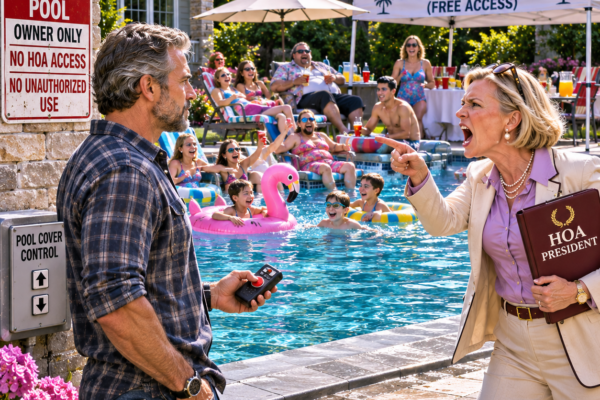
Blue pool water visible through winter trees.
“Promise.”
That night, I couldn’t sleep.
At three in the morning, I put on boots and walked the property.
Cold.
Frost on the grass.
The subdivision pool glowed under underwater lights.
Empty.
Beautiful.
Wrong.
I walked toward one of Grandpa’s old concrete markers.
**SUTTON 1962**
I ran my thumb across the carved letters.
He had made that mark before Creekstone existed.
Before Tammy.
Before Wade.
Before anyone imagined two hundred suburban houses beyond our fence.
Grandpa used to tell me land remembers work.
Fence posts.
Ditches.
Old roads.
Tree lines.
Human beings forget.
Land doesn’t.
The following week, I hired Tom Caldwell.
Licensed surveyor.
Thirty years in the business.
He arrived with modern GPS equipment and a copy of the original Sutton plat.
“Old survey’s pretty clean,” he said.
“Still valid?”
“Paper doesn’t expire because a developer builds next door.”
He worked for two days.
I tried not to hover.
Failed.
Second afternoon, Tom called.
“Garrett.”
“Yeah?”
“Come look at this.”
He had the survey spread across his truck tailgate.
Coffee thermos holding one corner down against the December wind.
He overlaid the newer Creekstone plat.
Then traced the property line.
“Pool isn’t partly on your land.”
I looked at him.
“What?”
He moved his finger.
“The whole thing is.”
I said nothing.
“Pool basin.”
Finger moved.
“Deck.”
Again.
“Pump house.”
Again.
“Part of the parking area.”
He looked over his glasses.
“Everything.”
“How much land?”
“Roughly four-tenths of an acre.”
I stared at the overlay.
The pool sat inside the Sutton parcel like someone had pasted the wrong structure onto the wrong map.
“Not one inch on HOA common property?”
“Not according to this survey.”
Tom shook his head.
“I’ve been doing this thirty years. I’ve seen fence disputes. Garages. Septic systems. Driveways.”
He tapped the pool.
“I have never seen somebody build something this expensive entirely on somebody else’s parcel.”
“Arrogance?”
“Or incompetence.”
He rolled the map.
“Probably both.”
I had the survey certified and recorded.
Daniel couriered it to the HOA attorney.
That was Tammy’s second opportunity to stop.
Remove the pool.
Negotiate.
Admit the consent document was invalid.
Apologize to Lee.
Anything.
Instead, their lawyer sent back an argument claiming long-standing community use somehow created access rights.
Daniel read it.
Then looked at me.
“How old is the pool?”
“About six months.”
He held up the letter.
“The legal doctrine they’re invoking requires vastly more time than that.”
“So?”
“So either their lawyer hasn’t been given the facts, or he’s hoping you don’t know them.”
Their next letter was even stranger.
It suggested the HOA might pursue some kind of compulsory acquisition theory.
Daniel actually laughed.
Not loudly.
One short sound.
“Private HOAs do not get to take private land just because they want amenities.”
He wrote back.
Professional.
Firm.
Then Tammy escalated.
A lien notice arrived.
Forty-seven thousand dollars.
According to Creekstone Estates, the Sutton property owed a special assessment because our land “benefited” from the community pool.
I read the sentence three times.
“They built it without asking.”
Lee stood beside me.
“Yes.”
“On our property.”
“Yes.”
“And now we owe them money for it.”
“That appears to be the theory.”
She laughed.
Then stopped.
“You’re not worried?”
“I’m furious.”
“You don’t look furious.”
“That’s because yelling doesn’t remove a lien.”
Daniel filed immediately to challenge it.
He also told me something important.
False property claims could create additional liability for whoever authorized them.
I asked him to document everything.
“Already am.”
He stared at me.
“You’re enjoying the paperwork now.”
“I’m an engineer.”
“Same disease attorneys have.”
Maybe.
Then Tammy called my chain of command.
My first sergeant, Dwight Patterson, called me into his office.
He closed the door.
“Sutton.”
“First Sergeant.”
“Some woman from an HOA says you’re threatening civilians.”
I didn’t react.
He watched me.
“You want to explain?”
I put a folder on his desk.
Property deed.
Survey.
Forged-consent photograph.
Tammy’s Facebook post.
Lee’s complaint timeline.
First Sergeant Patterson read.
Very slowly.
Then leaned back.
“So.”
“Yes, First Sergeant?”
“They built a pool on your land.”
“Yes.”
“While you were deployed.”
“Yes.”
“Your wife says she didn’t sign this.”
“Yes.”
“They’ve been harassing her.”
“Yes.”
“And now this woman is calling the Army because you hired a lawyer.”
“That’s about the size of it.”
He looked toward the ceiling.
Then back at me.
“Handle your business.”
“Roger.”
“Legally.”
“Absolutely.”
“Clean hands.”
“Yes, First Sergeant.”
“And if she calls this office again?”
He smiled without humor.
“I’ll handle this end.”
That night, Lee and I sat on the back porch.
Pool lights glowed beyond our pasture.
Families were swimming.
Children laughing.
On our land.
Lee rested both hands around a coffee mug.
“Maybe we should leave.”
I turned toward her.
“Move.”
“Start somewhere else.”
“No HOA.”
“No Tammy.”
I looked toward Grandpa’s marker.
“Is that what you want?”
“I want Colton normal again.”
“He will be.”
“You don’t know that.”
“No.”
I took her hand.
“But if we sell because Tammy drove you out while I was gone, you’ll think about that every time somebody tells you no for the rest of your life.”
Lee looked at the pool.
“I’m tired.”
“I know.”
“I don’t want revenge.”
“Neither do I.”
She turned to me.
“What do you want?”
I thought about it.
“The truth.”
That sounded noble.
It wasn’t completely true yet.
Part of me wanted Tammy humiliated.
Part of me wanted Wade afraid.
Part of me wanted to stand beside that pool while a demolition crew turned it into broken concrete.
Anger doesn’t disappear because you know how to control it.
It just becomes quieter.
The difference is what you do with it.
I went back to Daniel.
“I want everything.”
“Define everything.”
“Financials.”
“Okay.”
“Construction records.”
“Yes.”
“Who paid for the pool.”
“Yes.”
“Who notarized the consent.”
“Yes.”
“Who hired contractors.”
“Yes.”
“Who approved the lien.”
Daniel removed his glasses.
“You’re done defending.”
“Yes.”
“Good.”
That was the turning point.
We hired Sandra Whitfield.
Forensic accountant.
Fifteen years working fraud and nonprofit cases.
Gray hair.
Reading glasses on a chain.
She treated missing money like a personal insult.
Because I wasn’t a Creekstone homeowner, a resident named Dorothy Haynes made the financial-record request.
Dorothy was a retired schoolteacher.
Quiet.
Widowed.
She had seen Tammy’s Facebook post about PTSD.
“That was disgusting,” she told me.
“You don’t have to get involved.”
“Yes, I do.”
“Why?”
“Because everybody keeps saying that.”
I understood.
The records took time.
Tammy delayed.
Requested extensions.
Claimed archived statements were unavailable.
Daniel pushed back.
Eventually, boxes arrived.
Digital files.
Bank statements.
Vendor records.
Board approvals.
Sandra disappeared into them.
While she worked, Daniel investigated the consent form.
I investigated the property.
Lee rebuilt daily life.
She took Colton to school.
Ignored neighbors who crossed the street.
Started keeping her own notebook.
Date.
Time.
Event.
Who said what.
One evening I saw her writing at the kitchen table.
“You’re becoming me.”
“No.”
She looked up.
“I use better handwriting.”
Fair.
Sandra called after three weeks.
“Come in.”
Daniel was already there.
Three folders sat on his conference table.
She touched the first.
“The pool has a permitting problem.”
“How bad?”
“I found no ordinary county building approval trail matching a project of this scope.”
Daniel frowned.
“No permit?”
“Not one I can locate.”
Second folder.
“Money.”
Sandra opened a spreadsheet.
Creekstone’s reserve fund had accumulated roughly six hundred eighty thousand dollars.
Four hundred thousand was allocated for the pool.
That matched what Tammy publicly claimed.
Then Sandra traced payments.
Actual construction vendors appeared to have received far less.
The rest moved through several companies.
Related companies.
Addresses linked to Wade Breenidge.
One connected to his family.
Another to a mailbox associated with personal accounts.
Sandra looked at me.
“Roughly two hundred twenty thousand dollars requires explanation.”
Lee was sitting beside me.
Her mouth opened.
“So they stole from their own neighbors?”
Daniel raised one hand.
“We say the records indicate possible misappropriation until investigators decide otherwise.”
Sandra nodded.
“Correct.”
Then she opened folder three.
The consent.
That was the one.
“The notary was Helen Avery.”
I remembered the stamp.
The name that bothered me.
Sandra slid a public record across the table.
Helen Avery had died more than two years before the date on Lee’s alleged consent.
Nobody spoke.
Lee picked up the paper.
Read it.
Then looked at me.
“This woman was dead?”
“Yes.”
“When I supposedly signed this?”
“Yes.”
Her hands began shaking.
Daniel said:
“Lee?”
She placed the document down carefully.
“They forged my name.”
“Yes.”
“And used a dead woman’s notary stamp.”
“That is what the evidence appears to show.”
Lee stood.
Walked to the window.
For nine months, Tammy had made her doubt herself.
Made her afraid.
Made her think everybody believed she was the problem.
Now we were looking at proof that the people accusing her of being unstable had apparently manufactured the document supporting the entire project.
Lee turned around.
“I want them prosecuted.”
It was the first time she had said anything like that.
Daniel nodded.
“Then we hand it to people who make that decision.”
I should have felt relief.
Instead, I felt something colder.
The pool.
The lien.
The fake signature.
The money.
The harassment.
Each piece was worse than the last.
I had spent two months thinking Tammy was an aggressive HOA president.
Now it looked like the pool might be connected to financial misconduct and forged documents.
I looked at Sandra.
“Anything else?”
“Probably.”
“How long?”
“Give me another week.”
I drove home.
Walked the back pasture.
The pool was open.
Music.
Parents.
Children.
Tammy stood near the gate talking with two residents.
She saw me.
Waved.
Actually waved.
Like nothing had happened.
That arrogance made something click.
I had been reacting.
Their letter.
Our response.
Their lien.
Our motion.
Their complaint.
Our evidence.
That wasn’t how I liked operating.
I opened a blank notebook that night.
Three words.
**INTELLIGENCE**
**PREPARATION**
**EXECUTION**
Lee came behind me.
“What’s that?”
“A reminder.”
“For what?”
“That I don’t have to play on her timeline.”
She read it.
“You’re not planning something stupid?”
“No.”
“Illegal?”
“No.”
“Army?”
“No.”
She narrowed her eyes.
“Garrett.”
I looked up.
“Everything stays legal.”
“Promise.”
“Promise.”
The next part of the story is the part people eventually turned into a joke.
**Army engineer builds manure lagoon beside HOA pool.**
Funny headline.
But that isn’t how it began.
The Sutton property had been agricultural land since my grandfather bought it.
I had grown up around livestock.
After coming home, I had already been thinking about putting part of the acreage back into active farm use.
The pool dispute changed the timing.
I won’t pretend otherwise.
But I did not dig some illegal pit and fill it with sewage.
I registered a legitimate cattle operation.
Sutton Heritage Farm.
I bought four head.
Two Herefords.
One Angus bull.
One calf.
Colton named the calf Biscuit before it had been on our property ten minutes.
“Why Biscuit?”
“He looks like one.”
It did not.
But once a six-year-old names a calf, the matter is closed.
Then I worked through the county and agricultural requirements for the waste-management system appropriate to the operation.
Professionally.
On paper.
Reviewed.
Permitted.
The location was on our agricultural parcel near the side of the property where the HOA had built the pool.
I knew they would hate it.
That was not the same as building something unsafe.
Daniel made that distinction very clear.
“If you do this,” he said, “it has to be something you would still legally operate if the pool disappeared tomorrow.”
“It will be.”
“No fake farming.”
“Real cattle.”
“No nuisance stunt.”
“Real waste management.”
“No shortcuts.”
“I don’t do shortcuts.”
Daniel leaned back.
“You were in the Army. You absolutely do shortcuts.”
“Not in engineering.”
“Better answer.”
The farm registration became real.
Feed bills.
Veterinary care.
Fencing.
Water.
Waste plan.
Routine.
Legal.
Documented.
Then inspectors came.
Not because anything was wrong.
Because Tammy called everyone.
Agriculture.
Environmental.
County health.
Anyone who would listen.
Every inspector looked at the paperwork.
The cattle.
The facility.
The setbacks.
The farm records.
Every one left without ordering me to stop.
One inspector stared at the construction.
“You did this?”
“Yes.”
“What’s your background?”
“Combat engineer.”
He nodded.
“That explains the paperwork.”
The smell arrived with warm weather.
Agriculture smells like agriculture.
Cattle don’t care about HOA brochures.
Neither does decomposition.
Pool attendance dropped.
The first complaint appeared on Creekstone’s neighborhood page.
**Does anyone else smell something near the pool?**
Reply:
**It’s the Sutton cattle operation.**
Both posts disappeared quickly.
Tammy had moderator access.
Screenshots survived.
She drove to the property line one afternoon.
White Escalade stopped hard.
Door opened.
She marched toward me.
“What the hell did you build?”
I turned off the machine I was using.
“Farm infrastructure.”
“Next to the pool?”
“On my farm.”
“You did this intentionally.”
“I registered a cattle operation.”
“You are poisoning this community.”
“No.”
“This is retaliation.”
“It’s permitted.”
“I will have it shut down.”
“You’ve said that about a lot of things.”
Her face flushed.
“You think this is funny?”
“No.”
“Children swim there.”
“Children are swimming in an unpermitted pool that your HOA built entirely on my property.”
That stopped her.
For maybe two seconds.
Then:
“You don’t own that pool.”
“I own the land under it.”
“The board has rights.”
“Show me.”
She stared.
Same question I had asked months earlier.
Still no answer.
I gave her one more chance.
“Tammy.”
“What?”
“Settle this.”
She almost laughed.
“Excuse me?”
“Remove the pool. Withdraw the lien. Correct the false statements about Lee. Turn over the construction records.”
“You’re delusional.”
“You’ve seen the survey.”
“I don’t recognize it.”
“It’s certified.”
“I don’t care.”
“You’ve seen the consent issue.”
“My attorney says it’s valid.”
“It was notarized by a woman who had already died.”
For the first time, her face went blank.
Only for a fraction of a second.
But I saw it.
Then the mask returned.
“I don’t know what conspiracy nonsense you’ve been fed.”
“Okay.”
I climbed back onto the machine.
“Then we’re done talking.”
That was her last clean exit.
She didn’t take it.
Within twenty-four hours, cease-and-desist letters arrived.
Complaints.
Environmental hotline calls.
Health department.
She described my farm as a biological hazard.
Inspectors came.
Inspectors left.
Then someone cut my fence at 2:37 one morning.
Trail camera caught a hooded figure.
Bolt cutters.
Three sections of wire.
Another camera caught a white Escalade parked farther down the road.
Infrared caught blonde hair at the edge of the hood.
Not enough for me to confront anyone.
Enough to save.
Police report.
Photos.
Repair receipt.
More cameras.
That became the rhythm.
Tammy acted.
I documented.
Tammy complained.
Officials inspected.
The farm remained.
Then their attorney asked a judge for emergency relief.
Daniel went with me.
I sat beside him at counsel table.
Tammy sat across the room.
Phil Driscoll argued that my cattle operation created an intolerable nuisance threatening children using a community pool.
Daniel waited.
Then presented the farm registration.
Permits.
Inspection reports.
Certified survey.
Pool construction records—or rather, the lack of proper permitting records we had found.
The judge looked from one side to the other.
Then at Phil.
“Counsel, am I understanding this correctly?”
Phil shifted.
“Your Honor—”
“The pool your client wants protected is located on Mr. Sutton’s certified property boundary?”
“There are disputed—”
“Is there another certified survey?”
“No, Your Honor.”
“And your client is asking me to restrict a lawful agricultural operation on agricultural land because of its proximity to a recreational structure the association built on land it does not own?”
Phil started again.
The judge raised a hand.
Emergency relief denied.
Outside, Daniel said:
“That went well.”
I looked toward Tammy.
She was talking angrily with Phil.
“It won’t stop her.”
“No.”
“You knew that?”
“Yes.”
“Then why are you smiling?”
Daniel put on his coat.
“Because judges remember absurd cases.”
The pool emptied.
Not literally.
People stopped going.
A few parents still brought children.
Then none.
The beautiful resort complex sat unused.
Blue water behind iron fencing.
Empty lounge chairs.
Tammy had spent four hundred thousand dollars of her neighbors’ money on an amenity they no longer wanted to use.
And she could not legally force my farm to disappear simply because it made the pool less pleasant.
That was poetic.
But it still wasn’t the real consequence.
The real consequence was Sandra’s report.
She traced the money farther.
Two hundred twenty thousand dollars had moved into entities controlled or connected to Wade.
Daniel delivered the package to the district attorney’s office.
Assistant District Attorney Jennifer Holt met us.
Young.
Sharp.
No wasted words.
She read the summary.
Then the forged consent.
Then Helen Avery’s death record.
Then the vendor trail.
“This is substantial.”
Daniel nodded.
Jennifer looked at me.
“Mr. Sutton, I need to be clear. Once this comes into our office, decisions about investigation and timing are ours.”
“Understood.”
“You don’t direct arrests.”
“Understood.”
“You don’t contact witnesses and tell them what to say.”
“I won’t.”
“You preserve evidence.”
“Yes.”
“You let us do our job.”
“Yes.”
She studied me.
“Good.”
That was important.
The story later got simplified into me planning everything.
I didn’t.
I built my civil case.
I built my farm.
I preserved evidence.
Law enforcement chose what to investigate and when to act.
That line matters.
I also spoke with Beth Anne Crawford, an investigative reporter.
Background only at first.
Documents.
Survey.
Financial questions.
No publication until she independently checked records.
She did.
That mattered too.
I didn’t want a revenge blog.
I wanted somebody who would verify.
Tammy, meanwhile, kept escalating.
She circulated a petition demanding the county shut my farm down.
Eighty-seven signatures.
She described me as a disturbed veteran exploiting agricultural protections to intimidate families.
The county reviewed the farm file.
Registration.
Cattle.
Vet records.
Feed purchases.
Waste plan.
Permits.
The challenge went nowhere.
Then Tammy called television news.
That backfired spectacularly.
She expected:
**SOLDIER BUILDS SEWAGE PIT NEXT TO CHILDREN’S POOL**
What aired instead was more complicated.
The reporter stood outside Creekstone.
Explained Tammy’s complaint.
Then:
County records showed the pool had no ordinary permit history.
A certified survey placed the structure on Sutton property.
The agricultural operation had passed inspections.
The district attorney declined to comment on an ongoing financial investigation involving the HOA.
I watched from the couch.
Lee handed me a beer.
On television, Tammy was asked:
“Mrs. Breenidge, can you provide the building permit for the pool?”
Her mouth opened.
Closed.
“The board approval functions as—”
The reporter interrupted politely.
“I’m asking about the county permit.”
Tammy looked off-camera.
Then the segment cut to a county official confirming they could not locate a proper permit for the structure.
Lee sat down.
For a moment, neither of us spoke.
Then she laughed.
Not the polite laugh she had used for months.
A real one.
Head back.
Eyes watering.
I stared at her.
“What?”
“I forgot.”
“Forgot what?”
“What it felt like.”
She wiped her eyes.
“To watch Tammy not have an answer.”
I laughed too.
Colton came in.
“What’s funny?”
“Grown-up stuff.”
“That’s always boring.”
“Usually.”
The next week, the county rejected another challenge Tammy filed against the agricultural operation.
By then even some Creekstone residents were turning against her.
Dorothy Haynes started receiving phone calls.
Residents wanted to see the financial records.
She showed them.
One homeowner named Marcus Bell came to my house.
He stood awkwardly on the porch.
“I signed Tammy’s petition.”
“Okay.”
“I shouldn’t have.”
“Probably.”
He looked embarrassed.
“She told us your farm wasn’t real.”
“It’s real.”
“I see that.”
Biscuit mooed from the field.
Marcus glanced toward the calf.
“I guess that’s evidence.”
“Strong witness.”
He smiled.
Then:
“How much money is missing?”
“I’m not the person to answer that until the investigation is complete.”
“Tammy said you’re making that up too.”
“Then ask to see the books.”
He nodded.
“I will.”
That was how power shifted.
Not one dramatic rebellion.
One person deciding to verify.
Then another.
Then another.
Wade began looking worse.
I saw him only occasionally.
He had lost weight.
Dorothy later told me he had begun arguing with Tammy publicly.
He wanted to negotiate.
Tammy refused.
“I don’t settle,” she reportedly said.
“I win.”
People who say that usually misunderstand what winning is.
For Tammy, winning meant the other person backing down.
She had done it for eight years.
Fines.
Threats.
Social pressure.
People moved.
People apologized.
People paid.
Then she tried it with Lee while I was deployed.
She expected the same result.
Instead, she created records.
The fake complaint.
The fake consent.
The pool.
The lien.
The Facebook post.
The police complaint.
The farm complaints.
The vandalism footage.
Every new move narrowed her options.
Eventually, ADA Holt called.
“Mr. Sutton.”
“Yes, ma’am.”
“We’ve completed the next stage of our investigation.”
I sat straighter.
She explained that the case was moving forward.
Formal warrants would be handled by law enforcement.
I didn’t ask for details I didn’t need.
Then I told her Creekstone had a major HOA meeting the following Thursday.
Residents were already demanding answers about finances.
She paused.
“I’ll pass that information along.”
That was all.
Thursday evening, the clubhouse was packed.
About one hundred forty people.
Folding chairs.
People along walls.
Overflow in the hallway.
Tammy sat at the front.
Pearls.
Linen blazer.
Fresh hair.
Gavel.
Wade beside her.
Navy polo.
Sweat dark between his shoulders.
He kept looking toward the doors.
Two men stood near the rear.
Plain clothes.
I recognized Sheriff Randall Tate from earlier meetings with Daniel.
Deputy Owens stood beside him.
No one else seemed to notice.
Lee sat next to me.
Her hand was cold.
“You okay?”
“No.”
“Want to leave?”
“No.”
That answer made me proud.
Tammy opened the meeting.
Fourteen minutes.
Community values.
Threats to children.
Agricultural nuisance.
Property values.
The disturbed veteran on the neighboring parcel.
Then she called for authorization to spend additional HOA money on legal action against Sutton Heritage Farm.
I stood.
Tammy stopped.
“Before you vote, I’d like to show the homeowners something.”
“This is a board meeting, Mr. Sutton.”
“I know.”
“You are not a member.”
“No.”
“Then sit down.”
A man near the center called:
“Let him talk.”
Another:
“Yeah.”
Tammy hit the gavel.
“Order.”
Dorothy stood.
“I want to hear him.”
Then Marcus.
Then others.
Tammy looked around.
For the first time since I met her, the room was not waiting for permission from her.
She could feel it.
Her fingers tightened around the gavel.
I walked forward.
Lee carried masking tape.
I unfolded Tom Caldwell’s certified survey.
Three feet wide.
Taped it to the wall.
“This is a certified survey of the Sutton property.”
I pointed to our boundary.
“My grandfather bought these twelve acres in 1962.”
Then the pool outline.
“The community pool is here.”
The room went quiet.
“Every square foot of the pool basin is on Sutton property.”
Murmurs.
“The deck.”
More.
“Pump house.”
Someone said:
“No way.”
“And part of the parking area.”
Tammy stood.
“That survey is disputed.”
I looked at her.
“By what survey?”
She hesitated.
“We have historical records.”
“Show them.”
She sat.
Evidence one.
Boundary.
I moved to the next document.
“This is the consent form Mrs. Breenidge says my wife signed.”
I held it up.
“Lee Sutton.”
Lee stood beside me.
I displayed a copy of our mortgage documents.
Her real signature.
“You can compare them yourselves.”
People leaned forward.
“But handwriting isn’t the most important part.”
I pointed toward the notary stamp.
“This document was notarized by Helen Avery.”
Pause.
“Helen Avery died twenty-six months before the date on this form.”
The room went silent.
Completely.
No chairs.
No coughing.
Nothing.
Wade stopped moving his leg.
I looked toward him.
His face had drained.
Lee’s hand touched my back.
I continued.
“The document used to justify construction on our property appears to contain a forged signature and a notary seal belonging to a woman who was already dead.”
Tammy stood.
“This is a lie.”
Daniel, seated to the side, spoke for the first time.
“The underlying records have been provided to investigators.”
That changed the room.
Not gossip.
Not Garrett versus Tammy.
Investigators.
I took out Sandra’s financial summary.
“Now your money.”
That got everyone.
“Creekstone’s reserve fund held approximately six hundred eighty thousand dollars.”
People nodded.
Many knew that.
“Four hundred thousand was approved for the pool project.”
Again.
Then:
“Based on the records reviewed by a forensic accountant, roughly one hundred eighty thousand appears tied directly to actual construction vendors.”
Someone shouted:
“Where’s the rest?”
I waited.
“Approximately two hundred twenty thousand dollars moved through three related companies.”
I placed the company list on the screen.
Addresses.
Registration.
Connections.
“Those entities trace back to Wade Breenidge.”
The room exploded.
People stood.
Questions.
Anger.
Tammy grabbed the microphone.
“This is defamation!”
Nobody listened.
A woman shouted:
“You stole from us?”
Another:
“Where is my money?”
Wade stared at the table.
I raised one hand.
“I’m not asking you to take my word for it.”
The projector changed.
Bank records.
Company registrations.
Vendor payments.
Sandra’s flow chart.
“Check the records yourselves.”
That was the line that broke Tammy.
Because her entire authority had depended on people not checking.
She slammed the gavel.
“This presentation is over.”
Sheriff Tate stood.
He opened his shirt enough to show the badge.
The noise disappeared.
“Mr. Breenidge.”
Wade looked up.
“Please stand.”
He didn’t.
Deputy Owens moved closer.
Wade finally stood.
Sheriff Tate informed him he was being taken into custody on warrants connected to the financial and document investigation.
The room watched.
No cheering.
Just shock.
Handcuffs clicked.
Tammy screamed.
“This is a setup!”
Sheriff Tate turned.
“Mrs. Breenidge.”
She froze.
“Please stand.”
“No.”
“Ma’am.”
“I am the HOA president.”
“That has nothing to do with this.”
Her face changed.
“What are you arresting me for?”
He informed her there were warrants connected to the same investigation and to property damage evidence.
Tammy looked at me.
Pure hatred.
“You did this.”
I shook my head.
“No.”
She laughed wildly.
“You built that disgusting farm. You called the press. You turned these people against me.”
“I documented what you did.”
Sheriff Tate stepped between us.
Tammy kept looking at me as the cuffs went on.
For months, I had imagined feeling triumphant.
I didn’t.
I looked at Lee.
She was crying.
Not happily.
Not sadly.
Just releasing something.
I walked to her.
“You okay?”
She nodded.
Then shook her head.
“I don’t know.”
Colton wasn’t there.
We had left him with Lee’s brother.
Good decision.
Some scenes children don’t need.
Daniel stood.
“One more matter.”
The room turned.
He explained that county officials had also issued orders addressing the unpermitted pool structure.
Ultimately, it would have to be removed.
That was the closest thing to applause the room produced.
Not loud.
A few people.
Then others.
I didn’t join.
The pool was still on my grandfather’s land.
I didn’t need to clap.
I just needed it gone.
The criminal cases took longer than the dramatic meeting.
Real life usually does.
Wade eventually entered pleas connected to the forged documents and the missing money.
He received prison time.
Assets linked to the financial scheme were pursued and recovered where possible.
Tammy resolved her case with probation, community service, restitution, and other consequences.
The exact legal language mattered less to me than what happened afterward.
She lost Creekstone.
Not legally at first.
Socially.
The board removed her authority.
Committees stripped.
Access gone.
People who once moved aside when her Escalade approached stopped returning her calls.
Wade’s companies collapsed under investigation.
The remaining board resigned.
New elections brought Dorothy Haynes into leadership.
The retired schoolteacher who had quietly requested financial records became one of the people rebuilding the HOA.
Her first call to me:
“Garrett.”
“Yes?”
“We’re canceling every bogus fine issued against Lee.”
“Good.”
“Second, independent management company.”
“Better.”
“Third, full financial audit.”
“Best.”
She paused.
“And we owe your wife an apology.”
I looked toward Lee.
She was helping Colton with homework.
“Yes.”
“You do.”
Creekstone issued a written apology.
Not enough to erase nine months.
Nothing could.
But Lee read it three times.
Then put it in a drawer.
“What are you doing?”
“Keeping it.”
“For evidence?”
She smiled.
“No.”
“For me.”
Ninety days after the meeting, demolition began.
The same kind of excavators that had arrived while I was overseas returned.
Different purpose.
I stood with Lee at the edge of the field.
Coffee.
Cold morning.
The pool fence came down first.
Then decking.
Concrete.
Pump house.
Clubhouse sections on our land.
The turquoise water disappeared.
The pool shell broke under hydraulic equipment.
For months, I had pictured that moment as victory.
In reality, it was loud.
Dusty.
Ugly.
Construction demolition usually is.
Lee stood beside me.
“Feel better?”
I thought.
“Yes.”
“Happy?”
“No.”
She nodded.
“Me neither.”
Red Carolina clay went back into the hole.
Same earth Grandpa had farmed.
By evening, there was no pool.
Just disturbed ground.
I walked out after the crews left.
Found Grandpa’s concrete marker.
**SUTTON 1962**
Still there.
Scraped.
Dirty.
Unbroken.
I knelt.
Brushed soil away with my glove.
Lee came behind me.
“He would’ve been furious.”
“Grandpa?”
“Yes.”
I smiled.
“He would’ve charged them rent.”
That made her laugh.
Civil claims resolved later.
The settlement covered property restoration, legal expenses, and damages tied to what Lee had endured.
For the first time since I came home, we weren’t fighting.
The mailbox contained normal mail.
Utility bills.
Catalogs.
No HOA threats.
No anonymous notes.
No cease-and-desist letters.
That absence felt strange.
Then peaceful.
Sutton Heritage Farm stayed.
That part surprised people.
They assumed the cattle were only revenge.
They weren’t anymore.
Biscuit became Colton’s favorite animal.
We added two more cattle.
I started selling beef at the Lillington farmers market.
Saturday mornings became a family routine.
Truck packed before sunrise.
Cooler.
Table.
Sign.
**SUTTON HERITAGE FARM — EST. 1962**
Lee created a jerky recipe.
Colton handed out samples.
He was terrible at calculating change.
“Dad?”
“What?”
“This guy gave me twenty.”
“How much was the jerky?”
“Eight.”
“So?”
“I need twelve.”
“Good.”
“I already gave him fourteen.”
The customer laughed.
I covered the difference.
“Business school starts Monday.”
The agricultural waste facility remained.
Maintained.
Inspected.
Serving its actual purpose.
No pool beside it anymore.
Just pasture returning.
Grass slowly covered the scar where four hundred thousand dollars of concrete had once sat.
Lee changed too.
Recovery wasn’t immediate.
She still stiffened when unfamiliar cars entered the drive.
Still checked the window before answering the door.
Still sometimes asked:
“Did you hear that?”
At noises that meant nothing.
Nine months of harassment had trained her body to expect the next attack.
She found a military-spouse support group.
Then started volunteering with a family readiness organization.
Her first project was a short guide for spouses dealing with housing and HOA pressure during deployments.
**Know Your Rights.**
Document complaints.
Save notices.
Contact legal assistance early.
Tell your service member when something serious happens.
That last line was bold.
I saw it.
“You added that for me.”
“For both of us.”
She looked at me.
“I thought protecting you meant keeping quiet.”
“I thought protecting you meant fixing everything after I came home.”
“We were both idiots.”
“Married idiots.”
“Correct.”
Her guide spread.
Other spouses used it.
Calls came from families in similar situations.
Not always dramatic.
Sometimes fines.
Parking.
Lawn disputes.
Sometimes more serious.
Threatened liens.
Foreclosure notices.
Property access.
One case involved a deployed Marine whose HOA had accumulated thousands in fines while he was overseas.
The family nearly lost the home.
That one stayed with me.
So I used part of our settlement money to create the **Homefront Legal Defense Fund**.
Fifty thousand dollars to start.
Free initial legal consultations for military families facing HOA and property disputes during deployment.
We partnered with attorneys willing to donate time.
Military family resources helped direct people to us.
First year:
Twenty-three families.
Some cases ended with one letter.
Some required hearings.
One prevented a foreclosure.
I remember that Marine calling me.
Voice shaking.
“I don’t know how to thank you.”
“Come home.”
“What?”
“That’s how.”
Silence.
Then:
“Yes, Sergeant.”
“I’m retired from telling Marines what to do.”
“Yes, Sergeant.”
I laughed.
Sunday mornings changed too.
Before deployment, I barely sat still.
Work.
Army.
Repairs.
Projects.
Now I learned to sit on the porch.
Lee beside me.
Colton feeding cattle.
Twelve acres stretching toward sunrise.
The southeast corner had greened over around the farm infrastructure.
Where the pool once stood was grass.
Nothing fancy.
No memorial.
No sign saying:
**HERE LIES THE HOA’S $400,000 MISTAKE.**
I considered it.
Lee vetoed it.
“You are not putting that on our land.”
“Why?”
“Because you’re forty percent mature at best.”
Fair.
One morning Colton sat beside me.
He was seven by then.
“Dad?”
“Yeah?”
“Why did that lady take our land?”
Children ask questions adults spend hours avoiding.
“She thought she could.”
“Why?”
“Because I was far away.”
He looked toward Lee.
“Mom was here.”
“Yes.”
“She could’ve said no.”
“She did.”
“Then why didn’t the lady listen?”
I thought.
“Because some people hear no as the beginning of an argument instead of the end of one.”
Colton frowned.
“That’s dumb.”
“Very.”
He watched Biscuit.
Then:
“Did we win?”
I looked at Lee.
She looked back.
I said:
“We kept our home.”
“Is that winning?”
“Yes.”
He nodded.
That was enough.
Years later, I thought a lot about the lagoon.
Not because it smelled.
Though it absolutely did.
People online loved that part.
They reduced the whole story to:
**HOA builds luxury pool on soldier’s land. Soldier builds manure lagoon next door.**
Funny.
Memorable.
Incomplete.
The lagoon didn’t uncover the forged signature.
It didn’t trace the money.
It didn’t remove Tammy.
It didn’t arrest Wade.
It didn’t restore our land.
Documents did.
Survey did.
Financial records did.
Lee’s saved letters.
The dead notary record.
Camera footage.
Neighbors deciding to verify.
Lawyers.
Investigators.
The lagoon was pressure.
Legal pressure.
A reminder that Tammy could not claim absolute control over land she didn’t own.
What defeated her was her own paper trail.
That lesson became important when people asked me for advice.
I never told them:
Build something that smells worse.
I told them:
Get the deed.
Get the survey.
Save the letter.
Ask for records.
Don’t threaten.
Don’t vandalize.
Don’t improvise crimes because someone else is behaving badly.
Make them explain their claim in writing.
If they lie, preserve it.
If they trespass, document it.
If they misuse money, let professionals trace it.
If they’re wrong, give them a chance to correct it.
And if they refuse?
Let their refusal become evidence.
Tammy had several chances.
When I asked for the consent.
When Daniel sent the demand.
When the survey proved the pool was entirely on Sutton land.
When the dead notary was discovered.
When I asked her at the farm boundary to settle.
Every time, she chose escalation.
That is why the ending felt satisfying.
Not because I outsmarted her with cattle.
Because she built the consequence herself.
Layer by layer.
One lie on top of another.
The HOA changed after her.
Dorothy served only one term.
She said longer would be unhealthy.
Smart woman.
Creekstone hired professional management.
Financial reports went online.
Board votes recorded.
Vendor relationships disclosed.
No more president writing personal rules.
No more informal “community authority” extending beyond the subdivision.
The boundary between Creekstone and Sutton land was re-marked.
Permanent survey monuments.
New fence.
Clear signage.
One sign:
**SUTTON HERITAGE FARM
PRIVATE AGRICULTURAL PROPERTY
NO HOA JURISDICTION**
Lee laughed when she saw it.
“Subtle.”
“I considered twenty-foot letters.”
“I know.”
A few Creekstone residents became friends.
Marcus Bell bought beef from us every month.
Dorothy brought cookies for Colton.
One family who had stopped letting their daughter visit during Tammy’s campaign came to apologize.
The mother stood on our porch.
“I believed her.”
Lee crossed her arms.
“I know.”
“She said Garrett was dangerous.”
“I know.”
“She said CPS had concerns.”
Lee’s face tightened.
“They didn’t.”
“I know that now.”
Lee stayed quiet.
The woman started crying.
“I’m sorry.”
For a moment, I thought Lee might send her away.
She had every right.
Instead:
“Come inside.”
They drank coffee.
Not instant forgiveness.
Not best friends.
Just the beginning of something less poisoned.
I learned something watching Lee heal.
Justice and forgiveness are separate jobs.
The court can handle one.
The other takes longer.
Sometimes forever.
Wade eventually came home from prison.
I heard through somebody at the market.
He and Tammy had moved.
Wilmington, supposedly.
A condo.
No HOA leadership.
No development company.
I never checked.
For the first year, I would occasionally search their names online.
Then one night I realized I hadn’t done it in months.
That felt better than any headline.
They had stopped living in my head.
Colton grew.
Biscuit grew faster.
By ten, my son could identify every fence line Grandpa had shown me.
I walked them with him just like Grandpa walked them with me.
At the northeast corner, I pointed toward the old marker.
“What does it say?”
Colton brushed dirt away.
“Sutton 1962.”
“Who put it there?”
“Great-Grandpa Henry.”
“Why?”
“So people know the line.”
I smiled.
“What did he say about land?”
Colton rolled his eyes.
I had clearly repeated this too many times.
“Land doesn’t move. People forget where the line is.”
“Exactly.”
“Dad?”
“What?”
“Can I go feed Biscuit now?”
Legacy has limits.
“Go.”
He ran.
I stood beside the marker.
Sixty years before Tammy built that pool, Grandpa carved our name into concrete.
Not because he expected a fight.
Because boundaries matter even when everyone gets along.
Maybe especially then.
The Homefront Fund grew.
Law firms donated hours.
Local businesses contributed.
Military spouses volunteered.
Lee became the person families asked for.
Not me.
That made sense.
I had come home and fought the visible battle.
She had survived the invisible one.
One evening after a fundraiser, a young Army wife approached her.
Husband deployed.
HOA threatening fines over a work truck.
Nothing criminal.
Nothing like our case.
Still overwhelming.
The woman said:
“I feel stupid being this upset.”
Lee took her hands.
“You’re not.”
“It’s just letters.”
“No.”
“It feels like every time I open the mailbox I can’t breathe.”
Lee looked at me across the room.
She understood exactly.
“Then we start with the letters.”
Simple.
That was her gift.
I built systems.
Lee made scared people feel normal again.
Years later, she admitted something.
We were sitting beside the barn while Colton worked with a calf.
“I hated you for about two weeks after you came home.”
I turned.
“What?”
“Not really hated.”
“Good clarification.”
“I was angry.”
“At me?”
“Yes.”
“Why?”
“Because you came home, saw the pool, and immediately had a problem you could solve.”
I didn’t speak.
She continued.
“Survey. Lawyer. Records. Plan.”
“Okay.”
“I had been drowning for nine months and there was no survey for that.”
That hurt because it was true.
“I’m sorry.”
“I know.”
“I should’ve—”
“No.”
She touched my arm.
“You did what you knew.”
“What should I have done?”
“Asked how I was.”
“I did.”
“Then listened longer.”
Fair.
I became better at that.
Not perfect.
Better.
The farm gave us rhythm.
Calves.
Fencing.
Market Saturdays.
Seasons.
Rain.
Heat.
Work.
Land has a way of forcing life into practical units.
Animals need feed even when you’re angry.
Fence needs repair even when you’re grieving.
Markets open whether you slept.
Those routines helped Lee more than any dramatic victory.
They helped me too.
At forty-five, I retired from active military service.
Official ceremony.
Uniform.
Flags.
Speeches.
First Sergeant Patterson had retired before me but came anyway.
He shook my hand.
Then whispered:
“Still fighting HOAs?”
“Only recreationally.”
Lee heard.
“Absolutely not.”
Patterson laughed.
Colton stood beside us.
Thirteen.
Nearly as tall as Lee.
Afterward, we went home.
Not to a fancy restaurant.
To the farm.
Grilled steaks.
Sat outside.
I looked across the property.
The old pool footprint had vanished completely.
Grass.
Fence.
Cattle.
No trace unless you knew.
That fascinated me.
Four hundred thousand dollars.
Months of construction.
Stone.
Concrete.
Steel.
Water.
Gone.
Land absorbs arrogance eventually.
Takes time.
But it does.
A few years later, a Creekstone teenager working on a school history project knocked on our door.
“Mr. Sutton?”
“Yes?”
“Can I interview you?”
“About?”
“The pool.”
Of course.
She set up a phone recorder.
“What was your revenge plan?”
I laughed.
“You’ve been watching bad videos.”
“So you didn’t build the lagoon to get revenge?”
“I knew they wouldn’t enjoy it.”
She smiled.
“So yes.”
“It was a legitimate farm project.”
“That’s not a no.”
“Future journalist?”
“Maybe.”
“Dangerous.”
She asked:
“Did you want Tammy arrested?”
“I wanted the truth investigated.”
“That sounds rehearsed.”
“It is.”
“Did you hate her?”
“For a while.”
“What changed?”
“She stopped mattering.”
The girl looked disappointed.
“That’s not dramatic.”
“Most healthy endings aren’t.”
She wrote that down.
Then:
“What was the worst thing she did?”
I expected myself to say forged signature.
Pool.
Money.
CPS.
Instead:
“She made my son think something was wrong with his mother and father.”
That surprised both of us.
The reporter lowered her phone.
“How?”
I told her.
The canceled playdates.
Neighbors crossing the street.
The PTSD post.
Colton asking whether we had to move.
Property crimes get receipts.
Emotional damage rarely does.
That’s why I’m glad the story didn’t end with the arrests.
If it had, Tammy would still be the center.
Our real ending came later.
Lee laughing again.
Colton inviting friends over.
Saturday markets.
Military families getting help.
That’s the part revenge stories skip.
What do you build after the person hurting you is gone?
If the answer is nothing, they still took too much.
We built something.
The Homefront Fund eventually helped hundreds of families.
Not all HOA cases.
Some landlord problems.
Property disputes.
Deployment-related paperwork.
Whatever fit the mission.
Lee kept the original purple note in her desk.
**JUST MOVE. IT’S EASIER.**
I asked why.
“Reminder.”
“Of Tammy?”
“No.”
“Then what?”
“That I almost believed it.”
She folded it.
“And?”
“She was wrong.”
The fund framed another document.
Not Tammy’s arrest.
Not the court order.
A letter from the Marine whose foreclosure we helped stop.
**I came home to my house because somebody answered the phone.**
That one mattered.
Grandpa had protected twelve acres.
We protected them too.
Then somehow those twelve acres became the reason other families protected their homes.
I liked that.
At fifty-three, I became a grandfather.
Colton had a daughter.
Henry Sutton would have enjoyed the symmetry.
Her name was Elena Grace.
That was Lee’s idea.
The first time Colton brought her to the farm, Biscuit was long gone.
We had different cattle.
Same pasture.
Same corner markers.
I carried Elena Grace toward the southeast line.
Lee followed.
“You are not giving a six-month-old a property survey.”
“She needs to know.”
“She cannot hold her own head straight.”
“Early education.”
Colton laughed.
At the marker, I brushed away dirt.
**SUTTON 1962**
The letters had softened with time.
Still readable.
I held Elena Grace’s tiny hand against the concrete.
“This is where Great-Great-Grandpa Henry marked the land.”
She drooled.
Strong reaction.
Lee stood beside me.
“Tell her the other part.”
“What?”
“About the pool.”
“She’s six months old.”
“You were about to explain deed recording.”
Fair.
I looked toward the field where the pool had once been.
Nothing there now except grass moving in the wind.
“Somebody built something there once.”
Colton smiled.
“Something expensive.”
“Very.”
“Something stupid.”
Lee nudged him.
“Language.”
Elena Grace drooled again.
I said:
“It wasn’t theirs.”
That was enough.
Years later, when she was old enough to understand, I told her the whole story.
Not the internet version.
Not manure equals justice.
The real version.
Grandpa.
Deployment.
Lee alone.
The forged signature.
Survey.
Money.
Cattle.
Court.
Consequences.
Then what came afterward.
She asked:
“Were you scared?”
I thought.
“Yes.”
She looked surprised.
“You were Army.”
“Army people get scared.”
“But you knew what to do.”
“No.”
“Then how’d you win?”
I smiled.
“One document at a time.”
She considered that.
“What did Grandma do?”
I looked toward Lee, older now, sitting on the porch with coffee.
“She survived the hardest part.”
“What?”
“When nobody believed her.”
Elena Grace became quiet.
Then ran toward Lee.
I stayed beside the marker.
That question had finally put the story in the right order.
I used to think I was the protagonist.
Combat engineer comes home.
Finds stolen land.
Builds case.
Fights HOA.
Wins.
But the story started before I returned.
Lee lived it first.
She stood alone while someone with more social power tried to isolate her.
She protected Colton.
Protected my focus overseas.
Saved letters.
Saved screenshots.
Remembered dates.
Kept our house running.
She never forged a document.
Never retaliated.
Never vandalized anything.
She simply endured until I came home.
All my engineering came after that.
So when people asked who saved the Sutton property, my answer changed.
“We did.”
Not I.
We.
Eventually, age made farming harder.
My knees complained.
Back complained louder.
Colton took over more work.
Sutton Heritage Farm became his operation in everything but paperwork.
One evening, he said:
“Dad.”
“What?”
“You ready to sign it over?”
I pretended not to hear.
“Dad.”
“Wind’s loud.”
“We’re inside.”
“Exactly.”
Lee laughed from the kitchen.
“You’ve become your grandfather.”
“Compliment.”
“Not entirely.”
The transfer happened gradually.
Trust.
Conservation protections.
Family plan.
No rushed inheritance.
No ambiguity.
I had learned what unclear paperwork costs.
The southeast corner remained agricultural.
The old lagoon eventually was upgraded and replaced as farm practices changed.
Properly.
No symbolism.
Just infrastructure.
That was another ending.
The thing everybody associated with revenge became an ordinary piece of farm history.
Nothing lasts in the role people assign it.
Not even a manure lagoon.
Creekstone Estates changed too.
New families moved in who had never heard of Tammy.
Kids used the neighborhood playground.
Roads got resurfaced.
Trees matured.
The pool was never rebuilt.
The board chose a smaller recreation project entirely within HOA land.
Permit.
Survey.
Public vote.
Professional management.
Dorothy sent me a photograph.
Caption:
**LOOK, GARRETT. WE CHECKED THE PROPERTY LINE FIRST.**
I framed that one.
Not because it was funny.
Because it was progress.
The final time I ever heard Tammy’s name directly was years later.
A letter.
No return address I recognized.
Lee opened it.
Read.
Then handed it to me.
Tammy.
Short.
No excuses.
She wrote that she had spent years believing being HOA president made her responsible for everything around Creekstone.
Then entitlement became authority in her mind.
Authority became ownership.
She apologized to Lee specifically.
For the rumors.
For CPS.
For the veteran post.
For frightening Colton.
She wrote:
**I cannot undo what I did, and I don’t expect forgiveness. I only want Lee to know that none of it was because she was weak. I targeted her because I believed she was alone.**
Lee read that sentence again.
Then folded the letter.
I asked:
“You going to answer?”
“No.”
“Okay.”
She looked toward the porch.
“Do you think she means it?”
“Yes.”
“Why?”
“Because she didn’t ask for anything.”
Lee nodded.
Then put the letter in the same drawer as the purple note.
Two pieces of paper.
**JUST MOVE. IT’S EASIER.**
And:
**I TARGETED HER BECAUSE I BELIEVED SHE WAS ALONE.**
Years apart.
The beginning and end of Tammy’s understanding.
Lee closed the drawer.
“She was wrong.”
“About what?”
“Being alone.”
I took her hand.
“Yes.”
Sunday morning eventually became our favorite time.
No alarm.
Coffee.
Porch.
Sun rising over Harnett County.
Cattle moving through pasture.
Colton’s truck near the barn.
His daughter chasing a dog through the yard.
The original Sutton marker still at the tree line.
I would sometimes look toward the flat patch where the HOA pool had once sat.
If you didn’t know the story, you would never guess.
No concrete.
No clubhouse.
No lounge chairs.
No turquoise water.
Just grass.
That might be my favorite part.
Tammy had believed money made things permanent.
Four hundred thousand dollars.
Board votes.
Contractors.
Forms.
Notary stamp.
Social pressure.
Lawyer letters.
She piled all of it onto somebody else’s land and assumed the weight would make ownership real.
It didn’t.
Paper lies can be heavy.
Concrete can be heavy.
Power can feel heavy.
But none of those things move a property line.
Grandpa knew that.
**Land doesn’t move. People forget where the line is.**
I used to think he meant only survey lines.
He didn’t.
Families have lines too.
What you tolerate.
What you protect.
What you will not let somebody redefine simply because they speak more confidently than you do.
Tammy crossed our property line first.
Then she crossed every other line after.
Lee’s reputation.
Our son.
My military service.
Community money.
Official documents.
By the time consequences arrived, they weren’t something I engineered for her.
They were the accumulated weight of her own decisions.
That is the part I would keep if everything else disappeared.
Not the smell.
Not the arrests.
Not the television story.
Not even the pool demolition.
The fact that she had a chance to stop.
Then another.
Then another.
And every time she chose to push farther.
People call that poetic justice.
Maybe.
Engineers call it load accumulation.
Enough unsupported weight eventually brings a structure down.
One summer evening, years after all of it, I walked the property line with Elena Grace.
She was eight.
Same age I had been when Grandpa first took me out there.
She carried a bottle of water and complained about mosquitoes every thirty seconds.
At the old marker, she crouched.
“Sutton 1962.”
“Yep.”
“You carved it?”
“I’m not that old.”
“Grandpa Colton?”
“No.”
“Great-Grandpa?”
“Henry.”
She traced the letters.
“Is this the one from the pool story?”
“Yes.”
“So the pool was over there?”
I pointed.
“About there.”
She squinted.
“There’s nothing.”
“Exactly.”
“That’s weird.”
“No.”
I smiled.
“That’s restoration.”
She thought about that.
Then:
“Did you really build a poop pond?”
Kids always find the essential history.
I sighed.
“It was an agricultural waste-management system.”
“So yes.”
“Technically.”
She laughed so hard she nearly dropped the water bottle.
We kept walking.
Sunset behind the pines.
Red Carolina clay beneath our boots.
Same land.
Same line.
Different generation.
At the porch, Lee waited for us.
Older.
Gray in her hair.
Still the strongest person I knew.
Elena Grace ran ahead.
I stopped for one second and looked back.
Twelve acres.
Grandpa’s land.
Our home.
The place Tammy thought she could take because I was far away and Lee was alone.
She had been wrong about both things that mattered.
Distance didn’t erase ownership.
And Lee was never alone.
I went inside.
The screen door closed behind me.
The land stayed where it had always been.
And so did we.