PART 2: HOA Built a $400-a-Seat Floating Restaurant on My Private Lake—Then I Closed the Only Legal Boat Ramp
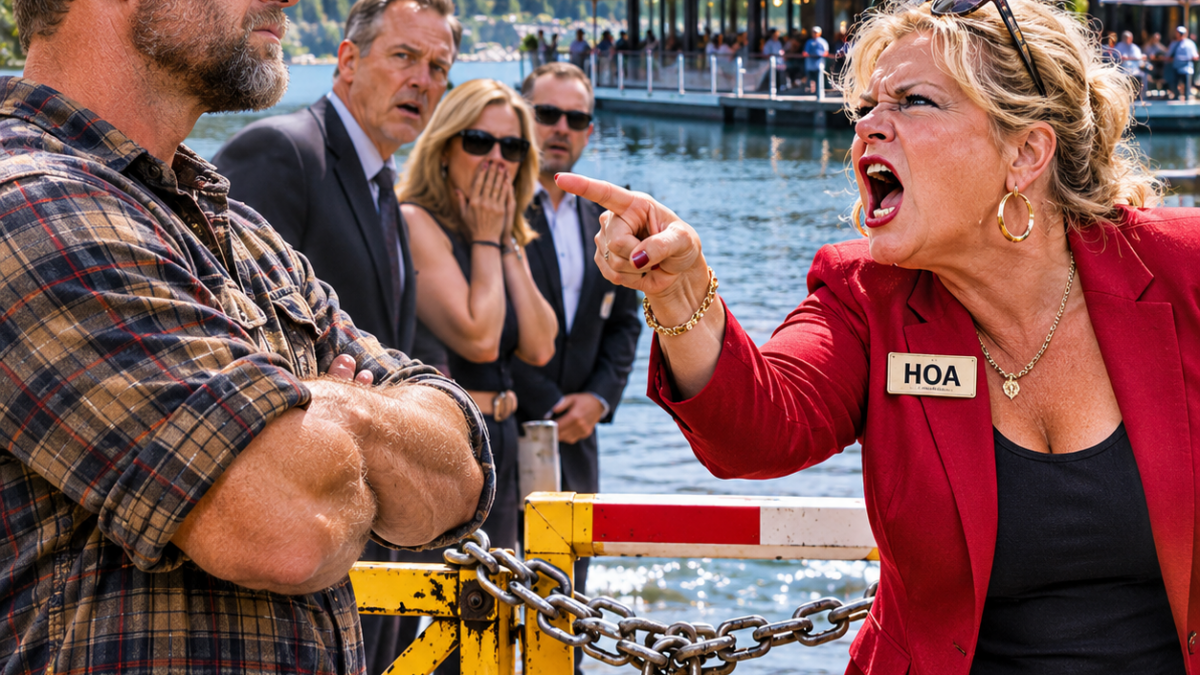
Seventy angry dinner guests were floating in circles on my private lake, demanding refunds for four-hundred-dollar seats, while an HOA president screamed at me from behind a locked gate like I had somehow stolen something from her.
At the center of the water sat a glowing luxury restaurant that should never have existed there in the first place, built by people who had spent months telling everyone they had legal rights they never actually possessed.
And as the boats began running out of places to go, the woman who had called me selfish finally realized the entire million-dollar fantasy depended on one weathered concrete ramp my grandfather had poured by hand seventy years earlier.
My name is Daniel Reed.
That lake has been in my family longer than I have been alive.
My grandfather bought the property in the 1950s, back when the road leading to it was mostly dirt and the nearest grocery store was forty minutes away.
He was not wealthy.
He was not a developer.
He did not buy land because he believed it would someday become valuable.
He bought it because he loved quiet places.
The lake was smaller then.
Wild around the edges.
Cattails.
Pine trees.
A muddy shoreline where deer came down in the mornings.
Granddad built a little cabin near the western bank, then poured a concrete boat ramp himself.
I have photographs of him doing it.
Work pants rolled above his ankles.
Cement on his boots.
My father standing beside him as a boy.
That ramp never looked impressive.
It still doesn’t.
Weathered concrete.
Cracks repaired over the decades.
A heavy steel gate at the top.
But it mattered.
Because legally, it was—and still is—the only authorized launch access to the lake.
No public ramp.
No community easement.
No historical access right.
No shared recreational agreement.
The property lines were boringly clear.
The lake was private.
The ramp was private.
I thought that meant nobody could seriously misunderstand the situation.
Then Willow Ridge Estates was built nearby.
And then I met Evelyn Parker.
Evelyn was exactly the kind of person who could turn the phrase “community enhancement” into something that sounded vaguely threatening.
She was HOA president.
Perfect clothes.
Perfect smile.
Perfect ability to speak for ten minutes without answering a simple question.
Her first email seemed harmless.
**Willow Ridge is exploring opportunities to enhance waterfront lifestyle experiences for residents.**
I read it twice.
Waterfront?
Willow Ridge did not own waterfront on my lake.
The next message mentioned a “floating culinary destination.”
Then an “upscale community dining concept.”
Then “shared lake activation.”
That last phrase made me laugh.
I replied with three questions.
Who owns the proposed site?
What permits have been issued?
How will boats legally enter the lake?
Evelyn answered none of them.
Instead:
**Daniel, all necessary considerations are being professionally managed.**
I wrote back:
**Please send me the recorded access easement.**
Nothing.
Two days later:
**There is a longstanding understanding regarding lake access.**
I replied:
**Please send me the document establishing that understanding.**
Nothing.
Then one morning, I drove toward the lake with coffee in my hand and stopped so hard it spilled down my wrist.
Barges were sitting offshore.
Steel framing rose over the water.
Construction crews shouted between boats.
Generators rattled against the morning quiet.
Someone was welding.
Someone else was unloading decking.
And nobody had asked me for permission.
I stood there staring at what was beginning to look like a floating restaurant.
A foreman noticed me.
“Morning.”
“What are you building?”
He looked confused.
“The Willow Ridge pavilion.”
“On whose lake?”
He laughed.
Then realized I wasn’t joking.
“HOA project.”
“That wasn’t my question.”
He pointed toward the subdivision.
“You’ll have to talk to management.”
I looked past him toward my grandfather’s water.
The lake that had never owed anybody a dining experience.
Then I looked at the trucks parked near my ramp.
And that was when I stopped being confused.
I took out my phone.
Started taking photographs.
Because if Evelyn Parker wanted to build a luxury restaurant on my private lake without proving she had the right to be there, I wasn’t going to scream.
I was going to let her finish explaining herself on paper.
PART 2
I called my attorney before I called Evelyn.
That was not my natural instinct.
My natural instinct was to drive straight to the Willow Ridge clubhouse, put the photographs on her desk, and ask what kind of person thought confidence could substitute for ownership.
But my grandfather had taught me something long before I understood property law.
When somebody wants you angry, get quiet.
Anger makes you talk.
Quiet makes you notice.
So I drove home.
Put the coffee mug in the sink.
Opened my computer.
Made a folder.
**WILLOW RIDGE — LAKE ACCESS**
Then I started saving everything.
Emails.
Photographs.
Dates.
Contractor vehicles.
Boat registrations.
Construction times.
Names printed on trucks.
The first call went to my attorney, David Mercer.
David had represented my family on land matters for years.
He knew the property.
More importantly, he knew I hated unnecessary lawsuits.
I sent him the first group of photos.
He called ten minutes later.
“Tell me those aren’t on your lake.”
“They’re on my lake.”
“Do they have an easement?”
“Not according to anything I own.”
“Permit?”
“I asked.”
“And?”
“Community enhancement.”
David went silent.
I knew that silence.
It meant he was annoyed professionally.
“Daniel.”
“Yes?”
“Do not touch their equipment.”
“I wasn’t planning to.”
“Do not physically block contractors yet.”
“Fine.”
“Do not threaten anybody.”
“I’m getting offended.”
“Good. Stay offended at home.”
“What do I do?”
“Records.”
Exactly what I was already doing.
We pulled the deed.
Original plats.
Subsequent surveys.
Tax maps.
Recorded easements.
Utility agreements.
Old access rights.
Every document involving the lake.
Nothing gave Willow Ridge a right to launch boats from my ramp.
Nothing gave the HOA commercial access.
Nothing gave its residents general recreational rights.
Then David called again.
“I want another survey.”
“We have three.”
“I know.”
“Why another?”
“Because I want one dated after the restaurant construction started.”
That made sense.
I hired a licensed surveyor named Tom Greer.
He had been working in the county for thirty years.
Tom arrived before sunrise three mornings later because he wanted clear access before the contractors showed up.
We walked the boundary.
He checked monuments.
Reviewed old plats.
Measured the ramp.
Tracked the shoreline parcel.
Near eight o’clock, he put his equipment down and looked at me.
“Your lines are clean.”
“How clean?”
He pointed toward the ramp.
“Yours.”
Then toward the lake.
“Yours.”
Then toward the Willow Ridge side.
“Their property gets close here, but it does not give them launch rights.”
“No easement?”
“No recorded easement.”
“Prescriptive access?”
“Nothing I see.”
“Historical right?”
Tom shook his head.
“How did they think they could do this?”
I looked toward the floating steel structure.
“That’s what I’m trying to learn.”
He studied it for a few seconds.
Then:
“That thing is going to be expensive.”
“Yes.”
Tom looked at me.
“Somebody should’ve checked before they started welding.”
I almost smiled.
Somebody had checked.
Me.
Apparently nobody on their side had.
The construction continued.
That was the part that made the whole thing surreal.
Every day, more material arrived.
Decking.
Glass panels.
Kitchen equipment.
Lighting.
Furniture.
A floating dock system.
People moved with the confidence of crews who had been told permits and access were somebody else’s problem.
At night, the project changed the lake completely.
Before Willow Ridge, darkness came naturally.
You could stand at the water after sunset and see stars reflected in black glass.
Now floodlights cut through trees.
Generators droned.
Power tools echoed.
One night around ten, music started.
Not a party.
A sound-system test.
Bass rolled across the water and into my house.
I stood on my porch listening.
The lake had never sounded like that.
Maybe that sounds sentimental.
It is.
I am not against restaurants.
I am not against development.
I am not against people having fun.
I am against being told that because somebody has a vision, my ownership becomes an inconvenience.
There is a difference.
I emailed Evelyn again.
**Please provide the document authorizing commercial passage through my boat ramp.**
Her answer came the next morning.
**Daniel, the board has been advised that historic community use supports continued access to the lake. We encourage all neighboring stakeholders to avoid obstructive conduct that could expose them to liability.**
I stared at that paragraph.
Historic community use.
There was no historic community.
Willow Ridge was new.
The subdivision had not existed when my grandfather built the ramp.
I forwarded it to David.
His response:
**Excellent.**
I called him.
“You think threatening me is excellent?”
“I think putting unsupported legal claims in writing is excellent.”
“Lawyers are strange.”
“Correct.”
Then the HOA notices began.
The first warned me against “interference with community operations.”
The second referenced “emergency lake access.”
The third claimed blocking access could create “public-safety consequences.”
I read that one carefully.
Then called David.
“Do they have emergency designation?”
“No.”
“Fire department agreement?”
“Not that I can find.”
“Rescue coordination?”
“No.”
“County access order?”
“No.”
“So they’re inventing things.”
“Careful.”
“What do you call it?”
“Unsupported assertions.”
“That’s lawyer for inventing things.”
“It keeps judges happier.”
I saved every letter.
Every envelope.
Every certified-mail receipt.
Every time a contractor drove across my property, I documented it.
When boats launched from the ramp without my authorization, I photographed them.
I installed cameras.
Visible ones.
I wanted no argument about secret surveillance.
A camera watched the ramp.
Another covered the gate.
One faced the access road.
Signs went up:
**PRIVATE PROPERTY**
**NO COMMERCIAL ACCESS**
**LAKE ACCESS BY OWNER PERMISSION ONLY**
The next morning, one of the signs was lying face down.
I put it back.
Didn’t accuse anyone.
Photographed it.
Added the photograph to the folder.
The folder became three binders.
Then four.
The restaurant became beautiful.
I can admit that.
Two levels.
Glass dining room.
Open-air upper deck.
Soft gold lighting.
Decorative railings.
A bar facing west toward sunset.
They called it:
**THE WATERSIDE AT WILLOW RIDGE**
Which was funny, because Willow Ridge didn’t actually own the water.
Marketing began before construction finished.
Promotional images appeared online.
Couples holding champagne.
A violinist on the deck.
Boats arriving beneath string lights.
Tagline:
**An Exclusive Dining Experience on Willow Ridge Lake.**
My lake had acquired a new name apparently.
I emailed the marketing company.
Very simple.
**Please identify the legal owner of “Willow Ridge Lake.”**
No reply.
Two days later, the phrase disappeared from one page.
Then returned elsewhere.
A neighbor named Frank stopped by.
Frank lived inside Willow Ridge.
We had known each other casually.
He looked uncomfortable.
“Daniel.”
“Frank.”
“You mad?”
“What gave it away?”
He laughed.
Then became serious.
“They’re telling everyone you approved it.”
That stopped me.
“Who?”
“The board.”
“Approved what?”
“Access.”
I stared at him.
“Do you believe them?”
“No.”
“Why not?”
“Because you look like a man who would rather sink the restaurant than approve it.”
“I’m trying very hard not to find that flattering.”
Frank laughed.
Then:
“They’re selling reservations.”
“How much?”
He winced.
“Opening package is four hundred per person.”
I thought I misheard.
“For dinner?”
“Boat transfer. Seven-course menu. Wine pairing.”
“Four hundred dollars.”
“That’s what I heard.”
“How are the boats launching?”
Frank looked toward the ramp.
“Here.”
My jaw tightened.
“They tell residents the HOA has access rights.”
“They don’t.”
“I know.”
“Do the residents?”
He looked down.
“Most don’t care.”
That bothered me.
Not because they were evil.
Because convenience makes legal fiction easy to accept.
If somebody in a blazer tells you access is handled, why question it?
You bought a dinner reservation.
Not a title examination.
The people at risk were not only me.
Guests.
Employees.
Vendors.
Boat operators.
What happened if somebody was injured?
What happened if emergency services needed to reach the floating structure?
What insurance covered access through a private ramp without permission?
Was the restaurant itself properly permitted?
Was the commercial marine activity approved?
David began sending questions.
Not accusations.
Questions.
County planning.
Environmental offices.
Fire authorities.
Insurance contacts where appropriate.
The kind of questions that make everyone suddenly realize assumptions have consequences.
One afternoon, a county employee called me.
“Mr. Reed?”
“Yes.”
“We have an inquiry regarding commercial boat-launch activity.”
“I’m familiar.”
“Do you authorize commercial use of your ramp?”
“No.”
There was a pause.
“None?”
“None.”
“Have you ever?”
“No.”
“Any written agreement?”
“No.”
“Oral?”
“No.”
Another pause.
“Interesting.”
That word made me smile.
“What have they told you?”
“I can’t discuss an active review.”
“Fair.”
He added:
“Do not alter anything before we inspect.”
“I won’t.”
The next stage was fascinating.
Vendors became nervous.
The catering company sent vehicles less frequently.
The boat operator changed.
Then changed again.
Construction slowed for three days.
Evelyn sent another email.
**Recent malicious inquiries by an adjacent landowner are creating unnecessary disruption to a major community investment. Residents should be assured all relevant matters are being addressed.**
Adjacent landowner.
That was me now.
Not Daniel.
Not neighbor.
Obstacle.
I printed the email.
Binder five.
Then came the big HOA meeting.
The invitation used the phrase:
**THE FUTURE OF WILLOW RIDGE LUXURY LIVING**
I almost didn’t attend.
David said:
“Go.”
“Why?”
“Let them talk.”
“I thought lawyers hated clients talking.”
“Do less of that.”
Helpful.
The clubhouse was packed.
They had built a slideshow.
Rendered images of the restaurant.
Revenue projections.
Property-value increases.
Tourism potential.
Community branding.
Evelyn stood beside the screen.
She was good.
That mattered.
She spoke confidently.
Warmly.
She described the project as though it were the inevitable next chapter of the subdivision.
People applauded.
Some residents had already reserved opening-week tables.
A man behind me whispered:
“My wife’s birthday is opening night.”
I felt a little sick.
These people were spending money based on representations they had no reason to doubt.
Evelyn moved to questions.
Hands went up.
Menu.
Parking.
Dress code.
Boat schedules.
Guest passes.
Finally, I stood.
The room quieted slightly.
Evelyn saw me.
Her smile tightened.
“Daniel.”
“I have one question.”
She leaned against the podium.
“Of course.”
“How are boats legally accessing the lake?”
The room went still.
Not because everyone understood.
Because everyone sensed the temperature change.
Evelyn smiled.
“As has been explained repeatedly, Willow Ridge enjoys longstanding lake-access rights.”
“Where?”
“The historical access corridor.”
“Recorded where?”
She paused.
“Our attorneys have addressed this.”
“Great.”
I held up a folder.
“Can you provide the easement?”
Her expression shifted.
“Daniel, this isn’t the forum for adversarial legal theater.”
“I’m asking where guests paying four hundred dollars are legally launching.”
Someone behind me murmured:
“Four hundred and fifty with wine.”
Perfect.
Evelyn continued.
“The community has used that access area for years.”
“No.”
I kept my voice calm.
“The ramp is entirely within my parcel.”
“Your interpretation—”
I turned toward the screen.
“Not my interpretation.”
I held up the certified survey.
“This was completed last month.”
The board attorney leaned toward Evelyn.
She ignored him.
I walked forward.
Placed copies on the table.
Recorded plat.
Survey.
County title records.
No easement.
No community launch right.
No commercial authorization from me.
A board member named Peter flipped through the pages.
His face changed.
He looked at Evelyn.
“Have we seen this?”
She said quickly:
“We have conflicting information.”
I looked at him.
“Ask her to show you the conflict.”
The room started talking.
One woman raised her hand.
“If we don’t own the ramp, how are the boats launching?”
Another:
“Are we trespassing?”
Another:
“Does the insurance know?”
That question landed hard.
The board attorney closed his eyes briefly.
Evelyn raised her voice.
“Everyone needs to remain calm.”
The room became less calm.
She pointed at me.
“This is precisely the kind of obstruction we have been dealing with.”
I stayed still.
“You’re holding the entire community hostage over a technical boundary issue.”
There it was.
Technical.
I looked at the residents.
“Ownership isn’t a technicality.”
Silence.
I turned back to Evelyn.
“If somebody built a restaurant in your backyard, would your property line be a technicality?”
She didn’t answer.
I continued.
“I have never told anyone the restaurant cannot exist.”
That was true.
“I have asked repeatedly for proof that you have legal access to it.”
I tapped the survey.
“You don’t.”
Someone shouted:
“Then how did this get approved?”
Evelyn looked toward the attorney.
The attorney did not rescue her.
I collected my original documents.
Left the copies.
Then walked out.
Frank followed me into the parking lot.
“Jesus.”
“I asked one question.”
“They didn’t know.”
“Somebody knew.”
“You think Evelyn knew?”
“I think she had months to produce an easement.”
Frank looked back toward the clubhouse.
“What happens now?”
I looked toward the lake beyond the trees.
“Paperwork.”
He laughed nervously.
“No, seriously.”
“So am I.”
That meeting changed the project.
Publicly, Evelyn insisted everything remained on schedule.
Privately, the emails became colder.
One letter accused me of “intentional economic interference.”
Another demanded that I refrain from restricting access.
David loved that one.
“Why?”
“Because they’re demanding something they haven’t established a right to.”
“You enjoy this too much.”
“I went to law school for a reason.”
Then we got the insurance question answered.
At least partially.
A representative contacted during the county review wanted clarification about site access.
I provided documents.
Nothing else.
No argument.
No editorial.
Just the survey and deed.
Within days, additional inspectors began asking questions.
The restaurant’s operation date was approaching.
Evelyn accelerated.
Invitations.
Press releases.
Local lifestyle magazine.
Opening-week reservations sold out.
I watched all of it.
People assumed I was doing nothing.
That was intentional.
I did not want a confrontation on the water.
I did not want to strand guests unsafely.
I did not want to create some reckless surprise.
David and I worked through the county.
The ramp’s commercial use was reviewed.
The access issue documented.
Not merely:
Daniel owns it and is angry.
But:
No recorded commercial access.
No easement.
No owner authorization.
No established emergency designation supporting the claims the HOA had made.
Eventually, the county issued the notice that mattered.
Unauthorized commercial access through the ramp was to cease pending compliance.
I read it three times.
David asked:
“You understand what this means?”
“Yes.”
“Say it.”
“They can’t legally use the ramp.”
“And without the ramp?”
I looked toward the restaurant.
“They can’t legally operate the boat service.”
“Correct.”
I felt no triumph yet.
Mostly dread.
Because opening weekend was days away.
I called the HOA attorney.
Not Evelyn.
I wanted there to be no ambiguity.
“I assume you received the notice.”
“Yes.”
“Are you canceling reservations?”
“I can’t discuss board decisions.”
“You understand the gate will be secured consistent with the county notice.”
A pause.
“Daniel, I strongly suggest you avoid unilateral conduct.”
“This isn’t unilateral.”
I read the notice number.
Another pause.
He knew.
I continued:
“I do not want guests transported onto that lake under the belief access is lawful.”
“I’ll communicate with my client.”
“Please do.”
I expected cancellation.
That would have been the reasonable choice.
The HOA announced opening night would proceed as scheduled.
I stared at the announcement.
Called David.
“They’re doing it.”
“I saw.”
“Why?”
“Money.”
“Or ego.”
“Often partners.”
I hated what came next.
Not because I doubted my rights.
Because innocent guests were now involved.
I emailed the board directly.
One final message.
**The county has ordered unauthorized commercial use of my ramp to cease. I will secure the access point in compliance with that notice. Please notify guests and vendors immediately.**
Delivered.
Read receipts.
No response.
Opening night arrived.
Perfect weather.
Of course.
Soft evening breeze.
Orange sunset.
The floating restaurant glowed over the lake.
String lights reflected in the water.
Music.
Staff in black uniforms.
Tables dressed in white.
For a few minutes, if you ignored the ownership problem, it looked stunning.
Luxury.
Confidence.
A fantasy somebody had spent a fortune building.
Vehicles began arriving near the transfer point.
Guests dressed for dinner.
Couples.
Business groups.
A birthday party.
Somebody celebrating an anniversary.
I knew because I heard pieces of conversations.
People were excited.
They had no idea.
That made me angry at Evelyn all over again.
The county-backed closure notice was posted clearly.
The ramp gate was chained.
Not secretly.
Not at the last second.
Not by some vigilante stunt.
The legal reality was physically visible.
A boat operator arrived.
Read the notice.
Called someone.
Another employee arrived.
More calls.
The first group of guests waited.
Then another.
Eventually, someone decided to launch a boat from an alternate nearby location.
That location did not provide lawful commercial access to the restaurant.
The operation became confused immediately.
Some guests already on the water could not return through the ramp system as planned.
Boats circled.
Engines idled.
Staff communicated over radios.
The restaurant lights continued glowing like nothing was wrong.
Then Evelyn arrived.
Fifteen minutes late.
White SUV.
She stepped out fast.
Saw the chain.
Saw the notice.
Saw me standing well back from the gate.
Her entire face changed.
“You.”
I said nothing.
She walked toward me.
“You can’t do this.”
I pointed at the posted county notice.
“I didn’t write that.”
“You caused it.”
“I asked who owned the ramp.”
“You’re destroying something bigger than yourself.”
I looked toward the water.
Guests were beginning to realize dinner was not going according to plan.
“No.”
I looked back at her.
“You built something bigger than your authority.”
Her jaw tightened.
“Unlock it.”
“No.”
“I am ordering you—”
“You are not in a position to order me to open private property in violation of a county-backed closure.”
Her voice dropped.
“Do you have any idea how much money is on that water?”
“Yes.”
That stopped her.
I continued.
“That’s why I warned you in writing.”
“You wanted this.”
“No.”
“Don’t lie.”
“I wanted you to show me an easement.”
She stared at me.
“That was months ago.”
“Yes.”
“You could have cooperated.”
“With what?”
“Our attorneys believed—”
“Then show me what they believed.”
She had nothing.
Behind us, someone shouted.
“Are we getting on the boats or not?”
Another guest:
“We paid sixteen hundred dollars!”
Four seats.
Another:
“What’s happening?”
Employees started avoiding eye contact.
Then the first reporter arrived.
I hadn’t called them.
Somebody had.
Maybe an angry guest.
Maybe a resident.
Maybe a vendor trying to protect themselves.
Camera lights came on.
Evelyn saw them.
Her instinct changed immediately.
She straightened.
Smoothed her jacket.
Public-relations mode.
“This is a temporary access complication caused by an adjacent property dispute.”
A reporter looked at the closure notice.
“Does the HOA own this ramp?”
“We have established historical rights.”
“Is there a recorded easement?”
“Our legal team is reviewing—”
“So no?”
Evelyn looked toward me.
I said nothing.
Another camera arrived.
A guest pointed toward the water.
“How are we supposed to get back?”
That mattered.
This was not funny anymore.
David had insisted on one thing:
Safety first.
The county and relevant operators needed to manage anyone already on the water.
Nobody was going to trap people for revenge.
Temporary arrangements were made to return guests safely through authorized procedures.
Slowly.
Awkwardly.
Not the luxury experience they had paid for.
The restaurant staff tried to keep guests calm.
Champagne stopped feeling glamorous.
Seventy people in expensive clothes waited under string lights while boat logistics collapsed.
Someone demanded a refund.
Then another.
One woman cried because the dinner was supposed to be her parents’ anniversary gift.
I hated that.
Not her.
The situation.
I kept thinking:
Evelyn could have stopped this.
She had the notice.
She had the survey.
She had months of warnings.
Still, she gambled with other people’s evening because she believed I would eventually be too embarrassed to enforce the boundary.
She misunderstood me.
More importantly, she misunderstood the county.
Around nine, the music on the floating restaurant stopped.
That was when the image changed.
Without music, you could hear engines.
Radios.
Guests complaining.
Water hitting pontoons.
The luxury illusion disappeared.
The structure suddenly looked less like a destination and more like a very expensive object floating where nobody had solved the access problem.
A reporter approached me.
“Mr. Reed?”
“Yes.”
“Did you close the boat ramp specifically to sabotage opening night?”
“No.”
“When did the HOA learn it could not legally use the ramp?”
“You’ll have to ask them.”
“Did you warn them?”
“Yes.”
“How many times?”
I thought.
“Enough.”
“What do you want?”
That question surprised me.
“What?”
“What outcome do you want?”
I looked toward the lake.
“My lake back.”
Simple.
The reporter waited for something more dramatic.
I didn’t give it.
By ten, the opening night was effectively dead.
Guests left angry.
Some by cars after being transported back through lawful alternative arrangements.
Others waited for refunds.
Restaurant staff began shutting down.
Evelyn disappeared into the clubhouse.
I stayed near the lake until everyone was safely gone.
Then I unlocked nothing.
Went home.
Sat on my porch.
For the first time in months, the lake was mostly dark.
The restaurant remained lit.
Empty.
It looked sad.
That surprised me.
I had spent months resenting it.
Now, with nobody inside, I could see the waste.
Money.
Labor.
People’s time.
All because leadership had treated verification as an inconvenience.
My grandfather used to say:
“Measure twice because wood doesn’t care how confident you are.”
Same principle.
Different material.
The next morning, county trucks arrived.
No sirens.
No dramatic raid.
That is what actual authority often looks like.
White trucks.
Clipboards.
Cameras.
People wearing practical shoes.
Inspectors started at the ramp.
One photographed the closure notice.
Another checked the gate.
Then property lines.
Boat access points.
The commercial loading area.
They reviewed records.
Asked employees questions.
Requested permits.
The floating restaurant sat offshore.
Dead lights.
Empty chairs.
A beautiful mistake.
An inspector asked me:
“Who authorized commercial use of this access point?”
“No one from my side.”
“You never granted permission?”
“No.”
“Written or verbal?”
“No.”
“Any historical commercial use?”
“No.”
He nodded.
“Thank you.”
That was it.
No speech.
Facts.
Evelyn arrived around eleven.
She looked different.
No polished smile.
Phone in one hand.
Binder in the other.
She walked from inspector to inspector as if proximity might create answers.
One finally asked:
“Can you provide the recorded easement?”
“We have a longstanding community-use understanding.”
“That wasn’t the question.”
I almost laughed.
Same question.
Same non-answer.
“Who verified access ownership before construction?”
“Our development consultants.”
“Names?”
She gave them.
“Did the HOA obtain owner permission for commercial ramp use?”
“We believed permission was implied.”
The inspector looked up.
“By what?”
Silence.
“Usage history?”
Silence.
“Contract?”
Silence.
“Recorded right?”
Silence.
That silence was the entire case.
By early afternoon, the language changed.
Not:
Questions.
Not:
Review.
Enforcement.
**Unauthorized commercial access.**
**Operations suspended.**
**Permit deficiencies.**
**Documentation required.**
No restaurant service.
No guest transportation.
No pretending the problem was a misunderstanding between neighbors.
Contracts began freezing almost immediately.
A catering vendor pulled out.
The boat operator suspended service.
Insurance representatives requested additional documentation.
Staff were told not to report for scheduled shifts.
Residents who had praised the project began asking the question they should have been allowed to ask months earlier:
How much did this cost?
The answer was not simple.
Capital expense.
Vendor commitments.
Deposits.
Marketing.
Legal fees.
Insurance.
Construction.
Reservation refunds.
Nobody wanted to publish one clean number.
That made residents more suspicious.
The next HOA meeting was nothing like the earlier one.
No glossy slides.
No applause.
No talk about lifestyle experiences.
People came carrying printed emails.
Financial statements.
Copies of the survey I had submitted.
One man stood before Evelyn and said:
“My wife and I paid for three opening-night tickets.”
Evelyn began:
“Refund processing—”
“I don’t care about the refund.”
She stopped.
“I want to know why you told us access was legal.”
“We relied on professional advice.”
“From who?”
“Our consultants.”
“Which consultants?”
She looked toward the attorney.
The man continued.
“You told us Daniel was trying to steal community access.”
I felt people look at me.
He pointed toward the survey.
“He owned it the whole time.”
Evelyn answered:
“The situation was more nuanced than—”
“No.”
The man shook his head.
“It wasn’t.”
Another woman stood.
“Did the board ever see a recorded easement?”
Silence.
A board member named Peter raised his hand.
“I did not.”
The room changed.
Evelyn turned toward him.
“Peter.”
He continued.
“I asked for it after Daniel’s presentation.”
“Board privilege—”
“I never received one.”
Another board member spoke.
“Neither did I.”
Now it was over.
Not officially.
But psychologically.
Evelyn’s authority depended on being the person who always knew more than everyone else.
Suddenly, board members were admitting they had been operating on her assurances.
Residents began asking about liability.
What if a guest had been injured on a boat?
What if there had been a fire on the restaurant?
What emergency plan relied on a ramp they did not own?
Who approved commercial operations?
Who signed vendor agreements?
Who promised access?
Evelyn tried to adjourn.
Residents refused to stop talking.
That was the second collapse.
The first happened at the ramp.
The second happened in the room.
A board member resigned the next day.
Not Evelyn.
Peter.
His email said he could no longer participate in a board that had moved forward with major financial commitments without adequate verification.
Another resigned three days later.
Then the HOA attorney issued a carefully worded letter recommending independent review.
That phrase is never comforting.
Independent review.
Translation:
People are checking what leadership did.
I stayed mostly out of it.
That surprised Frank.
He came to my house.
“You’re not going to the meetings?”
“No.”
“You could destroy her.”
“I don’t need to.”
“She’s been calling you selfish for months.”
“I know.”
“Doesn’t that bother you?”
“It did.”
“And now?”
I looked at the lake.
“The restaurant is closed.”
“That’s not what I asked.”
I understood.
Did I want revenge?
There had been moments.
Absolutely.
When I heard generators at midnight.
When I saw contractors use my ramp.
When Evelyn called ownership a technicality.
When residents accused me of keeping “their” lake from them.
I wanted the moment when everybody saw she was wrong.
I got it.
It didn’t feel as good as I imagined.
Mostly because innocent people had been dragged into the result.
Employees lost shifts.
Guests lost evenings.
Residents faced financial consequences through HOA dues.
That was not satisfying.
Accountability is not clean.
“Frank.”
“Yeah?”
“I wanted my boundary respected.”
“That’s it?”
“That’s enough.”
He looked unconvinced.
Then nodded.
The restaurant remained floating for several weeks.
It could not simply vanish.
Removing a structure that large required planning.
Contracts.
Marine equipment.
Weather windows.
The irony was painful.
The HOA had moved quickly to build it.
Removing it took careful permission.
Every piece had to be handled correctly.
No fuel leakage.
No debris.
No shoreline damage.
No unauthorized ramp use.
I watched from a distance.
Some residents wanted the structure sold to another lake.
Others hoped permits could somehow be fixed.
That possibility was reviewed.
But the project had been designed around access that did not exist.
Alternative access would require rights the HOA did not have, infrastructure it had not planned, and additional approvals.
The economics collapsed.
It was easier to remove it.
Evelyn resigned before dismantling began.
No community meeting.
No press conference.
Just an email.
**After careful consideration, I have decided to step away from my leadership role in order to allow Willow Ridge to move forward without further distraction.**
Distraction.
That was the word.
Not:
I built a commercial operation based on access we did not own.
Not:
I ignored repeated warnings.
Distraction.
David sent me the email.
His message:
**Politicians could learn from her.**
I replied:
**Don’t encourage her.**
Dismantling began on a cold morning.
Work crews arrived before sunrise.
Not the same crews who built it.
Different company.
Professional marine removal.
They unbolted railings.
Removed furniture.
Packed kitchen equipment.
Disconnected lights.
Section by section, the restaurant stopped looking luxurious.
Without tables and glassware, it was steel.
Decking.
Wires.
Pipes.
Machines.
The illusion depended on finishing.
I watched one worker remove the big illuminated sign:
**THE WATERSIDE**
He lowered it onto a barge.
For a second, the word lay sideways.
Then face down.
I thought I would feel victorious.
Instead, I remembered my grandfather.
He had built one ramp.
Not because he wanted power.
Because he needed to launch a fishing boat.
He never imagined a floating restaurant.
Never imagined an HOA.
Never imagined residents arguing that his concrete ramp should become commercial infrastructure.
He just built what he needed.
The simplicity of that felt almost sacred after months of corporate language.
By afternoon, one entire section of the restaurant was gone.
Then another.
Over several days, barges pulled pieces away.
Every morning the lake grew wider.
More visible.
The shadow disappeared.
The generators were gone.
Music gone.
Decorative lights gone.
Then one evening I walked down after the crews left.
Nothing remained but a temporary work float scheduled for removal the next morning.
The lake was nearly still.
Wind moved through the trees.
A bird crossed low over the water.
I stood there for a long time.
Not thinking about Evelyn.
Not thinking about the HOA.
Just listening.
My father died years before all of this.
My grandfather long before him.
Sometimes property carries memory in ways paperwork cannot show.
The deed says ownership.
The lake means something else.
Summer mornings with Dad.
Granddad teaching me how to back a trailer down the ramp.
My first fish.
My mother sitting on a folding chair complaining about mosquitoes.
My kids swimming near the western shore when they were young.
None of those memories made my legal rights stronger.
But they explained why I cared.
People accused me of hoarding water.
That was never it.
I had let neighbors fish before.
Invited friends.
Allowed local kids onto the shoreline with parents.
I wasn’t trying to keep every human away.
I wanted the right to say yes.
That is what ownership is at its simplest.
The right to say yes.
And the right to say no.
Evelyn wanted the benefit of my yes without ever asking.
That was the insult.
A week after removal, the new interim HOA board requested a meeting.
I almost declined.
David said:
“Go.”
“You really like HOA meetings.”
“I like endings.”
So I went.
Different room.
Smaller group.
No projector.
No glossy presentation.
Peter had returned temporarily only to help transfer records.
The interim chair was a retired accountant named Margaret Hill.
She shook my hand.
“Daniel.”
“Margaret.”
“I owe you an apology.”
“You personally?”
“The association.”
“That sounds expensive.”
She smiled.
“Still a sense of humor.”
“Barely.”
She pushed a folder toward me.
Inside was a formal acknowledgment.
The HOA recognized it possessed no ownership interest, easement, or commercial-access right through my ramp.
It agreed to remove references to community lake rights from marketing materials.
It would not represent the lake as HOA property.
Future proposals involving my parcel would require written owner consent.
Basic reality.
Written down.
I read it.
Then looked at Margaret.
“This is all I wanted.”
“I know.”
She sighed.
“That’s the embarrassing part.”
There was also a proposal.
The HOA wanted permission for a once-a-year charity fishing event.
I looked up.
Margaret raised both hands.
“Request. Not demand.”
I almost laughed.
“Insurance?”
“Already being arranged.”
“Guest list?”
“Limited.”
“Hours?”
“Daytime.”
“Cleanup?”
“Association responsibility.”
“Commercial use?”
“No.”
“Access fee?”
“No.”
I looked at David.
He was smiling.
“Stop enjoying this.”
Margaret said:
“Is that a yes?”
I thought about it.
Then:
“Yes.”
Her shoulders dropped.
“But.”
Of course.
“Written agreement.”
“Absolutely.”
“Revocable.”
“Yes.”
“No precedent for future rights.”
“Our attorney already wrote that clause.”
I nodded.
“Then yes.”
That decision surprised some people.
Frank came to me later.
“After everything?”
“What?”
“You’re letting the HOA use the ramp?”
“One day.”
“You could keep it closed forever.”
“I could.”
“Then why?”
Because this was the part Evelyn never understood.
A boundary is not a wall unless you make it one.
A boundary tells people where asking begins.
“I’m not angry at the residents.”
Frank studied me.
“You’re better than me.”
“No.”
I looked at him.
“I just don’t want Evelyn deciding who I become.”
That silenced him.
The first charity fishing day was almost painfully normal.
Twenty families.
Kids.
Life jackets.
Volunteers.
No champagne.
No violinist.
No four-hundred-dollar tickets.
At sunrise, I opened the gate.
Margaret stood beside me holding a clipboard.
I stared at it.
She noticed.
“Oh.”
She put it behind her back.
“Trauma?”
“Minor.”
We laughed.
Boats launched one at a time.
Carefully.
People thanked me.
Nobody called it Willow Ridge Lake.
A boy caught a small bass near noon.
His father wanted a picture.
They released it.
At the end of the day, volunteers cleaned the shoreline.
By five, everyone was gone.
I closed the gate.
Locked it.
No conflict.
No police.
No attorneys.
That was what cooperation looked like.
Ask.
Agree.
Respect.
So simple it almost felt insulting after everything else.
The financial consequences of the restaurant remained.
Residents were angry.
There were assessments.
Insurance disputes.
Vendor settlements.
The exact burden became an internal HOA issue.
I stayed away from it as much as possible.
One afternoon, an elderly couple from Willow Ridge approached me at the grocery store.
The man recognized me.
“You’re Reed.”
“Yes.”
“My HOA bill went up because of that restaurant.”
I waited.
His wife touched his arm.
He continued.
“I blamed you.”
“I figured some people did.”
“For closing the ramp.”
I nodded.
“And now?”
He looked embarrassed.
“I read the documents.”
That sentence meant more than an apology.
He continued:
“You warned them.”
“Yes.”
“They knew.”
“Yes.”
He exhaled.
“I’m sorry.”
“Thank you.”
His wife said:
“Evelyn told everyone you waited until opening night on purpose.”
“I didn’t.”
“I know.”
I explained the county notice.
The final warning.
The board’s decision to continue.
The man shook his head.
“She made us think you hated the neighborhood.”
“I barely knew the neighborhood.”
That made his wife laugh.
We parted.
No dramatic reconciliation.
Just facts replacing a story.
That happened repeatedly over the next year.
People who had seen me as the selfish lake owner learned I had been asking for documentation from the beginning.
Some apologized.
Some never did.
That was okay.
You cannot manage everyone’s opinion.
Trying is how people become like Evelyn.
My grandfather once told me:
“If your fence is in the right place, you don’t need everyone to like the fence.”
I thought about that often.
David eventually closed the legal file.
He came to my house carrying one final binder.
“I hate this thing.”
“You made most of it.”
“That’s why.”
We sat on the porch.
He handed me a final packet.
Surveys.
Correspondence.
Closure documents.
HOA acknowledgment.
Everything organized.
“You should keep this.”
“Obviously.”
“Fireproof storage.”
“Yes, Dad.”
He looked toward the lake.
“You know what I keep thinking?”
“What?”
“They could’ve avoided almost all of this with one phone call.”
“Which one?”
“‘Hello, Mr. Reed. We’d like to discuss purchasing or leasing ramp access.’”
Exactly.
Maybe I would have said no.
Maybe.
Commercial traffic on that lake was not something I wanted.
But at least we would have had an honest conversation.
Maybe a different site could have worked.
Maybe a smaller seasonal operation.
Maybe nothing.
The result would have been legitimate.
Instead, they started with entitlement.
Once leadership had publicly declared the lake part of their vision, admitting they needed my permission became politically difficult.
So they invented certainty.
Longstanding understanding.
Community necessity.
Historic use.
Implied rights.
Each phrase bought them another week.
Then another.
Eventually they had invested too much money to admit the original assumption was wrong.
That is how bad decisions grow.
Not usually because nobody sees the problem.
Because admitting the problem becomes more expensive every day.
The restaurant was a monument to sunk cost.
Evelyn kept building because stopping would have meant admitting she had started without authority.
So she gambled that I would surrender first.
I didn’t.
Years later, people still ask whether I intentionally timed the ramp closure for maximum humiliation.
The answer is no.
I timed nothing except my compliance with the county process.
Could I have personally locked the ramp earlier?
Probably.
Would that have created a bigger private dispute?
Absolutely.
Instead, we documented.
Surveyed.
Warned.
Asked questions.
Let agencies verify.
The opening-night disaster happened because the HOA chose to proceed after the access problem had become undeniable.
That distinction matters to me.
Justice becomes revenge when you create unnecessary harm just to enjoy the reaction.
I didn’t want seventy people stranded.
I wanted the board to cancel.
They chose spectacle.
Reality arrived anyway.
The lake returned to what it had been.
Mostly.
Not exactly.
Places remember things through us.
For months after the restaurant disappeared, I would sometimes hear an engine on the lake and feel irritated before remembering it was my own neighbor fishing with permission.
At night, I occasionally expected the glow of string lights offshore.
Nothing.
Only darkness.
The first winter after removal, the lake froze along the edges.
Snow covered the ramp.
I stood there one morning.
Everything quiet.
My grandfather’s ramp looked smaller than ever.
Concrete.
Gate.
Snow.
This unimpressive strip of access had stopped a multimillion-dollar development from operating.
Not because it was powerful.
Because the paperwork beneath it was clear.
That was the lesson.
People love dramatic power.
Big buildings.
Boards.
Titles.
Press releases.
Marketing budgets.
Law firms.
But sometimes power is a seventy-year-old concrete ramp and a recorded deed.
Paper beats performance.
Spring came.
The lake opened.
The first fishing boat I launched was my own.
I had not used the ramp recreationally during most of the conflict.
Too much activity.
Too many cameras.
Too much resentment.
That morning, I backed the trailer slowly.
Same way Granddad taught me.
Windows down.
One hand on the wheel.
Boat touched water.
I tied it off.
Parked the truck.
Then pushed away from shore.
The lake was glass.
I killed the motor after a few minutes.
Drifted.
No destination.
I looked toward where the restaurant had floated.
Nothing.
Water.
That was beautiful enough.
I said quietly:
“You’d have hated that thing.”
Talking to Granddad.
Maybe Dad too.
Then I laughed because Granddad might actually have liked the food.
He loved expensive steak when somebody else paid.
Memory is inconvenient like that.
People become more complicated when you remember them honestly.
I fished for two hours.
Caught almost nothing.
Perfect.
The new HOA became boring.
That is a compliment.
Meetings about landscaping.
Road repairs.
Reserve funds.
Pool maintenance.
They still disagreed.
Sometimes loudly.
But residents started demanding documents.
That became part of Evelyn’s legacy whether she liked it or not.
“Where is that authority written?”
“Show us the contract.”
“What is the insurance coverage?”
“Who owns the property?”
“Did legal counsel review this?”
Boring questions.
Excellent questions.
The interim board adopted a rule requiring independent legal review before any project relying on property outside HOA ownership.
Margaret sent me the policy.
I replied:
**Seems familiar.**
She replied:
**We learn slowly.**
Fair.
Evelyn sold her house about a year later.
I saw the listing.
Beautiful home.
Pool.
Outdoor kitchen.
Lake “views” carefully described without suggesting lake access.
Progress.
I never spoke to her again.
Once, I saw her at a hardware store.
Different aisle.
She saw me.
I saw her.
Neither approached.
I expected anger.
Felt almost none.
That surprised me.
For months she had occupied an enormous amount of my mental space.
Eventually she became a woman buying paint.
That might have been the real victory.
Not forcing her out.
Not humiliating her.
Reaching the point where she no longer mattered to my peace.
The lake mattered.
My family mattered.
The boundary mattered.
Evelyn did not.
One summer, my daughter visited with her children.
My granddaughter was nine.
She had heard pieces of the restaurant story.
Probably exaggerated by family.
She pointed toward the water.
“Is that where the bad lady built the restaurant?”
Children are efficient.
“Yes.”
“Why?”
“She wanted a restaurant.”
“Why didn’t she ask you?”
I smiled.
“That is an excellent question.”
“Would you have said yes?”
Another excellent question.
“I don’t know.”
She thought.
“Then maybe that’s why she didn’t ask.”
I stared at her.
Nine years old.
Already understands human nature.
“Probably.”
She continued:
“If you don’t ask, you can pretend the answer is yes.”
That one stopped me.
Exactly.
Entitlement often works like that.
Avoid the question so you can avoid hearing no.
Then act.
By the time someone objects, call the objection unreasonable.
Progress.
Community.
Necessity.
Anything except permission.
I told her:
“Remember what you just said.”
“Why?”
“It’ll save you lawyer money someday.”
She had no idea what I meant.
Good.
We spent the afternoon swimming.
The lake was noisy.
Kids.
Splashing.
Laughter.
I loved it.
That mattered.
During the HOA conflict, people accused me of wanting silence because I hated others enjoying the water.
Not true.
I loved my grandchildren turning it into chaos.
Because they were invited.
Permission transforms noise.
Someone else’s generator at midnight feels invasive.
Your family laughing from the dock feels like life.
Same decibels.
Different meaning.
That is why ownership arguments cannot be reduced to selfish versus generous.
Consent matters.
My grandfather was generous.
He let neighbors use the ramp.
But people asked.
Someone would call:
“Can I put the boat in Saturday?”
Granddad:
“Gate’s open after seven. Close it behind you.”
Simple.
Nobody interpreted years of generosity as permanent legal rights.
That came later.
When corporate language replaced relationships.
I started keeping a notebook near the ramp.
Not for enforcement.
For memories.
Grandkids drew pictures.
Friends signed dates.
One entry from Margaret after the charity fishing day:
**Thank you for teaching us the difference between access and entitlement.**
I thought that was overly dramatic.
Kept it anyway.
A few pages later, Tom Greer, the surveyor, wrote:
**Told you the lines were clean.**
I liked his better.
The ramp eventually needed resurfacing.
Of course.
After seventy years and one accidental career as the most important piece of infrastructure in HOA history, it deserved maintenance.
The contractor asked:
“You want to widen it?”
“No.”
“Could handle larger boats.”
“No.”
“Commercial grade?”
I stared.
He laughed.
“Sorry.”
We resurfaced it nearly the same width.
Kept the old edges visible.
I saved a small piece of original concrete that broke away during work.
My daughter found it in my garage.
“What is this?”
“Granddad’s ramp.”
“It’s a rock.”
“Concrete.”
“Why are you keeping garbage?”
“History.”
She put it down carefully.
Families tolerate strange sentimental objects because eventually everyone becomes the person keeping one.
The lake changed too.
Storms shifted shoreline vegetation.
A large pine fell near the north bank.
Fish populations changed.
Nothing stays pristine forever.
That was another thing the conflict taught me.
Protecting something doesn’t mean freezing it.
The lake could change naturally.
I could improve the dock.
Invite people.
Repair the ramp.
Manage vegetation.
What I rejected was someone else deciding its future without asking.
Stewardship is active.
So is consent.
The county later updated guidance related to commercial access for private inland-water operations.
I don’t know how much my case contributed.
Maybe a little.
David claimed more.
Lawyers enjoy legacy.
What I know is that planners became much more interested in access documentation.
A developer contacted me years later about a different project.
Not on my lake.
Nearby.
He asked about temporarily using my ramp during environmental surveying.
His email included:
Purpose.
Dates.
Insurance.
Number of boats.
Liability agreement.
Compensation offer.
Restoration terms.
Everything.
I read it.
Approved three days.
No conflict.
David laughed.
“Look at that.”
“What?”
“Civilization.”
Exactly.
That project finished.
No drama.
Because someone asked first.
It almost made the floating-restaurant disaster seem unnecessary.
Which it was.
There is a version of the story people prefer.
The stubborn landowner waits until rich HOA guests arrive, then chains the ramp and laughs while the luxury restaurant collapses.
Great internet story.
Incomplete.
I wasn’t laughing.
I was sick to my stomach watching people who had paid for anniversaries and birthdays get trapped in somebody else’s legal gamble.
I didn’t want employees wondering whether they still had jobs.
I didn’t want residents facing financial losses.
I wanted Evelyn to answer one question before millions of dollars and dozens of livelihoods depended on the answer.
**How are boats legally accessing the water?**
She never could.
That was the whole story.
Everything after was consequence.
Sometimes I wonder why nobody on the board stopped her.
Peter later told me.
We were standing after a charity event.
“I should’ve asked earlier.”
“Why didn’t you?”
He looked embarrassed.
“She seemed certain.”
That answer haunted me.
“She had attorneys.”
“So did you.”
“She had developers.”
“Okay.”
“She had permits.”
“Some permits.”
He nodded.
“I assumed somebody else had verified access.”
There it was.
The phrase that causes disasters everywhere.
I assumed somebody else checked.
Contractor assumed developer checked.
Developer assumed HOA checked.
HOA board assumed attorney checked.
Residents assumed board checked.
Evelyn assumed confidence could carry the missing piece.
Nobody checked.
Until I did.
Systems fail in gaps between responsibilities.
Everybody owns ninety percent of a decision.
Nobody owns the missing ten.
In this case, the missing ten was the only route onto the lake.
An embarrassingly large detail.
Peter said:
“I resigned because I realized I had voted to spend money on something I didn’t understand.”
“That takes more honesty than most people manage.”
“Still cost everyone.”
“Yes.”
He looked toward the lake.
“You hate us?”
“No.”
“Really?”
“I was angry.”
“That’s not the same.”
“No.”
I understood ordinary board members better over time.
Some were negligent.
Some overconfident.
But not all were malicious.
Evelyn wanted a legacy project.
Others got swept into momentum.
That did not excuse them.
But if you treat every bad decision as proof everybody involved is evil, you learn nothing useful.
Most dangerous failures are ordinary.
People trust.
People avoid awkward questions.
People don’t want to be the difficult person in the room.
One person says:
“Legal already approved it.”
Everyone relaxes.
Then steel gets welded over somebody else’s lake.
That was why the new board changed culture, not just leadership.
Questions became respectable.
Dissent no longer meant disloyalty.
Margaret once opened an HOA meeting with:
“If anybody thinks this proposal is stupid, please say so before we sign anything.”
Good policy.
A man immediately said:
“I think it’s stupid.”
They laughed.
Then discussed it.
The proposal was revised.
No catastrophe.
Sometimes democracy looks like inefficient conversation.
That is still cheaper than dismantling a floating restaurant.
The charity fishing event became annual.
Year two, forty people.
Year three, we capped it because parking became a problem.
My rule.
Margaret accepted it.
One resident asked:
“Can’t the HOA just vote for more spaces?”
I stared.
Everyone laughed.
He turned red.
“I deserved that.”
“Yes.”
The event raised money for a local volunteer rescue organization.
That felt appropriate.
We used the lake responsibly.
With insurance.
Permission.
Clear hours.
Emergency plans.
The first time I saw rescue volunteers launch from my ramp during the charity event, I thought about Evelyn’s old claim of “emergency necessity.”
Real emergency partnerships require work.
Agreements.
Coordination.
Training.
Not just convenient language in a threat letter.
Another lesson.
Real authority has documentation because real responsibility has consequences.
Fake authority prefers ambiguity.
That principle followed me beyond the lake.
Whenever someone says:
“We’ve always done it this way.”
I ask:
“Where is it written?”
Not because everything must be legalistic.
Because people confuse habit with right surprisingly quickly.
My grandfather let a neighbor named Bill launch boats for thirty years.
Bill never claimed ownership.
He knew kindness was not an easement.
Today people often want every informal relationship converted into permanent entitlement.
That destroys generosity.
If saying yes once means losing the ability to say no later, people stop saying yes.
The law understands that better than some communities do.
My granddaughter, older now, still jokes about the restaurant.
She once asked:
“What would happen if someone tried again?”
I pointed at five binders.
“They would meet paperwork.”
She laughed.
“Scary.”
“It should be.”
I eventually digitized everything.
My daughter insisted.
“Dad, if the house burns, your legal strategy cannot depend on five binders.”
Fair.
The electronic folder is meticulously organized.
Deeds.
Surveys.
Notices.
Emails.
County correspondence.
Photographs.
Videos.
HOA minutes.
I kept one physical binder.
The first.
Inside is Evelyn’s earliest email.
**Waterfront lifestyle experience.**
I read it occasionally.
Not obsessively.
Mostly when telling the story.
It reminds me how harmless bad ideas look at the beginning.
No bulldozer.
No threat.
Just polished language.
Then little by little:
Assumption becomes plan.
Plan becomes spending.
Spending becomes commitment.
Commitment becomes denial.
Denial becomes conflict.
By the time people recognize the original error, too many reputations depend on pretending it wasn’t an error.
That pattern is bigger than HOAs.
Companies.
Governments.
Families.
People.
Sometimes the strongest thing anyone can say early is:
Show me.
Show me the permit.
Show me the easement.
Show me the authority.
Not because you want a fight.
Because you want to prevent one.
Evelyn interpreted questions as opposition.
That guaranteed opposition.
The lake today is not completely silent.
I don’t want it to be.
There are permitted boats.
Family.
Friends.
Charity day.
Wildlife.
Storms.
Kids.
The difference is none of it feels stolen.
One late summer evening, I sat on the dock with Frank.
He had become a friend over the years.
He brought two beers.
We watched sunset.
The exact view the restaurant had tried selling at four hundred dollars a seat.
Frank looked at the sky.
“Pretty expensive view.”
“It’s free.”
“Not technically.”
“What?”
He lifted the beer.
“Seven bucks.”
“Get off my property.”
He laughed.
We sat.
After a while:
“You know what Evelyn’s biggest mistake was?”
I expected something about permits.
“What?”
“She thought because people wanted something, that made it reasonable to take.”
I nodded.
Frank continued.
“Residents wanted lake access.”
“Yes.”
“Restaurant wanted customers.”
“Yes.”
“Board wanted prestige.”
“Yes.”
“You wanted privacy.”
“Ownership.”
“Right.”
He took a drink.
“Everybody had a want.”
“The deed had an answer.”
He laughed.
“There’s the lawyer version.”
“I’m not a lawyer.”
“You lived with one too long.”
David would enjoy that.
The sun disappeared.
No string lights came on.
No engines.
Frank said:
“I think this is better.”
“So do I.”
The floating restaurant exists now only in photographs.
Some photographs are beautiful.
That is almost annoying.
One shows it at sunset.
Gold light.
Perfect reflection.
If you knew nothing else, you would think tearing it down was tragic.
Pictures can lie without being fake.
They show beauty.
Not authority.
You don’t see the missing easement.
Unauthorized ramp use.
Letters.
Insurance questions.
Liability.
A beautiful thing can still be wrong where it is.
That is a difficult idea.
We often assume beautiful projects deserve to survive.
Sometimes they don’t.
Sometimes the ethical choice is dismantling something impressive because it was built on somebody else’s rights.
I saved one photograph.
Not as a trophy.
As a reminder.
At the bottom, reflected lights.
At the top, glowing restaurant.
Behind it, my family’s trees.
It reminds me that boundaries matter most when violating them produces something attractive.
Everyone respects a boundary against obvious destruction.
It is harder when the violation promises luxury.
Jobs.
Property values.
Dinner.
Community improvement.
That is when people start calling ownership selfish.
But rights that disappear whenever violating them becomes profitable are not rights.
That lesson cost Willow Ridge a fortune.
It cost me months of stress.
Maybe it was worth learning.
Would I do anything differently?
Yes.
I would involve county reviewers even earlier.
I would communicate directly with residents sooner rather than letting Evelyn control the narrative.
I might post the survey publicly before the big meeting.
But I would not surrender the ramp.
Not because I enjoy control.
Because surrendering would have rewarded the exact behavior that caused the problem.
You cannot teach someone to ask permission by giving them what they take without it.
The final legal correspondence from the HOA arrived years ago.
It sits in the binder.
The last paragraph says:
**Willow Ridge acknowledges that no community access right exists absent express written authorization from the Reed property owner or successors.**
Successors.
That word matters.
This story will outlive me.
Eventually my children will own the property.
Maybe grandchildren.
Maybe one day they sell.
Their choice.
I added clear instructions to the estate records.
Not:
Never share.
Not:
Never develop.
Just:
Know what you own before anyone tells you otherwise.
Read the documents.
Do not let family sentiment replace legal maintenance.
Boundaries survive because records survive.
Granddad understood care physically.
Fix fence.
Repair ramp.
Clear brush.
I learned care also means paperwork.
Less romantic.
Equally necessary.
One morning, I took my grandson to the ramp.
He was learning to back a trailer.
Badly.
Very badly.
“Turn left.”
He turned right.
“Other left.”
“I know.”
“Apparently not.”
Eventually he lined up.
Boat entered water.
He looked proud.
I pointed at the concrete.
“Your great-great-grandfather poured the original.”
“This?”
“Yes.”
“It’s ugly.”
I laughed.
“He would agree.”
Then I told him the restaurant story.
Not the viral version.
The real one.
When I finished, he asked:
“So you closed the ramp and destroyed the restaurant?”
“No.”
“But basically.”
“No.”
I pointed at him.
“This matters.”
He sighed.
“Okay.”
“The HOA built a business that depended on access they didn’t legally have.”
“Right.”
“The county stopped unauthorized commercial access.”
“Right.”
“I enforced my property boundary.”
“And restaurant died.”
“Yes.”
“So basically—”
“No.”
He laughed.
Young people appreciate compression.
I made him listen anyway.
“Never tell yourself consequences are the same thing as revenge.”
He looked at me.
“Why?”
“Because if you cause unnecessary damage just to hurt someone, that’s yours.”
“And if they ignore warnings?”
“Then the consequences are theirs.”
He thought.
“Still feels like revenge.”
“Sometimes they look similar from far away.”
That was probably the most honest answer.
The night of the failed opening did feel like revenge for a moment.
Evelyn staring at the chain.
Guests angry.
Reporters asking the question she couldn’t answer.
A part of me felt satisfaction.
I am human.
But satisfaction is not the same as purpose.
My purpose was access control.
The satisfaction faded.
The boundary remained.
That distinction helped me sleep.
The lake continued being a lake.
That is the funniest part.
Through all our language:
Luxury.
Development.
Community rights.
Private access.
Economic harm.
Liability.
Historic understanding.
The water did not care.
Wind crossed it.
Rain fell.
Fish moved.
Birds landed.
Humans built a restaurant.
Humans removed it.
The lake remained.
That gave me perspective.
Property is important.
But ownership is temporary.
My grandfather had it.
My father.
Me.
Others after.
You protect land not because you will possess it forever.
Because you have responsibility while it is yours.
That is what Evelyn missed.
She thought I was defending exclusivity.
I was defending stewardship.
Commercial traffic would have changed erosion.
Noise.
Risk.
Water quality.
Emergency demands.
Maybe some of those changes could have been managed.
But the decision belonged in a real process.
Not an assumption.
A few years later, Margaret proposed a small environmental research partnership.
She called me first.
“Are you sitting?”
“What did you do?”
“Nothing.”
“Good start.”
“A university wants temporary lake access for water sampling.”
“How many boats?”
“One.”
“Dates?”
“Four mornings.”
“Insurance?”
“Sending it.”
“Purpose?”
“Water-quality study.”
I smiled.
“Sure.”
She went silent.
“That easy?”
“That easy.”
“You’re not going to make me attend a five-hour property-rights seminar?”
“Only if you ask.”
She laughed.
The students came.
Took samples.
Measured oxygen.
Studied algae.
One later sent me their report.
The lake was healthy.
I framed one page.
Not the data.
A photograph of the morning water.
Maybe I am sentimental.
Granddad would have mocked me.
Then probably framed it too.
The old restaurant site became indistinguishable over time.
There was no site, really.
Just water.
That is one advantage floating mistakes have.
Remove them and the surface heals quickly.
People take longer.
Willow Ridge took years to trust its board again.
That may have been healthy.
Blind trust is not community.
Accountable trust is.
Margaret served two terms.
Then stepped down voluntarily.
At her final meeting she said:
“The best thing this board can do is make sure nobody becomes indispensable.”
I liked that.
Evelyn had made herself indispensable.
Visionary.
Decision-maker.
Problem-solver.
The more central she became, the less anyone checked her.
That pattern appears everywhere.
Healthy institutions survive leadership changes.
Unhealthy ones depend on personality.
The new HOA became an institution again.
Boring.
Rules.
Audits.
Votes.
Records.
Exactly what it should be.
One resident once complained that meetings had become too slow.
Margaret said:
“Slow is cheaper than another floating restaurant.”
Motion passed without debate.
The charity fishing day continues.
I’m older.
I don’t manage every detail anymore.
My daughter does much of it.
The agreement renews annually.
No automatic easement.
No permanent right.
The HOA knows.
Everyone knows.
Somebody asked why I insist on annual renewal after all these years.
Because memory fades.
Paper doesn’t.
Kind people today do not guarantee kind people tomorrow.
Good agreements protect relationships from future personalities.
That isn’t cynicism.
It is maintenance.
The ramp gate has a new lock.
The old one rusted.
When I replaced it, I kept the old padlock for no good reason.
Another object my daughter calls garbage.
It sits beside the concrete piece.
Apparently my garage is becoming a museum of infrastructure.
One day my grandchildren will throw all of it away.
Good.
Objects are not the lesson.
The habit is.
Ask.
Verify.
Document.
Respect.
If those four things had happened before construction, nobody would remember this story.
That would have been better.
Interesting stories are often evidence somebody had a terrible month.
Or year.
I would trade the story for peace from the beginning.
But I didn’t get that option.
So I took the lesson.
The last time a reporter contacted me, she wanted an anniversary piece.
I declined initially.
Then she asked:
“What do people misunderstand about what happened?”
That interested me.
I said:
“They think the ramp was a weapon.”
“What was it?”
“A boundary.”
“Isn’t that the same thing?”
“No.”
I explained.
“A weapon exists to hurt somebody.”
“A boundary exists to define where permission is required.”
She wrote that down.
“What about locking it on opening night?”
“The commercial-use closure was already in place.”
“So you knew it would ruin the event.”
“I knew they couldn’t legally use the ramp.”
“Did you want them embarrassed?”
I considered lying.
“No.”
Then corrected myself.
“A little.”
She laughed.
“At least you’re honest.”
“But embarrassment wasn’t the goal.”
“What was?”
I looked toward the lake.
“For them to stop acting like my no didn’t exist.”
That became the quote.
I didn’t hate it.
No matters.
Not only in property.
Relationships.
Business.
Community.
Government.
A system that treats no as merely the opening bid for pressure eventually becomes abusive.
Evelyn heard no and translated it as obstruction.
That was the conflict.
When someone believes their goal is important enough, anybody with a boundary becomes an enemy.
That is dangerous.
Because everybody has boundaries.
The solution was never for me to become more generous.
The solution was for her to become more respectful.
Once the new board respected the boundary, I became generous voluntarily.
Charity fishing.
Research access.
Emergency coordination.
Funny how that works.
People give more when they trust that giving does not erase their right to stop.
That is what community should understand.
My grandfather understood intuitively.
His neighbors did too.
Modern paperwork only formalized what decent people already knew.
Ask first.
The lake at sunrise remains my favorite time.
Before boats.
Before voices.
Mist occasionally sits above water.
The ramp is damp.
Trees reflect upside down.
Some mornings I bring coffee.
Stand at the same gravel edge where opening-night guests once yelled about refunds.
It’s hard to overlay the memories now.
That chaos feels like something from another place.
Maybe time does that.
Softens edges.
The original restaurant photographs look almost fictional.
Evelyn’s emails sound ridiculous.
Even my anger feels distant.
Good.
I do not want conflict to remain emotionally current forever.
A boundary can stay without the anger that defended it.
That might be the final lesson.
You don’t have to keep fighting after the fight is over.
You can lock the gate.
Put away the binder.
Go fishing.
One morning I did exactly that.
Opened the gate.
Backed my boat down.
Locked the gate behind me.
Pushed into open water.
No audience.
No HOA.
No reporters.
Just me.
Halfway across the lake, I shut off the motor.
Drifted.
The sun came up over the trees.
Orange across the water.
Almost the same color the floating restaurant’s lights used to create.
Except better.
Quiet.
Free.
I thought about the seventy dinner guests.
The angry voices.
Evelyn saying:
“You’re destroying something bigger than yourself.”
She had been wrong.
But not in the way I thought.
The thing bigger than either of us was trust.
Trust that property records mean something.
Trust that boards verify before spending residents’ money.
Trust that community goals do not erase individual rights.
Trust that leadership can admit a mistake before it becomes a disaster.
She endangered that.
The new board rebuilt it.
Slowly.
I was only one part.
The county did its job.
Surveyor did his.
Attorney did his.
Residents eventually did theirs.
Even some board members did the right thing once the facts became unavoidable.
That is how accountability really works.
Not a hero defeating an HOA.
Lots of ordinary systems finally lining up with reality.
I cast a fishing line.
Waited.
Nothing.
Granddad would have told me I was using the wrong lure.
He always did.
I could almost hear him.
Then I looked toward the ramp.
Small from the middle of the lake.
A strip of gray concrete.
The only legal boat ramp.
The thing everyone assumed was insignificant until an entire luxury business depended on it.
I smiled.
Sometimes the smallest line on a map carries the biggest consequence.
Not because the line wants power.
Because people forget it exists.
Until somebody reads it.
I reeled in.
Cast again.
Wind moved through the trees.
The lake was quiet.
Not empty.
Not guarded.
Just respected.
That was all I ever wanted.
And after months of noise, lawyers, construction crews, angry meetings, stranded dinner guests, county inspectors, resignations, dismantling crews, and a very expensive lesson about property rights, the ending turned out to be almost boring.
The restaurant disappeared.
The board changed.
The guests got refunds.
The gate remained.
And the lake went back to being a lake.
Sometimes that is the most satisfying ending there is.








