PART 2: HOA Built 89 Condos Beside My Family Creek—Then Their President Told Me My Land Was Their Drainage System
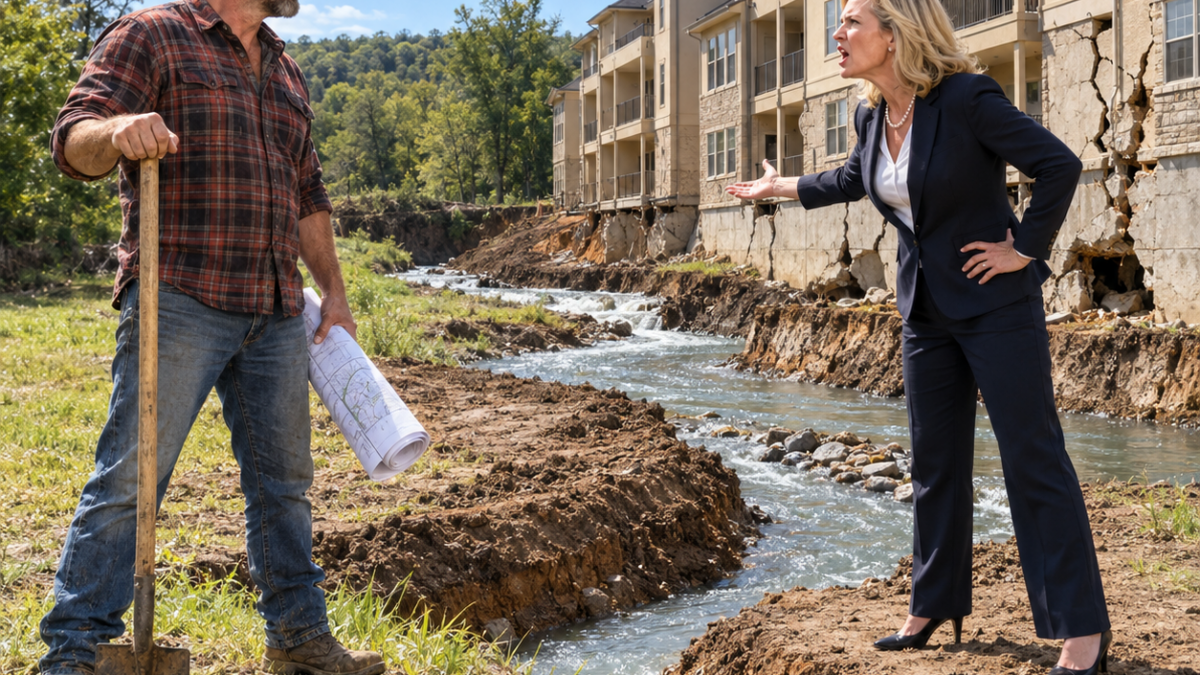
PART 2
I stayed at the kitchen table until nearly two in the morning.
The original site plan was dated four years earlier, back when Serenity Springs was still a collection of colored lines on somebody’s computer.
There they were.
Retention Basin A.
Retention Basin B.
Both large.
Both engineered to collect stormwater from the development before slowly releasing it.
I knew exactly why they were there.
Before the Army sent me overseas, I had trained as a civil engineer. After that, most of my twenty-year career had involved combat engineering—roads, bridges, drainage, temporary infrastructure, and the unglamorous work of figuring out how water behaved when people put things in its way.
Water was patient.
It didn’t care about sales brochures.
It didn’t care about property values.
And it certainly didn’t care how expensive your condo was.
When you covered forty acres of ground with roofs, pavement, and concrete, rainfall stopped soaking into soil the way it had before.
Runoff increased.
Speed increased.
Peak discharge increased.
Something had to absorb that difference.
On the approved plan, the retention ponds did exactly that.
Except someone had replaced them with condos.
Sarah came downstairs wearing her robe.
“You’re still up?”
“Come look at this.”
She pulled out a chair.
I showed her the old plan.
Then the satellite image.
Her eyes moved between them.
“I don’t understand.”
“These are retention ponds.”
“I know what a pond is, John.”
Despite everything, I smiled.
“Sorry.”
“What I mean is, why are there houses where the ponds are?”
“That’s what I’m trying to figure out.”
She looked at the map again.
“Can they just change the plan?”
“With approval, sure.”
“So maybe they got approval.”
“Maybe.”
The way I said it made her look at me.
“You don’t believe that.”
“I believe somebody approved something. I want to know what.”
Sarah leaned back.
Outside, the creek was still running high from the previous week’s rain.
“What happens if the sandbags fail?”
“The barn could flood.”
“And the house?”
“Not from this storm pattern. We’re higher.”
“What about next year?”
That was the question.
Developments changed watersheds permanently.
This wasn’t one bad summer.
If Apex Homes had truly designed Serenity Springs to discharge most of its runoff onto my land, I might be fighting that pipe for decades.
“I’m going to the county tomorrow,” I said.
Sarah nodded.
Then she touched my forearm.
“Don’t let Karen turn you into somebody who only knows how to fight.”
“I’m trying to protect our place.”
“I know.”
She looked toward the dark window.
“But protecting something and being consumed by it aren’t always the same thing.”
I heard her.
I just didn’t know yet how hard that warning would become to follow.
The county public works building looked exactly the way government engineering buildings always look—beige walls, fluorescent lights, file cabinets, and people who had developed the ability to appear busy while waiting for somebody else to approve something.
I gave the clerk the permit number.
“I need the complete development file.”
“Which portion?”
“Stormwater, drainage revisions, grading, erosion control, site modifications, inspection reports.”
She stared at me.
“All of it?”
“All of it.”
An hour later, I was sitting at a long table surrounded by rolled drawings and scanned documents.
The original design was solid.
I hated admitting that.
The engineer who designed the first version had done competent work.
Runoff from roofs and roads was directed into underground piping, then into two retention ponds. The ponds were sized for major storm events and had controlled outlets designed to release water gradually.
The plan did not send a thirty-six-inch pipe toward Miller’s Creek.
That came later.
I found the revision after lunch.
STORMWATER MANAGEMENT MODIFICATION 3C.
The two retention ponds had been removed.
The land they occupied had been redesignated for additional residential buildings.
The revised plan replaced the ponds with a direct discharge system leading toward an “existing natural receiving channel.”
My creek.
I read the hydrological calculations.
Then I read them again.
Something was wrong.
The runoff coefficient was too low.
The document treated sections of heavily graded, compacted land as though they absorbed water like undisturbed meadow.
The estimate for total impervious area looked short.
Roof area alone should have pushed the figure higher.
I took photographs of every sheet.
Then I called the smartest hydrologist I knew.
Dave Jensen answered on the fourth ring.
“John Miller.”
“Still ugly?”
“Only where the shrapnel hit me.”
“You never got hit by shrapnel.”
“Then I’m aging badly. What do you want?”
“I have eighty-nine condos dumping runoff into my creek.”
There was a pause.
“That sounds less fun than lunch.”
“I need you.”
“You always say that right before I lose a weekend.”
“Come look.”
He arrived two days later in a truck that looked older than my tractor.
Dave had been my platoon sergeant during one deployment, then used his GI benefits to finish a doctorate in hydrology.
He made good money now consulting for municipalities and engineering firms, but he still dressed like somebody who thought clean jeans counted as formal attire.
He walked down to the creek.
The joking stopped.
“Show me the outfall.”
We followed the bank north.
The culvert sat just beyond the property boundary.
Fresh erosion surrounded the receiving area.
Dave crouched near the creek.
“How high did it get?”
I pointed to debris caught in a fence.
His head came up.
“That high?”
“Last storm.”
He measured.
Photographed.
Took soil samples.
Set a flow meter.
Then he looked at the old oak beside the creek.
Nearly two feet of root was exposed on the downstream side.
“How long has that tree been here?”
“My grandfather said his father planted it.”
Dave rubbed mud between his fingers.
“This bank is failing.”
“I know.”
“No. I mean structurally. Another season like this and you lose that tree, maybe this whole bend.”
He spent the afternoon mapping grades.
At the kitchen table that evening, I showed him the county drawings.
He got very quiet when he reached Revision 3C.
“Where did you get this?”
“Public works.”
He traced the runoff calculations with a pencil.
“Who signed it?”
“Apex engineer. County review below.”
He pointed to a figure.
“This coefficient makes no sense.”
“That’s what I thought.”
“It gets worse.”
He opened his laptop.
We compared the approved site map with recent aerial imagery.
“They undercounted impervious surface,” he said.
“By how much?”
“At least forty percent from what I can see. Maybe more.”
“And the soil assumptions?”
“Fantasy.”
He sat back.
“John, if this is the actual basis for the permit revision, somebody should have rejected it.”
“But they didn’t.”
“No.”
“Can you put that in a report?”
“I can put facts in a report. I’m not calling it fraud until I know whether this was incompetence, a later field change, or something worse.”
That was Dave.
Even angry, he stayed exact.
I needed somebody equally exact on the legal side.
Marcus Thorne had served as a JAG officer before opening a civil litigation practice about ninety miles away.
We had not spoken in three years.
He answered with, “Please tell me you’re calling because you finally want to sue the Army for making you shave every morning.”
“I’ve got an HOA.”
“That’s worse.”
I sent him the file.
Every photograph.
Every letter.
The $500 fine.
The property records.
The original stormwater design.
Revision 3C.
Dave’s preliminary notes.
Two days later, Marcus called.
“First question. Are you a member of Serenity Springs HOA?”
“No.”
“Is your property subject to its covenants?”
“No.”
“Then why did you pay them five hundred dollars?”
“I wanted to stop late fees while I figured out what was happening.”
He groaned.
“Never do that again.”
“Understood.”
“They don’t get to fine adjacent property because they don’t like your sandbags.”
“Karen thinks otherwise.”
“I’m already beginning to dislike Karen.”
“Get in line.”
Marcus became serious.
“The drainage issue matters more. Did you grant any easement?”
“No.”
“Prior owner?”
“My father. No.”
“Recorded drainage rights?”
“None that I found.”
“Good. We verify all of that.”
“What do you think about the permit revision?”
“I think Dave needs to finish his analysis before we accuse anyone of falsifying anything.”
There was a pause.
“And I think you should assume every text, email, phone call, and conversation from this point forward may appear in a courtroom.”
“So don’t tell Karen what I think of her.”
“Especially not in writing.”
Karen sent the second fine four days later.
$100.
My fence supposedly violated Serenity Springs’ appearance standards.
Marcus read it and laughed.
“Keep it.”
“I planned to.”
“Don’t pay.”
The third notice concerned my mailbox.
The fourth accused me of maintaining an “unapproved agricultural nuisance.”
The nuisance was twelve cattle.
My land had been agricultural for a century.
Karen then filed a complaint with county code enforcement alleging improper manure storage, commercial activity, and contamination of the creek.
A county officer named Paul Reed came to inspect.
Karen waited by the county road while he walked my property.
That told me everything.
She wanted to watch.
I showed Reed the livestock area.
The compost enclosure.
Chemical storage.
Fuel tanks.
Septic.
Barn.
He inspected for nearly an hour.
Finally, we reached the creek.
He looked at the sandbags.
“She says that’s an illegal dam.”
“It’s bank protection.”
I showed him flood photographs.
Then the culvert.
He stared at it.
“That came from the development?”
“Yes.”
He walked closer.
“Do they have an easement?”
“Not that anybody can find.”
Reed looked back toward Karen.
She was still standing beside her vehicle.
“Your agricultural operation checks out,” he said. “I’ll write the report.”
Then he lowered his voice.
“Between us, she has called zoning, environmental health, public works, and code enforcement.”
“About me?”
“About anything she thinks might be actionable.”
I exhaled.
“Thank you.”
“I didn’t tell you that.”
“Of course not.”
Karen’s smile disappeared when Reed drove away without citing me.
That night, I stood in the kitchen holding another certified envelope.
Sarah watched me from across the island.
“What now?”
“Mailbox.”
“Seriously?”
“Apparently it leans.”
“It does lean.”
“Sarah.”
“I’m just saying.”
I laughed despite myself.
It was the first time I had laughed about any of it.
Then Ethan walked in.
“Are they still trying to fine us?”
“Yes.”
He shook his head.
“Why do they care what our mailbox looks like?”
“They don’t.”
“Then why?”
I looked at the envelope.
“Because they want me tired.”
That was the strategy.
Not one big attack.
A hundred small ones.
Every letter forced me to respond emotionally, even if legally I ignored it.
Every county vehicle at the driveway made me wonder what accusation came next.
Every unknown number on my phone tightened something in my chest.
One Sunday morning I snapped at Ethan because he moved one of the trail cameras without telling me.
He stared at me.
“I was changing the batteries like you asked.”
“I told you not to touch the angle.”
“It moved two inches.”
“I need the exact view.”
“Okay.”
He put the camera on the counter.
“You do it.”
He walked away.
Sarah said nothing.
She didn’t have to.
I found him in the barn twenty minutes later.
“I’m sorry.”
He kept sorting tools.
“I know.”
“No. Look at me.”
He did.
“This isn’t your fight.”
“I helped build the sandbags.”
“That doesn’t make it your responsibility.”
“They’re flooding our land.”
“Our land. My responsibility.”
He frowned.
“Grandpa would say that’s not how family works.”
I almost smiled.
“You sound too much like him.”
“Good.”
That conversation forced me to change.
I could fight hard.
But I was not going to let Karen make my house feel like a command post.
I moved most of the case documents into a locked office in the barn.
No more talking about legal strategy at dinner.
No more checking trail cameras every twenty minutes.
If Karen wanted my peace, I wasn’t going to hand it to her voluntarily.
Dave finished his preliminary report.
His conclusions were worse than I expected.
The revised drainage plan substantially underestimated peak runoff.
The retention basins in the original design would have reduced those peaks.
Replacing them with direct discharge increased both velocity and sediment load at the receiving channel.
The culvert was functioning exactly as constructed.
That was the problem.
Serenity Springs had been designed to get rid of water quickly.
My property absorbed the damage.
Dave also found signs that several northeast buildings were experiencing subsurface moisture problems.
“How would you know that?” I asked.
“Drainage staining. Settlement along sidewalks. Sump discharge.”
“Can you prove foundation trouble?”
“Not from outside.”
“So leave it alone.”
“I am.”
Then I met Tom Alvarez.
I was at the hardware store buying replacement sump-pump hose for my barn when I noticed a man wearing a Serenity Springs polo shirt staring at a display of pumps.
He looked exhausted.
“You flooding?” I asked.
“Third time this year.”
“Which building?”
He gave me the number.
I knew it immediately.
Northeast corner.
One of the buildings sitting where Retention Basin B had originally been designed.
I introduced myself.
His expression changed.
“John Miller?”
“Yes.”
He hesitated.
“Karen talks about you at meetings.”
“I bet she does.”
“She says you’re blocking drainage.”
“I’m trying to stop your drainage from washing away my farm.”
He looked skeptical.
So I showed him photographs.
The creek before Serenity Springs.
The erosion after.
The culvert.
Then the original site plan.
Tom stared at the blue shapes labeled RETENTION BASIN.
“That’s my building.”
“I know.”
“No, my actual unit is right there.”
He zoomed in.
“You’re telling me this was supposed to be a pond?”
“According to the original approved design.”
“What changed?”
“A revision.”
“Why?”
“More units, apparently.”
Tom rubbed both hands over his face.
“My basement wall cracked last month.”
I didn’t say anything.
“Builder says settlement.”
“That may be true.”
“Do you believe that?”
“I’m not qualified to diagnose your foundation from the plumbing aisle.”
He almost laughed.
Then he said, “You should come to my house.”
Sarah thought it was a trap.
Marcus thought it was useful.
“Do not inspect anything,” he warned me. “You are not their engineer.”
“I know.”
“You are not their lawyer.”
“I know.”
“You do not tell them their homes are unsafe.”
“I know.”
“John.”
“I know.”
Tom’s basement smelled damp.
A diagonal crack ran from the corner of a window toward the floor.
There was discoloration near the baseboard.
His neighbor, Rachel Kim, had similar damage.
Another owner had doors that no longer closed cleanly.
Someone else had a garage slab crack.
None of those things, by themselves, proved a catastrophic structural failure.
New buildings settle.
Concrete cracks.
Doors shift.
But taken alongside repeated flooding and missing stormwater basins, the homeowners had legitimate questions.
Tom had been asking them for months.
Karen’s board told him the builder warranty process was handling everything.
Apex blamed “normal settling.”
Owners blamed the HOA.
The HOA blamed owners for improper landscaping.
Nobody accepted responsibility.
Tom invited five neighbors over that evening.
I told them exactly what we knew.
And exactly what we didn’t.
“The original plan had ponds,” I said. “The revised plan removed them. My hydrologist believes the revision underestimated runoff. That does not automatically mean your foundation cracks were caused by drainage problems.”
Rachel nodded.
“So what do we do?”
“Document everything. Hire your own experts. Don’t rely on me.”
Tom looked surprised.
“You’re not asking us to join your lawsuit?”
“There isn’t one yet.”
“What are you asking?”
“Ask your board why the ponds were removed.”
That was enough.
Two weeks later, Serenity Springs residents submitted a petition for a special HOA meeting.
Karen denied it on a procedural technicality.
They submitted another.
She postponed it.
Then she sent an HOA newsletter.
The headline read:
PROTECTING SERENITY SPRINGS FROM OUTSIDE INTERFERENCE.
I was the outside interference.
According to Karen, an adjacent landowner opposed to “responsible progress” was attempting to undermine the community’s approved drainage system.
She did not mention the eroded pasture.
She did not mention the missing retention ponds.
She did not mention the fines.
Tom forwarded me the newsletter.
Marcus replied with one sentence.
Good. Keep everything.
By then, Dave had enough data for a formal engineering opinion.
Marcus drafted a cease-and-desist demand to Apex Homes, the HOA, and its board.
It was twenty-one pages long.
It included photographs.
Survey data.
Hydrology.
Property records.
Erosion measurements.
The lack of a drainage easement.
Copies of the HOA fines.
And a demand that Apex propose a lawful stormwater remediation plan.
They had thirty days.
Karen received her copy during an HOA meeting.
Tom recorded what happened.
She stood in front of nearly sixty homeowners holding Marcus’s letter.
“Our neighbor has hired an attorney to intimidate us.”
Someone asked, “What does it say?”
“It contains outrageous accusations.”
“About the drainage ponds?”
Karen’s face tightened.
“The original drainage design was revised by professionals.”
“Why?”
“That is not relevant.”
Tom raised his phone slightly.
It captured everything.
Karen lifted the letter.
“We are not going to let one disgruntled farmer dictate how eighty-nine families live.”
Then she tore the document in half.
People gasped.
Not because tearing paper had legal significance.
It didn’t.
Marcus still had proof of service.
What mattered was the attitude.
They had been formally told the system was damaging neighboring property.
Their president had publicly treated the warning like theater.
When Marcus watched the video, he leaned back.
“She’s making your credibility argument for you.”
“What happens when the thirty days expire?”
“We decide whether to sue.”
But something else had been in my mind.
Something older than Serenity Springs.
Miller’s Spring emerged on the northern ridge of my property.
From there, it fed the creek through the pasture.
My grandfather had once planned an irrigation pond near the spring.
He even had an old hand-drawn sketch.
The idea had never happened because cattle prices fell and money went elsewhere.
Now I began wondering whether the pond made sense.
Not as revenge.
As protection.
If I could retain more spring water higher on my property, I would have irrigation during dry months.
I could reduce erosion downstream.
And I could route controlled overflow away from the barn.
I called Marcus.
He was silent for several seconds.
“You’re asking whether you can change the flow of your own spring.”
“Yes.”
“Legally complicated.”
“I expected that.”
“Water law depends on state rules, downstream rights, environmental regulations, wetlands, permits, and whether you materially injure another property owner.”
“So we do it correctly.”
“If it can be done.”
Dave was even more cautious.
“You do not redesign a watershed because Karen annoys you.”
“I want an irrigation pond.”
“You wanted one six months ago?”
“No.”
“Then don’t pretend her drainage has nothing to do with it.”
Fair.
“I want to protect the barn.”
“Better answer.”
We hired an independent engineering firm.
Not Dave.
That mattered to Marcus.
Dave could advise me, but if this turned into litigation, we wanted a design created by professionals with no personal connection.
The engineers surveyed the spring.
Wetlands.
Soils.
Historic flow.
Downstream conditions.
They developed a one-acre agricultural pond with a controlled spillway and a new overflow channel reconnecting to Miller’s Creek far below the vulnerable barn bend.
It did not block Apex’s pipe.
It did not enter Serenity Springs.
It did not touch their infrastructure.
Most importantly, it did not depend on their approval.
The county reviewed it.
The state environmental agency reviewed it.
We revised the plans twice.
Marcus reviewed every page.
Then the permits arrived.
Approved.
I held them in my hand and felt something I had not felt in months.
Control.
Not over Karen.
Over my own land.
Hank Lawson’s family had been moving dirt in our county since before I was born.
He studied the plans.
“You want the pond here?”
“Yes.”
“Good soil.”
“You can do it?”
He looked offended.
“I built your cattle crossing.”
“That was twenty years ago.”
“And it’s still there.”
Fair point.
A week later, heavy equipment came up my driveway.
Karen called within forty minutes.
I let voicemail answer.
“John, this is Karen Davenport. I can see construction equipment operating near a community drainage corridor. You are required to stop immediately until the HOA has reviewed your plans.”
Marcus listened to the voicemail.
“Save it.”
“Obviously.”
“She truly believes she governs you.”
“I think she believes anything she can see belongs to her.”
On the third day of excavation, a sheriff’s deputy arrived.
Karen followed in her SUV.
The deputy approached while Hank’s excavator sat idle.
“We got a complaint about an illegal dam.”
I handed him a waterproof folder.
“Not a dam. Agricultural irrigation pond. County permit. State approval. Engineering drawings.”
He studied everything.
Then he called dispatch.
Karen waited by the road.
The deputy came back twenty minutes later.
“Everything checks out.”
“Thank you.”
He turned toward Karen.
She marched closer.
“He is altering a drainage system that protects eighty-nine homes.”
The deputy looked at her.
“Ma’am, I’m here to determine whether there’s an immediate law enforcement issue.”
“There is.”
“What crime?”
“He’s redirecting water.”
“On his property?”
Karen opened her mouth.
The deputy handed my folder back.
“This appears to be a permitted civil matter.”
She stared at me.
“You know exactly what you’re doing.”
I did.
I was protecting my farm.
I was also removing the assumption Serenity Springs had built into its drainage design—that my spring-fed creek would always be available to carry away whatever volume they dumped toward it.
But I had not hidden that issue.
Marcus’s letter had explicitly warned Apex that its system depended on a receiving channel over which it had no easement or guaranteed right.
They ignored him.
Construction took almost three weeks.
Hank shaped the pond basin.
Installed the control structure.
Built the emergency spillway.
Armored vulnerable slopes.
The new overflow route bypassed the barn.
For several days, we left the final spring connection untouched while inspectors reviewed the work.
Then the county signed off.
The state inspector signed off.
Hank looked at me.
“Ready?”
I thought of Karen.
The fines.
The flooded pasture.
Ethan stacking sandbags.
Sarah standing on the porch during storms.
Then I pushed all of it aside.
“This is for us,” I said.
Hank nodded.
The excavator removed the temporary earth plug.
Clear spring water entered the new channel.
It wound downhill.
Reached the pond.
And began filling.
I stood there until sunset.
By morning, the flow in the old upper creek channel had dropped substantially.
Groundwater seepage remained.
Small tributary runoff remained.
But the steady spring current was gone.
For the first time in my life, the stretch beside the barn was quiet.
Ethan walked down with me.
“It looks weird.”
“Yeah.”
“You miss it?”
“Already.”
“So why do it?”
I looked at the pond in the distance.
“Sometimes protecting something means changing it.”
He kicked a stone.
“Grandpa wouldn’t like that answer.”
“He didn’t like most of my answers.”
Ethan smiled.
A major storm was forecast for the following weekend.
Four inches possible.
Hank asked if I was nervous.
“Very.”
“Pond can handle it.”
“I’m not worried about the pond.”
I was worried about everything else.
The rain began Friday evening.
By nine, it was heavy enough to blur the pasture lights.
I checked the pond’s camera.
Water level rising normally.
Spillway clear.
Then I checked the camera at the Apex culvert.
At first, the discharge was modest.
Then it grew.
Brown water blasted from the pipe.
Without the old spring flow occupying the channel, the contrast was almost obscene.
For months Karen had described their runoff as something the creek naturally handled.
Now the camera showed the truth.
The development itself was creating most of the violent flow.
Water spread across the eroded receiving area.
My sandbag and bank-protection system redirected it away from the barn.
But on the Serenity Springs side, things started going wrong.
Tom called at 10:42.
“We’ve got water in the street.”
“How bad?”
“Storm drains are full.”
“Stay out of the water.”
“My sump pump’s running nonstop.”
“Do not go into the basement if electrical outlets are wet.”
“John, the pavement behind Building Eleven is sinking.”
That got my attention.
“How much?”
“I don’t know. Two inches? Maybe more.”
“Call the fire department if you think there’s structural danger.”
“We already did.”
By eleven thirty, emergency lights flashed between the buildings.
I could see them from the ridge.
Serenity Springs’ drainage network was overloaded.
Later engineering analysis would show several reasons.
The system was undersized.
Some pipes had been installed flatter than designed.
Construction debris had partially blocked two junction structures.
The development lacked the detention capacity removed when the ponds were eliminated.
And the northeast buildings had been placed on poorly compacted fill in soil that remained saturated during prolonged storms.
My pond had not cracked their foundations.
Their own construction defects had been developing for months.
But that night was when everything became impossible to hide.
Tom sent me a photograph.
A crack in the exterior foundation wall of Building Twelve had widened enough for water to enter.
Another building had separation between a concrete stair landing and the wall.
Residents were being moved out of several lower units as a precaution.
Then a vehicle slid to a stop at my driveway.
Karen.
Two sheriff’s deputies were behind her.
She ran toward my porch through the rain.
“You did this!”
Sarah stepped behind me.
Karen pointed toward Serenity Springs.
“Our homes are flooding!”
One deputy raised his hand.
“Ma’am, stay back.”
“He diverted the creek!”
I looked at the older deputy.
“I have the permits.”
“We need to see what happened.”
“Of course.”
I grabbed my raincoat and the waterproof document case.
We walked toward the creek.
Karen came behind us despite the deputy telling her to remain near the road.
The outfall was roaring.
Water swirled through the damaged channel.
The sandbags and temporary erosion barriers held.
The deputy shined his light downstream.
“Where was the original creek?”
“Through here.”
“And you moved it?”
“The spring source now feeds a permitted irrigation pond. Controlled overflow reconnects downstream.”
Karen shouted, “He knew this would happen!”
I turned.
“No. Your developer was told thirty-four days ago that your system was damaging my land and relied on discharge into a channel you had no easement to use.”
“You sabotaged us!”
“I didn’t touch your pipe.”
“You took away the creek!”
“My spring.”
“You can’t just—”
The older deputy interrupted.
“Ms. Davenport.”
She stopped.
He looked at me.
“Did you obstruct their drainage infrastructure?”
“No.”
“Enter their property?”
“No.”
“Modify their culvert?”
“No.”
I handed him the permits.
He read.
The younger deputy recognized them.
“I checked these before construction.”
The older man nodded.
“This is civil and regulatory. We’re not arresting anybody tonight.”
Karen stared at him.
“People’s homes are cracking!”
“Then you need engineers and emergency management.”
A television van appeared at the county road.
I looked at Tom’s number on my phone.
He had warned me earlier that one of the residents had called a local reporter.
Karen saw the camera.
Something in her face changed.
She walked toward it.
That was a mistake.
The reporter asked, “Ms. Davenport, residents say the HOA knew about repeated flooding complaints. Did the board know the original site plan included retention ponds?”
Karen froze.
“Those are technical questions for the developer.”
“Were you aware the ponds were replaced with additional condos?”
“This gentleman altered a natural waterway tonight.”
The camera turned toward me.
I hated cameras.
But Marcus had prepared me.
Facts.
Nothing else.
“My pond was fully permitted and inspected,” I said. “I have not touched Serenity Springs infrastructure. Their developer has been formally notified for more than a month that its drainage system is causing damage to my property. What is happening inside Serenity Springs needs to be evaluated by independent engineers.”
The reporter looked toward the flooded development.
“Did you expect this?”
“I expected Apex Homes to fix its drainage system before another major storm.”
Karen stepped forward.
“He planned this!”
The older deputy said, “Ma’am, you need to return to your property.”
The camera captured that too.
By morning, the video was everywhere locally.
Not because I looked heroic.
I didn’t.
I looked soaked, exhausted, and angry.
It spread because the images were undeniable.
Flooded streets.
Residents carrying boxes out of basement units.
A widening crack across one building’s foundation.
Emergency pumps.
Karen shouting beside a pipe her HOA had spent months defending.
And the original engineering drawing with two blue retention ponds sitting exactly where condos had been constructed.
The county announced an emergency inspection before noon.
Apex Homes sent lawyers.
Then engineers.
Then public-relations people.
The PR statement blamed an “unanticipated alteration of adjacent hydrological conditions.”
Marcus called me laughing.
“They mean your pond.”
“I know what they mean.”
“Good news.”
“What?”
“They just publicly admitted their drainage performance depended on conditions on your land.”
I understood.
If Apex had no easement and no contractual right to my spring flow, building a permanent stormwater system dependent on it was their problem.
But Marcus cautioned me.
“Do not celebrate. Families are displaced.”
He didn’t have to tell me.
Tom and Rachel were sleeping in a hotel.
An older woman named Mrs. Donovan had been taken to her daughter’s house after water entered her unit.
Six condos were temporarily evacuated pending structural inspection.
These people had bought homes.
They had mortgages.
They had family pictures in basements filling with water.
Karen deserved accountability.
They didn’t deserve this.
Sarah and I loaded our truck with bottled water, towels, and food.
Ethan came with us.
At the Serenity Springs entrance, one resident recognized me.
For a second, I thought he might yell.
Instead he said, “You’re John?”
“Yes.”
He looked at the supplies.
“Thank you.”
That moment changed something.
The fight had never really been farmers versus condo owners.
It was landowners and homeowners versus people who believed they could make money by pushing consequences onto somebody else.
The county’s emergency engineering report arrived twelve days later.
It was devastating.
The revised drainage model had materially underestimated runoff.
As-built impervious surface exceeded the assumptions used in the modification.
Several drainage components did not match permitted slopes and dimensions.
Construction debris impaired capacity.
Most serious, the northeast buildings had been constructed on fill that showed evidence of inadequate compaction and repeated saturation.
The storm had accelerated visible settlement.
Foundation cracking in several units required major repairs.
Apex Homes insisted the buildings remained repairable.
Independent engineers hired by homeowners agreed that most could be stabilized.
Four units, however, sat in the worst possible location.
Directly over the former retention basin footprint.
Marcus stared at the report.
“Now we sue.”
We filed separate but coordinated actions.
My claim sought damages for erosion, trespass by concentrated stormwater discharge, restoration costs, harassment, and declaratory relief regarding the HOA’s lack of authority over my property.
Tom and dozens of Serenity Springs owners pursued claims involving construction defects, misrepresentation, drainage failures, and warranty issues.
The Collins family and Garzas joined my side of the property dispute with their own evidence of harassment and development impacts.
Apex’s lawyers responded aggressively.
They accused me of creating the storm event’s worst consequences by rerouting Miller’s Spring.
Their expert claimed the historical creek had functioned as an essential receiving channel.
Marcus asked one simple question during deposition.
“What legal right did Apex Homes possess to require Mr. Miller to maintain a particular quantity of water in a creek entirely on his property for the benefit of Serenity Springs?”
The expert could not answer.
Apex then argued that I had acted maliciously.
They introduced Karen’s testimony that I had “threatened” to make the development regret using my creek.
I asked Marcus afterward, “Did I ever say that?”
“Not on any recording.”
“Could I have?”
“Probably. You were angry.”
That bothered me.
At home I searched my own memory.
Had this become revenge?
When I planned the pond, had part of me wanted their system to fail?
Yes.
There had been a part of me.
I admitted that to Marcus.
He nodded.
“That matters morally. Legally, the question is what you actually did.”
“I changed the creek knowing their system used it.”
“You changed your spring through a permitted project after giving them written notice that their unauthorized discharge was damaging your property.”
“Does motive matter?”
“It can.”
He leaned forward.
“That’s why we do not lie. If they ask whether you understood the drainage conditions would change, you say yes. If they ask whether you hoped Apex would be forced to stop dumping water onto you, you say yes.”
“What if they ask whether I wanted Karen humiliated?”
Marcus smiled.
“I recommend saying considerably less than yes.”
During my deposition, Apex’s attorney asked exactly that.
“Mr. Miller, wasn’t your pond designed as retaliation?”
“No.”
“You expect this jury to believe timing was coincidence?”
“No.”
He blinked.
“So you admit retaliation?”
“I admit Serenity Springs’ drainage problem was one reason I finally built a pond my family had discussed for years.”
“You knew reducing flow in Miller’s Creek would affect our system.”
“I knew your system discharged into my property without an easement and that your company had been formally told to stop damaging my land.”
“You wanted us to fail.”
“I wanted you to fix your drainage.”
“You could have left the creek alone.”
I looked at him.
“So your position is that I had an obligation to maintain my property in whatever condition made your defective drainage system function?”
His face tightened.
“I ask the questions.”
“Then ask better ones.”
Marcus kicked my shoe under the table.
Afterward he said, “Do not do that at trial.”
“I know.”
“You enjoyed it.”
“A little.”
Discovery produced the documents that broke Apex’s defense.
Internal emails showed company executives knew eliminating the retention ponds allowed additional premium units worth several million dollars.
One project manager warned:
DRAINAGE MODEL IS AGGRESSIVE. IF COUNTY PUSHES BACK, WE MAY NEED TO RESTORE BASIN A.
Another email responded:
GET 3C APPROVED. WE CANNOT LOSE EIGHT SELLABLE UNITS.
Then came an email regarding adjacent land.
MILLER PARCEL PROVIDES NATURAL OUTFALL. NO NEED TO OVERENGINEER.
No one had contacted my father, who owned the property at the time.
No one had requested an easement.
They simply used us as a line on a drawing.
Marcus printed that email and placed it in front of me.
“That sentence is your whole case.”
I read it again.
MILLER PARCEL PROVIDES NATURAL OUTFALL.
My family’s farm had become a cost-saving measure.
The county investigation also found irregularities surrounding approval of Revision 3C.
The senior reviewer who signed the modification had left county employment not long afterward.
Investigators later uncovered payments to a consulting business associated with him from a subcontractor connected to Apex.
I did not know whether every accusation would become a criminal conviction.
Marcus repeatedly reminded me not to say more than public records established.
But the county referred its findings to state investigators.
The permit approval was reopened.
Apex’s corporate leadership suddenly became much more interested in settlement.
Karen’s position collapsed even faster.
Serenity Springs residents demanded an emergency election.
The temporary clubhouse was packed.
Tom asked me to come.
“I’m not a member.”
“You’re half the agenda.”
I stayed near the back.
Karen entered carrying a binder.
She looked different.
The woman who once stood beside my creek talking about eighty-nine families now faced those families directly.
She called the meeting to order.
People kept talking.
She struck the table.
“Please!”
The room quieted.
“For months,” she began, “this community has been targeted by an outside individual with an obvious hostility toward Serenity Springs.”
A man near the front stood.
“Our basements were flooding before John built his pond.”
Applause.
Karen raised her voice.
“Apex is responsible for construction issues, not your HOA.”
Rachel stood.
“Then why did you fine John instead of demanding Apex fix the drainage?”
Karen looked at her.
“We acted based on the information available.”
Tom lifted a stack of papers.
“We requested these drainage records three times.”
“That request was under review.”
“For four months?”
Karen’s mouth tightened.
Another homeowner stood.
“My daughter slept in a hotel for two weeks because our building was evacuated. You sent us a reminder about trash-can placement during the evacuation.”
A few people laughed bitterly.
Karen tried again.
“We cannot allow emotion to destroy orderly governance.”
Mary Donovan, the older woman whose unit flooded, stood slowly.
She was seventy-four.
Her voice barely needed volume.
“My wedding album was in my basement.”
The room fell silent.
“Forty-eight years of photographs.”
Karen lowered the binder.
Mrs. Donovan continued.
“You fined my neighbor because her wreath was displayed three days too long after Christmas.”
Nobody moved.
“But when water came through our walls, you told us to call the builder.”
Karen looked down.
“That is because construction defects—”
“You wanted authority when authority meant telling us what color our doors could be.”
Mrs. Donovan’s voice shook.
“But when authority meant protecting us, suddenly everything belonged to somebody else.”
That ended the meeting.
Not legally.
Emotionally.
A motion was made to remove Karen as president.
It passed overwhelmingly.
Then the remaining board appointed an interim committee and authorized independent legal counsel.
Karen packed her binder.
As she passed me, she stopped.
“This is what you wanted.”
“No.”
“Don’t lie.”
“I wanted you to stop flooding my farm.”
“You destroyed this community.”
I looked around the room.
Residents were exchanging phone numbers.
Some were organizing temporary housing.
Others were discussing legal fees and engineering inspections.
“No,” I said. “I think they’re finally building one.”
She walked away.
I never saw her in power again.
The negotiations with Apex took another four months.
They did not simply surrender.
Companies rarely do.
They argued about percentages.
Causation.
Insurance.
Repair scope.
Property values.
Legal fees.
Future risk.
My restoration estimate alone exceeded $230,000.
The old oak survived, but its root zone needed stabilization.
The barn foundation had shifted slightly after repeated flooding.
Pasture soil had been stripped away.
The creek bank needed reconstruction.
Native vegetation had to be replanted.
Then there were the condo owners.
Foundation stabilization.
Mold remediation.
Basement repairs.
Drainage reconstruction.
Temporary housing.
Loss in value.
Apex’s insurer disputed parts.
The company disputed other parts.
Marcus reminded us continually that litigation might last years.
The first serious settlement conference went eleven hours.
At one point Apex offered to repair my property if I agreed to restore the creek to its former route.
“No,” I said.
Their lawyer leaned back.
“Then we have a problem.”
Marcus looked at me.
“Let him finish.”
The lawyer continued.
“Our engineers believe permanent restoration of baseline flow would reduce risk.”
I asked, “To whom?”
“Serenity Springs.”
“My pond is legal.”
“We’re not disputing the permit.”
“So you want me to give your development free stormwater infrastructure forever.”
“We’re proposing a cooperative drainage arrangement.”
“Pay for an easement.”
Silence.
Marcus almost smiled.
The final solution was nothing like Apex wanted.
They agreed to build proper detention infrastructure entirely within Serenity Springs.
To do that, they needed land.
The best location was still the original basin footprint.
Four of the most severely affected condo units were already considered uneconomical to repair.
Apex bought them back from their owners at negotiated values, including relocation compensation.
The buildings were demolished.
The area became part of a redesigned stormwater basin.
A second basin was constructed near the opposite corner using community open space and land Apex still controlled.
Underground piping was replaced.
Outfalls were reengineered.
Emergency overflow was routed through a legally acquired easement away from my barn and away from neighboring farms.
For the first time since Serenity Springs was built, its stormwater system did not depend on my family donating land, water, or tolerance.
My own settlement covered restoration and damages.
The amount was confidential.
The public portions required Apex to restore the damaged bank under independent environmental supervision.
Dave reviewed the design.
So did another engineer chosen by the county.
The HOA rescinded every fine issued against me.
They reimbursed the $500 I had stupidly paid.
The check arrived in a plain envelope.
Sarah held it up.
“What are we doing with this?”
“Frame it?”
“No.”
“Burn it?”
“Also no.”
Ethan walked through the kitchen.
“Buy a mailbox.”
I looked at him.
He grinned.
Sarah laughed so hard she had to sit down.
We used part of it to replace the mailbox.
Same style.
Same color.
But perfectly straight.
Ethan installed it.
Then deliberately tilted it half an inch.
“For character,” he said.
I left it that way.
The state investigation continued after our civil settlement.
The former county reviewer eventually faced charges related to unlawful payments and misconduct involving several development projects, not just Serenity Springs.
Apex removed two executives connected to the permitting process.
The company later entered agreements with regulators and paid substantial penalties.
Karen was never charged with engineering fraud.
That distinction mattered.
She had not designed the system.
She had not signed the county approval.
What she had done was use HOA authority to protect a developer’s decisions while attacking the people raising legitimate concerns.
Serenity Springs homeowners handled her consequences themselves.
She resigned from the board completely.
A few months later, her condo went on the market.
Tom called me.
“She’s leaving.”
“How do you feel?”
“I thought I’d feel happier.”
“Yeah.”
“You too?”
“Most victories feel better before you get them.”
He understood.
Karen sold and moved away.
I never learned where.
I didn’t care enough to look.
Tom became president of the new board reluctantly.
His first proposal was a rule limiting presidents to two consecutive terms.
His second was independent engineering review for any major infrastructure dispute.
His third was almost funny.
“Neighbor relations committee.”
I stared at him across my kitchen table.
“You need a committee to tell people not to trespass?”
“Apparently.”
“Government expands.”
“This is an HOA.”
“Same disease.”
He laughed.
The Landowners Alliance did not disappear either.
Mr. Collins insisted on monthly breakfasts.
The Garzas joined.
Several Serenity Springs residents came too.
At first, conversations were awkward.
The condo owners worried we blamed them.
Some farmers did blame them.
It took time.
Then one Saturday, Tom brought six Serenity Springs families to help replant the damaged section of creek.
Nobody ordered them to come.
No HOA service credits.
No publicity.
They came with shovels.
Mrs. Donovan came with sandwiches.
Rachel brought native shrubs.
Ethan organized teenagers to carry mulch.
Sarah worked beside two women who had once signed a petition complaining about cattle odors.
By lunchtime they were exchanging vegetable recipes.
I stood by the barn watching them.
Dave walked up.
“You’re getting sentimental.”
“Shut up.”
“Combat engineer defeated by volunteer landscaping.”
“Don’t you have water to measure?”
“Water’s doing fine.”
That was true.
The restored creek section no longer carried the spring’s entire historic flow, but the new pond’s controlled overflow fed it enough to support habitat during most seasons.
Bank stabilization held.
Native grasses returned.
The old oak produced leaves the following spring.
The pond itself changed our farm.
Sarah stocked the shallow edges with wetland plants.
Ethan convinced me to add bluegill.
Herons appeared within months.
So did ducks.
One evening Sarah and I carried two chairs down there.
Sunset turned the water orange.
She looked across the pond.
“You know what’s strange?”
“What?”
“I hated this pond.”
“When?”
“Before you built it.”
“You never said that.”
“You were obsessed.”
“Fair.”
“I thought every shovel of dirt was another step deeper into the fight.”
I looked at the water.
“Maybe it was.”
“But now…”
She watched a heron lift from the far bank.
“Now it feels like ours.”
I reached for her hand.
“I’m sorry.”
“For what?”
“For disappearing into it.”
“You came back.”
That was more forgiveness than I deserved.
A year after the storm, Serenity Springs held an open community meeting in its finished clubhouse.
Not the double-wide trailer.
A real building.
Tom invited adjacent landowners.
I almost declined.
Then Mrs. Donovan called Sarah and told her she had baked peach cobbler specifically because “your stubborn husband better show his face.”
So we went.
The clubhouse had photographs on one wall documenting the drainage reconstruction.
Not flattering photographs.
Flooded streets.
Excavation.
Demolished units.
New basins.
Pipe installation.
The board decided not to hide what happened.
At the meeting, Tom presented a new emergency plan.
Flood response.
Independent inspections.
Financial reserves.
Board transparency.
Then he said something I did not expect.
“We spent our first year thinking John Miller was the problem because that’s what we were told.”
Everyone looked at me.
I hated it.
Tom continued.
“The truth was harder. John was inconvenient because he was evidence that something was wrong.”
He paused.
“Our new board’s job is not to make inconvenience disappear. It’s to listen when inconvenience is trying to tell us something.”
I looked down.
Afterward, a young couple approached.
They had bought one of the condos after the repairs.
The woman said, “We heard the story about the creek.”
“I’m sorry.”
She laughed.
“No, I mean we knew before buying.”
Her husband nodded.
“The new drainage report is why we felt comfortable.”
That surprised me.
For so long, everyone had treated transparency as a threat to property values.
But sometimes hiding defects destroyed trust far more thoroughly than admitting them.
Outside, Karen’s old condo had a new owner.
A retired schoolteacher named Linda.
She introduced herself.
“I hope we can be better neighbors.”
“So do I.”
She pointed toward my side of the property.
“Is that your ugly fence?”
I stared at her.
Then she smiled.
Tom had clearly told her.
“Yes.”
“I like it.”
“Careful. That kind of opinion could get you elected president.”
She laughed.
The following month, Ethan left for college.
He chose civil engineering.
I blamed Dave.
Dave took full credit.
Before we drove him to campus, Ethan asked to stop at the creek.
We walked down to the oak.
New soil covered the exposed roots.
Native grass grew along the rebuilt bank.
The old sandbags were gone.
He touched the trunk.
“Remember when we stacked those?”
“Every one.”
“I thought Karen was going to explode when she saw them.”
“She almost did.”
He looked toward Serenity Springs.
The new retention basin was visible through a line of young trees.
“It’s weird.”
“What?”
“If they’d built that in the first place, none of this happens.”
“No.”
“No fines.”
“No.”
“No lawyers.”
“No.”
“No cracked buildings?”
“Maybe some construction issues still happen. But not the same way.”
He nodded.
“All because they wanted four more buildings.”
“Money makes smart people very creative at explaining bad decisions.”
Ethan smiled.
“That sounds like Grandpa.”
“It probably was.”
Before leaving, he walked to the mailbox.
Still leaning half an inch.
“You never fixed it.”
“I like the character.”
“Mom says you’re stubborn.”
“She knew that before marrying me.”
“Fair.”
After he left for school, the farm felt too quiet.
I spent more time near the pond.
Sometimes I thought about Karen.
Not often.
What surprised me most was that anger faded faster than the physical damage.
For months she had occupied space in my head without paying rent.
Then one day she simply didn’t.
The creek mattered.
My family mattered.
Whether Karen regretted anything did not.
That might have been the most satisfying part.
Not watching her lose the presidency.
Not seeing Apex tear down expensive condos to build the retention ponds they should have built from the beginning.
Not even the settlement.
It was realizing I no longer needed her to understand why she had been wrong.
The engineering proved it.
The county records proved it.
The homeowners learned it.
The repaired land showed it.
Nothing else was required.
Two years after the first flood, a major tropical system moved through the county.
Forecast: nearly five inches of rain.
Ten years earlier, that number would not have meant much to me.
Now I watched the radar carefully.
Tom called.
“Big one.”
“Looks like it.”
“You worried?”
“Always.”
“Engineers say we’re good.”
“Engineers also designed Titanic.”
“That was naval architecture.”
“Still engineers.”
He laughed.
Rain started after dark.
Sarah made coffee.
I checked the pond.
Normal.
Then the creek.
Normal.
At midnight the storm intensified.
Water entered Serenity Springs’ new retention basins.
Exactly as designed.
The basins rose.
Held.
Controlled outlets released water slowly.
My pasture remained intact.
No emergency vehicles.
No calls.
No Karen at my driveway.
At one in the morning, Sarah found me standing on the porch.
“You know normal people sleep during storms.”
“I’m getting there.”
We listened.
Rain hammered the metal barn roof.
But there was no roar from the culvert.
No sound of soil collapsing.
No panic.
Just rain.
By morning, clouds broke.
I walked the creek.
The water was high but clear enough to see stones beneath the surface.
The oak stood firm.
The barn was dry.
At Serenity Springs, both ponds were full.
A pair of geese floated on one.
Tom stood beside the fence.
He raised his coffee cup.
“Still here.”
“Looks that way.”
He pointed at the pond.
“You know residents complain about the geese.”
“Fine them.”
He stared at me for half a second.
Then we both started laughing.
The laugh carried across the wet field.
A couple of years earlier, that property line had felt like a battlefield.
Now it was just a fence.
That afternoon Sarah and I walked to our pond.
Sunlight broke through the clouds.
Drops clung to the grass.
A great blue heron stood motionless near the shallows.
Sarah leaned into me.
“You won?”
I looked at her.
“What?”
“All that time, you kept saying you were going to win.”
“I don’t remember saying that.”
“You said it constantly.”
“That sounds unlike me.”
“John.”
I smiled.
She asked again.
“So did you?”
I looked toward the barn.
Then the creek.
Then the new trees volunteers had planted along the bank.
Across the boundary, children were riding bicycles near Serenity Springs’ retention pond.
Nobody was yelling.
Nobody was measuring my fence.
Nobody was sending fines.
“No,” I said.
Sarah raised an eyebrow.
“No?”
“I think we finally stopped losing.”
She considered that.
Then nodded.
The difference mattered.
Revenge would have been flooding Karen’s home because she flooded mine.
Justice was forcing the people who created the problem to fix it.
Revenge would have been making eighty-nine families suffer because their HOA president treated my farm like a sewer.
Justice was standing beside those same families until the developer could no longer divide us.
And victory was not the cracked foundations, the lawsuits, the penalties, the news cameras, or Karen leaving town.
Victory was quieter.
It was Ethan coming home from college and checking the pond before he even walked into the house.
It was Sarah growing tomatoes again without worrying that the lower garden would wash away.
It was Mr. Collins bringing coffee to a Serenity Springs board meeting just because he felt welcome there.
It was Mrs. Donovan replacing the wedding photographs she could save and keeping the damaged ones too because, as she told me, “Forty-eight years shouldn’t look perfect.”
It was Tom calling before a storm not because he feared me, but because neighbors check on each other.
And it was standing beside Miller’s Creek one autumn evening, listening to water move over stone exactly where the new engineering plan said it should.
My great-grandfather could never have imagined eighty-nine condos beyond that ridge.
My grandfather would have hated them on principle.
My father probably would have complained about their streetlights.
But I think all three of them would have understood the lesson the land taught me.
Property is not just dirt inside a surveyed line.
It is responsibility.
What you build on your land can hurt the person beside you.
What you dump downhill eventually reaches somebody.
And paperwork does not erase gravity.
Apex Homes learned that lesson at enormous cost.
Karen learned that authority without accountability does not last.
I learned something harder.
Being technically right does not automatically make every choice wise.
There were nights during the fight when anger drove me harder than principle.
There were moments I cared too much about watching Karen lose.
If Sarah and Ethan had not pulled me back, I might have won the case and still lost the peace I was supposedly defending.
That realization stayed with me.
One evening, Ethan came home from college carrying a rolled drawing.
“What’s that?”
“Senior project.”
“You’re not a senior.”
“Early concept.”
He unrolled it across the kitchen table.
It was a small watershed restoration design.
Retention structures.
Riparian planting.
Controlled overflow.
Sarah looked at me.
“No.”
“What?”
“No telling him how to redesign it.”
“I wasn’t going to.”
Ethan laughed.
“Yes, you were.”
He pointed to one feature.
“What do you think?”
I studied it.
Then I caught myself.
“What does your professor think?”
“He says the calculations work.”
“Then listen to him.”
Ethan narrowed his eyes.
“You feeling okay?”
“I’m evolving.”
Sarah nearly dropped her coffee.
Later that evening, Ethan and I walked to the pond.
The old creek conflict had become part of family history now.
Not a crisis.
A story.
Near sunset, we passed the mailbox.
Still half an inch crooked.
Ethan stopped.
“You know, I can fix that.”
“Absolutely not.”
“HOA standards.”
“Get off my property.”
He laughed all the way to the pond.
At the water’s edge, we watched two ducks move through the reflection of the clouds.
The pasture behind us was green.
The barn stood firm.
The oak beside the creek was scarred but alive.
Beyond the ridge, the roofs of Serenity Springs caught the fading light.
Once, I had looked at those roofs and seen an invasion.
Now I saw neighbors.
Complicated ones.
Imperfect ones.
People who had made mistakes, trusted the wrong leaders, ignored things they should have questioned, and then eventually decided to stand up.
That felt more real than any clean story about heroes and villains.
Karen had been cruel.
Apex had been greedy.
Some officials had failed.
But most of the eighty-nine families were simply trying to build ordinary lives.
So were we.
I bent down, picked up a flat stone, and skipped it across the pond.
Four skips.
Ethan whistled.
“Lucky.”
“Skill.”
“Old-man luck.”
I handed him a stone.
He threw.
Five.
“Don’t tell anybody.”
“Too late.”
Sarah’s voice carried from the porch, calling us for dinner.
Ethan started back.
I stayed another moment.
The evening was almost completely still.
For months, water had been the weapon in this story.
Too much water.
Water moving too fast.
Water carrying mud and chemicals.
Water finding cracks.
Water forcing people from their homes.
Now the same water lay quiet in front of me, held where it belonged, released where it could do no harm.
That was what good engineering had always been about.
Not controlling nature.
Respecting consequences.
I looked toward the creek one last time.
The fight began because Karen Davenport told me Miller’s Creek was not mine.
In one narrow sense, maybe she had accidentally touched something true.
The creek belonged to my property.
But water itself never really belongs to anyone.
We only decide what we do with it while it passes through our hands.
Apex tried to push its water away and make the consequences somebody else’s problem.
Karen tried to use authority to silence anyone who objected.
I nearly made the opposite mistake—believing that because I was right, every consequence on the other side of the fence was theirs alone to suffer.
In the end, the solution worked only when everybody stopped asking whose problem the water was and started building something that actually worked.
I turned toward the farmhouse.
Ethan held the door open.
Sarah was waiting inside.
Behind me, the pond reflected the last orange line of sunset.
Across the ridge, the new retention basins quietly held the day’s runoff.
And Miller’s Creek kept moving through the grass, carrying nothing it wasn’t supposed to carry.
For the first time in years, I didn’t need to measure the bank.
I didn’t need to check a camera.
I didn’t need to prepare for the next envelope.
I simply walked home.
[END OF STORY]








