PART 2: HOA Built 80 Homes Behind My Property—Then Their “Access Road” Ended at My Fence
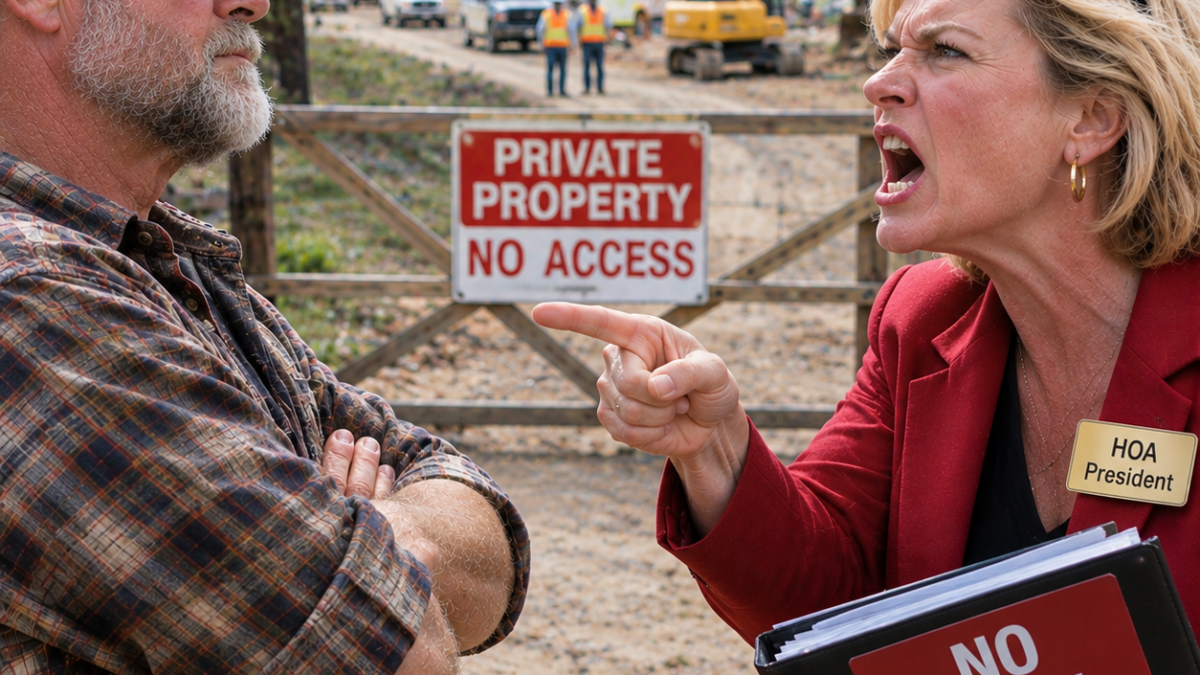
PART 2
The clause was only three sentences long.
I read them until the words blurred.
Decades earlier, before my father owned the eastern strip, a neighboring landowner had proposed an access easement across it.
The deal had never been completed.
No final grant.
No recording.
No legal right of passage.
Then my father bought that strip.
And buried inside the closing agreement was language stating that no unrecorded or incomplete right of passage would transfer to any third party through the sale.
I called Gideon.
It was almost ten at night.
He answered on the fifth ring.
“Somebody dying?”
“No.”
“Being arrested?”
“No.”
“Then this should probably wait until morning.”
“I found something in Dad’s safe.”
Silence.
“What kind of something?”
“Old sale agreement.”
“That got my attention.”
“I’m sending photographs.”
I took pictures of every page.
Five minutes later, Gideon called back.
His voice had changed.
“Where did your father get this?”
“It was in his safe.”
“Original?”
“Looks like it.”
“Don’t staple it. Don’t write on it. Don’t carry it around in your truck.”
“I’m not an idiot.”
“Good. Bring it to me tomorrow.”
“What does it mean?”
“It means we need to verify everything.”
“Gideon.”
“I know what you want me to say.”
“Then say it.”
“No.”
I could hear papers moving.
“Not until I confirm the chain.”
That was the first thing I learned about Gideon.
He never gave me the answer that felt best.
He gave me the answer the documents could carry.
The next morning, he spread the agreement across his desk.
For almost twenty minutes he spoke only to himself.
Dates.
Names.
Parcel references.
Book numbers.
He had a habit of tapping his pen against his thumbnail when something mattered.
The tapping stopped.
He looked up.
“Your father knew.”
“Knew what?”
“That somebody might eventually try to use this strip for access.”
“How?”
“Maybe he didn’t know about Renfield. But this old proposed easement made the land strategically important.”
He pointed at the legal description.
“The parcel behind you was difficult to reach even back then.”
“So Dad bought this strip to block access?”
“I’m not going to assign motive to a dead man from one document.”
“That sounds like yes.”
“That sounds like your father understood what he was purchasing.”
I sat back.
“Can Renfield use the road?”
“Not based on this.”
“Can they claim the old easement?”
“If it was never completed and never recorded, that argument has a serious problem.”
“What about the subdivision map?”
“A map can show what a developer intends.”
He leaned toward me.
“It cannot, by itself, give them property rights you never granted.”
That sentence should have made me feel better.
Instead, I thought of eighty houses.
“Then how did the county approve them?”
“Good question.”
“Can you find out?”
“That is why lawyers charge obscene hourly rates.”
“I thought that was because you enjoy suffering.”
“Also true.”
He called in an independent surveyor named Silas Ren.
Silas was sixty-one and had spent most of his life walking land nobody else noticed.
He showed up at my place before sunrise wearing a faded jacket, work boots, and an expression that suggested the modern world disappointed him.
“You Elias?”
“Yes.”
“Where’s the disputed corner?”
I pointed.
He looked at my property.
Then at Renfield Estates.
Then at me.
“That road supposed to cross yours?”
“According to them.”
“According to you?”
“No.”
“Good. At least one of you is wrong.”
That was Silas’s entire introduction.
For three days, he worked the eastern boundary.
He located original monuments.
Compared them to county records.
Shot bearings.
Measured distances.
Marked corners.
He found two old pins so badly rusted I would have walked past them without noticing.
On the third afternoon, he came to my porch.
“Your boundary’s right.”
“That sounds promising.”
“Depends who you are.”
He opened his field book.
“The subdivision road comes right to you. But the legal access they’re assuming continues over land they don’t own.”
“Mine.”
“Yours.”
“No easement?”
“I’m a surveyor, not title counsel.”
I smiled.
“Gideon’s rubbing off on everyone.”
Silas ignored that.
“My job is location. Their road requires passage across your strip. Your recorded boundary hasn’t moved.”
He looked toward the subdivision.
“If somebody wants to cross, they need a legal reason.”
Gideon found no recorded easement.
Not under my father’s name.
Not under mine.
Not tied to the older neighboring parcel.
Not under Renfield Estates.
Nothing.
He drafted a formal notice.
The language was polite.
The meaning wasn’t.
Produce the instrument establishing access.
Cease any work or entry affecting my property.
Do not disturb the eastern strip.
Preserve documents concerning the access corridor.
Marla’s attorney answered within four days.
He did not produce an easement.
Instead, he claimed the association held what he called prescriptive and historical access rights arising from longstanding use.
I read that sentence three times.
“Is that bad?”
Gideon smiled.
Barely.
“What?”
“He just told us something useful.”
“That they have prescriptive rights?”
“That they don’t have a recorded easement.”
I stared.
“Because if they had one—”
“They’d send it.”
He pushed the letter toward me.
“Instead they’ve shifted theories.”
“Can they win on prescriptive access?”
“Depends on facts and state law. But they have another problem.”
“What?”
“How long has Renfield existed?”
“Less than two years.”
“Exactly.”
He leaned back.
“They’re going to have difficulty turning a new subdivision’s assumptions into decades of legal history.”
“So we answer?”
“Not yet.”
“Why?”
“Let them keep talking.”
That sentence became the center of our strategy.
Marla talked.
A lot.
The HOA sent notices to every resident.
According to them, I was trying to cut off access to an entire neighborhood over a “technical boundary disagreement.”
Technical.
That word traveled fast.
At the grocery store, a woman stepped directly in front of my cart.
I recognized her from the meeting.
“You’re Mercer.”
“Yes.”
“Are you really trying to close our road?”
“I’m trying to determine whether you have a legal right across my property.”
“That’s lawyer talk.”
“No. That’s the issue.”
She shifted a bag of groceries against her hip.
“My mother lives with us. She’s seventy-eight.”
I waited.
“If an ambulance needs to get in, what then?”
“I hope it gets in.”
“That isn’t an answer.”
“No.”
I looked at her.
“It’s the only honest one I have while your HOA is claiming rights they haven’t proved.”
Her face tightened.
“You can’t punish eighty families because you don’t like the development.”
“I don’t care about the development.”
“That’s easy for you to say.”
“Ma’am—”
“We have babies in those houses.”
“I know.”
“We paid for legal homes.”
“I believe you.”
That slowed her down.
She had expected a fight.
I continued.
“I’m not saying you did anything wrong.”
“Then why are we the ones suffering?”
I had no answer that wouldn’t sound cruel.
Because someone else built first and checked later.
Because Marla decided eighty families would make good leverage.
Because a finished neighborhood looked more persuasive than an unsigned easement.
So I said:
“I’m trying to make sure the people who created the problem fix it without pretending my land caused it.”
She stared at me.
Then walked away.
Someone had filmed the conversation.
By evening, clips were circulating through Renfield.
The video cut off before my last sentence.
Of course it did.
The caption said:
**LANDOWNER REFUSES TO GUARANTEE EMERGENCY ACCESS FOR RENFIELD FAMILIES**
I sat at my kitchen table watching it.
For the first time in the dispute, I lost my temper.
Not publicly.
Alone.
I threw my phone onto the couch hard enough that it bounced.
Then I walked outside.
My father’s old workshop stood behind the house.
I opened the door.
Nothing inside had changed much since he died.
Pegboard.
Hand tools.
A coffee tin full of screws.
His old radio.
I sat on the workbench.
I remembered being sixteen and furious because Dad wouldn’t let a neighbor move a fence two feet across our line.
“It’s two feet,” I had told him.
Dad looked at me.
“If two feet doesn’t matter, why does he need yours?”
At sixteen, I thought that was stubborn.
At forty-seven, I understood.
Still, understanding didn’t make the grocery-store video hurt less.
I didn’t want eighty families hating me.
I especially didn’t want children or elderly residents wondering whether I would block emergency vehicles just to prove a legal point.
The next day I told Gideon:
“We need to say something publicly.”
“No.”
“People think I’m trying to trap them.”
“Are you?”
“No.”
“Then let the legal process show that.”
“That could take months.”
“Yes.”
“That’s easy for you.”
“No.”
His voice sharpened slightly.
“You’re my client. I know exactly what this is doing to you.”
I folded my arms.
“Then why not respond?”
“Because Marla wants a public argument.”
“How do you know?”
“Because every public statement she makes turns ownership into morality.”
He pointed toward the file.
“Our advantage is that ownership is documented.”
“So I just let her call me a monster?”
“For now.”
I hated him a little that day.
Later I realized he was right.
While Marla performed for the neighborhood, Gideon kept digging.
He requested the subdivision permit file.
The county produced thousands of pages.
Traffic studies.
Drainage plans.
Emergency-response documents.
Utility approvals.
Plat revisions.
Engineering certifications.
Buried in the original application was a sworn declaration stating Renfield Estates had full legal access to a public road.
Gideon called me.
“Come in.”
“What did you find?”
“Something I want you to read instead of hear over the phone.”
That was never a comforting sentence.
I arrived twenty minutes later.
He handed me the declaration.
I read it.
“Full and legal access.”
“Yes.”
“They swore this?”
“Yes.”
“To the county?”
“Yes.”
“Where’s the supporting document?”
“Excellent question.”
He had requested it.
The county could not produce it.
No easement.
No recorded access agreement.
No owner authorization.
The file treated access as if it existed.
But the thing creating that access was missing.
“Could the county have lost it?”
“Possible.”
“Likely?”
Gideon gave me a look.
“I don’t use likely until I know more.”
Silas arrived that afternoon carrying another problem.
He laid an infrastructure plan across the conference table.
A blue line followed the same disputed strip.
“What’s that?” I asked.
“Drainage.”
My stomach tightened.
“Stormwater?”
“Underground system.”
The subdivision’s stormwater infrastructure crossed beneath the same eastern strip tied to the road.
Silas traced it with one finger.
“Pipe here. Junction here. Outlet farther south.”
“On my property?”
“Part of the alignment, yes.”
I looked at Gideon.
“They buried infrastructure under my land?”
“It appears so.”
“Without an easement?”
“We need to confirm.”
“How do you put drainage under land you don’t own?”
Silas answered.
“Same way you draw a road across it.”
Gideon gave him a look.
Silas shrugged.
“What? I’m retired enough to be honest.”
That discovery changed the stakes.
The dispute was no longer just whether cars could cross my strip.
The infrastructure keeping eighty homes from flooding could be legally entangled too.
I drove home sick to my stomach.
Not triumphant.
Sick.
It would have been easy to enjoy finding another weakness in Marla’s position.
But the drainage line wasn’t Marla’s basement.
It belonged to families.
Families who had bought homes believing the pipes under their streets were as legally secure as the houses above them.
I stood near the eastern boundary at dusk.
On the other side, lights came on in Renfield.
Kitchen windows.
Porch lights.
A child riding a bicycle.
A man dragging trash cans toward a curb.
Ordinary life built on extraordinary carelessness.
I called Gideon.
“We’re not shutting off drainage.”
He laughed once.
“You think I planned to send you out with a backhoe?”
“I’m serious.”
“So am I.”
“If this goes to court—”
“We protect your property without creating unnecessary harm.”
“Put that in writing.”
“You hired me because you trust me.”
“I hired you because Sam Pickett said you were unpleasant but competent.”
“That is basically trust.”
The county planning office sent Renfield an official request for proof of legal access.
That changed public opinion faster than anything I could have said.
Rumors started spreading.
Insurance concerns.
Mortgage concerns.
Title concerns.
Refinancing.
Resale.
I heard that one retired couple spent an entire weekend calling their insurance carrier because someone told them lack of legal access might void their policy.
A young couple who had closed two months earlier contacted their lender.
They were terrified they had bought an unsellable house.
Nobody knew what was true yet.
That was the problem.
Fear fills gaps faster than facts.
Marla called another emergency meeting.
I did not attend.
Gideon advised me to stay away and let the board question its own leadership.
Celeste Harrow did.
I learned what happened afterward from meeting minutes and from Celeste herself.
She had served on the board for years.
She stood and asked:
“If we have a legal easement, why hasn’t counsel produced it?”
Marla accused her of undermining the association.
Celeste asked again.
No document appeared.
Gideon sent a formal ten-day demand.
Produce the easement.
Day one.
Nothing.
Day five.
Nothing.
Day eight.
Nothing.
Day nine.
Nothing.
On day ten, the HOA attorney requested an extension for “ongoing internal review.”
Gideon read the email aloud in his office.
Then closed the folder.
“They don’t have it.”
That was the first time he said it without qualification.
I felt relief.
Then guilt for feeling relieved.
“What happens now?”
“We find out who knew what and when.”
“Does that matter to ownership?”
“No.”
“Then why?”
“Because they built eighty homes.”
He looked at me.
“And someone represented legal access existed.”
The phone call came Sunday night.
Unknown number.
I nearly ignored it.
“Mr. Mercer?”
“Yes.”
“My name doesn’t matter yet.”
“That’s a terrible way to start a conversation.”
The man gave a nervous laugh.
“I used to work on Renfield.”
“What do you mean?”
“Project coordination. Early phase.”
I sat down.
“Why are you calling?”
“Because I’ve been reading about the access issue.”
“Go on.”
He took a long breath.
“The map they keep showing wasn’t an access document.”
“I know.”
“It was conceptual.”
“Who knew that?”
Silence.
“Who knew?”
“Everybody who worked development.”
My hand tightened around the phone.
“Marla?”
“I saw her in meetings.”
“That isn’t an answer.”
“No.”
He sounded frightened.
“I remember an email.”
“What email?”
“Someone warned that there was no recorded easement over the Mercer property.”
I stood.
“When?”
“Before construction.”
“How long before?”
“Before the first major phase.”
“And what happened?”
“They decided access could be negotiated later.”
I felt my pulse in my throat.
“After houses were built?”
“Yes.”
“Why?”
Another pause.
“Because once enough buyers were committed, they thought the landowner would have more incentive to cooperate.”
I closed my eyes.
There it was.
Not a misunderstanding.
Not simply misplaced paperwork.
Leverage.
People.
Homes.
Mortgages.
Children.
Eighty families had been turned into pressure before they ever knew a dispute existed.
“Do you have the email?”
“No.”
“Can you identify it?”
“I think so.”
“Will you speak to my attorney?”
Silence.
“I have a job.”
“I understand.”
“My company works with the same developers.”
“I understand.”
“I have two mortgages.”
“I’m not asking you to ruin your life.”
He exhaled.
“I just couldn’t keep reading stories about those homeowners blaming you.”
I wrote down everything he could remember.
Then called Gideon.
He did not sound surprised.
That worried me more than if he had.
“We subpoena communications.”
“Can we?”
“The litigation posture is mature enough that we have avenues.”
“Will we get it?”
“If it exists and they preserve records the way they’re required to.”
Weeks passed.
Then Gideon called.
“Found it.”
I drove to his office.
He had printed one email and placed it alone on his desk.
I read the critical paragraph.
The development team acknowledged no recorded easement existed across the Mercer property.
Then came the sentence that made my hands shake.
If the Mercer family refused to cooperate, access could be negotiated after home sales and closings, when community reliance would make refusal less practical.
I read it twice.
“Community reliance.”
“Yes.”
“They built the houses to make it harder for me to say no.”
“That is one reasonable interpretation.”
“Gideon.”
He looked at me.
“Yes.”
I sat back.
For months, Marla had stood in front of residents talking about innocent families.
She had made their innocence into an argument against me.
Now I knew someone in the development process had anticipated that exact leverage before those families moved in.
“Did Marla receive this?”
“She was on the distribution.”
I stopped breathing for a second.
“She saw it.”
“The email went to her address.”
“That’s not the same as proof she read it.”
I laughed bitterly.
“You always find the smallest possible place for doubt.”
“That is my job.”
“She told me the legal team had everything airtight.”
“I remember.”
“She offered me almost nothing for the land.”
“Yes.”
“She told eighty families I was the threat.”
“Yes.”
“And she had this in her inbox.”
“Yes.”
I stood and walked toward the window.
“What do you want to do?” Gideon asked.
“Burn the whole thing down.”
He said nothing.
I turned.
“Not literally.”
“I assumed.”
“I want every resident to see that email.”
“Eventually they may.”
“Eventually?”
“We use it properly first.”
“You always say that.”
“Because the fastest way to ruin good evidence is to turn it into a public-relations stunt before you establish foundation.”
I hated that too.
Then a homeowner filed a separate claim.
Word of the email leaked through channels that had nothing to do with us.
The neighborhood split.
Some residents still defended Marla.
Others demanded resignation.
Some blamed the original developer more than the HOA.
Others wanted to sue everyone.
One night somebody threw a rock through a window at the HOA clubhouse.
I called Celeste.
“Tell people to stop.”
“You think I control them?”
“No. But tell whoever you can.”
She sounded tired.
“I’m trying.”
“I don’t want this becoming something else.”
“Elias, people are scared.”
“I know.”
“Some of them think they may lose everything.”
“They won’t because of me.”
“I believe you now.”
That word landed.
“Now?”
She was quiet.
“I didn’t before.”
“Why?”
“Because Marla had answers.”
“No. She had confidence.”
Celeste sighed.
“Those felt like the same thing.”
The formal hearing was scheduled for a cold morning near the end of fall.
I arrived early with Gideon.
The courthouse was already crowded.
Residents filled the benches.
Reporters sat along the back wall.
Celeste was in the middle row.
The woman who confronted me at the grocery store sat near her.
When she saw me, she looked away.
Marla sat across the aisle with her lawyer.
She looked smaller than she had in the clubhouse.
Not physically.
Just stripped of the room she controlled.
The HOA’s attorney went first.
He talked about harm.
Eighty families.
Access.
Property values.
Emergency vehicles.
Infrastructure.
He argued that whatever mistakes existed in paperwork, equity should not permit one landowner to destabilize an entire finished community.
I listened.
Parts of it were compelling.
That bothered me.
Because the families really could be harmed.
Gideon stood.
“I agree with counsel on one point.”
The HOA attorney looked surprised.
Gideon continued.
“The residents face serious harm.”
The judge leaned forward.
“Then where do you disagree?”
Gideon looked toward Marla.
“On who created it.”
Silence.
He started with my deed.
Then the survey.
Then Silas’s report.
No recorded easement.
Then the old proposed access document.
Incomplete.
Never recorded.
Then my father’s purchase.
Protective clause.
Then Renfield’s conceptual map.
The road shown as planned access.
Not property rights.
Then the county declaration claiming full legal access.
No supporting instrument.
Then the drainage plan.
Then the HOA attorney’s letter shifting to prescriptive rights.
Then the internal email.
Gideon read only the key portion.
Community reliance could be used after sales and closings to make refusal less practical.
People behind me murmured.
The judge raised her hand.
Silence returned.
The HOA attorney tried to argue historical use.
The judge asked:
“Show me the instrument.”
He shifted to equitable access.
She asked:
“Show me owner consent.”
He discussed reliance.
She asked:
“Reliance on whose representation?”
That one landed harder than anything Gideon said.
Finally Marla testified.
Her attorney asked whether she intended to deceive homeowners.
“No.”
“Did you believe legal access would be secured?”
“Yes.”
“Did you rely on the developer?”
“Yes.”
“Did you believe Mr. Mercer would eventually negotiate?”
“Yes.”
That last answer made me look up.
Gideon stood for cross-examination.
“You believed I would negotiate?”
Marla looked at him.
“Yes.”
“Before construction?”
“Yes.”
“Before eighty homes were completed?”
“Yes.”
“Before residents moved in?”
“Yes.”
“Did you possess an executed easement at that time?”
“No.”
“Did you tell buyers there was no executed easement?”
“I wasn’t responsible for sales disclosures.”
“Did you tell your board?”
“We discussed access planning.”
“That was not my question.”
Her jaw tightened.
“No.”
Gideon lifted the internal email.
“Do you recognize this?”
She stared.
“Yes.”
“Did you receive it?”
“It appears so.”
“Did you read it?”
“I don’t remember.”
“Do you remember discussing the possibility that the Mercer family could refuse?”
“Yes.”
“Do you remember anyone suggesting the development could negotiate after homes were sold?”
Marla’s attorney objected.
The judge allowed Gideon to rephrase.
“Did you understand, before construction was complete, that legal access across the Mercer parcel had not yet been secured?”
The courtroom went silent.
Marla looked at me.
Then at the judge.
Finally:
“I understood there were details still being finalized.”
Gideon waited.
“What detail was larger than the legal right to cross land you did not own?”
Her face hardened.
“The project had other access planning.”
“Then why did you need my client’s property?”
No answer.
“Why offer to buy it if you already had a right?”
Her attorney objected.
Overruled.
Marla said:
“To avoid unnecessary conflict.”
“Why threaten eighty families with loss of access if the right already existed?”
“I never threatened them.”
“You told them Mr. Mercer was trying to close their access.”
“He was.”
“No.”
Gideon’s voice remained quiet.
“He was asking you to prove it existed.”
Marla stopped answering quickly after that.
That was when I understood something about confidence.
Confidence works best when nobody forces it to slow down.
Gideon did.
One question at a time.
The judge did not issue some dramatic final ruling that morning.
Real court rarely moves like that.
But the direction became clear.
The HOA had not established the broad property right it claimed.
The judge questioned whether current use could continue on the same terms while ownership and infrastructure issues were unresolved.
She encouraged immediate structured negotiations.
Gideon asked permission to present my proposed terms.
Marla looked at me sharply.
This was the part nobody expected.
I was not asking the court to demolish eighty homes.
I was not asking for families to be trapped behind a locked gate.
I was not asking for drainage pipes to be dug out.
I wanted a real easement.
Fair market value.
Clear boundaries.
HOA pays legal costs caused by the dispute.
Property damage repaired.
Drainage infrastructure brought into the agreement.
Maintenance responsibility defined.
Past unauthorized use compensated.
Full disclosure to residents.
No future expansion beyond the easement without written consent.
And if the evidence established that Marla knowingly concealed the missing access right, she should no longer control negotiations on behalf of the association.
The judge looked toward the HOA table.
“Counsel?”
Marla whispered urgently to her lawyer.
Then she stood.
“We are not agreeing to that.”
Her attorney reached for her sleeve.
She pulled away.
“This man is exploiting eighty families.”
The judge’s expression changed.
“Ms. Voss, sit down.”
Marla remained standing for one second too long.
Then sat.
The court entered a temporary order limiting further use of the disputed strip while the matter continued and requiring the parties to preserve essential safety and emergency arrangements without treating those temporary measures as permanent property rights.
That distinction mattered.
I was not allowed to use the order as a weapon against residents.
The HOA was not allowed to pretend temporary access proved ownership.
A county worker placed the notice near the gate days later.
No television cameras.
No crowd.
Just laminated paper.
Legal language.
Orange barrier.
The road that Marla had treated as settled suddenly looked very unsettled.
Residents were furious.
But this time, most of the anger moved away from me.
Celeste acted before the board could contain the damage.
She printed the internal email.
Then a timeline.
Development planning.
Missing easement warning.
Construction.
Home sales.
County declaration.
My objection.
Marla’s public statements.
She delivered copies to every mailbox in Renfield before sunrise.
Marla called it sabotage.
Celeste called it disclosure.
A special HOA vote was scheduled.
I did not attend.
I didn’t need to.
Celeste called afterward.
“She’s out.”
I sat on my porch.
“Removed?”
“Overwhelming vote.”
“What happens now?”
“We get competent counsel and come talk to you.”
I looked toward the eastern tree line.
For months, I had imagined that sentence.
I expected satisfaction.
Instead, I felt exhausted.
“What about Marla?”
“She left before the meeting ended.”
The new board contacted Gideon within forty-eight hours.
No threats.
No community-pressure letters.
No television interviews.
Their attorney opened the first meeting with:
“We need to solve the access problem legally.”
Gideon looked at me.
I said:
“That’s all I’ve asked for.”
The negotiations were difficult anyway.
Fair market value had to be established.
The easement had to account for road width.
Drainage.
Repairs.
Snow removal.
Emergency access.
Utility work.
My own farm access.
Liability.
Future widening.
Construction traffic.
Landscaping.
Fences.
The underground drainage system complicated everything.
Engineers had to confirm where pipes were located.
Some segments required formal utility and maintenance rights.
The HOA had to accept responsibility for repairing damage from installation and maintenance.
An independent appraiser valued the burden on my property.
When the number arrived, I stared at it.
It was far higher than Marla’s first offer.
Gideon watched me.
“You look surprised.”
“I am.”
“Why?”
“I wasn’t expecting that much.”
“That’s why we use independent valuation.”
“I don’t want to bankrupt people.”
“You are not charging them an invented number.”
“The HOA pays.”
“The HOA represents homeowners, yes.”
I looked at him.
“Then families pay indirectly.”
“That is true.”
I hated that.
For two nights, I thought about reducing the compensation.
Then I drove past Renfield.
A family was decorating for a birthday.
Balloons tied to a mailbox.
Two kids chasing each other across a lawn.
None of them had decided to build first and negotiate later.
I called Gideon.
“Can we structure some of the cost against parties responsible for development?”
“We can negotiate allocation.”
“Do it.”
The new board agreed to pursue recovery from the original development interests where available and to avoid placing unnecessary immediate burden on residents.
That made signing easier.
Before the final agreement, Marla asked to see me.
I almost refused.
Then I agreed.
We met at the same fence where we first spoke.
She arrived without a blazer.
No folder.
No sunglasses.
Just jeans, a dark coat, and a tired face.
“You got your way.”
I leaned against the fence.
“That’s how you want to start?”
She looked away.
“No.”
We stood in silence.
Finally:
“I was wrong.”
I waited.
“I should have secured access before the homes were built.”
“Yes.”
“You don’t need to make this worse.”
“I’m not.”
“I know.”
That seemed hard for her to say.
She looked toward Renfield.
“I really believed you’d negotiate.”
“You mean after the houses existed.”
“Yes.”
“Why?”
“Because everybody does eventually.”
I stared at her.
“You built eighty homes because you assumed I would become reasonable after you created enough pressure.”
She flinched.
“When you say it like that—”
“How else should I say it?”
“I thought the project mattered more than one strip of land.”
“That strip belongs to someone.”
“I know.”
“Now.”
She looked at me.
“Do you have any idea what it takes to build a community like that?”
“No.”
“Years.”
Her voice shook slightly.
“Financing. Permits. Contractors. County meetings. Engineers. Buyers. Delays. Every week costs money.”
“I believe you.”
“You reach a point where one unresolved issue feels like something you solve later.”
“That’s the issue you built the road through.”
She nodded.
“I thought momentum would carry us through.”
“There it is.”
“What?”
“Momentum.”
I pointed toward the subdivision.
“You thought enough houses could become a property right.”
“I thought you would see that fighting us made no sense.”
“And if I didn’t?”
She didn’t answer.
“That was the part you never planned for.”
“No.”
“What did you actually want from me?”
“I wanted access.”
“You had months to ask honestly.”
“I know.”
“Instead you made the families the argument.”
Her eyes filled.
Not dramatically.
Just enough that she looked away.
“I thought if the neighborhood depended on it, you wouldn’t say no.”
“That is exactly why my father protected the strip.”
She turned back.
“Your father?”
I told her about the old agreement.
The incomplete easement.
The protective clause.
His warning to me.
A man who controls the road controls everything behind it.
Marla listened.
“He knew?”
“Not about you.”
I looked at the land.
“He knew pressure follows access.”
She gave a tired laugh.
“I spent years thinking this whole thing was about a stubborn old property line.”
“It was.”
“No.”
She shook her head.
“It was about someone understanding the problem decades before I did.”
I didn’t correct her.
She asked:
“What do you want now?”
I looked toward the houses.
“Those families to have a legal road.”
Her expression changed.
“You’re signing?”
“Yes.”
“After everything?”
“They didn’t build on assumptions. You did.”
She nodded slowly.
“And me?”
“What about you?”
“Do you want me punished?”
I thought about the grocery-store video.
The meetings.
The letters.
The threats.
My father’s safe.
The internal email.
“I want you to live with the part that was yours.”
She looked down.
“That may be enough.”
We shook hands.
Not forgiveness.
Not friendship.
Just the end of one kind of fight.
The permanent easement was signed two weeks later.
Survey attached.
Exact legal description.
Maintenance obligations.
Drainage rights.
Repair requirements.
Residential access.
Emergency access.
Limits on expansion.
Compensation.
Every page initialed.
Every signature notarized.
Then recorded.
Gideon drove with me to the courthouse.
The clerk stamped the instrument.
I watched.
A simple mechanical sound.
Thump.
After months of arguments, that tiny stamp created what Marla had spent years pretending already existed.
Gideon handed me the certified copy.
“How does it feel?”
“Boring.”
He smiled.
“That is how good property law should feel.”
The temporary barrier came down.
The road opened fully under the new agreement.
Nobody cheered.
Residents simply started driving.
That was perfect.
The woman from the grocery store came to my house three days later.
She stood outside my gate holding a pie.
I looked at it.
“What’s that?”
“An apology.”
“Looks like apple.”
“It’s both.”
I opened the gate.
She stayed outside.
“I was awful to you.”
“You were scared.”
“That doesn’t excuse it.”
“No.”
“I saw the email.”
I nodded.
“My mother asked why I believed Marla without asking to see anything.”
“What did you tell her?”
“That apparently being sixty-eight years younger does not make me smarter.”
I smiled.
“She sounds difficult.”
“She is.”
She held out the pie.
“I’m sorry.”
“Thank you.”
“And for the video.”
“You didn’t post it.”
“My sister did.”
“That explains everything.”
She laughed.
Then became serious.
“You really weren’t going to strand us, were you?”
“No.”
“Even after what everybody said?”
“No.”
“Why?”
I looked toward Renfield.
“Because you didn’t create the problem.”
Her eyes filled.
She nodded.
Then left.
Celeste became the new HOA president temporarily.
She hated the title.
That made me trust her more.
Her first official letter to me began:
**Mr. Mercer, pursuant to the recorded easement…**
I called her.
“You know how happy that sentence makes me?”
“That is the saddest thing I’ve ever heard.”
“Instrument number too?”
“Page two.”
“Excellent.”
She laughed.
The HOA created new rules.
Any future property claim required independent title review.
No infrastructure could be installed across adjacent land without recorded rights.
Board members had to receive actual source documents, not summaries from developers.
Major land-use decisions required outside counsel.
Obvious things.
Expensive lessons often produce obvious rules.
The drainage system was inspected.
Several sections near my property needed repairs.
The HOA notified me.
Their engineer showed me plans.
They scheduled access.
They restored the ground.
Permission.
Notice.
Documentation.
I almost wanted to frame the work order.
Months passed.
Renfield became ordinary.
The road stopped looking like an invasion.
Cars came through.
People waved.
Kids rode bikes.
Delivery trucks followed the approved route.
Emergency services had documented access.
My land remained mine.
One evening, the young father who confronted me at the first meeting walked over.
His name was Daniel Price.
I knew that by then.
He leaned on the fence.
“You remember me?”
“Yes.”
“I asked if you understood my kids already lived here.”
“I remember.”
“I was angry.”
“I noticed.”
He smiled.
“My oldest started middle school.”
“Good.”
He looked toward the road.
“You could’ve shut us down.”
“I could’ve made things harder.”
“Why didn’t you?”
“Because I wanted the road legal, not gone.”
He nodded.
“Marla told us you wanted the entire subdivision demolished.”
I laughed.
“That would’ve been ambitious.”
“She said your attorney was threatening everything.”
“Gideon threatens with footnotes.”
Daniel smiled.
Then his face changed.
“I’m sorry.”
“You don’t owe me much.”
“I treated you like you were trying to hurt my family.”
“You were protecting them.”
“From the wrong person.”
That sentence stayed with me.
Marla sold her home in Renfield a few months later.
I learned through Celeste.
“Where’d she go?”
“Another county.”
“Still developing?”
“I don’t know.”
I hoped not.
Then I felt guilty for hoping that.
People are rarely only the worst decision they made.
But some decisions deserve to follow you until you understand them.
I hoped Marla understood.
A year after the dispute, Gideon came to my porch carrying the final bound easement file.
“You already gave me one.”
“This is the complete version.”
“Why do I need complete?”
“Because when I die, I don’t want you calling another lawyer at ten at night.”
“You’re fifty-two.”
“Exactly. Ancient.”
We sat outside.
Renfield porch lights came on one by one.
Gideon watched cars using the road.
“You know, most clients in your position would’ve asked for more.”
“Money?”
“Everything.”
“Could I have?”
“You had leverage.”
“That word again.”
He looked at me.
“You don’t like it.”
“Not anymore.”
“Why?”
“Because somebody used eighty families as leverage against me.”
He nodded.
“What did your father want?”
I looked toward the eastern strip.
“I don’t know.”
“You think he would’ve signed?”
“Eventually.”
“Why?”
“He hated waste.”
I smiled.
“He also hated people trespassing.”
“Those qualities can coexist.”
“He would’ve made them pay for every survey pin.”
Gideon laughed.
“That I believe.”
I opened the final file.
My signature.
HOA signature.
Legal description.
Recorded instrument.
Drainage easement.
Maintenance agreement.
Everything where it belonged.
For the first time, the road behind my land was not a question.
That mattered more than winning.
Then, three years after Renfield opened, a major storm hit the county.
Rain fell for nearly two days.
Creeks rose.
Ditches overflowed.
The drainage system beneath the eastern strip carried water exactly as designed.
At midnight, I stood in a raincoat near the fence watching runoff.
Celeste arrived in an HOA utility vehicle.
“You okay?”
“I live on higher ground.”
“We’ve got water backing near Hawthorne Court.”
“Engineer coming?”
“On the way.”
I pointed toward the maintenance access.
“Use it.”
She hesitated.
“The agreement—”
“Emergency maintenance. Section seven.”
She stared at me.
“You memorized it?”
“Parts.”
“That is deeply unhealthy.”
“Go.”
Workers arrived.
They cleared debris from a junction.
Water dropped.
No argument.
No boundary dispute.
No call to attorneys.
Because the agreement already answered the question.
That night taught me what the whole fight should have been about.
Not keeping people out.
Making sure everyone knew when they could come in.
The next spring, Celeste asked me to attend Renfield’s annual meeting.
I refused.
She called again.
“Why?”
“I’m not a member.”
“I know.”
“That is my favorite fact.”
“You’re impossible.”
“Yes.”
“We want to recognize you.”
“Absolutely not.”
“There’s no plaque.”
“Still no.”
“Daniel wants to say something.”
“Tell Daniel I’m busy.”
“You’re retired.”
“I’m busy privately.”
She hung up.
Two days later, eighty families sent me a card.
Not every signature.
But most.
The front showed a photograph of the road.
Inside:
**Thank you for helping us make it legal instead of making us lose it.**
I sat at my kitchen table reading that sentence.
Then I opened my father’s safe.
The old agreement was still there.
Yellowed.
Fragile.
I placed the card beside it for a while.
Dad would have mocked me.
“You got sentimental over an HOA card?”
Probably.
But he also would have understood.
A road can divide people.
It can connect them too.
The legal document doesn’t decide which.
People do.
That summer, I rebuilt part of the eastern fence.
Daniel helped.
He showed up with a post-hole digger and no idea how to use it.
“You ever done this?”
“No.”
“Then why did you bring that?”
“It looked right.”
“You bought it this morning.”
“Yes.”
“You know I have one.”
“No.”
“You could have asked.”
He stared at me.
“That sentence feels pointed.”
“Learning is happening.”
We worked until noon.
His children came later with sandwiches.
The older boy asked:
“Is this the famous property line?”
Daniel groaned.
“Please don’t call it that.”
I pointed at the marker.
“That’s the corner.”
The kid looked disappointed.
“It’s just metal.”
“Most important things look boring.”
Daniel said:
“Don’t encourage him.”
I laughed.
That was how the anger disappeared.
Not through one apology.
Not through a court order.
Through normal days.
Fence posts.
Storm repairs.
Kids.
Cars.
Neighbors waving.
Marla faded into the story people told about how Renfield almost lost legal access.
I tried not to let that story become cruel.
Whenever someone said she tried to steal my entire property, I corrected them.
“No. She tried to force access.”
If someone said she intentionally trapped eighty families from the beginning, I said:
“The documents show she knew access wasn’t secured and moved forward anyway. Anything beyond that is speculation.”
Gideon noticed.
“You’ve become irritatingly precise.”
“I learned from you.”
“My condolences.”
Precision mattered.
Marla had caused real harm.
She didn’t need invented crimes added to make the truth dramatic.
The truth was dramatic enough.
She knew the access wasn’t secured.
She expected pressure to solve it later.
She let homes be built and sold.
She used residents’ fear against me.
Then the same residents removed her when the evidence surfaced.
That was consequence enough for the story.
The old developer eventually faced claims connected to disclosures and infrastructure representations.
I stayed out of those cases unless subpoenaed.
I had no appetite for revenge litigation.
My settlement was done.
My land was secure.
The easement was paid.
The road legal.
The drainage system maintained.
When people asked whether I regretted not demanding more, I always said the same thing.
“No.”
Because I had never wanted Renfield destroyed.
I wanted the assumption destroyed.
The assumption that if you build enough houses, somebody else’s property rights become inconvenient details.
The assumption that a map creates permission.
The assumption that confidence is authority.
The assumption that an individual will surrender if enough people depend on his surrender.
Those assumptions were gone.
Five years after the dispute, I found another note from my father.
Not hidden intentionally.
It was inside an old toolbox I decided to clean.
A folded piece of paper behind a drawer.
Mostly measurements.
Fence lengths.
Posts needed.
Wire cost.
At the bottom, in his handwriting:
**East strip — never sell unless access terms protect the farm.**
I sat on the workshop floor.
For years, I had remembered him saying never sell it.
My memory turned that into an absolute rule.
But the note was more nuanced.
Never sell unless access terms protect the farm.
Dad wasn’t against access.
He was against giving up control carelessly.
That hit me harder than the original clause.
I had spent months wondering whether signing the easement betrayed what he wanted.
Now I knew.
It didn’t.
I took the note to Gideon.
He read it.
“Feel better?”
“Yes.”
“I could have told you.”
“You didn’t know.”
“No.”
He handed it back.
“But your father sounds annoyingly sensible.”
“He was.”
“Explains why you’re difficult.”
“Apparently not hereditary enough to stop me hiring you.”
He smiled.
The road changed over the years.
Renfield added trees.
The HOA replaced streetlights.
Cars got newer.
Children grew.
The little boy who once asked about the famous property line eventually drove past my house in his first truck.
He stopped.
“Mr. Mercer!”
I looked up from repairing a gate hinge.
“What?”
“Got my license.”
“That seems dangerous.”
“My dad says the same.”
“Smart man.”
He pointed at the road.
“This easement means I can drive through, right?”
“Residential access.”
“So yes.”
“Follow the speed limit.”
“There’s a speed limit?”
“There is now.”
He laughed and drove off too fast.
I called Daniel.
“Your son is abusing my easement.”
“He gets that from the HOA.”
“Not funny.”
“A little.”
Life had moved on.
That was the ending I wanted.
Not Marla humiliated forever.
Not residents ashamed.
Not me standing at a locked gate feeling victorious.
Ordinary life.
One evening, nearly six years after the first excavator appeared, I walked toward the eastern boundary with my father’s old flashlight.
The sun had gone down.
Renfield glowed beyond the trees.
Eighty homes no longer looked new.
Porches had furniture.
Trees had grown taller.
One house had a basketball hoop.
Another had chalk drawings covering the sidewalk.
The road ran quietly across the easement.
A car passed.
The driver waved.
I waved back.
Then I stopped beside the survey marker.
That piece of metal had been there before Renfield.
Before Marla.
Before the hearings.
Before the emails.
Before eighty families were told their road already existed.
The marker had never moved.
The legal boundary had never moved.
What changed was everybody’s understanding of it.
I thought about the first morning Marla stood there.
“There’s nothing for you to worry about, Mr. Mercer.”
She believed that.
I think she really did.
Not because she had the right.
Because she believed momentum would become the right.
That was the mistake.
Concrete can be poured quickly.
Houses can rise in months.
A neighborhood can appear almost overnight.
Property rights don’t work that way.
They require consent.
Documents.
Recording.
Definitions.
Limits.
The boring things people ignore until the exciting things go wrong.
I returned to the porch.
The fireproof safe sat in my father’s study.
I opened it.
Inside:
The old sale agreement.
His handwritten note.
My deed.
The final recorded easement.
The card from Renfield residents.
I laid them side by side.
Four documents.
Four different moments.
My father protecting the strip.
Me inheriting it.
The neighborhood finally obtaining legal access.
The people on both sides choosing to live with what the paperwork actually said.
Gideon once told me the truth speaks louder when properly assembled.
He was right.
Not because paper is magical.
Because paper forces memory, confidence, and convenience to answer to something fixed.
I returned everything to the safe.
Closed it.
Locked it.
Outside, headlights moved down the road.
No one stopped at the fence.
No one demanded access.
No one threatened court.
Nobody had to wonder whether the road legally existed anymore.
The easement did.
My ownership did.
Both could be true at once.
That was the part Marla never understood until it was too late.
She thought giving the neighborhood access meant I had to lose control of my land.
I once feared the same thing.
We were both wrong.
A properly written easement did exactly what the original assumption never could.
It gave them a road.
It left me my property.
And for the first time since eighty houses appeared behind my tree line, nothing on either side of that boundary needed to be taken from anyone.
[END OF STORY]








