PART 2: HOA Built 3 Bridges Across My Private Creek—Then Their $340,000 Park Started Running Dry
PART 2
The subdivision boundary didn’t touch Laurel Creek.
It didn’t come close.
I leaned over the plat and traced the heavy survey line with one finger.
Ridgerest Meadows ended well before the creek bank.
Between the subdivision and the water lay a strip of land that was unmistakably Holloway property.
I checked the legend.
Then the scale.
Then the recorded notes.
Nothing.
No access easement.
No recreational easement.
No community trail.
No shared waterway designation.
The creek had been deliberately left outside the development.
I asked the clerk for the original filing packet.
She brought me another folder.
Then another.
I spent most of the afternoon standing beneath bad fluorescent lights, comparing a subdivision that existed on paper with the one Tammy had been selling to her neighbors.
The more I read, the worse it became.
When Pinnacle Development Group carved Ridgerest out of the old Henderson farm, they had stopped the subdivision boundary short of Laurel Creek.
Not accidentally.
Deliberately.
The creek corridor carried environmental restrictions and additional review burdens that the developer clearly had not wanted inside the project.
So they excluded it.
On their own recorded plat.
I stared at that line.
Tammy’s letters claimed historical community rights.
The founding survey said the community ended before the water began.
Those two things could not both be true.
I drove home with certified copies on the passenger seat.
The first bridge was already being used.
A woman in running clothes crossed it with a golden retriever.
A man pushed a stroller behind her.
Neither of them looked toward my house.
That bothered me more than open hostility would have.
To them, it already felt normal.
That was Tammy’s real advantage.
She understood that repetition creates the appearance of legitimacy.
Build a bridge.
Put up a sign.
Call it a community trail.
Let families use it for a few weeks.
Soon anyone objecting looks like the person taking something away.
I parked near the house and walked to the creek.
Two teenagers were throwing stones from the bridge.
“Hey.”
They looked over.
“This is private property.”
One boy frowned.
“It’s the HOA trail.”
“No. It isn’t.”
“There’s a sign.”
I looked toward the new sign.
**RIDGEREST MEADOWS NATURE LOOP**
Of course there was.
“Who told you this belongs to the HOA?”
He shrugged.
“Everybody.”
That answer stayed with me.
Everybody.
Not a deed.
Not an easement.
Not a permit.
Everybody.
I waited until they left, photographed the bridge, the sign, the footings, the disturbed bank, and every tire mark the construction crews had left.
Then I called Tammy.
She answered on the fourth ring.
“Garrett.”
“You received my certified letter.”
“I receive a lot of correspondence.”
“The one telling you to stop building on my land.”
“Your interpretation of the boundary is disputed.”
“No, it isn’t.”
Pause.
“You’ve seen the subdivision plat.”
Another pause.
“Plat maps don’t always reflect historical use.”
“Then send me the document that does.”
“What document?”
“The easement.”
She sighed.
“Garrett, you’re making this much harder than it needs to be.”
“Send me the easement.”
“I don’t respond well to demands.”
“I’m giving you the opportunity to remove the bridge voluntarily.”
“You’re threatening the neighborhood now?”
“No.”
I looked at the creek.
“I’m documenting what happens next.”
She hung up.
That was opportunity number one.
She could have stopped.
She didn’t.
The second bridge arrived three weeks later.
I heard diesel engines before sunrise.
A flatbed.
Steel framing.
A concrete mixer.
This crossing was wider than the first.
Not some improvised wooden footbridge.
It looked municipal.
The kind of structure you might expect on a greenway project.
I walked down while the crew unloaded materials.
The foreman was a broad man named Hank Jessup.
“Morning.”
He turned.
“Morning.”
“That’s my creek.”
He checked his clipboard.
“We’ve got a work order.”
“From Ridgerest?”
“HOA.”
“Do you have an easement?”
He shifted his weight.
“I build what I’m contracted to build.”
“I’m telling you the property owner has not authorized this.”
“Then you need to talk to whoever hired us.”
“I already did.”
He gave me the tired look contractors reserve for disputes they wish they had never discovered.
“I’m not getting in the middle.”
“You’re already standing in the middle.”
I called the sheriff’s non-emergency line.
A deputy came.
He reviewed the situation.
He wasn’t rude.
He also wasn’t much help.
“Mr. Holloway, this is likely a civil property dispute.”
“They’re pouring concrete on my land.”
“I understand.”
“Can you stop them?”
“You need a court order or legal counsel.”
I looked at the crew behind him.
“So they can keep building?”
“I’m telling you to speak with an attorney.”
That was the first real setback.
I had spent my career working around public infrastructure.
If a contractor crossed a federal project boundary without authorization, work stopped.
Immediately.
Here, on my own property, I watched a mixer turn while a deputy told me the system needed time.
By sunset, the footings were in.
Within days, bridge number two was open.
Traffic increased.
Joggers.
Dogs.
Parents.
Fishing poles.
Picnic baskets.
Someone left two folding chairs near Elena’s painting rock.
I posted four private-property signs.
Forty-eight hours later, all four were gone.
One floated facedown beneath the first bridge.
I fished it out.
The red letters were still readable through the water.
**PRIVATE PROPERTY — NO TRESPASSING**
I installed cameras.
Eight along the creek corridor.
Additional coverage near the bridges.
Not to provoke anyone.
To stop arguing about what happened.
The recordings filled quickly.
Residents tearing down signs.
Dogs running through the protected bank.
People fishing.
Children throwing trash.
A woman removing one of my signs while another person laughed behind the camera.
I saved everything.
Then I went back to the county records.
This time I wanted permits.
The park construction permit took longer to locate.
When I finally received it, I sat in my truck outside the courthouse and read it twice.
Laurel Creek was identified as a **public waterway with community access rights**.
Those words were typed into an official application.
Yet the recorded subdivision plat—the document filed when Ridgerest was created—showed the opposite.
Someone had changed the story between the plat and the permit.
Then I reached the signatures.
Tammy’s husband.
Vince Pritchard.
He appeared in the application history as an HOA representative.
And later, through his role on the county planning commission, he participated in approvals connected to the park expansion.
I closed the folder.
For the first time, I understood why Tammy had been so confident.
This wasn’t simply an HOA president ignoring a boundary.
She had political cover.
At least she believed she did.
I started another file.
Deed.
Plat.
Permit.
Photographs.
Certified letters.
Camera footage.
Every page got a date.
Every video got a backup.
I had spent twenty-eight years telling young engineers that if a structure failed, the answer was almost always visible somewhere in the record.
Bad assumptions.
Ignored inspections.
Changed calculations.
Unreported loads.
You just had to follow the sequence backward.
So I did.
The planning commission minutes gave me another piece.
Months before Tammy ever came to my door, Ridgerest had requested expanded recreational access along Laurel Creek.
Vince had voted in favor.
No meaningful recusal.
No public acknowledgment that his wife ran the HOA benefiting from the expansion.
No acknowledgment that he owned property inside Ridgerest.
I printed the minutes.
Added them to the file.
Tammy showed up that afternoon.
No smile.
No sweet tea.
She pointed at one of my cameras.
“You’re filming residents.”
“They’re on my property.”
“They have privacy rights.”
“They’re walking across my land on bridges you built.”
“You will remove those cameras.”
“No.”
“Excuse me?”
“No.”
She stared.
I continued.
“You’ve seen the plat.”
“I’ve seen many documents.”
“You know where your subdivision ends.”
“That’s your opinion.”
“No. That’s a survey.”
Her lips tightened.
“This community has invested significant money in that trail.”
“I didn’t ask them to.”
“You think two hundred families are going to let one angry widower take away an amenity they paid for?”
There it was.
Money.
“How much?”
“What?”
“How much did they pay?”
Tammy’s expression changed almost imperceptibly.
“Community finances are none of your business.”
“They become my business when you spend them on my land.”
“You don’t want to make an enemy of Ridgerest.”
“I don’t want enemies at all.”
I looked toward Laurel Creek.
“I want my creek back.”
She walked away.
That was opportunity number two.
She could have stopped.
She didn’t.
December came cold.
Bare trees.
Gray sky.
Frost in the mornings.
I returned from a doctor’s appointment one afternoon and saw construction fencing near the most scenic bend in Laurel Creek.
My stomach tightened before I even parked.
Bridge number three.
It was wider.
Arched.
Decorative railings.
Integrated pathway lights.
Composite decking.
The kind of thing designed to appear in a real-estate brochure.
And it had been placed at Elena’s bend.
I walked toward it slowly.
The flat rock where she used to sit was partially covered by fresh concrete work.
Her rock.
I could see her there as clearly as if she had never left.
Green jacket.
Paint on her fingers.
Hair pinned up badly.
Squinting toward the creek.
“Elena, you’re staring at water.”
“I’m studying light.”
“You’ve been studying it for four hours.”
“It keeps changing.”
That had been her answer every time.
Now a contractor had drilled into the bank above that spot.
A timber sign stood near the bridge entrance.
**RIDGEREST MEADOWS COMMUNITY TRAIL**
I stood there until a worker asked if I was okay.
“No.”
He looked uncomfortable.
“This your property?”
“Yes.”
He looked toward the bridge.
Then back at me.
“Boss didn’t tell us that.”
“I’m learning nobody tells contractors very much around here.”
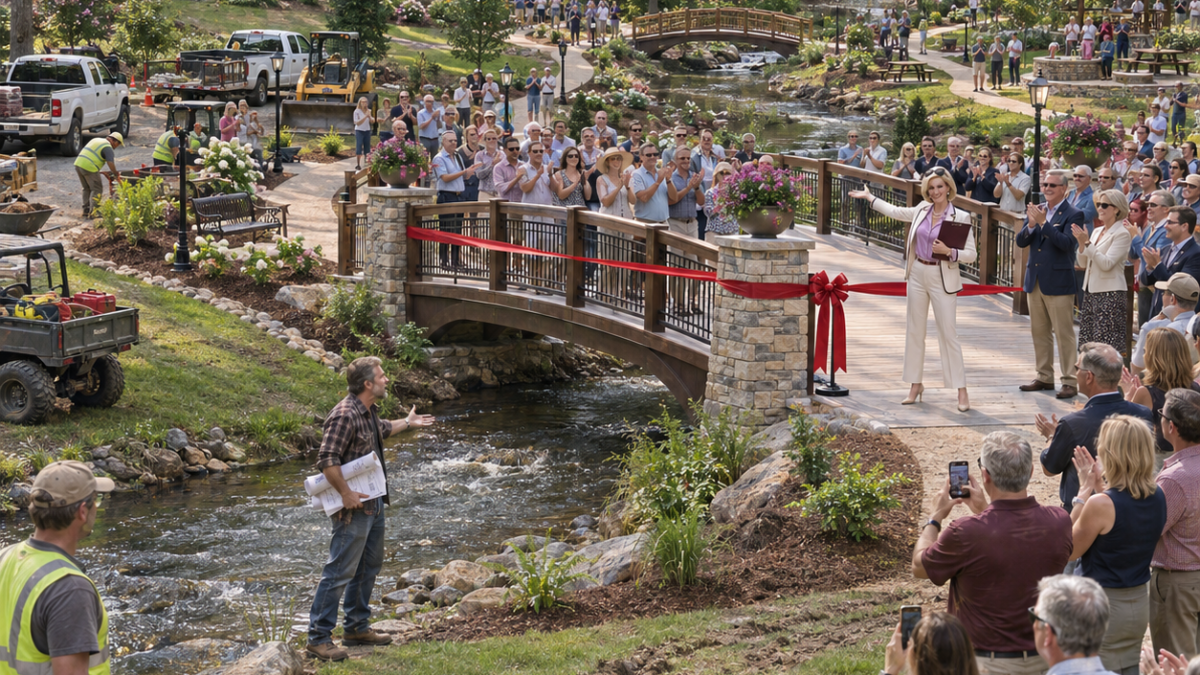
Saturday, Tammy held a ribbon cutting.
Catering.
Families.
Children with painted faces.
Community newsletter photographer.
Two hundred people at the park.
I watched from a distance.
Tammy stood with oversized ceremonial scissors.
“This trail represents what Ridgerest is about,” she announced.
“Community. Nature. Shared spaces.”
Applause.
“Our beautiful creek.”
More applause.
Something inside me went very still.
After the ceremony, I walked toward her.
A few residents recognized me.
Conversation softened.
Tammy turned.
“Garrett.”
“Can you show me the easement?”
She laughed.
Loudly.
For the audience.
“Oh, Garrett.”
“I’m serious.”
“The creek belongs to everyone.”
She looked around at the crowd.
“Water doesn’t read deeds, sweetheart.”
Several people chuckled.
Some didn’t.
I nodded.
“Okay.”
That surprised her.
No argument.
No raised voice.
I turned and walked away.
That was opportunity number three.
The last easy one.
That evening, Earl Tisdale came up my driveway.
Seventy-four.
Retired county surveyor.
He carried a six-pack under one arm and a rolled plat under the other.
“I’ve watched enough.”
“Come in.”
“No. Porch.”
Earl preferred porches to living rooms.
We spread the map across the table.
Original Ridgerest subdivision survey.
His signature.
He tapped the forty-foot offset from Laurel Creek.
“I drew that.”
“I know.”
“Developer told me to keep the creek out.”
“Why?”
“Environmental headache.”
I looked at him.
“You remember that specifically?”
“Son, surveyors remember property lines better than birthdays.”
He tapped the map again.
“They knew.”
“Pinnacle?”
“Yes.”
“Tammy?”
“Anyone who ever bothered reading this.”
Then he told me about a letter he had sent years earlier.
When the HOA first began expanding the park, Earl warned the board that the pond depended on a private creek and that any expansion toward Laurel Creek crossed property boundaries.
The board acknowledged receiving it.
Then buried it.
“You still have a copy?”
Earl smiled.
“Surveyors also keep paper.”
That letter changed something.
Until then, Tammy could still claim confusion.
Bad advice.
Old assumptions.
A developer’s mistake.
Earl’s warning showed the HOA had been told.
Years earlier.
They continued anyway.
I looked through the window at Elena’s watercolor above the kitchen sink.
October on Laurel Creek.
The bend.
Her rock.
The bridge wasn’t in the painting.
Of course it wasn’t.
She had painted the place before anybody decided community meant taking without asking.
“I’m done arguing,” I said.
Earl opened a beer.
“Good.”
“I’m calling a lawyer.”
“Better.”
“And I’m going to find out where every dollar came from.”
Earl nodded.
“Now you’re thinking like your grandfather.”
For two weeks, I lived between the county courthouse, public-record requests, my kitchen table, and Laurel Creek.
Three discoveries emerged.
The first was already clear.
The subdivision’s own plat excluded the creek.
The park permit later described the same water as public.
Both could not be accurate.
The second involved money.
Ridgerest collected monthly HOA dues from two hundred households.
Part of those dues had been earmarked for park maintenance and improvements.
Over several years, the amount connected to the park approached three hundred forty thousand dollars.
I stared at the total.
That money had funded trails.
Landscaping.
Bridge construction.
Amenities that crossed onto property Ridgerest did not own.
Residents had paid hundreds of thousands of dollars toward Tammy’s version of reality.
Most of them probably had no idea.
The third discovery was Vince.
The records showed a pattern of him participating in county decisions involving Ridgerest improvements while also owning property in the development and being married to its president.
I didn’t need to decide what laws had been broken.
That was for attorneys and county officials.
I only needed to preserve the records.
I made three stacks on the dining table.
**PROPERTY**
**MONEY**
**APPROVALS**
Then I called Katherine Yates.
Earl had recommended her.
“She’s the one you want.”
Her office was in a converted mill near Asheville.
Exposed brick.
Topographic maps.
Hiking boots under the desk.
She read quietly.
Ten minutes.
Twenty.
She finally looked up.
“Mr. Holloway.”
“Garrett.”
“Garrett, why haven’t they removed these bridges?”
“Because they think I’ll give up.”
“Are you?”
“No.”
“Good.”
She tapped the plat.
“This boundary is unusually clear.”
Then Earl’s letter.
“And this makes it difficult for them to argue they had no notice.”
Then the financial records.
Her eyebrows rose.
“Homeowners funded this?”
“Looks like it.”
Katherine sat back.
“What do you want?”
“My property restored.”
“Damages?”
“If they’re appropriate.”
“Anything else?”
I thought about the park pond.
The decorative water.
The bridges.
Tammy standing with scissors.
“I want them to understand the creek was never theirs.”
Katherine studied me.
“You’re an engineer.”
“Yes.”
“What kind?”
“Hydraulic.”
That made her pause.
Then she smiled slightly.
“I think we should discuss your water rights very carefully before you do anything clever.”
I laughed for the first time in days.
“I haven’t done anything.”
“Engineers say that immediately before producing drawings.”
Fair.
The truth was, a conservation project had already been sitting in the back of my mind.
Long before Ridgerest.
Elena and I had once discussed creating a small upstream pond.
Habitat.
Irrigation.
Native trout.
A place where water could spread into a quiet basin instead of racing down the channel after heavy rain.
I had abandoned the idea when she got sick.
Now I revisited it.
Not as a weapon.
That distinction mattered.
Katherine made sure it mattered.
“If you build anything,” she said, “it has to stand on its own legitimate purpose.”
“Agreed.”
“No structure designed simply to damage their park.”
“Agreed.”
“Required approvals.”
“Obviously.”
“Ecological flow downstream.”
“Of course.”
“And no surprises for regulators.”
“I spent twenty-eight years being the regulator.”
“Former regulator.”
“Cruel.”
She smiled.
We worked through it.
A modest conservation impoundment.
Fully reviewed.
Professionally designed.
Properly permitted.
I deliberately avoided shortcuts.
If one inspector wanted another drawing, I produced it.
If someone requested a study, I provided it.
If a condition changed, I documented it.
The project was for my property.
Irrigation.
Habitat.
Water management.
What Ridgerest had no right to demand was that my private creek continue operating as the unpaid plumbing system for their decorative park.
Katherine also began work protecting the Laurel Creek corridor from future construction.
The bridges had taught me a lesson.
Winning once was not enough if the next board could start the same fight ten years later.
We needed a permanent boundary.
Meanwhile, Dennis Caldwell started asking questions inside Ridgerest.
Dennis was a software developer.
Quiet guy.
Two kids.
Mortgage.
He had moved into Ridgerest because it looked safe and affordable.
When he learned what I had found, he didn’t immediately believe me.
Good.
I respected that.
He went to the county himself.
Pulled the plat.
Checked the boundary.
Then called.
“Garrett?”
“Yeah?”
“I owe you an apology.”
“For what?”
“My daughter used that trail.”
“She didn’t know.”
“I didn’t know.”
“That’s different from not caring.”
He exhaled.
“Where did the park money go?”
“That’s the question.”
Dennis began talking to neighbors.
Not organizing a rebellion.
Just showing documents.
Thirty residents became curious.
Then forty.
Tammy noticed.
Her attorney sent me a letter threatening litigation if I altered Laurel Creek.
Katherine read it.
“Predictable.”
“Anything serious?”
“They’re arguing years of use give them rights.”
“Do they?”
“Not based on what I’ve seen.”
She drafted a response.
Calm.
Professional.
No threats.
She attached the recorded plat.
That was the wall every argument kept hitting.
Ridgerest itself had been created with a boundary that stopped before Laurel Creek.
The HOA could not simultaneously rely on that subdivision and pretend its founding map did not exist.
Tammy called county departments next.
Building.
Environmental.
County administration.
She described my planned conservation project as dangerous.
Vindictive.
Ecologically destructive.
The county sent Wayne Hargrove.
Inspector.
Twenty-two years on the job.
He arrived in an old county truck.
I handed him the permit packet.
He walked the site.
Asked questions.
Measured.
Reviewed.
I didn’t follow him around trying to sell the project.
The documents could speak.
Two hours later he returned.
“This is thorough.”
“I get nervous when people compliment engineers.”
He smiled.
“I’m not saying I like the paperwork.”
“Good.”
“I’m saying I don’t see grounds to deny it.”
Permit approved.
Tammy filed another complaint.
Wayne returned.
Checked erosion controls.
Construction boundaries.
Site condition.
Dismissed it.
Then Tammy sent a private environmental consultant onto my land without asking.
My cameras caught his truck.
His face.
GPS device.
Forty minutes of unauthorized walking around the site.
This time I called the sheriff.
Deputy Kyle Lacader reviewed the footage.
“Did you authorize him?”
“No.”
“Did he contact you?”
“No.”
“Is there any public easement here?”
“No.”
He took the report.
The consultant later produced a document criticizing the project.
Katherine read it in her office.
Then looked at me.
“Apparently your pond will make Laurel Creek flow backward.”
I stared.
“Did he actually write that?”
She turned the page.
“Yes.”
“That would solve a lot of energy problems.”
“Also, he misspelled ‘impoundment.’”
“Twice?”
“Three times.”
I leaned back.
“This is going to sound arrogant.”
“It already does.”
“I spent twenty-eight years designing water-control systems.”
“I know.”
“And they sent somebody who thinks gravity is optional.”
Katherine smiled.
“We’ll let the report speak for itself.”
That became our rule.
Let them speak.
Let them write.
Let them file.
Every reckless claim created a record.
Every trespass created evidence.
Every threat became another page.
Tammy changed tactics.
Petition.
**PROTECT OUR CREEK**
Seventy-four signatures.
People I had never met accused me of destroying the neighborhood.
Facebook posts called me bitter.
A recluse.
A property hoarder.
Someone photographed my truck and labeled it **THE ENEMY**.
That one got to me.
Not because strangers insulted me.
Because I had come home to Laurel Creek after Elena died precisely because I wanted to disappear from conflict.
I didn’t want to be anybody’s enemy.
One evening I sat on Elena’s rock after construction crews had left the upstream pond site.
The third bridge towered downstream.
LED lights came on automatically.
I could see them through the trees.
Elena had once painted fireflies there.
Now the HOA had pathway lighting.
“I hate this,” I said aloud.
The creek answered the way creeks answer.
With water.
I visited Elena’s grave that Sunday.
Frost around the headstone.
I brought no flowers.
Elena hated cut flowers.
“Building again,” I told her.
I stood with hands in my coat pockets.
“Small project.”
Wind moved through bare branches.
“You’d tell me not to become cruel.”
I swallowed.
“I’m trying.”
That was important.
There was a version of this story where anger could have made me reckless.
Block everything overnight.
Destroy their bridges myself.
Shut water down without review.
Fight spectacle with spectacle.
Elena would have hated that.
So I didn’t.
I let the project move through legitimate review.
I let Katherine handle the legal side.
I let regulators inspect.
I let Tammy keep talking.
Then Tammy called the press.
That was the best thing she ever did for me.
Sandra Jessup worked for the Asheville Citizen Times.
Tammy pitched her a simple story.
Angry widower.
Illegal dam.
Community park under attack.
Sandra did something Tammy had apparently stopped expecting from other adults.
She checked.
Subdivision plat.
Park permit.
Financial statements.
Planning commission minutes.
She called me.
“Mr. Holloway?”
“Yes?”
“This is Sandra Jessup with the Citizen Times.”
“I know who you are.”
“I was contacted about your dam.”
“I assumed.”
Pause.
“I’ve reviewed county records.”
“Good.”
“I think I’m missing part of the story.”
“Come out.”
She arrived Tuesday afternoon.
Notebook.
Recorder.
No camera crew.
I made coffee.
We sat at my dining table.
Property stack.
Money stack.
Approval stack.
Sandra asked good questions.
“Did you ever authorize any bridge?”
“No.”
“Verbal permission?”
“No.”
“Did your father?”
“No.”
“Any easement?”
“None recorded.”
“Did you receive compensation?”
“No.”
“Did you tell the HOA to stop before the third bridge?”
“Several times.”
I showed certified receipts.
Sandra studied the dates.
Then Earl’s old warning letter.
“This predates your dispute.”
“Yes.”
“So the HOA was told the creek was private years ago.”
“Yes.”
She looked toward the window.
“Why build the pond now?”
“Because I’ve wanted a conservation pond for years.”
“And because the park depends on your downstream flow.”
I met her eyes.
“Yes.”
“Is that revenge?”
“No.”
“Be honest.”
“I am.”
I paused.
“Do I understand the consequence? Absolutely.”
She waited.
“The park was designed around water the HOA never secured rights to. That is not my engineering failure.”
Sandra wrote that down.
Two hours later she closed the notebook.
“I’ve covered land-use fights for six years.”
“And?”
“I’ve never seen one documented like this.”
“You should see federal dam files.”
She smiled.
“You should’ve been an attorney.”
“I’m something worse.”
“What?”
“Engineer.”
That line made her laugh.
Inside Ridgerest, things were shifting.
Tammy called an emergency meeting.
She wanted a special assessment.
Two thousand five hundred dollars per household.
Half a million dollars total.
A legal war chest.
Two hundred families paying to sue me over a creek their own plat said they didn’t own.
Dennis stood up.
“Before we spend five hundred thousand dollars, can someone tell us where the existing three hundred forty thousand went?”
Tammy tried to shut him down.
“Not on the agenda.”
“Then put it on the agenda.”
The room changed.
Treasurer Brenda Marsh had already begun looking through accounts.
Clay Stanton, retired firefighter and reluctant board member, called me privately.
“I joined because nobody wanted the seat.”
“Congratulations.”
“I wanted to make sure the community pool had enough chlorine.”
“Ambitious.”
“I did not sign up for property fraud.”
“Then ask questions.”
“We are.”
Patty Greer, another board member, ran Dennis’s numbers herself.
They didn’t like what they found.
Tammy’s base wasn’t collapsing dramatically.
It was eroding.
That’s more dangerous.
By January, my conservation pond was complete.
The first morning it filled properly, I walked along the bank.
Mist lifted from the surface.
A great blue heron stood near the far side.
Elena would have painted it.
Downstream, Laurel Creek still flowed.
But differently.
Lower.
Controlled.
Enough to maintain the creek ecosystem within the limits established through the project review.
Not enough to feed Ridgerest’s decorative pond the way it once had.
Within days, the HOA pond dropped.
Stone edging appeared above the waterline.
A muddy ring developed.
Decorative plants sagged.
Some of the park irrigation sputtered.
Bridge number three still glowed at night.
Now it crossed a much smaller ribbon of water.
The photographs reached social media immediately.
**GARRETT HOLLOWAY IS DESTROYING OUR PARK**
Tammy called another emergency meeting.
Dennis invited me.
So did Brenda Marsh.
Katherine came.
Sandra Jessup came.
County attorney Phil Wexler attended quietly after the public records raised broader questions.
Sheriff Donnie Burke and Deputy Lacader waited outside.
The clubhouse held eighty comfortably.
Around one hundred fifty people squeezed in.
Wet coats.
Bad coffee.
Folding chairs.
People standing along walls.
Tammy wore navy and pearls.
She opened the meeting with twenty minutes of outrage.
I sat quietly.
She called my pond vindictive.
Dangerous.
Environmental sabotage.
Then she used the phrase:
“Water terrorism.”
Katherine leaned toward me.
“Do not smile.”
“I’m trying.”
Tammy pointed toward the screen.
“This man has deliberately attacked a community resource.”
Dennis stood.
“Before we vote, Garrett has a presentation.”
“He isn’t a resident.”
Brenda Marsh stood next.
“I invited him as treasurer.”
Tammy glared.
“For what purpose?”
Brenda’s voice shook once.
Then steadied.
“Financial oversight.”
That silenced the room faster than any gavel.
I walked to the front.
No speech.
Three findings.
First slide.
Recorded subdivision plat beside the later park permit.
The boundary line on one.
The claim of public water access on the other.
I pointed.
“Ridgerest Meadows ends here.”
Then Laurel Creek.
“The creek is outside your recorded subdivision.”
I changed slides.
“Yet this park permit described the same creek as a public community waterway.”
Murmurs.
I looked toward Tammy.
“These documents contradict each other.”
She grabbed the microphone.
“Historical use—”
I held up one hand.
“You’ll have a chance.”
That surprised her.
Second slide.
Financial summary.
Five years.
Park fees.
Construction expenses.
Estimated total near $340,000.
“Your HOA collected approximately three hundred forty thousand dollars for park maintenance and improvements.”
People leaned forward.
“A substantial portion funded bridges, trails, and landscaping that extend onto land Ridgerest does not own.”
Someone in the back:
“What?”
Another:
“How much?”
Brenda Marsh looked pale.
Tammy’s face hardened.
“This is misleading.”
I changed slides.
Third.
Planning commission records.
Vince’s votes.
Park permit.
Expansion.
Trail access.
I didn’t accuse him of a crime.
I didn’t need to.
“Commissioner Vince Pritchard participated in multiple decisions affecting Ridgerest while owning property here and while his wife served as HOA president.”
The room erupted.
Questions.
Shouting.
Not violence.
Confusion becoming anger.
Tammy stood.
“This is slander!”
Katherine rose slightly.
“No, Mrs. Pritchard. These are public records.”
Tammy pointed at me.
“He’s bitter because his wife died!”
The words hit the room like something dropped.
Silence.
Even Tammy seemed to realize too late what she had said.
I reached into my jacket.
Not dramatically.
I unfolded a certified copy of the deed.
“My grandfather’s name was Silus Holloway.”
I held the paper.
“This property has been in my family since 1948.”
I looked toward the back of the room.
Earl stood near the wall.
“This creek ran through Holloway land before Ridgerest existed.”
Then Tammy.
“My wife painted Laurel Creek every spring and fall for thirty-one years.”
My voice almost failed.
I stopped.
Breathed.
Then continued.
“You built three bridges without permission.”
I placed the deed on the table.
“You were warned.”
Earl raised a copy of his old letter.
“You were asked to remove them.”
Certified receipts appeared on the screen.
“You chose not to.”
Tammy opened her mouth.
The back door opened first.
Sheriff Burke walked in.
Deputy Lacader behind him.
The room turned.
The sheriff held paperwork.
“Mrs. Pritchard.”
Tammy stared.
He continued.
“Ridgerest Meadows HOA has been formally directed to cease unauthorized use of structures located on Mr. Holloway’s property while the property matter is resolved.”
Then more plainly:
“Those bridges need to come down.”
Nobody spoke.
County attorney Wexler approached Vince.
“Mr. Pritchard, my office would like you available for a review of several planning matters.”
Vince looked at Tammy.
Tammy looked at the crowd.
Sandra’s pen moved across her notebook.
The meeting had begun with Tammy trying to raise half a million dollars to destroy me.
It ended with her own board asking for the financial books.
Three days later, Sandra’s story ran.
The headline was close to perfect:
**HOA BUILT PARK IMPROVEMENTS ON NEIGHBOR’S LAND, COLLECTED $340,000 IN FEES—RETIRED ENGINEER FOUGHT BACK WITH A POND**
Regional outlets picked it up.
Then national.
The internet turned Tammy into a symbol.
I disliked that part more than I expected.
People reduced her to memes.
Sunglasses.
Escalade.
“Water doesn’t read deeds.”
Some were funny.
Most made the story simpler than it was.
Tammy wasn’t defeated because she was ridiculous.
She was defeated because she spent seven years surrounded by people who stopped checking her work.
That distinction mattered to me.
The emergency board meeting after the article lasted less than an hour.
Brenda Marsh.
Clay Stanton.
Patty Greer.
Vote of no confidence.
Tammy removed.
She threatened litigation.
Katherine responded on my behalf.
Tammy’s lawyer apparently gave her the best advice she had received in years.
Stop talking.
Vince resigned from the planning commission.
The county opened a formal review of the decisions connected to Ridgerest.
His public career was effectively over.
The review focused on conflicts, procedure, and the validity of approvals.
I stayed out of that.
I had what I wanted.
A court order ultimately required all three unauthorized bridges removed at the HOA’s expense.
The work began in February.
Bridge one came down first.
The simple wooden crossing.
Decking removed.
Footings broken out.
Bank repaired.
Bridge two followed.
Steel lifted.
Concrete demolished.
Creek edge restored.
Then bridge three.
Elena’s bend.
I watched from the porch.
Not close.
I didn’t need revenge theater.
The decorative railing came off.
LED wiring removed.
Composite deck lifted section by section.
Then workers broke the footing near Elena’s rock.
I couldn’t watch that part from a distance.
I walked down after the crew left.
Mud.
Broken concrete dust.
Freshly exposed stone.
And there it was.
Elena’s flat rock.
Cracked.
But still there.
I stepped into the creek.
Cold water over my boots.
Sat down.
Placed my palm against the rock.
For months, I had imagined what I would say when it was restored.
Something profound.
Something about winning.
Something about her.
Nothing came.
So I sat.
The creek moved around my boots.
Thin from the upstream pond.
Quiet.
But alive.
Some moments don’t need language.
The new HOA board contacted Katherine.
Brenda Marsh was interim president.
Dennis represented a group of homeowners.
They wanted to negotiate.
I drove to Katherine’s office.
“What do they want?”
“Water.”
“Of course.”
“They also want this over.”
“So do I.”
Katherine opened a legal pad.
“Terms?”
I had thought about them.
“Forensic accounting.”
She wrote.
“Every park dollar.”
“Good.”
“Refund or credit homeowners for funds that were improperly spent.”
“Subject to what the accounting supports.”
“Fine.”
“Permanent recognition that Laurel Creek and its buffer are private Holloway property.”
“Yes.”
“No future structures without written permission.”
“Yes.”
“A conservation fund.”
She looked up.
“What kind?”
“Jointly supported. Water quality. Native planting. Education.”
Katherine smiled.
“And the pond?”
“If they accept the terms and restore every encroachment, I’ll adjust the downstream release within the lawful operating plan so Laurel Creek returns closer to its historic flow.”
“You’re giving them water.”
“No.”
I thought about Tammy.
“I’m choosing to share it.”
That difference meant everything.
They accepted.
Every term.
The forensic review took months.
The final numbers were complicated.
Some park money had been spent legitimately on HOA-owned land.
Some had not.
Homeowners received accounting corrections and financial restitution according to the new board’s process.
The old practice of collecting money without transparent project boundaries ended.
The conservation fund launched that spring.
I named it the **Elena Holloway Conservation Fund**.
The board approved the name unanimously.
I almost objected.
Then didn’t.
The fund paid for native plant restoration along Laurel Creek.
Water-quality testing.
Environmental education.
Streambank protection.
No bridges across my property.
No public trail through my buffer.
A small bronze plaque went up at the trailhead on HOA land.
**ELENA HOLLOWAY CONSERVATION FUND**
Beneath it:
**BECAUSE WATER REMEMBERS**
I opened the spillway controls on a Saturday morning.
Not as spectacle.
No press.
No ribbon.
Just me.
Katherine.
Dennis.
Brenda Marsh.
Earl.
A county water-resource technician.
We watched increased flow move downstream.
First a deeper thread.
Then a fuller channel.
Water climbed over stones that had been dry for months.
Sound returned.
That was the part I had missed most.
Not volume.
Sound.
Laurel Creek had a voice.
The park pond slowly recovered.
Only the portions of Ridgerest Park actually located on Ridgerest land remained.
No stolen trail.
No bridges.
No fishing access through my property.
Just a legitimate community park supported by water that now flowed under a transparent, lawful arrangement.
Dennis stood beside me.
“So after all this, you’re letting the water go.”
“It was always going downstream.”
“You know what I mean.”
“Yes.”
“Why?”
I looked at him.
“Because you asked.”
He smiled.
“That simple?”
“Should’ve been.”
That became the whole lesson.
Tammy believed community erased ownership.
It doesn’t.
Ownership and community can coexist.
But the bridge between them is permission.
Not pressure.
Not fake permits.
Not repetition.
Not public embarrassment.
Permission.
Ridgerest changed after Tammy.
Slowly.
The new board published financial reports.
Projects required clear property verification.
Conflicts were disclosed.
Major expenditures received independent review.
Residents who had once called me an enemy began waving when they saw me.
Some apologized.
One woman—the same woman who had commented that I should move and give the creek to the community—came to my door.
“I wrote something online.”
“I remember.”
Her face reddened.
“I’m sorry.”
“Okay.”
“That’s it?”
“What do you want me to say?”
“I don’t know.”
I smiled slightly.
“Then okay is enough.”
She nodded.
It was.
Not every reconciliation needs a speech.
Tammy and Vince sold their Ridgerest properties and moved away.
I saw the moving truck from across the creek.
White Escalade followed.
No conversation.
No final showdown.
I was glad.
Real closure rarely needs the villain to deliver one last monologue.
Sometimes they simply leave.
The first April after the bridges came down, I held a community fishing day.
That idea came from Earl.
“You spent a year fighting strangers off your creek.”
“I remember.”
“So invite them.”
I stared.
“You’ve lost your mind.”
“Maybe.”
“Why?”
“So they learn the difference.”
“Between what?”
“Trespassing and being welcomed.”
That was annoyingly wise.
We opened one designated stretch for a Saturday.
Kids from Ridgerest.
Families from the old road.
No fees.
No HOA banners.
No megaphones.
Earl taught fly casting.
Dennis burned hot dogs so badly even the dogs hesitated.
I stocked the upstream pond with native trout.
A great blue heron arrived before half the guests.
Colton—
No.
There was no Colton in my story.
That thought caught me strangely.
Elena and I never had children.
Cancer stole more futures than one.
For a few minutes, watching families along Laurel Creek hurt.
Then a little girl approached me holding a fly rod backward.
“Mr. Holloway?”
“Garrett.”
“Is this right?”
“No.”
She frowned.
“Completely wrong?”
“Impressively.”
She laughed.
I turned the rod.
Showed her the grip.
Ten minutes later she landed a tiny trout.
You would have thought she caught a marlin.
Her father took photographs.
She released the fish.
Ran back toward Earl.
I sat on Elena’s rock.
Maybe this was enough.
Not the life Elena and I expected.
But a life.
The annual fishing day became tradition.
Once a year.
By invitation.
The rest of the year, Laurel Creek remained private.
That boundary stayed clear.
The conservation program brought school groups to the HOA side of the corridor.
Students learned watersheds.
Erosion.
Property stewardship.
Why buffers matter.
Why development changes runoff.
Why water crosses political boundaries even when land ownership doesn’t.
I volunteered occasionally.
Teachers loved introducing me as:
“Mr. Holloway, the engineer who built the pond.”
Students had seen the news story.
One boy asked:
“Did you build it to destroy the HOA?”
“No.”
“But it drained their park.”
“It reduced the water feeding an amenity that never had secured rights to that supply.”
He blinked.
“That sounds like yes.”
Teachers laughed.
I smiled.
“The pond had legitimate conservation and agricultural purposes.”
“Still sounds like yes.”
Smart kid.
I became careful when telling the story.
The internet wanted revenge.
Retired engineer uses dam to wipe out HOA park.
Simple.
Satisfying.
But simplicity can teach the wrong lesson.
I never wanted someone hearing my story and thinking:
If your neighbor annoys you, manipulate water until they suffer.
That wasn’t what happened.
The dam went through review.
It served real purposes.
It maintained required downstream flow.
And when Ridgerest stopped trespassing and negotiated honestly, I voluntarily increased the flow again.
The victory was not that I could control water.
The victory was that I didn’t have to misuse that control.
Elena would have cared about that.
Especially Elena.
Years passed.
Earl slowed down.
His memory remained terrifyingly sharp.
At seventy-eight, he still corrected surveyors younger than his grandchildren.
One fishing day he stood beside Elena’s rock.
“You gonna put a plaque here?”
“No.”
“Why?”
“She hated plaques.”
“Smart woman.”
“She’d say the creek was enough.”
Earl spat tobacco into an empty bottle.
“Also smart.”
He looked toward the restored bank.
“You ever regret not suing Tammy personally for everything?”
“No.”
“Liar.”
I laughed.
“Sometimes.”
“There it is.”
“I wanted her to pay.”
“She did.”
“Not in the satisfying movie way.”
“Life isn’t a movie.”
“You’re very disappointing today.”
Earl grinned.
Then grew serious.
“You got the land back.”
“Yes.”
“You got the creek back.”
“Yes.”
“You got her bridge off Elena’s rock.”
I looked down.
“Yes.”
“What else you need?”
Nothing.
He was right.
Earl died two winters later.
Stroke.
Quick.
His daughter asked if we could scatter some of his ashes near the old survey line.
I said yes.
We stood beneath bare trees.
No speeches.
His grandson carried Earl’s rolled-up field map.
Afterward, the family donated some of his surveying records to the county historical archive.
Among them was the original field notebook from Ridgerest.
One entry:
**Developer requests 40′ exclusion from Laurel Creek. “Keep creek out.”**
There it was again.
Handwritten.
Dated.
The earliest version of the truth.
I made one copy.
Not for litigation.
The case was over.
I framed it in my office.
Not because I needed proof.
Because I liked the idea that one ordinary field note outlasted seven years of confident lies.
Sandra Jessup returned five years after her article.
She was doing a follow-up on HOA governance.
We sat on the porch.
Laurel Creek audible below.
“Do you think the publicity changed Ridgerest?”
“Yes.”
“Do you think the dam changed Ridgerest?”
I considered.
“The records changed Ridgerest.”
She smiled.
“That’s less dramatic.”
“Sorry.”
“Why?”
“Tammy survived for years because nobody checked.”
“Then you did.”
“Dennis did.”
“Earl did.”
“The board eventually did.”
I looked at her recorder.
“The pond only changed leverage.”
Sandra nodded.
“What changed you?”
That question took longer.
“Elena died.”
“I mean after that.”
I understood.
For years after Elena, I had treated Laurel Creek as a retreat.
A place where nobody could ask anything of me.
The HOA invasion had forced me outward.
Lawyers.
Neighbors.
County offices.
Meetings.
Children fishing.
School groups.
Community.
I looked toward the water.
“I came here to be left alone.”
“And now?”
“I still like being left alone.”
She laughed.
“But?”
“But I learned privacy and isolation aren’t the same thing.”
Sandra wrote that down.
I regretted giving reporters good lines.
The conservation fund expanded.
Residents voted to contribute annually.
Local environmental groups matched some funding.
We restored sections of bank upstream and downstream.
The ornamental park pond eventually became less dependent on continuous diversion from Laurel Creek.
Engineers redesigned parts of Ridgerest’s system so the park no longer lived or died based on one private upstream owner’s choices.
That was healthier for everyone.
I reviewed the plans informally.
The young engineer assigned to the project was named Marcus Lee.
Twenty-nine.
Smart.
Nervous around me because somebody told him my old Army Corps title.
“Sir, I’ve run the model three times.”
“Don’t call me sir.”
“Yes, sir.”
I stared.
“Sorry.”
He showed me the drainage plan.
It was good.
Better than good.
“You don’t need me.”
“I wanted you to check.”
“Why?”
“You know the watershed.”
That was true.
We walked the creek.
I showed him where spring flow changed.
Where heavy rain undercut the bank.
Where Silus had placed riverstone decades earlier.
Where Elena painted.
He stopped near her rock.
“This is the famous spot?”
“I wish people would stop calling it that.”
“No plaque?”
“No plaque.”
“Good.”
I liked him.
Ridgerest implemented the project.
The ornamental pond became more resilient.
During dry periods, it dropped naturally without becoming a crisis.
During heavy rain, the park handled runoff better.
Nobody called Laurel Creek a public waterway anymore.
The new neighborhood maps labeled the boundary correctly.
**PRIVATE RIPARIAN CORRIDOR — HOLLOWAY PROPERTY**
The first time I saw that label, I stood staring longer than necessary.
Words matter.
So do lines.
At seventy, I began thinking about what happened after me.
No children.
No direct heir.
The Holloway property had been in the family for generations.
I didn’t want it carved into luxury lots.
I also didn’t want to turn ownership into a burden for some distant relative who barely knew the place.
Katherine and I created a long-term conservation plan.
The core acreage would remain protected.
Laurel Creek corridor permanently conserved.
Limited educational access by agreement.
The upstream pond maintained.
House and working land managed through a trust.
The Ridgerest HOA received no ownership.
No permanent recreational easement through my creek.
But the Elena Holloway Conservation Fund retained a cooperative relationship with future trustees.
That felt balanced.
When I signed the final documents, Katherine looked at me.
“Satisfied?”
“No.”
She laughed.
“You engineers are impossible.”
“It’s permanent. Permanent decisions should make people nervous.”
“Fair.”
I looked at Elena’s watercolor hanging in her office temporarily because she had asked to photograph it for the conservation records.
October on Laurel Creek.
Same bend.
Same rock.
No bridge.
“That’s what I wanted.”
“What?”
“For it to look like that after I’m gone.”
Katherine softened.
“It will.”
I visited Elena’s grave afterward.
No frost this time.
Late spring.
Birds.
Grass.
I sat beside the stone.
“Got the paperwork done.”
Wind.
“You’d hate how much it cost.”
Nothing.
“You’d also tell me I spent too much time arguing over the wording.”
Still nothing.
I smiled.
“The creek’s safe.”
That was all I really needed to say.
On the tenth anniversary of Tammy’s ribbon cutting, Ridgerest invited me to a park event.
Not on my property.
Important distinction.
They unveiled educational signage about Laurel Creek.
The sign described the watershed.
Private and public land stewardship.
Development history.
Conservation.
No mention of Tammy.
No public shaming.
I appreciated that.
Dennis, now HOA president somehow despite years of swearing he would never serve, stood beside me.
“How did this happen to you?”
He sighed.
“Nobody else wanted the job.”
“Classic.”
“I have term limits.”
“Good.”
“Financial audits.”
“Better.”
“And three residents currently furious because we denied artificial turf.”
“Democracy.”
He laughed.
The sign included a small reproduction of one of Elena’s watercolors.
I had approved it.
Underneath:
**Art by Elena Holloway, used with permission.**
Permission.
Again.
One word.
The lesson refused to disappear.
A little boy pointed toward the painting.
“Did she live here?”
“Yes.”
“Was she famous?”
“No.”
He looked disappointed.
“She was an art teacher.”
“Oh.”
“She would’ve liked that answer better.”
His mother smiled.
They walked away.
That evening, I sat on Elena’s rock.
Creek full.
The upstream pond behind me.
Ridgerest Park downstream.
Both existing.
Neither stealing from the other.
That was the outcome nobody online cared about.
Compromise is terrible clickbait.
But it is often a better ending.
The HOA didn’t lose its park forever.
I didn’t wall off the entire watershed.
The park lost what had been illegally built on my land.
The creek corridor returned to me.
The HOA fixed its governance.
The county reviewed its approvals.
Vince lost his position.
Tammy lost control.
Homeowners got transparency.
And eventually, water flowed downstream again under an arrangement that respected where one person’s rights ended and another community’s needs began.
That was enough.
One spring morning, years later, I found an old box of Elena’s art supplies in the attic.
Brushes.
Dried watercolor pans.
Tape.
Paper.
At the bottom was a sketch I had never seen.
Laurel Creek.
Not finished.
Only pencil.
The outline of the bank.
Hemlocks.
Her rock.
And in the corner, one handwritten sentence:
**Water always finds the honest path.**
I sat on the attic floor.
Held that piece of paper.
Cried harder than I had in years.
Maybe Elena meant composition.
Maybe she was describing how she wanted to paint the current.
Maybe it had nothing to do with anything that happened later.
Didn’t matter.
I framed it.
Hung it beside October on Laurel Creek.
The two paintings became the first thing I saw every morning.
One finished.
One unfinished.
Like life.
The fishing day continued.
Children came.
Parents.
New Ridgerest residents who had never met Tammy and knew the bridge story only as neighborhood mythology.
Every year someone asked:
“Is this where the big bridge was?”
I would point.
“There.”
“Can you still see it?”
“No.”
Good restoration should make damage difficult to find.
One year, a boy wandered toward Elena’s rock carrying a tiny fishing rod.
“Can I sit there?”
I almost said no automatically.
Then stopped.
“Sure.”
He sat.
Cast badly.
Hook landed three feet away.
He looked embarrassed.
“First time?”
“Yes.”
I sat beside him.
“Mine too.”
He stared.
“You’re old.”
“Cruel.”
“You’ve fished before.”
“Many times.”
“So you lied.”
“I was trying to make you feel better.”
“Didn’t work.”
I laughed.
We practiced.
Eventually his cast reached the current.
He didn’t catch anything.
Didn’t care.
Before leaving, he touched the crack in the stone.
“What happened?”
“A bridge.”
“Like a flood?”
“No.”
“Someone built one here?”
“Yes.”
“Why?”
“They thought they could.”
“Could they?”
“No.”
He nodded like that resolved the universe.
Maybe for children it does.
I sat after he left.
Hand on the same crack.
The rock had held.
The creek had returned.
So had I.
That was the part nobody saw when Tammy first arrived with her folder.
I had been surviving, not living.
Elena’s death had turned my world into a series of quiet routines.
Coffee.
Garden.
Creek.
Sleep.
Tammy’s trespass made me furious.
But the fight forced me to build again.
Draw again.
Attend meetings.
Talk to neighbors.
Teach children.
Use the part of myself I thought I had retired with my career and buried with my wife.
I would never thank Tammy for what she did.
That would be absurd.
Pain does not become acceptable because something good eventually grows around it.
But I can acknowledge what I did with the aftermath.
I turned anger into documentation.
Documentation into leverage.
Leverage into restoration.
Restoration into stewardship.
That part was mine.
At seventy-four, I gave my final formal talk for the conservation fund.
A classroom full of local middle-school students.
Elena’s age group.
That nearly undid me.
The teacher introduced me.
“Mr. Holloway is a retired hydraulic engineer.”
A boy whispered:
“Dam guy.”
I heard him.
“Yes.”
The class laughed.
I projected an aerial photograph of Laurel Creek.
“What do you see?”
Hands.
“Water.”
“Trees.”
“Houses.”
“Park.”
“Pond.”
“Property lines?”
Silence.
Exactly.
“Most of the important lines on this map are invisible from the ground.”
I showed the parcel overlay.
“People get into trouble when they assume invisible means unimportant.”
We talked about watersheds.
Ownership.
Buffers.
Public infrastructure.
Conservation.
Then I showed Elena’s painting.
No legal lesson.
No Tammy.
Just art.
“What do you see?”
The answers changed.
“Light.”
“Reflection.”
“Fall.”
“Peaceful.”
One girl said:
“It looks like she loved it.”
My throat tightened.
“She did.”
After class, the teacher approached.
“You okay?”
“Yeah.”
“She would’ve liked today.”
I looked at the students leaving.
“I think so.”
That evening, I opened the upstream pond control slightly more than usual after checking conditions.
Water moved down Laurel Creek.
Past Silus’s riverstone.
Past Elena’s rock.
Past the old bridge sites.
Into Ridgerest’s legitimate park.
Then onward.
Water doesn’t read deeds.
Tammy had been right about exactly one thing.
Water doesn’t.
People do.
And people have to decide whether sharing something means respecting the person who owns the ground beneath their feet.
Tammy skipped that part.
She thought community was a magic word.
Say it loudly enough and private becomes public.
Put it on a sign.
Spend enough money.
Build enough structures.
Let enough families use them.
Eventually nobody will question it.
For seven years, that worked.
Until somebody did.
The creek never needed revenge.
Neither did I.
It needed a boundary.
The homeowners needed the truth.
And I needed to remember that Elena’s favorite place was worth protecting without becoming the kind of man who could only protect by destroying.
My pond still sits upstream.
The heron still visits.
Laurel Creek still flows.
Ridgerest Park is still there.
The difference is that now everyone knows where each one begins and ends.
Every April, families arrive for fishing day.
I unlock the gate myself.
That detail matters.
They enter because I open it.
They fish because I invite them.
Children sit on the banks.
Earl’s grandson teaches casting now.
Dennis still burns hot dogs.
The conservation fund pays for native plants and school programs.
And when evening comes, everybody leaves.
The gate closes.
Laurel Creek becomes quiet again.
Mine to protect.
Not mine to hoard.
There is a difference.
After the last fishing day of my seventy-fifth year, I stayed on Elena’s rock until sunset.
The crack from the bridge is still there.
Moss has grown inside it.
Tiny green line through gray stone.
I ran my thumb along it.
A scar.
Not hidden.
Not ruining anything.
Just proof that pressure had once been there.
I thought about bridges.
The ones Tammy built.
The ones workers removed.
The invisible ones that came later between my property and Ridgerest.
Permission.
Trust.
Records.
Honesty.
Those held better.
The creek caught the last orange light.
For one second, the surface looked exactly like Elena’s watercolor.
I could almost hear her behind me.
“You’re staring at water.”
I smiled.
“Studying light.”
The current moved around the rock.
Downstream.
Home.
And this time, nobody needed a bridge to tell it where to go.