PART 2: HOA Built 109 Luxury Cabins Around My Family’s Private Lake—So I Opened One 100-Year-Old Spillway and Drained Their “Lakefront” Dream
PART 2
Devlin Vance arrived in our part of Bonner County in 2020.
Former lumber broker.
Commercial property flipper.
The kind of man who looked at cut-over timberland and didn’t see stumps.
He saw renderings.
Brochures.
Buyers from Seattle tired of traffic and willing to pay half a million dollars for the phrase “private alpine lake.”
He bought eighty acres bordering the north side of our property.
Then started clearing.
Roads.
Slabs.
Utility trenches.
Cabins.
His company was called Vance Lakeshore Development.
The project was Eagle Ridge Lake Lodges.
One hundred nine cabin lots.
Not rustic cabins.
Luxury versions.
Stone fireplaces.
Black metal roofs.
Huge windows.
Timber beams.
Outdoor kitchens.
Hot tubs.
Marketing copy that used words like legacy, pristine, secluded, exclusive, and authentic so often the brochure sounded like it had been written by someone charging by the adjective.
The lake was the centerpiece.
PREMIER LAKEFRONT LIVING.
PRIVATE WATER ACCESS.
FORTY-SEVEN ACRES OF PRISTINE ALPINE WATER.
The problem was simple.
Devlin did not own the lake.
He did not own my shoreline.
He did not hold the dam license.
He did not hold riparian title across the impoundment.
He had purchased eighty acres adjoining family land.
Nothing more.
But he understood something else.
My father was slipping.
The Strickland name had gone quiet locally.
Cole was dead.
I was still finishing my military career when most of Devlin’s early marketing materials went out.
And the people buying those cabins were not showing up with century-old deeds and federal dam records.
They saw water.
They saw a developer pointing at it.
They assumed the legal work had been done.
That assumption cost a lot of people a lot of money.
I came home permanently before Devlin understood that I was not my father.
I watched construction for almost two years without confronting him directly.
That may sound strange.
But in the Corps, you learn not to start an argument before you understand the system.
I wanted records.
Permits.
Surveys.
Drainage.
Water rights.
Every piece.
I knew eventually someone from Eagle Ridge would come to my door.
They did.
Tuesday in May.
I was peeling apples at the kitchen counter.
Last of the previous fall’s storage apples.
Tilly had requested pie for her birthday weekend.
A white Cadillac Escalade rolled up the gravel.
Cream jacket stepped out.
Blonde hair.
Leather folio.
Bridget Lockheart Vance.
Devlin’s wife.
President of the Eagle Ridge Lake Lodges Homeowners Association.
She came up my steps.
“Mr. Strickland?”
“Yes.”
“I’m Bridget Lockheart Vance.”
“I know.”
That surprised her.
“May I come in?”
“No.”
Her expression tightened.
“What can I do for you?”
She opened the folio.
Pulled out one sheet.
“This is your community absorption notice.”
I looked at it.
As of last month, it said, my parcel fell within an expanded Eagle Ridge HOA boundary.
Annual dues:
$4,800.
Quarterly.
Membership privileges.
Amenity access.
Common lake management.
It would have been funny if it were not so deliberate.
I folded the paper.
Kept it.
Bridget extended her hand.
“I’ll take that back.”
“No.”
“Mr. Strickland—”
“It was served to me.”
Her eyes changed.
Tiny thing.
But visible.
“Mrs. Lockheart Vance, my family has held this property since 1922.”
“Bridget is fine.”
“Mrs. Lockheart Vance.”
That bothered her more than it should have.
“We have operated this dam under federal license since 1923. We are not part of Eagle Ridge. We have never joined Eagle Ridge. Your boundary does not include my parcel.”
“Your father signed an integration agreement.”
That stopped me.
“My father?”
She nodded.
“With my husband. 2020.”
“Show me.”
She pulled out a second document.
Two pages.
Vance Lakeshore Development letterhead.
October 14, 2020.
My father’s signature on the bottom.
Wobbly.
Wrong in ways only family notices.
His O in Owen too large.
Second line sloping down.
Date filled in by another hand.
Witness:
Devlin Vance.
I stared.
October 2020.
Same month Dad got lost driving back from Sandpoint.
Same month his neurologist formally documented moderate Alzheimer’s.
Bridget watched me.
“Your father agreed to integrate the property for shared lake-amenity purposes.”
“He didn’t understand what he was signing.”
“That’s your opinion.”
“No.”
“It’s a legal document.”
“So is a medical incapacity diagnosis.”
Her smile changed.
Very little.
“That’s a matter for attorneys.”
“Yes.”
“In the meantime, your assessment is due within thirty days.”
“Leave.”
She blinked.
“Excuse me?”
“Get off my porch.”
“Mr. Strickland, Eagle Ridge represents one hundred nine households now.”
“I can count.”
“We are a substantial economic presence in this county.”
“Congratulations.”
“You may want to think carefully about whether you want to make enemies of all of them.”
I looked at her.
“I’m not making enemies of anyone.”
“You’re refusing community integration.”
“I’m refusing theft.”
Her mouth went flat.
“We can do this the easy way or the hard way.”
I had heard that sentence from contractors, colonels, municipal officials, and one Afghan provincial administrator who later discovered the bridge he wanted built had no foundation support.
People who say it usually believe only they know what the hard way means.
I said:
“Goodbye, Mrs. Lockheart Vance.”
She left.
The dogs watched from beside me.
Pendleton, my fourteen-year-old yellow Lab, leaned his shoulder against my leg.
He had been doing that since Dad stopped remembering his name.
I stood there holding Bridget’s papers.
Then went inside.
Finished the pie.
Tilly was due Friday.
Family first.
War later.
That evening, I drove to First Bonner National Bank.
Safe-deposit box.
Original deed.
1922.
Federal dam license.
1923.
Renewal letters.
1933.
1943.
1953.
Then decades of regulatory transitions.
Inspection records.
Operation plans.
Family trust documents.
Hand-drawn survey notes from my grandfather.
I spread everything across my kitchen table.
Read nine hours.
By midnight, I knew exactly what Devlin owned.
I also knew exactly what he did not own.
Water.
Shoreline.
Dam.
Operating authority.
None of it.
The next question was what my father had supposedly signed.
Tilly arrived Friday.
Dust-covered Subaru.
Two backpacks.
She dropped one on the porch.
Hugged me.
Three seconds.
That is a long Strickland hug.
“Hey, Uncle Hold.”
“Hey.”
“Water still cold?”
“It’s June.”
“Good.”
She walked straight down the path.
Fully clothed.
Jumped off the dock.
Pendleton barked.
She surfaced yelling:
“Perfect!”
Cole did the same thing when we were teenagers.
Every June.
No matter how cold.
I watched her tread water.
For a second I saw him.
Then she splashed me and ruined the moment.
Saturday morning, she took the canoe out before sunrise.
Fishing.
South shore.
I was working on records requests when I heard the canoe hit the dock too hard.
I stepped out.
Tilly was climbing the path fast.
Face tight.
“Uncle Hold.”
“What?”
“Two guys told me I had to leave the South Shore.”
I set down coffee.
“Who?”
“Matching polos.”
“What did they say?”
“Eagle Ridge Lake Safety Coordinators.”
That title made me tired.
“Did they touch you?”
“No.”
“Touch the canoe?”
“No.”
“Photograph you?”
“One tried.”
“Did he?”
“I told him not to.”
“Good.”
“I told him my uncle was Army Corps and he could deal with you.”
I closed my eyes.
“Tilly.”
“What?”
“You don’t threaten people with retired colonels.”
“I didn’t threaten.”
“You weaponized an old man.”
“You’re fifty-four.”
“Ancient.”
She almost smiled.
Then I saw her hand shaking.
Small.
Anger or fear.
Both.
That changed things.
A teenager fishing on her own family’s water should not be chased by paid HOA staff.
I said:
“Stay near the dock for a few days.”
“That’s exactly what they want.”
“I know.”
“Then why?”
“Because I need to understand what they’re willing to do before I let you become part of the experiment.”
She stared.
Then:
“Fine.”
That night I made a list.
FERC records.
County permits.
Septic permits.
Shoreline variances.
Environmental counsel.
Water testing.
And my father.
That was the one I dreaded.
The next morning, I drove to Coeur d’Alene.
Memory care.
Dad was by the window.
He had a blue blanket across his legs.
For eleven minutes, he was clear.
That was rare.
I sat.
“Dad.”
“Holden.”
The name hit me hard.
“Yes.”
He looked pleased with himself.
“Still bald?”
“Still old?”
He smiled.
Then I asked:
“Do you remember a man named Devlin Vance?”
Dad frowned.
“Came with papers.”
“When?”
“Few times.”
“What did he say?”
Dad rubbed his thumb against his finger.
A habit.
“He said the dam license needed renewal.”
“What did he ask you to sign?”
“Where he pointed.”
I waited.
“Did you read it?”
Dad’s face fell.
“I thought it was license stuff.”
“That’s okay.”
“Did I sign away the lake?”
His voice got quiet.
That broke something in me.
“No.”
“Holden.”
“No, Dad.”
“You sure?”
“Completely.”
He looked out the window.
Robin on the lawn.
“He was polite.”
“I’m sure.”
Dad stared another few seconds.
Then his eyes changed.
The clarity left.
He looked at me.
“Cole?”
I took his hand.
“Yeah, Dad.”
He smiled.
“Good.”
I sat another forty minutes.
Let him have whichever son he needed.
After that visit, I hired Vaughn Peyton.
Sixty-eight.
Water rights.
Dam licensing.
Environmental litigation.
Slow voice.
Sharp mind.
He read my file for four hours.
Called.
“Holden.”
“Yes?”
“You know what your grandfather created in 1923?”
“A dam.”
“No.”
“I mean legally.”
“Federal impoundment.”
“Exactly.”
He paused.
“You don’t just own the land under this thing.”
“I know.”
“You control the lawful operation that makes the lake exist.”
“Yes.”
“Have you drawn it down?”
“Maintenance cycle. Sixteen years ago.”
“How far?”
“Twelve feet.”
Silence.
Then Vaughn said:
“If you ever needed to prove to everyone exactly where the lake ends and your land begins, a federally authorized maintenance drawdown would make the answer extremely visible.”
I leaned back.
Wind outside.
Pines.
Dogs sleeping.
“How long?”
“For a proper filing?”
“Yes.”
“Months.”
“I can wait.”
Then Devlin sued first.
Quiet-title action.
Bonner County District Court.
Claimed shared rights to the lake through Dad’s 2020 agreement.
Filed Friday before a holiday weekend.
Response deadline tight.
Classic pressure move.
Vaughn filed our answer Monday.
Thirty-one pages.
Federal license.
Chain of title.
Family trust.
Dad’s diagnosis.
Neurologist affidavit.
Dr. Annabelle Whitaker stated plainly:
By October 2020, Owen Strickland lacked capacity to enter property agreements of the kind Devlin presented.
That one exhibit changed the case immediately.
Devlin and Bridget responded with public pressure.
Sandpoint Sentinel:
LAKE DISPUTE THREATENS EAGLE RIDGE COMMUNITY.
I was described as reclusive.
Uncooperative.
Trying to seize a regional recreational asset from 109 families.
Funny.
A man can inherit a lake under a century of documentation and still be accused of stealing it from people who arrived four years ago.
Vaughn advised silence.
I agreed.
Bridget created a Facebook group.
Organized walks.
Posted photographs.
Candlelight vigil at my driveway.
Signs about community rights.
Eleven people came.
I watched from the porch.
Tilly asked:
“Why aren’t you saying anything?”
“Because they think the question is whether I’m mean.”
“Isn’t it?”
“No.”
“What is it?”
“Whether Devlin told the truth when he sold them those cabins.”
That was the real question.
And while Bridget kept everyone focused on personality, I sampled the water.
Seventeen shoreline points.
Sterile bottles.
North shore.
South shore.
Near creek inflow.
Near cabin clusters.
Sent overnight to Spokane.
Twelve days later:
Coliform.
Bad.
E. coli.
Nine samples.
Nitrates high.
Phosphorus high.
North shoreline counts hundreds of times what should have been there.
I read the results twice.
Then walked to the dock.
The water looked perfect.
Clear.
Blue-green.
Tilly once caught cutthroat from that spot.
Cole learned to swim there.
Dad taught us to skip stones there.
And beneath the clean surface, Eagle Ridge had been leaking waste into it.
I called Vaughn.
“Water results.”
“How bad?”
“Federal bad.”
Pause.
“EPA?”
“Yes.”
He exhaled.
“Quiet-title case just became something much larger.”
EPA Region 10 sent Lou Bartholomew.
Veteran inspector.
Fifty-nine.
Balding.
Friendly in a way that made dishonest people talk too much.
He stayed six days.
Walked Eagle Ridge.
Opened records.
Looked at septic layouts.
Soil.
Drainage.
Creeks.
What he found was worse than I expected.
Sixty-three of 109 cabins with septic systems that failed to meet state standards.
Twenty-two with no permits located.
Eleven tied into a shared drainage system that was little more than a trench running toward a seasonal creek.
That creek fed my lake.
Four years.
Raw or partially treated effluent.
Then Lou found Hattie Branscom.
Deputy county clerk.
Thirty-one years.
She had been waiting for someone to ask who approved the development.
Bonner County Planning Commission.
Chair in 2020:
Carter Vance.
Devlin’s first cousin.
Recusal box:
Blank.
Carter voted on the original development.
Then variances.
Extensions.
Shoreline issues.
Everything.
Lou came to my house Sunday.
Vaughn on speakerphone.
Tilly at the counter pretending not to listen.
Lou said:
“Holden, here’s what we have.”
He counted.
“Clean Water Act issues.”
“Okay.”
“State environmental violations.”
“Okay.”
“County conflict-of-interest problem.”
“Okay.”
“Potential consumer fraud involving 109 buyers.”
“Okay.”
“Quiet title.”
“Yes.”
“Your HOA president signed notices asserting rights that don’t appear to exist.”
“Yes.”
Vaughn said:
“They’ll both end up in the same conspiracy picture if the evidence keeps going this way.”
I stared at the lake.
Then:
“What if we draw it down?”
Silence.
Tilly stopped pretending to read.
Vaughn said slowly:
“Maintenance drawdown?”
“Scheduled.”
“Under license?”
“Yes.”
Lou leaned back.
I continued.
“Twelve feet.”
“Why?”
“Inspection cycle overdue.”
True.
“And exposed shoreline would allow direct examination.”
Also true.
Lou’s eyes narrowed.
“The entire north shore.”
“Yes.”
“And everyone sees at the same time that these are cabins beside an impoundment, not owners of a lake.”
“Yes.”
Vaughn said:
“Holden.”
“I know.”
“This has to be exact.”
“I know.”
“Paperwork.”
“Yes.”
“Notice.”
“Yes.”
“Environmental coordination.”
“Yes.”
“No improvisation.”
“Never.”
Tilly whispered:
“That is so cool.”
I looked at her.
“It is paperwork.”
“Still cool.”
We spent eleven weeks preparing.
FERC notice.
Maintenance drawdown.
Twelve-foot reduction.
Eighteen to twenty-four hours.
Fourteen-day maintenance pool.
Dam inspection.
Natural refill over roughly ninety days.
FERC approved.
Idaho DEQ notified.
EPA access coordinated.
Then certified letters.
All 109 owners.
Not angry.
Not threatening.
Clinical.
Strickland Lake is created by a federally licensed dam.
Maintenance drawdown scheduled.
Developer owns no recorded interest in lake or shoreline.
Consult counsel regarding purchase agreements.
Vaughn said:
“Every one of those people will call a lawyer.”
He was right.
Tilly turned eighteen that summer.
She arrived from Boise carrying a wrapped box.
Inside:
Brass key.
Leather lanyard.
Mounted in wood.
Plate:
ASSISTANT OPERATOR
STRICKLAND LAKE
FERC LICENSE 4416
T. STRICKLAND
I looked at her.
She suddenly looked nervous.
“It’s not official.”
“No.”
“I know.”
“Okay.”
“I just thought…”
Her voice caught.
“We should start.”
I couldn’t speak.
“Uncle Hold.”
“You want this?”
“The lake?”
“The responsibility.”
She nodded.
“I want to be next.”
Cole’s daughter.
Standing in my kitchen.
Wanting to inherit not property.
Duty.
I hugged her.
Longer than three seconds.
She said:
“Okay, okay.”
That night, I put the brass key beside my grandfather’s original license.
Three generations behind.
Maybe a fourth ahead.
The operational meeting happened Wednesday.
Vaughn.
Lou.
EPA lead Margaret Foresight.
State hydrologist Reese Callaway.
Sheriff Wallace Trent.
Tilly.
Me.
Maps.
Checklists.
Press containment.
Safety.
Access.
Drawdown rate.
Inspection zones.
Federal cease-and-desist regarding unauthorized HOA shoreline activity.
Wallace looked at me.
“This county is going to talk about Saturday for fifty years.”
“Probably.”
“You sure?”
“Yes.”
Three days before:
Bridget filed to stop it.
Federal court.
Emergency injunction.
Denied.
Forty minutes.
Then state court.
Environmental court.
Federal reconsideration.
Denied.
Denied.
Denied.
One federal order said essentially:
We already decided this.
Bridget organized a protest.
SAVE OUR LAKE.
DON’T DRAIN OUR DREAM.
FAMILY MAN OR FAMILY TYRANT.
Forty-seven homeowners.
Teal shirts.
News cameras.
Tilly stood beside me eating a peach.
“This is unreal.”
“Yes.”
“You going down?”
“No.”
“Why?”
“They don’t know yet.”
“Know what?”
“That most of them are victims.”
She looked at the signs.
“Will they apologize?”
“Some.”
“What about the rest?”
“They don’t have to.”
Thursday:
Seven calls from Bridget.
I answered none.
Voicemails got sharper.
Last one:
“You have no idea what kind of community you’re about to destroy.”
Vaughn circled it.
Intimidation.
Friday:
Escalade.
Contractor truck.
Four men.
Chain-link gate.
Metal stakes.
Banner:
EAGLE RIDGE LAKE COMMUNITY ENTRANCE.
They started unloading at my private driveway.
I walked out.
Tilly followed with phone recording.
“Mrs. Lockheart Vance.”
“Mr. Strickland.”
“What are you doing?”
“Establishing community access.”
“This is private land.”
“Our filings—”
“Were denied.”
She froze.
I continued:
“Federal judge denied you an hour ago.”
Her face went gray.
“You’re making a catastrophic mistake.”
“No.”
Tilly already had Sheriff Trent on the phone.
Wallace said:
“Nine minutes.”
I relayed it.
“Leave now.”
Bridget turned to her contractors.
“Put it back.”
Then to me:
“We’ll come back later.”
“No.”
I said it calmly.
“You will not.”
The men loaded the gate.
Nobody wanted a trespass citation.
Bridget left.
Tilly lowered her phone.
“She’s going to do something stupid tonight.”
“Yes.”
“What are you going to do?”
I looked down the hill.
Water still.
Loons near dock.
Dam house among cedars.
Iron wheel waiting.
“At dawn?”
“Yes?”
“I’m going to open it.”
At 3:47 a.m., the dogs barked.
Not ordinary barking.
Pendleton’s deep warning bark.
I was already awake.
Coffee.
Checklist.
Tilly came downstairs.
“Someone’s at the dam house.”
Motion light had come on.
Through trees:
Cream jacket.
Bolt cutters.
Bridget.
She was attacking the padlock.
My father installed the outer one in 1989.
Inside:
Second lock.
Third.
Steel deadbolt added after I came home.
She was not getting in.
But she was on camera.
4K.
Floodlight.
Attempting to enter a federally regulated facility hours before an authorized operation.
I called Wallace.
“Bridget is at the dam house.”
“With what?”
“Bolt cutters.”
Pause.
“Do not engage.”
“I won’t.”
“Fourteen minutes.”
I hung up.
Tilly stood still.
“Go pack your camera and notebook.”
“Yes, sir.”
First and only time she ever called me that.
I sat on the porch.
Coffee.
Pendleton beside me.
Watched Bridget work.
Eleven minutes.
Sawing.
Cutting.
Pulling.
Losing her balance.
Trying again.
She never saw us.
Then headlights.
Sheriff Tahoe.
Two deputy vehicles.
No sirens.
Slow.
Bridget heard gravel.
Turned.
Dropped the bolt cutters.
Ran six steps.
Deputy Marin Holloway caught up.
Professional.
Quiet.
Hands.
Stop.
Bridget stopped.
Tilly came onto porch.
“Is this real?”
“Yes.”
“Still drawing down?”
I checked watch.
5:17.
“Right on schedule.”
Federal inspectors began arriving before six.
Press too.
More than expected.
By 6:20, the driveway looked like a media staging area.
KREM.
KHQ.
Boise NPR.
Spokesman-Review.
Sandpoint Sentinel.
Regional TV.
Freelancer.
Sheriff line.
EPA jackets.
State vehicles.
Bridget sat in the back of a cruiser with a blanket over her shoulders.
Devlin was nowhere.
Because federal agents were serving search warrants at his home and office.
At 6:04, I entered the dam house.
Tilly behind me.
Stone walls.
Cedar floor.
Single east-facing window.
The wheel dominated the room.
Five feet across.
Iron.
Brass linkage.
Pendleton Strickland’s initials cast into the rim.
P.S.
Leather grip my father replaced in 1979.
I checked:
Dial.
Closed.
Lockout.
Disengaged.
Authorization sheet.
FERC.
EPA coordination.
DEQ.
Sheriff witness notation.
Everything.
Then Tilly.
Jeans.
Flannel.
Wool cap.
Camera.
Cole’s daughter.
“Ready?”
“Yes.”
“Want first quarter turn?”
Her eyes widened.
“Seriously?”
“Yes.”
She stepped beside me.
We put hands on the leather.
The wheel resisted.
Sixteen years since full movement.
Iron stuck.
Then—
A soft metallic shudder.
Released.
Quarter turn.
Spillway opened six inches.
Sound changed first.
Deep rumble.
Water moving through a path it hadn’t taken at scale in years.
Tilly grinned.
“Again.”
We continued.
Four quarter turns.
Twelve minutes.
6:22.
Spillway fully open.
Authorized rate.
Lake dropping toward maintenance pool.
We stepped outside.
At first, visually nothing.
Large lakes move slowly.
But shore edge began shifting.
Wet line.
Mud.
Stones.
Then more.
EPA teams walked with cameras.
Within ninety minutes they found things that had been invisible beneath the normal pool.
Thirty-one illegal discharge pipes.
Four shoreline encroachments extending deeply over my property line.
One bad footing.
Improvised septic connections.
Construction debris.
Drain trenches.
The lake was not disappearing.
The lie was.
A reporter approached.
“Statement?”
“Yes.”
Cameras.
Microphones.
I said:
“My name is Holden Strickland.”
Then license number.
1923.
Family ownership.
109 cabins.
No ownership of lake.
No ownership of shoreline.
I explained the drawdown was authorized maintenance.
Then the septic investigation.
Then Bridget’s attempt to break into the dam house.
A murmur from press.
I turned slightly.
Tilly stood behind me.
I looked at cameras.
“To the cabin owners.”
Pause.
“You are victims of fraud.”
That mattered.
“I will testify for any of you who bring a legitimate claim regarding what you were sold.”
I wasn’t going to punish teachers, nurses, engineers, retirees, or families because Devlin lied to them.
Then I added:
“Some doors are not meant to be opened from the outside.”
That quote made every newspaper.
I would later wish I had said something less dramatic.
Tilly loved it.
The lake kept dropping.
By midday, Eagle Ridge no longer looked lakefront.
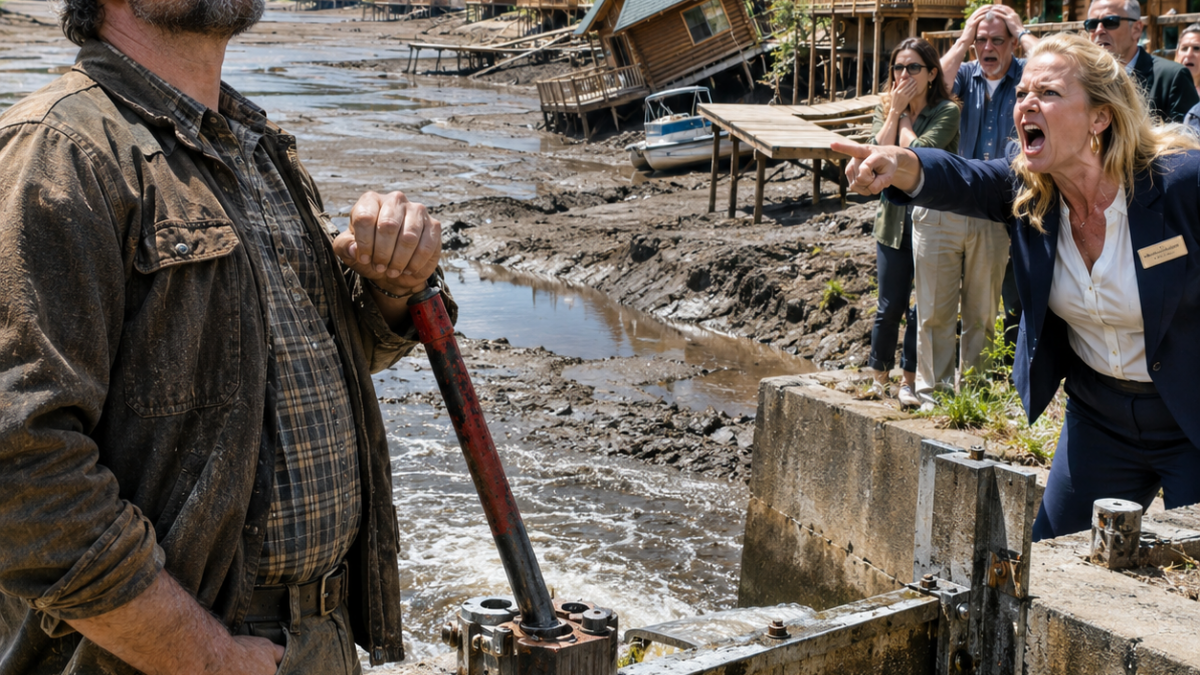
It looked like cabins above a wide band of mud, rock, pipe, exposed septic infrastructure, and construction scars.
People stood on decks staring.
Some angry.
Some crying.
Some on phones with attorneys.
Several came to the edge.
Federal officers kept them back.
One man shouted:
“You destroyed our property values!”
I looked at him.
Didn’t answer.
Another woman:
“Is the lake coming back?”
“Yes.”
She stopped.
“What?”
“After maintenance.”
“How long?”
“Natural refill. Roughly ninety days.”
Her knees seemed to weaken.
Someone had told these people I was permanently draining everything.
Bridget’s campaign had convinced them I planned to erase the lake.
I wasn’t.
I was inspecting it.
And exposing what Devlin had built.
By afternoon, attorneys were calling Vaughn faster than he could return messages.
Cabin buyers had contracts describing:
Deeded lake access.
Private lake amenity.
Exclusive shoreline use.
Shared lake ownership rights.
None existed.
Some title policies excluded the language.
Some contracts relied on HOA documents.
Some referenced the 2020 agreement with Dad.
One forged or invalid foundation had been used to support dozens of sales representations.
That is how fraud grows.
One bad document at the bottom.
A hundred transactions stacked on top.
Devlin was indicted later.
Twenty-one federal counts initially.
Clean Water Act.
Mail fraud.
Wire fraud.
Conspiracy.
False statements.
Environmental violations.
He pleaded to twelve.
Eight-year sentence.
Vance Lakeshore Development dissolved.
Assets:
Around eighteen million.
Court-controlled trust for buyers.
Bridget faced conspiracy.
Attempted entry into federally licensed facility.
Intimidation.
False statements.
She pleaded.
Served eleven months federal.
I heard people joke about her losing the Escalade and linen.
I didn’t.
Prison is not a punchline.
What she did was serious.
So were the consequences.
Carter Vance lost his planning commission position.
Ethics investigations followed.
The cabin owners became the hardest part.
It is easier to be angry at a group than to meet them individually.
One was a middle-school teacher from Spokane.
She had sold a smaller house and used nearly everything for an Eagle Ridge cabin.
She came to my porch.
Her name was Annette.
Sixty-one.
She stood holding a folder.
“Mr. Strickland.”
“Holden.”
“I signed Bridget’s petition.”
“I know.”
“I called you a tyrant online.”
“I did not know that.”
Her face reddened.
“I’m sorry.”
“Come in.”
She didn’t move.
“Did you really own the water the whole time?”
“My trust controls the lake and dam operation.”
“And shoreline?”
“Most of the relevant shoreline, yes.”
She closed her eyes.
“My contract says deeded access.”
“I know.”
“I asked the salesman.”
“What did he say?”
“That the Strickland family had transferred community rights.”
I thought of Dad.
2020.
Signed where pointed.
Annette started crying.
“I’m not rich.”
“I know.”
“I bought one stupid cabin.”
“It wasn’t stupid.”
“I believed them.”
“That isn’t stupidity.”
“It feels like it.”
I poured coffee.
We sat.
I showed her the federal license.
Not to gloat.
To explain.
When she left, she asked:
“Will you help us?”
“Yes.”
“Even after what we said?”
“You bought what you were told was legal.”
That became my position.
Not everyone liked it.
Some locals said:
“Let them lose everything.”
No.
That would make me another Devlin.
About sixty buyers settled through the trust.
Roughly seventy percent recovery depending on their claims.
Around thirty kept title to the land and cabins.
Not lakefront during drawdown.
Later, once the lake refilled, physically near water again.
But their legal relationship changed.
Nineteen remained in litigation longer.
Some cases complicated.
Loans.
Insurers.
Title companies.
Disclosure.
Fraud has a wide blast radius.
The environmental cleanup took fourteen months.
Illegal septic outflows removed.
Drainage repaired.
Shoreline restored.
Erosion stabilized.
Native vegetation replanted.
Some cabin setbacks corrected through easements or demolition.
The lake refilled.
Naturally.
Week after week.
Rain.
Snowmelt.
Tributaries.
By the following season, normal pool elevation returned.
The first morning the dock floated where it should, Tilly and I sat at the end.
She put her feet in.
“Cold?”
“Obviously.”
“Good?”
“Perfect.”
The loons returned first.
Then cutthroat began rising along restored shallows.
I had forgotten how much relief can look like ordinary water.
The lawsuit did not make the lake beautiful.
Cleanup did.
I refused to take personal recovery from some of the settlement money allocated for trespass, intimidation, and the dam-house intrusion.
Instead:
Cole Strickland Memorial Lake Restoration Fund.
I did not tell Dad immediately.
He was fading.
Some days names were gone.
Others time.
I told Tilly.
She cried.
Then got angry that she was crying.
“Uncle Hold.”
“What?”
“That’s Dad’s name.”
“I know.”
“What does it do?”
“Native fish.”
“Okay.”
“Shoreline restoration.”
“Okay.”
“Dam licensing help for families who can’t afford federal compliance.”
She wiped her face.
“He would love that.”
“Probably complain about paperwork.”
“Definitely.”
In fifteen months, the fund helped nineteen families across three states.
Small impoundments.
Family lakes.
Old federal or state licenses.
People who inherited structures without inheriting the money to maintain them.
One family in Montana had a ninety-year-old diversion structure.
Another in Washington had a tiny mill pond threatening to lose compliance because engineering costs were beyond them.
Cole’s name helped.
That felt right.
He had spent his adult life flying into places other people wanted to leave.
Now his name helped families hold onto water systems responsibly.
Dad died the following February.
I was there.
Quiet room.
Snow outside.
His breathing slow.
He had barely spoken all day.
Then his eyes opened.
“Holden.”
Clear.
I leaned close.
“Yes, Dad.”
“Did we take care of the lake?”
I swallowed.
“Yes.”
“Did we?”
“Yes.”
I took his hand.
“We took care of it.”
He relaxed.
“Good.”
Closed his eyes.
Never opened them again.
We buried him on the south shore.
Where he taught Cole and me to fish in 1979.
Small stone.
Owen Strickland.
Dates.
Then a line my grandmother once said about him at Christmas when he was eight:
HE WAS ALWAYS GOING TO BE A STEADY ONE.
That was Dad.
Not flashy.
Not loud.
Steady.
Even Alzheimer’s couldn’t erase that completely.
For months afterward, I felt guilty about the 2020 document.
Not legally.
Emotionally.
I kept wondering:
What if I had retired sooner?
What if I had been home?
What if Cole had lived?
What if Devlin never got Dad alone?
Those questions have no useful answer.
Tilly finally told me:
“You’re doing that thing.”
“What thing?”
“Trying to engineer the past.”
“I do not.”
“You absolutely do.”
I stared.
She continued.
“You keep acting like there was a version where you could have prevented everything.”
“Maybe.”
“Dad died.”
Silence.
“Grandpa got sick.”
Silence.
“Devlin lied.”
Silence.
“You came home.”
I looked away.
“You fixed what you could.”
She sounded like Cole.
Or maybe I wanted her to.
Two years after the drawdown, Tilly started environmental engineering at Idaho State.
She came home most weekends.
Not every weekend.
Enough.
She completed federal backup dam-operator training.
Submitted succession paperwork.
The brass key she gave me on her eighteenth birthday became real.
Not symbolic.
Legal.
She got her own authorization.
The first day we completed an inspection together, she carried the clipboard.
I watched her check the spillway linkage.
“Grease point.”
“Done.”
“Gate seal?”
“Good.”
“Upstream face?”
“Minor vegetation growth.”
“Action?”
“Remove.”
I smiled.
“What?”
“Nothing.”
“You have that face.”
“What face?”
“Old colonel face.”
“Not a thing.”
“Absolutely a thing.”
We entered the dam house.
She put her hand on the iron wheel.
Grandfather’s initials.
Dad’s leather.
My maintenance marks.
Now hers.
“Uncle Hold.”
“Yes?”
“You ever think about removing it?”
“The dam?”
“Eventually.”
“Maybe.”
“Why?”
“Ecology?”
“That.”
“Maintenance cost?”
“That too.”
“Or because it has done its job?”
I looked through the east window.
Lake.
Cabins beyond.
Pines.
“Maybe.”
She nodded.
“Not yet.”
“No.”
“Good.”
Stewardship is not automatically keeping everything forever.
It is understanding what you hold well enough to know when it should change.
Dad taught me inspection.
The Corps taught me systems.
Devlin taught me paperwork can be weaponized.
Tilly taught me succession means letting someone younger ask questions you don’t like.
The Eagle Ridge homeowners eventually reorganized.
No Bridget.
No absorption notices.
No fantasy lake authority.
They formed a normal property association for roads, snow, shared grounds, and whatever they actually owned.
I attended one meeting.
Only one.
Their new president was Annette.
The teacher who had once called me a tyrant online.
She opened the meeting.
“First item.”
Pause.
“Things we actually own.”
People laughed.
Good start.
They renegotiated legitimate shoreline-access licenses with the Strickland trust.
Limited.
Clearly defined.
Revocable under environmental violations.
No ownership language.
No HOA authority over dam operations.
No pretend annexation.
Fees supported restoration.
Some cabin owners hated paying for access they thought they already owned.
Understandable.
But the truth does not become optional because the fraud was expensive.
One man challenged me after.
“You could just give us rights.”
“I could.”
“So why not?”
“Because rights written badly are how this happened.”
He started to argue.
Then stopped.
Fair.
I said:
“My family will not sell you a lie to make you feel better about the one Devlin sold.”
He nodded eventually.
That became the new relationship.
Not friendship with everyone.
Clarity.
Clarity is underrated.
The north shore changed once the septic mess was repaired.
Water tests improved.
Nitrates fell.
E. coli dropped out.
Phosphorus stabilized.
Native plants came back.
One summer, Tilly counted juvenile cutthroat near an area that had been dead for years.
She shouted so loud I heard from the porch.
“Uncle Hold!”
I ran down expecting blood.
She pointed.
“Look!”
Fish.
Small.
Maybe four inches.
She was grinning.
“You nearly gave me a heart attack.”
“Worth it.”
She crouched.
“They’re back.”
I watched the water.
Clear.
Cold.
Movement under surface.
“Yeah.”
That day made the whole fight feel different.
The legal victory was important.
But lawsuits are mostly paper.
Fish coming back is physical.
You can see it.
In the years after, journalists continued requesting interviews.
Most wanted the same angle.
MAN DRAINS LAKE TO DESTROY HOA RESORT.
I refused that framing.
One producer said:
“But you pulled the lever.”
“It was a wheel.”
“That’s less dramatic.”
“Correct.”
“And the cabins lost their lake.”
“Temporarily.”
“That ruins the title.”
“Then your title is wrong.”
He didn’t use me.
Fine.
The truth was dramatic enough.
I did not drain the lake in anger.
I filed.
Waited.
Coordinated.
Notified.
Got approval.
Opened a federally authorized control structure at a regulated rate.
Held maintenance pool.
Inspected.
Closed.
Refilled.
The dramatic part was not that I could make the lake disappear.
The dramatic part was that Devlin built a $50-million-plus development without understanding—or caring—who legally controlled the water that made his cabins valuable.
That was his failure.
Not mine.
There is a lesson in that every engineer knows:
Do not build your entire system around a component you do not control.
Devlin built an entire luxury brand around my dam.
Then tried to use Dad’s decline to manufacture the control he had skipped purchasing.
Bad engineering.
Worse ethics.
Bridget made the same mistake politically.
She treated numbers as authority.
109 families.
109 votes.
109 angry people.
That looks powerful.
But one federal license can outweigh a hundred opinions when the question is who operates the dam.
The day she tried to break into the dam house, she finally met a boundary her confidence could not move.
Steel.
Law.
Camera.
Sheriff.
I never visited her in prison.
Never wrote.
Never followed her life after.
Some people asked:
“Don’t you want her to know you won?”
No.
If your victory depends on the loser understanding it, you are still letting them define the outcome.
The lake was clean.
Dad was at peace.
Tilly was training.
That was enough.
Devlin wrote one letter from prison through his attorney.
Apology.
Mostly legal language.
He said:
“I regret representations made regarding lake ownership.”
I read that line twice.
Representations.
That is what developers call lies after conviction.
I filed it.
Not because I cared.
Because folders matter.
The old farmhouse still stands.
Same kitchen.
Same porch.
The Escalade no longer comes up the drive.
Neither do protesters.
Sometimes Eagle Ridge kids paddle across with proper permission.
Tilly created a simple access-tag system.
“Too bureaucratic.”
I told her.
“You raised me.”
“I did not.”
“Close enough.”
She laminated the tags.
Color-coded.
Of course.
She studies environmental engineering.
She loves field instruments.
Complains about calculus.
Has Cole’s stubbornness.
Dad’s steadiness.
Maybe some of mine.
Last fall, she asked if we could take Grandpa’s old survey notes out of storage.
We spread them on the kitchen table.
1923.
Pencil.
Measurements.
Dam cross-section.
Spillway geometry.
Sawmill intake.
She traced one line carefully.
“He calculated this by hand.”
“Yes.”
“No computer.”
“None.”
“No laser.”
“No.”
“No GPS.”
“No.”
She stared.
“That’s insane.”
“He was good.”
“So are you.”
That caught me off guard.
“Thank you.”
She kept reading.
Then:
“Do you think he knew the lake would still be here?”
“No.”
“Do you think he wanted it to be?”
“I don’t know.”
She nodded.
“Maybe we don’t need to know.”
Exactly.
Legacy is not following old instructions forever.
It is inheriting responsibility.
Making new decisions with enough respect to understand the old ones.
That is the thing Devlin never had.
Respect.
He saw Dad’s weakness.
Not Dad’s history.
He saw shoreline.
Not license.
He saw water.
Not structure.
He saw 109 sales.
Not 109 families who would eventually discover they had been sold something that did not legally exist.
I once asked Annette why people believed his lake claims so easily.
She said:
“Because the lake was right there.”
That answer stayed with me.
Of course.
You stand on a deck.
Water twenty feet away.
Brochure says lakefront.
Why would you suspect?
Most people do not expect fraud to be built at subdivision scale.
That is why the law requires disclosure.
That is why title exists.
That is why old documents matter.
Systems exist because ordinary buyers cannot investigate everything themselves.
Devlin exploited that trust.
Some buyers never recovered emotionally.
One couple sold.
Couldn’t stand looking at the lake anymore.
Another stayed but stopped using the water.
A third sued their broker separately.
Fraud leaves residue long after money changes hands.
That is another reason I do not romanticize the drawdown.
It exposed truth.
But truth hurt people who did not deserve it.
Still, hiding the truth longer would have hurt them more.
That is the kind of choice engineers hate.
No perfect option.
Only controlled damage versus uncontrolled failure.
The Army taught me that too.
You rarely get a clean problem.
You get constraints.
Risk.
Time.
Unknowns.
Then responsibility.
The Cole Strickland Memorial Fund became my way of moving forward.
First grant:
Small family-owned impoundment in eastern Washington.
Owner was a widow.
Husband died.
Federal paperwork behind.
Spillway needed inspection.
She could not afford the engineering report.
We paid.
Second:
Montana family.
Fish passage modification.
Third:
Idaho farm pond under an old licensing structure.
Nineteen families eventually.
Not glamorous.
No ribbon-cutting mostly.
Just compliance.
Concrete.
Habitat.
Paperwork.
Cole would have laughed.
He hated paperwork more than any human I knew.
But he understood mission.
The fund had one.
Keep working families from losing old water systems simply because professional compliance costs were beyond them.
Tilly became obsessed.
She suggested expanding into environmental education.
I said:
“Stay focused.”
She said:
“You’re boring.”
I said:
“You’re eighteen.”
She said:
“You’re fifty-four.”
Stalemate.
Then she wrote a proposal anyway.
It was good.
We added youth watershed workshops.
Small.
Controlled.
I pretended it was my idea.
She did not allow that.
Dad never saw the fund fully operating.
But he saw the first brochure.
I brought it to memory care.
Some days he could still read.
That day, he looked at Cole’s photograph.
Then at me.
“Good boy.”
I didn’t know whether he meant Cole or me.
Didn’t matter.
I said:
“Yes.”
He touched the page.
“Helicopters?”
“No.”
“Why not?”
“Fish.”
He looked confused.
Then laughed.
For thirty seconds, he was Dad again.
That memory is worth more than any court judgment.
Years after the drawdown, one of the original Eagle Ridge owners invited me to dinner.
His name was Marcus.
Software architect.
He had kept his cabin.
Paid to correct septic.
Signed new access agreement.
He cooked steaks outside.
Lake below.
His wife asked:
“Do you hate this development?”
I thought.
“No.”
Marcus looked surprised.
“You did.”
“I hated what was done.”
“Difference?”
“Yes.”
“The cabins are still here.”
“Yes.”
“Is that hard?”
“Sometimes.”
He nodded.
“I bought mine because I wanted my kids to have what you had growing up.”
“What?”
“A lake.”
I looked at his son skipping stones.
That was the first time I fully understood the buyers.
They were not invaders.
Most of them.
They were people who wanted water.
Quiet.
Family.
Exactly what my grandfather had built for us accidentally while trying to power a sawmill.
Devlin sold them that longing.
Then lied about who controlled it.
I said:
“You can still give them that.”
Marcus looked toward the water.
“Really?”
“Respect it.”
He waited.
“Don’t treat it like your backyard pool.”
He smiled.
“Fair.”
“Teach them where the water comes from.”
“The dam.”
“And creeks.”
“Okay.”
“Teach them who cleans up after people.”
“EPA?”
“Tilly.”
He laughed.
Later, his kids joined one of the fund’s shoreline projects.
That felt like progress.
Not forgiveness exactly.
Integration done honestly.
The thing Bridget tried to manufacture with an absorption notice.
Real community does not come from declaring ownership over someone else.
It comes from negotiated boundaries.
Shared work.
Respect.
No logo required.
One autumn, Sheriff Wallace Trent came by.
Retired now.
Brought bourbon.
We sat on porch.
He said:
“You know what I remember most?”
“Bridget running?”
“No.”
“Tilly with the key?”
“No.”
“The wheel?”
“No.”
“What?”
“Your dog.”
“Pendleton?”
“He watched that woman try to break into a federal dam like he had seen worse.”
I laughed.
“He had.”
“Bear?”
“Bear.”
Wallace nodded.
“Good dog.”
Pendleton died at sixteen.
Ridiculous age.
He slept by the dock one afternoon.
Didn’t wake.
Tilly buried him near Dad.
Said:
“He guarded everybody.”
True.
The lake had accumulated graves.
Dad.
Dog.
Memories of Cole.
That sounds sad.
It isn’t entirely.
Places become homes because they hold the people who leave.
Tilly once asked if Cole should have a stone there too.
His body was buried at Arlington.
We put a small plaque by the water anyway.
COLE STRICKLAND
HE ALWAYS CAME HOME HERE
No dates.
Didn’t need them.
The first time we dedicated a restoration project under his fund, Tilly wore her father’s old watch.
Too big.
Loose on her wrist.
She gave a short speech.
“My dad flew helicopters.”
Pause.
“He would think fish restoration is extremely unexciting.”
People laughed.
“But he believed if you were responsible for people, you did the job right.”
She looked at me.
“So did my grandfather.”
Then toward the dam.
“So does my uncle.”
I looked down.
She finished:
“That’s what this fund is for.”
I cried in public.
Unacceptable.
She was pleased.
The lake drawdown became required reading in one Idaho land-use seminar.
Vaughn sent me the slide deck.
Title:
THE STRICKLAND IMPOUNDMENT DISPUTE: TITLE, LICENSE, ENVIRONMENTAL LIABILITY, AND DEVELOPMENT FRAUD.
Tilly said:
“Boring title.”
“What would you call it?”
She smiled.
“109 Cabins, One Wheel.”
I hate that she’s good at titles.
I refused an invitation to speak at first.
Then agreed.
Room full of engineers, planners, lawyers.
I held up the 1923 license.
“This.”
I said.
“Was older than almost every person who made a decision in this case.”
Then Bridget’s absorption letter.
“This was newer.”
Then Dad’s fake or invalid agreement.
“This was the bridge between the lie and the money.”
Then EPA photos.
“This is what happens when people build faster than oversight can keep up.”
Then one photograph of Tilly’s hands beside mine on the wheel.
“This is succession.”
That was my favorite.
A planner asked:
“What was Devlin’s biggest mistake?”
I said:
“Assuming the old man’s signature was more important than the old man’s capacity.”
A lawyer asked:
“Second biggest?”
“Assuming nobody would read the license.”
An engineer asked:
“Third?”
“Bad septic.”
That got laughter.
But all three were real.
Fraud.
Paper.
Infrastructure.
Every collapse starts somewhere.
Most people notice only after the visible part fails.
The lake never failed.
The project did.
The current Eagle Ridge brochures no longer say private lake ownership.
They say:
ACCESS TO STRICKLAND LAKE UNDER LICENSE AGREEMENT.
Accurate.
Less sexy.
Good.
Accuracy should sometimes be less sexy.
The road signs changed too.
No:
EAGLE RIDGE LAKE.
Now:
EAGLE RIDGE LODGES.
Below:
STRICKLAND LAKE ACCESS SUBJECT TO PRIVATE AGREEMENT.
Tilly photographed it.
Sent to me.
Caption:
CHARACTER DEVELOPMENT.
I replied:
BE NICE.
She replied:
NO.
That is Cole’s child.
I sometimes revisit the dam house at night.
Not because I expect Bridget.
Because it is quiet.
Stone holds cold.
Iron wheel.
East window.
Dad’s leather.
Grandfather’s initials.
My maintenance tags.
Tilly’s new inspection stickers.
Four generations in one room.
The wheel is not magical.
People tell the story like it is.
One lever.
Resort disappears.
Reality is slower.
It took notices.
Permits.
Lawyers.
Inspections.
A federal schedule.
Hours of controlled drawdown.
Then months of refill.
The wheel mattered because law gave me the right to turn it.
That is the real power.
Not the metal.
Authority grounded in something older and better documented than anyone’s confidence.
Bridget had a logo.
I had a license.
Devlin had brochures.
I had title.
Carter had a planning vote.
EPA had test results.
At some point, reality accumulates enough documents that spin collapses.
That is what happened.
The moment everyone remembers is 6:04 a.m.
My hand.
Tilly’s.
Iron wheel.
But the real victory happened earlier.
When I opened the folder.
When I read.
When I called Dad.
When I sampled water.
When Hattie told Lou who approved the development.
When letters went to 109 owners.
When buyers called lawyers.
The wheel was only the visible end of an invisible process.
That’s another thing the Corps taught me.
When an operation succeeds, people remember the explosion.
Or the bridge opening.
Or the water moving.
They forget surveying.
Load calculations.
Procurement.
Permits.
Inspection.
Training.
Success is usually boring for a long time before it becomes dramatic for one minute.
The morning the lake dropped, I was not angry.
Not really.
Focused.
Every person on that shoreline had a stake in what happened.
Even people who hated me.
Especially them.
One wrong operation could have caused erosion.
Fish loss.
Downstream flooding.
Structural stress.
That responsibility outweighed revenge.
That’s why I refuse the phrase:
“I drained their lake.”
It was never their lake.
But they lived beside it.
And I was responsible for operating it safely.
Words matter.
I performed a maintenance drawdown.
The fact that it simultaneously exposed fraud was because fraud had been sitting underneath the water.
Years later, Tilly asked:
“If Bridget hadn’t tried to absorb us, would you still have found the septic?”
Eventually.
“Would the lake have been damaged?”
More.
“How much?”
“I don’t know.”
She looked at the water.
“So she accidentally helped?”
I frowned.
“Don’t say that.”
“She did.”
“She attacked us.”
“And made you test.”
“Yes.”
“And then EPA came.”
“Yes.”
“So…”
I sighed.
“Unintended consequence.”
She smiled.
“Character development again.”
I hate when she wins arguments.
The lake today is healthier than before Eagle Ridge.
That is strange.
The project damaged it.
The fight exposed damage.
Cleanup improved systems.
New access fees fund monitoring.
Buyers know what they actually own.
Shoreline vegetation stronger.
Fish better.
Septic properly regulated.
The old conflict produced a better equilibrium.
That does not justify the wrongdoing.
But it gives meaning to the aftermath.
Dad’s last question still lives with me.
Did we take care of the lake?
Not:
Did we win?
Not:
Did Devlin go to prison?
Not:
Did Bridget lose the Escalade?
Take care.
That is the standard.
Every decision I make now comes back to it.
Tilly too.
She once proposed installing new automated gate controls.
I asked:
“Why?”
“Remote monitoring.”
“Necessary?”
“Useful.”
“Fail safe?”
“Yes.”
“Manual override?”
“Obviously.”
“Power outage?”
“Battery.”
“Lightning?”
“Surge.”
“Cyberattack?”
She stared.
“You are exhausting.”
“Take care of the lake.”
She rolled her eyes.
Then improved the design.
Good.
Owen would approve.
The day her name was officially added to the federal operational succession record, we went to see Dad’s grave.
She brought the brass key.
Placed it on the stone.
Not left.
Just set it there.
“Grandpa.”
Wind through pines.
“I’m on the license.”
She looked at me.
“Do dead people care about federal paperwork?”
“Stricklands do.”
She laughed.
Then picked up the key.
At sunset, we sat on the dock.
Native cutthroat feeding.
Loons south.
Tilly bumped my shoulder.
“You ever wish you had kids?”
That question surprised me.
“I had two.”
She looked over.
“What?”
I thought of Dad calling me Cole.
Cole’s daughter sitting beside me.
“I just didn’t always know which one I had on which day.”
She leaned against me.
Neither of us spoke for a while.
That was enough.
If someone asks me now what the whole story was about, the easy answer is an HOA built 109 cabins around a private lake and I drained it.
That is the headline.
The truth is bigger.
It was about a developer seeing an old man with Alzheimer’s and assuming confusion could be converted into property rights.
It was about a community buying something beautiful without being told the legal foundation beneath the promise.
It was about an HOA president mistaking collective anger for ownership.
It was about regulators missing things until dirty water forced the right questions.
It was about a hundred-year-old dam whose paperwork mattered more than a modern marketing campaign.
It was about my father.
My brother.
My niece.
And a five-foot iron wheel that connected all of us to a man named Pendleton who cast his initials into metal in 1923 without any idea what his family would one day need that wheel to prove.
The Eagle Ridge cabins are still there.
That matters.
I did not bulldoze them.
I did not want families homeless.
The “resort” disappeared only in the sense that the fantasy disappeared.
For two weeks, their lakefront views became mud, exposed pipes, bad foundations, illegal encroachments, and federal inspectors.
Then the water came back.
But the lie did not.
That is the difference.
You can refill a lake.
You cannot easily refill a false story after the truth drains out of it.
Devlin’s version of Eagle Ridge was gone.
No shared ownership.
No HOA absorption.
No private-lake fantasy.
No illegal septic.
What replaced it was less glamorous.
More honest.
People owned cabins.
The Strickland trust operated the lake.
Access existed by agreement.
Environmental rules applied.
Everybody knew the boundaries.
That is how it should have been from the beginning.
The first morning after the lake returned to full pool, I woke early.
Walked to the dock.
Fog.
Perfect surface.
Tilly still asleep.
Pendleton gone by then.
Dad gone.
Cole gone much longer.
For a moment, I felt very alone.
Then a loon called from the south shore.
Another answered.
I sat.
Watched the water.
Grandfather built the dam for work.
Dad maintained it because that was what Stricklands did.
I came home because Dad needed me.
Tilly stayed connected because Cole couldn’t.
None of us planned the chain.
Families rarely do.
We inherit.
We adapt.
We keep moving.
The lake looked the same as it had before the conflict.
That was the strange part.
Forty-seven acres.
Pines.
Granite.
Cabins on north shore.
Farmhouse behind me.
Anyone visiting for the first time would never know 109 households had once been told they owned the water.
Would never know EPA found discharge pipes in the mud.
Would never know Bridget had stood under a floodlight with bolt cutters before dawn.
Would never know Tilly and I opened the spillway together while cameras watched.
Land does not remember drama the way people do.
It just holds consequences.
Cleaner water.
Better shoreline.
New agreements.
That is enough.
I walked up to the dam house.
Unlocked it.
The wheel sat in shadow.
P.S. on rim.
Leather grip worn smooth.
I put one hand there.
Not to turn.
Just touch.
Then I heard footsteps.
Tilly.
Coffee.
Hair a mess.
“You started without me.”
“I’m sitting.”
“Inspection?”
“No.”
“Brooding?”
“Maybe.”
She handed me coffee.
We looked out the east window.
She said:
“Grandpa really asked if we took care of it?”
“Yes.”
“And you said yes.”
“Yes.”
She thought.
“Were you sure?”
That is an engineer’s question.
I smiled.
“No.”
“What?”
“I was sure we had done what we could.”
She nodded.
“Better answer.”
Exactly.
We stood there a while.
Then she looked at the wheel.
“One day this is mine.”
“Shared responsibility.”
“Still.”
“Yes.”
“You think Bridget ever understood that she could never own it?”
“The wheel?”
“The lake.”
I looked through the window.
“No.”
“Why?”
“Because she thought ownership was something you could declare.”
“And it isn’t?”
“Sometimes people do declare it.”
“Then what?”
“You better be able to prove it.”
She smiled.
“Folders.”
“Folders.”
We closed the dam house.
Locked the old door.
Walked back up the slope.
The lake behind us was still.
Healthy.
Ours to care for.
Not ours forever.
No land is.
No water is.
But for now, the responsibility had a name.
Strickland.
And the next name was already carrying the key.








