PART 2: HOA Board Member Kept Taking My Deeded Parking Spot — So I Locked It Down at the County Office Before She Could Claim It
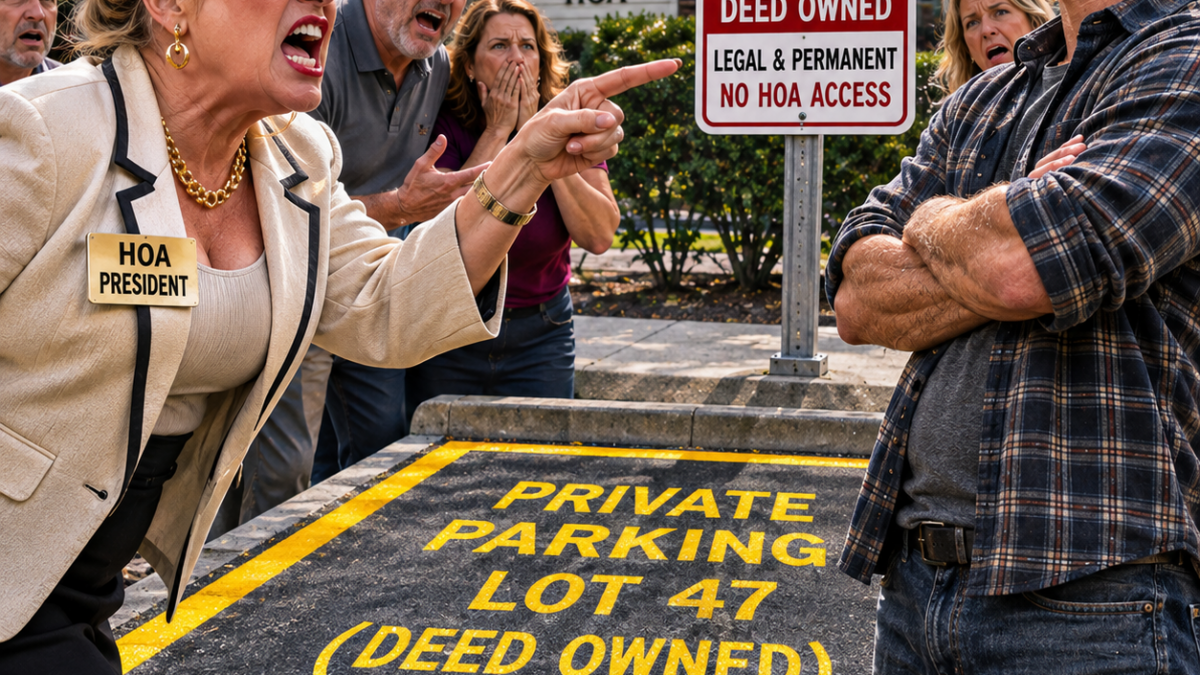
PART 2
I didn’t knock on Beverly’s door the second time.
I opened the HOA management portal instead.
Millbrook Ridge used Pinnacle Property Services to handle maintenance requests, violations, fees, parking complaints and all the bureaucratic tasks people assume are being handled until they discover they aren’t.
I submitted a simple complaint.
**Unauthorized vehicle repeatedly occupying deeded parking space 114 assigned to Unit 114-C.**
No insults.
No accusations.
I included Beverly’s unit number.
Submitted.
Then waited.
Eleven days.
That was how long it took Pinnacle to respond.
Not directly to me.
Instead, every resident received an email.
**REMINDER: PLEASE RESPECT ASSIGNED PARKING SPACES.**
That was it.
No warning.
No name.
No enforcement.
No question about whether Beverly had violated anything.
Just a mass email.
I showed it to Connie.
She read it while sitting at the kitchen table with a stack of spelling tests.
“That’s their response?”
“Apparently.”
“Did they contact her?”
“No idea.”
She handed me the phone.
“Maybe it’ll stop.”
I hoped so.
The following evening, around 9:30, I heard tires rolling slowly through the parking lot.
There was a very specific crunch vehicles made over the loose gravel at the edge of the asphalt.
I went to the window.
The Escalade passed spot 122.
Her spot.
Kept going.
Turned slightly.
Backed into 114.
My spot.
I watched the brake lights shut off.
Connie looked up from the couch.
“She did it again?”
“Yep.”
“After the email?”
“Yep.”
Connie sighed.
I stood at the window longer than necessary.
That was when I stopped believing this was an accident.
—
Over the next six weeks, I became something I had never expected to become.
A parking historian.
I bought a small outdoor security camera.
Mounted it on the balcony.
Angled it toward 114.
Then I built a spreadsheet.
Date.
Arrival time.
Departure time.
Duration.
Photograph.
Notes.
If you work in commercial HVAC long enough, documentation becomes instinct.
You don’t write:
**Unit not working.**
You write:
**Compressor drawing 18.4 amps against 12.7 rated load; contactor pitted; supply air 71°F; return 75°F.**
Because specifics solve arguments.
So I got specific.
October 29.
6:41 p.m. to 8:13 a.m.
October 31.
9:04 p.m. to 7:26 a.m.
November 2.
5:55 p.m. to 10:17 p.m.
It continued.
Sometimes Beverly parked correctly.
Sometimes she didn’t.
At first I thought the inconsistency helped her.
Then I realized it helped me.
Random violations can be explained.
Patterns cannot.
After three documented incidents, I filed another complaint.
This time I attached photographs.
Timestamps.
My purchase documents.
The previous complaint.
Eleven days later, another community email arrived.
Same language.
Almost word for word.
**Residents are reminded to respect assigned spaces.**
I stared at it.
Then checked my spreadsheet.
Twenty-seven incidents.
Forty-two days.
Beverly had occupied 114 on twenty-seven separate occasions.
Sixty-four percent of the time.
I told that number to a coworker named Mike.
He laughed.
“Derek, you calculated the occupancy percentage?”
“Yes.”
“It’s a parking spot.”
“No.”
He looked at me.
“What?”
“It stopped being about the parking spot.”
He shook his head.
“That sounds exactly like something somebody says when it is definitely about a parking spot.”
I laughed.
But he was wrong.
Every time Beverly used 114, she was testing something.
Not the space.
The system.
Could a board member violate a written rule while management ignored complaints?
So far, the answer was yes.
And each time the answer stayed yes, Beverly became more comfortable.
That mattered.
Power rarely gets abused for the first time in a dramatic way.
It starts small.
Nobody objects.
Then it grows.
—
I finally read the entire set of CC&Rs.
I should have done it when we purchased the condo.
Most people should.
Almost nobody does.
Buried in Section 7.4 was exactly what I needed.
Each assigned parking space constituted an appurtenance to its associated unit and could not be used by another person without the owner’s express permission.
That was not vague.
I printed the section.
Highlighted it.
Then wrote a formal letter to all five HOA board members.
Certified mail.
Return receipt.
I addressed every board member individually.
Quoted Section 7.4.
Attached photographs.
Attached my spreadsheet summary.
Requested enforcement.
The receipt came back signed.
Fourteen days passed.
Nothing.
Not even another useless mass email.
Nothing.
Then one Friday evening, somebody knocked.
It wasn’t Beverly.
It was Terence.
Retired postal worker.
Friendly guy.
The closest thing Building C had to a welcome committee.
He stood in my hallway looking uncomfortable.
“Hey, Derek.”
“Hey.”
“Can I ask you something?”
“Sure.”
He rubbed the back of his neck.
“I don’t want to get involved.”
That sentence almost always means somebody is already involved.
“Okay.”
“Beverly mentioned there’s been a parking issue.”
I said nothing.
“She said she’s had some mobility trouble lately.”
I looked at him.
“Mobility trouble.”
“Yeah. She says 114 is easier because it’s closer.”
For one second, I actually felt bad.
If Beverly had a genuine physical problem, that mattered.
Connie knew exactly what mobility issues felt like.
I had watched my wife spend weeks learning to trust her knee again.
“I’m not against an accommodation,” I said.
Terence looked relieved.
“Really?”
“Of course not. If she needs a closer space, there’s a process.”
He hesitated.
“She was hoping maybe you two could just work something out.”
“She’s used my spot twenty-seven times without asking.”
“I didn’t know that.”
“I’ve filed multiple complaints.”
He looked even more uncomfortable.
“I didn’t know that either.”
“Tell her I’m completely willing to consider a formal accommodation request. In writing. Through the HOA.”
Terence nodded.
“That sounds fair.”
“There’s a procedure for this exact thing.”
“I’ll tell her.”
He left.
The next morning, I checked the camera.
The Escalade was in 114.
I laughed.
Not because it was funny.
Because now I knew.
The mobility story was not an attempt to find a solution.
It was an attempt to avoid paperwork.
—
Three days later, I received an official HOA violation.
For my camera.
Apparently, mounting a security camera on the balcony violated Section 9.2, which prohibited unapproved exterior equipment.
I stood in the kitchen holding that letter and laughed hard enough that Connie came in from the other room.
“What?”
I handed it to her.
She read it.
Then looked at me.
“They’re punishing the camera?”
“Yes.”
“Not Beverly?”
“Correct.”
She sat down.
“That seems…”
“Useful?”
“I was going to say ridiculous.”
“Both.”
Because Beverly had made a mistake.
Up until that moment, the HOA had been vague.
Now they had given me something specific.
A citation.
A rule number.
A written action.
That meant we were playing on paper.
I took the camera down.
Cheerfully.
I already had twenty-seven documented incidents.
It had done its job.
Now I needed a lawyer.
—
My cousin Malcolm recommended Franklin O’Shea, a real-estate attorney in Durham.
Malcolm described him as “a surgeon with paperwork.”
I liked that.
Franklin’s office smelled like old files and strong coffee.
I brought everything.
The deed.
CC&Rs.
Photographs.
Spreadsheet.
Complaint responses.
Certified letter.
Camera violation.
He listened.
Didn’t interrupt.
When I finished, he folded his hands.
“You’ve documented this unusually well.”
“I fix air-conditioning systems for a living. If I don’t document, people blame the technician.”
He smiled.
“Good habit.”
Then he opened the CC&Rs.
“You may eventually have a nuisance claim. You may have governance issues. Possibly selective enforcement.”
He tapped a paragraph.
“But before we do anything expensive, you missed something.”
I leaned forward.
Section 4.11.
The association was required to hold a formal hearing within a set period when an affected unit owner submitted a written request regarding disputed parking rights.
Franklin looked at me.
“Have you requested a formal hearing?”
“I complained.”
“That’s not what I asked.”
“I sent certified mail.”
“Did you write the words ‘formal hearing request pursuant to Section 4.11’?”
“No.”
“Then you haven’t triggered this provision.”
That irritated me.
Not at Franklin.
At myself.
All those complaints.
All those emails.
And three words changed the legal obligation.
“Do it today,” he said.
“What happens then?”
“They either schedule the hearing…”
“Or?”
“They create another problem for themselves.”
I liked Franklin.
—
I mailed the request the next morning.
Certified.
Return receipt.
Exact language.
**FORMAL HEARING REQUEST PURSUANT TO SECTION 4.11.**
Suddenly Pinnacle’s tone changed.
Within a week, I received a real response.
No generic reminder.
No friendly community language.
The letter acknowledged the hearing request.
Scheduled a board meeting.
Then included a sentence that made me stop.
**The Board has reviewed available records and has found no evidence of a sustained pattern of unauthorized parking.**
No evidence.
I had submitted photographs.
Dates.
Timestamps.
Multiple complaints.
Certified correspondence.
I forwarded the letter to Franklin.
His response was four words.
**Save everything. This helps.**
That was when something else happened.
Gerald Pruitt knocked on my door.
Retired electrician.
Lived across the hall.
He held up his phone.
“I think you might want these.”
Photographs.
Beverly’s Escalade.
Not in my spot.
In Gerald’s guest space.
Twice.
His wife Pat had two more photographs.
I stared at them.
“She uses yours too?”
“Apparently.”
Gerald shrugged.
“I never cared enough to complain until I heard what they were doing to you.”
We stood in the hallway comparing dates.
A few days later, Terence returned.
Different expression this time.
“I looked up the camera rule.”
“And?”
“It applies to exterior building surfaces.”
I waited.
“Your balcony rail isn’t covered the way Beverly said.”
I nodded.
Terence looked embarrassed.
“She knew that.”
“How do you know?”
“She discussed it at a meeting last year.”
Interesting.
Then he told me about his own problem.
A storage unit attached to his condo had been reassigned without proper notice.
Management told him it was a clerical error.
He let it go.
Now he was reconsidering.
Beverly had tried to isolate me.
Instead, she was creating witnesses.
—
The hearing arrived on a cold Thursday night in February.
I walked into the clubhouse carrying a binder.
Gerald and Pat came behind me.
Terence sat in the third row.
Six residents I hadn’t invited were already there.
Word had spread.
Beverly sat at the center of the board table.
Perfect posture.
Reading glasses hanging from their chain.
The expression of someone who had controlled that room for years.
The board wasted forty minutes on routine business.
Budget.
Pool maintenance.
Landscaping.
By the time my issue appeared, it was 7:40.
“Item six,” Beverly said. “Resident parking complaint.”
Complaint.
Not hearing.
Not deed dispute.
Complaint.
I stood.
“My question is simple.”
I handed copies of Section 7.4 to the board.
“Is parking space 114 legally assigned to Unit 114-C?”
Beverly folded her hands.
“Parking enforcement involves a number of factors.”
“That isn’t my question.”
“We have to consider overall community needs.”
“Is 114 assigned to my unit?”
She smiled.
“The records speak for themselves.”
Sheila, one of the quieter board members, leaned toward her microphone.
She was younger than the others.
An accountant.
“Can we confirm for the minutes that 114 is assigned to Unit 114-C?”
Beverly turned toward her.
“The records speak for themselves.”
Sheila frowned.
“Then can we confirm the board’s enforcement position?”
Long pause.
“We’ll take the matter under advisement.”
There it was.
The phrase people use when they want the discussion to end without giving an answer.
I sat down.
Gerald stood next.
He presented his photos.
Then Terence.
Then something happened I hadn’t planned.
Other residents began speaking.
A resident whose deeded space had been used by a landscaping contractor.
Someone whose accessible space was repeatedly blocked.
Another resident who said gate codes had been changed without proper notification.
The room turned.
What Beverly had tried to frame as my personal obsession with one parking space suddenly looked like something else.
A pattern.
After the meeting, Sheila found me in the parking lot.
February air.
Wet pavement.
Car exhaust.
She lowered her voice.
“I’m sorry.”
“For what?”
“What happened in there.”
She glanced toward the clubhouse.
“I’ve been uncomfortable with some things for a while.”
“What things?”
She hesitated.
“I want to send you documents.”
“Board documents?”
“Some.”
“Why me?”
“Because you have an attorney.”
That answer told me more than she probably intended.
“I’ll send them from my personal email.”
Then she walked away.
—
The email arrived the next morning.
Three attachments.
The first:
A landscaping invoice.
Company owned by Beverly’s son-in-law.
Paid with HOA funds.
Second:
Internal meeting notes showing parking-enforcement proposals had been raised multiple times and tabled repeatedly.
Each time by Beverly.
Third:
An administrative note connected to the original parking assignments.
Handwritten.
Initialed:
**BS.**
Beverly Storch.
Beside spot 114:
**Potential reassignment pending unit vacancy.**
I read it once.
Then again.
My unit had never been vacant.
We still lived there.
We were paying dues.
Using the property.
Beverly had apparently placed a note into the HOA’s administrative records suggesting my deeded space could eventually be reassigned.
I called Franklin.
He answered quickly.
“I’m emailing you something.”
“What?”
“You’re going to want to sit down.”
He reviewed it.
Called me back.
His voice changed.
“Derek.”
“Yeah?”
“This just became more serious.”
“Because of the note?”
“Because she is a board member touching administrative records related to property she personally wants to use.”
I stared at the printed page.
“Can she actually take the spot?”
“Not legally through a handwritten HOA note.”
“Then why does it matter?”
“Intent.”
He paused.
“And interference.”
Then Franklin asked a question.
“Read me exactly what your deed says about 114.”
I pulled it out.
Read it.
Unit 114-C.
Common interest.
Limited common element.
Parking space 114.
As shown on the recorded plat.
Franklin interrupted.
“Stop.”
“What?”
“As shown on the recorded plat.”
“Yes.”
“That matters.”
“How?”
“Because your parking space is not just an HOA spreadsheet entry.”
“I know.”
“No. Listen carefully. It exists on a recorded county plat.”
I leaned back.
“Meaning?”
“Meaning we can make your ownership much harder for anyone to play games with.”
—
Franklin explained it slowly.
My parking space was already legally attached to my unit.
Nothing he was proposing would magically give me ownership I didn’t already have.
That part mattered.
The title wasn’t changing.
The evidence was.
He could prepare a standalone affidavit referencing the deed, recorded plat, parcel information and physical location of spot 114.
Then we could record it with the Wake County Register of Deeds.
Public record.
Searchable.
Permanent.
Not something buried in an HOA file cabinet.
Not a line somebody could quietly annotate.
Not dependent on Beverly.
Not dependent on Pinnacle.
Anybody doing future title work would see it.
“So this doesn’t make it mine,” I said.
“It’s already yours.”
“It makes it impossible to pretend there’s confusion.”
Franklin smiled.
“Exactly.”
“How much?”
“Roughly $185 in filing costs, plus my drafting time.”
I thought about Beverly’s Escalade.
The ignored complaints.
The mobility excuse.
The camera violation.
The note beside spot 114.
“Draft it.”
“I’ll have it in three days.”
“Two.”
He laughed.
“Two.”
—
The affidavit arrived forty-eight hours later.
Four pages.
Clean.
Dry.
Beautiful in the way only a document can be beautiful when you know exactly what it protects.
Original deed citation.
Recorded plat number.
Parcel ID.
Description of spot 114.
Franklin had also included the existence of the HOA reassignment notation as context for why the affidavit was being recorded.
No accusation.
No inflammatory language.
Just fact.
I called him.
“You put Beverly’s note in there.”
“As context.”
“She’s going to hate that.”
“That is not a legal standard I considered.”
I smiled.
Tuesday morning, I drove to the Wake County Register of Deeds.
I parked in a public lot.
Walked inside.
Fluorescent lights.
Old laminate counter.
Government-building quiet.
I handed the clerk the affidavit.
Identification.
Check.
$185.
She reviewed the pages.
Stamped them.
Entered the recording.
Assigned a book and page number.
Then handed me the receipt.
That was it.
No music.
No courtroom.
No cheering.
Just a stamp.
But standing there holding that receipt, I felt months of frustration drop several inches off my shoulders.
Beverly had spent months acting as though 114 belonged to whoever had more influence inside the HOA.
Now there was a standalone county record saying otherwise.
Her board seat could not erase it.
Her handwritten note could not erase it.
A mass email could not erase it.
The space had always been mine.
Now the paperwork was loud enough for everyone to hear.
—
That was only track one.
Franklin believed the board’s behavior needed formal review.
So we assembled a regulatory complaint.
Dates.
Photographs.
Failure to enforce Section 7.4.
Failure to respond meaningfully.
Camera retaliation.
Hearing problems.
Potential selective enforcement.
I spent two hours drafting the narrative.
Then attached supporting documentation.
Gerald provided a statement.
Pat.
Terence.
Others.
Within two weeks, nine residents had documented incidents connected to Beverly or board actions.
That mattered.
One angry homeowner can be dismissed as difficult.
Nine homeowners with documents are harder to dismiss.
Dorothy from Building A contacted us next.
I barely knew her.
She had been charged a landscaping fee eighteen months earlier.
She believed it was improper.
When she showed me the invoice, my stomach tightened.
Same company.
Beverly’s son-in-law.
Dorothy had payment records.
Meeting records.
The contract approval.
And Beverly had apparently voted on the matter.
No disclosed family connection.
I sent everything to Franklin.
He called.
“This is no longer a parking case.”
“I noticed.”
“This is potentially a governance pattern involving conflicts of interest.”
I looked at the growing stack.
“What do we do?”
“We keep doing what you’ve been doing.”
“Document.”
“Exactly.”
—
Life became strange for a while.
Not dramatic.
Strange.
I went to work.
Managed technicians.
Answered emergency calls.
Came home.
Connie graded papers.
We ate dinner.
Sometimes watched football.
Sometimes didn’t talk about the HOA at all.
That mattered.
Because disputes like this can swallow your entire life if you allow them.
One Saturday, Gerald and I replaced the weather stripping on his front door.
It took forty-five minutes.
Clear problem.
Clear solution.
Old strip off.
New strip on.
Draft gone.
I realized how much I missed problems that ended when the work ended.
The parking dispute did not.
Beverly continued using 114.
Not every night.
But enough.
I had moved the camera inside, behind the sliding glass door.
No exterior installation.
No board approval argument.
Every time the Escalade appeared, another entry went into the spreadsheet.
By then, I wasn’t angry when I saw it.
That surprised me.
I almost welcomed it.
Another date.
Another photograph.
Another line.
Beverly was still treating each incident as a parking convenience.
I was treating each one as evidence.
We were playing different games.
—
About ten days after the county filing, I found a folded note under my door.
Floral border.
Handwritten.
Very Beverly.
**Derek,**
**I understand you have taken certain legal steps regarding space 114. I want you to know I have always been willing to discuss this directly, and I am sorry if you felt otherwise. I hope we can resolve this as neighbors.**
**B.**
I read it twice.
Then showed Connie.
She raised an eyebrow.
“Neighbors.”
“Apparently.”
“Was she being neighborly when she filed the camera notice?”
“No.”
“When she ignored the certified letter?”
“No.”
“When she parked in the spot?”
“Definitely not.”
Connie handed the note back.
“Interesting timing.”
Exactly.
Franklin told me not to respond verbally.
Everything in writing.
Everything preserved.
No hallway deals.
No conversations somebody could later remember differently.
So the note went into the file.
—
Then Craig arrived.
Building D.
I barely knew him.
Sunday evening.
He stood at my door looking like a man who had agreed to deliver a message and regretted it before he arrived.
“Hey, Derek.”
“Hey.”
“You got a minute?”
“Sure.”
He spoke in circles.
Beverly wanted peace.
People were tired of conflict.
Maybe the whole thing could disappear.
Finally I asked:
“What are you asking me?”
Craig looked at the floor.
“If you withdrew the complaint, I think Beverly might be willing to compensate you for inconvenience.”
I stared at him.
“Did Beverly ask you to say that?”
“No. I mean… not exactly.”
“Craig.”
“I’m just passing along something I heard.”
I took a breath.
“Do you understand how that sounds?”
His face changed.
“I’m not offering anything.”
“You just told me I might receive money if I withdraw a regulatory complaint.”
“I didn’t use the word money.”
“You said compensate.”
“I’m just trying to help.”
“I understand.”
I thanked him.
Closed the door.
Then immediately wrote everything down.
Date.
Time.
Exact wording as best I remembered.
Emailed Franklin.
His response:
**Do not engage further. Preserve this account.**
Then:
**Useful.**
Franklin had a strange definition of useful.
—
A week later, the anonymous Facebook post appeared.
It didn’t name me.
It didn’t have to.
It asked whether residents were concerned about a homeowner with “anger problems” escalating a minor parking disagreement and making neighbors uncomfortable.
Classic.
No accusation strong enough to prove.
Just questions.
Just implications.
But Beverly’s problem was timing.
By then, too many residents had their own stories.
Instead of turning people against me, the post irritated them.
Gerald screenshotted it.
Pat.
Terence.
Dorothy.
Seven people had copies before a moderator deleted it.
Dorothy sent our small group a message.
**I’ve been thinking about this for eighteen months. I’m done thinking.**
Attached:
Four-page statement.
Landscaping charge.
Invoice.
Payment.
Board vote.
Family relationship.
I forwarded it to Franklin.
He called.
“You understand what you have now?”
“A mess?”
“A pattern.”
That word again.
“Should we go public?”
Pause.
“Potentially.”
“How public?”
“Consumer-investigation-desk public.”
I opened my laptop.
—
A local investigative reporter named Alyssa responded to my email within four hours.
I expected nothing.
Instead she asked for documents.
Then more documents.
Then a phone interview.
Then another.
She interviewed Gerald.
Asked sharp questions about the landscaping company.
Board process.
Parking.
The county affidavit.
The story was getting bigger.
I told almost nobody.
Beverly went strangely quiet.
No more notes.
No Craig.
No Facebook post.
The Escalade still appeared in 114 sometimes, but less often.
Meanwhile, the complaint had been assigned a case number.
Pinnacle received requests for documentation.
Management suddenly became very responsive.
Funny how that works.
Two members of the board independently sought legal advice about their own exposure.
Sheila formally recused herself from a budget issue.
Then Pinnacle sent a notice to all residents.
**Governance review underway.**
**Certain administrative actions from the previous eighteen months are being audited for compliance.**
People who had never attended meetings started reading the CC&Rs.
The word **audit** can do that.
Gerald brought over a casserole Pat made.
Chicken.
Biscuits on top.
Connie looked at it.
“Is this what revolution looks like?”
“Apparently it comes with gravy.”
She laughed.
It was the first relaxed laugh I had heard from her about the situation in months.
Then she looked at my spreadsheet.
“When this is finished, you need another hobby.”
“This is my hobby.”
“No.”
I smiled.
Six days until the annual meeting.
—
The night before the meeting, I parked in spot 114.
My spot.
For the first time in months, I didn’t check the camera before going to bed.
I slept.
The next evening was cold and clear.
North Carolina late winter.
Connie came with me.
So did Gerald.
Pat.
Terence.
Dorothy.
Four other residents.
Franklin drove from Durham wearing a charcoal suit.
We arrived at the clubhouse.
Thirty-plus homeowners were inside.
Alyssa’s vehicle sat at the far edge of the lot.
Another unfamiliar car belonged to an observer connected to the ongoing review.
Beverly sat in the center of the board table.
Dark blazer.
Reading glasses.
Hands folded.
Very still.
I had watched her enough by then to recognize the difference between calm and control.
She was controlled.
The meeting began.
Budget approval.
Sheila moved to table it pending the review.
Another board member seconded.
Motion passed.
Beverly didn’t react.
Then public comment opened.
I walked to the microphone.
I had one page.
Not forty.
Not the entire file.
One page.
Bullet points.
Spot 114.
Deed.
County affidavit.
Documented parking incidents.
Hearing request.
Management responses.
Conflict concerns.
Landscaping invoice.
Case number.
I distributed copies.
Then spoke.
Seven minutes.
No shouting.
No insults.
At the end, I said:
“This began because one person repeatedly used property attached to my unit while the board declined to enforce the written rules.”
I looked around.
“But it stopped being about parking when residents discovered the same decision-making pattern in other areas.”
Dorothy stood next.
She explained her landscaping charge.
Gerald presented his photographs.
Terence described his storage-unit issue.
Others followed.
Short.
Documented.
No speeches.
Facts.
One after another.
Franklin had coached everybody:
Don’t exaggerate.
Don’t speculate.
If you cannot prove it, don’t say it.
The effect was devastating.
Because Beverly could argue with emotion.
She could not easily argue with nine people holding paper.
When public comments ended, Franklin stood.
He didn’t even walk to the microphone.
He didn’t need to.
“My name is Franklin O’Shea. I represent Mr. Holloway and several residents involved in the documented complaints presented tonight.”
The room stayed silent.
“I want the record to reflect that relevant materials have been preserved and submitted through appropriate channels, that an outside review is active, and that my clients are prepared to pursue available civil and administrative remedies if corrective action is not taken.”
Then he sat down.
That was it.
One of the board members turned to Beverly.
“Beverly.”
She looked at him.
“I think you need to address this.”
Beverly uncapped her pen.
Recapped it.
Then looked out at the room.
“I will be stepping back from board duties pending my personal review of these concerns.”
Her voice was perfect.
Measured.
Professional.
But the words landed like something breaking quietly.
No applause.
Nobody cheered.
The room simply exhaled.
And strangely, that felt better.
—
Outside after the meeting, a woman I had never met approached me.
“I’ve lived here eleven years.”
I nodded.
“I stopped attending meetings because I figured nothing ever changed.”
She looked toward the parking lot.
Spot 114 was visible beneath a light.
Empty at the moment.
Still mine.
“What changed?” she asked.
“People started writing things down.”
She nodded.
Then left.
Alyssa found me near her vehicle.
“Can we schedule a formal interview?”
“Yes.”
The story aired the following week.
County record.
Residents on camera.
HOA governance questions.
Parking dispute.
Conflict issues.
Pinnacle issued a statement saying it would cooperate fully with the review.
Beverly declined comment.
Good choice.
—
Several weeks later, the formal findings arrived.
The language was bureaucratic.
Dry.
But the result was clear.
There had been failures in consistent enforcement.
Problems with the hearing process.
Conflict-of-interest concerns involving board decisions.
Remedial action followed.
Beverly was removed from the board.
The landscaping contract connected to her son-in-law ended.
Pinnacle cooperated with an independent governance audit.
Eleven administrative decisions from the prior period were reviewed and reversed or modified.
Four residents received refunds for charges that had been improperly applied.
I sat at the kitchen table reading the report.
Connie sat across from me.
“That’s it?”
“That’s it.”
“How do you feel?”
I thought about it.
“Tired.”
She smiled.
“That’s not the dramatic answer.”
“It’s the true one.”
She reached across the table.
“Worth it?”
I looked toward the window.
Spot 114 sat outside.
“Yes.”
Not because Beverly lost.
Because nobody else had to wonder whether complaining was pointless.
—
The parking space itself became wonderfully boring.
Connie parked there.
Every day.
Sometimes I parked there.
Sometimes it sat empty for hours.
And nobody said:
“That spot’s been empty all day.”
Because that sentence had always been the heart of Beverly’s argument.
If you aren’t using something at this exact moment, why should I respect that it belongs to you?
That is a dangerous way to think.
An empty house does not become yours.
An unused tool does not become yours.
A parking space attached to someone else’s deed does not become yours because their car is gone.
Property rights do not vanish between uses.
Neither does respect.
Spot 114 had been mine before the county affidavit.
The affidavit didn’t create that right.
It exposed it.
Made it visible.
Searchable.
Impossible to bury under board language about “community needs.”
I kept the recording receipt in the same binder as the original deed.
Book number.
Page number.
Every time I saw it, I remembered the $185 check.
One of the better checks I ever wrote.
—
Millbrook Ridge changed afterward.
Sheila became board president in a special election.
She was not exciting.
That was a compliment.
Meetings started on time.
Minutes became detailed.
Conflict disclosures became normal.
Parking assignments were published clearly.
Residents could access an archive of major decisions.
A Resident Advisory Council formed.
Not another HOA.
A watchdog group.
Attend meetings.
Keep records.
Make sure no one person became the entire institution again.
Gerald joined.
Dorothy.
Terence.
Others.
I did not.
I had spent enough evenings reading bylaws.
But I helped organize the first archive.
Because if there was one thing I believed in by then, it was accessible paperwork.
The new board also redirected several thousand dollars from a questionable administrative budget line.
Previously, some of that money had apparently funded things like annual governance dinners.
The new use was better.
A Good Neighbor Fund.
The first year, two local high-school seniors received $500 scholarships for community service.
Another portion went toward county tree planting.
Three shade trees were planted along the parking lot.
One directly beside the grass strip near 114.
That tree became my favorite part.
Gerald knew it.
One Saturday morning, he stood beside me drinking coffee.
“You realize that thing’s going to drop leaves all over your truck.”
“I know.”
“Birds too.”
“I know.”
“You still like it?”
“Yep.”
He shook his head.
“After all that fighting over the spot.”
I looked up at the small tree.
“It’s my leaves.”
Gerald nearly choked on his coffee.
—
One afternoon, Connie came home carrying grocery bags.
She parked in 114.
Got out.
Closed the door.
Walked inside.
No thought.
No hesitation.
I watched from the balcony.
That was the ending I had wanted without realizing it.
Not a dramatic victory.
Not Beverly watching me park there.
Not a sign saying:
**DEREK’S SPACE.**
Just my wife getting home and using the parking space attached to our unit without needing to wonder whether someone else had decided their convenience mattered more.
Her knees were doing better by then.
Still not perfect.
Probably never would be.
She saw me standing on the balcony.
“What are you looking at?”
“You.”
“That’s creepy.”
“My property.”
“Excuse me?”
“The parking spot.”
She rolled her eyes.
“You need help.”
“You married me.”
“Third-grade teachers make mistakes too.”
She went inside.
I laughed.
Normal.
Beautifully normal.
—
I saw Beverly around the development occasionally after she left the board.
Not often.
She still lived in 118 for a while.
She parked in 122.
Every single time.
Funny how quickly people learn when systems start working.
The first time we crossed paths, I was checking the mail.
She walked in.
We were alone.
She stopped.
I waited.
For months I had imagined that moment.
I thought I would have something brilliant prepared.
A line about spot 114.
Maybe the county filing.
Maybe her note.
Something sharp enough to make the whole fight feel complete.
Instead she said:
“Derek.”
“Beverly.”
Silence.
Then she walked past.
That was it.
I didn’t need the line anymore.
When you spend months wanting somebody to finally understand they cannot control you, you assume the best moment will be telling them.
It isn’t.
The best moment is realizing you no longer care whether they understand.
The records understood.
The board understood.
The residents understood.
That was enough.
—
I kept the original spreadsheet.
Thirty-seven entries by the end.
Thirty-seven.
People sometimes laugh when I tell them that.
“Why didn’t you tow her?”
Because I wasn’t interested in creating a different problem.
“Why didn’t you block the spot?”
Because I wanted the dispute documented cleanly.
“Why did you let her keep doing it?”
I didn’t exactly let her.
I objected.
Repeatedly.
But after a point, each violation made the evidence stronger.
That is something people misunderstand about patience.
Patience is not surrender.
Sometimes patience is active.
Deliberate.
You are not doing nothing.
You are allowing the other person to keep showing you exactly who they are while you keep a record.
Beverly mistook my patience for weakness.
That was her biggest error.
Not parking in 114.
Not the camera notice.
Not even the handwritten reassignment note.
Her biggest mistake was believing that because I wasn’t shouting, I had stopped fighting.
—
About a year later, Terence brought up the old mobility explanation.
We were at a resident picnic.
Sheila’s board had moved most meetings to evenings so working residents could attend.
Radical concept.
Terence handed me a soda.
“You know, I still feel bad about coming to your door that night.”
“Why?”
“I was carrying her message.”
“You didn’t know.”
“I should’ve asked questions.”
I shrugged.
“You did later.”
He nodded.
“I believed the mobility thing.”
“So did I.”
“For a minute?”
“Yeah.”
He looked surprised.
“Really?”
“Connie’s had two knee surgeries. If Beverly had actually come to me with a legitimate accommodation request, we could have figured something out.”
“You would’ve given up 114?”
“Maybe not permanently.”
I thought about it.
“But we could have found a solution.”
Terence looked toward the parking area.
“That’s what gets me.”
“What?”
“It never had to become all that.”
He was right.
That is the frustrating part about stories like this.
They sound inevitable after the ending.
They aren’t.
Beverly could have knocked.
Asked.
Explained.
Filed an accommodation request.
The board could have enforced the rules after the first complaint.
Pinnacle could have responded seriously.
Any one of those choices could have ended the dispute before it grew.
Instead, every person with authority chose the easier option.
Ignore Derek.
Protect Beverly.
Send generic email.
Blame camera.
Delay hearing.
That was how one parking space became a governance investigation.
Not because I wanted escalation.
Because nobody in power wanted accountability until accountability arrived with a case number.
—
Franklin and I stayed in touch.
Not socially.
I did not want my attorney becoming one of my closest friends.
That usually means your life has become too complicated.
But I called him once after everything ended.
“I have a question.”
“That sentence has cost you money before.”
“Not this one.”
“Go ahead.”
“Did the affidavit really matter as much as it felt like it did?”
“Yes and no.”
“Helpful.”
“It didn’t create your ownership.”
“I know.”
“The deed already did that.”
“Right.”
“But psychologically and administratively?”
“Yeah?”
“It changed the terrain.”
That was Franklin.
Always talking like a property dispute was a military map.
“How?”
“Before the filing, Beverly benefited from ambiguity inside the association.”
“Even though legally there wasn’t ambiguity.”
“Correct.”
“After?”
“After the county record existed independently of the association. Anyone trying to contradict it had to explain why.”
I smiled.
“That’s what I thought.”
“Also…”
“What?”
“You stopped asking Beverly’s institution to confirm something the county had already confirmed.”
That sentence stayed with me.
I had spent months asking the HOA:
Please acknowledge my rights.
Please enforce my rights.
Please answer.
Please help.
The affidavit changed the direction.
I was no longer asking the HOA to tell me what I owned.
I was telling the HOA:
The public record already says what I own.
Now explain why you are ignoring it.
Completely different posture.
—
One summer morning, Gerald and I sat outside drinking coffee.
The new tree beside 114 had grown enough to produce actual shade.
Not much.
But enough.
Gerald looked at it.
“You still have the camera?”
“Inside.”
“You still record the spot?”
“No.”
“Spreadsheet?”
“Archived.”
“Beverly?”
“Haven’t seen her in weeks.”
He nodded.
Then:
“You miss the excitement?”
“No.”
“Not even a little?”
“Gerald, I maintain commercial HVAC systems. I get enough excitement when compressors explode.”
He laughed.
Cars came and went.
Nobody parked in 114 except us.
Nobody thought about it.
That was the whole point.
Rights work best when you don’t have to constantly defend them.
A door lock is useful because eventually you stop thinking about the lock.
A deed is useful because eventually you stop thinking about the deed.
A rule is useful because people follow it without forcing somebody else to prove it every night.
For months, Beverly made me think about spot 114 every single day.
Now I could go weeks without noticing it.
That felt like freedom.
—
The hardest conversation I had during the whole thing wasn’t with Beverly.
It was with Connie.
It happened around the middle.
Before the annual meeting.
After the Facebook post.
I was at the kitchen table.
Laptop open.
Spreadsheet.
Emails.
Documents.
Connie was grading papers.
She closed her red pen.
“Derek.”
“Yeah?”
“Look at me.”
I did.
“Are you still doing this because of the parking spot?”
I started to answer.
She stopped me.
“Think first.”
So I did.
“No.”
“Are you doing it because you want Beverly punished?”
That question irritated me.
Maybe because part of me didn’t know the answer.
“I want her stopped.”
“That isn’t what I asked.”
I leaned back.
Connie waited.
Teachers are very good at silence.
Finally I said:
“Maybe a little.”
She nodded.
“Okay.”
“You’re not going to tell me I’m becoming obsessed?”
“You are becoming obsessed.”
“Thank you.”
“But that doesn’t mean you’re wrong.”
I stared at her.
She continued.
“I just don’t want Beverly to become the center of our life.”
That landed.
Because she was right.
Every dinner.
Every conversation.
Every evening.
Beverly.
114.
HOA.
Complaint.
Franklin.
Spreadsheet.
I had turned a fight for our home into something that was beginning to occupy the home itself.
“What do you want me to do?”
“Finish it.”
I laughed.
“That simple?”
“No.”
She took my hand.
“Finish it without letting it change who you are.”
That was harder.
Much harder.
But I tried.
No revenge posts.
No insults.
No following Beverly.
No confronting her in parking lots.
No making every neighbor choose sides.
Documents.
Meetings.
Legal channels.
Then dinner.
Football.
Work.
Marriage.
Life.
That probably saved me more than Franklin did.
Don’t tell him I said that.
—
When the Good Neighbor Fund awarded its first scholarships, Connie and I attended.
Two seniors.
One headed into nursing.
Another planning to study civil engineering.
Sheila gave a short speech.
No mention of Beverly.
No mention of scandals.
She talked about community service.
Responsibility.
Transparency.
Neighbors looking out for one another.
The civil-engineering student stood with his parents for a photograph.
Behind them, through the clubhouse windows, I could see the parking lot.
Spot 114.
The young tree.
For one moment I thought about the chain of events.
Beverly parks in my space.
I complain.
Ignored.
Camera.
Violation.
Lawyer.
Hearing.
Documents.
County record.
Investigation.
Board changes.
Budget changes.
Scholarship.
That is the strange thing about conflict.
You never know what will exist on the other side.
Sometimes the most satisfying ending has almost nothing to do with the original fight.
I had wanted a parking space.
What we got was a better association.
I’ll take that trade.
—
I still work.
Still crawl into mechanical rooms.
Still come home smelling like metal, dust and whatever refrigerant somebody managed to leak that day.
I’m older.
Slower.
Less willing to climb ladders when somebody younger can do it.
Connie still teaches.
Third graders still test her patience in ways Beverly never managed.
Millbrook Ridge is still imperfect.
People argue over pool rules.
Dogs.
Packages.
Holiday decorations.
One guy complains about the trash compactor at least once every month.
But nobody runs the place alone anymore.
That matters.
Spot 114?
Still mine.
Still recorded.
Still boring.
There is a book number and page number at Wake County confirming exactly what the deed already said.
Every once in a while, I look at the county receipt.
$185.
People spend more than that on dinner.
For me, it bought something different.
Not property.
I already owned that.
Certainty.
Visibility.
A boundary nobody could quietly redraw in a board file.
—
And if you’re wondering whether Beverly ever apologized, she didn’t.
No heartfelt letter.
No knock on the door.
No moment where she admitted:
Derek, I was wrong.
For a long time, I thought that bothered me.
Then one evening I came home from work.
Twelve-hour day.
Back hurting.
Boots greasy.
Almost exactly like the night this story began.
I turned into Millbrook Ridge.
Passed the clubhouse.
Building C ahead.
Spot 114 was open.
I pulled in.
Turned off the engine.
Sat there.
Nothing happened.
No Escalade.
No camera alert.
No email.
No certified letter.
I climbed out.
Connie opened the building door.
“You coming?”
“Yeah.”
I looked down at the painted number.
114.
Then up at the young tree beside it.
The branches moved slightly in the evening breeze.
I realized I hadn’t thought about Beverly once that day.
That was the apology I no longer needed.
That was the victory.
Not making her suffer.
Not watching her lose a board seat.
Not seeing her embarrassed in a meeting.
Getting my ordinary life back.
Because people often think revenge is the moment when the other person finally feels what they made you feel.
I don’t.
Not anymore.
The best revenge I got from Beverly was much quieter.
She spent months making me believe my rights existed only if she chose to respect them.
By the end, everyone knew the opposite was true.
The deed mattered.
The record mattered.
The rules mattered.
And no board title was bigger than any of them.
I walked toward Connie.
She held the door open.
“Hurry up.”
“I’m coming.”
“You’re getting slow.”
“I worked twelve hours.”
“You always say that.”
“Because I always work twelve hours.”
She smiled.
I went inside.
The door closed behind us.
Outside, spot 114 stayed exactly where it had always been.
Closest to Building C.
Paint slightly faded.
Tree beside it.
Nothing special.
Except it was ours.
It had always been ours.
And after everything Beverly tried to turn it into, that simple fact was finally enough.








