PART 2: HOA Blocked the Only Road to My Family Cabin—So I Put 113 “No HOA Boats” Signs Around the Lake They’d Been Selling for 11 Years
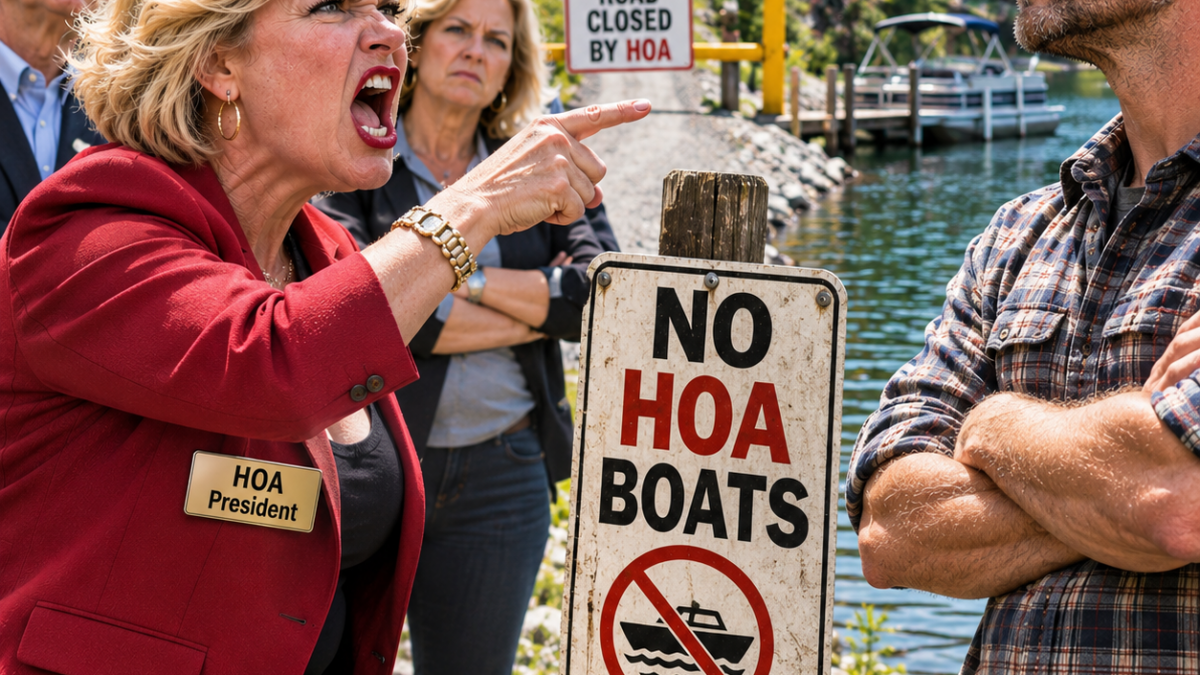
PART 2
I called my attorney, Ezra Tilden, the same morning the gate appeared.
Ezra had represented my family for twenty-eight years.
He was sixty-eight, wore suspenders even when nobody else did, and had the habit of laughing when legal problems were so obvious they became insulting.
He drove out that afternoon.
We met at the gate.
He read the HOA notice Cordy had taped to the steel post.
Then I handed him my grandfather’s 1937 easement.
Ezra read the first paragraph.
Then the recording information.
Then the legal description.
He laughed.
Not politely.
Fourteen straight seconds.
Pernilla looked at me.
I checked my watch.
“You counting?” she asked.
“Occupational habit.”
Ezra finally stopped.
“Hamish.”
“Yes?”
“This easement was recorded twenty-eight years before their development was even platted.”
“I know.”
“It runs across the entire half-section.”
“I know.”
“It’s senior to every covenant they have.”
“That’s what I thought.”
He looked at the gate.
“I can have this removed by court order.”
“How long?”
“Ten days. Eleven if the judge’s calendar is ugly.”
I looked through the bars.
“Don’t.”
Ezra blinked.
“Excuse me?”
“Not yet.”
“Hamish, they locked you out of your cabin.”
“I can hike in from the western forestry track.”
“That’s not the point.”
“I know.”
Pernilla folded her arms.
Ezra looked from her to me.
“What are you planning?”
“The signs.”
“What signs?”
I told him.
One hundred thirteen.
Every two hundred feet.
Entire shoreline.
Private waters.
No HOA boats.
Trespass enforcement.
DNR classification number.
Owner contact.
And one additional line Sigrid wanted added.
A Wisconsin Department of Justice tip number for any Northwoods Sanctuary homeowner who had been told their property came with Loonsong Lake access.
Ezra stopped smiling.
“You’ve already spoken to DOJ.”
“Yes.”
“For how long?”
“Long enough.”
He stared at me.
Then toward the gate.
Then laughed again, but this time more quietly.
“Hamish, I believe the gate has just become the least important mistake these people made.”
HOW A COURTESY BECAME A PRODUCT
When Northwoods Sanctuary first went up, I had no problem with the residents.
That point matters.
I did not sit on my porch glaring at every new roofline as though civilization had invaded.
The developer built north of our property.
Fine.
People bought houses.
Fine.
Some walked down toward the lake.
A few asked whether they could fish.
I said yes.
Some wanted to launch kayaks.
Usually yes.
One family had two children who loved watching the loons from a safe distance.
I showed them where not to approach during nesting season.
That was how it worked.
Permission.
Courtesy.
Neighborliness.
Those words are simple.
But they depend on everybody remembering what they mean.
A courtesy is something the owner gives.
A right is something you legally possess.
Linnaeus Branwell blurred that line in his marketing.
Then Cordy tried to erase it completely.
The first letter from her arrived in August 2018.
Professional stationery.
Pleasant language.
She proposed a recorded easement granting Northwoods Sanctuary residents permanent motorboat access, kayak launching, swimming, ice fishing, and dock construction rights across Loonsong Lake.
I read it twice.
Then wrote back.
No.
Politely.
I explained the classification.
Explained the ownership.
Explained that current use was permissive.
I even said the informal arrangement could continue indefinitely if residents respected it as an informal arrangement.
That should have been the end.
Instead, the November HOA newsletter described an “adjacent landowner” whose refusal to recognize the community’s lake-access character created “uncertainty regarding property values.”
Underneath that editorial was a half-page advertisement from Northwoods Discovery Realty.
Linnaeus’s brokerage.
Three listings.
Each advertised some version of:
LOONSONG LAKE ACCESS.
Pernilla read it at breakfast.
Then set the newsletter down.
“That’s an advertisement for a lie.”
“Yes.”
“Are you going to call them?”
“No.”
She looked at me.
“What are you going to do?”
“Collect them.”
“Advertisements?”
“Every one.”
Pernilla smiled.
She knew me too well.
THE BANKER’S BOX
I went into Eagle River.
Requested historical listing records.
Came home with a banker’s box.
Forty-seven sales through Linnaeus’s brokerage from 2014 through 2018.
Forty-three described lake access in one form or another.
Exclusive access.
Shared waterfront.
Community lake privileges.
Lake-access subdivision.
Not one explained that the lake belonged to somebody else.
Not one explained that no permanent access easement existed.
Not one explained that residents were using the lake because I had chosen to allow it.
I carried the box into my office.
Set it in the closet.
Pernilla stood in the doorway.
“You’re not doing anything?”
“Not yet.”
“You have enough.”
“To prove some listings are wrong.”
“That seems like enough.”
“It isn’t enough to prove why.”
She nodded.
That is another reason I married her.
She knew when I was waiting for a pattern.
CORDY TRIES GOVERNMENT
In 2019, Cordy complained about our septic system.
Supposedly it threatened community waters.
The county inspector came out.
He had personally inspected that system for years.
He read Cordy’s complaint.
Looked at the septic.
Looked at me.
Then laughed.
“No violation.”
Cordy moved on.
In 2020, Linnaeus arrived.
Large truck.
Real-estate logo.
Country-club tan.
He stood at the foot of my driveway.
“Mr. Brevard, I’d like to make you an offer.”
“For what?”
“The entire parcel.”
“No.”
“You haven’t heard the number.”
“Doesn’t matter.”
“One-point-three million.”
“No.”
“You and Mrs. Brevard could remain in the cabin for life.”
“No.”
“When you’re gone, the lake would become part of the Sanctuary community assets.”
I looked at him.
There it was.
Not land.
Not conservation.
Not family history.
An asset.
Something to be added to brochures.
I said:
“My great-grandfather paid $140 for this land in 1903.”
Linnaeus smiled.
“I’m offering almost ten thousand times that.”
“You’re offering the wrong man.”
He left.
Returned the following year.
Higher offer.
Then higher again.
I declined every one.
THE $158,000 PIER
In April 2022, the HOA board approved a community pier.
On my shoreline.
They budgeted $158,000.
I learned from meeting minutes posted online.
Cordy mailed me a copy afterward requesting cooperation.
I declined.
Again.
She sued.
Small claims.
Claimed I had interfered with the development of a promised community amenity.
Judge Winona Lammer listened.
Then asked:
“Mrs. Branwell, where is the deed?”
Cordy’s attorney shifted.
“What deed, Your Honor?”
“The deed showing your client owns the shore where she wishes to build the amenity.”
“We contend the community has established recreational expectations—”
“That was not my question.”
Silence.
The judge dismissed the case.
Court costs to me.
Cordy didn’t appeal.
Instead, she hired a dock builder.
That was when I realized she had started treating adverse rulings as opinions.
THE PILE DRIVER
I heard the machine from across the lake.
Heavy metallic pounding.
Sigrid was in the boathouse doing sonar calibration.
She came down the stairs.
“What is that?”
“Pile driver.”
“Where?”
“North shore.”
She looked at me.
“They didn’t.”
“They did.”
We drove around.
The contractor had a barge.
Flatbeds.
Cedar.
Brackets.
The crew chief was Wendell Sauko.
Sixty-three.
Forty years building docks in northern Wisconsin.
I walked up.
“Mr. Sauko?”
“Yes?”
“Who authorized this?”
“Northwoods Sanctuary HOA.”
“Did they show you ownership?”
He frowned.
“They told us community owned.”
I gave him the private-water classification number.
My parcel survey.
Boundary coordinates.
“Call Spooner.”
He looked at me.
“DNR?”
“Yes.”
“I’m assuming you know somebody there.”
“I worked there thirty-one years.”
That got his attention.
He made the call.
Four minutes later, his expression changed.
He turned toward his crew.
“Shut it down.”
Cordy had lied to a contractor.
Not misunderstood.
Not forgotten.
She had just lost a court case over the same shoreline.
And hired the crew anyway.
Wendell apologized.
I believed him.
His men removed their equipment.
One half-driven pile remained.
I pulled it myself the following weekend.
That night, Wendell called.
“I want you to know I didn’t know.”
“I know.”
“She told my office she had authority.”
“I know.”
“I should’ve asked for paper.”
“Yes.”
Silence.
Then:
“I will next time.”
That mattered more than his apology.
SIGRID’S SPREADSHEET
Sigrid had always been the quiet one.
Annika would challenge a fact at dinner before you finished saying it.
Sigrid listened.
Then went away.
Then came back with data.
She had been building a spreadsheet of Northwoods Sanctuary property transactions.
Dates.
Listing prices.
Sale prices.
Brokerage.
Description language.
References to Loonsong Lake.
Comparable property values.
By the time the pier incident happened, she had sixty-three sales or resales.
Fifty-eight advertised lake access.
Then she calculated the apparent access premium against comparable nearby homes without lake rights.
Approximately thirty-one percent.
She turned the laptop toward me.
“Dad.”
I adjusted my glasses.
“What am I looking at?”
“Seven-point-two million dollars.”
“In what?”
“Price premium associated with represented lake access.”
I looked again.
“Estimate?”
“Yes. Conservative.”
“And all these listings?”
“Northwoods Discovery Realty.”
Linnaeus.
Sigrid leaned back.
“He isn’t selling houses beside your lake.”
“What’s he selling?”
“Your lake.”
Pernilla was at the stove.
She turned around.
“He tried to buy the parcel three times.”
Sigrid nodded.
“Exactly.”
I looked at the rows.
Then I understood.
The pressure campaigns.
The community-access language.
The pier.
The lawsuits.
If Linnaeus could eventually force or convince us to sell, the representation in all those listings would become true retroactively.
His problem would disappear into ownership.
Until then, every house sold under those descriptions rested on something he had never possessed.
That was the first time I felt genuinely afraid.
Not for myself.
For how large the thing might be.
OTHER LAKES
Sigrid contacted the Wisconsin DOJ Real Estate Fraud Unit.
She sent the spreadsheet.
MLS documents.
Newsletters.
Screenshots.
Marketing.
The assigned investigator was Sigrun Haugen.
She called us quickly.
“I want everything.”
She pulled Linnaeus’s statewide listing history.
Days later, she called back.
“Hamish, we found three more.”
“Three more what?”
“Developments.”
Other lake-access projects.
Same pattern.
A lake on Star Lake.
One near Boulder Lake.
Another near Big Saint Germain.
Private water.
Adjacent older landowner.
New development marketed with access.
Years of pressure.
Then landowner sells.
Then developer gains control.
Three times.
Loonsong looked like attempt number four.
The combined estimated sales premium across the developments was enormous.
More than twenty million dollars according to the investigators’ preliminary analysis.
I sat on the porch after that call.
Pernilla beside me.
Sigrid on the railing.
Loonsong lay still.
The western loons called.
I remember thinking how absurd it was that something so quiet could sit in the center of so much greed.
THE PEOPLE WHO SOLD
I asked Sigrun whether I could speak with earlier landowners.
Two were alive.
One was Anders Pollard.
Eighty-seven.
Assisted living in Wausau.
He had once owned property beside Star Lake.
Sold after sustained pressure.
When Sigrid and I met him, he listened for ninety minutes.
Then said:
“I’ve waited thirteen years for somebody to ask.”
That sentence changed me.
Not because it helped the case.
Because it revealed what these campaigns did to people.
They isolated them.
Made them feel unreasonable.
Old.
Stubborn.
Obstructive.
Made surrender sound like common sense.
And after they sold, everyone stopped asking what had happened.
Anders signed an affidavit.
Then we met Gerda Korhonen outside Three Lakes.
Seventy-nine.
She had kept every letter.
Every HOA notice.
Every threat.
Every offer.
Green metal file box.
Root cellar.
Fourteen years after she sold, she still had them.
She handed the box to Sigrid.
“You remind me of my daughter.”
Sigrid smiled gently.
Gerda’s daughter had died years earlier.
Then Gerda signed her affidavit.
Driving home, neither Sigrid nor I spoke for almost an hour.
Finally she said:
“Dad?”
“Yeah?”
“If Cordy hadn’t put in that gate, would you have posted the lake?”
I thought.
“Eventually.”
“But not now?”
“Maybe not now.”
Sigrid stared through the windshield.
“Then she really did this to herself.”
“Yes.”
113 SIGNS
The posting requirement was straightforward.
The shoreline stretched 4.3 miles.
Signs every two hundred feet.
Sigrid mapped them with professional GPS equipment.
One hundred thirteen locations.
We ordered one hundred thirteen reflective signs.
White.
Black lettering.
No decorative design.
No emotional language.
Just:
NO HOA BOATS
PRIVATE WATERS — LOONSONG LAKE
NORTHWOODS SANCTUARY HOA WATERCRAFT PROHIBITED
Legal information below.
Classification number.
Owner contact.
Trespass notice.
DOJ tip information for homeowners told they had access.
When the truck delivered them, Pernilla stood beside the pallets.
“That’s a lot of signs.”
“Four-point-three miles.”
“Cordy is going to lose her mind.”
“Probably.”
“She’ll call it harassment.”
“Probably.”
Pernilla touched one sign.
“You sure?”
I looked toward the lake.
“Completely.”
THE GATE COMES FIRST
Here is the irony.
We already had the signs before Cordy installed the gate.
They had not yet been posted.
So when that steel barrier appeared across Bravard Lane, Cordy thought she had escalated.
She believed she had cornered me.
Instead, she removed the last emotional hesitation I had about ending the courtesy access.
Ezra helped us prepare notices to all sixty households.
Not threats.
Explanations.
Each packet included:
The private-water classification.
Survey.
Property boundary.
Posting statute.
Ownership documentation.
And one page explaining there was an active investigation into the real-estate representations.
The last sentence mattered:
If you purchased a Northwoods Sanctuary property on the basis of represented Loonsong Lake access, you may have been a victim of material disclosure fraud.
That was the sentence that broke Cordy’s control of the narrative.
Until then, she had convinced residents I was taking something from them.
Now they had documents showing somebody else may have sold them something that was never available.
Different story.
Very different anger.
WENDELL RETURNS
Wendell Sauko came back.
Same dock builder Cordy had misled.
Truck loaded with cedar posts.
“I heard about the signs.”
“Everybody has.”
“I want to install the posts.”
“I can pay.”
“Materials.”
“Labor too.”
“No.”
“Wendell.”
He looked at me.
“She put my company in the middle of something I should have checked.”
“You stopped when you learned.”
“I still should’ve checked first.”
We negotiated.
Materials plus lunch.
That was the deal.
His crew started at six Tuesday morning.
Posts exactly two hundred feet apart.
West to east.
Five feet deep.
By Wednesday afternoon, the shoreline was ready.
Thursday, Pernilla, Sigrid, and I mounted every sign.
One hundred thirteen.
The final screw went in at 6:15 p.m.
I stepped back.
The sign caught the evening light.
Reflective white.
Black letters.
NO HOA BOATS.
Pernilla stood beside me.
“Well.”
“Well what?”
“You’ve posted a lake.”
“Yes.”
“All of it.”
“Yes.”
She smiled.
“I married an extremely patient man.”
“That’s a compliment?”
“Not always.”
THE CALLS BEGIN
The certified letters arrived Wednesday and Thursday.
By Friday noon, eleven Northwoods Sanctuary homeowners had called the DOJ tip line.
By midafternoon, Sigrun called.
“Hamish.”
“Yes?”
“The case tripled overnight.”
“That sounds inconvenient.”
“You know exactly what you did.”
“I mailed people documents.”
“You gave sixty potential victims a phone number.”
“That too.”
She laughed.
Then became serious.
“We’re moving faster now.”
“How fast?”
“Federal involvement.”
I looked toward Sigrid.
She was standing nearby.
Sigrun continued:
“Your county board meeting. The rezoning hearing for phase two.”
“Yes?”
“Is Linnaeus presenting?”
“Yes.”
“Good.”
CORDY’S FIRST MISTAKE AFTER THE SIGNS
The HOA sued to stop the signs.
Emergency request.
Temporary restraining order.
Their complaint described my posting as harassment.
Ezra read that word and sighed.
“Harassment.”
“Apparently.”
“You posted your own property.”
“Yes.”
“At statutory intervals.”
“Yes.”
“With required notice.”
“Yes.”
“And mailed supporting documents.”
“Yes.”
Ezra looked at me.
“Hamish, you are the least exciting harasser I have ever represented.”
The judge denied the restraining request.
The statutory posting stood.
The HOA was hit with sanctions and costs.
Cordy’s response was not to reconsider.
It was to escalate again.
SHE TRIES TO RECLASSIFY THE LAKE
Cordy drove to the DNR office.
Requested an emergency reclassification of Loonsong from private waters to public navigable waters.
This was almost funny.
Almost.
Tovey Anderson handled the request.
Tovey had worked with me years earlier.
She knew the lake.
She knew the classification.
She knew the hydrography.
Cordy apparently presented what she considered a compelling community-interest argument.
Tovey listened.
Then said:
“The lake has no navigable inlet or outlet. Its classification is not changing.”
Cordy pushed.
Tovey repeated herself.
Then asked her to leave.
Instead of treating that as a final answer, Cordy drove to the newspaper.
THE INTERVIEW
Sunday’s headline quoted Cordy calling for reform of Wisconsin private-lake rules.
She framed herself as a community advocate.
An outdated doctrine, she said, allowed one landowner to deprive dozens of families of shared natural resources.
Pernilla read the article.
Then handed it to me.
“She has become a legislator now.”
“Apparently.”
“Promotion.”
“Fast career.”
A retired DNR fisheries supervisor wrote a response explaining the actual legal framework.
The paper printed it.
Cordy’s argument started collapsing publicly.
But Linnaeus was the one who finally showed me they understood how bad things had become.
THE OFFER
He arrived Monday afternoon.
F-450.
Same real-estate logo.
Sat in the truck forty-three minutes.
I know because Sigrid timed it.
Finally he got out.
He stayed near the driveway.
“Brevard.”
“Linnaeus.”
“Two and a half million.”
Pernilla came outside.
“For what?” I asked.
“Everything.”
“No.”
“Cash.”
“No.”
“Pull the signs.”
“No.”
His expression hardened.
“You’re destroying sixty families’ property values.”
“I didn’t advertise lake rights to them.”
“You allowed use for years.”
“Yes.”
“People relied on that.”
“They relied on your marketing.”
“Two and a half million is more than fair.”
I walked a little closer.
“The signs aren’t negotiating leverage.”
“Everything is leverage.”
“No.”
“What are they, then?”
“Property notice.”
He shook his head.
“You’re enjoying this.”
That made me angry.
Not enough to show it.
I thought of Anders.
Gerda.
Their boxes of old letters.
I said:
“Wisconsin DOJ has been investigating you for fourteen weeks.”
His face changed.
“The federal authorities are involved too.”
He stopped breathing for half a second.
“This isn’t a negotiation.”
Silence.
“You’re watching.”
He returned to his truck.
Never offered again.
CORDY COMES TO THE DOCK
That night, Cordy arrived.
9:15.
Lincoln Navigator.
She sat inside for half an hour.
Then walked down toward my grandfather’s dock.
Sigrid saw her from the boathouse.
Pernilla from the kitchen.
I went outside.
Cordy stood at the water.
No clipboard.
No HOA jacket.
No audience.
I stopped twenty feet away.
For a moment, neither of us spoke.
Then:
“Get off my property.”
She looked at me.
No argument.
No speech.
Nothing.
I added:
“County board meeting tomorrow.”
She turned.
Walked away.
Pernilla waited on the porch with coffee.
“Tomorrow,” she said.
“Tomorrow.”
We sat outside until the moon rose.
Across the western shore, the loons called.
I thought about Granddad Sven.
His fountain-pen easement.
He could never have imagined any of this.
But he had written one document carefully enough that ninety years later I could still drive to my own cabin.
That mattered.
THE COUNTY BOARD MEETING
The room was packed.
One hundred forty people.
Residents.
Reporters.
DNR.
DOJ.
Federal staff.
Investigators.
Anders Pollard in his wheelchair.
His daughter had flown from Australia.
Gerda Korhonen with her green file box on her lap.
Wendell Sauko in clean boots.
Retired fisheries people.
People who understood why the meeting mattered.
Linnaeus sat at the petitioner’s table.
Cordy behind him.
Phase two of Northwoods Sanctuary was on the agenda.
Another forty-one acres.
More houses.
More potential buyers.
Linnaeus began his presentation.
Polished.
Professional.
Slides.
Property values.
Community amenities.
Natural beauty.
He did not say “lake access.”
Not once.
His lawyer had probably begged him not to.
When public comment opened, I stood.
Walked to the microphone.
Set my folder down.
“My name is Hamish Brevard.”
The room became quiet.
“My family has owned Loonsong Lake since 1903.”
I held up Sven’s easement.
“This recorded access easement dates to 1937.”
Next document.
“The HOA gated that easement.”
Next.
DNR classification.
“Loonsong is private water entirely within my recorded parcel.”
Next.
One of the signs.
“I have formally posted the lake.”
I held it up.
NO HOA BOATS.
A murmur went through the room.
Then I gave them the number.
Sixty-three property sales or resales.
Years of lake-access representations.
Millions in estimated access-related premium.
Then the other lakes.
Star.
Boulder.
Big Saint Germain.
Other landowners.
Other pressure campaigns.
The total estimated pattern.
Twenty-three-point-four million dollars.
Then I sat down.
Nobody clapped.
Good.
This wasn’t theater anymore.
SIGRUN STANDS
Sigrun Haugen rose from the back.
Walked forward.
She carried a folded document.
“My name is Sigrun Haugen. Wisconsin Department of Justice.”
Linnaeus did not move.
Cordy did.
Sigrun continued.
“I have a sealed indictment.”
The room changed instantly.
Names.
Counts.
Companies.
Disclosure fraud.
Conspiracy.
Fiduciary breaches.
Related offenses.
Investigators stood.
Cordy tried to speak.
Nobody needed to hear her anymore.
At 7:46, handcuffs closed.
Eleven years of marketing.
Years of newsletters.
Court filings.
Pressure.
A locked gate.
And suddenly the room belonged to the record.
The county board chair withdrew the phase-two rezoning item.
No vote.
No expansion.
Not while the criminal case existed.
THE FIRST APOLOGY
A man stood.
Lot 12.
Asher Petrolia.
He had paid more than six hundred thousand dollars for his home.
He looked directly at me.
“Mr. Brevard, I didn’t know.”
I believed him.
Most residents had not known.
They had been given brochures.
Listings.
Assurances.
They paid professionals to tell them what they were buying.
That was the whole point.
“You should cooperate with DOJ,” I said.
Another resident stood.
Then another.
Apologies spread through the room.
I stopped them.
“Save the energy for the investigators.”
A woman cried.
“I thought you were trying to take our lake.”
I looked at her.
“I never took anything.”
That silenced the room again.
Because that was the truth.
The lake had never belonged to them.
What had been taken was their money.
Their trust.
Their ability to know what they had actually purchased.
THE PRESS CONFERENCE
Outside, cameras waited.
A reporter asked:
“What do you say to Cordelia Branwell?”
I held up Sven’s easement.
“My grandfather recorded this in 1937 so our family could reach our cabin.”
Then:
“The HOA was sold on access it never owned.”
I looked toward the government center doors.
“The signs are not retaliation.”
That sentence mattered.
“They are statutory notice.”
“Will you remove them after the criminal case?”
I thought.
“No.”
“Never?”
“Not as HOA access.”
“Why?”
“Because courtesy was turned into a product.”
I paused.
“And once somebody sells your generosity without permission, you stop leaving the arrangement ambiguous.”
THE COURTESY ENDS
That decision upset some residents.
I understood.
Children had grown up paddling the lake.
Families had traditions there.
Some genuinely loved Loonsong.
But the problem was larger now.
If I resumed casual HOA access immediately, somebody ten years later could point at continued use and begin the entire argument again.
So the signs stayed.
No HOA boats.
No motorized access.
No automatic community right.
That didn’t mean the lake became something I wanted hidden behind fences forever.
It meant future use would be explicit.
Conservation first.
Education second.
No marketing.
No invented rights.
No ambiguity.
THE GATE FINALLY COMES DOWN
Remember Cordy’s steel gate?
The thing that started the final stage?
Ezra got the order.
The easement was senior.
The HOA had no right to block my family.
The gate could remain only if it did not interfere with access.
Keys.
Codes.
Emergency procedures.
Permanent Brevard entry.
The HOA’s new board complied.
I did not cut the lock.
Did not tow the steel away.
Did not pose for a photograph beside it.
The legal correction was almost boring.
That pleased me.
Cordy wanted a confrontation.
Instead, the gate became paperwork.
THE CRIMINAL CASES
Linnaeus eventually pleaded guilty to major federal charges arising from the broader scheme.
Years in federal custody.
Millions in restitution.
His brokerage dissolved.
License gone.
His development company entered receivership.
Cordy pleaded to her own charges.
Prison.
Future HOA leadership prohibited.
Phase two died permanently.
The undeveloped acreage went into conservation protection.
That outcome mattered to me more than seeing either Branwell punished.
Forty-one acres that would have become roofs, driveways, drainage, docks, and marketing brochures remained forest.
Sometimes a criminal case gives land a second chance too.
THE HOMEOWNERS GET MONEY BACK
Restitution eventually reached Northwoods Sanctuary residents.
Average payments were substantial.
More importantly, the HOA bylaws changed.
No future marketing could claim Loonsong access.
Board members with financial interests in brokerages faced strict restrictions.
Dues dropped.
Records opened.
Asher became board chair.
The man who had first stood and apologized.
He came to my cabin after the new board formed.
No suit.
No folder.
Just a thermos.
“Can we talk?”
“Sure.”
We sat on the porch.
He looked toward the lake.
“My kids miss it.”
“I know.”
“They thought it was ours.”
“I know.”
“I’m not asking you to remove the signs.”
“Good.”
He smiled faintly.
“I learned.”
We sat awhile.
Then he said:
“Is there any way children could come back someday?”
That question stayed with me.
PERNILLA’S ANSWER
After Asher left, I told Pernilla.
She was splitting kindling.
“What do you think?”
“About kids?”
“Yes.”
“Not HOA access.”
“No.”
“Not motorboats.”
“No.”
“Not real-estate marketing.”
“Absolutely not.”
She stopped.
“Education.”
That was exactly where my mind had gone.
Sigrid agreed.
So did Annika.
I contacted former colleagues at DNR.
We started discussing a conservation designation.
LOONSONG BECOMES A REFUGE
In 2025, we entered a formal conservation partnership.
Loonsong became a protected wild-lake research and educational site.
No motorized recreational traffic.
No commercial recreation.
No automatic HOA use.
Limited supervised educational visits.
Water sampling.
Native fish identification.
Kettle-lake ecology.
Loon habitat.
About a hundred schoolchildren a year.
Three weekends.
Controlled.
Documented.
Purposeful.
The first group arrived in spring.
A boy stood at the dock staring into the water.
“Is this the lake with all the signs?”
“Yes.”
“Why are there so many?”
“Because adults had an argument.”
He nodded.
Children accept that explanation more easily than adults.
Then he asked:
“Who won?”
I looked across the lake.
“Hopefully the lake.”
That was the first time I realized the story had changed for me.
THE SVEN BREVARD INITIATIVE
Pernilla and I used part of what came from settlements and our own savings to establish a conservation initiative in Sven’s name.
Scholarships for students entering fisheries work.
Support for private-waters conservation.
Help for older landowners dealing with development pressure.
The first scholarship went to a young woman whose grandfather had lost a kettle-lake parcel to development years earlier.
When she visited Loonsong, she stood beside one of the signs.
“My grandfather should have had these.”
There was nothing useful to say.
So I said:
“I’m sorry.”
She touched the cedar post.
“Me too.”
Then she smiled.
“But I’m going into fisheries.”
That was useful.
Loss does not always get repaired.
Sometimes the best you can do is make the next loss less likely.
SIGRID’S WEDDING
Sigrid stayed in the boathouse loft.
Her USGS monitors remained beside Sven’s old fly-tying bench.
She eventually married a DNR conservation warden named Axel.
They married at the south-shore dock.
The one Sven built in 1937.
Annika flew in from Maine.
For the first time in decades, the cabin porch held four generations of Brevard family.
Pernilla cried before the ceremony.
I pretended the wind had gotten in my eyes.
Sigrid caught me.
“Dad.”
“What?”
“You’re crying.”
“No.”
“You are.”
“Humidity.”
“It’s forty-seven degrees.”
“Very complicated humidity.”
She laughed.
Then hugged me.
During the reception, I looked across the water.
One of the reflective signs was visible between the trees.
For a second I thought it looked ugly.
Then I remembered what it protected.
Beauty doesn’t always come in beautiful forms.
Sometimes it comes as black text on white aluminum.
ANDERS
Anders Pollard died two years after the indictment.
His daughter sent me a letter.
She wrote that during his final year, he kept a newspaper clipping about the Loonsong case beside his chair.
She said he talked about the county board meeting constantly.
Not because he enjoyed seeing the Branwells arrested.
Because somebody had finally believed what happened to him.
That sentence hurt.
There are people who lose property.
Then spend years wondering whether they imagined the pressure.
Whether they were foolish.
Whether they were simply old and in the way.
Anders got an answer before he died.
No.
He had not imagined it.
Someone had used a system against him.
The record finally said so.
I put his daughter’s letter in the banker’s box.
That box is no longer in the closet.
It sits beside my desk.
GERDA’S GREEN FILE BOX
Gerda refused to take back her green file box after the case.
“Keep it.”
“It’s yours.”
“No.”
“Family papers.”
“Evidence.”
“The case is over.”
She looked at me.
“Then make it history.”
So I did.
Sigrid scanned every page.
The originals now live in a protected archival container with the conservation initiative.
Future students studying land-use disputes can read them.
Complaint letters.
Offers.
Threats.
The slow pressure campaign.
The boring paperwork that ruins lives without ever looking dramatic.
History often survives because somebody was stubborn enough not to throw away an envelope.
THE NEW HOA
Northwoods Sanctuary became quieter.
The new board did less.
That was an improvement.
No lake-branding campaigns.
No private-water lawsuits.
No expansion plan.
No rallies.
They managed roads.
Snow.
Common landscaping.
Insurance.
Actual association business.
Asher once told me:
“Our meetings are forty minutes now.”
“That long?”
He laughed.
“We’re improving.”
Property values eventually stabilized.
Turns out houses near a protected wild lake still have value even when buyers are told the truth.
Imagine that.
People could look at Loonsong.
Enjoy the view.
Hear the loons.
Walk community trails.
They simply could not buy a house and assume the water became theirs.
That distinction became part of every future listing.
Correctly.
THE SIGNS WEATHER
Every month, I drive the perimeter road.
Check all 113 signs.
A few screws loosen.
Some edges fade.
Snow bends one occasionally.
Wendell’s cedar posts hold.
He chose good wood.
Once, I found one sign scratched.
Not removed.
Just scratched.
Pernilla inspected it.
“Replace?”
“No.”
“Why?”
“It still reads.”
She smiled.
“You’re getting sentimental about vandalism.”
“Patina.”
“Of course.”
The scratches remind me the signs are no longer just legal notices.
They are landmarks.
A boundary made visible.
WHY I DIDN’T OPEN THE LAKE AGAIN
Some people called my decision harsh.
I understand.
They argued the residents were victims too.
Correct.
So why exclude HOA boats permanently?
Because victimhood does not create ownership.
Restitution repaired part of what residents lost.
The lake was not part of that restitution because it had never belonged to them.
If I had simply reopened full use, the next generation could make the same mistake.
Children grow up.
Owners sell.
Boards change.
Memories fade.
Documents survive longer.
Signs help.
My future daughters should not have to rediscover the same argument.
ANNIKA’S QUESTION
Annika once asked:
“Would Grandpa Sven have posted the lake?”
I thought about it.
“He hated signs.”
“He also hated developers.”
“True.”
“He would’ve used fewer.”
“Probably twelve.”
She laughed.
“Illegal spacing.”
“He wasn’t a fisheries biologist.”
“No.”
“But he recorded the easement.”
“That he did.”
We sat on the dock.
Then Annika said:
“You know the funny part?”
“What?”
“You were the one who always told us access and ownership were different.”
“Yes.”
“And Cordy managed to teach sixty families the same lesson.”
“Very expensive classroom.”
THE LOONS
The western pair kept nesting.
That mattered more than most people understand.
Loons are sensitive to shoreline disturbance.
Motor traffic.
Human activity.
Wake.
Noise.
One benefit of the posting was immediate quiet.
Fewer boats.
Less shoreline intrusion.
Sigrid documented nesting success.
Some years better than others.
Nature doesn’t follow legal narratives.
But the western shoreline became calmer.
One evening, Pernilla and I heard both adults calling while a chick moved between them.
She squeezed my hand.
“You hear that?”
“Yes.”
“Worth the signs?”
I looked across the water.
“Every one.”
THE ROAD CORDY BLOCKED
Bravard Lane remains our access.
The gate system changed under the new board.
Our easement recognized.
Permanent code.
Emergency override.
No interference.
Sometimes I drive through and remember the morning Cordy installed it.
The anger has faded.
What remains is almost gratitude.
Not toward her.
Toward the moment.
Because until that gate appeared, I was still tolerating ambiguity.
Still hoping courtesy could coexist with dishonest marketing.
Still letting the signs sit uninstalled.
The gate ended my hesitation.
It told me exactly what she believed.
That she could control my access while selling access to my lake.
Once stated that clearly, the whole contradiction became impossible to ignore.
THE THING ABOUT POWER
Cordy thought power was a locked gate.
Linnaeus thought power was price.
Offer enough money.
Apply enough pressure.
Repeat a representation enough times.
Eventually the older landowner sells.
Then the lie becomes true.
That had worked before.
With Anders.
With Gerda.
With others.
But they made one mistake with us.
They assumed age meant isolation.
It didn’t.
My daughter built spreadsheets.
My wife understood the land.
My lawyer read the easement.
My former colleagues knew the lake.
Other victims had saved their letters.
The system they had used to isolate landowners finally connected them instead.
ONE WINTER MORNING
Years later, I found Sigrid at the boathouse before sunrise.
She was looking at sonar.
“What are you doing?”
“Walleye.”
“Problem?”
“No.”
She pointed.
“Year class looks good.”
I sat beside her.
Three monitors.
Graphs.
My grandfather’s fly-tying vise on the bench beside a modern multibeam sonar system worth more than the cabin probably cost to build.
The contrast made me laugh.
“What?”
“Nothing.”
“Dad.”
“Sven built this boathouse before television was common.”
“And?”
“Now you’re mapping fish with sonar in it.”
She smiled.
“He’d love it.”
“He wouldn’t understand it.”
“He’d pretend he did.”
That was true.
Then Sigrid said:
“You know what I’m proudest of?”
“The case?”
“No.”
“The refuge?”
“No.”
“What?”
“That we didn’t sell.”
I looked toward the lake.
“So am I.”
THE FINAL OFFER I NEVER RECEIVED
After Linnaeus was sentenced, nobody offered to buy the lake again.
Not developers.
Not investors.
Not the HOA.
That silence felt good.
For years, every conversation had carried an implied price.
One-point-three million.
One-point-six.
Two-point-one.
Two-point-five.
As though every no was just a number waiting to be increased.
Eventually the offers stopped.
The land returned to being land.
Not a negotiation.
PERNILLA AND THE PORCH
Pernilla and I spend more time on the porch now.
Retirement.
Coffee.
Bad knees.
Good view.
One night she asked:
“Do you regret letting the residents use the lake in the first place?”
“No.”
She looked surprised.
“Really?”
“The problem wasn’t sharing.”
“What was it?”
“Somebody monetized the sharing.”
She nodded.
“So you’d do it again?”
“Differently.”
“How?”
“Written permission.”
“Of course.”
“Clear terms.”
“Of course.”
“Revocable.”
“You’re very romantic.”
“That’s why you married me.”
“I married you because you had a boat.”
Fair.
WHAT I WOULD TELL A NEW LANDOWNER
If a younger landowner asked me what I learned, I would say this:
Know what you own.
Know what crosses it.
Know what rights you have granted.
Know which ones you have not.
And when somebody says, “Everyone knows,” ask for the document.
The Branwells survived for years because “everyone knew” Northwoods Sanctuary had lake access.
Buyers knew.
Residents knew.
Real-estate advertisements said it.
HOA newsletters said it.
Market value reflected it.
But the deed did not.
The lake classification did not.
The survey did not.
The statute did not.
A crowd believing something cannot record an easement.
THE SCHOOL GROUP
One autumn, I guided a group of seventh graders.
We sampled water.
Measured temperature.
Identified shoreline plants.
A girl named Rachel asked:
“Why is it called a kettle lake?”
I explained glacial formation.
Another asked:
“Why are there signs saying HOA boats?”
The teacher looked embarrassed.
I smiled.
“History.”
“Bad history?”
“Complicated history.”
A boy asked:
“Did the HOA own it?”
“No.”
“Did they think they did?”
“Some people were told they did.”
“Who told them?”
“Adults who should have checked.”
The teacher laughed.
Then I said:
“That’s actually part of science too.”
The kids looked confused.
“Check claims.”
That became the lesson.
Not just ecology.
Evidence.
THE SIGN AT THE DOCK
Eventually Sigrid made one additional sign for the cabin dock.
Not statutory.
Small cedar plaque.
It reads:
COURTESY IS NOT OWNERSHIP.
Pernilla called it preachy.
I called it accurate.
We compromised by putting it where only family and educational groups usually see it.
CORDY’S HOUSE
Cordy’s old home eventually sold.
New owners.
Nice people.
They came to the cabin once.
Asked whether they needed to apologize.
“No.”
“But we bought from—”
“You bought a house.”
“That’s all?”
“That’s all.”
They looked relieved.
I had learned from the Cain Ranch story in another county—though I didn’t know those people personally—that punishing successors for predecessors’ mistakes only recreates the same arrogance from the opposite direction.
Property carries legal burdens.
It shouldn’t carry personal grudges unnecessarily.
THE CASE FILE CLOSES
When the last major restitution distribution was complete, Sigrun Haugen called.
“We’re closing the primary file.”
“How does that feel?”
“Like I need a vacation.”
“You take those?”
“Government employees are theoretically allowed.”
I laughed.
Then she said:
“You know your signs changed the case.”
“I figured the records did.”
“They did.”
“But?”
“The signs made the victims realize they were victims.”
I stayed quiet.
That was the key.
Before the signs, residents thought I was withholding something they owned.
After the signs and the certified documentation, they asked:
Why were we sold this?
Who promised it?
Where is the easement?
Why didn’t anyone disclose this?
One visible boundary had broken an invisible narrative.
THE LAST CONVERSATION ABOUT CORDY
Years later, somebody at a supper club asked what happened to Cordy after release.
I didn’t know.
They looked surprised.
“You never checked?”
“No.”
“Not curious?”
“No.”
That was when I realized the story was finally over.
During the fight, Cordy had occupied an absurd amount of mental space.
Letters.
Calls.
Meetings.
Lawsuits.
Gate.
News.
Once the systems were corrected and the lake protected, she became irrelevant.
Not forgiven exactly.
Just absent.
That felt healthier.
THE SUPPER CLUB
One warm summer night, Pernilla, Sigrid, Axel, and I drove into Eagle River for dinner.
Broasted chicken.
Old-fashioneds.
A jukebox playing Hank Williams Jr.
The kind of Wisconsin evening that feels almost embarrassingly predictable.
We drove home with the windows down.
Warm pine air.
Loons calling in the distance.
At the gate, Sigrid leaned forward from the back seat.
“Dad.”
“What?”
“Remember when Cordy locked this?”
“Yes.”
“You could’ve cut it.”
“I know.”
“You wanted to.”
“Maybe.”
Pernilla laughed.
“He absolutely wanted to.”
I looked through the windshield.
“If I cut the gate, the story would’ve been about a gate.”
Sigrid nodded.
“And because you didn’t?”
“It became about the lake.”
She smiled.
“And the brokerage.”
“And the other families.”
“And twenty-three million dollars.”
“Approximately.”
“Dad.”
“Occupational habit.”
THE WALL OF SIGNS
People online later called it the Wall of Signs.
That was dramatic.
They are not a wall.
They are 113 small rectangles spaced across 4.3 miles.
Most of the time, you can only see one or two.
But together they form something stronger than a wall.
A record.
Every sign says the same thing.
This is private water.
The previous story was false.
The boundary is now explicit.
Some signs protect land by keeping people physically out.
These protect it by keeping future lies from growing back.
THE PART THAT STILL HURTS
The part I still think about is not Cordy.
Or Linnaeus.
It’s Anders.
Gerda.
The older landowners who sold.
People like them often hear afterward:
Why didn’t you fight?
Why didn’t you get a lawyer?
Why didn’t you call somebody?
Those questions sound reasonable when asked by people who are younger, healthier, richer, surrounded by family, and not being pressured for years.
A campaign doesn’t have to be dramatic to work.
One letter.
Then another.
Complaints.
Rumors.
Offers.
Lawsuits.
Neighbors turning cold.
Professionals telling you your property is worth less if you don’t cooperate.
Eventually exhaustion becomes part of the price.
I had advantages they didn’t.
Professional knowledge.
Family.
Sigrid.
Pernilla.
Ezra.
DNR contacts.
Enough money to wait.
That is why our conservation initiative helps other landowners now.
Not everybody should need a daughter with federal sonar equipment to keep a lake.
THE LOON CHICK
One July morning, I watched a loon chick ride on its mother’s back near the western shore.
I had seen the behavior hundreds of times.
Still stopped me.
Pernilla came down.
“What are you looking at?”
I pointed.
She stood beside me.
Neither of us spoke for several minutes.
Then she said:
“Imagine a community pier over there.”
I knew what she meant.
More boats.
Wake.
Noise.
Shoreline traffic.
Maybe the loons adapt.
Maybe not.
We would never know.
That future had been canceled.
Sometimes protecting property and protecting habitat become the same act.
THE CABIN FOUNDATION
The cabin foundation still contains stones Sven set by hand.
Some have shifted.
Every few years we repoint mortar.
Sigrid helps.
Axel helps.
Annika complains she always visits when there is work.
That is also family tradition.
One afternoon, I found the original chisel marks in one stone near the west corner.
I touched them.
Same year as the easement.
Sven had been building walls and paperwork at the same time.
One kept the cabin standing.
One kept us able to reach it.
You need both kinds of structure.
THE FILE CABINET
All the important records now live in a fire-resistant cabinet.
Deed.
Survey.
Easement.
Private-water classification.
Posting map.
Copies of every sign specification.
DOJ correspondence.
Restitution records.
Conservation agreement.
Sigrid has digital backups in three places.
Annika has one.
Pernilla says this is excessive.
Then she reminds me to check the backup every January.
THE FUTURE
Sigrid will likely inherit most responsibility for the lake eventually.
Annika loves it too, but Maine has become home.
We have worked through conservation restrictions to make sure neither daughter has to face the same development pressure.
No casual assumptions.
No undocumented arrangements.
Future educational access clearly defined.
No commercial rights.
No HOA rights.
No ambiguity.
That word again.
Ambiguity.
It feels friendly at first.
Flexible.
Neighborly.
Until somebody monetizes it.
Then it becomes expensive.
THE FINAL QUESTION
A reporter once asked me:
“If Cordy had never installed the gate, would you still have exposed the fraud?”
“Yes.”
“When?”
“I don’t know.”
“So the gate accelerated it?”
“Yes.”
“Do you think she understands that?”
I laughed.
“I hope she does.”
“What would you say to her now?”
Nothing.
That answer surprised the reporter.
“Nothing?”
“Nothing.”
“Why?”
“Because the signs already say enough.”
THE MORNING AFTER A STORM
Last fall, a windstorm came through.
Took down two red pines.
One landed near sign 74.
Didn’t hit it.
The next morning, I rode the perimeter with Sigrid.
We cleared limbs.
Checked posts.
At sign 74, she stopped.
“You realize these will outlive you if we maintain them.”
“That’s the idea.”
“They might outlive me.”
“Cedar’s good.”
“I meant the rule.”
I looked at the lake.
“Better.”
She adjusted the sign.
Then tightened a screw.
That felt like inheritance in its simplest form.
Not ceremony.
Maintenance.
ONE MORE VISIT FROM ASHER
Asher came by one spring with his granddaughter.
Seven years old.
She carried binoculars.
“Mr. Brevard?”
“Yes?”
“Can she see the loons?”
“From shore.”
“No boat?”
“No boat.”
He nodded.
No argument.
That mattered.
Years earlier, his property had been sold as having exclusive lake access.
Now he brought his granddaughter and accepted the boundary without resentment.
We walked to an observation point.
The girl saw a loon.
Whispered:
“There.”
Asher looked at me.
“Thank you.”
I knew he wasn’t thanking me for denying access.
He was thanking me for letting his granddaughter see what survived after the dispute.
WHAT I FINALLY UNDERSTOOD
For years, I thought this story was about ownership.
Then law.
Then fraud.
Eventually I realized it was about stewardship.
My great-grandfather purchased the parcel.
My grandfather built the cabin.
My parents maintained it.
I studied fish.
Pernilla studied forests.
Our daughters built careers around water.
None of us created the lake.
A glacier did.
We only happened to be the family whose name ended up on the deed.
That does not make ownership meaningless.
It makes responsibility heavier.
Linnaeus saw Loonsong as a premium.
Cordy saw it as a community amenity.
I see it as something I am responsible for delivering intact to people who will outlive me.
That is why the signs stay.
THE LAST SUMMER EVENING
Last night I sat on the dock.
Pernilla beside me.
Sigrid and Axel were up at the cabin.
The air smelled like pine and lake water.
Sunset turned the western shoreline copper.
One loon called.
Then the second answered.
Pernilla leaned against my shoulder.
“You ever miss when nobody knew about us?”
“What do you mean?”
“Before the lawsuits. Before reporters. Before the signs.”
“Yes.”
“Me too.”
We sat quietly.
Then she said:
“But I like this better than losing it.”
“So do I.”
Across the lake, sign 31 caught the last sunlight.
White rectangle.
Black letters.
Not beautiful.
Necessary.
THE END
Cordy Branwell thought locking Bravard Lane would force me to choose between surrender and confrontation.
She expected me to cut the gate.
Yell.
Sue only about the road.
Maybe make enough noise that she could call me unstable and tell sixty homeowners I was attacking their community.
Instead, I read the documents.
My grandfather’s easement.
My DNR classification.
The property survey.
The old listings.
Sigrid’s spreadsheet.
Gerda’s letters.
Anders’s affidavit.
Fifteen years of a pattern that had survived because each landowner had been treated as though their fight was private.
The 113 signs changed that.
Suddenly every homeowner had the same question staring back at them from the shoreline:
If this lake belongs to the HOA, why does the owner have the legal right to post us out?
Then came the second question:
If the HOA never owned access, why did our listing say it did?
That question was much more dangerous than any bolt cutter.
It reached bank records.
Listings.
Contracts.
Other lakes.
Other families.
Eventually it reached prosecutors.
Cordy locked one road.
The evidence opened four lakes’ worth of history.
Linnaeus lost his brokerage.
The development expansion died.
Residents received restitution.
Land went into conservation.
Loonsong became a protected research and education lake.
My daughters kept the cabin.
The easement stayed recorded.
The gate no longer controls us.
And the signs are still standing.
Every two hundred feet.
All 4.3 miles.
One hundred thirteen quiet reminders that a glossy brochure cannot transfer property.
An HOA vote cannot create a deed.
A marketing promise cannot manufacture an easement.
And courtesy does not become ownership simply because somebody sells it enough times.
Sometimes visitors ask whether the signs still make me angry.
They don’t.
At first they represented conflict.
Now they represent clarity.
When I drive the perimeter each month, I tighten screws, replace damaged reflectors, trim branches, and check the cedar posts.
Then I go home.
That’s all.
No adrenaline.
No revenge.
No Cordy.
Just maintenance.
Because that’s what ownership mostly is when you strip away the drama.
Maintenance.
You maintain fences.
Cabins.
Easements.
Documents.
Relationships.
Water.
Truth.
My great-grandfather kept the land.
My grandfather recorded the road.
My father kept the paperwork.
Sigrid built the spreadsheet.
Pernilla kept reminding me which part actually mattered.
And I put up the signs.
Different generations.
Different jobs.
Same responsibility.
Last week, a school group visited.
One boy pointed toward the nearest sign.
“Mr. Brevard, why does it say no HOA boats?”
I looked at the lake.
Then toward the cabin Sven built.
Then at the loon floating beyond the reeds.
“Because somebody once tried to sell something they didn’t own.”
The boy frowned.
“Did they get caught?”
“Yes.”
“Because of the signs?”
“Partly.”
“What really caught them?”
I thought for a second.
“People finally checked the paperwork.”
He nodded like that made perfect sense.
Maybe it should.
He ran back toward the other children.
I stayed beside the dock.
Across the water, the loons called again.
The sound traveled cleanly from the western shore.
No motors.
No community pier.
No subdivision phase two.
Just water.
Trees.
Wind.
And a lake that had survived another generation of people trying to decide what it was worth.
To Linnaeus, it had been millions in sales premium.
To Cordy, it had been a promised amenity.
To me, it was the place my great-grandfather chose in 1903.
The lake my grandfather built a cabin beside.
The water I had spent a career learning how to protect.
The shoreline where my daughter got married.
The place where children now come three weekends a year to learn why groundwater, fish, forests, and human choices are all connected.
I suppose that is the final irony.
Cordy wanted Loonsong turned into a community amenity.
She failed.
But the lake did become something larger than our family.
Not through entitlement.
Through permission.
Not through marketing.
Through conservation.
Not for people who paid the highest property price.
For children willing to show up with notebooks and learn.
That is the difference between taking and sharing.
One is about believing you deserve access.
The other begins with understanding that somebody had to protect the thing before you arrived.
The sun went down.
I stood.
Walked back toward the cabin.
Near the path, sign 113 reflected my porch light.
NO HOA BOATS.
I smiled.
Cordy had wanted a locked gate.
She got one for a few weeks.
I got something better.
A lake whose boundaries nobody would ever be able to pretend they hadn’t seen again.








