PART 2: HOA Blocked My Driveway With Concrete Barriers—72 Hours Later the Board Was Begging Me to Settle
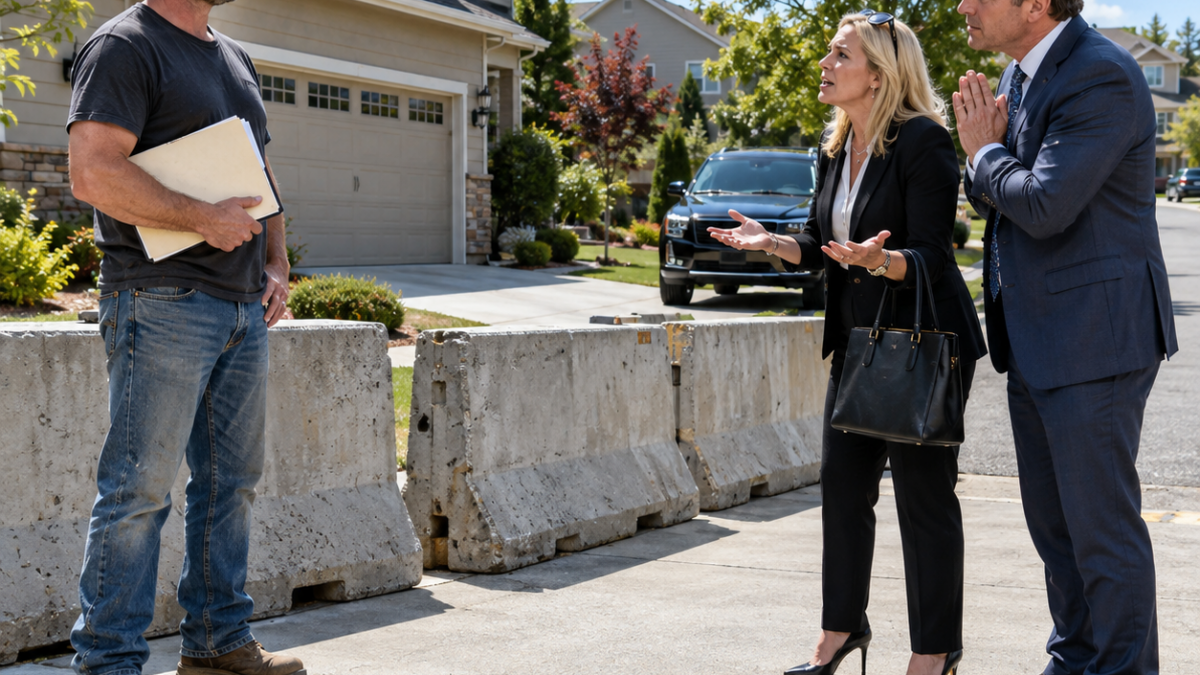
PART 2
I did not walk across the street and wave the deed in Karen’s face.
Six months earlier, I probably would have.
Thirty years in uniform had taught me to solve problems quickly, and retirement had not yet cured me of believing every problem appreciated efficiency.
Sarah had been working on that.
“Don’t go over there,” she said.
I had barely stepped through the front door.
“I wasn’t.”
“You were looking at her house.”
“I look at things.”
“You were holding county documents and looking at her house.”
“That proves nothing.”
She folded her arms.
“What are you going to do?”
“Call Dave.”
That relaxed her slightly.
Dave Sterling and I had met almost twenty years earlier when he was still an Army JAG officer and I was learning that the phrase “the contract clearly says” was often followed by three attorneys explaining why it did not clearly say anything.
He had retired before me and opened a property and business law practice outside Raleigh.
He answered on the fourth ring.
“Jack Reacher.”
“Don’t call me that.”
“You have the name.”
“I had it first.”
“No, you didn’t.”
“Are you done?”
“Never. What broke?”
“My HOA blocked my driveway with Jersey barriers.”
Silence.
Then, “You finally lost your mind.”
“I did not install them.”
Another silence.
“Say that again.”
“My HOA president hired somebody to place three Jersey barriers across my driveway.”
“How big?”
“Standard highway barriers.”
“You mean actual Jersey barriers?”
“Approximately two tons each.”
He laughed.
Not because it was funny.
Dave laughed when legal facts were so bad they became professionally entertaining.
“Why?”
“She says the driveway apron is HOA common property.”
“Is it?”
“No.”
“How sure?”
“I’m holding a certified plat and deed.”
His tone changed immediately.
“Send them.”
I scanned everything.
Twenty minutes later, Dave called back.
“Jack.”
“Yes.”
“She put them on your lot.”
“I know.”
“I mean very clearly on your lot.”
“I also know.”
“She had a survey?”
“Not that she showed me.”
“Board resolution?”
“She says they voted.”
“Hearing?”
“No.”
“Written authorization for this particular remedy?”
“Not that I’ve found.”
“Contractor?”
“Don’t know yet.”
Dave exhaled slowly.
“Do not move those barriers yourself.”
“I wasn’t planning to.”
“That sentence means you already have a crane company in mind.”
“I know people.”
“Jack.”
“I said I wasn’t planning to move them myself.”
“You are exhausting.”
“So you’ll help?”
“Oh, absolutely.”
I heard his chair creak.
“This may be one of the worst HOA enforcement decisions I’ve seen, and I once represented a man whose board tried to fine him because his golden retriever was allegedly the wrong shade of yellow.”
“That cannot be real.”
“It was.”
“What’s our first move?”
“Notice.”
“I already gave her seventy-two hours.”
“Verbally?”
“Yes.”
“Adorable.”
I heard typing.
“Now we give the association a deadline that matters.”
Dave’s letter arrived in my inbox shortly after lunch.
It was eight pages.
No insults.
No references to dictators, kingdoms, tyrants, or wars.
Dave hated emotional legal writing.
“Judges already know when something is stupid,” he liked to say. “Our job is to make the stupidity easy to locate.”
The letter began with a timeline.
My application.
The two emails.
The thirty-day provision.
The completed driveway.
The violation.
The later fines.
The concrete barriers.
Then the county records.
He attached the certified plat and deed.
The language was restrained.
The association was placed on formal notice that the barriers appeared to occupy property legally described as part of Lot 247.
Their placement materially interfered with ingress and egress.
The board was asked to preserve all documents relating to the decision, including emails, meeting minutes, contractor bids, invoices, authorization records, and communications among board members.
Then came the deadline.
Seventy-two hours.
Remove the barriers at association expense.
Suspend the driveway violation.
Provide the records supporting the enforcement decision.
Reimburse documented transportation costs caused by the obstruction.
If the association refused, we would seek emergency judicial relief and damages as appropriate.
No promise of millions.
No theatrical threat to take Karen’s house.
Just consequences.
“That’s it?” I asked.
“That is plenty.”
“She put six tons of concrete across my driveway.”
“And we want a judge focused on that fact, not on your feelings about it.”
“I don’t have feelings.”
Dave laughed.
“I’ve known you twenty years.”
We sent the letter to Oakmont’s registered management company, its legal contact, and every board member.
Certified mail.
Email.
And because Dave wanted no argument later, a professional process server delivered copies personally.
Karen received hers at 4:12 Wednesday afternoon.
I knew because I watched the process server walk away while Karen stood on her porch holding the envelope.
Her face changed as she read the first page.
She looked across the street.
I was sitting on my porch.
I lifted my coffee.
Nothing else.
Her front door slammed.
The seventy-two hours began.
That evening, my next-door neighbor came over.
His name was George Henderson.
Seventy-one.
Retired school principal.
Serious gardener.
His backyard looked like a botanical garden that had received military funding.
He stood at the barriers staring.
“I’ve lived here seventeen years.”
“And?”
“Never seen anything this stupid.”
“That’s comforting.”
He pointed to my garage.
“Truck trapped?”
“Yes.”
“What if there’s an emergency?”
“Sarah’s sister lent us a car.”
“That’s not what I asked.”
I looked at him.
George’s expression had become serious.
“This isn’t normal, Jack.”
“I know.”
He glanced toward Karen’s house.
“She fined me two hundred bucks last month.”
“For what?”
“My roses.”
I assumed I had misheard.
“Your roses.”
“Queen Elizabeth variety.”
“What did they do?”
“Apparently they’re not approved.”
I looked toward his property.
The rose bushes were beautiful.
Pink blooms lined his fence.
“Did you get a hearing?”
“No.”
“Written warning?”
“Letter. Then fine.”
“Appeal?”
“I called Karen.”
“And?”
“She told me architectural decisions were final.”
My mind went back to Oakmont’s enforcement provision.
Warning.
Notice.
Opportunity to cure.
Hearing.
Board action.
“George, do you still have the letters?”
“Of course.”
“Can I see them?”
He studied me.
“You planning something?”
“No.”
“That sounded like a lie.”
“I’m documenting.”
“That sounded worse.”
Ten minutes later, I was reading George’s violation notice at my kitchen table.
Same language as mine.
Same signature.
No hearing notice.
No documented board decision.
Sarah read over my shoulder.
“This is how it starts.”
“What?”
“You find one neighbor.”
“It’s relevant.”
“Then six.”
“I haven’t spoken to six.”
“Yet.”
She knew me.
By Thursday afternoon, I had spoken to seven.
The Garcias across the street had removed their son’s basketball hoop after being fined.
No hearing.
A widow named Ruth Collins had paid $300 because a windstorm damaged a section of fence and she did not repair it within ten days.
A young couple received two fines because their trash cans remained visible while they were out of town caring for a sick parent.
Mike Davenport was warned over his work van.
One homeowner had been fined for an American flag bracket installed without committee approval.
The individual disputes were not identical.
Some may have involved legitimate rule violations.
That was not what interested me.
The process was.
Karen seemed to believe that if the board president declared something, process became optional.
I created a spreadsheet.
Sarah found me entering dates Thursday night.
“No.”
I looked up.
“What?”
“You have a spreadsheet.”
“I use spreadsheets.”
“You’re building a case.”
“I’m organizing documents.”
“Against the whole HOA?”
“Against bad procedure.”
She put her hands on the table.
“Jack.”
Her voice was quieter now.
“We came here because you said you were finished fighting everything.”
That landed.
I closed the laptop.
“This came to us.”
“I know.”
“They blocked our house.”
“I know.”
“And George—”
“I know.”
She sat across from me.
“I’m not telling you to let them get away with it.”
“What are you telling me?”
“Don’t turn retirement into another deployment.”
The room went quiet.
My military career had ended honorably.
But coming home permanently had not been as easy as I expected.
For thirty years, every day had objectives.
Plans.
Risks.
Timelines.
People counting on me.
Then retirement arrived and suddenly the most urgent decision some mornings was whether I wanted to prune hydrangeas before breakfast.
Sarah loved the quiet.
Part of me did too.
Another part kept waiting for someone to hand me a mission folder.
Karen had practically dropped one on my driveway.
“You’re right,” I said.
Sarah blinked.
“You’re getting better at that.”
“At what?”
“Admitting I’m right.”
“Don’t get comfortable.”
She smiled.
I reached for her hand.
“I’m going to handle my property issue. If the neighbors want to challenge their fines, they can decide that.”
“Good.”
“But if they ask what the bylaws say—”
“Jack.”
“I can answer questions.”
She sighed.
“Baby steps.”
Thursday passed.
The barriers remained.
Friday morning, the Oakmont community received Karen’s response.
It was an email blast.
Subject:
URGENT COMMUNITY LEGAL THREAT
I read it twice.
Karen described an unnamed homeowner as “aggressively challenging the authority of the association.”
She warned that a threatened lawsuit could expose Oakmont to substantial legal expenses.
She claimed the board had acted in good faith to preserve common property.
And she announced an emergency meeting Monday evening to consider a special assessment for legal defense costs.
What she did not mention:
The deed.
The plat.
My architectural application.
The thirty-day provision.
Or that the “common property” she claimed to be defending was recorded as mine.
George called five minutes after the email arrived.
“She means you.”
“Seems likely.”
“She wants us to pay her lawyer because she blocked your driveway.”
“Seems likely.”
“That woman has lost her mind.”
“George.”
“What?”
“Don’t write that on Facebook.”
“I’m seventy-one. I can write what I want.”
“You’ll make Dave’s hair fall out.”
“Good.”
Dave called thirty minutes later.
“Your president is having an emergency meeting.”
“I know.”
“She wants a legal assessment.”
“Yes.”
“You attending?”
“Absolutely.”
“That answer was disturbingly enthusiastic.”
“She created the forum.”
“Jack, listen carefully. We are not turning Monday into a trial.”
“I know.”
“You present documents.”
“Yes.”
“You do not accuse her of crimes.”
“Yes.”
“You do not say ‘fraud,’ ‘corruption,’ ‘extortion,’ or ‘criminal trespass.’”
“Understood.”
“And you let me talk if she starts improvising legal theory.”
“I can talk.”
“That is exactly why I’m worried.”
Friday at 4:12 p.m., the seventy-two-hour deadline expired.
Nothing happened.
The barriers remained.
Dave filed for emergency injunctive relief electronically before five.
We were seeking an order requiring restoration of access and preventing further interference while the underlying property and covenant issues were resolved.
But court schedules are court schedules.
Even obvious problems take time.
I did not want to wait through a weekend without vehicle access.
So Dave and I discussed another option.
Private removal.
Not vigilante removal.
Documented removal of objects located on my property, performed by an insured contractor, after notice had expired.
Dave wanted the county surveyor’s line physically marked before anything moved.
I agreed.
Saturday morning at 6:30, licensed surveyor Patrick Lane arrived.
Karen noticed before he finished unloading equipment.
Of course she did.
“What is he doing?”
She stood at the curb wearing a long robe.
Patrick looked at me.
“You want me to answer?”
“I’ll handle it.”
“He’s locating my property boundary.”
Karen crossed her arms.
“You already know where it is.”
“Yes.”
“Then this is harassment.”
“Surveying my property is harassment?”
“You’re creating a spectacle.”
I looked at the three concrete barriers.
“I didn’t bring the spectacle.”
Patrick coughed to hide a laugh.
He set two pins and marked the relevant boundary points with bright survey tape.
The barriers sat fully inside my property.
Not one inch in dispute.
I photographed everything.
At 7:12, the crane arrived.
Not fifty tons.
We did not need a machine that dramatic.
A local heavy-equipment contractor brought a hydraulic boom truck rated comfortably for the load and a flatbed trailer.
His name was Mack Donnelly.
Former Army.
We had served in different units but knew each other through the local veterans’ network.
He climbed down from the cab and stared at the barriers.
“So these are the famous ones.”
“They’re not famous.”
“My wife knows about them.”
“Your wife lives forty minutes away.”
“Exactly.”
Sarah stood on the porch drinking coffee.
Neighbors began appearing.
I hated that part.
This was starting to feel like entertainment.
I walked over to George.
“No cheering.”
“What?”
“No cheering when they move them.”
“You’re no fun.”
“I’m serious.”
“These people blocked your driveway.”
“And we’re removing the barriers, not storming Normandy.”
George raised both hands.
“Fine.”
Karen came outside wearing actual clothes this time.
She carried her phone.
“You are not touching HOA property.”
Mack paused.
I handed Karen a copy of the surveyor’s field confirmation and Dave’s notice.
“These objects are on my property.”
“You dispute that.”
“The recorded plat and a licensed field survey do not.”
“I’m calling the police.”
“That’s your right.”
She did.
Two cruisers arrived while Mack’s crew was still setting up.
One officer was the same young man who had responded Wednesday.
Officer Miller.
The other was Sergeant James Caldwell.
Caldwell listened to Karen first.
Then me.
Then Patrick.
He studied the certified plat.
Looked at the survey marks.
Read Dave’s letter.
Finally he said, “We’re not deciding HOA contract issues.”
Karen nodded vigorously.
“Exactly.”
Caldwell continued.
“But the surveyor is identifying the barriers as sitting on Mr. Riley’s parcel.”
My name was Riley.
Karen’s lips tightened.
“HOA documents show that area as common.”
Patrick spoke.
“With respect, ma’am, I located the recorded deed boundary.”
Caldwell looked at me.
“Your contractor insured?”
Mack handed him documentation.
“Removal plan?”
“Lift vertically, load to flatbed, avoid damage to pavement.”
“Where are the barriers going?”
I looked at Karen.
“That is a question for the HOA.”
Mack said, “My yard until someone pays delivery.”
Caldwell nodded.
“Keep the street clear. We’ll stay until you’re finished.”
Karen stared at him.
“You’re allowing this?”
“We’re maintaining the peace.”
The same phrase that had frustrated me three days earlier now worked exactly as it should.
Not deciding the ownership case.
Preventing stupidity.
The first barrier rose at 7:46.
The steel rigging tightened.
Concrete lifted slowly from the driveway.
No cheering.
George kept his promise.
But Mrs. Garcia whispered, “Thank God.”
The barrier swung onto the flatbed.
Then the second.
Then the third.
Twenty-six minutes later, the driveway was clear.
I stood where the concrete had been.
There were scratches.
Some surface staining.
One small chipped edge where a barrier had been dropped.
Nothing major.
Still documented.
Mack handed me an invoice.
I almost laughed.
“You charged me full rate.”
“You want professional work, Colonel, you pay professional rates.”
“Fair.”
He lowered his voice.
“I’m buying you a beer though.”
“Deal.”
The truck left carrying all three barriers.
Karen remained across the street.
She was shaking.
Not theatrically.
Her hands actually trembled.
“This is not over.”
I did not answer with a clever line.
I was tired of clever lines.
I simply said, “Then I’ll see you Monday.”
I opened the garage.
My 1972 Ford sat exactly where I had left it.
Dark green.
Chrome polished.
A truck I had spent four years restoring.
I turned the key.
The old V8 came alive.
Sarah stood in the driveway.
She smiled.
“That sound is obnoxious.”
“You love this truck.”
“I tolerate your relationship with it.”
I backed slowly onto the street.
Nothing blocked me.
It should have felt like victory.
Instead, I felt relief.
There is a difference.
Victory makes you look toward your opponent.
Relief makes you look home.
Monday night, Oakmont’s clubhouse held more people than I had ever seen there.
The fire marshal would later tell someone we were five people below capacity.
Usually HOA meetings drew fifteen residents.
That night there were ninety-three.
Karen sat at the board table.
Vice president Bob Vance sat beside her.
Treasurer Stan Gable.
Secretary Cynthia Ross.
At-large director Phyllis Lane.
All had received Dave’s notice.
All looked uncomfortable.
Karen opened the meeting by framing the dispute exactly as her email had.
A homeowner was challenging association authority.
The board was defending community standards.
Legal costs threatened everyone.
Therefore, she proposed a $200 special assessment.
When she finished, nobody applauded.
Then Stan raised his hand.
Karen looked annoyed.
“What?”
“I think the membership should hear the underlying issue.”
Her face hardened.
“They received the email.”
“That was our position.”
“Our position is the issue.”
Stan looked down.
“I’ve seen the county plat now.”
That was the first surprise.
Karen stared at him.
“We discussed this.”
“No. You told us the apron was common property.”
“It is.”
Stan shook his head.
“The recorded plat doesn’t appear to say that.”
The room murmured.
Karen grabbed the microphone.
“We are not relitigating this tonight.”
Dave stood.
“You are asking homeowners for money to litigate it.”
That line turned the room.
Karen looked toward him.
“You are not a member.”
“I represent one whose dispute is the stated basis for this assessment.”
Cynthia opened the bylaws.
Quietly, she said, “He can speak.”
Karen turned on her.
“Cynthia.”
“The member can address matters affecting an assessment.”
Karen closed her eyes briefly.
Then she pointed at me.
“Five minutes.”
Dave whispered, “Use three.”
I connected my laptop to the clubhouse projector.
Slide one was the certified plat.
No dramatic title.
LOT 247 — RECORDED BOUNDARY.
“This is the county-recorded subdivision plat.”
I enlarged my lot.
“The red line marks the legal boundary.”
Next slide.
The surveyor’s field marks.
“The HOA barriers were located inside that line.”
Next slide.
My deed.
“The legal description matches the plat.”
Next slide.
My architectural application.
Sent date.
Follow-up date.
No response.
Then the covenant language.
No response within thirty days.
I said, “Reasonable people can argue about whether this provision automatically approved every detail of the project. That is not the central problem.”
Dave had forced me to include that sentence.
He was right.
“The central problem is that the board responded by physically blocking access to my home based on an ownership claim contradicted by the recorded deed.”
The room was silent.
I displayed the barriers.
Then the enforcement provision.
Warning.
Notice.
Opportunity to cure.
Hearing.
Board authorization.
“I received no hearing before the barriers were installed.”
Karen interrupted.
“You were repeatedly notified.”
“Yes.”
“Then don’t pretend you were surprised.”
“I was surprised by six tons of concrete.”
Someone laughed.
I continued.
“I am not asking anyone here to take my word for it.”
I pointed toward the documents.
“Read them.”
Then I disconnected the laptop.
Three minutes, forty-one seconds.
Dave nodded.
Good enough.
George stood next.
Nobody had invited him.
He held one of his rose violation letters.
“I’d like to know where my hearing was.”
Karen sighed.
“This meeting is not about your garden.”
“It is about board process.”
He looked at the room.
“They fined me two hundred dollars for roses my wife planted twenty-three years ago.”
The room shifted.
Mrs. Garcia stood.
Then Mike Davenport.
Then Ruth Collins.
One story after another.
Not all dramatic.
That made them stronger.
Garbage can.
Fence.
Basketball hoop.
Work van.
Flag bracket.
No hearings.
Minimal records.
Karen tried to stop the testimony.
The room would not cooperate.
Then Stan, the treasurer, stood again.
His shirt was damp at the collar.
“There’s something else.”
Karen went still.
Stan held a folder.
“I pulled the invoice for the barriers.”
Dave looked at me.
We had requested it but had not received it.
Stan continued.
“The cost was $4,860.”
People murmured.
“For three barriers?” somebody said.
Stan nodded.
“Including delivery, installation, and emergency mobilization.”
Karen said, “It was necessary.”
Stan swallowed.
“The contractor was Miller Concrete Services.”
Silence.
I knew before he said it.
Maybe because of the name.
Maybe because Karen’s face changed.
Stan looked at her.
“Frank Miller is your brother-in-law.”
A woman behind me whispered, “Oh my God.”
Karen straightened.
“Frank owns a reputable company.”
“That is not the issue.”
Stan’s voice strengthened.
“The expense exceeded my discretionary authority. I signed the check because you told me the board had approved it.”
“It was an emergency.”
“I cannot find the vote.”
“You were there.”
“At what meeting?”
Karen stared at him.
Stan opened the minutes.
“I cannot find one.”
Cynthia looked down at her papers.
“There wasn’t one.”
Karen spun toward her.
“Excuse me?”
Cynthia looked terrified.
But she continued.
“I asked you if we needed an emergency vote.”
“You agreed.”
“I said we should have one.”
“You knew what we were doing.”
“That is not the same thing.”
The room became completely still.
Karen’s authority had always depended partly on confidence.
She spoke as if decisions existed before anyone else had finished asking questions.
Now the people who had helped maintain that illusion were correcting the record publicly.
Karen saw it happening.
“You’re all panicking because one man threatened you.”
Stan shook his head.
“No.”
“Yes. You’re scared he’ll sue your houses.”
Dave spoke calmly.
“Our notice does not claim an automatic right to seize anyone’s personal assets.”
Karen ignored him.
“I protected this community for six years.”
George called from the back, “From roses?”
Laughter.
Karen slammed the gavel.
“Enough!”
The room quieted.
She looked at me.
“You moved here six months ago.”
“Yes.”
“You knew the rules.”
“I read them.”
“You changed property at the entrance to the street without permission.”
“I submitted a request.”
“To my email.”
“The address specified by the HOA.”
“I never received it.”
“I have delivery records.”
“Emails can be manipulated.”
Dave stood.
“That allegation is unnecessary.”
Karen pointed at me.
“You have been looking for a fight since you arrived.”
I almost answered.
Sarah touched my arm.
Come home.
I heard her without words.
So I said, “No, Karen. I wanted a driveway.”
A few people laughed.
But the room stayed calm.
That saved us.
No meltdown.
No chair thrown.
No cartoon ending.
Just evidence.
Then an elderly man named Paul Davies stood.
He had been a real-estate attorney before retiring.
“I have a procedural question.”
Karen looked exhausted.
“What?”
“Does our governing document allow members to petition for recall of directors at a properly noticed special membership meeting?”
Cynthia answered before Karen could.
“Yes.”
“Has such a petition been submitted?”
A woman near the aisle raised a folder.
“I have one.”
That was news to me.
George whispered, “We’ve been busy.”
I looked at him.
“You said you wouldn’t start a riot.”
“This is paperwork.”
The petition contained signatures representing thirty-nine percent of Oakmont owners.
More than enough under the bylaws to force a recall meeting.
Not remove Karen tonight.
That part of the original story would have been legally shaky.
Instead, tonight created the next meeting.
The one where homeowners would decide.
Karen stared at the signatures.
Her face changed.
For the first time, she looked less angry than tired.
“Fine.”
She pushed the folder away.
“You want a recall? Have one.”
Then Stan spoke.
“Before that, I move we withdraw the special assessment.”
Bob Vance seconded.
Karen looked at him.
“You too?”
Bob avoided her eyes.
The board voted.
Four to one.
Assessment withdrawn.
Then Stan made another motion.
Authorize counsel to negotiate immediate resolution of the Riley driveway dispute.
Four to one.
Karen was suddenly president of a board that had stopped following her.
The meeting adjourned at 10:18.
I had barely stood when Stan, Cynthia, Bob, and Phyllis approached Dave and me.
Karen had already left.
Stan looked miserable.
“We want to settle.”
Dave nodded.
“Have your counsel call me tomorrow.”
Stan shook his head.
“I mean tonight.”
“That would be unwise.”
“Mr. Riley.”
He looked at me.
“Please.”
That word carried more weight than I expected.
Three days earlier, Karen had stood beside the barriers telling me the board did not negotiate.
Now the board was asking.
But I did not feel like crushing them.
That surprised me too.
“You should have known,” I said.
Stan’s eyes dropped.
“I know.”
“No. You should have known before she put concrete on my property.”
“I trusted her.”
“So did everyone whose fine you approved.”
He swallowed.
“You’re right.”
That answer cooled something in me.
Dave took over.
“Here’s what happens. Your attorney contacts me. We exchange a written proposal. Nobody signs anything tonight.”
Cynthia looked toward the door Karen had used.
“What are you asking for?”
I answered.
“Repair the driveway damage.”
“Yes.”
“Reimburse transportation, survey, crane, and reasonable legal expenses.”
“Yes.”
“Rescind the driveway violation and any fines issued without required process.”
Her eyes widened.
“All of them?”
“Review all of them.”
I looked at George.
“If a violation was valid and properly handled, it stands. If it wasn’t, fix it.”
That mattered.
I was not interested in replacing Karen’s arbitrary rule with mine.
“Independent review of the Miller Concrete expenditure.”
Stan nodded slowly.
“And governance changes.”
“What kind?”
Dave smiled.
“That conversation will require more than a hallway.”
The formal settlement took two weeks.
Not one dramatic sheet signed under fluorescent lights.
Lawyers revised language.
The insurance carrier got involved.
The association wanted no admission of intentional wrongdoing.
I wanted no gag clause.
We compromised.
Oakmont paid for the crane.
Survey.
Transportation expenses.
Driveway repairs.
A substantial portion of legal fees.
The driveway violation disappeared.
The board acknowledged that the recorded property boundary did not support its original common-area claim.
The association agreed to review enforcement actions issued during the previous three years for procedural compliance.
Most importantly, the settlement required an independent governance and financial review.
Not because every board member was corrupt.
Because no organization should have been able to spend nearly five thousand dollars on an enforcement stunt involving the president’s relative without basic documentation.
The review uncovered more problems.
Not the massive criminal scheme neighbors immediately imagined.
Reality was messier.
Miller Concrete had performed legitimate work for Oakmont before.
Storm drain repairs.
Curb replacement.
Clubhouse sidewalk work.
The prices were sometimes competitive.
Sometimes high.
The bigger issue was disclosure.
Karen’s familial relationship had not always been documented.
Competitive bids were inconsistent.
Several expenditures lacked clear board authorization.
That included the barriers.
There were also enforcement fees issued without proper hearings.
A lot of them.
George’s roses.
Canceled.
The Garcias’ basketball hoop fine.
Canceled.
Mike’s work van penalty.
Canceled.
Ruth’s storm-damaged fence fine.
Canceled.
Other violations stayed.
One homeowner had ignored repeated notices about a collapsing fence leaning into a common walkway.
That one was valid.
Another had left an inoperable car leaking fluids in visitor parking for seven months.
Valid.
Fairness did not mean no rules.
It meant predictable rules.
The recall meeting occurred one month later.
Oakmont had never seen attendance like it.
Karen was given time to speak.
I expected anger.
Instead, she surprised me.
She stood behind the podium wearing a blue jacket.
No clipboard.
No gavel.
“I know many of you believe I abused my position.”
The room remained silent.
“I disagree with some of what has been said.”
That sounded like Karen.
Then she continued.
“But I also recognize that I made decisions too quickly.”
Cynthia looked at her.
Karen’s voice tightened.
“I believed decisive leadership was better than endless debate.”
George whispered, “There’s debate and there’s six tons of concrete.”
I elbowed him.
Karen continued.
“I believed Mr. Riley’s driveway encroached on common property because that is how I understood the development map we had used for years.”
That may have been true.
“The county plat proved otherwise.”
She looked toward me.
“I should have verified it before acting.”
No one laughed.
No one applauded.
It was the closest thing to accountability we had heard from her.
Then she defended the broader architectural standards.
She argued that Oakmont remained attractive because rules were enforced.
She reminded residents that volunteer board members routinely dealt with angry neighbors, contractors, insurance claims, collections, landscaping, and emergencies.
Also true.
The problem with Karen had never been that every decision she made was wrong.
It was that she had stopped distinguishing disagreement from disobedience.
When she finished, the recall vote began.
Paper ballots.
Independent counters.
Separate vote for each director.
Karen was removed.
Sixty-eight percent.
Stan survived his recall vote narrowly after publicly accepting responsibility and committing to resign as treasurer once transition was complete.
Cynthia stayed.
Bob and Phyllis both resigned voluntarily.
Karen remained sitting after the result was announced.
For several moments, nobody approached her.
Then Sarah did.
I caught her arm.
“What are you doing?”
“Saying goodbye.”
“To Karen?”
“She’s still our neighbor.”
That was Sarah.
She walked across the room.
I could not hear their conversation.
Karen looked at her.
Sarah said something.
Karen’s face softened.
Only briefly.
Then they shook hands.
When Sarah returned, I asked, “What did you say?”
“That I hope things get quieter for everyone.”
“That’s it?”
“And that I still think the barriers were insane.”
I laughed.
“What did she say?”
“She agreed with the second part.”
“That is shocking.”
“You’d be surprised what people admit once they don’t have to defend a title.”
Linda Park became interim president.
She was an accountant with a terrifying affection for procedure.
Her first board meeting lasted two hours because she insisted every motion be read twice.
George complained.
I loved her.
The new architectural committee was elected instead of appointed.
I refused the chairmanship.
Sarah had made me promise.
I did agree to serve for one year as a regular member.
The first application we reviewed was for a pergola.
The owner had forgotten to include the setback measurement.
Old Oakmont would have denied it.
We emailed him.
He sent the measurement.
Approved.
The world did not collapse.
We rewrote several standards.
Applications received acknowledgment within five business days.
Missing information had to be specifically identified.
Denials required a written rule-based explanation.
Homeowners received a real appeal process.
Enforcement hearings were scheduled before escalating penalties.
Emergency authority was narrowly defined.
Related-party contracts required disclosure and recusal where appropriate.
Large unbudgeted expenditures required board approval except for actual emergencies involving health, safety, or property preservation.
“Blocking Jack’s driveway” became an unofficial example of what did not qualify.
I hated that my name appeared in so many jokes.
George loved it.
At one meeting, someone asked if the board could install temporary bollards near the pool.
George said, “Only if Jack approves.”
I stared at him.
He looked delighted.
The three concrete barriers remained at Mack’s equipment yard for almost a month because nobody wanted them.
The HOA certainly did not.
Miller Concrete argued that they belonged to Oakmont.
Oakmont did not want to pay delivery back.
Mack began charging storage.
Eventually, the lawyers worked it out.
Miller Concrete collected them.
There was no humiliating sign at the landfill.
I had proposed one jokingly.
Dave looked at me and said, “You are seventy percent more mature than when this started. Don’t ruin it.”
He was right.
The best revenge was not preserving a monument to Karen.
It was making the barriers irrelevant.
Repair crews patched the marks at the bottom of my driveway.
The fresh concrete was slightly lighter than the rest.
For months, I could see exactly where the barriers had sat.
Then weather darkened the repair.
The scar faded.
Karen listed her house the following spring.
That surprised me.
I heard it from George.
“Sign went up.”
“Maybe she wants something smaller.”
“She’s running away.”
“George.”
“What?”
“We have no idea why she’s selling.”
“She told my wife.”
“Oh.”
“She says she wants to move closer to her sister.”
“That sounds reasonable.”
“Her sister lives near Asheville.”
I remembered Miller Concrete.
“Frank’s wife?”
“Yep.”
Life has a sense of humor.
The afternoon the moving truck arrived, I was polishing the F-100.
Karen crossed the street.
I put down the cloth.
“Jack.”
“Karen.”
She looked at the driveway.
“Looks good.”
“Thank you.”
“Still think the apron should have been asphalt.”
I laughed.
That surprised both of us.
“Of course you do.”
She smiled faintly.
For once, there was no hostility in it.
“I wanted to say something before I leave.”
I waited.
“I really did believe the map we had showed that strip as common area.”
“I believe you.”
Her shoulders relaxed slightly.
“I should have checked.”
“Yes.”
“I should have given you a hearing.”
“Yes.”
“I should not have called Frank before the board met.”
“No.”
“I understand you enjoyed saying that.”
“A little.”
She looked toward my garage.
“Your truck was trapped for three days.”
“Sarah still brings that up.”
“She should.”
A pause.
Then Karen said, “I hated that you made me look incompetent.”
There was the honest part.
“I didn’t make you do anything.”
“I know.”
She looked down.
“That took me a while.”
I did not rush to reassure her.
Accountability should be uncomfortable.
But it does not have to be cruel.
“You did some good things here too,” I said.
She looked surprised.
“The pool renovation. Storm drainage on Maple Street. Negotiating the insurance renewal.”
“You noticed?”
“I read the records.”
She laughed.
“Of course you did.”
“I disagreed with how you used authority. That doesn’t mean every hour you served was worthless.”
Karen’s eyes became wet.
She looked away quickly.
“I don’t know if that makes me feel better.”
“It wasn’t designed to.”
She nodded.
“Still an engineer.”
“Unfortunately.”
She held out her hand.
I shook it.
Then she walked home.
Two days later, Karen Miller left Oakmont.
Nobody held a party.
That mattered.
We were not freeing ourselves from a monster.
We were recovering from a system that had allowed one personality to become too important.
The new system had to work even if the next president was charming.
Especially if the next president was charming.
Six months after the barriers, Oakmont held its annual picnic.
George’s roses were blooming.
The Garcias’ basketball hoop stood beside their driveway.
Mike’s work van was parked legally in front of his house.
Children ran between folding tables.
Linda had set up a little booth with copies of the revised architectural guidelines because, as I said, she was terrifying.
Sarah and I sat beneath an oak tree.
My F-100 was parked nearby.
Unblocked.
George approached carrying two paper plates.
“You know what we should do?”
“No.”
“Put a little plaque at the end of your driveway.”
“No.”
“Here lie the barriers.”
“No.”
“Six tons of stupidity.”
“Absolutely not.”
Sarah laughed.
“I like that one.”
“You are supposed to support me.”
“I supported you through seventy-two hours of concrete incarceration.”
“You were not incarcerated.”
“My SUV was.”
George sat beside us.
“You know, people are going to tell this story for years.”
“That’s unfortunate.”
“The Battle of Chandler Court.”
“There was no battle.”
“Three barriers. Crane. Cops. Lawyers.”
“The cops mostly drank coffee.”
“Battle.”
I looked around.
Neighbors who had barely spoken six months earlier were arguing about barbecue sauce.
Linda was explaining reserve funding to someone trying to escape.
Cynthia had become noticeably more confident as secretary.
Stan had finished his transition and resigned from the board but was helping serve lemonade.
The place felt different.
Not because there were fewer rules.
Because people understood they were allowed to ask why.
Sarah leaned against me.
“This is what we wanted.”
“What?”
“A neighborhood.”
I looked at her.
“We already had one.”
“No.”
She shook her head.
“We had houses close together.”
That stayed with me.
The barriers had exposed more than a property-line error.
They exposed how disconnected we had become.
Karen could threaten George over roses because nobody knew.
She could fine the Garcias because nobody asked.
She could authorize concrete because the other directors trusted rather than verified.
We all lived twenty yards apart while treating each problem as private.
The moment we compared stories, everything changed.
A year later, Linda asked me to run for president.
I laughed so hard I had to sit down.
“I’m serious,” she said.
“That makes it worse.”
“You understand the documents.”
“I understand bridges too. I don’t want to become one.”
“What?”
“Nothing.”
She stared at me.
“You would be good.”
“That is exactly how bad ideas begin.”
Sarah agreed with me.
Mostly.
“You’d become unbearable.”
“I’m already unbearable.”
“You’d acquire a gavel.”
That settled it.
I declined.
Instead, I remained on the architecture committee until my one-year promise ended.
My last case involved a homeowner who wanted to widen his driveway.
I read the application carefully.
Then stopped.
Same issue.
Property line near common roadway.
I requested a survey before approval.
The homeowner called me.
“Is this because of your concrete barriers?”
“Yes.”
“So I have to pay for a survey because Karen blocked you?”
“No. You need a survey because property boundaries should be verified before anybody pours concrete.”
He thought about it.
“Fair.”
Two weeks later, the survey showed his proposed widening would have crossed six inches onto HOA-owned landscaping.
We modified the design.
Approved it.
No fight.
No barriers.
No emergency meeting.
That might have been my favorite outcome of the whole ordeal.
We had learned.
My driveway dispute became institutional memory.
Not gossip.
Policy.
That is how organizations improve.
Not by pretending mistakes never happened.
By making them harder to repeat.
The repaired section of my driveway eventually weathered until I could barely distinguish where the barriers had been.
One Saturday morning, I was underneath the F-100 changing oil when Sarah called from the kitchen.
“Jack.”
“Yeah?”
“Someone’s at the door.”
I rolled out.
A young couple stood on the porch.
New homeowners.
Tom and Alicia.
They had moved into Karen’s old house three weeks earlier.
Tom looked embarrassed.
“Sorry to bother you.”
“No problem.”
“We were told you know a lot about the HOA.”
I closed my eyes.
Sarah was laughing inside.
“What did you hear?”
Tom smiled.
“Something about a crane.”
“Exaggerated.”
Alicia looked toward the driveway.
“Can we ask you about putting in a fence?”
I nearly sent them to Linda.
Then I remembered something.
People asking before acting.
Board members explaining instead of dictating.
That was what we wanted.
“Sure.”
I pulled up the guidelines on my phone.
We reviewed setback requirements.
They submitted the application that afternoon.
Approved nine days later.
Their fence went up.
No drama.
Months passed.
Then years.
Oakmont became ordinary again.
That may sound like an anticlimax.
It wasn’t.
Ordinary is underrated.
The pool opened on time.
Meetings were boring.
Invoices were posted.
Homeowners argued about landscaping and parking like normal people.
Not every decision pleased everyone.
George lost an argument over allowing ornamental grass near the entrance and complained for two months.
I reminded him dissent was legal.
He told me to shut up.
The system worked.
Sarah and I eventually took the F-100 on a long road trip through Tennessee and Kentucky.
It had been the retirement project I kept postponing while the HOA battle consumed us.
One evening, we parked beside a small cabin overlooking a lake.
Sarah sat on the porch.
“You know what’s funny?”
“Dangerous question.”
“If Karen never put those barriers down, you’d probably still be paying every stupid little fine.”
I considered that.
“Probably.”
“You hated conflict when we moved in.”
“I still hate pointless conflict.”
“You were very happy when that crane arrived.”
“I appreciated competent equipment operation.”
She laughed.
Then became quiet.
“You scared me that morning.”
“When?”
“The barriers.”
I knew immediately.
“Not because I thought Karen could win.”
She looked toward the lake.
“Because I saw something switch on in you.”
I said nothing.
“The old Jack.”
“The old Jack?”
“The mission Jack.”
That hurt because I understood.
“I’m sorry.”
“You came back.”
I looked at her.
She smiled.
“You listened.”
“Eventually.”
“You let lawyers do lawyer things.”
“That was painful.”
“You didn’t turn the whole neighborhood into an enemy.”
“No.”
“You even shook Karen’s hand.”
“Temporary lapse.”
Sarah laughed.
Then rested her head on my shoulder.
“You learned how to fight without living inside the fight.”
That may have been the hardest thing retirement taught me.
In the military, a mission ends because someone tells you it ends.
In civilian life, nobody comes to collect the mission folder.
You have to decide when enough has been done.
When justice becomes obsession.
When accountability starts becoming revenge.
I had wanted Karen to feel what we felt.
Trapped.
Powerless.
Humiliated.
For about forty-eight hours, revenge sounded satisfying.
Then I realized something.
If my goal was to make Karen feel small, I would simply be using power the way she had.
So our settlement repaired systems.
Records.
Hearings.
Conflicts of interest.
Appeals.
Those changes lasted longer than humiliation ever could.
Five years after the concrete barriers, George died.
Seventy-six.
Stroke.
Fast.
His daughter asked if Sarah and I would come to the funeral.
Of course.
Afterward, I walked through George’s garden.
The Queen Elizabeth roses were still there.
His daughter had kept them exactly as he wanted.
Beside one bush was a small wooden marker.
MOM’S FIRST ROSE — 1996.
I stood there longer than I expected.
That $200 violation seemed even more absurd now.
George had not been defending landscaping.
He had been defending memory.
Rules cannot understand memory unless people do.
That was why process mattered.
Not because procedure is holy.
Because procedure forces authority to slow down long enough to see the human being in front of it.
George’s daughter eventually sold the house.
The new owners loved the roses.
No application required.
The landscape guidelines had been rewritten years earlier.
On the fifth anniversary of the barrier incident, someone anonymously left a miniature concrete Jersey barrier on my porch.
Six inches long.
Gray plastic.
A little label underneath read:
PROPERTY OF JACK’S HOA DEFENSE SYSTEM.
I suspected Stan.
He denied everything.
Cynthia denied it too quickly.
Sarah kept the thing.
It sits on the bookshelf in my office today.
Not as a trophy.
More like a joke we finally earned the right to make.
Sometimes visitors ask about it.
I tell them the short version.
“My HOA blocked my driveway.”
They laugh.
Then I show them the county plat framed on the wall.
That part is real.
Certified copy.
Boundary highlighted.
I framed it after Dave retired from practice and mailed it to me with a note.
ALWAYS READ THE DEED.
Good advice.
The strangest thing is that when I think back to those seventy-two hours, the moment I remember most is not the crane.
Not the emergency meeting.
Not Stan discovering Karen’s brother-in-law got the contract.
Not even the barriers coming off the driveway.
I remember Sarah standing behind me that first morning.
Bare feet.
Coffee mug.
Fear in her eyes.
Because home is supposed to be the place where the world stops pushing.
Karen brought the fight to our driveway.
That was why I fought.
But the years after taught me something more important.
A home is not protected because you win every confrontation around it.
It is protected because the people inside still feel safe after the confrontation ends.
One warm evening, long after Karen was gone, Sarah and I sat on the front porch.
The F-100 rested in the driveway.
A basketball bounced across the street at the Garcias’ house.
Tom and Alicia’s new fence had ivy growing along it.
Somewhere down the block, a dog barked.
Nothing dramatic.
Sarah pointed toward the end of the driveway.
“Remember when there were three giant blocks of concrete there?”
“Vaguely.”
“Liar.”
“I try not to dwell.”
“You had a surveyor, lawyer, police report, crane company, evidence binder, and slideshow.”
“Minimal response.”
She laughed.
“What would you do differently?”
That question took me a while.
“I would not pay the first fine.”
“The driveway one?”
“Yes.”
“Why?”
“Because I paid it to buy peace.”
“Didn’t work.”
“No.”
I looked down the street.
“I taught Karen that pressure worked on me.”
Sarah nodded.
“What else?”
“I would talk to the neighbors earlier.”
“Even George?”
“Especially George.”
She smiled.
“And?”
“I would listen to you sooner.”
Her head turned very slowly.
“Repeat that.”
“No.”
“I want to record it.”
“Conversation over.”
She laughed so hard she spilled tea.
I watched her wipe it from the porch rail.
This was what retirement was supposed to be.
Not silence.
Not isolation.
Not absence of problems.
This.
A porch.
A woman laughing.
A truck I could drive out whenever I wanted.
Neighbors whose names I knew.
Rules I could read.
Leaders I could question.
A driveway that belonged to me not because Karen finally admitted it, but because a deed drawn years before either of us arrived said exactly where the line was.
Karen had spent years believing authority began wherever she said it began.
Three concrete barriers taught Oakmont something different.
Authority has boundaries.
So does private property.
So does obedience.
And when those boundaries become unclear, the answer is not whoever shouts loudest or carries the biggest clipboard.
You check the record.
You follow the process.
You ask questions.
You make people explain themselves.
And sometimes, yes, you hire a crane.
The next morning, I backed the F-100 out of the garage before sunrise.
No barriers.
No protesters.
No board president waiting at the curb.
Just an empty driveway opening onto a quiet street.
I stopped for a moment where the concrete wall had once stood.
Years earlier, I would have called that spot the place Karen lost.
I don’t anymore.
It was the place Oakmont learned.
The place my neighbors stopped believing power was something handed down from a folding table at the clubhouse.
The place the board learned that volunteer authority still carried responsibility.
The place I learned that winning mattered less than what you built after winning.
Then I shifted into drive.
The truck rolled forward.
The road opened in front of me.
And nothing stood in the way.








