PART 2: HOA Annexed Five Acres of My Family Ranch—Then My Lawyer Found the One Document Their Entire Subdivision Couldn’t Survive Without
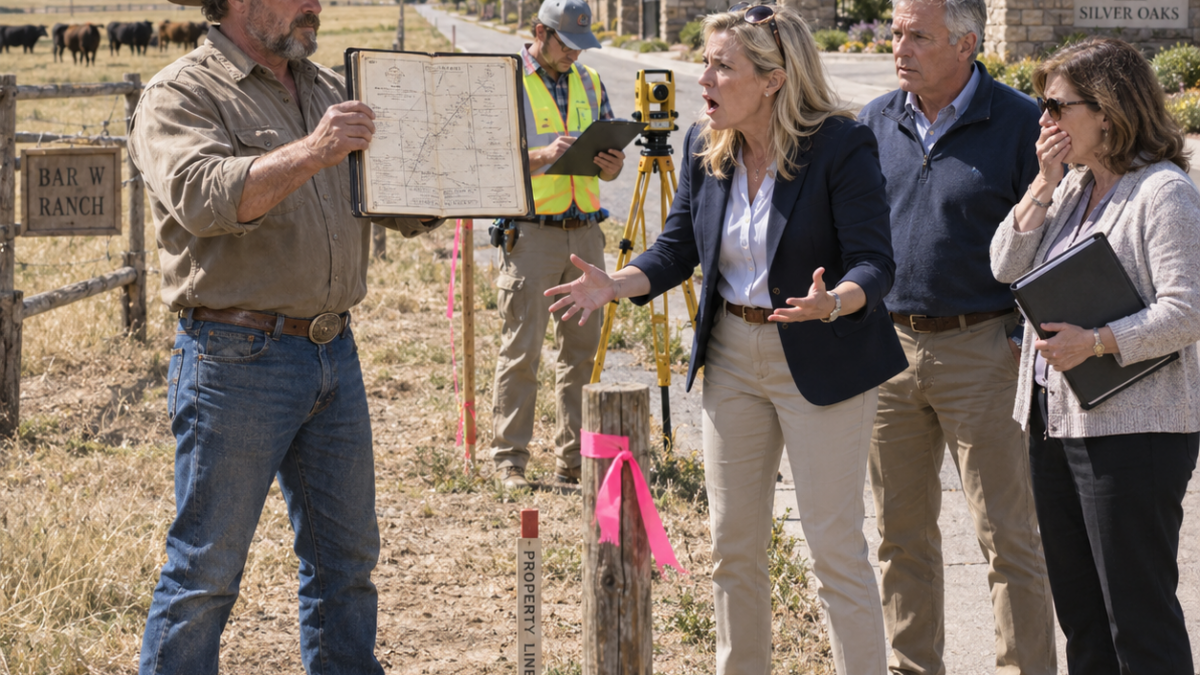
PART 2
The words were:
**ASSIGNMENT AND ASSUMPTION OF DEVELOPER RIGHTS.**
At first, I didn’t understand why they mattered.
Bob did.
He leaned against his truck while I held the old plat in both hands.
“What am I looking at?”
“The transfer provision.”
“Transfer of what?”
“Power.”
He took the paper from me and pointed to a block of text along the lower edge.
“Oak Haven was created by a developer. Developer writes the restrictions. Developer creates the architectural committee. Developer keeps enforcement authority until whatever turnover condition they wrote into the declaration is met.”
I followed the faded lines with my finger.
The original developer had retained broad control during construction.
Approval of buildings.
Enforcement.
Amendments.
Expansion rights.
Then came the sentence Bob had marked.
Upon sale of seventy-five percent of the residential lots, enforcement authority would transfer to a homeowners association through a formally executed and recorded assignment and assumption of developer rights.
I read it again.
“You’re saying the HOA needs that document?”
“I’m saying the plat says it does.”
“Does every HOA work that way?”
“No.”
He shook his head.
“Don’t turn one paragraph into law school. I’m a surveyor, not your lawyer.”
“Then why are you smiling?”
“Because people who wave paperwork around usually hate it when somebody reads the footnotes.”
I looked toward Oak Haven.
“Do you know if the assignment was recorded?”
“No clue.”
“Can I search it?”
“County clerk.”
He opened his truck door.
“And John?”
“Yeah?”
“Don’t get too excited yet.”
“I’m not.”
“You’re doing the face.”
“What face?”
“The face your dad made when he thought he’d found somebody else’s mistake.”
I smiled despite myself.
“He was usually right.”
“He was occasionally unbearable.”
“That too.”
Bob drove away.
I stood beside the new pink boundary markers until his truck disappeared.
Karen’s metal stakes were still there.
I had not removed most of them.
The first one I pulled during the confrontation now leaned against the barn.
After talking to Bob, I decided the rest were better evidence exactly where Karen’s crew had placed them.
That evening I drafted my response to Oak Haven.
Short.
Professional.
No anger.
I attached my deed.
The 2005 certified survey completed when Dad transferred the property to me.
Bob’s signed boundary verification.
Photographs of Karen’s stakes inside my pasture.
I also pointed out another problem Bob had noticed.
Oak Haven’s own recorded plat showed a utility easement separating part of their back lots from the strip Karen claimed.
Their declarations expressly limited association control over public utility corridors.
Even under their own theory, they were reaching across land they admitted they could not simply absorb through an internal vote.
I ended with:
**Any additional entry upon Miller Ranch by Oak Haven representatives without written permission will be treated as trespass.**
Certified mail.
Return receipt.
Sarah watched me seal the envelope.
“You didn’t mention the missing-document thing.”
“No.”
“Why?”
“Because I don’t know if it’s missing.”
“You’re going to check?”
“Eventually.”
She crossed her arms.
“John.”
“What?”
“You have been awake until two in the morning three nights in a row.”
“I’m fine.”
“You alphabetized the survey file.”
“That is organization.”
“You alphabetized it by surveyor and then by year.”
“Advanced organization.”
She almost smiled.
Then her face softened.
“This scares me.”
That pulled me out of the paperwork.
I sat beside her.
“They can’t legally take the ranch.”
“You keep saying legally.”
I knew what she meant.
Sarah and I had spent enough years around the military to understand that being right and being safe are not identical.
A lien, even a fraudulent one, could cloud title.
A legal dispute could cost tens of thousands.
Banks panic around title disputes.
Insurance companies ask questions.
Courts move on court time.
Karen didn’t have to be correct to make our life miserable.
She only had to create enough friction.
Sarah touched the old dining table.
My great-grandfather had supposedly signed the ranch purchase papers there, although by the time I was born nobody could prove the story.
Dad believed it.
That was enough for me.
“Our kids are supposed to have a choice about this place,” Sarah said.
“They will.”
“What if this drains everything we’ve saved?”
I didn’t answer quickly enough.
Her eyes found mine.
“That’s what I’m asking.”
“We’ll be careful.”
“That is not an answer.”
“No.”
I took her hand.
“I don’t know what it will cost.”
There.
Truth.
“But I’m not signing away five acres because Karen wants a better view from the back row of houses.”
Sarah squeezed my fingers.
“Then don’t turn this into a pride contest.”
“I won’t.”
She gave me a look that suggested twelve years of marriage had taught her otherwise.
“I mean it.”
“I know.”
“Defend the land.”
“I will.”
“Don’t make destroying Karen the mission.”
At the time, I thought those were the same thing.
I would learn the difference.
A week later, Oak Haven replied.
The fines doubled.
Six thousand dollars.
Late charges.
Administrative fees.
And a claim that the association’s “land management committee” had reviewed my evidence and determined my survey was “nonbinding upon Oak Haven’s historical boundary rights.”
I read that phrase three times.
Historical boundary rights.
Based on what?
Their letter didn’t say.
Then came the real threat.
If I failed to pay within fifteen days, Oak Haven would pursue “all remedies available,” including a lien and potential foreclosure action against the affected property.
I called Sarah into the kitchen.
She read it.
“Foreclosure?”
“They’re escalating.”
“Can an HOA foreclose on someone who isn’t in the HOA?”
“Not legitimately.”
“Again with legitimately.”
I rubbed my face.
“I need a lawyer.”
“Yes.”
“But first I need another survey.”
“You already have two.”
“I want one they can’t dismiss as my father’s friend.”
Bob would understand.
He did.
When I called, he said, “Good.”
“No offense.”
“None taken. If this ends up in court, you want somebody current, insured, and expensive enough to scare people.”
“That is exactly my thinking.”
I hired a civil engineering and surveying firm from Austin.
Three days later, two surveyors arrived with GNSS receivers, robotic total stations, and enough equipment to make Karen’s hardware-store stakes look even more ridiculous.
They spent nearly nine hours on the ranch.
Found original iron monuments.
Checked occupation lines.
Compared recorded calls.
Verified the creek crossing.
Confirmed the eastern fence.
When they finished, the crew chief came to the porch.
“Mr. Miller.”
“John.”
“John, your deed and monuments are remarkably clean for property this old.”
“Good?”
“Very.”
He unfolded a preliminary print.
“The HOA stakes are inside your property.”
“How far?”
“It varies. Their claimed line is not derived from any record boundary we found.”
“Could it be based on some historic survey?”
“Anything is possible until we see it.”
He pointed.
“But if someone is claiming this line has title significance, I would want to see the instrument creating it.”
Exactly.
A week later, the signed survey arrived.
Certified.
Stamped.
Ten-page legal description.
Coordinate table.
Record references.
It cost enough to hurt.
I sent it to every Oak Haven board member individually.
Not only Karen.
Every one.
The cover letter was six sentences.
The last one read:
**Any future assertion that Miller Ranch lies within Oak Haven jurisdiction will be considered knowing conduct made after receipt of professional contrary evidence.**
Sarah read it.
“Govern yourselves accordingly would’ve been funnier.”
“You’ve been reading my drafts.”
“I married the drafts.”
Then silence.
Two weeks.
No fines.
No golf cart.
No inspectors.
No emails.
For the first time since Karen drove into the pasture, I started wondering whether sanity had finally entered the conversation.
Then a tow truck showed up.
It stopped on the public road near my eastern fence.
The driver climbed out holding a work order.
I walked toward him.
“Morning.”
“You John Miller?”
“Yes.”
“Got a vehicle pickup.”
“What vehicle?”
He pointed toward the barn.
My old Ford F-250.
Nonrunning.
Restoration project.
A hundred yards inside my property.
“Who ordered it?”
He turned the page.
“Oak Haven HOA.”
“Reason?”
“Abandoned vehicle on HOA-controlled parcel.”
I actually smiled.
Not because it was funny.
Because Karen had just made something very useful.
“Can I see that?”
He handed over the work order.
Property address.
My ranch.
Vehicle description.
Authorization from Oak Haven.
I photographed it.
Then I handed it back.
“See those pink survey markers?”
“Yeah.”
“That is the certified property boundary.”
He looked.
“Truck’s way inside.”
“Yes.”
I showed him the survey.
He read the title block.
Professional engineer.
Registered surveyor.
Seal.
His whole posture changed.
“Man, they told me this was common-area land.”
“It isn’t.”
“I’m not crossing that fence.”
“I appreciate it.”
He called dispatch.
Then Karen.
I heard only his side.
“No, ma’am.”
Pause.
“No, I’m looking at a stamped survey.”
Pause.
“No, I’m not towing it.”
His voice hardened.
“Because I’m not getting charged with trespass over your HOA dispute.”
He hung up.
“Sorry.”
“Not your fault.”
“Can you sign that I appeared?”
“Sure.”
I signed.
Before he left, I asked for a copy of the dispatch order.
He gave me one.
That became exhibit number seventeen.
The next envelope came from a law firm.
Wilkes, Abernathy & Finch.
Austin.
Heavy paper.
Embossed name.
The kind of letterhead designed to make ordinary people pay before finishing page one.
According to the firm, I owed $12,500 in association fines, assessments, collection charges, and attorneys’ fees.
Ten days to pay.
Then:
**Our client intends to record a lien against the subject property and pursue all lawful remedies available thereafter.**
I read it standing beside the mailbox.
The pasture stretched behind me.
Bluebonnets moved in the wind.
The barn roof caught afternoon sun.
My daughter’s mare grazed beside the creek.
Twelve thousand five hundred dollars.
Based on five acres Karen invented.
Secured, apparently, against a hundred acres that had never joined Oak Haven.
I took the letter inside.
Sarah was making dinner.
She saw my face.
“What?”
I handed it over.
She read the first page.
Then turned off the stove.
“Now?”
“Now.”
She knew what I meant.
Lawyer.
Not a friend who practiced closings.
Not a local generalist.
Someone who litigated land.
A veteran friend gave me a name.
Ana Davies.
Her office sat on the thirtieth floor of a glass building in Austin.
I felt underdressed before the elevator doors opened.
She didn’t.
Ana wore a charcoal suit and black-framed glasses.
Early forties.
No small talk.
Her assistant brought me into a conference room overlooking downtown.
Ana arrived with a legal pad.
“Mr. Miller.”
“John.”
“My assistant says you have an HOA dispute.”
“Yes.”
“I get a lot of those.”
“I imagine.”
“Most involve fences, paint, or somebody parking a boat where they shouldn’t.”
She sat.
“Why is yours different?”
I opened my briefcase.
“I own the land.”
“I would hope so.”
“They don’t.”
That got her attention.
I arranged the file in chronological order.
Karen’s annexation notice.
Their map.
My deed.
1923 survey.
2005 survey.
Bob’s letter.
Austin firm’s survey.
Tow order.
Fines.
Certified-mail receipts.
The law firm’s lien threat.
Then Dave’s name.
I hadn’t mentioned Dave yet.
Because Dave entered the story three nights earlier.
I had been checking the pink markers at dusk when a man walking a German shepherd stopped on the Oak Haven side of the fence.
“Hell of a color.”
I looked at the flags.
“Bob likes drama.”
The man smiled.
“Boundary fight?”
“Apparently.”
He glanced behind him.
“Karen?”
“Apparently.”
He laughed quietly.
“Dave Reynolds. Morning Dove Court.”
“John Miller.”
“I know.”
That made me cautious.
Dave noticed.
“Relax. I’m not on her side.”
“Whose side are you on?”
“My wife’s.”
“Good answer.”
“She got fined four hundred dollars last year because our trash cans were visible for three hours after pickup.”
“I’ve heard worse.”
“So have I.”
He stepped closer to the fence.
“Karen’s telling people you’re refusing to pay for land Oak Haven owns.”
“Karen says lots of things.”
“You got proof?”
“Enough.”
Dave looked toward the houses.
“Half the people in there hate her.”
“Then elect someone else.”
“She uses fines.”
“What does that have to do with elections?”
“You challenge her, suddenly your driveway crack matters.”
I studied him.
“Why are you telling me?”
“Because she’s gone too far.”
He pulled out his phone.
“If you need to know what she’s telling residents, call me.”
“Why should I trust you?”
“You shouldn’t.”
That answer helped.
“Check me.”
I did.
Army veteran.
Oak Haven owner eight years.
No board position.
No obvious connection to Karen.
Over the next several days he sent me copies of homeowner notices voluntarily provided by neighbors.
A widow fined thousands over driveway cracks.
A family denied a playset.
A vegetable garden ordered removed.
A retired couple threatened over solar screens.
I showed Ana all of it.
She read for twenty minutes.
No interruptions.
Then she went back to Karen’s first map.
“Where did they get this?”
“No idea.”
“Have they produced a survey?”
“No.”
“Title report?”
“No.”
“Deed?”
“No.”
“Boundary-line agreement?”
“No.”
She looked over her glasses.
“And after receiving two professional surveys, they threatened a lien.”
“Yes.”
She placed the law firm letter beside the surveys.
“That was generous.”
I blinked.
“Generous?”
“To us.”
She pointed.
“Petty harassment is irritating. A formal title claim backed by a lien threat after notice of contrary ownership is something courts understand.”
Sarah had come with me.
She leaned forward.
“What can they actually do?”
“First, breathe.”
Ana looked at us both.
“I am not telling you the HOA has a valid claim. Based on what I’m seeing, the annexation theory is extremely weak.”
“Extremely?”
“I don’t use ‘impossible’ before I verify the record.”
I liked her immediately.
She continued.
“If they record a wrongful lien, we move to clear title and seek damages where available.”
“Can we stop them before they file?”
“Possibly.”
Then she tapped Oak Haven’s recorded plat.
“But I’m interested in something else.”
I leaned closer.
Ana pointed to the same provision Bob had shown me.
**ASSIGNMENT AND ASSUMPTION OF DEVELOPER RIGHTS.**
“Did you pull this?”
“No.”
“Why?”
“I was busy proving they don’t own my ranch.”
“That proves your boundary.”
She sat back.
“It does not necessarily tell me what authority Oak Haven possesses even over Oak Haven.”
Sarah looked at her.
“What are you saying?”
“I’m saying HOA power comes from recorded instruments and contracts, not from a president declaring herself powerful.”
She tapped the original plat.
“This says developer enforcement rights transfer upon a recorded assignment after seventy-five-percent turnover.”
“And?”
“I want the assignment.”
“What if there isn’t one?”
Ana’s expression didn’t change.
“Then this case becomes much more interesting.”
The next morning I drove to the Travis County clerk’s office.
I expected an hour.
I spent six.
Old records have personalities.
Some are searchable.
Some are scanned badly.
Some exist in indexes that look like they were designed by people angry at future generations.
The clerk helping me was named Linda.
When I explained what I needed, she pulled up Oak Haven’s chain.
Original subdivision plat.
1987.
Developer declaration.
Architectural-control provisions.
Articles of incorporation for Oak Haven Estates HOA.
1991.
Bylaw amendments.
Supplemental restrictions.
Lien releases.
Election notices.
Dozens of enforcement filings.
I made a list.
One item never appeared.
Assignment and Assumption of Developer Rights.
“Maybe indexed differently,” Linda said.
We searched the developer’s name.
Oak Haven Development Corporation.
Corporate filings.
Deeds.
Utility grants.
Easements.
Bank documents.
No assignment.
We searched the HOA name.
Nothing.
We searched the original officers.
Nothing.
By early afternoon my eyes hurt.
“Could it have gone unrecorded?”
“Anything could exist privately.”
“But the plat says recorded.”
“Yes.”
“Could it have been lost?”
“The county could have indexing issues. That’s why we search grantor and grantee variations.”
Another hour.
Nothing.
Then Linda found the developer’s dissolution file.
Oak Haven Development Corporation had entered bankruptcy and ceased operations in the early nineties.
The preliminary architectural committee disappeared around the same period.
But there was still no document transferring the developer’s retained enforcement rights to the resident-controlled HOA in the form the original plat required.
I sat staring at the screen.
Oak Haven had spent decades acting as though the transfer occurred.
Maybe another legal doctrine saved some of that authority.
Maybe later documents ratified it.
Maybe Ana would tell me I was reading too much into one clause.
I had learned enough not to declare victory inside a county office.
So I ordered certified copies.
Every foundational document.
Every relevant amendment.
The clerk stamped the packet.
I drove straight to Austin.
Ana was leaving for another appointment when I arrived.
Her assistant told her I had county records.
She turned around.
Ten minutes later we were in her conference room.
I placed the stack on the table.
“I couldn’t find the assignment.”
Ana removed her coat.
“Couldn’t find, or doesn’t exist?”
“County couldn’t find it under the developer, HOA, officers, or likely index variations.”
She sat.
Read the turnover clause.
Checked the incorporation date.
Read amendments.
Then she began making notes.
Fifteen minutes.
Twenty.
Sarah called while I waited.
“What did she say?”
“Nothing yet.”
“That good?”
“With Ana, I have no idea.”
Finally Ana looked up.
“This is significant.”
“How significant?”
“Not ‘your neighbor loses his mailbox rules tomorrow’ significant.”
I smiled.
“Keep going.”
“We need to research whether authority transferred by some other legally effective method, whether later instruments cured the defect, whether residents ratified enforcement, limitations issues, equitable doctrines, all of it.”
“But?”
“But the recorded documents do not show the transfer this plat says was required.”
She pointed at the file.
“And if that remains true after full title research, Karen may have built her enforcement system on a very unstable foundation.”
I felt adrenaline rise.
Ana held up one finger.
“Do not celebrate.”
“I’m sitting.”
“I can see you celebrating internally.”
Sarah would have agreed.
“What do we do?”
Ana leaned back.
“First, I want a professional title researcher verifying the chain independently.”
“Okay.”
“Second, you do not tell Dave.”
“Why?”
“Because Karen is still threatening a lien.”
“And?”
“I want to know what they do when they believe you have no answer.”
That bothered me.
“You want them to file it.”
“I want them to make their own decisions without us coaching them away from bad conduct.”
“A lien damages my title.”
“Temporarily, and we can seek emergency relief.”
“Temporarily is doing a lot of work there.”
Ana nodded.
“Correct.”
Sarah looked at me through the speakerphone.
“John?”
I knew that tone.
“What?”
“Don’t turn this into a trap because you want the satisfaction.”
I looked at Ana.
She said nothing.
Good lawyer.
Not helping the marriage argument.
“I want the ranch protected.”
Sarah answered, “Then make decisions for the ranch, not for Karen.”
I exhaled.
“Ana?”
“My advice is we send their law firm one final notice of dispute, include the certified surveys, demand their title basis, warn them that recording a lien may expose them to additional claims, and preserve every right.”
“No secret ambush.”
“No.”
That changed part of the source plan.
It also felt real.
We sent the letter.
Oak Haven received every warning.
They filed anyway.
Eleven days later, Ana called.
“Check your email.”
I opened the attachment.
Travis County Official Public Records.
Oak Haven Estates Homeowners Association.
Claim of Lien.
$12,500.
Against Miller Ranch.
All one hundred acres.
For a debt supposedly originating from a five-acre “annexation zone.”
My hand tightened around the phone.
“They did it.”
“Yes.”
“After your letter.”
“Yes.”
“After two surveys.”
“Yes.”
“After you demanded title authority.”
“Yes.”
I stood.
“What now?”
Ana’s voice became colder.
“Now we ask a judge to read.”
Within forty-eight hours, she filed.
Quiet-title action.
Challenge to the lien.
Declaratory relief regarding Oak Haven’s annexation claim.
Damages associated with the title cloud and enforcement campaign.
And the issue nobody inside Oak Haven knew was coming:
Whether the association had ever received the enforcement powers it claimed to exercise.
We did not ask a judge to “destroy the HOA.”
That would have been childish.
Oak Haven owned common areas.
It collected money for mowing, insurance, entrance maintenance, and other legitimate functions.
The legal question was narrower and, in some ways, more dangerous.
What restrictive-covenant enforcement power had actually transferred?
What fines were authorized?
What liens were supported?
What power belonged to the association corporation itself versus powers reserved originally to the developer and never properly assigned?
Ana explained it at my dining table two nights later.
“You keep saying one missing paper can take down the HOA.”
“Because that sounds more satisfying.”
“It is also legally sloppy.”
She took one of Sarah’s cookies.
“My children tell me I’m difficult.”
“They’re correct.”
“Here’s the actual point.”
She laid out the title chain.
“The HOA exists.”
“Okay.”
“It can probably perform functions granted directly to it.”
“Okay.”
“But some of the enforcement powers Oak Haven has been exercising appear to trace through rights the developer retained and promised to assign formally.”
“The missing assignment.”
“Yes.”
“If that transfer failed?”
“Then the HOA may have been exercising some powers it never received in the required manner.”
“What happens to old fines?”
“Depends.”
“Liens?”
“Depends.”
“Everything with you is ‘depends.’”
“That is why lawyers have jobs.”
Then she looked at me.
“But Karen’s annexation of your ranch?”
She tapped my deed.
“That remains nonsense regardless.”
The annual Oak Haven meeting was three weeks away.
Dave sent me the agenda.
Budget.
Landscape contract.
Pool repairs.
Election procedures.
Then:
**Special Resolution—Enforcement Against Adjacent Noncompliant Agricultural Parcel.**
“They’re voting on foreclosure,” I said.
Dave replied:
**Karen is telling everyone you’ll settle once the vote passes.**
My anger returned.
Ana read the agenda.
Then smiled.
I had learned to worry when Ana smiled.
“What?”
“We need to serve the board.”
“At the meeting?”
“That is efficient.”
“Also dramatic.”
“I am capable of efficiency and drama simultaneously.”
Sarah raised an eyebrow.
“I thought lawyers avoided theater.”
Ana shrugged.
“Lawyers avoid pointless theater.”
Dave quietly encouraged attendance.
He did not tell residents why.
Just:
Come.
Ask questions.
Read the agenda.
The clubhouse was full by seven.
Sarah and I sat in the back.
Ana sat beside us.
Karen was at the front.
Floral dress.
Gold necklace.
Clipboard.
For the first time in months, she looked relaxed.
She believed she had won.
That was obvious.
The meeting crawled through ordinary business.
Then Karen stood.
“And now we come to the special enforcement matter regarding the adjacent agricultural parcel.”
Adjacent.
Not annexed.
Interesting change.
She spent ten minutes describing me.
Noncompliant.
Aggressive.
Hostile.
Refusing to cooperate.
Running “industrial and agricultural operations” incompatible with Oak Haven.
Then came the fiction.
“For months this board has attempted to resolve longstanding boundary irregularities.”
Longstanding?
Karen invented them in summer.
“We have exercised our lawful authority to incorporate the affected acreage and assess appropriate violations.”
A woman near the front raised her hand.
Karen ignored her.
“The owner has refused every reasonable accommodation.”
Sarah whispered, “Like surrendering.”
I squeezed her hand.
Karen continued.
“Accordingly, I move that the membership authorize the board and counsel to pursue foreclosure and other remedies necessary to protect the community.”
A man in a gray suit stood.
The process server.
“Karen Peterson?”
Her face changed.
“I’m speaking.”
“Karen Peterson?”
“Yes.”
He walked forward.
“You’ve been served.”
The room went silent.
He handed her the complaint.
Then served the other named board members.
Not every director was sued individually.
Ana had been careful.
Those directly involved in the annexation and lien decisions faced personal claims where supported.
Others were served on behalf of the association or as officers as required.
Karen looked toward the back.
Saw me.
Saw Ana.
Her face went pale.
“What is this?”
Ana stood.
“My name is Ana Davies. I represent John Miller.”
Karen gripped the papers.
“This is a private association meeting.”
Ana remained beside her chair.
“I will not address the membership unless invited.”
Dave stood.
“I move that we permit counsel to explain why our board was just served before we vote on spending more money pursuing this.”
Someone seconded immediately.
Karen struck the gavel.
“That is not on the agenda.”
Another resident said, “Foreclosure is.”
A third:
“And apparently so is a lawsuit.”
The room stirred.
Karen looked toward the board.
“Sit down, Dave.”
“No.”
Just that.
No.
The first crack.
A procedural vote followed.
Overwhelming approval to hear Ana.
She walked to the front.
No theatrics now.
No raised voice.
“My client owns Miller Ranch.”
She displayed the certified survey.
“Oak Haven does not.”
Then the lien.
“Your board recorded a twelve-thousand-five-hundred-dollar claim against his one-hundred-acre ranch based on a unilateral attempt to annex private property.”
Murmurs.
Karen interrupted.
“That is disputed.”
Ana nodded.
“Yes.”
That answer threw Karen off.
“The court will resolve disputed issues.”
She turned toward the residents.
“But there is another issue you should understand before voting tonight.”
She held up the original 1987 plat.
“This document helped create Oak Haven.”
People leaned forward.
“It provides that certain developer enforcement powers were to be transferred through a formal recorded assignment after the development reached its turnover threshold.”
She paused.
“Our title search has not located that recorded assignment.”
The room went quiet.
Karen laughed sharply.
“That is absurd.”
Ana looked at her.
“I hope you are correct.”
Karen blinked.
“If your board possesses a valid recorded transfer or another legally sufficient chain of authority, produce it in court.”
Then Ana faced the residents again.
“Our lawsuit asks a judge to determine what powers this association actually holds.”
Someone shouted, “What does that mean?”
Ana answered carefully.
“It does not mean your HOA disappears tonight.”
Good.
Truth over drama.
“It means there is a substantial legal question regarding whether some enforcement powers, including certain fines and liens, were ever properly transferred to the association.”
The room erupted.
A man stood.
“They liened my house over a fence.”
Another woman:
“I paid four thousand dollars in fines.”
Karen struck the gavel.
“Order!”
Dave turned toward her.
“Did the board know about this?”
Karen snapped, “There is no missing document.”
Ana said, “Excellent.”
The room quieted slightly.
“Produce it.”
Karen glared.
“Our attorney has all governing documents.”
Ana nodded.
“Then this litigation may become very simple.”
It was devastating precisely because she did not overclaim.
Karen couldn’t dismiss her as hysterical.
Couldn’t call it fake.
Could only produce the document.
Or not.
A board member named Thomas Greene leaned into his microphone.
“Karen, have you personally seen the assignment?”
She turned.
“This is ridiculous.”
“That wasn’t my question.”
The room changed.
Thomas looked around the table.
“Has anyone?”
Silence.
One member shook her head.
Another looked down.
Karen’s power had always depended on vertical authority.
President tells board.
Board tells manager.
Manager tells homeowners.
Ana had turned it horizontal.
Everyone was suddenly asking everyone else.
Dave stood again.
“I move to postpone any foreclosure authorization until counsel verifies the association’s authority and the court rules on Mr. Miller’s title.”
Dozens seconded before the secretary could recognize one.
The vote passed overwhelmingly.
Karen’s coronation died without ever reaching foreclosure.
Outside afterward, Dave caught me near my truck.
“Do you understand what you just did?”
“I filed a lawsuit.”
“People are losing their minds.”
“That’s not automatically good.”
“My neighbor paid eight grand in fines over a driveway.”
“He needs his own lawyer.”
“You sound like Ana.”
“Unfortunately.”
Dave lowered his voice.
“She’s done, John.”
I looked through the clubhouse windows.
Karen was still inside arguing with two directors.
“No.”
“Come on.”
“No.”
I shook my head.
“She isn’t done until your homeowners decide she’s done.”
That process began the next morning.
The lawsuit became public.
A local reporter picked it up.
Then television.
The headline exaggerated.
**VETERAN RANCHER CHALLENGES LEGAL EXISTENCE OF TEXAS HOA.**
Ana nearly threw her phone.
“We are not challenging its existence.”
“Headline writers like fewer words.”
“They also like being wrong efficiently.”
I did one interview.
One.
Ana present.
Ranch behind me.
Barn visible.
No insults.
No Karen jokes.
I explained the title.
The annexation notice.
The lien.
The missing transfer document.
“This isn’t about whether HOAs should exist,” I told the reporter.
“It’s about whether any organization can exercise power it does not legally possess.”
“What do you want?”
“My land left alone.”
“And the HOA?”
“That’s for its members and the court.”
The interview aired.
Karen refused comment.
Then sent a community email calling my lawsuit “a coordinated attack by anti-HOA activists.”
That email did more damage to her than my interview.
Two board members resigned within forty-eight hours.
Their resignation statements said they had relied on Karen and prior counsel regarding the annexation.
Dave forwarded them.
**Rats?**
I replied:
**Scared volunteers. Don’t make them villains unless evidence says they were.**
Ten minutes later:
**Ana hacked your phone?**
Maybe I was learning.
The HOA’s insurer sent a reservation-of-rights letter.
Intentional misconduct.
Potentially uncovered acts.
Conflict issues.
The law firm that filed my lien hired separate counsel.
Suddenly everyone wanted distance from Karen’s decision.
Meanwhile, Oak Haven homeowners organized.
Not against HOAs.
Against this board.
Oak Haven Residents for Reform.
Dave joined.
A widow named Margaret Lopez joined.
A young father whose playset had been denied joined.
Even the former board treasurer joined after producing emails showing he had questioned Karen about the annexation and been told to “stop obstructing progress.”
The reform group hired its own attorney.
They demanded financial records.
Meeting minutes.
Fine histories.
Legal invoices.
Not everything Karen had done was improper.
That became important.
Some fines had clear covenant support.
Some residents truly had unpaid assessments.
Some enforcement actions were ordinary.
The reform attorney separated legitimate governance from conduct depending on disputed authority.
That made the movement credible.
This wasn’t “all rules are tyranny.”
It was:
Show us the authority.
Show us the vote.
Show us the money.
Karen hated those questions.
The court hearing on our preliminary relief came six weeks after filing.
Judge Evelyn Marsh presided.
Late sixties.
Silver hair.
No patience for speeches.
Ana presented the title chain.
My deed.
Surveys.
HOA annexation document.
Lien.
Original Oak Haven plat.
Turnover provision.
Title researcher affidavit stating no recorded assignment had been located after a comprehensive search.
The HOA’s new lawyer—because Wilkes, Abernathy & Finch had withdrawn from parts of the dispute due to conflicts created by the lien—argued that decades of association operation, homeowner conduct, later amendments, and statutory principles could support continued authority despite the missing instrument.
That was the first time I understood the other side had a real legal argument.
Not about my ranch.
They had almost nothing there.
About Oak Haven itself.
Ana had warned me.
Law is rarely as clean as a viral headline.
Judge Marsh asked:
“Counsel, where is your recorded instrument authorizing annexation of Miller Ranch?”
The HOA lawyer shifted.
“The association relies upon the expansion language in its declaration.”
“With owner consent?”
“Or other legal means.”
“What legal means occurred here?”
“A board determination regarding historical subdivision intent.”
The judge removed her glasses.
“Does a board determination convey title?”
“No, Your Honor.”
“Then why is there a lien against one hundred acres owned by a nonmember?”
Silence.
The lawyer tried.
“The lien relates to fines imposed on the disputed annexed parcel.”
“Which your client does not own.”
“We dispute—”
“Show me a deed.”
He couldn’t.
That was the moment I knew the ranch itself was safe.
Not the whole case.
The ranch.
Judge Marsh granted temporary relief removing the immediate foreclosure threat and preventing additional enforcement against Miller Ranch while the case continued.
She did not rule that every Oak Haven action for thirty years was void.
Ana had never expected that in one hearing.
But the judge ordered expedited production of the authority chain and reserved the broader declaration question.
Outside the courthouse, reporters waited.
I walked past them.
Ana stopped once.
“The court has protected Mr. Miller’s title pending final resolution. We will litigate the remaining issues in court, not on the sidewalk.”
That night Sarah and I sat on the porch.
No documents.
No television.
Kids inside.
Wind moving through the grass.
“You feel better?” she asked.
“A little.”
“Only a little?”
“I keep waiting for the next letter.”
She nodded.
“That’s what this has done.”
“What?”
“You check the mailbox like it’s an ambush.”
I looked toward the road.
She was right.
The ranch had always been where my nervous system went quiet.
Now every certified envelope reset the fight.
Sarah touched my arm.
“This has to end someday.”
“It will.”
“And when it does?”
“What?”
“You’re going to need to remember how to live here.”
That sentence scared me more than the lawsuit.
Because I had spent months defending Miller Ranch so fiercely that I had stopped enjoying Miller Ranch.
I hadn’t worked cattle with my son in weeks.
My daughter kept asking when we’d finish the F-250.
The barn project sat untouched.
I walked fence lines looking for trespass instead of calves.
Karen had not taken five acres.
But I had accidentally given her hundreds of hours.
The next morning I went to the barn.
My son, Luke, was feeding.
“You busy Saturday?”
He looked suspicious.
“Why?”
“We’re working on the Ford.”
His face lit.
“Seriously?”
“Seriously.”
“What about the case?”
“Ana has a phone.”
That Saturday, Luke and I pulled the old engine apart.
My daughter Emma painted brackets at the workbench.
Sarah brought sandwiches.
For six hours, Karen did not exist.
That was medicine.
Litigation continued without my constant supervision.
The title research deepened.
Ana found no recorded assignment matching the original plat’s requirement.
The HOA located later amendments signed by large percentages of owners.
They argued those instruments confirmed association authority.
Ana conceded they might validate some powers prospectively or independently.
That disappointed me.
“You said the house of cards could fall.”
“I said it could.”
“It’s wobbling.”
“Yes.”
“I wanted dramatic collapse.”
“Hire a screenwriter.”
“You are ruining revenge.”
“I am protecting you from becoming stupid.”
The decisive issue became not whether Oak Haven existed at all, but what powers it could prove.
Some assessment authority survived through other recorded provisions.
Common-area maintenance survived.
Basic corporate functions survived.
But Karen’s punitive enforcement system had leaned heavily on developer-retained architectural and enforcement powers whose transfer was defective.
The association faced serious risk that many fines and liens based solely on those powers were unenforceable.
That was enough.
More than enough.
Because Karen’s political power came from fines.
Take away uncertainty backed by money, and people stopped trembling.
Oak Haven Residents for Reform petitioned for a recall.
The threshold was met in four days.
Karen challenged signatures.
The reform lawyer verified them.
She accused Dave of orchestrating harassment.
He published her email without comment.
Bad strategy on her part.
The recall meeting filled the clubhouse and overflowed into the park.
Sarah and I didn’t attend at first.
I wasn’t a member.
It was their house to clean.
Dave texted:
**They voted to invite you.**
Ana said, “Go.”
“Why?”
“Closure.”
“You’re becoming sentimental.”
“I deny that.”
We entered through the side doors.
Karen sat at the front.
No floral dress this time.
Dark suit.
Folder.
Exhausted eyes.
Dave chaired because the membership had elected a neutral presiding officer for the special meeting.
He summarized the issues.
Annexation.
Lien.
Legal costs.
Missing authority instrument.
Insurance dispute.
Two resignations.
Then residents spoke.
Margaret Lopez described being fined more than three thousand dollars over driveway cracking.
The young parents described removing a vegetable garden while their daughter cried.
Another homeowner produced seventeen violation letters in eleven months.
Then Karen stood.
For once, she didn’t shout.
“I know many of you are angry.”
Her voice was tired.
“I know I’ve made mistakes.”
The room stayed quiet.
“I also know many of you called me when your neighbor’s yard was a mess.”
A few people looked down.
“When someone parked an RV for months.”
More eyes dropped.
“When dogs ran loose.”
“When dues went unpaid.”
“When common property needed repairs.”
Karen looked around.
“You wanted enforcement.”
That was true.
“And every person who ever sat on this board learned quickly that the same homeowner demanding rules on Monday will call you a tyrant when the rules reach their driveway on Tuesday.”
No one laughed.
Because that was also true.
“I became strict.”
She gripped the podium.
“Too strict.”
Then she looked toward me.
“The Miller annexation was wrong.”
A murmur moved through the room.
It was the first clean admission.
“I believed expansion language gave us more authority than it did.”
Ana whispered beside me, “Careful.”
Legal instinct.
Karen continued.
“I should have stopped after the first survey.”
Sarah squeezed my hand.
Karen looked at the residents.
“But if you remove me tonight, don’t pretend every problem disappears.”
No villain speech.
No meltdown.
That made the moment heavier.
Dave thanked her.
Then invited me.
I stood.
No prepared remarks.
“I don’t live here.”
That earned the expected laugh.
“I don’t know how many emails you send your president.”
More laughter.
“I don’t know which rules you want.”
I looked at Karen.
“I know what happened on my side of the fence.”
Then at the residents.
“Your board sent me a document claiming my family’s land.”
I paused.
“When I objected, fines increased.”
Another pause.
“When I produced surveys, they threatened a lien.”
“When lawyers got involved, they filed it.”
I looked around the room.
“My lawyer found a defect in the records that forced everybody to ask a question that should have been asked before any of that happened.”
I held up one finger.
“Where does your power come from?”
Silence.
“That’s not an anti-HOA question.”
Dave nodded.
“It’s a governance question.”
I looked toward Karen.
“Rules are only legitimate when everyone—including the people enforcing them—can point to where the authority begins and where it ends.”
I thought about my fence.
“That is what boundaries are for.”
Then I sat.
The recall passed.
Not unanimously.
Karen had supporters.
People who remembered years of volunteer work.
People who believed the lawsuit had become excessive.
People worried reform would create chaos.
I was glad they voted.
A real community shouldn’t become another mob simply because power changed sides.
But the result was decisive.
Karen and the remaining allied directors were removed.
An interim committee took control pending new elections.
Dave refused the presidency that night.
“Not before new documents are fixed,” he said.
Good answer.
Settlement negotiations began immediately afterward.
The association had multiple problems.
My lien.
Legal fees.
Potential homeowner claims.
Uncertain enforcement authority.
Board turnover.
Insurance pressure.
Ana had leverage.
She used it.
Not recklessly.
The final agreement took another two months.
First:
The lien against Miller Ranch was released and formally expunged where legally available.
Second:
Oak Haven permanently disclaimed any ownership, annexation right, assessment authority, architectural jurisdiction, or enforcement power over Miller Ranch without my written consent and whatever legal conveyance process Texas law required.
Third:
The HOA reimbursed my attorney fees, survey expenses, title-research costs, and additional damages.
The total made Sarah sit silently for several seconds.
“Is that real?”
Ana nodded.
“Before taxes and allocations, yes.”
I looked at her.
“What’s your fee?”
She smiled.
“Already included in the accounting.”
“I liked you better before that sentence.”
Fourth:
Oak Haven consented to a declaratory judgment resolving the disputed authority chain.
The ruling did not magically erase every act in Oak Haven history.
It did something more useful.
It identified categories of enforcement authority unsupported by the recorded transfer history and prohibited the current association from continuing those practices until the ownership and covenant structure was lawfully corrected.
Certain fines tied solely to those powers were canceled.
Outstanding related liens were reviewed and released where unsupported.
Prior homeowners with contested payments were given a process for claims and reimbursement negotiations.
Common-area assessments necessary for maintenance remained intact under separate authority.
It was messy.
Real.
And devastating to Karen’s old system.
Fifth:
The former board agreed not to seek immediate return to association leadership under the settlement framework.
Karen later sold her house.
Not the next morning.
Not because a judge ordered her out.
Months later.
I saw the moving truck from the ranch.
Her golf cart went up the ramp last.
For a second I almost laughed.
Then I remembered Sarah’s warning.
Defend the land.
Don’t make destroying Karen the mission.
I went back to the barn.
By then Luke and I had the Ford’s engine on a stand.
Emma had labeled every bolt bag in handwriting far better than mine.
Life was waiting.
Dave became president after the new Oak Haven structure was repaired.
The process took months.
Title lawyers.
Homeowner votes.
Recorded amendments.
Proper delegation.
Clear appeal procedures.
Conflict rules.
Fine caps.
Notice requirements.
Open financial reports.
The residents did not abolish standards.
They chose fewer and clearer ones.
No one wanted abandoned cars on front lawns.
No one wanted common areas neglected.
No one wanted neighbors refusing dues while everyone else paid.
They simply stopped treating personal taste like constitutional law.
Dave called me one evening.
“We need help.”
“No.”
“You don’t know what.”
“If it involves HOA bylaws, no.”
“It involves a map.”
I hung up.
He called back.
“I’m serious.”
“So am I.”
He laughed.
“We’re updating the subdivision boundary exhibits.”
“Hire a surveyor.”
“We did.”
“Then why me?”
“Because the surveyor says we need your acknowledgment where the utility easement meets the ranch line.”
“That is a real reason.”
“I’m learning.”
I attended one meeting.
Ana reviewed everything first.
The new map showed the eastern Oak Haven boundary exactly where it belonged.
On their land.
My ranch beside it.
No annexation zone.
No gray shading.
No fantasy.
I signed an acknowledgment of the existing boundary.
Nothing more.
Dave looked almost emotional.
“This feels historic.”
“It feels like Tuesday.”
“You have no poetry.”
“I own cows.”
Months passed.
Spring came.
Bluebonnets covered the pasture Karen tried to claim.
Emma ran through them carrying a camera.
“Dad!”
“What?”
“Stand by the barn.”
“Why?”
“Picture.”
“I’m working.”
“Mom said you have to.”
Betrayal.
I stood.
The barn remained exactly where Karen had circled it in red.
Unapproved structure.
One hundred years old.
Still standing.
Luke had the old F-250 running by then.
Not finished.
Running.
The first time the engine fired, he shouted loud enough that cattle scattered.
Sarah came out laughing.
I stood beside the truck with my hand on the hood.
Dad had bought it used.
I had ridden in the middle seat as a kid.
The cracked dashboard remained.
I refused to replace it.
Some damage becomes history.
The settlement money covered everything we had spent.
We set aside education funds for the kids.
Then an opportunity appeared.
Ten acres along my southern edge came up for sale.
Old ranching family.
Downsizing.
Sarah and I debated it.
“You want more land after fighting over land for a year?”
“When you put it like that…”
“John.”
“It preserves the creek approach.”
“Do we need it?”
“No.”
“Do you want it?”
“Yes.”
She smiled.
“Then say that.”
We bought it.
No conquest.
No victory.
Just preservation.
The eastern fence was another decision.
The old barbed wire had been built by Dad and me.
Part of me wanted to leave it forever.
But posts were failing.
Wire sagging.
Repairs accumulated.
One evening I ran my hand along a weathered cedar post.
Sarah stood beside me.
“You don’t have to keep every old thing because your father touched it.”
“That sounds suspiciously healthy.”
“I’ve been practicing.”
We replaced the boundary with a four-rail wooden fence.
Strong.
Clean.
Open enough to see through.
On the ranch side I planted bluebonnets.
On the Oak Haven side, the new board planted native grass.
Dave walked the finished line with me.
“Looks friendly.”
“That was the idea.”
“You know Karen would’ve hated it.”
I looked at him.
He raised both hands.
“Sorry.”
Because by then, that mattered.
We were trying to build a peace that did not require Karen to remain the central character.
Oak Haven held a community barbecue the following summer.
Dave invited us.
I almost declined.
Sarah said yes before I could.
The park had changed.
Playset.
Vegetable beds.
Picnic tables.
A basketball hoop.
Margaret Lopez, the widow with the driveway fines, hugged me.
“You gave us our houses back.”
I shook my head.
“No.”
She looked offended.
“You absolutely did.”
“I defended mine.”
I gestured around.
“You all handled the rest.”
“That’s not nothing.”
“No.”
“It isn’t.”
A little girl ran past carrying a tomato from the community garden.
The same neighborhood that once banned vegetable gardens had built raised beds beside the clubhouse.
I started laughing.
Dave found me by the grill.
“What?”
I pointed.
“Tomatoes.”
He grinned.
“Revolutionary.”
He handed me a beer.
For a while we watched families move around the park.
No fear.
No dramatic liberation music.
Just people.
One man complained that someone had parked too close to the hydrant.
Dave groaned.
“See?”
“What?”
“It never ends.”
“Governance?”
“People.”
“Same problem.”
He looked toward my fence in the distance.
“You know the craziest thing?”
“What?”
“If Karen had left your five acres alone, none of this happens.”
Probably true.
“She wanted more territory.”
“And lost her board.”
I took a drink.
“Not exactly.”
Dave frowned.
“She lost because she forgot authority has edges.”
“That sounds like something Ana would charge six hundred dollars an hour to say.”
“Don’t tell her.”
The new Oak Haven documents were eventually recorded correctly.
That was the strangest part of the ending.
My lawyer had exposed a missing transfer document that threatened the enforcement structure.
And what did the residents do with that knowledge?
They fixed it.
They did not choose anarchy.
They chose legitimacy.
Every owner received proposed governing documents.
Meetings were held.
Changes were debated.
Some restrictions stayed.
Some disappeared.
Voting thresholds were met.
Assignments and declarations were recorded in the proper county records.
Dave sent me the final stamped packet.
I called him.
“Why am I receiving HOA documents?”
“Because I thought you’d appreciate the irony.”
“I do not.”
“You spent a year telling us to fix the paperwork.”
“My lawyer did.”
“You’re HOA-adjacent now.”
“Never say that again.”
He laughed.
Then became serious.
“John.”
“Yeah?”
“Thank you.”
There was nothing useful to say.
So I said, “You’re welcome.”
That evening I carried the packet into my office.
My deed was there.
The 1923 survey reproduction.
Modern surveys.
Settlement.
Lien release.
Karen’s annexation notice.
For months I had kept every piece within reach.
I took Karen’s notice out.
Five acres shaded gray.
Barn circled.
Fine total.
Annexation processing fee.
I stared at it.
Then I put it in a storage box.
Not the active file.
Archive.
That felt bigger than I expected.
A year later, Bob Jenkins came by.
His truck somehow looked even older.
He climbed out slowly.
“You replaced my flags.”
“They faded.”
“They were professional equipment.”
“They were plastic ribbon.”
He walked toward the new wooden fence.
“Straight.”
“I had a surveyor.”
“Insulting.”
We reached the corner marker.
Original iron rod.
Still there.
Bob tapped it with his boot.
“Your dad used to check this thing every spring.”
“I know.”
“Didn’t trust fences.”
“He trusted deeds.”
“He trusted monuments.”
Bob looked toward Oak Haven.
“So they fixed their paperwork?”
“Yes.”
“Good.”
“You’re not disappointed?”
“Why would I be?”
“I thought you enjoyed watching them collapse.”
“Nah.”
He smiled.
“I enjoyed watching bad surveying lose.”
Fair.
He looked across the pasture.
Bluebonnets.
Barn.
Cattle.
“Your dad would’ve been proud.”
I didn’t answer.
Bob understood.
He changed the subject.
“That truck running?”
“Sometimes.”
“Then it’s a Ford.”
I laughed.
We sat on the porch with coffee.
Bob told stories about Dad.
Some I knew.
Some I didn’t.
One involved a boundary dispute from the seventies.
Two ranchers argued over a fence location.
Grandpa apparently brought both families to the same table and refused to leave until they agreed to hire one surveyor jointly.
“Your father told me that story fifty times,” Bob said.
“Why?”
“Because your grandfather said something he liked.”
“What?”
Bob scratched his jaw.
“Something like, ‘A line is useful only if both sides know where it is.’”
I looked toward my new fence.
“That sounds like him.”
Bob nodded.
“It’s not about keeping people apart.”
That sat with me.
For a year, the eastern boundary had felt like a battle line.
Flags.
Cameras.
Certified letters.
Lawyers.
News crews.
Now two kids from Oak Haven rode bicycles along their side of it while Emma rode a horse on ours.
They waved.
She waved.
The fence did not create hostility.
Uncertainty did.
Entitlement did.
Fear did.
A clear boundary made good neighbors possible.
Karen had treated my fence as an obstacle to be moved.
The new board treated it as information.
That difference was everything.
Two years after the settlement, Ana called unexpectedly.
“I have something you’ll enjoy.”
“Invoice?”
“No.”
“Then continue.”
“The law firm that filed your lien settled the remaining professional-liability issues.”
“Am I involved?”
“Barely. Final release confirmation.”
“Anything I need to sign?”
“One acknowledgment.”
She emailed it.
I drove to Austin a week later.
Her office looked exactly the same.
Ana did not.
More gray in her hair.
Still terrifying.
She slid the paper across.
I signed.
“That’s it?”
“That’s it.”
I looked around.
“This feels anticlimactic.”
“Most successful legal work is.”
“I thought there’d be a gavel.”
“You watch bad television.”
I stood.
Then stopped.
“Ana.”
“Yes?”
“If you hadn’t found that transfer clause…”
“You found the reference.”
“You found the problem.”
She shrugged.
“We would still have won your ranch case.”
“You sure?”
“Your title was excellent. Their annexation theory was ridiculous.”
“So the missing assignment didn’t save my land.”
“No.”
That surprised me.
“Then what did it do?”
Ana removed her glasses.
“It forced Oak Haven to examine itself.”
I waited.
“Your case would have ended with a released lien and damages.”
She pointed toward the window.
“The authority defect turned one man’s property dispute into a governance crisis.”
I smiled.
“That sounds expensive.”
“It was.”
“Worth it?”
She thought.
“For you?”
“Yes.”
“For the residents?”
“They would need to answer.”
I drove home considering that.
The viral version of the story was simple.
HOA tries to steal ranch.
Rancher finds missing document.
HOA collapses.
Real life was better.
The document did not vaporize their subdivision.
It made everyone stop pretending.
The HOA had to prove what it could do.
Residents had to decide what they wanted it to do.
Board members had to distinguish service from control.
Lawyers had to repair decades of sloppy assumptions.
I had to decide whether protecting my land required hating the people next door.
The answer to that last one mattered most.
Karen had been gone nearly two years when I saw her again.
Austin hardware store.
Of all places.
I was buying fencing staples.
She was near the paint aisle.
I recognized her before she saw me.
Older.
Thinner.
No clipboard.
No golf cart.
Just a woman comparing paint samples.
For a moment I considered walking away.
Then she looked up.
“John.”
“Karen.”
Awkward silence.
“You look well.”
“So do you.”
Lie.
Not cruel.
Civil.
She looked at my cart.
“Fence?”
“Repairs.”
“Still ranching?”
“Yes.”
Another silence.
“I heard Oak Haven reorganized.”
“They did.”
“Dave president?”
“Yes.”
She gave a small smile.
“He always wanted my job.”
“I don’t think he did.”
Her smile disappeared.
Then returned, weaker.
“No. Maybe not.”
She looked at the paint samples.
“I made a mess of that.”
It was so simple I almost missed the weight.
“Yes.”
No comforting lie.
Karen nodded.
“I thought if I let one person challenge me, everyone would.”
“They eventually did.”
“I know.”
She looked at me.
“Do you hate me?”
The question caught me off guard.
“No.”
“You did.”
“For a while.”
“What changed?”
I thought about Sarah.
The kids.
Bob.
Dave.
The rebuilt Ford.
The bluebonnets.
“I got busy.”
Karen laughed.
A real laugh.
Small.
“That might be the meanest answer.”
“I didn’t mean it that way.”
“I know.”
She looked toward the checkout.
“I’m sorry about the flowers.”
“What?”
“The bluebonnets.”
I remembered her golf cart tires crushing them.
Of all the things she could apologize for.
That.
“My daughter was mad about those.”
“I know.”
“How?”
“You said it during deposition.”
I had forgotten.
Karen set one paint sample back.
“Tell her I’m sorry.”
“I will.”
We walked in opposite directions.
No courtroom.
No humiliation.
No dramatic final line.
And somehow that felt like the last victory.
Not because Karen apologized.
Because seeing her did not ruin my day.
That spring, the bluebonnets came in thicker than I had ever seen them.
Emma was older.
College applications on the kitchen table.
Luke could drive the F-250 without me reminding him where second gear liked to grind.
Sarah still checked me when I became too proud of winning arguments.
Bob had finally stopped doing fieldwork.
Dave sent HOA documents I pretended not to read.
Miller Ranch remained one hundred ten acres now.
One hundred original.
Ten acquired later.
No Oak Haven annexation zone.
No HOA lien.
No metal stakes.
On the centennial anniversary of my great-grandfather buying the ranch, our family held a dinner.
Nothing fancy.
Long tables beneath the live oaks.
Neighbors.
Family.
Bob.
Dave and his wife.
Ana even came for an hour and refused to admit she enjoyed herself.
After dinner, Emma brought out the old carved sign.
MILLER RANCH
EST. 1923.
The bottom had begun to rot.
“We should replace it,” Luke said.
“No.”
Sarah looked at me.
“John.”
“Fine. Repair it.”
Luke smiled.
“I thought you’d say that.”
We cleaned the wood.
Reinforced the back.
Sealed it.
Hung it again.
As the sun dropped, I walked to the eastern fence.
The same place Karen had driven her golf cart years earlier.
Bluebonnets beneath the rails.
Oak Haven beyond.
From the park I could hear music.
Their neighborhood was holding some kind of movie night.
Children laughed.
Someone shouted about popcorn.
No one stared across the fence.
No one measured my grass.
My cattle smelled exactly as cattle had smelled before Karen arrived.
The barn still lacked Oak Haven architectural approval.
A tragedy the community somehow survived.
Dave appeared on the other side holding two beers.
“Cross-border diplomacy.”
He passed one between the rails.
“Is this an HOA-approved beverage?”
“Absolutely not.”
“Good.”
We stood there.
He looked toward my pasture.
“Hard to believe she wanted five acres.”
“It wasn’t about five acres.”
“What was it about?”
“Control.”
He nodded.
Then looked back at Oak Haven.
“And the document?”
“What about it?”
“One missing piece of paper changed everything.”
I thought about the county records office.
Plat Book 82.
Page 114.
One sentence buried in the margin.
Formal recorded assignment.
The paper we never found.
“It didn’t change everything.”
Dave raised an eyebrow.
“No?”
“It made everyone check what was already true.”
He waited.
“Karen didn’t own my ranch.”
“True.”
“You people didn’t belong to Karen.”
He smiled.
“Also true.”
“And rules aren’t authority just because somebody prints them on letterhead.”
He lifted his beer.
“That should be on the HOA website.”
“Absolutely not.”
We laughed.
The sun dropped lower.
The wooden fence cast long shadows across the pasture.
A boundary.
Clear.
Visible.
Peaceful.
My great-grandfather would have understood it.
So would Dad.
A line does not need anger to hold.
It needs people willing to respect where one thing ends and another begins.
Years earlier, Karen crossed that line because she believed power could turn trespass into jurisdiction.
She was wrong.
But I had nearly made my own mistake.
I nearly let defending the boundary turn the boundary into the center of my life.
Sarah pulled me back.
My children pulled me back.
Work pulled me back.
The ranch itself pulled me back.
Because land is not preserved so you can spend every day fighting over it.
It is preserved so somebody gets to live there.
That evening, I walked home through the bluebonnets.
Luke was underneath the Ford.
Emma was photographing the sunset.
Sarah stood on the porch talking to Ana.
The old barn glowed red in the last light.
Behind me, Oak Haven’s movie started.
Ahead of me, the Miller Ranch sign hung beside the driveway exactly where it had for years.
Karen once handed me a map showing five acres of my pasture shaded gray and labeled:
**OAK HAVEN ANNEXATION ZONE — PHASE ONE.**
I still had that map.
Stored deep in a file cabinet.
Not framed.
Not displayed.
Not celebrated.
Beside it sat the certified copy of Oak Haven’s original plat.
And somewhere between those two pieces of paper was the whole story.
One document tried to invent authority.
Another revealed its limits.
Karen thought the first one would take my land.
She never imagined the second would force her entire subdivision to ask whether the power she wielded had ever belonged to her at all.
The final result was not that Oak Haven disappeared.
It became something Karen had never understood how to build.
A community where authority had a boundary.
A board where questions were allowed.
A neighborhood whose residents no longer mistook fear for order.
And beside it stood my ranch.
Still ours.
Still loud.
Still imperfect.
Still covered in cattle tracks, wild grass, bluebonnets, and the accumulated memory of a hundred years.
I reached the porch.
Sarah handed me a glass of iced tea.
“Everything okay?”
I looked toward the eastern fence.
Then toward our children.
“Yeah.”
No certified mail waited on the table.
No survey crew stood in the pasture.
No golf cart crossed the fence.
Nothing dramatic was happening.
For a long time, that would have felt like an empty ending.
Now I understood better.
Peace is supposed to be boring.
I sat beside Sarah as the last light disappeared behind Miller Ranch.
And for the first time since Karen drove those metal stakes into our soil, the boundary between us and Oak Haven was exactly what it should have been all along.
Just a fence between neighbors.
[END OF STORY]








