PART 2: His Own Owner Broke His Jaw and Left Him Crying—Three Months Later, This Little Puppy Ran Into the Arms of a Family Who Chose Love
PART 2
The veterinarian ordered imaging immediately.
I stayed beside Himtchan while the team prepared everything.
Even with pain medication beginning to take effect, he remained tense.
Every time someone approached his face, his body stiffened.
Nobody blamed him.
How could we?
A five-month-old puppy had learned one of the worst lessons an animal can learn.
Hands could hurt.
People could hurt.
Even the person who belonged to you could hurt you.
Now strangers were surrounding him.
Strangers touching his face.
Strangers lifting him.
Strangers moving him from one room to another.
We knew we were helping.
Himtchan didn’t.
To him, people had already proven what they were capable of.
I sat beside him.
“You don’t have to understand today.”
His good eye looked toward me.
“You just have to let us try.”
He lowered his head against my leg.
The X-rays confirmed how devastating the trauma was.
His jaw had been fractured badly enough that normal eating was impossible.
Several teeth were damaged.
The eye injury was severe.
The surrounding tissue was inflamed.
Infection had already begun taking advantage of the untreated wounds.
The veterinarian spread the images in front of us.
“We need surgery.”
“How soon?”
“As soon as we can stabilize him.”
I looked at Himtchan.
“Can everything be repaired?”
The veterinarian paused.
That pause told me to prepare myself.
“The jaw will require significant work.”
“And the eye?”
Another pause.
“We need to examine it more closely under anesthesia, but I’m very concerned.”
“You think he’ll lose it.”
“I think there’s a strong possibility.”
I looked away.
Five months old.
One eye.
Broken jaw.
Teeth.
Infection.
Pain.
And all because someone said he had been disobedient.
I wanted to be angry.
I was angry.
But anger was useless inside that room.
Himtchan needed decisions, not rage.
“What do you need from us?”
The veterinarian explained the procedure.
The first surgery would likely take hours.
They would need to clean the infected tissue, deal with the damaged teeth and jaw, evaluate the eye, and do as much reconstruction as his body could safely tolerate.
“As much as his body can tolerate?”
“Yes.”
“You don’t think you can do everything in one operation?”
“I don’t know yet.”
“Why not?”
“Because there’s a limit to how long a puppy this injured can safely stay under anesthesia.”
That was the first time I understood that surgery itself would become another danger.
Himtchan needed treatment urgently.
But treatment could only be pushed so far before the effort to save him became too much for his little body.
“What happens if you have to stop?”
“Then we stabilize him, let him recover, and go back in later.”
Another operation.
Before the first had even begun, we were already discussing a second.
I looked down at Himtchan.
He had crawled partly into my lap.
His body was small enough to fit easily.
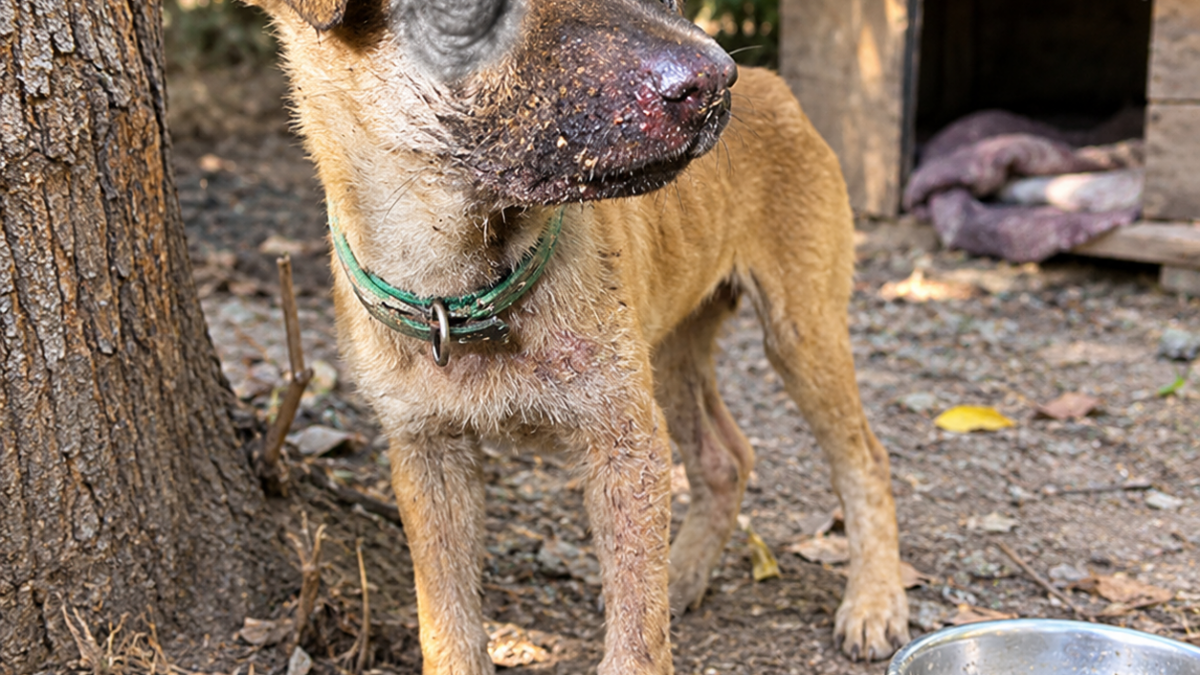
The side of his face was swollen.
His jaw sat unnaturally.
His good eye kept moving between my face and the people around us.
I stroked him gently.
“You really picked a terrible way to meet us.”
His head rested against me.
The veterinarian gave us time before surgery.
I sat on the floor with Himtchan in my lap.
He was quiet.
Too quiet for a puppy.
At five months old, he should have been impossible to contain.
He should have been chewing my sleeve.
He should have wanted to investigate every sound.
Instead, he leaned against me with his body trembling every few minutes.
Then he made a small sound.
A whimper.
I looked down.
“Hey.”
Another sound.
Not loud.
More like a broken little cry.
That destroyed me.
I held him more carefully.
“I know.”
His body pressed closer.
“I know it hurts.”
He cried again.
Then tucked his face as close to me as his damaged jaw would allow.
That was the moment I stopped seeing him as only a medical case.
He was scared.
Not abstractly.
Not in some dramatic rescue-story way.
He was a baby who had been badly hurt and did not understand why the world kept moving him from one frightening place to another.
I bent over him.
“No one here is going to punish you.”
His good eye looked up.
“You hear me?”
He couldn’t understand the words.
Still, I said them.
“You don’t have to be good.”
I stroked his back.
“You don’t have to obey anyone today.”
His breathing slowed.
“You just have to survive.”
A surgical technician approached.
“We’re ready.”
Himtchan immediately became tense.
The technician crouched rather than reaching straight toward him.
“Hey, buddy.”
Himtchan pressed himself deeper into my lap.
I felt my throat tighten.
He didn’t want to go.
Of course he didn’t.
He had already been hurt by people.
Now another stranger wanted to take him away.
I looked at the technician.
“Give me a second.”
She nodded.
I leaned close to Himtchan.
“They’re going to help you.”
He stayed pressed against me.
“I know you don’t believe that.”
His body trembled.
“But when you wake up, I’ll come back.”
I paused.
“I promise.”
The technician reached slowly.
Himtchan whimpered.
I almost changed my mind.
Not about surgery.
About letting go.
For one irrational second, every instinct in me wanted to hold him tighter and protect him from another frightening hand.
But keeping him in my arms would not repair his jaw.
It would not stop infection.
It would not save him.
So I handed him over.
He looked back at me as they carried him toward the operating room.
That image stayed with me through the next three hours.
The surgery was difficult from the beginning.
His mouth contained more damage than anyone had hoped.
Several teeth had to be removed.
The infected tissue needed to be cleaned carefully.
The fractured jaw required delicate reconstruction.
And when the surgical team evaluated the injured eye fully, the answer became unavoidable.
It could not be saved.
I received that update while the operation was still underway.
“We have to remove the eye.”
I closed mine.
“There’s no other option?”
“No.”
“Is he in pain from it?”
“Yes.”
“Then do it.”
There are decisions you never expect to make for an animal you have known less than a day.
But rescue doesn’t always give you time to build a relationship before asking you to protect someone.
Sometimes protection begins with signing a form.
After approximately three hours, the surgeon stopped.
Not because everything was finished.
Because Himtchan’s body had reached the safe limit.
The veterinarian came to see me.
“He’s out.”
“Alive?”
“Yes.”
I exhaled.
“How much did you get done?”
“We addressed the eye. We removed the damaged teeth we needed to remove. We cleaned and treated the infected areas, and we began stabilizing the jaw.”
“Began?”
“He needs another operation.”
I had known it was possible.
Hearing it still hurt.
“When?”
“Not now.”
“Tomorrow?”
“No.”
“How long?”
“He needs time.”
The veterinarian looked serious.
“If we continue pushing him now, we increase the anesthesia risk too much. He has already been through three hours of surgery.”
I nodded.
“So we stop.”
“For now.”
I looked toward the recovery area.
“Can I see him?”
“When he’s more awake.”
The first time I saw Himtchan after the procedure, I had to prepare myself before stepping close.
One eye was gone.
His face was bandaged.
His mouth looked different.
The swelling remained.
Lines ran into his body.
But he was alive.
I crouched near him.
“Himtchan.”
His remaining eye opened slightly.
“There you are.”
For a second, he looked confused.
Then his gaze settled on me.
I put my hand beside his head.
“You came back.”
His nose moved weakly.
“So did I.”
He slept again.
That first night after surgery was about pain control.
Himtchan needed strong medication.
The staff watched him closely.
His body was exhausted from trauma, infection and anesthesia.
He couldn’t simply wake up and feel better.
The repair itself hurt.
Healing hurt.
Every few hours, someone checked his temperature, breathing and surgical sites.
I stayed longer than anyone expected.
One nurse eventually asked, “Are you planning to sleep here?”
“Apparently.”
“He’s stable.”
“I know.”
“You said that like you don’t believe me.”
“I believe you.”
I looked at Himtchan.
“I just don’t think he believes us yet.”
The nurse glanced at him.
“About what?”
“That people can leave and come back.”
The nurse didn’t answer.
Neither did I.
So I stayed.
Over the following days, Himtchan slowly became more alert.
Pain medication helped, but the first recovery was difficult.
Eating remained complicated because of the jaw.
His mouth had to be protected.
The repaired structures could not tolerate normal movement.
Everything had to be controlled.
The veterinarian explained it carefully.
“He cannot open the jaw too far.”
“How far is too far?”
“We’ll restrict it.”
“What if he gets excited?”
“That’s exactly what we’re worried about.”
I looked at Himtchan.
He was barely moving.
“Excited seems unlikely right now.”
“Give him a few days.”
The vet was right.
Himtchan surprised us.
The first day, he mostly slept.
The second, his eye followed people more.
By the third, he began recognizing footsteps.
Mine included.
I walked toward his enclosure.
His head came up.
“Hey.”
His tail moved.
Once.
I stopped.
“Was that for me?”
Another small wag.
I laughed.
“You remember me.”
The tail moved again.
That was the beginning.
A dog who had every reason to fear people began choosing to trust one.
Not all at once.
Trust rarely works that way.
Himtchan didn’t suddenly become fearless.
If someone moved too quickly near his face, he flinched.
If an unfamiliar person reached toward him, he sometimes froze.
Certain movements made his body react before he had time to think.
Trauma stays in the body even when the danger is gone.
But when I entered?
He started wagging.
Sometimes he tried to rise.
“Slow.”
He ignored me.
“Himtchan.”
His tail moved faster.
“You are still recovering.”
He tried to come closer.
I laughed.
“Okay. Apparently we’re feeling better.”
That little enthusiasm created a new problem.
His jaw was still healing.
He could not open it too far.
He could not grab toys roughly.
He could not stretch his mouth wide in excitement.
One wrong movement could damage the reconstruction.
The veterinarian warned us repeatedly.
“If the repair fails, he may need another surgery.”
I stared at Himtchan.
“No.”
The veterinarian smiled.
“I agree.”
“We’re done with surprise surgeries.”
“Hopefully.”
I looked at the puppy.
“You hear that?”
Himtchan wagged.
“Do not break your face again.”
His good eye stayed on me.
“I’m serious.”
Of course he had no idea.
Puppies do not understand postoperative restrictions.
They understand feelings.
And Himtchan was beginning to feel better.
That created a strange contradiction.
Every sign of happiness thrilled us.
Every sign of excitement frightened us.
He would see me and try to greet me.
“Easy!”
His tail would go wild.
“Slow down.”
His body bounced slightly.
“No bouncing.”
The nurse laughed.
“You’re telling a five-month-old puppy not to be a puppy.”
“I know.”
“Good luck.”
But for Himtchan, being a puppy was dangerous for a while.
His body needed patience his personality was starting to outgrow.
Then came the second surgery.
We had known it was coming.
That did not make it easier.
Days after the first procedure, once the veterinary team believed his body had recovered enough from the initial anesthesia and trauma, they scheduled the next operation.
The veterinarian reviewed everything again.
“This one may take around four hours.”
“Longer than the first.”
“Yes.”
“And afterward?”
“Strong pain control. Close monitoring. Then we see how the repair holds.”
I looked at Himtchan.
By then, he knew me.
That made handing him over harder.
The first time, he had been frightened because I was almost a stranger.
Now he knew my lap was safe.
He knew my voice.
He knew my smell.
When the technician arrived to take him, Himtchan leaned against me.
“No.”
I laughed softly even though my chest hurt.
“You can’t say no.”
He pressed closer.
“That’s not fair.”
His tail moved.
“You’re manipulating me now.”
The technician waited.
I kissed the top of his head.
“You know the deal.”
His eye looked up.
“You go with them.”
I paused.
“And I come back.”
I had made that promise once.
This time, maybe some part of him believed me.
When they lifted him away, he still looked back.
But he didn’t cry the way he had before the first surgery.
That mattered.
The second operation lasted approximately four hours.
Four hours.
I thought the first surgery had taught me how to wait.
It hadn’t.
Waiting becomes harder when you know the animal.
During the first operation, I was terrified of losing a puppy I’d just rescued.
During the second, I was terrified of losing Himtchan.
The puppy who wagged when I walked in.
The puppy who leaned into my lap.
The puppy who had started trusting me after people had given him every reason not to.
That difference made every minute heavier.
The surgical team worked on the remaining jaw reconstruction carefully.
The damage from the original trauma had been extensive.
This wasn’t a simple fracture where two clean edges could be aligned and forgotten.
There had been bone damage.
Dental damage.
Inflammation.
Infection.
Days without treatment.
Everything complicated healing.
Four hours later, the call finally came.
“He’s out of surgery.”
I closed my eyes.
“Okay.”
“The procedure went as planned.”
“Okay.”
“He’ll need intensive pain control.”
“Okay.”
The veterinarian paused.
“Are you hearing me?”
I laughed weakly.
“Yes. I’m just waiting for the part where you tell me something terrible.”
“For now, there isn’t one.”
I almost cried from relief.
“For now?”
She smiled.
“You’ve learned our language.”
“I hate your language.”
“I know.”
Himtchan’s second recovery was harder in some ways.
His body had now endured two major operations within a short period.
The first had lasted three hours.
The second four.
Seven hours of surgery on a five-month-old puppy whose injuries should never have happened.
The pain medication kept him comfortable, but he was sleepy.
For a while, the energetic puppy who had started emerging disappeared again beneath exhaustion.
I sat beside him.
“You don’t have to wag today.”
His eye opened.
“Seriously.”
I touched his shoulder.
“You’ve done enough.”
His tail moved once.
I sighed.
“Of course.”
That was Himtchan.
Even through pain, he kept offering something back.
A tail movement.
A look.
A small lean toward my hand.
The affection grew slowly.
At first, touch had made him tense.
Now he began seeking it.
If I stopped stroking him, he would shift slightly.
Sometimes his paw moved toward me.
The first time he placed it against my hand, I froze.
“What?”
He kept it there.
I looked at the nurse.
“Is he asking me not to stop?”
“Looks like it.”
I smiled.
“You’re needy.”
Himtchan’s tail moved.
“You know what?”
I resumed petting him.
“You’ve earned needy.”
I wanted him spoiled.
I wanted him to become so secure in affection that he forgot it could ever be withheld.
The weeks accumulated.
Himtchan remained hospitalized because jaw injuries of that severity require patience.
Healing bone cannot be rushed.
Infection needed monitoring.
The surgical sites needed to remain stable.
The mouth is not an easy place to protect.
Every meal.
Every lick.
Every attempt to chew.
Every excited movement creates pressure.
We watched everything.
At one point the vet said, “He’s doing well, but we still need to be extremely careful.”
I laughed.
“You’ve been saying that for weeks.”
“Because it’s still true.”
“When do I get to stop being afraid he’ll undo everything?”
“When the bone is healed enough.”
“That sounds like never.”
The veterinarian smiled.
“It won’t be never.”
Himtchan had no interest in our anxiety.
He was feeling better.
That was obvious.
He began greeting familiar staff.
His tail wag became stronger.
He tried to stand against the front of his enclosure when people approached.
We discouraged that.
He ignored us whenever possible.
He wanted attention.
One day, I arrived and heard a nurse say, “Your boyfriend is here.”
I looked around.
“Who?”
“Himtchan.”
I laughed.
His tail was already moving wildly.
“You’ve created a monster.”
The nurse shook her head.
“He created himself.”
I walked closer.
Himtchan became even more excited.
“Easy.”
His body wiggled.
“No.”
Wiggle.
“Jaw.”
More wagging.
“Do you remember the jaw?”
No.
He did not.
That was perhaps the best sign of all.
Pain had dominated his world when I met him.
Now he sometimes forgot he was injured.
We had to remember for him.
There were moments when his enthusiasm almost caused problems.
Once he moved his mouth too suddenly while greeting someone, and everyone froze.
The veterinarian checked him.
I stood nearby.
“Did he damage it?”
“Give me a second.”
Himtchan looked completely unconcerned.
I stared at him.
“You are not allowed to scare us like this.”
The veterinarian finished examining him.
“The repair appears stable.”
I exhaled.
“Thank God.”
“But this is what we mean.”
“I know.”
I looked at Himtchan.
“If you break this after two surgeries, I will personally be offended.”
Tail wag.
“You don’t care.”
More wagging.
That became the strange emotional rhythm of those months.
Fear and laughter living beside each other.
Medical seriousness interrupted by puppy behavior.
Concern over bone healing followed by Himtchan trying desperately to greet someone.
The longer he stayed, the more people loved him.
Staff who had initially known him as “the puppy with the jaw” began knowing his personality.
He liked certain people.
He responded to particular voices.
He enjoyed gentle touch around his neck and shoulders.
He had expressions we learned to read.
One look meant food.
Another meant attention.
Another clearly meant he was tired of being confined.
His identity expanded beyond injury.
That mattered to me.
I hated the idea that Himtchan would forever be described only by what had been done to him.
He was more than that.
He was affectionate.
Persistent.
Curious.
Impatient.
Funny.
He had survived cruelty, but cruelty was not his personality.
As the second month passed, the visible healing became more encouraging.
The swelling reduced.
The surgical areas improved.
He learned to function within the limitations of his jaw.
His remaining eye became expressive enough that sometimes I forgot he had lost the other one.
Dogs adapt differently than people expect.
We looked at Himtchan and saw absence.
He seemed to look at the world and simply adjust.
He didn’t wake up mourning the eye.
He moved his head differently.
Used what he had.
Kept going.
One afternoon, I sat beside him and realized something.
“You know you’re handsome, right?”
His tail moved.
“I mean it.”
He leaned toward me.
“One eye. Weird little recovering mouth. Still handsome.”
A nurse walked by.
“He knows.”
“Of course he does.”
The nurse smiled.
“He gets told all day.”
“Good.”
I wanted him surrounded by voices that said good things.
Not because dogs understand compliments the way humans do.
Because tone matters.
Safety matters.
Repetition matters.
The more kind voices Himtchan heard, the more his body relaxed around people.
He had learned fear through repetition.
Now we were teaching trust the same way.
A hand approaches.
Nothing bad happens.
Again.
A person enters.
Food arrives.
Again.
Someone touches your back.
It feels good.
Again.
You fall asleep.
When you wake up, the safe people are still there.
Again.
Trust is built from those repetitions.
By the third month, Himtchan hardly resembled the puppy I’d carried out of the shelter.
Not because his face was completely unchanged.
It wasn’t.
He had lost an eye.
The jaw had been through extensive surgery.
There were consequences that could not be erased.
But the emotional difference was enormous.
He held his body differently.
He greeted people.
He showed excitement.
He anticipated good things.
The puppy who had once cried in my lap because he was terrified to leave my arms now became excited when doors opened because doors often brought people he loved.
That transformation mattered more to me than perfect symmetry ever could.
Then came the conversation we had been waiting for.
The veterinarian called me into a room.
My first reaction was fear.
Three months of hospital life had conditioned me.
“What happened?”
She smiled.
“Nothing happened.”
“Then why are we sitting down?”
“Because we’re talking about discharge.”
I stared at her.
“Himtchan?”
“Yes.”
“Going home?”
“Yes.”
For a second, I didn’t say anything.
I had imagined that conversation many times.
Now that it was real, I couldn’t process it.
“When?”
“Soon.”
“How soon?”
“If everything continues like this, very soon.”
I started laughing.
The veterinarian smiled.
“You look shocked.”
“I think I forgot this was supposed to end.”
Hospital life can do that.
When a treatment lasts days, you count down.
When it lasts months, the hospital starts feeling like part of the animal’s identity.
Himtchan had grown there.
Five months old when he arrived.
A puppy spending a huge piece of his young life inside treatment rooms.
Now we were talking about outside.
Home.
Other dogs.
A family.
Real life.
I walked to Himtchan.
His tail started the moment he saw me.
“Guess what?”
He moved closer.
“You’re getting out.”
Wag.
“Not right this second.”
Less enthusiastic wag.
“But soon.”
He leaned against me.
“Three months.”
I stroked him.
“You’ve been here almost three months.”
His eye stayed on me.
“I think you’re ready.”
The first time we took him outside with real freedom approaching, the world seemed too big.
Himtchan stepped onto the ground.
For a second he paused.
Then his body changed.
Excitement.
His tail rose.
His legs moved faster.
“Himtchan.”
He started forward.
“Easy!”
Someone laughed behind me.
“You’re still saying that?”
“I’ll probably say it forever.”
But this time there was less fear.
His jaw had healed significantly.
The medical restrictions were easing.
The puppy wanted to run.
And for the first time, we were able to let him move more like himself.
He accelerated.
Not a full sprint at first.
A little bounce.
Then several faster steps.
I felt tears immediately.
“Look at you.”
He turned.
Then ran toward us.
His face looked joyful.
One eye.
Repaired jaw.
Tail moving.
Completely alive.
Other dogs nearby noticed him.
One approached.
Then another.
Himtchan slowed.
For a second, I wondered how he would respond.
After everything he’d experienced with people, another question had remained.
What had social life been like for him before?
Would he be afraid?
Defensive?
Overwhelmed?
The dogs sniffed.
Himtchan stood.
Tail moving.
One dog moved away.
Himtchan followed.
Then something happened that felt almost impossible compared with the puppy in my lap before surgery.
He played.
Not aggressively.
Not wildly.
But genuinely.
A little chase.
A bounce.
Interest.
Joy.
I laughed.
Three months earlier, his mouth contained exposed broken bone.
Now he was outside trying to participate in the life of other dogs.
There are moments when healing becomes visible all at once.
That was one.
I watched him move and thought about the teenager who had reportedly called him disobedient.
Maybe Himtchan had been disobedient.
He was a puppy.
Maybe he had ignored commands.
Maybe he chewed something.
Maybe he ran somewhere he shouldn’t.
Maybe he did every annoying thing puppies do.
Standing there watching him play, I realized something.
I hoped he became wonderfully disobedient.
I hoped he stole socks.
I hoped he ignored someone when a more interesting smell appeared.
I hoped he ran through the house with something ridiculous in his mouth.
I hoped he made his future family laugh and occasionally sigh in frustration.
Because every act of puppy mischief would mean he had finally reached the kind of life where a mistake wasn’t answered with violence.
That was the justice I wanted for him.
Not retaliation.
Not another person being hurt.
Himtchan didn’t need violence returned to the world.
He needed to discover that the world could respond differently.
Puppy makes mistake.
Human redirects.
Puppy gets overexcited.
Human laughs.
Puppy chews wrong thing.
Human takes it away.
No broken bones.
No swollen eye.
No fear.
Just normal life.
That was his revenge.
To live normally after someone had treated normal puppy behavior as something deserving pain.
Soon, the family came.
The people who would become his forever home already knew his history.
They knew about the eye.
The jaw.
The surgeries.
The months in the hospital.
They knew he might carry emotional memories even after physical healing.
And still they wanted him.
That mattered.
I watched their first interactions carefully.
Himtchan approached cautiously.
Then his tail moved.
One of them crouched rather than looming over him.
Good.
A hand extended.
Himtchan smelled it.
No rush.
No grabbing.
He moved closer on his own.
Better.
Then his body relaxed.
I stood several feet away.
The family member looked toward me.
“Can I pet him?”
“Yes. Let him choose.”
The hand moved slowly.
Himtchan stayed.
Touch.
A tail wag.
Then another.
I smiled.
That was how it should have been from the beginning.
Choice.
Gentleness.
Patience.
When it was time for Himtchan to leave, I expected to feel only happy.
I didn’t.
I felt everything.
Relief.
Pride.
Grief.
Fear.
Joy.
The hospital had become the place where Himtchan learned to trust me.
Now loving him correctly meant letting him go somewhere better.
I crouched beside him.
“You know what’s happening?”
Tail wag.
“Of course not.”
He leaned toward me.
“You’re leaving.”
His eye watched my face.
“With them.”
I pointed gently toward his new family.
“They’re yours now.”
Himtchan looked toward them.
Then back at me.
I swallowed.
“And you’re theirs.”
He pushed against my hand.
I laughed through tears.
“Don’t do that.”
Tail wag.
“You’re making this harder.”
One of the family members smiled.
“We’ll take good care of him.”
I nodded.
“I know.”
That was why I could let go.
The first time I had handed Himtchan to someone, it had been a surgical technician.
He had cried.
He had tried to stay in my lap because he didn’t understand that the stranger taking him away was trying to save him.
Now, three months later, I was handing him toward another future.
This time, he wasn’t crying.
He was curious.
His tail moved.
His body was stronger.
The difference almost overwhelmed me.
I bent down one last time.
“Remember our deal?”
He looked at me.
“I always came back.”
I stroked his shoulder.
“Now you don’t need me to.”
That sentence broke me.
Because that was the goal.
Not to become indispensable.
To help him become safe enough that he no longer needed rescuing.
Himtchan left.
The house he entered was different from every place connected to his earlier life.
No shelter cage.
No surgical ward.
No teenagers surrounding him.
A home.
Food.
Beds.
People waiting for him.
The first updates were cautious.
He explored.
He rested.
He watched.
He followed family members.
Then he began showing more personality.
That was when I knew he had settled.
Himtchan discovered that homes contain interesting things.
Corners.
Furniture.
Sounds.
Smells.
People moving from room to room.
He followed.
His tail became a permanent part of the updates.
“He’s wagging.”
Of course he was.
“He gets excited when we come home.”
Of course.
“He wants to be with us all the time.”
That one hurt in the best way.
A puppy once hurt by his owner now waited for people because their arrival meant affection.
Think about how enormous that change is.
The same species that had frightened him became the source of comfort again.
That is not weakness.
Trusting after trauma is one of the bravest things an animal can do.
Himtchan didn’t have to forgive in the human sense.
He simply learned that different people create different worlds.
One world hurt.
Another healed.
And eventually, the second became more familiar than the first.
His family learned his routines.
They understood the medical history.
They watched his jaw.
They knew his remaining eye deserved protection.
But they did not treat him as fragile forever.
That mattered too.
Once an animal survives something terrible, people sometimes become so protective that the animal never gets to be normal.
Himtchan needed care.
But he also needed freedom.
Freedom to run.
To play.
To investigate.
To be a five-month-old puppy becoming a young dog.
One of the updates showed him outside.
Running.
Real running.
His legs moving beneath him.
Tail up.
His whole body committed to motion.
I stared at the image.
Then I remembered the lap.
The crying.
The technician waiting.
The swollen eye.
The jawbone above the gums.
Three days without treatment.
Three-hour surgery.
Four-hour surgery.
Strong pain medication.
Weeks of careful movement.
And now this.
Running.
He looked nothing like a victim.
That mattered to me.
Not because what happened should be forgotten.
But because I never wanted what was done to him to become his entire identity.
Himtchan was not “the abused puppy.”
He was Himtchan.
He played.
He loved.
He got excited.
He had a home.
The abuse belonged to his history.
It did not own his future.
That distinction is everything.
People sometimes ask what punishment someone deserves for hurting an animal.
I understand the anger behind that question.
When you see a five-month-old puppy with a broken jaw and destroyed eye, anger comes naturally.
I felt it too.
But sitting beside Himtchan for three months changed what I wanted most.
I didn’t want his story to remain centered around the people who hurt him.
They had already taken enough.
They had taken his eye.
They had broken his jaw.
They had given him pain.
I refused to give them the ending.
The ending belonged to Himtchan.
The people who hurt him were a few terrible pages.
The family who loved him would become chapters.
Years.
Memories.
Birthdays.
Ordinary mornings.
Walks.
Meals.
Naps.
That was the better victory.
One day, I received an update that showed Himtchan surrounded by other dogs.
They moved around him comfortably.
He looked excited.
No hospital equipment.
No one holding him still.
No one warning him not to open his jaw.
He was simply part of the group.
I smiled.
Another image showed him resting at home.
Safe.
The difference struck me.
At the hospital, rest had meant recovery from surgery.
At home, rest meant he was tired after living.
Those are completely different things.
One is survival.
The other is life.
I thought about the factory owner who had first stopped the teenagers.
Without him, what would have happened?
We don’t know.
Maybe nothing good.
He had seen something wrong and intervened.
Then the shelter had failed to provide the treatment Himtchan urgently needed for three days.
That delay could have cost him everything.
By the time we reached him, infection and inflammation were already part of the injury.
The veterinarian called his survival a miracle.
But miracles, if we use that word, are often built from very practical choices.
Someone says stop.
Someone makes a phone call.
Someone drives.
Someone pays attention.
Someone operates for three hours.
Then four.
Someone stays beside the kennel.
Someone returns every day.
Someone adopts.
Himtchan’s life continued because different people chose the next right action.
No single person could give him everything.
Together, they gave him a future.
I often thought about his eye.
People might see the missing eye first.
Children might ask questions.
Strangers might wonder what happened.
But eventually, to his family, I suspect it became simply Himtchan’s face.
That’s another kind of healing.
The scar stops being an event.
It becomes part of the animal you love.
You don’t wake up and think, “one-eyed rescue dog.”
You think, “Himtchan wants breakfast.”
Or, “Himtchan stole something.”
Or, “Himtchan is sleeping in my place.”
Normality absorbs the scar.
I wanted that for him.
I wanted a day when nobody talked about surgery.
A day when no one counted months.
A day when his family forgot to think of him as fragile.
A day when the biggest problem was that he was being stubborn.
Maybe that would make the person who once called him disobedient seem even smaller.
Because the trait used as an excuse to hurt him could become something a loving family smiled about.
“Himtchan, come here.”
Maybe he would look.
Then continue sniffing something.
“Himtchan.”
No response.
Someone laughs.
“Of course.”
That is how a puppy is supposed to be corrected.
With patience.
Not pain.
The thought made me strangely happy.
I hoped he broke rules.
Harmless ones.
I hoped he became confident enough to have opinions.
I hoped he tested boundaries because he knew the people around him would still love him afterward.
Animals who have been abused sometimes become extremely careful.
They monitor humans.
They watch tone.
They shrink at movements.
They try not to make mistakes.
Confidence looks different.
Confidence is stealing a sock because you assume the consequence will be someone chasing you, not someone breaking your jaw.
That is the kind of “bad behavior” I wanted Himtchan to learn.
Safe mischief.
The right to be imperfect.
His family gave him that.
Months after the surgeries, Himtchan’s physical transformation was obvious.
His face had healed.
His jaw function had improved within the limits of the repairs.
His body had grown.
He was no longer the tiny puppy whose pain had made him seem smaller than five months old.
But the emotional transformation mattered even more.
He sought affection.
He welcomed interaction.
He played with dogs.
He enjoyed being outside.
He moved with excitement instead of fear.
That was the part I returned to.
People had once taught him that human hands could cause unbearable pain.
Then another set of humans spent three months teaching him the opposite.
Hands could hold.
Hands could feed.
Hands could give medicine.
Hands could stroke your back until you slept.
Hands could steady you after anesthesia.
Hands could be there when you woke.
Repeated kindness can be powerful.
Not magical.
Himtchan still had memories in his body.
Certain fears may have remained.
But kindness gave him enough new experiences that fear no longer controlled everything.
That’s what recovery often looks like.
You don’t erase the past.
You make the present bigger.
Himtchan’s present kept growing.
Hospital.
Then outdoor play.
Then family.
Then home.
Then ordinary life.
The worst day remained fixed in the past while everything good kept accumulating ahead of it.
Eventually, the math changes.
One terrible event.
Then hundreds of safe meals.
Thousands of gentle touches.
Countless mornings where no one hurts you.
Walks.
Naps.
Play.
Years.
The past doesn’t disappear.
But it gets outnumbered.
I hope that’s what happened for Himtchan.
I hope love outnumbered fear.
One afternoon, I watched a later video of him running.
I paused it.
His body was mid-stride.
Ears back.
Tail raised.
One eye focused ahead.
I stared.
That image became my favorite.
Not because running is extraordinary.
Because for Himtchan, movement represented ownership of his own body again.
When I met him, his face had been shaped by what someone else did.
Pain controlled his mouth.
Swelling closed his eye.
Infection dictated his day.
Surgery dictated the next three months.
Later, when he ran, the body was his again.
He chose where to go.
How fast.
Who to follow.
Freedom can look like four paws hitting the ground.
I thought about the phrase we had first heard.
“He was disobedient.”
Maybe whoever said it expected that sentence to excuse something.
It never did.
Nothing excuses that level of cruelty toward a puppy.
But eventually, the words took on a different meaning for me.
Yes.
I hoped Himtchan remained disobedient.
Disobedient to the future his abusers almost forced on him.
Disobedient to fear.
Disobedient to the idea that hands should always make him flinch.
Disobedient to the expectation that one terrible owner gets to decide how the rest of your life feels.
If that was rebellion, Himtchan became very good at it.
He trusted again.
He loved again.
He played.
He went home.
That was the only revenge his story needed.
Not someone else bleeding.
Not someone else afraid.
A puppy who had known violence discovering tenderness and deciding he still wanted to be close to people.
That defeated the cruelty more completely than another act of violence ever could.
When Himtchan arrived at the hospital, I told him he did not have to trust me yet.
Months later, he didn’t just trust.
He expected kindness.
That may be the greatest victory in the entire story.
Expectation.
At first, he expected pain.
When a hand came toward his face, he froze.
When someone tried to take him from my lap, he cried.
His body predicted harm.
Later, when a person approached, his tail moved.
His body predicted affection.
That’s healing.
The world had changed in his mind.
Not perfectly.
But enough.
I sometimes wonder what Himtchan thought the first night in his forever home.
Maybe nothing complicated.
Dogs experience the present more cleanly than we do.
Perhaps he smelled unfamiliar rooms.
Listened to new sounds.
Watched his family.
Found a comfortable place.
Eventually slept.
But I like to imagine something in his body recognized the difference.
No clinic smell.
No surgical lights.
No cage.
No strangers preparing another procedure.
Just quiet.
A place where he could wake without someone examining his jaw.
A place where touch happened because someone loved him.
I hope he slept deeply.
He deserved to.
Three months is a long time in the life of a puppy.
Think about it.
When you’re only five months old, another three months represents a huge percentage of everything you’ve experienced.
For Himtchan, an enormous part of puppyhood happened inside treatment.
That could have stolen something from him.
Instead, once he got out, he seemed determined to catch up.
Run.
Play.
Meet dogs.
Explore.
Love.
Puppies are good at living in the present when their bodies finally allow it.
Himtchan didn’t need to make up for every lost day consciously.
He just needed space.
He filled it.
I saw him surrounded by dogs and thought about those teenagers.
Once he had been surrounded by people who hurt him.
Now he was surrounded by animals who wanted to play.
Once a group represented danger.
Now a group could mean companionship.
That contrast almost felt too perfect.
But it was real.
I wanted that image to replace the old one.
Not erase it.
Replace its dominance.
When people thought of Himtchan, I wanted them to see the running dog first.
The happy eye.
The tail.
The family.
Then, if necessary, remember what he survived.
Not the other way around.
Victims deserve identities beyond victimhood.
Animals too.
Himtchan’s life did not need to remain evidence of cruelty forever.
It could become evidence of recovery.
One evening, I thought back to the veterinarian’s first words.
“It’s a miracle he’s still alive.”
At the time, that sentence had frightened me.
Later, it sounded different.
He was still alive.
Yes.
And look what he did with it.
He took that life and used it to trust again.
Used it to greet people.
Used it to play.
Used it to run toward a family.
The miracle wasn’t only that his heart kept beating through the untreated injury.
The miracle, if we call it that, was what became possible once people decided to protect that heartbeat.
Survival opens a door.
Life has to walk through it.
Himtchan did.
I remember the first surgery day clearly.
The technician approaching.
Himtchan pressing himself into my lap.
The crying.
My promise.
“When you wake up, I’ll come back.”
I kept it.
Then, at the end, the promise changed.
He didn’t need me to come back anymore.
He had people who would stay.
That is perhaps the most satisfying ending rescue can offer.
Not endless dependence on the rescuer.
Transfer of safety.
The animal learns:
This person saved me.
Then:
These people are my home.
The rescuer steps out.
The family steps in.
The love continues.
I could live with that.
More than live with it.
That’s the point.
Himtchan’s forever family didn’t receive the same puppy I found.
They received everything those three months had protected.
His curiosity.
His affection.
His future.
His ability to play.
His capacity for trust.
They received a puppy who had scars, yes.
But also a puppy with an enormous amount of life still ahead.
Maybe someday those people will tell someone his story.
Maybe they’ll say, “He went through a lot as a puppy.”
And Himtchan will be lying nearby, completely uninterested.
That would be perfect.
He doesn’t need to carry the narrative.
Humans can do that.
He can carry a toy.
I hope he does.
I hope he becomes obsessed with some ridiculous object.
I hope he sleeps in inconvenient places.
I hope he scratches at the door at bad times.
I hope he gets muddy.
I hope he interrupts conversations because he wants attention.
I hope someone says, laughing, “Himtchan, you’re impossible.”
And I hope his tail wags.
Because once, someone called him disobedient and answered with violence.
Now, every normal correction can rewrite that memory.
“No, Himtchan.”
Then a gentle hand.
“Leave that.”
Then dinner.
“Come here.”
Then laughter when he doesn’t.
Normalcy becomes medicine.
Not clinical medicine.
Life medicine.
The kind that teaches an animal the rules have changed.
Mistakes do not cost you safety.
That is perhaps the lesson he needed most.
I can’t know whether Himtchan understood any of this the way I do.
Probably not.
He understood simpler things.
Pain.
Then relief.
Fear.
Then safety.
Alone.
Then together.
Hospital.
Then home.
Those opposites are enough.
Sometimes people complicate rescue stories because we want every event to carry a message.
Himtchan did not survive to teach us something.
He survived because he deserved to live.
Any lesson is ours.
And the lesson I carried was simple.
Cruelty can happen quickly.
Healing is slower.
A few moments can break a jaw.
Repair takes hours of surgery.
Trust can be damaged in seconds.
Rebuilding it takes hundreds of gentle interactions.
An eye can be lost forever.
Confidence can still return.
Violence is fast.
Care is patient.
Maybe that’s why care feels less dramatic.
It doesn’t always create one shocking moment.
It accumulates.
Three hours of surgery.
Then four.
One day of recovery.
Then another.
One visit.
One tail wag.
One safe touch.
Three months.
Then home.
Healing wins by persistence.
Himtchan’s abusers had moments.
His rescuers gave him months.
His family could give him years.
That’s how the balance shifts.
Years.
That’s the word I liked most.
Not recovery.
Not surgery.
Years.
Years ahead.
Birthdays.
Seasons.
Different beds.
Different toys.
Maybe gray hair someday.
I wanted Himtchan to grow old.
Not because old age is easy.
Because an elderly Himtchan would mean the five-month-old puppy they almost destroyed had received an entire life afterward.
That would be the final answer.
Time.
More time than the cruelty.
More time than the hospital.
More time than fear.
Someday three months of surgery could become a tiny fraction of his life.
That is what I hoped for.
When I look back, I still feel anger.
I don’t think that disappears completely.
A five-month-old puppy should never suffer because someone lacked patience.
No animal should.
But anger is no longer the strongest feeling attached to Himtchan.
Joy is.
That matters.
The people who hurt him don’t deserve to occupy the biggest emotional space in his story.
Himtchan does.
So when I tell his story, I end where he would probably choose.
Outside.
Running.
Other dogs around him.
His body moving freely.
A family waiting.
His good eye bright.
Tail moving.
Not in my lap crying.
Not under surgical lights.
Not in the shelter untreated.
Outside.
Free.
I imagine calling his name.
“Himtchan!”
He looks.
Maybe he comes.
Maybe he doesn’t.
Maybe something else is more interesting.
Honestly?
I hope sometimes he doesn’t.
I hope he turns and runs toward the other dogs.
I hope whoever calls him laughs instead of getting angry.
I hope someone says, “That dog never listens.”
And I hope those words exist in a completely safe world.
Because that is what Himtchan deserved from the beginning.
The freedom to be imperfect without being hurt.
The freedom to be a puppy.
The freedom to trust.
The freedom to run.
Three months earlier, he had cried when someone tried to take him from my arms because humans had taught him that being taken away could mean pain.
Now he could run willingly toward people.
That’s not a small transformation.
That’s a life rebuilt.
Himtchan lost an eye.
We cannot change that.
His jaw was damaged badly enough to require two major surgeries.
We cannot erase that.
He spent three untreated days in pain.
We cannot take them back.
But the future remained open.
And people filled it with something different.
Care.
Medicine.
Patience.
Affection.
Home.
Himtchan never got his old eye back.
He got something larger.
A world he could look at without fear controlling every moment.
He never got those painful puppy days back.
He got new ones.
Days where food arrived.
Where other dogs approached to play.
Where family members reached toward him and he moved closer instead of away.
There is no way to make what happened fair.
But there is a way to make sure it isn’t the final thing that happens.
That’s what everyone did.
They kept adding good days.
Until the good days became his life.
I think of his first surgery.
Three hours.
The second.
Four.
Seven hours total on operating tables because people had done in moments what doctors needed hours to repair.
Then I think of the decades of collective veterinary knowledge behind those hands.
The medications.
The monitoring.
The technique.
The nurses.
The rescue.
So much effort concentrated around one little puppy.
Some people may ask whether all that was worth it.
Look at Himtchan running.
There’s the answer.
Value doesn’t come from perfect bodies.
He had one eye.
He had a reconstructed jaw.
He was still worthy.
Value doesn’t come from obedience.
He was a puppy.
He was still worthy.
Value doesn’t come from being easy.
His care took months.
He was still worthy.
That was the truth his story eventually made impossible to miss.
The people who hurt him acted as though inconvenience could erase his value.
The people who saved him spent three months proving the opposite.
Not with words.
With action.
Every surgery said he mattered.
Every medication said he mattered.
Every visit.
Every meal.
Every check.
Every careful restriction designed to prevent another operation.
Every person who waited.
Every family member who welcomed him.
That is how you answer cruelty.
You invest where someone else discarded.
You protect what someone else harmed.
You love what someone else treated as worthless.
Himtchan finally slept in a home where nobody needed him to earn safety.
That’s what I wanted.
Not gratitude.
Animals don’t owe gratitude for being treated decently.
Safety should have been his from the beginning.
He finally had it.
Sometimes the strongest happy endings are not about getting something extraordinary.
They’re about finally getting what should always have been ordinary.
A puppy shouldn’t have to earn gentle hands.
Himtchan finally got them.
He shouldn’t have to survive surgery to deserve food.
He got meals.
He shouldn’t have to lose an eye before people decide to protect him.
But eventually, people did.
I wish they had arrived sooner.
Still, they arrived.
And he lived.
There will always be a part of me that remembers his cry before surgery.
I don’t think I will ever forget it.
But now another sound exists beside that memory.
His paws running outside.
That is the sound I choose.
Movement.
Freedom.
The kind of sound a hospital cannot give you.
The kind you have to survive long enough to make.
Himtchan made it.
Three months.
Two operations.
Seven surgical hours.
One lost eye.
Several damaged teeth removed.
A jaw rebuilt.
Pain controlled.
Infection treated.
Trust restored little by little.
Then the door opened.
And Himtchan ran toward the rest of his life.
That is where his story belongs.
Not with the teenagers.
Not with the word “disobedient.”
With the family who looked at a scarred little puppy and saw someone worth loving.
With the dogs who welcomed him into play.
With the person who reached down to pet him and watched his tail move instead of his body flinch.
With every ordinary day that came afterward.
That was his victory.
And if I could go back to that first day at the shelter, kneel beside the frightened five-month-old puppy, and tell him only one thing, I wouldn’t explain the surgeries.
I wouldn’t tell him about losing his eye.
I wouldn’t explain that healing would take months.
I would simply say:
“Stay with us.”
Because somewhere beyond the pain was grass beneath his paws.
Other dogs waiting.
A family.
A home.
And a future in which no one would ever again have the right to hurt him for being a puppy.
Himtchan stayed.
And eventually, he found all of it.
The little dog who once cried because he was terrified to leave a rescuer’s arms became the dog who could run freely outside, surrounded by friends, knowing there were loving arms waiting whenever he chose to come back.
His jaw had been broken.
His trust had been broken.
Only one of those things required surgery.
The other was repaired by hundreds of small acts of kindness.
And in the end, both healed enough for Himtchan to do what every puppy should have been allowed to do from the beginning.
Live.
Play.
Trust.
Love.
And go home.








