PART 2: HER OWNER LOCKED HER IN A GARAGE FOR NEARLY A YEAR BECAUSE HE WAS “BORED”—BUT OPAL STILL WAGGED HER TAIL WHEN WE FOUND HER
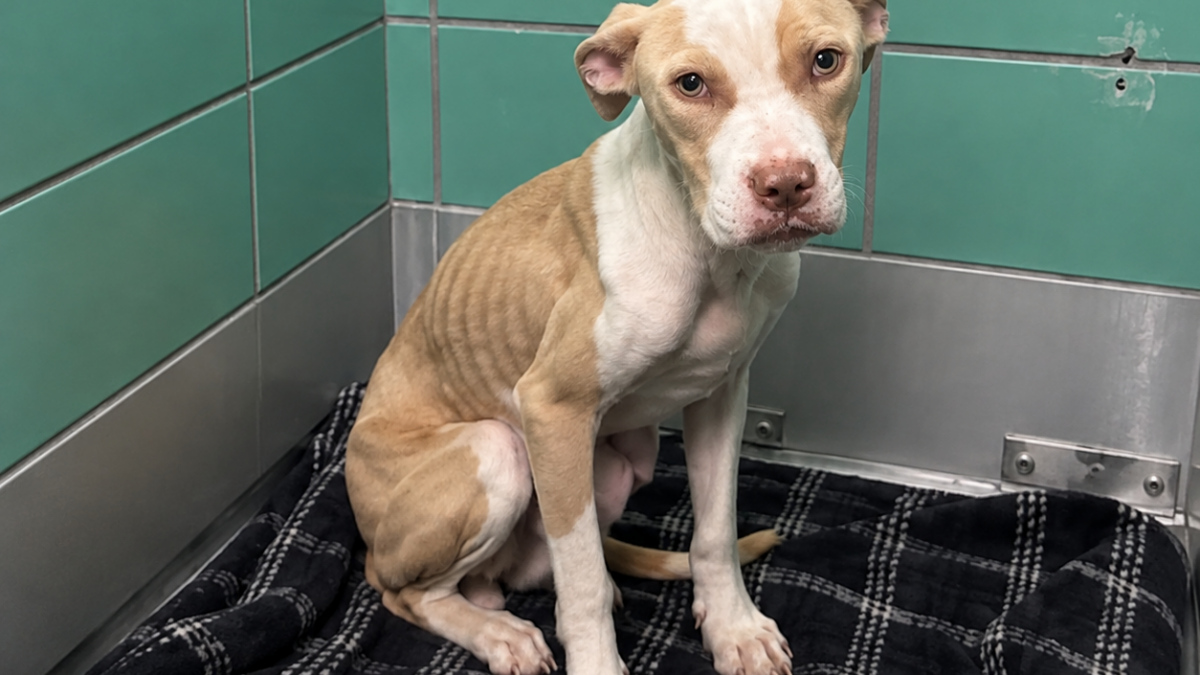
PART 2
I stared at him.
“She’s starving.”
“I know.”
“Then why wouldn’t we feed her?”
Dr. Warren pulled a stool closer and sat across from me.
“Because a dog this malnourished can be injured by being fed too aggressively.”
He explained refeeding syndrome in calm, careful language.
Opal’s body had been surviving on almost nothing for so long that suddenly flooding it with calories could cause dangerous shifts in electrolytes and fluid balance.
Her heart could be affected.
Her muscles.
Her nervous system.
Even the food she desperately needed could become dangerous if we tried to erase a year of starvation in one night.
I looked through the glass.
Opal was watching a technician prepare a tiny portion of food.
Her nose lifted.
Her entire body seemed to wake up.
“How much can she have?”
“Small portions. Frequently. Controlled.”
“That’s going to be torture for her.”
“It may feel that way.”
He paused.
“But it’s how we keep her alive.”
The technician placed the bowl inside.
Opal tried to stand.
Her front paws slid.
I opened the enclosure and supported her chest.
“Slow.”
The moment she reached the food, she began eating so quickly that the technician had to move the bowl away after several bites.
Opal stared at it.
Then at us.
The expression in her eyes was unbearable.
She was not angry.
She looked confused.
As if food had appeared and disappeared so many times in her life that she had learned not to question it.
“We’re bringing it back,” I whispered.
Her tail moved weakly.
“You’re getting more. I promise.”
We waited.
Then offered another small portion.
That first night became a cycle.
Food.
Rest.
Water.
Fluids.
Temperature checks.
Blood pressure.
Food again.
Every hour felt borrowed.
By midnight, her fever was still dangerously high.
Her paws remained cold.
Dr. Warren was concerned about circulation, infection, dehydration, and organ function.
Blood tests showed abnormalities everywhere you would expect in a body pushed that far.
Her protein levels were low.
Her red blood cell count worried him.
Electrolytes needed monitoring.
There were signs of prolonged nutritional deprivation.
But there was one thing he could not explain immediately.
Her neurological examination was better than expected.
“She knows where her feet are,” he said.
“What does that mean?”
“It means when I reposition her paws, she corrects them. Her reflexes are present. She’s weak, but I’m not seeing clear evidence of major neurological damage.”
I let out a breath I hadn’t realized I was holding.
“So she might walk normally again?”
“If weakness is the primary issue, yes.”
“If.”
He nodded.
“We need time.”
Time.
Everything with Opal came back to time.
She had lost almost a year.
Now we were asking her body to survive one hour at a time.
At two in the morning, I sat on the floor beside her kennel.
Marcus had gone home to sleep for a few hours.
The clinic lights were dim.
Machines hummed in the treatment area.
Opal was awake.
I reached through the bars.
She pressed her nose into my fingers.
“Why do you still like us?”
Her tail tapped once.
I smiled despite myself.
“You’re terrible at holding grudges.”
She closed her eyes.
I stayed.
At four, another small meal.
At six, bloodwork.
At seven, her fever finally began dropping.
Not normal.
But lower.
Dr. Warren came in carrying a paper cup of coffee.
“That’s the first good thing I’ve seen this morning.”
I looked at him.
“Only the first?”
He glanced at the chart.
“No. Her glucose is holding. She tolerated the food. And she hasn’t vomited.”
“So we’re improving?”
“We’re not out of danger.”
“I know.”
“But yes. Those are encouraging signs.”
I wanted to celebrate.
Instead, I looked at Opal.
She had made it through her first night.
That was enough.
The second day was harder emotionally because the immediate panic faded.
Once I knew she might survive, I started thinking about why she had been in that garage at all.
The animal-control investigator arrived shortly after noon.
Her name was Rachel Kim.
She photographed Opal.
Reviewed the veterinary record.
Asked me who had made the original call.
Then she asked the question I had been waiting for.
“Where’s the owner?”
“I don’t know.”
Rachel nodded.
“I do.”
Apparently, he had already been interviewed.
His name was Trevor Baines.
Thirty-one years old.
He had adopted Opal as a puppy.
At first, neighbors remembered seeing them outside.
Walking.
Playing in the yard.
Trevor had even posted photos of her online.
A tiny puppy with oversized ears.
Opal asleep across his lap.
Opal wearing a red bandana at Christmas.
Then the pictures stopped.
So did the walks.
According to one neighbor, Trevor began leaving Opal in the garage for longer periods after she reached adolescence.
At first, only during work.
Then overnight.
Then most of the time.
Eventually, people stopped seeing her completely.
“How did nobody report it?” I asked.
Rachel’s expression tightened.
“Because people assumed she’d been rehomed.”
That hurt.
Not because the neighbors had done something intentionally wrong.
Because neglect thrives on assumptions.
Someone stops seeing a dog.
They think she moved.
Someone hears barking.
They think it belongs to another house.
Someone smells something unpleasant.
They assume trash.
Nobody wants to believe there is an animal slowly starving twenty feet away.
“What did Trevor say?”
Rachel closed her notebook.
“He claimed caring for her became difficult.”
“That isn’t what the caller told us.”
“I know.”
“He said he was bored with her?”
Rachel hesitated.
“He used that word during an earlier conversation with a relative.”
I felt my jaw tighten.
“Bored.”
“That statement is being documented.”
“What was he feeding her?”
“We’re still investigating.”
I looked through the kennel glass.
Opal was asleep.
The outline of her spine showed beneath the blanket.
“Did he ever take her outside?”
“According to him, occasionally.”
“Do you believe him?”
Rachel looked at me.
“My job isn’t to believe him. It’s to document what can be proven.”
That answer frustrated me.
Later, I understood why it mattered.
Emotion can make a case loud.
Evidence makes it strong.
The garage told its own story.
Rachel returned that afternoon with photographs.
There was a plastic food bowl.
Empty.
A water container coated in grime.
Old feces across sections of the concrete.
Urine stains.
No proper bedding.
No open windows.
No evidence of recent cleaning.
The temperature inside had been oppressive.
There were scratches around the bottom of the interior door.
I stared at one photograph longer than the others.
“What are those?”
Rachel zoomed in.
“Claw marks.”
Opal had scratched at the door.
I imagined her hearing Trevor inside the house.
Television.
Footsteps.
The refrigerator opening.
A phone ringing.
People laughing.
All separated from her by a wooden door.
I handed the phone back.
“I can’t look anymore.”
Rachel softened.
“You don’t have to.”
“Yes, I do.”
I took it again.
If Opal had lived it, I could at least look at it.
There were six long scratches in the paint.
One above another.
A dog trying to reach home while already technically inside it.
That night, Opal stood by herself for eleven seconds.
I counted every one.
“One.”
Her legs trembled.
“Two.”
She looked at me.
“Three.”
Her hind legs shook harder.
“Four.”
“Come on, sweetheart.”
Five.
Six.
Seven.
At eight, her left leg started folding.
I moved closer.
“Nine.”
Ten.
Eleven.
Then she collapsed gently into my arms.
I laughed and cried at the same time.
“You did it.”
Opal licked my chin.
It was the weakest lick I had ever received.
It felt like a medal.
On the third day, we gave her a bath.
Technically, it was her second since the rescue, but the first one had been little more than medical cleaning.
This time, we used warm water.
Soft shampoo.
Towels heated in the dryer.
Two technicians helped.
The smell did not disappear completely.
Urine had soaked into her coat and skin for so long that one washing couldn’t undo it.
Neither could two.
But when the water ran dark into the drain, I imagined pieces of that garage leaving with it.
Opal leaned against my chest while I rinsed her.
She seemed confused by the attention.
Every few minutes, she looked up as if checking whether I was still there.
“I’m here.”
Her eyes closed.
When we finished, we wrapped her in three towels.
Marcus entered carrying a tiny pink fleece blanket.
“Really?”
“What?”
“Pink?”
“She’s named Opal. It suits her.”
Opal sniffed the blanket.
Then curled into it.
“She approves,” Marcus said.
Her bloodwork improved slowly over the next several days.
Not dramatically.
But enough to make Dr. Warren cautiously optimistic.
Her fever resolved.
Circulation improved.
She began holding her head higher.
Her appetite became almost comical.
Any sound resembling food preparation brought her ears up.
Plastic bag?
Food.
Drawer opening?
Food.
Someone peeling tape?
Possibly food.
Marcus once opened a package of gauze and Opal tried to stand.
“You are going to be very disappointed.”
Her tail wagged anyway.
By the end of the week, she had gained just over two pounds.
Two pounds.
To most people, nothing.
To us, enormous.
Dr. Warren smiled at the scale.
“Twenty-seven point two.”
I clapped quietly.
Opal looked at me, then toward the technician holding treats.
“She doesn’t care.”
“She cares about measurable outcomes.”
“She cares about chicken.”
“That too.”
The first real walk happened nine days after rescue.
We used a support sling under her abdomen.
I took her outside behind the clinic.
Grass covered a small courtyard.
When Opal’s paws touched it, she froze.
The sensation seemed unfamiliar.
She lowered her nose.
Sniffed.
Moved one paw.
Then another.
Sunlight fell across her back.
She lifted her face.
I watched her eyes close.
For perhaps five seconds, Opal simply stood in the sun.
I had to swallow hard.
Marcus stood beside me.
“Don’t.”
“What?”
“If you start crying, I’m leaving.”
“You’re already crying.”
“I have allergies.”
“In October?”
“Severe seasonal.”
Opal took four steps.
Rested.
Then six.
She found a patch of grass and lowered herself onto it.
Not collapsed.
Chose.
There was a difference.
She rolled slightly onto one hip.
Her tail moved.
I sat beside her.
“This is grass.”
She sniffed it again.
“You should’ve had this every day.”
Her head rested against my leg.
For nearly a year, the sun had existed outside the walls of her garage.
Now it belonged to her again.
The legal case moved more slowly than Opal’s body.
Rachel interviewed neighbors.
A relative who had visited Trevor.
A delivery driver who remembered hearing barking from the garage months earlier.
There were text messages.
That was where the case became difficult for Trevor.
One message had been sent to his younger brother after the brother asked why Opal never came into the house anymore.
Trevor replied:
**She’s annoying now. I’m bored with dealing with her.**
Another:
**She has food out there. She’s fine.**
A later message:
**Maybe I’ll get rid of her eventually.**
Rachel showed them to me only after they became part of the formal case.
I read the first one twice.
Bored.
There was the word.
Not rumor.
Not interpretation.
His word.
I looked at Opal sleeping against my shoe.
“How can someone be bored of you?”
Rachel closed the folder.
“People sometimes like puppies more than dogs.”
“That isn’t an answer.”
“No.”
She sighed.
“It’s just something I see.”
The puppy became bigger.
Needed training.
Needed exercise.
Chewed things.
Barked.
Had energy.
Stopped being an accessory and became a responsibility.
Trevor stopped wanting the responsibility.
But instead of finding Opal another home, surrendering her, contacting a shelter, or asking for help, he closed a door.
Then another.
Then apparently stopped looking behind it often enough to care what was happening.
The defense eventually argued that Trevor had not intended to starve Opal.
He claimed she had stopped eating normally.
He claimed he believed she was naturally thin.
He claimed he had been under stress.
He claimed he planned to take her to a veterinarian.
Planned.
That word joined bored on my list of words I hated.
Planned to feed better.
Planned to clean.
Planned to get help.
Planned to surrender.
Meanwhile, Opal reached twenty-nine pounds.
Then thirty.
Her legs strengthened.
She could cross the clinic hallway without a sling.
Not gracefully.
Her walk looked like a newborn deer learning physics.
But she walked.
The first time she made it from one end of the hallway to the other, the reception staff applauded.
Opal panicked at the sound.
Everyone stopped.
I crouched immediately.
“Sorry.”
She pressed against my knees.
I stroked her neck.
“We got excited.”
Her tail slowly resumed wagging.
After that, we celebrated quietly.
Jazz hands.
Thumbs up.
Silent dancing.
Marcus became particularly committed to silent dancing.
He looked ridiculous.
Opal adored him.
Two weeks after rescue, she was medically stable enough to leave the emergency clinic.
She moved to our rehabilitation foster center.
I drove her.
The back of the van had a thick orthopedic bed.
Blankets.
Water.
A harness.
Opal sat up for the first five minutes.
Then lay down.
At a stoplight, I glanced through the rearview mirror.
She was watching traffic through the window.
Cars.
Trees.
People.
The world must have seemed enormous.
At the foster center, we gave her a quiet room near the kitchen.
Large bed.
Open crate.
Toys.
A window at dog height.
And a door we deliberately left open whenever possible.
Opal noticed that door constantly.
For the first few nights, she slept facing it.
Every sound woke her.
If someone closed another door in the house, her head shot up.
The garage had taught her that closed doors could swallow months.
We needed to teach her something else.
So we began a simple game.
I stood on one side of the doorway.
Opal on the other.
“Come.”
She walked through.
Treat.
Then I stepped back.
“Come.”
She crossed again.
Treat.
Later, I moved the door slightly.
Never shutting it completely.
Open.
Treat.
Open.
Treat.
Eventually, close for one second.
Open.
Treat.
At first, Opal panicked when the door clicked.
She scratched once.
I opened it immediately.
No drama.
No punishment.
No forcing.
Again.
Half second.
Open.
Treat.
One second.
Open.
Treat.
Three seconds.
By the fifth day, she could remain calm for ten seconds.
By the second week, thirty.
We never made the goal confinement.
The goal was trust.
A door could close.
And someone could still come back.
Her relationship with food was harder.
Opal ate as though every meal might be the last food on earth.
We used slow feeders.
Puzzle bowls.
Small meals throughout the day.
She guarded nothing aggressively.
That almost made it sadder.
If I touched her bowl, she stepped away.
Immediately.
No resistance.
As if she believed I had the right to take it.
I stopped touching her food unless medically necessary.
Instead, I walked past and added something.
Chicken.
A spoonful of wet food.
A treat.
My presence near the bowl needed to mean more, not less.
Weeks passed.
Opal learned.
She stopped inhaling every bite.
She began pausing.
Looking around.
Returning to the bowl.
One afternoon, she left three pieces of kibble.
I stared.
Marcus stared.
“Is she sick?”
I laughed.
“She’s full.”
We both looked at Opal.
She had walked away from food because she believed food would exist later.
I knelt and hugged her.
“You have no idea how big this is.”
She licked my cheek.
By then, Opal weighed thirty-five pounds.
Her coat was improving.
The dull, brittle fur began softening.
The urine odor was gone.
Her eyes were clear.
She had discovered toys.
Not all toys.
Squeaky toys frightened her.
Tennis balls bored her.
But stuffed animals?
Opal loved them.
Especially a stuffed green frog Marcus bought.
She carried it everywhere.
Bed.
Hallway.
Yard.
Kitchen.
One morning she brought Frog to breakfast and dropped him beside her bowl.
“Is he eating with you?”
Tail wag.
“Okay.”
Frog joined us.
The first full month ended with another veterinary evaluation.
Dr. Warren walked into the room and stopped.
“That’s not the same dog.”
Opal wagged so hard her hips moved.
He crouched.
“Look at you.”
She walked to him without assistance.
Not perfectly.
But steadily.
He examined her muscles.
Joints.
Heart.
Neurological response.
Then her weight.
Thirty-eight point six.
Dr. Warren looked at me.
“I think we can start increasing exercise.”
I smiled.
“How much?”
“Short controlled walks. Nothing excessive.”
Opal heard the word walk.
We had accidentally taught it two weeks earlier.
Her ears rose.
Dr. Warren laughed.
“I see she understands.”
“Oh, she understands anything connected with leaving the house.”
That was true.
Once Opal discovered walks, she became obsessed.
At first, fifty yards.
Then one block.
Then two.
Every mailbox deserved inspection.
Every tree contained breaking news.
Every leaf might be edible until proven otherwise.
The first time a butterfly passed her nose, she jumped backward.
Then chased it.
I laughed so loudly a woman gardening across the street looked over.
Opal ran back to me.
“You missed.”
Tail wag.
“Terrible hunter.”
Bigger wag.
We were building a normal dog out of experiences that should have been ordinary all along.
The legal hearing was scheduled for late November.
Rachel asked whether I would testify about Opal’s condition.
“Yes.”
“You sure?”
“Yes.”
“You may be cross-examined.”
“I don’t care.”
“You need to care enough to stay calm.”
I looked at her.
“Meaning?”
“Meaning the goal is not to tell the court what you think of Trevor.”
“I know.”
“The goal is to describe what you observed.”
Twenty-five pounds.
Unable to walk more than a few steps.
Urine odor.
Visible ribs.
High fever.
Cold extremities.
Severe emaciation.
Controlled refeeding required.
Veterinary hospitalization.
Those were facts.
Facts were enough.
The hearing room was smaller than I expected.
Trevor sat beside his attorney.
Clean shirt.
Trimmed beard.
Polished shoes.
If I had seen him at a grocery store, I would never have guessed.
That was another lesson rescue work had taught me.
Neglect does not wear a uniform.
Sometimes it looks ordinary.
When I was called, I sat down and answered questions.
My name.
Role.
Experience.
Date of rescue.
Then the prosecutor showed me a photograph.
Opal on the garage floor.
My stomach twisted.
“Do you recognize this dog?”
“Yes.”
“Who is she?”
“Opal.”
Trevor’s attorney objected.
“Her legal name was not Opal at the time.”
The prosecutor looked at me.
“What name did the owner use?”
I hesitated.
The documentation listed Daisy.
I had almost forgotten.
“Daisy.”
The attorney nodded.
I corrected myself.
“The dog we later named Opal.”
The photograph stayed on the screen.
Twenty-five pounds.
Bones.
Filth.
Eyes staring toward the camera.
“Describe her condition.”
I did.
Then another photograph.
Garage floor.
Another.
Empty bowl.
Another.
Claw marks.
The prosecutor asked, “What was your impression when she tried to walk?”
“She wanted to approach us.”
“Could she?”
“Not normally.”
“What happened?”
“Her legs gave out.”
“How many steps?”
“Three the first time I observed it.”
Trevor looked down.
I continued.
“She kept trying.”
The prosecutor paused.
“What happened when you approached her?”
“She wagged her tail.”
I saw someone in the back row wipe her eyes.
Trevor’s attorney stood for cross-examination.
He was professional.
Not cruel.
He asked whether I was a veterinarian.
No.
Could I prove how much food Trevor had offered?
No.
Had I personally seen him lock Opal inside for the entire year?
No.
Did I witness him intentionally withholding food?
No.
Could some medical conditions cause weight loss?
Yes.
“Then you cannot state with certainty that my client deliberately starved the dog.”
I looked at him.
“I can state exactly how she looked when we found her.”
“That was not my question.”
“No.”
“Thank you.”
I stepped down.
Dr. Warren testified next.
His testimony was different.
Clinical.
Measured.
Severe emaciation.
Dehydration.
Fever.
Muscle wasting.
Weakness.
Condition consistent with prolonged inadequate nutrition and neglect.
Need for cautious refeeding.
No underlying disease identified that reasonably explained the extent of the starvation.
That sentence mattered.
The defense had suggested disease.
Dr. Warren dismantled it with lab results.
Then Rachel testified.
Photographs.
Witness statements.
Texts.
Trevor’s own messages.
His attorney fought hard against the interpretation of “bored.”
Context.
Casual language.
Frustration.
Not evidence of intent.
The prosecutor did not need intent to sound monstrous.
He needed neglect.
And neglect had left claw marks on a door.
Trevor testified too.
I had not expected that.
He said Opal had become difficult after puppyhood.
Chewing.
Jumping.
Barking.
He worked long hours.
His relationship ended.
Money became tight.
He put her in the garage temporarily.
Temporary stretched.
He said he fed her.
Sometimes she wouldn’t eat.
Sometimes he forgot.
He admitted cleaning became less frequent.
Then the prosecutor asked:
“Why didn’t you surrender her?”
Trevor looked uncomfortable.
“I thought about it.”
“Why didn’t you?”
“I don’t know.”
“Why didn’t you contact a rescue?”
“I don’t know.”
“Why didn’t you take her to a veterinarian when she became visibly thin?”
“I kept thinking she’d improve.”
“Without changing anything?”
His attorney objected.
Sustained.
The prosecutor changed direction.
He displayed the text message.
**She’s annoying now. I’m bored with dealing with her.**
“Did you write this?”
Trevor stared at it.
“Yes.”
“What did you mean?”
“I was frustrated.”
“With what?”
“Everything.”
“With the dog?”
“Yes.”
“Did your frustration influence how much care she received?”
“No.”
Then another text.
**Maybe I’ll get rid of her eventually.**
“Did you?”
“No.”
“No further questions.”
There was no dramatic shouting.
No confession.
No movie moment.
Just silence.
The judge reviewed photographs again.
And I watched Trevor refuse to look at them.
The final ruling came weeks later.
The court found sufficient evidence of neglect.
Trevor permanently surrendered any remaining ownership claim to Opal as part of the case resolution.
He received penalties, mandatory restrictions on animal ownership for a defined period, monitoring conditions, and financial responsibility tied to parts of Opal’s care under the applicable orders.
Some people at the rescue wanted more.
I understood.
When you have carried a dog whose bones feel sharper than her body, no consequence seems proportionate.
But Rachel said something that stayed with me.
“Don’t measure justice by how miserable he becomes.”
I looked at her.
“Then how?”
“By whether Opal is safe.”
That changed something in me.
Revenge would have meant spending the rest of Opal’s life looking backward at Trevor.
Justice meant making sure he no longer controlled what came next.
The day the surrender became final, I drove directly to the foster center.
Opal was outside with Marcus.
She weighed forty-two pounds.
Forty-two.
Seventeen pounds more than the day we found her.
She was trotting along the fence carrying Frog.
“Hey, Opal.”
She dropped the toy.
Ran toward me.
Not walked.
Ran.
She hit my knees hard enough that I nearly fell.
I hugged her.
“You’re free.”
Tail everywhere.
“You officially belong to the rescue.”
She licked my nose.
Marcus grinned.
“She seems underwhelmed by legal status.”
“Very.”
He threw Frog.
Opal sprinted after it.
I watched her legs.
The same legs that had folded after three steps.
Now they stretched.
Pushed.
Carried her.
She returned with the toy.
I cried.
Not quietly.
Marcus pretended not to notice.
Two months after rescue, Opal was cleared for adoption.
That should have been a happy milestone.
Instead, I hated it.
Applications arrived immediately.
Her story had become known locally after the case concluded.
Everyone wanted the dog who survived the garage.
But wanting a story and wanting a dog are not the same thing.
Opal needed patience.
Routine.
No extended confinement.
A family willing to continue confidence building.
Someone who understood food insecurity.
Someone who would not treat her as broken.
We rejected several applicants.
One wanted a “rescue dog for content.”
No.
One said they worked fourteen-hour shifts but planned to leave her in a crate.
Absolutely not.
Another had three young dogs and wanted Opal to “learn how to be a dog from them.”
Maybe someday.
Not now.
Then I met Eleanor.
She was fifty-eight.
Widowed.
Lived in a small house with a fenced yard.
Worked from home as an accountant.
Had lost her old Labrador seven months earlier.
She arrived at the foster center carrying nothing except a leash she kept folded in her purse.
“No treats?” Marcus whispered.
I shook my head.
“Good sign.”
“What does that mean?”
“She’s not trying to buy affection.”
Eleanor sat in the visiting room.
Opal entered.
Stopped.
Eleanor did not reach for her.
Did not call.
Did not clap.
She simply sat.
Opal sniffed the chair.
Then Eleanor’s shoes.
Then walked away.
Five minutes.
Ten.
Eleanor asked me questions.
“What frightens her?”
“Doors closing unexpectedly. Loud shouting. Sometimes garages.”
“Food?”
“Much better, but routine helps.”
“Does she like other dogs?”
“Usually, but she doesn’t need one.”
“Can she be alone?”
“For reasonable periods now. We’ve built up slowly.”
Opal returned.
This time she sniffed Eleanor’s hand.
Eleanor still did not pet her.
Opal looked up.
Then nudged the hand.
Eleanor smiled.
“May I?”
I nodded.
She stroked Opal’s neck.
Opal leaned closer.
Eleanor’s eyes filled.
“My husband used to say dogs decide faster than humans.”
“What was his name?”
“Michael.”
“How long were you married?”
“Thirty-one years.”
She looked at Opal.
“The house has been too quiet.”
Opal rested her head against Eleanor’s knee.
Nobody spoke.
Marcus later told me he knew at that exact second.
I did too.
Still, we did the process properly.
Home visit.
References.
Veterinary history from her previous Labrador.
Fenced yard inspection.
Trial visits.
Overnight.
Weekend.
Each time Eleanor brought Opal back, she gave detailed notes.
Ate breakfast at 7:10.
Rested near desk.
Barked once at delivery truck.
Walked twenty-six minutes.
Startled when garage door across street opened.
Recovered within thirty seconds.
Slept beside bedroom door.
The notes were excessive.
I loved them.
After the third trial, Eleanor looked at me.
“If you tell me she isn’t ready, I’ll wait.”
That was the sentence that convinced me more than anything else.
People who truly love animals do not ask, “When can I have her?”
They ask, “What does she need?”
Adoption day arrived in January.
Snow flurries drifted outside.
Opal wore a purple harness.
Marcus packed Frog.
Her blanket.
Food.
Medical records.
Favorite treats.
I signed paperwork with Eleanor.
Then came the part I hated.
Goodbye.
I knelt.
Opal licked my face immediately.
“No starving.”
Tail wag.
“No garages.”
Wag.
“No accepting legal advice from Marcus.”
“Excuse me?”
Opal wagged harder.
I pressed my forehead to hers.
“You get to be somebody’s dog now.”
That sentence almost broke me.
Not a case.
Not a survivor.
Not an intake number.
A pet.
Eleanor crouched beside us.
“I’ll take care of her.”
“I know.”
We walked outside.
Opal hopped into Eleanor’s car.
Then turned around to look at me through the open door.
For one terrible second, I wanted to take everything back.
She had survived with us.
What if she thought we were abandoning her now?
I stepped closer.
Eleanor rested her hand on Opal’s shoulder.
“Ready to go home?”
Home.
Opal looked at her.
Then sat.
I closed the car door.
They drove away.
I cried all the way back inside.
Three hours later, Eleanor sent a photograph.
Opal was asleep on a couch.
Frog under her chin.
Caption:
**She chose the big cushion. I guess the couch belongs to her now.**
Marcus looked over my shoulder.
“Terrible placement.”
“Completely irresponsible.”
“She’ll own the house within a week.”
“Probably tonight.”
He was right.
Eleanor sent updates almost daily at first.
Opal discovered the kitchen rug.
Opal barked at her reflection.
Opal learned the sound of the treat drawer.
Opal watched squirrels.
Opal stole one sock and carried it around for twenty minutes without damaging it.
Then came a photograph that stopped me.
Eleanor had opened her garage while moving storage boxes.
Opal stood at the doorway.
Body low.
Tail tucked.
She would not enter.
Eleanor did not pull.
Did not coax excessively.
She sat on the floor just inside the house.
Waited.
Then closed the garage door.
The message said:
**We don’t need to conquer everything today.**
I stared at that sentence.
Exactly.
Healing is not a performance.
A dog does not owe us a triumphant transformation on schedule.
Opal could hate garages forever and still have a beautiful life.
For the next month, Eleanor did nothing with the garage.
Nothing.
She used the front door.
Back door.
Car stayed outside when possible.
Then one afternoon, she opened the interior garage door and placed Opal’s favorite blanket six feet away from it inside the house.
No pressure.
Next day, five feet.
Eventually, three.
Then at the threshold.
Weeks later, a treat just inside.
Opal took it.
Backed out.
Done.
A month after that, she put two paws inside.
Then four.
Eleanor texted me:
**She stood there for eight seconds. I did not ask for nine.**
I smiled for the rest of the day.
That woman understood her.
Spring arrived.
Opal reached forty-eight pounds.
Her ideal range.
Muscle covered her hips.
Her coat gleamed.
She looked nothing like the dog in the garage photograph.
Except the eyes.
Same eyes.
Different light behind them.
Eleanor brought her to the rescue’s spring picnic.
I had not seen Opal in six weeks.
The moment she spotted me, she froze.
Then ran.
Full speed.
I barely had time to brace.
She jumped against me.
“You remember!”
Of course she did.
Marcus crouched.
“Opal!”
She ran to him too.
Then back to Eleanor.
That mattered.
She remembered us.
But Eleanor was home.
I watched Opal check where Eleanor stood every few minutes.
A glance.
A reassurance.
Then back to exploring.
At one point, Eleanor leaned toward me.
“I need to tell you something.”
My stomach tightened.
“What?”
“Trevor contacted me.”
Every happy feeling disappeared.
“How?”
“I think he found me through someone who recognized Opal at the park.”
“What did he say?”
“He sent me a message.”
She handed me her phone.
Trevor had written:
**I heard you have Daisy. I’d like to see her sometime. I made mistakes but people have turned me into some kind of monster. She used to love me.**
My hands became cold.
“Did you answer?”
“No.”
“Good.”
“I blocked him.”
“Good.”
“But I wanted you to know.”
I immediately called Rachel.
The ownership restrictions did not necessarily forbid contact with adopters, but Trevor had no legal claim to Opal.
Rachel documented it.
“Tell Eleanor not to engage.”
“She already blocked him.”
“If he appears at the house, call law enforcement.”
I hated that he had reentered the story.
For two days, I was angry.
Not worried about legal ownership.
That was settled.
Angry that he felt entitled to approach the life Opal had built without him.
Then Rachel reminded me:
“He can ask.”
“And?”
“She can say nothing.”
That was powerful too.
Trevor had spent a year deciding whether Opal ate.
Whether she went outside.
Whether the door opened.
Now he could send a message.
And get silence.
The door belonged to someone else.
Nothing happened for several weeks.
Then Trevor appeared at the rescue.
I was in reception when he walked in.
I recognized him immediately.
He recognized me too.
“I want to talk.”
I stood.
“About?”
“You know.”
“No.”
“Opal.”
“You have no ownership rights to Opal.”
“I’m aware.”
“Then what do you want?”
His shoulders lowered slightly.
“I want to apologize.”
That was not what I expected.
“To me?”
“No.”
“To who?”
He looked uncomfortable.
“To her.”
I stared at him.
“She’s not here.”
“I know.”
“How?”
“I figured she wouldn’t be.”
I kept my distance.
Trevor looked older than at the hearing.
Not dramatically.
Just tired.
“I saw the pictures.”
“What pictures?”
“The rescue picnic.”
I said nothing.
“She looks good.”
“Yes.”
“Really good.”
“Yes.”
He rubbed the back of his neck.
“Does she hate me?”
The question made me angry.
Then sad.
“I don’t know.”
“Would she remember me?”
“Probably.”
He looked toward the floor.
“Would she be scared?”
“Possibly.”
His jaw tightened.
“I never hit her.”
“I never said you did.”
“Everybody thinks I tortured her.”
“She weighed twenty-five pounds.”
“I know.”
“She couldn’t walk.”
“I know.”
“She had a fever.”
“I know.”
“She slept in urine.”
His face changed.
“I know.”
“Then what exactly are you asking me to tell you?”
Nothing.
I kept my voice steady.
“You want me to make what happened smaller because you didn’t physically beat her.”
He stared at me.
“You closed a door and let time do the damage.”
That landed.
He sat in one of the reception chairs.
For a few seconds, he looked like he might leave.
Instead he said, “I stopped looking.”
I did not answer.
“At first I fed her every day.”
My fists tightened.
“Then?”
“I’d forget.”
“Then?”
“She started making a mess. I didn’t want her inside.”
“Then?”
“I put food out there.”
“How often?”
He stared toward the window.
“I don’t know.”
“That’s the problem.”
“I know.”
His voice cracked slightly.
I did not comfort him.
This was not his redemption scene.
Opal had paid too much for it to become one.
“I was depressed,” he said.
That gave me pause.
“I’m sorry you were struggling.”
He looked surprised.
I continued.
“But suffering explains some behavior. It doesn’t erase the consequences.”
“I know.”
“You could have called someone.”
“I know.”
“You could have surrendered her.”
“I know.”
“She would have been taken the same day.”
He covered his face briefly.
“I know.”
For once, he did not argue.
Then he asked, “Can I give you something?”
“No money directly to me.”
He almost smiled.
“Not money.”
He removed a photograph from his wallet.
Opal.
Maybe six months old.
Healthy.
Lying across his chest while he slept on a couch.
“I found it.”
I stared at the picture.
“She really did love you.”
His eyes lowered.
“I loved her too.”
The words made me angry again.
“Then remember that the next time you think love is the same thing as care.”
He nodded.
I took the photograph.
Not for him.
For Opal.
Or maybe for the story of who she had been before the garage.
Trevor stood.
“I’m not going to contact Eleanor again.”
“Good.”
“I shouldn’t have.”
“No.”
He turned toward the door.
Then stopped.
“If she ever gets sick or something…”
I waited.
“Never mind.”
He left.
I never saw him again.
Later, I showed the photograph to Eleanor.
“You don’t have to keep this.”
She studied it.
Opal was lying nearby.
Healthy.
Half asleep.
Eleanor touched the edge of the picture.
“I think I will.”
“Why?”
“Because her life did not begin when I adopted her.”
That answer surprised me.
“It doesn’t excuse anything.”
“No.”
“But she was that puppy once.”
“Yes.”
Eleanor placed the photograph inside Opal’s medical folder.
Not framed.
Not displayed.
Just preserved.
A piece of history.
Summer came.
Then autumn.
A year had nearly passed since the rescue.
Eleanor invited Marcus and me to dinner.
When we arrived, Opal greeted us carrying Frog.
The toy had been repaired twice.
One eye missing.
Green fabric faded.
We ate on the back patio.
Opal lay between us.
After dinner, Eleanor said, “I have something to show you.”
She walked toward the garage.
I stiffened automatically.
Opal stood.
Eleanor opened the interior door.
Light came on.
The garage looked completely different from Trevor’s.
Clean.
Bright.
Windows.
Shelves.
Car parked on one side.
Near the interior door was a large dog bed.
I looked at Eleanor.
“You put a bed in here?”
“Months ago.”
Opal stood at the threshold.
Tail neutral.
Not tucked.
Eleanor said nothing.
Opal stepped inside.
One step.
Two.
Three.
Walked to the bed.
Turned in a circle.
Lay down.
I stopped breathing.
Marcus whispered, “Oh.”
Eleanor’s eyes filled.
“She started doing this last week.”
Opal rested her chin on the edge of the bed.
Garage door open behind the car.
Sunlight entered from outside.
Both exits visible.
Nothing locked.
Nothing trapping her.
I crouched beside her.
“You did it.”
Then I corrected myself.
“No.”
I stroked her head.
“You chose it.”
That mattered.
Nobody had made Opal conquer the garage.
Nobody needed a dramatic before-and-after clip.
One day, she decided a garage could simply be a room.
That was enough.
The anniversary of her rescue fell on a Tuesday.
Exactly one year.
Eleanor brought Opal to the clinic for her annual examination.
Dr. Warren walked in.
Stopped.
Then laughed.
“Forty-nine point one.”
Opal wagged.
“Do you remember twenty-five?”
I did.
Exactly.
Twenty-five.
The number had lived in my head for a year.
Dr. Warren listened to her heart.
Checked her joints.
Bloodwork.
Everything normal.
“No neurological problems.”
“No.”
“No organ damage showing up.”
“No.”
“Excellent muscle condition.”
I smiled.
“What’s your diagnosis?”
He scratched behind Opal’s ears.
“Spoiled.”
Eleanor laughed.
“Terminal?”
“Probably.”
Opal kissed him.
We took a photograph outside the clinic.
Me.
Marcus.
Eleanor.
Dr. Warren.
Opal in the middle.
Not a recreation of the rescue photo.
I never wanted to reproduce that image.
This one had sunshine.
Grass.
A purple harness.
Frog at her paws.
Later that evening, I visited the neighborhood where we found her.
Not because I wanted to.
Rachel asked me to meet her about an unrelated case nearby.
When I turned the corner, I recognized the beige house.
The garage door was closed.
I slowed.
For a second, every image returned.
Heat.
Smell.
Darkness.
Bones.
Tail scraping concrete.
Then something strange happened.
Nothing.
The house had lost its power over me.
It was just a building.
Opal was not inside.
That garage could close a thousand times.
She would never be behind it again.
Rachel noticed where I was looking.
“You okay?”
“Yes.”
And I meant it.
I drove to Eleanor’s house afterward.
She opened the door.
Opal came running.
I knelt.
She nearly knocked me over.
We went into the backyard.
Opal chased a ball now.
She still preferred Frog.
But she had learned tennis balls could be interesting if thrown far enough.
She ran across the grass.
Forty-nine pounds.
Strong legs.
Bright eyes.
Tail high.
At sunset, she slowed and sat beside Eleanor.
I watched them together.
The contrast was almost impossible to hold in my mind.
One year earlier, Opal could manage three steps.
Now she spent half an hour running because she wanted to.
Not because she was fleeing.
Not because she was searching for food.
Because running felt good.
Eleanor rubbed her chest.
“You ready for dinner?”
Opal’s ears shot up.
I laughed.
“Some things never change.”
Dinner still mattered enormously.
But now Opal no longer inhaled it.
She ate.
Paused.
Drank water.
Walked away.
Sometimes even left a few bites.
The first time Eleanor told me that, I nearly cried.
Security can look like three pieces of kibble left in a bowl.
It means the dog knows breakfast will exist tomorrow.
Two years after rescue, Opal had become almost unrecognizable from the photographs that first circulated among our team.
People who met her without knowing the story saw an energetic dog with a soft coat and ridiculous affection for stuffed animals.
They did not see starvation.
That was the best outcome I could imagine.
Survival was no longer the most interesting thing about her.
She liked sleeping under blankets.
Hated cucumbers.
Loved cheese.
Snored.
Barked at lawn decorations shaped like animals.
Refused to walk through deep puddles.
Chased falling leaves.
Learned to open Eleanor’s bedroom door with her nose.
Stole socks but never shoes.
Had exactly one mortal enemy: the robotic vacuum.
Those facts mattered more than Trevor.
That was her real revenge.
Not that he suffered.
Not that strangers hated him.
Not even that a court held him accountable.
It was that eventually, his role in Opal’s life became small.
A chapter.
Not the book.
The garage became a place she had once survived, not the place that defined who she was.
One winter evening, Eleanor called me.
“You need to come over.”
My heart dropped.
“Is Opal okay?”
“She’s fine.”
“What happened?”
“You just need to see something.”
I drove there immediately.
Snow covered the yard.
The garage door was open.
Inside, Eleanor had set up a small Christmas tree near the workbench because she was sorting decorations.
Opal was lying on her garage bed.
Frog beside her.
Soft Christmas lights reflected against the concrete floor.
I stood in the doorway.
“Seriously?”
Eleanor smiled.
“She wouldn’t leave.”
Opal lifted her head.
Tail wag.
Eleanor sat beside her.
“She followed me in while I was carrying boxes. Then she climbed onto the bed.”
I crouched.
The same species of room.
Concrete floor.
Garage door.
Winter air.
But everything else different.
Food in the kitchen.
Water beside her bed.
Warm house through the open interior door.
A person sitting beside her.
Freedom to leave.
That was the detail people often missed when they heard Opal’s story.
Safety is not only about where an animal is.
It is about whether she has choice.
The first garage had been a prison because Opal could not leave.
This garage was simply another room because every door could open.
I sat beside her.
“You know what today is?”
Eleanor looked at me.
“What?”
“Two years and nine weeks since we carried her out.”
“You remember the weeks?”
“I remember the hours.”
Opal rolled onto her side.
I rubbed her belly.
Her ribs were hidden beneath healthy muscle now.
I remembered counting them visually without touching her.
One.
Two.
Three.
All the way down her side.
Now I could feel none unless I pressed gently as you should in a healthy dog.
I placed my hand on her chest.
Strong heartbeat.
Steady.
“Good girl.”
Her eyes closed.
Sometimes people ask which rescue changed me most.
I usually avoid answering.
Every case matters differently.
But Opal taught me something I had not understood before.
I used to think cruelty always looked active.
A kick.
A chain.
A wound.
Someone deliberately causing pain.
Opal taught me cruelty can also be absence.
Not filling a bowl.
Not opening a door.
Not making the appointment.
Not cleaning the floor.
Not noticing that bones are becoming visible.
Not caring enough to check.
Neglect is made from things that do not happen.
And because nothing dramatic happens in a single moment, people can tell themselves everything is fine.
Until a twenty-five-pound dog collapses after three steps.
But Opal also taught me something better.
Kindness can be repetitive too.
One small meal.
Then another.
One bath.
Then another.
One step.
Then another.
One door closed for one second.
Then opened.
One walk.
One safe night.
One person returning in the morning.
None of those moments alone transformed her.
Together, they rebuilt a life.
The last time I visited Eleanor before moving to another rescue program, Opal was almost five years old.
We sat on the porch.
Eleanor brought coffee.
Opal brought Frog.
Of course.
The stuffed animal was barely recognizable.
I tossed it across the yard.
Opal ran.
No hesitation.
Her legs looked powerful.
She retrieved it.
Dropped it at my feet.
Again.
I threw it farther.
Again.
By the fifth throw, she decided I was the one who needed training and refused to return it.
She lay under a maple tree chewing Frog’s remaining ear.
Eleanor smiled.
“Do you ever think about the first day?”
“Yes.”
“Still?”
“Sometimes.”
I looked at Opal.
“Not as much.”
That was true.
The healthy version had finally become stronger in my memory than the starving one.
For years, when someone said Opal, I saw concrete.
Now I saw grass.
When someone said garage, I no longer smelled urine.
I remembered Christmas lights.
When someone said twenty-five pounds, I heard Dr. Warren say forty-nine point one.
The ending had replaced the beginning.
Before I left, Eleanor handed me a small envelope.
“What’s this?”
“Open it later.”
Inside my car, I did.
There were two photographs.
The first was Trevor’s old photo.
Puppy Opal asleep on his chest.
The second was recent.
Adult Opal asleep across Eleanor’s lap.
Same position.
Almost eerie.
On the back, Eleanor had written:
**She was always capable of loving people. She just needed someone to keep deserving it.**
I sat in my car for a long time.
That sentence explained Opal better than anything I had ever written in a case report.
She never lost sweetness.
That was what amazed us from the beginning.
When her body had almost nothing left, her tail still wagged.
When I touched her for the first time, she leaned closer.
She had every reason to fear people.
Instead, she kept offering trust in tiny pieces.
We did not give Opal her kindness back.
She had protected it herself.
All we did was finally give it somewhere safe to land.
Years later, I still have the first rescue photograph.
I don’t look at it often.
But I keep it.
Not because I want to remember her suffering.
Because I never want to forget what can hide behind an ordinary garage door.
I also keep another photograph beside it.
Opal running.
Mouth open.
Ears flying backward.
Four paws almost off the ground.
Grass beneath her.
Sun above her.
No walls.
No leash visible.
No person in the frame.
Just Opal moving toward whatever she wants.
Those two photographs are the whole story.
In the first, someone else had decided how small her world would be.
In the second, the world is open.
Trevor once said he had grown bored with her.
The truth is that he stopped seeing what was standing in front of him.
We didn’t.
Eleanor didn’t.
And Opal eventually learned not to measure her worth by the door one person refused to open.
She learned it in warm baths.
Careful meals.
Quiet voices.
Grass beneath her paws.
A stuffed green frog.
A woman who sat patiently instead of demanding affection.
A full bowl she could walk away from.
A garage she could enter and leave whenever she pleased.
And every single morning, when Eleanor opened the bedroom door, Opal still greeted her as though kindness were the greatest surprise in the world.
Maybe that is the part of her story that stays with me most.
After everything, Opal did not become hard.
She became safe.
And there is a difference.
The dog who once collapsed after three steps eventually ran until we were the ones asking for a break.
The dog whose bones once showed through her skin grew strong enough to race across a yard with her favorite toy.
The dog hidden away because someone was “bored” became the center of another person’s home.
And the garage that nearly ended her life eventually became nothing more than a room she could walk into, lie down, and leave whenever she wanted.
That is where I choose to end Opal’s story.
Not on the concrete floor where we found her.
Not in court.
Not with Trevor.
I end it on an ordinary evening at Eleanor’s house.
Dinner finished.
Bowl empty except for two forgotten pieces of kibble.
Frog on the couch.
Rain tapping softly against the windows.
Opal stretched across a blanket, sleeping so deeply that her paws moved in a dream.
The garage door was closed.
The front door was closed too.
So was the back door.
But Opal did not watch any of them.
She did not need to.
She finally knew that a closed door was only a door.
Someone who loved her would always open it again.
A few minutes later, Eleanor came into the living room carrying a folded load of laundry.
Opal opened one eye.
That was all.
No jump.
No panic.
No need to check whether Eleanor was leaving.
She watched her walk across the room, disappear down the hallway, and return less than a minute later.
Then Opal closed her eye again.
It sounds like nothing.
For her, it was everything.
There had been a time when every disappearing person meant uncertainty.
Every closed door might stay closed.
Every empty bowl might remain empty.
Every night might stretch into another morning on cold concrete.
Now she could sleep while somebody walked away.
Because she had learned that people could come back.
Eleanor sat beside her and rubbed the loose skin behind her ears.
“You’re getting gray already,” she said.
Opal sighed without opening her eyes.
I laughed from the other side of the room.
“She’s earned every one.”
Eleanor looked at me.
“So have we.”
That became the rhythm of Opal’s life.
Nothing dramatic.
Nothing anyone would make a movie about.
Breakfast at seven.
A walk after Eleanor’s first cup of coffee.
A nap near the desk while Eleanor worked.
Lunch usually ignored unless chicken happened to be involved.
Another walk in the afternoon.
Dinner at six.
Frog carried from room to room like an employee who never received a day off.
Then the couch.
Always the couch.
Sometimes I think the happiest endings are almost boring from the outside.
No sirens.
No courtroom.
No rescue van.
No urgent bloodwork.
Just repetition.
The same hand filling the same bowl.
The same leash clipped to the same harness.
The same person saying, “I’ll be right back.”
And coming back.
For a dog like Opal, ordinary life was not ordinary at all.
It was the reward.
About six months after that winter evening, Eleanor called me one Saturday morning.
“Do you remember how she used to stand in the doorway of the garage?”
“Of course.”
“She doesn’t anymore.”
“What does she do?”
“She sleeps in there.”
I smiled.
“That’s progress.”
“No, you don’t understand.”
There was laughter in Eleanor’s voice.
“She won’t get out of my car when we come home unless I open the garage first.”
I thought she was exaggerating.
Then she sent a video.
Eleanor’s car pulled into the driveway.
The garage door began rising.
Before it was fully open, Opal was already standing in the back seat.
The moment Eleanor opened the car door, Opal hopped down, trotted straight into the garage, grabbed Frog from the bed, and carried him into the house.
No hesitation.
No lowered body.
No backward glance.
The room that had once represented terror had become part of her routine.
That did not erase what happened.
Nothing could.
But it meant the memory no longer controlled the present.
Eleanor understood that distinction better than anyone.
She never tried to turn Opal into a dog who had never suffered.
She let her become a dog who had suffered and still built something afterward.
There is a difference.
One afternoon, I stopped by with paperwork from the rescue.
Opal greeted me at the door.
Her muzzle had begun to whiten.
She was not old.
Not really.
But dogs wear time differently.
The first two years of her life had asked too much from her body.
I sometimes wondered whether those months in the garage would shorten her life.
Dr. Warren could never give me a precise answer.
“Maybe,” he once said.
“Long-term starvation can leave effects we don’t always predict.”
That frightened me.
I did not want the past stealing anything else.
Not one day.
Not one year.
But Dr. Warren had added something I tried to remember whenever fear took over.
“We can’t control how long she gets.”
He had looked through the clinic window at Opal sleeping beside Eleanor.
“We can control what fills it.”
So that became our measure.
Not years.
Days.
Good days.
Days with food.
Days outside.
Days with Frog.
Days with people who stayed.
On the third anniversary of her rescue, Eleanor drove Opal to the shelter where our team was helping with an adoption event.
We had never brought her to something so crowded before.
Too many dogs.
Too many voices.
Too many doors opening and closing.
But Opal surprised us.
She walked through the lobby with her purple harness and a calm little wag.
Then she stopped near the intake hallway.
A young dog was inside one of the temporary kennels.
Skinny.
Terrified.
Recently surrendered.
He was pressed against the back wall.
He had not eaten since arriving.
Every time a staff member approached, he growled.
Not viciously.
Fearfully.
Opal stood outside his kennel.
The dog froze.
She sniffed beneath the door.
He sniffed back.
I started to guide her away.
Eleanor stopped me.
“Wait.”
Opal lay down.
Just lay there.
Nothing more.
No touching.
No barking.
She rested beside the door.
After several minutes, the young dog moved closer.
Then closer again.
Eventually, he lay down on the other side.
Two dogs separated by a kennel door.
One terrified of what might happen next.
One who had once known that exact fear.
I know we should be careful not to give dogs human thoughts they may not have.
I do not know what Opal understood.
Maybe she only smelled another dog.
Maybe she liked the cool floor.
Maybe she was tired.
But I watched that frightened animal lower his head beside her.
And I remembered the first time Opal had rested her chin in my hand.
Sometimes safety travels quietly.
The shelter staff later told me the young dog ate that evening.
Not because of Opal alone.
Of course not.
But I kept thinking about them lying on opposite sides of that door.
One life recovered.
One just beginning.
When we left, Eleanor looked down at Opal.
“You’re getting good at this.”
Opal sneezed.
I laughed.
“She’s not applying for a job.”
“Too late. She wants benefits.”
“What benefits?”
“Cheese.”
That was another thing I loved about Eleanor.
She refused to let Opal’s story become permanently tragic.
She respected what happened.
She never minimized it.
But she did not force sorrow into every moment.
Opal was allowed to be ridiculous.
Spoiled.
Stubborn.
Funny.
She had suffered enough to deserve comedy.
And she was very good at it.
She learned that if she stood beside the refrigerator and stared at Eleanor long enough, there was a possibility of cheese.
She learned that visitors often arrived carrying bags.
Bags sometimes contained food.
Therefore, all bags required inspection.
She learned that rain was acceptable if followed by towel drying.
She learned that the mail carrier carried biscuits.
She learned that Frog could be hidden beneath blankets and “found” repeatedly.
She learned that if she leaned her entire body against my knees, I could not leave without petting her.
Most importantly, she learned that nobody would punish her for wanting things.
That sounds small.
It wasn’t.
Neglected dogs often stop asking.
They stop barking at doors.
Stop pawing at people.
Stop bringing toys.
Stop expecting a response.
Opal had once scratched at a door until marks remained in the paint.
No one came.
Years later, she scratched at Eleanor’s bedroom door every morning.
And every morning, Eleanor opened it.
Sometimes immediately.
Sometimes after saying, “Give me one minute, Opal.”
But it opened.
That became one of my favorite details about her life.
Not because a bedroom door matters.
Because expectation had returned.
She expected breakfast.
Expected walks.
Expected affection.
Expected someone to answer.
Hope had become habit.
Four years after her rescue, Eleanor invited several of us over for Opal’s unofficial birthday.
We did not know her exact birthday, so Eleanor chose the rescue date.
“The day she got her life back,” she called it.
Marcus brought dog-safe cupcakes.
Dr. Warren brought a new stuffed frog.
I brought nothing.
Eleanor stared at me.
“You forgot her birthday?”
“I brought myself.”
“She wanted cheese.”
“I knew I should’ve brought cheese.”
Opal inspected all three of us and chose Dr. Warren.
The veterinarian laughed.
“Professional judgment.”
“He brought Frog.”
“Still professional.”
We sat in the backyard while Opal tore open wrapping paper.
Nobody had taught her how.
She simply discovered destruction was permitted for once and committed completely.
Paper covered the grass.
Eleanor recorded everything.
At some point, Opal stopped.
She stood there in the middle of the torn wrapping paper with the new frog hanging from her mouth.
Then she ran.
Around the yard.
Past the patio.
Around the tree.
Back toward us.
Marcus shouted, “There she goes!”
Opal circled again.
I watched her legs.
I still did that.
Even after four years.
Some part of me always compared the dog in front of me to the dog who collapsed after three steps.
But that afternoon the comparison felt different.
It was no longer painful.
It was proof.
One step.
Two.
Three.
That had once been her limit.
Now she could run circles until everyone watching got tired.
Eleanor noticed me staring.
“You’re thinking about the garage.”
I shook my head.
“Not exactly.”
“What then?”
“The day we carried her out.”
She looked toward Opal.
“I think about it too.”
“She weighed twenty-five pounds.”
“I know.”
“Sometimes I still can’t believe this is the same dog.”
Opal ran toward Eleanor and nearly knocked her chair sideways.
Eleanor caught her.
“Believe it.”
We both laughed.
That evening, after the others left, I stayed.
The sun dropped behind the trees.
Opal slept beside us.
Eleanor asked me a question I had never considered.
“If you could change one thing about her story, what would it be?”
“Everything before we found her.”
“Obviously.”
“No. I mean it.”
I watched Opal breathe.
“I wish none of it had happened.”
Eleanor nodded.
“Me too.”
Then she said, “But I used to think I needed her story to make sense.”
“What do you mean?”
“Like there had to be a reason she survived. A purpose.”
I knew what she meant.
People love turning suffering into lessons.
As if pain becomes acceptable when something beautiful grows afterward.
Eleanor looked at Opal.
“I don’t think that anymore.”
“What do you think?”
“I think something terrible happened to her.”
She paused.
“And then something good happened.”
Simple.
Accurate.
No destiny.
No bargain.
Opal had not needed to suffer to become special.
She had already been special.
The garage had not created her sweetness.
It had nearly taken her life.
What mattered was that she survived long enough for someone to recognize what was still there.
I carried that thought with me for years.
Eventually, my work took me to another rescue organization two counties away.
I saw Opal less often.
Eleanor still sent pictures.
Opal sleeping.
Opal walking.
Opal wearing a ridiculous birthday hat.
Opal refusing to come inside because a squirrel had personally offended her.
Then came one photograph I saved immediately.
Opal stood in Eleanor’s open garage.
The interior door to the house was open behind her.
The exterior garage door was open in front of her.
Sunlight crossed the concrete.
Opal stood exactly in the middle.
She could go either direction.
Inside.
Outside.
She belonged in both.
That photograph became more important to me than the one of her running.
Because freedom is not always running away from something.
Sometimes freedom is being able to stay.
Years later, when Opal slowed down, Eleanor called me.
Not an emergency.
Just age.
Her hips had become stiff.
She slept more.
Walks became shorter.
Frog was carried less often.
The original Frog had finally disappeared entirely after one final surgical repair failed.
Eleanor kept the last piece of green fabric in a drawer.
“She’s still happy,” Eleanor told me.
“I know.”
“But I need you to come see her.”
So I did.
Opal met me at the door.
Slowly.
No running.
No jumping.
But the tail.
Still there.
The same tail that scraped weakly against concrete when I first knelt beside her.
It wagged.
I sat on the floor.
She walked into my arms.
“Hey, sweetheart.”
She leaned against me.
I buried my face in her neck.
She smelled like dog shampoo and Eleanor’s house.
Not urine.
Never again urine.
Eleanor sat beside us.
“She remembers you.”
“I hope so.”
“No.”
Eleanor smiled.
“She does.”
We spent the afternoon doing almost nothing.
Exactly the kind of ending Opal deserved.
She ate chicken.
Walked slowly around the yard.
Slept in the sun.
Woke when Eleanor moved.
Went back to sleep when she returned.
At one point, she stood at the garage doorway.
I followed.
The room was quiet.
Her bed was still there.
Older now.
Flattened.
Opal stepped onto it and lay down.
Eleanor opened the exterior garage door.
Warm air moved inside.
Opal lifted her nose.
She smelled the world.
Then rested her head again.
I sat beside her.
The concrete beneath me was cool.
For a moment, memory tried to bring back the first garage.
Dark.
Filthy.
Hot.
A twenty-five-pound dog trying to stand.
I looked at Opal now.
Her body was older.
Full.
Safe.
Eleanor nearby.
Two open doors.
I realized that this was the final victory.
Not the court ruling.
Not Trevor leaving the rescue.
Not even the first time Opal ran.
It was this.
A garage.
A sleeping dog.
An open door nobody needed to guard.
Nothing happening.
No emergency.
No fear.
Just peace.
I rested my hand against her side.
Her breathing was slow and steady.
“You did good, Opal.”
Her tail moved once.
Then again.
The same little answer she had given me years before.
Only this time, she was not lying on concrete wondering whether anyone cared.
She was lying in her own bed.
Inside her own home.
With a person who had spent years proving that every meal would come, every door would open, and every absence would end with somebody returning.
The first time I met Opal, I thought the most remarkable thing about her was that she still trusted people.
I was wrong.
The most remarkable thing was what she eventually learned to trust.
Not strangers.
Not rescue workers.
Not even one specific person.
She learned to trust tomorrow.
Breakfast would come tomorrow.
The sun would come tomorrow.
The door would open tomorrow.
Eleanor would still be there tomorrow.
For a dog who had once been forgotten for nearly a year, that was the greatest gift anyone could have given her.
Not survival.
Certainty.
And when I finally stood to leave that evening, Opal did not follow me to the door.
Years earlier, that might have hurt.
Instead, I smiled.
She stayed on her garage bed beside Eleanor.
I opened the front door.
Turned back.
“Bye, Opal.”
Her tail thumped once.
Eleanor waved.
Then I stepped outside and closed the door behind me.
For the first time in all the years I had known her, I did not wonder whether Opal would be afraid when she heard it shut.
I knew better.
She knew better too.
Because somewhere inside that house was a woman who would open it again.
And this time, Opal did not have to wait.








