PART 2: Her Last Puppy Was Adopted, and the Half-Blind Labrador Waited by the Shelter Door for Six Days—Then the Old Man Came Back With Teddy
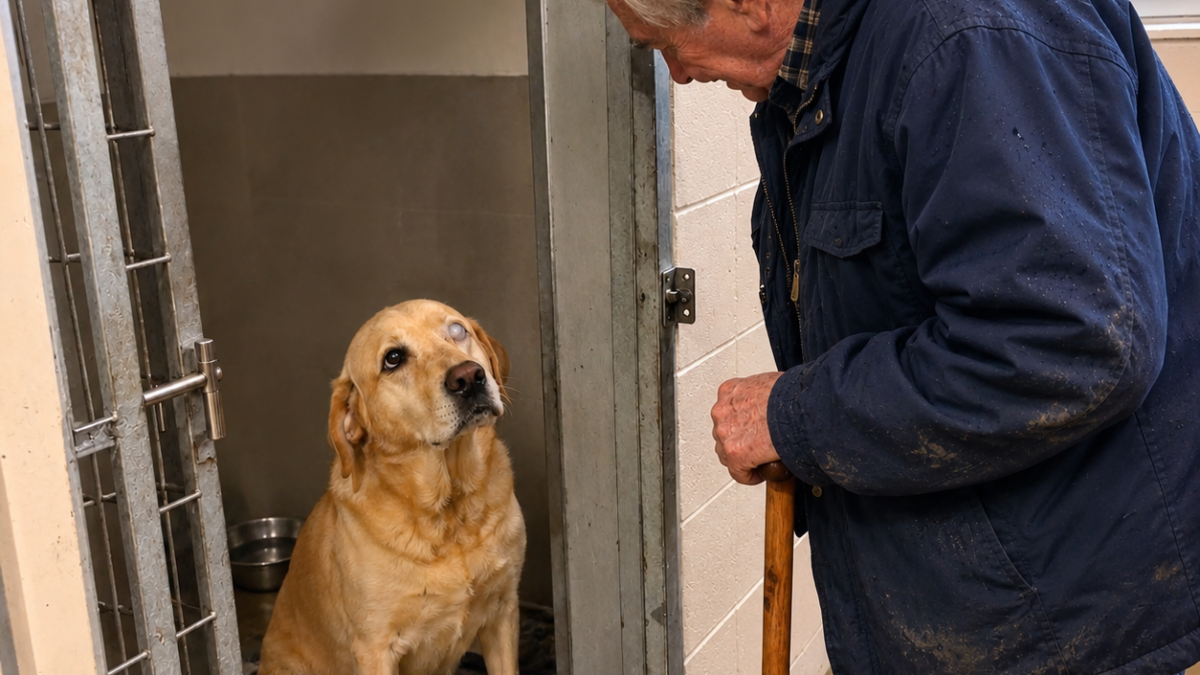
PART 2
For a few seconds, I simply stood there with my key still halfway to the lock.
Rainwater dripped from the edge of the awning behind Harold, and Teddy’s little golden head kept appearing and disappearing behind the car window as he bounced from one side of the seat to the other.
I looked at Harold.
Then at Teddy.
Then back at Harold.
“What happened?”
Harold glanced toward the car.
“He won’t sleep.”
My heart tightened.
“Is he sick?”
“No.”
“Eating?”
“A little.”
“Vomiting?”
“No.”
“Diarrhea?”
“No.”
“Then what—”
“He cries.”
The word came out quietly.
Harold looked older than he had six days earlier.
“He cries at night. He walks from room to room. He goes to the front door and scratches. I thought he needed time.”
I didn’t say anything.
“Then yesterday I washed the blanket you sent home with him.”
The blue one Luna and Teddy had slept on.
Harold swallowed.
“He stood next to the washing machine for forty minutes.”
My eyes burned.
“He’s looking for her.”
“I know.”
That was the first moment I realized Harold had not come back to return Teddy.
At least not in the usual way.
I finally unlocked the shelter.
“Come inside.”
Harold shook his head.
“Not yet.”
“Why?”
He looked through the glass doors.
“I need to ask you something before I take him in there.”
“What?”
“Will she remember him?”
My throat tightened.
“Yes.”
“You’re sure?”
“I’ve never been more sure of anything.”
Harold closed his eyes briefly.
Then he nodded.
“All right.”
I went to the car and opened the back door.
Teddy nearly launched himself into my chest.
“Easy!”
He climbed over my arms, whining, licking my chin.
Then suddenly he stopped.
His ears lifted.
The shelter door was twenty feet away.
From inside the building came a sound.
One bark.
Luna.
Teddy froze.
Another bark.
He exploded.
I barely got his leash secured before he was dragging me across the wet pavement.
Harold followed as quickly as he could with his cane.
“Teddy!”
The puppy didn’t hear him.
Or didn’t care.
I opened the door.
Teddy shot inside.
From the kennel hallway came barking.
Not the normal shelter noise.
Luna.
A deep, desperate bark I had never heard from her before.
I ran behind Teddy.
The moment we rounded the corner, Luna was standing.
For the first time in six days.
Standing.
Her entire body trembled.
Teddy screamed.
It was the only word for the sound.
A high, frantic cry.
Luna slammed both front paws against the kennel door.
I opened it.
Teddy went through before the latch was fully clear.
He crashed into his mother.
Luna lowered her entire body over him.
She licked his face.
His ears.
His back.
Teddy climbed beneath her chest, whining so loudly that two shelter workers came running.
Luna made sounds I had never heard from a Labrador.
Low, broken moans.
Almost human.
Then she lay down.
Teddy curled against her belly.
Exactly where he used to sleep.
Luna closed her good eye.
And for the first time in six days—
she stopped watching the door.
I turned around.
Harold stood at the end of the hallway.
His hand covered his mouth.
He was crying.
—
Dr. Maria arrived twenty minutes later.
She took one look at Luna and Teddy together and didn’t need an explanation.
“Oh.”
That was all she said.
Then she crouched beside them.
Teddy was asleep.
Completely asleep.
Luna’s head rested over his back.
Maria checked Luna’s pulse.
Then smiled.
“Higher.”
I almost laughed.
“Already?”
“Already.”
Harold stood behind us.
“What do I do?”
Maria looked at him.
“What do you mean?”
He pointed toward Teddy.
“I adopted one dog.”
His eyes moved toward Luna.
“Apparently I adopted half a family.”
I smiled.
Maria did too.
Then Harold said:
“I can’t take him away again.”
The smile left my face.
“No.”
“But I don’t know if I can handle two.”
That was honest.
And important.
People sometimes romanticize rescue stories.
They imagine love solves everything.
It doesn’t.
Food costs money.
Veterinary care costs money.
Large dogs need space.
Older dogs need medication.
Harold was sixty-four, lived alone, used a cane, and had adopted a puppy because he believed one small dog would give him companionship.
Now he was looking at a seventy-pound adult Labrador with a blind eye and a medical history we didn’t fully understand.
Maria stood.
“Nobody is asking you to decide this minute.”
Harold looked at Teddy.
“Yes, they are.”
I followed his gaze.
Teddy had one paw draped over Luna’s front leg.
Harold sighed.
“Look at him.”
Maria smiled sadly.
“Yes.”
“He’s going home with her or staying here.”
“Those are probably the healthiest options.”
Harold rubbed his forehead.
“I’m going to need a bigger dog bed.”
I stared at him.
“What?”
He looked at me.
“I’m not separating them.”
“Harold…”
“I said I made a mistake.”
His voice strengthened.
“I’m old, not stupid.”
Maria laughed.
I started crying.
Harold pointed at me.
“Don’t do that.”
“I’m not.”
“You absolutely are.”
“It’s allergies.”
“In November?”
“Very aggressive allergies.”
He looked back at Luna.
“What do I need to sign?”
—
The shelter did not allow same-day adoption of Luna.
We needed a home assessment.
Medical disclosure.
A conversation about her blindness.
A plan for introducing her safely into Harold’s home.
Harold was annoyed by all of it.
“That puppy already lives there.”
“Yes.”
“And she’s his mother.”
“Yes.”
“And she wants to live there.”
“Probably.”
“Then why are we acting like I’m applying for a mortgage?”
“Because the last thing Luna needs is another return.”
That silenced him.
He nodded.
“Fair.”
The home assessment happened the next afternoon.
I went with Maria.
Harold lived in a small one-story brick house near the edge of town.
The yard was fenced.
Not huge.
Enough.
There were two bedrooms.
A wide living room.
A fireplace.
A back porch with three steps.
Harold had already bought a ramp.
“For Luna?”
“For me.”
He looked at us.
“Now we can share.”
The house was quiet.
Too quiet.
You notice that after spending enough time in shelters.
Some homes have noise built into them.
Children.
Televisions.
Phones.
Music.
Harold’s house sounded like a place where someone used to live.
There were framed photographs everywhere.
Harold with a woman around his age.
Young.
Then older.
Travel.
Birthdays.
Christmas.
A wedding photograph from decades ago.
Maria noticed me looking.
“My wife,” Harold said.
“Evelyn?”
He nodded.
“Forty years.”
“I’m sorry.”
“Me too.”
His voice stayed steady.
“She hated dogs.”
I blinked.
Maria laughed.
Harold smiled.
“That surprises people.”
“You adopted Teddy.”
“She hated dogs until she met one.”
He looked toward the back door.
“We had a beagle named Rosie for fourteen years. After Rosie died, Evelyn said she would never get another.”
“Why?”
“Because losing one hurt too much.”
He paused.
“Then Evelyn died anyway.”
The room went quiet.
“So I figured avoiding love wasn’t exactly working.”
That stayed with me.
—
Teddy had already taken over the house.
His toys were everywhere.
A stuffed duck.
A rope.
Two tennis balls.
One chewed slipper that Harold claimed had been “stolen in combat.”
His crate sat beside Harold’s bedroom door.
“Does he sleep there?”
Harold shook his head.
“First night, yes.”
“And now?”
“My bed.”
Maria laughed.
“You lasted one night.”
“He screamed.”
“He trained you.”
“That is unfortunately becoming clear.”
Then Teddy ran toward the hallway.
He stopped in front of a closed guest-room door.
Whined.
Harold’s face changed.
“He does that every night.”
“What’s in there?”
“Nothing.”
I opened it.
Empty bed.
Closet.
A dresser.
Teddy ran inside.
Sniffed under the bed.
Then returned to us.
“He’s searching.”
“For Luna,” Harold said.
“Yes.”
Harold looked toward Maria.
“When can she come?”
Maria said:
“Tomorrow.”
Harold nodded once.
“Good.”
—
Luna left the shelter the next morning.
We gave her a bath first.
Not because Harold cared.
Because I did.
I wanted her to leave clean.
She stood quietly while warm water ran through her coat.
When I washed the left side of her face, my fingers moved over the scar around her blind eye.
She flinched.
Not much.
But enough.
I had seen it before.
I asked Maria again:
“Do you know what caused this?”
“No.”
“Could someone have hit her?”
Maria didn’t answer immediately.
“It could be blunt trauma.”
“Could?”
“Yes.”
“What else?”
“Vehicle. Fence. Fall. Animal attack.”
Luna turned her head toward my voice.
Her good eye found me.
I stroked her cheek.
“Someone did this to you?”
Maria said softly:
“We may never know.”
I wish she had been right.
—
When Harold arrived, Teddy was with him.
Shelter policy normally discouraged bringing recently adopted puppies back so quickly.
We ignored that.
The reunion was smaller this time.
No desperate screaming.
Teddy simply ran to Luna.
Luna licked his forehead.
Then both walked toward Harold.
He crouched as far as his knee allowed.
“Okay.”
He pointed toward them.
“Rules.”
I smiled.
“They don’t understand that speech.”
“I need to hear it.”
He looked at Teddy.
“No chewing furniture.”
Then Luna.
“No knocking me down.”
Then both.
“No taking over the bed.”
Teddy yawned.
Luna leaned against his leg.
Harold sighed.
“None of you are listening.”
I attached Luna’s leash.
Handed it to him.
He looked at me.
“You coming over this week?”
“Do you want me to?”
“No.”
Pause.
“Yes.”
I smiled.
“Wednesday.”
“Bring coffee.”
“Bossy.”
“I’m old.”
“You’re sixty-four.”
“Ancient.”
Teddy barked.
Harold pointed.
“See? He agrees.”
Then they left.
Luna walked beside Harold.
Teddy beside Luna.
No one looked back.
I stood at the shelter entrance until the car disappeared.
That should have been the end.
A mother and her last puppy reunited.
A lonely widower suddenly responsible for two animals he hadn’t planned for.
Happy ending.
But Luna’s story had begun long before she reached us.
And someone from that beginning was about to notice her again.
—
For the first month, everything went better than expected.
Harold sent photos constantly.
Not because he understood how texting worked well.
Because he had apparently decided I needed photographic proof of every event.
Luna sleeping beside the fireplace.
Teddy with his head inside a cereal box.
Luna stealing Harold’s pillow.
Teddy asleep across Luna’s neck.
Harold once sent a completely black image.
I replied:
**What is this?**
He wrote:
**Pocket.**
Then:
**Ignore.**
Two minutes later:
**How delete?**
I laughed for five straight minutes.
Luna gained weight.
Her coat brightened.
Her heart rate normalized.
Most importantly, she stopped waiting at doors.
At least for Teddy.
If he went into the backyard, she followed the sound of his collar.
If Harold took Teddy to the veterinarian, Luna became anxious but didn’t shut down.
Because Harold came back.
Teddy came back.
Again and again.
Predictability became medicine.
—
I visited every Wednesday.
Harold pretended it was because Luna needed follow-up.
It wasn’t.
He was lonely.
So was I, in a different way.
University felt temporary.
The shelter felt real.
Harold’s house became part of my week.
Coffee.
Dog hair.
Arguments about whether Teddy was overweight.
He wasn’t.
Harold simply believed every Labrador was starving unless actively eating.
One Wednesday, I noticed Luna stop near the back fence.
Her body stiffened.
A pickup truck was driving slowly along the road behind the property.
Dark green.
Old.
The moment the engine rattled, Luna crouched.
Tail tucked.
Teddy noticed.
He ran back to her.
Luna pushed him behind her.
My chest tightened.
The truck continued.
Luna remained frozen.
Harold came outside.
“What happened?”
“That truck.”
“What about it?”
“She’s afraid.”
Harold watched it disappear.
“Lots of dogs don’t like trucks.”
“Maybe.”
But something about Luna’s reaction bothered me.
Not general fear.
Recognition.
—
Two weeks later, I was updating shelter intake files when I noticed something in Luna’s original paperwork.
She had been found on a rural roadside twenty-three miles outside town.
Four puppies.
No collar.
No microchip.
A cardboard box.
The officer who picked them up had written:
**Adult female highly protective. Old ocular injury. Evidence of repeated lactation.**
Repeated lactation.
I read it again.
Luna had probably had more than one litter.
Maria looked over my shoulder.
“You’ve read that before.”
“I didn’t notice this.”
“She’s seven.”
“How many litters?”
“Impossible to know.”
“Could she have been used for breeding?”
“Yes.”
“Why didn’t we talk about that?”
“Because suspicion isn’t proof.”
I hated when people said that.
Mostly because they were right.
Then I saw another line:
**Blue nylon rope fragment around rear leg.**
I remembered Luna’s scars.
“Maria.”
“Yes?”
“What kind of operation uses rope around a breeding dog?”
She looked at me.
“Bad ones.”
—
The next development came from social media.
Harold’s daughter, Claire, posted a photo of him with Luna and Teddy.
She lived in another state and had come to visit for Thanksgiving.
The caption said:
**Dad went to adopt one puppy and somehow came home with the puppy’s mom too. Meet Teddy and Luna.**
It spread locally because the shelter shared it.
People loved the story.
Blind mother.
Last puppy.
Old widower.
Reunion.
Then a comment appeared.
Just four words.
**That dog belongs to me.**
The profile name was **Raymond Pike**.
I clicked.
Middle-aged man.
Rural property.
Photos of hunting dogs.
Kennels.
Litters.
Puppies for sale.
My stomach dropped.
One older photograph showed a yellow Labrador.
Same build.
Same white marking beneath the chest.
Both eyes intact.
Caption:
**Daisy, third litter due in spring.**
I stared.
Daisy.
Not Luna.
Maria came over.
“What?”
I turned the screen.
She studied it.
“Could be her.”
“Could?”
“Photos aren’t proof.”
Then we noticed the date.
Four years earlier.
In another photo, the same dog sat beside a green pickup truck.
Old.
Dark green.
The kind Luna had reacted to.
I whispered:
“That’s him.”
Maria frowned.
“Who?”
“The truck.”
—
I called Harold immediately.
He answered:
“Is somebody dead?”
“What?”
“You never call before dinner.”
“Harold, listen to me.”
My tone changed his.
“What happened?”
“Someone commented on Claire’s post claiming Luna belongs to him.”
Silence.
Then:
“No.”
“We don’t know anything yet.”
“No.”
“Harold.”
“You’re not taking her.”
“I’m not.”
“Nobody is.”
“Listen.”
“No.”
He sounded more frightened than angry.
“She waited six days. Teddy nearly stopped eating. Nobody is separating them.”
“I agree.”
“Then why are you calling?”
“Because if this man is connected to her past, we need to know.”
Harold went quiet.
Finally:
“Who?”
“Raymond Pike.”
Long pause.
“I know that name.”
I froze.
“How?”
“Feed store.”
“What?”
“He sells puppies.”
“You’ve met him?”
“Not really. Seen him.”
“Does he drive a green truck?”
“Yes.”
My stomach sank.
Harold said:
“Eli.”
“Yes?”
“Luna is under my kitchen table.”
I closed my eyes.
“The truck?”
“He drove past ten minutes ago.”
—
Harold called the sheriff.
So did the shelter.
Raymond Pike was not allowed onto Harold’s property.
But that didn’t stop him from sending messages.
First to the shelter.
Then Claire.
Then Harold.
He claimed Luna—whom he called Daisy—was one of his breeding dogs.
He said she escaped two years earlier.
He demanded her return.
That part immediately made no sense.
Luna arrived at our shelter less than a year earlier.
If she escaped two years before, where had she been?
Then Pike changed the story.
He said a former employee had taken her.
Then abandoned her.
He insisted the puppies were also genetically connected to his breeding line.
Meaning Teddy.
Harold read the message.
His hands shook.
“He wants Teddy too?”
“He says he owns both.”
Harold laughed once.
Not humor.
“He can come explain that to me.”
“Don’t.”
“I didn’t say I’d invite him politely.”
“Harold.”
“I have a cane.”
“That is not helping.”
He sat down.
Teddy climbed into his lap.
Luna lay beside him.
Harold lowered his voice.
“He’s not getting them.”
“No.”
“You promise?”
I thought about what that word meant.
I couldn’t legally promise.
So I said:
“I promise we fight.”
Harold nodded.
“That’s enough.”
—
The shelter’s attorney got involved.
Animal control opened a review.
We compared Pike’s photographs to Luna.
Same scar-free face in the old photos.
Same body shape.
Same unusual notch in one ear.
Then Maria found something.
A faded tattoo inside Luna’s right thigh.
We had recorded it at intake but never traced it.
Numbers.
Barely legible.
The same numbering system appeared in Pike’s old breeding posts.
**RP-27.**
Luna’s tattoo:
**27.**
That was the first real connection.
Raymond Pike had owned Luna.
Or Daisy.
Whatever name he used.
The question was whether he still had any legal claim after apparently losing or abandoning her.
Then another woman contacted us.
Her name was Megan Shaw.
She had worked for Pike.
Her message said:
**Please don’t give that dog back. He didn’t lose her.**
I read it three times.
Then called her.
—
We met at the shelter after hours.
Megan was thirty-two.
Nervous.
She kept twisting the sleeve of her sweater.
Luna was not there.
I was glad.
Megan looked at the photograph.
“That’s Daisy.”
“What happened?”
She swallowed.
“Ray bred Labs.”
“For hunting?”
“Some. Mostly puppies.”
“How often?”
“Too often.”
Megan said Luna had produced at least four litters.
Maybe five.
Pike bred her again before she fully recovered from previous pregnancies.
He kept several females in outdoor runs.
Medical care was minimal.
If a dog had complications, he treated them only if the dog remained profitable.
My stomach turned.
“What happened to her eye?”
Megan went pale.
I knew.
“What?”
“It wasn’t an accident.”
Maria sat beside me.
“Tell us.”
Megan looked at the floor.
“One winter, Daisy got out of her run.”
“How?”
“Gate latch broke.”
“She ran?”
“No.”
“She went to another kennel.”
“Why?”
“Her puppies were there.”
I stopped.
“What do you mean?”
Pike had separated one of Luna’s earlier litters at five weeks.
Too early.
He moved them to another building to prepare them for sale.
Luna escaped her run and tried to get to them.
Pike found her scratching at the kennel door.
He got angry.
“What did he do?”
Megan started crying.
“He hit her with the end of a catch pole.”
Maria inhaled sharply.
“On the face?”
“Yes.”
“Did the eye rupture?”
“I don’t know. It swelled. There was blood.”
“Veterinarian?”
“No.”
My hands went cold.
Megan continued.
“The eye went cloudy over the next few weeks.”
Luna had lost vision because she tried to reach her puppies.
The same dog who waited six days for Teddy.
It wasn’t new.
That was who she had always been.
A mother who did not understand how to stop waiting for her babies.
I had to look away.
—
“What happened before we found her?” I asked.
Megan wiped her eyes.
“The last litter went badly.”
“Teddy’s litter?”
“Probably.”
“How many?”
“Six.”
I froze.
“We found four.”
Megan nodded slowly.
“Two died.”
“How?”
“One was stillborn.”
“And the other?”
She said nothing.
Maria asked softly:
“Megan?”
“Ray wouldn’t pay for emergency care.”
The puppy faded over two days.
Luna stayed beside it.
Pike called her useless because she became difficult to breed and the injured eye made her harder to sell as an adult.
“What did he do?”
Megan looked at me.
“He told one of the guys to take her and the puppies somewhere.”
“Where?”
“I don’t know.”
“Did you see them leave?”
“Yes.”
“Alive?”
“Yes.”
“All four?”
“Yes.”
So Luna had not escaped.
She had been discarded.
With four puppies.
Raymond Pike now wanted her back because her story had gone viral.
Or because Teddy had become valuable.
Or because admitting abandonment could expose everything.
Maybe all three.
—
Megan agreed to give a formal statement.
That was the beginning of Pike’s problems.
Not the end.
He denied everything.
Claimed Megan was disgruntled.
Claimed Luna had been stolen.
Claimed old breeding records were incomplete.
Claimed he had searched for her.
No missing-dog reports existed.
No shelter calls.
No social posts.
No police report.
Nothing.
Then the shelter found something buried in our intake evidence bag.
A torn feed sack collected from the roadside where Luna and the puppies were found.
Brand.
Batch number.
Store code.
The feed store confirmed the sack had been sold locally.
Hundreds of bags.
Not enough.
But the lot was a specialty high-calorie breeding formula.
Pike’s account showed regular purchases.
Still not enough.
Then Megan remembered the employee.
The man who drove Luna away.
His name was Travis Bell.
He had quit months later.
Animal control found him.
At first, he refused to speak.
Then Pike publicly accused him of stealing Luna.
That made Travis angry.
Angry witnesses remember things.
—
Travis came in with an attorney.
He admitted driving Luna and the four surviving puppies.
Pike had told him to “get rid of them.”
“Where?”
“The county line.”
“Did he say shelter?”
“No.”
“Rescue?”
“No.”
“What exactly did he say?”
Travis looked uncomfortable.
“Take them somewhere they won’t come back.”
I felt sick.
“What did you do?”
“I drove until I found a road.”
“And left them?”
“Yes.”
“With food?”
“A bag.”
“Water?”
“Bucket.”
“Shelter?”
“Cardboard box.”
“You left a half-blind nursing dog and four puppies beside a rural road?”
He looked at me.
“I know how it sounds.”
“How it sounds?”
Maria touched my arm.
I stopped.
Travis said:
“I thought somebody would find them.”
“That was your plan?”
“No.”
“Then what was your plan?”
He had no answer.
The lawyer spoke instead.
Travis would cooperate.
That was how the legal world works sometimes.
People tell the truth only after truth becomes safer than silence.
I hated it.
But I accepted it.
Because Luna needed evidence more than I needed moral purity.
—
Pike’s ownership claim collapsed.
A person cannot easily demand property he ordered an employee to abandon.
But the cruelty investigation expanded.
Animal control obtained a warrant for Pike’s property.
We weren’t allowed there.
I was glad.
Then Maria received a call.
She went quiet.
“What?”
“They found dogs.”
“How many?”
“Twelve.”
My stomach dropped.
“Condition?”
“Mixed.”
“What does that mean?”
“Some okay. Some not.”
Two females were severely underweight.
One had untreated ear infections.
Another had a mammary mass.
Three dogs showed scars consistent with restraint.
One young Labrador had a healing leg injury.
All were removed pending investigation.
Pike was furious.
He called it government theft.
He blamed Megan.
Travis.
The shelter.
Me.
Harold.
Anyone except himself.
Then he made a mistake.
He came to Harold’s house.
—
It was after dark.
I was there.
Wednesday coffee.
Teddy had grown.
No longer a round puppy.
Still clumsy.
Luna slept near Harold’s chair.
A truck slowed outside.
Luna woke immediately.
Her body changed.
She stood.
Ears back.
Then the engine stopped.
Harold looked toward the window.
“Stay inside.”
I said:
“You stay inside.”
“My house.”
“Exactly.”
He grabbed his cane.
I grabbed my phone.
The porch camera turned on.
Knock.
Three hard hits.
Harold opened the interior door but kept the storm door locked.
Pike stood outside.
I recognized him from photos.
Broad shoulders.
Work jacket.
Face red with anger.
“Where’s my dog?”
Harold looked almost bored.
“Which one?”
“Daisy.”
“No Daisy here.”
“You know exactly what I mean.”
Harold stepped closer to the glass.
“Luna lives here.”
“She’s mine.”
“She was yours.”
Pike’s face changed.
Tiny.
But there.
“You people don’t know anything.”
“I know enough.”
He saw me.
“You.”
I raised my phone.
“Smile.”
He swore.
Then pointed at me.
“You ruined my business.”
“No.”
My hands were shaking but my voice wasn’t.
“You did.”
Luna appeared behind Harold.
Pike saw her.
“Daisy.”
Luna froze.
Her tail disappeared beneath her.
Teddy immediately moved in front of her.
A young dog.
Still barely grown.
Standing between his mother and the man who hurt her.
Pike smiled.
“See? She knows me.”
Harold said quietly:
“Fear isn’t ownership.”
That was the best thing I ever heard him say.
Pike grabbed the storm-door handle.
Locked.
Harold didn’t move.
“You touch that door again,” he said, “and the police report gets more interesting.”
Pike laughed.
“Old man, you can barely stand.”
Harold lifted his cane.
“I only need one good swing.”
“Harold.”
He glanced at me.
“I said need. Not will.”
Police lights appeared behind Pike’s truck.
I had called before Harold opened the door.
Pike turned.
His confidence changed.
Fast.
Deputies ordered him off the porch.
He argued.
Claimed Luna was stolen.
Then Teddy barked.
Pike shouted:
“Shut that mutt up!”
Luna flinched.
Harold’s face hardened.
Deputies moved closer.
Pike finally backed down.
Before they took him away from the property, he shouted:
“That dog was useless before I dumped her and she’s useless now!”
Silence.
Absolute silence.
Even he realized it.
One deputy said:
“Before you what?”
Pike’s face drained.
Harold slowly looked at me.
I looked at the porch camera.
Still recording.
Pike tried to recover.
“I meant before she was dumped.”
“That isn’t what you said.”
“I misspoke.”
Maybe.
But paired with Travis’s statement and Megan’s testimony, it mattered.
He had just publicly tied himself to the abandonment.
Arrogance does what evidence sometimes can’t.
It makes people talk.
—
The court issued a protective order.
Pike was prohibited from approaching Harold, Luna, Teddy, or the shelter during the case.
His dogs remained in protective custody.
Some people in town defended him.
That surprised me.
They said he had bred dogs for years.
That he loved animals “in his own way.”
That activists exaggerated.
That working dogs aren’t pets.
That breeding is a business.
All true or partly true in the abstract.
None explained untreated injuries.
None explained Luna’s eye.
None explained abandoned puppies.
Cruelty does not become care because someone earns money from it.
—
The case dragged on for months.
Luna healed during that time.
Not physically.
Her eye remained blind.
The scar stayed.
But fear loosened.
The green-truck sound stopped making her hide after Pike’s truck was impounded and no longer passed the house.
She learned Harold’s routines.
Breakfast at six.
Walk at seven.
Nap after lunch.
Teddy’s chaos at every hour.
Harold became stronger too.
That surprised everyone.
Walking two dogs forced him outside.
His doctor told him his mobility had improved.
He complained.
“Now everybody expects me to live longer.”
I told him:
“Terrible.”
“Exactly.”
One afternoon I found him in the backyard throwing a tennis ball for Teddy.
Luna lay in the shade.
Harold threw badly.
Teddy chased anyway.
“You’re terrible at this.”
“I have a cane.”
“You’re using the other arm.”
“Respect your elders.”
“You’re not that old.”
“I become older when convenient.”
Luna lifted her head.
Harold smiled.
“See? She understands.”
—
Then came the moment that changed Harold completely.
He fell.
Not badly.
But enough.
He had gone to the kitchen at night.
His cane slipped.
He hit the floor.
Teddy panicked.
Luna didn’t.
She stood over Harold.
Licked his face.
Then walked to the bedroom door and barked.
Again.
Again.
Harold lived alone.
No one was there.
So Luna returned.
He tried to stand.
Couldn’t.
Luna crouched beside him.
Harold put one hand on her back.
Used her for balance only briefly, enough to reach a chair.
Then his cane.
He got up.
The next morning he called me.
“I think your broken dog saved my hip.”
“Broken?”
His voice changed.
“I didn’t mean—”
“I know.”
Pause.
“Eli.”
“Yes?”
“She’s not broken.”
“No.”
“I know that.”
“I know.”
He was quiet.
“The woman who said she wasn’t complete…”
“I remember.”
“She was an idiot.”
I smiled.
“Yes.”
Harold cleared his throat.
“Good. Wanted to confirm.”
—
The family who had rejected Luna saw the news story months later.
The story had grown.
Blind Labrador waits six days for puppy.
Widower adopts both.
Former breeder investigated.
They contacted the shelter.
Not to apologize at first.
They wanted to know whether Luna was “available again” if Harold became unable to care for her.
I stared at the email.
Then laughed.
Maria asked:
“What?”
I showed her.
She read.
Her face went blank.
Then:
“No.”
“That’s all?”
“No.”
I wanted to write more.
A lot more.
Maria took the keyboard away.
“You are emotionally compromised.”
“They called her incomplete.”
“And now they want her because she’s famous.”
“Exactly.”
“So we respond professionally.”
I folded my arms.
“You’re boring.”
“Yes.”
The shelter replied:
**Luna has been permanently adopted and is not available.**
That should have been enough.
But the family came to an adoption event weeks later.
The mother recognized me.
She approached awkwardly.
“We didn’t understand.”
I looked at her.
“Understand what?”
“Luna.”
She glanced toward a poster of Luna and Teddy.
“My children saw the story.”
I waited.
“We handled that badly.”
“Yes.”
She looked surprised by my directness.
“I’m sorry.”
I studied her.
The angry part of me wanted to say something cruel.
Then I thought about Luna.
Luna didn’t need this woman humiliated.
She was home.
So I said:
“I hope next time you meet an animal with a disability, you don’t confuse different with less.”
The woman nodded.
“I won’t.”
That was enough.
Not all revenge needs an audience.
Sometimes the correction is the point.
—
The criminal case finally moved toward trial.
Pike rejected the first plea deal.
He insisted he had done nothing wrong.
Then prosecutors obtained veterinary records.
Not Luna’s.
Other dogs.
Megan had once taken a female Labrador to a clinic secretly because of a uterine infection.
Pike refused recommended surgery.
The dog disappeared two weeks later.
Another employee testified that Pike had sold puppies before eight weeks.
A buyer produced messages complaining that a puppy arrived sick.
Pike replied:
**Once it leaves here, it’s your problem.**
More buyers came forward.
Skin disease.
Parasites.
Genetic issues.
No health records.
The pattern mattered.
Then Maria reviewed photographs from the seized property.
One image stopped her.
A metal catch pole.
Bent.
Older.
Rust near the hook.
Megan identified it.
The same kind used when Luna was struck.
Could anyone prove it was the exact tool?
No.
But prosecutors didn’t need one dramatic object.
They had witnesses.
Records.
Abandonment testimony.
Pike’s own porch statement.
The seized dogs’ conditions.
Enough pieces.
Truth is usually a mosaic.
—
Harold wanted to attend every hearing.
I told him not to.
His knee hurt.
Court benches were awful.
He went anyway.
Teddy stayed with me.
Luna stayed with Harold’s daughter when necessary.
The first time Pike saw Harold in court, he smirked.
Harold smiled back.
I asked:
“What was that?”
“What?”
“That smile.”
“Polite.”
“You looked like you were imagining murder.”
“Eli.”
“Yes?”
“I am a respectable senior citizen.”
“You threatened him with a cane.”
“I threatened the door with a cane.”
“That’s not what happened.”
“History is written by survivors.”
I laughed so loudly the bailiff glared at us.
—
Megan testified.
That was hard.
Pike stared at her.
She shook.
The prosecutor asked:
“Why didn’t you report him earlier?”
Megan looked toward the jury.
“Because I needed the job.”
“Did that make what you saw acceptable?”
“No.”
“Why speak now?”
Her eyes moved toward a photograph of Luna.
“Because she survived.”
Silence.
“If she hadn’t?”
Megan swallowed.
“I probably would’ve kept telling myself it wasn’t my business.”
That honesty mattered.
Then she described the eye injury.
The litters.
The puppies.
The order to remove Luna.
Pike’s attorney attacked her credibility.
Disgruntled employee.
No report.
No photograph of the strike.
No veterinary record.
Megan almost broke.
Then the attorney asked:
“Isn’t it true you’re here because you hate my client?”
Megan looked at Pike.
“No.”
“Then why?”
She answered:
“Because I hate who I was when I stayed quiet.”
The room became still.
Even Pike looked away.
—
Travis testified next.
He admitted leaving Luna and the puppies.
The prosecutor asked:
“Why?”
“Ray told me to.”
“You knew it was wrong.”
“Yes.”
“And did it anyway.”
“Yes.”
“Why?”
Travis looked toward Pike.
“Because he paid me.”
That was ugly.
But useful.
He described the cardboard box.
The feed.
The road.
The four puppies.
Then the prosecutor asked:
“What did Mr. Pike say before you left?”
Travis took a breath.
“He said, ‘Don’t bring that half-blind bitch back.’”
Harold’s hand closed around mine.
I looked at him.
His jaw was tight.
The prosecutor asked:
“Why?”
“Because he said she wasn’t worth feeding.”
That sentence became the heart of the case.
Not worth feeding.
Luna.
The dog who waited six days without her puppy.
The dog who helped Harold off the floor.
The dog who had nursed litter after litter.
Not worth feeding.
—
I testified too.
I hated it.
I described Luna’s condition.
Teddy.
The six days.
The family rejecting her.
Harold returning.
Pike’s claim.
The truck.
The porch.
His words.
Pike’s attorney tried to portray me as emotional.
He succeeded easily.
“Ms. Carter, you are attached to Luna.”
“Yes.”
“Very attached.”
“Yes.”
“So your perception may be biased.”
“Yes.”
He looked pleased.
Then I added:
“That’s why we have veterinary records, shelter records, two former employees, video, photographs, and your client’s own recorded statement.”
The prosecutor hid a smile.
The judge said:
“Ms. Carter, answer only the question.”
“Sorry.”
I wasn’t.
—
Maria testified as an expert.
She described Luna’s eye.
Old trauma.
Untreated.
Likely painful when it happened.
She described repeated breeding.
Body condition at intake.
Mammary changes.
Dental wear.
Scars.
The defense asked whether every injury could be conclusively linked to Pike.
“No.”
“Then you cannot say he caused the blindness.”
“Not from the eye alone.”
“Thank you.”
Maria didn’t move.
The prosecutor stood for redirect.
“Doctor, if a witness testified that she observed Mr. Pike strike Luna near the eye, would Luna’s injury be consistent with that account?”
“Yes.”
“Could untreated blunt trauma cause permanent blindness?”
“Yes.”
“Was Luna’s injury treated promptly?”
“No evidence of it.”
“Could repeated breeding without adequate recovery harm a dog?”
“Yes.”
“How?”
Maria explained.
No drama.
Just science.
Sometimes calm truth is more devastating than anger.
—
The jury deliberated for almost six hours.
Harold and I sat in the hallway.
He ate crackers from a vending machine.
I paced.
“You’re making me nervous.”
“You’re eating crackers.”
“Yes.”
“How?”
“With my mouth.”
“Harold.”
He smiled.
“Teddy does this.”
“What?”
“Paces when he wants something.”
“Great.”
“You should eat more.”
“I will throw your crackers away.”
“Hostile youth.”
Then the bailiff called us.
Verdict.
Guilty on multiple counts.
Animal cruelty.
Abandonment.
Neglect.
Record violations.
Not every charge.
Enough.
Harold closed his eyes.
I expected triumph.
Instead, he whispered:
“Good.”
Just that.
Good.
—
At sentencing, rescued dogs’ conditions were described.
Families spoke.
Megan spoke.
Then Harold asked to speak.
I didn’t know he planned to.
He walked slowly to the front with his cane.
Pike did not look at him.
Harold said:
“I am not Luna’s first owner.”
Pause.
“I hope I am her last.”
The judge watched.
“When I adopted Teddy, I thought I was bringing home a puppy because my house was too quiet after my wife died.”
He smiled faintly.
“I was wrong.”
He looked at Pike.
“I brought home a family.”
Pike stared at the table.
“You called Luna useless.”
Another pause.
“She wakes me every morning. She makes me walk when I’d rather sit. She helped me stand when I fell. She raised Teddy. She teaches every person who meets her that losing one eye does not make a life half as valuable.”
Harold’s voice broke slightly.
“And the thing I find most difficult to understand is that you had years with her and somehow never learned any of that.”
The courtroom was silent.
He returned to his seat.
I was crying.
He leaned toward me.
“Allergies?”
I laughed through tears.
“Shut up.”
—
Pike received jail time, probation afterward, substantial fines, and a long-term prohibition on owning, breeding, selling, or working with animals under the court’s orders.
His breeding operation closed.
The dogs removed from his property were permanently surrendered or forfeited.
Most were adopted.
The female with the mammary mass received surgery.
The young Labrador with the leg injury healed.
One elderly dog went into hospice foster care and spent his final months on a couch.
That one mattered to me.
Pike appealed parts of the case.
Some financial issues took longer.
But he never regained Luna.
He never regained Teddy.
He never rebuilt the operation.
He lost access to the living things he had treated like inventory.
That was the only punishment I truly cared about.
—
After court, reporters waited outside.
Luna and Teddy were not there.
Harold had refused.
“They are dogs, not props.”
I agreed.
One reporter asked:
“Do you feel like Luna got revenge?”
I almost said yes.
Then thought about it.
“No.”
The reporter seemed disappointed.
“Why not?”
“Because revenge would mean her life is still about him.”
I looked toward Harold.
“Her life isn’t.”
That answer became the headline anyway.
But I meant it.
Pike was part of Luna’s past.
Not her identity.
Her real revenge was ordinary.
Breakfast.
Teddy.
Harold.
Sunlight.
The right to sleep without listening for kennel gates.
The right to age.
The right to be useless if she wanted.
Animals should not have to earn safety by proving value.
That lesson took me longer than it should have.
—
Luna became famous locally.
Not huge.
Enough.
Children sent drawings.
One showed her wearing an eye patch like a pirate.
Harold framed it.
Another wrote:
**LUNA IS COMPLETE.**
That one went above his fireplace.
The family who once rejected her saw it during an adoption event.
The mother cried.
I didn’t enjoy that.
I thought I would.
Instead, I felt tired.
She said:
“My daughter made something.”
A little girl stepped forward.
She held a drawing.
Luna.
One eye golden.
The blind eye drawn as a silver star.
Below it:
**SHE SEES WITH LOVE.**
That was sentimental.
A little too sentimental.
I loved it anyway.
Harold put that one beside the first.
—
Teddy grew into a huge Labrador.
Far larger than expected.
Harold complained constantly.
“That puppy was supposed to stay small.”
“No Labrador stays small.”
“He committed fraud.”
“You adopted a Labrador.”
“He was eight pounds.”
“Temporary condition.”
Teddy eventually outweighed Luna.
Still slept beside her.
Still touched her when resting.
Still checked if she was nearby.
But the desperation faded.
He learned he could leave the room.
She learned he came back.
Sometimes Harold took Teddy alone to the park.
Luna stayed home with me.
No panic.
No waiting at the door for six days.
Healing.
Not forgetting.
Learning.
—
I graduated university two years later.
Harold came to the ceremony.
So did Claire.
Luna and Teddy obviously couldn’t attend inside.
They waited at Harold’s house.
Afterward, I went there still wearing my graduation gown.
Harold had bought a cake.
It said:
**CONGRATS ELI**
The bakery spelled my name right.
A miracle.
Teddy tried to eat the corner.
Luna stepped on my gown.
Harold raised a glass.
“To the most stubborn shelter worker I know.”
“I’m not a shelter worker anymore.”
He frowned.
“What?”
I smiled.
“I got hired.”
Full-time animal welfare coordinator.
His eyes widened.
“Here?”
“Yes.”
He started crying.
Then denied it.
“Allergies,” I said.
“Very aggressive.”
—
My job changed because of Luna.
Not officially.
Internally.
Before her, I had believed rescue was mostly about getting animals adopted.
After Luna, I understood placement mattered more than speed.
The right home.
The whole history.
Bonded animals.
Mothers.
Seniors.
Disabled dogs.
Trauma.
We changed intake questions.
Behavior notes.
How we described disabilities.
We stopped saying “special needs” as if it meant lesser value.
We wrote exactly what the animal needed.
Luna’s file became training material.
Not because every mother dog needs to remain with a puppy.
They don’t.
Because the lesson was about observing the actual animal.
Not assuming.
Luna had been telling us what Teddy meant.
We almost missed it.
—
Harold aged.
Slowly.
His cane became a walker.
Then sometimes a wheelchair for longer distances.
Luna aged beside him.
Her face whitened.
Her hearing faded.
The right eye—the good one—developed cataracts.
That frightened me.
“If she loses the other eye?”
“She may.”
Maria examined her.
“Can she handle it?”
“Yes.”
Harold said:
“She already has Teddy.”
Maria smiled.
“And you.”
He waved that off.
“I’m mostly furniture.”
Luna rested her head on his knee.
“See?” I said.
“Furniture.”
—
By eleven, Luna’s vision worsened significantly.
She could still see light and shapes.
Not much more.
We rearranged Harold’s house.
Furniture stayed fixed.
Rugs marked doorways.
Water bowls always in the same place.
Teddy became her guide without training.
He walked slightly ahead.
She followed his scent and tags.
If she bumped into something, he stopped.
Waited.
Harold watched them one afternoon.
“Funny.”
“What?”
“I adopted him because I thought he needed me.”
He looked at Luna.
“Then I adopted her because he needed her.”
He smiled.
“Now I think they mostly adopted me.”
That was true.
—
Then Harold got sick.
Not suddenly.
Heart failure.
Manageable at first.
Medication.
Diet.
Appointments.
He hated all of it.
“Doctors are obsessed with keeping people alive.”
“That’s literally their job.”
“Inconvenient.”
Luna became even more attached to him.
She slept beside his recliner.
Teddy near the door.
One winter evening Harold was admitted to the hospital for three days.
Luna stopped eating after the first.
My heart dropped.
Not again.
I stayed at the house.
Claire came.
We brought one of Harold’s sweaters.
Luna slept on it.
Teddy paced.
Day two.
Still little food.
Then Harold called on video.
I held the phone.
“Hey, troublemakers.”
Teddy barked.
Luna’s ears lifted.
Harold laughed.
“I’m coming home.”
Luna walked toward the phone.
Pressed her nose against the screen.
Harold went quiet.
Then:
“I mean it.”
He came home the next day.
Luna ate dinner.
Every bite.
Some bonds are simply physical.
—
Harold lived another three years.
Longer than doctors predicted.
He blamed the dogs.
“They won’t let me die.”
“Good.”
“Debatable.”
He still made coffee every Wednesday when I visited.
We talked about shelter cases.
His late wife.
My work.
Claire’s children.
Life.
Luna slept nearby.
Teddy eventually developed arthritis.
All three of them became old together.
There was something beautiful about it.
No one pretending time wasn’t moving.
Just adjusting.
Slower walks.
Softer beds.
More medication.
More naps.
—
Luna’s final illness came first.
Kidney disease.
Then worsening arthritis.
She was almost thirteen.
Old for a Labrador who had lived the life she had.
We managed it.
Fluids.
Medication.
Food changes.
Good months.
Then fewer.
Harold knew before I did.
One Wednesday I arrived.
Luna was on her bed.
Teddy beside her.
Harold said:
“She didn’t eat.”
I sat.
“For how long?”
“Yesterday.”
“Water?”
“Some.”
Maria came.
Bloodwork.
Numbers bad.
We had options.
None good.
Harold asked:
“Pain?”
“Discomfort.”
“Can we make her comfortable?”
“For a little while.”
“How long?”
Maria didn’t answer immediately.
Harold looked at Luna.
Then Teddy.
“I don’t want to wait until she’s frightened.”
That was the right decision.
The hardest right decision.
—
We chose Saturday.
Claire came.
I came.
Maria came.
Teddy obviously stayed.
Luna lay on her favorite blanket near the fireplace.
The framed drawing above her:
**LUNA IS COMPLETE.**
I almost couldn’t look at it.
Harold sat beside her.
His walker nearby.
Teddy lay with his head across Luna’s paws.
Luna’s eyes were almost completely blind by then.
But she knew everyone by scent.
She knew me.
She licked my wrist.
I started crying immediately.
Harold said:
“Allergies.”
I laughed.
“Shut up.”
He stroked Luna’s head.
“You know something?”
Luna breathed slowly.
“First time I saw Teddy, I thought he was what I needed.”
He looked at me.
“Then I came back here and found out he came with instructions.”
Teddy lifted his head.
Harold smiled.
“Mother included.”
Claire cried.
Harold continued.
“You waited six days.”
His voice broke.
“For him.”
Luna’s ear moved.
“And he waited for you.”
Harold bent lower.
“I’m sorry anybody ever made you feel disposable.”
My chest tightened.
“But you weren’t.”
He touched the scar beside her blind eye.
“You weren’t incomplete.”
A breath.
“You weren’t useless.”
Another.
“You were expensive.”
We all laughed through tears.
Harold smiled.
“Very expensive.”
Teddy licked Luna’s face.
Harold whispered:
“Worth every dollar.”
Maria gave the first medication.
Luna relaxed.
Her head settled against Teddy.
Teddy sniffed her.
Then remained still.
Harold placed his hand over Luna’s front paw.
“I’ve got him.”
My throat closed.
The sentence mattered.
Luna had spent years guarding puppies.
Searching.
Waiting.
Protecting.
Harold said it again.
“I’ve got Teddy.”
Her breathing slowed.
“You don’t have to wait anymore.”
The final medication entered.
Teddy stayed touching her.
Harold kept his hand on her paw.
I touched her shoulder.
Claire stroked her back.
Luna took one last soft breath.
Then nothing.
No kennel.
No road.
No man calling her useless.
Home.
—
Teddy stayed beside Luna’s body for almost an hour.
He sniffed.
Licked her ear.
Walked away.
Came back.
Then finally lay down near Harold’s feet.
He understood something.
Not in our language.
Enough.
The next morning he searched the house.
That hurt.
But he ate.
Harold sat beside him.
“Good.”
Teddy looked toward Luna’s empty bed.
Harold did too.
“You and me now.”
Teddy rested his chin on Harold’s knee.
It was not the same.
Nothing should be.
Love after loss isn’t replacement.
It’s continuation.
—
Luna’s ashes stayed with Harold.
In a simple wooden urn.
On the shelf beneath the drawing:
**LUNA IS COMPLETE.**
Beside it, Harold placed a photograph.
Luna with all four puppies at the shelter.
Mocha.
Biscuit.
Spark.
Teddy.
The only photograph we had of them all together.
Months later, the other puppy families brought their dogs for a reunion.
The three puppies were adults.
Huge.
Golden.
Ridiculous.
Teddy recognized them by scent.
Maybe.
Maybe not.
They played anyway.
We took another photograph.
Four grown dogs.
Luna absent physically.
Everywhere otherwise.
—
Pike completed his sentence years later.
I heard he moved.
Never bred again legally.
I stopped caring where he went.
That surprised me.
There had been a time I imagined satisfaction in knowing he was miserable.
Then Luna died.
And I realized her story was too large to end with him.
Pike got a few paragraphs.
Luna got years.
Harold.
Teddy.
My career.
The shelter changes.
Children who learned disabled dogs were complete.
Families who adopted older mothers because of her.
That is the revenge people like Pike never understand.
They think power is the ability to hurt.
Real defeat is becoming irrelevant to the life you tried to reduce.
—
Harold died two years after Luna.
Peacefully.
At home.
Claire found him in his recliner one morning.
Teddy was lying beside him.
Not panicking.
Not barking.
Just there.
Like Luna had taught him how to stay.
Claire called me.
I drove over.
Teddy met me at the door.
He was gray now.
Old himself.
I sat on the floor.
He leaned against me.
I cried into his neck.
“Again?”
He didn’t answer.
Dogs are terrible conversationalists.
Excellent company.
Harold’s will was simple.
Claire inherited the house.
Teddy—
to me.
I laughed when the lawyer read it.
Then cried.
Of course.
Harold had written a note.
**Eli, you started this mess. You finish it.**
Below:
**Also Teddy steals socks. Don’t believe him.**
That was Harold.
Even dead.
Annoying.
—
Teddy came home with me.
My apartment was smaller than Harold’s house.
He didn’t care.
I placed Luna’s urn on a shelf.
Harold’s daughter said I should take it.
“She belongs with Teddy.”
So I did.
Teddy sniffed the urn once.
Then lay beneath it.
The first night, he slept beside my bed.
Just like he had slept beside Luna.
Then Harold.
Then me.
Love moves.
It doesn’t disappear.
—
Teddy lived another three years.
He became a shelter ambassador.
Not officially.
He came with me to quiet adoption events.
Children loved him.
He leaned against nervous people.
He had no idea he was part of a famous story.
That was good.
One day a little boy noticed the framed photograph on my desk.
Luna.
Blind eye.
Teddy as a puppy.
“Who’s that?”
I said:
“His mom.”
“Where is she?”
“Gone.”
The boy looked at Teddy.
“Is he sad?”
I thought about it.
“Sometimes.”
“Then why is he happy?”
Children.
Always dangerous.
I smiled.
“Because both can be true.”
He accepted that immediately.
Adults struggle more.
—
The shelter eventually created a program for mother dogs and bonded family groups.
Not every family needed to stay together.
Sometimes separation was healthy and normal.
But we stopped assuming it automatically.
We evaluated.
Observed.
Listened.
Luna changed that.
A plaque went up in the maternity wing:
**LUNA’S ROOM**
Below:
**LOVE IS NOT A DEFECT. DISABILITY IS NOT INCOMPLETENESS. PAY ATTENTION TO WHAT THE ANIMAL IS TELLING YOU.**
Harold would have hated the length.
He believed plaques should be brief.
I didn’t care.
—
Years later, the mother who once called Luna incomplete returned.
She came alone.
Older.
She stood in front of the plaque for a long time.
Then found me.
“I wanted to say something.”
I waited.
“My daughter volunteers at a rescue now.”
I smiled.
“The one who drew the picture?”
“Yes.”
“She remembers Luna.”
“So do I.”
The woman looked ashamed.
“I think about what I said.”
I didn’t rescue her from the discomfort.
Some discomfort is useful.
Finally:
“I was afraid.”
“Of what?”
“Responsibility.”
She looked toward the maternity wing.
“I saw the blind eye and imagined vet bills, problems, my children being sad.”
She swallowed.
“And I called that incomplete because it was easier than saying I was scared.”
That was honest.
I respected it.
“I’m sorry.”
“Thank you.”
“Do you forgive me?”
I thought about Luna.
I said:
“This isn’t mine to forgive.”
She nodded.
Then smiled sadly.
“That makes sense.”
Before leaving, she donated to Luna’s Room.
No announcement.
No plaque.
Just money.
I liked that more than an apology speech.
—
When Teddy’s final day came, I knew exactly what to do because Luna had taught me.
He was sixteen.
An extraordinary age.
His body simply wore out.
Arthritis.
Heart disease.
Kidneys.
Too many systems tired at once.
He stopped enjoying food.
That was the line.
Labs do not casually reject food.
Maria had retired by then, but she came anyway.
“Wouldn’t miss this.”
We laid Teddy on the same blue blanket Harold brought back to the shelter all those years earlier.
Yes.
I kept it.
Faded.
Thin.
Still soft.
I placed Luna’s urn nearby.
Harold’s photograph too.
Three lives tied together.
I sat on the floor.
Teddy’s head in my lap.
Maria beside me.
Claire on video because she couldn’t travel in time.
I stroked his face.
“You were supposed to be one puppy.”
His tail moved weakly.
“You caused a lot of trouble.”
Another movement.
“You made an old man adopt your mother.”
He sighed.
“You made me fight a breeder.”
Maria laughed softly.
“You made me stay at that shelter.”
That part was true.
There were years I almost left animal welfare.
Burnout.
Low pay.
Loss.
Teddy and Luna reminded me why I stayed.
I whispered:
“You were worth every mess.”
The first medication relaxed him.
I looked at Luna’s urn.
Then Harold’s photo.
“I’m going to say something stupid.”
Maria said:
“When has that stopped you?”
I smiled through tears.
I bent close to Teddy.
“You don’t have to look for them.”
His breathing slowed.
“If there’s somewhere they are…”
Another breath.
“They already know you’re coming.”
I didn’t know whether I believed that.
I wanted to.
Sometimes wanting is enough.
The final medication entered.
Teddy’s head became heavy in my lap.
I whispered:
“Your mom waited six days.”
My voice broke.
“You waited a lifetime.”
Another breath.
“You can go.”
Then he was still.
—
After Teddy died, I placed his ashes beside Luna’s.
Harold’s daughter gave me one of his old photographs.
Harold sitting in his backyard.
Luna beside his chair.
Teddy sprawled across his feet.
On the back Harold had written:
**Apparently I needed both.**
I framed it.
It sits in my office now.
New volunteers always ask.
I tell them the story.
Not every detail.
Usually this:
A blind Labrador came in with four puppies.
Three left.
The last one left.
She waited by the door for six days.
The man who adopted the last puppy came back.
He realized the puppy needed his mother.
Then he realized maybe he needed her too.
That is enough for most people.
For the volunteers who stay longer, I tell the rest.
The breeder.
The injury.
The abandonment.
The court.
Harold.
The deaths.
The years.
Because rescue work is not made of one miracle.
It is made of what happens after the photograph.
After the viral moment.
After the reunion.
Food.
Medication.
Court dates.
Walks in the rain.
Cleaning accidents.
Paying bills.
Saying goodbye.
Love is less cinematic than people think.
And much harder.
And much better.
—
I am older now.
Not old.
Older.
I still work in animal welfare.
The shelter has changed.
New building.
New staff.
Different software.
The metal cage Luna waited in no longer exists.
During renovation, I asked maintenance to save the old kennel door.
They thought I was insane.
Maybe.
It now hangs on a wall in Luna’s Room.
Not because cages are beautiful.
Because history matters.
Beneath it is the first photograph taken of Luna and Teddy after Harold returned.
Luna lying down.
Teddy curled against her.
Eyes closed.
For six days, she had stared at that door believing he might come back.
Then he did.
I think that photograph is more important than any courtroom picture.
More important than Pike’s conviction.
More important than publicity.
Because it captures the moment before everything else.
A mother learns the thing she loves is not gone.
A puppy learns the same.
And an old man learns that sometimes the life you planned is too small for the love that finds you.
—
People ask whether Harold came back because he felt guilty.
No.
Not exactly.
He came back because Teddy told him something without words.
The pacing.
The crying.
The door.
The blanket.
Harold listened.
That is the miracle.
So many animals communicate clearly.
Humans insist on waiting for language.
Teddy did not say:
I miss my mother.
He showed it.
Luna did not say:
I am grieving.
She stopped eating.
She waited.
Harold did not say:
I am lonely.
He adopted a puppy.
Then two dogs.
Then built his days around them.
Sometimes the truth appears in behavior first.
Words come later.
—
I often think about the fifth-day family.
The word complete.
It used to make me angry.
Now I almost appreciate it.
Not because it was kind.
It wasn’t.
Because Luna spent the rest of her life proving how useless that word was.
Complete compared to what?
Two working eyes?
Four perfect legs?
No scars?
No fear?
If that is completeness, very few living creatures qualify.
Luna had one blind eye.
Old trauma.
A body used too many times for puppies.
And somehow she still had enough love to raise Teddy, comfort Harold, trust me, and teach an entire shelter how to look at animals differently.
If that was incomplete, then maybe completeness was overrated.
—
The revenge part of Luna’s story is the part people always ask me to make dramatic.
Did Pike cry?
Did he beg?
Did he lose everything?
Was he humiliated?
I understand the curiosity.
But the most satisfying thing I ever saw had nothing to do with a courtroom.
It happened three years after Luna’s adoption.
Harold was sitting in his backyard.
Teddy was chasing a ball.
Luna was asleep on the grass.
The green truck sound had long stopped mattering.
A motorcycle passed.
She didn’t move.
A gate slammed.
Nothing.
Teddy ran around the side of the house.
Luna lifted her head.
Waited.
He came back.
She lay down again.
That was it.
The dog who once believed separation meant permanent loss had learned something new.
People leave.
Dogs leave rooms.
Doors close.
Cars drive away.
And sometimes—
they come back.
Pike had taught Luna fear.
Harold taught her return.
Return won.
That was revenge.
—
I wish every shelter story ended like Luna’s.
They don’t.
Some animals wait too long.
Some people don’t come back.
Some injuries cannot be healed.
Some legal cases fail.
Some dogs are adopted and returned.
Again.
Again.
Some die without the home they deserved.
That is why stories like Luna’s matter to me.
Not because they prove everything works out.
They don’t.
They prove outcomes can change when one person pays attention.
Harold could have told himself Teddy would adjust.
He didn’t.
He watched.
He listened.
He came back.
That one decision gave Luna years.
It gave Teddy his mother.
It gave Harold a family.
It gave me a career.
It gave other shelter dogs better policies.
One old man turning his car around.
That was all.
Sometimes change is that small at the beginning.
—
There is a sentence Harold said near the end of his life that I never wrote down.
I wish I had.
We were sitting in his kitchen.
Luna had already died.
Teddy was asleep nearby.
Harold was tired.
We were talking about Evelyn.
His wife.
He said:
“When she died, I thought grief meant I had loved too much.”
I didn’t answer.
“Then Luna taught me grief means you loved exactly enough.”
I looked at him.
He smiled.
“Still hurts.”
“Yes.”
“But pain isn’t proof you made a mistake.”
No.
It isn’t.
That became one of the things I tell adopters who hesitate because a dog is old.
Or sick.
Or disabled.
They say:
“I’ll lose him too soon.”
Maybe.
Maybe not.
But avoiding love does not protect you from loss.
Harold knew that.
Luna knew it without knowing words.
Teddy lived it.
—
If I could go back to that sixth morning, I would still stand beneath the awning and watch Harold approach.
Cane.
Blue blanket.
Teddy in the car.
I would still think something had gone wrong.
In a way, it had.
Harold had made a mistake.
He adopted Teddy without understanding the bond.
But mistakes are not the same as failures.
A failure is seeing harm and refusing to change.
Harold changed.
Immediately.
That is why I never think of him as the man who separated Luna and Teddy.
I think of him as the man who came back.
People should be allowed to become the person who came back.
—
The old blue blanket is folded in my office drawer now.
After Teddy died, I couldn’t throw it away.
Maybe that makes me sentimental.
Fine.
Sometimes new volunteers ask why I keep a faded dog blanket.
I say:
“Because one puppy cried into it until an old man understood what he was trying to say.”
Then I show them the picture.
Luna.
Teddy.
Harold.
And I tell them:
“Watch the animals.”
Not only the charts.
Not only the intake notes.
Not only the diagnoses.
Watch them.
Sometimes a dog sitting at a door is not just sitting.
Sometimes a mother refusing food is not stubborn.
Sometimes an old dog looking at one corner of a kennel is remembering.
Sometimes the thing people call a behavioral problem is grief.
And sometimes the difference between tragedy and home is one person realizing that in time.
—
Luna waited six days.
Not forever.
Six days.
At the time, each one felt enormous.
Day one.
Day two.
Day three.
Her body slowing.
Day four.
Me sitting beside her in the dark.
Day five.
A family calling her incomplete.
Then day six.
Rain.
A cane.
A blue blanket.
Teddy in the car.
Harold saying:
“I think I made a mistake.”
I’ve heard thousands of sentences in shelters.
That remains one of my favorites.
Because what came next was not simply an adoption.
It was a correction.
A mother and puppy reunited.
A widower’s house becoming noisy again.
A blind dog learning she was wanted.
A man who thought he needed one small companion discovering there was room for two.
A breeder losing the power to define a dog by what she could produce.
A shelter changing the way it understood attachment and disability.
A young volunteer discovering what kind of work she wanted to spend her life doing.
All because someone was willing to admit:
I was wrong.
And come back.
—
People still sometimes call Luna the blind Labrador.
I understand.
It is the easiest detail to remember.
But when I think of her, blindness is not the first thing I see.
I see her lying beside Teddy.
I see her pushing him behind her when Pike appeared.
I see her under Harold’s kitchen table during storms.
I see her guiding an old man emotionally while Teddy eventually guided her physically.
I see her asleep in the backyard, no longer waiting for anything.
And I see that fifth-day family stepping backward because one eye did not work.
They looked at Luna and saw something missing.
Harold looked at the same dog one day later and realized something in his own house was missing instead.
Her.
That was the difference.
—
So if you ask me what the ending of Luna’s story really was, I won’t say the day Pike was sentenced.
I won’t say the day the shelter named a room after her.
I won’t even say the day she died peacefully with Teddy beside her.
The ending happened much earlier.
It happened one evening at Harold’s house, about six months after the adoption.
I was leaving after coffee.
Teddy ran outside with me.
Luna stayed in the living room.
Harold called:
“Teddy!”
He came back.
Luna lifted her head.
He entered.
She watched him.
Then—
she put her head back down.
No pacing.
No crying.
No waiting by the door.
She knew.
He came back.
That was the thing she had spent most of her life unable to trust.
Puppies disappeared.
People disappeared.
Safety disappeared.
Then Harold and Teddy taught her differently.
They left.
They returned.
Again.
Again.
Again.
Until one day Luna stopped waiting for loss.
And started expecting return.
For a dog who had spent six days staring at a shelter door because she believed love might never come back through it, I can’t imagine a happier ending than that.
She never became whole because Harold adopted her.
She had always been whole.
She simply found people who finally knew how to see it.








