PART 2: He’d Been Abandoned So Many Times He Hid From Us for Six Days—Then My Husband Sat Down With a Book and Changed Everything
PART 2
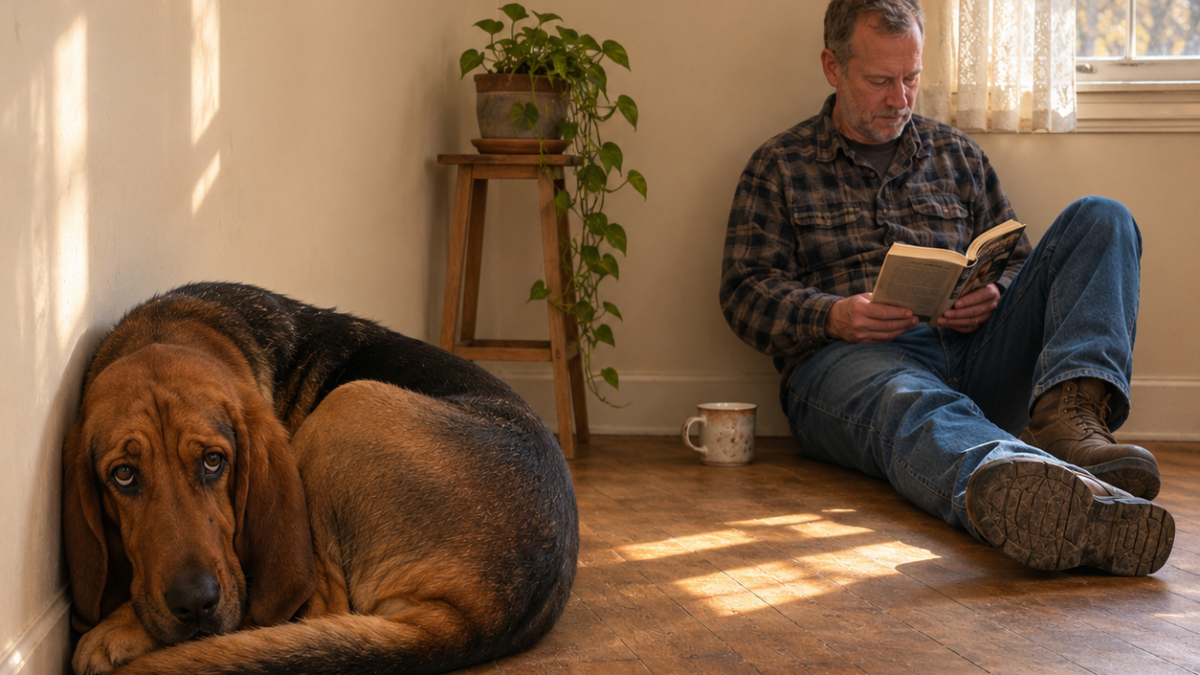
The second day, Martin repeated the ritual.
Same room.
Same book.
Same place on the floor.
He had chosen an old adventure novel he’d already read several times. I don’t remember why. Maybe because the book was familiar enough that he didn’t need to concentrate.
He sat.
Opened it.
Read.
Bruno remained in the corner.
I placed food about six feet away from him.
When I walked back into the kitchen, he crawled forward and ate.
Martin stayed completely still.
Bruno watched him between bites.
When Martin turned a page, Bruno froze.
Martin kept reading.
Eventually Bruno finished the food.
Then backed into the corner again.
“Progress?” I asked later.
Martin shrugged.
“He ate.”
“He was watching you.”
“He’s allowed.”
“You really aren’t going to try touching him?”
“No.”
“What if it takes weeks?”
“Then I get through several books.”
I smiled.
“You hate that book.”
“I do.”
“Why are you reading it?”
“I already know what happens.”
I didn’t understand.
Martin looked toward Bruno.
“If I get emotional about the story, my voice changes.”
I stared at him.
“You’ve thought about this.”
“No.”
He smiled.
“I’ve thought about him.”
That was Martin.
He wasn’t a man who gave speeches.
He fixed things.
Leaky faucets.
Broken cabinet hinges.
Problems at work.
Our elderly neighbor’s lawn mower.
But Bruno was a problem Martin understood he could not fix.
That distinction changed everything.
On day three, Martin moved two feet closer.
Not because Bruno invited him.
Because Bruno’s body no longer tensed every time Martin entered the room.
Martin sat.
Read.
Bruno watched.
Half an hour later, he lowered his head onto his paws.
Not sleep.
But closer.
On day four, Bruno ate while Martin was still in the room.
On day five, everything nearly fell apart.
Martin sneezed.
Loudly.
Suddenly.
Bruno reacted like somebody had fired a gun.
His body slammed backward against the wall.
He whimpered.
His legs scrambled beneath him.
He tried to push himself into a corner that had nowhere else to go.
Martin froze.
Book open.
Hands visible.
No eye contact.
I started moving toward Bruno.
Martin whispered:
“Don’t.”
I stopped.
Every instinct in me wanted to comfort him.
But comfort can become pressure when the frightened one didn’t ask for it.
So we waited.
Bruno trembled.
Martin slowed his own breathing.
In.
Out.
In.
Out.
Several minutes passed.
Finally, Martin whispered:
“Sorry, buddy.”
Bruno’s eyes stayed fixed on him.
“I didn’t mean to scare you.”
Another minute.
“I’m not coming over there.”
Bruno’s breathing slowed.
“I’m staying right here.”
Then Martin looked down at his book.
And continued reading.
That night, I cried in the kitchen.
Not quietly enough.
Martin came in.
“What happened?”
“Nothing.”
“You’re crying.”
“Excellent detective work.”
He sat across from me.
I wiped my face.
“How many people do you think did this to him?”
“We don’t know anyone did.”
“You saw that reaction.”
“I did.”
“A sneeze, Martin.”
“I know.”
“He thought you were going to hurt him because you sneezed.”
Martin said nothing.
I looked toward the living room.
Bruno was hidden beyond the doorway.
“He’s been abandoned multiple times. He’s terrified of men. He can’t even sleep properly.”
I covered my face.
“What do people have to do to an animal before it learns that?”
Martin reached across the table and touched my hand.
“We don’t know.”
“I want to know.”
“Why?”
“So I can hate somebody.”
That answer surprised even me.
Martin’s expression softened.
“Would that help Bruno?”
“No.”
“Then hate them later.”
I laughed through tears.
“What do we do now?”
“Same thing.”
“You read.”
“I read.”
“He hides.”
“If he needs to.”
“And tomorrow?”
“We’re still here.”
That was Martin’s entire philosophy.
Tomorrow, we are still here.
The sixth morning began differently.
Bruno wasn’t curled into a tight ball.
He lay on his side.
Long legs stretched slightly.
Head resting on his paws.
His eyes followed Martin when he entered with coffee and the book.
I was sitting on the couch pretending to look at my phone.
Martin took his usual position.
By then, he was maybe four feet away.
He opened the book.
Started reading.
Nothing happened for almost fifteen minutes.
Then Bruno moved.
At first, I thought he was adjusting his legs.
He wasn’t.
He raised his chest slightly.
Crawled forward.
Stopped.
My breath caught.
Martin did not look up.
He kept reading.
Bruno moved again.
His stomach still touched the floor.
Tail tucked.
Eyes locked on Martin.
He stopped three feet away.
Martin turned a page.
Bruno sniffed.
Another small movement.
Two feet.
My hands started shaking.
Martin’s voice remained steady, though I saw his jaw tighten.
Bruno stopped again.
He studied Martin’s hands.
His face.
The book.
The coffee mug.
Nothing changed.
Nobody reached.
Nobody grabbed.
Nobody demanded.
Finally, Bruno crossed the last few inches.
He lowered his heavy Basset head.
And placed it directly on Martin’s lap.
The room disappeared.
Martin stopped reading.
His eyes filled immediately.
But he didn’t touch Bruno.
Not yet.
He let the dog rest there.
One minute.
Two.
Five.
Bruno sighed.
It was a long trembling sound.
The kind that seems to come from somewhere deeper than lungs.
His body softened.
Shoulders lowered.
Tail came loose from between his legs.
Eyes closed.
Martin looked at me.
I was crying.
He was too.
Still, he didn’t reach.
After nearly ten minutes, Martin slowly lowered one hand.
Not onto Bruno.
Beside him.
Bruno smelled it.
Then moved his head.
He pushed the side of his face beneath Martin’s palm.
Permission.
Martin touched him.
One stroke.
From forehead to ear.
Bruno didn’t flinch.
Another.
Then Martin resumed reading.
His voice broke on one sentence.
He stopped.
Cleared his throat.
Tried again.
Bruno stayed.
An hour later, he lifted his head.
I expected him to return to the corner.
He didn’t.
He sat beside Martin.
Looked around the room.
Really looked.
Not scanning for danger.
Taking it in.
“Hi, Bruno,” I whispered.
His eyes moved toward me.
Tail.
One tiny movement.
“Welcome home.”
That afternoon, Bruno followed Martin into the kitchen.
Three steps behind.
When Martin stopped, Bruno stopped.
When Martin moved, Bruno followed.
It was not healthy confidence yet.
It was attachment built on the first safe man Bruno had found.
But it was a beginning.
Over the next several weeks, Bruno expanded.
That’s the best word I have.
A frightened animal often makes himself smaller.
Bruno began occupying space.
First the corner.
Then the rug.
Then the hallway.
One afternoon, I found him asleep in the middle of the kitchen floor.
I had to step around him.
I nearly cried.
He was becoming inconvenient.
That’s when you know a traumatized dog is starting to believe he belongs.
When he stops apologizing for taking up space.
Martin became Bruno’s anchor.
If the doorbell rang, Bruno looked at him.
If a deliveryman appeared, Bruno moved behind Martin.
If something fell in the kitchen, Bruno froze, then checked Martin’s face.
Martin developed a phrase.
“Nothing bad.”
Not “It’s okay.”
Not “Don’t be scared.”
Just:
“Nothing bad.”
Eventually Bruno seemed to understand the tone.
Vacuum cleaner?
Nothing bad.
Thunder?
Nothing bad.
Dropped pan?
Nothing bad.
My brother arriving in work boots?
That one required more convincing.
Bruno saw the boots and vanished.
My brother Daniel stopped at the door.
“Do I leave?”
“No.”
“Do I take these off?”
“Yes.”
He removed the boots.
Bruno still hid.
Daniel sat at the dining table.
Ignored him.
Twenty minutes later, Bruno emerged.
Halfway.
Stopped.
Daniel never looked.
Bruno smelled the air.
Came closer.
Eventually sniffed Daniel’s sock.
My brother whispered:
“Can I move?”
“No.”
“My foot is asleep.”
“Lose the foot.”
He waited.
The next visit, Bruno approached faster.
Third visit, he accepted chicken from Daniel’s hand.
Fourth, one touch beneath the chin.
Daniel drove home like he’d won a championship.
“He let me pet him!”
Martin rolled his eyes.
“You have two children.”
“Neither achievement compares.”
Bruno’s first real play happened almost a month after we brought him home.
Rain outside.
Martin rolled a tennis ball across the floor.
Not threw.
Rolled.
Bruno watched it pass.
The ball hit a table leg.
Stopped.
Bruno stared.
Martin rolled it again.
This time it touched Bruno’s paw.
He jumped.
Then looked at the ball.
Tapped it.
The ball rolled away.
Bruno froze.
Martin smiled.
He rolled it back.
Bruno hit it harder.
It rolled toward Martin.
Martin sent it back.
Bruno’s tail moved.
Once.
Twice.
Then something came out of him that neither of us expected.
A bark.
Deep.
Rough.
Almost rusty.
Bruno looked startled by his own voice.
Martin laughed.
Bruno barked again.
Then launched himself after the ball.
Those enormous ears flew.
His short legs scrambled.
He slid on the hardwood and crashed gently into the couch.
Stopped.
Looked at us.
For half a second, I thought fear might return.
Then Martin laughed.
Bruno jumped up.
Barked.
Ran again.
I cried.
Naturally.
Martin pointed.
“Every time something good happens, you cry.”
“Be quiet.”
Bruno chased the ball again.
That evening he slept beside the couch.
Not in the corner.
The corner stayed empty.
Days became months.
His ribs disappeared.
His coat became glossy.
He learned the sound of Martin’s truck.
Every weekday around 5:20, Bruno waited near the front window.
When Martin’s truck turned into the driveway, Bruno’s body transformed.
Tail.
Ears.
Whole rear end moving.
He would rush toward the door, stop three feet away, then bounce in place because apparently dignity had left permanently.
Martin came in.
Bruno leaned into him.
Every day.
Same man.
Same door.
Same return.
That repetition was medicine.
Then Emma called.
“Do you still have Bruno’s original paperwork?”
“Yes.”
“We found something.”
My stomach tightened.
“What?”
“Another microchip registration.”
Bruno’s chip had been updated several times, but the shelter had finally received older records from a clinic in Missouri.
His history became clearer.
Bruno had originally belonged to a couple named Warren and Denise Blake.
They purchased him as a puppy.
Two years later, they divorced.
Denise moved into an apartment that did not allow large dogs.
Warren kept Bruno.
For six months.
Then Warren surrendered him to a rural rescue, claiming work travel.
That rescue placed Bruno with a family in Arkansas.
They kept him eight months.
Then reported him missing.
Except someone later found evidence they had given him away through an online classified ad.
The next recorded owner was a man named Curtis Hale.
Curtis never updated the microchip.
Bruno was found outside a property associated with him five months later.
Then another informal rehoming.
Then another state.
Finally:
Derek Malloy.
That name appeared on a veterinary receipt found in Bruno’s shelter file.
Emma had contacted the clinic.
Derek had brought Bruno in seven months before Bruno was found tied to the dumpster.
“He was the last documented person with him?”
“Looks that way.”
“Can we contact him?”
“We already tried.”
“And?”
“He said Bruno ran away.”
I looked toward Bruno.
He was asleep against Martin’s shoe.
“Where?”
“From his yard.”
“Did he file a missing report?”
“No.”
“Post online?”
“He says yes.”
“Did he show you?”
“No.”
“Did he call shelters?”
“No record.”
“When did he supposedly run away?”
Emma told me.
Eleven days before Bruno was found tied to the dumpster.
I felt cold.
“That’s convenient.”
“Yes.”
“Can anyone prove he tied him there?”
“Not yet.”
Yet.
That word stayed with me.
The shelter reported the new information to animal control because Bruno’s abandonment was still technically an open case.
Nothing happened immediately.
No cameras had clearly captured the person who tied him there.
No witness had come forward.
Derek denied it.
Bruno was legally ours anyway.
I told myself it didn’t matter.
Then, two weeks later, the shelter posted a short update about Bruno’s recovery.
They used a photograph of Martin sitting in his chair reading while Bruno slept with his head on Martin’s foot.
The caption was simple:
**HE ONCE HID FROM MEN. NOW HE WAITS FOR ONE TO COME HOME.**
The post spread.
First locally.
Then farther.
Thousands of shares.
Comments.
Messages.
People told stories about their own frightened dogs.
Then one message arrived from a woman named Kelly.
She wrote:
**I think I know this dog.**
Emma forwarded it to us.
Kelly had dated Derek Malloy.
She recognized Bruno immediately.
She agreed to speak with animal control.
Her story filled several gaps.
Derek had gotten Bruno from a coworker.
At first, he liked him.
Bruno was quiet.
Affectionate.
Then Derek’s patience shortened.
Bruno howled when left alone.
Had accidents in the house.
Feared loud voices.
Derek called him “broken.”
Kelly said Bruno became increasingly frightened of him.
“Did Derek hit him?” the officer asked.
Kelly hesitated.
“I saw him shove Bruno with his foot.”
“Kick?”
“Not hard.”
That phrase made me furious.
Not hard.
As if fear measures force with a ruler.
“Anything else?”
“He grabbed his collar.”
“How?”
“Aggressively.”
“Did Bruno bite?”
“No.”
“Growl?”
“No.”
Kelly looked ashamed.
“He would just flatten.”
I had seen that.
The living-room corner.
A sneeze becoming a gunshot.
“Why did Bruno leave?”
Kelly looked at the table.
“Derek’s landlord found out he had him.”
“Pets prohibited?”
“Large dogs.”
“What did Derek say?”
“He said he’d get rid of him.”
“Those words?”
“Yes.”
“Did he say how?”
“No.”
Kelly paused.
“But that week Bruno disappeared.”
“Did Derek tell you he ran away?”
“At first.”
“And later?”
She swallowed.
“He said, ‘Doesn’t matter. He’s someone else’s problem now.’”
Animal control documented everything.
Still not enough by itself for a major case.
Then another person contacted them.
A security guard from the shopping center.
The viral post had reminded him.
He had worked the night Bruno was discovered.
He remembered a dark SUV stopping behind the stores around 4:00 a.m.
He hadn’t thought much of it at the time.
Security footage was normally deleted after thirty days.
But one clip had been retained because the same SUV had nearly hit a loading dock and the property manager saved the incident.
The image quality wasn’t great.
But the plate was visible.
Registered to Derek Malloy.
The video showed enough.
SUV stops.
Man exits.
Opens rear door.
A low-bodied dog jumps out.
The man walks behind a dumpster.
Returns without the dog.
Drives away.
No question.
I watched it once.
Then couldn’t watch again.
Martin watched the entire thing.
His face barely moved.
At the end, he closed the laptop.
“That’s him.”
“Yes.”
“He didn’t even look back.”
I stared at Martin.
“No.”
Martin stood.
Bruno immediately stood with him.
Followed him toward the kitchen.
Same pattern.
Except now it meant something completely different.
A man once walked away.
This one always came back.
Derek was cited for abandonment and neglect-related violations.
Because Bruno had not suffered severe acute physical injury when found, the case was not the spectacular criminal prosecution some people online demanded.
There were fines.
Restitution.
A temporary restriction on acquiring another animal.
Mandatory educational requirements.
The exact legal outcome felt small compared with what Bruno carried emotionally.
But then Derek made everything worse.
He contacted the shelter.
He claimed the viral story had damaged his reputation.
He said the video was “misunderstood.”
Then he said something I still remember.
“I never surrendered ownership.”
Emma stared at him.
“You abandoned him behind a shopping center.”
“I left him somewhere people would find him.”
“That is abandonment.”
“He was difficult.”
Emma’s expression hardened.
“He was frightened.”
“He destroyed stuff.”
“He had separation anxiety.”
“I couldn’t deal with him.”
“Then surrender him properly.”
Derek said:
“I paid money for that dog.”
Emma stopped.
There it was.
Not love.
Ownership.
“I want compensation.”
“For what?”
“My property.”
Emma called me afterward.
I thought she was joking.
“He wants money?”
“Apparently.”
“For Bruno?”
“Yes.”
“That’s insane.”
“Legally, it isn’t going anywhere.”
“Good.”
“But he also wants to see him.”
“No.”
“I assumed.”
“No.”
“That’s fine.”
For several weeks, nothing happened.
Then Derek came to our house.
It was a Saturday morning.
Martin was in the backyard.
I was washing dishes.
Bruno was asleep near the kitchen.
The doorbell rang.
Bruno woke.
He looked toward the hallway.
I walked to the door.
Through the glass, I saw a man in his late thirties.
Baseball cap.
Heavy boots.
Dark jacket.
Something about him bothered me immediately.
I opened the door only a few inches.
“Can I help you?”
“Bruno here?”
My blood went cold.
“Who are you?”
“Derek.”
Behind me, Bruno stood.
He heard the voice.
His entire body froze.
That’s how I knew before anything else.
No recognition wag.
No curiosity.
Freeze.
Derek heard his tags.
“Hey, Bruno.”
Bruno backed away.
I closed the door.
Locked it.
Derek knocked again.
“Come on.”
I called Martin.
Then the police.
Derek continued talking through the door.
“I just want to see him.”
Bruno retreated into the living room.
Not the old corner.
Close.
He looked toward the hallway.
Martin came through the back door.
One look at Bruno and his expression changed.
“Who?”
“Derek.”
Martin walked into the living room.
He did not go toward the front door.
He sat down.
Exactly where he had sat the first week.
On the floor.
Bruno watched him.
Outside, Derek knocked again.
“Bruno!”
Bruno flinched.
Martin said softly:
“Nothing bad.”
Bruno’s eyes stayed on him.
“Nothing bad.”
Police arrived minutes later.
Derek was removed from the property.
He received a formal trespass warning.
I barely paid attention.
What happened inside mattered more.
Bruno crossed the room.
Not crawling this time.
Walking.
He reached Martin.
Placed his head in Martin’s lap.
Same place.
Same man.
Six months apart.
But this time there was no terror in the movement.
It was a decision.
Martin stroked his ears.
“You’re okay.”
Bruno sighed.
I sat beside them.
The following week, Derek requested a supervised meeting through animal control.
We were not required to agree.
My answer was no.
Martin surprised me.
“Maybe.”
I stared.
“Why?”
“He came here.”
“Exactly.”
“If he keeps trying—”
“We get a restraining order.”
“Yes.”
Martin looked toward Bruno.
“But I keep wondering what Bruno needs.”
“He needs never to see that man.”
“Maybe.”
“You saw him freeze.”
“I did.”
“Then?”
Martin thought carefully.
“I want Derek to understand Bruno is not a possession.”
“That isn’t Bruno’s job.”
“No.”
Martin nodded.
“You’re right.”
So we declined.
Derek threatened civil action.
Our attorney responded with the surrender history, abandonment video, animal-control finding, adoption records and trespass notice.
The threat disappeared quickly.
But Derek’s public complaints did not.
He wrote online that we had “stolen” his dog.
People argued.
One person asked why we couldn’t just let him visit.
Another wrote:
**Dogs forgive. Humans should too.**
I stared at that comment.
Then deleted social media from my phone for a week.
Bruno did not owe Derek forgiveness.
More importantly, forgiveness was not access.
You can regret hurting someone and still not be entitled to return to their life.
That principle became central to everything I learned from Bruno.
The real climax came months later at an administrative hearing related to restitution and animal-ownership restrictions.
We did not have to bring Bruno.
Initially, we weren’t going to.
Then the hearing officer requested an updated behavioral report because Derek’s attorney claimed Bruno’s fearfulness predated Derek and that his client had therefore not caused the behavioral damage.
Fine.
It was technically true that Bruno had prior trauma.
But Derek had known that.
And abandoned him anyway.
Martin and I attended.
Bruno remained in a quiet waiting area with Emma.
Near the end, Derek requested permission to see him.
The hearing officer looked at us.
We could refuse.
Martin whispered:
“Only if Bruno chooses.”
I hated the idea.
Still, I agreed under strict conditions.
Large room.
Leash loose.
Emma present.
No reaching unless Bruno approached.
Derek entered first.
He removed his hat at the officer’s request.
Bruno came through another door with Emma.
The moment Derek spoke, Bruno stopped.
“Hey, Bruno.”
No tail.
No movement.
Derek crouched.
“Come here.”
Bruno looked toward Emma.
Then scanned the room.
He found Martin.
Martin was seated in a chair twenty feet away.
He did not call.
Did not pat his leg.
Did not make himself more attractive.
He simply sat.
Exactly as he had on day one.
Derek called again.
“Bruno.”
Bruno took one step.
For a second, I thought he was going toward Derek.
He wasn’t.
He moved sideways.
Then another step.
And another.
He crossed the room.
Slowly.
Past Derek.
Straight toward Martin.
He stopped in front of him.
Lowered his head.
Placed it in Martin’s lap.
The same gesture.
The same choice.
Derek stared.
His attorney said nothing.
I couldn’t breathe.
Martin rested one hand on Bruno’s ear.
Not triumphantly.
Quietly.
The hearing officer looked toward Derek.
Derek’s face changed.
“He remembers me.”
Martin answered:
“I think he does.”
“Then why—”
Martin interrupted gently.
“Remembering isn’t the same as trusting.”
That sentence ended the argument more completely than any legal filing.
Derek looked at Bruno.
“I fed him.”
Martin nodded.
“Probably.”
“I took care of him.”
“For a while.”
“I didn’t beat him.”
Nobody had accused him of that in the hearing.
Derek’s voice rose.
“I didn’t.”
Martin remained calm.
“You don’t have to beat a dog to teach him you aren’t safe.”
Silence.
Derek looked down.
For the first time, anger left him.
Something else replaced it.
Shame, perhaps.
Or realization.
He whispered:
“I couldn’t handle him.”
Martin stroked Bruno’s ear.
“Then you should have asked for help.”
“I know.”
That was it.
Not a dramatic confession.
No courtroom collapse.
Three words.
I know.
The hearing upheld the restitution order and animal-ownership restriction.
Derek had to reimburse part of Bruno’s shelter and behavioral-care expenses, complete additional responsible-surrender education and remain subject to restrictions for the period already imposed.
He did not get Bruno.
He never contacted us again.
That was the revenge people later wanted me to describe.
But when I think about that day, I don’t think about Derek’s penalties.
I remember Bruno walking past him.
Not because Bruno wanted revenge.
Dogs don’t build moral theater for us.
Bruno simply knew where safety was.
A man who once treated him like a problem stood on one side of the room.
A man who had spent six days reading on the floor stood on the other.
Bruno chose accordingly.
There was nothing louder than that.
Afterward, life became beautifully boring.
That’s the part rescue stories often skip.
Bruno wasn’t constantly healing.
He started living.
He learned that Martin’s sneeze meant nothing.
Eventually, when Martin sneezed, Bruno barely lifted his head.
The first time that happened, Martin looked at me.
“Did you see?”
“Yes.”
“He didn’t move.”
“I know.”
Martin sneezed again deliberately.
Bruno glared at him.
I laughed.
“Stop harassing the dog.”
“That was science.”
Bruno started sleeping on the couch.
Then taking the whole couch.
Basset Hounds have a way of becoming liquid when they sleep.
One dog somehow occupied three cushions.
Martin would stand there after work.
“Move.”
Nothing.
“Bruno.”
One eye opened.
“That’s my seat.”
Bruno closed it again.
Martin sat on the floor.
I took photographs.
Justice.
Bruno discovered the backyard.
At first he stayed near the door.
Then the grass.
Then the fence.
Then the entire perimeter.
His nose led him everywhere.
He became obsessed with one particular corner where a rabbit occasionally passed.
He would stand there for twenty minutes smelling yesterday.
His ears dragged through mud.
His feet turned brown.
He came inside proud.
I bought dog wipes in bulk.
He hated them.
We took him hiking.
Short hikes.
Basset legs are designed more for dramatic appearance than athletic achievement.
Half a mile in, Bruno would lie down.
Martin would say:
“We’re not carrying you.”
Bruno would remain still.
We carried him.
Fifty pounds of stubbornness.
At home, he became a foster brother.
That happened accidentally.
Emma called.
Again.
“I need three nights.”
“No.”
“It’s a female terrier.”
“No.”
“Scared.”
I looked at Bruno.
He was asleep upside down, one ear covering his eye.
“How scared?”
The terrier’s name was Penny.
She arrived that evening.
Bruno sniffed her.
Penny growled.
Bruno walked away.
Excellent social skills.
She followed him.
For three days, Penny watched Bruno interact with Martin.
Every time Martin entered, Penny hid.
Bruno did not.
Martin sat.
Bruno approached.
Martin touched him.
Nothing bad.
By day three, Penny remained in the room when Martin entered.
She was adopted two weeks later.
Then another foster came.
Then another.
Bruno never became a therapy dog.
He didn’t need a title.
He simply became evidence.
Evidence that fear could change.
Not disappear.
Change.
One particularly frightened foster named Jasper had been abused by a man.
Jasper refused to enter the living room if Martin was there.
So Martin returned to the floor.
Book.
Distance.
Silence.
Bruno walked over.
Placed his head on Martin’s foot.
Jasper watched.
Two days later, Jasper came halfway across the room.
I stood in the kitchen crying.
Martin looked up.
“Again?”
“Shut up.”
The shelter heard about what Martin was doing.
Emma asked if he’d volunteer.
“With dogs?”
“No, the tax department.”
He gave her a look.
“Yes, with dogs.”
Martin began spending Saturday mornings at the shelter.
Not walking dogs.
Not training.
Reading.
He sat outside kennels containing dogs who were too frightened for normal handling.
The shelter eventually created a quiet room.
Soft chair.
Floor cushions.
Bookshelf.
No fluorescent lights.
A sign on the door:
**SIT WITH ME**
Martin hated the name.
I loved it.
Volunteers were taught the basic principle.
Presence without pressure.
Don’t reach because you need proof the dog likes you.
Don’t lure an animal closer solely for your emotional reward.
Let distance be information.
Let the animal choose.
Some dogs never approached.
That was okay.
Some came after one session.
Others after ten.
A shepherd named Nova took twenty-three.
Martin read almost an entire trilogy.
When Nova finally touched his shoe, Martin came home and cried in the garage because he didn’t want the shelter volunteers to see him.
I saw him.
Naturally.
“You cry a lot for someone who mocks me.”
“Dust.”
“In your garage?”
“Severe problem.”
Bruno came outside.
Martin sat on the step.
Bruno immediately put his head in Martin’s lap.
Same place.
Always.
Years passed.
Bruno turned seven.
Then eight.
His face grayed early.
Bassets have a talent for looking elderly even when they’re young, so eventually nobody could tell.
He developed chronic ear infections.
Those ears were beautiful biological disasters.
Cleaning them became a family event.
I held treats.
Martin cleaned.
Bruno acted betrayed.
“You trusted this man with your soul,” I told him.
Bruno glared.
“But ear cleaner is where you draw the line?”
Yes.
Apparently.
At nine, Bruno needed back surgery for a ruptured disc.
Basset bodies come with structural challenges.
The veterinary neurologist warned us.
Recovery would take weeks.
Strict rest.
Physical therapy.
Possibly incomplete function.
Martin slept on the living-room floor beside Bruno’s recovery pen for nine nights.
I found them one morning.
Martin asleep.
Book open on his chest.
Bruno awake.
Head pushed against the side of the pen as close to Martin as possible.
I took a picture.
Did not wake them.
Recovery was slow.
Bruno hated the support harness.
Hated therapy exercises.
Loved hydrotherapy because it involved treats.
Eventually he walked normally again.
Slower.
But walking.
The first time he crossed the backyard independently, Martin stood beside me.
“You think he remembers the corner?”
“Which corner?”
“The first one.”
I looked at Bruno sniffing a bush.
“No.”
Then corrected myself.
“Maybe.”
Martin put his arm around me.
“It doesn’t matter.”
He was right.
Memory didn’t need to disappear for life to become larger.
At ten, Bruno’s story spread again when the shelter posted an anniversary photograph.
First day:
Bruno hiding behind his ears.
Years later:
Bruno sleeping across Martin’s chest while Martin tried to read.
The caption:
**SIX DAYS OF PATIENCE. YEARS OF TRUST.**
The post became far more popular than anyone expected.
People donated to Sit With Me.
The shelter trained more volunteers.
A local retirement community began sending residents to read to anxious dogs.
Teenagers needing volunteer hours joined.
Veterans participated.
One man named Robert sat with a terrified coonhound every Thursday for four months.
When the dog was adopted, Robert kept volunteering.
He told Martin:
“I thought I was helping them.”
Martin smiled.
“Yeah.”
Robert looked at him.
“Turns out sitting quietly with something scared is good for you too.”
Martin understood.
Neither man explained further.
Bruno remained at the center without knowing it.
He preferred staying home.
Fame did not impress him.
Chicken did.
Then Martin had a heart attack.
It happened when Bruno was eleven.
One Monday morning, Martin complained about pressure in his chest.
He tried to dismiss it.
I didn’t.
Emergency room.
Cardiac catheterization.
Two blocked arteries.
Stent.
He survived.
But the night Martin stayed in the hospital, Bruno returned to the old corner.
For the first time in years.
I found him there at midnight.
Curled tightly.
Head low.
My heart shattered.
“Hey.”
Bruno looked at me.
“He’s coming back.”
His body remained tense.
“I know you don’t believe me.”
I sat on the floor.
Not beside him.
Across the room.
Exactly the way Martin had.
I picked up a book.
His book.
The old novel.
The same worn cover.
I opened it.
Started reading aloud.
My voice shook.
Bruno’s ears lifted.
I read.
Ten minutes.
Twenty.
Eventually Bruno crawled out of the corner.
He crossed the room.
Placed his head in my lap.
I stroked him.
“He’s coming back.”
The next afternoon, Martin came home.
He moved slowly.
Hospital bracelet still around his wrist.
Bruno heard the door.
Ran.
Stopped five feet away.
Stared.
Martin crouched as much as his doctor would have hated.
“Hey, buddy.”
Bruno launched himself into him.
I shouted:
“Careful!”
Too late.
Martin laughed.
Bruno whimpered.
Licked his face.
Pressed against him.
Martin’s eyes closed.
“You thought I left.”
I cried.
“I told him you didn’t.”
Martin held Bruno.
“I came back.”
That moment revealed something.
Bruno’s fear had never disappeared completely.
Deep inside was still a dog who expected absence to become permanent.
But now he had something different.
Evidence.
Martin left the hospital.
Came home.
Again.
The same lesson.
Tomorrow, we are still here.
After his heart attack, Martin slowed down.
So did Bruno.
Their routines matched.
Morning coffee.
Short walk.
Book.
Nap.
Another walk.
Bruno would follow Martin to the porch.
Martin sat.
Bruno lay at his feet.
Sometimes no reading.
No talking.
Just presence.
At twelve, Bruno developed glaucoma in one eye.
We managed it.
At thirteen, arthritis.
Medication.
Ramps.
Orthopedic beds.
Which he mostly ignored.
At fourteen, he stopped climbing onto the couch.
Martin lowered himself to the floor instead.
I watched them one evening.
Martin reading.
Bruno’s head in his lap.
Same image as day six.
Different bodies.
Martin’s hair gray.
Bruno’s face almost white.
I took a photograph.
Neither noticed.
The next year brought the diagnosis we feared.
Cancer.
Splenic mass.
Likely malignant.
Bruno was nearly fifteen.
Surgery was possible.
Risky.
The veterinarian, Dr. Harris, explained everything.
“We could operate.”
“Would it cure him?” Martin asked.
“Unlikely if it’s what we suspect.”
“Buy time?”
“Maybe.”
“How much?”
“No honest answer.”
I looked at Bruno.
He was lying on the exam-room floor.
His eyes followed Martin.
Always.
“What would you do?” I asked.
Dr. Harris sighed.
“That’s not fair.”
“I know.”
She sat beside us.
“If this were my dog, at his age, with his history and current comfort?”
She looked toward Bruno.
“I’d choose quality.”
Martin nodded.
“No surgery.”
That was the decision.
Bruno received medication.
Good food.
Every comfort.
Then something unexpected arrived.
A letter.
From Derek.
After all those years.
The envelope had been forwarded through the shelter.
I almost threw it away.
Martin said:
“Read it.”
“I don’t want to.”
“Then don’t.”
I read it.
Derek wrote that he had completed the court requirements years earlier.
He had not owned another dog.
He said the animal-responsibility course initially made him angry.
He believed everyone exaggerated.
Then the instructor showed videos of abandonment behavior.
Dogs waiting beside roads.
At doors.
Near houses.
He wrote:
**I kept thinking about Bruno hiding after I raised my voice. I used to think he was weak. I understand now he was afraid of me.**
My stomach tightened.
He continued.
**I know saying sorry doesn’t change anything. I don’t expect to see him. I don’t want to disrupt his life. I just wanted you to know I finally understand that leaving him tied behind that shopping center wasn’t rehoming him. It was me deciding my problem mattered more than his fear.**
Martin read over my shoulder.
Derek ended with:
**Please don’t tell me he forgives me. I don’t deserve to use him for that. I only hope he had a better life after me.**
I sat quietly.
Bruno slept nearby.
Martin asked:
“Are you going to answer?”
“No.”
Then I reconsidered.
I wrote one sentence.
**He had a very good life.**
That was all.
Derek never contacted us again.
I don’t know if I forgave him.
It doesn’t matter.
Bruno didn’t need our moral verdict.
The consequences had happened.
Derek lost him.
Paid restitution.
Was restricted.
Had to confront what he had done.
And ultimately, the dog he called broken became the reason frightened animals across our county received more patient care.
That was enough.
The biggest revenge was Bruno’s ordinary life.
He had once been tied to a dumpster.
Then he spent years deciding which couch cushion belonged to him.
Someone had treated him as disposable.
Then two grown adults rearranged an entire house because his back hurt.
Someone had walked away because Bruno was difficult.
Then hundreds of shelter volunteers learned to sit quietly because Bruno taught Martin what fear needed.
Derek abandoned a problem.
We got Bruno.
That was his loss.
Our gift.
Bruno’s final decline came quickly.
One week, he was eating chicken.
The next, half.
Then none.
He still drank.
Still followed Martin with his eyes.
But standing became difficult.
One Saturday morning, Bruno tried to rise.
His legs failed.
Martin immediately knelt.
“Easy.”
Bruno looked up.
Tail moved.
One slow sweep.
I knew.
So did Martin.
Dr. Harris came to the house that afternoon.
Bruno lay on his favorite blanket in the living room.
Not the corner.
Never again the corner.
Right in the middle.
Sunlight from the window fell across him.
Martin sat on the floor.
Book in hand.
The same old novel.
Cover nearly detached.
Pages yellow.
I sat beside Bruno.
Dr. Harris examined him.
Then whispered:
“We could give fluids.”
Martin looked at her.
“Would they change where we’re going?”
“No.”
“Then no.”
The room became very quiet.
Dr. Harris gave us time.
Martin opened the book.
I stared.
“You’re going to read?”
He nodded.
“To him.”
Bruno’s eyes moved toward Martin’s voice.
Martin began.
The same passage he’d been reading on day six.
Not intentionally, I thought.
Then I realized he had marked it.
His voice shook.
Bruno’s breathing slowed.
Martin read about a man standing at the edge of a valley.
About fog lifting.
About realizing home was not merely a place.
Halfway through the passage, Bruno moved.
Barely.
He lifted his head.
Martin stopped.
Bruno shifted.
Slowly.
Painfully.
Then placed his head in Martin’s lap.
Exactly as he had fourteen years earlier.
Martin broke.
The book fell open beside him.
“Oh, buddy.”
He put both hands around Bruno’s face.
This time there was no need to wait for permission.
A lifetime had granted it.
“You remember?”
Bruno breathed.
Martin cried openly.
I had seen him cry perhaps a dozen times in our marriage.
That afternoon erased any illusion that quiet men feel less.
“You came to me.”
Bruno’s tail moved.
“You did all the work.”
I placed my hand on Martin’s shoulder.
Bruno’s eyes half closed.
Martin continued.
“You know what you taught me?”
Another breath.
“I thought helping meant doing something.”
He stroked one ear.
“You taught me sometimes helping means staying.”
I couldn’t see through tears.
Dr. Harris sat quietly near the door.
Martin whispered:
“You never had to earn this house.”
His voice broke.
“You never had to become brave enough.”
Another breath.
“You didn’t have to stop being scared.”
Bruno looked at him.
“You just had to be Bruno.”
The first sedative went in.
Bruno relaxed deeper.
His head became heavier in Martin’s lap.
I touched his back.
“You were never broken.”
My voice shook.
“People failed you.”
His breathing slowed.
“That wasn’t the same thing.”
Martin closed his eyes.
“You’re not going to another house.”
That sentence destroyed me.
Bruno had lived through too many doors.
Too many homes.
Too many goodbyes.
Martin leaned over him.
“You’re home.”
Another breath.
“You stay home.”
Dr. Harris prepared the final medication.
Martin opened the book one last time.
He read:
“And he remained there, because at last he understood that he belonged.”
His voice failed.
Bruno exhaled.
I whispered:
“We’re here.”
Martin pressed his forehead to Bruno’s.
“No one’s leaving you.”
The medication entered.
One breath.
Another.
Then stillness.
Martin remained bent over Bruno.
His hands rested on those long ears.
I held them both.
For several minutes, none of us moved.
Our house was silent.
Not empty.
Silent.
Different.
Bruno died at home.
In the middle of the room.
With the man he’d once feared holding his head.
There was no corner.
No leash tied to a dumpster.
No unfamiliar parking lot.
No person walking away.
Only us.
Staying.
We had Bruno cremated.
Part of his ashes went beneath the maple tree behind our house.
Part stayed in a wooden box beside Martin’s chair.
On the box, we put no long inscription.
Just:
**BRUNO**
**HE CAME CLOSER WHEN HE WAS READY.**
A week later, Martin returned to the shelter.
I thought it was too soon.
He said:
“That’s why I have to go.”
The Sit With Me room was empty when we arrived.
Martin sat on the floor.
No book at first.
Just sat.
Emma came in.
She hugged him.
He cried.
Then she handed him something.
The shelter had framed a photograph.
Bruno on day six.
We hadn’t taken one that morning.
But I had taken one weeks later that looked almost identical.
Martin sitting on the floor.
Book open.
Bruno’s head in his lap.
Underneath, a small plaque read:
**BRUNO’S ROOM**
**NOT EVERY FRIGHTENED ANIMAL NEEDS YOU TO COME CLOSER.**
**SOMETIMES THEY NEED YOU TO PROVE YOU CAN STAY.**
Martin stared.
“You changed the name.”
Emma nodded.
“Sit With Me is the program.”
She pointed.
“Bruno gets the room.”
Martin shook his head.
“He’d hate this.”
“No.”
I smiled through tears.
“He’d sleep through it.”
That made Martin laugh.
The program grew.
Volunteers received additional training.
People who wanted to work with fearful animals were required to learn one rule before all others:
**Do not make the animal’s fear about your feelings.**
If a dog backs away, don’t become offended.
If he won’t take your treat, don’t call him stubborn.
If he growls, ask what distance you’re violating.
If he hides, don’t drag him out to prove your kindness.
Safety is not created by intention.
It’s created by behavior.
That principle came directly from Bruno.
Over the next several years, Bruno’s Room held dozens of dogs.
A Doberman who hadn’t allowed touch in three months.
A small poodle rescued from a hoarding case.
A pit bull who shook whenever someone wore a belt.
An elderly shepherd surrendered after his owner died.
Different wounds.
Same method.
Sit.
Read.
Exist.
Let the dog decide whether your presence becomes safe.
Not every story ended perfectly.
One dog remained fearful for life.
He still found a quiet home.
Another never became comfortable around men.
A woman adopted him.
Good.
Healing did not require transforming into somebody else’s definition of normal.
That may have been Bruno’s greatest lesson.
Martin and I eventually fostered again.
Not immediately.
Grief needed room.
Then Emma called.
“You have got to stop calling us,” I said.
“I have a dog.”
“No.”
“Basset mix.”
“That’s manipulation.”
“Terrified of women.”
I paused.
Martin laughed from across the kitchen.
“That one’s yours.”
The dog’s name was Gus.
He was nothing like Bruno.
Shorter ears.
Louder.
Stole trash.
Afraid of me but loved Martin instantly.
So the roles reversed.
I sat on the floor.
Across the room.
Book in hand.
Martin watched.
“Don’t laugh.”
“I haven’t said anything.”
“You’re thinking loudly.”
I read.
Gus hid.
Second day.
Same.
Third.
Closer.
On day eight, Gus approached.
He sniffed my fingers.
I didn’t move.
Then he climbed partially into my lap.
Martin’s eyes filled.
I pointed at him.
“Don’t you dare.”
“Allergies.”
“Of course.”
Gus was adopted three months later by a retired couple.
I cried when he left.
Martin did too.
Again, allergies.
Years continued.
We grew older.
The book Martin had read to Bruno finally fell apart.
The binding split completely.
I offered to buy another copy.
Martin said no.
He had the pages repaired.
“Why?”
“You know why.”
I did.
The book sat on the shelf beside Bruno’s ashes.
One evening, long after Bruno was gone, Martin took it down.
He sat in his chair.
I was reading beside him.
There was no dog at his feet.
The emptiness still hurt.
Not sharply anymore.
More like an old injury when weather changes.
Martin opened to the marked page.
He smiled.
“What?”
“Nothing.”
“What?”
“I was thinking about day six.”
“So was I.”
He looked toward the old corner.
We had changed the furniture since then.
The bookcase moved.
A lamp now stood there.
Bruno’s corner didn’t exist anymore.
Good.
Places shouldn’t have to remain museums of pain.
Martin said:
“I really thought I was helping him by reading.”
“You were.”
He shook his head.
“No.”
I waited.
“I was helping myself stay still.”
That surprised me.
He continued.
“If I’d sat there doing nothing, I would’ve wanted to reach.”
“Yes.”
“The book gave my hands somewhere to be.”
I smiled.
“And your mouth.”
“Very funny.”
He looked at the page.
“I wasn’t patient because I’m special.”
“I know.”
“Thank you.”
“I mean—”
“I know what you mean.”
He smiled.
Then became serious.
“Anybody could’ve done it.”
“Yes.”
“That bothers me sometimes.”
“Why?”
“Because how many Brunos don’t get someone who sits?”
I had no answer.
So we kept supporting the program.
Not because Bruno’s story needed to stay famous.
Because the behavior mattered.
Years after his death, a young shelter volunteer named Noah contacted us.
He was nineteen.
He had been assigned to Bruno’s Room with a terrified hound named Maple.
Maple had spent weeks beneath a bench.
Noah sat every Saturday.
Read comic books.
On week six, Maple approached.
She put her head on his shoe.
He sent Martin the message:
**I didn’t touch her. I remembered Bruno. I let her choose.**
Martin read it twice.
Then handed me the phone.
His eyes were wet.
I read.
“That’s it.”
Martin nodded.
“That’s what?”
“The revenge.”
He looked confused.
I thought of Derek.
The dumpster.
The video.
All the people who moved Bruno from home to home.
The fear they’d left inside him.
“That.”
I pointed toward Noah’s message.
“That’s the revenge.”
Not Derek paying money.
Not a public humiliation.
Not Bruno walking past him.
Those things had their place.
But this was bigger.
Someone had taught Bruno that humans could not be trusted.
Bruno’s life eventually taught humans how to become trustworthy.
That was reversal.
That was justice.
A frightened dog once hid behind his ears.
Years later, people he’d never meet were sitting quietly with frightened animals because of him.
The harm did not reproduce itself.
The kindness did.
That’s the victory.
Martin put the phone down.
“I like that.”
“Me too.”
We sat in silence.
Years earlier, silence in our living room had been filled with Bruno’s fear.
Now it was comfortable.
Safe.
Home.
Sometimes people still ask us how we “made Bruno trust again.”
I correct them.
We didn’t make him.
That’s the entire point.
You can’t make trust.
You can only behave in ways that make trust reasonable.
Bruno watched Martin for six days.
He saw a man enter.
Sit.
Leave.
Return.
Sit.
Leave.
Return.
No grabbing.
No yelling.
No punishment.
No demand.
By day six, Bruno had enough evidence to try one step.
Then another.
And another.
He put his head in Martin’s lap.
After that came years of additional evidence.
Martin going to work.
Returning.
Doors closing.
Opening.
Food appearing tomorrow.
Hands moving without striking.
Sneezes causing nothing.
Boots becoming shoes instead of warning signs.
Visitors arriving and leaving.
Vet visits ending with home.
Hospital stays ending with Martin walking back through the door.
Trust was not one moment.
Day six was only the first deposit.
The account grew for fourteen years.
That’s what people miss when they share rescue stories.
The dramatic moment is easy.
A dog approaches.
Music plays.
Everyone cries.
Real healing is Tuesday three years later when somebody drops a pan and the dog no longer flinches.
It’s an old dog snoring so loudly you turn up the television.
It’s medication.
Ear cleaning.
Mud.
Vet bills.
Back surgery.
A dog becoming comfortable enough to inconvenience you.
Those are the victories.
Bruno had been abandoned repeatedly before us.
For years, that fact defined every introduction.
“Bruno, the dog abandoned three times.”
Eventually, I stopped saying it.
He was Bruno.
The dog who stole socks from laundry baskets.
The dog who hated ear cleaner.
The dog who refused to walk in heavy rain.
The dog who snored.
The dog who could locate cheese from three rooms away.
The dog who followed Martin everywhere.
The dog who once learned to play tennis-ball soccer because fetch seemed intellectually unnecessary.
The dog who grew old.
That last one matters most.
An abandoned dog getting old is not a tragedy.
It’s a privilege.
Bruno got arthritis.
Cancer.
Gray hair.
Bad hearing.
Those things hurt us.
They were also proof.
He lived long enough.
The people who abandoned him didn’t get the final chapter.
They barely got the introduction.
His life belonged to everything after.
I still have the photograph from his last day.
I don’t show it often.
Some photographs belong to the people who were there.
Bruno lies in sunlight.
Martin on the floor.
Book beside them.
His head in Martin’s lap.
If you compare it with the early picture, almost everything has changed.
Gray muzzle.
Thinner body.
Older hands.
But the position is identical.
Head in lap.
Trust.
The first time, Bruno did it because he was testing whether the world might finally be safe.
The last time, he did it because he already knew.
That is the complete story.
Not abandonment.
Not fear.
Not revenge.
Certainty.
Bruno began with a question:
**Will you leave too?**
For fourteen years, Martin answered the same way.
Not with words.
By coming home.
By sitting down.
By staying.
And in the end, when Bruno no longer had strength to follow him anywhere, he put his head in the same lap and closed his eyes without fear.
Because by then he knew the answer.
No.
Not this one.
This one stayed.








