PART 2: He Was Too Weak to Stand—But When I Reached Out to Touch Him, What He Did Broke Me
PART 2
The veterinary clinic was twenty-three minutes away.
I made it in eighteen.
Every red light felt like an insult.
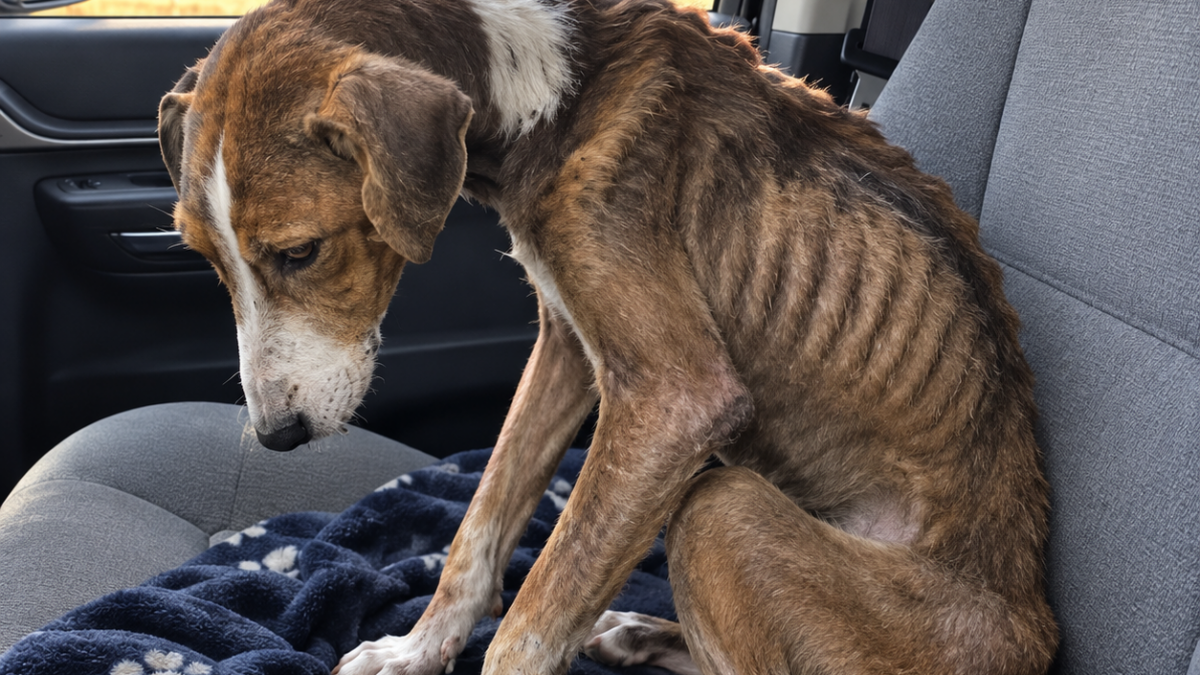
Every time I looked over, the dog was still leaning against my arm.
His eyes were half closed.
“Stay with me.”
One ear moved.
“That’s it.”
I kept talking.
I told him where we were going.
I complained about traffic.
I told him my name.
I told him he had terrible timing.
Anything to keep the car from becoming too quiet.
When we pulled into the clinic, I called from the parking lot.
“I need somebody outside.”
The receptionist heard something in my voice and didn’t ask many questions.
Two technicians came through the doors with a stretcher.
The dog tried to lift his head.
One of them stopped.
“Oh my God.”
“Found him near Mercer Service Road.”
“How long has he been like this?”
“I don’t know.”
“Can he walk?”
“Barely, if at all.”
They moved him carefully.
The second my hands left his body, he lifted his head toward me.
It wasn’t dramatic.
Just one weak movement.
But I saw it.
So did the technician.
“You should come with us.”
“I was planning to.”
—
Dr. Allison Reyes examined him.
The first thing she did was weigh him.
Then she weighed him again.
She frowned at the number.
“What should he weigh?”
“Depending on his frame? At least forty-five, maybe fifty pounds.”
“And?”
“Twenty-seven.”
I stared at her.
“That’s almost half.”
“Yes.”
The word landed heavily.
She checked his gums.
Pale.
His temperature.
Low.
Heart rate.
Elevated.
She ran her hands across his abdomen.
He barely reacted.
“Any obvious injuries?”
“Some older abrasions. Pressure sores. Nothing that explains all this by itself.”
“So starvation?”
“Severe malnutrition and dehydration, definitely.”
“Can you fix it?”
Dr. Reyes looked at me.
People who work in emergency medicine learn not to make promises.
“I can treat him.”
“That isn’t what I asked.”
“No.”
She took a breath.
“He’s extremely compromised. His body has been surviving by consuming itself.”
I looked toward him.
He was lying on a warming blanket now.
“You mean muscle?”
“Muscle. Fat. Eventually the body starts protecting only essential systems.”
“His organs?”
“That’s what the bloodwork will tell us.”
My stomach tightened.
“What can we do right now?”
“Fluids, carefully. Warmth. Glucose monitoring. Bloodwork. Small controlled feedings if he’s stable enough.”
“Why small?”
“If we feed an animal this starved too aggressively, we can cause dangerous electrolyte shifts. Refeeding has to be controlled.”
The idea felt cruel.
A starving dog finally had food available and we had to limit it.
But survival had rules.
And I was beginning to understand that wanting him better immediately wasn’t the same as helping him.
—
We needed a name for the chart.
“Unknown male dog” felt unbearable.
The technician asked, “Want to give him a temporary name?”
I looked at him.
He had a narrow face and one white patch over his chest that I’d barely noticed beneath the dirt.
“Sam.”
The technician wrote it down.
“Sam?”
“My grandfather’s name.”
“Was he tough?”
“Stubborn.”
She smiled.
“Good fit?”
I looked at the dog.
“We’ll see.”
So Sam he became.
Temporary, I told myself.
Just for the medical chart.
I was wrong about that.
—
Bloodwork took forty minutes.
I spent all forty sitting in the waiting room.
I could hear dogs barking behind the treatment doors.
Phones ringing.
People moving.
Every few minutes, somebody walked past carrying a chart.
Then Dr. Reyes appeared.
I stood before she reached me.
“How bad?”
“His kidney values are elevated, but dehydration may be contributing. Liver values are also abnormal. He’s anemic.”
My throat tightened.
“Is that survivable?”
“Potentially.”
“Potentially.”
“I know you want certainty.”
“I want you to tell me he’s going to live.”
“I can’t.”
I looked away.
She continued softly.
“But he’s responding to fluids.”
That pulled me back.
“He is?”
“Yes.”
“That’s good.”
“Yes.”
“Very good?”
She almost smiled.
“Good. Let’s stay with good.”
I nodded.
Good.
For that night, good was enough.
—
At around ten, one of the technicians brought me a photograph.
Sam was lying beneath a blanket with an IV catheter taped to his front leg.
His eyes were closed.
“He finally relaxed,” she said.
I looked at the picture.
“Is he sleeping?”
“Yes.”
“Really sleeping?”
“I think so.”
That affected me more than I expected.
Beside the road, he’d been too weak to lie down completely.
In my car, he’d fought to remain upright.
Now he was asleep.
Warm.
Monitored.
Safe.
I whispered, mostly to myself:
“Good.”
—
I went home after midnight.
I didn’t sleep.
At 2:07 a.m., I called.
Stable.
At 4:30, I called again.
Still stable.
At 6:15, the clinic called me before I could call them.
My heart stopped when I saw the number.
Dr. Reyes spoke first.
“He ate.”
I sat up.
“What?”
“A little.”
“How much?”
“Not much. That’s intentional.”
“Did he eat by himself?”
“Yes.”
I covered my face.
She continued.
“And he stood briefly when we changed his bedding.”
“Stood?”
“With support nearby.”
I was already putting on shoes.
“I’ll be there.”
“You don’t have to rush.”
“I know.”
I rushed.
—
Sam looked worse and better at the same time.
Still skeletal.
Still exhausted.
But his eyes were more focused.
When I entered the treatment room, his head lifted.
The technician noticed.
“He recognizes you.”
“Maybe he recognizes the jacket.”
“You aren’t wearing it.”
Fair.
I sat beside the kennel.
“Hey, Sam.”
His tail moved.
Once.
Barely.
I stared.
“Did you see that?”
The technician laughed.
“Yes.”
“That was a wag.”
“It was movement.”
“That was a wag.”
“Fine. A very economical wag.”
I put my fingers through the kennel bars.
Sam sniffed them.
Then rested his muzzle against my hand.
I didn’t move for several minutes.
—
For the next four days, Sam remained hospitalized.
Every day brought a new number.
Temperature improving.
Kidneys improving.
Electrolytes stabilizing.
Weight increasing by tiny amounts.
He ate several carefully measured meals.
By the fourth day, he stood long enough to take three steps.
The staff celebrated.
Sam looked confused by the attention.
I came twice a day.
Sometimes three times.
Dr. Reyes finally said:
“You know we can call you.”
“I know.”
“You live forty minutes away.”
“I know.”
“You’re using a lot of gas.”
“I know.”
She shook her head.
“Okay.”
—
When Sam was discharged, he still looked terrible.
That was important.
Rescue stories often skip this part.
They jump from dying dog to beautiful recovery.
Real healing doesn’t work that way.
His ribs still showed.
His spine was still visible.
He tired after crossing a room.
He needed medication.
Special food.
Follow-up bloodwork.
A strict feeding schedule.
And supervision.
I brought him home anyway.
I had set up a corner beside my couch.
Thick orthopedic bed.
Washable blankets.
Water.
Non-slip mats.
Sam entered the living room and stopped.
He looked around.
Then toward the door.
“You’re staying.”
His ears moved.
“At least tonight.”
He looked at me.
“And probably tomorrow.”
Nothing.
“All right. Don’t make me commit.”
I guided him toward the bed.
He sniffed it.
Then lay on the floor beside it.
I sighed.
“Of course.”
I moved the blanket onto the floor.
He lay down.
Apparently furniture was negotiable.
—
The first week was dominated by food.
Sam thought about it constantly.
That was encouraging and heartbreaking.
At feeding time, he tried to stand too quickly.
His legs shook.
“Slow.”
He stared at the bowl.
“Sam.”
Another step.
His hips almost folded.
I caught him.
“Food isn’t running away.”
He looked unconvinced.
I held the bowl closer.
He ate.
Then licked it.
Then the floor.
Then the edge.
Then looked at me.
“No.”
Stare.
“Doctor’s orders.”
Longer stare.
“You’re manipulative.”
His tail moved once.
That dog learned quickly.
—
He gained two pounds.
Then another.
At three weeks, the hollows around his eyes started filling.
His coat remained dull, but the skin underneath improved.
He became strong enough to walk into the yard.
At first, he only stood there.
Grass beneath his feet.
Wind.
Birds.
Normal things.
Sam looked at them as though he’d forgotten they existed.
Then he sniffed the ground.
One step.
Another.
He reached a patch of sunlight.
Stopped.
Lowered himself.
And slept.
I sat on the back steps watching him.
For a dog who had nearly died alone beside a road, sleeping outdoors voluntarily felt like a strange kind of victory.
Outside no longer meant danger.
It could mean sun.
—
Trust took longer.
That surprised people.
“But he lets you pet him.”
Yes.
That wasn’t the same as trust.
If I reached too quickly, he flinched.
If I raised my hand above his head, his body lowered.
If a door slammed, he froze.
If a man spoke loudly outside, Sam stopped eating.
The first time I noticed that, anger rushed through me.
Someone had taught him these reactions.
Maybe intentionally.
Maybe through neglect.
Maybe through chaos.
I didn’t know.
And not knowing mattered.
I refused to invent a villain just to have somewhere to put my anger.
So I focused on what was in front of me.
Sam.
Not what might have happened.
What could happen next.
—
One afternoon, I reached toward him while he slept.
My fingers stopped six inches away.
I remembered the car.
His eyes looking at my hand.
Confused.
I waited.
Sam woke.
Saw me.
Instead of flinching, he moved his head forward until his forehead touched my palm.
That tiny decision hit harder than any weight gain.
He chose the touch.
I scratched behind his ear.
His eyes closed.
Then came a sound I’d never heard from him.
A low sigh.
Not fear.
Not exhaustion.
Contentment.
“Yeah.”
I smiled.
“That’s better.”
—
A month after I found him, Sam weighed thirty-five pounds.
Still too thin.
But no longer skeletal.
His kidney values had normalized.
His liver numbers were heading in the right direction.
The anemia was improving.
Dr. Reyes checked him and smiled.
“He’s going to make it.”
I froze.
She had never said that before.
“What?”
“I said he’s going to make it.”
“Say it again.”
She laughed.
“No.”
“Please.”
“He’s going to make it.”
I looked down.
Sam was trying to steal a treat from her coat pocket.
My eyes burned.
“Thank you.”
“Don’t thank me.”
“I’m thanking you.”
She looked at Sam.
“He did most of the work.”
He found the treat.
She caught him.
“Thief.”
I smiled.
“Healthy behavior.”
“Don’t encourage him.”
Too late.
—
Our first real walk was six weeks after rescue.
Not far.
Two blocks.
I brought water.
Treats.
A towel.
Phone.
Emergency number.
You would have thought we were crossing a mountain.
Sam walked beside me slowly.
His gait was still weak.
But his head was up.
At the corner, a delivery truck backfired.
Sam dropped.
Flat.
His body trembled.
I immediately knelt.
“Okay.”
He tried to pull backward.
I didn’t force him forward.
“We can go home.”
His eyes were wide.
I waited.
Eventually his breathing slowed.
We turned around.
Some people would call that a failed walk.
I didn’t.
We went two blocks.
Then his body said enough.
I listened.
That was success.
—
The next week, we made it three blocks.
Then four.
Then a small park.
Sam discovered squirrels.
This was unfortunate for everyone.
The first one he saw ran across the grass.
Sam froze.
I felt the leash tighten.
“Don’t even think about it.”
His ears went forward.
The squirrel stopped.
Terrible decision.
Sam took off.
Or attempted to.
His body wasn’t ready for sprinting.
He made maybe five quick strides before I caught up.
“Absolutely not.”
Sam looked at the squirrel.
The squirrel looked smug.
“You’re both ridiculous.”
For the first time, Sam barked.
One sharp bark.
Then another.
I started laughing.
People in the park looked at me.
I didn’t care.
The dog who had sat silently on my jacket finally had something worth shouting about.
A squirrel.
Perfect.
—
Two months after rescue, animal control called.
They had received the report from the clinic because Sam’s condition raised concerns about severe neglect.
They’d scanned him for a microchip on the first day.
There was one.
The registration information was outdated.
But after some digging, they found a previous owner.
My chest tightened.
“Previous?”
“Yes.”
“Not current?”
“Apparently Sam was rehomed about two years ago.”
“To who?”
“That gets complicated.”
Of course.
The original owner, a woman named Diane, had moved into assisted living after a stroke.
Her adult son had supposedly found Sam another home.
No documentation.
No updated chip.
No contract.
Just a first name.
“Can you find the person?”
“Maybe.”
“Was Diane looking for him?”
The officer paused.
“She thought he was living with a family.”
I closed my eyes.
That hurt in a different way.
Somewhere, someone had believed Sam was safe.
He wasn’t.
—
I visited Diane two weeks later with permission from animal control.
I didn’t bring Sam.
Not yet.
She was eighty-one.
Her speech was slower after the stroke, but her mind was sharp.
When I showed her Sam’s current photograph, she covered her mouth.
“That’s my Sammy.”
The name answered something.
Sam hadn’t been random.
He had been loved once.
“How long did you have him?”
“Since he was a puppy.”
I swallowed.
“What happened when you moved?”
“My son couldn’t keep him.”
She looked confused.
“He found a family.”
“That’s what he told you?”
“Yes.”
My anger moved again.
Different direction.
“Do you know their name?”
“Brian.”
Last name?
No.
Location?
Somewhere outside town.
Her eyes filled.
“Is he okay?”
I hesitated.
The truth mattered.
“He was very sick when we found him.”
Diane cried.
Quietly.
I hated being the person carrying this information.
“But he’s getting better.”
She looked up.
“He is?”
“Yes.”
“Can I see him?”
I didn’t hesitate.
“Yes.”
—
Sam recognized her voice before he recognized the room.
The moment Diane said:
“Sammy?”
He froze.
His ears lifted.
Then his entire body changed.
He pulled toward her.
Not fear.
Urgency.
Diane started crying.
Sam reached her wheelchair and pressed his face into her lap.
She put one hand over his head.
“Oh, baby.”
I turned away.
There are moments where being a witness feels intrusive.
Diane touched his ears.
His muzzle.
His chest.
Then she saw how thin he still was.
Her face tightened.
“What did they do to you?”
Sam licked her hand.
She looked at me.
“I gave him away because I thought he’d be safe.”
“I know.”
“I would never—”
“I know.”
That mattered.
The blame didn’t belong everywhere.
Only where evidence put it.
—
Diane remembered more details after seeing him.
Her son, Eric, had handled the rehoming.
He had met “Brian” through a local online classifieds group.
No home check.
No references.
No follow-up.
Eric had been overwhelmed by his mother’s medical crisis and wanted the problem solved quickly.
When investigators interviewed him, he admitted he had never confirmed what happened after handing Sam over.
He had told Diane the family was wonderful because that was easier.
That wasn’t deliberate cruelty.
But it was negligence of another kind.
The kind built from convenience.
Eric cried when he eventually saw Sam.
“I thought he was okay.”
I looked at him.
“You hoped he was okay.”
He didn’t argue.
That was at least honest.
“I should’ve checked.”
“Yes.”
“I know that now.”
Good.
Sometimes accountability begins when excuses stop.
—
Finding Brian took longer.
A partial phone number.
Old messages.
A screenshot.
Then finally a name.
Brian Mercer.
He denied having Sam.
Then admitted he’d had “a dog like that.”
Then said it ran away.
Timeline?
Six months earlier.
Had he reported the dog missing?
No.
Called shelters?
No.
Posted online?
No.
Kept veterinary records?
No.
The story began falling apart.
Then a neighbor spoke.
She remembered Sam.
“He was always outside.”
Food?
“Sometimes.”
Shelter?
“A plastic doghouse.”
Water?
“Usually.”
Usually.
That word bothered me.
Then she said:
“He disappeared about a month before people found that starving dog.”
Animal control asked whether Brian had searched.
She laughed.
“No.”
That wasn’t proof he’d deliberately starved Sam.
But it established something.
Sam had been living there.
His owner had apparently allowed him to disappear without doing anything meaningful to find him.
—
The investigation couldn’t prove exactly where every day of Sam’s suffering happened.
That mattered legally.
You cannot replace missing evidence with anger.
Brian was cited for licensing and welfare violations connected to conditions documented before Sam disappeared.
Other issues led to fines and restrictions after officers inspected his property and found another dog living without adequate shelter.
That dog was removed.
I was glad.
Not because Brian suffered.
Because another animal didn’t have to.
As for Sam, no courtroom could reconstruct the missing weeks.
Maybe he escaped already underweight.
Maybe conditions worsened afterward.
Maybe someone else encountered him.
We would probably never know.
At first, that frustrated me.
I wanted a clean villain.
A clean answer.
A clean punishment.
Real life gave me an incomplete file and a dog sleeping on my couch.
Eventually I realized which mattered more.
—
Sam visited Diane every two weeks.
She couldn’t take him back.
Her facility didn’t allow permanent pets.
But they allowed supervised visits.
The first time I brought him after he’d gained more weight, she stared.
“You look handsome.”
Sam put his head on her knee.
“He always had beautiful eyes.”
I smiled.
“He still does.”
Diane brought out old photographs.
Sam as a puppy.
Sam wearing a ridiculous red sweater.
Sam asleep beside her late husband.
Sam heavier.
Healthy.
Happy.
Seeing those pictures changed something in me.
His life had not begun with suffering.
His entire past wasn’t darkness.
He had once had Christmas mornings.
A couch.
A woman who loved him.
That mattered.
Trauma was part of his story.
Not the whole story.
—
By month four, Sam reached forty-three pounds.
Dr. Reyes wanted two or three more.
Sam wanted twenty.
He became shameless around food.
I started keeping treats in a high cabinet.
He learned the cabinet.
Then he learned the sound of the cabinet.
Then he learned to sit beneath it and stare.
“You’ve eaten.”
Stare.
“Dinner was fifteen minutes ago.”
Long stare.
“You nearly died of starvation and now you’re using that against me.”
His tail wagged.
I laughed.
“Emotional manipulation.”
He sat straighter.
“One.”
I gave him a treat.
We both knew who had won.
—
The biggest milestone wasn’t his weight.
It happened one night during a thunderstorm.
Sam had always reacted to sudden noise.
That night, thunder cracked hard enough to shake the windows.
He jumped.
Then ran toward the hallway.
I expected him to hide.
Instead, he stopped.
Looked at me.
Another thunderclap.
Sam came back.
He climbed halfway onto the couch, something he wasn’t technically allowed to do.
I moved the blanket.
“Fine.”
He curled against my leg.
His body trembled.
I rested my hand over his shoulder.
“It’s okay.”
Another boom.
Sam pressed closer.
I realized what had changed.
He was still afraid.
But now fear brought him toward someone instead of away.
That was trust.
Not absence of fear.
Knowing where to go with it.
—
Six months after rescue, I signed the adoption papers.
No drama.
No hesitation.
The coordinator asked:
“Keeping the name?”
“Sam.”
“Officially?”
“Yes.”
Diane had called him Sammy.
The clinic had written Sam.
Both belonged to him.
“Any concerns?”
I looked at Sam.
He was trying to inspect a wastebasket.
“Yes. Criminal tendencies.”
The coordinator laughed.
“Anything serious?”
“No.”
That answer felt extraordinary.
No.
The dog once near death now had no serious medical concerns beyond monitoring and normal care.
I signed.
Sam became mine.
Or I became his.
Paperwork is unclear on these things.
—
That evening, I took him to see Diane.
I showed her the adoption certificate.
She touched the paper.
Then looked at me.
“Thank you.”
“You don’t have to thank me.”
“I do.”
“No.”
I sat beside her.
“He had somebody who loved him before me.”
Her eyes filled.
“I failed him.”
“You didn’t.”
“I left.”
“You had a stroke.”
“I still left.”
“Diane.”
She looked at me.
“You trusted your son to find him a home.”
She lowered her eyes.
“That wasn’t wrong.”
Then I added:
“But now we know trust needs follow-up.”
She nodded.
Hard truths and compassion can exist together.
That’s another thing Sam taught me.
—
Sam became a different dog.
Not completely.
He still flinched occasionally.
Still guarded food around unfamiliar dogs.
Still disliked raised voices.
But his world expanded.
He loved the park.
Car rides.
My couch despite regulations.
Diane.
Dr. Reyes because she had excellent treats.
He hated rain.
Refused puddles.
Considered baths a personal violation.
One summer afternoon, he discovered a shallow creek.
I expected fear.
Instead, he stepped in.
Then deeper.
Then suddenly jumped sideways, splashing water over both of us.
“Seriously?”
Sam barked.
Then ran through the creek.
He came out soaked.
Dirty.
Thrilled.
I sat on a rock laughing.
The first time I’d put him in my car, he hadn’t had enough strength to lie down.
Now he was sprinting through water because he wanted to.
That was his revenge.
Not against one person.
Against the entire expectation that his suffering was the final thing anyone would ever say about him.
—
A year after I found him, Dr. Reyes invited the clinic staff outside.
Sam had an appointment.
I thought something was wrong.
Instead, they brought out the old photograph.
The one from his first night.
Twenty-seven pounds.
Hollow face.
IV line.
Beside it, they took a new photo.
Sam stood in the same hallway.
Forty-eight pounds.
Glossy coat.
Strong legs.
Head high.
The technician who had helped carry him inside started crying.
“You cried when he wagged once,” I reminded her.
“So did you.”
“I did not.”
“You absolutely did.”
Sam sat between us.
Then sneezed.
Perfect emotional timing.
—
We visited Diane afterward.
She had framed a photograph of Sam beside her bed.
Not the sick one.
The creek.
Sam wet and happy.
She touched it.
“I like this one.”
“Me too.”
“He looks young.”
“He acts younger than he is.”
She smiled.
“I told you.”
Then she became serious.
“Promise me something.”
“What?”
“If I die before him…”
I knew where this was going.
“He stays with me.”
“You promise?”
“He’s already mine.”
“I know.”
“Then yes.”
She relaxed.
“Good.”
Sam placed his chin on her lap.
We sat quietly.
—
Diane died the following spring.
Peacefully.
Her daughter called.
Not Eric.
A daughter who lived out of state.
She asked whether Sam could come to the funeral gathering.
I brought him.
He didn’t understand funerals.
Dogs are fortunate that way.
He understood people.
He moved from person to person.
Accepting touch.
Then he found Diane’s empty wheelchair near the corner.
He sniffed it.
Stopped.
Sat beside it.
I couldn’t breathe for a second.
Eventually he came back to me.
I knelt.
“She loved you.”
He pushed his head against my chest.
We left early.
Some grief doesn’t need an audience.
—
Eric contacted me afterward.
He wanted to apologize.
Again.
This time differently.
“I’ve been thinking about him.”
“Okay.”
“If I’d done more…”
“Yes.”
He swallowed.
“I was dealing with Mom. Work. Everything.”
“I know.”
“I told myself finding any home was better than a shelter.”
I waited.
“And I never checked.”
There it was.
The truth.
“What do you want from me?”
“Nothing.”
“Then why call?”
“Because I want you to know I was wrong.”
I looked at Sam asleep nearby.
“All right.”
“Do you forgive me?”
That was harder.
“It isn’t really mine to forgive.”
He was silent.
“But learn from it.”
“I have.”
I hoped so.
Sometimes the only useful ending is someone becoming less likely to repeat the harm.
—
Years passed.
Sam’s muzzle whitened.
Mine probably did too.
He never forgot food.
At age nine, he still appeared in the kitchen exactly three minutes before dinner.
At ten, he learned to open a low cabinet.
At eleven, arthritis slowed him.
The dog who once couldn’t sit upright now had become old enough to need joint medication.
That fact made me strangely happy.
He had been allowed to age.
Not merely survive.
Age.
There is a difference.
—
Our walks became shorter.
Sam no longer chased squirrels.
He watched them with professional interest.
Then looked at me as if saying:
Not worth the effort.
I agreed.
We sat on park benches instead.
Children sometimes asked to pet him.
Sam loved calm kids.
One little boy touched the white fur around his muzzle.
“He’s old.”
“Yes.”
“Was he always old?”
I laughed.
“No.”
The boy thought about that.
“Was he a puppy?”
“Once.”
“Do you have pictures?”
I showed him.
Not the starving photo.
The puppy photo Diane had given me.
Sam beside a Christmas tree.
The boy smiled.
“He was cute.”
“He knows.”
Sam leaned into the child’s hand.
—
I stopped showing strangers the rescue photograph unless there was a reason.
People became fascinated by suffering.
Look how thin.
Look how sad.
Look how terrible.
But Sam wasn’t a before picture.
He was a dog.
His starvation didn’t deserve more space than his years of happiness.
So when I talked about him, I mentioned the creek.
The cabinet.
The squirrels.
Diane.
The couch.
The thunderstorm.
The stolen chicken sandwich.
Especially the sandwich.
He took the entire thing when I answered the phone.
No remorse.
A criminal.
—
The person who originally abandoned or neglected him was never identified with absolute certainty.
For a while, that bothered me.
I thought a satisfying ending required a name.
Consequences.
An apology.
Maybe a courtroom.
Eventually, Sam showed me otherwise.
Some stories never give you the villain’s confession.
You still get to choose the ending.
Sam didn’t spend his life waiting for someone to explain what they’d done.
He ate.
Ran.
Slept.
Trusted.
Loved.
A person who had failed him might never understand his worth.
Sam did not need their understanding.
Neither did I.
—
If there was revenge, it looked like ordinary life.
Someone once allowed him to become too weak to stand.
Years later, he jumped onto my bed when he thought I was sleeping.
Someone left him hungry.
He became an expert in locating every treat container in the house.
Someone taught him to fear reaching hands.
He eventually fell asleep while strangers at the clinic scratched his ears.
Someone left him alone beside a road.
He grew old surrounded by people who knew exactly where he was.
That was enough.
More than enough.
—
When Sam was twelve, he slowed dramatically.
Dr. Reyes had retired by then.
Her replacement, Dr. Patel, found a heart condition.
Manageable.
For a while.
Medication helped.
Sam still enjoyed food.
Still walked into the yard.
Still demanded the couch.
Quality of life.
That’s what we watched.
Not how many days.
How those days felt.
I had learned not to turn survival into another race.
—
One autumn morning, Sam refused breakfast.
That frightened me more than almost anything.
“Sam?”
He looked at the bowl.
Then away.
I offered chicken.
Nothing.
Cheese.
Nothing.
Now I knew.
We went to the clinic.
His heart had worsened.
Fluid.
Fatigue.
Options existed.
Hospitalization.
Aggressive treatment.
Maybe more time.
I asked the question I had learned to ask carefully.
“More good time?”
The vet looked at me.
“I’m not sure.”
Sam rested his head on my shoe.
I knew.
Love isn’t always fighting for one more day.
Sometimes it’s protecting someone from the day after the good days are gone.
I took him home.
—
We spent his last afternoon in the yard.
Same patch of sun he’d discovered when he first came home.
He lay on a blanket.
His breathing was slower.
I sat beside him.
I had the old jacket with me.
The one I’d placed on the passenger seat years earlier.
I’d kept it.
Not intentionally at first.
Then I could never throw it away.
I folded it beneath his head.
Sam smelled it.
His eyes opened.
“Remember this?”
Probably not.
“That was the first thing you stole from me.”
His tail moved weakly.
“Everything after that too.”
I laughed through tears.
The vet came to the house near sunset.
I was grateful.
No clinic lights.
No car ride.
No fear.
Just home.
I put my hand against Sam’s cheek.
The same place I’d touched him for the first time.
Back then, he’d looked at my fingers as if kindness were a language he’d forgotten.
Now he closed his eyes beneath my palm.
No confusion.
Only trust.
“You don’t have to hold yourself up anymore.”
Those were nearly the same words I’d spoken in the car.
Years earlier.
This time, I understood them differently.
He rested his head fully against my hand.
And I stayed with him until his breathing stopped.
—
Afterward, the house felt impossible.
Food bowl.
Leash.
Bed.
Hair on the couch.
People complain about dog hair until there’s no dog left to make more.
Then every strand becomes precious.
For weeks, I kept expecting him to appear in the kitchen before dinner.
He didn’t.
Grief is a habit looking for somewhere to go.
—
I scattered part of his ashes near the creek.
The place where he’d first run through water.
The rest stayed beside Diane’s photograph.
Sam had belonged to both parts of his life.
Before suffering.
After rescue.
One didn’t erase the other.
—
Months later, the rescue organization asked whether they could use his story in a training program.
Not fundraising.
Training.
Specifically about severely malnourished animals and the importance of not rushing touch, feeding, or recovery.
I agreed under one condition.
“Don’t make him look pathetic.”
The coordinator nodded.
“What picture do you want?”
I sent the creek photograph.
Sam soaked.
Mouth open.
Eyes bright.
She laughed.
“This one?”
“Yes.”
“Why?”
“Because that’s who he was.”
Not the bones.
Not the road.
Not the prognosis.
Sam.
—
The training room eventually displayed two sentences beneath his photograph:
SURVIVAL WAS THE FIRST GOAL.
SAFETY WAS THE LIFE THAT CAME AFTER.
I liked that.
Because saving a dog isn’t only keeping the heart beating.
It’s teaching the body that the world won’t hurt it every time it relaxes.
It’s putting down food and proving another meal will come.
It’s reaching slowly.
Stopping when they flinch.
Trying again tomorrow.
It’s giving them enough ordinary days that the terrible ones stop being the center of the story.
—
I still have the jacket.
There’s a small stain near one sleeve from that first drive.
I’ve washed it.
The mark remains.
Sometimes I touch it and remember Sam sitting in the passenger seat.
Head lowered.
Legs trembling.
Refusing to lie down.
Then my hand reaching toward him.
His eyes lifting.
That was the beginning.
Not because he instantly trusted me.
He didn’t.
Not because I knew he’d survive.
I didn’t.
The beginning was simply this:
A frightened, exhausted dog looked at a hand coming toward him.
And for one second, he decided not to turn away.
That’s all trust was at first.
One second.
Then another.
Eventually a lifetime.
—
People sometimes ask what I would say to whoever allowed Sam to become that thin.
Years ago, I had many answers.
Angry ones.
Now?
Only one.
You were wrong about what his life was worth.
That’s enough.
Because whoever failed him got the smallest part of his story.
A missing chapter.
A wound.
A question we never fully answered.
The rest belonged to Sam.
To Diane.
To the clinic staff.
To the park.
To the creek.
To my couch.
To countless breakfasts.
To thunderstorms survived with his body pressed against mine.
To ordinary years.
And finally to an old dog asleep in the sun with absolutely nothing left to prove.
—
When I think back to the day I found him, I no longer remember the ribs first.
I remember his eyes.
The way they lifted toward my hand.
Tired.
Uncertain.
Almost confused.
As though some part of him was asking:
What happens now?
I didn’t know.
I couldn’t promise him recovery.
I couldn’t promise years.
I couldn’t promise we’d ever learn what happened.
All I could give him was the next thing.
A jacket.
A car.
A veterinarian.
Water.
A meal.
A safe floor.
A hand that stopped when he was afraid.
Then another day.
And another.
That’s how his life came back.
Not in one miracle.
In thousands of small proofs that he was no longer alone.
And in the end, that was the most satisfying revenge his story could have had.
Someone had once treated his life as though losing it wouldn’t matter.
Sam spent the rest of his years proving, without trying to prove anything at all, just how much it did.








