PART 2: He Was So Weak Ants Were Crawling Over Him—Then the X-Ray Revealed Something Worse
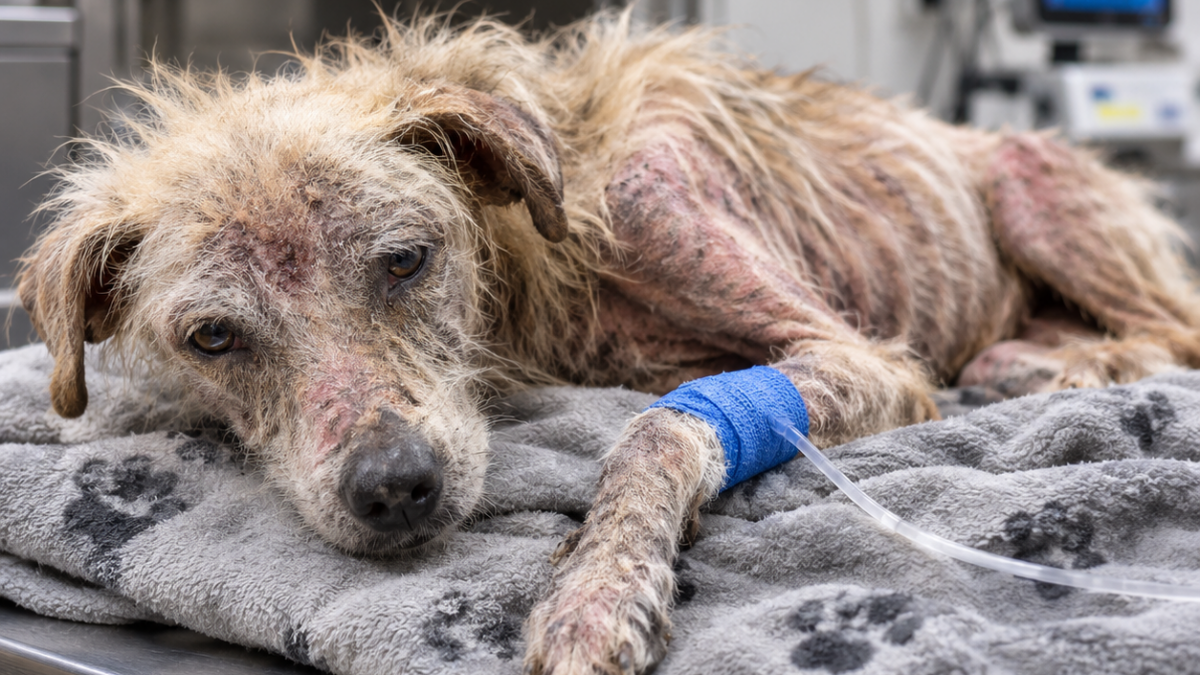
By the time we reached the backyard of a small house on Cleveland’s east side, Jake was so starved and cold that ants were crawling over his legs and belly, and he no longer had enough strength to lift his head, much less brush them away.
We thought the worst thing we were looking at was the neglect—the ribs showing through his skin, the swollen paws, the raw patches where fur should have been, and a heartbeat so slow our veterinary contact warned us his body might already be shutting down—but the first X-rays at the emergency clinic showed that Jake had been fighting something even more dangerous inside him.
Then one of the technicians pointed to a tiny bright object lodged deep in his body, and before any of us could process what it might mean, the surgeon came through the doors and told us we had minutes to decide whether this nearly lifeless dog could survive an operation that might be his only chance.
My name is Rachel Hayes, and at the time I volunteered with a small rescue group in Cleveland, Ohio.
The call came just before noon.
“Rachel, we have a dog down behind a house,” our coordinator, Maria, said. “Caller says he’s barely moving.”
“Hit by a car?”
“They don’t know. They said he’s extremely thin.”
Twenty minutes later, Maria and I turned into a narrow residential street. A man waiting near the sidewalk waved us toward the back of one house.
“He’s behind there.”
I remember thinking I had seen thin dogs before.
Then I saw Jake.
For a second, neither of us moved.
He lay on his side near a patch of dead grass, curled so tightly his knees almost touched his chest. His coat was sparse and dirty. Every rib showed. His hips rose like sharp angles beneath the skin.
And ants were moving across him.
“Oh, God,” Maria whispered.
I dropped to my knees.
“Hey, sweetheart.”
Jake’s eyes opened a fraction.
That was all.
I brushed the ants away with my sleeve and touched his ear.
Cold.
Far too cold.
Maria was already calling the emergency clinic.
“He’s freezing,” I told her.
Jake tried to move one front paw.
It slid an inch through the dirt and stopped.
I bent closer.
“You don’t have to go anywhere by yourself now. We’ve got you.”
His eyes opened again.
For one second, he looked directly at me.
Then they closed.
The man who had called us stood several feet away, visibly shaken.
“How long has he been like this?” I asked.
“I only came over because I heard him crying last night.”
“Does he belong here?”
He hesitated.
“There’s a guy who’s been staying in the house. Says the dog isn’t really his.”
“What does that mean?”
“He said somebody left the dog with him and he never wanted him.”
Maria looked at me.
That detail would matter later.
At that moment, all I cared about was Jake’s pulse.
I could barely feel it.
We slid a blanket beneath him and lifted.
He weighed almost nothing.
In the van, Maria turned the heat up as high as it would go while I wrapped Jake in two more blankets.
“Stay with me,” I whispered.
His breathing was shallow.
At the emergency hospital, a technician met us with a gurney.
The first temperature reading made her face change.
“Severe hypothermia.”
They rushed him into treatment.
Warm fluids. Heated blankets. Oxygen. Bloodwork.
I stood behind the glass with Maria.
A veterinarian named Dr. Patel came out fifteen minutes later.
“He’s critically ill.”
“What’s happening?”
“His abdomen is distended. We’re taking films now.”
The X-rays appeared on a monitor.
Dr. Patel pointed at Jake’s stomach.
My stomach dropped before she even explained it.
“It’s severely enlarged with gas, and I’m concerned it has twisted.”
“Bloat?”
She nodded.
“Gastric dilatation-volvulus. If that’s what we’re seeing, this is a surgical emergency.”
Maria whispered, “Can he survive surgery?”
Dr. Patel looked through the treatment-room window.
“That’s the problem.”
Jake was profoundly underweight, anemic, dehydrated, hypothermic, and dangerously weak.
Then the radiology technician leaned closer to the screen.
“Doctor?”
Dr. Patel turned.
The technician pointed near Jake’s torso.
A tiny white shape glowed against the darker image.
“What is that?” I asked.
Dr. Patel studied it.
Her expression tightened.
“Metal.”
Maria stepped closer.
“From what?”
Dr. Patel didn’t answer immediately.
When she finally did, her voice was quiet.
“It could be a pellet.”
I looked at Jake through the glass.
Starved.
Frozen.
Twisted stomach.
Metal lodged inside him.
And suddenly the question was no longer only whether we could save him.
It was what, exactly, had happened to him before we arrived.
PART 2
Dr. Patel didn’t give us much time to think.
“If his stomach is twisted, waiting is more dangerous than operating,” she said. “But I need you to understand the anesthesia risk. His body has almost no reserve.”
Maria glanced at me.
We were both authorized to approve emergency treatment through the rescue, but neither of us spoke.
Dr. Patel continued.
“We’re decompressing the stomach now. We’re correcting his temperature and circulation as much as we can. If we can stabilize him enough to get him into surgery, that gives him a chance.”
“How much of a chance?” I asked.
She held my eyes.
“I can’t give you a percentage I trust.”
That was veterinarian language for bad.
I looked through the glass.
A technician was clipping fur from Jake’s front leg while another adjusted the warm-air blanket around his body.
He didn’t resist.
He barely seemed aware of them.
I remembered the ants crawling over his stomach.
I remembered him opening his eyes when I told him he wasn’t alone.
“Do it,” I said.
Maria nodded.
“Whatever gives him the best chance.”
Dr. Patel went back through the doors.
I sat down.
My hands had started shaking.
Maria noticed.
“You okay?”
“No.”
“Me either.”
For nearly an hour, all we could do was wait while the team tried to make a dying dog strong enough to survive the procedure that might keep him alive.
A technician came out once.
“His temperature is coming up.”
“Good?”
“Better than it was.”
Another twenty minutes.
Then Dr. Patel appeared again.
“We’re going in.”
I stood.
“Definitely twisted?”
“The pattern is highly suspicious, and his condition is deteriorating. We don’t have the luxury of waiting.”
“What about the metal?”
“Not the priority right now. It appears to be in soft tissue, not his stomach.”
“So someone shot him?”
“I said it could be a pellet. We’ll document it. Later we can determine whether removal is necessary.”
She lowered her voice.
“Right now I need you focused on the thing that can kill him in the next hour.”
Jake disappeared through the surgery doors.
And the waiting started again.
—
Maria eventually bought two coffees from a machine down the hall.
Neither of us drank them.
“Who was that man at the house?” she asked.
“The caller?”
“No. The guy who supposedly didn’t want the dog.”
“We never saw him.”
The man who had called us, a neighbor named Tom, had told us the occupant was away.
“He said somebody left Jake there,” Maria continued.
“I know.”
“But if he wasn’t his dog, why didn’t he call someone?”
“I don’t know.”
“Why was Jake behind his house?”
“I don’t know.”
“And why is there something that looks like a pellet inside him?”
I looked at her.
“I don’t know.”
Those three words became the center of everything.
—
An hour into surgery, a nurse came out.
“Jake is still under. Dr. Patel asked me to tell you they confirmed the stomach had rotated.”
My chest tightened.
“How bad?”
“She’ll explain afterward.”
“Is he alive?”
“Yes.”
That was enough.
For another hour.
Then another forty minutes.
At one point I realized I’d been staring at the same poster about flea prevention without reading a single word.
Finally the surgery door opened.
Dr. Patel walked toward us.
Her mask was hanging loose beneath her chin.
She looked exhausted.
But she smiled.
“He made it through.”
Maria covered her face.
I sat down before my knees could decide for me.
“What did you do?”
“The stomach had rotated significantly. We decompressed it, returned it to position, checked the tissue for viability, and performed a gastropexy to reduce the chance of recurrence.”
“Did anything have to be removed?”
“Not from the stomach. That’s the good news.”
“The bad?”
“He’s not out of danger.”
Of course.
“His heart rhythm became unstable briefly during the procedure. We corrected it. He’s extremely weak, and the next twenty-four to forty-eight hours are critical.”
I nodded.
“And the pellet?”
“Still there.”
She pulled up the radiograph again.
The metallic object sat near the rear of his rib cage, off to one side.
“It doesn’t appear to be causing the immediate problem. Once he’s stronger, we can take more views. If it’s stable and not causing pain or infection, removing it may create more harm than leaving it.”
Maria stared at the screen.
“How old?”
“Impossible to tell from one film.”
“So it could have happened years ago.”
“Yes.”
“Or last week.”
“Yes.”
Dr. Patel looked at us carefully.
“Don’t build a criminal case from an X-ray. Document it. Let the humane investigator do the rest.”
She was right.
I didn’t like it.
But she was right.
—
Jake woke slowly.
At first, only his eyes moved.
Then his ears.
When I was finally allowed into intensive care, he was under layers of blankets with monitors attached to him.
The dog who had looked enormous from the road seemed impossibly small on that bed.
“Hey.”
One eye opened.
“You did it.”
His breathing stayed slow.
“You made everybody very nervous.”
His eye closed again.
I sat beside him.
“We’ll discuss your hospital bill later.”
A technician smiled from across the room.
I lowered my voice.
“You don’t owe us anything.”
Jake’s ear twitched.
I placed my hand beside his paw.
Not on it.
Beside it.
After several minutes, his toes moved until they touched my fingers.
I stayed there until Maria finally forced me to go home.
—
At 3:14 the next morning, my phone rang.
I answered before I was fully awake.
“Rachel?”
Dr. Patel.
My heart stopped.
“What happened?”
“He had another abnormal rhythm. We’ve stabilized him.”
I sat upright.
“Is he dying?”
“I don’t know.”
The most frightening doctors are the ones who don’t pretend.
“Can I come?”
“Yes.”
I was dressed in under three minutes.
—
Jake looked worse when I arrived.
His gums were pale.
His breathing was faster.
A technician was sitting beside him recording his heart rate.
I stood outside until Dr. Patel waved me in.
“We’re worried about reperfusion injury and the stress his body took before surgery.”
“What can we do?”
“What we’re doing.”
I hated that answer.
Fluids.
Pain control.
Electrolyte correction.
Cardiac monitoring.
Warmth.
Care.
No miracle.
Jake opened his eyes when I spoke.
“Come on.”
His gaze found me.
“You’ve already done the hardest part.”
I knew that wasn’t necessarily true.
I said it anyway.
“Stay.”
His eyes closed.
I put my hand against his shoulder.
“Just stay.”
—
He did.
By sunrise, the heart rhythm had settled.
By afternoon, his temperature was normal without active warming.
That evening, Dr. Patel offered him a teaspoon of soft food.
He turned his head away.
Nobody panicked.
The next morning, he licked some from her finger.
Maria sent a message to our rescue group:
**HE ATE.**
It was ridiculous how much happiness three licks of food could create.
—
The humane investigator came to the hospital that afternoon.
Her name was Denise Walker.
She wore jeans, boots, and the expression of someone who had learned to let other people lie before correcting them.
She photographed Jake.
His weight.
His paws.
The raw skin.
The areas where mange was suspected.
The wound marks.
She photographed the radiographs and requested copies.
Then she sat with Maria and me.
“Start at the call.”
We did.
She took notes.
“What did the caller say about the person living at the property?”
“That Jake had been left there and the man never wanted him,” I said.
“Name?”
“Tom gave us ‘Caleb.’ I don’t know the last name.”
Denise did.
“Caleb Mercer.”
“You’ve spoken to him?”
“Briefly.”
“What did he say?”
“That the dog wasn’t his.”
“Then whose?”
“He says Jake belonged to his mother.”
I stopped.
“His mother?”
“Marianne Mercer. She died about eight months ago.”
That changed the picture instantly.
“So Jake lived with her?”
“That’s what I’m verifying.”
“Then why was he with Caleb?”
“He says the family couldn’t find anyone else.”
“And he took Jake?”
“He says temporarily.”
Maria frowned.
“For eight months?”
Denise closed her notebook.
“Temporarily is a very elastic word when people don’t want responsibility.”
“What did Caleb say about Jake’s condition?”
“That the dog had been declining because of age.”
I laughed once.
Denise didn’t.
“He says Jake stopped eating two days ago.”
“He didn’t become that thin in two days.”
“I know.”
“The mange?”
“Says he didn’t notice until recently.”
“The pellet?”
“I haven’t asked him yet.”
“Why not?”
“Because I like people to tell me their story before they know which parts I can prove false.”
I liked Denise immediately.
—
The first person to complicate Caleb’s story was Tom.
Denise interviewed him the next day.
Then she called me.
“He says Jake had been outside most of the summer.”
“Most?”
“Backyard or under the porch.”
“Food?”
“Tom says he saw bowls sometimes.”
“That doesn’t mean Jake was eating.”
“No.”
“What else?”
“He says Caleb complained about the dog getting into garbage.”
My mind went to the pellet.
“Did Tom see anyone hurt him?”
“No.”
I exhaled.
Then Denise added:
“But another neighbor may have.”
—
I wasn’t supposed to become involved in the investigation.
I tried not to.
Jake made that difficult simply by existing.
Every mark on him felt like a question.
The skin tests confirmed severe mange with secondary infection.
His paws were swollen from a combination of inflammation, poor condition, and neglected nails.
His bloodwork suggested prolonged malnutrition.
There were pressure sores over bony areas where his body had almost no padding left.
Every time another result came in, I imagined someone walking past him.
Again.
Again.
Again.
That was the part that made me angriest.
Extreme suffering is rarely invisible.
People just become practiced at looking around it.
—
On Jake’s third postoperative day, he stood.
Not gracefully.
A technician named Luis supported him with a sling.
Jake’s back legs trembled so badly I almost told them to stop.
“Let him decide,” Luis said.
Jake took one step.
Then another.
His nails scraped the rubber flooring.
“That’s enough,” I whispered.
He took a third.
Then collapsed gently into the sling.
Luis smiled.
“Stubborn.”
“He’ll fit right in.”
Jake looked at me.
For the first time, there was something in his eyes besides exhaustion.
Annoyance.
I laughed.
“That is the best thing I’ve seen all week.”
—
The next person Denise found was Caleb’s sister, Laura.
She had lived out of state and had not known how bad Jake’s condition had become.
When their mother died, Laura had wanted Jake placed through a senior-dog rescue.
Caleb refused.
Why?
According to Laura, their mother’s will had not left money specifically for Jake, but she had verbally asked Caleb to keep him.
Their mother had been deeply attached to the dog.
Caleb had agreed at the funeral.
Then regretted it almost immediately.
Laura told Denise she’d sent him money for dog food twice.
Caleb never asked for more.
That didn’t prove cruelty.
It proved opportunity.
He could have said no.
He could have surrendered Jake.
He could have called Laura.
He did none of those things.
—
Then Laura sent Denise old photographs.
Jake at three years old beside Marianne’s kitchen table.
Jake in a Christmas sweater.
Jake sleeping beside Marianne in a recliner.
Jake standing in a yard with a red ball in his mouth.
I stared at the pictures on Denise’s phone.
“That’s him?”
Same white blaze on the chest.
Same dark ears.
But healthy.
Muscular.
Bright-eyed.
Loved.
The contrast hurt more than if Jake had always been stray.
He knew what a home felt like.
Then he lost the person who gave him one.
—
Laura came to the hospital.
I expected Jake to recognize her.
He did.
His head lifted the moment she entered.
Laura stopped in the doorway and began crying.
“Oh, Jake.”
He tried to stand.
She rushed toward him.
“No, no, stay down.”
Jake’s tail moved weakly.
Laura knelt.
He pressed his nose against her hand.
She cried harder.
“I should have come.”
Nobody answered.
She touched the thin fur on his head.
“I should have checked.”
Jake licked one finger.
Laura looked at me.
“I believed Caleb.”
“What did he tell you?”
“That Jake was slowing down but fine.”
“When?”
“Two weeks ago.”
She pulled out her phone.
A text.
**Jake’s old but hanging in there. Eats like a horse. Stop worrying.**
Sent nine days before we found Jake too weak to brush ants from his skin.
Laura stared at the message.
“He lied.”
I didn’t know what to say.
Sometimes there’s nothing useful you can add to a sentence like that.
—
Denise took a copy.
Then she asked a question that changed everything.
“Do you have messages about the pellet gun?”
Laura looked up.
“What pellet gun?”
My attention sharpened.
Denise kept her voice neutral.
“Caleb owns one?”
Laura blinked.
“He has an air rifle. For squirrels.”
My stomach tightened.
“What kind?” Denise asked.
Laura shrugged.
“I don’t know.”
“Did he ever mention shooting at Jake?”
Laura’s face changed.
“No.”
“Think carefully.”
She did.
Then her thumb started moving over her phone.
“What?” I asked.
“One second.”
She searched old family messages.
Scroll.
Scroll.
Then stopped.
Her face went pale.
“Oh my God.”
She handed the phone to Denise.
The message was four months old.
Caleb had written in a family group chat:
**Mom’s stupid dog tore open the trash again. I hit him with a BB and he still came back twenty minutes later. This thing is indestructible.**
Nobody in the family had responded.
Laura covered her mouth.
“I thought he meant threw something at him.”
Denise stared at the screen.
“I’m going to need this.”
Laura nodded.
Her hands were shaking.
“I didn’t know.”
I looked through the glass at Jake.
A tiny white shape still sat inside his body.
Four months.
Maybe that was when.
Maybe not.
But now there was a message.
Not proof by itself.
A direction.
—
Caleb denied it.
Of course he did.
Denise later told us he claimed the message was a joke.
Then he said “BB” meant a plastic pellet.
Then he said he had fired near Jake, not at him.
Then he said he couldn’t remember.
Denise didn’t argue.
She collected the air rifle voluntarily after telling him she could seek a warrant if investigators developed sufficient cause.
She documented the ammunition.
The pellet seen on Jake’s X-ray was consistent in size with the kind Caleb owned, but Denise was careful.
“That’s not like matching a fingerprint,” she told me. “We don’t get to say the gun definitely fired it just because the size fits.”
“But the text matters.”
“Yes.”
“The condition matters.”
“Yes.”
“The lie to Laura matters.”
“Yes.”
She looked at me.
“Stop trying to win this before Jake can walk.”
That shut me up.
—
By day five, Jake was strong enough to leave intensive care.
Not the hospital.
Just ICU.
His stomach incision looked good.
His heart rhythm had stayed stable.
He was eating small meals.
Very small.
The nutrition plan was cautious because his body had been starved.
Too much food too fast could create its own dangerous problems.
I learned more about refeeding risks that week than I ever wanted.
Jake learned that chicken came from nurses.
He became extremely interested in nurses.
Progress.
—
On day seven, he wagged his tail at me.
Not a weak accidental movement.
A real wag.
I walked in with his food.
Thump.
I stopped.
“Do that again.”
Nothing.
“You did it.”
Jake stared at the bowl.
“Oh.”
Thump.
“You’re using me.”
Thump.
Luis laughed behind me.
“He’s recovering.”
“How can you tell?”
“Manipulation.”
I set the bowl down.
Jake ate.
Slowly.
Every bite felt like rebellion.
—
Caleb learned Jake had survived through the local humane officer.
His reaction wasn’t concern.
It was anger.
He called the rescue office.
Maria put him on speaker.
“I want my mother’s dog back.”
I was standing across the room.
Maria’s head snapped up.
“You told the investigator he wasn’t your dog.”
“He was my mother’s. That makes him family property.”
“No.”
“What do you mean, no?”
“Ownership and custody are being handled through the humane investigation.”
“You people had no permission to take him.”
“He was on your property dying.”
“He wasn’t dying.”
Maria looked at me.
I mouthed, Don’t.
She ignored me.
“Caleb, he had emergency surgery for gastric torsion.”
“That’s your vet saying that.”
“No. That’s surgery actually performed.”
“Maybe you caused it moving him.”
I had to walk away.
Maria stayed calm.
“Your complaint should go through the investigator.”
“I want to know where he is.”
“We will not give you his location.”
“You can’t hide my dog from me.”
“You just said he was your mother’s.”
Silence.
Then Caleb said:
“You people are trying to make me look like a monster.”
Maria answered softly.
“We haven’t said anything publicly about you.”
That was true.
We had posted Jake’s condition and asked for donations.
No address.
No owner name.
No accusations.
Caleb hung up.
Twenty minutes later, his first social media post appeared.
—
A screenshot reached us through a supporter.
**LOCAL RESCUE STOLE MY DEAD MOTHER’S DOG AND IS USING HIM TO MAKE MONEY.**
Underneath, Caleb wrote that Jake had been old and sick, that he had planned to seek veterinary care, and that “strangers trespassed” and took him.
Maria read it twice.
“Do we answer?”
I said, “Yes.”
Our rescue attorney said, “No.”
She won.
For forty-eight hours.
—
The story spread through neighborhood groups.
Most people didn’t know what to believe.
Some defended Caleb.
One wrote:
**Not everyone can afford a $10,000 vet bill.**
Another:
**Rescues love making owners look bad.**
A third accused us of starving Jake for photographs.
That one almost made me throw my phone.
Maria took it away.
“No more comments.”
“Someone said we starved him.”
“I saw.”
“Can we post his intake report?”
“Not while Denise is investigating.”
“So he gets to lie?”
“For now.”
I hated those words.
For now.
—
Jake didn’t know any of this.
He was learning stairs.
Badly.
His paws were still tender, and his muscles were almost nonexistent.
We used a harness.
One step.
Pause.
Another.
At the top he looked at me as if he’d climbed Everest.
“You’re incredibly dramatic.”
He leaned against my leg.
I scratched behind his ear.
“Fine. Hero.”
—
On day ten, Dr. Patel said Jake could leave the hospital if we had a medically experienced foster.
Maria looked at me.
“No.”
“I didn’t say anything.”
“You have that face.”
“What face?”
“The foster-fail face.”
“I have two dogs.”
“They’re gentle.”
“I work.”
“You work remotely three days a week.”
“I have stairs.”
“You have a downstairs guest room.”
I stared at her.
“You’ve thought about this.”
“Since day two.”
I looked through the kennel.
Jake was sleeping with his head on a stuffed duck.
“Temporary.”
“Of course.”
“Until he’s stronger.”
“Absolutely.”
“You don’t believe me.”
“Not even a little.”
—
Jake came home with me on a Friday.
My dogs, Penny and Moose, stayed behind a baby gate while he entered.
Jake froze.
He stared into the living room.
Soft rug.
Water bowl.
Bed.
Sunlight.
Nothing threatening.
Still, he wouldn’t move.
I sat on the floor.
“You don’t have to.”
Five minutes.
Ten.
Eventually he took one step.
Then another.
Penny whined from behind the gate.
Jake looked at her.
His tail moved.
Moose sneezed.
Jake startled so badly he almost fell.
“Moose.”
The Labrador looked ashamed.
Jake walked to the bed.
Sniffed.
Turned twice.
Collapsed.
Within five minutes he was asleep.
I sat beside him.
For the first time since we found him, there were no monitors.
No clinic sounds.
No voices.
Just breathing.
His.
Mine.
Penny’s impatient whining.
It was the quietest moment of the entire rescue.
And somehow the one that made me cry hardest.
—
Recovery wasn’t a straight line.
The first week at my house, Jake vomited after breakfast.
I panicked.
Dr. Patel didn’t.
“Slow his meals. Monitor him.”
The next day he ate normally.
Then his skin flared.
Medication adjustment.
Then one paw became swollen.
Another veterinary visit.
Then loose stool.
Different food.
Healing looked nothing like the triumphant before-and-after videos people imagined.
It was laundry.
Medication alarms.
Small meals.
Cleaning.
Watching.
Waiting.
And arguing with Jake about whether the couch was medically necessary.
He believed it was.
—
His personality arrived in pieces.
First came food obsession.
Then blankets.
Then sunlight.
Then theft.
I found him one morning with Penny’s toy rabbit.
Penny stood three feet away staring at me as though reporting a crime.
“Jake.”
He looked up.
“That’s not yours.”
His tail moved.
“You understand me.”
He put his head on the rabbit.
Penny looked offended.
I gave her another toy.
Justice was imperfect in our house.
—
His fur grew back slowly.
Mostly tan and white.
The raw red skin faded.
His paws looked less swollen.
His eyes changed most.
The exhaustion receded.
He started following me into the kitchen.
Then the bathroom.
Then from room to room.
One afternoon, I looked behind me and nearly tripped over him.
“You know you don’t have to monitor me.”
Jake sat.
His tail swept the floor.
I thought about the backyard.
Too weak to lift his head.
Now he was inconveniencing me.
I loved it.
—
The humane case moved more slowly.
Caleb’s lawyer argued that Jake had belonged to Marianne and that Caleb was never the legal owner.
Denise explained why that didn’t automatically remove responsibility.
He had possessed the dog.
Fed—or failed to feed—the dog.
Kept him on the property.
Prevented Laura from arranging placement.
Represented to family members that Jake was fine.
Responsibility didn’t disappear because he hadn’t wanted it.
That became the central argument.
Caleb’s defense was simple:
He had never agreed to own Jake.
Laura had abandoned the dog with him.
Jake had been deteriorating from age.
The gastric torsion was sudden and unrelated to neglect.
The mange was difficult to recognize.
The pellet was old and unconnected.
And we had exaggerated his condition to raise money.
Some of that was possible.
Enough of it was possible that I became afraid.
Not that Caleb would get Jake back.
That was increasingly unlikely.
I was afraid the legal case would reduce months of visible suffering into reasonable doubt and paperwork.
Denise reminded me:
“Court isn’t where we prove every terrible thing we imagine happened. It’s where we prove what the evidence supports.”
“What if that’s not enough?”
“Then you still saved the dog.”
That had to be enough.
For a while.
—
Then Tom’s security camera changed the case.
It wasn’t pointed at Caleb’s yard.
It covered Tom’s driveway.
But the edge of the image included part of the neighboring fence.
Tom had installed it after tools were stolen from his truck.
He hadn’t thought about the recordings until Denise asked if anyone nearby had cameras.
Most old footage had automatically overwritten.
Three clips remained because motion alerts had been saved to his phone.
The first was from six weeks before Jake’s rescue.
Jake wandered into frame.
Thin already.
He searched near Tom’s trash bins.
Caleb appeared at the fence.
Even without audio, his body language was unmistakable.
He threw something.
Jake flinched.
Ran.
The second clip was two weeks later.
Jake limped past at night.
The third was the most important.
Nine days before we found him, Tom’s camera recorded Jake standing near the fence at 2:13 a.m.
He was already skeletal.
He walked to a puddle beside the curb and drank.
Then he went back toward Caleb’s yard.
Nine days.
Caleb had texted Laura two days later:
**Jake’s fine. Eats like a horse.**
There it was.
Not a diagnosis.
Not the pellet.
A lie tied to a date.
—
Laura agreed to testify.
Caleb called her.
She recorded the conversation after telling him she was doing so.
“Why are you doing this?” he demanded.
“Because Mom loved Jake.”
“So did I.”
“No, you didn’t.”
“You weren’t here.”
“Exactly. That’s why I asked you.”
“You dumped him on me.”
“I asked you if you could keep him until I found placement.”
“For eight months?”
“Because every time I found one, you said he was fine with you.”
Silence.
Then Caleb said something that would later be repeated in court.
“He was Mom’s problem. Mom died.”
Laura’s voice broke.
“He was alive.”
Caleb hung up.
—
The public argument got uglier.
Caleb posted another accusation.
This time he claimed we had refused to let him visit Jake.
That part was true.
He omitted the fact that the humane investigator had instructed us not to disclose the foster location.
People began sending messages to our rescue.
Some were supportive.
Some weren’t.
Then one person posted my last name and neighborhood.
That changed things.
Maria called the police.
The post was removed.
Caleb denied involvement.
We had no evidence he had shared the information.
So we didn’t accuse him.
I became more careful anyway.
I stopped walking Jake alone after dark.
I hated that the case had reached my front door.
—
Jake noticed my anxiety.
One evening I was sitting at the kitchen table reading comments I had promised Maria I wouldn’t read.
Jake walked over.
Placed his chin on my thigh.
I kept scrolling.
He pushed harder.
“Jake.”
He stared.
I put the phone down.
“Fine.”
His tail moved.
“You win.”
I scratched his head.
The irony wasn’t lost on me.
I was supposed to be rescuing him.
He had started interrupting the things that were hurting me.
—
Two months after surgery, Jake weighed nineteen pounds more than intake.
Dr. Patel stared at the scale.
“That’s enough enthusiasm.”
I laughed.
“He likes food.”
“I’ve noticed.”
Jake looked between us, hoping one of us had a snack.
His bloodwork had improved dramatically.
His anemia was resolving.
His skin infection was gone.
The mange was controlled.
His incision was fully healed.
We took new radiographs.
The pellet remained exactly where it had been.
“Leave it?” I asked.
Dr. Patel nodded.
“It isn’t causing a problem. Surgery to chase it would be unnecessary.”
“So he carries it forever.”
“Probably.”
I hated that.
Dr. Patel saw my face.
“Rachel.”
“I know.”
“It’s not hurting him.”
“I know.”
“Then don’t make the scar more important than the dog.”
That stayed with me.
—
Caleb’s attorney requested an independent veterinary review.
The rescue board agreed to provide records through the proper legal process.
A second veterinarian confirmed the obvious:
Jake’s malnutrition and skin disease developed over time.
The gastric torsion itself could occur acutely and wasn’t proof of neglect.
But Jake’s condition when it occurred dramatically reduced his ability to survive it.
That distinction mattered.
We never claimed Caleb caused the torsion.
We claimed Jake entered that emergency after prolonged neglect had left him dangerously compromised.
That was supportable.
—
Then Caleb made the mistake that ended the argument about money.
He filed a civil demand through an attorney claiming the rescue had profited from Jake’s story and that, as the dog’s “lawful custodian,” he was entitled to either the dog or compensation.
Our attorney read the letter.
Then smiled.
Maria noticed.
“Why are you smiling?”
“Because he just described himself as Jake’s lawful custodian.”
I understood slowly.
For weeks Caleb’s criminal defense had emphasized that Jake wasn’t his responsibility.
Now his civil demand asserted custody because he wanted money.
He couldn’t comfortably hold both positions.
The civil letter went straight to Denise and the prosecutor.
Caleb’s attorney withdrew it two days later.
Too late.
—
The hearing took place four months after we found Jake.
By then, he barely resembled the dog in the intake photographs.
I did not bring him to court.
He wasn’t evidence to be displayed.
The pictures were enough.
Caleb sat beside his attorney.
Clean shirt.
Tired face.
He looked less like a villain than people wanted him to.
That made the entire thing more disturbing.
Cruel neglect doesn’t always wear a cruel face.
Sometimes it looks like a person who kept saying, Not today.
—
Dr. Patel testified first.
She explained hypothermia.
Body condition.
Anemia.
Mange.
The emergency gastric torsion.
Surgery.
The pressure sores.
She didn’t exaggerate.
Caleb’s attorney asked:
“Doctor, gastric dilatation-volvulus can happen suddenly even in a well-cared-for dog, correct?”
“Yes.”
“So my client did not cause the torsion merely by allegedly failing to feed the dog adequately.”
“I did not testify that he did.”
The attorney paused.
Dr. Patel continued.
“I testified that Jake arrived with a life-threatening acute condition on top of severe chronic neglect.”
The room went still.
“Would a layperson necessarily recognize mange?”
“Not by name.”
“Would they recognize severe hair loss, inflamed skin, open sores, and constant scratching?”
The attorney changed direction.
—
Then came the photographs.
I couldn’t look at the first one for long.
Jake in the dirt.
Ants visible on his leg.
Ribs.
Hips.
Bare skin.
No drama needed.
The image was its own testimony.
—
Laura testified.
She described their mother.
Jake’s life before Marianne died.
Her attempts to find placement.
Caleb’s repeated assurances.
Then the text appeared on the courtroom screen.
**Jake’s fine. Eats like a horse. Stop worrying.**
The prosecutor asked:
“When did you receive that?”
Laura gave the date.
“And when was Jake rescued?”
Nine days later.
The next image was Tom’s footage timestamped two days before Caleb’s message.
Jake drinking from the curb.
Already visibly emaciated.
Caleb looked down.
—
The prosecutor then introduced the family message.
**Mom’s stupid dog tore open the trash again. I hit him with a BB and he still came back twenty minutes later. This thing is indestructible.**
Caleb’s attorney objected to any claim that this definitively proved the metallic object in Jake’s body came from that event.
The judge agreed.
So did the prosecutor.
He didn’t need to overreach.
He asked only:
“Did you write this?”
Caleb said yes.
“What did you mean by ‘hit him with a BB’?”
“A joke.”
“What was funny?”
Silence.
“I don’t know.”
“Did you own an air rifle?”
“Yes.”
“Did you fire it around Jake?”
“Sometimes at pests.”
“At Jake?”
“No.”
“Then why did you write that you hit Jake with a BB?”
“I was exaggerating.”
The prosecutor nodded.
No shouting.
No theatrical accusation.
Just the words sitting there.
—
Tom testified about water.
About hearing Jake cry.
About seeing him grow thinner.
Caleb’s attorney attacked his credibility because the two men had argued over trash and parking.
Tom admitted it.
Then the attorney asked:
“So you disliked Mr. Mercer?”
“Sometimes.”
“You wanted him in trouble?”
“No.”
“You called the rescue.”
“I called because his dog couldn’t stand.”
That ended that line of questioning.
—
Then I testified.
I hated every second.
The prosecutor asked what I saw when we arrived.
I described the ants.
Jake’s temperature.
His inability to stand.
How light he felt when we lifted him.
Then Caleb’s lawyer stood.
“Ms. Hayes, you’re emotionally attached to Jake, correct?”
“Yes.”
“You foster him.”
“Yes.”
“You’ve raised money using his story.”
“The rescue raised money for his medical care.”
“Your organization benefits financially from compelling rescue stories.”
I felt anger rise.
Our attorney had warned me.
Answer only what is asked.
“Our organization receives donations.”
“Because people see photographs of suffering animals.”
“Sometimes.”
“You understand why a more dramatic story might raise more money?”
“Yes.”
“So you have an incentive to portray my client as cruel.”
“No.”
“Really?”
“Really.”
“Yet you’ve repeatedly discussed Mr. Mercer with investigators.”
“Because they asked.”
“You’ve followed the case closely.”
“Yes.”
“You’re angry with him.”
I hesitated.
“Ms. Hayes?”
“Yes.”
There was no point lying.
He smiled slightly.
“So your testimony is colored by anger.”
I looked at the judge.
Then back at him.
“My feelings don’t change Jake’s intake weight.”
His smile disappeared.
“They don’t change his temperature, his bloodwork, his surgery, his skin scrapings, the timestamps on the video, or your client’s text messages.”
The prosecutor didn’t need to object.
The attorney sat down.
My hands shook all the way back to my seat.
—
Caleb eventually testified.
That surprised me.
He said he had never wanted Jake after his mother died.
That part I believed.
He said Laura had pressured him.
Probably true.
He said his finances were bad.
Also true.
He had lost hours at work.
He was behind on rent.
His car needed repairs.
He had been caring for their mother during her final months and resented that the rest of the family expected him to take on her dog too.
For the first time, I understood his anger.
Not his choices.
His anger.
He had spent months caring for a dying parent.
Then the parent died and left behind another dependent creature.
Caleb didn’t want one more thing needing him.
That was human.
What happened next wasn’t inevitable.
He could have said no.
He could have surrendered Jake.
Instead, pride and resentment turned into delay.
Delay turned into neglect.
And neglect became normal because Jake couldn’t call anyone himself.
The prosecutor asked:
“Why didn’t you contact a shelter?”
“I thought they’d put him down.”
“Why didn’t you call your sister?”
“She’d blame me.”
“Why didn’t you seek low-cost veterinary help?”
“I didn’t know any.”
“Did you look?”
Caleb’s hand tightened around the edge of the witness stand.
“No.”
“Why did you tell Laura Jake was eating well?”
“I didn’t want another argument.”
“So you knew she would be concerned if she saw his actual condition.”
Caleb didn’t answer.
The prosecutor waited.
“Yes.”
That single word did more damage than anger ever could.
—
The court did not convict Caleb of everything investigators had considered.
The pellet allegation could not be tied conclusively enough to a specific act for the prosecution to build the most serious version of that charge.
I was angry at first.
Denise wasn’t.
“Evidence has limits,” she reminded me.
But the neglect evidence was overwhelming.
Caleb ultimately entered a plea on charges related to companion-animal neglect and cruelty rather than continuing the case through every disputed count.
The judge imposed probation, fines and restitution, required counseling and humane-education conditions, and prohibited him from owning or having primary custody of animals during the court-ordered period.
There was also a short jail component, part of which was suspended contingent on compliance.
It wasn’t the dramatic punishment social media wanted.
It was real.
And it stayed on paper long after the comments disappeared.
—
Outside court, Caleb looked at me.
I expected anger.
Instead, he said:
“Is he alive?”
The question stopped me.
“Yes.”
“How’s he doing?”
“Better.”
He nodded.
“Does Laura see him?”
“Yes.”
That seemed to hurt.
Then he said something I hadn’t expected.
“Mom would’ve hated me.”
I didn’t answer.
Maybe that was his real punishment.
Not the fine.
Not probation.
Not losing the argument.
Knowing exactly what his mother would have seen if she had walked into that backyard.
—
Caleb’s online accusations collapsed after the hearing.
The rescue didn’t gloat.
Maria refused to.
“We’re not turning Jake into a weapon.”
So we posted one factual update.
The case had been resolved.
Jake remained safe.
Donations had gone toward documented veterinary expenses and care.
No names beyond what was already public record.
No victory speech.
Caleb didn’t deserve control over the rest of Jake’s story.
Neither did we.
Jake did.
—
The bigger surprise came from Laura.
She visited almost every weekend.
At first, Jake became excited.
Then confused.
He would sniff her, wag, look toward the door.
As though expecting Marianne to follow.
Laura understood before I did.
“He associates me with Mom.”
Her voice broke.
She sat on the floor.
Jake put his head in her lap.
“I should have taken you.”
I had heard versions of that sentence from everyone.
I should have called.
I should have checked.
I should have taken him.
Regret has perfect vision after the fact.
Laura stroked Jake’s ear.
“I thought Caleb was difficult, not dangerous.”
I sat across from her.
“He wasn’t dangerous every day.”
She looked at me.
“That almost makes it worse.”
I knew what she meant.
If Caleb had been obviously monstrous, somebody might have intervened sooner.
Instead, he was a man under stress making one bad decision after another while a dog quietly absorbed the consequences.
—
Five months after surgery, Jake reached a healthy weight.
Not young-dog muscular.
He was ten.
His back legs had arthritis.
His muzzle was gray.
One side of his body still carried the pellet.
But he looked like a dog again.
A real dog.
Not a collection of emergencies.
His favorite activity was lying in a patch of sun by my back door.
His second favorite was eating.
His third was stealing Moose’s bed.
Moose outweighed him by twenty pounds and still allowed it.
No one understood why.
I suspected Jake had seniority through suffering.
—
Then Maria brought adoption paperwork.
I stared at it.
“What is this?”
“Jake is medically cleared for placement.”
My stomach dropped.
“Oh.”
She watched me carefully.
“What?”
“Nothing.”
“You’ve had him five months.”
“I know.”
“He needs a permanent home.”
“I know.”
“We’ve had applications.”
That hurt more than it should have.
“Good.”
“One retired couple looks excellent.”
“Good.”
“They have a fenced yard.”
“Good.”
“No other pets.”
“Great.”
“Rachel.”
“What?”
“You’re gripping the form.”
I looked down.
I was.
Maria smiled.
“No one is making you give him up.”
“He’s a foster.”
“Only because you haven’t admitted otherwise.”
I looked across the room.
Jake was asleep with his head on Moose’s back.
“What if I can’t give him everything he needs?”
Maria laughed.
“You took him to nineteen appointments.”
“That’s different.”
“You sleep downstairs when his stomach makes a weird noise.”
“He had GDV.”
“Five months ago.”
“He could have gas.”
“You own a stethoscope now.”
“That was practical.”
“You are insane.”
Jake opened one eye.
I whispered:
“I’m adopting him.”
Maria nodded.
“I brought both sets of paperwork.”
I hated her.
—
Jake became mine officially on a Tuesday afternoon.
I signed the papers at the kitchen table.
Laura came.
So did Maria.
Dr. Patel stopped by after work.
Jake slept through most of it.
When Maria finally placed the certificate beside him and took a photograph, his expression suggested we were all embarrassing ourselves.
I knelt.
“Congratulations.”
Jake yawned.
“You have a last name.”
Nothing.
“Hayes.”
He looked toward the kitchen.
“I see what matters.”
I gave him a piece of chicken.
—
For the first few weeks after adoption, I expected to feel relieved.
Instead, I became anxious.
Every time Jake slept deeply, I checked his breathing.
Every time he skipped part of a meal, I remembered the hospital.
Every time his abdomen looked slightly round after eating, panic climbed my throat.
Dr. Patel finally confronted me.
“You need to stop trying to prevent every possible bad thing.”
“Easy for you to say.”
“No. I’m a veterinarian. I do this professionally.”
She pointed at Jake.
“He’s alive.”
“I know.”
“He’s healthy for his age.”
“I know.”
“He has risks.”
“I know.”
“So let him be a dog.”
That was harder than saving him.
—
I started taking him to a quiet park near my house.
At first, he stayed close.
Then one morning he wandered six feet ahead.
Stopped.
Looked back.
I said:
“Go.”
He sniffed a tree.
Then another.
Nothing remarkable.
Except Jake had spent months existing in a world where every movement was pain or survival.
Now he could waste time smelling grass.
That felt enormous.
—
One afternoon, a boy approached with his father.
“Can I pet him?”
I looked at Jake.
He looked at the boy.
“Let him smell your hand.”
The boy did.
Jake leaned forward.
Then pressed his head against the child’s palm.
“What happened to his fur?”
“It grew back.”
“Was he sick?”
“Yes.”
“Is he okay now?”
I looked down at him.
Jake’s tail moved.
“Yes.”
For the first time, I said it without qualification.
“He’s okay.”
—
The rescue created an emergency fund in Jake’s name.
Not because we wanted to turn him into a mascot.
Because his case revealed a problem we kept seeing.
People waited too long.
Sometimes from cruelty.
Sometimes denial.
Sometimes poverty.
Sometimes shame.
Whatever the reason, the animal suffered.
The fund helped owners who asked early.
It also helped people surrender animals safely before neglect began.
The first case was an elderly man with a diabetic dog he could no longer afford.
He called before the dog became critically ill.
We arranged treatment and placement.
The dog survived.
I thought about Caleb.
Help had existed.
He just never asked.
—
A year passed.
Then another.
Jake aged.
His muzzle whitened.
His arthritis progressed.
He slept more.
But he remained obsessed with food.
The first time he barked at me because dinner was late, I nearly applauded.
“You used to refuse food.”
Bark.
“Show some gratitude.”
Bark.
Moose joined in.
Penny joined because she didn’t know why we were yelling.
Within seconds, my kitchen sounded insane.
I stood there laughing.
Jake’s tail wagged.
That noise was one of the happiest sounds of my life.
—
Laura stayed part of his life.
We never pretended she was blameless.
Neither did she.
She had trusted Caleb and stayed too far away.
She carried that.
But Jake never punished her.
Whenever she arrived, he brought her a toy.
Usually the ugliest one.
Laura kept an old photograph of Marianne and Jake on her phone.
One evening, she showed it to me.
Marianne sat on the porch.
Jake was beside her.
Same head tilt.
Same eyes.
“He loved her,” Laura said.
“I know.”
“Do you think losing her is why he stopped fighting?”
I looked at Jake.
He was asleep.
“No.”
Laura frowned.
“He was still fighting when we found him.”
Ants had been crawling over him.
His heart had barely been beating.
Yet when I touched him, he opened his eyes.
“He hadn’t stopped.”
Laura started crying.
I put an arm around her.
“He just needed somebody to notice.”
—
Caleb disappeared from our lives for nearly two years.
Then a letter arrived at the rescue.
No return address on the front.
Maria recognized the handwriting from court documents.
She called me before opening it.
“Do you want this?”
“No.”
“You sure?”
“Yes.”
A week later, I changed my mind.
The letter was short.
Caleb said he had completed probation requirements.
He said he wasn’t asking for Jake back.
He wasn’t asking for forgiveness.
He wanted us to know he had started volunteering twice a month at a food pantry after a counselor asked him why he had refused help when he needed it.
That was the strangest detail.
Not animal rescue.
People.
He wrote:
**I kept thinking asking for help meant admitting I was failing. By the time I couldn’t hide how bad things were, Jake was the one who paid for it.**
Then:
**I don’t expect this to matter to you. I just wanted somebody who knew him to know I finally understand that.**
I folded the letter.
Maria looked at me.
“Well?”
“I don’t know.”
“Want me to throw it away?”
I looked toward Jake’s photograph on the rescue wall.
“No.”
“Why?”
“Because understanding doesn’t erase what he did.”
“No.”
“But maybe it should still be allowed to exist.”
We put the letter in Jake’s case file.
Not on social media.
Not in a redemption post.
Some things don’t need an audience.
—
Jake turned twelve.
We held a ridiculous birthday party.
Maria put a paper crown on him.
Jake ate it.
Not all of it.
Enough to prove the idea had been bad.
Dr. Patel brought dog-safe cupcakes.
Penny stole one.
Moose stole two.
Jake received three new beds and slept on the floor.
Laura brought Marianne’s old red ball.
The one from the photographs.
She had found it in a box of her mother’s belongings.
Jake sniffed it.
For a moment, nothing happened.
Then his entire body changed.
His ears lifted.
He grabbed the ball.
Twelve years old.
Arthritis.
Gray face.
He ran.
Not far.
Across the yard.
But he ran.
Laura covered her mouth.
“Oh my God.”
Jake brought the ball back.
Dropped it.
Looked at her.
She threw it.
Again.
He ran.
I watched Laura cry while laughing.
For five minutes, Jake was young.
Or maybe memory simply reached him through smell in a way it never reaches us.
Eventually he lay down with the ball between his paws.
Laura sat beside him.
“Mom would love this.”
I believed her.
—
Jake lived another year and a half.
Longer than Dr. Patel had predicted when we first discussed his future.
Long enough for his rescue story to stop being the most important thing about him.
That mattered to me.
He became the dog who hated rain.
The dog who stole towels.
The dog who snored through thunderstorms but panicked when the toaster popped.
The dog who adored children and distrusted vacuum cleaners.
The dog who knew exactly where I kept cheese.
He became ordinary.
After what he had endured, ordinary felt like victory.
—
His final winter was difficult.
Arthritis medication helped until it didn’t help enough.
His kidneys began showing age-related changes.
Then his heart.
Nothing catastrophic.
Just time collecting what it had been owed.
We adjusted medication.
Added rugs so he wouldn’t slip.
Put a ramp by the porch.
He still insisted on sleeping near my bed.
One night, I woke because he was standing in the hallway.
“What?”
He looked toward the back door.
I helped him outside.
Snow had fallen.
Jake stood on the porch.
He hated snow.
Usually he would turn around immediately.
That night he stepped into it.
Slowly.
One paw.
Then another.
He walked into the yard and stood beneath the porch light.
Snow landed on his back.
I wrapped my coat around myself and followed.
“You’ve lost your mind.”
Jake sniffed the air.
Then sat.
I sat beside him.
For ten minutes, neither of us moved.
I don’t know what he smelled.
What he remembered.
Maybe nothing.
Maybe I was the one filling the silence.
Eventually he leaned against me.
I put my arm around his shoulders.
“You’re a strange dog.”
His tail touched the snow once.
—
In March, he stopped finishing breakfast.
I knew before I admitted it.
Dr. Patel examined him.
Bloodwork.
X-rays.
Ultrasound.
The results weren’t one dramatic diagnosis.
They were age.
Kidneys declining.
Heart less efficient.
Arthritis.
A body becoming tired.
I hated that there was nothing to fight.
“Could we change his diet?”
“Yes.”
“Medication?”
“We can adjust.”
“Fluids?”
“If needed.”
“What do we fix?”
Dr. Patel looked at me.
“Rachel.”
I stared at the floor.
“What do we fix?”
She put a hand on my shoulder.
“We keep him comfortable.”
I cried in the exam room.
Jake licked my wrist.
Of course he did.
—
He had good weeks after that.
Then bad days.
We made a list on my refrigerator.
Things Jake still loved.
Cheese.
Sun.
Laura.
Short walks.
Car rides.
Warm towels.
Chicken.
Sitting beside me while I worked.
As long as the list stayed longer than the things he had lost, we continued.
Then one morning, he refused cheese.
I stared at the piece in my hand.
“No.”
Jake turned his head.
“That’s not allowed.”
He lay down.
I called Dr. Patel.
—
Laura came that afternoon.
So did Maria.
Jake was on his favorite blanket by the back door.
The red ball rested beside him.
Laura sat down.
“Hey, old man.”
His tail moved once.
She handed me an envelope.
“What is this?”
“Something Mom wrote.”
“When?”
“Years before she died.”
She had found it while cleaning an old desk.
It wasn’t about Jake specifically.
It was a note Marianne had written to Laura after their father died.
One sentence stood out:
**Love isn’t proved by how much you miss something after it’s gone; it’s proved by what you do while it’s still depending on you.**
Laura couldn’t finish reading it aloud.
I did.
Then neither of us spoke.
Jake slept between us.
—
The next morning, he couldn’t stand without help.
I knew.
Knowing didn’t make the decision easier.
Dr. Patel came to my house.
Maria brought breakfast nobody ate.
Laura brought the red ball.
Penny and Moose were gone by then—both had died peacefully in the previous year—so the house was strangely quiet.
Jake lay in the same patch of sunlight where he’d spent his first afternoon after leaving the hospital.
I sat beside him.
“Remember when you stole Penny’s rabbit?”
His ear moved.
“You were terrible.”
Nothing.
“You cost me a fortune.”
His eyes opened.
“Worth it.”
His tail moved.
I laughed and cried at the same time.
Dr. Patel gave him the first medication.
His body relaxed.
Laura put one hand on his shoulder.
I held his face.
No ants.
No dirt.
No cold.
No fear.
Just sun.
A soft blanket.
People who knew his name.
“You don’t have to fight anymore,” I whispered.
Jake breathed out.
I pressed my forehead against his.
“You already won.”
Dr. Patel gave the final medication.
His heart slowed.
Then stopped.
—
For several minutes, none of us moved.
Laura finally placed the red ball between his front paws.
“I think Mom’s got him now.”
I wasn’t sure what I believed about that.
But I wanted it to be true.
—
Jake was cremated.
I kept a small portion of his ashes.
Laura took some too.
The rescue planted a tree beside the entrance.
Not because Jake was the only animal we’d lost.
Because his case had changed how we handled neglect calls.
We built a rapid-response fund.
Created a list of emergency surrender options.
Partnered with two clinics for urgent care.
Started contacting family members sooner when ownership was disputed.
Not every case ended well.
But more of them got help before an animal reached Jake’s condition.
That was something.
—
Caleb heard Jake had died.
I know because he sent one final note.
Only three sentences.
**I’m sorry he suffered because I was too proud to ask for help. I’m glad he got years I didn’t think he had. I won’t ask you to answer.**
I didn’t.
There was nothing left to say.
—
People sometimes ask me what punishment Caleb received.
They want the answer because cruelty stories make us crave balance.
A suffering animal.
A guilty person.
A consequence equal to the suffering.
Real life doesn’t work like that.
No fine could make Jake’s ribs disappear from that first photograph.
No court order could give back the days he spent hungry.
No public embarrassment could erase the moment ants crawled over a living animal too weak to move.
Caleb faced legal consequences.
His lies contradicted each other.
His own texts became evidence.
His civil demand exposed the contradiction in claiming Jake wasn’t his responsibility while simultaneously claiming ownership when he thought money was involved.
His family stopped protecting him.
A judge put his failure into words he couldn’t dismiss.
But none of that was the ending I cared about.
Jake was.
—
Years later, I still have the first blanket we wrapped around him.
It’s washed now.
Clean.
Folded in a cabinet.
Sometimes new volunteers ask why we keep one ugly brown blanket when the rescue receives beautiful donations every month.
I usually don’t explain.
Then one cold November morning, we received another call.
An elderly dog.
Abandoned garage.
Too weak to stand.
I grabbed the emergency bag.
A young volunteer named Sophie followed me.
As we reached the van, she noticed the brown blanket under my arm.
“We have new ones.”
“I know.”
“Why that one?”
I looked down at it.
Because once, a dog named Jake had lain inside it with a heartbeat so weak I could barely feel it.
Because a surgeon had told us he might die.
Because an X-ray had shown metal inside a body already carrying more pain than seemed possible.
Because everyone thought the story was about the terrible things done to him.
They were wrong.
The important part was what happened after someone finally stopped.
I handed Sophie the blanket.
“It’s warm.”
That was all I said.
We drove.
At the next house, another frightened old dog was waiting.
I knelt beside him.
He tried to pull away.
“It’s okay.”
I opened the blanket.
“You don’t know me yet.”
The dog’s eyes stayed on mine.
“But I’m here.”
And this time, help had arrived before the ants did.
[END OF STORY]








