PART 2: He Was Chained to a Stake in a Frozen Field—Then I Found the Evidence His Owner Never Expected Me to See
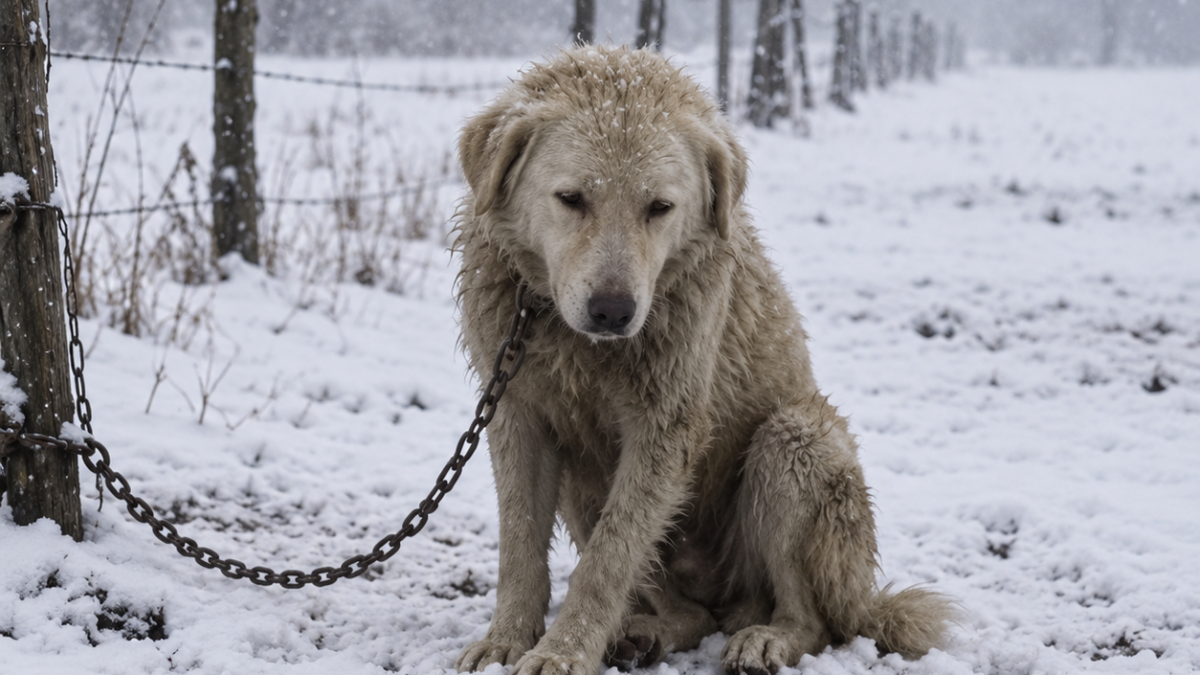
PART 2
I shoved the papers inside my coat and lifted the dog as carefully as I could.
He made no sound.
That scared me.
A dog in pain will often cry, struggle, snap, or at least tense against you.
This dog simply surrendered his weight.
His head rested against my shoulder as I carried him through the snow.
“Stay with me,” I kept saying. “Come on, buddy. Stay with me.”
When I reached the truck, I laid him across the back seat on an old quilt I kept for emergencies.
I turned the heater as high as it would go.
He didn’t move.
I called Pine Valley Veterinary Hospital.
Dr. Elena Ramirez answered personally.
“Rachel?”
“Elena, I need you.”
Something in my voice must have told her this wasn’t routine.
“What happened?”
“Dog. Severe exposure. Starved. Dehydrated. Possibly hypothermic.”
“How far?”
“Fifteen minutes if the road stays clear.”
“Drive carefully. We’ll be ready.”
Before I could pull away, headlights appeared through the snow.
A sheriff’s SUV stopped behind me.
Deputy Matt Holloway stepped out.
I knew Matt from town. Everybody did. He was forty-something, broad-shouldered, quiet, and possessed the useful habit of listening before speaking.
He looked toward the broken chain, then into my truck.
His expression changed immediately.
“You cut him loose?”
“Yes.”
“Good.”
I stared at him.
“I thought you were going to tell me I contaminated evidence.”
“You probably did.”
“Sorry.”
“I’ll survive.”
He pulled on gloves.
“Go. I’ll photograph everything here.”
I remembered the papers.
“There was a bag beneath him.”
I handed it over.
Matt unfolded the first sheet beneath the dome light in his SUV.
His jaw tightened.
“What?”
He showed it to me.
It was a treatment estimate from Dr. Ramirez’s clinic dated three days earlier.
The patient’s name was Ranger.
Male.
Approximately six years old.
Weight: fifty-four pounds.
Normal estimated weight: seventy to seventy-five.
The notes listed severe malnutrition, dehydration, untreated skin infection, and concern about prolonged exposure.
At the bottom was a handwritten note:
OWNER ADVISED DOG REQUIRES IMMEDIATE INDOOR SHELTER, FOOD, WATER, AND FOLLOW-UP CARE. OWNER DECLINED HOSPITALIZATION.
Beneath that was a signature.
Clay Mercer.
I knew the name.
Most people in our county did.
Mercer Construction.
Mercer Equipment Leasing.
Mercer Storage.
His company signs were everywhere.
Clay sponsored Little League.
He donated to the Christmas toy drive.
There was a photo of him in the lobby of the county hospital after his company paid for a new pediatric waiting room.
“What was Ranger doing out here after this?” I asked.
Matt folded the document.
“That’s what I intend to find out.”
I looked toward the empty farmhouse.
“Where is Mercer?”
“House looks vacant.”
“Then who brought Ranger here?”
Matt met my eyes.
“That’s another thing I intend to find out.”
Ranger shifted weakly behind me.
I didn’t wait.
The drive to Pine Valley was the longest thirteen minutes of my life.
Every few seconds I looked in the rearview mirror to make sure his chest was still rising.
At one point I couldn’t tell.
“Ranger?”
Nothing.
“Ranger!”
His ear twitched.
I nearly cried from relief.
When I skidded into the clinic parking lot, Elena and two technicians were already waiting with a gurney.
They rushed him inside.
I followed until Elena blocked the treatment-room door.
“Let us work.”
“I can help.”
“You can help by letting us work.”
Her eyes softened.
“I’ll come get you.”
So I sat in the waiting room wearing wet jeans and snow-covered boots while the clock on the wall ticked louder than any clock had a right to.
Ten minutes.
Twenty.
Thirty.
A technician hurried past carrying warmed fluids.
Another brought blankets.
I heard the oxygen machine start.
My hands wouldn’t stop shaking.
I had spent seven years volunteering with North County Animal Rescue. I had seen neglect before. Dogs with embedded collars. Cats abandoned in taped boxes. Horses left without hay.
But Ranger was different.
Maybe because I had felt that single tail thump.
Maybe because I had seen the perfect circle of tracks around the stake.
Or maybe because somebody had been told exactly what he needed and apparently decided that freezing alone in a field was easier.
After almost an hour, Elena came out.
Her scrub top was damp.
“He’s alive.”
I closed my eyes.
“How bad?”
“Bad.”
She sat beside me.
“His core temperature was dangerously low when he arrived. He’s severely dehydrated, badly underweight, anemic, and his paws have early frostbite. I’m worried about his kidneys because of the dehydration.”
“Can he make it?”
“Yes.”
The certainty in her voice surprised me.
Then she added, “But I’m not promising he will.”
I nodded.
“Can I see him?”
“For thirty seconds.”
Ranger lay beneath heated blankets with an IV line taped to his leg.
He looked even smaller on the treatment table.
I approached slowly.
His eyes opened.
“Hey,” I whispered.
His tail moved beneath the blanket.
Once.
Elena saw it.
“So he likes you.”
“He doesn’t know me.”
“Maybe he knows enough.”
I touched his forehead.
“You’re not going back there.”
Elena glanced at me.
“That decision belongs to law enforcement.”
“I know.”
But inside me, something had already decided.
Ranger would never see that stake again.
Not if I could do anything about it.
Two hours later, Matt returned.
He stood in the hallway holding an evidence bag.
“What did you find?”
“The house is empty. Utilities were shut off six weeks ago.”
“Six weeks?”
“Yes.”
“Then someone has been bringing Ranger food.”
Matt shook his head.
“Not necessarily.”
My stomach dropped.
He continued.
“There was an empty plastic tub about twenty feet beyond the radius of his chain.”
“Beyond?”
“Far enough that he couldn’t reach it.”
I stared at him.
“You’re saying somebody put food where he could see it but couldn’t get to it?”
“I’m saying I photographed a container. We don’t know when it was placed there.”
I appreciated his precision.
I hated what the implication meant.
“Anything else?”
“Tire tracks near the service entrance. Fresh enough to photograph, not clean enough to identify yet.”
“And Mercer?”
Matt looked toward the treatment room.
“He says he gave Ranger away.”
“To whom?”
“He wouldn’t say.”
My anger sharpened.
“He wouldn’t say?”
“He claims a man answered an online ad and picked the dog up two days ago.”
“Then why are his veterinary papers underneath Ranger?”
“That’s one of several questions.”
“Did you arrest him?”
“No.”
I stared at Matt.
“He almost killed that dog.”
“I know what he almost did.”
“Then arrest him.”
Matt lowered his voice.
“Rachel, I need evidence that connects him to that field. Anger isn’t evidence.”
I hated hearing it.
Mostly because he was right.
“Is Ranger chipped?”
“Yes.”
“Registered to Mercer?”
“Yes.”
“He signed the vet papers.”
“Yes.”
“And you found him on Mercer property.”
“The land hasn’t belonged to Clay Mercer in eleven months.”
That stopped me.
“What?”
“It belongs to Mercer Holdings LLC.”
“That’s him.”
“Maybe. Maybe not legally in the way you think. Corporate structure matters.”
“So he’s hiding behind paperwork?”
“I didn’t say that.”
“You didn’t have to.”
Matt didn’t argue.
He simply said, “Let me build the case.”
I looked through the glass at Ranger.
“Build it fast.”
Ranger survived the night.
Then the next.
On the third morning, Elena called me at 6:17.
I answered before the second ring.
“Tell me he’s okay.”
“He stood up.”
I sat upright in bed.
“What?”
“Four steps. Wobbly. Ugly. But four.”
I cried.
I didn’t even try not to.
By afternoon, I was sitting on the clinic floor with him.
Ranger had gained less than a pound, but his eyes looked different.
More present.
I held a small piece of boiled chicken in my palm.
He sniffed it.
Then looked at me.
“It’s yours.”
He took it gently.
No snapping.
No frantic swallowing.
Just the softest touch of his teeth against my glove.
“You deserved better than this,” I whispered.
His ears moved.
“You hear me? Whoever did this doesn’t get the last word.”
That sentence became a promise.
At the time, I thought I was promising to save a dog.
I had no idea I was about to uncover a pattern.
Three days later, I received a message from a woman named Linda Carver.
She had seen a short statement from the sheriff’s office asking anyone with information about an abandoned dog near the old Mercer farm to come forward.
Her message contained only seven words.
I know that dog. Please call me.
I called immediately.
Linda answered in a whisper.
“Is Ranger alive?”
“Yes.”
She started crying.
“Thank God.”
“You know him?”
“I cleaned Mr. Mercer’s house.”
“Clay Mercer?”
“For four years.”
“What happened to Ranger?”
Silence.
Then she said, “I shouldn’t be talking about this.”
“Why?”
“Because Clay ruins people who cross him.”
Those words sat between us.
“Linda, somebody chained Ranger in a field in nine-degree weather.”
“I know.”
I stood from my kitchen table.
“You know?”
“I saw him there.”
“When?”
“Two days before you found him.”
My grip tightened around the phone.
“Did you report it?”
“I tried.”
“What does that mean?”
“I called Clay.”
“You called the man you were afraid of?”
“I didn’t know what else to do. Ranger was his dog. I thought maybe someone working for him had made a mistake.”
“What did he say?”
Another long silence.
“He told me Ranger wasn’t his problem anymore.”
The room seemed to shrink.
“Those exact words?”
“Yes.”
“Linda, you need to tell Deputy Holloway.”
“I can’t.”
“You can.”
“You don’t understand.”
“Then help me understand.”
She took a shaky breath.
“Clay’s company owns the building where my husband’s repair shop operates. Our lease renews in March.”
There it was.
Fear with a price tag.
“What would happen if he knew you talked?”
“He’d find a reason to throw us out.”
“Maybe.”
“He’s done it before.”
That mattered.
“To whom?”
“I don’t know if I should say.”
“Linda.”
“I’ll think about it.”
She hung up.
I immediately called Matt.
He listened without interrupting.
“Can you trace her statement without forcing her?”
“Not unless she agrees to speak.”
“She’s scared.”
“I understand.”
“Do something.”
“I’ll contact her carefully.”
“Matt—”
“Rachel.”
His voice hardened just enough to stop me.
“If Mercer did this, the strongest thing we can do is build a case he can’t buy his way out of.”
“You really think money matters that much?”
“I think people with money usually know how to make uncertainty expensive.”
I understood what he meant.
A weak case would become paperwork.
A strong case could become consequences.
So I waited.
Barely.
Meanwhile Ranger improved.
He began walking the clinic hallway.
Then he barked for the first time when a delivery driver dropped a box outside the exam room.
Everyone froze.
Ranger looked startled by his own voice.
Elena laughed.
“That’s right. You still have one.”
His tail wagged.
A real wag this time.
The clinic staff applauded.
Ranger looked at us as if we were insane.
It was one of the happiest moments I can remember.
And then Clay Mercer walked through the front door.
I was sitting in the waiting room with Ranger beside me on a padded mat.
The bell above the entrance jingled.
A tall man stepped inside wearing a charcoal wool coat and polished boots.
I recognized him immediately.
Clay Mercer looked exactly like the photographs.
Silver beginning at his temples.
Clean shave.
Expensive watch.
The calm, practiced smile of a man accustomed to shaking hands in front of cameras.
Ranger saw him.
Everything changed.
His tail stopped.
His body lowered.
He moved behind my chair.
Clay noticed.
So did I.
“You’re Rachel Monroe?”
I stood.
“Yes.”
“I understand you found my dog.”
My dog.
The words made me sick.
“He was chained in a field.”
“I heard.”
Clay glanced toward Ranger.
“Looks much better.”
I stepped between them.
“He nearly died.”
“I’m sorry to hear that.”
“You’re sorry to hear it?”
His expression remained smooth.
“I came because I’d like him returned.”
“No.”
His eyebrows lifted.
“I wasn’t asking you.”
“You’ll need to speak with law enforcement.”
“I already did.”
“Then you know he’s evidence in an active cruelty investigation.”
“That investigation is based on a misunderstanding.”
I laughed once.
There was nothing humorous in it.
“A dog chained outside without shelter in nine-degree weather is a pretty impressive misunderstanding.”
Clay looked around the waiting room.
Two clients were watching us.
He lowered his voice.
“I gave Ranger to someone else.”
“Who?”
“I don’t believe that concerns you.”
“It became my concern when I carried him half-frozen out of your field.”
“Not my field.”
I stared at him.
He smiled faintly.
That smile told me something.
He was proud of the technicality.
“Mercer Holdings owns it,” I said.
“And I don’t personally own Mercer Holdings.”
“But your name is on Ranger’s microchip.”
“Records become outdated.”
“Your signature is on his veterinary paperwork three days before I found him.”
His smile disappeared.
“You’ve seen confidential veterinary records?”
“They were underneath the dog.”
That landed.
For the first time, he looked genuinely surprised.
Only for a fraction of a second.
Then the expression vanished.
“Those papers were stolen from my vehicle.”
“Really?”
“Yes.”
“When?”
“I’m discussing that with the sheriff.”
“Convenient.”
Clay stepped closer.
Ranger retreated farther behind me.
I felt the leash tremble.
“Ms. Monroe, I understand you’re emotional.”
That sentence did something extraordinary to my temper.
I became completely calm.
“No,” I said. “You don’t.”
He paused.
“I know exactly what I saw. I know exactly what that dog felt like when I picked him up. I know his body was so cold I couldn’t tell whether he was breathing. And I know he’s afraid of you.”
Clay glanced down.
“Dogs behave unpredictably after trauma.”
“Yes,” I said. “They do.”
Elena appeared behind the desk.
“Mr. Mercer, you need to leave.”
“This is my animal.”
“Not while he is under a veterinary hold authorized by the county.”
“I pay your clinic.”
Elena’s face hardened.
“You pay invoices for services. You don’t buy authority.”
Clay looked around again.
More people were watching now.
His mask slipped slightly.
“You people have no idea what you’re getting involved in.”
I heard it clearly.
So did Elena.
So did the retired schoolteacher sitting six feet away.
Clay realized it immediately.
His smile returned.
“I mean legally.”
“Of course you do,” I said.
He walked out.
Ranger remained behind me long after the door closed.
I crouched beside him.
“You’re okay.”
He pressed his head against my chest.
But something about Clay’s visit bothered me.
Not the threat.
Not even the arrogance.
The surprise when I mentioned the papers.
If Clay had placed those records beneath Ranger, why would he be surprised that I had them?
Unless he hadn’t put them there.
That night I called Matt.
“What if someone else left the papers?”
“I’ve wondered the same thing.”
“Why?”
“Because the grocery bag had a pharmacy receipt in it.”
My heart accelerated.
“Whose?”
“Not Mercer’s.”
“Whose?”
“I can’t tell you yet.”
“Matt.”
“I’m working on it.”
“Is it Linda?”
Silence.
That was answer enough.
“Oh, my God.”
“Do not contact her about evidence.”
“She tried to help Ranger.”
“It appears someone did.”
“She couldn’t break the chain, so she left the records where someone might find them.”
“I didn’t say that.”
“You didn’t have to.”
“Rachel.”
“All right.”
For once, I listened.
The next morning Linda called me herself.
Her voice shook.
“I talked to Deputy Holloway.”
“Okay.”
“I told him everything.”
“What is everything?”
She inhaled slowly.
“More than the dog.”
That was the beginning.
Clay Mercer had bought Ranger as a puppy after his second divorce.
According to Linda, Ranger spent his first three years inside Clay’s enormous house on Briar Hill.
He slept beside the fireplace.
Rode in the truck.
Went to Clay’s construction sites.
There were old social-media photographs of them together.
Clay kneeling beside a younger, healthy Ranger.
Clay throwing a tennis ball.
Clay posting captions about loyalty.
Then Clay married again.
His new wife, Vanessa, didn’t like dog hair.
Ranger moved to the garage.
Then a fenced run.
Then the old farm property.
Linda noticed him losing weight.
She asked questions.
Clay told her not to worry.
When she found Ranger without water one afternoon in July, she filled his bowl herself.
Clay saw her on a security camera and told her never to interfere with his property again.
She kept interfering.
Quietly.
Food.
Water.
A blanket.
Once she took Ranger to Dr. Ramirez because he had stopped eating.
That was how the veterinary clinic became involved.
“Why did Clay sign the paperwork?” I asked.
“Because Elena told the receptionist they couldn’t treat Ranger without the owner’s authorization for certain things. I called Clay. He came in furious.”
“And declined hospitalization.”
“Yes.”
“Then took Ranger back?”
“He told me one of his employees would.”
“And three days later Ranger was chained in that field.”
“Yes.”
“Did you see who did it?”
Linda hesitated.
“No.”
It wasn’t a convincing no.
“Linda.”
“I didn’t see their face.”
“Their?”
She swallowed.
“A company truck.”
Mercer Construction.
She had driven past the field the morning after the veterinary appointment.
She recognized Ranger immediately.
She stopped.
The chain was locked.
She called Clay.
He told her Ranger had been “rehomed” and whoever now owned him could do whatever they wanted.
She called animal control.
No one answered because the office was closed due to the storm.
She left a voicemail.
Then she placed the veterinary paperwork under Ranger, hoping whoever responded would understand how urgent it was.
“Why didn’t you cut the chain?”
“I didn’t have anything in my car.”
Her voice cracked.
“I went home to get my husband’s cutters.”
“What happened?”
“The roads closed.”
I heard her begin to cry.
“I kept thinking he would die before I got back.”
“You tried.”
“I should have done more.”
“You gave us the first evidence.”
That quieted her.
“You think it matters?”
“Yes.”
It mattered more than either of us understood.
Because Linda hadn’t merely seen a Mercer Construction truck.
She had taken a picture.
The image was grainy and shot through her windshield, but the company logo was visible on the rear door.
So was part of the unit number.
M-17.
Matt traced the vehicle.
It was assigned to a foreman named Travis Boone.
Travis was twenty-nine years old with a wife, a two-year-old daughter, and a mortgage.
When deputies questioned him, he initially claimed he knew nothing.
Then Matt showed him Linda’s photograph.
Travis changed his story.
He admitted taking Ranger to the field.
But he said he had done it under orders.
Whose orders?
Clay Mercer’s.
According to Travis, Clay called him the evening after Ranger’s veterinary visit.
He instructed Travis to pick the dog up and take him to the old property.
“Leave him by the barn.”
Travis said he assumed someone would collect Ranger later.
Matt asked why he chained the dog to a stake.
Travis said the stake was already there.
Matt asked why he left no shelter.
Travis had no answer.
Matt asked who gave him the chain and padlock.
Travis requested a lawyer.
That was when the investigation changed.
Because the padlock was new.
And its serial batch matched a box purchased with a Mercer Construction company card that same morning.
Matt obtained the receipt.
Then surveillance footage from the hardware store.
Clay Mercer himself was visible buying the box.
I remember sitting at my kitchen table when Matt told me.
“So arrest him.”
“We’re getting there.”
“What else do you need?”
“A prosecutor who can prove intent beyond neglect.”
“He bought the lock.”
“He can say he bought locks every week for job sites.”
“He told Travis to move Ranger.”
“He can say he believed Ranger would be collected.”
I slammed my palm against the table.
“Why does every obvious thing need another obvious thing?”
“Because court isn’t about what we know emotionally. It’s about what we can prove legally.”
“Then prove it.”
“We are.”
I looked at Ranger sleeping near my refrigerator.
He had been discharged from the clinic into temporary foster care.
Mine.
I hadn’t planned to foster him.
At least that’s what I told everyone.
I had prepared a bed in the laundry room, thinking he might need quiet.
The first night, Ranger ignored it.
He slept beside my bedroom door.
The second night he slept halfway inside the room.
By the fifth, he had discovered my rug.
By the seventh, he had discovered my couch.
Apparently severe trauma did not prevent a dog from quickly identifying premium furniture.
I woke one morning and found him stretched across three cushions with his head on a decorative pillow.
“You’re recovering suspiciously fast.”
One eye opened.
His tail thumped.
I smiled.
Then someone knocked.
Ranger shot off the couch.
His entire body stiffened.
I checked the window.
Clay Mercer stood on my porch.
I called Matt before opening the door.
“Mercer’s here.”
“Do not let him inside.”
“I wasn’t planning to.”
“I’m ten minutes away.”
Clay knocked again.
I opened the door but kept the storm door locked.
“What do you want?”
“To talk.”
“We’ve already talked.”
“This is getting out of hand.”
Behind me, Ranger growled.
It was the first time I had heard him do it.
Clay looked past me.
“So you have him.”
“I’m his county-approved foster.”
“He belongs to me.”
“Interesting. I thought you gave him away.”
Clay’s eyes narrowed.
“I’d like this resolved without lawyers.”
“You already have lawyers.”
“So do you, apparently.”
I didn’t.
Not yet.
“Whatever story that housekeeper told you, she’s lying.”
“You should tell the sheriff.”
“I have.”
“Then we have nothing to discuss.”
I started closing the door.
Clay put his hand against it.
Not hard.
Just enough.
“Ms. Monroe.”
I looked at his hand.
Then at his face.
“Move it.”
He did.
“I’m offering you five thousand dollars.”
I stared.
“For what?”
“The dog.”
“No.”
“Ten.”
I almost laughed.
“You think this is about money?”
“Everything becomes about money eventually.”
“Not this.”
“Twenty-five thousand.”
Ranger growled again.
I leaned closer to the glass.
“You couldn’t buy him for twenty-five million.”
Clay’s expression changed.
The smile vanished.
“You don’t know what you’re doing.”
“Funny. You said something like that at the clinic.”
“You’re turning a misunderstanding into a public spectacle.”
“I haven’t spoken publicly.”
“Not yet.”
“And that bothers you?”
“What bothers me is watching people who don’t understand the facts destroy reputations.”
“Whose reputation?”
“You know exactly whose.”
I thought about the circle of tracks in the snow.
“I’m more worried about the dog.”
Clay stared at me for several seconds.
Then he said quietly, “You should be worried about yourself.”
A sheriff’s SUV appeared at the end of my driveway.
Clay noticed.
“So should you,” I said.
He stepped away.
Matt arrived before Clay reached his vehicle.
They spoke near the driveway.
I couldn’t hear everything.
I heard enough.
Matt told him not to return without legal authorization.
Clay protested that he had been invited.
I opened the door.
“No, he wasn’t.”
Matt wrote something down.
Clay looked toward me one last time.
Then he drove away.
When Matt came inside, he found me standing with both hands shaking.
“You okay?”
“I’m furious.”
“That’s not what I asked.”
I looked down.
Ranger had pressed himself against my legs.
“No,” I admitted.
Matt nodded.
“Good answer.”
“What happens now?”
“We add this visit to the file.”
“He offered to buy Ranger.”
“That’s interesting.”
“He threatened me.”
“That’s more interesting.”
“You sound excited.”
“I’m a deputy. Our version of excitement is paperwork that connects things.”
Despite myself, I laughed.
Then his expression became serious.
“Rachel, there’s something else.”
“What?”
“Travis Boone came back with his attorney.”
My smile vanished.
“He talked?”
“Yes.”
“What did he say?”
Matt sat at my kitchen table.
“Clay didn’t tell him someone was coming for Ranger.”
I already knew what came next.
But hearing it still hurt.
“Then what did he tell him?”
“Leave the dog there and don’t go back.”
The room went silent.
Ranger looked up at me.
Matt continued.
“Travis asked about food. Clay told him—and this is a quote from Travis—‘If he’s hungry enough, he’ll figure it out.’”
My stomach turned.
“He was chained.”
“I know.”
“He couldn’t figure anything out.”
“I know.”
“Did Travis know?”
“He says he realized that after he secured the chain.”
“Then why did he leave?”
“Because Clay was his boss.”
“That’s not an excuse.”
“No.”
“Is Travis being charged?”
“That’ll be the prosecutor’s decision.”
I looked toward Ranger.
He had curled beside my chair.
The anger I felt was no longer hot.
It had become something colder.
More useful.
“What else did Travis say?”
Matt hesitated.
“Clay told him Ranger had become an inconvenience.”
I thought of those smiling photographs online.
LOYALTY.
BEST JOB-SITE PARTNER.
MAN’S BEST FRIEND.
An inconvenience.
That word stayed with me.
And it became the word that ultimately destroyed Clay Mercer’s defense.
The story might have remained a local animal-cruelty case if Clay had done one simple thing.
Stayed quiet.
He didn’t.
Three days later, his attorney released a statement accusing “activists” of manufacturing allegations against a respected local businessman.
The statement claimed Ranger had been transferred to a third party who failed to care for him.
It suggested that photographs of Ranger’s condition were misleading.
And although it didn’t name me, it described the person who found Ranger as someone “associated with animal-rights organizations.”
That was technically true.
I volunteered for a rescue.
It was also designed to make me sound like I had gone searching for something to be angry about.
Then Clay made his bigger mistake.
He went on local television.
The reporter asked whether he had ordered Ranger taken to the field.
Clay replied, “Absolutely not.”
I watched from my living room.
Ranger slept at my feet.
The reporter asked about Travis Boone.
Clay said Travis was a disgruntled former employee.
Former?
He had fired Travis that morning.
Then the reporter asked why Ranger’s veterinary papers listed Clay as his owner.
Clay smiled.
“Administrative oversight.”
I leaned toward the television.
“You liar.”
Ranger lifted his head.
“Not you.”
His tail thumped.
The interview spread across local social media.
People argued.
Some defended Clay.
They had worked for him.
Gone to church with him.
Received donations from his companies.
Others posted photographs of Ranger’s field.
Then something unexpected happened.
People began contacting North County Animal Rescue.
Not about Ranger.
About other animals.
A former tenant said Clay had once threatened to leave her horses locked behind a gate during an eviction dispute.
A subcontractor said he had seen neglected guard dogs at a storage property.
A delivery driver remembered two dogs chained behind a warehouse the previous summer.
Most of the reports led nowhere.
Some were exaggerated.
A few were completely unrelated.
But one call mattered.
It came from a man named Samuel Price.
Samuel had worked nights at Mercer Storage until eight months earlier.
He asked whether deputies had searched Warehouse C.
Matt obtained a warrant.
Inside a locked utility room behind Warehouse C, investigators found something Clay could not explain away.
Records.
Boxes of them.
Mercer Construction maintained handwritten logs for company guard dogs used at remote equipment lots.
The county prosecutor later described the recordkeeping as unusually detailed.
Feeding schedules.
Veterinary expenses.
Transfer dates.
Animal names.
And beside three names, one word:
Removed.
Two of those dogs had disappeared years earlier.
The third was Ranger.
Beside his name was a date.
The date Travis Boone transported him to the field.
Beside the date were Clay’s initials.
C.M.
And in the final column:
No further expense.
When Matt told me, I sat silently.
“What does ‘removed’ mean for the other two dogs?”
“We don’t know.”
“Can you find them?”
“We’re trying.”
“Were they killed?”
“We don’t know.”
I wanted certainty.
But real investigations rarely hand you certainty quickly.
They hand you fragments.
Then demand patience.
The next fragment came from Clay himself.
Investigators obtained company emails.
Among them was a message Clay had sent to his bookkeeper after Ranger’s veterinary visit.
Stop all expenses on R. No food, vet, transport after Friday.
Another email instructed staff to remove Ranger from the company insurance schedule.
Then there was a text to Travis.
Take him to North Farm. Chain by west stake. Done with it.
Fourteen words.
That was enough.
Clay Mercer was arrested the following Monday.
The photograph of him entering the county courthouse appeared everywhere.
I expected satisfaction.
Instead I felt tired.
Ranger was beside me when the news came.
He had gained nine pounds.
His coat was beginning to shine again.
That mattered more.
“You won,” my friend Melissa told me.
“No.”
I watched Ranger chew a rubber ball.
“He survived.”
There was a difference.
And we weren’t finished.
Because Clay’s lawyers immediately attacked the case.
They argued the phrase “Done with it” meant Clay was done handling Ranger personally, not that he intended the dog to die.
They claimed Travis had exceeded instructions.
They suggested Linda had planted the medical documents to frame Clay.
They questioned whether the field conditions photographed by Matt accurately reflected conditions when Ranger was placed there.
Then they came after me.
My name appeared in court documents.
My volunteer work was scrutinized.
A private investigator photographed my house.
Someone searched my old social-media posts.
Clay’s attorney found a comment I had written five years earlier beneath a story about an abused horse:
People who knowingly starve animals should never own one again.
During a preliminary hearing, his lawyer asked whether that statement proved I was biased against Clay before I found Ranger.
I almost laughed.
“How could I be biased against a man I hadn’t connected to the dog yet?”
The attorney adjusted his glasses.
“But you held strong opinions about accused animal abusers.”
“About proven animal abusers.”
“And you had already decided Mr. Mercer was guilty.”
“I decided the dog was freezing.”
He paused.
“That wasn’t my question.”
“No,” I said. “But it was why I cut the chain.”
The prosecutor hid a smile.
Clay didn’t.
He watched me from across the courtroom with the same expression he had worn on my porch.
Cold.
Offended.
As though the worst crime committed against anyone had been making him sit there.
Then his attorney asked me something I will never forget.
“Ms. Monroe, isn’t it true that Ranger’s condition has benefited your rescue organization?”
The courtroom went quiet.
I stared at him.
“Benefited?”
“Donations increased after this story became public.”
“I don’t control donations.”
“But your rescue benefited.”
“People donated because they saw what happened to Ranger.”
“Exactly.”
He leaned closer.
“So the worse Ranger appeared, the more emotional the public response became.”
I understood what he was suggesting.
So did everyone else.
I turned toward the judge.
Then back to him.
“Would you like to know how Ranger appeared when I found him?”
“That isn’t necessary.”
“I think it is.”
The attorney started to object.
The prosecutor said, “He opened the door, Your Honor.”
The judge allowed me to answer.
I looked directly at Clay.
“He was curled in snow so deep around his body that I could see the outline where he had been lying for hours. His chain had carved a circle into the field because he had walked the same few feet over and over. His water container was empty and frozen. His hip bones were visible. When I touched him, he couldn’t stand. When I picked him up, I could feel every rib.”
Nobody moved.
I continued.
“I didn’t need Ranger to look worse.”
My voice cracked.
“I needed him to live.”
The attorney sat down.
That moment spread online after a reporter quoted it.
But the courtroom wasn’t Facebook.
Emotion mattered less than evidence.
And evidence was where Clay finally lost control.
The prosecution called Travis Boone.
He looked terrified.
Clay stared at him throughout the testimony.
Travis described receiving the order.
He described collecting Ranger.
He described Clay handing him the chain.
Then the prosecutor asked the question everyone had been waiting for.
“What did Mr. Mercer tell you would happen to the dog?”
Travis looked toward Clay.
Clay’s attorney objected.
Overruled.
Travis swallowed.
“He said nobody wanted him.”
The prosecutor waited.
“Anything else?”
“Yes.”
“What?”
Travis looked down.
“He said the cold would handle it.”
The room changed.
I heard someone behind me gasp.
Clay’s face didn’t move.
The prosecutor asked, “Those were his words?”
“Yes.”
“The cold would handle it?”
“Yes.”
“And you still left Ranger there?”
Travis’s eyes filled.
“Yes.”
“Why?”
“Because I was a coward.”
No lawyer had prepared that answer.
You could tell.
Travis wiped his face.
“I had a kid. A mortgage. Clay had fired people for less. I kept telling myself maybe he didn’t mean it. Maybe someone would come. I drove away.”
He looked toward me.
“I’m sorry.”
I didn’t know what to do with his apology.
Part of me hated him.
Part of me saw a man who had done something terrible because fear had made obedience easier than courage.
The prosecutor asked whether Clay had ever ordered something similar.
Travis hesitated.
Then said yes.
The judge leaned forward.
Clay’s lawyer stood.
The prosecutor asked for permission to continue.
That testimony led investigators to another Mercer-owned property.
And there, behind an equipment shed, they found two old chains attached to wooden stakes.
No dogs.
Just chains.
One still had a faded red collar attached.
The missing company logs listed a dog named Duke.
Samuel Price remembered Duke.
Large black Labrador mix.
Friendly.
Used as a guard dog despite being useless at guarding anything because, according to Samuel, “He liked everybody.”
Duke disappeared two winters earlier.
The other dog, Sadie, had disappeared the year before that.
We never learned with absolute certainty what happened to them.
No remains were found.
No adoption records existed.
Clay claimed they had been rehomed.
No recipients were ever identified.
Those cases were not charged.
But the evidence was allowed in limited form to establish company practices and records.
For me, it changed something deeper.
Ranger might not have been the first.
But he would be the last.
The trial began four months after I found him.
By then spring had reached the valley.
Ranger weighed seventy-one pounds.
His fur had filled in.
The frostbite healed without requiring amputation.
His kidneys recovered.
He had learned several things during those months.
The sound of my refrigerator opening.
The exact location of every tennis ball in the house.
That the mailman was apparently a threat to national security.
And that he was allowed on my bed only when I wasn’t looking.
Most important, he learned that hands could reach toward him without hurting him.
He still feared chains.
The first time I clipped a normal leash to his collar, he froze.
So we stopped.
I bought a harness.
For weeks, we practiced inside.
One step.
Treat.
Two steps.
Treat.
Front porch.
Treat.
Driveway.
Treat.
Eventually he walked beside me without shrinking.
But if metal clanked behind him, he still turned.
Trauma doesn’t disappear because a story needs a happy ending.
It becomes part of the life that continues.
The prosecutor offered Clay a plea agreement.
He refused.
His attorney told reporters Clay intended to clear his name.
So we went to trial.
The courtroom was packed.
Not because animal-cruelty cases usually drew crowds.
Because Clay Mercer had spent twenty years becoming one of the county’s most visible men.
His company had built houses.
Donated scoreboards.
Sponsored parades.
Funded scholarships.
People wanted to know how the man in those photographs fit with the man described in the evidence.
The prosecution didn’t tell them what to think.
It showed them.
The veterinary records.
Linda’s photograph.
The hardware-store video.
The company receipt.
The text message.
The expense log.
The weather report.
Nine degrees when Ranger was found.
Six degrees overnight.
Wind chill below zero.
Elena testified next.
She explained Ranger’s body condition.
She showed photographs taken at intake.
I had seen them before.
Seeing them projected on a courtroom screen was different.
A healthy Ranger sat beside the prosecutor’s table in a more recent photograph.
Then the intake image appeared.
Sunken eyes.
Visible ribs.
Raw skin.
The contrast hurt.
Clay’s attorney tried to suggest Ranger’s malnutrition could have developed after Clay transferred ownership.
Elena remained calm.
“No.”
“How can you be certain?”
“Because this degree of muscle wasting develops over time.”
“How much time?”
“Several weeks at minimum, likely longer.”
“Could the dog have refused food?”
“Possible.”
“Could illness have caused weight loss?”
“Yes.”
“So you cannot say neglect caused it.”
“I can say what I diagnosed.”
“And that was?”
“Severe malnutrition and dehydration.”
“But not the cause.”
Elena looked at him.
“The dog gained weight consistently when provided appropriate food and water.”
The attorney changed direction.
Then he made another mistake.
“Doctor, animals survive outdoors all the time, correct?”
“Some do.”
“Dogs included.”
“Yes.”
“So merely being outdoors in cold weather is not necessarily cruel.”
“No.”
He smiled slightly.
“Thank you.”
Elena wasn’t finished.
“But leaving a severely malnourished, dehydrated dog chained without adequate shelter during subzero wind chills creates an obvious and potentially fatal risk.”
The smile disappeared.
“That wasn’t my question.”
“No,” Elena said. “It was the relevant answer.”
I loved her a little for that.
Linda testified next.
Her hands shook so badly that she almost dropped the microphone.
She described caring for Ranger.
The summer water bowl.
The veterinary appointment.
Finding him chained.
Calling Clay.
Then the prosecutor asked, “Why didn’t you come forward immediately?”
Linda looked toward Clay.
“Because I was scared.”
“Of what?”
“Losing everything.”
She explained the repair-shop lease.
Then she revealed something even I hadn’t known.
Two years earlier, her husband had complained after Mercer Construction equipment blocked access to his shop.
The following month, their rent increased thirty percent.
Clay’s attorney objected to the implication.
The judge limited the testimony.
But the jury heard enough to understand her fear.
Then Travis testified.
His voice trembled.
He admitted his role.
He admitted he should have refused.
He admitted chaining Ranger.
He admitted driving away.
The defense attacked him.
They emphasized his agreement with prosecutors.
They suggested he was blaming Clay to save himself.
Then Clay’s attorney asked, “Mr. Boone, you expect this jury to believe my client said, ‘The cold will handle it’?”
“Yes.”
“No recording exists?”
“No.”
“No witness heard it?”
“No.”
“So we only have your word.”
“Yes.”
“A man seeking leniency.”
Travis looked toward the jury.
“Yes.”
The lawyer smiled.
Travis continued.
“And a man who will regret leaving that dog for the rest of my life.”
The smile vanished again.
When it was my turn, I told them about the road.
The moving shape in the snow.
The chain.
The single tail thump.
The bolt cutters.
I kept my eyes on the jurors.
I didn’t look at Clay until the prosecutor handed me the broken chain.
It had been preserved as evidence.
The metal felt heavier than I remembered.
“Do you recognize this?”
“Yes.”
“What is it?”
“The chain attached to Ranger.”
“What did you do with it?”
“I cut it.”
“Why?”
“Because I believed Ranger would die if I left him there.”
“No further questions.”
Clay’s attorney approached.
“Ms. Monroe, you’ve become attached to Ranger.”
“Yes.”
“You want to keep him.”
“Yes.”
“You have a personal interest in Mr. Mercer losing ownership.”
“I have a personal interest in Ranger never being chained in that field again.”
“That wasn’t my question.”
“It’s my answer.”
He frowned.
“You’ve spoken with witnesses.”
“Yes.”
“You spoke with Linda Carver.”
“Yes.”
“You discussed the investigation with Deputy Holloway.”
“Yes.”
“You posted online.”
“No.”
He paused.
“No?”
“I never posted about the case while it was active.”
“You never discussed it publicly?”
“No.”
That surprised him.
Because Clay’s team had built part of its argument around the idea that I was orchestrating a public campaign.
I hadn’t.
Others had talked.
I had stayed quiet because Matt asked me to.
The attorney glanced at his notes.
“You volunteer for North County Animal Rescue.”
“Yes.”
“Which received donations following news coverage of Ranger.”
“Yes.”
“You benefit when dramatic animal stories attract attention.”
I stared at him.
“I’m unpaid.”
“The organization benefits.”
“The animals benefit.”
He changed topics.
“Did you know my client personally before this?”
“No.”
“Had you ever met him?”
“No.”
“So you cannot testify about his feelings toward Ranger.”
“No.”
“You cannot testify about what instructions he gave Mr. Boone.”
“No.”
“You cannot testify that he intended Ranger to die.”
“No.”
He turned toward the jury.
“Thank you.”
“But I can testify about what I found.”
He stopped.
The prosecutor didn’t speak.
The judge looked at the defense attorney.
He sighed.
“What did you find, Ms. Monroe?”
“A dog whose survival depended on a stranger stopping.”
Silence.
“And fortunately,” I said, “I did.”
He ended the cross-examination.
Clay eventually testified in his own defense.
His lawyers probably advised against it.
He did it anyway.
That was Clay’s problem.
He believed he was always the most convincing person in the room.
He told the jury he loved Ranger.
He described buying him as a puppy.
He described taking him to worksites.
He blamed work pressures, divorce, and shifting living arrangements for Ranger spending more time outside.
He admitted instructing Travis to transport him.
But he denied intending harm.
The prosecutor approached.
“You told Mr. Boone to take Ranger to North Farm?”
“Yes.”
“And chain him?”
“I told him to secure the dog temporarily.”
“You purchased the padlock that morning?”
“For company use.”
“You texted, ‘Take him to North Farm. Chain by west stake. Done with it.’”
“Yes.”
“What did ‘Done with it’ mean?”
“That the matter was delegated.”
“You stopped paying for Ranger’s food?”
“I believed he would be transferred.”
“To whom?”
“A private individual.”
“Name?”
“I don’t recall.”
The prosecutor let that sit.
“You gave a dog you claim to have loved to a man whose name you cannot remember?”
“It was handled informally.”
“Phone number?”
“I no longer have it.”
“Email?”
“No.”
“Message?”
“No.”
“Ad?”
“Deleted.”
“Witness?”
“No.”
“Payment?”
“No.”
The prosecutor walked toward the evidence table.
“So there is no evidence this mystery person existed.”
“I know he existed.”
“But you cannot identify him.”
“No.”
“Meanwhile your company records list Ranger as ‘removed.’”
“Accounting language.”
“And ‘No further expense.’”
“Also accounting.”
“You emailed your bookkeeper, ‘Stop all expenses on R.’”
“Yes.”
“You canceled his food purchases.”
“Because he was leaving my care.”
“You declined hospitalization.”
“I couldn’t justify the expense.”
That sentence hung in the air.
The prosecutor turned slowly.
“You couldn’t justify the expense?”
Clay realized the mistake.
“I mean I believed the recommended treatment was excessive.”
“The treatment required to save the dog you say you loved?”
“Objection.”
“Sustained.”
The prosecutor moved on.
Then came the question that ended Clay’s testimony.
“Mr. Mercer, when you appeared on television, did you state that you had never ordered Ranger taken to the North Farm?”
Clay shifted.
“I don’t recall the exact phrasing.”
The prosecutor played the clip.
Clay’s own voice filled the courtroom.
“Absolutely not.”
The screen froze on his face.
The prosecutor looked at him.
“Was that statement true?”
Clay hesitated.
His lawyer stared at the table.
Finally Clay said, “I interpreted the question differently.”
I saw one juror’s eyebrows rise.
The prosecutor nodded.
“No further questions.”
The jury deliberated six hours.
I spent most of that time walking around the courthouse square.
Ranger wasn’t allowed inside during deliberations, so Melissa waited with him outside.
I eventually sat beside them on a bench.
Ranger placed his chin on my knee.
“What if they acquit him?” I asked.
Melissa looked at me.
“Then Ranger is still here.”
“That’s not enough.”
“No. But it’s true.”
I rubbed Ranger’s ears.
People had begun treating the trial as though it were a contest between Clay and me.
It wasn’t.
I didn’t want Clay’s money.
His business.
His humiliation.
I wanted a line drawn somewhere.
A simple line.
You do not get to decide that a living creature becomes disposable because caring for him becomes inconvenient.
At 4:42 p.m., Matt came through the courthouse doors.
“Verdict.”
My knees weakened.
We went inside.
Clay stood beside his attorneys.
The jury entered.
The foreperson handed the form to the bailiff.
I stared at the floor.
The clerk read the first count.
Guilty.
A breath moved through the courtroom.
Second count.
Guilty.
Third.
Guilty.
Clay didn’t react.
Not visibly.
But his shoulders changed.
Just slightly.
For the first time since I had met him, he looked like a man who understood that he could not talk his way out of the room.
The judge ordered a presentence investigation.
Clay remained free pending sentencing under strict conditions.
He was prohibited from owning, possessing, controlling, or directing the care of any animal.
That order mattered most to me.
But the consequences had only begun.
The local news reported the conviction.
Several companies suspended contracts with Mercer Construction.
A bank reviewing one of his development loans invoked a morality clause connected to fraud discovered in company records during the investigation.
That part had nothing to do with Ranger directly.
The animal-cruelty investigation had exposed bookkeeping irregularities.
Those irregularities triggered a separate financial audit.
I wasn’t involved.
I didn’t need to be.
Clay had spent years building a system in which employees were afraid to challenge him.
Once Travis spoke, others began speaking too.
Former workers described unpaid overtime.
A subcontractor produced invoices showing improper charges.
Tenants challenged lease practices.
None of those accusations were mine to prove.
Some were substantiated.
Some weren’t.
But the wall of silence had cracked.
And once people realized Clay Mercer could be challenged, fear stopped doing as much work for him.
At sentencing, the judge spoke for nearly fifteen minutes.
She acknowledged Clay’s community donations.
His lack of prior criminal convictions.
His businesses.
His charitable work.
Then she said something I still remember.
“Good acts do not purchase credit against deliberate cruelty.”
Clay stared forward.
The judge continued.
“The evidence established that Ranger was not abandoned through confusion, oversight, or momentary negligence. He was placed in conditions that any reasonable person would recognize as dangerous, after a veterinarian specifically warned of his vulnerability.”
She sentenced Clay to jail time permitted under our state statutes, followed by probation.
He received substantial fines.
He was ordered to pay Ranger’s veterinary expenses.
Most importantly, he was prohibited from owning or possessing animals for the maximum period available under the court’s authority.
Travis received a lesser sentence under his cooperation agreement, community service, probation, and the same temporary animal-possession restriction.
Some people thought Travis deserved more.
Others thought he deserved less.
I never figured out exactly what I believed.
I only knew he came to see me once after sentencing.
We met outside the rescue center.
He stood beside his truck twisting his keys in his hands.
“How is he?”
“Good.”
“Could I see him?”
I hesitated.
Then I brought Ranger outside on his harness.
The moment Ranger saw Travis, he stopped.
Travis stopped too.
He didn’t approach.
His face collapsed.
“I’m sorry, boy.”
Ranger stayed beside me.
Travis crouched twenty feet away.
“I should’ve taken you home.”
His voice broke.
“I should’ve lost the job.”
Ranger watched him.
Then looked at me.
I didn’t tell Travis it was okay.
It wasn’t.
I didn’t tell him Ranger forgave him.
I had no right to speak for the dog.
After a minute, Travis stood.
“Thank you for stopping.”
“I almost didn’t take that road.”
“But you did.”
He left.
I never saw him again.
There was one final question.
Who owned Ranger now?
Legally, the court terminated Clay’s ownership after the conviction.
Ranger became eligible for adoption.
North County Animal Rescue posted his profile.
I protested.
Melissa laughed.
“You know that’s how the process works.”
“He already has a home.”
“Has someone applied?”
“You’re enjoying this.”
“Very much.”
So I filled out the same application everyone else did.
Name.
Address.
Work schedule.
Veterinary references.
Fenced yard.
Other animals.
Experience.
Why do you want to adopt this dog?
I stared at that question for nearly ten minutes.
Then I wrote:
Because he already knows the way home.
The rescue board approved me unanimously.
They still made me pay the adoption fee.
I complained.
Melissa said, “Rules are rules.”
Ranger’s adoption day was warm and bright.
Nothing like the morning I found him.
Elena came.
Matt came.
Linda and her husband came.
Several clinic employees came.
We didn’t invite reporters.
This part wasn’t for them.
Melissa handed me the adoption papers.
“Officially yours.”
I looked down at Ranger.
He sat beside me wearing a blue harness.
Seventy-four pounds.
Bright eyes.
Healthy coat.
A ridiculous amount of confidence.
“Ready to go home?”
His tail swept the floor.
We drove back along County Road 16.
I hadn’t planned to stop.
But when we reached the old farm, Ranger stood in the back seat.
The field was green now.
The wooden stake was gone.
Investigators had removed it as evidence months earlier.
I pulled onto the shoulder.
For a moment, I simply looked across the grass.
Then I opened Ranger’s door.
“Want to walk?”
He jumped down.
We crossed the ditch.
His steps slowed as we approached the place where I had found him.
I wondered if he remembered.
Of course, I couldn’t know.
Dogs don’t tell us what pictures live inside their minds.
But Ranger stood very still.
The wind moved through the grass.
No snow.
No chain.
No circle around a stake.
He looked across the field.
Then he looked at me.
I unclipped the long training lead from his harness inside the fenced section investigators had once used for evidence staging.
It was the first time I had ever let him run freely in that field.
“Go ahead.”
He stared at me.
I smiled.
“You can go.”
Ranger took three steps.
Then five.
Then suddenly he ran.
Not away from me.
Just ran.
Across the grass.
His body stretched into long, powerful strides.
He turned in a huge circle.
Then another.
No six-foot radius.
No chain snapping him backward.
No invisible boundary.
He raced until I started laughing so hard tears blurred my eyes.
Finally he came charging back.
He hit me in the legs hard enough that I nearly fell.
“Easy!”
He jumped up, front paws against my chest.
Six months earlier, I had carried him from that same ground because he couldn’t stand.
Now he nearly knocked me over.
I held his face between my hands.
“You did it.”
His tongue hit my chin.
“Yes, disgusting. Thank you.”
I sat in the grass.
Ranger dropped beside me.
For a long time, neither of us moved.
I thought about revenge.
People had used that word constantly after Clay’s conviction.
They said I got revenge.
That Ranger got revenge.
That the county got revenge.
But sitting there, I realized they had it wrong.
Revenge would have meant making Clay feel the same fear Ranger felt.
The same cold.
The same hunger.
The same helplessness.
I didn’t want that.
What I wanted was consequence.
There is a difference.
Clay lost the right to own animals because he proved he could not be trusted with them.
He faced criminal punishment because evidence showed what he had done.
His reputation collapsed because the public learned facts he had tried to deny.
Employees stopped being afraid because one person spoke, then another, then another.
And Ranger?
Ranger didn’t spend his second life looking backward.
He had more important things to do.
He learned to swim that summer.
Badly.
The first time he jumped from the dock, he panicked, splashed half the lake into my face, scrambled onto shore, and barked at the water for ten minutes as if it had personally betrayed him.
He developed an obsession with tennis balls.
He stole socks but never shoes.
He slept through thunderstorms but became deeply suspicious of my vacuum cleaner.
Every morning at 6:10, he put one paw on my mattress.
If I ignored him, he added the second.
If I continued ignoring him, seventy-four pounds of rehabilitated shepherd mix climbed directly onto my chest.
A subtle animal.
Linda visited often.
The first time Ranger recognized her, he ran across my yard so fast she started crying before he reached her.
He leaned against her legs.
She buried both hands in his fur.
“I’m sorry I couldn’t get you out.”
I stood several feet away and watched.
Ranger licked her wrist.
Linda laughed through her tears.
Maybe animals don’t understand apologies.
Or maybe they understand the part that matters.
She had tried.
A year after Ranger’s rescue, North County Animal Rescue received an anonymous donation large enough to build six insulated emergency kennels.
For months, we didn’t know where it came from.
Eventually Melissa discovered the donor.
Travis Boone.
He had sold his fishing boat.
I never told Ranger.
He probably would have preferred tennis balls.
The old Mercer farm was sold after the company restructured.
A young couple bought it.
They removed the remaining stakes.
Repaired the barn.
Installed fencing.
And started fostering senior dogs.
The first time I drove past and saw three gray-faced dogs sleeping in the sun outside the barn, I had to pull over.
Life has strange ways of reclaiming places.
A field can be remembered as somewhere a dog nearly died.
Or it can become somewhere another dog finally feels safe.
Sometimes it becomes both.
Two years after I found Ranger, I received a letter forwarded through the rescue.
There was no return address.
Inside was a single sheet of paper.
Rachel,
I know you probably never want to hear from me.
The letter was from Clay.
He wrote that prison had given him time to think.
He said losing Ranger had been one decision among many that he now regretted.
He said he had convinced himself that providing food and housing for an animal was an expense rather than a responsibility.
He said he understood why I hated him.
Then he asked whether Ranger was well.
I read the letter twice.
I felt no triumph.
No rage.
Just distance.
I walked into the yard.
Ranger was asleep beneath the maple tree.
His paws twitched as he dreamed.
For a while, I considered throwing the letter away.
Instead I wrote one sentence on the bottom.
Ranger is safe, healthy, loved, and free.
I mailed it back through his attorney.
Nothing more.
He did not need forgiveness from me.
And Ranger did not need an apology to live a good life.
Three winters have passed since that morning.
Snow still makes me think about County Road 16.
Whenever the first heavy storm comes, I check on outdoor animals in our area with the rescue team.
Sometimes we knock on doors and discover everything is fine.
Sometimes we help families obtain straw, insulated shelters, or heated water bowls.
Sometimes we find situations that need law enforcement.
I always carry bolt cutters.
They remain behind my truck seat.
Rust has begun forming on the handles.
I could replace them.
I haven’t.
Ranger rides with me occasionally now.
He sits upright in the passenger seat wearing his harness, watching the road like he owns half the county.
One January afternoon, we drove past the field during a snowfall.
I slowed.
The landscape looked almost exactly as it had the day I found him.
White ground.
Gray sky.
Wind blowing powder across the road.
Ranger looked through the window.
Then he turned toward me.
For one irrational second, I wondered whether he remembered everything.
The cold.
The hunger.
The chain.
Me walking toward him through the snow.
Maybe he did.
Maybe he didn’t.
I reached over and scratched his neck.
“You okay?”
He yawned.
Then he put his paw on my arm.
The same dog who once couldn’t lift his head now had warm air blowing from the dashboard, a full stomach, a home waiting ten miles away, and absolutely no respect for personal space.
I laughed.
“Yeah. Me too.”
At home, the snow came down harder.
Ranger ran ahead of me toward the porch.
Halfway there, he stopped.
He turned around.
He waited.
He always waits for me now.
I caught up.
Together we climbed the steps.
Inside, his dinner bowl was ready.
His bed sat beside the fireplace even though he rarely used it because apparently my couch remained superior.
A basket overflowing with toys occupied one corner.
His adoption photograph hung beside my refrigerator.
In that picture, Ranger was sitting upright, ears forward, eyes bright.
Nobody looking at it would guess he had once been a few hours from death.
Sometimes I still see the other version of him.
Curled in snow.
Too weak to stand.
A chain stretching from his collar to a wooden stake.
That image will probably never leave me.
But now another image lives beside it.
Ranger racing across the same field in summer.
No chain.
No stake.
Nothing stopping him.
That is the one I choose to remember.
Because the cruelest person in Ranger’s life had once decided he was an inconvenience.
A cost.
Something disposable.
But Ranger survived long enough for a stranger to take the wrong road on the right morning.
He survived long enough for Linda to speak.
For Travis to confess.
For Elena to fight for him.
For Matt to build the case.
For a jury to listen.
For a judge to draw that line.
And for me to learn something I wish I had understood years earlier.
Saving an animal doesn’t always look heroic.
Sometimes it looks like stopping your truck.
Sometimes it looks like making a phone call when you are afraid.
Sometimes it looks like telling the truth about your boss.
Sometimes it looks like staying awake beside a treatment table.
Sometimes it looks like collecting receipts, preserving photographs, answering uncomfortable questions, and refusing to be intimidated.
And sometimes it is as simple as cutting one chain.
Ranger is older now.
A little gray has appeared around his muzzle.
He moves more slowly on cold mornings.
But every spring, I take him back to that field.
The new owners know us.
They leave the side gate unlocked.
I stand near the place where the stake used to be.
Then I unclip Ranger’s lead.
He always pauses.
Always looks at me.
And every single time, I say the same two words.
“Go run.”
And he does.








