PART 2: HE THR3W A MOTHER CAT AND HER 3 NEWBORNS INTO A SEALED BOX BECAUSE THEY WERE THE “WRONG” COLORS—BUT HE LEFT BEHIND ONE THING THAT LED US STRAIGHT BACK TO HIM
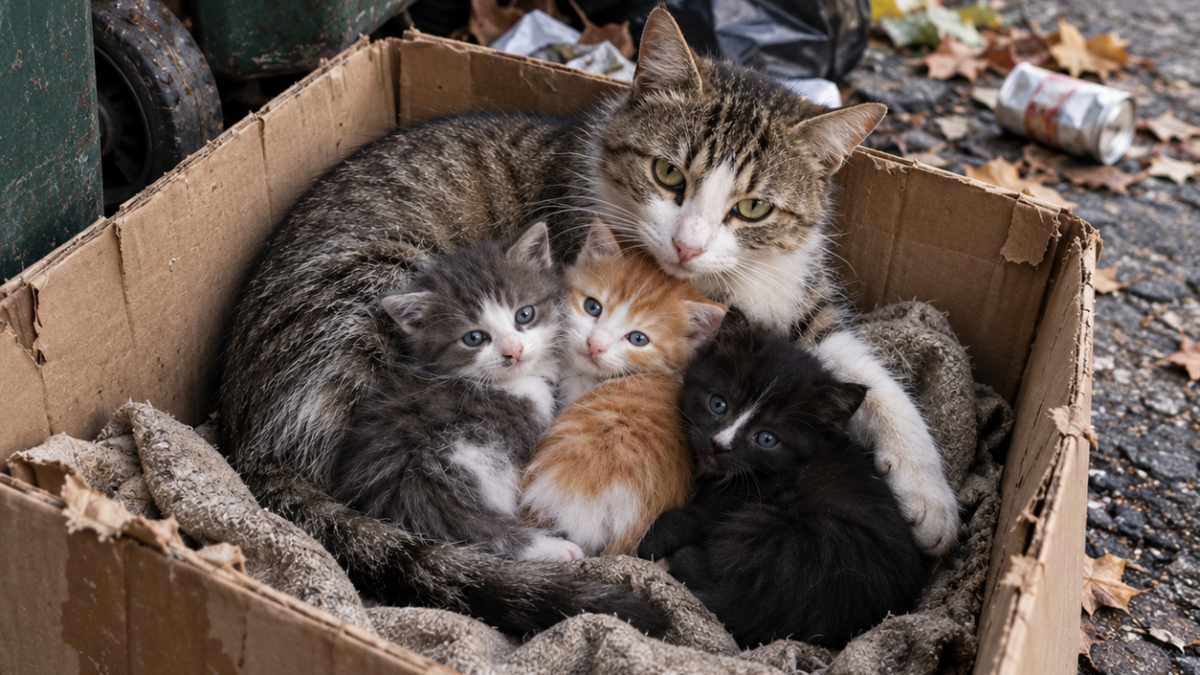
I thought the weak crying beside the dumpsters was coming from a single stray kitten until I opened a taped cardboard box and saw a mother cat wrapped around three newborns like her body was the last wall keeping death away.
She was exhausted, dehydrated, and terrified, but the moment I reached inside, she dragged all three babies beneath her chest and prepared to fight me with whatever strength she had left.
I had no idea that the reason someone had thrown them away was almost as disturbing as what I would eventually find hidden beneath the bottom flap of that box.
My name is Rachel Bennett, and I found them at 6:42 on a cold Thursday morning outside Murfreesboro, Tennessee.
I was driving to work when I heard the sound.
At first, I kept going.
The industrial road was lined with warehouses, empty lots, and several large commercial dumpsters. Cats sometimes lived behind the buildings, and I assumed I had heard one of them.
Then the sound came again.
Thin.
Broken.
A kitten crying so quietly I almost missed it over my engine.
I stopped.
The temperature was thirty-nine degrees.
Wind pushed paper cups across the pavement while I walked between two dumpsters and followed the sound toward a pile of discarded boxes.
Most were flattened.
One was not.
A brown shipping box sat behind a broken wooden pallet.
The top flaps had been folded inward and taped twice across the middle.
Something scratched inside.
My stomach dropped.
“Hello?”
The scratching stopped.
Then came a hoarse adult meow.
I pulled the tape loose.
The smell of urine and wet cardboard hit me immediately.
Inside was a small tortoiseshell cat.
She stared up at me with enormous green eyes.
Her body was thin.
Her coat was dirty.
And beneath her were three newborn kittens who could not have been more than a day old.
One was gray and white.
One was orange with a white chest.
The smallest was almost completely black except for a white spot on his nose.
The mother cat flattened herself across them.
When I reached toward her, she hissed.
I stopped.
“Okay.”
Her sides moved quickly.
“You don’t know me.”
Another hiss.
“I understand.”
I took off my coat and knelt beside the box.
One of the kittens squeaked.
The mother immediately lowered her head and licked him.
That broke something in me.
Whoever had put them there had sealed the box.
No food.
No water.
No opening large enough for the mother to escape.
If I had not heard that kitten—
I stopped myself from finishing the thought.
I called the veterinary clinic three miles away.
“Cedar Grove Animal Hospital.”
“My name is Rachel Bennett. I found a cat and three newborn kittens sealed inside a box near the industrial park.”
The receptionist’s voice changed.
“Can the mother stand?”
“I don’t know.”
“Are the kittens moving?”
“Yes.”
“Bring them immediately. Keep them warm.”
I looked at the cat.
Getting her into my car was going to require trust she had no reason to give me.
“I need to move you.”
She growled softly.
“I know.”
I slid my coat around the box instead of reaching toward her.
Then I lifted the entire thing.
The mother rose halfway, shielding the kittens.
“It’s okay.”
She stared at me.
“We’re leaving together.”
Ten minutes later, I was driving with the heat turned all the way up and the box buckled into my passenger seat.
The mother never stopped watching me.
At one red light, I heard a tiny purr.
Not from a kitten.
From her.
She was still scared.
Still trapped.
Still protecting her babies.
But somewhere between the dumpsters and the clinic, she had decided I might not be the next person to hurt them.
Dr. Hannah Cole met me at the door.
We carried the box directly into an exam room.
She checked the kittens first.
“Cold, but responsive.”
Then the mother.
“Dehydrated. Underweight. Recently delivered, obviously. No major trauma.”
I finally breathed.
“They’ll survive?”
“If we can stabilize Mom and keep the kittens nursing, their chances are good.”
Hannah lifted the smallest black kitten.
“That little one worries me most.”
The mother cat immediately tried to stand.
Hannah returned him.
“Easy, Mama.”
I looked down at the box.
That was when I saw something strange stuck beneath one of the lower flaps.
A torn shipping label.
Most of the address had been peeled away.
But one name was still visible.
And when Hannah read it, she went completely still.
PART 2
The name on the label was:
DARREN COLEMAN.
Underneath it, only part of an address remained.
The street name was torn in half.
The city was gone.
A phone number had been blacked out with marker.
Hannah looked at me.
“Don’t touch it.”
“I wasn’t going to.”
“You were absolutely going to.”
She knew me too well after eight years of bringing injured strays into her clinic.
“What does it mean?”
“Maybe nothing.”
“You don’t believe that.”
“No.”
She photographed the label before carefully removing the flap from the rest of the cardboard.
Then she placed it inside a clear specimen bag.
“Why?”
“In case animal control wants it.”
My anger sharpened.
“You think someone deliberately abandoned them?”
Hannah looked toward the mother cat.
The answer was obvious.
“You don’t accidentally tape four living animals inside a box and leave them behind dumpsters.”
I looked at the tiny kittens.
The gray-and-white one had found a nipple and was nursing.
The orange one was searching.
The black kitten barely moved.
Hannah touched him.
“Come on, little guy.”
The mother licked his head.
“What’s wrong?”
“He’s weak.”
“Can you help?”
“We can supplement him.”
“Do whatever you need.”
Hannah glanced at me.
“You realize they aren’t technically yours.”
“I realize that sentence is irrelevant.”
She almost smiled.
Then she became serious.
“Rachel, if this turns into an animal-cruelty case, animal control may take custody.”
“As long as they’re safe.”
“They will be.”
I sat beside the exam table.
The mother watched me.
“What are we calling her?”
“We?”
“You need a chart.”
“That is the weakest excuse you have ever used to name an animal.”
“She needs a name.”
Hannah considered her.
“How about Ivy?”
The tortoiseshell cat looked unimpressed.
“Ivy.”
I held my hand near her face.
She sniffed it.
“That works.”
The gray-and-white kitten became Ash.
The orange one became Sunny.
The little black one, because of the white mark on his nose, became Dot.
Hannah spent the next two hours stabilizing all four.
I called my manager and told him I would be late.
He asked why.
“I found four cats in a box.”
Silence.
Then:
“Of course you did.”
That reaction said too much about my life.
At 9:10, Officer Caleb Ruiz from county animal control arrived.
He was younger than I expected.
Maybe thirty-five.
Calm.
Patient.
He photographed Ivy and each kitten.
Then the box.
Then the tape.
Then the shipping label.
“Where exactly did you find this?”
I described the location.
“Any vehicles nearby?”
“No.”
“People?”
“No.”
“Cameras?”
I thought about the warehouses.
“There might be.”
Caleb nodded.
“We’ll check.”
I pointed toward the bag containing the label.
“What about the name?”
“We’ll follow it.”
“Can I?”
“No.”
“Why?”
“Because you are a civilian.”
“That has never stopped me before.”
Hannah coughed.
Caleb looked from her to me.
“I’m beginning to understand the problem.”
“What problem?”
“You.”
Hannah laughed.
I did not.
“Someone sealed newborn kittens into a box.”
“I know.”
“I want to know who.”
“So do I.”
“Then tell me what you find.”
“When I legally can.”
I hated reasonable people.
They slowed down anger.
Caleb asked if I could provide a written statement.
I did.
Then he told me the animals would remain at the clinic overnight under protective hold.
“What happens after that?”
“Depends on their condition and whether ownership can be established.”
“If ownership is established, you’re not giving them back.”
His expression hardened.
“If we establish that the owner abandoned them, no.”
That was enough.
For the moment.
I went to work.
I accomplished almost nothing.
Every hour I texted Hannah.
How is Ivy?
Nursing.
How’s Dot?
Still weak.
At noon:
How’s Dot?
Supplemental feeding. Holding temperature.
At three:
Dot?
Stop asking every forty minutes.
At three-forty:
Dot?
Alive.
I exhaled.
At five-thirty, I returned to the clinic.
Ivy was standing.
That alone felt like a miracle.
Her legs were thin, but she moved around the enclosure while the kittens slept beneath the warming lamp.
When I entered, she froze.
“Hey, Mama.”
I sat on the floor.
She watched me for nearly a minute.
Then stepped out of the enclosure.
Slowly.
One paw.
Then another.
She came toward me.
I did not move.
Ivy sniffed my knee.
Then my hand.
Then she climbed into my lap.
I stopped breathing.
Hannah stood in the doorway.
“Don’t make a big deal out of it.”
“I’m not.”
“You look like you’re about to cry.”
“I have allergies.”
“It is November.”
“Seasonal allergies.”
“To what?”
“Judgment.”
Ivy curled against me and began to purr.
A deep, steady sound.
The same cat who had covered her babies with her body twelve hours earlier was now asleep against my stomach.
“She trusts you,” Hannah said.
“No.”
I looked down at her.
“She’s trying to.”
That difference mattered.
Trust after abandonment is rarely immediate.
It comes in fractions.
A hand tolerated.
A meal accepted.
A door that closes and opens again.
I stayed until the clinic closed.
Before I left, Caleb called.
“We found cameras.”
My pulse jumped.
“What did they show?”
“Not enough yet.”
“Caleb.”
“A dark pickup pulled into the industrial lot at 11:43 last night.”
“And?”
“Stayed four minutes.”
“License plate?”
“Partially obscured.”
“Driver?”
“Male.”
“Can you see the box?”
“We can see him carrying something.”
My hand tightened around the phone.
“Is it the box?”
“Likely.”
“Do you have the plate?”
“Partial.”
“Does it match Darren Coleman?”
Pause.
“We’re checking.”
I closed my eyes.
“Can you tell me anything else?”
“Yes.”
“What?”
“The shipping label wasn’t random.”
My stomach tightened.
“What does that mean?”
“The name is connected to a local address.”
“Where?”
“Rachel.”
“You knew I would ask.”
“I also knew I wouldn’t answer.”
“I dislike you.”
“So I’ve heard.”
He hung up.
The next morning, Dot crashed.
Hannah called me at 5:57.
“Get here.”
That was all.
I drove through three red lights that I will deny forever.
Dot lay beneath the warming blanket.
His tiny body looked impossibly still.
Ivy was frantic.
She kept trying to push her face toward him.
“What happened?”
“He stopped nursing around four.”
Hannah was holding a syringe.
“His blood sugar dropped. He’s dehydrated.”
“Can you save him?”
“We’re trying.”
Ivy cried.
Not meowed.
Cried.
A low, broken sound that seemed too human.
I put my hand beside her.
She grabbed my wrist with both paws.
Not scratching.
Holding.
“Come on, Dot.”
Hannah fed him one drop at a time.
Minutes passed.
Then twenty.
Then forty.
At 7:02, he moved one front paw.
I started crying.
Hannah did too.
“That’s it.”
Another movement.
“Come on.”
Dot opened his mouth.
Hannah gave him another drop.
By eight, he was nursing again.
Ivy licked him until his fur stood in every direction.
“You scared us.”
I touched his back with one finger.
He was barely larger than my palm.
That tiny life had been discarded because someone did not want his color.
At least, that was what we would eventually learn.
At 9:18, Caleb arrived.
He looked tired.
“Good news?”
“Depends.”
“That phrase is never good.”
He pulled a chair beside me.
“We identified Darren Coleman.”
My anger returned instantly.
“Who is he?”
“Thirty-nine. Lives outside Smyrna.”
“Does he own cats?”
“Yes.”
“How many?”
“We don’t know.”
“What do you mean?”
“He advertises kittens online.”
The room went quiet.
Hannah stopped writing.
“What kind?”
“Various long-haired mixes. Some are advertised as ‘rare colors.’”
I felt sick.
“He breeds them?”
“Appears so.”
“Licensed?”
“Not for commercial breeding.”
“Did he admit Ivy was his?”
“Not yet.”
“You talked to him?”
“We went to the property.”
“And?”
“He denied abandoning any cats.”
“Of course.”
Caleb continued.
“He said he occasionally receives shipping boxes with his name on them and throws them away. Claims someone could have reused one.”
“That is possible.”
Hannah said it reluctantly.
I looked at her.
“What?”
“She’s right,” Caleb said.
“I hate both of you.”
“Evidence still matters.”
“What about the truck?”
“Coleman owns a dark Ford F-150.”
“Plate?”
“Matches three of the four visible characters.”
My pulse quickened.
“So arrest him.”
“Not enough.”
“He owns the truck, the box had his name, and he breeds kittens.”
“Rachel.”
“What more do you need?”
“A clear plate. Identification. Admission. Physical evidence tying Ivy to his property. Something stronger than coincidence.”
“Coincidence?”
My voice rose.
Hannah touched my shoulder.
Caleb remained calm.
“I am not defending him.”
“It sounds like it.”
“I’m building a case that survives court.”
That shut me up.
Mostly.
He continued.
“We asked to inspect his animals.”
“What did he say?”
“No.”
“Can he refuse?”
“Without a warrant or probable cause, yes.”
“What gives you probable cause?”
He looked toward Ivy.
“More than we had yesterday.”
There was something he was not saying.
“What?”
Caleb rubbed his jaw.
“A neighbor talked to us.”
I leaned forward.
“What did they say?”
“Coleman has a female cat that recently gave birth.”
I looked at Ivy.
“And?”
“The neighbor heard kittens in his shed Tuesday night.”
Ivy had probably delivered Wednesday night.
Close enough.
“Did they see them?”
“No.”
“Anything else?”
“Coleman complained Wednesday morning that the litter was ‘useless.’”
My hands went cold.
“Those exact words?”
“Yes.”
Hannah stared at him.
“Why?”
“He apparently expected pale cream kittens.”
There it was.
The original cruelty finally had a motive.
Not hunger.
Not desperation.
Not somebody overwhelmed by an accidental litter.
Color.
Money.
Caleb continued.
“The neighbor says Coleman had a buyer lined up for light-colored kittens.”
I looked at Ash.
Gray and white.
Sunny.
Orange.
Dot.
Black.
“Wrong colors.”
“That appears possible.”
The phrase made me furious.
Wrong colors.
As if life had failed a paint order.
“What happens now?”
“We requested a warrant.”
“When?”
“This morning.”
“How long?”
“Rachel.”
“I know. You can’t promise.”
“No.”
“Then I’m going to do something I can control.”
“What?”
“Foster them.”
Hannah turned.
“You have two dogs.”
“My dogs like cats.”
“Your dogs tolerate cats.”
“Same thing.”
“You work full-time.”
“I can take leave.”
“You live alone.”
“I have Megan next door.”
“You have never fostered neonates.”
“I have you.”
Hannah stared.
“You are weaponizing friendship.”
“Yes.”
Caleb looked between us.
“I’m going to leave before I become involved in this.”
He did.
The foster approval took one day.
My house changed completely.
The spare bedroom became Ivy’s room.
Warming pad.
Low-sided bed.
Food.
Water.
Litter tray.
Scale.
Formula.
Syringes.
Tiny towels.
My dogs, Cooper and June, were banned from entering.
They sat outside the door in offended silence.
Ivy adjusted faster than I expected.
The kittens did not.
Newborns require schedules that make adult humans question every life decision they have made.
Dot needed supplemental feeding every two hours.
That meant midnight.
Two.
Four.
Six.
I began sleeping in ninety-minute fragments.
I went to work with formula on my shirt.
My manager stopped asking.
On the third night, Ivy climbed onto my pillow.
At first I thought she wanted warmth.
Then she placed one paw on my face.
I opened my eyes.
“What?”
She looked toward the kitten bed.
Dot was crying.
“You woke me up?”
Ivy jumped down.
I followed.
Dot had crawled away from the warmth.
I moved him back.
Ivy immediately curled around him.
“Okay.”
I looked at her.
“We’re a team.”
She blinked.
That became our routine.
Ivy did most of the mothering.
I handled what she could not.
We weighed every kitten daily.
Ash gained.
Sunny gained.
Dot gained slowly.
Every half ounce felt like victory.
Meanwhile, the case against Darren Coleman grew.
Two days later, Caleb called.
“We executed the warrant.”
I sat down.
“What did you find?”
“Twenty-three cats.”
I stopped breathing.
“Twenty-three?”
“Adults and juveniles.”
“Conditions?”
“Mixed.”
“What does that mean?”
“Some were healthy enough. Others were underweight. Several had untreated respiratory infections.”
“Pregnant females?”
“Two.”
My stomach twisted.
“Any records?”
“Yes.”
“About Ivy?”
“Maybe.”
“Caleb.”
“We found a breeding notebook.”
“What does it say?”
“Females. Dates. Pairings. Expected colors.”
I looked at Ivy sleeping beside her kittens.
“What about her?”
“One female listed as ‘Tortie 4.’”
I closed my eyes.
Not Ivy.
Not Mama.
Tortie 4.
“Last entry?”
Caleb hesitated.
“Delivered three. Wrong mix.”
I felt sick.
“Anything else?”
“Yes.”
“What?”
“Next to it, one word.”
I already knew.
“Cull?”
“No.”
“Dump.”
I stood.
For several seconds, I could not speak.
“Dump.”
“Yes.”
“Written?”
“Yes.”
“In his notebook?”
“Yes.”
“Then arrest him.”
“We did.”
The anger that had been building inside me for a week did not explode.
It collapsed.
I sat down.
“Charges?”
“Animal cruelty. Abandonment. Additional counts pending based on the cats recovered.”
“Did he say anything?”
“He says ‘dump’ meant surrender.”
“To whom?”
“He hasn’t explained.”
“Of course.”
Caleb continued.
“We also found the same industrial tape used on the box.”
“Good.”
“And cardboard shipping boxes from the same supplier.”
“Good.”
“The truck’s GPS history places it near the industrial park during the relevant time.”
I finally exhaled.
“Good.”
That word did not feel good enough.
But it was something.
“What happens to the other cats?”
“Temporary protective custody.”
“Where?”
“Shelters. Rescues. Veterinary partners.”
“Can I help?”
“You are currently bottle-feeding a black kitten at two in the morning.”
“Three kittens.”
“I am aware.”
“I can still help.”
“I know.”
There are moments when justice feels dramatic in stories.
Sirens.
Handcuffs.
Courtroom speeches.
In reality, justice often looks like paperwork.
Photographs.
Veterinary exams.
Chain-of-custody forms.
Witness statements.
Receipts.
Microchip scans.
Urinalysis.
Fecal tests.
Long nights in overcrowded shelters.
Volunteers driving carriers across counties.
The day those twenty-three cats were removed from Coleman’s property, nothing felt victorious.
Many were frightened.
One Persian mix had mats so severe she needed sedation to be shaved.
A young male had a respiratory infection that made every breath sound wet.
One queen had been bred so repeatedly that her body was depleted.
A cream-colored kitten—the exact color Coleman had wanted—sat in a carrier shaking so hard the door rattled.
That image changed something in me.
Even the “valuable” kittens had not won.
There was no winning in a place where an animal’s worth depended on what someone would pay.
Color did not protect them.
Profit did not protect them.
Nothing protected them until people stepped in.
Ivy’s babies turned two weeks old.
Their eyes opened.
Ash saw me first.
Or at least looked in my direction.
Sunny learned to scream whenever food was delayed by six seconds.
Dot remained the smallest.
But he was stubborn.
When the others slept, he crawled.
When they surrendered, he searched.
He would climb Ivy’s side and somehow end up sleeping on her neck.
I began calling him the General.
Megan objected.
“He weighs nine ounces.”
“He commands the room.”
“He falls over while walking.”
“Leadership takes many forms.”
At three weeks, Ash began escaping the nesting box.
At four, Sunny discovered my toes.
At five, Dot bit me for the first time.
I sent Hannah a photograph.
HE HAS CHOSEN VIOLENCE.
She replied:
He has chosen teeth.
By six weeks, my spare room looked as if a tiny tornado had learned to use a litter box badly.
Ivy changed too.
She gained weight.
Her coat became glossy.
She stopped flinching when doors closed.
The first time I carried a cardboard box into the room, however, she panicked.
I did not think.
I was bringing clean towels.
The second Ivy saw the box, she flattened herself.
Her pupils widened.
She ran to the kittens.
Covered them.
Same posture as the dumpster.
I dropped the box immediately.
“Oh, Ivy.”
She growled.
I sat on the floor.
The kittens climbed around her, confused.
“I’m sorry.”
I removed the box.
Brought the towels in my arms.
For the next month, I kept cardboard out of her sight.
Eventually, Hannah suggested gentle desensitization.
Not forcing.
Not trapping.
A flattened piece across the room.
Treats nearby.
Then smaller distances.
Weeks passed.
One afternoon, Ivy walked onto a flat piece of cardboard by herself.
She sniffed it.
Sat.
Then began grooming.
I cried.
Megan found me.
“What happened?”
“She sat on cardboard.”
Megan stared.
“You need sleep.”
“She was terrified of it.”
Her face softened.
“Oh.”
Recovery is full of moments that look ridiculous to everyone except the person who knows what came before.
The criminal case took months.
Coleman pleaded not guilty.
His attorney argued there was no proof the box I found was the same box from Coleman’s property.
Then forensic testing found cat hair inside his truck consistent in color and microscopic characteristics with Ivy’s coat.
Not DNA-level identification.
But supportive.
More importantly, his notebook existed.
So did video.
GPS records.
Neighbor testimony.
The label.
The tape.
And Coleman’s own online messages.
Those messages turned out to be worse than anything I had imagined.
Investigators obtained them through a warrant.
He had promised a buyer three pale cream kittens from Ivy’s litter.
The buyer had offered $900 each if the color was “clean.”
Coleman had replied:
Should hit cream or buff. Mother throws light.
The morning after Ivy gave birth, he sent:
Bad litter. Gray, orange, black. Waste of feed.
The buyer replied:
That sucks.
Coleman:
I’ll clear them out and repeat breeding next cycle.
Clear them out.
Not find homes.
Not surrender them.
Not care for them.
Clear them out.
Another message:
Mom’s decent producer. I’ll keep her if she cycles fast.
I read that message in Ellen Shaw’s office.
Yes.
The same Ellen who later became involved because apparently my life now came with permanent legal representation for animals.
“This is enough, right?”
She looked at me.
“The prosecutor thinks so.”
“Will he go to jail?”
“Maybe.”
“Maybe?”
“Rachel.”
“I know. Courts don’t work like movies.”
“Correct.”
“What can happen?”
“Fines. Probation. Jail. Prohibition on owning animals. Forfeiture.”
“I want the prohibition.”
“That is likely the most important long-term outcome.”
“I want permanent.”
“The court decides.”
I hated that too.
Coleman’s defense changed when prosecutors added charges involving several other cats.
One had untreated dental disease so severe she could barely eat.
Another had an infected wound.
Three had never received routine veterinary care.
Two kittens tested positive for parasites.
The pattern mattered.
So did profit.
His online sales records showed dozens of kittens sold over three years.
Cash.
Venmo.
Marketplace messages.
Private groups.
No meaningful health guarantees.
No breeding records beyond color and sale price.
No concern with temperament.
No genetic screening.
Animals had been reduced to inventory.
Court began in April.
By then, Ivy’s kittens were seven months old.
Ash had been adopted by a retired teacher named Donna.
Sunny went to a firefighter and his wife, who sent me weekly photographs of him sleeping in increasingly ridiculous places.
Dot remained.
Not because nobody wanted him.
Because I stopped pretending.
He was mine.
Ivy was too.
The rescue paperwork said “foster failure.”
I preferred “administrative correction.”
Megan preferred “predictable outcome.”
At trial, I testified first.
The prosecutor showed photographs from the dumpster.
Ivy inside the box.
Her body over the kittens.
The tape.
The torn label.
I had seen them many times.
Still, my throat tightened.
Coleman sat at the defense table.
Clean shirt.
Glasses.
Hair trimmed.
Ordinary.
That is what disturbed me most.
People want cruelty to look obvious.
It often does not.
The prosecutor asked, “What did you hear before opening the box?”
“A kitten crying.”
“How was the box closed?”
“Taped.”
“Could the mother cat get out?”
“No.”
“Was there food inside?”
“No.”
“Water?”
“No.”
“Ventilation holes?”
“No.”
“How cold was it?”
“Thirty-nine degrees when I checked later.”
The defense attorney stood.
“You did not see Mr. Coleman place the box there.”
“No.”
“You did not see him tape it.”
“No.”
“You did not know Mr. Coleman before this incident.”
“No.”
“So you cannot personally testify that he abandoned these cats.”
“I can testify where I found them.”
“That was not my question.”
“No.”
He smiled slightly.
Then made a mistake.
“You are emotionally attached to these animals now, correct?”
“Yes.”
“You adopted two of them.”
“Yes.”
“So you have a personal interest in seeing my client punished.”
I looked toward Coleman.
Then back at the attorney.
“I have a personal interest in seeing the evidence matter.”
The prosecutor objected.
The judge sustained it.
But the jury had heard.
Hannah testified next.
She described Ivy’s condition.
The kittens’ hypothermia risk.
Dot’s crash.
The likely consequences of remaining sealed in the box.
“How long could they have survived?”
The prosecutor asked.
Hannah was careful.
“No exact number can be given.”
“But medically?”
“The kittens were neonates. Their ability to regulate body temperature was extremely limited. At the ambient temperature reported, without intervention, deterioration could have been rapid.”
“What about the mother?”
“She was dehydrated and underweight, but stronger.”
“Could she have escaped the box?”
“Not without damaging it significantly from inside. The box showed scratching, but the tape remained intact.”
Then Caleb testified.
Video.
Truck.
GPS.
The search warrant.
The notebook.
The word DUMP.
Coleman’s attorney challenged everything.
Could “dump” mean surrender?
Theoretically.
Could the truck have been driven by someone else?
Theoretically.
Could another shipping box with Coleman’s name have reached the industrial lot?
Theoretically.
Then the neighbor testified.
Her name was Elaine Parker.
She had lived beside Coleman for five years.
She looked nervous.
The prosecutor asked, “Did you hear kittens on the night before the animals were found?”
“Yes.”
“Where?”
“His shed.”
“Did you speak to Mr. Coleman the following morning?”
“Yes.”
“What did he say?”
Elaine looked toward Coleman.
Then at the jury.
“He said the litter came out wrong.”
“Wrong how?”
“Colors.”
“What else did he say?”
“He said he had three buyers waiting for creams and that these were useless.”
The courtroom became very quiet.
“Did you see him later that day?”
“Yes.”
“What was he doing?”
“Carrying a taped box from the shed toward his truck.”
My hands turned cold.
The defense attorney stood quickly.
“How far away were you?”
“Maybe sixty feet.”
“Could you see inside the box?”
“No.”
“Could it have contained supplies?”
“Yes.”
“Trash?”
“Yes.”
“Anything?”
“Yes.”
“So you do not know those cats were in it.”
Elaine looked directly at him.
“No.”
He nodded.
Then she continued without being asked.
“But the crying stopped after he left.”
The attorney froze.
The prosecutor stood.
“No further questions.”
The online messages came next.
Waste of feed.
Clear them out.
Repeat breeding.
Keep her if she cycles fast.
Coleman eventually testified.
That surprised everyone.
His attorney probably advised against it.
He said the notebook was business shorthand.
He said “dump” meant take to a rescue.
The prosecutor asked which rescue.
Coleman could not name one.
He claimed the box had contained trash.
The prosecutor asked why Elaine heard kittens before he carried it away and none afterward.
He said he did not know.
He claimed Ivy must have escaped his property independently.
The prosecutor displayed the video of his truck entering the industrial lot.
He said he had stopped to throw away scrap cardboard.
“At 11:43 p.m.?”
“Yes.”
“Behind commercial dumpsters miles from your home?”
“Yes.”
“Why?”
“I was already out.”
“Doing what?”
“Driving.”
“Where?”
“I don’t remember.”
The prosecutor paused.
“Do you normally drive around with discarded cardboard near midnight?”
His attorney objected.
Overruled.
Coleman looked angry.
“No.”
The prosecutor held up a photograph of Ivy.
“Was this your cat?”
“Yes.”
Finally.
The courtroom changed.
“Did she give birth on your property?”
“Yes.”
“To three kittens?”
“Yes.”
“What colors?”
Coleman looked toward his attorney.
“Gray. Orange. Black.”
“Did you want those colors?”
“I didn’t care.”
The prosecutor showed the buyer messages.
The jury read them.
Coleman’s jaw tightened.
The prosecutor asked again.
“Did you want those colors?”
“No.”
“Did you consider them valuable?”
“No.”
“Did you write ‘wrong mix’ in your breeding notebook?”
“Yes.”
“Did you write ‘dump’ beside the entry?”
“Yes.”
“Did you carry a taped box from your shed to your truck later that morning?”
“I carried a box.”
“Did you drive the same truck to the industrial park where Ivy and her kittens were found?”
“Yes.”
He had nowhere left to go.
“Were Ivy and the kittens inside that box?”
Silence.
His attorney stood.
“My client has answered—”
The judge looked at Coleman.
“Answer the question.”
Coleman stared at the table.
“No.”
That was his final denial.
The jury deliberated for just under three hours.
I waited outside with Hannah, Caleb, Megan, and Donna.
Donna had brought photographs of Ash.
I appreciated the distraction.
One showed him lying across her laptop keyboard.
“He sends emails now.”
“Work emails?”
“He fired my accountant.”
“Reasonable.”
Megan paced.
Hannah ate crackers.
Caleb pretended not to check the courthouse door every thirty seconds.
Finally, the bailiff appeared.
We went back inside.
The jury returned.
Guilty on abandonment.
Guilty on animal cruelty related to Ivy and the three kittens.
Guilty on multiple neglect counts involving animals recovered from the property.
Not guilty on two lesser counts where ownership records were unclear.
I did not celebrate.
Not then.
I looked at Coleman.
For the first time since I had seen him, he looked small.
Not physically.
In consequence.
The judge ordered all remaining animals permanently forfeited.
Coleman was prohibited from possessing, breeding, selling, or residing with companion animals for a lengthy period as part of sentencing and probation conditions.
He received jail time, probation, fines, restitution for veterinary costs, and mandatory inspections associated with compliance.
His breeding operation ended.
His online accounts disappeared.
The surviving cats went to rescues and homes.
That was justice.
But there was one more piece.
A month after sentencing, Caleb called.
“We found something while closing out property evidence.”
“What?”
“Another notebook.”
I sat down.
“More animals?”
“Older records.”
“How old?”
“Three years.”
My stomach tightened.
“What’s in it?”
“Litters.”
“Sold?”
“Mostly.”
“Mostly?”
“There are notations similar to Ivy’s.”
I went cold.
“Dump?”
“Sometimes.”
“How many?”
“Rachel.”
“How many?”
“Seven litters have entries that concern us.”
I closed my eyes.
“Can anything be done?”
“We’re checking historical complaints, shelter intakes, dumped-animal reports.”
“Will it change his sentence?”
“Maybe not significantly.”
“So what’s the point?”
Caleb was quiet.
“The point is finding out what happened.”
He was right.
Not every truth changes a sentence.
Some truths exist because the abandoned deserve to be counted.
Over the next four months, volunteers helped cross-reference old intake photographs.
An orange female with four kittens found behind a grocery store.
A white queen with two kittens left near a church.
Three juvenile cats found beside a county road.
Not every case could be linked.
Two likely could.
One almost certainly.
There was not enough evidence for new charges in every instance.
But the pattern became part of the court record during restitution review.
Coleman had not made one terrible decision.
Ivy had not been a single lapse.
She was the cat who survived long enough to expose the pattern.
That became the “revenge” people always wanted when I told the story.
Not harm.
Not cruelty returned with cruelty.
Exposure.
The animals he considered disposable became the reason he could no longer profit from animals.
The box he expected nobody to open became evidence.
The name he failed to tear completely from a shipping label led investigators back to his door.
The kittens he called worthless were photographed in newspapers, adopted into homes, and became the faces of a fundraising campaign that eventually covered veterinary care for dozens of abandoned mothers and litters.
That was enough for me.
Almost.
There was still Ivy.
For months after the trial, Ivy remained sensitive to certain things.
Tape ripping.
Cardboard boxes.
Truck engines.
If she heard packing tape pulled loudly, she would run toward Dot.
Even when Dot was nearly full-grown.
Even when he outweighed her.
Even when he was asleep on my couch with all four legs in the air.
She remained his mother.
That never turned off.
One evening, I came home with groceries.
Dot was sitting in the paper bag before I finished unloading it.
Ivy watched from the kitchen doorway.
The bag tipped.
Dot rolled out.
I laughed.
Ivy walked over.
Sniffed the bag.
Then climbed inside.
I froze.
She turned twice.
Lay down.
Only her eyes and ears showed above the top.
“Really?”
Dot climbed in on top of her.
The bag collapsed.
Both cats walked out looking offended.
I sat on the floor and laughed until I cried.
Megan found me that way five minutes later.
“What happened?”
I pointed at the bag.
“Ivy went inside.”
Megan understood immediately.
She sat beside me.
“That’s good.”
“Yeah.”
I wiped my face.
“That’s really good.”
A year after I found them, I drove back to the industrial park.
Not because I wanted to relive it.
Because I needed to see the place when it was no longer holding them.
The dumpsters were still there.
The wooden pallet was gone.
Someone had painted the warehouse wall.
Traffic moved on the highway nearby.
Nothing looked dramatic.
That bothered me.
I expected a place where four lives nearly ended to look marked.
It didn’t.
Places rarely carry visible scars.
People and animals do.
I stood beside the spot where the box had been.
Then I heard a car door.
Hannah.
“You followed me?”
“Megan told me.”
“Traitor.”
“She worries.”
“I’m fine.”
“I know.”
We stood in silence.
“You ever think about what would’ve happened if I kept driving?”
I asked.
“Yes.”
“Me too.”
Hannah looked at me.
“That’s not useful.”
“I know.”
“You heard them.”
“I almost didn’t.”
“But you did.”
I looked at the ground.
“Dot wouldn’t have made it.”
“Probably not.”
“And Ivy?”
“Longer. But sealed like that? Without water?”
She stopped.
No need.
I stared at the dumpsters.
“You know what I hate?”
“Many things.”
“I’m being serious.”
“So am I.”
I smiled slightly.
Then said, “I hate that Coleman probably assumed nobody would notice.”
Hannah put her hands into her coat pockets.
“People who dump animals usually depend on that.”
“That someone else won’t look.”
“Yes.”
We walked back to our cars.
Before leaving, Hannah handed me something.
A small framed photograph.
Ivy.
Ash.
Sunny.
Dot.
All together at six weeks old.
Ivy in the center.
Kittens piled around her.
On the bottom, Hannah had written:
NOT THE WRONG COLORS.
I stared at it.
“Subtle.”
“I know.”
I hugged her.
“I hate you.”
“Seasonal allergies?”
“Shut up.”
Two years passed.
Ash became enormous.
Donna claimed he had Maine Coon somewhere in his ancestry.
I told her he had refrigerator somewhere in his ancestry.
Sunny became obsessed with water and slept in the bathroom sink.
Dot became the most spoiled creature in Tennessee.
He slept against my neck.
Stole pens.
Opened cabinet doors.
Once learned to turn on the bathroom faucet and nearly flooded the house.
Ivy remained quiet.
Gentle.
Watchful.
She loved windows.
Sunlight.
Warm laundry.
She hated thunderstorms.
Whenever one came, she gathered toys.
Not kittens.
Toys.
She carried Dot’s old stuffed mouse under the bed.
Then another.
Then another.
As if some part of her still believed responsibility meant making sure nobody was left out.
At four years after rescue, Ivy developed a lump.
My chest tightened the moment I felt it.
Hannah examined her.
“Mammary mass.”
“Cancer?”
“Could be.”
I sat down.
“Because she wasn’t spayed?”
“Early spaying reduces risk significantly. We don’t know her full breeding history.”
Coleman’s notebook suggested Ivy had been bred repeatedly before the litter I found.
Maybe three times.
Maybe more.
Anger returned.
Old anger.
Hannah saw it.
“Don’t.”
“What?”
“Go backward.”
“He did this.”
“We don’t know that.”
“He bred her repeatedly.”
“Yes.”
“He didn’t provide proper care.”
“Yes.”
“He—”
“Rachel.”
I stopped.
Hannah softened.
“Right now Ivy needs you here.”
Not in court.
Not at the dumpster.
Not with Coleman.
Here.
We scheduled surgery.
The mass was removed.
The biopsy came back malignant but localized.
Margins were clean.
Ivy recovered.
For years afterward, every vet check terrified me.
She remained cancer-free.
At seven, she became slower.
At eight, she developed kidney disease.
Manageable at first.
Fluids.
Diet.
Medication.
Dot never left her alone during treatment.
If I gave Ivy subcutaneous fluids, Dot sat beside her and screamed at me as if I were committing a felony.
“You realize I saved your life once.”
He screamed again.
“Ungrateful.”
Ivy head-butted my hand.
By then, the three kittens had not lived together for years.
But every December, their families came to my house.
Not because cats care about reunions.
They did not.
Ash hissed at Sunny the first year.
Sunny stole Dot’s food.
Dot hid upstairs.
But the humans cared.
Donna.
Matt and Elise, Sunny’s people.
Megan.
Hannah.
Caleb came twice.
He claimed it was only for food.
I made a photo each year.
Three adult cats descended from the “wrong” litter.
Ash—gray and white, twenty pounds of arrogance.
Sunny—orange and white, bright-eyed and ridiculous.
Dot—black with the white mark still perfectly centered on his nose.
And Ivy.
Their mother.
The first year, we tried lining them up.
Impossible.
The second, we gave up.
By year five, the photograph showed only Ivy because all three adult kittens had left the frame.
It became my favorite.
She sat in the middle of the couch.
Alone.
Calm.
Safe.
Eight years after the rescue, Caleb retired from animal control.
At his retirement dinner, he handed me an evidence photocopy.
The original shipping label.
Darren Coleman.
Torn address.
Black marker.
“I thought you might want it.”
I stared.
“No.”
He looked surprised.
“I don’t.”
“Okay.”
“Destroy it.”
“You sure?”
“Yes.”
He nodded.
Then I stopped him.
“Wait.”
“What?”
I looked at the copy.
A name that once felt important.
Evidence.
A path back to the man responsible.
Now it looked small.
“Can I have the photo of the box instead?”
“The box?”
“Yes.”
“Why?”
“Because Ivy is in it.”
His face softened.
He gave me the photograph.
I never kept Coleman’s name.
I kept Ivy’s survival.
That distinction mattered.
At nine, Ivy stopped jumping onto my bed.
I bought stairs.
She ignored them.
So I lifted her.
At ten, she started sleeping more.
Dot, now ten himself, became gentler with her.
He groomed her ears.
Let her take his favorite blanket.
Stopped ambushing her from behind furniture.
Maybe he understood.
Maybe age simply made him lazy.
One November morning, Ivy did not eat.
I tried chicken.
Tuna.
Her favorite pâté.
Nothing.
She drank.
Then returned to the sunny spot beside the window.
I called Hannah.
Kidney values had worsened.
We adjusted treatment.
For two months, Ivy rallied.
Then the good days became mixed.
She still purred.
Still followed me.
But she lost weight.
One night, I woke at 2:16.
Ivy was standing beside my bed.
She never came upstairs anymore.
“Ivy?”
She looked toward the hallway.
Then walked downstairs.
Slowly.
I followed.
She led me to the spare room.
The room where she had raised her kittens.
I had changed it years ago.
Desk.
Bookshelf.
Guest bed.
But one thing remained.
Her old blanket.
Folded in a basket.
Ivy walked to it.
Lay down.
I sat beside her.
Dot appeared minutes later.
He curled against her stomach.
Exactly where he had slept as a newborn.
I stared at them.
Black body.
White spot on the nose.
Tortoiseshell mother.
Ten years disappeared.
I saw the box.
Cold cardboard.
Three tiny kittens.
Ivy covering them.
But now there was no tape.
No dumpster.
No wind.
Just home.
I put my hand on her.
“You did it.”
She purred.
“You kept them alive.”
Dot opened one eye.
“You especially.”
He ignored me.
Ivy’s breathing slowed.
Not dangerously.
She was only tired.
That night I slept on the floor beside them.
The next morning, I knew.
Not because she was in obvious pain.
Because she no longer wanted breakfast.
Did not want the window.
Did not respond when I opened the patio door.
I called Hannah.
She came to the house.
She examined Ivy on the old blanket.
Then sat beside me.
“I think we’re there.”
I nodded.
I had been preparing for months.
Preparation did not help.
“Can we do it here?”
“Yes.”
Megan came.
Donna.
Matt and Elise.
They did not bring Ash or Sunny.
That would have stressed Ivy.
Instead they brought photographs.
Every kitten.
Every year.
We spread them across the floor.
Ivy as a young mother.
Ash at one.
Sunny asleep in the sink.
Dot destroying my curtains.
Ivy in a Christmas box she voluntarily climbed into five years after being terrified of cardboard.
That photograph made me laugh through tears.
“She really learned boxes could be good.”
Hannah smiled.
“Eventually.”
Ivy lay in my lap.
Dot beside her.
I stroked her forehead.
“You were never the wrong cat.”
Her purr was faint.
“None of them were the wrong colors.”
Megan covered her mouth.
I continued because I needed Ivy to hear my voice.
“You were a good mother.”
Purr.
“You were brave.”
Purr.
“And you can stop protecting everybody now.”
I started crying.
“They’re okay.”
Dot pressed against her.
“Ash is okay.”
I touched the gray kitten in the photograph.
“Sunny is okay.”
Orange.
“And this idiot is definitely okay.”
Dot looked offended.
Everyone laughed softly.
“I’ve got him.”
I whispered.
“You don’t have to cover anybody anymore.”
Hannah gave the sedative.
Ivy relaxed.
Her head became heavy in my hand.
For a moment, I thought of her first morning with me.
Her body over three kittens.
Ready to use her last strength against a stranger.
Then I thought of the years in between.
Sunlight.
Food.
Soft beds.
Open doors.
Christmas photographs.
Dot sleeping on her back.
She had not spent her life inside that box.
That mattered.
The final medication went in.
Ivy took one breath.
Another.
Then stopped.
Dot sniffed her.
He touched his nose to her ear.
Waited.
Then curled beside her.
I cried harder than I had at any point in the entire story.
Not because her life was tragic.
Because it was not.
Someone had tried to reduce Ivy to a failed breeding result.
Wrong litter.
Wrong colors.
Waste of feed.
Dump.
But he did not get to define her life.
He got one morning.
We got ten years.
That was the balance I carried with me.
Ash and Sunny both lived long lives.
Dot reached sixteen.
He remained a menace until the final month.
The rescue that had helped with Coleman’s twenty-three cats eventually opened a maternal-care room for abandoned queens and neonatal kittens.
They named it Ivy’s Room.
I resisted.
Of course.
I always resist sentimental names before immediately crying over them.
On the wall hangs the photograph Hannah gave me years ago.
Ivy with all three kittens.
Under it are the words:
NO LIFE IS THE WRONG COLOR.
The room has warming incubators.
Formula.
Scales.
Oxygen.
Quiet foster spaces.
Emergency supplies.
Volunteers trained in neonatal care.
Dozens of litters have passed through it.
Some survive.
Some do not.
That is rescue.
Not every ending can be fixed.
But every life deserves effort.
Years later, someone once asked whether I ever forgave Darren Coleman.
I did not know how to answer.
Forgiveness was never part of my responsibility.
He faced the court.
Lost the animals.
Lost the breeding operation.
Paid restitution.
Served his sentence.
Lived with the public record of what he had done.
That was the system’s job.
My job was smaller.
Keep Ivy warm.
Feed Dot at two in the morning.
Clean litter.
Drive to appointments.
Learn that orange cats apparently consider gravity optional.
Send photographs to families.
Sit beside an old mother cat when her kidneys failed.
Love them long enough that abandonment became only the first chapter.
People expected revenge to look like Coleman suffering.
But the best revenge was visible every December in my living room.
Three adult cats in three loving homes.
A mother cat sleeping in sunlight.
A former breeding operation shut down.
Twenty-three other cats removed.
New laws proposed locally for repeat commercial breeders.
A rescue room carrying Ivy’s name.
Dozens of newborn kittens warmed beneath blankets instead of dying behind dumpsters.
He had thrown them away because the colors were wrong.
Years later, those exact colors were the part everyone remembered.
Ash’s gray-and-white coat.
Sunny’s bright orange chest.
Dot’s black face with one ridiculous white spot.
The litter he considered worthless became the reason people donated.
The mother he reduced to “Tortie 4” became Ivy.
A name.
A life.
A family.
Sometimes I still drive that industrial road.
The dumpsters have been replaced.
The warehouse changed owners.
There is a coffee shop where an empty lot used to be.
If I did not know, I would never recognize the place.
But every time I pass it, I remember 6:42 on a cold Thursday morning.
A weak cry.
A taped box.
Green eyes staring up at me.
And a mother cat who thought my hand might be another threat.
I remember telling her:
“We’re leaving together.”
At the time, I meant the dumpsters.
I did not know the sentence would become a promise.
We left the dumpsters.
Then the clinic.
Then fear.
Then the court case.
Then the story someone else had written for her.
And eventually, years later, Ivy left me too.
But not abandoned.
Not cold.
Not sealed inside anything.
She left lying on the blanket where she had once raised her babies, with Dot beside her and my hand beneath her cheek.
Safe.
Named.
Loved.
The way she should have been from the beginning.
For a long time after Ivy died, I could not bring myself to wash the blanket.
That surprised me.
I had washed it hundreds of times before.
When the kittens were newborns, it had been soaked with milk, formula, urine, medicine, and the thousand tiny messes that come with raising three fragile lives in one small room.
Later, after the kittens had grown, it became Ivy’s favorite place to sleep.
The fabric had faded from dark blue to something closer to gray.
One corner had a tear Dot made when he was four months old and convinced there was an invisible enemy living underneath it.
I had meant to replace it several times.
I never did.
After Ivy died, the blanket remained on the floor of the spare room for eleven days.
Dot slept on it every night.
During the day, he wandered through the house as if looking for something.
He would enter the kitchen.
Stop.
Look beneath the table.
Walk to the living room.
Jump onto the couch.
Then return to the spare room.
The first few days, I heard him calling.
Not loudly.
Just a short, uncertain meow.
I knew who he was looking for.
So did Megan.
She came over on the third evening and found me sitting beside him.
“You should eat something.”
“I’m not hungry.”
“You said that yesterday.”
“I ate toast.”
“That is not dinner.”
“It had peanut butter.”
She looked at me.
“That is still toast.”
Dot was curled in the center of Ivy’s blanket.
He had one paw stretched into the empty space beside him.
Megan sat down.
For several minutes, neither of us spoke.
Then she said, “Do you remember how tiny he was?”
I laughed softly.
“He fit in one hand.”
“And screamed like he weighed fifty pounds.”
“He still does.”
Dot opened one eye at the sound of his name.
“He almost died that second morning,” Megan said.
“I remember.”
“You were convinced you could keep him alive by glaring at Hannah.”
“I thought pressure helped.”
“You threatened a veterinarian with optimism.”
“That sounds reasonable.”
Megan smiled.
Then her eyes moved toward the empty part of the blanket.
“She really did everything for them.”
I nodded.
Even at the end, that was what I remembered most clearly.
Not the box.
Not Coleman.
Not the courtroom.
Ivy bent over three newborn kittens, arranging them against her body while she had barely enough strength for herself.
She had never asked whether they were the right colors.
She had not cared whether one was gray, one orange, one black.
They were hers.
That was enough.
Maybe that was why the original cruelty remained so hard for me to understand.
Coleman had looked at exactly the same three kittens and seen failure.
Ivy had looked at them and seen her entire world.
For years, I thought anger would fade with time.
It did, but not in the way I expected.
I did not wake up one morning and forgive him.
I did not decide the past no longer mattered.
Instead, the rest of Ivy’s life simply became bigger than what he had done.
Ten years of safety eventually outweighed one night inside a box.
Not erased it.
Outweighed it.
That distinction mattered to me.
The first anniversary after Ivy died, I went to the rescue.
I had avoided Ivy’s Room for months.
Every time Hannah mentioned it, I changed the subject.
Then one Saturday morning, she called.
“We have a mother cat with four newborns.”
“That happens in a maternal-care room.”
“Rachel.”
“What?”
“One of the kittens is crashing.”
I was already putting on shoes.
Some habits never leave.
When I arrived, the room was warm and dim.
A young tabby mother lay in an enclosure while four kittens nursed.
One kitten was separated beneath a warming pad.
Tiny.
Brown.
Barely moving.
For one second I was back at Cedar Grove with Dot.
Same helpless body.
Same impossible smallness.
Hannah looked at me.
“You okay?”
“No.”
“Want to leave?”
“No.”
I sat.
“What do you need?”
She handed me a syringe.
That was how I returned.
Not with a ceremony.
Not with a speech.
With one drop of formula at a time.
The little brown kitten survived.
His name became Peanut because rescue volunteers should never be trusted with dignified naming rights.
He was adopted eight weeks later.
His family sent a photograph of him sleeping on a little girl’s backpack.
I printed it.
It became the first new picture I placed beside Ivy’s photograph in the room.
After that, more came.
A white mother cat found beneath a church porch.
Five kittens abandoned in a plastic storage tote.
A pregnant tabby surrendered by an elderly woman entering assisted living.
A three-day-old orphaned litter found inside a wall after construction workers heard crying.
Some stories were cruel.
Some were simply sad.
Some were accidents.
But every time I entered Ivy’s Room, I remembered what Hannah had told me years earlier.
Not every ending can be fixed.
Every life still deserves effort.
I began volunteering two Saturdays each month.
Eventually, it became every Saturday.
Then one evening during kitten season, Hannah called at midnight.
“You awake?”
“I am now.”
“Can you take a bottle baby?”
“One?”
Pause.
“How many?”
“Six.”
“Hannah.”
“They’re very small.”
“That does not improve the number.”
“Rachel.”
I looked toward Dot.
He was fourteen then and asleep against my leg.
“You owe me.”
“I have saved your sanity more times than I can count.”
“You are the reason I need sanity.”
Twenty minutes later, I was driving toward the rescue.
That litter lived in my house for nine weeks.
Dot hated them.
Then loved them.
Then hated them again.
At two in the morning, I would wake with six kittens screaming in the spare room and Dot sitting outside the door looking personally betrayed.
“You were exactly like this.”
He stared at me.
“You were worse.”
He walked away.
One of those kittens was black.
Completely black except for a tiny white mark under his chin.
Every time I looked at him, I thought of newborn Dot.
I named him Felix.
Megan said that was suspiciously normal.
“I’m growing.”
“No, you’re tired.”
She was probably right.
Felix was adopted by a young couple who had lost their cat the previous year.
When they came to meet him, the husband sat on the floor.
Felix climbed directly into his lap and fell asleep.
The man looked at his wife.
She started crying.
I looked away because I knew that expression.
Recognition before ownership.
The moment when a person realizes the animal has already made the decision.
That had happened with Ivy.
It had happened with Dot.
It happened over and over in rescue.
People like to think humans choose animals.
Sometimes we do.
Sometimes they simply stop in front of the right cage.
Open the right box.
Extend the right hand.
Years after Coleman’s conviction, people still occasionally contacted me about him.
Someone would see the old newspaper story.
A blogger would find court records.
A local reporter would ask whether I had heard where he moved.
I always gave the same answer.
“No.”
At first, people seemed disappointed.
As though my story required me to keep track of him.
But I did not want to.
I had spent enough time allowing his choices to occupy my thoughts.
The court had done what it could.
The breeding operation was gone.
The animals had been removed.
He had served his sentence and remained under restrictions.
What happened after that belonged to the legal system.
Not me.
My attention belonged somewhere else.
Ivy’s Room.
Dot.
The cats who still needed help.
That became the final form of revenge.
Coleman wanted animals measured by their market value.
We built a room where their value was never questioned.
He discarded kittens because they would not sell for enough.
People donated thousands of dollars in their names.
He tried to erase one unwanted litter.
That litter became the reason hundreds of people learned what irresponsible breeding could look like.
Every year, the rescue held a small open house.
Not a fundraiser with balloons and music.
Hannah hated loud events around recovering animals.
It was simple.
Visitors toured the maternal-care room.
Volunteers explained neonatal care.
Families who had adopted former Ivy’s Room kittens returned with photographs.
One year, Donna brought Ash.
That was a mistake.
Ash weighed nearly twenty-two pounds and hated carriers.
When she opened the carrier door in the quiet meeting room, he emerged with the expression of a landlord arriving to inspect damage.
“He has gotten larger,” I said.
Donna looked offended.
“He’s fluffy.”
“He has his own gravitational field.”
Ash walked to me.
Sniffed my shoe.
Then bit the lace.
“Still charming.”
“Very.”
Matt and Elise brought Sunny.
Sunny immediately climbed onto a windowsill and knocked over a stack of brochures.
Dot stayed home because he had reached the age where he believed leaving the house was a constitutional violation.
We took a photograph of Ash and Sunny together.
Neither looked pleased.
I placed the picture beside the old one of them as newborns.
Two colors Coleman once considered wrong.
Gray and white.
Orange and white.
Alive.
Loved.
Old enough to be annoyed by cameras.
That seemed like success.
As Dot aged, the past returned in different ways.
He developed arthritis.
Then thyroid disease.
Then early kidney trouble.
Every diagnosis frightened me because he was the last animal from that original box still living in my house.
Ash and Sunny were alive, but they belonged to other families.
Dot carried my daily memory of Ivy.
He had her habit of tapping my face when breakfast was late.
He slept in the same patch of sunlight.
He even made the same low questioning sound when I opened the refrigerator.
At sixteen, he began losing weight.
Hannah adjusted his medication.
We changed food.
I gave fluids.
He tolerated them badly.
After each session, he would walk three feet away, sit with his back turned to me, and refuse eye contact.
“You are being dramatic.”
Nothing.
“I have saved your life repeatedly.”
His ears moved.
“Your mother would be embarrassed.”
That earned me a look.
I took it as progress.
One afternoon, I found him asleep on Ivy’s old blanket.
I had finally washed it years earlier.
But I never stopped using it.
The tear remained.
The faded fabric remained.
Dot slept with his nose against the same corner where he had curled beside Ivy on her final night.
I sat beside him.
“You really had a good life, didn’t you?”
His eyes opened.
“Very expensive.”
He purred.
“Emotionally demanding.”
Louder purr.
“Unrepentant criminal behavior.”
He stretched one paw onto my leg.
I smiled.
“Worth it.”
Dot lived another seven months.
His final decline was slower than Ivy’s.
There was no single morning when everything changed.
More like a dimmer switch.
Less food.
Less jumping.
More sleep.
Eventually, he stopped coming upstairs.
Then one evening I sat beside him in the living room and realized he had not moved from the couch all day.
Hannah came over.
She examined him.
Then looked at me.
Not yet, her face said.
But close.
I understood.
For the next week, I stopped scheduling anything unnecessary.
I worked from home.
I slept downstairs.
Megan came every evening.
Donna and Matt sent photographs of Ash and Sunny.
I placed them beside Dot’s bed.
“Look.”
Dot barely opened his eyes.
“Your siblings are still annoying.”
His tail moved.
“Good.”
The day finally came in June.
Warm.
Bright.
Dot refused breakfast.
Then water.
He walked slowly to the back door.
I opened it.
He stepped onto the screened porch and lay in the sun.
I sat beside him.
He was sixteen years old.
Sixteen.
The black kitten Coleman considered worthless had lived sixteen years.
I kept repeating that number.
Not because age made losing him easier.
Because it proved how wrong the beginning had been.
Waste of feed.
That was what Coleman had written about the litter.
Sixteen years.
How many mornings was that?
How many meals?
How many naps?
How many hands had touched him?
How many people had laughed because he stole something?
How many times had he climbed into my lap when I was sad?
There are no numbers for those things.
That is the problem with valuing life only in money.
You can calculate purchase price.
Food cost.
Veterinary bills.
You cannot calculate presence.
I touched the white mark on Dot’s nose.
It had been there the first morning I found him.
Still there.
Smaller now because his face had grown.
“Your mother protected that stupid little nose.”
He opened his eyes.
“You know that?”
Purr.
“She nearly scared me to death.”
His eyes closed again.
I called Hannah.
She came that evening.
Megan came too.
This time, there was no old mother cat beside him.
No littermates.
Only us.
I placed Ivy’s photograph near his bed.
Dot looked at it for a second.
Maybe he recognized her.
Maybe he recognized only shapes.
I did not need to know.
I held him the same way I had when he was a newborn.
Against my chest.
His body was light again.
Not newborn-light.
Old-light.
There is a difference.
Newborns feel unfinished.
Old animals feel worn smooth by time.
I kissed the white spot on his nose.
“You made it.”
That sentence had become important to me.
Not “You won.”
Not “You proved him wrong.”
Just:
“You made it.”
Hannah gave the sedative.
Dot relaxed.
His paws loosened.
His breathing slowed.
I whispered the same things I had told Ivy.
“You’re okay.”
“You’re safe.”
“You don’t have to do anything else.”
Then one more thing.
“Your mom already knows where you are.”
Megan cried behind me.
I almost laughed.
“I know that sounds ridiculous.”
“It doesn’t.”
Dot died quietly.
Sixteen years after someone taped him inside a box because his color was wrong.
I sat with him for a long time.
The grief was different from Ivy.
Losing her felt like losing the mother at the center of the story.
Losing Dot felt like closing the final door of the house where that story had lived.
Ash died the following year.
Sunny six months later.
Donna called me when Ash passed.
Matt called when Sunny did.
Each time, we talked about the litter.
Not sadly at first.
We remembered things.
Ash chewing laptop cables.
Sunny turning on faucets.
Dot opening cabinets.
Ivy sleeping on clean laundry.
Eventually one of us would cry.
Then laugh again.
That became another thing rescue taught me.
A satisfying ending does not mean nobody dies.
That is impossible.
A satisfying ending means they got to live before they died.
Really live.
Not survive in a shed.
Not produce litter after litter.
Not sit in a cage waiting for a buyer.
Live.
Warm rooms.
People who knew their names.
Veterinarians who worried about them.
Photographs.
Birthdays nobody knew the exact dates of, so we invented them.
Beds they refused to use.
Boxes they eventually learned not to fear.
That was the ending.
Years later, Ivy’s Room was renovated.
The rescue had outgrown it.
We added better incubators.
A separate isolation space.
Washable wall panels.
More storage.
A small consultation room for foster families learning bottle-feeding techniques.
Hannah asked me to help choose what stayed on the walls.
Most of the old photographs had faded.
Ivy’s had not.
It was behind glass.
Mother in the center.
Three kittens around her.
I removed it carefully.
For a second, I considered taking it home.
Then I placed it back.
It did not belong only to me anymore.
Below it, the words remained:
NO LIFE IS THE WRONG COLOR.
A young volunteer named Sophie stood beside me.
She was nineteen.
Had not been born when I first started rescuing animals.
“Was Ivy really found in a sealed box?”
“Yes.”
“With all three kittens?”
“Yes.”
“Was this the black one?”
She pointed to Dot.
“Yes.”
“He looks tiny.”
“He was.”
“What happened to him?”
“He lived to sixteen.”
Her eyes widened.
“Really?”
“Really.”
“And the others?”
“Long lives too.”
She looked back at the photograph.
“So they all made it?”
I thought about the question.
Did they all make it?
Ivy died.
Dot died.
Ash died.
Sunny died.
Eventually every animal we save leaves us.
But that was not what she was asking.
“Yes,” I said.
“They all made it.”
Sophie smiled.
Then someone in the neonatal room called her name.
She hurried away.
I stayed beside the photograph.
For a moment I saw everything at once.
Cold industrial road.
Brown cardboard.
Tape.
Green eyes.
Three tiny bodies.
Coleman’s name on the torn label.
Courtroom lights.
Ivy sitting on flattened cardboard years later without fear.
Dot asleep in her belly.
Christmas photographs.
Hospital visits.
The old blanket.
Ivy’s Room.
Sixteen years.
I had once thought the story ended when Coleman was convicted.
Then I thought it ended when Ivy died.
Then when Dot died.
I was wrong every time.
Stories like theirs do not end cleanly.
They move into other lives.
A volunteer learns neonatal care because Ivy once needed it.
A family adopts an old breeding cat because they saw her photograph.
Someone stops beside a taped box because they remember what can be inside.
A person chooses the black kitten instead of walking past because someone once told them color has nothing to do with worth.
Maybe that is the only kind of ending that lasts.
The original box is long gone.
Animal control destroyed it after the case closed.
I was glad.
For years, people assumed I would want to keep it.
I never did.
I kept nothing that belonged to Coleman.
No label.
No tape.
No notebook copy.
No photograph of his property.
What I kept belonged to them.
Ivy’s picture.
Dot’s first weight chart.
Ash’s adoption photograph.
Sunny asleep inside a bathroom sink.
The collar Ivy eventually wore.
The old blanket.
A paw print from each of them.
Sometimes people ask whether finding them changed my life.
That question sounds dramatic.
But the answer is simple.
Yes.
Before Ivy, I thought rescue meant removing an animal from danger.
After Ivy, I understood that removal is only the first minute.
Rescue is everything that follows.
It is waking at two in the morning.
Paying bills.
Driving to appointments.
Cleaning messes.
Learning what scares them.
Learning what makes them happy.
Sitting beside them when they regress.
Celebrating things no one else would notice.
A cat sitting on cardboard.
A kitten gaining half an ounce.
A mother finally sleeping without covering her babies.
A black cat living sixteen years.
That is rescue.
Not the moment the box opens.
The years afterward.
I am older now.
Hannah is semi-retired.
Megan has grandchildren who know Ivy’s story because she tells it better than I do.
Caleb moved to Florida and still sends me pictures every time he sees a tortoiseshell cat.
Donna keeps Ash’s ashes on her bookshelf.
Matt and Elise planted an orange rosebush for Sunny.
I keep Ivy and Dot together.
Their urns sit beside the photograph from the six-week mark.
Mother.
Three kittens.
Everyone looking in different directions.
Nobody cooperating.
Perfect.
On cold mornings, I sometimes drive the old industrial road.
Not often.
Maybe once a year.
The dumpsters are gone now.
The coffee shop expanded.
Cars fill the parking lot.
People walk in carrying laptops and paper cups.
Nobody there knows four cats nearly died on that patch of ground.
That used to bother me.
Now it doesn’t.
A place does not need to remember.
I do.
One winter morning, I parked there.
The temperature was almost exactly what it had been when I found Ivy.
Thirty-nine degrees.
I stepped out.
Cold air hit my face.
For a moment I closed my eyes.
I could almost hear it.
That tiny cry.
The sound that made me stop.
I imagined myself years earlier.
Younger.
Tired.
Late for work.
Almost driving past.
I wanted to tell that version of myself something.
Not dramatic.
Just:
Go look.
That was all.
Go look.
Because sometimes the difference between tragedy and a whole lifetime is one person walking a few extra feet.
I returned to the car.
Before leaving, I looked once more at the place where the box had been.
Then I thought about the final night of Ivy’s life.
No cardboard.
No tape.
No dumpster.
A warm room.
Her son against her.
People around her.
My hand beneath her cheek.
She had entered my life unnamed, underweight, frightened, and trying to shield three kittens from the cold.
She left it ten years later having slept in sunlight, stolen chicken, raised three healthy babies, survived cancer, learned to trust cardboard again, and been loved by more people than Coleman could ever have imagined.
Dot had entered the world classified as a color nobody wanted.
He left it sixteen years later as the animal everyone fought over when choosing who got his framed photograph.
Ash became Donna’s constant companion.
Sunny slept every night beside Matt’s pillow until the week she died.
There had never been anything wrong with their colors.
There had been something wrong only with the person measuring their worth.
And in the end, he lost that power.
That is the part I hold onto.
The man who called them worthless does not get the final sentence.
Ivy does.
Ash does.
Sunny does.
Dot does.
The final sentence belongs to the lives that continued.
To the mother who never abandoned her babies.
To the kittens who grew old.
To the rooms built because people learned their story.
To every animal who came after them and found warmth where once there had been cold.
If there is revenge in any of that, it is this:
They lived so fully that the cruelty meant to erase them became smaller and smaller with every passing year.
Until one day, when I looked back, I no longer saw a sealed box first.
I saw Ivy asleep in sunlight.
I saw Ash taking over Donna’s keyboard.
I saw Sunny dripping water across a bathroom floor.
I saw Dot at sixteen, still carrying that ridiculous white spot on his nose.
I saw names.
Not inventory.
Family.
Not product.
Lives.
Not colors.
And that was the ending they deserved.








