PART 2: He Thought Nobody Saw Him Abandon His Dog—Then I Remembered the Dashcam Behind My Windshield
PART 2
I called the local animal service.
A man named Mathieu answered.
I explained what I had seen.
The pickup.
The open door.
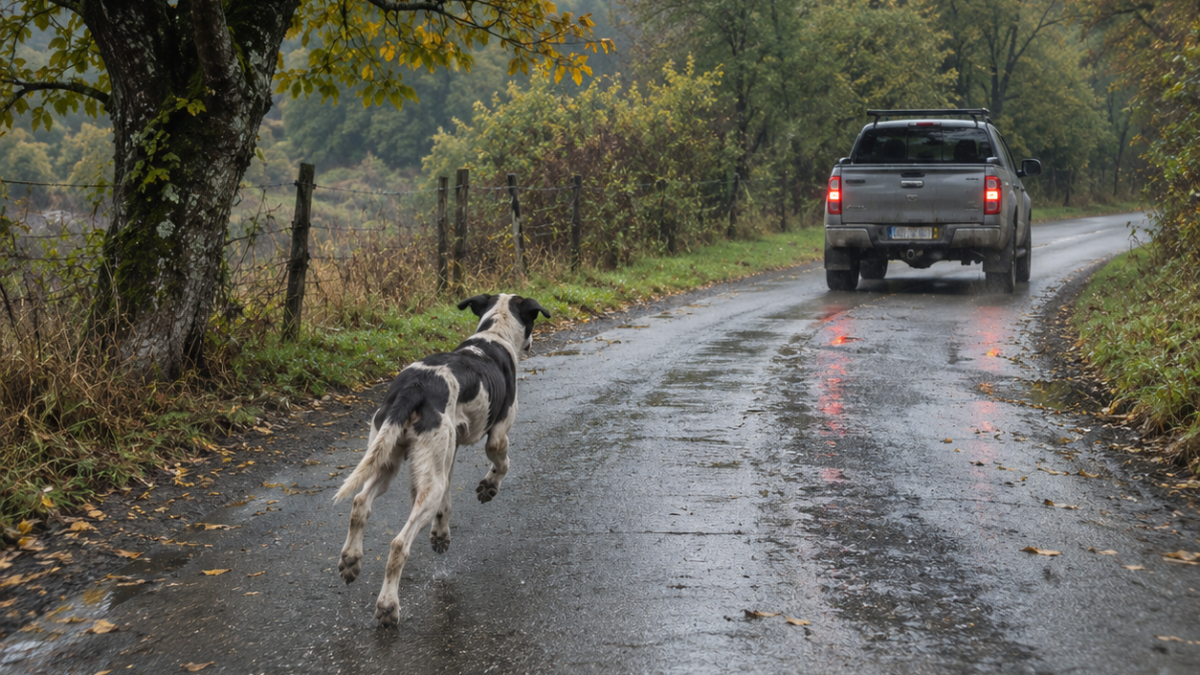
The dog running after it.
The way he kept returning to the same patch of gravel.
“Where exactly are you?” Mathieu asked.
I gave him the road and the nearest farm lane.
“I’m already on another call,” he said. “I can get there, but it won’t be immediate.”
“I’m afraid he’s going to get hit.”
“Is he letting you approach?”
“No. If I get close, he runs away.”
“Then please don’t chase him.”
“I can’t just leave him.”
“I’m not asking you to leave.”
His voice softened.
“I’m asking you not to frighten him away.”
I looked at the brown dog.
He was still staring around the bend.
Mathieu continued.
“Dogs that have just been abandoned sometimes return to the last place they saw their owner. They can stay there for hours. Sometimes days.”
“Days?”
“Yes.”
My heart sank.
“What do I do?”
“If you can stay, sit at a distance. Don’t stare at him. Don’t try to grab him. Let him decide you’re safe.”
I checked the time.
11:05.
Michel would be wondering where I was.
I called him.
“I’m going to be late.”
“Car trouble?”
“No.”
Silence.
Then I said, “There’s a dog.”
The silence became longer.
“Jeanne.”
“I know.”
“You promised yourself.”
“I’m not adopting him.”
I looked toward the dog.
“I’m waiting until someone comes.”
“What happened?”
I explained.
The pickup.
The chase.
The waiting.
Michel sighed.
Not an angry sigh.
The kind that meant he already knew exactly what I was going to do.
“You have your sandwich?”
“Yes.”
“Water?”
“Yes.”
“And that ridiculous folding chair is still in the trunk?”
I smiled.
“Yes.”
“Then sit down. Your knees will punish both of us tonight if you stand for three hours.”
“I’m not staying three hours.”
I heard him laugh softly.
“Of course not.”
Before hanging up, he said, “Be careful.”
I took the old folding chair from the trunk and set it in the grass several yards from the road.
Praline’s red leash rested across my knees.
The dog glanced at me once.
Then an engine sounded in the distance.
He shot to his feet.
A white van appeared.
His whole body leaned forward.
Hope.
Pure, immediate hope.
The van drove past.
His tail dropped.
He returned to the gravel.
I opened my sandwich.
Cheese.
Nothing special.
I tore off a piece of bread and placed it in the grass.
The dog looked at it.
Then the bend.
Then me.
I looked away.
A few minutes later, I heard soft footsteps.
He took the bread.
Then hurried back to his place.
I put another piece down.
Closer this time.
He returned sooner.
Every bite seemed to compete with the road for his attention.
Eat.
Look up.
Listen.
Wait.
Another vehicle.
Stand.
Hope.
Disappointment.
Sit again.
It happened over and over.
A woman driving past eventually stopped and rolled down her window.
“Are you all right?”
“Yes.”
I pointed toward the dog.
“He’s waiting for someone.”
“Is he yours?”
“No.”
She looked at him.
Then at me.
“Do you need water?”
“That would help.”
She handed me a bottle.
I thanked her and poured some into a plastic food container I kept in the car.
The dog drank for a long time.
Then returned to the bend.
No matter what I offered him, the road mattered more.
By noon, my knees hurt even though I was sitting.
The sun warmed the gravel.
Once, I stood only to move my chair a few inches into the shade.
The dog immediately backed away.
“Sorry.”
I lowered myself again.
“I’m not moving.”
I spoke to him occasionally.
“You must be hungry.”
“You can come closer.”
“Nobody here is going to hurt you.”
And each time an engine appeared, I found myself saying the same thing.
“No, sweetheart.”
Another car.
His body stiffened.
“Not that one.”
A tractor.
He stood.
“No.”
A delivery van.
“No.”
He lay down eventually, head resting on his front paws.
For a moment, I thought he might sleep.
Then a distant engine growled.
He was standing before I even saw the vehicle.
Still hoping.
Still believing.
I thought about Praline.
About the day I sat beside her and whispered, “You can stop now.”
She had looked at me as though she understood.
I had given her permission to rest.
Now I was sitting beside another dog who seemed to need a different kind of permission.
Permission to stop waiting.
But I could not give it to him.
Not yet.
At 1:20, Michel called again.
“You’re still there.”
“Yes.”
“The officer?”
“Not yet.”
“And the dog?”
I looked down.
For the first time, the brown dog was watching me instead of the road.
“He’s still here.”
Michel was quiet.
Then he asked, “Do you want me to bring you something?”
“No.”
“Jeanne.”
“What?”
“Do not stand around on those knees.”
I laughed.
“I’m sitting.”
“Of course you are. You’ve had that chair in your trunk since the grandchildren were little.”
When the call ended, I noticed movement.
The dog had left the gravel.
Not running toward food.
Not returning to the road.
Coming toward me.
Slowly.
His nose stayed close to the ground.
He stopped about three feet away.
I held my breath.
His eyes moved toward my hand.
Then toward the red leash on my lap.
I did nothing.
One more step.
Then another.
He lowered himself beside my chair.
And placed his head on my shoe.
I felt the weight of him.
Warm.
Exhausted.
Real.
My hand almost moved automatically.
I wanted to stroke his head.
But I was afraid that if I touched him too soon, the moment would shatter.
So I sat perfectly still.
“That’s good,” I whispered.
His eyes closed.
A minute passed.
Then another.
For the first time since the pickup disappeared, he stopped watching the road.
When Mathieu finally arrived, I was still sitting in exactly the same position.
He parked farther away and approached slowly.
The dog lifted his head.
He did not run.
Mathieu crouched.
“Hello, buddy.”
The dog looked at him.
Then back at me.
Mathieu managed to slip a rescue lead around his neck without resistance.
He checked the injured paw.
“Pads are scraped.”
“He ran after the truck.”
“How far?”
“I don’t know. Far enough.”
“He’s thin too.”
“I noticed.”
There was no collar.
Later, scanning would reveal no microchip either.
Mathieu looked at me.
“You definitely saw him come out of the pickup?”
“Yes.”
“Could he have jumped out by himself?”
“I couldn’t tell whether he jumped or someone pushed him.”
“But the truck drove away?”
“Yes.”
“Did the driver stop when the dog chased?”
“No.”
I felt anger returning as I remembered.
“I honked twice.”
Mathieu pulled out a small notebook.
“Vehicle?”
“Gray pickup. Large.”
“Driver?”
“I couldn’t see clearly.”
“License plate?”
My stomach dropped.
“No.”
He nodded slowly.
“That makes it difficult.”
I looked at the dog.
He was sitting beside my chair now.
Mathieu continued.
“Without a plate or another witness, it may be very hard to identify whoever was driving.”
Then I looked toward my car.
Something behind the windshield caught the light.
A tiny black box.
For several seconds, my brain refused to understand what I was seeing.
Then I remembered.
Lucas.
My grandson.
Three months earlier, Lucas had insisted on installing a dash camera in my car.
“For insurance, Grandma.”
“I’ve driven longer than you’ve been alive.”
“That doesn’t mean everyone else knows how to drive.”
I had rolled my eyes.
But I let him install it.
And then I forgot about it.
Until that moment.
I stood so quickly that the dog lifted his head.
Mathieu looked alarmed.
“Madame Perrin?”
I pointed at the windshield.
“Wait.”
“What?”
I could feel my heart beginning to pound.
“I think someone else saw what happened.”
I opened my car door.
The little camera was still there.
A tiny red light blinked.
Recording.
Mathieu stepped beside me.
“Dashcam?”
“My grandson installed it.”
“When?”
“Months ago.”
“Does it record continuously?”
“I have no idea.”
I pulled out my phone.
“Lucas does.”
My grandson answered on the third ring.
“Grandma?”
“Lucas, I need you.”
His voice changed immediately.
“What happened?”
“Your camera.”
“My camera?”
“The one in my car.”
“Yes?”
“Does it save footage?”
“Of course.”
“How much?”
“Depends. Why?”
I looked at Mathieu.
Then at the dog.
“Because I think it recorded someone abandoning a dog.”
Lucas stopped talking.
“What?”
I told him what happened.
By the end, he sounded angrier than I felt.
“Don’t touch anything.”
“I wasn’t planning to perform surgery on it.”
“I mean don’t turn it off, don’t pull the card, nothing. I’m coming.”
“You’re working.”
“I’m coming.”
“Lucas—”
“Grandma.”
His tone sounded exactly like Michel’s.
“Stay there.”
Forty minutes later, Lucas arrived with a laptop.
By then, Mathieu had arranged to have the dog transported for a veterinary examination, but because the animal had finally settled beside me, he did not want to force the departure until we had checked the footage.
Lucas removed the memory card.
We sat inside my car.
My hands were shaking.
“You okay?” he asked.
“Just find it.”
He opened the files.
Dozens.
Roads.
Cars.
Trees.
The ordinary record of places I had forgotten five minutes after driving through them.
Then Lucas found the timestamp.
10:32.
He clicked.
My windshield filled the screen.
The gray pickup was directly ahead.
My breath stopped.
“There.”
Lucas leaned closer.
The video showed the truck slowing.
The door opening.
The dog appearing.
Then the dog hit the road.
From the camera angle, we still could not see clearly whether he had jumped or been pushed.
But everything after that was unmistakable.
The pickup accelerated.
The dog chased.
My horn sounded.
Once.
Twice.
The truck continued.
Then came the bend.
For one second, the rear of the pickup filled enough of the frame that the license plate was visible.
Lucas froze the video.
Mathieu leaned forward.
“Can you enlarge that?”
Lucas did.
The image became grainier.
But the plate remained readable.
Not perfect.
Readable.
Mathieu exhaled slowly.
“Well.”
I looked at him.
“Well what?”
“Now we have somewhere to start.”
I stared at the frozen image.
The back of the gray pickup.
The plate.
The dog’s head just visible at the bottom of the screen.
Something inside me changed.
For three hours, I had felt helpless.
I had watched that animal wait for a person who had chosen not to return.
Now, for the first time, the road was pointing in the other direction.
Back toward the person who had left him there.
Mathieu copied the footage.
“Do not post this online.”
“I wasn’t going to.”
“Good.”
“What happens now?”
“We identify the registered owner. We ask questions. We preserve the video.”
“And the dog?”
“He goes to the veterinarian, then into protective care.”
The dog.
I looked toward him.
He was lying beside the grass now, the red rescue lead loose between Mathieu’s hands.
“What happens after that?”
“If no lawful owner claims him, and depending on the investigation, he can eventually be made available for adoption.”
Adoption.
I looked away.
Lucas saw my face.
“Oh no.”
“What?”
“You’re thinking.”
“I am always thinking.”
“You’re thinking about the dog.”
“I am thinking about what happens to him.”
“Grandma.”
“I’m not adopting him.”
“You said that way too fast.”
“I’m seventy-seven.”
“So?”
“So I already explained this after Praline.”
Lucas’s expression softened.
“I know.”
The dog lifted his head when I spoke Praline’s name.
My eyes dropped to the red leash on my chair.
I had brought it out that morning without thinking.
Or maybe some part of me had thought after all.
The veterinarian called later that afternoon.
I had given Mathieu my number and asked him to keep me informed.
The dog was underweight, mildly dehydrated, and exhausted. His paw pads were abraded from the run, but there were no fractures. No serious internal injuries. He was estimated to be somewhere between three and five years old.
Young.
Much younger than Praline had been.
That detail should not have mattered.
It did.
“He ate?” I asked.
“A little,” Mathieu said.
“Good.”
“He’s very subdued.”
“Meaning?”
“He keeps going to the kennel door every time he hears a vehicle outside.”
I closed my eyes.
Still waiting.
That evening, I put the apple tart on the table.
Michel looked at it.
Then at me.
“You remembered.”
“I always remember your tart.”
“You forgot lunch.”
“I ate some.”
“You fed half of it to the dog.”
I stared at him.
“How do you know?”
“I’ve been married to you forty-eight years.”
I sat down.
Michel poured tea.
For a while, neither of us spoke.
Then he asked, “How bad?”
“Not terrible medically.”
“That isn’t what I meant.”
I understood.
“He waited three hours.”
Michel looked down at his cup.
“I know.”
“No, Michel. He actually waited. Every car.”
I could feel my throat tightening.
“Every engine. He stood up because he thought that truck was coming back.”
Michel reached across the table and put his hand over mine.
“I’m sorry.”
“I hate whoever did it.”
“I know.”
“The camera got the plate.”
His eyebrows rose.
“Lucas’s camera?”
“Yes.”
“That boy will be unbearable.”
I almost smiled.
“He already is.”
Michel squeezed my fingers.
“What will happen to the dog?”
“I don’t know.”
There it was again.
The question.
Not what happens to the driver.
What happens to the dog?
That night, I dreamed about Praline.
She was sitting in the passenger seat of the old bibliobus.
Young again.
Her ears flopping.
The red leash hanging beside her.
When I woke, I could not remember anything else about the dream.
Only the leash.
Two days later, Mathieu called.
“We identified the registered owner of the pickup.”
I sat straighter.
“And?”
“He’s been contacted.”
“What did he say?”
A pause.
“He claims the dog got out accidentally.”
I laughed.
Not because it was funny.
“He drove away.”
“We know.”
“I honked.”
“We know.”
“He was running behind the truck.”
“We have the footage.”
“So how can he say it was an accident?”
“People can say many things.”
I gripped the phone.
“Did he ask if the dog was alive?”
Mathieu went quiet.
That answer was worse than anything he could have said.
“He didn’t, did he?”
“No.”
I closed my eyes.
“What did he ask?”
“He asked where the dog was.”
My stomach tightened.
“Why?”
“He says the dog is his property.”
I stood.
“What?”
“Jeanne, calm down.”
“No. He left him on the road.”
“The investigation is ongoing. The dog is not being returned while this is being reviewed.”
“But he wants him back?”
“He wants control of the situation back.”
That sentence stayed with me.
Control.
Perhaps that was what cruelty often became when someone was finally confronted.
Not regret.
Not sorrow.
Control.
“What’s the dog’s name?” I asked suddenly.
Mathieu hesitated.
“The man says it’s Milo.”
Milo.
I repeated it softly.
“Milo.”
Across the kitchen, Michel looked up from his newspaper.
“His name?”
I nodded.
Milo.
For three hours, I had called him sweetheart, buddy, poor boy.
Now he had a name.
That somehow made what happened worse.
You abandon a stray, and your mind can pretend there is no history.
But Milo had a name.
He had lived in a house.
He knew the sound of that pickup.
He knew the person who drove it.
That was why he ran.
That was why he waited.
The next day, I went to see him.
I told Michel I was only checking on him.
He said nothing.
That should have warned me.
Mathieu met me outside the animal facility.
“You don’t have to do this.”
“I know.”
“He’s safe.”
“I know.”
“Then why are you here?”
I looked at him.
“You have children?”
“Two.”
“If you found a child crying beside a road and stayed with him for three hours, would you never ask what happened afterward?”
Mathieu smiled.
“Come in.”
Milo was in a quiet kennel at the end of the corridor.
He was lying on a blanket.
The moment he heard my footsteps, his head lifted.
I stopped outside the gate.
“Milo?”
His ears rose.
I crouched.
“It’s me.”
For half a second, nothing happened.
Then he stood.
He came toward the gate.
Not cautiously.
Not like before.
Directly.
I put my fingers through the bars.
Milo pressed his forehead against them.
My eyes filled instantly.
“You remember me.”
His tail moved once.
Then again.
Mathieu stood behind me.
“He’s been reserved with everyone.”
I scratched beneath Milo’s chin.
“He doesn’t know me.”
“I think he does.”
Mathieu opened the kennel.
Milo walked straight to me.
Then sat on my shoes.
Exactly like the roadside.
I laughed through my tears.
“You really have one trick, don’t you?”
He leaned against my knees.
I stroked his head.
This time, I did not stop myself.
His fur was soft.
Much softer than Praline’s had been.
That thought brought guilt so quickly that I withdrew my hand.
Milo looked up.
Mathieu noticed.
“What happened?”
“Nothing.”
“That looked like something.”
I stared at Milo.
“I promised her.”
“Who?”
“My dog.”
I explained Praline.
Fifteen years.
The veterinary clinic.
My promise.
No more dogs.
Mathieu listened quietly.
Then he said, “Promises made in grief are strange things.”
I looked at him.
“What does that mean?”
“It means sometimes we promise never to hurt again when what we really mean is we’re afraid to love again.”
“I’m not afraid.”
He raised one eyebrow.
“I’m seventy-seven.”
“That wasn’t the question.”
I disliked him for about ten seconds.
Then Milo pushed his nose beneath my hand.
I sighed.
“You’re both annoying.”
Mathieu smiled.
The investigation moved quickly after that because of the video.
I was asked to give a formal statement.
So was Lucas, regarding the camera and the original file.
The footage was copied and preserved.
The registered owner of the pickup changed his story.
First, Milo had jumped out.
Then he claimed he had stopped to let Milo out briefly because the dog had been sick.
Then he said he panicked when Milo ran.
The video did not support any of it.
Why did you accelerate?
Why did you fail to stop after the witness honked?
Why did you continue when the dog was visibly chasing you?
Why did you not report him missing?
Why did you not call shelters or veterinarians?
Why did you not ask whether he was injured when authorities contacted you?
Each question made the story smaller.
Less room to hide.
A week after the roadside incident, I received a call from Mathieu.
“The owner wants to speak with you.”
“No.”
“That’s what I told him.”
“What does he want?”
“To explain.”
“I watched his explanation drive around a bend.”
“Jeanne.”
“What?”
“You’re enjoying being angry.”
I sat down.
“No, I’m not.”
“Yes, you are.”
I hated that he was partly right.
Anger felt easier than sadness.
Anger was clean.
Sadness was not.
“What happens now?”
“The case is being forwarded.”
“And Milo?”
“Still under protective hold.”
“Can I visit?”
Mathieu laughed.
“You were going to anyway.”
I visited Milo every other day.
Then every day.
I told Michel it was temporary.
He continued saying nothing.
The silence became suspicious.
One Saturday, Michel came with me.
“You don’t have to.”
“I know.”
“You don’t even like shelters.”
“I don’t like hospitals either. I still visit people.”
When Milo saw me, he came forward.
Then he noticed Michel.
He stopped.
Michel crouched slowly.
“Hello.”
Milo looked at me.
Then back at Michel.
My husband extended one hand.
“Apparently you have caused trouble in my marriage.”
“Michel.”
“What? He should know.”
Milo sniffed his fingers.
Then stepped closer.
Michel stroked his chest.
Milo’s tail wagged.
My husband looked at me.
“Oh, this is bad.”
“What?”
“He’s charming.”
“I told you.”
“You did not tell me.”
“I said he was sweet.”
“You said he was thin and traumatized.”
“He can be several things.”
Michel scratched Milo’s ears.
For almost ten minutes, the two ignored me.
On the drive home, Michel finally said, “He needs a quiet house.”
“Yes.”
“A garden would be good.”
“Yes.”
“Someone retired.”
I turned toward him.
“Do not.”
“I’m just describing ideal conditions.”
“You are describing us.”
“Coincidence.”
“We said no more dogs.”
“You said no more dogs.”
“You agreed.”
“I agreed not to argue while you were grieving.”
I stared ahead.
“You are impossible.”
“Yes.”
We drove another mile.
Then Michel said, “You’re not afraid you’ll lose another dog.”
I said nothing.
“You’re afraid the dog will lose you.”
My hands tightened around the steering wheel.
“That’s different.”
“Yes.”
“I could die before him.”
“So could a forty-year-old.”
“That isn’t helpful.”
“It’s true.”
“I’m seventy-seven.”
“I’ve noticed.”
I glared at him.
He smiled.
“You have a husband, children, grandchildren. We can make a plan.”
“A plan?”
“If something happens to us, someone takes him.”
“Who?”
Michel looked at me.
“You know exactly who.”
Lucas.
I said nothing.
That evening, Lucas came for dinner.
Michel had called him without telling me.
Traitor.
After dessert, Michel cleared his throat.
“Your grandmother has a question.”
“I do not.”
Lucas looked between us.
“Should I be worried?”
Michel said, “If your grandmother adopted Milo and something happened to us, would you take him?”
I nearly dropped my glass.
“Michel!”
Lucas did not even hesitate.
“Yes.”
I stared at him.
“You don’t know what you’re agreeing to.”
“I know exactly.”
“You work.”
“I also have a house.”
“You travel.”
“Not as much as you think.”
“You have no idea what his behavior will be like.”
“Grandma.”
“What?”
“I would take him.”
The room went quiet.
I looked at my grandson.
“You mean that?”
“Yes.”
“Even years from now?”
“Yes.”
“Put it in writing.”
He smiled.
“I knew you’d say that.”
From his bag, he took out a printed page.
Michel began laughing.
I looked at them both.
“You planned this.”
Lucas placed the page in front of me.
A simple agreement.
If Jeanne and Michel Perrin could no longer care for Milo, Lucas would assume responsibility for him.
I read it twice.
Then a third time.
“You are both manipulative.”
Michel kissed my cheek.
“You raised us well.”
“You are not related to me by blood.”
“Even more impressive.”
I wanted to be angry.
Instead, I cried.
Not dramatically.
Just enough that the words on the page blurred.
Seven months earlier, I had told myself the loving thing was never to adopt again.
Now the people I loved were showing me that loving an animal did not require pretending I controlled the future.
It required making sure he would not face it alone.
The legal process surrounding Milo took longer than my heart wanted.
He could not simply leave with us because the abandonment investigation had to be resolved.
Then something happened that turned my anger into something sharper.
The former owner came to the facility.
I was there.
I had just finished walking Milo around the enclosed yard when a gray pickup entered the parking area.
Milo saw it before I did.
His entire body changed.
He stopped.
The leash went tight.
His ears lifted.
For one second, I thought he was excited.
Then he started pulling.
Toward the truck.
My heart broke all over again.
Because even after everything, he knew it.
“Milo.”
He pulled harder.
The driver got out.
A man perhaps in his forties.
Jeans.
Dark jacket.
Nothing remarkable about him.
That bothered me.
Cruelty should look different.
It should announce itself.
It rarely does.
Milo whined.
The man looked toward us.
“There he is.”
I froze.
Mathieu came out of the building immediately.
“You were told not to come here without an appointment.”
“I have a right to see my dog.”
Milo strained forward.
The man slapped his thigh.
“Come on.”
I felt the leash move through my fingers.
Milo wanted to go to him.
Not because he had forgotten.
Not because abandonment had not hurt.
Because dogs do not organize love according to our sense of justice.
The man had once been his whole world.
Milo did not understand court files.
Evidence.
Betrayal.
He knew a voice.
A smell.
A truck.
And he wanted the person connected to them.
That was the hardest part.
I wanted Milo to hate him.
Milo didn’t.
Not then.
The man looked at me.
“You’re the woman with the camera.”
I tightened my grip.
“Yes.”
“You’ve made this into something it isn’t.”
“You left him.”
“He jumped.”
“You drove away.”
“I panicked.”
“For several kilometers?”
His jaw tightened.
“You don’t know the situation.”
“I know he ran after you until his paws bled.”
“You people always make animals into children.”
Mathieu stepped between us.
“That’s enough.”
The man pointed toward Milo.
“He’s mine.”
I felt something cold settle inside me.
Not rage this time.
Certainty.
“No.”
He looked at me.
“What?”
I did not raise my voice.
“A dog is not a piece of furniture you dump beside a road and demand back when someone notices.”
“Lady, stay out of it.”
“I tried.”
I looked down at Milo.
“For three hours.”
The man’s face hardened.
“You ruined my life with that video.”
The sentence shocked me.
Not because of the accusation.
Because of what was missing.
No mention of Milo.
Not his fear.
Not his bleeding paws.
Not his waiting.
His life.
His inconvenience.
His consequences.
I looked at him.
“No.”
He frowned.
“No what?”
“I didn’t ruin anything.”
I pointed toward the gray pickup.
“You made the decision before I ever turned on my camera.”
He laughed bitterly.
“So this is what you wanted?”
That question stayed suspended between us.
Mathieu started to intervene.
I stopped him with one hand.
I looked at the man.
“No.”
My voice shook, but I held his eyes.
“What I wanted was for you to turn around.”
He said nothing.
“I wanted you to stop when he chased you.”
Milo whined softly beside me.
“I wanted you to see him running in your mirror and decide you couldn’t do it.”
The man looked away.
“That is what I wanted.”
Silence.
“But you didn’t.”
Mathieu told him to leave.
He argued.
Another officer arrived.
The discussion became louder.
Milo began trembling.
That ended everything for me.
I crouched.
“Come on.”
Milo looked toward the man.
Then at me.
“Come with me.”
For several seconds, he stayed torn between us.
The past.
And whatever I was becoming.
Then Milo stepped toward me.
One step.
Two.
He pressed against my leg.
I almost stopped breathing.
Behind me, the former owner stopped talking.
I put my hand on Milo’s shoulder.
“That’s it.”
His body relaxed.
I led him inside.
I never looked back.
The case eventually reached its conclusion.
I will not pretend it became a grand courtroom spectacle.
Real justice rarely resembles television.
There were statements.
Paperwork.
Evidence.
Questions.
The original dashcam recording mattered because it showed the sequence clearly.
The pickup stopping.
Milo leaving the vehicle.
The truck accelerating.
Milo chasing.
My horn.
The failure to stop.
The plate.
The later explanations did not fit what had been recorded.
By the time the decision came, Milo’s former owner had lost any claim to take him back.
There were legal consequences for the abandonment, financial consequences connected to the case and Milo’s care, and restrictions imposed regarding future animal ownership.
When Mathieu called me with the final news, I sat down at my kitchen table.
“That’s it?” I asked.
“That’s it.”
“He can’t take Milo?”
“No.”
I closed my eyes.
For months, I had imagined I would feel triumphant.
I didn’t.
I felt tired.
Relieved.
Sad.
“What happens now?”
Mathieu laughed softly.
“You know exactly what happens now.”
The next morning, Michel and I drove to the shelter together.
The red leash was in my bag.
Praline’s leash.
I had cleaned the metal clip the night before.
Michel noticed but said nothing.
Mathieu met us at the entrance with adoption documents.
“You sure?”
“No.”
He smiled.
“Good answer.”
“I’m seventy-seven.”
“I’ve heard.”
“I have a backup plan.”
“I know. Lucas called.”
“Of course he did.”
“And Michel?”
I looked at my husband.
Michel shrugged.
“I’m mostly here for the paperwork.”
Milo entered the room with a volunteer.
He saw me.
His tail started moving.
Then faster.
He came directly toward us.
This time, when he placed his head against my shoe, I laughed.
“You really need a second move.”
I knelt.
I clipped Praline’s red leash to his collar.
My fingers shook.
For one second, grief hit me so hard I could barely breathe.
Praline had worn that leash for years.
Walks through our village.
Trips to the veterinarian.
The final ride.
I had thought using it for another dog would feel like betrayal.
It didn’t.
It felt like continuity.
Like something Praline had left behind finally had somewhere to go.
Michel rested his hand on my shoulder.
“You okay?”
I nodded.
“Milo.”
He looked up.
“Want to go home?”
His ears moved.
That word.
Home.
I did not know whether he understood it.
But when I opened the door, he followed.
The first weeks were not perfect.
I think people prefer transformation stories where a rescued animal immediately understands that everything is safe.
Milo did not.
For the first several nights, he slept near our front door.
Not on the bed we bought him.
Not near us.
At the door.
Ready.
Waiting.
Sometimes, when a truck passed outside, he stood.
He listened until the sound disappeared.
Then lay down again.
The first time it happened, I sat beside him.
“You don’t have to wait.”
He looked at the door.
I stroked his chest.
“He isn’t coming.”
Milo’s eyes moved toward me.
“And that’s all right.”
I did not know whether I was talking to him or myself.
Maybe both.
He also hated being left alone.
Even for minutes.
If I went upstairs and Michel stayed downstairs, Milo paced between the staircase and the kitchen.
If both of us stepped outside, he scratched at the door.
The first time I returned from the bakery and found him trembling, guilt crushed me.
“I’m sorry.”
Michel stopped me.
“No.”
“What?”
“Don’t apologize for leaving for fifteen minutes.”
“He thought—”
“I know what he thought.”
Michel crouched beside Milo.
“But he has to learn you come back.”
That became our work.
Leaving.
Returning.
Again.
Again.
Again.
At first, thirty seconds.
Then a minute.
Five.
Ten.
Every time I came back, Milo reacted as if I had returned from another country.
Tail.
Whining.
Whole body moving.
I kept my greetings calm.
“I came back.”
That was all.
The phrase became a ritual.
“I came back.”
When I went to the mailbox.
“I came back.”
When I visited a neighbor.
“I came back.”
When Michel and I went to the market together and Lucas stayed with him.
“I came back.”
Weeks passed.
Milo learned.
One afternoon, I returned after twenty minutes and found him asleep.
He lifted his head.
Looked at me.
Then put it back down.
I stared.
Michel laughed from behind me.
“Well, that’s gratitude.”
I crouched beside Milo.
“You didn’t think I disappeared?”
Tail thump.
That was it.
No panic.
No desperate rush.
I suddenly had tears in my eyes.
Michel noticed.
“Jeanne.”
“He knew.”
“Knew what?”
“That I would come back.”
Michel put his arm around me.
That was the first day I understood that trust does not always look like excitement.
Sometimes trust is sleeping because you know the door will open again.
Milo gained weight.
His ribs disappeared beneath healthy muscle.
His paw pads healed.
He discovered that Michel dropped pieces of toast if stared at long enough.
I repeatedly told both of them this behavior was unacceptable.
Neither listened.
He discovered the garden.
At first, he stayed close to the house.
Then the gate.
Then the apple tree.
One morning, I watched him run.
Not chasing a departing vehicle.
Just running.
Across grass.
For no reason except that his body could.
He made a wide circle around the garden.
Michel stood beside me.
“Look at him.”
I couldn’t answer.
The last time I had seen Milo run that fast, he had been chasing someone who did not want him.
Now nobody was leaving.
He came back because he wanted to.
Straight toward us.
He stopped beside Michel, tongue hanging out.
I laughed.
“There.”
Michel scratched his neck.
“That’s better.”
My biggest fear had been age.
It did not disappear because we signed adoption papers.
Every birthday reminded me.
Every ache in my knees.
Every doctor appointment.
Sometimes I looked at Milo, young and strong, and wondered if I had made a selfish decision.
Then Lucas would visit.
Milo adored him.
They walked together.
Played.
Sometimes Lucas took him home for a weekend so that Milo learned another safe place.
That mattered to me.
One Sunday afternoon, I watched them leave together.
Milo climbed into Lucas’s car.
I expected him to resist.
He didn’t.
Lucas opened the back door.
“Come on, buddy.”
Milo got inside.
The car drove away.
I stood in the driveway feeling strangely empty.
Michel joined me.
“You all right?”
“No.”
“He’ll be back tomorrow.”
“I know.”
Michel smiled.
“Now who’s waiting?”
I looked at him.
“That was cruel.”
“Accurate.”
The next afternoon, Lucas returned.
Milo jumped out.
Ran toward me.
I knelt awkwardly despite my knees.
He pushed his entire body against me.
“I came back,” I whispered.
Then I laughed.
“No. You came back.”
That was when I realized we had both changed.
Milo had learned that people could leave and return.
I had learned the same thing in another way.
Loving someone does not become pointless because one day you will lose them.
Praline’s death had convinced me that love ended in an empty collar.
Milo taught me that sometimes one love prepares you for another.
Not as a replacement.
Never that.
Praline had not disappeared because Milo slept in our kitchen.
Her photographs remained.
Her little ceramic paw print remained on the shelf.
I still thought about her.
Sometimes I told Milo stories about her.
“You would have annoyed her.”
Milo stared.
“She was very dignified.”
Tail wag.
“You have no dignity.”
He rolled onto his back.
“Exactly.”
Months after Milo came home, I had to drive the road again.
The same road.
The same bend.
I almost chose another route.
Michel noticed.
“You can go around.”
“That adds fifteen minutes.”
“So?”
I looked toward the back seat.
Milo was there.
We had been taking him on short drives to help him become comfortable in cars again.
He still became alert whenever we slowed unexpectedly.
But he no longer trembled.
I tightened my hands on the wheel.
“No.”
“What?”
“We’re taking this road.”
Michel said nothing.
As we approached the farm lane, my heart began racing.
I could see the gravel.
The grass.
The place where my chair had sat.
Milo stood in the back seat.
His nose lifted.
I checked the mirror.
Did he recognize it?
I slowed.
The spot came closer.
I remembered the pickup door.
Milo running.
His paws slipping.
His body sitting absolutely still.
Waiting.
We passed the gravel.
Milo looked out the window.
My throat tightened.
Then he turned away.
He lowered himself onto the seat.
And put his head down.
That was all.
He did not stand.
Did not stare behind us.
Did not whine.
The bend disappeared.
Milo stayed down.
Michel looked at me.
I could barely see through my tears.
“He didn’t wait.”
Michel took my hand briefly.
“No.”
I laughed while crying.
“He didn’t even look back.”
Behind us, Milo sighed.
A normal dog sigh.
Impatient.
Comfortable.
Bored.
Perfect.
For months, people had spoken about justice.
The footage.
The investigation.
The former owner.
The legal consequences.
And those things mattered.
They mattered because abandoning an animal should not disappear just because nobody expects to be seen.
The camera mattered.
Lucas mattered.
Mathieu mattered.
Evidence mattered.
But sitting in that car, driving past the exact place where Milo once waited for someone who would never return, I realized the justice I wanted most had nothing to do with punishment.
Milo had stopped waiting.
That was it.
The person who abandoned him had once occupied his entire world.
One engine sound could make him stand.
One familiar truck could make him forget his pain and run.
One human choice had left him sitting beside a road for hours.
Now that person no longer owned that part of him.
Milo’s world had become bigger.
Michel.
Lucas.
Our kitchen.
The garden.
His bed near the radiator.
The baker who kept a dog biscuit beneath the counter.
The neighbor’s grandchildren.
The apple tree.
Sunday walks.
My ridiculous folding chair, which Milo eventually claimed for himself whenever I opened it in the garden.
Life had pushed that gray pickup farther and farther toward the edge of his memory.
That felt like revenge.
Not vengeance.
Not suffering.
Freedom.
One evening, nearly a year after I found him, Michel and I sat outside.
Milo lay between us.
The sunset made the fields gold.
I had Praline’s old leash looped around my wrist.
It was Milo’s now.
The red fabric had faded.
The silver clip was scratched.
Michel looked at it.
“You know what I think?”
“That is always dangerous.”
“I think Praline would approve.”
I looked down.
Milo was asleep.
“I used to worry adopting him meant I was moving on from her.”
Michel shook his head.
“You did move on.”
I looked at him.
“That sounds terrible.”
“It shouldn’t.”
He squeezed my hand.
“Moving on doesn’t mean leaving someone behind.”
I thought about Milo waiting beside that road.
Perhaps nobody understood the difference better than he did.
Leaving behind and moving forward were not the same thing.
One is done to you.
The other is something you eventually choose.
The man in the pickup had left Milo behind.
Milo had eventually moved forward.
So had I.
A few weeks later, Mathieu visited us.
He had not seen Milo since the adoption.
When Milo heard his vehicle, he barked.
A proper bark.
Not frightened.
Just announcing company.
Mathieu entered the garden.
Milo ran over.
Mathieu laughed.
“That can’t be the same dog.”
“Oh, it is.”
“He’s twice the size.”
“He discovered Michel.”
“That explains it.”
Michel looked offended.
“I feed him responsibly.”
I stared at him.
“Toast is not responsible.”
Milo sat beside Mathieu.
The officer scratched his chest.
“You remember me?”
Milo licked his hand.
Mathieu looked toward the folding chair.
“You really stayed out there for three hours?”
“I had no choice.”
“You had plenty of choices.”
I thought about it.
He was right.
I could have driven home.
I could have decided someone else would help.
I could have called and continued.
Instead, I stayed.
Not because I was heroic.
Because I understood waiting.
After Praline died, some part of me had also been sitting beside an empty road.
I had believed the life I had with a dog was over.
I was waiting for grief to become something else without moving toward anything new.
Then Milo appeared.
He needed someone to sit beside him long enough for him to stop watching the bend.
Maybe I needed the same thing.
Mathieu stood to leave.
Before he reached his vehicle, he turned.
“Oh, one more thing.”
“What?”
“The dashcam.”
“Yes?”
“Still working?”
I laughed.
“Lucas upgraded it.”
“Of course he did.”
“Front and rear now.”
Mathieu grinned.
“Good.”
After he left, I looked toward my car.
That tiny camera had changed everything.
Not because technology saved Milo.
It didn’t.
A camera cannot comfort a frightened dog.
It cannot offer water.
It cannot sit beside a road.
It cannot teach someone to trust again.
But it can remember when people hope nobody is watching.
That morning, I had been too shocked to memorize the license plate.
The camera had not been.
There was something satisfying about that.
The person driving the pickup believed the road was empty enough to hide what he was doing.
He was wrong.
The camera saw.
I saw.
And eventually, everyone who needed to see it saw too.
But when people later asked me which part of the story mattered most, I rarely mentioned the camera first.
I talked about Milo’s head on my shoe.
Because that was the moment everything changed for me.
He had spent hours waiting for the person who left him.
Then, for a few minutes, he chose to rest beside someone else.
Trust did not arrive all at once.
It began with the weight of a tired dog’s head against an old woman’s shoe.
I was seventy-seven.
I had sworn I would never adopt another dog.
I had reasons.
Good ones.
Fear can sound very reasonable when you give it enough words.
I might die first.
I might become ill.
I might not be able to walk him one day.
He might suffer.
All possible.
All true.
But there was another truth.
On that September morning, Milo had no idea what tomorrow would bring either.
He trusted me anyway.
Maybe love had always been that.
Not certainty.
A decision made without certainty.
Years later—if I am lucky enough to have years—I know one day Milo may have to live with Lucas.
That possibility no longer terrifies me the same way.
He knows Lucas.
He knows his house.
He knows there are several places in this world where he is wanted.
That was what I really needed to give him.
Not a guarantee that nobody would ever leave.
No one can promise that.
I needed to teach him that being left once did not mean he would always be alone.
And Milo taught me the same lesson.
There is one photograph I keep near Praline’s.
Lucas took it the first winter after Milo arrived.
I am sitting in the kitchen.
Milo’s head is on my lap.
Michel is pouring coffee.
Morning light is coming through the window.
Nothing dramatic.
Nobody who saw the photograph without context would understand why I treasure it.
But I do.
Because Milo is asleep.
Deeply asleep.
While Michel moves behind him.
While I drink coffee.
While cars pass outside.
He is not listening for an engine.
Not watching a door.
Not waiting for someone to return.
He is simply home.
Sometimes I look at that photograph and think about the gray pickup.
I wonder what would have happened if I had taken another road.
What if I had stayed at the market ten minutes longer?
What if the apple seller had had a longer line?
What if I had decided not to buy Michel that ridiculous slice of tart?
What if Lucas had never installed the camera?
Life can turn on embarrassingly small things.
But I try not to live inside those questions.
Milo taught me something about that too.
For three hours, he looked backward.
Then eventually he put his head on my shoe.
A small movement.
But it changed the direction of his life.
Perhaps all of us have moments like that.
We cannot change the vehicle disappearing around the bend.
We cannot always force someone to return.
We cannot erase the choice they made.
But eventually, if we are fortunate, we can turn our head.
And discover someone stayed.
That is the part I remember.
Not the man who drove away.
The people who stayed.
Mathieu came.
Lucas preserved the video.
Michel opened our home.
The veterinarian cared for Milo’s paws.
Neighbors stopped with water.
A stranger beside the road asked whether I needed help.
So many people stayed in small ways.
One person abandoned him.
Many others answered.
Cruelty can be dramatic.
Kindness is often repetitive.
A bowl filled every day.
A door opening again.
A walk every morning.
A hand reaching down without hurting.
A person returning after saying, “I’ll be back.”
That repetition rebuilt Milo more effectively than anger ever could.
The former owner eventually became a story I told less and less.
The court decision went into a drawer with the other papers.
The dashcam footage remained stored because Lucas insisted on keeping multiple copies.
But Milo did not need either.
He needed breakfast.
He needed walks.
He needed his bed.
He needed Michel to stop pretending toast fell accidentally.
He needed me.
And I needed him.
One autumn morning, almost exactly a year after I found him, I went back to the market.
Apples.
Bread.
Vegetables.
And yes, apple tart for Michel.
Milo rode in the back.
I took the same road home.
When we approached the bend, I did not slow.
I did not need to.
Milo was asleep.
Completely asleep.
His head bounced gently with the road.
We passed the farm lane.
The gravel.
The spot where a gray pickup had stopped.
The place where he had once sat believing patience would make someone love him again.
Milo never opened his eyes.
I smiled.
“Good boy.”
He slept on.
When I reached home, Michel came outside.
Milo woke immediately and jumped from the car.
He ran toward him.
Michel opened his arms.
“There’s my starving dog.”
“He ate breakfast.”
“He may be starving emotionally.”
“You are both ridiculous.”
Milo came back to me.
I clipped the red leash on.
For a moment, I looked at it.
Praline’s leash.
Milo’s leash.
My promise.
My broken promise.
Maybe some promises deserve to be broken.
I had said I would never adopt another dog because I believed loving again would betray the one I had lost.
I know better now.
Praline taught me how much a dog could become part of a life.
Milo taught me that grief does not have to be the final proof that love existed.
Sometimes the proof is what love makes you capable of doing next.
I bent down.
Milo licked my cheek.
“Disgusting.”
Tail wag.
Michel laughed.
We went inside.
Years of driving the bibliobus had taught me that every road eventually led somewhere.
Some to tiny villages.
Some to empty farms.
Some to houses where an elderly woman waited all week for a new novel.
But at seventy-seven, Milo taught me something those thirty years had not.
Sometimes the road is not taking you somewhere.
Sometimes it is placing someone in front of you and asking whether you will stop.
That September morning, one person made a choice.
He opened a truck door.
He drove away.
Milo ran after him.
Then another person made a choice.
I pulled over.
I stayed.
For a long time, I thought the dramatic part of the story was the camera.
The license plate.
The evidence.
The confrontation.
The consequences.
Maybe those things make a better story.
But they are not the part that matters most to me.
The part that matters happened before any of that.
A frightened dog stopped watching the bend.
He walked toward an old woman sitting in a folding chair.
He lay down.
And he put his head on her shoe.
He did not know I had promised never to love another dog.
I did not know he had already spent more loyalty on someone than that person deserved.
Neither of us knew what would happen next.
But for a few quiet minutes on the side of a country road, we stopped waiting for the people we had lost.
And we stayed with each other.
That was where our story really began.
The pickup driver thought he had left Milo behind.
He was wrong.
Milo was the one who eventually learned how to leave the past behind.
The man who abandoned him faced consequences.
The camera made sure the truth followed him.
But the greatest justice did not happen in an office, an investigation, or a courtroom.
It happened in our kitchen.
In our garden.
On the road a year later.
It happened every time Milo heard an engine and did not run toward it.
Every time I left the house and he trusted me to return.
Every night he slept without watching the door.
Every morning he woke up knowing where his next meal would come from.
And especially the day we passed that bend and he did not even lift his head.
That was the moment the man in the gray pickup truly lost him.
Not when he opened the door.
Not when the authorities took the case.
Not when his ownership ended.
He lost Milo when Milo stopped waiting.
And Milo?
Milo finally found the one thing he had been sitting beside that road hoping would return.
A home.
It just arrived in a different car.








